Computer Organization & Assembly Language
Muhammad Zohaib Aslam - CS211019
VON NEUMANN VS.
HARVARD
ARCHITECTURE
Von Neumann Architecture:
Single memory for data and instructions.
Sequential execution.
Simple and cost-effective.
Harvard Architecture:
Separate memory for data and instructions.
Parallel execution.
Higher performance in specialized tasks.
INTRODUCTION TO
ARCHITECTURES
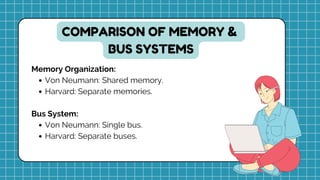
Memory Organization:
Von Neumann: Shared memory.
Harvard: Separate memories.
Bus System:
Von Neumann: Single bus.
Harvard: Separate buses.
COMPARISON OF MEMORY &
BUS SYSTEMS
Von Neumann:
Potential bottleneck due to shared bus.
Common in general-purpose computers.
Harvard:
Higher efficiency due to parallel access.
Used in embedded systems and DSPs.
PERFORMANCE AND
APPLICATION
Von Neumann Pros:
Simpler, cost-effective, flexible.
Von Neumann Cons:
Bottleneck, slower memory
access.
PROS AND CONS
PROS AND CONS
Harvard Pros:
Faster, specialized, reduced
bottlenecks.
Harvard Cons:
Complex, costly, less flexible.
Von Neumann: Simple, cost-effective, but can have
performance bottlenecks.
Harvard: High performance, efficient, but more
complex and costly.
Key Takeaway: Choice depends on the
application’s needs—flexibility vs. performance.
Final Thought: Understanding both is essential for
optimized system design.
CONCLUSION

Von Neumann vs. Harvard Architecture.pdf

  • 1.
    Computer Organization &Assembly Language Muhammad Zohaib Aslam - CS211019 VON NEUMANN VS. HARVARD ARCHITECTURE
  • 2.
    Von Neumann Architecture: Singlememory for data and instructions. Sequential execution. Simple and cost-effective. Harvard Architecture: Separate memory for data and instructions. Parallel execution. Higher performance in specialized tasks. INTRODUCTION TO ARCHITECTURES
  • 3.
    Memory Organization: Von Neumann:Shared memory. Harvard: Separate memories. Bus System: Von Neumann: Single bus. Harvard: Separate buses. COMPARISON OF MEMORY & BUS SYSTEMS
  • 4.
    Von Neumann: Potential bottleneckdue to shared bus. Common in general-purpose computers. Harvard: Higher efficiency due to parallel access. Used in embedded systems and DSPs. PERFORMANCE AND APPLICATION
  • 5.
    Von Neumann Pros: Simpler,cost-effective, flexible. Von Neumann Cons: Bottleneck, slower memory access. PROS AND CONS
  • 6.
    PROS AND CONS HarvardPros: Faster, specialized, reduced bottlenecks. Harvard Cons: Complex, costly, less flexible.
  • 7.
    Von Neumann: Simple,cost-effective, but can have performance bottlenecks. Harvard: High performance, efficient, but more complex and costly. Key Takeaway: Choice depends on the application’s needs—flexibility vs. performance. Final Thought: Understanding both is essential for optimized system design. CONCLUSION