International Journal of Technology (2011) 1: 47‐55 
ISSN 2086‐9614 

© IJTech 2011 

THE IMPACT OF RENEWABLE ENERGY ON EMPLOYMENT IN INDONESIA
Maria Elfani*
London Metropolitan University, Institute for the Study of European Transformations, Tower Building
1st Floor, 166-220 Holloway Road London N7 8DB, UK
(Received: November 2010 / Revised: December 2010 / Accepted: January 2011) 

ABSTRACT
A global demand for energy has forced many countries to search for alternative and renewable
energy. An anticipated effect of the development of renewable is an increase in employment as
part of new green jobs creation, a major benefit for Indonesia to cope with its high
unemployment rate. This paper describes the impact of renewable energy development on the
jobs creation in Indonesia. First, we identify current government policies relative to renewable
energy. Second, this paper describes the definition of green jobs and what type of jobs might be
created due to development of renewable energy. Third, companies in Indonesia currently
operating in the renewable energy sector are analyzed for their potential growth. Research is
based solely on secondary data analysis. Information publicly available from the
government/ministry website was used to examine policies concerning renewable energy.
Related journals and articles were used to explore plans for the creation of green jobs, and a
database search was conducted to identify companies currently operating in the renewable
energy sector. The Kammen et al. (2004) study of Jobs per Megawatt of Capacity identified that
the renewable energy installed capacity in 2007 created approximately 14,000 jobs in
Indonesia. The potential capacity of renewable energy will create 70,000-190,000 jobs in
Indonesia.
Keywords: Renewable energy; Employment; Indonesia
1. INTRODUCTION
Indonesia has launched the Law on Energy Number 30 year 2007 to regulate sources, purpose,
management of, and policies regarding energy use in Indonesia. Energy by its definition is an
ability to produce heat, light, mechanical, chemical and electromagnetic activity (Law of the
Republic of Indonesia, 2007). New energy may come from renewable and nonrenewable
sources, with renewable sources characterized as sustainable and ongoing, including geothermal
energy, wind, bio-energy, solar energy, water movement and oceans. Nonrenewable sources
cannot be sustained and will ultimately run out; they include oil, natural gas, coal and peat.
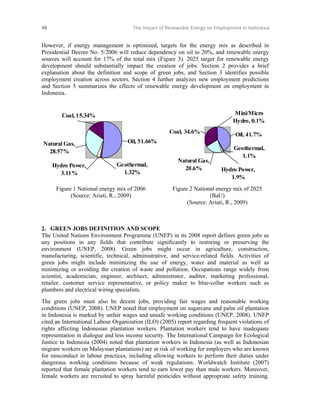
In the national energy mix as of 2006 (Figure 1), oil was the main source of energy (52%),
followed by natural gas at 29%, coal at 15%, hydro power at 3% and geothermal energy at 1%.
Assuming “business as usual” until 2025, the composition of the national energy mix (Figure 2)
presumes oil to maintain its position as the major energy source at 42%, followed by coal at
35%, natural gas at 21%, hydro power at 1.9%, geothermal energy at 1.1%, and mini/micro
hydro power at 0.1%.

*

Corresponding author’s email: mae0352@my.londonmet.ac.uk, Tel. +44 (0) 7879141656
48 

The Impact of Renewable Energy on Employment in Indonesia 


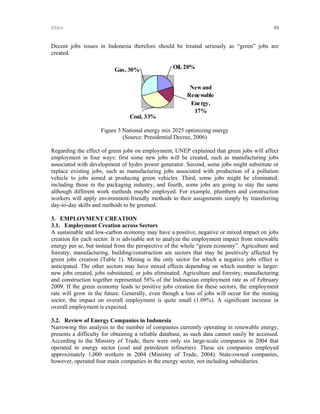
However, if energy management is optimized, targets for the energy mix as described in
Presidential Decree No. 5/2006 will reduce dependency on oil to 20%, and renewable energy
sources will account for 17% of the total mix (Figure 3). 2025 target for renewable energy
development should substantially impact the creation of jobs. Section 2 provides a brief
explanation about the definition and scope of green jobs, and Section 3 identifies possible
employment creation across sectors. Section 4 further analyzes new employment predictions
and Section 5 summarizes the effects of renewable energy development on employment in
Indonesia.

Mini/Micro
Hydro, 0.1%

Coal, 15.34%
Coal, 34.6%

Natural Gas,
28.57%
Hydro Power,
3.11%

Oil, 41.7%

Oil, 51.66%

Geothermal,
1.32%

Figure 1 National energy mix of 2006
(Source: Ariati, R., 2009)

Natural Gas,
20.6%

Geothermal,
1.1%
Hydro Power,
1.9%

Figure 2 National energy mix of 2025
(BaU)
(Source: Ariati, R., 2009)

2. GREEN JOBS DEFINITION AND SCOPE
The United Nations Environment Programme (UNEP) in its 2008 report defines green jobs as
any positions in any fields that contribute significantly to restoring or preserving the
environment (UNEP, 2008). Green jobs might occur in agriculture, construction,
manufacturing, scientific, technical, administrative, and service-related fields. Activities of
green jobs might include minimizing the use of energy, water and material as well as
minimizing or avoiding the creation of waste and pollution. Occupations range widely from
scientist, academician, engineer, architect, administrator, auditor, marketing professional,
retailer, customer service representative, or policy maker to blue-collar workers such as
plumbers and electrical wiring specialists.
The green jobs must also be decent jobs, providing fair wages and reasonable working
conditions (UNEP, 2008). UNEP noted that employment on sugarcane and palm oil plantation
in Indonesia is marked by unfair wages and unsafe working conditions (UNEP, 2008). UNEP
cited an International Labour Organization (ILO) (2005) report regarding frequent violations of
rights affecting Indonesian plantation workers. Plantation workers tend to have inadequate
representation in dialogue and less income security. The International Campaign for Ecological
Justice in Indonesia (2004) noted that plantation workers in Indonesia (as well as Indonesian
migrant workers on Malaysian plantations) are at risk of working for employers who are known
for misconduct in labour practices, including allowing workers to perform their duties under
dangerous working conditions because of weak regulations. Worldwatch Institute (2007)
reported that female plantation workers tend to earn lower pay than male workers. Moreover,
female workers are recruited to spray harmful pesticides without appropriate safety training.

 
Elfani 

49 

Decent jobs issues in Indonesia therefore should be treated seriously as “green” jobs are
created.

Gas, 30%

Oil, 20%
New and
Renewable
Energy,
17%

Coal, 33%
Figure 3 National energy mix 2025 optimizing energy
(Source: Presidential Decree, 2006)
Regarding the effect of green jobs on employment, UNEP explained that green jobs will affect
employment in four ways: first some new jobs will be created, such as manufacturing jobs
associated with development of hydro power generator. Second, some jobs might substitute or
replace existing jobs, such as manufacturing jobs associated with production of a pollution
vehicle to jobs aimed at producing green vehicles. Third, some jobs might be eliminated,
including those in the packaging industry, and fourth, some jobs are going to stay the same
although different work methods maybe employed. For example, plumbers and construction
workers will apply environment-friendly methods to their assignments simply by transferring
day-to-day skills and methods to be greened.
3. EMPLOYMENT CREATION
3.1. Employment Creation across Sectors
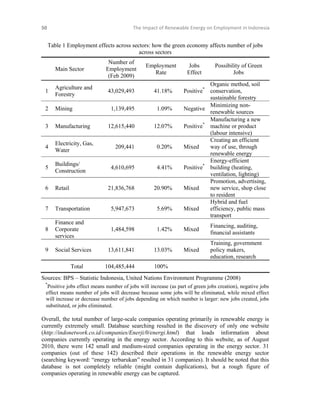
A sustainable and low-carbon economy may have a positive, negative or mixed impact on jobs
creation for each sector. It is advisable not to analyze the employment impact from renewable
energy per se, but instead from the perspective of the whole “green economy”. Agriculture and
forestry, manufacturing, building/construction are sectors that may be positively affected by
green jobs creation (Table 1). Mining is the only sector for which a negative jobs effect is
anticipated. The other sectors may have mixed effects depending on which number is larger:
new jobs created, jobs substituted, or jobs eliminated. Agriculture and forestry, manufacturing
and construction together represented 58% of the Indonesian employment rate as of February
2009. If the green economy leads to positive jobs creation for these sectors, the employment
rate will grow in the future. Generally, even though a loss of jobs will occur for the mining
sector, the impact on overall employment is quite small (1.09%). A significant increase in
overall employment is expected.
3.2. Review of Energy Companies in Indonesia
Narrowing this analysis to the number of companies currently operating in renewable energy,
presents a difficulty for obtaining a reliable database, as such data cannot easily be accessed.
According to the Ministry of Trade, there were only six large-scale companies in 2004 that
operated in energy sector (coal and petroleum refineries). These six companies employed
approximately 1,000 workers in 2004 (Ministry of Trade, 2004). State-owned companies,
however, operated four main companies in the energy sector, not including subsidiaries.
50 

The Impact of Renewable Energy on Employment in Indonesia 


Table 1 Employment effects across sectors: how the green economy affects number of jobs
across sectors
Main Sector

1

Agriculture and
Forestry

2

Mining

3

Manufacturing

4

Electricity, Gas,
Water

5

Buildings/
Construction

6

Retail

7

Number of
Employment
(Feb 2009)

Employment
Rate

Jobs
Effect

Possibility of Green
Jobs

Organic method, soil
Positive* conservation,
sustainable forestry
Minimizing nonNegative
renewable sources
Manufacturing a new
*
Positive machine or product
(labour intensive)
Creating an efficient
Mixed
way of use, through
renewable energy
Energy-efficient
Positive* building (heating,
ventilation, lighting)
Promotion, advertising,
Mixed
new service, shop close
to resident
Hybrid and fuel
Mixed
efficiency, public mass
transport

43,029,493

41.18%

1,139,495

1.09%

12,615,440

12.07%

209,441

0.20%

4,610,695

4.41%

21,836,768

20.90%

Transportation

5,947,673

5.69%

8

Finance and
Corporate
services

1,484,598

1.42%

Mixed

Financing, auditing,
financial assistants

9

Social Services

13,611,841

13.03%

Mixed

Training, government
policy makers,
education, research

Total

104,485,444

100%

Sources: BPS – Statistic Indonesia, United Nations Environment Programme (2008)
*

Positive jobs effect means number of jobs will increase (as part of green jobs creation), negative jobs
effect means number of jobs will decrease because some jobs will be eliminated, while mixed effect
will increase or decrease number of jobs depending on which number is larger: new jobs created, jobs
substituted, or jobs eliminated.

Overall, the total number of large-scale companies operating primarily in renewable energy is
currently extremely small. Database searching resulted in the discovery of only one website
(http://indonetwork.co.id/companies/Enerji/0/energi.html) that loads information about
companies currently operating in the energy sector. According to this website, as of August
2010, there were 142 small and medium-sized companies operating in the energy sector. 31
companies (out of these 142) described their operations in the renewable energy sector
(searching keyword: “energy terbarukan” resulted in 31 companies). It should be noted that this
database is not completely reliable (might contain duplications), but a rough figure of
companies operating in renewable energy can be captured.

 
Elfani 

51 

4. EMPLOYMENT PREDICTION
A sustainable and low-carbon economy that includes the renewable energy factor will create
more jobs in manufacturing and construction rather than in services, operation and
maintenance. Kammen, Kapadia and Fripp (2004) stated that there will be a shift from jobs in
mining and services to jobs in manufacturing, construction and agriculture. Agriculture jobs in
Indonesia will increase significantly since more than 5% of Indonesia’s energy mix in 2025 is
expected to come from bio-fuel and biomass. Green jobs creation through renewable energy
will obviously benefit the Indonesian economy since agriculture has a decline trend in
employment rates and manufacturing still has a low employment rates (Table 2).
Table 2 Employment rate in agriculture, manufacturing and services sectors
Year
1987
1990
1993
1996
1999
2002
2005

Agriculture* [%]
57.79
55.32
50.08
43.51
43.21
44.34
44.04

Manufacturing [%]
8.80
10.88
11.95
13.50
13.78
13.90
16.92

Services [%]
33.42
33.80
37.97
42.99
43.01
41.75
39.04

(Sources: Hasoloan, 2006; Suryadarma et al., 2007)
*

Agriculture sector has a declining trend of employment rate while
manufacturing has an increasing trend of employment rate. Services sector has
an increasing trend although at the end it started to decline.

A declining trend of employment rate in agriculture will be countered by a green jobs creation
in agriculture (Table 2). While a green jobs creation in manufacturing will increase the size of
the manufacturing workforce, services employment will face a declining trend as a result of
sector-shifting from services to agriculture and manufacturing (green-jobs oriented).
4.1. Jobs per Megawatt of Capacity
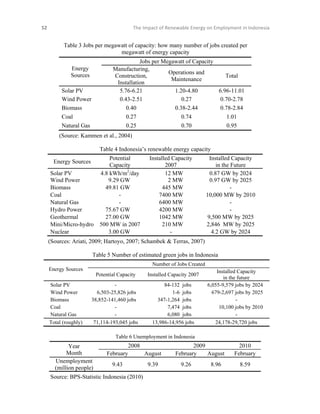
One study across Europe and the United States, conducted by Kammen, Kapadia and Fripp
(2004), presents a job creation model per megawatt of energy capacity (Table 3). To estimate
the number of potential new jobs in Indonesia, the country’s renewable energy installed
capacity, potential capacity and plans for the installed capacity in the future are described
(Table 4).
Applying the job creation model results in an estimated number of green jobs created in
Indonesia. Table 5 describes the number of jobs that can be created on installed capacity,
potential capacity and plans for the installed capacity in the future. This result is taken after
applying jobs creation model (Table 3) into Indonesia’s energy capacity (Table 4).
For the Indonesian renewable energy installed capacity in 2007, total jobs created were
approximately 14,000, and this number significantly contributes to 0.15% of total
unemployment in February 2008 (Table 6). Compared to February 2010 unemployment,
installed capacity of renewable energy will contribute 0.27-0.34% of total unemployment.
While the potential capacity of renewable energy roughly is anticipated to create 70,000190,000 jobs, this number contributed 0.8-2.2% of total unemployment in February 2010 (Table
6). By contribute to unemployment means that the number of unemployment is expected to be
reduced by the number of green jobs creation.
52 

The Impact of Renewable Energy on Employment in Indonesia 


Table 3 Jobs per megawatt of capacity: how many number of jobs created per
megawatt of energy capacity
Jobs per Megawatt of Capacity
Manufacturing,
Operations and
Construction,
Total
Maintenance
Installation
5.76-6.21
1.20-4.80
6.96-11.01
0.43-2.51
0.27
0.70-2.78
0.40
0.38-2.44
0.78-2.84
0.27
0.74
1.01
0.25
0.70
0.95

Energy
Sources
Solar PV
Wind Power
Biomass
Coal
Natural Gas

(Source: Kammen et al., 2004)
Table 4 Indonesia’s renewable energy capacity
Energy Sources
Solar PV
Wind Power
Biomass
Coal
Natural Gas
Hydro Power
Geothermal
Mini/Micro-hydro
Nuclear

Potential
Capacity
4.8 kWh/m2/day
9.29 GW
49.81 GW
75.67 GW
27.00 GW
500 MW in 2007
3.00 GW

Installed Capacity
2007
12 MW
2 MW
445 MW
7400 MW
6400 MW
4200 MW
1042 MW
210 MW
-

Installed Capacity
in the Future
0.87 GW by 2024
0.97 GW by 2025
10,000 MW by 2010
9,500 MW by 2025
2,846 MW by 2025
4.2 GW by 2024

(Sources: Ariati, 2009; Hartoyo, 2007; Schambek & Terras, 2007)
Table 5 Number of estimated green jobs in Indonesia
Number of Jobs Created
Energy Sources
Potential Capacity
Solar PV
Wind Power
Biomass
Coal
Natural Gas
Total (roughly)

Installed Capacity 2007

6,503-25,826 jobs
38,852-141,460 jobs
71,114-193,045 jobs

84-132 jobs
1-6 jobs
347-1,264 jobs
7,474 jobs
6,080 jobs
13,986-14,956 jobs

Installed Capacity
in the future
6,055-9,579 jobs by 2024
679-2,697 jobs by 2025
10,100 jobs by 2010
24,178-29,720 jobs

Table 6 Unemployment in Indonesia

Year
Month
Unemployment
(million people)

2008
February

August

9.43

9.39

Source: BPS-Statistic Indonesia (2010)

2009
February
August
9.26

8.96

2010
February
8.59

 
Elfani 

53 

Since the study does not estimate green jobs creation from other renewable energy sources such
as hydro-power, geothermal energy, mini/micro-hydro power and nuclear energy, the total
number of green jobs created for Indonesia should be greater than available in this analysis,
therefore the contribution to reduce unemployment is even more significant.
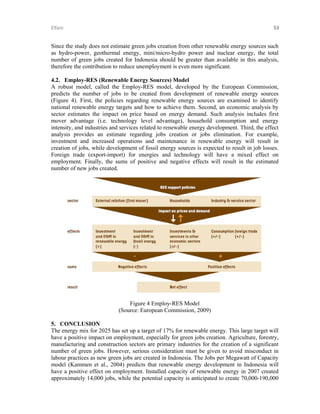
4.2. Employ-RES (Renewable Energy Sources) Model
A robust model, called the Employ-RES model, developed by the European Commission,
predicts the number of jobs to be created from development of renewable energy sources
(Figure 4). First, the policies regarding renewable energy sources are examined to identify
national renewable energy targets and how to achieve them. Second, an economic analysis by
sector estimates the impact on price based on energy demand. Such analysis includes first
mover advantage (i.e. technology level advantage), household consumption and energy
intensity, and industries and services related to renewable energy development. Third, the effect
analysis provides an estimate regarding jobs creation or jobs elimination. For example,
investment and increased operations and maintenance in renewable energy will result in
creation of jobs, while development of fossil energy sources is expected to result in job losses.
Foreign trade (export-import) for energies and technology will have a mixed effect on
employment. Finally, the sums of positive and negative effects will result in the estimated
number of new jobs created.

Figure 4 Employ-RES Model
(Source: European Commission, 2009)
5. CONCLUSION
The energy mix for 2025 has set up a target of 17% for renewable energy. This large target will
have a positive impact on employment, especially for green jobs creation. Agriculture, forestry,
manufacturing and construction sectors are primary industries for the creation of a significant
number of green jobs. However, serious consideration must be given to avoid misconduct in
labour practices as new green jobs are created in Indonesia. The Jobs per Megawatt of Capacity
model (Kammen et al., 2004) predicts that renewable energy development in Indonesia will
have a positive effect on employment. Installed capacity of renewable energy in 2007 created
approximately 14,000 jobs, while the potential capacity is anticipated to create 70,000-190,000
54 

The Impact of Renewable Energy on Employment in Indonesia 


jobs. For research in the future, the author recommends the Employ-RES comprehensive model
for jobs creation in Indonesia. Although the current number of companies operating in
renewable energy is small, potential growth is forecast in the future. Government support is
needed for financing, advising, and directing industries through the proper regulations and
policies.
6. REFERENCES
Ariati, R., 2009. National Energy Policy and Biomass Development Program in Indonesia,
Ministry of Energy and Mineral Resources presented at 6th Biomass Asia Seminar, Jakarta
2009.
Badan Pusat Statistik – Statistic Indonesia, 2010. Employment According to Main Sectors.
Available
at
<http://www.bps.go.id/tab_sub/view.php?tabel=1&daftar=1&id_subyek=06&notab=2>
Badan Pusat Statistik – Statistic Indonesia, 2010. Monthly Report Social Economics Data, 2nd
Edition, July 2010. Available at < http://www.bps.go.id/download_file/IP_Juli_2010.pdf>
European Commission, 2009. The Impact of Renewable Energy Policy on Economic Growth
and Employment in the European Union, Summary of the results of Employ-RES project.
Available
at
<http://ec.europa.eu/energy/renewables/studies/doc/renewables/2009_employ_res_summary
.pdf>
Hartoyo, B., 2007. Outlook of Indonesian Domestic Coal Supply and Demand Toward 2025,
APEC Clean Fossil Energy Technical and Policy Seminar, Hanoi 2007. Available at
<http://www.egcfe.ewg.apec.org/publications/proceedings/CFE/Hanoi_2007/32_Hartoyo.pdf>
Hasoloan, M.A., 2006. Country Report the Indonesian Labor Market, Presented at Forum on
the Restated OECD Jobs Strategy in Tokyo, Tokyo 2006. Available at
<http://www.oecd.org/dataoecd/20/36/37873500.pdf>
ILO, 2005. Indonesian Plantation Workers Still Face Lack of Labour Rights, Press release
(Jakarta: 26 August 2005).
International Campaign for Ecological Justice in Indonesia, 2004. Sustainable Palm Oil:
Mission Impossible?, Down to Earth, November 2004.
Kammen, D.M., Kapadia, K., Fripp, M., 2004. Putting Renewables to Work: How Many Jobs
Can the Clean Energy Industry Generate? RAEL Report, University of California, Berkeley.
Available
at
<http://www.ewea.org/fileadmin/ewea_documents/documents/policy/external_documents/0
40413_renewables_berkeley.pdf>
Law of the Republic of Indonesia, 2007. Law of the Republic of Indonesia Number 30 Year
2007 on Energy. Available at <http://www.esdm.go.id/prokum/uu/2007/uu-30-2007en.pdf>
Ministry of Trade, 2004. Number of Company and Worker across Sectors. Available at
<http://www.depdag.go.id/addon/statistik_industri/index.php?isi=6&isi_pdf=dua&menu=be
sar>
Presidential Decree, 2006. Presidential Decree Number 5 Year 2006 on National Energy
Policy. Available at < http://faolex.fao.org/docs/pdf/ins64284.pdf>
Schambek, H. & E.Terras AG, 2007. Geothermie in Indonesien, Proceeding of the Conference
on Renewable Energies for Embassies in Germany, Berlin 2007. Available at
<http://www.dena.de/en/news-archive/2007/ambassadors-conference-in-berlin>
Suryadarma, D., Suryahadi, A., Sumarto, S., 2007. Reducing Unemployment in Indonesia:
Result from a Growth-Employment Elasticity Model, SMERU Working Paper January
2007.

 
Elfani 

55 

United Nations Environment Programme, 2008. Green Jobs: Towards Decent Work in a
Sustainable, Low-Carbon World, UNEP/ILO/IOE/ITUC September 1998. Available at
<www.unep.org/civil_society/Publications/index.asp>
Worldwatch Institute, 2007. Biofuels for Transport: Global Potential and Implications for
Sustainable Energy and Agriculture, London: Earthscan, pp. 124,126.

Jurnal Internasional – Dampak Energi Terbarukan Terhadap Ketenagakerjaan di Indonesia

  • 1.
    International Journal of Technology (2011) 1: 47‐55  ISSN 2086‐9614  © IJTech 2011  THE IMPACT OFRENEWABLE ENERGY ON EMPLOYMENT IN INDONESIA Maria Elfani* London Metropolitan University, Institute for the Study of European Transformations, Tower Building 1st Floor, 166-220 Holloway Road London N7 8DB, UK (Received: November 2010 / Revised: December 2010 / Accepted: January 2011)  ABSTRACT A global demand for energy has forced many countries to search for alternative and renewable energy. An anticipated effect of the development of renewable is an increase in employment as part of new green jobs creation, a major benefit for Indonesia to cope with its high unemployment rate. This paper describes the impact of renewable energy development on the jobs creation in Indonesia. First, we identify current government policies relative to renewable energy. Second, this paper describes the definition of green jobs and what type of jobs might be created due to development of renewable energy. Third, companies in Indonesia currently operating in the renewable energy sector are analyzed for their potential growth. Research is based solely on secondary data analysis. Information publicly available from the government/ministry website was used to examine policies concerning renewable energy. Related journals and articles were used to explore plans for the creation of green jobs, and a database search was conducted to identify companies currently operating in the renewable energy sector. The Kammen et al. (2004) study of Jobs per Megawatt of Capacity identified that the renewable energy installed capacity in 2007 created approximately 14,000 jobs in Indonesia. The potential capacity of renewable energy will create 70,000-190,000 jobs in Indonesia. Keywords: Renewable energy; Employment; Indonesia 1. INTRODUCTION Indonesia has launched the Law on Energy Number 30 year 2007 to regulate sources, purpose, management of, and policies regarding energy use in Indonesia. Energy by its definition is an ability to produce heat, light, mechanical, chemical and electromagnetic activity (Law of the Republic of Indonesia, 2007). New energy may come from renewable and nonrenewable sources, with renewable sources characterized as sustainable and ongoing, including geothermal energy, wind, bio-energy, solar energy, water movement and oceans. Nonrenewable sources cannot be sustained and will ultimately run out; they include oil, natural gas, coal and peat. In the national energy mix as of 2006 (Figure 1), oil was the main source of energy (52%), followed by natural gas at 29%, coal at 15%, hydro power at 3% and geothermal energy at 1%. Assuming “business as usual” until 2025, the composition of the national energy mix (Figure 2) presumes oil to maintain its position as the major energy source at 42%, followed by coal at 35%, natural gas at 21%, hydro power at 1.9%, geothermal energy at 1.1%, and mini/micro hydro power at 0.1%. * Corresponding author’s email: mae0352@my.londonmet.ac.uk, Tel. +44 (0) 7879141656
  • 2.
    48  The Impact of Renewable Energy on Employment in Indonesia    However, if energymanagement is optimized, targets for the energy mix as described in Presidential Decree No. 5/2006 will reduce dependency on oil to 20%, and renewable energy sources will account for 17% of the total mix (Figure 3). 2025 target for renewable energy development should substantially impact the creation of jobs. Section 2 provides a brief explanation about the definition and scope of green jobs, and Section 3 identifies possible employment creation across sectors. Section 4 further analyzes new employment predictions and Section 5 summarizes the effects of renewable energy development on employment in Indonesia. Mini/Micro Hydro, 0.1% Coal, 15.34% Coal, 34.6% Natural Gas, 28.57% Hydro Power, 3.11% Oil, 41.7% Oil, 51.66% Geothermal, 1.32% Figure 1 National energy mix of 2006 (Source: Ariati, R., 2009) Natural Gas, 20.6% Geothermal, 1.1% Hydro Power, 1.9% Figure 2 National energy mix of 2025 (BaU) (Source: Ariati, R., 2009) 2. GREEN JOBS DEFINITION AND SCOPE The United Nations Environment Programme (UNEP) in its 2008 report defines green jobs as any positions in any fields that contribute significantly to restoring or preserving the environment (UNEP, 2008). Green jobs might occur in agriculture, construction, manufacturing, scientific, technical, administrative, and service-related fields. Activities of green jobs might include minimizing the use of energy, water and material as well as minimizing or avoiding the creation of waste and pollution. Occupations range widely from scientist, academician, engineer, architect, administrator, auditor, marketing professional, retailer, customer service representative, or policy maker to blue-collar workers such as plumbers and electrical wiring specialists. The green jobs must also be decent jobs, providing fair wages and reasonable working conditions (UNEP, 2008). UNEP noted that employment on sugarcane and palm oil plantation in Indonesia is marked by unfair wages and unsafe working conditions (UNEP, 2008). UNEP cited an International Labour Organization (ILO) (2005) report regarding frequent violations of rights affecting Indonesian plantation workers. Plantation workers tend to have inadequate representation in dialogue and less income security. The International Campaign for Ecological Justice in Indonesia (2004) noted that plantation workers in Indonesia (as well as Indonesian migrant workers on Malaysian plantations) are at risk of working for employers who are known for misconduct in labour practices, including allowing workers to perform their duties under dangerous working conditions because of weak regulations. Worldwatch Institute (2007) reported that female plantation workers tend to earn lower pay than male workers. Moreover, female workers are recruited to spray harmful pesticides without appropriate safety training.  
  • 3.
    Elfani  49  Decent jobs issuesin Indonesia therefore should be treated seriously as “green” jobs are created. Gas, 30% Oil, 20% New and Renewable Energy, 17% Coal, 33% Figure 3 National energy mix 2025 optimizing energy (Source: Presidential Decree, 2006) Regarding the effect of green jobs on employment, UNEP explained that green jobs will affect employment in four ways: first some new jobs will be created, such as manufacturing jobs associated with development of hydro power generator. Second, some jobs might substitute or replace existing jobs, such as manufacturing jobs associated with production of a pollution vehicle to jobs aimed at producing green vehicles. Third, some jobs might be eliminated, including those in the packaging industry, and fourth, some jobs are going to stay the same although different work methods maybe employed. For example, plumbers and construction workers will apply environment-friendly methods to their assignments simply by transferring day-to-day skills and methods to be greened. 3. EMPLOYMENT CREATION 3.1. Employment Creation across Sectors A sustainable and low-carbon economy may have a positive, negative or mixed impact on jobs creation for each sector. It is advisable not to analyze the employment impact from renewable energy per se, but instead from the perspective of the whole “green economy”. Agriculture and forestry, manufacturing, building/construction are sectors that may be positively affected by green jobs creation (Table 1). Mining is the only sector for which a negative jobs effect is anticipated. The other sectors may have mixed effects depending on which number is larger: new jobs created, jobs substituted, or jobs eliminated. Agriculture and forestry, manufacturing and construction together represented 58% of the Indonesian employment rate as of February 2009. If the green economy leads to positive jobs creation for these sectors, the employment rate will grow in the future. Generally, even though a loss of jobs will occur for the mining sector, the impact on overall employment is quite small (1.09%). A significant increase in overall employment is expected. 3.2. Review of Energy Companies in Indonesia Narrowing this analysis to the number of companies currently operating in renewable energy, presents a difficulty for obtaining a reliable database, as such data cannot easily be accessed. According to the Ministry of Trade, there were only six large-scale companies in 2004 that operated in energy sector (coal and petroleum refineries). These six companies employed approximately 1,000 workers in 2004 (Ministry of Trade, 2004). State-owned companies, however, operated four main companies in the energy sector, not including subsidiaries.
  • 4.
    50  The Impact of Renewable Energy on Employment in Indonesia    Table 1 Employmenteffects across sectors: how the green economy affects number of jobs across sectors Main Sector 1 Agriculture and Forestry 2 Mining 3 Manufacturing 4 Electricity, Gas, Water 5 Buildings/ Construction 6 Retail 7 Number of Employment (Feb 2009) Employment Rate Jobs Effect Possibility of Green Jobs Organic method, soil Positive* conservation, sustainable forestry Minimizing nonNegative renewable sources Manufacturing a new * Positive machine or product (labour intensive) Creating an efficient Mixed way of use, through renewable energy Energy-efficient Positive* building (heating, ventilation, lighting) Promotion, advertising, Mixed new service, shop close to resident Hybrid and fuel Mixed efficiency, public mass transport 43,029,493 41.18% 1,139,495 1.09% 12,615,440 12.07% 209,441 0.20% 4,610,695 4.41% 21,836,768 20.90% Transportation 5,947,673 5.69% 8 Finance and Corporate services 1,484,598 1.42% Mixed Financing, auditing, financial assistants 9 Social Services 13,611,841 13.03% Mixed Training, government policy makers, education, research Total 104,485,444 100% Sources: BPS – Statistic Indonesia, United Nations Environment Programme (2008) * Positive jobs effect means number of jobs will increase (as part of green jobs creation), negative jobs effect means number of jobs will decrease because some jobs will be eliminated, while mixed effect will increase or decrease number of jobs depending on which number is larger: new jobs created, jobs substituted, or jobs eliminated. Overall, the total number of large-scale companies operating primarily in renewable energy is currently extremely small. Database searching resulted in the discovery of only one website (http://indonetwork.co.id/companies/Enerji/0/energi.html) that loads information about companies currently operating in the energy sector. According to this website, as of August 2010, there were 142 small and medium-sized companies operating in the energy sector. 31 companies (out of these 142) described their operations in the renewable energy sector (searching keyword: “energy terbarukan” resulted in 31 companies). It should be noted that this database is not completely reliable (might contain duplications), but a rough figure of companies operating in renewable energy can be captured.  
  • 5.
    Elfani  51  4. EMPLOYMENT PREDICTION Asustainable and low-carbon economy that includes the renewable energy factor will create more jobs in manufacturing and construction rather than in services, operation and maintenance. Kammen, Kapadia and Fripp (2004) stated that there will be a shift from jobs in mining and services to jobs in manufacturing, construction and agriculture. Agriculture jobs in Indonesia will increase significantly since more than 5% of Indonesia’s energy mix in 2025 is expected to come from bio-fuel and biomass. Green jobs creation through renewable energy will obviously benefit the Indonesian economy since agriculture has a decline trend in employment rates and manufacturing still has a low employment rates (Table 2). Table 2 Employment rate in agriculture, manufacturing and services sectors Year 1987 1990 1993 1996 1999 2002 2005 Agriculture* [%] 57.79 55.32 50.08 43.51 43.21 44.34 44.04 Manufacturing [%] 8.80 10.88 11.95 13.50 13.78 13.90 16.92 Services [%] 33.42 33.80 37.97 42.99 43.01 41.75 39.04 (Sources: Hasoloan, 2006; Suryadarma et al., 2007) * Agriculture sector has a declining trend of employment rate while manufacturing has an increasing trend of employment rate. Services sector has an increasing trend although at the end it started to decline. A declining trend of employment rate in agriculture will be countered by a green jobs creation in agriculture (Table 2). While a green jobs creation in manufacturing will increase the size of the manufacturing workforce, services employment will face a declining trend as a result of sector-shifting from services to agriculture and manufacturing (green-jobs oriented). 4.1. Jobs per Megawatt of Capacity One study across Europe and the United States, conducted by Kammen, Kapadia and Fripp (2004), presents a job creation model per megawatt of energy capacity (Table 3). To estimate the number of potential new jobs in Indonesia, the country’s renewable energy installed capacity, potential capacity and plans for the installed capacity in the future are described (Table 4). Applying the job creation model results in an estimated number of green jobs created in Indonesia. Table 5 describes the number of jobs that can be created on installed capacity, potential capacity and plans for the installed capacity in the future. This result is taken after applying jobs creation model (Table 3) into Indonesia’s energy capacity (Table 4). For the Indonesian renewable energy installed capacity in 2007, total jobs created were approximately 14,000, and this number significantly contributes to 0.15% of total unemployment in February 2008 (Table 6). Compared to February 2010 unemployment, installed capacity of renewable energy will contribute 0.27-0.34% of total unemployment. While the potential capacity of renewable energy roughly is anticipated to create 70,000190,000 jobs, this number contributed 0.8-2.2% of total unemployment in February 2010 (Table 6). By contribute to unemployment means that the number of unemployment is expected to be reduced by the number of green jobs creation.
  • 6.
    52  The Impact of Renewable Energy on Employment in Indonesia    Table 3 Jobsper megawatt of capacity: how many number of jobs created per megawatt of energy capacity Jobs per Megawatt of Capacity Manufacturing, Operations and Construction, Total Maintenance Installation 5.76-6.21 1.20-4.80 6.96-11.01 0.43-2.51 0.27 0.70-2.78 0.40 0.38-2.44 0.78-2.84 0.27 0.74 1.01 0.25 0.70 0.95 Energy Sources Solar PV Wind Power Biomass Coal Natural Gas (Source: Kammen et al., 2004) Table 4 Indonesia’s renewable energy capacity Energy Sources Solar PV Wind Power Biomass Coal Natural Gas Hydro Power Geothermal Mini/Micro-hydro Nuclear Potential Capacity 4.8 kWh/m2/day 9.29 GW 49.81 GW 75.67 GW 27.00 GW 500 MW in 2007 3.00 GW Installed Capacity 2007 12 MW 2 MW 445 MW 7400 MW 6400 MW 4200 MW 1042 MW 210 MW - Installed Capacity in the Future 0.87 GW by 2024 0.97 GW by 2025 10,000 MW by 2010 9,500 MW by 2025 2,846 MW by 2025 4.2 GW by 2024 (Sources: Ariati, 2009; Hartoyo, 2007; Schambek & Terras, 2007) Table 5 Number of estimated green jobs in Indonesia Number of Jobs Created Energy Sources Potential Capacity Solar PV Wind Power Biomass Coal Natural Gas Total (roughly) Installed Capacity 2007 6,503-25,826 jobs 38,852-141,460 jobs 71,114-193,045 jobs 84-132 jobs 1-6 jobs 347-1,264 jobs 7,474 jobs 6,080 jobs 13,986-14,956 jobs Installed Capacity in the future 6,055-9,579 jobs by 2024 679-2,697 jobs by 2025 10,100 jobs by 2010 24,178-29,720 jobs Table 6 Unemployment in Indonesia Year Month Unemployment (million people) 2008 February August 9.43 9.39 Source: BPS-Statistic Indonesia (2010) 2009 February August 9.26 8.96 2010 February 8.59  
  • 7.
    Elfani  53  Since the studydoes not estimate green jobs creation from other renewable energy sources such as hydro-power, geothermal energy, mini/micro-hydro power and nuclear energy, the total number of green jobs created for Indonesia should be greater than available in this analysis, therefore the contribution to reduce unemployment is even more significant. 4.2. Employ-RES (Renewable Energy Sources) Model A robust model, called the Employ-RES model, developed by the European Commission, predicts the number of jobs to be created from development of renewable energy sources (Figure 4). First, the policies regarding renewable energy sources are examined to identify national renewable energy targets and how to achieve them. Second, an economic analysis by sector estimates the impact on price based on energy demand. Such analysis includes first mover advantage (i.e. technology level advantage), household consumption and energy intensity, and industries and services related to renewable energy development. Third, the effect analysis provides an estimate regarding jobs creation or jobs elimination. For example, investment and increased operations and maintenance in renewable energy will result in creation of jobs, while development of fossil energy sources is expected to result in job losses. Foreign trade (export-import) for energies and technology will have a mixed effect on employment. Finally, the sums of positive and negative effects will result in the estimated number of new jobs created. Figure 4 Employ-RES Model (Source: European Commission, 2009) 5. CONCLUSION The energy mix for 2025 has set up a target of 17% for renewable energy. This large target will have a positive impact on employment, especially for green jobs creation. Agriculture, forestry, manufacturing and construction sectors are primary industries for the creation of a significant number of green jobs. However, serious consideration must be given to avoid misconduct in labour practices as new green jobs are created in Indonesia. The Jobs per Megawatt of Capacity model (Kammen et al., 2004) predicts that renewable energy development in Indonesia will have a positive effect on employment. Installed capacity of renewable energy in 2007 created approximately 14,000 jobs, while the potential capacity is anticipated to create 70,000-190,000
  • 8.
    54  The Impact of Renewable Energy on Employment in Indonesia    jobs. For researchin the future, the author recommends the Employ-RES comprehensive model for jobs creation in Indonesia. Although the current number of companies operating in renewable energy is small, potential growth is forecast in the future. Government support is needed for financing, advising, and directing industries through the proper regulations and policies. 6. REFERENCES Ariati, R., 2009. National Energy Policy and Biomass Development Program in Indonesia, Ministry of Energy and Mineral Resources presented at 6th Biomass Asia Seminar, Jakarta 2009. Badan Pusat Statistik – Statistic Indonesia, 2010. Employment According to Main Sectors. Available at <http://www.bps.go.id/tab_sub/view.php?tabel=1&daftar=1&id_subyek=06&notab=2> Badan Pusat Statistik – Statistic Indonesia, 2010. Monthly Report Social Economics Data, 2nd Edition, July 2010. Available at < http://www.bps.go.id/download_file/IP_Juli_2010.pdf> European Commission, 2009. The Impact of Renewable Energy Policy on Economic Growth and Employment in the European Union, Summary of the results of Employ-RES project. Available at <http://ec.europa.eu/energy/renewables/studies/doc/renewables/2009_employ_res_summary .pdf> Hartoyo, B., 2007. Outlook of Indonesian Domestic Coal Supply and Demand Toward 2025, APEC Clean Fossil Energy Technical and Policy Seminar, Hanoi 2007. Available at <http://www.egcfe.ewg.apec.org/publications/proceedings/CFE/Hanoi_2007/32_Hartoyo.pdf> Hasoloan, M.A., 2006. Country Report the Indonesian Labor Market, Presented at Forum on the Restated OECD Jobs Strategy in Tokyo, Tokyo 2006. Available at <http://www.oecd.org/dataoecd/20/36/37873500.pdf> ILO, 2005. Indonesian Plantation Workers Still Face Lack of Labour Rights, Press release (Jakarta: 26 August 2005). International Campaign for Ecological Justice in Indonesia, 2004. Sustainable Palm Oil: Mission Impossible?, Down to Earth, November 2004. Kammen, D.M., Kapadia, K., Fripp, M., 2004. Putting Renewables to Work: How Many Jobs Can the Clean Energy Industry Generate? RAEL Report, University of California, Berkeley. Available at <http://www.ewea.org/fileadmin/ewea_documents/documents/policy/external_documents/0 40413_renewables_berkeley.pdf> Law of the Republic of Indonesia, 2007. Law of the Republic of Indonesia Number 30 Year 2007 on Energy. Available at <http://www.esdm.go.id/prokum/uu/2007/uu-30-2007en.pdf> Ministry of Trade, 2004. Number of Company and Worker across Sectors. Available at <http://www.depdag.go.id/addon/statistik_industri/index.php?isi=6&isi_pdf=dua&menu=be sar> Presidential Decree, 2006. Presidential Decree Number 5 Year 2006 on National Energy Policy. Available at < http://faolex.fao.org/docs/pdf/ins64284.pdf> Schambek, H. & E.Terras AG, 2007. Geothermie in Indonesien, Proceeding of the Conference on Renewable Energies for Embassies in Germany, Berlin 2007. Available at <http://www.dena.de/en/news-archive/2007/ambassadors-conference-in-berlin> Suryadarma, D., Suryahadi, A., Sumarto, S., 2007. Reducing Unemployment in Indonesia: Result from a Growth-Employment Elasticity Model, SMERU Working Paper January 2007.  
  • 9.
    Elfani  55  United Nations EnvironmentProgramme, 2008. Green Jobs: Towards Decent Work in a Sustainable, Low-Carbon World, UNEP/ILO/IOE/ITUC September 1998. Available at <www.unep.org/civil_society/Publications/index.asp> Worldwatch Institute, 2007. Biofuels for Transport: Global Potential and Implications for Sustainable Energy and Agriculture, London: Earthscan, pp. 124,126.