© 2015 Cengage Learning. All Rights Reserved. May not be scanned, copied or duplicated, or posted to a publicly accessible website, in whole or in part.
Individual Income Taxes
1
Chapter 12
Alternative Minimum
Tax
2
The Big Picture (slide 1 of 2)
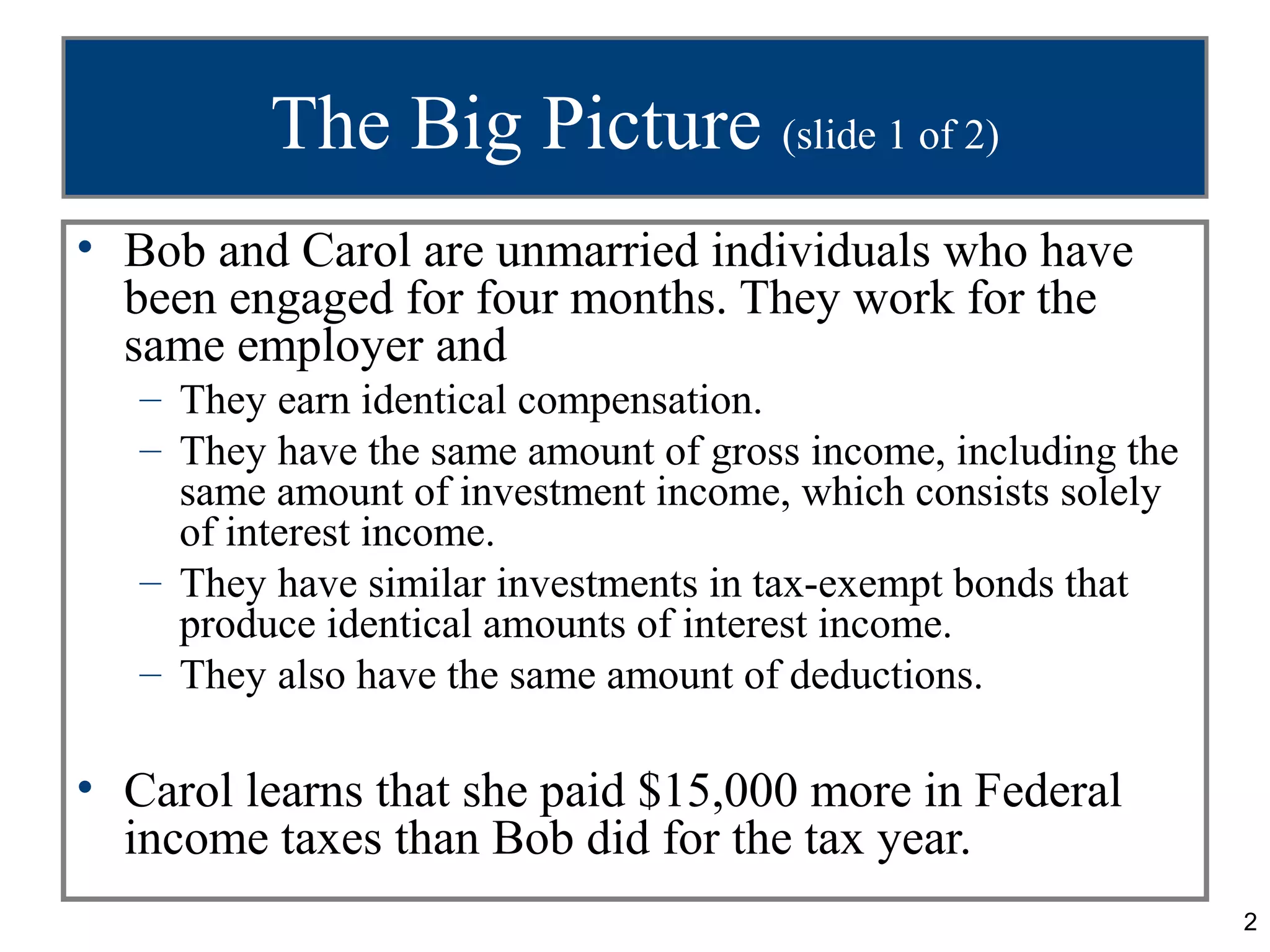
• Bob and Carol are unmarried individuals who have
been engaged for four months. They work for the
same employer and
– They earn identical compensation.
– They have the same amount of gross income, including the
same amount of investment income, which consists solely
of interest income.
– They have similar investments in tax-exempt bonds that
produce identical amounts of interest income.
– They also have the same amount of deductions.
• Carol learns that she paid $15,000 more in Federal
income taxes than Bob did for the tax year.
3
The Big Picture (slide 2 of 2)
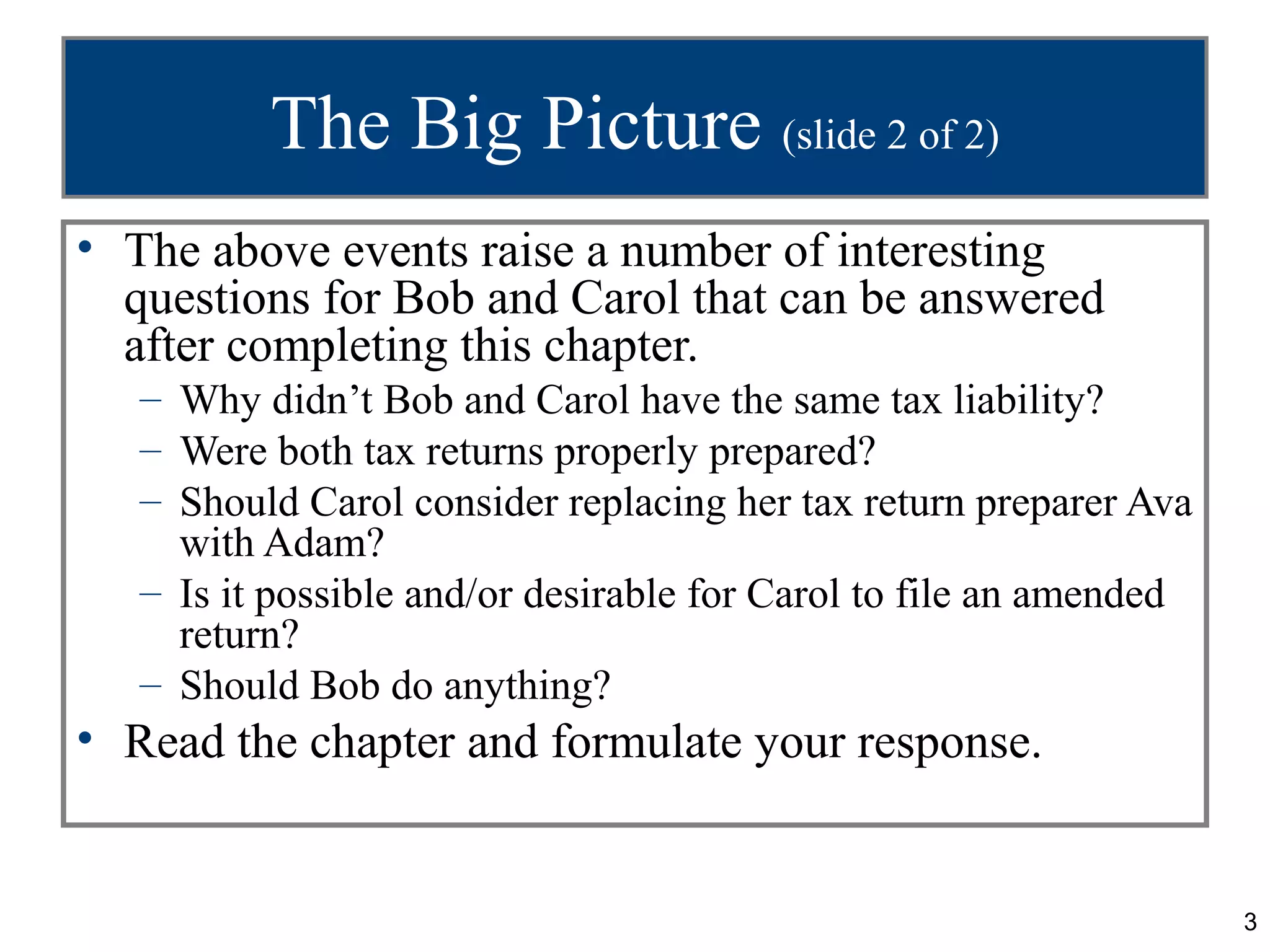
• The above events raise a number of interesting
questions for Bob and Carol that can be answered
after completing this chapter.
– Why didn’t Bob and Carol have the same tax liability?
– Were both tax returns properly prepared?
– Should Carol consider replacing her tax return preparer Ava
with Adam?
– Is it possible and/or desirable for Carol to file an amended
return?
– Should Bob do anything?
• Read the chapter and formulate your response.
4
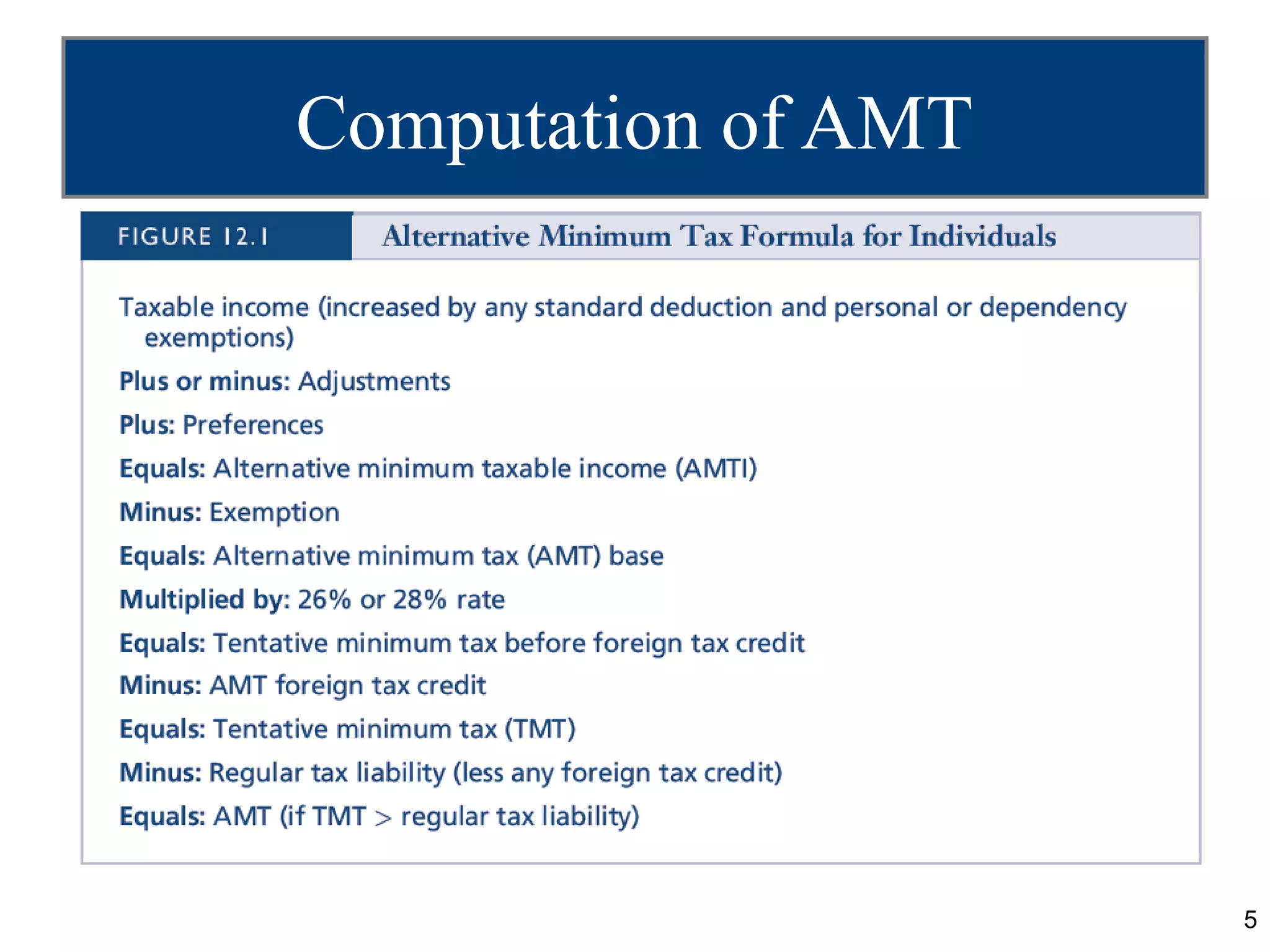
Alternative Minimum Tax (AMT)
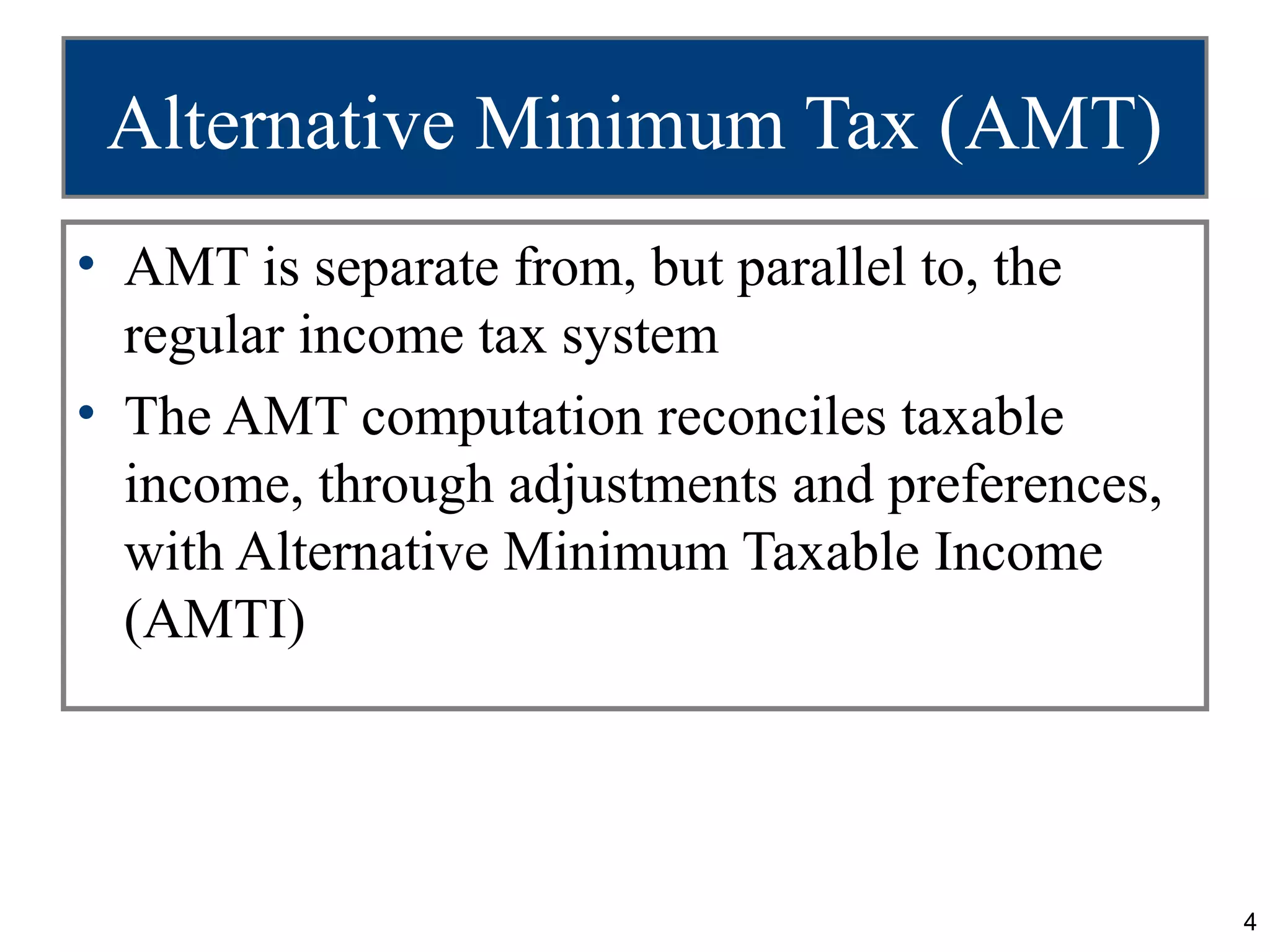
• AMT is separate from, but parallel to, the
regular income tax system
• The AMT computation reconciles taxable
income, through adjustments and preferences,
with Alternative Minimum Taxable Income
(AMTI)
5
Computation of AMT
6
AMT Adjustments And Preferences
(slide 1 of 3)
• Most AMT adjustments relate to timing differences
– Timing differences eventually reverse
• Positive adjustments will be offset by negative adjustments in the future,
and vice versa
– Example - circulation expenditures
• For regular income tax purposes, circulation expenditures can be deducted
in the year incurred
• For AMT purposes, however, circulation expenditures must be deducted
over a three-year period
• Certain AMT adjustments do not relate to timing differences
– These adjustments result in a permanent difference between taxable
income and AMTI
• e.g., Itemized deductions
7
AMT Adjustments And Preferences
(slide 2 of 3)
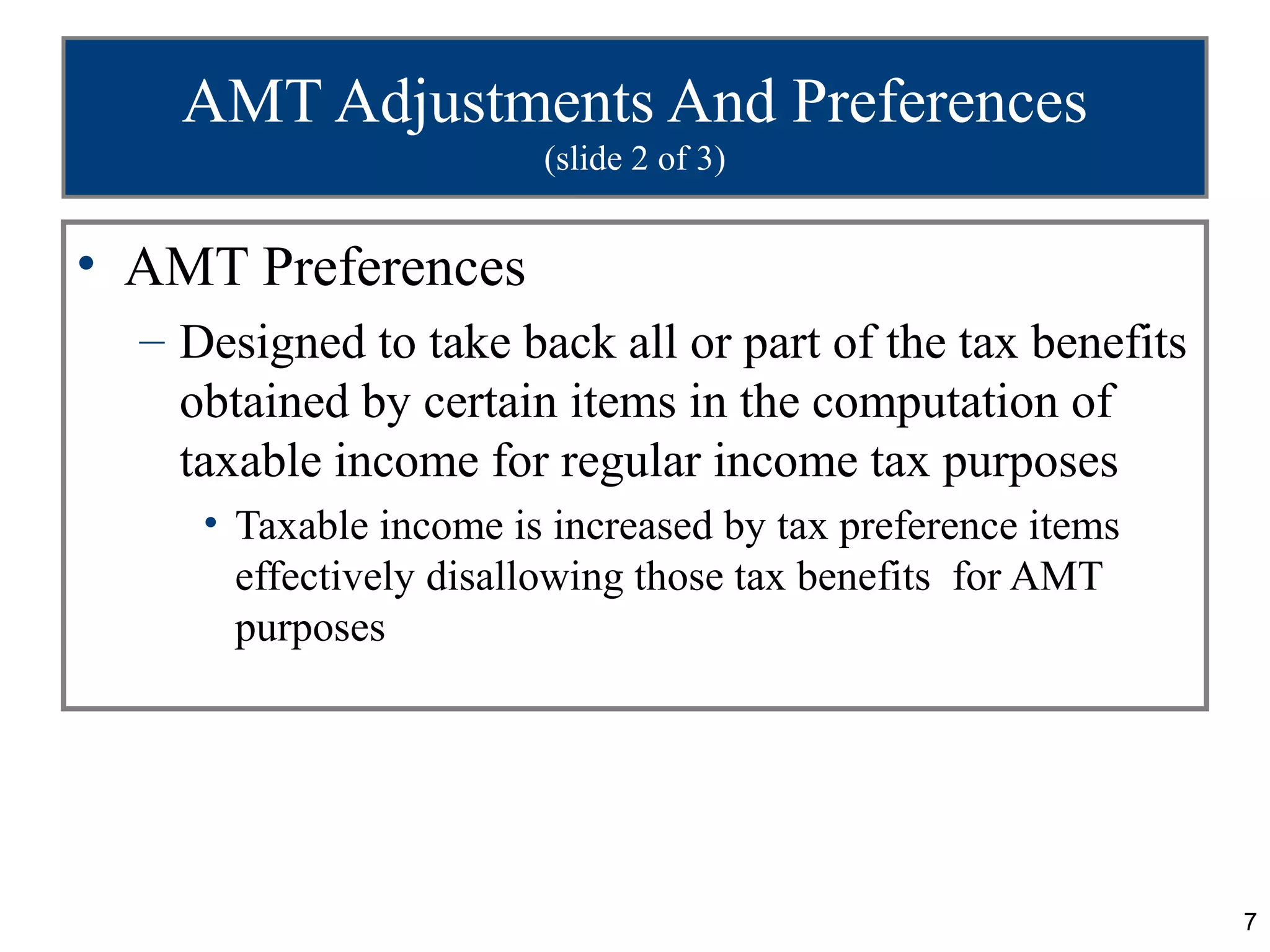
• AMT Preferences
– Designed to take back all or part of the tax benefits
obtained by certain items in the computation of
taxable income for regular income tax purposes
• Taxable income is increased by tax preference items
effectively disallowing those tax benefits for AMT
purposes
8
AMT Adjustments And Preferences
(slide 3 of 3)
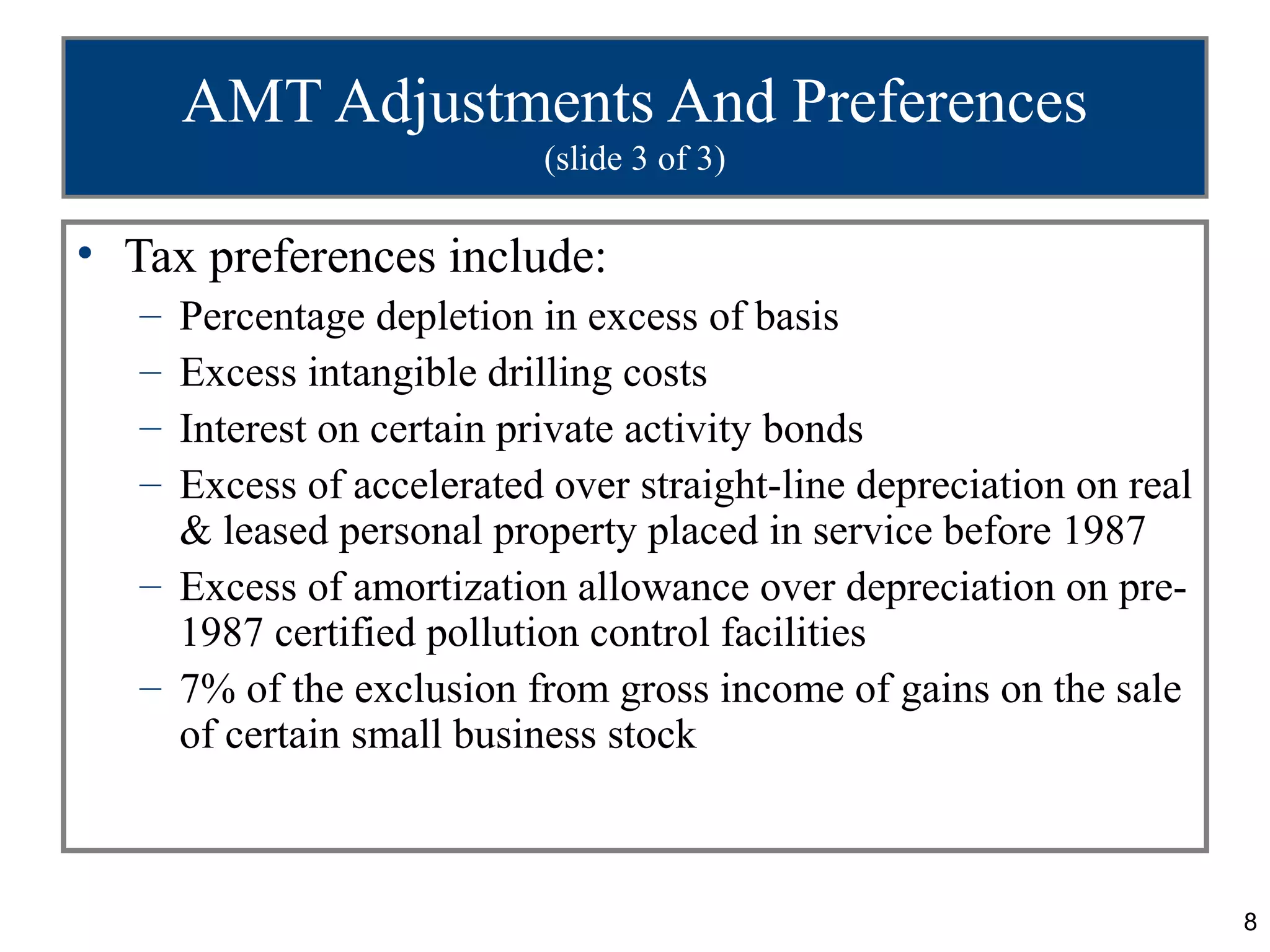
• Tax preferences include:
– Percentage depletion in excess of basis
– Excess intangible drilling costs
– Interest on certain private activity bonds
– Excess of accelerated over straight-line depreciation on real
& leased personal property placed in service before 1987
– Excess of amortization allowance over depreciation on pre-
1987 certified pollution control facilities
– 7% of the exclusion from gross income of gains on the sale
of certain small business stock
9
Other Components of AMT
(slide 1 of 3)
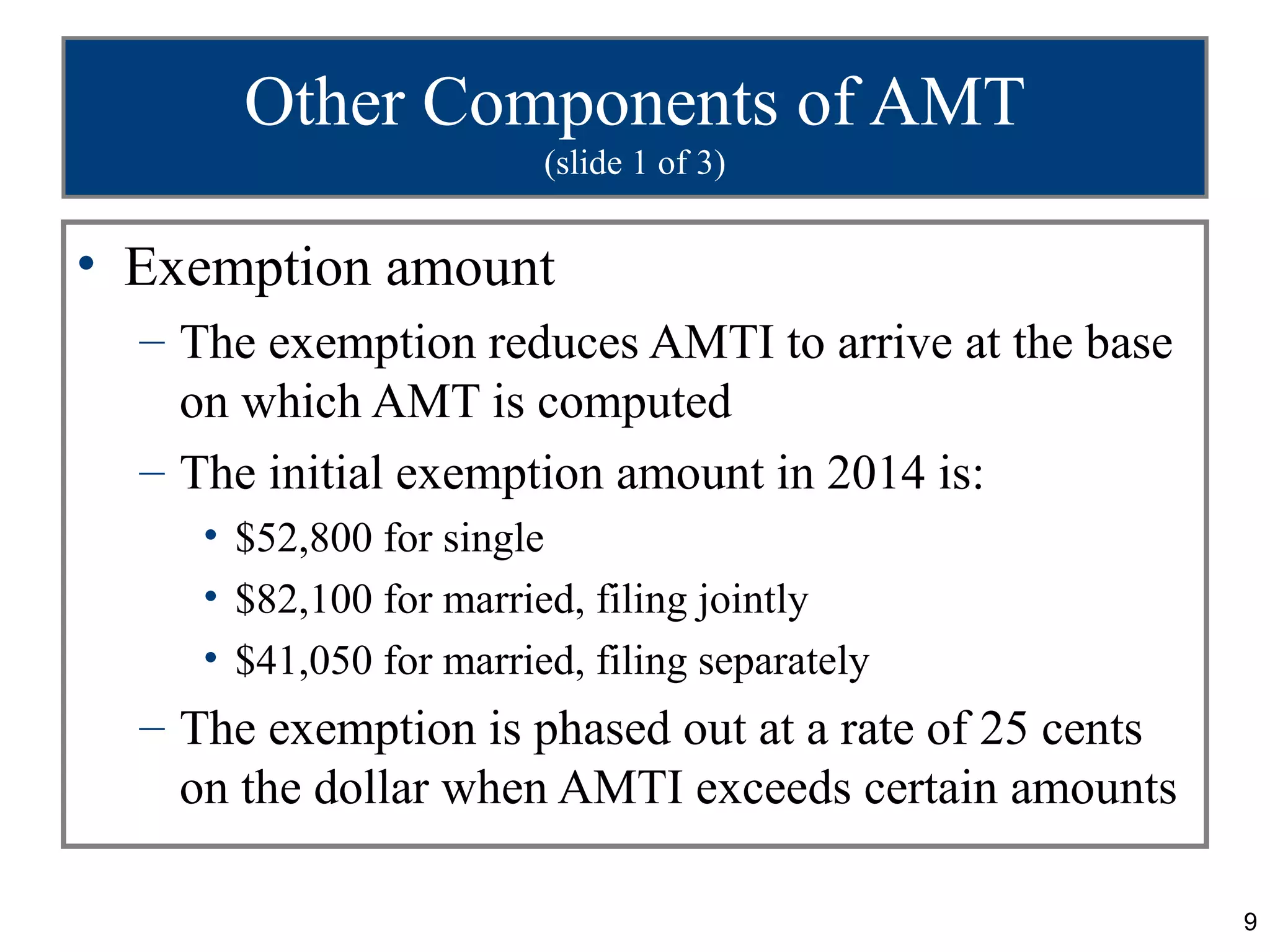
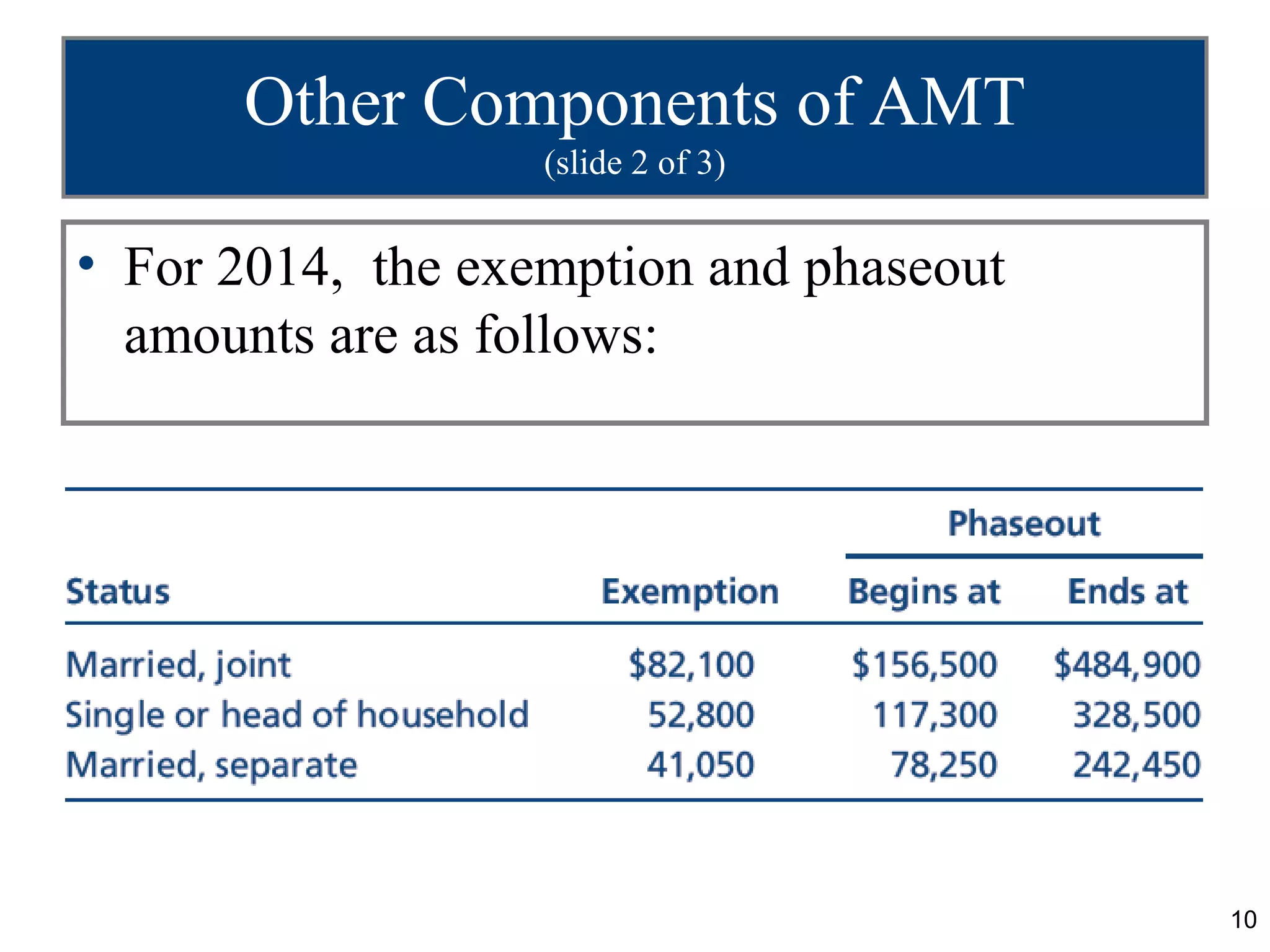
• Exemption amount
– The exemption reduces AMTI to arrive at the base
on which AMT is computed
– The initial exemption amount in 2014 is:
• $52,800 for single
• $82,100 for married, filing jointly
• $41,050 for married, filing separately
– The exemption is phased out at a rate of 25 cents
on the dollar when AMTI exceeds certain amounts
10
Other Components of AMT
(slide 2 of 3)
• For 2014, the exemption and phaseout
amounts are as follows:
11
Other Components of AMT
(slide 3 of 3)
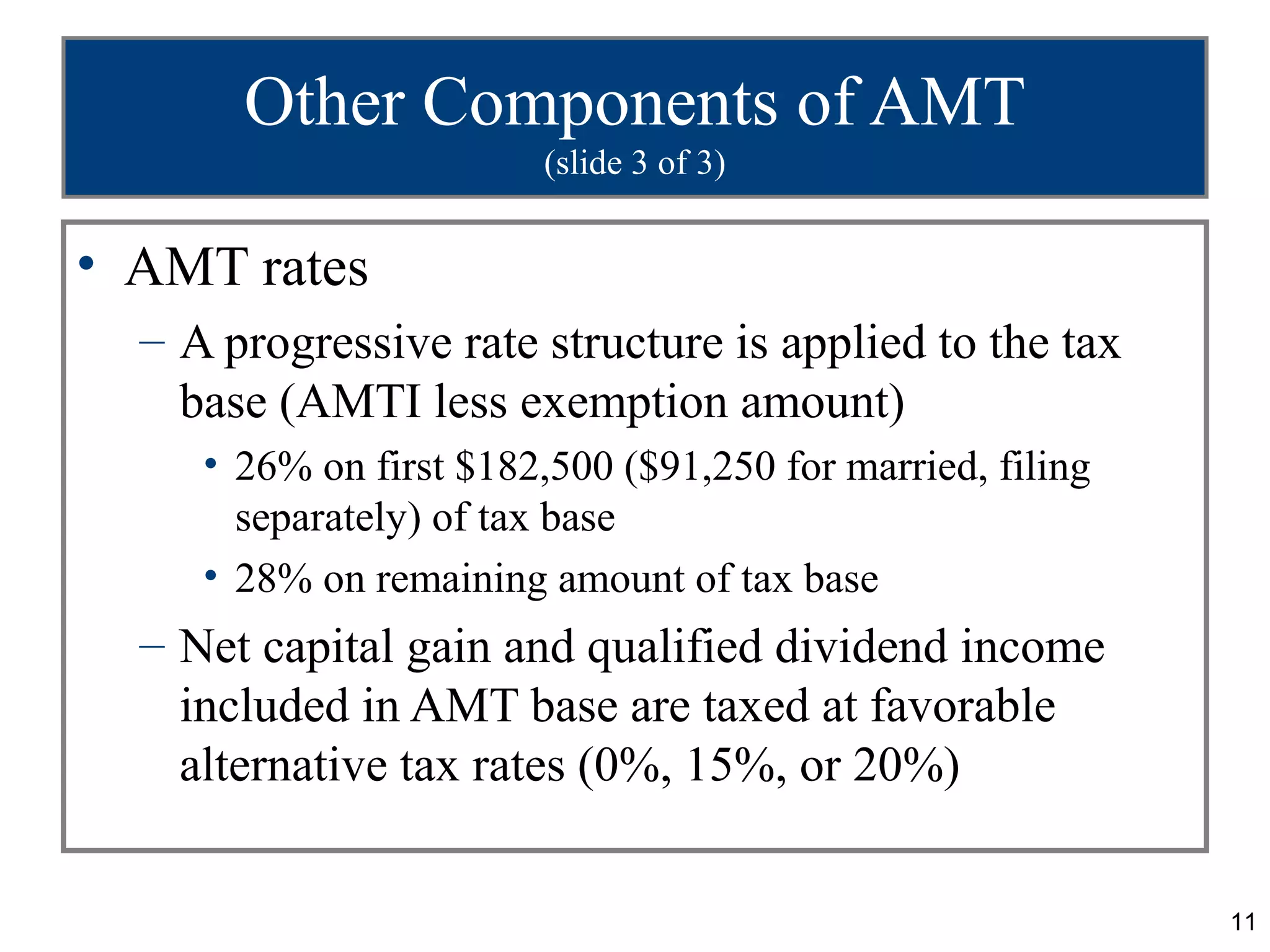
• AMT rates
– A progressive rate structure is applied to the tax
base (AMTI less exemption amount)
• 26% on first $182,500 ($91,250 for married, filing
separately) of tax base
• 28% on remaining amount of tax base
– Net capital gain and qualified dividend income
included in AMT base are taxed at favorable
alternative tax rates (0%, 15%, or 20%)
12
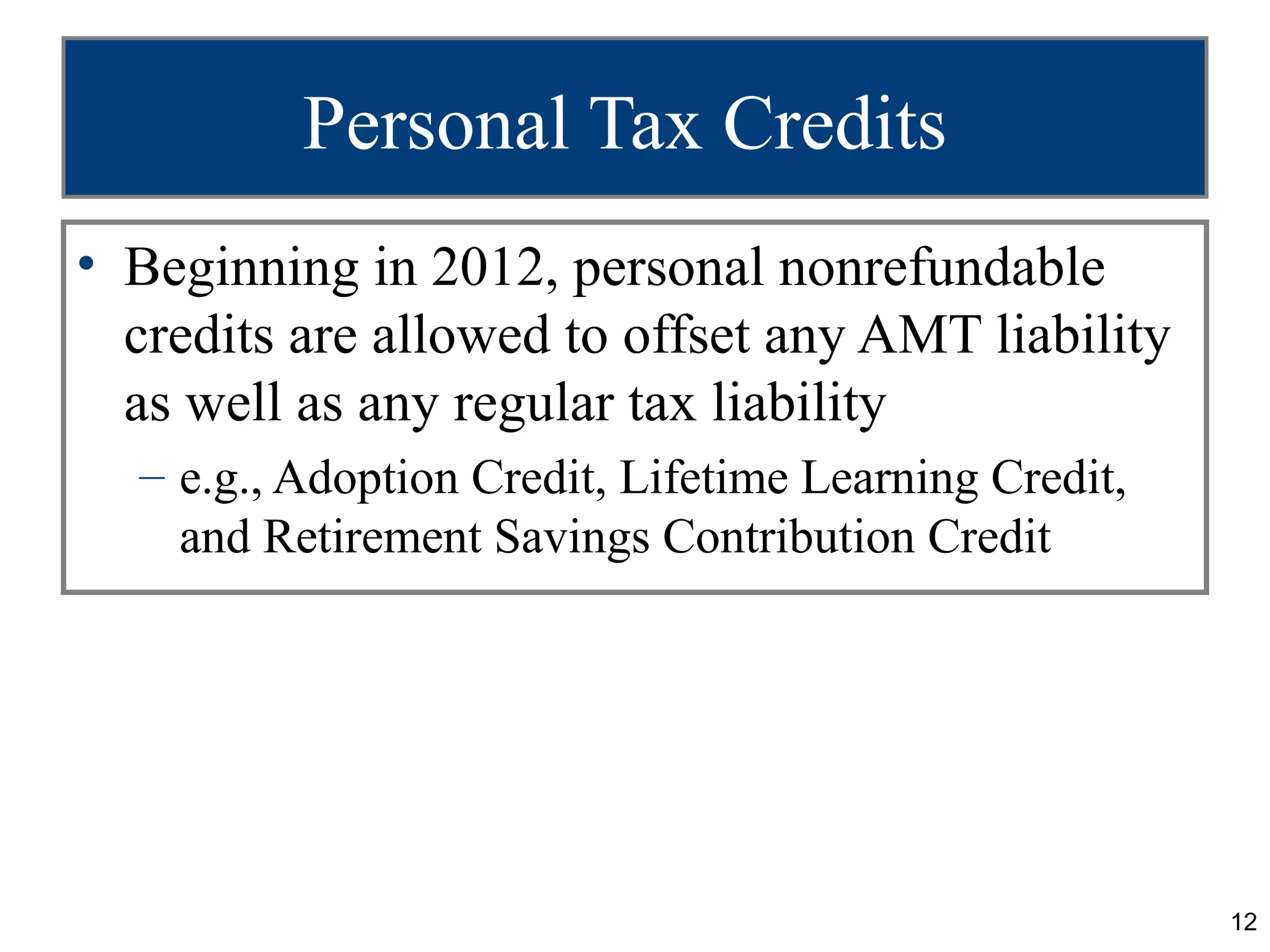
Personal Tax Credits
• Beginning in 2012, personal nonrefundable
credits are allowed to offset any AMT liability
as well as any regular tax liability
– e.g., Adoption Credit, Lifetime Learning Credit,
and Retirement Savings Contribution Credit
13
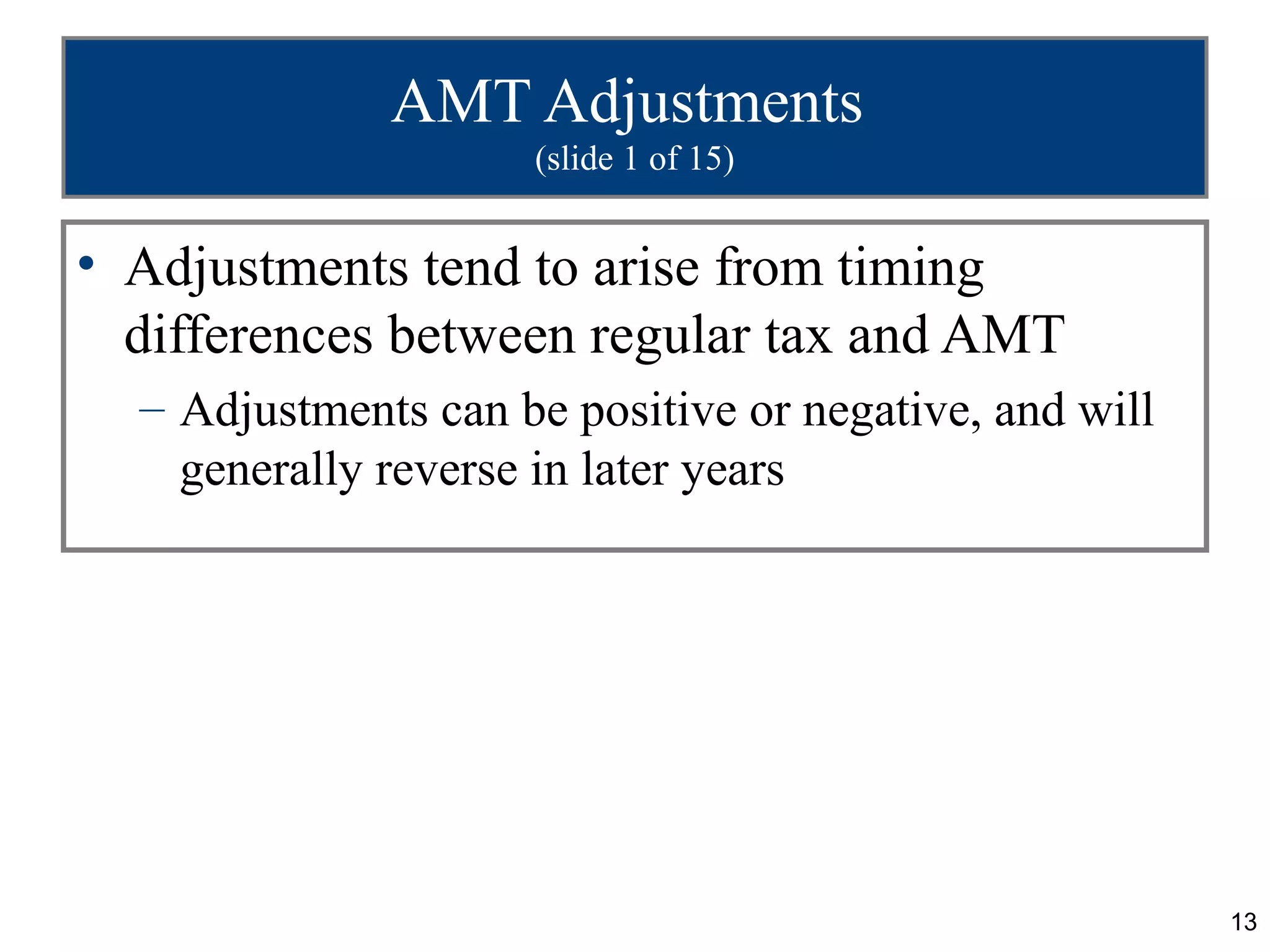
AMT Adjustments
(slide 1 of 15)
• Adjustments tend to arise from timing
differences between regular tax and AMT
– Adjustments can be positive or negative, and will
generally reverse in later years
14
Adjustments
(slide 2 of 15)
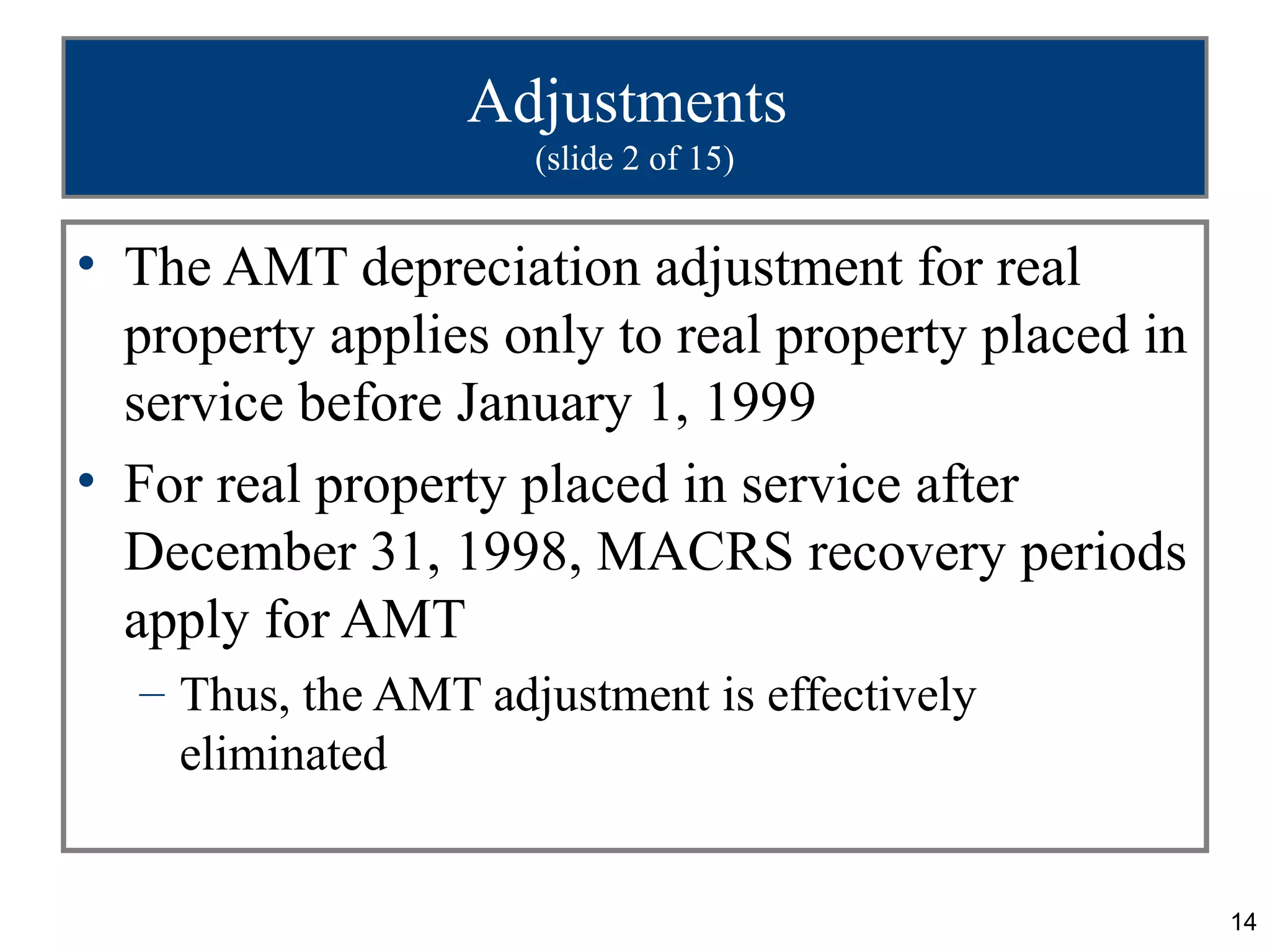
• The AMT depreciation adjustment for real
property applies only to real property placed in
service before January 1, 1999
• For real property placed in service after
December 31, 1998, MACRS recovery periods
apply for AMT
– Thus, the AMT adjustment is effectively
eliminated
15
Adjustments
(slide 3 of 15)
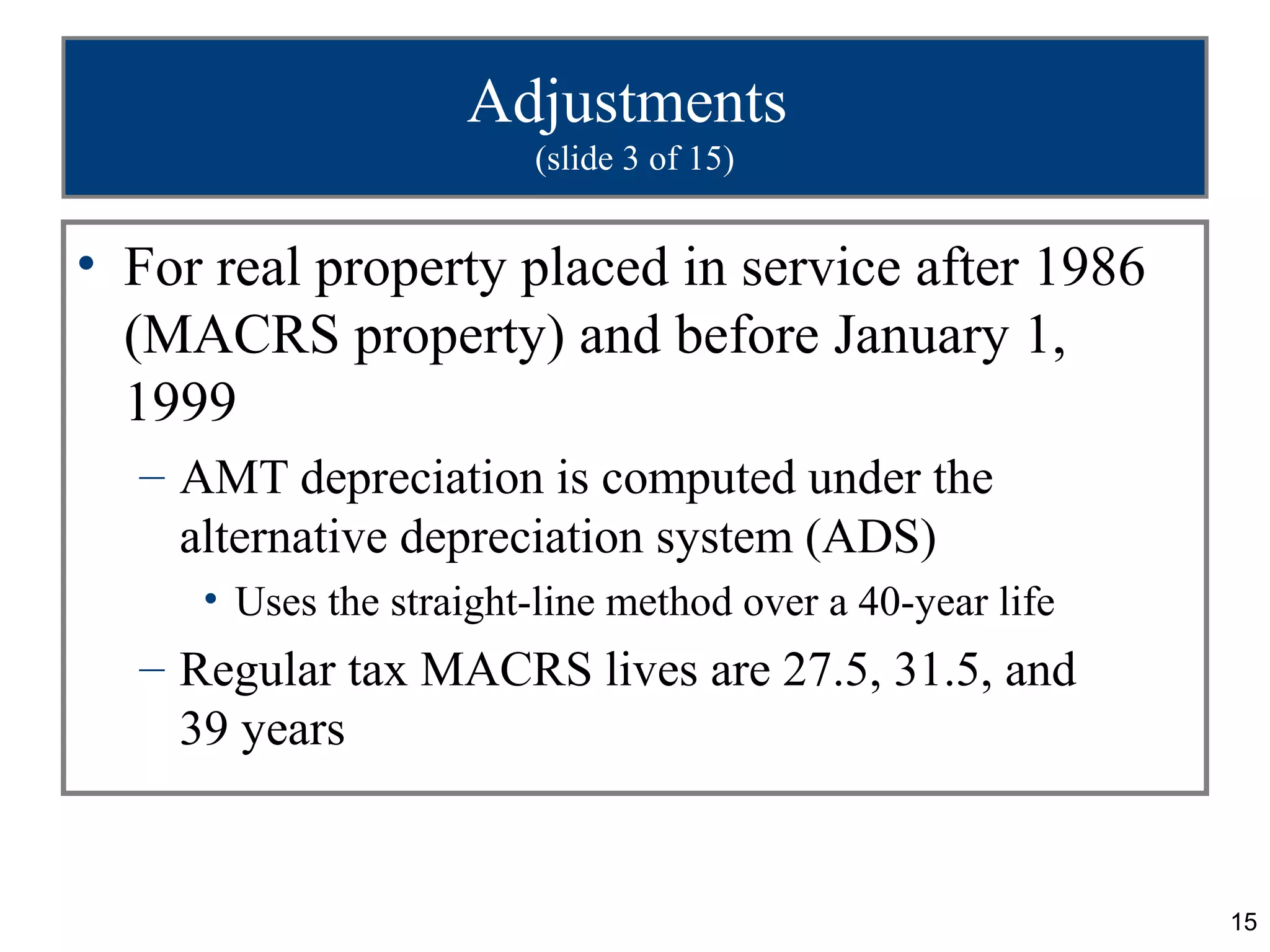
• For real property placed in service after 1986
(MACRS property) and before January 1,
1999
– AMT depreciation is computed under the
alternative depreciation system (ADS)
• Uses the straight-line method over a 40-year life
– Regular tax MACRS lives are 27.5, 31.5, and
39 years
16
Adjustments
(slide 4 of 15)
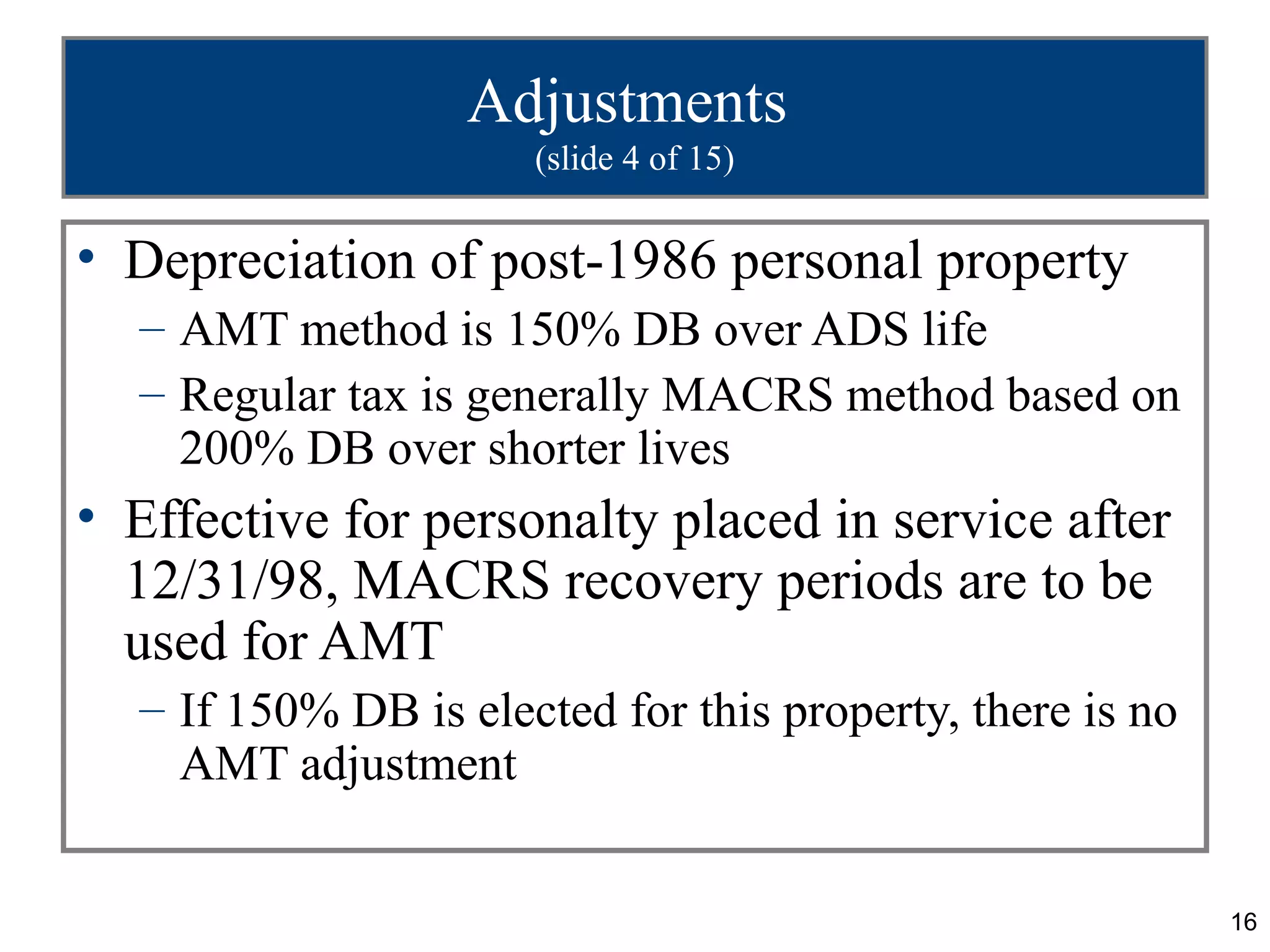
• Depreciation of post-1986 personal property
– AMT method is 150% DB over ADS life
– Regular tax is generally MACRS method based on
200% DB over shorter lives
• Effective for personalty placed in service after
12/31/98, MACRS recovery periods are to be
used for AMT
– If 150% DB is elected for this property, there is no
AMT adjustment
17
Adjustments
(slide 5 of 15)
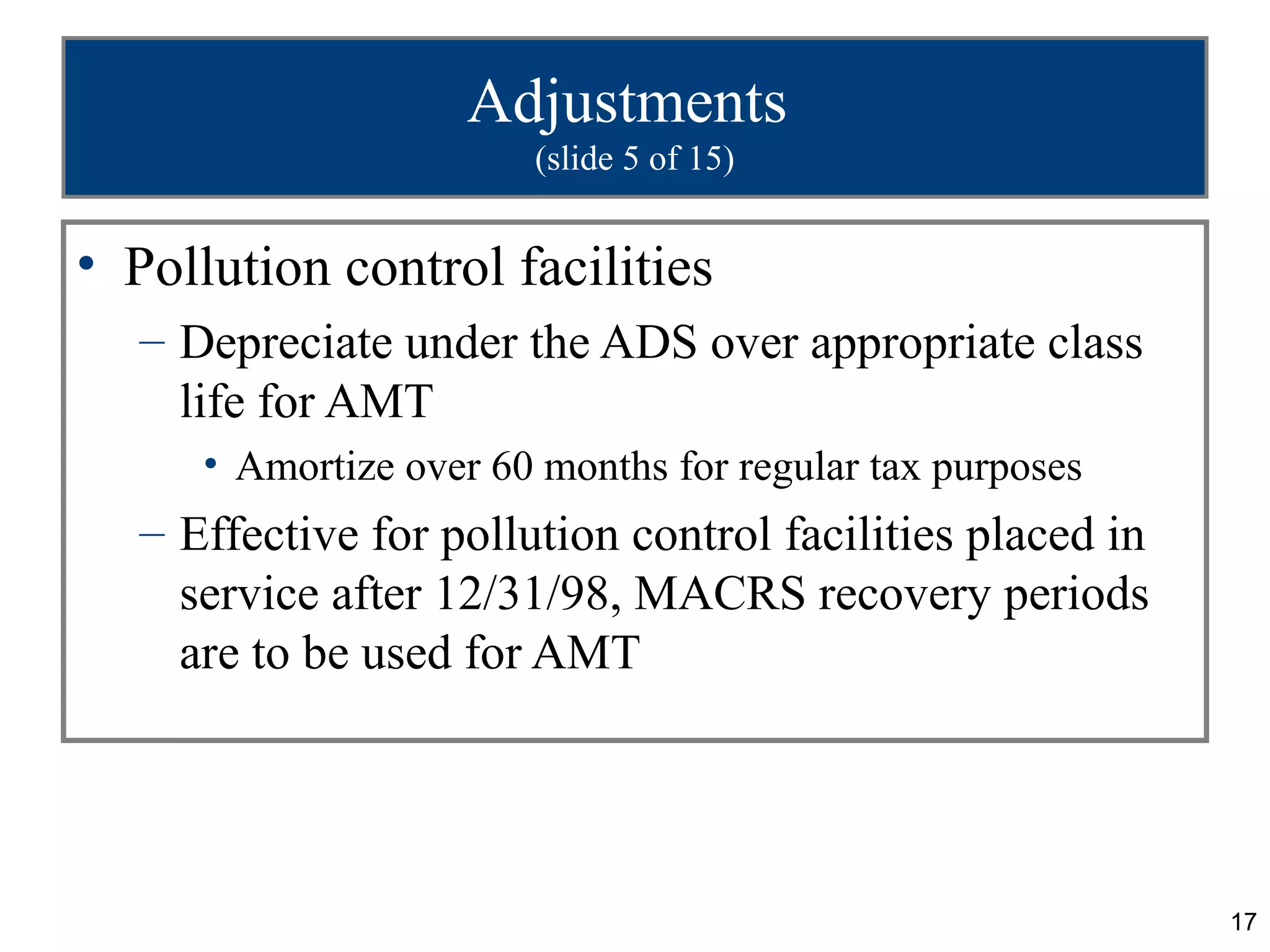
• Pollution control facilities
– Depreciate under the ADS over appropriate class
life for AMT
• Amortize over 60 months for regular tax purposes
– Effective for pollution control facilities placed in
service after 12/31/98, MACRS recovery periods
are to be used for AMT
18
Adjustments
(slide 6 of 15)
• Circulation expenditures
– Amortized over 3 years for AMT
• Expensed in year incurred for regular tax
19
Adjustments
(slide 7 of 15)
• Mining exploration/development costs and
research/experimental expenditures
– Amortized over 10 years for AMT
• Expensed in year incurred for regular tax purposes
– Taxpayer may elect to capitalize and amortize over
10 years for regular tax purposes and thus avoid
the AMT adjustment
20
Adjustments
(slide 8 of 15)
• Completed contract method
– AMT requires the use of percentage of completion
method for long-term contracts rather than
completed contract method
21
Adjustments
(slide 9 of 15)
• Incentive stock options (ISOs)
– The exercise of an ISO can cause income for AMT
purposes that is not currently taxable for regular
tax purposes
• Excess of FMV over exercise price is adjustment in the
taxable year in which the option is exercised
22
Adjustments
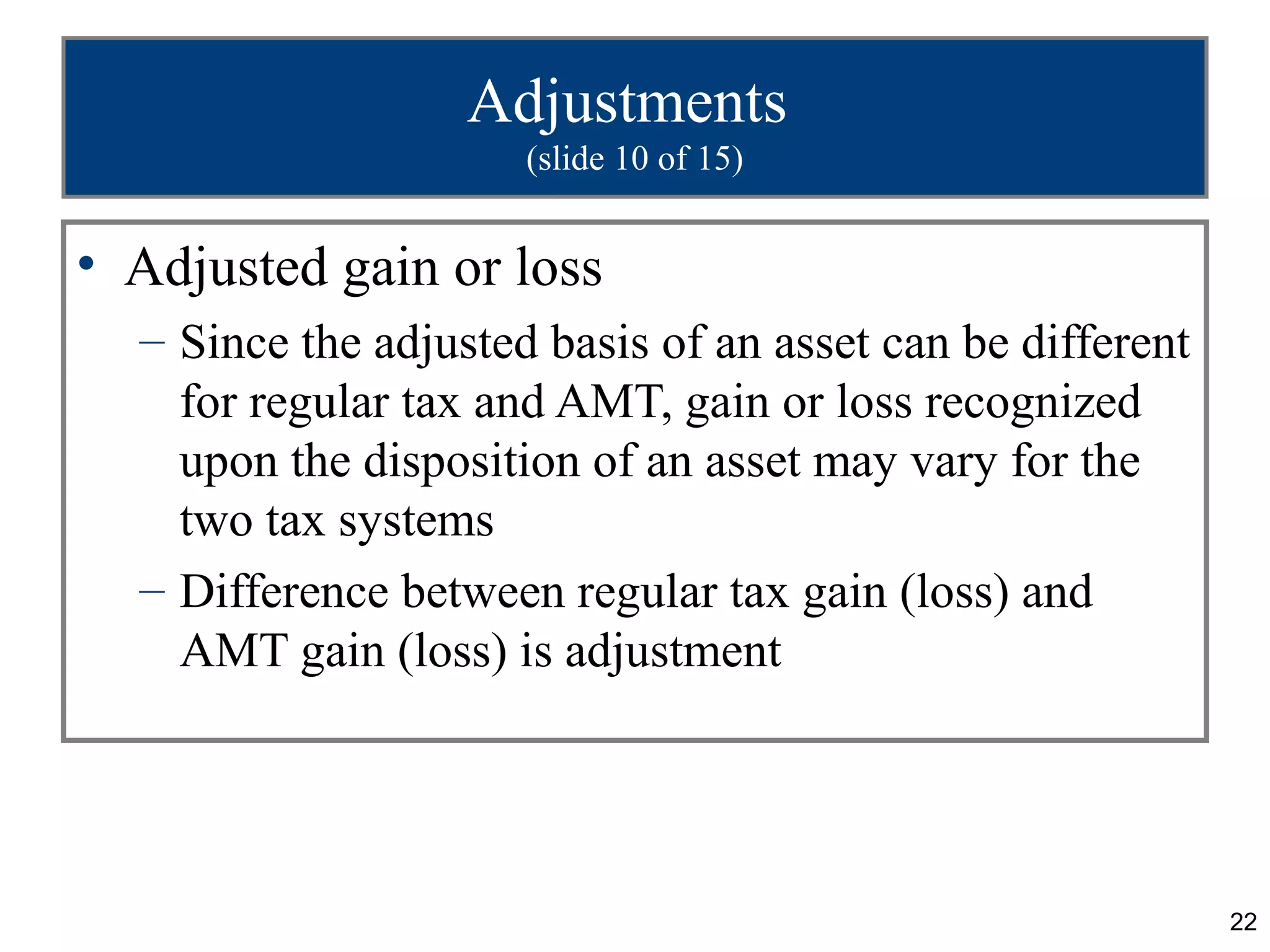
(slide 10 of 15)
• Adjusted gain or loss
– Since the adjusted basis of an asset can be different
for regular tax and AMT, gain or loss recognized
upon the disposition of an asset may vary for the
two tax systems
– Difference between regular tax gain (loss) and
AMT gain (loss) is adjustment
23
Adjustments
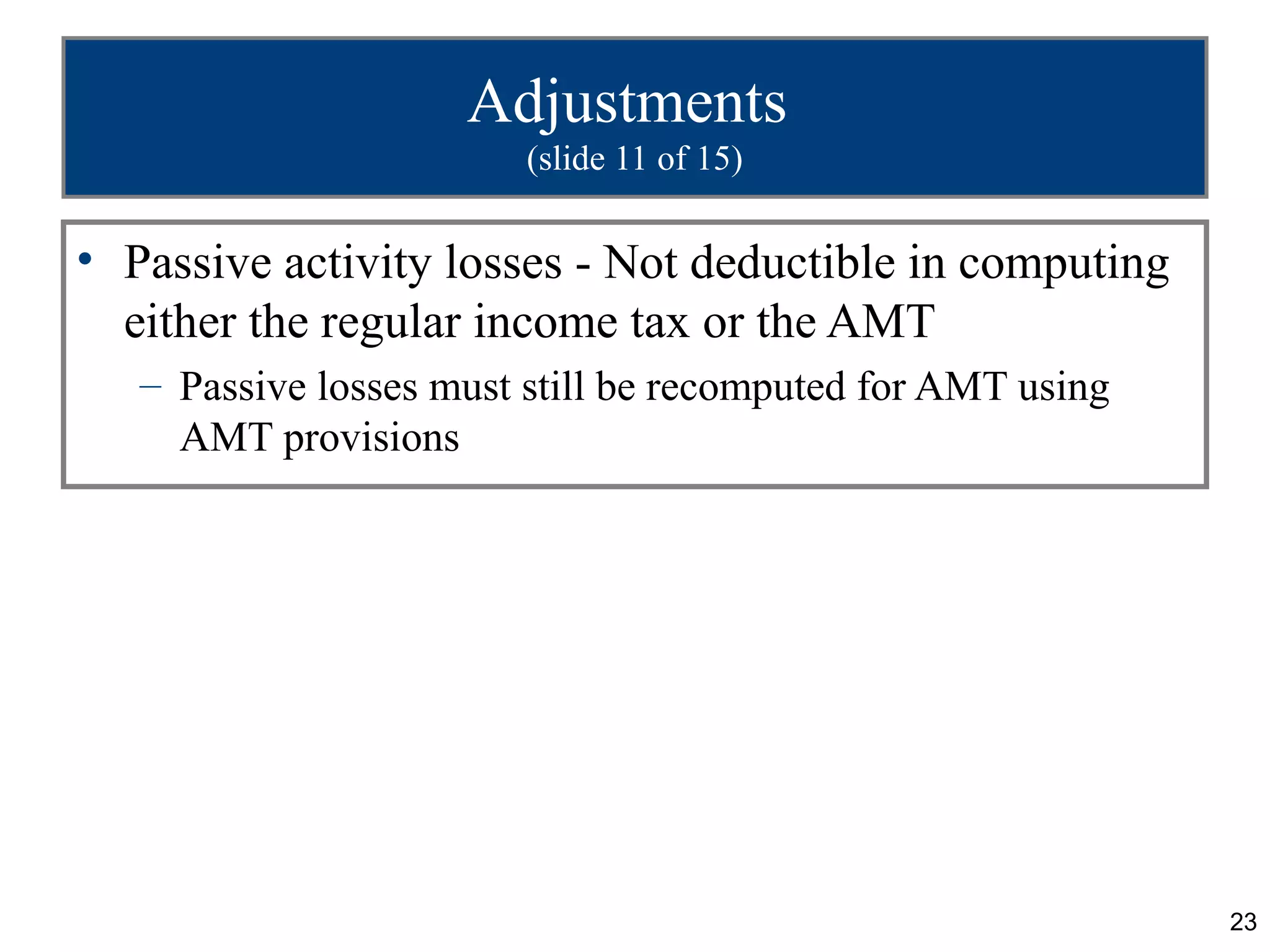
(slide 11 of 15)
• Passive activity losses - Not deductible in computing
either the regular income tax or the AMT
– Passive losses must still be recomputed for AMT using
AMT provisions
24
Adjustments
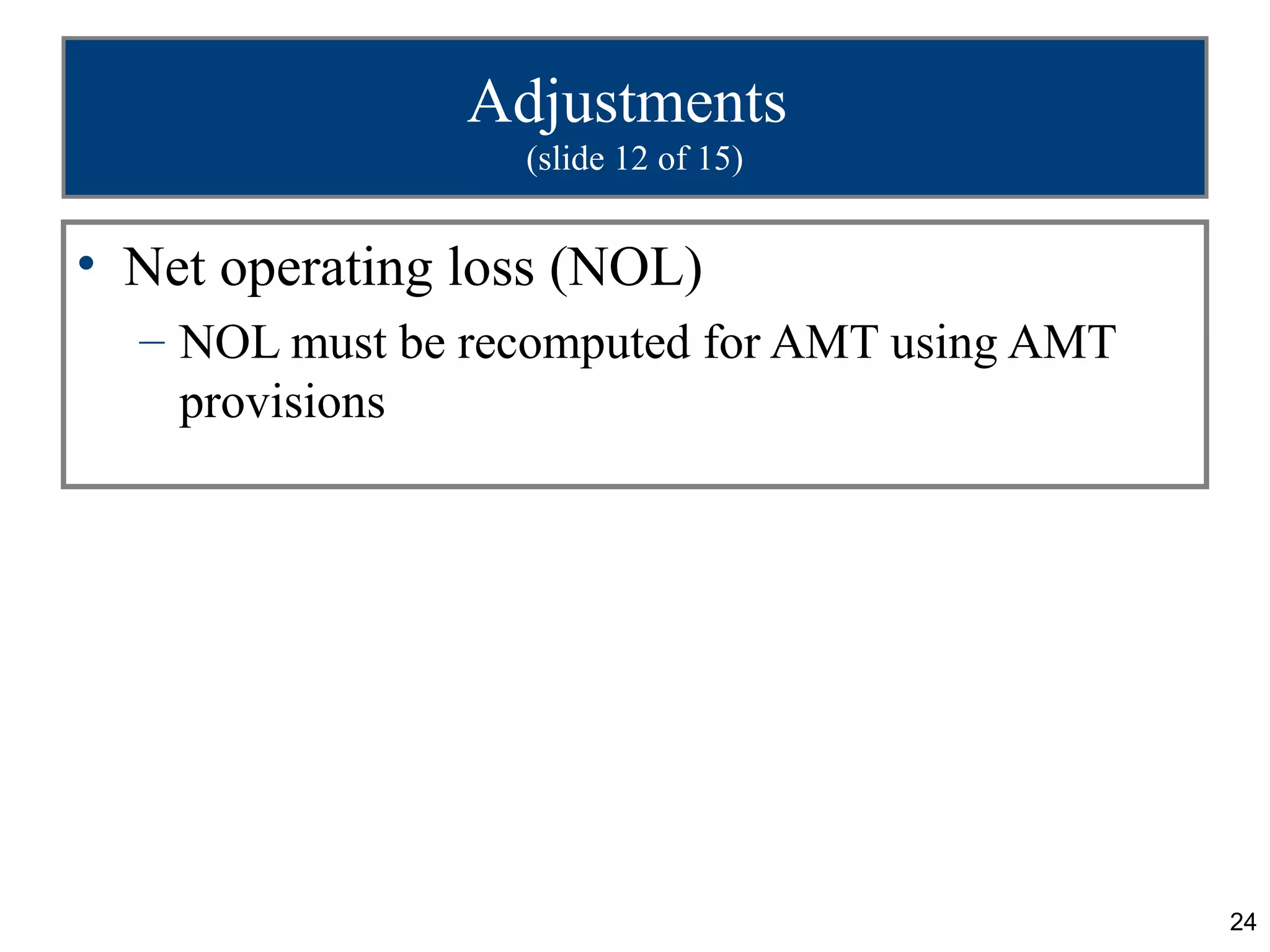
(slide 12 of 15)
• Net operating loss (NOL)
– NOL must be recomputed for AMT using AMT
provisions
25
Adjustments
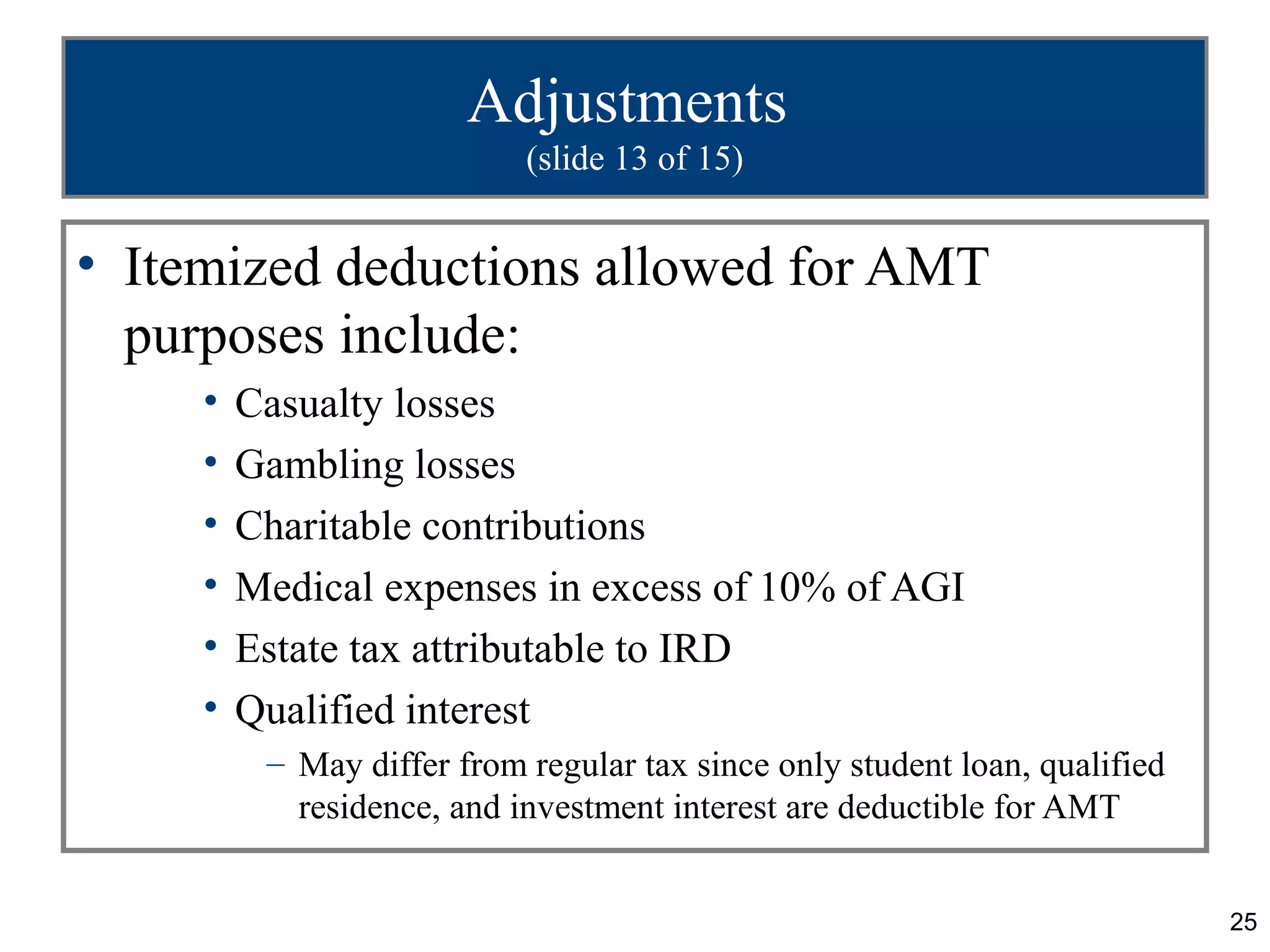
(slide 13 of 15)
• Itemized deductions allowed for AMT
purposes include:
• Casualty losses
• Gambling losses
• Charitable contributions
• Medical expenses in excess of 10% of AGI
• Estate tax attributable to IRD
• Qualified interest
– May differ from regular tax since only student loan, qualified
residence, and investment interest are deductible for AMT
26
Adjustments
(slide 14 of 15)
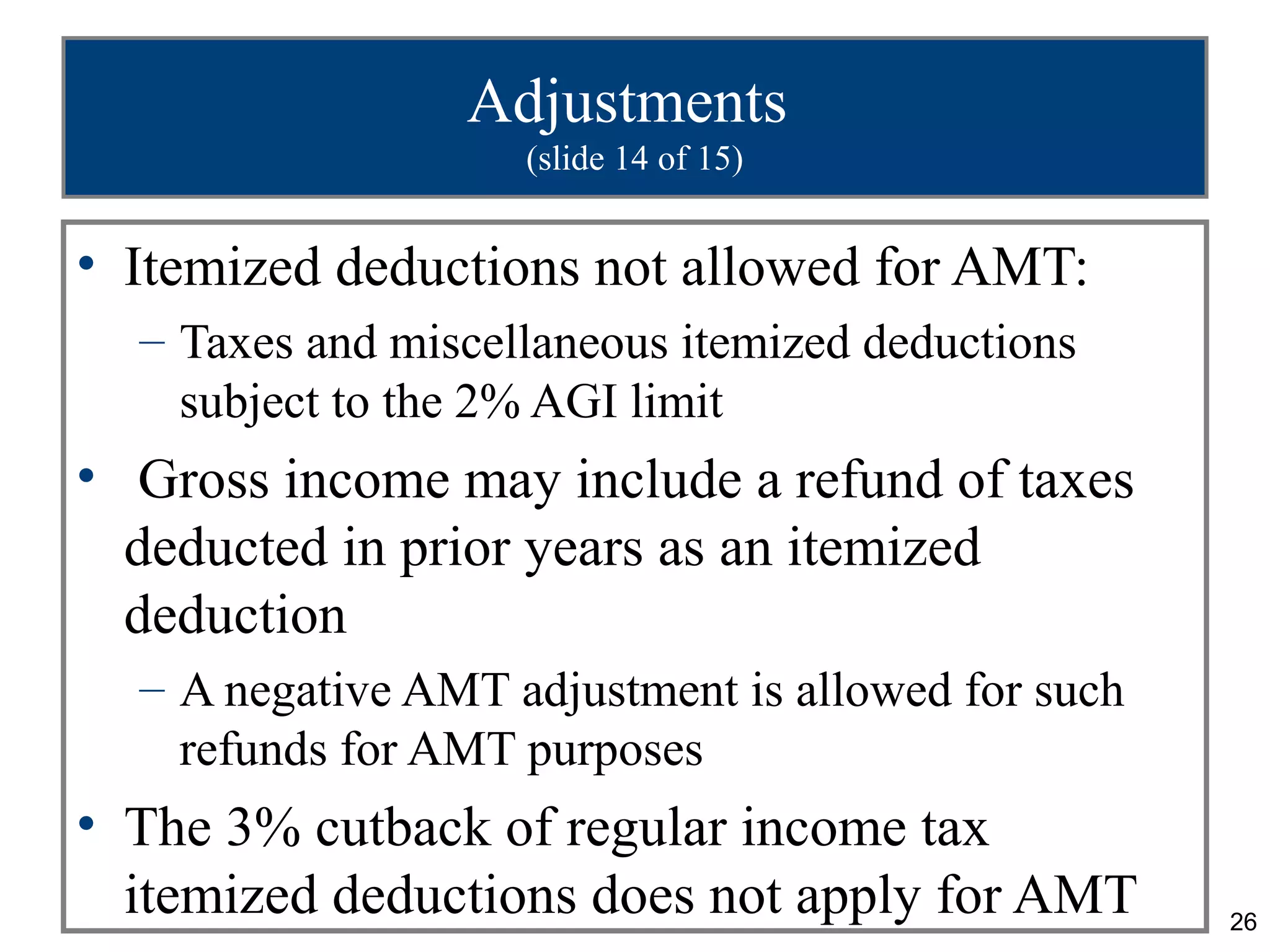
• Itemized deductions not allowed for AMT:
– Taxes and miscellaneous itemized deductions
subject to the 2% AGI limit
• Gross income may include a refund of taxes
deducted in prior years as an itemized
deduction
– A negative AMT adjustment is allowed for such
refunds for AMT purposes
• The 3% cutback of regular income tax
itemized deductions does not apply for AMT
27
Adjustments
(slide 15 of 15)
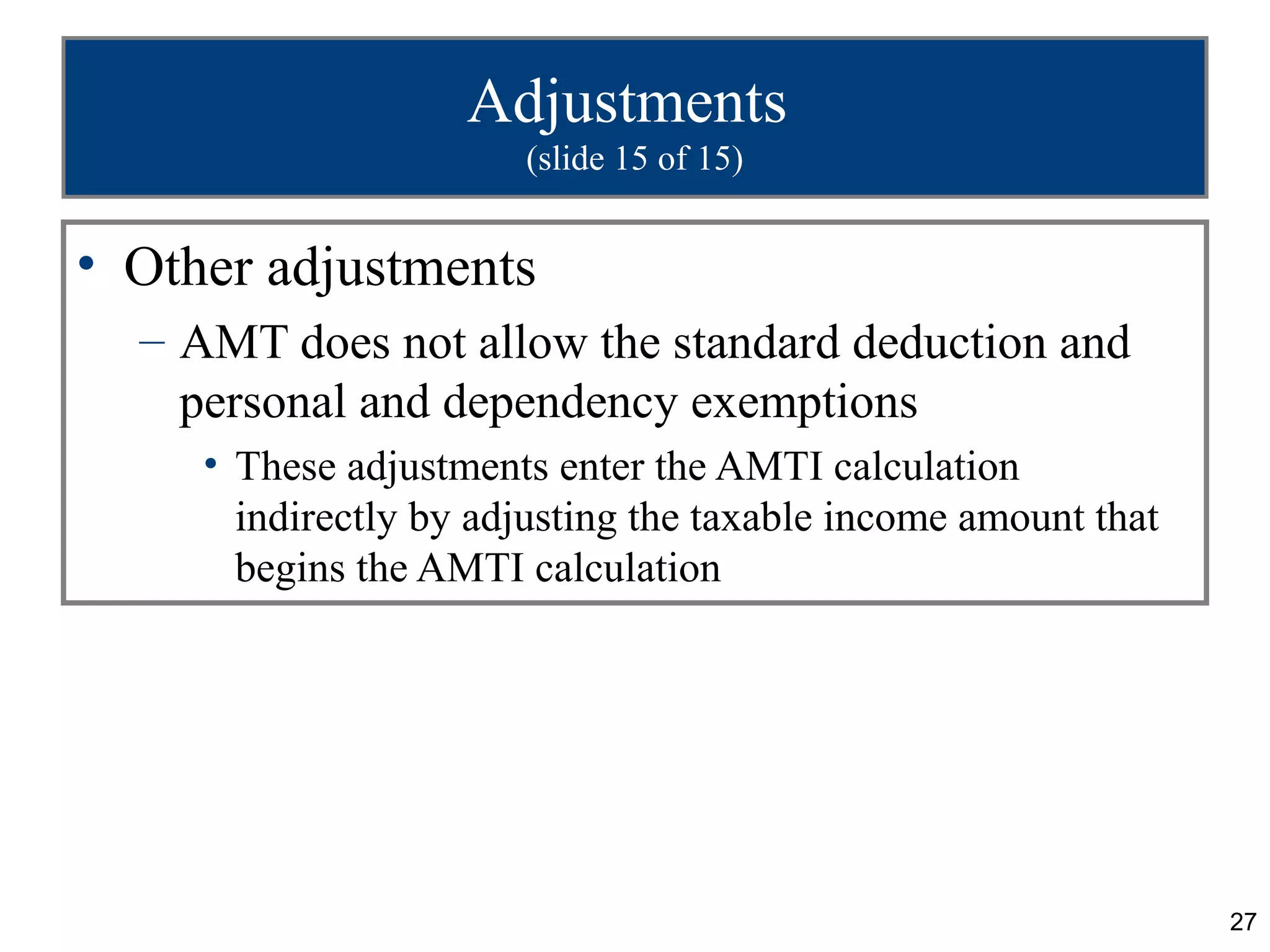
• Other adjustments
– AMT does not allow the standard deduction and
personal and dependency exemptions
• These adjustments enter the AMTI calculation
indirectly by adjusting the taxable income amount that
begins the AMTI calculation
28
Preferences
(slide 1 of 5)
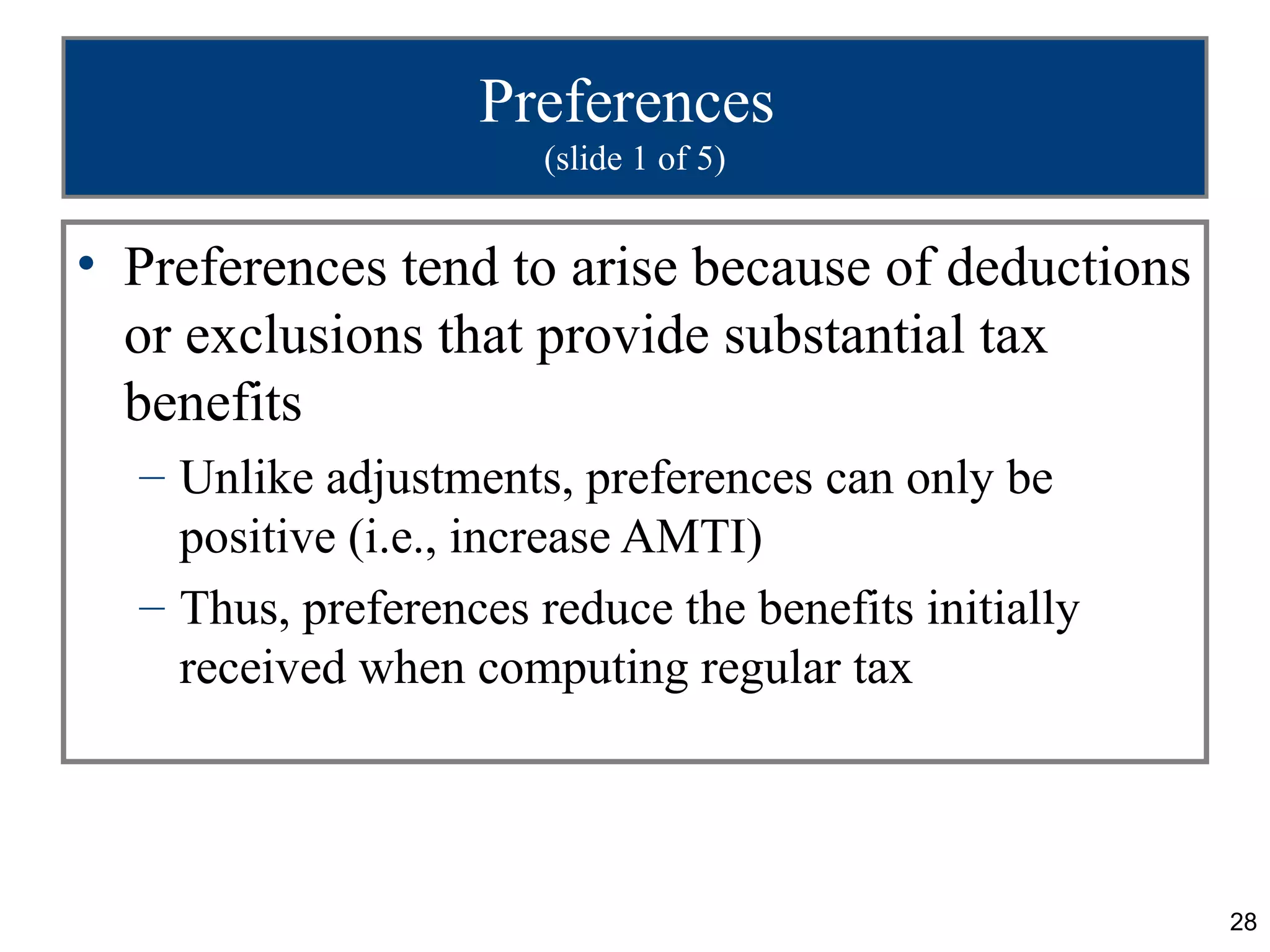
• Preferences tend to arise because of deductions
or exclusions that provide substantial tax
benefits
– Unlike adjustments, preferences can only be
positive (i.e., increase AMTI)
– Thus, preferences reduce the benefits initially
received when computing regular tax
29
Preferences
(slide 2 of 5)
• Percentage depletion
– Preference is the amount of percentage depletion
taken for regular tax which is in excess of the
adjusted basis of the property at the end of the year
30
Preferences
(slide 3 of 5)
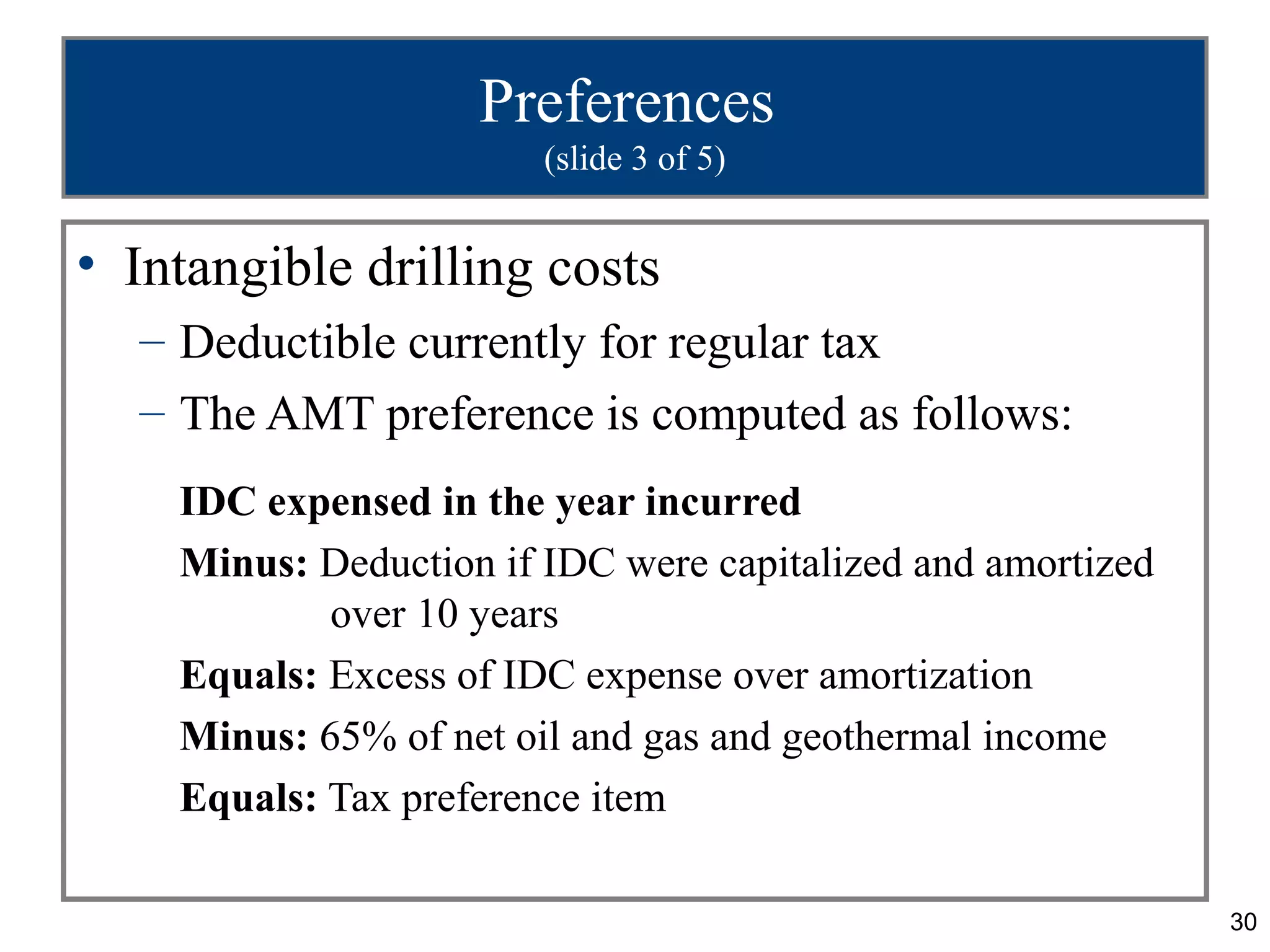
• Intangible drilling costs
– Deductible currently for regular tax
– The AMT preference is computed as follows:
IDC expensed in the year incurred
Minus: Deduction if IDC were capitalized and amortized
over 10 years
Equals: Excess of IDC expense over amortization
Minus: 65% of net oil and gas and geothermal income
Equals: Tax preference item
31
Preferences
(slide 4 of 5)
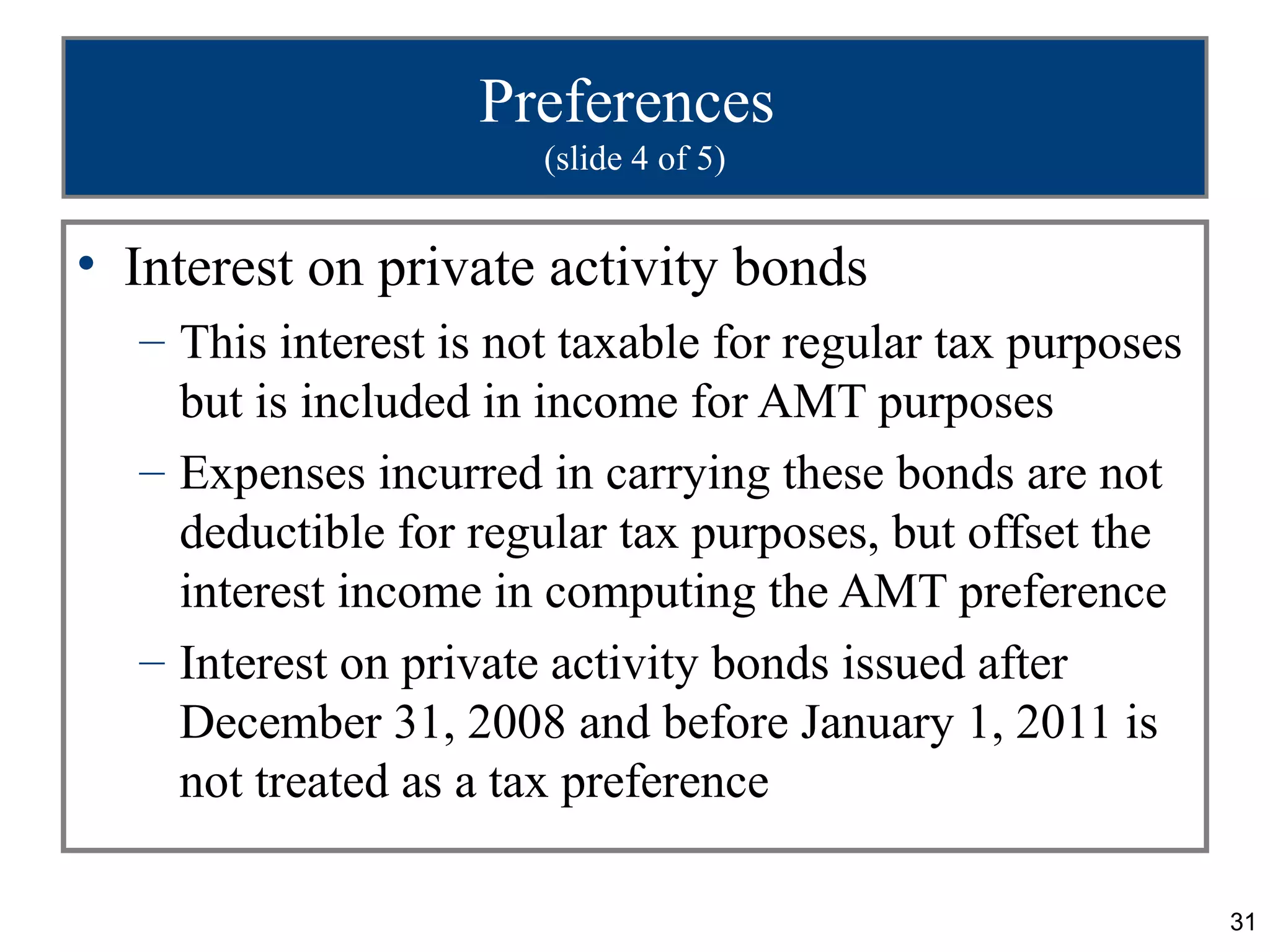
• Interest on private activity bonds
– This interest is not taxable for regular tax purposes
but is included in income for AMT purposes
– Expenses incurred in carrying these bonds are not
deductible for regular tax purposes, but offset the
interest income in computing the AMT preference
– Interest on private activity bonds issued after
December 31, 2008 and before January 1, 2011 is
not treated as a tax preference
32
Preferences
(slide 5 of 5)
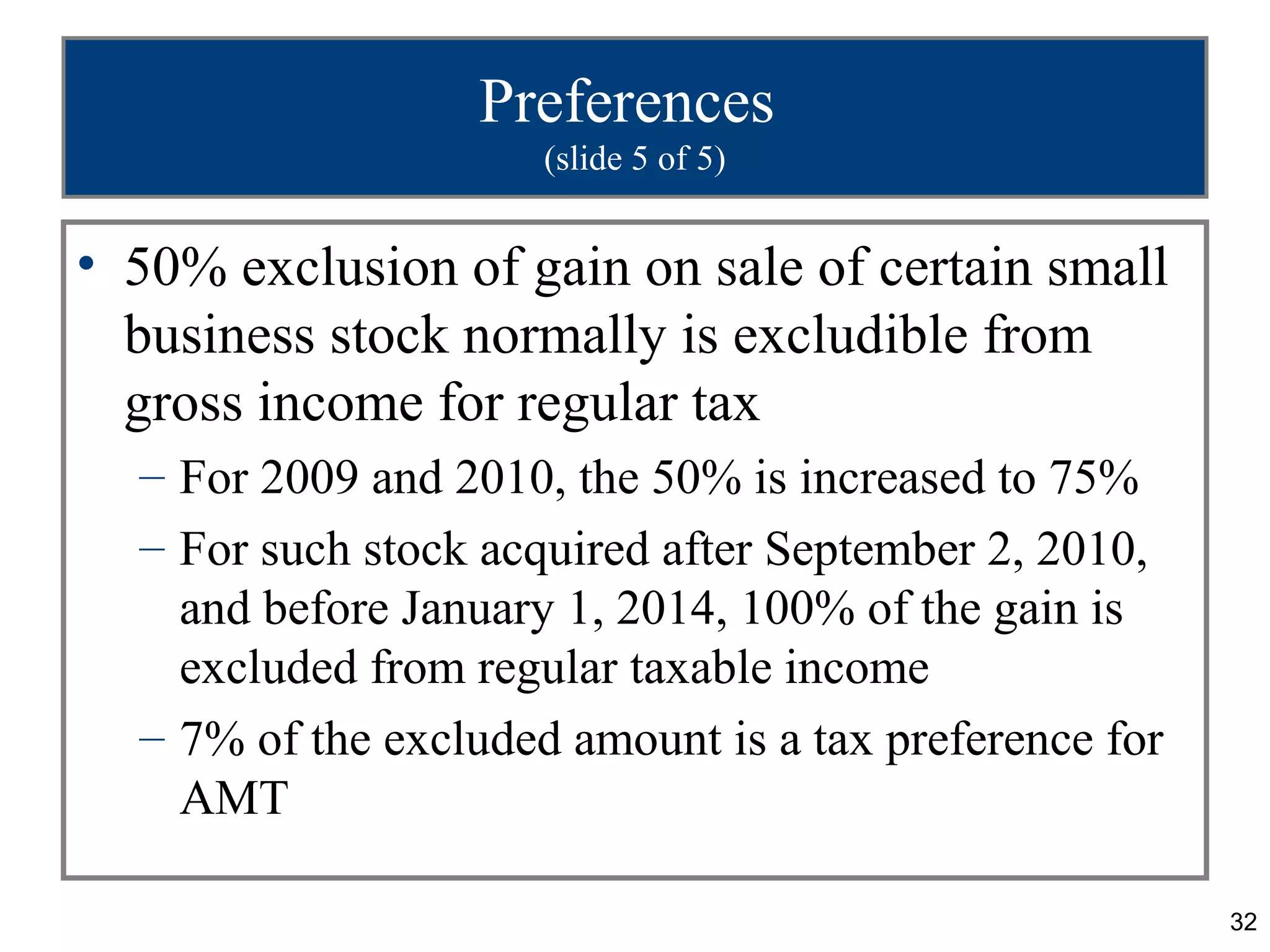
• 50% exclusion of gain on sale of certain small
business stock normally is excludible from
gross income for regular tax
– For 2009 and 2010, the 50% is increased to 75%
– For such stock acquired after September 2, 2010,
and before January 1, 2014, 100% of the gain is
excluded from regular taxable income
– 7% of the excluded amount is a tax preference for
AMT
33
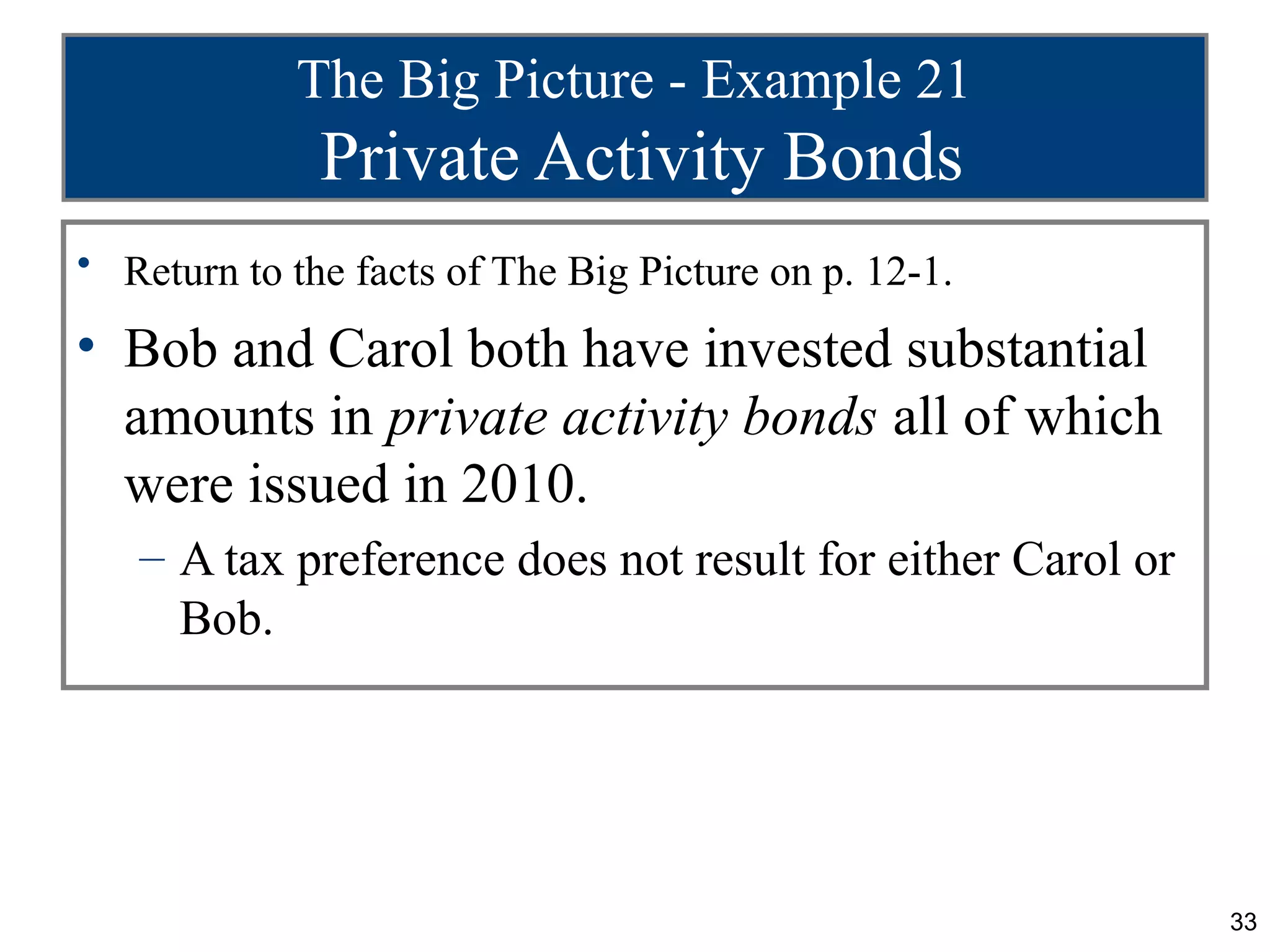
The Big Picture - Example 21
Private Activity Bonds
• Return to the facts of The Big Picture on p. 12-1.
• Bob and Carol both have invested substantial
amounts in private activity bonds all of which
were issued in 2010.
– A tax preference does not result for either Carol or
Bob.
34
AMT Credit
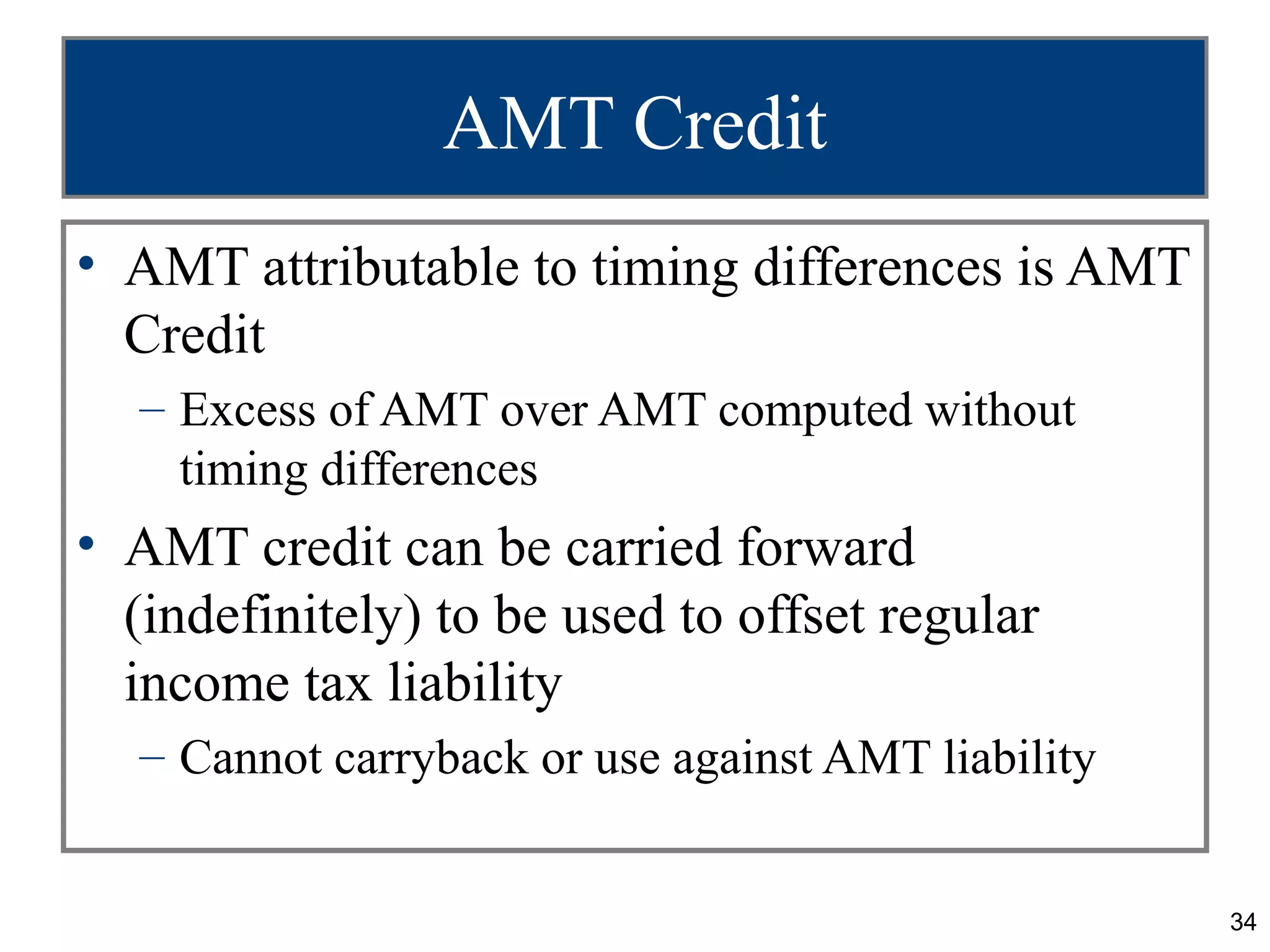
• AMT attributable to timing differences is AMT
Credit
– Excess of AMT over AMT computed without
timing differences
• AMT credit can be carried forward
(indefinitely) to be used to offset regular
income tax liability
– Cannot carryback or use against AMT liability
35
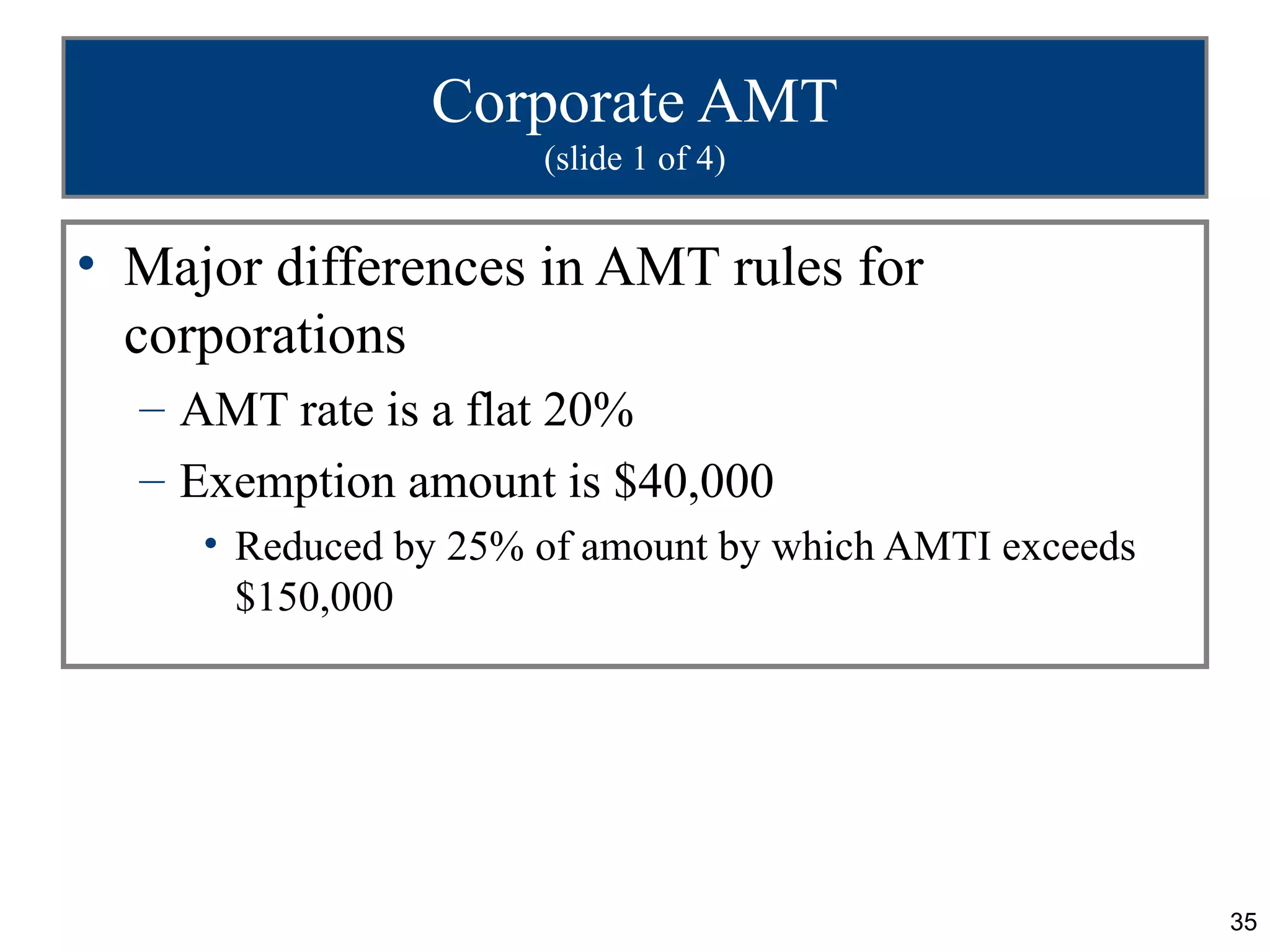
Corporate AMT
(slide 1 of 4)
• Major differences in AMT rules for
corporations
– AMT rate is a flat 20%
– Exemption amount is $40,000
• Reduced by 25% of amount by which AMTI exceeds
$150,000
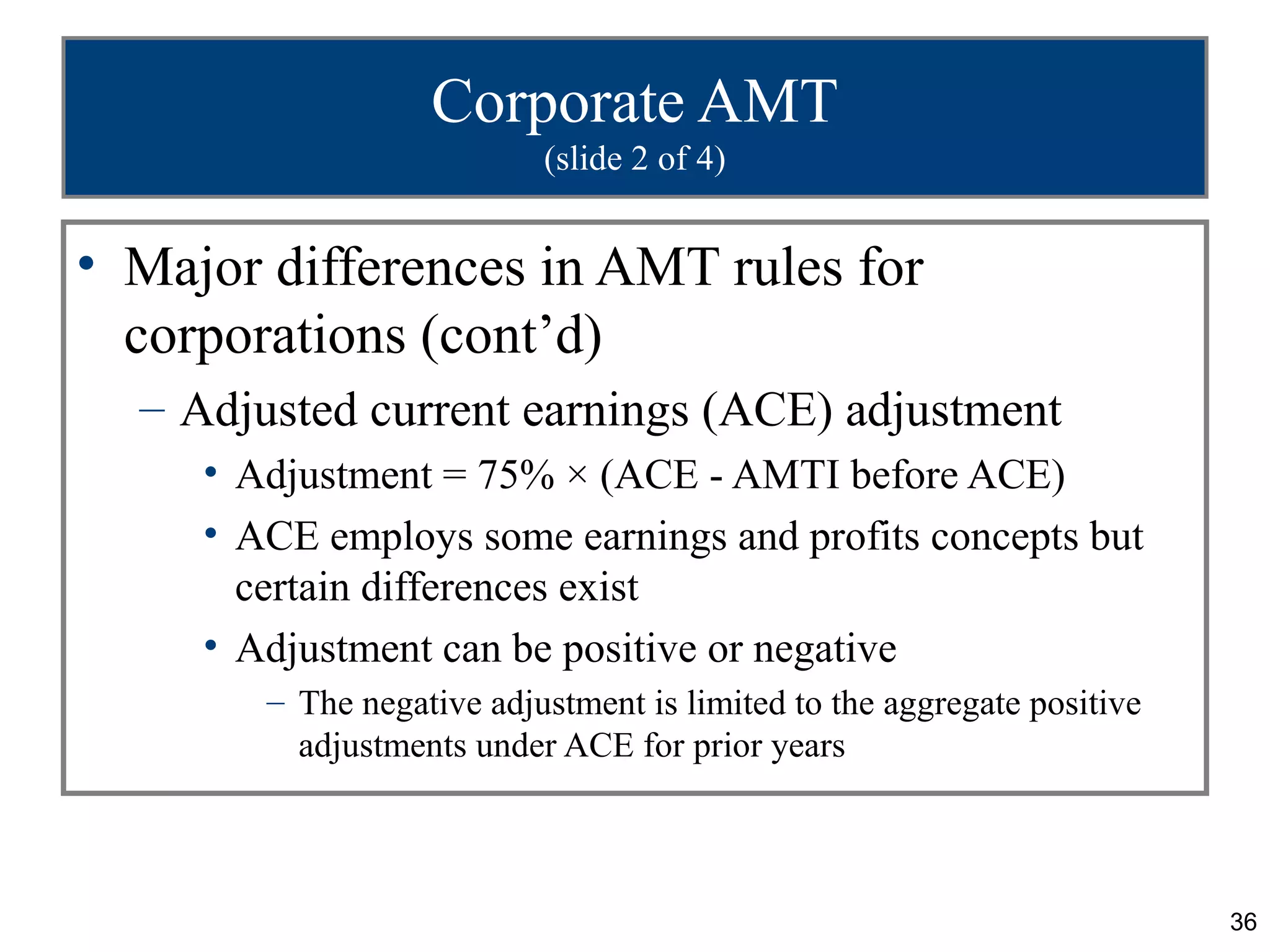
36
Corporate AMT
(slide 2 of 4)
• Major differences in AMT rules for
corporations (cont’d)
– Adjusted current earnings (ACE) adjustment
• Adjustment = 75% × (ACE - AMTI before ACE)
• ACE employs some earnings and profits concepts but
certain differences exist
• Adjustment can be positive or negative
– The negative adjustment is limited to the aggregate positive
adjustments under ACE for prior years
37
Corporate AMT
(slide 3 of 4)
• AMT is repealed for small corporations for tax years
beginning after 12/31/97
– A corporation is classified as a small corporation if both of
the following apply
• It was treated as a small corporation exempt from the AMT for all
prior years beginning after 1997
• Average gross receipts for the 3 year period ending before its
current tax year did not exceed $7.5 million
– $5 million if the corporation had only one prior tax year
– However, if a corporation ever fails the gross receipts test,
it is ineligible for small corporation classification in future
tax years
38
Corporate AMT
(slide 4 of 4)
• A new corporation is automatically classified
as a small corporation its first tax year of
existence
39
Minimum Tax Credit
• All of a corporation’s AMT is available for
carryover as a minimum tax credit
– Does not matter whether the adjustments and
preferences originate from timing differences or
AMT exclusions
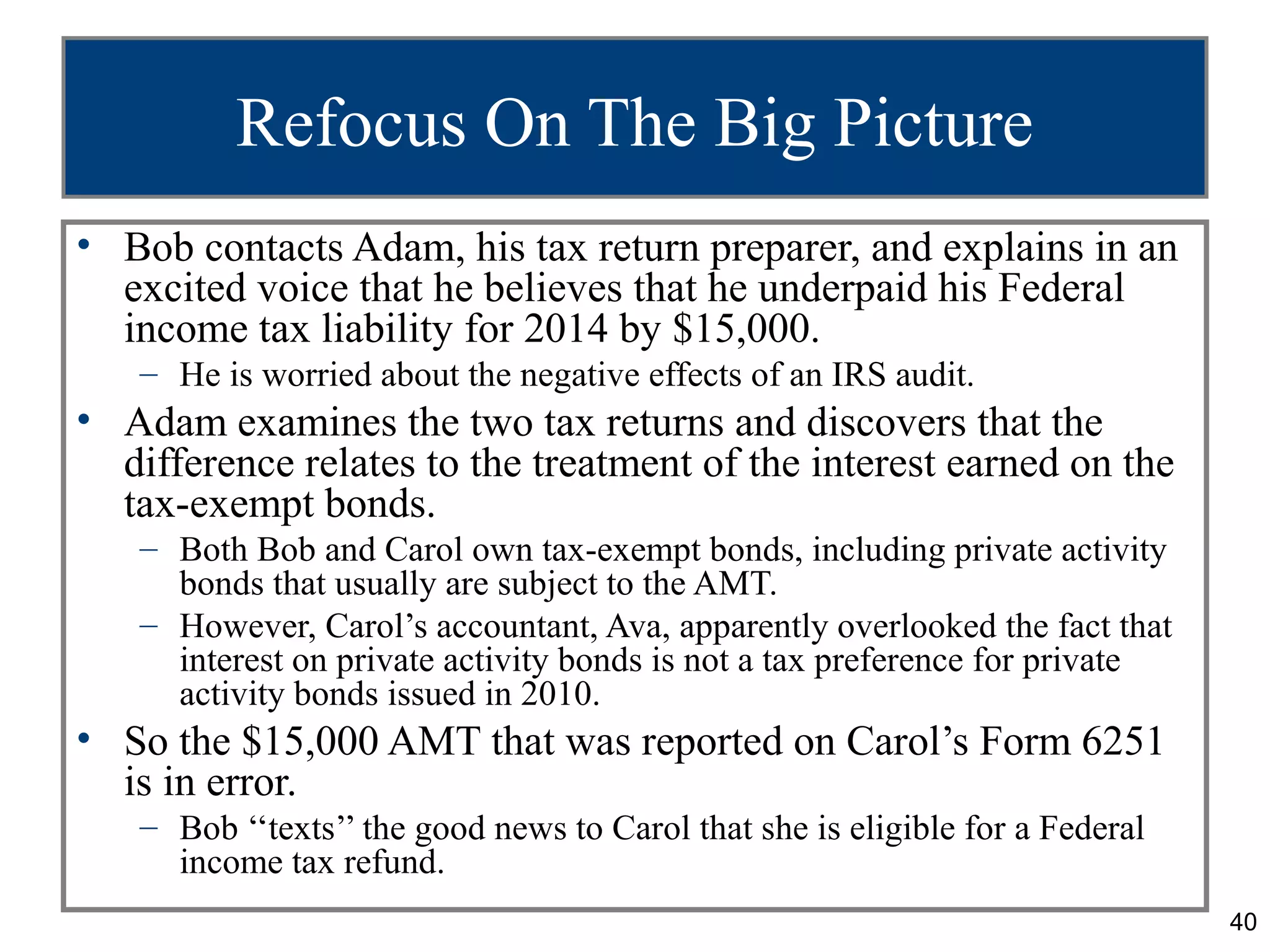
40
Refocus On The Big Picture
• Bob contacts Adam, his tax return preparer, and explains in an
excited voice that he believes that he underpaid his Federal
income tax liability for 2014 by $15,000.
– He is worried about the negative effects of an IRS audit.
• Adam examines the two tax returns and discovers that the
difference relates to the treatment of the interest earned on the
tax-exempt bonds.
– Both Bob and Carol own tax-exempt bonds, including private activity
bonds that usually are subject to the AMT.
– However, Carol’s accountant, Ava, apparently overlooked the fact that
interest on private activity bonds is not a tax preference for private
activity bonds issued in 2010.
• So the $15,000 AMT that was reported on Carol’s Form 6251
is in error.
– Bob ‘‘texts’’ the good news to Carol that she is eligible for a Federal
income tax refund.
© 2015 Cengage Learning. All Rights Reserved. May not be scanned, copied or duplicated, or posted to a publicly accessible website, in whole or in part.
41
If you have any comments or suggestions concerning this
PowerPoint Presentation for South-Western Federal
Taxation, please contact:
Dr. Donald R. Trippeer, CPA
trippedr@oneonta.edu
SUNY Oneonta

Vol 01 chapter 12 2015

  • 1.
    © 2015 CengageLearning. All Rights Reserved. May not be scanned, copied or duplicated, or posted to a publicly accessible website, in whole or in part. Individual Income Taxes 1 Chapter 12 Alternative Minimum Tax
  • 2.
    2 The Big Picture(slide 1 of 2) • Bob and Carol are unmarried individuals who have been engaged for four months. They work for the same employer and – They earn identical compensation. – They have the same amount of gross income, including the same amount of investment income, which consists solely of interest income. – They have similar investments in tax-exempt bonds that produce identical amounts of interest income. – They also have the same amount of deductions. • Carol learns that she paid $15,000 more in Federal income taxes than Bob did for the tax year.
  • 3.
    3 The Big Picture(slide 2 of 2) • The above events raise a number of interesting questions for Bob and Carol that can be answered after completing this chapter. – Why didn’t Bob and Carol have the same tax liability? – Were both tax returns properly prepared? – Should Carol consider replacing her tax return preparer Ava with Adam? – Is it possible and/or desirable for Carol to file an amended return? – Should Bob do anything? • Read the chapter and formulate your response.
  • 4.
    4 Alternative Minimum Tax(AMT) • AMT is separate from, but parallel to, the regular income tax system • The AMT computation reconciles taxable income, through adjustments and preferences, with Alternative Minimum Taxable Income (AMTI)
  • 5.
  • 6.
    6 AMT Adjustments AndPreferences (slide 1 of 3) • Most AMT adjustments relate to timing differences – Timing differences eventually reverse • Positive adjustments will be offset by negative adjustments in the future, and vice versa – Example - circulation expenditures • For regular income tax purposes, circulation expenditures can be deducted in the year incurred • For AMT purposes, however, circulation expenditures must be deducted over a three-year period • Certain AMT adjustments do not relate to timing differences – These adjustments result in a permanent difference between taxable income and AMTI • e.g., Itemized deductions
  • 7.
    7 AMT Adjustments AndPreferences (slide 2 of 3) • AMT Preferences – Designed to take back all or part of the tax benefits obtained by certain items in the computation of taxable income for regular income tax purposes • Taxable income is increased by tax preference items effectively disallowing those tax benefits for AMT purposes
  • 8.
    8 AMT Adjustments AndPreferences (slide 3 of 3) • Tax preferences include: – Percentage depletion in excess of basis – Excess intangible drilling costs – Interest on certain private activity bonds – Excess of accelerated over straight-line depreciation on real & leased personal property placed in service before 1987 – Excess of amortization allowance over depreciation on pre- 1987 certified pollution control facilities – 7% of the exclusion from gross income of gains on the sale of certain small business stock
  • 9.
    9 Other Components ofAMT (slide 1 of 3) • Exemption amount – The exemption reduces AMTI to arrive at the base on which AMT is computed – The initial exemption amount in 2014 is: • $52,800 for single • $82,100 for married, filing jointly • $41,050 for married, filing separately – The exemption is phased out at a rate of 25 cents on the dollar when AMTI exceeds certain amounts
  • 10.
    10 Other Components ofAMT (slide 2 of 3) • For 2014, the exemption and phaseout amounts are as follows:
  • 11.
    11 Other Components ofAMT (slide 3 of 3) • AMT rates – A progressive rate structure is applied to the tax base (AMTI less exemption amount) • 26% on first $182,500 ($91,250 for married, filing separately) of tax base • 28% on remaining amount of tax base – Net capital gain and qualified dividend income included in AMT base are taxed at favorable alternative tax rates (0%, 15%, or 20%)
  • 12.
    12 Personal Tax Credits •Beginning in 2012, personal nonrefundable credits are allowed to offset any AMT liability as well as any regular tax liability – e.g., Adoption Credit, Lifetime Learning Credit, and Retirement Savings Contribution Credit
  • 13.
    13 AMT Adjustments (slide 1of 15) • Adjustments tend to arise from timing differences between regular tax and AMT – Adjustments can be positive or negative, and will generally reverse in later years
  • 14.
    14 Adjustments (slide 2 of15) • The AMT depreciation adjustment for real property applies only to real property placed in service before January 1, 1999 • For real property placed in service after December 31, 1998, MACRS recovery periods apply for AMT – Thus, the AMT adjustment is effectively eliminated
  • 15.
    15 Adjustments (slide 3 of15) • For real property placed in service after 1986 (MACRS property) and before January 1, 1999 – AMT depreciation is computed under the alternative depreciation system (ADS) • Uses the straight-line method over a 40-year life – Regular tax MACRS lives are 27.5, 31.5, and 39 years
  • 16.
    16 Adjustments (slide 4 of15) • Depreciation of post-1986 personal property – AMT method is 150% DB over ADS life – Regular tax is generally MACRS method based on 200% DB over shorter lives • Effective for personalty placed in service after 12/31/98, MACRS recovery periods are to be used for AMT – If 150% DB is elected for this property, there is no AMT adjustment
  • 17.
    17 Adjustments (slide 5 of15) • Pollution control facilities – Depreciate under the ADS over appropriate class life for AMT • Amortize over 60 months for regular tax purposes – Effective for pollution control facilities placed in service after 12/31/98, MACRS recovery periods are to be used for AMT
  • 18.
    18 Adjustments (slide 6 of15) • Circulation expenditures – Amortized over 3 years for AMT • Expensed in year incurred for regular tax
  • 19.
    19 Adjustments (slide 7 of15) • Mining exploration/development costs and research/experimental expenditures – Amortized over 10 years for AMT • Expensed in year incurred for regular tax purposes – Taxpayer may elect to capitalize and amortize over 10 years for regular tax purposes and thus avoid the AMT adjustment
  • 20.
    20 Adjustments (slide 8 of15) • Completed contract method – AMT requires the use of percentage of completion method for long-term contracts rather than completed contract method
  • 21.
    21 Adjustments (slide 9 of15) • Incentive stock options (ISOs) – The exercise of an ISO can cause income for AMT purposes that is not currently taxable for regular tax purposes • Excess of FMV over exercise price is adjustment in the taxable year in which the option is exercised
  • 22.
    22 Adjustments (slide 10 of15) • Adjusted gain or loss – Since the adjusted basis of an asset can be different for regular tax and AMT, gain or loss recognized upon the disposition of an asset may vary for the two tax systems – Difference between regular tax gain (loss) and AMT gain (loss) is adjustment
  • 23.
    23 Adjustments (slide 11 of15) • Passive activity losses - Not deductible in computing either the regular income tax or the AMT – Passive losses must still be recomputed for AMT using AMT provisions
  • 24.
    24 Adjustments (slide 12 of15) • Net operating loss (NOL) – NOL must be recomputed for AMT using AMT provisions
  • 25.
    25 Adjustments (slide 13 of15) • Itemized deductions allowed for AMT purposes include: • Casualty losses • Gambling losses • Charitable contributions • Medical expenses in excess of 10% of AGI • Estate tax attributable to IRD • Qualified interest – May differ from regular tax since only student loan, qualified residence, and investment interest are deductible for AMT
  • 26.
    26 Adjustments (slide 14 of15) • Itemized deductions not allowed for AMT: – Taxes and miscellaneous itemized deductions subject to the 2% AGI limit • Gross income may include a refund of taxes deducted in prior years as an itemized deduction – A negative AMT adjustment is allowed for such refunds for AMT purposes • The 3% cutback of regular income tax itemized deductions does not apply for AMT
  • 27.
    27 Adjustments (slide 15 of15) • Other adjustments – AMT does not allow the standard deduction and personal and dependency exemptions • These adjustments enter the AMTI calculation indirectly by adjusting the taxable income amount that begins the AMTI calculation
  • 28.
    28 Preferences (slide 1 of5) • Preferences tend to arise because of deductions or exclusions that provide substantial tax benefits – Unlike adjustments, preferences can only be positive (i.e., increase AMTI) – Thus, preferences reduce the benefits initially received when computing regular tax
  • 29.
    29 Preferences (slide 2 of5) • Percentage depletion – Preference is the amount of percentage depletion taken for regular tax which is in excess of the adjusted basis of the property at the end of the year
  • 30.
    30 Preferences (slide 3 of5) • Intangible drilling costs – Deductible currently for regular tax – The AMT preference is computed as follows: IDC expensed in the year incurred Minus: Deduction if IDC were capitalized and amortized over 10 years Equals: Excess of IDC expense over amortization Minus: 65% of net oil and gas and geothermal income Equals: Tax preference item
  • 31.
    31 Preferences (slide 4 of5) • Interest on private activity bonds – This interest is not taxable for regular tax purposes but is included in income for AMT purposes – Expenses incurred in carrying these bonds are not deductible for regular tax purposes, but offset the interest income in computing the AMT preference – Interest on private activity bonds issued after December 31, 2008 and before January 1, 2011 is not treated as a tax preference
  • 32.
    32 Preferences (slide 5 of5) • 50% exclusion of gain on sale of certain small business stock normally is excludible from gross income for regular tax – For 2009 and 2010, the 50% is increased to 75% – For such stock acquired after September 2, 2010, and before January 1, 2014, 100% of the gain is excluded from regular taxable income – 7% of the excluded amount is a tax preference for AMT
  • 33.
    33 The Big Picture- Example 21 Private Activity Bonds • Return to the facts of The Big Picture on p. 12-1. • Bob and Carol both have invested substantial amounts in private activity bonds all of which were issued in 2010. – A tax preference does not result for either Carol or Bob.
  • 34.
    34 AMT Credit • AMTattributable to timing differences is AMT Credit – Excess of AMT over AMT computed without timing differences • AMT credit can be carried forward (indefinitely) to be used to offset regular income tax liability – Cannot carryback or use against AMT liability
  • 35.
    35 Corporate AMT (slide 1of 4) • Major differences in AMT rules for corporations – AMT rate is a flat 20% – Exemption amount is $40,000 • Reduced by 25% of amount by which AMTI exceeds $150,000
  • 36.
    36 Corporate AMT (slide 2of 4) • Major differences in AMT rules for corporations (cont’d) – Adjusted current earnings (ACE) adjustment • Adjustment = 75% × (ACE - AMTI before ACE) • ACE employs some earnings and profits concepts but certain differences exist • Adjustment can be positive or negative – The negative adjustment is limited to the aggregate positive adjustments under ACE for prior years
  • 37.
    37 Corporate AMT (slide 3of 4) • AMT is repealed for small corporations for tax years beginning after 12/31/97 – A corporation is classified as a small corporation if both of the following apply • It was treated as a small corporation exempt from the AMT for all prior years beginning after 1997 • Average gross receipts for the 3 year period ending before its current tax year did not exceed $7.5 million – $5 million if the corporation had only one prior tax year – However, if a corporation ever fails the gross receipts test, it is ineligible for small corporation classification in future tax years
  • 38.
    38 Corporate AMT (slide 4of 4) • A new corporation is automatically classified as a small corporation its first tax year of existence
  • 39.
    39 Minimum Tax Credit •All of a corporation’s AMT is available for carryover as a minimum tax credit – Does not matter whether the adjustments and preferences originate from timing differences or AMT exclusions
  • 40.
    40 Refocus On TheBig Picture • Bob contacts Adam, his tax return preparer, and explains in an excited voice that he believes that he underpaid his Federal income tax liability for 2014 by $15,000. – He is worried about the negative effects of an IRS audit. • Adam examines the two tax returns and discovers that the difference relates to the treatment of the interest earned on the tax-exempt bonds. – Both Bob and Carol own tax-exempt bonds, including private activity bonds that usually are subject to the AMT. – However, Carol’s accountant, Ava, apparently overlooked the fact that interest on private activity bonds is not a tax preference for private activity bonds issued in 2010. • So the $15,000 AMT that was reported on Carol’s Form 6251 is in error. – Bob ‘‘texts’’ the good news to Carol that she is eligible for a Federal income tax refund.
  • 41.
    © 2015 CengageLearning. All Rights Reserved. May not be scanned, copied or duplicated, or posted to a publicly accessible website, in whole or in part. 41 If you have any comments or suggestions concerning this PowerPoint Presentation for South-Western Federal Taxation, please contact: Dr. Donald R. Trippeer, CPA trippedr@oneonta.edu SUNY Oneonta