2012
Year-End Tax Planning
Tegan Long, Tax Senior Manager &
Michelle VanDellen, Tax Senior
Manager


                                   1
The material appearing in this presentation is for informational purposes
only and is not legal or accounting advice. Communication of this
information is not intended to create, and receipt does not constitute, a
legal relationship, including, but not limited to, an accountant-client
relationship. Although these materials may have been prepared by
professionals, they should not be used as a substitute for professional
services. If legal, accounting, or other professional advice is required, the
services of a professional should be sought.


                                                                                2
WELCOME AND AGENDA

• Scheduled Tax Changes
• Tax planning opportunities for remainder of
  2012 and into 2013:
    for you and your family
    for your business
• Health Care Update


                                                3
SCHEDULED
   TAX
 CHANGES

            4
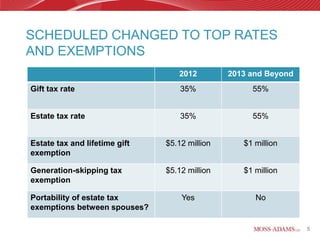
SCHEDULED CHANGED TO TOP RATES
AND EXEMPTIONS
                                  2012         2013 and Beyond
Gift tax rate                      35%              55%


Estate tax rate                    35%              55%


Estate tax and lifetime gift   $5.12 million      $1 million
exemption

Generation-skipping tax        $5.12 million      $1 million
exemption

Portability of estate tax          Yes               No
exemptions between spouses?

                                                                 5
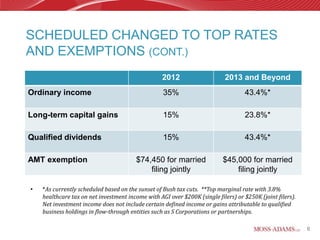
SCHEDULED CHANGED TO TOP RATES
AND EXEMPTIONS (CONT.)
                                                   2012                     2013 and Beyond
Ordinary income                                    35%                             43.4%*

Long-term capital gains                            15%                             23.8%*

Qualified dividends                                15%                             43.4%*

AMT exemption                            $74,450 for married               $45,000 for married
                                             filing jointly                    filing jointly

•   *As currently scheduled based on the sunset of Bush tax cuts. **Top marginal rate with 3.8%
    healthcare tax on net investment income with AGI over $200K (single filers) or $250K (joint filers).
    Net investment income does not include certain defined income or gains attributable to qualified
    business holdings in flow-through entities such as S Corporations or partnerships.

                                                                                                           6
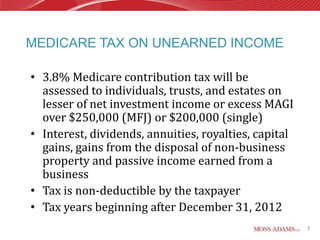
MEDICARE TAX ON UNEARNED INCOME

• 3.8% Medicare contribution tax will be
  assessed to individuals, trusts, and estates on
  lesser of net investment income or excess MAGI
  over $250,000 (MFJ) or $200,000 (single)
• Interest, dividends, annuities, royalties, capital
  gains, gains from the disposal of non-business
  property and passive income earned from a
  business
• Tax is non-deductible by the taxpayer
• Tax years beginning after December 31, 2012
                                                       7
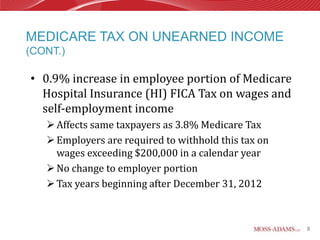
MEDICARE TAX ON UNEARNED INCOME
(CONT.)

• 0.9% increase in employee portion of Medicare
  Hospital Insurance (HI) FICA Tax on wages and
  self-employment income
    Affects same taxpayers as 3.8% Medicare Tax
    Employers are required to withhold this tax on
     wages exceeding $200,000 in a calendar year
    No change to employer portion
    Tax years beginning after December 31, 2012


                                                      8
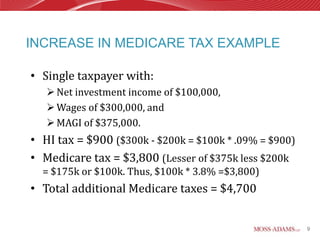
INCREASE IN MEDICARE TAX EXAMPLE

• Single taxpayer with:
    Net investment income of $100,000,
    Wages of $300,000, and
    MAGI of $375,000.
• HI tax = $900 ($300k - $200k = $100k * .09% = $900)
• Medicare tax = $3,800 (Lesser of $375k less $200k
  = $175k or $100k. Thus, $100k * 3.8% =$3,800)
• Total additional Medicare taxes = $4,700


                                                        9
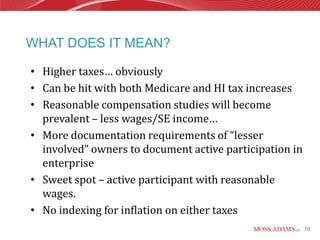
WHAT DOES IT MEAN?

• Higher taxes… obviously
• Can be hit with both Medicare and HI tax increases
• Reasonable compensation studies will become
  prevalent – less wages/SE income…
• More documentation requirements of “lesser
  involved” owners to document active participation in
  enterprise
• Sweet spot – active participant with reasonable
  wages.
• No indexing for inflation on either taxes
                                                         10
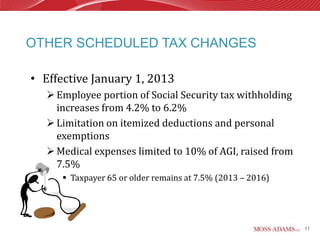
OTHER SCHEDULED TAX CHANGES

• Effective January 1, 2013
    Employee portion of Social Security tax withholding
     increases from 4.2% to 6.2%
    Limitation on itemized deductions and personal
     exemptions
    Medical expenses limited to 10% of AGI, raised from
     7.5%
       Taxpayer 65 or older remains at 7.5% (2013 – 2016)


                                                             11
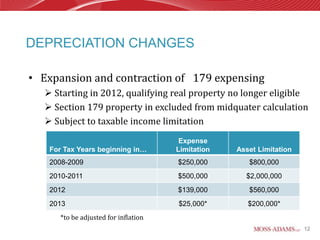
DEPRECIATION CHANGES

• Expansion and contraction of 179 expensing
   Starting in 2012, qualifying real property no longer eligible
   Section 179 property in excluded from midquater calculation
   Subject to taxable income limitation
                                       Expense
   For Tax Years beginning in…        Limitation   Asset Limitation
   2008-2009                          $250,000        $800,000
   2010-2011                          $500,000       $2,000,000
   2012                               $139,000        $560,000
   2013                               $25,000*        $200,000*
      *to be adjusted for inflation
                                                                      12
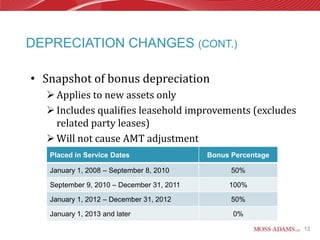
DEPRECIATION CHANGES (CONT.)

• Snapshot of bonus depreciation
   Applies to new assets only
   Includes qualifies leasehold improvements (excludes
    related party leases)
   Will not cause AMT adjustment
   Placed in Service Dates                 Bonus Percentage

   January 1, 2008 – September 8, 2010           50%

   September 9, 2010 – December 31, 2011        100%

   January 1, 2012 – December 31, 2012           50%

   January 1, 2013 and later                     0%

                                                              13
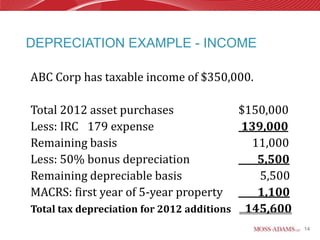
DEPRECIATION EXAMPLE - INCOME

ABC Corp has taxable income of $350,000.

Total 2012 asset purchases                $150,000
Less: IRC 179 expense                     139,000
Remaining basis                             11,000
Less: 50% bonus depreciation                 5,500
Remaining depreciable basis                  5,500
MACRS: first year of 5-year property         1,100
Total tax depreciation for 2012 additions 145,600
                                                     14
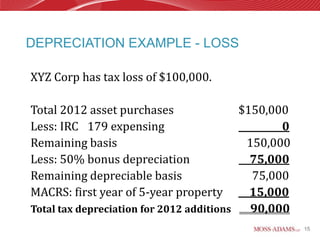
DEPRECIATION EXAMPLE - LOSS

XYZ Corp has tax loss of $100,000.

Total 2012 asset purchases                $150,000
Less: IRC 179 expensing                          0
Remaining basis                            150,000
Less: 50% bonus depreciation                75,000
Remaining depreciable basis                 75,000
MACRS: first year of 5-year property        15,000
Total tax depreciation for 2012 additions   90,000
                                                     15
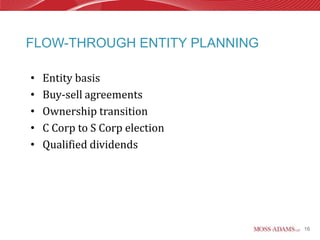
FLOW-THROUGH ENTITY PLANNING

•   Entity basis
•   Buy-sell agreements
•   Ownership transition
•   C Corp to S Corp election
•   Qualified dividends


                                16
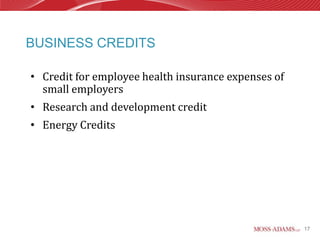
BUSINESS CREDITS

• Credit for employee health insurance expenses of
  small employers
• Research and development credit
• Energy Credits


                                                     17
PRESIDENTIAL
 PROPOSALS


               18
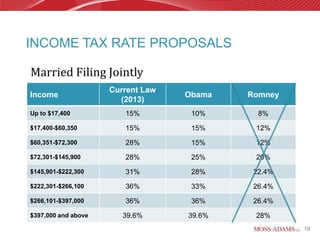
INCOME TAX RATE PROPOSALS

Married Filing Jointly
                     Current Law
Income                             Obama   Romney
                       (2013)
Up to $17,400           15%         10%      8%

$17,400-$60,350         15%         15%     12%

$60,351-$72,300         28%         15%     12%

$72,301-$145,900        28%         25%     20%
$145,901-$222,300       31%         28%     22.4%

$222,301-$266,100       36%         33%     26.4%

$266,101-$397,000       36%         36%     26.4%

$397,000 and above      39.6%      39.6%    28%
                                                    19
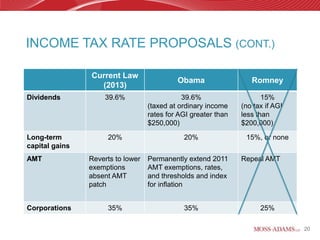
INCOME TAX RATE PROPOSALS (CONT.)

                Current Law
                                            Obama                  Romney
                  (2013)
Dividends            39.6%                    39.6%                    15%
                                   (taxed at ordinary income    (no tax if AGI
                                   rates for AGI greater than   less than
                                   $250,000)                    $200,000)

Long-term            20%                      20%                15%, or none
capital gains
AMT             Reverts to lower   Permanently extend 2011      Repeal AMT
                exemptions         AMT exemptions, rates,
                absent AMT         and thresholds and index
                patch              for inflation


Corporations         35%                      35%                     25%

                                                                                 20
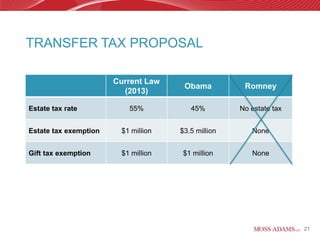
TRANSFER TAX PROPOSAL

                       Current Law
                                      Obama          Romney
                         (2013)

Estate tax rate           55%           45%         No estate tax

Estate tax exemption    $1 million   $3.5 million      None


Gift tax exemption      $1 million   $1 million        None


                                                                    21
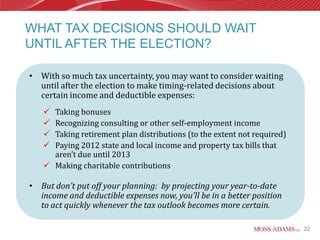
WHAT TAX DECISIONS SHOULD WAIT
UNTIL AFTER THE ELECTION?

• With so much tax uncertainty, you may want to consider waiting
  until after the election to make timing-related decisions about
  certain income and deductible expenses:
    Taking bonuses
    Recognizing consulting or other self-employment income
    Taking retirement plan distributions (to the extent not required)
    Paying 2012 state and local income and property tax bills that
     aren’t due until 2013
    Making charitable contributions

• But don’t put off your planning: by projecting your year-to-date
  income and deductible expenses now, you’ll be in a better position
  to act quickly whenever the tax outlook becomes more certain.

                                                                         22
ENTITY
SELECTION
PLANNING

            23
COMMON ENTITY TYPES - BENEFITS

• LLC
  • Single member LLC
  • “Check-the-Box” Election
• S-Corp
• C-Corp


                                 24
HEALTH CARE
  UPDATE


              25
WHAT WE’LL COVER

•   Supreme Court decision
•   Insurance Exchanges
•   Employer Mandate
•   The Future of Employer-Provided Insurance
•   Questions


                                                26
THE SUPREME COURT DECISION
• The Individual Mandate


                              27
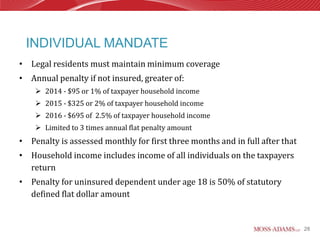
INDIVIDUAL MANDATE
• Legal residents must maintain minimum coverage
• Annual penalty if not insured, greater of:
     2014 - $95 or 1% of taxpayer household income
     2015 - $325 or 2% of taxpayer household income
     2016 - $695 of 2.5% of taxpayer household income
     Limited to 3 times annual flat penalty amount
• Penalty is assessed monthly for first three months and in full after that
• Household income includes income of all individuals on the taxpayers
  return
• Penalty for uninsured dependent under age 18 is 50% of statutory
  defined flat dollar amount


                                                                              28
COMMERCE CLAUSE

• Commerce Clause regulates activities
  conducted in interstate commerce.
• Opponents of the ACA argued that the
  individual mandate is an attempt by Congress
  to regulate inactivity and to uphold this
  provision of the ACA would grant Congress vast
  new powers.
• Supreme Court agreed.


                                                   29
IT’S NOT A TAX . . . IT IS A TAX . . .???

• The individual mandate is constitutional under
  the government’s power to tax.

• But wait . . . . “For us to say that you’ve got to
  take a responsibility to get health insurance is
  absolutely not a tax increase.”
                                         Barack Obama
                                   September 20, 2009

                                                        30
IT IS A TAX . . .

“The Affordable Care Act’s requirement that certain
individuals pay a financial penalty for not
obtaining health insurance may reasonably be
characterized as a tax. Because the Constitution
permits such a tax, it is not our role to forbid it or
to pass upon its wisdom or fairness.”

                          Chief Justice John Roberts
                                       June 28, 2012
                                                         31
THE SUPREME COURT DECISION
• The Individual Mandate
• Severability clause


                              32
THE SUPREME COURT DECISION
• The Individual Mandate
• Severability Clause
• Medicaid Expansion


                              33
WHAT HAPPENS NEXT?
The Majority of employers who have not evaluated
  their options and run the numbers……
  Were waiting for the Supreme Court….
  And then they were waiting for the
  election results……
            ….that ship has sailed!


                                                   34
INSURANCE EXCHANGES


                      35
WHAT ARE THE EXCHANGES?
SOURCE: KAISER FAMILY FOUNDATION


• State-regulated and standardized plans
• Serve primarily individuals and small businesses
  (up to 100 employees)
   States may choose to include larger employers in the
    future


                                                           36
WHAT IS THE PURPOSE OF THE
EXCHANGES?

•   Offer a choice of health plans
•   Focus competition on price
•   Provide standardized, transparent information
•   Create mechanism for enrollment
•   Administer subsidies
•   Portability of coverage


                                                    37
WHAT ARE THE EXCHANGES?
• States may run their own exchange or
• Run multiple exchanges or
    Each exchange covers a geographic area
• Join together to run multi-state exchanges or
• Opt out completely
    Federal government will step in to create an exchange
• WA State has created its exchange


                                                             38
EMPLOYER SHARED RESPONSIBILITY
              FEE
   AKA ‘PAY OR PLAY’ PENALTY


                             39
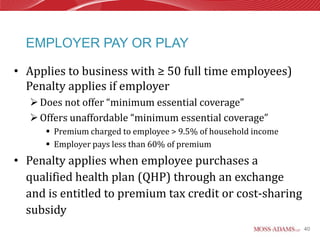
EMPLOYER PAY OR PLAY

• Applies to business with ≥ 50 full time employees)
  Penalty applies if employer
    Does not offer “minimum essential coverage”
    Offers unaffordable “minimum essential coverage”
       Premium charged to employee > 9.5% of household income
       Employer pays less than 60% of premium
• Penalty applies when employee purchases a
  qualified health plan (QHP) through an exchange
  and is entitled to premium tax credit or cost-sharing
  subsidy
                                                                 40
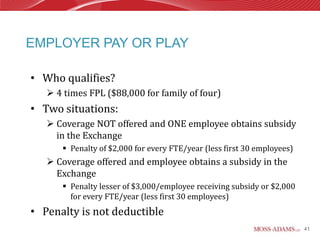
EMPLOYER PAY OR PLAY

• Who qualifies?
    4 times FPL ($88,000 for family of four)
• Two situations:
    Coverage NOT offered and ONE employee obtains subsidy
     in the Exchange
       Penalty of $2,000 for every FTE/year (less first 30 employees)
    Coverage offered and employee obtains a subsidy in the
     Exchange
       Penalty lesser of $3,000/employee receiving subsidy or $2,000
        for every FTE/year (less first 30 employees)
• Penalty is not deductible
                                                                         41
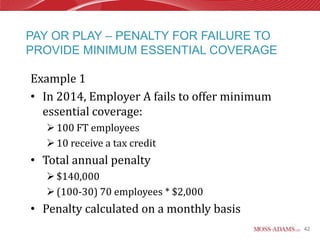
PAY OR PLAY – PENALTY FOR FAILURE TO
PROVIDE MINIMUM ESSENTIAL COVERAGE

Example 1
• In 2014, Employer A fails to offer minimum
  essential coverage:
   100 FT employees
   10 receive a tax credit
• Total annual penalty
   $140,000
   (100-30) 70 employees * $2,000
• Penalty calculated on a monthly basis
                                               42
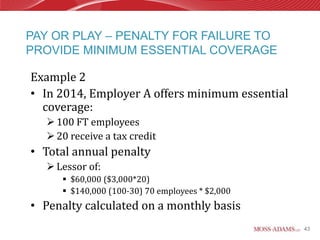
PAY OR PLAY – PENALTY FOR FAILURE TO
PROVIDE MINIMUM ESSENTIAL COVERAGE

Example 2
• In 2014, Employer A offers minimum essential
  coverage:
   100 FT employees
   20 receive a tax credit
• Total annual penalty
   Lessor of:
      $60,000 ($3,000*20)
      $140,000 (100-30) 70 employees * $2,000
• Penalty calculated on a monthly basis
                                                 43
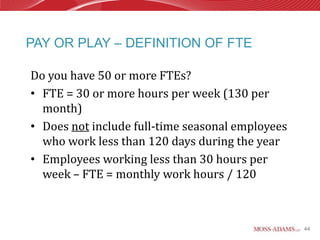
PAY OR PLAY – DEFINITION OF FTE

Do you have 50 or more FTEs?
• FTE = 30 or more hours per week (130 per
  month)
• Does not include full-time seasonal employees
  who work less than 120 days during the year
• Employees working less than 30 hours per
  week – FTE = monthly work hours / 120


                                                  44
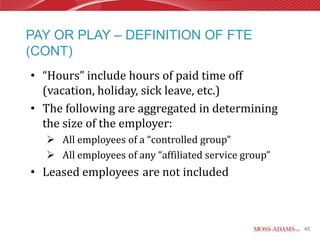
PAY OR PLAY – DEFINITION OF FTE
(CONT)
• “Hours” include hours of paid time off
  (vacation, holiday, sick leave, etc.)
• The following are aggregated in determining
  the size of the employer:
   All employees of a “controlled group”
   All employees of any “affiliated service group”
• Leased employees are not included


                                                      45
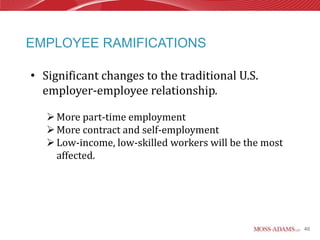
EMPLOYEE RAMIFICATIONS

• Significant changes to the traditional U.S.
  employer-employee relationship.

    More part-time employment
    More contract and self-employment
    Low-income, low-skilled workers will be the most
     affected.


                                                        46
EFFECT ON EMPLOYER-
PROVIDED INSURANCE


                      47
ASK YOURSELF THE QUESTION?
   If you could:
   • stop providing employee health benefits
   • give employees the money

   And your employees could:
   • buy their own health insurance
   • with equal or better benefits
   • for equal or lower premiums,
                 Would you do that?

                                               48
WILL EMPLOYERS KEEP HEALTH PLANS?
• Initially a coin flip
• But of those saying they will
  keep their plans, their top three
  reasons are…
        To retain current employees
        To attract future talent
        To maintain employee satisfaction
         and loyalty


                    What if the paradigm
                            shifts?
 International Foundation of Employee Benefits “2012 Employer Action Survey”   49
QUESTIONS?

Tegan Long, CPA
Tax Senior Manager
(360) 676-1920
Tegan.Long@mossadams.com

Michelle VanDellen, CPA
Tax Senior Manager
(360) 676-1920
Michelle.vandellen@mossadams.com
                                   50
THANK YOU


            51

TAG Luncheon: 2012 Tax Update

  • 1.
    2012 Year-End Tax Planning TeganLong, Tax Senior Manager & Michelle VanDellen, Tax Senior Manager 1
  • 2.
    The material appearingin this presentation is for informational purposes only and is not legal or accounting advice. Communication of this information is not intended to create, and receipt does not constitute, a legal relationship, including, but not limited to, an accountant-client relationship. Although these materials may have been prepared by professionals, they should not be used as a substitute for professional services. If legal, accounting, or other professional advice is required, the services of a professional should be sought. 2
  • 3.
    WELCOME AND AGENDA •Scheduled Tax Changes • Tax planning opportunities for remainder of 2012 and into 2013:  for you and your family  for your business • Health Care Update 3
  • 4.
    SCHEDULED TAX CHANGES 4
  • 5.
    SCHEDULED CHANGED TOTOP RATES AND EXEMPTIONS 2012 2013 and Beyond Gift tax rate 35% 55% Estate tax rate 35% 55% Estate tax and lifetime gift $5.12 million $1 million exemption Generation-skipping tax $5.12 million $1 million exemption Portability of estate tax Yes No exemptions between spouses? 5
  • 6.
    SCHEDULED CHANGED TOTOP RATES AND EXEMPTIONS (CONT.) 2012 2013 and Beyond Ordinary income 35% 43.4%* Long-term capital gains 15% 23.8%* Qualified dividends 15% 43.4%* AMT exemption $74,450 for married $45,000 for married filing jointly filing jointly • *As currently scheduled based on the sunset of Bush tax cuts. **Top marginal rate with 3.8% healthcare tax on net investment income with AGI over $200K (single filers) or $250K (joint filers). Net investment income does not include certain defined income or gains attributable to qualified business holdings in flow-through entities such as S Corporations or partnerships. 6
  • 7.
    MEDICARE TAX ONUNEARNED INCOME • 3.8% Medicare contribution tax will be assessed to individuals, trusts, and estates on lesser of net investment income or excess MAGI over $250,000 (MFJ) or $200,000 (single) • Interest, dividends, annuities, royalties, capital gains, gains from the disposal of non-business property and passive income earned from a business • Tax is non-deductible by the taxpayer • Tax years beginning after December 31, 2012 7
  • 8.
    MEDICARE TAX ONUNEARNED INCOME (CONT.) • 0.9% increase in employee portion of Medicare Hospital Insurance (HI) FICA Tax on wages and self-employment income  Affects same taxpayers as 3.8% Medicare Tax  Employers are required to withhold this tax on wages exceeding $200,000 in a calendar year  No change to employer portion  Tax years beginning after December 31, 2012 8
  • 9.
    INCREASE IN MEDICARETAX EXAMPLE • Single taxpayer with:  Net investment income of $100,000,  Wages of $300,000, and  MAGI of $375,000. • HI tax = $900 ($300k - $200k = $100k * .09% = $900) • Medicare tax = $3,800 (Lesser of $375k less $200k = $175k or $100k. Thus, $100k * 3.8% =$3,800) • Total additional Medicare taxes = $4,700 9
  • 10.
    WHAT DOES ITMEAN? • Higher taxes… obviously • Can be hit with both Medicare and HI tax increases • Reasonable compensation studies will become prevalent – less wages/SE income… • More documentation requirements of “lesser involved” owners to document active participation in enterprise • Sweet spot – active participant with reasonable wages. • No indexing for inflation on either taxes 10
  • 11.
    OTHER SCHEDULED TAXCHANGES • Effective January 1, 2013  Employee portion of Social Security tax withholding increases from 4.2% to 6.2%  Limitation on itemized deductions and personal exemptions  Medical expenses limited to 10% of AGI, raised from 7.5%  Taxpayer 65 or older remains at 7.5% (2013 – 2016) 11
  • 12.
    DEPRECIATION CHANGES • Expansionand contraction of 179 expensing  Starting in 2012, qualifying real property no longer eligible  Section 179 property in excluded from midquater calculation  Subject to taxable income limitation Expense For Tax Years beginning in… Limitation Asset Limitation 2008-2009 $250,000 $800,000 2010-2011 $500,000 $2,000,000 2012 $139,000 $560,000 2013 $25,000* $200,000* *to be adjusted for inflation 12
  • 13.
    DEPRECIATION CHANGES (CONT.) •Snapshot of bonus depreciation  Applies to new assets only  Includes qualifies leasehold improvements (excludes related party leases)  Will not cause AMT adjustment Placed in Service Dates Bonus Percentage January 1, 2008 – September 8, 2010 50% September 9, 2010 – December 31, 2011 100% January 1, 2012 – December 31, 2012 50% January 1, 2013 and later 0% 13
  • 14.
    DEPRECIATION EXAMPLE -INCOME ABC Corp has taxable income of $350,000. Total 2012 asset purchases $150,000 Less: IRC 179 expense 139,000 Remaining basis 11,000 Less: 50% bonus depreciation 5,500 Remaining depreciable basis 5,500 MACRS: first year of 5-year property 1,100 Total tax depreciation for 2012 additions 145,600 14
  • 15.
    DEPRECIATION EXAMPLE -LOSS XYZ Corp has tax loss of $100,000. Total 2012 asset purchases $150,000 Less: IRC 179 expensing 0 Remaining basis 150,000 Less: 50% bonus depreciation 75,000 Remaining depreciable basis 75,000 MACRS: first year of 5-year property 15,000 Total tax depreciation for 2012 additions 90,000 15
  • 16.
    FLOW-THROUGH ENTITY PLANNING • Entity basis • Buy-sell agreements • Ownership transition • C Corp to S Corp election • Qualified dividends 16
  • 17.
    BUSINESS CREDITS • Creditfor employee health insurance expenses of small employers • Research and development credit • Energy Credits 17
  • 18.
  • 19.
    INCOME TAX RATEPROPOSALS Married Filing Jointly Current Law Income Obama Romney (2013) Up to $17,400 15% 10% 8% $17,400-$60,350 15% 15% 12% $60,351-$72,300 28% 15% 12% $72,301-$145,900 28% 25% 20% $145,901-$222,300 31% 28% 22.4% $222,301-$266,100 36% 33% 26.4% $266,101-$397,000 36% 36% 26.4% $397,000 and above 39.6% 39.6% 28% 19
  • 20.
    INCOME TAX RATEPROPOSALS (CONT.) Current Law Obama Romney (2013) Dividends 39.6% 39.6% 15% (taxed at ordinary income (no tax if AGI rates for AGI greater than less than $250,000) $200,000) Long-term 20% 20% 15%, or none capital gains AMT Reverts to lower Permanently extend 2011 Repeal AMT exemptions AMT exemptions, rates, absent AMT and thresholds and index patch for inflation Corporations 35% 35% 25% 20
  • 21.
    TRANSFER TAX PROPOSAL Current Law Obama Romney (2013) Estate tax rate 55% 45% No estate tax Estate tax exemption $1 million $3.5 million None Gift tax exemption $1 million $1 million None 21
  • 22.
    WHAT TAX DECISIONSSHOULD WAIT UNTIL AFTER THE ELECTION? • With so much tax uncertainty, you may want to consider waiting until after the election to make timing-related decisions about certain income and deductible expenses:  Taking bonuses  Recognizing consulting or other self-employment income  Taking retirement plan distributions (to the extent not required)  Paying 2012 state and local income and property tax bills that aren’t due until 2013  Making charitable contributions • But don’t put off your planning: by projecting your year-to-date income and deductible expenses now, you’ll be in a better position to act quickly whenever the tax outlook becomes more certain. 22
  • 23.
  • 24.
    COMMON ENTITY TYPES- BENEFITS • LLC • Single member LLC • “Check-the-Box” Election • S-Corp • C-Corp 24
  • 25.
    HEALTH CARE UPDATE 25
  • 26.
    WHAT WE’LL COVER • Supreme Court decision • Insurance Exchanges • Employer Mandate • The Future of Employer-Provided Insurance • Questions 26
  • 27.
    THE SUPREME COURTDECISION • The Individual Mandate 27
  • 28.
    INDIVIDUAL MANDATE • Legalresidents must maintain minimum coverage • Annual penalty if not insured, greater of:  2014 - $95 or 1% of taxpayer household income  2015 - $325 or 2% of taxpayer household income  2016 - $695 of 2.5% of taxpayer household income  Limited to 3 times annual flat penalty amount • Penalty is assessed monthly for first three months and in full after that • Household income includes income of all individuals on the taxpayers return • Penalty for uninsured dependent under age 18 is 50% of statutory defined flat dollar amount 28
  • 29.
    COMMERCE CLAUSE • CommerceClause regulates activities conducted in interstate commerce. • Opponents of the ACA argued that the individual mandate is an attempt by Congress to regulate inactivity and to uphold this provision of the ACA would grant Congress vast new powers. • Supreme Court agreed. 29
  • 30.
    IT’S NOT ATAX . . . IT IS A TAX . . .??? • The individual mandate is constitutional under the government’s power to tax. • But wait . . . . “For us to say that you’ve got to take a responsibility to get health insurance is absolutely not a tax increase.” Barack Obama September 20, 2009 30
  • 31.
    IT IS ATAX . . . “The Affordable Care Act’s requirement that certain individuals pay a financial penalty for not obtaining health insurance may reasonably be characterized as a tax. Because the Constitution permits such a tax, it is not our role to forbid it or to pass upon its wisdom or fairness.” Chief Justice John Roberts June 28, 2012 31
  • 32.
    THE SUPREME COURTDECISION • The Individual Mandate • Severability clause 32
  • 33.
    THE SUPREME COURTDECISION • The Individual Mandate • Severability Clause • Medicaid Expansion 33
  • 34.
    WHAT HAPPENS NEXT? TheMajority of employers who have not evaluated their options and run the numbers…… Were waiting for the Supreme Court…. And then they were waiting for the election results…… ….that ship has sailed! 34
  • 35.
  • 36.
    WHAT ARE THEEXCHANGES? SOURCE: KAISER FAMILY FOUNDATION • State-regulated and standardized plans • Serve primarily individuals and small businesses (up to 100 employees)  States may choose to include larger employers in the future 36
  • 37.
    WHAT IS THEPURPOSE OF THE EXCHANGES? • Offer a choice of health plans • Focus competition on price • Provide standardized, transparent information • Create mechanism for enrollment • Administer subsidies • Portability of coverage 37
  • 38.
    WHAT ARE THEEXCHANGES? • States may run their own exchange or • Run multiple exchanges or  Each exchange covers a geographic area • Join together to run multi-state exchanges or • Opt out completely  Federal government will step in to create an exchange • WA State has created its exchange 38
  • 39.
    EMPLOYER SHARED RESPONSIBILITY FEE AKA ‘PAY OR PLAY’ PENALTY 39
  • 40.
    EMPLOYER PAY ORPLAY • Applies to business with ≥ 50 full time employees) Penalty applies if employer  Does not offer “minimum essential coverage”  Offers unaffordable “minimum essential coverage”  Premium charged to employee > 9.5% of household income  Employer pays less than 60% of premium • Penalty applies when employee purchases a qualified health plan (QHP) through an exchange and is entitled to premium tax credit or cost-sharing subsidy 40
  • 41.
    EMPLOYER PAY ORPLAY • Who qualifies?  4 times FPL ($88,000 for family of four) • Two situations:  Coverage NOT offered and ONE employee obtains subsidy in the Exchange  Penalty of $2,000 for every FTE/year (less first 30 employees)  Coverage offered and employee obtains a subsidy in the Exchange  Penalty lesser of $3,000/employee receiving subsidy or $2,000 for every FTE/year (less first 30 employees) • Penalty is not deductible 41
  • 42.
    PAY OR PLAY– PENALTY FOR FAILURE TO PROVIDE MINIMUM ESSENTIAL COVERAGE Example 1 • In 2014, Employer A fails to offer minimum essential coverage:  100 FT employees  10 receive a tax credit • Total annual penalty  $140,000  (100-30) 70 employees * $2,000 • Penalty calculated on a monthly basis 42
  • 43.
    PAY OR PLAY– PENALTY FOR FAILURE TO PROVIDE MINIMUM ESSENTIAL COVERAGE Example 2 • In 2014, Employer A offers minimum essential coverage:  100 FT employees  20 receive a tax credit • Total annual penalty  Lessor of:  $60,000 ($3,000*20)  $140,000 (100-30) 70 employees * $2,000 • Penalty calculated on a monthly basis 43
  • 44.
    PAY OR PLAY– DEFINITION OF FTE Do you have 50 or more FTEs? • FTE = 30 or more hours per week (130 per month) • Does not include full-time seasonal employees who work less than 120 days during the year • Employees working less than 30 hours per week – FTE = monthly work hours / 120 44
  • 45.
    PAY OR PLAY– DEFINITION OF FTE (CONT) • “Hours” include hours of paid time off (vacation, holiday, sick leave, etc.) • The following are aggregated in determining the size of the employer:  All employees of a “controlled group”  All employees of any “affiliated service group” • Leased employees are not included 45
  • 46.
    EMPLOYEE RAMIFICATIONS • Significantchanges to the traditional U.S. employer-employee relationship.  More part-time employment  More contract and self-employment  Low-income, low-skilled workers will be the most affected. 46
  • 47.
  • 48.
    ASK YOURSELF THEQUESTION? If you could: • stop providing employee health benefits • give employees the money And your employees could: • buy their own health insurance • with equal or better benefits • for equal or lower premiums, Would you do that? 48
  • 49.
    WILL EMPLOYERS KEEPHEALTH PLANS? • Initially a coin flip • But of those saying they will keep their plans, their top three reasons are…  To retain current employees  To attract future talent  To maintain employee satisfaction and loyalty What if the paradigm shifts? International Foundation of Employee Benefits “2012 Employer Action Survey” 49
  • 50.
    QUESTIONS? Tegan Long, CPA TaxSenior Manager (360) 676-1920 Tegan.Long@mossadams.com Michelle VanDellen, CPA Tax Senior Manager (360) 676-1920 Michelle.vandellen@mossadams.com 50
  • 51.