
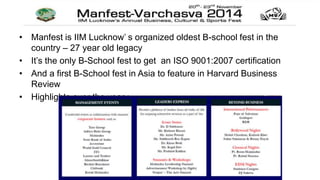



• Manfest is IIM Lucknow’ s organized oldest B-school fest in the 
country – 27 year old legacy 
• It’s the only B-School fest to get an ISO 9001:2007 certification 
• And a first B-School fest in Asia to feature in Harvard Business 
Review 
• Highlights over the year :
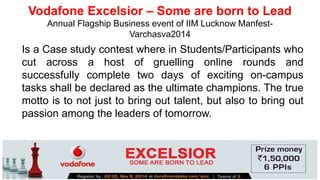
Vodafone Excelsior – Some are born to Lead 
Annual Flagship Business event of IIM Lucknow Manfest- 
Varchasva2014 
Is a Case study contest where in Students/Participants who 
cut across a host of gruelling online rounds and 
successfully complete two days of exciting on-campus 
tasks shall be declared as the ultimate champions. The true 
motto is to not just to bring out talent, but also to bring out 
passion among the leaders of tomorrow. 
“A leader is one who knows the way, goes the way, and shows the way“ 
-John C. 
Maxwell
What was in for Students! 
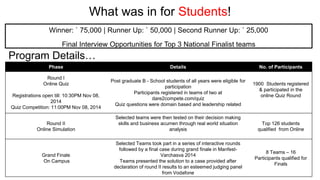
Winner: ` 75,000 | Runner Up: ` 50,000 | Second Runner Up: ` 25,000 
Final Interview Opportunities for Top 3 National Finalist teams 
Phase Details No. of Participants 
Round I 
Online Quiz 
Registrations open till: 10:30PM Nov 08, 
2014 
Quiz Competition: 11:00PM Nov 08, 2014 
Post graduate B - School students of all years were eligible for 
participation 
Participants registered in teams of two at 
dare2compete.com/quiz 
Quiz questions were domain based and leadership related 
1900 Students registered 
& participated in the 
online Quiz Round 
Round II 
Online Simulation 
Selected teams were then tested on their decision making 
skills and business acumen through real world situation 
analysis 
Top 126 students 
qualified from Online 
Grand Finale 
On Campus 
Selected Teams took part in a series of interactive rounds 
followed by a final case during grand finale in Manfest- 
Varchasva 2014 
Teams presented the solution to a case provided after 
declaration of round II results to an esteemed judging panel 
from Vodafone 
8 Teams – 16 
Participants qualified for 
Finals 
Program Details…
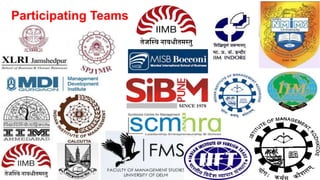
Participating Teams
6 
Sneak Peak at the 
Grand Finale of 
Vodafone Excelsior Contest 
- Some are born to Lead
Employer Branding 
in Action : Vodafone 
Discover 
Management 
Trainees sharing 
their success 
stories
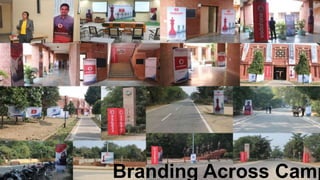
Branding Across Campus
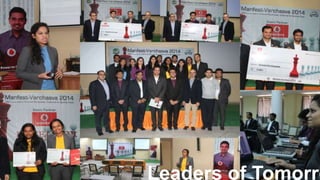
Leaders of Tomorrow
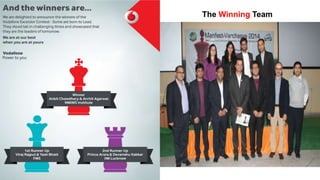
The Winning Team
Annexure 
mPesa Case / Problem Statement
Vodafone Excelsior Contest – Problem Statement 
Situation: India has a migrant population of close to 300Mn. A large number of them have left their homes in the villages and gone to the cities in search of higher paying 
jobs. Most of them have left behind their families. Every month crores of money is sent by these migrants from the cities to the villages. 
It is estimated that there are only a little over 100k bank branches in the country. Very little banking has reached the villages. As a result of this close to 75% of the people in 
villages do not have access to proper financial services. The nearest bank branch is many times a good 25km away. 
As a result of this, a large portion of domestic remittances still happen through informal means - could be somebody within a group actually going back to the village and 
physically carrying money from everyone. Close to 70% is estimated to go through this route. 
The banking network is estimated to handle close to 20% of the remittances. However for banks this is definitely not their core business and hence tends to push this 
business to their customer service points. These services points normally have huge queues especially on Mondays and have fixed working hours. It is actually an ordeal for 
the migrants to send money through this route. 
The remaining goes through the postal system. However, the charges are exorbitant. In all these cases: 
1. The migrant only hands over the cash. All further processing to ensure money reaches the destination is done by the person receiving this money. 
2. There is a huge element of trust since the money in question is a significant portion of the sender’s earnings and it is a lso critical that it reaches the village. 
Mobile companies are now attempting to get into this domestic remittance business. The pioneer in the field has been the Safaricom service in Kenya called mpesa. 
Launched only around 8 years back, it is believed that close to 45% of the country's GDP flows through mpesa. 
These companies hope to make use of their: 
1. widespread distribution reach which has a significant rural presence 
2. Ability to handle complex documentations as required by the banking system 
3. Ability to handle large number of small value transactions 
They also hope to in the process bring loyalty amongst their customer base by engaging with them beyond their telecom needs. 
Problem statement: How do telecom companies in India bring value to these migrants and thereby garner a larger share of what is hitherto an underserved domestic 
remittance market. It is estimated that this market is approximately 30% larger than the telecom market in the country. 
1. Most of the telecom companies operate with a mobile wallet. The agent is expected to only load the wallet or provide cash out faci lities. The customer needs to self-initiate 
any transaction on the money in the wallet. 
So how does one move the market from a current agent assisted mode to a self-assisted mode? 
2. Trust is a key element in this business. The migrant needs to trust the agent where he hands over the money to be loaded into the wallet. This is a much lesser of a 
problem since he is perhaps dealing with this agent for his prepaid recharge. However how does he trust the agent where the receiver is expected to go and cash out - 
someone who in all probability he has never seen? 
So how does one build trust in the money transfer corridor? 
3. Telecom companies also spend significantly in promoting their products. However the traditional promotions do not work in this case since it has to do with hard earned 
money which needs to reach the family in the village - all the time without fail.
Thank You 

Vodafone excelsior contest campus connect

  • 2.
    • Manfest isIIM Lucknow’ s organized oldest B-school fest in the country – 27 year old legacy • It’s the only B-School fest to get an ISO 9001:2007 certification • And a first B-School fest in Asia to feature in Harvard Business Review • Highlights over the year :
  • 3.
    Vodafone Excelsior –Some are born to Lead Annual Flagship Business event of IIM Lucknow Manfest- Varchasva2014 Is a Case study contest where in Students/Participants who cut across a host of gruelling online rounds and successfully complete two days of exciting on-campus tasks shall be declared as the ultimate champions. The true motto is to not just to bring out talent, but also to bring out passion among the leaders of tomorrow. “A leader is one who knows the way, goes the way, and shows the way“ -John C. Maxwell
  • 4.
    What was infor Students! Winner: ` 75,000 | Runner Up: ` 50,000 | Second Runner Up: ` 25,000 Final Interview Opportunities for Top 3 National Finalist teams Phase Details No. of Participants Round I Online Quiz Registrations open till: 10:30PM Nov 08, 2014 Quiz Competition: 11:00PM Nov 08, 2014 Post graduate B - School students of all years were eligible for participation Participants registered in teams of two at dare2compete.com/quiz Quiz questions were domain based and leadership related 1900 Students registered & participated in the online Quiz Round Round II Online Simulation Selected teams were then tested on their decision making skills and business acumen through real world situation analysis Top 126 students qualified from Online Grand Finale On Campus Selected Teams took part in a series of interactive rounds followed by a final case during grand finale in Manfest- Varchasva 2014 Teams presented the solution to a case provided after declaration of round II results to an esteemed judging panel from Vodafone 8 Teams – 16 Participants qualified for Finals Program Details…
  • 5.
  • 6.
    6 Sneak Peakat the Grand Finale of Vodafone Excelsior Contest - Some are born to Lead
  • 7.
    Employer Branding inAction : Vodafone Discover Management Trainees sharing their success stories
  • 8.
  • 9.
  • 10.
  • 11.
    Annexure mPesa Case/ Problem Statement
  • 12.
    Vodafone Excelsior Contest– Problem Statement Situation: India has a migrant population of close to 300Mn. A large number of them have left their homes in the villages and gone to the cities in search of higher paying jobs. Most of them have left behind their families. Every month crores of money is sent by these migrants from the cities to the villages. It is estimated that there are only a little over 100k bank branches in the country. Very little banking has reached the villages. As a result of this close to 75% of the people in villages do not have access to proper financial services. The nearest bank branch is many times a good 25km away. As a result of this, a large portion of domestic remittances still happen through informal means - could be somebody within a group actually going back to the village and physically carrying money from everyone. Close to 70% is estimated to go through this route. The banking network is estimated to handle close to 20% of the remittances. However for banks this is definitely not their core business and hence tends to push this business to their customer service points. These services points normally have huge queues especially on Mondays and have fixed working hours. It is actually an ordeal for the migrants to send money through this route. The remaining goes through the postal system. However, the charges are exorbitant. In all these cases: 1. The migrant only hands over the cash. All further processing to ensure money reaches the destination is done by the person receiving this money. 2. There is a huge element of trust since the money in question is a significant portion of the sender’s earnings and it is a lso critical that it reaches the village. Mobile companies are now attempting to get into this domestic remittance business. The pioneer in the field has been the Safaricom service in Kenya called mpesa. Launched only around 8 years back, it is believed that close to 45% of the country's GDP flows through mpesa. These companies hope to make use of their: 1. widespread distribution reach which has a significant rural presence 2. Ability to handle complex documentations as required by the banking system 3. Ability to handle large number of small value transactions They also hope to in the process bring loyalty amongst their customer base by engaging with them beyond their telecom needs. Problem statement: How do telecom companies in India bring value to these migrants and thereby garner a larger share of what is hitherto an underserved domestic remittance market. It is estimated that this market is approximately 30% larger than the telecom market in the country. 1. Most of the telecom companies operate with a mobile wallet. The agent is expected to only load the wallet or provide cash out faci lities. The customer needs to self-initiate any transaction on the money in the wallet. So how does one move the market from a current agent assisted mode to a self-assisted mode? 2. Trust is a key element in this business. The migrant needs to trust the agent where he hands over the money to be loaded into the wallet. This is a much lesser of a problem since he is perhaps dealing with this agent for his prepaid recharge. However how does he trust the agent where the receiver is expected to go and cash out - someone who in all probability he has never seen? So how does one build trust in the money transfer corridor? 3. Telecom companies also spend significantly in promoting their products. However the traditional promotions do not work in this case since it has to do with hard earned money which needs to reach the family in the village - all the time without fail.
  • 13.