1
VOCATIONAL TRAINING REPORT
AGRA LOCOMOTIVES
SUBMITTED BY-
UTKARSH CHANDRA
1305220054
CONTENT
 HISTORY
 RAILWAY TRACK
 INTRODUCTION
 CLASSIFICATION OF LOCOMOTIVE IN
INDIA BY TYPES
 OVERVIEW OF ELECTRIC
LOCOMOTIVE
 ELECTRICAL PARTS OF
LOCOMOTIVE
 VIGILANCE CONTROL SYSTEM
 CONCLUSION
2
HISTORY
 1st Electric locomotive was built by:-
a Scotsman, Robert
Davidson of Aberdeen in 1837 &
powered by ”BATTERIES”.
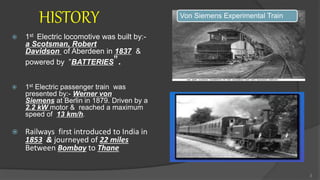
 1st Electric passenger train was
presented by:- Werner von
Siemens at Berlin in 1879. Driven by a
2.2 kW motor & reached a maximum
speed of 13 km/h.
 Railways first introduced to India in
1853 & journeyed of 22 miles
Between Bombay to Thane
3
Von Siemens Experimental Train
Railway track
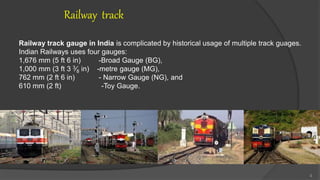
Railway track gauge in India is complicated by historical usage of multiple track guages.
Indian Railways uses four gauges:
1,676 mm (5 ft 6 in) -Broad Gauge (BG),
1,000 mm (3 ft 3 3⁄8 in) -metre gauge (MG),
762 mm (2 ft 6 in) - Narrow Gauge (NG), and
610 mm (2 ft) -Toy Gauge.
4
INTRODUCTION
(AGRA Locomotives)
Brief History:-
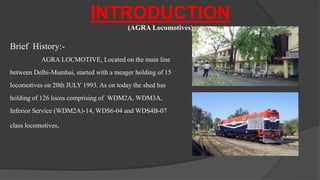
AGRA LOCMOTIVE, Located on the main line
between Delhi-Mumbai, started with a meager holding of 15
locomotives on 20th JULY 1993. As on today the shed has
holding of 126 locos comprising of WDM2A, WDM3A,
Inferior Service (WDM2A)-14, WDS6-04 and WDS4B-07
class locomotives.
TYPES OF LOCOMOTIVE
1.In case of Electric locomotives
1. WAP-1, WAP-4, WAM-4, WAg-5/6/7 and WCAM-1/2/3 used DC Series Motors
for traction.
2. WAP-5/7 and WAG-9 have three phase induction motors for Traction.
2.In case of Diesel locomotives
1. WDM-2/3A/3D/3F, WDG-3A WDP-1/3A type locomotives use DC Series
motors for traction (ALCO locomotives)
2. WDP-4/4B/4D and WDG-4/4D type locomotives use three phase induction
motors for Traction.
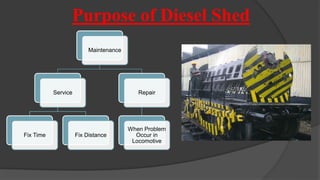
Purpose of Diesel Shed
Maintenance
Service
Fix Time Fix Distance
Repair
When Problem
Occur in
Locomotive
OVERVIEW OF ELECTRIC LOCOMOTIVE
 Now a days all locos are running through
Electricity with the help of OHE line.
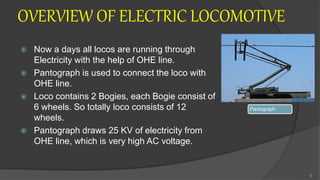
 Pantograph is used to connect the loco with
OHE line.
 Loco contains 2 Bogies, each Bogie consist of
6 wheels. So totally loco consists of 12
wheels.
 Pantograph draws 25 KV of electricity from
OHE line, which is very high AC voltage.
8
Pantograph
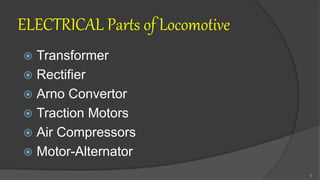
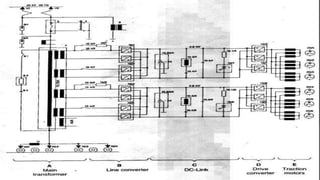
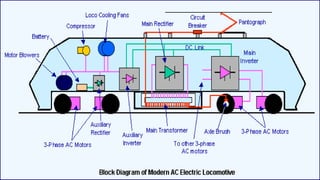
ELECTRICAL Parts of Locomotive
 Transformer
 Rectifier
 Arno Convertor
 Traction Motors
 Air Compressors
 Motor-Alternator
9
10
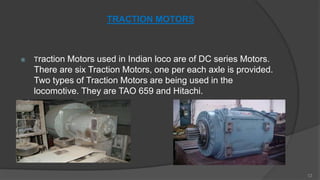
TRACTION MOTORS
 Traction Motors used in Indian loco are of DC series Motors.
There are six Traction Motors, one per each axle is provided.
Two types of Traction Motors are being used in the
locomotive. They are TAO 659 and Hitachi.
12
Implementation of Modern Vigilance
Control Device
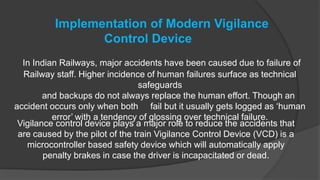
In Indian Railways, major accidents have been caused due to failure of
Railway staff. Higher incidence of human failures surface as technical
safeguards
and backups do not always replace the human effort. Though an
accident occurs only when both fail but it usually gets logged as ‘human
error’ with a tendency of glossing over technical failure.
Vigilance control device plays a major role to reduce the accidents that
are caused by the pilot of the train Vigilance Control Device (VCD) is a
microcontroller based safety device which will automatically apply
penalty brakes in case the driver is incapacitated or dead.
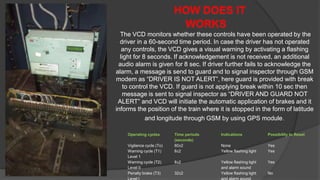
The VCD monitors whether these controls have been operated by the
driver in a 60-second time period. In case the driver has not operated
any controls, the VCD gives a visual warning by activating a flashing
light for 8 seconds. If acknowledgement is not received, an additional
audio alarm is given for 8 sec. If driver further fails to acknowledge the
alarm, a message is send to guard and to signal inspector through GSM
modem as “DRIVER IS NOT ALERT”, here guard is provided with break
to control the VCD. If guard is not applying break within 10 sec then
message is sent to signal inspector as “DRIVER AND GUARD NOT
ALERT” and VCD will initiate the automatic application of brakes and it
informs the position of the train where it is stopped in the form of latitude
and longitude through GSM by using GPS module.
HOW DOES IT
WORKS
Operating cycles Time periods
(seconds)
Indications Possibility to Reset
Vigilance cycle (To) 60±2 None Yes
Warning cycle (T1)
Level 1
8±2 Yellow flashing light Yes
Warning cycle (T2)
Level II
8±2 Yellow flashing light
and alarm sound
Yes
Penalty brake (T3) 32±2 Yellow flashing light No
ADVANTAGES OF ELECTRIC LOCOMOTIVE
 Electric engines do not produce much heat and noise.
 Electric engines are therefore easier to maintain whereas the moving parts of a
diesel engine require constant maintenance.
 The simple nature of the electric engine makes them efficient and powerful.
 Electric engines are light weight, constituting only motors and wheel axles, and have
almost no moving parts.
 Do Not Produce Smock.
15
CONCLUSION
 Main Objective was to learn electric
locomotive In Railways.
 Electricity is used to eliminate smoke and
take advantage of the high efficiency of
electric motors.
 I am very thankfull to people of AGRA
locomotive.
16
VOCATIONAL TRAINING REPORT

VOCATIONAL TRAINING REPORT

  • 1.
    1 VOCATIONAL TRAINING REPORT AGRALOCOMOTIVES SUBMITTED BY- UTKARSH CHANDRA 1305220054
  • 2.
    CONTENT  HISTORY  RAILWAYTRACK  INTRODUCTION  CLASSIFICATION OF LOCOMOTIVE IN INDIA BY TYPES  OVERVIEW OF ELECTRIC LOCOMOTIVE  ELECTRICAL PARTS OF LOCOMOTIVE  VIGILANCE CONTROL SYSTEM  CONCLUSION 2
  • 3.
    HISTORY  1st Electriclocomotive was built by:- a Scotsman, Robert Davidson of Aberdeen in 1837 & powered by ”BATTERIES”.  1st Electric passenger train was presented by:- Werner von Siemens at Berlin in 1879. Driven by a 2.2 kW motor & reached a maximum speed of 13 km/h.  Railways first introduced to India in 1853 & journeyed of 22 miles Between Bombay to Thane 3 Von Siemens Experimental Train
  • 4.
    Railway track Railway trackgauge in India is complicated by historical usage of multiple track guages. Indian Railways uses four gauges: 1,676 mm (5 ft 6 in) -Broad Gauge (BG), 1,000 mm (3 ft 3 3⁄8 in) -metre gauge (MG), 762 mm (2 ft 6 in) - Narrow Gauge (NG), and 610 mm (2 ft) -Toy Gauge. 4
  • 5.
    INTRODUCTION (AGRA Locomotives) Brief History:- AGRALOCMOTIVE, Located on the main line between Delhi-Mumbai, started with a meager holding of 15 locomotives on 20th JULY 1993. As on today the shed has holding of 126 locos comprising of WDM2A, WDM3A, Inferior Service (WDM2A)-14, WDS6-04 and WDS4B-07 class locomotives.
  • 6.
    TYPES OF LOCOMOTIVE 1.Incase of Electric locomotives 1. WAP-1, WAP-4, WAM-4, WAg-5/6/7 and WCAM-1/2/3 used DC Series Motors for traction. 2. WAP-5/7 and WAG-9 have three phase induction motors for Traction. 2.In case of Diesel locomotives 1. WDM-2/3A/3D/3F, WDG-3A WDP-1/3A type locomotives use DC Series motors for traction (ALCO locomotives) 2. WDP-4/4B/4D and WDG-4/4D type locomotives use three phase induction motors for Traction.
  • 7.
    Purpose of DieselShed Maintenance Service Fix Time Fix Distance Repair When Problem Occur in Locomotive
  • 8.
    OVERVIEW OF ELECTRICLOCOMOTIVE  Now a days all locos are running through Electricity with the help of OHE line.  Pantograph is used to connect the loco with OHE line.  Loco contains 2 Bogies, each Bogie consist of 6 wheels. So totally loco consists of 12 wheels.  Pantograph draws 25 KV of electricity from OHE line, which is very high AC voltage. 8 Pantograph
  • 9.
    ELECTRICAL Parts ofLocomotive  Transformer  Rectifier  Arno Convertor  Traction Motors  Air Compressors  Motor-Alternator 9
  • 10.
  • 12.
    TRACTION MOTORS  TractionMotors used in Indian loco are of DC series Motors. There are six Traction Motors, one per each axle is provided. Two types of Traction Motors are being used in the locomotive. They are TAO 659 and Hitachi. 12
  • 13.
    Implementation of ModernVigilance Control Device In Indian Railways, major accidents have been caused due to failure of Railway staff. Higher incidence of human failures surface as technical safeguards and backups do not always replace the human effort. Though an accident occurs only when both fail but it usually gets logged as ‘human error’ with a tendency of glossing over technical failure. Vigilance control device plays a major role to reduce the accidents that are caused by the pilot of the train Vigilance Control Device (VCD) is a microcontroller based safety device which will automatically apply penalty brakes in case the driver is incapacitated or dead.
  • 14.
    The VCD monitorswhether these controls have been operated by the driver in a 60-second time period. In case the driver has not operated any controls, the VCD gives a visual warning by activating a flashing light for 8 seconds. If acknowledgement is not received, an additional audio alarm is given for 8 sec. If driver further fails to acknowledge the alarm, a message is send to guard and to signal inspector through GSM modem as “DRIVER IS NOT ALERT”, here guard is provided with break to control the VCD. If guard is not applying break within 10 sec then message is sent to signal inspector as “DRIVER AND GUARD NOT ALERT” and VCD will initiate the automatic application of brakes and it informs the position of the train where it is stopped in the form of latitude and longitude through GSM by using GPS module. HOW DOES IT WORKS Operating cycles Time periods (seconds) Indications Possibility to Reset Vigilance cycle (To) 60±2 None Yes Warning cycle (T1) Level 1 8±2 Yellow flashing light Yes Warning cycle (T2) Level II 8±2 Yellow flashing light and alarm sound Yes Penalty brake (T3) 32±2 Yellow flashing light No
  • 15.
    ADVANTAGES OF ELECTRICLOCOMOTIVE  Electric engines do not produce much heat and noise.  Electric engines are therefore easier to maintain whereas the moving parts of a diesel engine require constant maintenance.  The simple nature of the electric engine makes them efficient and powerful.  Electric engines are light weight, constituting only motors and wheel axles, and have almost no moving parts.  Do Not Produce Smock. 15
  • 16.
    CONCLUSION  Main Objectivewas to learn electric locomotive In Railways.  Electricity is used to eliminate smoke and take advantage of the high efficiency of electric motors.  I am very thankfull to people of AGRA locomotive. 16