C h a p t e r            F o u r
                                                                                                                                 4
Vocational Education and Skills Training
1. Introduction
Vocational education is an essential component of strategies to reduce and prevent child labor. Many children drop out
of school because they do not see the relevance of education to their lives. In many cases, the decision not to send a child
to school is taken by the parents, who would rather have their children enter the workplace as they do not see how learn-
ing to read, write, and do sums can help put bread on the table.

In order to influence the decisions of at-risk children and their parents, education should have a tangible end, particularly
in terms of improving future employment prospects. In such circumstances and where older children are concerned, the
focus should be on the transition from school to work, either through vocational education or skills training programs.
The skills transmitted through such programs should prepare young people for gainful employment. These skills can
be taught through the formal education system, for example, in vocational education institutions, through non-formal
education programs, or through private businesses and apprenticeships. In vocational training, work safety and codes
must be taught and practiced as well as monitoring by organizations or communities to ensure children are not being
exploited or abused in apprenticeship situations.

2. CIRCLE experiences with vocational education and skills training
Many CIRCLE projects combined vocational education and skills training with basic educational elements, such as
literacy and numeracy. Where appropriate, implementing partners provided additional training on starting up and
                                                        running a small business, including basic book-keeping,
                                                        accessing micro-credit and other financing modalities,
                                                        and sales. Most of the skills taught were based on analy-
                                                        ses of local labor markets. In some cases, implementing
                                                        partners also provided beneficiaries with start-up kits to
                                                        facilitate their entry into the labor market. Employers in
                                                        the informal sector and in rural settings are not always
                                                        able to provide workers with the tools of the trade, and
                                                        it can enhance their employability if workers can supply
                                                        their own tools.

                                                                 Vocational education programs can prevent children from
                                                                 ending up in situations of child labor by ensuring that
                                                                 trainees master skills and benefit from basic education
                                                                 classes that include training in health, safety, and their
                                                                 rights. Some programs also offer life-skills training to pro-
                                                                 mote the beneficiaries’ personal and social development.

                                                                 CARD in Sierra Leone targeted at-risk children in rural
                                                                 communities, including young mothers and school drop-
                                                                 outs, for basic education and skills training. The program
                                                                 was delivered through a community training center, and
                                                                 staff were recruited locally to ensure that the center could
                                                                 continue to operate in the longer term. The staff under-
                                                                 went pedagogical training in a range of basic subjects and
                                                                 skills areas. The program provided the young mothers

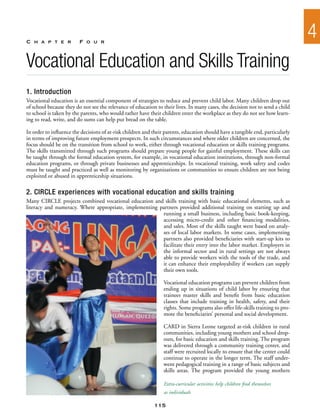
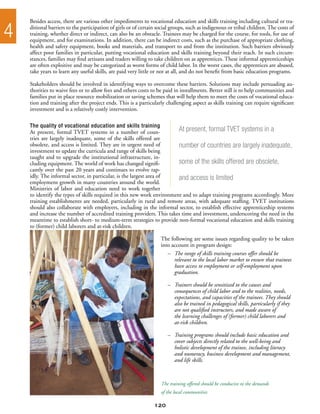
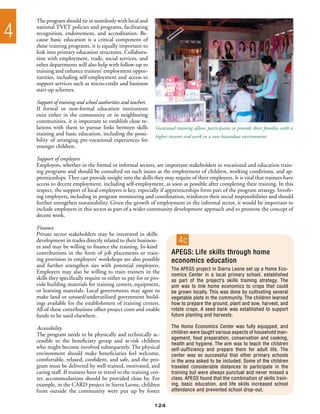
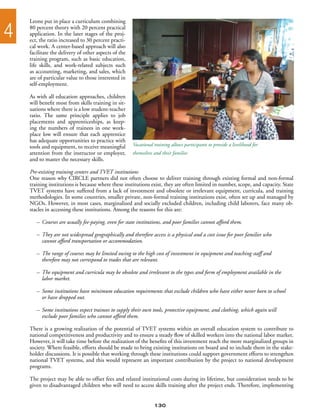
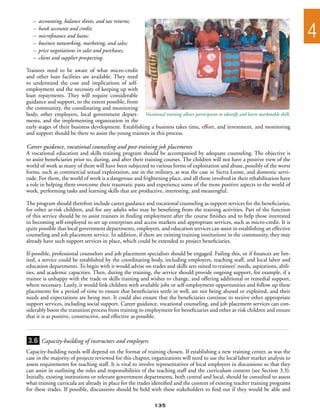
                                                                 Extra-curricular activities help children find themselves
                                                                 as individuals

                                                            115
4         CIRCLE partners with an identified best practice in vocational education and skills training

             Africa	                         Asia	                                  Latin America
             ANPPCAN, Kenya	                 NDS, Bangladesh	                       PAMI, Guatemala
             AID-Mali, Mali	                 HCC, Cambodia	                         Dos Generaciones, Nicaragua
             AJA, Mali	                      Wathnakpheap, Cambodia
             RAC, Mali	                      WDA, Cambodia
             DARNA Morocco
             APEGS, Sierra Leone
             CARD, Sierra Leone
             CCB, Sierra Leone
             CLASSE, West Africa

    with childcare and family planning courses as well as combining literacy with skills and development. Childcare facilities
    were on hand so that young mothers could participate fully and the sensitive issue of foster families was introduced as a
    support structure for young mothers while they progressed through training and until they could find decent employ-
    ment and were able to take care of the children themselves.

    Ensuring that training programs provide the skills that are in demand in the local labor market is a common feature
    of most of the CIRCLE projects that offered vocational education and skills training. Once they have completed skills
    training, vulnerable children and (former) child laborers need to have access to decent employment. This requires carry-
    ing out a local labor market survey and tailoring the training program. WDA in Cambodia worked with a broad group
    of stakeholders to design training programs accordingly.

    In the CCB project in Sierra Leone, local enterprises pro-
    vided skills training in construction, engineering, and elec-        4a
    trical and electronic engineering. CCB was meticulous in
    its screening of the training service providers: companies        Wathnakpheap: A holistic approach
    were chosen on the strength of their health and safety com-       to skills training
    pliance, reasonable level of working hours, and training pro-     The Wathnakpheap project in Cambodia targeted chil-
    gram proposal. CCB conducted interviews with employees            dren and young people at risk of child labor and traf-
    and neighbors of each workplace. Following the selection          ficking in a rural area close to the border with Thailand.
    of the service providers, CCB interviewed each trainee to         The main objective was to reduce children’s vulnerabil-
    assist them in choosing a trade best suited to their interests    ity to these dangers through education and skills train-
    and capacities. They were able to spend a trial period in the     ing. The project established skills training programs
    workshops to get a feeling for the trade and the environ-         based on market demand identified in the targeted
    ment before making a final choice.                                communities and on the availability of local natural re-
                                                                      sources, such as bamboo and rattan.
    APEGS in Sierra Leone focused on enhancing trainees’
                                                                      To make the courses more accessible, children were
    skills to improve productivity in agriculture. To this end,
                                                                      able to do their training either in the community, for
    the trainees were provided with appropriate tools and seeds       such activities as making bamboo furniture or rattan
    to cultivate a variety of crops. A seed bank was established      weaving, in training centers, where qualified instruc-
    from the harvests to ensure sustainability. As well as agri-      tors provided six-month courses in selected skills, or in
    cultural science, trainees were taught home economics as          the workshops of local businesses. As well as teaching
    a step toward self-sufficiency. The vocational training ac-       marketable skills, the program provided instruction in
    tivities were accompanied by basic education to ensure that       key subject areas such as literacy, life skills, business
    trainees received a rounded education.                            skills, children’s rights, and primary health care.

    Agricultural training was found to be the most relevant           The children exhibited their products at trade fairs,
    skills set by beneficiaries in the vocational education pro-      which helped them develop new designs, find new
                                                                      market openings, learn the nature of competition, and
    grams of CLASSE in Mali and Côte d’Ivoire. The training
                                                                      have direct contact with potential clients. Most of the
    focused on cocoa plantations in Côte d’Ivoire, and on the         products that were exhibited were sold or put on order,
    cultivation of other crops and vegetables in Mali and CĂ´te        which built confidence and reinforced understanding of
    d’Ivoire. A large vegetable garden was cleared and planted        business processes.
    next to a school in one of the target communities in CĂ´te

                                                               116
d’Ivoire. The garden provided a training area for the children in agricultural skills, while the produce was given to the
school canteen.

AID-Mali supported the CLASSE project by strengthening opportunities for the young graduates in their employment
                                                                                                                                  4
choices. Older boys apprenticed in carpentry, motorbike mechanics, and gardening enterprises. Girls worked primarily
in tailoring and cloth dyeing. A training center allowed the AID-Mali trainees to take part in a fashion tailoring course
for less than a third of the regular price. The girls were assiduous in their studies and constantly urged the teachers to give
them more of their time for training

Besides linking skills to local labor market demands, there are            Besides linking skills to local labor
several other common features of effective vocational education
and skills training programs for at-risk children. Wathnakpheap
in Cambodia looked at how to maximize the use of locally                   market demands, there are several other
available resources in its skills training programs. Communities
were encouraged to grow bamboo to support bamboo furniture
making. In addition, the training was designed to be adaptable             common features of effective vocational
to the situation of each trainee by providing skills training in
different environments, including in the community, training               education and skills training programs
centers, or in private workshops with local artisans. Follow-up
included support to trainees in either setting up businesses or
seeking employment. Setting up micro-enterprises was another               for at-risk children
element of the Dos Generaciones project in Nicaragua.

HCC in Cambodia reinforced the link between basic education and skills training, noting that the children who benefit-
ed most from training were those who were literate and had a stronger educational foundation. As with Wathnakpheap,
HCC targeted children at risk of child labor and trafficking through the provision of formal and non-formal education
and skills training. The main place of training was the organization’s special shelter, and the skills required were identified
on the basis of local labor market analyses. Besides life skills, HCC integrated other important aspects to assist the train-
ees in starting their new lives, including business management, cooking, and basic farming skills. A similar approach was
used by Dos Generaciones in Nicaragua, where the demand for skills training came from the families themselves. Most
of the families were headed by single mothers, who recognized the importance of their children leaving school with skills
that would enable them to access better jobs in the future, including computer studies. The PAMI project in Guatemala
also linked basic education and skills training. DARNA in Morocco combined training in farming techniques with basic
education and life skills (see box 4f ).

AJA in Mali found that when basic education (particularly literacy and numeracy) was combined with skills training in
the apprentice schools involved in the project, trainees were able to better grasp the technical aspects of their training, to
understand the importance of health and safety, and to apply these principles in practice. In addition, the beneficiaries
received appropriate work clothes and protective equipment.

                                                                                   In its project in Mali, RAC took on the
                                                                                   major challenge of the traditional “ap-
                                                                                   prenticeship” system widespread in the
                                                                                   region. Parents are supportive of these
                                                                                   apprenticeships as they want their chil-
                                                                                   dren to learn a useful trade. However,
                                                                                   these apprenticeships, mostly found in
                                                                                   the informal sector in the workshops of
                                                                                   artisans and craftspeople, are often under
                                                                                   conditions that can be considered child
                                                                                   labor, although not necessarily a worst
                                                                                   form of child labor. Because of limited
                                                                                   access to education or parents’ negative


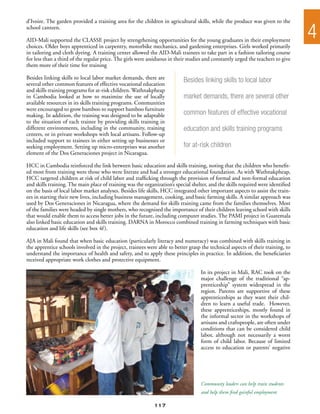
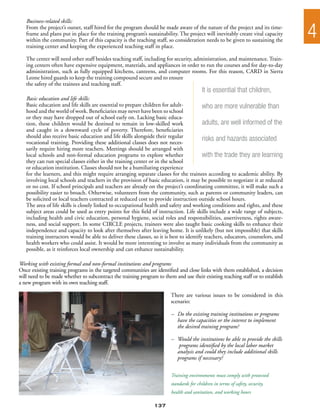
                                                                                   Community leaders can help train students
                                                                                   and help them find gainful employment

                                                             117
attitudes to education, a large number of apprentices have ei-

4   ther never been to school or have dropped out. Taking these fac-
    tors into account, the project introduced a “dual” apprenticeship
    system that included basic education. The process required an
    intensive awareness-raising component to impress upon parents
    and employers the importance of education, particularly litera-
    cy, and to reduce the number of hours apprentices had to work,
    which facilitated their participation in basic transitional and for-
    mal education programs.

    3. Designing a vocational education and skills
    training program
    Many poor families look at education in terms of how it will sup-
    port the family in the long term. If children can complete their
    education cycle and emerge with a set of skills that can facilitate
    their access to decent work with improved working conditions,
    this will make the program more appealing to parents, who are
    the main family decision-makers.

    However, technical skills, while required for employment, are not
    sufficient in themselves. They should be accompanied by basic
    education, such as literacy and numeracy, as well as vital life skills
    that will prepare them more fully for adult life.
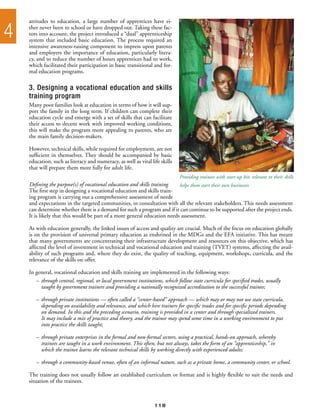
                                                                              Providing trainees with start-up kits relevant to their skills
    Defining the purpose(s) of vocational education and skills training   helps them start their own businesses
    The first step in designing a vocational education and skills train-
    ing program is carrying out a comprehensive assessment of needs
    and expectations in the targeted communities, in consultation with all the relevant stakeholders. This needs assessment
    can determine whether there is a demand for such a program and if it can continue to be supported after the project ends.
    It is likely that this would be part of a more general education needs assessment.

    As with education generally, the linked issues of access and quality are crucial. Much of the focus on education globally
    is on the provision of universal primary education as enshrined in the MDGs and the EFA initiative. This has meant
    that many governments are concentrating their infrastructure development and resources on this objective, which has
    affected the level of investment in technical and vocational education and training (TVET) systems, affecting the avail-
    ability of such programs and, where they do exist, the quality of teaching, equipment, workshops, curricula, and the
    relevance of the skills on offer.

    In general, vocational education and skills training are implemented in the following ways:
       –	 through central, regional, or local government institutions, which follow state curricula for specified trades, usually
       	 taught by government trainers and providing a nationally recognized accreditation to the successful trainee;

       –	 through private institutions — often called a “center-based” approach — which may or may not use state curricula,
       	 depending on availability and relevance, and which hire trainers for specific trades and for specific periods depending
       	 on demand. In this and the preceding scenario, training is provided in a center and through specialized trainers.
       	 It may include a mix of practice and theory, and the trainee may spend some time in a working environment to put
       	 into practice the skills taught;

       –	 through private enterprises in the formal and non-formal sectors, using a practical, hands-on approach, whereby
       	 trainees are taught in a work environment. This often, but not always, takes the form of an “apprenticeship,” in
       	 which the trainee learns the relevant technical skills by working directly with experienced adults;

       –	 through a community-based venue, often of an informal nature, such as a private home, a community center, or school.

    The training does not usually follow an established curriculum or format and is highly flexible to suit the needs and
    situation of the trainees.


                                                                  118
Skills training can be a mix of the above. The
needs assessment in the targeted community
will determine the choice of service provider.
Another early project design element is whether
                                                                                                                                   4
the provision of vocational education and skills
training will be the main activity or whether it
will be a sub-component of an integrated educa-
tion strategy within the community. This deci-
sion will affect the manner in which training is
offered and whether it will be linked directly to
other forms of education. It will also affect the
strategy for working within the existing educa-
tion infrastructure or whether new institutions
need to be created.

Accessibility of vocational education
and skills training
The availability of state vocational education and
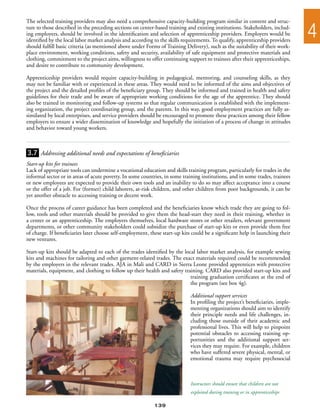
training institutions is often limited to major The interests, age, and gender of a child must be taken into account while
urban centers and mainly to children who have selecting trainees for a particular trade
obtained appropriate qualifications through the
formal school system, for example, successful completion of primary education. Access to such institutions in rural and
remote areas is often scarce or non-existent. Therefore, an organization wishing to include vocational education and
skills training in its project will need to map out what state or private vocational education and training institutions
already exist in the community or nearby. At the same time, they should identify potential venues that can facilitate the
delivery of skills training, such as schools or community centers. HCC in Cambodia used its own buildings as the venue
for the skills training program. If no suitable venues exist, premises may have to be built or renovated. These choices have
financial implications for the project.

The following issues should be considered in terms of accessibility:
  –	 What institutions or services, either formal or non-formal, are already available in the community?

   –	 What institutions or services are available in neighboring communities that would be accessible to the beneficiaries
   	 either on foot or if a transport service were provided?

   –	 If such institutions exist, do they have the capacities to absorb the project beneficiaries and activities and would the
   	 curricula and courses on offer be appropriate to the beneficiary group? Would it be necessary to sign agreements with
   	 the institutions and make financial or other contributions?

   –	 To what extent are girls prevented from benefiting from these programs or services because of issues of safety or relating
   	 to culture, tradition, religion, or other social impediments, perceived or real?

   –	 If there are clearly identifiable problems with accessibility, how can these be most effectively addressed? For example,
   	 are there adequate existing structures or rooms that can be renovated or adapted? These options should be discussed
   	 with community members, local education and labor authorities, the beneficiaries, and other youth in the community.
   	 In the case of CARD in Sierra Leone, the project was located near a Catholic high school, and the parish donated
   	 an old dormitory to renovate and use as a training workshop and day-care center for the young mothers participating
   	 in the program.

   –	 Would authorities be willing to offer support, for example by providing trained teachers, building new classrooms, or
   	 supplying technical equipment for training purposes?

   –	 What role could private sector actors play in training provision, perhaps through apprenticeships? Private sector
   	 employers, particularly those based in the community close to where the beneficiaries live, should be consulted and
   	 where possible engaged in the development of community-based skills training programs.

Ease of access is an aspect of accessibility: project beneficiaries must be able to reach the training center and/or workshop
easily and safely. Moreover, appropriate sanitary facilities must be in place on the training premises or in private work-
shops, especially for girls. If not, girls may drop out of the program, especially those who have reached puberty.

                                                               119
Besides access, there are various other impediments to vocational education and skills training including cultural or tra-

4   ditional barriers to the participation of girls or of certain social groups, such as indigenous or tribal children. The costs of
    training, whether direct or indirect, can also be an obstacle. Trainees may be charged for the course, for tools, for use of
    equipment, and for examinations. In addition, there can be indirect costs, such as the purchase of appropriate clothing,
    health and safety equipment, books and materials, and transport to and from the institution. Such barriers obviously
    affect poor families in particular, putting vocational education and skills training beyond their reach. In such circum-
    stances, families may find artisans and traders willing to take children on as apprentices. These informal apprenticeships
    are often exploitive and may be categorized as worst forms of child labor. In the worst cases, the apprentices are abused,
    take years to learn any useful skills, are paid very little or not at all, and do not benefit from basic education programs.

    Stakeholders should be involved in identifying ways to overcome these barriers. Solutions may include persuading au-
    thorities to waive fees or to allow fees and others costs to be paid in installments. Better still is to help communities and
    families put in place resource mobilization or saving schemes that will help them to meet the costs of vocational educa-
    tion and training after the project ends. This is a particularly challenging aspect as skills training can require significant
    investment and is a relatively costly intervention.

    The quality of vocational education and skills training
    At present, formal TVET systems in a number of coun-                At present, formal TVET systems in a
    tries are largely inadequate, some of the skills offered are
    obsolete, and access is limited. They are in urgent need of         number of countries are largely inadequate,
    investment to update the curricula and range of skills being
    taught and to upgrade the institutional infrastructure, in-
    cluding equipment. The world of work has changed signifi-           some of the skills offered are obsolete,
    cantly over the past 20 years and continues to evolve rap-
    idly. The informal sector, in particular, is the largest area of    and access is limited
    employment growth in many countries around the world.
    Ministries of labor and education need to work together
    to identify the types of skills required in this new work environment and to adapt training programs accordingly. More
    training establishments are needed, particularly in rural and remote areas, with adequate staffing. TVET institutions
    should also collaborate with employers, including in the informal sector, to establish effective apprenticeship systems
    and increase the number of accredited training providers. This takes time and investment, underscoring the need in the
    meantime to establish short- to medium-term strategies to provide non-formal vocational education and skills training
    to (former) child laborers and at-risk children.

                                                                   The following are some issues regarding quality to be taken
                                                                   into account in program design:
                                                                      –	 The range of skills training courses offer should be
                                                                      	 relevant to the local labor market to ensure that trainees
                                                                      	 have access to employment or self-employment upon
                                                                      	 graduation.

                                                                      – 	 Trainers should be sensitized to the causes and
                                                                      	 consequences of child labor and to the realities, needs,
                                                                      	 expectations, and capacities of the trainees. They should
                                                                      	 also be trained in pedagogical skills, particularly if they
                                                                      	 are not qualified instructors, and made aware of
                                                                      	 the learning challenges of (former) child laborers and
                                                                      	 at-risk children.

                                                                      –	   Training programs should include basic education and
                                                                      	    cover subjects directly related to the well-being and
                                                                      	    holistic development of the trainee, including literacy
                                                                      	    and numeracy, business development and management,
                                                                      	    and life skills.


                                                                   The training offered should be conducive to the demands
                                                                   of the local communities

                                                                120
–	 Extracurricular activities, including recreational, sporting,
   		 cultural, traditional, and social activities, should be
   		 integrated into skills training programs.
                                                                                                                                            4
   –	 Trainees should be introduced to a range of skills areas to
   	 assess which are best suited to their capacities, interests,
   	 needs, and expectations. Girls should be encouraged to
   	 participate in traditionally male-dominated trades if they
   	 so wish (and vice-versa).

   –	 Training delivery should be flexible and implemented
   	 through a variety of approaches that accommodate the
   	 situation of each trainee, including center-based,
   	 community-based, or apprenticeships. Programs can be a
   	 mix of all approaches, if appropriate.

   –	 Awareness-raising activities should precede training
   	 programs and target children, their families, community
   	 members and, in particular, employers who use child labor.
   	 The objective is to reinforce the contribution of education
   	 and skills training to business and community development.
   	 In some cases, employers are simply unaware of legislation
   	 governing the minimum age of employment, occupational
   	 health and safety, and working conditions. Awareness-
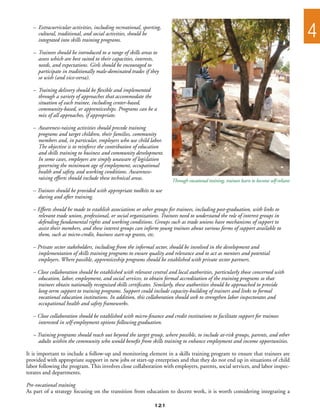
   	 raising efforts should include these technical areas.             Through vocational training, trainees learn to become self-reliant
   – Trainees should be provided with appropriate toolkits to use
   	 during and after training.

   – Efforts should be made to establish associations or other groups for trainees, including post-graduation, with links to
   	 relevant trade union, professional, or social organizations. Trainees need to understand the role of interest groups in
   	 defending fundamental rights and working conditions. Groups such as trade unions have mechanisms of support to
   	 assist their members, and these interest groups can inform young trainees about various forms of support available to
   	 them, such as micro-credit, business start-up grants, etc.

   – Private sector stakeholders, including from the informal sector, should be involved in the development and
   	 implementation of skills training programs to ensure quality and relevance and to act as mentors and potential
   	 employers. Where possible, apprenticeship programs should be established with private sector partners.

   – Close collaboration should be established with relevant central and local authorities, particularly those concerned with
   	 education, labor, employment, and social services, to obtain formal accreditation of the training programs so that
   	 trainees obtain nationally recognized skills certificates. Similarly, these authorities should be approached to provide
   	 long-term support to training programs. Support could include capacity-building of trainers and links to formal
   	 vocational education institutions. In addition, this collaboration should seek to strengthen labor inspectorates and
   	 occupational health and safety frameworks.

   – Close collaboration should be established with micro-finance and credit institutions to facilitate support for trainees
   	 interested in self-employment options following graduation.

   – Training programs should reach out beyond the target group, where possible, to include at-risk groups, parents, and other
   	 adults within the community who would benefit from skills training to enhance employment and income opportunities.

It is important to include a follow-up and monitoring element in a skills training program to ensure that trainees are
provided with appropriate support in new jobs or start-up enterprises and that they do not end up in situations of child
labor following the program. This involves close collaboration with employers, parents, social services, and labor inspec-
torates and departments.

Pre-vocational training
As part of a strategy focusing on the transition from education to decent work, it is worth considering integrating a

                                                               121
“pre-vocational training” component into the project’s

4   activities. This constitutes an introductory period prior
    to full vocational education and skills training, during
    which beneficiaries and other at-risk children partici-
    pate in short workshops on a range of skills for differ-
    ent trades. These introductory workshops enable the
    children to “try out” the trades that have been iden-
    tified through a labor market analysis and, with the
    guidance and support of vocational counselors and
    employers, to choose the skills set best suited to their
    needs, abilities, academic capacities, and aspirations.
    For example, CARD in Sierra Leone provided ben-
    eficiaries with basic theory classes on each of the four
    trades offered at the training center and counseling to
    help them choose one.

    Pre-vocational training can also be integrated into pri-
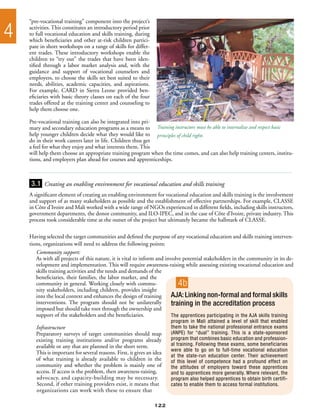
    mary and secondary education programs as a means to Training instructors must be able to internalize and respect basic
    help younger children decide what they would like to principles of child rights
    do in their work careers later in life. Children thus get
    a feel for what they enjoy and what interests them. This
    will help them choose an appropriate training program when the time comes, and can also help training centers, institu-
    tions, and employers plan ahead for courses and apprenticeships.


    3.1 Creating an enabling environment for vocational education and skills training
    A significant element of creating an enabling environment for vocational education and skills training is the involvement
    and support of as many stakeholders as possible and the establishment of effective partnerships. For example, CLASSE
    in Côte d’Ivoire and Mali worked with a wide range of NGOs experienced in different fields, including skills instructors,
    government departments, the donor community, and ILO-IPEC, and in the case of Côte d’Ivoire, private industry. This
    process took considerable time at the outset of the project but ultimately became the hallmark of CLASSE.

    Having selected the target communities and defined the purpose of any vocational education and skills training interven-
    tions, organizations will need to address the following points:
       Community support:
       As with all projects of this nature, it is vital to inform and involve potential stakeholders in the community in its de-
       velopment and implementation. This will require awareness-raising while assessing existing vocational education and
       skills training activities and the needs and demands of the
       beneficiaries, their families, the labor market, and the
       community in general. Working closely with commu-                   4b
       nity stakeholders, including children, provides insight
       into the local context and enhances the design of training        AJA: Linking non-formal and formal skills
       interventions. The program should not be unilaterally             training in the accreditation process
       imposed but should take root through the ownership and
       support of the stakeholders and the beneficiaries.                The apprentices participating in the AJA skills training
                                                                        program in Mali attained a level of skill that enabled
       Infrastructure                                                   them to take the national professional entrance exams
       Preparatory surveys of target communities should map             (ANPE) for “dual” training. This is a state-sponsored
       existing training institutions and/or programs already           program that combines basic education and profession-
       available or any that are planned in the short term.             al training. Following these exams, some beneficiaries
                                                                        were able to go on to full-time vocational education
       This is important for several reasons. First, it gives an idea
                                                                        at the state-run education center. Their achievement
       of what training is already available to children in the         of this level of competence had a profound effect on
       community and whether the problem is mainly one of               the attitudes of employers toward these apprentices
       access. If access is the problem, then awareness-raising,        and to apprentices more generally. Where relevant, the
       advocacy, and capacity-building may be necessary.                program also helped apprentices to obtain birth certifi-
       Second, if other training providers exist, it means that         cates to enable them to access formal institutions.
       organizations can work with these to ensure that

                                                                 122
programs are both complementary and interlinked. For example, if there is already a formal vocational education
institution, it would be important to know what training programs it offers, how accessible the institution is to the
target group, and whether it would be possible to implement program activities through this institution. This would
involve detailed discussions with the institution management and teaching staff to assess local labor market require-
                                                                                                                                     4
ments and potentially to add other skills training to the range on offer, to ensure relevant capacity and equipment,
and to include basic education and life skills as part of the courses to be developed. Third, knowing what institutions
already exist may help in decisions regarding the need to build facilities, renovate buildings, or rent classrooms.

Local labor market analysis
Analysis of the current and potential local employment
and self-employment situation will provide insight into
what skills are in demand and what post-training op-
portunities are available to beneficiaries. If unemploy-          If unemployment is high and opportunities
ment is high and opportunities are scarce, the program
will need to address this through a comprehensive post-           are scarce, the program will need to address
training job-placement approach. (See Section 3.2.)

Apprenticeship programs                                             this through a comprehensive post-training
Existing apprenticeship programs should be part of the
institutional mapping exercise and an assessment car-
ried out that analyzes their effectiveness, working con-
                                                                    job-placement approach
ditions, health and safety, age and sex of the apprentices,
provision of basic education, level of practical training,
follow-up, and accreditation. Apprentices may also be working in traditional and informal trades that are less visible
than in the formal sector. The assessment should include discussions with apprentices and parents to understand their
expectations and the extent to which these are being met. Discussions with potential employers should be conducted
sensitively and in a spirit of constructive collaboration to avoid compromising the future availability of apprenticeship
programsand to ensure employers will observe safe practices and not exploit the trainees.

Age
The age of the project beneficiaries is an important factor in the selection process. Normally, vocational education and
skills training are applicable to older children, beyond the age of primary education and approaching the minimum
legal age of employment. Children below this age group should be linked into primary education interventions.
Older children or children in particularly vulnerable situations are more suited to skills training combined with basic
education and may prefer this option to returning to a school environment. Clear criteria for the selection of trainees,
including their age and vulnerability levels, should be set in collaboration with communities and stakeholders.

Gender
As the world of work evolves, it is no longer only girls who do “hairdressing” and “embroidery” or boys who do “me-
chanics” and “carpentry.” Care must be taken to introduce change sensitively in consultation with stakeholders, and
their support and guidance sought.

                                                                    Local and national government support
                                                                    and policy frameworks
                                                                    Contact should be made with education, labor,
                                                                    and employment departments at the local, region-
                                                                    al, and central levels, particularly with training
                                                                    institutions, to explore areas of mutual support.
                                                                    Unlike primary, secondary, and tertiary education,
                                                                    vocational education and skills training are inter-
                                                                    sectoral, with responsibility usually shared between
                                                                    ministries of labor and education, though quite
                                                                    often under the sole responsibility of the Ministry
                                                                    of Labor. This can create challenges for program
                                                                    development, implementation, and follow-up, so
                                                                    it is vital to talk to those concerned in all sectors.


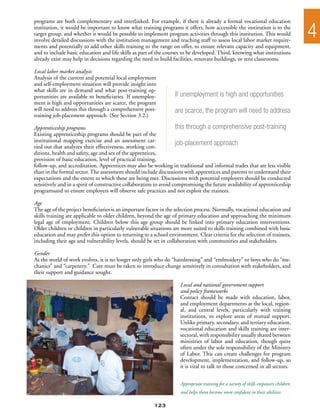
                                                                    Appropriate training for a variety of skills empowers children
                                                                    and helps them become more confident in their abilities

                                                        123
The program should tie in seamlessly with local and

4   national TVET policies and programs, facilitating
    recognition, endorsement, and accreditation. Be-
    cause basic education is a critical component of
    these training programs, it is equally important to
    link into primary education structures. Collabora-
    tion with employment, trade, social services, and
    other departments will also help with follow-up to
    training and enhance trainees’ employment oppor-
    tunities, including self-employment and access to
    support services such as micro-credit and business
    start-up schemes.

    Support of training and school authorities and teachers
    If formal or non-formal education institutions
    exist either in the community or in neighboring
    communities, it is important to establish close re-
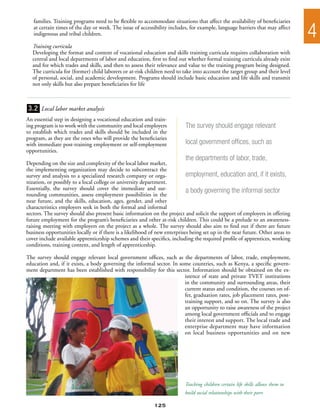
    lations with them to pursue links between skills          Vocational training allows participants to provide their families with a
    training and basic education, including the possi-        higher income and work in a non-hazardous environment
    bility of arranging pre-vocational experiences for
    younger children.

    Support of employers
    Employers, whether in the formal or informal sectors, are important stakeholders in vocational and education train-
    ing programs and should be consulted on such issues as the employment of children, working conditions, and ap-
    prenticeships. They can provide insight into the skills they may require of their employees. It is vital that trainees have
    access to decent employment, including self-employment, as soon as possible after completing their training. In this
    respect, the support of local employers is key, especially if apprenticeships form part of the program strategy. Involv-
    ing employers, including in program monitoring and coordination, reinforces their social responsibilities and should
    further strengthen sustainability. Given the growth of employment in the informal sector, it would be important to
    include employers in this sector as part of a wider community development approach and to promote the concept of
    decent work.

    Finance
    Private sector stakeholders may be interested in skills
    development in trades directly related to their business-             4c
    es and may be willing to finance the training. In-kind
    contributions in the form of job placements or train-             APEGS: Life skills through home
    ing provision in employers’ workshops are also possible           economics education
    and further strengthen ties with potential employers.
                                                                      The APEGS project in Sierra Leone set up a Home Eco-
    Employers may also be willing to train trainers in the
                                                                      nomics Center in a local primary school, established
    skills they specifically require or either to pay for or pro-     as part of the project’s skills training strategy. The
    vide building materials for training centers, equipment,          aim was to link home economics to crops that could
    or learning materials. Local governments may agree to             be grown locally. This was done by cultivating several
    make land or unused/underutilized government build-               vegetable plots in the community. The children learned
    ings available for the establishment of training centers.         how to prepare the ground, plant and sow, harvest, and
    All of these contributions offset project costs and enable        rotate crops. A seed bank was established to support
    funds to be used elsewhere.                                       future planting and harvests.

    Accessibility                                                     The Home Economics Center was fully equipped, and
    The program needs to be physically and technically ac-            children were taught various aspects of household man-
                                                                      agement, food preparation, conservation and cooking,
    cessible to the beneficiary group and at-risk children
                                                                      health and hygiene. The aim was to teach the children
    who might become involved subsequently. The physical              self-sufficiency and prepare them for adult life. The
    environment should make beneficiaries feel welcome,               center was so successful that other primary schools
    comfortable, relaxed, confident, and safe, and the pro-           in the area asked to be included. Some of the children
    gram must be delivered by well-trained, motivated, and            traveled considerable distances to participate in the
    caring staff. If trainees have to travel to the training cen-     training but were always punctual and never missed a
    ter, accommodations should be provided close by. For              class. APEGS found that the combination of skills train-
    example, in the CARD project in Sierra Leone, children            ing, basic education, and life skills increased school
    from outside the community were put up by foster                  attendance and prevented school drop-out.


                                                              124
families. Training programs need to be flexible to accommodate situations that affect the availability of beneficiaries
   at certain times of the day or week. The issue of accessibility includes, for example, language barriers that may affect
   indigenous and tribal children.                                                                                                4
  Training curricula
  Developing the format and content of vocational education and skills training curricula requires collaboration with
  central and local departments of labor and education, first to find out whether formal training curricula already exist
  and for which trades and skills, and then to assess their relevance and value to the training program being designed.
  The curricula for (former) child laborers or at-risk children need to take into account the target group and their level
  of personal, social, and academic development. Programs should include basic education and life skills and transmit
  not only skills but also prepare beneficiaries for life


3.2 Local labor market analysis
An essential step in designing a vocational education and train-
ing program is to work with the community and local employers              The survey should engage relevant
to establish which trades and skills should be included in the
program, as they are the ones who will provide the beneficiaries
with immediate post-training employment or self-employment                 local government offices, such as
opportunities.
                                                                           the departments of labor, trade,
Depending on the size and complexity of the local labor market,
the implementing organization may decide to subcontract the
survey and analysis to a specialized research company or orga-              employment, education and, if it exists,
nization, or possibly to a local college or university department.
Essentially, the survey should cover the immediate and sur-                 a body governing the informal sector
rounding communities, assess employment possibilities in the
near future, and the skills, education, ages, gender, and other
characteristics employers seek in both the formal and informal
sectors. The survey should also present basic information on the project and solicit the support of employers in offering
future employment for the program’s beneficiaries and other at-risk children. This could be a prelude to an awareness-
raising meeting with employers on the project as a whole. The survey should also aim to find out if there are future
business opportunities locally or if there is a likelihood of new enterprises being set up in the near future. Other areas to
cover include available apprenticeship schemes and their specifics, including the required profile of apprentices, working
conditions, training content, and length of apprenticeship.

The survey should engage relevant local government offices, such as the departments of labor, trade, employment,
education and, if it exists, a body governing the informal sector. In some countries, such as Kenya, a specific govern-
ment department has been established with responsibility for this sector. Information should be obtained on the ex-
                                                                        istence of state and private TVET institutions
                                                                        in the community and surrounding areas, their
                                                                        current status and condition, the courses on of-
                                                                        fer, graduation rates, job placement rates, post-
                                                                        training support, and so on. The survey is also
                                                                        an opportunity to raise awareness of the project
                                                                        among local government officials and to engage
                                                                        their interest and support. The local trade and
                                                                        enterprise department may have information
                                                                        on local business opportunities and on new


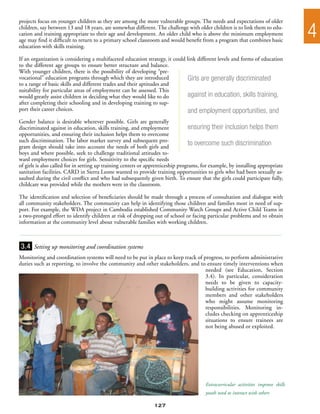
                                                                           Teaching children certain life skills allows them to
                                                                           build social relationships with their peers

                                                            125
enterprises in the pipeline. Other informa-

4   tion to be researched includes the involve-
    ment of local government in apprenticeship
    schemes, the status of the labor inspector-
    ate, and the extent of monitoring of work-
    ing conditions, minimum age employment,
    and other employment-related legislation.
    The survey should cover the availability of
    government support for self-employment,
    micro-enterprise, and micro-finance.

    One area for analysis is that of support in-
    dustries to major industries or public sec-
    tor activities in the area. For example, large
    industries often require smaller companies
    to supply them with related products and
    services or to perform product finishing ser-
    vices. Public sector offices also often require
    outside services and products, such as statio-
    nery, maintenance, and cleaning. All of these Skill training must be able to address knowledge, attitudes, and practices in
    support activities create business and em- child-friendly ways
    ployment opportunities, some of which may
    as yet be unexplored. Therefore, as well as looking at what already exists, the survey should consider what opportunities
    could be created. This is especially useful for those setting up self-employment or micro-enterprise activities.

    The survey should also seek to identify the presence and activity of trade unions and other workers’ or professional or-
    ganizations and to involve them in assessing the local labor market. These organizations have a different perspective to
    that of employers and local government and will help to provide a balanced picture of the labor market. It is also good
    to engage such organizations on the issue of child labor and involve them in project activities. For example, trade unions
    can teach trainees about working conditions and workers’ rights and how to protect themselves. Involvement is in the
    interests of trade unions and professional associations, as trainees may wish to join up once they enter the labor market.
    Other potential targets for the survey include local chambers of commerce, employers’ associations, and business associa-
    tions.

    The analysis of the survey results should inform discussions with community and other stakeholders on the project
    design, including the selection of trades and skills sets. The analysis would also be of interest to other stakeholders, in-
    cluding employers, local government, chambers of commerce, training institutions, schools, community associations,
    trade unions, and professional associations. It can further serve as the basis of an awareness-raising campaign targeting
    relevant stakeholders.

    In order for skills training to keep pace with change, labor market surveys should be conducted on a regular basis, for
    example once every one or two years. Responsibility for the survey should be shared between stakeholders, particularly
    local government and employers, as they stand to benefit most. The cost will not be as high as the initial project survey
    since start-up investment is always highest. Once the format, content, and process have been established, costs should
    decrease proportionately and, if the survey is carried out regularly, could become minimal as respondents only complete
    the survey if changes have occurred. The biggest task would be to identify new entrants to the business environment.


    3.3 Identification of beneficiaries
    Projects will be restricted in the choice of beneficiaries by the funds available and the timeframe for implementation. The
    main objective is to reach those children most in need, particularly those who should be removed as soon as possible from
    the worst forms of child labor. CARD in Sierra Leone developed criteria and was careful to select beneficiaries evenly
    from the target communities with the help of local civil authorities and the Child Welfare Committee.

    Age and gender are also factors in identifying beneficiaries. In the CIRCLE projects, some beneficiaries were of primary
    school age (between 9 and 12 years), but in other cases, particularly in projects involving either apprenticeships or a mix
    of center-based and job placement activities, the children were older (between 15 and 18 years) and therefore above the
    legal minimum age of employment in the countries concerned. In light of ILO Convention No. 182, many child labor

                                                              126
projects focus on younger children as they are among the more vulnerable groups. The needs and expectations of older
children, say between 13 and 18 years, are somewhat different. The challenge with older children is to link them to edu-
cation and training appropriate to their age and development. An older child who is above the minimum employment
age may find it difficult to return to a primary school classroom and would benefit from a program that combines basic
                                                                                                                                    4
education with skills training.

If an organization is considering a multifaceted education strategy, it could link different levels and forms of education
to the different age groups to ensure better structure and balance.
With younger children, there is the possibility of developing “pre-
vocational” education programs through which they are introduced              Girls are generally discriminated
to a range of basic skills and different trades and their aptitudes and
suitability for particular areas of employment can be assessed. This
would greatly assist children in deciding what they would like to do          against in education, skills training,
after completing their schooling and in developing training to sup-
port their career choices.                                                    and employment opportunities, and
Gender balance is desirable wherever possible. Girls are generally
discriminated against in education, skills training, and employment               ensuring their inclusion helps them
opportunities, and ensuring their inclusion helps them to overcome
such discrimination. The labor market survey and subsequent pro-
gram design should take into account the needs of both girls and
                                                                                  to overcome such discrimination
boys and where possible, seek to challenge traditional attitudes to-
ward employment choices for girls. Sensitivity to the specific needs
of girls is also called for in setting up training centers or apprenticeship programs, for example, by installing appropriate
sanitation facilities. CARD in Sierra Leone wanted to provide training opportunities to girls who had been sexually as-
saulted during the civil conflict and who had subsequently given birth. To ensure that the girls could participate fully,
childcare was provided while the mothers were in the classroom.

The identification and selection of beneficiaries should be made through a process of consultation and dialogue with
all community stakeholders. The community can help in identifying those children and families most in need of sup-
port. For example, the WDA project in Cambodia established Community Watch Groups and Active Child Teams in
a two-pronged effort to identify children at risk of dropping out of school or facing particular problems and to obtain
information at the community level about vulnerable families with working children.


3.4 Setting up monitoring and coordination systems
Monitoring and coordination systems will need to be put in place to keep track of progress, to perform administrative
duties such as reporting, to involve the community and other stakeholders, and to ensure timely interventions when
                                                                                   needed (see Education, Section
                                                                                   3.4). In particular, consideration
                                                                                   needs to be given to capacity-
                                                                                   building activities for community
                                                                                   members and other stakeholders
                                                                                   who might assume monitoring
                                                                                   responsibilities. Monitoring in-
                                                                                   cludes checking on apprenticeship
                                                                                   situations to ensure trainees are
                                                                                   not being abused or exploited.


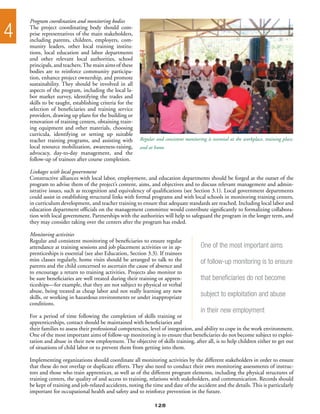
                                                                                        Extracurricular activities improve skills
                                                                                        youth need to interact with others

                                                                127
Program coordination and monitoring bodies

4   The project coordinating body should com-
    prise representatives of the main stakeholders,
    including parents, children, employers, com-
    munity leaders, other local training institu-
    tions, local education and labor departments
    and other relevant local authorities, school
    principals, and teachers. The main aims of these
    bodies are to reinforce community participa-
    tion, enhance project ownership, and promote
    sustainability. They should be involved in all
    aspects of the program, including the local la-
    bor market survey, identifying the trades and
    skills to be taught, establishing criteria for the
    selection of beneficiaries and training service
    providers, drawing up plans for the building or
    renovation of training centers, obtaining train-
    ing equipment and other materials, choosing
    curricula, identifying or setting up suitable
    teacher training programs, and assisting with        Regular and consistent monitoring is essential at the workplace, training place,
    local resource mobilization, awareness-raising,      and at home
    advocacy, day-to-day management, and the
    follow-up of trainees after course completion.

    Linkages with local government
    Constructive alliances with local labor, employment, and education departments should be forged at the outset of the
    program to advise them of the project’s content, aims, and objectives and to discuss relevant management and admin-
    istrative issues, such as recognition and equivalency of qualifications (see Section 3.1). Local government departments
    could assist in establishing structural links with formal programs and with local schools in monitoring training centers,
    in curriculum development, and teacher training to ensure that adequate standards are reached. Including local labor and
    education department officials on the management committee would contribute significantly to formalizing collabora-
    tion with local government. Partnerships with the authorities will help to safeguard the program in the longer term, and
    they may consider taking over the centers after the program has ended.

    Monitoring activities
    Regular and consistent monitoring of beneficiaries to ensure regular
    attendance at training sessions and job placement activities or in ap-              One of the most important aims
    prenticeships is essential (see also Education, Section 3.3). If trainees
    miss classes regularly, home visits should be arranged to talk to the               of follow-up monitoring is to ensure
    parents and the child concerned to ascertain the cause of absence and
    to encourage a return to training activities. Projects also monitor to
    be sure beneficiaries are well treated during their training or appren-             that beneficiaries do not become
    ticeships—for example, that they are not subject to physical or verbal
    abuse, being treated as cheap labor and not really learning any new
    skills, or working in hazardous environments or under inappropriate                 subject to exploitation and abuse
    conditions.
                                                                                        in their new employment
    For a period of time following the completion of skills training or
    apprenticeships, contact should be maintained with beneficiaries and
    their families to assess their professional competencies, level of integration, and ability to cope in the work environment.
    One of the most important aims of follow-up monitoring is to ensure that beneficiaries do not become subject to exploi-
    tation and abuse in their new employment. The objective of skills training, after all, is to help children either to get out
    of situations of child labor or to prevent them from getting into them.

    Implementing organizations should coordinate all monitoring activities by the different stakeholders in order to ensure
    that these do not overlap or duplicate efforts. They also need to conduct their own monitoring assessments of instruc-
    tors and those who train apprentices, as well as of the different program elements, including the physical structures of
    training centers, the quality of and access to training, relations with stakeholders, and communication. Records should
    be kept of training and job-related accidents, noting the time and date of the accident and the details. This is particularly
    important for occupational health and safety and to reinforce prevention in the future.

                                                                128
Community self-help groups
Part of the community mobilization process could involve helping families of trainees to set up self-help groups to offer
various forms of support to their children and to each other. These groups can motivate by ensuring that beneficiaries
regularly attend training courses and perform to the best of their abilities. This might take the form of assisting children
                                                                                                                                 4
or families in particular need or of providing encouragement when commitment to the program falters. These self-help
groups can look at how skills training would benefit adults leading to income-generating activities or setting up family
businesses. These opportunities could boost the income of disadvantaged and poor families, leading to increased earnings
and thereby alleviating the need to resort to child labor.


 3.5 Forms of training delivery
The most effective training method will depend on the needs of the beneficiaries. Possibilities include:
  –	 Subcontracting delivery to existing formal and non-formal training institutions and/or programs in the community
  	 or in neighboring communities, including through scholarships. Although not common among the best practices
  	 reviewed for this chapter, this approach is applicable in situations where some level of state TVET infrastructure exists.
  	 For example, AJA and AID in Mali tapped into existing training centers. One of these centers had been established
  	 through a previous ILO-IPEC project but had suffered following the end of that project. AJA supported its renovation
  	 and restructuring, including providing safety clothing and materials and training equipment, and included a focus
  	 on basic education so that trainees could read and write. In the AID project, a local fashion and tailoring center agreed
  	 to accept trainees for less than a third of the usual cost. Dos Generaciones in Nicaragua provided scholarships for
  	 beneficiaries to attend technical training courses in a vocational education center.

   –	 Establishing a center-based approach, either by building a multipurpose center or renovating existing buildings to
   	 accommodate the training program. For example, CARD in Sierra Leone was provided with a building by the local
   	 parish, which it was able to convert into four separate training workshop areas, plus a cafeteria and kitchen.
   	 Additional temporary shelters were built alongside to provide sanitary facilities, including showers, and a day-care
   	 center. A fence was erected around the building using locally available materials, and guards were hired to enhance
   	 its security, which was important given the number of girls attending the program. DARNA in Morocco, meanwhile,
   	 erected farm buildings on land provided by the government outside Tangiers. The farm was built to include stables,
   	 barns, water, and grazing areas to support the livestock and fowl for the farm, as well as the accommodation and
   	 training areas for the children.

   –	 Providing skills training through non-formal venues based in the community, including schools, private homes and
   	 land. For example, PAMI in Guatemala integrated the skills training workshops into the overall education strategy,
   	 and workshops were provided as a supplement to the
   	 children’s education. Private teachers were hired to
   	 provide training in computer skills, sewing, and                     4d
   	 arts and crafts.                                              CCB: Linking beneficiaries to relevant
   –	 Setting up apprenticeship schemes with local employers         training service providers
   	 in the formal and non-formal sectors. For example, CCB          The CCB project in Sierra Leone targeted child street
   	 in Sierra Leone conducted a careful screening process           beggars. These children were enrolled in a special edu-
   	 of hundreds of enterprises in the target areas to select        cation program that included basic literacy and numer-
   	 those able to provide hands-on training to the                  acy, psychosocial support, and emergency and basic
   	 beneficiaries (see box 4d).                                     relief support, including clothing and health services.
                                                                     The basic education course was designed to provide
                                                                     a crucial preparatory framework for the skills training
   – A mix of all or some of the above.                              component that followed, which included community-
                                                                     based trades. CCB also covered training costs and pro-
The training delivery method should depend on the out-               vided training materials, including basic work tools.
come of the initial needs analysis, which should focus not
only on the labor market, but also on the needs and expecta-         CCB identified suitable community-based enterprises
tions of the beneficiary group, parents, other at-risk children,     in various trades. Criteria for selection included ad-
employers, relevant local government departments, and the            equate health and safety, length of working hours, and
community generally (see Section 3.2). Integrating a center-         the content of the training program. CCB also spoke to
based approach with practical job placements with local em-          other employers and neighbors to create a comprehen-
ployers is particularly effective as it enables trainees to grasp    sive picture of each work place. Following selection,
the technical aspects of the new skills and then to apply            trainees worked for a few days in each chosen work-
                                                                     shop to decide which trade would suit them best.
them in a work environment. The CARD project in Sierra

                                                                    129
Leone put in place a curriculum combining

4   80 percent theory with 20 percent practical
    application. In the later stages of the proj-
    ect, the ratio increased to 30 percent practi-
    cal work. A center-based approach will also
    facilitate the delivery of other aspects of the
    training program, such as basic education,
    life skills, and work-related subjects such
    as accounting, marketing, and sales, which
    are of particular value to those interested in
    self-employment.

    As with all education approaches, children
    will benefit most from skills training in sit-
    uations where there is a low student-teacher
    ratio. The same principle applies to job
    placements and apprenticeships, as keep-
    ing the numbers of trainees in one work-
    place low will ensure that each apprentice
    has adequate opportunities to practice with
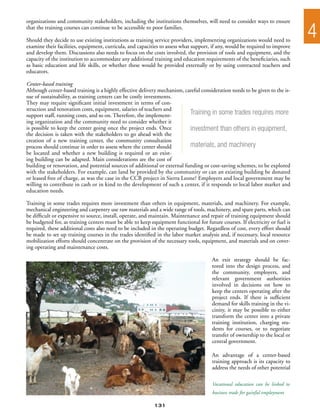
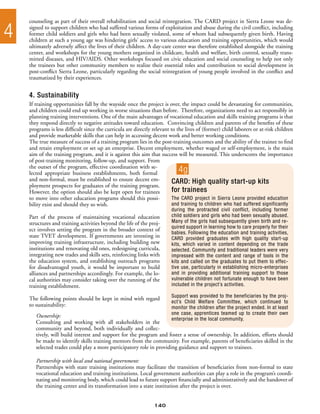
    tools and equipment, to receive meaningful        Vocational training allows participants to provide a livelihood for
    attention from the instructor or employer,        themselves and their families
    and to master the necessary skills.

    Pre-existing training centers and TVET institutions
    One reason why CIRCLE partners did not often choose to deliver training through existing formal and non-formal
    training institutions is because where these institutions exist, they are often limited in number, scope, and capacity. State
    TVET systems have suffered from a lack of investment and obsolete or irrelevant equipment, curricula, and training
    methodologies. In some countries, smaller private, non-formal training institutions exist, often set up and managed by
    NGOs. However, in most cases, marginalized and socially excluded children, including child laborers, face many ob-
    stacles in accessing these institutions. Among the reasons for this are:

       –	 Courses are usually fee-paying, even for state institutions, and poor families cannot afford them.

       –	 They are not widespread geographically and therefore access is a physical and a cost issue for poor families who
       	 cannot afford transportation or accommodation.

       –	 The range of courses may be limited owing to the high cost of investment in equipment and teaching staff and
       	 therefore may not correspond to trades that are relevant.

       –	 The equipment and curricula may be obsolete and irrelevant to the types and form of employment available in the
       	 labor market.

       –	 Some institutions have minimum education requirements that exclude children who have either never been to school
       	 or have dropped out.

       –	 Some institutions expect trainees to supply their own tools, protective equipment, and clothing, which again will
       	 exclude poor families who cannot afford them.

    There is a growing realization of the potential of TVET systems within an overall education system to contribute to
    national competitiveness and productivity and to ensure a steady flow of skilled workers into the national labor market.
    However, it will take time before the realization of the benefits of this investment reach the more marginalized groups in
    society. Where feasible, efforts should be made to bring existing institutions on board and to include them in the stake-
    holder discussions. It is possible that working through these institutions could support government efforts to strengthen
    national TVET systems, and this would represent an important contribution by the project to national development
    programs.

    The project may be able to offset fees and related institutional costs during its lifetime, but consideration needs to be
    given to disadvantaged children who will need to access skills training after the project ends. Therefore, implementing


                                                                 130
organizations and community stakeholders, including the institutions themselves, will need to consider ways to ensure
that the training courses can continue to be accessible to poor families.

Should they decide to use existing institutions as training service providers, implementing organizations would need to
                                                                                                                               4
examine their facilities, equipment, curricula, and capacities to assess what support, if any, would be required to improve
and develop them. Discussions also needs to focus on the costs involved, the provision of tools and equipment, and the
capacity of the institution to accommodate any additional training and education requirements of the beneficiaries, such
as basic education and life skills, or whether these would be provided externally or by using contracted teachers and
educators.

Center-based training
Although center-based training is a highly effective delivery mechanism, careful consideration needs to be given to the is-
sue of sustainability, as training centers can be costly investments.
They may require significant initial investment in terms of con-
struction and renovation costs, equipment, salaries of teachers and
support staff, running costs, and so on. Therefore, the implement-         Training in some trades requires more
ing organization and the community need to consider whether it
is possible to keep the center going once the project ends. Once           investment than others in equipment,
the decision is taken with the stakeholders to go ahead with the
creation of a new training center, the community consultation
process should continue in order to assess where the center should         materials, and machinery
be located and whether a new building is required or an exist-
ing building can be adapted. Main considerations are the cost of
building or renovation, and potential sources of additional or external funding or cost-saving schemes, to be explored
with the stakeholders. For example, can land be provided by the community or can an existing building be donated
or leased free of charge, as was the case in the CCB project in Sierra Leone? Employers and local government may be
willing to contribute in cash or in kind to the development of such a center, if it responds to local labor market and
education needs.

Training in some trades requires more investment than others in equipment, materials, and machinery. For example,
mechanical engineering and carpentry use raw materials and a wide range of tools, machinery, and spare parts, which can
be difficult or expensive to source, install, operate, and maintain. Maintenance and repair of training equipment should
be budgeted for, as training centers must be able to keep equipment functional for future courses. If electricity or fuel is
required, these additional costs also need to be included in the operating budget. Regardless of cost, every effort should
be made to set up training courses in the trades identified in the labor market analysis and, if necessary, local resource
mobilization efforts should concentrate on the provision of the necessary tools, equipment, and materials and on cover-
ing operating and maintenance costs.

                                                                                       An exit strategy should be fac-
                                                                                       tored into the design process, and
                                                                                       the community, employers, and
                                                                                       relevant government authorities
                                                                                       involved in decisions on how to
                                                                                       keep the centers operating after the
                                                                                       project ends. If there is sufficient
                                                                                       demand for skills training in the vi-
                                                                                       cinity, it may be possible to either
                                                                                       transform the center into a private
                                                                                       training institution, charging stu-
                                                                                       dents for courses, or to negotiate
                                                                                       transfer of ownership to the local or
                                                                                       central government.

                                                                                       An advantage of a center-based
                                                                                       training approach is its capacity to
                                                                                       address the needs of other potential

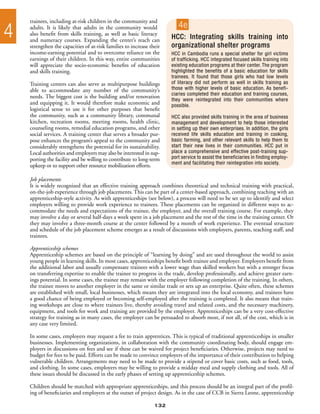
                                                                                       Vocational education can be linked to
                                                                                       business trade for gainful employment

                                                            131
trainees, including at-risk children in the community and

4   adults. It is likely that adults in the community would
    also benefit from skills training, as well as basic literacy
    and numeracy courses. Expanding the center’s reach can
                                                                         4e
                                                                      HCC: Integrating skills training into
    strengthen the capacities of at-risk families to increase their   organizational shelter programs
    income-earning potential and to overcome reliance on the          HCC in Cambodia runs a special shelter for girl victims
    earnings of their children. In this way, entire communities       of trafficking. HCC integrated focused skills training into

    will appreciate the socio-economic benefits of education          existing education programs at their center. The program
    and skills training.                                              highlighted the benefits of a basic education for skills
                                                                      trainees. It found that those girls who had low levels
    Training centers can also serve as multipurpose buildings         of literacy did not perform as well in skills training as
    able to accommodate any number of the community’s                 those with higher levels of basic education. As benefi-
                                                                      ciaries completed their education and training courses,
    needs. The biggest cost is the building and/or renovation
                                                                      they were reintegrated into their communities where
    and equipping it. It would therefore make economic and            possible.
    logistical sense to use it for other purposes that benefit
    the community, such as a community library, communal              HCC also provided skills training in the area of business
    kitchen, recreation rooms, meeting rooms, health clinic,          management and development to help those interested
    counseling rooms, remedial education programs, and other          in setting up their own enterprises. In addition, the girls
    social services. A training center that serves a broader pur-     received life skills education and training in cooking,
    pose enhances the program’s appeal to the community and           basic farming, and other relevant skills to help them to
    considerably strengthens the potential for its sustainability.    start their new lives in their communities. HCC put in
    Local authorities and employers may also be interested in sup-    place a comprehensive and effective post-training sup-
    porting the facility and be willing to contribute to long-term    port service to assist the beneficiaries in finding employ-
                                                                      ment and facilitating their reintegration into society.
    upkeep or to support other resource mobilization efforts.

    Job placements
    It is widely recognized that an effective training approach combines theoretical and technical training with practical,
    on-the-job experience through job placements. This can be part of a center-based approach, combining teaching with an
    apprenticeship-style activity. As with apprenticeships (see below), a process will need to be set up to identify and select
    employers willing to provide work experience to trainees. These placements can be organized in different ways to ac-
    commodate the needs and expectations of the trainee, the employer, and the overall training course. For example, they
    may involve a day or several half-days a week spent in a job placement and the rest of the time in the training center. Or
    they may involve a three-month course at the center followed by a month of work experience. The eventual structure
    and schedule of the job placement scheme emerges as a result of discussions with employers, parents, teaching staff, and
    trainees.

    Apprenticeship schemes
    Apprenticeship schemes are based on the principle of “learning by doing” and are used throughout the world to assist
    young people in learning skills. In most cases, apprenticeships benefit both trainee and employer. Employers benefit from
    the additional labor and usually compensate trainees with a lower wage than skilled workers but with a stronger focus
    on transferring expertise to enable the trainee to progress in the trade, develop professionally, and achieve greater earn-
    ings potential. In some cases, the trainee may remain with the employer following completion of the training. In others,
    the trainee moves to another employer in the same or similar trade or sets up an enterprise. Quite often, these schemes
    are established with small, local businesses, which means they are integrated into the local economy, and trainees have
    a good chance of being employed or becoming self-employed after the training is completed. It also means that train-
    ing workshops are close to where trainees live, thereby avoiding travel and related costs, and the necessary machinery,
    equipment, and tools for work and training are provided by the employer. Apprenticeships can be a very cost-effective
    strategy for training as in many cases, the employer can be persuaded to absorb most, if not all, of the cost, which is in
    any case very limited.

    In some cases, employers may request a fee to train apprentices. This is typical of traditional apprenticeships in smaller
    businesses. Implementing organizations, in collaboration with the community coordinating body, should engage em-
    ployers in discussions on fees and see if these can be waived for project beneficiaries. Otherwise, projects may need to
    budget for fees to be paid. Efforts can be made to convince employers of the importance of their contribution to helping
    vulnerable children. Arrangements may need to be made to provide a stipend or cover basic costs, such as food, tools,
    and clothing. In some cases, employers may be willing to provide a midday meal and supply clothing and tools. All of
    these issues should be discussed in the early phases of setting up apprenticeship schemes.

    Children should be matched with appropriate apprenticeships, and this process should be an integral part of the profil-
    ing of beneficiaries and employers at the outset of project design. As in the case of CCB in Sierra Leone, apprenticeship

                                                                132
providers should be selected on the basis of criteria that include credibility, professional reputation, location, health and
safety features, appropriate working conditions, availability of appropriate working tools and equipment, training ca-
pacities, commitment to project aims and objectives, and cost of apprenticeship. Written agreements with the employer
and possibly between the apprentice and the employer can be established. For example, Wathnakpheap in Cambodia
                                                                                                                                4
concluded contracts directly with skills instructors selected to provide training services. Vocational guidance should be
provided to match candidates to apprenticeships since it is important to get the choice right from the outset as it is may
be difficult to change once training has started. Children and parents will need support in making choices. This process
should also help in overcoming gender stereotyping in the selection of skills, particularly for girls.
Employers should be expected to train apprentices in specific vocational skills only. Subjects such as business skills, basic
education, life skills, and health education need to be covered by other service providers (for example, schools, counsel-
ors, and educators). However, apprentices can also learn a great deal about how a business is set up, run, and managed
by observing employers and being involved in these activities. Planning must include discussions including employers on
this additional education and training (the format, content, and delivery), and agreement reached on when these would
take place in order to cause limited disruption to the child’s skills training and to the work of the employer. For example,
it may be possible to organize the additional education program in a particular venue for all apprentices on one or two
days a week. Care must be taken to avoid overburdening the apprentices. A healthy work and life balance must be estab-
lished so that apprentices can enjoy normal aspects of childhood, such as recreation and time with friends and family.

Similar consideration should be given to the provision of social support services to apprentices, as it is unreasonable to
expect employers to provide these. These services should be provided initially through the project, but the issue of how
these will be sustained in the longer term should be part of the discussions with the community. These support services
might include meals, subsidies, counseling, transport, health, recreation, and sport.

One of the positive outcomes of a successful apprenticeship scheme is that employers are introduced to the concept and
may come to embrace it. Employers who have had favorable experiences can be highly effective advocates and can assist
in mobilizing other potential employers willing to take on apprentices in the future. This is very important to sustain-
ability.

Training content and schedules
The content of the skills training program will depend on the type of industry or business involved, but it needs to be as
detailed as possible. Employers have noted how important it is for trainees to be aware of all the different elements of the
trade, including names of tools and machinery, spare parts, descriptions of skills and processes, timing, and so on. In this
respect, trainees must be able to read, write, and do basic calculations, particularly if there are handbooks and manuals
to be read and digested and, for example, machines to be repaired. Training can be verbal and observational, with the
trainee replicating what she or he has been told or has observed. The overall approach is learning by doing and refining
skills through practice and repetition.

The length of training courses and apprenticeships will depend on the training course and the skills being taught. In
addition, it will depend on the format of the training delivery, for example, whether it is center-based or a mix of theory
and practice through job placements. Some trades require considerable time for trainees to become competent and ex-
                                                                               perienced enough to be considered skilled
                                                                               workers, particularly if they are setting up
                                                                               their own businesses. Unfortunately, the
                                                                               length of some training courses may be
                                                                               dictated by the length of the project. In
                                                                               more complex trades, such as mechanics,
                                                                               construction, or computer programming,
                                                                               it may take years rather than months to
                                                                               achieve an adequate level. Guidance can
                                                                               be sought from employers, training in-
                                                                               stitutions, and relevant local government
                                                                               departments on the amount of time to al-
                                                                               locate to different training courses.

                                                                                 Through monitoring, a close eye should
                                                                                 be kept on individual trainees and on their
                                                                                 capacities to complete the training within
                                                                                 Employers could support older youth as
                                                                                 apprentices for their skill enhancement

                                                            133
the given timeframe. If at the end of the course or apprenticeship trainees have not mastered the necessary skills, arrange-

4   ments should be made with the training providers to continue with additional and remedial training until the trainees
    have reached a satisfactory level. As with education, children have different capacities and abilities, and these need to be
    taken into account in tailoring individual training programs.

    Health and safety concerns
    Training centers, skills instructors, and employers of apprentices will need to keep detailed records of job-related acci-
    dents involving trainees. These records can contribute to a regular review of health and safety practices and ensure that
    these are of the highest standard possible. This process can contribute to safer working practices and help trainees to
    understand the importance of health and safety equipment and clothing.

    In addition, implementing organizations, in close collaboration with community stakeholders, local health departments,
    and clinics, should ensure that accident and health plans are in place before training begins. Actions to take in the event
    of an accident or emergency should be built into pre-service capacity-building of trainers and support staff and be inte-
    grated into the occupational health and safety component of the skills training courses. This may require arranging for
    health and accident insurance to cover any related costs to beneficiaries and their families. Stakeholders should be made
    aware of the importance of maintaining health and social insurance and consider how to address it following the end of
    the project.

    Earning while learning
    While children are learning new skills either in centers or
    while on job placements or apprenticeships, they will in-
    evitably be doing productive work that might either result
                                                                           4f
    in the manufacture of products or in the delivery of some           DARNA: Relating skills training to
    service or repair, for example, car mechanics. For this, they
    should be entitled to some remuneration, however nomi-              income generation
    nal. This can boost children’s confidence and self-esteem           With the support of the government, DARNA in Morocco
    and reinforces participation in their own training. For ex-         established a special training farm to accommodate
    ample, the trainees involved in the Wathnakpheap project            children removed from the streets of Tangiers. Most of
                                                                        these children came from rural backgrounds and had
    in Cambodia were able to exhibit and sell their crafts at
                                                                        migrated to Tangiers in the hope of finding work and a
    a trade fair. The practice of “earning while learning” is to        better life. Because of the beneficiaries’ backgrounds,
    be encouraged in training programs and apprenticeships. It          DARNA tailored its center-based education program to
    also helps in resource mobilization, including in financing         tap into their knowledge and understanding by provid-
    the costs of running a center.                                      ing training in agricultural and farming skills. In ad-
                                                                        dition, classes were given in basic education and life
    Training centers and employers should consider how to               skills.
    use this part of the learning process to greatest effect. For
    example, should trainees be rewarded with payments from             DARNA ensured that the beneficiaries were trained in all
    sales and services? They can also learn from how money              aspects of agriculture and farming, from understanding
    earned from sales is used to further develop the business.          the process from a theoretical perspective to planting,
                                                                        crop management, harvesting, and processing the pro-
    In other words, the process of “earning while learning” in-
                                                                        duce to feed farm animals, to sell or to eat. Similarly,
    cludes training in business and entrepreneurial skills, which       they were taught all aspects of animal farming, as well
    is particularly useful for those trainees interested in self-em-    as how to enhance milk production in goats, making
    ployment.                                                           cheese, and processing it for sale. The children built
                                                                        the animal enclosures in and around the farm. The farm
    Skills related to self-employment and micro-enterprises             also supplies the shop and restaurant run by DARNA
    Business and entrepreneurial skills are an important subject        members in Tangiers and supplies cheese to the lo-
    area in vocational training, particularly for trainees inter-       cal youth center, from which it receives bread from the
    ested in setting up their own small business. Some of the           youth center’s bakery in return.
    topics they will need to cover are:
                                                                        DARNA links literacy and other basic education activi-
                                                                        ties to farming activities so that children learn more
       –	 the nature and functioning of the business market;
                                                                        effectively. Beneficiaries are treated with respect and
       –	 costs of raw materials, production, and finishing;            are encouraged to consider the farm as their own so
       –	 calculating sales and costs of sales;                         that they have a vested interest in its activities, main-
       –	 the concept and nature of profit and its contribution         tenance, and success. In return, they have accommo-
       	 to business development;                                       dation, food, work, education, and training. The farm
                                                                        has become self-financing and self-sufficient, with
       –	 the concept and importance of cash flow;                      money made from sales of farm produce reinvested in
       –	 depreciation and the need to maintain and invest              maintenance, running costs, education activities, and
       	 in equipment and machinery;                                    recreation.

                                                                  134
–	 accounting, balance sheets, and tax returns;
   –	 bank accounts and credit;
   –	 microfinance and loans;
   –	 business networking, marketing, and sales;
                                                                                                                                  4
   –	 price negotiations in sales and purchases;
   –	 client and supplier prospecting.

Trainees need to be aware of what micro-credit
and other loan facilities are available. They need
to understand the cost and implications of self-
employment and the necessity of keeping up with
loan repayments. They will require considerable
guidance and support, to the extent possible, from
the community, the coordinating and monitoring
body, other employers, local government depart- Vocational training allows participants to identify and learn marketable skills
ments, and the implementing organization in the
early stages of their business development. Establishing a business takes time, effort, and investment, and monitoring
and support should be there to assist the young trainees in this process.

Career guidance, vocational counseling and post-training job placements
A vocational education and skills training program should be accompanied by adequate counseling. The objective is
to assist beneficiaries prior to, during, and after their training courses. The children will not have a positive view of the
world of work as many of them will have been subjected to various forms of exploitation and abuse, possibly of the worst
forms, such as commercial sexual exploitation, use in the military, as was the case in Sierra Leone, and domestic servi-
tude. For them, the world of work is a dangerous and frightening place, and all those involved in their rehabilitation have
a role in helping them overcome their traumatic pasts and experience some of the more positive aspects to the world of
work, performing tasks and learning skills that are productive, interesting, and meaningful.

The program should therefore include career guidance and vocational counseling as support services for the beneficiaries,
for other at-risk children, and for any adults who may be benefiting from the training activities. Part of the function
of this service should be to assist trainees in finding employment after the course finishes and to help those interested
in becoming self-employed to set up enterprises and access markets and appropriate services, such as micro-credit. It is
quite possible that local government departments, employers, and education services can assist in establishing an effective
counseling and job placement service. In addition, if there are existing training institutions in the community, they may
already have such support services in place, which could be extended to project beneficiaries.

If possible, professional counselors and job placement specialists should be engaged. Failing this, or if finances are lim-
ited, a service could be established by the coordinating body, including employers, teaching staff, and local labor and
education departments. To begin with it would advise on trades and skills sets suited to trainees’ needs, aspirations, abili-
ties, and academic capacities. Then, during the training, the service should provide ongoing support, for example, if a
trainee is unhappy with the trade or skills training and wishes to change, and offering additional or remedial support,
where necessary. Lastly, it would link children with available jobs or self-employment opportunities and follow up these
placements for a period of time to ensure that beneficiaries settle in well, are not being abused or exploited, and their
needs and expectations are being met. It could also ensure that the beneficiaries continue to receive other appropriate
support services, including social support. Career guidance, vocational counseling, and job placement services can con-
siderably boost the transition process from training to employment for beneficiaries and other at-risk children and ensure
that it is as positive, constructive, and effective as possible.


3.6 Capacity-building of instructors and employers
Capacity-building needs will depend on the format of training chosen. If establishing a new training center, as was the
case in the majority of projects reviewed for this chapter, organizations will need to use the local labor market analysis to
assess requirements for teaching staff. It is vital to involve representatives of local employers in discussions so that they
can assist in outlining the roles and responsibilities of the teaching staff and the curriculum content (see Section 3.3).
Initially, existing institutions or relevant government departments, both central and local, should be consulted to assess
what training curricula are already in place for the trades identified and the content of existing teacher training programs
for these trades. If possible, discussions should be held with these stakeholders to find out if they would be able and

                                                             135
willing to support the capacity-building of the new teach-

4   ing staff. This could be an in-kind contribution and lead to
    further savings on project funds. It is also possible that these
    stakeholders, including employers, will be able to identify
    potential teaching staff or second a member of their own
    staff for this purpose.

    Criteria should be established for the hiring of teaching
    staff, including detailed technical knowledge of the skills
    to be taught, but also a high level of motivation, sensitivity,
    and commitment. A selection committee could be estab-
    lished, including employers where possible, as they would
    have a better understanding of the technical aspects of skills
    training. During the selection process, from job advertis-
    ing to interviews, candidates should be informed of the na-
    ture of the project and the profile of the beneficiary group.
    Successful candidates would be expected to be more than
    teachers to the children. They need to act as mentors and
    counselors and be sensitive to the children’s particular needs
    and situations.

    An appropriate gender balance should apply in hiring teach-
    ers, particularly in communities where female teachers are
    required to teach girls and where these teachers can become Vocational education can help in income generation through use
    powerful role models to the students. Where possible, ef-
    forts should also be made to hire local teachers so that the of local resources
    capacities transferred remain in the community after the
    project ends. This is particularly important for projects involving indigenous and tribal populations. For more informa-
    tion on the content of the teacher training program, see the chapter on Education and specifically Section 2.6 on the
    training of teachers and facilitators.

    There are some additional elements and priorities to consider in vocational education and skills training:
       Pedagogical role:
       One of the challenges in hiring skills training instructors is that they may not have the necessary level of pedagogical
       training. It is possible that they will be either employers or individuals skilled in a particular trade but do not come
       from a teaching background. Competence in the skills required is only a part of the teaching task. The other part is
       knowing how to pass on this knowledge and understanding in an effective and accessible manner. Teaching is a voca-
       tion, and much of the work involves communicating effectively. Therefore, capacity-building programs equip instruc-
       tors with pedagogical skills and should include both pre- and in-service training to ensure that support is provided on
       a continuous basis during the program.

       Occupational health and safety:
       This component of safe work is too often overlooked. It is essential that children, who are more vulnerable than
       adults, are well informed of the risks and hazards associated with the trade they are learning. They need to know
       how to take precautionary action and what protective clothing, equipment, and materials are needed and available.
       Teachers should be familiar with the legal framework of occupational health and safety, and any information on le-
       gal requirements, including manuals and other materials, should be obtained and the labor inspectorate involved if
       possible. Such contacts can be facilitated through local labor and employment departments. This particular training
       component also provides an effective entry point for organizations
       to introduce additional health issues, such as personal hygiene, nutrition, sex education, HIV/AIDS, and child wel-
       fare and care.

       Working conditions and rights:
       The program should cover the nature, causes, and consequences of child labor. Participants should be informed of the
       relevant legislation, what is and is not acceptable, and how to defend their rights. In this way, the trainees learn what
       is acceptable in the workplace and how to inform and protect their peers. Trade unions or other professional bodies
       can assist in transmitting this knowledge. Trainees will thus be familiarized with the vital role these bodies play in the
       world of work and in protecting the rights of workers.


                                                                 136
Business-related skills:
   From the project’s outset, staff hired for the program should be made aware of the nature of the project and its time-
   frame and plans put in place for the training program’s sustainability. The project will inevitably create vital capacity
   within the community. Part of this capacity is the teaching staff, so consideration needs to be given to sustaining the
                                                                                                                                    4
   training center and keeping the experienced teaching staff in place.

   The center will need other staff besides teaching staff, including for security, administration, and maintenance. Train-
   ing centers often have expensive equipment, materials, and appliances in order to run the courses and for day-to-day
   administration, such as fully equipped kitchens, canteens, and computer rooms. For this reason, CARD in Sierra
   Leone hired guards to keep the training compound secure and to ensure
   the safety of the trainees and teaching staff.
                                                                                         It is essential that children,
   Basic education and life skills:
   Basic education and life skills are essential to prepare children for adult-          who are more vulnerable than
   hood and the world of work. Beneficiaries may never have been to school
   or they may have dropped out of school early on. Lacking basic educa-
   tion, these children would be destined to remain in low-skilled work                  adults, are well informed of the
   and caught in a downward cycle of poverty. Therefore, beneficiaries
   should also receive basic education and life skills alongside their regular           risks and hazards associated
   vocational training. Providing these additional classes does not neces-
   sarily require hiring more teachers. Meetings should be arranged with
   local schools and non-formal education programs to explore whether                    with the trade they are learning
   they can run special classes either in the training center or in the school
   or education institution. Classes should not be a humiliating experience
   for the learners, and this might require arranging separate classes for the trainees according to academic ability. By
   involving local schools and teachers in the provision of basic education, it may be possible to negotiate it at reduced
   or no cost. If school principals and teachers are already on the project’s coordinating committee, it will make such a
   possibility easier to broach. Otherwise, volunteers from the community, such as parents or community leaders, can
   be solicited or local teachers contracted at reduced cost to provide instruction outside school hours.
   The area of life skills is closely linked to occupational health and safety and working conditions and rights, and these
   subject areas could be used as entry points for this field of instruction. Life skills include a wide range of subjects,
   including health and civic education, personal hygiene, social roles and responsibilities, assertiveness, rights aware-
   ness, and social support. In some CIRCLE projects, trainees were also taught basic cooking skills to enhance their
   independence and capacity to look after themselves after leaving home. It is unlikely (but not impossible) that skills
   training instructors would be able to deliver these classes, so it is best to identify teachers, educators, counselors, and
   health workers who could assist. It would be more interesting to involve as many individuals from the community as
   possible, as it reinforces local ownership and can enhance sustainability.

Working with existing formal and non-formal institutions and programs
Once existing training programs in the targeted communities are identified and close links with them established, a decision
will need to be made whether to subcontract the training program to them and use their existing teaching staff or to establish
a new program with its own teaching staff.

                                                                        There are various issues to be considered in this
                                                                        scenario:

                                                                        –	 Do the existing training institutions or programs
                                                                        	 have the capacities or the interest to implement
                                                                        	 the desired training program?

                                                                        –	   Would the institutions be able to provide the skills
                                                                        	     programs identified by the local labor market
                                                                        	    analysis and could they include additional skills
                                                                        	    programs if necessary?


                                                                        Training environments must comply with protected
                                                                        standards for children in terms of safety, security,
                                                                        health and sanitation, and working hours

                                                                137
4      –	 Would the institutions be accessible to the
       	 beneficiaries, not only in terms of physical
       	 location but also in terms of the training
       	 and pedagogical environment?

       –	 Would the institutional management and
       	 teaching staff be able to accommodate the
       	 specific needs and expectations of the
       	 beneficiaries or be prepared to learn and
       	 adapt their teaching and training
       	 approaches and methodologies?

       –	 Could the institution’s curriculum be
       	 adapted and modified to accommodate
       	 the special needs, expectations, and
       	 learning requirements of the beneficiaries?

       –	 Would the institution have the appropriate
       	 training equipment for the skills sets
       	 required and adequate job placement,            Children who have received training for a certain skill can be effective
       	 monitoring, and follow-up mechanisms to         teachers to their peers
       	 provide post-training support to graduates?

       –	 If the institution or program is non-formal, in other words outside the state TVET system, does it have the competencies
       	 to implement and follow up the training program and is its fully accredited by the state and recognized by employers?

    Once these issues have been considered, it will be possible to make informed decisions as to whether to subcontract the
    training or to proceed with the development of a new training program. It is vital, however, to impress upon the man-
    agement and teaching staff of existing institutions the specific challenges associated with meeting the needs and expecta-
    tions of the beneficiary group. If implementation of the training program is subcontracted to an existing institution, a
    coordinating and monitoring body should be created comprising members of the training institution along with other
    stakeholders, such as the implementing organization, parents, employers, and community leaders.

    Discussions with the training institution should address the level and nature of capacity-building of teaching staff. If
    additional skills are required, the institution and the implementing organization will need to assess whether to hire new
    trainers or whether existing staff can taken on the new responsibilities following further training. This will also neces-
    sitate a review of available training equipment and links with local employers.

    The key issue in working with an existing institution is ensuring that its pedagogical methods are sensitive and can be
    tailored to the needs and expectations of the beneficiaries, whose learning capacities and challenges may be different
    from those of other trainees. Workshops will need to be organized for teaching staff to acquaint them with the causes
    and consequences of child labor, the situation and background of the beneficiaries, their possible learning difficulties,
    and the content of the child labor project. They may require additional training in learner-centered and child-friendly
    teaching techniques, as well as in basic counseling and referral for beneficiaries who require additional support. This may
    entail forging closer links with social and health services. Teaching staff will also need additional training in monitoring
    and follow-up.

    Apprenticeship schemes
    Unfortunately, apprenticeship schemes in some countries, particularly in the informal sector or traditional artisan trades,
    can become abusive and exploitive. Apprentices may be obliged to work long and hard hours, may not benefit from proper
    skills training, may be reduced to running errands and doing odd jobs, may not be paid sufficiently or at all, and may
    spend many years before completing training. Unaware of the conditions in which their children work or believing this to
    be normal practice, parents may be misled into thinking that their children are obtaining a trade to support them in the
    future. It is therefore a good idea to raise the awareness of employers and parents as to what constitutes exploitation and
    child labor and to point out that legislation exists governing employment, particularly in the areas of minimum age and
    health and safety. This will pave the way for meaningful and structured apprenticeships that address the needs and expecta-
    tions of children and their families, while contributing to enterprise, labor market, and community development.


                                                                 138
The selected training providers may also need a comprehensive capacity-building program similar in content and struc-
ture to those described in the preceding sections on center-based training and existing institutions. Stakeholders, includ-
ing employers, should be involved in the identification and selection of apprenticeship providers. Employers would be
identified by the local labor market analysis and according to the skills requirements. To qualify, apprenticeship providers
                                                                                                                                4
should fulfill basic criteria (as mentioned above under Forms of Training Delivery), such as the suitability of their work-
place environment, working conditions, safety and security, availability of safe equipment and protective materials and
clothing, commitment to the project aims, willingness to offer continuing support to trainees after their apprenticeships,
and desire to contribute to community development.

Apprenticeship providers would require capacity-building in pedagogical, mentoring, and counseling skills, as they
may not be familiar with or experienced in these areas. They would need to be informed of the aims and objectives of
the project and the detailed profiles of the beneficiary group. They should be informed and trained in health and safety
guidelines for their trade and be aware of appropriate working conditions for the age of the apprentice. They should
also be trained in monitoring and follow-up systems so that regular communication is established with the implement-
ing organization, the project coordinating group, and the parents. In this way, good employment practices are fully as-
similated by local enterprises, and service providers should be encouraged to promote these practices among their fellow
employers to ensure a wider dissemination of knowledge and hopefully the initiation of a process of change in attitudes
and behavior toward young workers.


3.7 Addressing additional needs and expectations of beneficiaries
Start-up kits for trainees
Lack of appropriate tools can undermine a vocational education and skills training program, particularly for trades in the
informal sector or in areas of acute poverty. In some countries, in some training institutions, and in some trades, trainees
or new employees are expected to provide their own tools and an inability to do so may affect acceptance into a course
or the offer of a job. For (former) child laborers, at-risk children, and other children from poor backgrounds, it can be
yet another obstacle to accessing training or decent work.

Once the process of career guidance has been completed and the beneficiaries know which trade they are going to fol-
low, tools and other materials should be provided to give them the head-start they need in their training, whether in
a center or an apprenticeship. The employers themselves, local hardware stores or other retailers, relevant government
departments, or other community stakeholders could subsidize the purchase of start-up kits or even provide them free
of charge. If beneficiaries later choose self-employment, these start-up kits could be a significant help in launching their
new ventures.

Start-up kits should be adapted to each of the trades identified by the local labor market analysis, for example sewing
kits and machines for tailoring and other garment-related trades. The exact materials required could be recommended
by the employers in the relevant trades. AJA in Mali and CARD in Sierra Leone provided apprentices with protective
materials, equipment, and clothing to follow up their health and safety training. CARD also provided start-up kits and
                                                                           training graduation certificates at the end of
                                                                           the program (see box 4g).

                                                                             Additional support services
                                                                             In profiling the project’s beneficiaries, imple-
                                                                             menting organizations should aim to identify
                                                                             their principle needs and life challenges, in-
                                                                             cluding those outside of their academic and
                                                                             professional lives. This will help to pinpoint
                                                                             potential obstacles to accessing training op-
                                                                             portunities and the additional support ser-
                                                                             vices they may require. For example, children
                                                                             who have suffered severe physical, mental, or
                                                                             emotional trauma may require psychosocial


                                                                             Instructors should ensure that children are not
                                                                             exploited during training or in apprenticeships

                                                            139
counseling as part of their overall rehabilitation and social reintegration. The CARD project in Sierra Leone was de-

4   signed to support children who had suffered various forms of exploitation and abuse during the civil conflict, including
    former child soldiers and girls who had been sexually violated, some of whom had subsequently given birth. Having
    children at such a young age was hindering girls’ access to various education and training opportunities, which would
    ultimately adversely affect the lives of their children. A day-care center was therefore established alongside the training
    center, and workshops for the young mothers organized in childcare, health and welfare, birth control, sexually trans-
    mitted diseases, and HIV/AIDS. Other workshops focused on civic education and social counseling to help not only
    the trainees but other community members to realize their essential roles and contribution to social development in
    post-conflict Sierra Leone, particularly regarding the social reintegration of young people involved in the conflict and
    traumatized by their experiences.


    4. Sustainability
    If training opportunities fall by the wayside once the project is over, the impact could be devastating for communities,
    and children could end up working in worse situations than before. Therefore, organizations need to act responsibly in
    planning training interventions. One of the main advantages of vocational education and skills training programs is that
    they respond directly to negative attitudes toward education. Convincing children and parents of the benefits of these
    programs is less difficult since the curricula are directly relevant to the lives of (former) child laborers or at-risk children
    and provide marketable skills that can help in accessing decent work and better working conditions.
    The true measure of success of a training program lies in the post-training outcomes and the ability of the trainee to find
    and retain employment or set up an enterprise. Decent employment, whether waged or self-employment, is the main
    aim of the training program, and it is against this aim that success will be measured. This underscores the importance
    of post-training monitoring, follow-up, and support. From
    the outset of the program, effective coordination with se-
    lected appropriate business establishments, both formal                 4g
    and non-formal, must be established to ensure decent em-              CARD: High quality start-up kits
    ployment prospects for graduates of the training program.
    However, the option should also be kept open for trainees             for trainees
    to move into other education programs should this possi-              The CARD project in Sierra Leone provided education
    bility exist and should they so wish.                                 and training to children who had suffered significantly
                                                                         during the protracted civil conflict, including former
    Part of the process of maintaining vocational education              child soldiers and girls who had been sexually abused.
    structures and training activities beyond the life of the proj-      Many of the girls had subsequently given birth and re-
                                                                         quired support in learning how to care properly for their
    ect involves setting the program in the broader context of
                                                                         babies. Following the education and training activities,
    state TVET development. If governments are investing in              CARD provided graduates with high quality start-up
    improving training infrastructure, including building new            kits, which varied in content depending on the trade
    institutions and renovating old ones, redesigning curricula,         selected. Community and traditional leaders were very
    integrating new trades and skills sets, reinforcing links with       impressed with the content and range of tools in the
    the education system, and establishing outreach programs             kits and called on the graduates to put them to effec-
    for disadvantaged youth, it would be important to build              tive use, particularly in establishing micro-enterprises
    alliances and partnerships accordingly. For example, the lo-         and in providing additional training support to those
    cal authorities may consider taking over the running of the          vulnerable children not fortunate enough to have been
    training establishment.                                              included in the project’s activities.

                                                                         Support was provided to the beneficiaries by the proj-
    The following points should be kept in mind with regard
                                                                         ect’s Child Welfare Committee, which continued to
    to sustainability:                                                   monitor the children after the project ended. In at least
                                                                         one case, apprentices teamed up to create their own
       Ownership:
                                                                         enterprise in the local community.
       Consulting and working with all stakeholders in the
       community and beyond, both individually and collec-
       tively, will build interest and support for the program and foster a sense of ownership. In addition, efforts should
       be made to identify skills training mentors from the community. For example, parents of beneficiaries skilled in the
       selected trades could play a more participatory role in providing guidance and support to trainees.

       Partnership with local and national government:
       Partnerships with state training institutions may facilitate the transition of beneficiaries from non-formal to state
       vocational education and training institutions. Local government authorities can play a role in the program’s coordi-
       nating and monitoring body, which could lead to future support financially and administratively and the handover of
       the training center and its transformation into a state institution after the project is over.


                                                                140
Partnership with private vocational education and training institutions:
Where they exist, private formal and non-formal training institutions potentially have a dual function. First, the train-
ing program can be subcontracted to them, and second, they can provide support in capacity-building, curriculum
development and reform, provision of training venues, and the development of links with employers and local gov-
                                                                                                                                  4
ernment. It is important, therefore, to establish and foster constructive relations with these institutions by soliciting
their guidance, support, and monitoring. If these institutions see the value of the program in helping disadvantaged
children through focused training programs, they will potentially act as strong supporters to maintain the program
after the project ends.

Broad-based partnership:
By bringing together as many partners and stakeholders as possible to support project outcomes, organizations can
reinforce long-term sustainability.

Standardization and accreditation of training qualifications:
Local government departments and formal institutions should be ap-
proached about the accreditation of qualifications obtained in project              Local government authorities
training centers or apprenticeships. If qualifications are not standard-
ized, this may affect the sustainability of the program.
                                                                                    can play a role in the program’s
Finance:
A major obstacle to any form of education for marginalized and disad-          coordinating and monitoring body
vantaged groups is that of cost, direct and indirect. Consider what can
be done in terms of awareness-raising, advocacy, capacity-building,
and resource mobilization to support the continuation of program activities. If vocational education and skills train-
ing costs become a burden on a family, this could affect the trainee’s continuation in the program.

Structural and professional development:
A number of CIRCLE vocational education and skills training programs involved building or renovating training
centers. Ideally, the community would take on the construction work itself, further reinforcing ownership. Teach-
ers and facilitators receive professional training in a wide range of pedagogical, counseling, and management skills
leading to increased capacity within the community. Once these structures, systems, and capacities are in place, it is
less challenging to identify ways to sustain them in the long term, as the high initial costs have been covered by the
project. In particular, if community members have benefited from capacity-building, it is likely that they will remain
in the community and their services will continue to benefit children.

Expansion of training services:
In order to sustain structures and the professional capacities of trained skills instructors, efforts could be made to
expand the coverage of the training services to other groups in the community, including through adult education
and skills training. The possibility of commercializing the program by turning the training center into a private in-
                                                                 stitution or of seeking public or private funding for
                                                                 community development could be explored with the
                                                                 community and stakeholders.

                                                                  Investing in trainees as mentors and skills instructors:
                                                                  It may be possible for trainee graduates to upgrade
                                                                  their skills to become qualified skills instructors or
                                                                  vocational guidance counselors themselves, thereby
                                                                  using their newly acquired skills to benefit future
                                                                  generations and to contribute to the reduction and
                                                                  prevention of child labor.

                                                                  5. Challenges
                                                                  Vocational education and skills training interven-
                                                                  tions are not without challenges and limitations, not
                                                                  least the cost in setting them up and sustaining them.

                                                                  Providing children with a chance to apply their lessons helps
                                                                  reinforce their skills

                                                        141
Such interventions can be costly in the initial stages, but making the investment is critical to their success.

4   State TVET systems have suffered in many countries from a lack of investment and attention within overall national
    education development plans. Part of this problem may be because TVET usually falls under the responsibility of the
    Ministry of Labor, while it also has a clear education component. Closer, more effective intersectoral collaboration
    between ministries of labor and education is called for to reinforce this sector, which is a vital aspect of improving the
    quality of education systems and their ability to focus on the needs, expectations, and aspirations of learners, especially
    (former) child laborers and at-risk children. Vocational education, pre-vocational training, and skills training have been
    identified by UNESCO, the Global Task Force on Child Labor and Education, and other international agencies as hav-
    ing the potential to influence attitudes toward education and to persuade parents and children of the value of education
    in making a difference to their lives. Therefore, organizations designing programs that include vocational education and
    skills training activities should establish contact with local and central labor and education departments to explore how
    they might fit into national and local efforts to strengthen this area of education.

    Some other challenges include:
      Lack of premises, materials, and equipment:
      Unless organizations have enough funds or support from the community and from external sources, finding and fi-
      nancing premises, materials, equipment, and staff can be problematic. Concerted efforts should be made to mobilize
      the necessary funds from a range of sources, including government departments and employers.

       Appropriate skills linked to the local labor market:
       Ideally, the skills taught will lead to rapid gainful employment or self-employment, but this can be challenging in an
       environment where unemployment is high or there is a small local labor market. In cases where agriculture is the ma-
       jor economic activity, skills training activities should be directed toward this area. For example, the CLASSE project
       in Mali and Côte d’Ivoire included skills training in agriculture to improve productivity and ensure better returns for
       families and communities and to tackle child labor. Agriculture requires relatively little in the way of start-up train-
       ing costs or for trainees to put into practice their new skills. Agricultural training also has a powerful multiplier ef-
       fect, as trainees can pass on these skills to their siblings,
       parents, and peers. Agriculture is part of the commu-
       nity tradition and way of life and can involve the use              4h
       of locally available materials. As was the case with the
       CLASSE project (see box 4h), agricultural and rural-             CLASSE: Tackling rural migration
       oriented skills training can also form a part of a strategy      through education and skills training
       to combat rural migration by dissuading children from            Child labor has been a high profile issue on the cocoa
       leaving their home communities to move to urban cen-             plantations in Côte d’Ivoire for several years, due in large
       ters where they become vulnerable to situations of child         part to rural migration both internally and from neighbor-
       labor and exploitation.                                          ing countries. The Winrock CLASSE project aimed to en-
                                                                        hance education opportunities for girls and boys through
                                                                        a sustained strategy of improving and strengthening
       Vocational guidance counseling and pre-vocational training:
                                                                        agricultural systems by working closely with women’s
       To avoid difficulties arising after training activities are      groups, enhancing education opportunities for girls, pre-
       under way, beneficiaries should receive career guidance          venting trafficking, and establishing community-based
       counseling beforehand, possibly in the form of pre-vo-           educational alternatives in vulnerable areas with a high
       cational training that provides beneficiaries with oppor-        risk of child labor and migration. Children were vulner-
       tunities to experience different trades as part of the as-       able to trafficking and migration owing to the lack of
       sessment. Thus, children participate in deciding which           education and employment opportunities locally. Re-
       skills and trades suit them best and feel confident in           search indicated that if there were affordable education
       what they have decided to pursue.                                and skills development alternatives, children would not
                                                                        only stay in their villages but would also stay in farming
                                                                        and develop marketable skills.
       Over-subscription of training courses:
       Care should be taken not to allow training class sizes to        The approach involved a combination of vocational edu-
       become too large nor to allow too many trainees to work          cation and basic literacy and life skills. The agricultural
       in one particular workshop. Numbers could be based on            skills training component aimed at improving productiv-
       the local employment market and should aim to avoid              ity that would ultimately benefit entire families and com-
       creating too much competition in particular trades,              munities. Vocational education in other trades was also
       especially if jobs or self-employment opportunities are          offered to beneficiaries in Mali, but agricultural knowl-
       limited (although efforts should be made to meet the             edge and expertise proved particularly sustainable. In
       aspirations of individual trainees). Moreover, the quality       Côte d’Ivoire, the focus was solely on agricultural train-
       of training requires keeping the trainee/teacher ratio as        ing, and later received support from the private sector to
                                                                        improve livelihoods in cocoa communities.
       low as possible.

                                                                142
Sensitizing state institutions to the profiles of beneficiaries:
  If the training program is to be implemented through a state institution, trainers and management should be sensi-
  tized to the beneficiaries’ profile and background so that trainees, some of whom are illiterate, are not overwhelmed
  by the training process and drop out.
                                                                                                                               4
  Limited pedagogical capacities among potential trainers:
  There is a great difference between being good at a particular job and being able to teach others how to do it. Selec-
  tion of skills instructors must include the capacity to learn and to teach. They should be provided with capacity-
  building to refine their pedagogical and communications skills and be understanding of and sensitive to the profiles
  of the beneficiaries, and be prepared to offer strong moral, emotional, and psychosocial support and guidance.

  Resistance from central and local government authorities, state training institutions, and their directors and teachers:
  The support of these stakeholders is critical to the sustained success of a project. If there is resistance to acknowl-
  edging, recognizing, and supporting the program, this could jeopardize its success, recognition of the qualifications
  obtained, and its sustainability.

  Provision of additional social, education, and vocational support:
  Vocational education and skills training by themselves are not sufficient for the reduction and prevention of child
  labor. These interventions should be accompanied by basic education, life skills education, civic and social education,
  vocational guidance counseling, health and safety education, enterprise and self-employment training, social and
  health services, psychosocial counseling, and so on. These education and support services should be provided before,
  during, and after the training activities to the extent possible, or the outcomes may not be effective or sustainable, and
  drop-out may occur. However, these services are costly and can be difficult to access. It would be important to work
  closely with relevant government authorities and other service providers to ensure that these essential support systems
  are available to those who need such support most.

  Exploitation of trainees:
  The aim of these programs is to bring an end to the exploitation of child labor and other forms of child abuse.
  Therefore, organizations must ensure that an effective monitoring system is established, preferably community-based,
  which prevents employers from taking advantage of cheap labor in the form of apprentices. One means of addressing
  this challenge is to ensure that a written contract is signed between apprentice and employer. The greatest challenge
  will be in ensuring that monitoring systems remain in place after the project ends to make sure that standards do not
  drop subsequently and exploitation does not creep back into training activities.

  Follow-up mechanisms:
  Project impact can be limited by the length of the project, the capacity of the implementing organization, and the
  willingness and commitment of the stakeholders to sustain the activities. If the project is too short, it may also have
  an impact on its capacity to train beneficiaries successfully, as in certain trades and skills it takes some time to reach
  an adequate level of proficiency.

  Linking curricula in project training centers to state curricula:
   It may be possible to use existing state curricula if they are available or adapt them to the program’s needs. The chal-
  lenge is to ensure the recognition of the trainees’ qualifications by employers and local government and that these
  qualifications are transferable throughout the country.

Other relevant chapters
Awareness-raising, p. 45
Advocacy, p. 66
Education, p. 82
Peer Education, p.144
Child Labor Monitoring, p.156


                                                           143

Vocational training skills

  • 1.
    C h ap t e r F o u r 4 Vocational Education and Skills Training 1. Introduction Vocational education is an essential component of strategies to reduce and prevent child labor. Many children drop out of school because they do not see the relevance of education to their lives. In many cases, the decision not to send a child to school is taken by the parents, who would rather have their children enter the workplace as they do not see how learn- ing to read, write, and do sums can help put bread on the table. In order to influence the decisions of at-risk children and their parents, education should have a tangible end, particularly in terms of improving future employment prospects. In such circumstances and where older children are concerned, the focus should be on the transition from school to work, either through vocational education or skills training programs. The skills transmitted through such programs should prepare young people for gainful employment. These skills can be taught through the formal education system, for example, in vocational education institutions, through non-formal education programs, or through private businesses and apprenticeships. In vocational training, work safety and codes must be taught and practiced as well as monitoring by organizations or communities to ensure children are not being exploited or abused in apprenticeship situations. 2. CIRCLE experiences with vocational education and skills training Many CIRCLE projects combined vocational education and skills training with basic educational elements, such as literacy and numeracy. Where appropriate, implementing partners provided additional training on starting up and running a small business, including basic book-keeping, accessing micro-credit and other financing modalities, and sales. Most of the skills taught were based on analy- ses of local labor markets. In some cases, implementing partners also provided beneficiaries with start-up kits to facilitate their entry into the labor market. Employers in the informal sector and in rural settings are not always able to provide workers with the tools of the trade, and it can enhance their employability if workers can supply their own tools. Vocational education programs can prevent children from ending up in situations of child labor by ensuring that trainees master skills and benefit from basic education classes that include training in health, safety, and their rights. Some programs also offer life-skills training to pro- mote the beneficiaries’ personal and social development. CARD in Sierra Leone targeted at-risk children in rural communities, including young mothers and school drop- outs, for basic education and skills training. The program was delivered through a community training center, and staff were recruited locally to ensure that the center could continue to operate in the longer term. The staff under- went pedagogical training in a range of basic subjects and skills areas. The program provided the young mothers Extra-curricular activities help children find themselves as individuals 115
  • 2.
    4 CIRCLE partners with an identified best practice in vocational education and skills training Africa Asia Latin America ANPPCAN, Kenya NDS, Bangladesh PAMI, Guatemala AID-Mali, Mali HCC, Cambodia Dos Generaciones, Nicaragua AJA, Mali Wathnakpheap, Cambodia RAC, Mali WDA, Cambodia DARNA Morocco APEGS, Sierra Leone CARD, Sierra Leone CCB, Sierra Leone CLASSE, West Africa with childcare and family planning courses as well as combining literacy with skills and development. Childcare facilities were on hand so that young mothers could participate fully and the sensitive issue of foster families was introduced as a support structure for young mothers while they progressed through training and until they could find decent employ- ment and were able to take care of the children themselves. Ensuring that training programs provide the skills that are in demand in the local labor market is a common feature of most of the CIRCLE projects that offered vocational education and skills training. Once they have completed skills training, vulnerable children and (former) child laborers need to have access to decent employment. This requires carry- ing out a local labor market survey and tailoring the training program. WDA in Cambodia worked with a broad group of stakeholders to design training programs accordingly. In the CCB project in Sierra Leone, local enterprises pro- vided skills training in construction, engineering, and elec- 4a trical and electronic engineering. CCB was meticulous in its screening of the training service providers: companies Wathnakpheap: A holistic approach were chosen on the strength of their health and safety com- to skills training pliance, reasonable level of working hours, and training pro- The Wathnakpheap project in Cambodia targeted chil- gram proposal. CCB conducted interviews with employees dren and young people at risk of child labor and traf- and neighbors of each workplace. Following the selection ficking in a rural area close to the border with Thailand. of the service providers, CCB interviewed each trainee to The main objective was to reduce children’s vulnerabil- assist them in choosing a trade best suited to their interests ity to these dangers through education and skills train- and capacities. They were able to spend a trial period in the ing. The project established skills training programs workshops to get a feeling for the trade and the environ- based on market demand identified in the targeted ment before making a final choice. communities and on the availability of local natural re- sources, such as bamboo and rattan. APEGS in Sierra Leone focused on enhancing trainees’ To make the courses more accessible, children were skills to improve productivity in agriculture. To this end, able to do their training either in the community, for the trainees were provided with appropriate tools and seeds such activities as making bamboo furniture or rattan to cultivate a variety of crops. A seed bank was established weaving, in training centers, where qualified instruc- from the harvests to ensure sustainability. As well as agri- tors provided six-month courses in selected skills, or in cultural science, trainees were taught home economics as the workshops of local businesses. As well as teaching a step toward self-sufficiency. The vocational training ac- marketable skills, the program provided instruction in tivities were accompanied by basic education to ensure that key subject areas such as literacy, life skills, business trainees received a rounded education. skills, children’s rights, and primary health care. Agricultural training was found to be the most relevant The children exhibited their products at trade fairs, skills set by beneficiaries in the vocational education pro- which helped them develop new designs, find new market openings, learn the nature of competition, and grams of CLASSE in Mali and Côte d’Ivoire. The training have direct contact with potential clients. Most of the focused on cocoa plantations in Côte d’Ivoire, and on the products that were exhibited were sold or put on order, cultivation of other crops and vegetables in Mali and Côte which built confidence and reinforced understanding of d’Ivoire. A large vegetable garden was cleared and planted business processes. next to a school in one of the target communities in Côte 116
  • 3.
    d’Ivoire. The gardenprovided a training area for the children in agricultural skills, while the produce was given to the school canteen. AID-Mali supported the CLASSE project by strengthening opportunities for the young graduates in their employment 4 choices. Older boys apprenticed in carpentry, motorbike mechanics, and gardening enterprises. Girls worked primarily in tailoring and cloth dyeing. A training center allowed the AID-Mali trainees to take part in a fashion tailoring course for less than a third of the regular price. The girls were assiduous in their studies and constantly urged the teachers to give them more of their time for training Besides linking skills to local labor market demands, there are Besides linking skills to local labor several other common features of effective vocational education and skills training programs for at-risk children. Wathnakpheap in Cambodia looked at how to maximize the use of locally market demands, there are several other available resources in its skills training programs. Communities were encouraged to grow bamboo to support bamboo furniture making. In addition, the training was designed to be adaptable common features of effective vocational to the situation of each trainee by providing skills training in different environments, including in the community, training education and skills training programs centers, or in private workshops with local artisans. Follow-up included support to trainees in either setting up businesses or seeking employment. Setting up micro-enterprises was another for at-risk children element of the Dos Generaciones project in Nicaragua. HCC in Cambodia reinforced the link between basic education and skills training, noting that the children who benefit- ed most from training were those who were literate and had a stronger educational foundation. As with Wathnakpheap, HCC targeted children at risk of child labor and trafficking through the provision of formal and non-formal education and skills training. The main place of training was the organization’s special shelter, and the skills required were identified on the basis of local labor market analyses. Besides life skills, HCC integrated other important aspects to assist the train- ees in starting their new lives, including business management, cooking, and basic farming skills. A similar approach was used by Dos Generaciones in Nicaragua, where the demand for skills training came from the families themselves. Most of the families were headed by single mothers, who recognized the importance of their children leaving school with skills that would enable them to access better jobs in the future, including computer studies. The PAMI project in Guatemala also linked basic education and skills training. DARNA in Morocco combined training in farming techniques with basic education and life skills (see box 4f ). AJA in Mali found that when basic education (particularly literacy and numeracy) was combined with skills training in the apprentice schools involved in the project, trainees were able to better grasp the technical aspects of their training, to understand the importance of health and safety, and to apply these principles in practice. In addition, the beneficiaries received appropriate work clothes and protective equipment. In its project in Mali, RAC took on the major challenge of the traditional “ap- prenticeship” system widespread in the region. Parents are supportive of these apprenticeships as they want their chil- dren to learn a useful trade. However, these apprenticeships, mostly found in the informal sector in the workshops of artisans and craftspeople, are often under conditions that can be considered child labor, although not necessarily a worst form of child labor. Because of limited access to education or parents’ negative Community leaders can help train students and help them find gainful employment 117
  • 4.
    attitudes to education,a large number of apprentices have ei- 4 ther never been to school or have dropped out. Taking these fac- tors into account, the project introduced a “dual” apprenticeship system that included basic education. The process required an intensive awareness-raising component to impress upon parents and employers the importance of education, particularly litera- cy, and to reduce the number of hours apprentices had to work, which facilitated their participation in basic transitional and for- mal education programs. 3. Designing a vocational education and skills training program Many poor families look at education in terms of how it will sup- port the family in the long term. If children can complete their education cycle and emerge with a set of skills that can facilitate their access to decent work with improved working conditions, this will make the program more appealing to parents, who are the main family decision-makers. However, technical skills, while required for employment, are not sufficient in themselves. They should be accompanied by basic education, such as literacy and numeracy, as well as vital life skills that will prepare them more fully for adult life. Providing trainees with start-up kits relevant to their skills Defining the purpose(s) of vocational education and skills training helps them start their own businesses The first step in designing a vocational education and skills train- ing program is carrying out a comprehensive assessment of needs and expectations in the targeted communities, in consultation with all the relevant stakeholders. This needs assessment can determine whether there is a demand for such a program and if it can continue to be supported after the project ends. It is likely that this would be part of a more general education needs assessment. As with education generally, the linked issues of access and quality are crucial. Much of the focus on education globally is on the provision of universal primary education as enshrined in the MDGs and the EFA initiative. This has meant that many governments are concentrating their infrastructure development and resources on this objective, which has affected the level of investment in technical and vocational education and training (TVET) systems, affecting the avail- ability of such programs and, where they do exist, the quality of teaching, equipment, workshops, curricula, and the relevance of the skills on offer. In general, vocational education and skills training are implemented in the following ways: – through central, regional, or local government institutions, which follow state curricula for specified trades, usually taught by government trainers and providing a nationally recognized accreditation to the successful trainee; – through private institutions — often called a “center-based” approach — which may or may not use state curricula, depending on availability and relevance, and which hire trainers for specific trades and for specific periods depending on demand. In this and the preceding scenario, training is provided in a center and through specialized trainers. It may include a mix of practice and theory, and the trainee may spend some time in a working environment to put into practice the skills taught; – through private enterprises in the formal and non-formal sectors, using a practical, hands-on approach, whereby trainees are taught in a work environment. This often, but not always, takes the form of an “apprenticeship,” in which the trainee learns the relevant technical skills by working directly with experienced adults; – through a community-based venue, often of an informal nature, such as a private home, a community center, or school. The training does not usually follow an established curriculum or format and is highly flexible to suit the needs and situation of the trainees. 118
  • 5.
    Skills training canbe a mix of the above. The needs assessment in the targeted community will determine the choice of service provider. Another early project design element is whether 4 the provision of vocational education and skills training will be the main activity or whether it will be a sub-component of an integrated educa- tion strategy within the community. This deci- sion will affect the manner in which training is offered and whether it will be linked directly to other forms of education. It will also affect the strategy for working within the existing educa- tion infrastructure or whether new institutions need to be created. Accessibility of vocational education and skills training The availability of state vocational education and training institutions is often limited to major The interests, age, and gender of a child must be taken into account while urban centers and mainly to children who have selecting trainees for a particular trade obtained appropriate qualifications through the formal school system, for example, successful completion of primary education. Access to such institutions in rural and remote areas is often scarce or non-existent. Therefore, an organization wishing to include vocational education and skills training in its project will need to map out what state or private vocational education and training institutions already exist in the community or nearby. At the same time, they should identify potential venues that can facilitate the delivery of skills training, such as schools or community centers. HCC in Cambodia used its own buildings as the venue for the skills training program. If no suitable venues exist, premises may have to be built or renovated. These choices have financial implications for the project. The following issues should be considered in terms of accessibility: – What institutions or services, either formal or non-formal, are already available in the community? – What institutions or services are available in neighboring communities that would be accessible to the beneficiaries either on foot or if a transport service were provided? – If such institutions exist, do they have the capacities to absorb the project beneficiaries and activities and would the curricula and courses on offer be appropriate to the beneficiary group? Would it be necessary to sign agreements with the institutions and make financial or other contributions? – To what extent are girls prevented from benefiting from these programs or services because of issues of safety or relating to culture, tradition, religion, or other social impediments, perceived or real? – If there are clearly identifiable problems with accessibility, how can these be most effectively addressed? For example, are there adequate existing structures or rooms that can be renovated or adapted? These options should be discussed with community members, local education and labor authorities, the beneficiaries, and other youth in the community. In the case of CARD in Sierra Leone, the project was located near a Catholic high school, and the parish donated an old dormitory to renovate and use as a training workshop and day-care center for the young mothers participating in the program. – Would authorities be willing to offer support, for example by providing trained teachers, building new classrooms, or supplying technical equipment for training purposes? – What role could private sector actors play in training provision, perhaps through apprenticeships? Private sector employers, particularly those based in the community close to where the beneficiaries live, should be consulted and where possible engaged in the development of community-based skills training programs. Ease of access is an aspect of accessibility: project beneficiaries must be able to reach the training center and/or workshop easily and safely. Moreover, appropriate sanitary facilities must be in place on the training premises or in private work- shops, especially for girls. If not, girls may drop out of the program, especially those who have reached puberty. 119
  • 6.
    Besides access, thereare various other impediments to vocational education and skills training including cultural or tra- 4 ditional barriers to the participation of girls or of certain social groups, such as indigenous or tribal children. The costs of training, whether direct or indirect, can also be an obstacle. Trainees may be charged for the course, for tools, for use of equipment, and for examinations. In addition, there can be indirect costs, such as the purchase of appropriate clothing, health and safety equipment, books and materials, and transport to and from the institution. Such barriers obviously affect poor families in particular, putting vocational education and skills training beyond their reach. In such circum- stances, families may find artisans and traders willing to take children on as apprentices. These informal apprenticeships are often exploitive and may be categorized as worst forms of child labor. In the worst cases, the apprentices are abused, take years to learn any useful skills, are paid very little or not at all, and do not benefit from basic education programs. Stakeholders should be involved in identifying ways to overcome these barriers. Solutions may include persuading au- thorities to waive fees or to allow fees and others costs to be paid in installments. Better still is to help communities and families put in place resource mobilization or saving schemes that will help them to meet the costs of vocational educa- tion and training after the project ends. This is a particularly challenging aspect as skills training can require significant investment and is a relatively costly intervention. The quality of vocational education and skills training At present, formal TVET systems in a number of coun- At present, formal TVET systems in a tries are largely inadequate, some of the skills offered are obsolete, and access is limited. They are in urgent need of number of countries are largely inadequate, investment to update the curricula and range of skills being taught and to upgrade the institutional infrastructure, in- cluding equipment. The world of work has changed signifi- some of the skills offered are obsolete, cantly over the past 20 years and continues to evolve rap- idly. The informal sector, in particular, is the largest area of and access is limited employment growth in many countries around the world. Ministries of labor and education need to work together to identify the types of skills required in this new work environment and to adapt training programs accordingly. More training establishments are needed, particularly in rural and remote areas, with adequate staffing. TVET institutions should also collaborate with employers, including in the informal sector, to establish effective apprenticeship systems and increase the number of accredited training providers. This takes time and investment, underscoring the need in the meantime to establish short- to medium-term strategies to provide non-formal vocational education and skills training to (former) child laborers and at-risk children. The following are some issues regarding quality to be taken into account in program design: – The range of skills training courses offer should be relevant to the local labor market to ensure that trainees have access to employment or self-employment upon graduation. – Trainers should be sensitized to the causes and consequences of child labor and to the realities, needs, expectations, and capacities of the trainees. They should also be trained in pedagogical skills, particularly if they are not qualified instructors, and made aware of the learning challenges of (former) child laborers and at-risk children. – Training programs should include basic education and cover subjects directly related to the well-being and holistic development of the trainee, including literacy and numeracy, business development and management, and life skills. The training offered should be conducive to the demands of the local communities 120
  • 7.
    – Extracurricular activities,including recreational, sporting, cultural, traditional, and social activities, should be integrated into skills training programs. 4 – Trainees should be introduced to a range of skills areas to assess which are best suited to their capacities, interests, needs, and expectations. Girls should be encouraged to participate in traditionally male-dominated trades if they so wish (and vice-versa). – Training delivery should be flexible and implemented through a variety of approaches that accommodate the situation of each trainee, including center-based, community-based, or apprenticeships. Programs can be a mix of all approaches, if appropriate. – Awareness-raising activities should precede training programs and target children, their families, community members and, in particular, employers who use child labor. The objective is to reinforce the contribution of education and skills training to business and community development. In some cases, employers are simply unaware of legislation governing the minimum age of employment, occupational health and safety, and working conditions. Awareness- raising efforts should include these technical areas. Through vocational training, trainees learn to become self-reliant – Trainees should be provided with appropriate toolkits to use during and after training. – Efforts should be made to establish associations or other groups for trainees, including post-graduation, with links to relevant trade union, professional, or social organizations. Trainees need to understand the role of interest groups in defending fundamental rights and working conditions. Groups such as trade unions have mechanisms of support to assist their members, and these interest groups can inform young trainees about various forms of support available to them, such as micro-credit, business start-up grants, etc. – Private sector stakeholders, including from the informal sector, should be involved in the development and implementation of skills training programs to ensure quality and relevance and to act as mentors and potential employers. Where possible, apprenticeship programs should be established with private sector partners. – Close collaboration should be established with relevant central and local authorities, particularly those concerned with education, labor, employment, and social services, to obtain formal accreditation of the training programs so that trainees obtain nationally recognized skills certificates. Similarly, these authorities should be approached to provide long-term support to training programs. Support could include capacity-building of trainers and links to formal vocational education institutions. In addition, this collaboration should seek to strengthen labor inspectorates and occupational health and safety frameworks. – Close collaboration should be established with micro-finance and credit institutions to facilitate support for trainees interested in self-employment options following graduation. – Training programs should reach out beyond the target group, where possible, to include at-risk groups, parents, and other adults within the community who would benefit from skills training to enhance employment and income opportunities. It is important to include a follow-up and monitoring element in a skills training program to ensure that trainees are provided with appropriate support in new jobs or start-up enterprises and that they do not end up in situations of child labor following the program. This involves close collaboration with employers, parents, social services, and labor inspec- torates and departments. Pre-vocational training As part of a strategy focusing on the transition from education to decent work, it is worth considering integrating a 121
  • 8.
    “pre-vocational training” componentinto the project’s 4 activities. This constitutes an introductory period prior to full vocational education and skills training, during which beneficiaries and other at-risk children partici- pate in short workshops on a range of skills for differ- ent trades. These introductory workshops enable the children to “try out” the trades that have been iden- tified through a labor market analysis and, with the guidance and support of vocational counselors and employers, to choose the skills set best suited to their needs, abilities, academic capacities, and aspirations. For example, CARD in Sierra Leone provided ben- eficiaries with basic theory classes on each of the four trades offered at the training center and counseling to help them choose one. Pre-vocational training can also be integrated into pri- mary and secondary education programs as a means to Training instructors must be able to internalize and respect basic help younger children decide what they would like to principles of child rights do in their work careers later in life. Children thus get a feel for what they enjoy and what interests them. This will help them choose an appropriate training program when the time comes, and can also help training centers, institu- tions, and employers plan ahead for courses and apprenticeships. 3.1 Creating an enabling environment for vocational education and skills training A significant element of creating an enabling environment for vocational education and skills training is the involvement and support of as many stakeholders as possible and the establishment of effective partnerships. For example, CLASSE in Côte d’Ivoire and Mali worked with a wide range of NGOs experienced in different fields, including skills instructors, government departments, the donor community, and ILO-IPEC, and in the case of Côte d’Ivoire, private industry. This process took considerable time at the outset of the project but ultimately became the hallmark of CLASSE. Having selected the target communities and defined the purpose of any vocational education and skills training interven- tions, organizations will need to address the following points: Community support: As with all projects of this nature, it is vital to inform and involve potential stakeholders in the community in its de- velopment and implementation. This will require awareness-raising while assessing existing vocational education and skills training activities and the needs and demands of the beneficiaries, their families, the labor market, and the community in general. Working closely with commu- 4b nity stakeholders, including children, provides insight into the local context and enhances the design of training AJA: Linking non-formal and formal skills interventions. The program should not be unilaterally training in the accreditation process imposed but should take root through the ownership and support of the stakeholders and the beneficiaries. The apprentices participating in the AJA skills training program in Mali attained a level of skill that enabled Infrastructure them to take the national professional entrance exams Preparatory surveys of target communities should map (ANPE) for “dual” training. This is a state-sponsored existing training institutions and/or programs already program that combines basic education and profession- available or any that are planned in the short term. al training. Following these exams, some beneficiaries were able to go on to full-time vocational education This is important for several reasons. First, it gives an idea at the state-run education center. Their achievement of what training is already available to children in the of this level of competence had a profound effect on community and whether the problem is mainly one of the attitudes of employers toward these apprentices access. If access is the problem, then awareness-raising, and to apprentices more generally. Where relevant, the advocacy, and capacity-building may be necessary. program also helped apprentices to obtain birth certifi- Second, if other training providers exist, it means that cates to enable them to access formal institutions. organizations can work with these to ensure that 122
  • 9.
    programs are bothcomplementary and interlinked. For example, if there is already a formal vocational education institution, it would be important to know what training programs it offers, how accessible the institution is to the target group, and whether it would be possible to implement program activities through this institution. This would involve detailed discussions with the institution management and teaching staff to assess local labor market require- 4 ments and potentially to add other skills training to the range on offer, to ensure relevant capacity and equipment, and to include basic education and life skills as part of the courses to be developed. Third, knowing what institutions already exist may help in decisions regarding the need to build facilities, renovate buildings, or rent classrooms. Local labor market analysis Analysis of the current and potential local employment and self-employment situation will provide insight into what skills are in demand and what post-training op- portunities are available to beneficiaries. If unemploy- If unemployment is high and opportunities ment is high and opportunities are scarce, the program will need to address this through a comprehensive post- are scarce, the program will need to address training job-placement approach. (See Section 3.2.) Apprenticeship programs this through a comprehensive post-training Existing apprenticeship programs should be part of the institutional mapping exercise and an assessment car- ried out that analyzes their effectiveness, working con- job-placement approach ditions, health and safety, age and sex of the apprentices, provision of basic education, level of practical training, follow-up, and accreditation. Apprentices may also be working in traditional and informal trades that are less visible than in the formal sector. The assessment should include discussions with apprentices and parents to understand their expectations and the extent to which these are being met. Discussions with potential employers should be conducted sensitively and in a spirit of constructive collaboration to avoid compromising the future availability of apprenticeship programsand to ensure employers will observe safe practices and not exploit the trainees. Age The age of the project beneficiaries is an important factor in the selection process. Normally, vocational education and skills training are applicable to older children, beyond the age of primary education and approaching the minimum legal age of employment. Children below this age group should be linked into primary education interventions. Older children or children in particularly vulnerable situations are more suited to skills training combined with basic education and may prefer this option to returning to a school environment. Clear criteria for the selection of trainees, including their age and vulnerability levels, should be set in collaboration with communities and stakeholders. Gender As the world of work evolves, it is no longer only girls who do “hairdressing” and “embroidery” or boys who do “me- chanics” and “carpentry.” Care must be taken to introduce change sensitively in consultation with stakeholders, and their support and guidance sought. Local and national government support and policy frameworks Contact should be made with education, labor, and employment departments at the local, region- al, and central levels, particularly with training institutions, to explore areas of mutual support. Unlike primary, secondary, and tertiary education, vocational education and skills training are inter- sectoral, with responsibility usually shared between ministries of labor and education, though quite often under the sole responsibility of the Ministry of Labor. This can create challenges for program development, implementation, and follow-up, so it is vital to talk to those concerned in all sectors. Appropriate training for a variety of skills empowers children and helps them become more confident in their abilities 123
  • 10.
    The program shouldtie in seamlessly with local and 4 national TVET policies and programs, facilitating recognition, endorsement, and accreditation. Be- cause basic education is a critical component of these training programs, it is equally important to link into primary education structures. Collabora- tion with employment, trade, social services, and other departments will also help with follow-up to training and enhance trainees’ employment oppor- tunities, including self-employment and access to support services such as micro-credit and business start-up schemes. Support of training and school authorities and teachers If formal or non-formal education institutions exist either in the community or in neighboring communities, it is important to establish close re- lations with them to pursue links between skills Vocational training allows participants to provide their families with a training and basic education, including the possi- higher income and work in a non-hazardous environment bility of arranging pre-vocational experiences for younger children. Support of employers Employers, whether in the formal or informal sectors, are important stakeholders in vocational and education train- ing programs and should be consulted on such issues as the employment of children, working conditions, and ap- prenticeships. They can provide insight into the skills they may require of their employees. It is vital that trainees have access to decent employment, including self-employment, as soon as possible after completing their training. In this respect, the support of local employers is key, especially if apprenticeships form part of the program strategy. Involv- ing employers, including in program monitoring and coordination, reinforces their social responsibilities and should further strengthen sustainability. Given the growth of employment in the informal sector, it would be important to include employers in this sector as part of a wider community development approach and to promote the concept of decent work. Finance Private sector stakeholders may be interested in skills development in trades directly related to their business- 4c es and may be willing to finance the training. In-kind contributions in the form of job placements or train- APEGS: Life skills through home ing provision in employers’ workshops are also possible economics education and further strengthen ties with potential employers. The APEGS project in Sierra Leone set up a Home Eco- Employers may also be willing to train trainers in the nomics Center in a local primary school, established skills they specifically require or either to pay for or pro- as part of the project’s skills training strategy. The vide building materials for training centers, equipment, aim was to link home economics to crops that could or learning materials. Local governments may agree to be grown locally. This was done by cultivating several make land or unused/underutilized government build- vegetable plots in the community. The children learned ings available for the establishment of training centers. how to prepare the ground, plant and sow, harvest, and All of these contributions offset project costs and enable rotate crops. A seed bank was established to support funds to be used elsewhere. future planting and harvests. Accessibility The Home Economics Center was fully equipped, and The program needs to be physically and technically ac- children were taught various aspects of household man- agement, food preparation, conservation and cooking, cessible to the beneficiary group and at-risk children health and hygiene. The aim was to teach the children who might become involved subsequently. The physical self-sufficiency and prepare them for adult life. The environment should make beneficiaries feel welcome, center was so successful that other primary schools comfortable, relaxed, confident, and safe, and the pro- in the area asked to be included. Some of the children gram must be delivered by well-trained, motivated, and traveled considerable distances to participate in the caring staff. If trainees have to travel to the training cen- training but were always punctual and never missed a ter, accommodations should be provided close by. For class. APEGS found that the combination of skills train- example, in the CARD project in Sierra Leone, children ing, basic education, and life skills increased school from outside the community were put up by foster attendance and prevented school drop-out. 124
  • 11.
    families. Training programsneed to be flexible to accommodate situations that affect the availability of beneficiaries at certain times of the day or week. The issue of accessibility includes, for example, language barriers that may affect indigenous and tribal children. 4 Training curricula Developing the format and content of vocational education and skills training curricula requires collaboration with central and local departments of labor and education, first to find out whether formal training curricula already exist and for which trades and skills, and then to assess their relevance and value to the training program being designed. The curricula for (former) child laborers or at-risk children need to take into account the target group and their level of personal, social, and academic development. Programs should include basic education and life skills and transmit not only skills but also prepare beneficiaries for life 3.2 Local labor market analysis An essential step in designing a vocational education and train- ing program is to work with the community and local employers The survey should engage relevant to establish which trades and skills should be included in the program, as they are the ones who will provide the beneficiaries with immediate post-training employment or self-employment local government offices, such as opportunities. the departments of labor, trade, Depending on the size and complexity of the local labor market, the implementing organization may decide to subcontract the survey and analysis to a specialized research company or orga- employment, education and, if it exists, nization, or possibly to a local college or university department. Essentially, the survey should cover the immediate and sur- a body governing the informal sector rounding communities, assess employment possibilities in the near future, and the skills, education, ages, gender, and other characteristics employers seek in both the formal and informal sectors. The survey should also present basic information on the project and solicit the support of employers in offering future employment for the program’s beneficiaries and other at-risk children. This could be a prelude to an awareness- raising meeting with employers on the project as a whole. The survey should also aim to find out if there are future business opportunities locally or if there is a likelihood of new enterprises being set up in the near future. Other areas to cover include available apprenticeship schemes and their specifics, including the required profile of apprentices, working conditions, training content, and length of apprenticeship. The survey should engage relevant local government offices, such as the departments of labor, trade, employment, education and, if it exists, a body governing the informal sector. In some countries, such as Kenya, a specific govern- ment department has been established with responsibility for this sector. Information should be obtained on the ex- istence of state and private TVET institutions in the community and surrounding areas, their current status and condition, the courses on of- fer, graduation rates, job placement rates, post- training support, and so on. The survey is also an opportunity to raise awareness of the project among local government officials and to engage their interest and support. The local trade and enterprise department may have information on local business opportunities and on new Teaching children certain life skills allows them to build social relationships with their peers 125
  • 12.
    enterprises in thepipeline. Other informa- 4 tion to be researched includes the involve- ment of local government in apprenticeship schemes, the status of the labor inspector- ate, and the extent of monitoring of work- ing conditions, minimum age employment, and other employment-related legislation. The survey should cover the availability of government support for self-employment, micro-enterprise, and micro-finance. One area for analysis is that of support in- dustries to major industries or public sec- tor activities in the area. For example, large industries often require smaller companies to supply them with related products and services or to perform product finishing ser- vices. Public sector offices also often require outside services and products, such as statio- nery, maintenance, and cleaning. All of these Skill training must be able to address knowledge, attitudes, and practices in support activities create business and em- child-friendly ways ployment opportunities, some of which may as yet be unexplored. Therefore, as well as looking at what already exists, the survey should consider what opportunities could be created. This is especially useful for those setting up self-employment or micro-enterprise activities. The survey should also seek to identify the presence and activity of trade unions and other workers’ or professional or- ganizations and to involve them in assessing the local labor market. These organizations have a different perspective to that of employers and local government and will help to provide a balanced picture of the labor market. It is also good to engage such organizations on the issue of child labor and involve them in project activities. For example, trade unions can teach trainees about working conditions and workers’ rights and how to protect themselves. Involvement is in the interests of trade unions and professional associations, as trainees may wish to join up once they enter the labor market. Other potential targets for the survey include local chambers of commerce, employers’ associations, and business associa- tions. The analysis of the survey results should inform discussions with community and other stakeholders on the project design, including the selection of trades and skills sets. The analysis would also be of interest to other stakeholders, in- cluding employers, local government, chambers of commerce, training institutions, schools, community associations, trade unions, and professional associations. It can further serve as the basis of an awareness-raising campaign targeting relevant stakeholders. In order for skills training to keep pace with change, labor market surveys should be conducted on a regular basis, for example once every one or two years. Responsibility for the survey should be shared between stakeholders, particularly local government and employers, as they stand to benefit most. The cost will not be as high as the initial project survey since start-up investment is always highest. Once the format, content, and process have been established, costs should decrease proportionately and, if the survey is carried out regularly, could become minimal as respondents only complete the survey if changes have occurred. The biggest task would be to identify new entrants to the business environment. 3.3 Identification of beneficiaries Projects will be restricted in the choice of beneficiaries by the funds available and the timeframe for implementation. The main objective is to reach those children most in need, particularly those who should be removed as soon as possible from the worst forms of child labor. CARD in Sierra Leone developed criteria and was careful to select beneficiaries evenly from the target communities with the help of local civil authorities and the Child Welfare Committee. Age and gender are also factors in identifying beneficiaries. In the CIRCLE projects, some beneficiaries were of primary school age (between 9 and 12 years), but in other cases, particularly in projects involving either apprenticeships or a mix of center-based and job placement activities, the children were older (between 15 and 18 years) and therefore above the legal minimum age of employment in the countries concerned. In light of ILO Convention No. 182, many child labor 126
  • 13.
    projects focus onyounger children as they are among the more vulnerable groups. The needs and expectations of older children, say between 13 and 18 years, are somewhat different. The challenge with older children is to link them to edu- cation and training appropriate to their age and development. An older child who is above the minimum employment age may find it difficult to return to a primary school classroom and would benefit from a program that combines basic 4 education with skills training. If an organization is considering a multifaceted education strategy, it could link different levels and forms of education to the different age groups to ensure better structure and balance. With younger children, there is the possibility of developing “pre- vocational” education programs through which they are introduced Girls are generally discriminated to a range of basic skills and different trades and their aptitudes and suitability for particular areas of employment can be assessed. This would greatly assist children in deciding what they would like to do against in education, skills training, after completing their schooling and in developing training to sup- port their career choices. and employment opportunities, and Gender balance is desirable wherever possible. Girls are generally discriminated against in education, skills training, and employment ensuring their inclusion helps them opportunities, and ensuring their inclusion helps them to overcome such discrimination. The labor market survey and subsequent pro- gram design should take into account the needs of both girls and to overcome such discrimination boys and where possible, seek to challenge traditional attitudes to- ward employment choices for girls. Sensitivity to the specific needs of girls is also called for in setting up training centers or apprenticeship programs, for example, by installing appropriate sanitation facilities. CARD in Sierra Leone wanted to provide training opportunities to girls who had been sexually as- saulted during the civil conflict and who had subsequently given birth. To ensure that the girls could participate fully, childcare was provided while the mothers were in the classroom. The identification and selection of beneficiaries should be made through a process of consultation and dialogue with all community stakeholders. The community can help in identifying those children and families most in need of sup- port. For example, the WDA project in Cambodia established Community Watch Groups and Active Child Teams in a two-pronged effort to identify children at risk of dropping out of school or facing particular problems and to obtain information at the community level about vulnerable families with working children. 3.4 Setting up monitoring and coordination systems Monitoring and coordination systems will need to be put in place to keep track of progress, to perform administrative duties such as reporting, to involve the community and other stakeholders, and to ensure timely interventions when needed (see Education, Section 3.4). In particular, consideration needs to be given to capacity- building activities for community members and other stakeholders who might assume monitoring responsibilities. Monitoring in- cludes checking on apprenticeship situations to ensure trainees are not being abused or exploited. Extracurricular activities improve skills youth need to interact with others 127
  • 14.
    Program coordination andmonitoring bodies 4 The project coordinating body should com- prise representatives of the main stakeholders, including parents, children, employers, com- munity leaders, other local training institu- tions, local education and labor departments and other relevant local authorities, school principals, and teachers. The main aims of these bodies are to reinforce community participa- tion, enhance project ownership, and promote sustainability. They should be involved in all aspects of the program, including the local la- bor market survey, identifying the trades and skills to be taught, establishing criteria for the selection of beneficiaries and training service providers, drawing up plans for the building or renovation of training centers, obtaining train- ing equipment and other materials, choosing curricula, identifying or setting up suitable teacher training programs, and assisting with Regular and consistent monitoring is essential at the workplace, training place, local resource mobilization, awareness-raising, and at home advocacy, day-to-day management, and the follow-up of trainees after course completion. Linkages with local government Constructive alliances with local labor, employment, and education departments should be forged at the outset of the program to advise them of the project’s content, aims, and objectives and to discuss relevant management and admin- istrative issues, such as recognition and equivalency of qualifications (see Section 3.1). Local government departments could assist in establishing structural links with formal programs and with local schools in monitoring training centers, in curriculum development, and teacher training to ensure that adequate standards are reached. Including local labor and education department officials on the management committee would contribute significantly to formalizing collabora- tion with local government. Partnerships with the authorities will help to safeguard the program in the longer term, and they may consider taking over the centers after the program has ended. Monitoring activities Regular and consistent monitoring of beneficiaries to ensure regular attendance at training sessions and job placement activities or in ap- One of the most important aims prenticeships is essential (see also Education, Section 3.3). If trainees miss classes regularly, home visits should be arranged to talk to the of follow-up monitoring is to ensure parents and the child concerned to ascertain the cause of absence and to encourage a return to training activities. Projects also monitor to be sure beneficiaries are well treated during their training or appren- that beneficiaries do not become ticeships—for example, that they are not subject to physical or verbal abuse, being treated as cheap labor and not really learning any new skills, or working in hazardous environments or under inappropriate subject to exploitation and abuse conditions. in their new employment For a period of time following the completion of skills training or apprenticeships, contact should be maintained with beneficiaries and their families to assess their professional competencies, level of integration, and ability to cope in the work environment. One of the most important aims of follow-up monitoring is to ensure that beneficiaries do not become subject to exploi- tation and abuse in their new employment. The objective of skills training, after all, is to help children either to get out of situations of child labor or to prevent them from getting into them. Implementing organizations should coordinate all monitoring activities by the different stakeholders in order to ensure that these do not overlap or duplicate efforts. They also need to conduct their own monitoring assessments of instruc- tors and those who train apprentices, as well as of the different program elements, including the physical structures of training centers, the quality of and access to training, relations with stakeholders, and communication. Records should be kept of training and job-related accidents, noting the time and date of the accident and the details. This is particularly important for occupational health and safety and to reinforce prevention in the future. 128
  • 15.
    Community self-help groups Partof the community mobilization process could involve helping families of trainees to set up self-help groups to offer various forms of support to their children and to each other. These groups can motivate by ensuring that beneficiaries regularly attend training courses and perform to the best of their abilities. This might take the form of assisting children 4 or families in particular need or of providing encouragement when commitment to the program falters. These self-help groups can look at how skills training would benefit adults leading to income-generating activities or setting up family businesses. These opportunities could boost the income of disadvantaged and poor families, leading to increased earnings and thereby alleviating the need to resort to child labor. 3.5 Forms of training delivery The most effective training method will depend on the needs of the beneficiaries. Possibilities include: – Subcontracting delivery to existing formal and non-formal training institutions and/or programs in the community or in neighboring communities, including through scholarships. Although not common among the best practices reviewed for this chapter, this approach is applicable in situations where some level of state TVET infrastructure exists. For example, AJA and AID in Mali tapped into existing training centers. One of these centers had been established through a previous ILO-IPEC project but had suffered following the end of that project. AJA supported its renovation and restructuring, including providing safety clothing and materials and training equipment, and included a focus on basic education so that trainees could read and write. In the AID project, a local fashion and tailoring center agreed to accept trainees for less than a third of the usual cost. Dos Generaciones in Nicaragua provided scholarships for beneficiaries to attend technical training courses in a vocational education center. – Establishing a center-based approach, either by building a multipurpose center or renovating existing buildings to accommodate the training program. For example, CARD in Sierra Leone was provided with a building by the local parish, which it was able to convert into four separate training workshop areas, plus a cafeteria and kitchen. Additional temporary shelters were built alongside to provide sanitary facilities, including showers, and a day-care center. A fence was erected around the building using locally available materials, and guards were hired to enhance its security, which was important given the number of girls attending the program. DARNA in Morocco, meanwhile, erected farm buildings on land provided by the government outside Tangiers. The farm was built to include stables, barns, water, and grazing areas to support the livestock and fowl for the farm, as well as the accommodation and training areas for the children. – Providing skills training through non-formal venues based in the community, including schools, private homes and land. For example, PAMI in Guatemala integrated the skills training workshops into the overall education strategy, and workshops were provided as a supplement to the children’s education. Private teachers were hired to provide training in computer skills, sewing, and 4d arts and crafts. CCB: Linking beneficiaries to relevant – Setting up apprenticeship schemes with local employers training service providers in the formal and non-formal sectors. For example, CCB The CCB project in Sierra Leone targeted child street in Sierra Leone conducted a careful screening process beggars. These children were enrolled in a special edu- of hundreds of enterprises in the target areas to select cation program that included basic literacy and numer- those able to provide hands-on training to the acy, psychosocial support, and emergency and basic beneficiaries (see box 4d). relief support, including clothing and health services. The basic education course was designed to provide a crucial preparatory framework for the skills training – A mix of all or some of the above. component that followed, which included community- based trades. CCB also covered training costs and pro- The training delivery method should depend on the out- vided training materials, including basic work tools. come of the initial needs analysis, which should focus not only on the labor market, but also on the needs and expecta- CCB identified suitable community-based enterprises tions of the beneficiary group, parents, other at-risk children, in various trades. Criteria for selection included ad- employers, relevant local government departments, and the equate health and safety, length of working hours, and community generally (see Section 3.2). Integrating a center- the content of the training program. CCB also spoke to based approach with practical job placements with local em- other employers and neighbors to create a comprehen- ployers is particularly effective as it enables trainees to grasp sive picture of each work place. Following selection, the technical aspects of the new skills and then to apply trainees worked for a few days in each chosen work- shop to decide which trade would suit them best. them in a work environment. The CARD project in Sierra 129
  • 16.
    Leone put inplace a curriculum combining 4 80 percent theory with 20 percent practical application. In the later stages of the proj- ect, the ratio increased to 30 percent practi- cal work. A center-based approach will also facilitate the delivery of other aspects of the training program, such as basic education, life skills, and work-related subjects such as accounting, marketing, and sales, which are of particular value to those interested in self-employment. As with all education approaches, children will benefit most from skills training in sit- uations where there is a low student-teacher ratio. The same principle applies to job placements and apprenticeships, as keep- ing the numbers of trainees in one work- place low will ensure that each apprentice has adequate opportunities to practice with tools and equipment, to receive meaningful Vocational training allows participants to provide a livelihood for attention from the instructor or employer, themselves and their families and to master the necessary skills. Pre-existing training centers and TVET institutions One reason why CIRCLE partners did not often choose to deliver training through existing formal and non-formal training institutions is because where these institutions exist, they are often limited in number, scope, and capacity. State TVET systems have suffered from a lack of investment and obsolete or irrelevant equipment, curricula, and training methodologies. In some countries, smaller private, non-formal training institutions exist, often set up and managed by NGOs. However, in most cases, marginalized and socially excluded children, including child laborers, face many ob- stacles in accessing these institutions. Among the reasons for this are: – Courses are usually fee-paying, even for state institutions, and poor families cannot afford them. – They are not widespread geographically and therefore access is a physical and a cost issue for poor families who cannot afford transportation or accommodation. – The range of courses may be limited owing to the high cost of investment in equipment and teaching staff and therefore may not correspond to trades that are relevant. – The equipment and curricula may be obsolete and irrelevant to the types and form of employment available in the labor market. – Some institutions have minimum education requirements that exclude children who have either never been to school or have dropped out. – Some institutions expect trainees to supply their own tools, protective equipment, and clothing, which again will exclude poor families who cannot afford them. There is a growing realization of the potential of TVET systems within an overall education system to contribute to national competitiveness and productivity and to ensure a steady flow of skilled workers into the national labor market. However, it will take time before the realization of the benefits of this investment reach the more marginalized groups in society. Where feasible, efforts should be made to bring existing institutions on board and to include them in the stake- holder discussions. It is possible that working through these institutions could support government efforts to strengthen national TVET systems, and this would represent an important contribution by the project to national development programs. The project may be able to offset fees and related institutional costs during its lifetime, but consideration needs to be given to disadvantaged children who will need to access skills training after the project ends. Therefore, implementing 130
  • 17.
    organizations and communitystakeholders, including the institutions themselves, will need to consider ways to ensure that the training courses can continue to be accessible to poor families. Should they decide to use existing institutions as training service providers, implementing organizations would need to 4 examine their facilities, equipment, curricula, and capacities to assess what support, if any, would be required to improve and develop them. Discussions also needs to focus on the costs involved, the provision of tools and equipment, and the capacity of the institution to accommodate any additional training and education requirements of the beneficiaries, such as basic education and life skills, or whether these would be provided externally or by using contracted teachers and educators. Center-based training Although center-based training is a highly effective delivery mechanism, careful consideration needs to be given to the is- sue of sustainability, as training centers can be costly investments. They may require significant initial investment in terms of con- struction and renovation costs, equipment, salaries of teachers and support staff, running costs, and so on. Therefore, the implement- Training in some trades requires more ing organization and the community need to consider whether it is possible to keep the center going once the project ends. Once investment than others in equipment, the decision is taken with the stakeholders to go ahead with the creation of a new training center, the community consultation process should continue in order to assess where the center should materials, and machinery be located and whether a new building is required or an exist- ing building can be adapted. Main considerations are the cost of building or renovation, and potential sources of additional or external funding or cost-saving schemes, to be explored with the stakeholders. For example, can land be provided by the community or can an existing building be donated or leased free of charge, as was the case in the CCB project in Sierra Leone? Employers and local government may be willing to contribute in cash or in kind to the development of such a center, if it responds to local labor market and education needs. Training in some trades requires more investment than others in equipment, materials, and machinery. For example, mechanical engineering and carpentry use raw materials and a wide range of tools, machinery, and spare parts, which can be difficult or expensive to source, install, operate, and maintain. Maintenance and repair of training equipment should be budgeted for, as training centers must be able to keep equipment functional for future courses. If electricity or fuel is required, these additional costs also need to be included in the operating budget. Regardless of cost, every effort should be made to set up training courses in the trades identified in the labor market analysis and, if necessary, local resource mobilization efforts should concentrate on the provision of the necessary tools, equipment, and materials and on cover- ing operating and maintenance costs. An exit strategy should be fac- tored into the design process, and the community, employers, and relevant government authorities involved in decisions on how to keep the centers operating after the project ends. If there is sufficient demand for skills training in the vi- cinity, it may be possible to either transform the center into a private training institution, charging stu- dents for courses, or to negotiate transfer of ownership to the local or central government. An advantage of a center-based training approach is its capacity to address the needs of other potential Vocational education can be linked to business trade for gainful employment 131
  • 18.
    trainees, including at-riskchildren in the community and 4 adults. It is likely that adults in the community would also benefit from skills training, as well as basic literacy and numeracy courses. Expanding the center’s reach can 4e HCC: Integrating skills training into strengthen the capacities of at-risk families to increase their organizational shelter programs income-earning potential and to overcome reliance on the HCC in Cambodia runs a special shelter for girl victims earnings of their children. In this way, entire communities of trafficking. HCC integrated focused skills training into will appreciate the socio-economic benefits of education existing education programs at their center. The program and skills training. highlighted the benefits of a basic education for skills trainees. It found that those girls who had low levels Training centers can also serve as multipurpose buildings of literacy did not perform as well in skills training as able to accommodate any number of the community’s those with higher levels of basic education. As benefi- ciaries completed their education and training courses, needs. The biggest cost is the building and/or renovation they were reintegrated into their communities where and equipping it. It would therefore make economic and possible. logistical sense to use it for other purposes that benefit the community, such as a community library, communal HCC also provided skills training in the area of business kitchen, recreation rooms, meeting rooms, health clinic, management and development to help those interested counseling rooms, remedial education programs, and other in setting up their own enterprises. In addition, the girls social services. A training center that serves a broader pur- received life skills education and training in cooking, pose enhances the program’s appeal to the community and basic farming, and other relevant skills to help them to considerably strengthens the potential for its sustainability. start their new lives in their communities. HCC put in Local authorities and employers may also be interested in sup- place a comprehensive and effective post-training sup- porting the facility and be willing to contribute to long-term port service to assist the beneficiaries in finding employ- ment and facilitating their reintegration into society. upkeep or to support other resource mobilization efforts. Job placements It is widely recognized that an effective training approach combines theoretical and technical training with practical, on-the-job experience through job placements. This can be part of a center-based approach, combining teaching with an apprenticeship-style activity. As with apprenticeships (see below), a process will need to be set up to identify and select employers willing to provide work experience to trainees. These placements can be organized in different ways to ac- commodate the needs and expectations of the trainee, the employer, and the overall training course. For example, they may involve a day or several half-days a week spent in a job placement and the rest of the time in the training center. Or they may involve a three-month course at the center followed by a month of work experience. The eventual structure and schedule of the job placement scheme emerges as a result of discussions with employers, parents, teaching staff, and trainees. Apprenticeship schemes Apprenticeship schemes are based on the principle of “learning by doing” and are used throughout the world to assist young people in learning skills. In most cases, apprenticeships benefit both trainee and employer. Employers benefit from the additional labor and usually compensate trainees with a lower wage than skilled workers but with a stronger focus on transferring expertise to enable the trainee to progress in the trade, develop professionally, and achieve greater earn- ings potential. In some cases, the trainee may remain with the employer following completion of the training. In others, the trainee moves to another employer in the same or similar trade or sets up an enterprise. Quite often, these schemes are established with small, local businesses, which means they are integrated into the local economy, and trainees have a good chance of being employed or becoming self-employed after the training is completed. It also means that train- ing workshops are close to where trainees live, thereby avoiding travel and related costs, and the necessary machinery, equipment, and tools for work and training are provided by the employer. Apprenticeships can be a very cost-effective strategy for training as in many cases, the employer can be persuaded to absorb most, if not all, of the cost, which is in any case very limited. In some cases, employers may request a fee to train apprentices. This is typical of traditional apprenticeships in smaller businesses. Implementing organizations, in collaboration with the community coordinating body, should engage em- ployers in discussions on fees and see if these can be waived for project beneficiaries. Otherwise, projects may need to budget for fees to be paid. Efforts can be made to convince employers of the importance of their contribution to helping vulnerable children. Arrangements may need to be made to provide a stipend or cover basic costs, such as food, tools, and clothing. In some cases, employers may be willing to provide a midday meal and supply clothing and tools. All of these issues should be discussed in the early phases of setting up apprenticeship schemes. Children should be matched with appropriate apprenticeships, and this process should be an integral part of the profil- ing of beneficiaries and employers at the outset of project design. As in the case of CCB in Sierra Leone, apprenticeship 132

  • 19.
    providers should beselected on the basis of criteria that include credibility, professional reputation, location, health and safety features, appropriate working conditions, availability of appropriate working tools and equipment, training ca- pacities, commitment to project aims and objectives, and cost of apprenticeship. Written agreements with the employer and possibly between the apprentice and the employer can be established. For example, Wathnakpheap in Cambodia 4 concluded contracts directly with skills instructors selected to provide training services. Vocational guidance should be provided to match candidates to apprenticeships since it is important to get the choice right from the outset as it is may be difficult to change once training has started. Children and parents will need support in making choices. This process should also help in overcoming gender stereotyping in the selection of skills, particularly for girls. Employers should be expected to train apprentices in specific vocational skills only. Subjects such as business skills, basic education, life skills, and health education need to be covered by other service providers (for example, schools, counsel- ors, and educators). However, apprentices can also learn a great deal about how a business is set up, run, and managed by observing employers and being involved in these activities. Planning must include discussions including employers on this additional education and training (the format, content, and delivery), and agreement reached on when these would take place in order to cause limited disruption to the child’s skills training and to the work of the employer. For example, it may be possible to organize the additional education program in a particular venue for all apprentices on one or two days a week. Care must be taken to avoid overburdening the apprentices. A healthy work and life balance must be estab- lished so that apprentices can enjoy normal aspects of childhood, such as recreation and time with friends and family. Similar consideration should be given to the provision of social support services to apprentices, as it is unreasonable to expect employers to provide these. These services should be provided initially through the project, but the issue of how these will be sustained in the longer term should be part of the discussions with the community. These support services might include meals, subsidies, counseling, transport, health, recreation, and sport. One of the positive outcomes of a successful apprenticeship scheme is that employers are introduced to the concept and may come to embrace it. Employers who have had favorable experiences can be highly effective advocates and can assist in mobilizing other potential employers willing to take on apprentices in the future. This is very important to sustain- ability. Training content and schedules The content of the skills training program will depend on the type of industry or business involved, but it needs to be as detailed as possible. Employers have noted how important it is for trainees to be aware of all the different elements of the trade, including names of tools and machinery, spare parts, descriptions of skills and processes, timing, and so on. In this respect, trainees must be able to read, write, and do basic calculations, particularly if there are handbooks and manuals to be read and digested and, for example, machines to be repaired. Training can be verbal and observational, with the trainee replicating what she or he has been told or has observed. The overall approach is learning by doing and refining skills through practice and repetition. The length of training courses and apprenticeships will depend on the training course and the skills being taught. In addition, it will depend on the format of the training delivery, for example, whether it is center-based or a mix of theory and practice through job placements. Some trades require considerable time for trainees to become competent and ex- perienced enough to be considered skilled workers, particularly if they are setting up their own businesses. Unfortunately, the length of some training courses may be dictated by the length of the project. In more complex trades, such as mechanics, construction, or computer programming, it may take years rather than months to achieve an adequate level. Guidance can be sought from employers, training in- stitutions, and relevant local government departments on the amount of time to al- locate to different training courses. Through monitoring, a close eye should be kept on individual trainees and on their capacities to complete the training within Employers could support older youth as apprentices for their skill enhancement 133
  • 20.
    the given timeframe.If at the end of the course or apprenticeship trainees have not mastered the necessary skills, arrange- 4 ments should be made with the training providers to continue with additional and remedial training until the trainees have reached a satisfactory level. As with education, children have different capacities and abilities, and these need to be taken into account in tailoring individual training programs. Health and safety concerns Training centers, skills instructors, and employers of apprentices will need to keep detailed records of job-related acci- dents involving trainees. These records can contribute to a regular review of health and safety practices and ensure that these are of the highest standard possible. This process can contribute to safer working practices and help trainees to understand the importance of health and safety equipment and clothing. In addition, implementing organizations, in close collaboration with community stakeholders, local health departments, and clinics, should ensure that accident and health plans are in place before training begins. Actions to take in the event of an accident or emergency should be built into pre-service capacity-building of trainers and support staff and be inte- grated into the occupational health and safety component of the skills training courses. This may require arranging for health and accident insurance to cover any related costs to beneficiaries and their families. Stakeholders should be made aware of the importance of maintaining health and social insurance and consider how to address it following the end of the project. Earning while learning While children are learning new skills either in centers or while on job placements or apprenticeships, they will in- evitably be doing productive work that might either result 4f in the manufacture of products or in the delivery of some DARNA: Relating skills training to service or repair, for example, car mechanics. For this, they should be entitled to some remuneration, however nomi- income generation nal. This can boost children’s confidence and self-esteem With the support of the government, DARNA in Morocco and reinforces participation in their own training. For ex- established a special training farm to accommodate ample, the trainees involved in the Wathnakpheap project children removed from the streets of Tangiers. Most of these children came from rural backgrounds and had in Cambodia were able to exhibit and sell their crafts at migrated to Tangiers in the hope of finding work and a a trade fair. The practice of “earning while learning” is to better life. Because of the beneficiaries’ backgrounds, be encouraged in training programs and apprenticeships. It DARNA tailored its center-based education program to also helps in resource mobilization, including in financing tap into their knowledge and understanding by provid- the costs of running a center. ing training in agricultural and farming skills. In ad- dition, classes were given in basic education and life Training centers and employers should consider how to skills. use this part of the learning process to greatest effect. For example, should trainees be rewarded with payments from DARNA ensured that the beneficiaries were trained in all sales and services? They can also learn from how money aspects of agriculture and farming, from understanding earned from sales is used to further develop the business. the process from a theoretical perspective to planting, crop management, harvesting, and processing the pro- In other words, the process of “earning while learning” in- duce to feed farm animals, to sell or to eat. Similarly, cludes training in business and entrepreneurial skills, which they were taught all aspects of animal farming, as well is particularly useful for those trainees interested in self-em- as how to enhance milk production in goats, making ployment. cheese, and processing it for sale. The children built the animal enclosures in and around the farm. The farm Skills related to self-employment and micro-enterprises also supplies the shop and restaurant run by DARNA Business and entrepreneurial skills are an important subject members in Tangiers and supplies cheese to the lo- area in vocational training, particularly for trainees inter- cal youth center, from which it receives bread from the ested in setting up their own small business. Some of the youth center’s bakery in return. topics they will need to cover are: DARNA links literacy and other basic education activi- ties to farming activities so that children learn more – the nature and functioning of the business market; effectively. Beneficiaries are treated with respect and – costs of raw materials, production, and finishing; are encouraged to consider the farm as their own so – calculating sales and costs of sales; that they have a vested interest in its activities, main- – the concept and nature of profit and its contribution tenance, and success. In return, they have accommo- to business development; dation, food, work, education, and training. The farm has become self-financing and self-sufficient, with – the concept and importance of cash flow; money made from sales of farm produce reinvested in – depreciation and the need to maintain and invest maintenance, running costs, education activities, and in equipment and machinery; recreation. 134
  • 21.
    – accounting, balancesheets, and tax returns; – bank accounts and credit; – microfinance and loans; – business networking, marketing, and sales; 4 – price negotiations in sales and purchases; – client and supplier prospecting. Trainees need to be aware of what micro-credit and other loan facilities are available. They need to understand the cost and implications of self- employment and the necessity of keeping up with loan repayments. They will require considerable guidance and support, to the extent possible, from the community, the coordinating and monitoring body, other employers, local government depart- Vocational training allows participants to identify and learn marketable skills ments, and the implementing organization in the early stages of their business development. Establishing a business takes time, effort, and investment, and monitoring and support should be there to assist the young trainees in this process. Career guidance, vocational counseling and post-training job placements A vocational education and skills training program should be accompanied by adequate counseling. The objective is to assist beneficiaries prior to, during, and after their training courses. The children will not have a positive view of the world of work as many of them will have been subjected to various forms of exploitation and abuse, possibly of the worst forms, such as commercial sexual exploitation, use in the military, as was the case in Sierra Leone, and domestic servi- tude. For them, the world of work is a dangerous and frightening place, and all those involved in their rehabilitation have a role in helping them overcome their traumatic pasts and experience some of the more positive aspects to the world of work, performing tasks and learning skills that are productive, interesting, and meaningful. The program should therefore include career guidance and vocational counseling as support services for the beneficiaries, for other at-risk children, and for any adults who may be benefiting from the training activities. Part of the function of this service should be to assist trainees in finding employment after the course finishes and to help those interested in becoming self-employed to set up enterprises and access markets and appropriate services, such as micro-credit. It is quite possible that local government departments, employers, and education services can assist in establishing an effective counseling and job placement service. In addition, if there are existing training institutions in the community, they may already have such support services in place, which could be extended to project beneficiaries. If possible, professional counselors and job placement specialists should be engaged. Failing this, or if finances are lim- ited, a service could be established by the coordinating body, including employers, teaching staff, and local labor and education departments. To begin with it would advise on trades and skills sets suited to trainees’ needs, aspirations, abili- ties, and academic capacities. Then, during the training, the service should provide ongoing support, for example, if a trainee is unhappy with the trade or skills training and wishes to change, and offering additional or remedial support, where necessary. Lastly, it would link children with available jobs or self-employment opportunities and follow up these placements for a period of time to ensure that beneficiaries settle in well, are not being abused or exploited, and their needs and expectations are being met. It could also ensure that the beneficiaries continue to receive other appropriate support services, including social support. Career guidance, vocational counseling, and job placement services can con- siderably boost the transition process from training to employment for beneficiaries and other at-risk children and ensure that it is as positive, constructive, and effective as possible. 3.6 Capacity-building of instructors and employers Capacity-building needs will depend on the format of training chosen. If establishing a new training center, as was the case in the majority of projects reviewed for this chapter, organizations will need to use the local labor market analysis to assess requirements for teaching staff. It is vital to involve representatives of local employers in discussions so that they can assist in outlining the roles and responsibilities of the teaching staff and the curriculum content (see Section 3.3). Initially, existing institutions or relevant government departments, both central and local, should be consulted to assess what training curricula are already in place for the trades identified and the content of existing teacher training programs for these trades. If possible, discussions should be held with these stakeholders to find out if they would be able and 135
  • 22.
    willing to supportthe capacity-building of the new teach- 4 ing staff. This could be an in-kind contribution and lead to further savings on project funds. It is also possible that these stakeholders, including employers, will be able to identify potential teaching staff or second a member of their own staff for this purpose. Criteria should be established for the hiring of teaching staff, including detailed technical knowledge of the skills to be taught, but also a high level of motivation, sensitivity, and commitment. A selection committee could be estab- lished, including employers where possible, as they would have a better understanding of the technical aspects of skills training. During the selection process, from job advertis- ing to interviews, candidates should be informed of the na- ture of the project and the profile of the beneficiary group. Successful candidates would be expected to be more than teachers to the children. They need to act as mentors and counselors and be sensitive to the children’s particular needs and situations. An appropriate gender balance should apply in hiring teach- ers, particularly in communities where female teachers are required to teach girls and where these teachers can become Vocational education can help in income generation through use powerful role models to the students. Where possible, ef- forts should also be made to hire local teachers so that the of local resources capacities transferred remain in the community after the project ends. This is particularly important for projects involving indigenous and tribal populations. For more informa- tion on the content of the teacher training program, see the chapter on Education and specifically Section 2.6 on the training of teachers and facilitators. There are some additional elements and priorities to consider in vocational education and skills training: Pedagogical role: One of the challenges in hiring skills training instructors is that they may not have the necessary level of pedagogical training. It is possible that they will be either employers or individuals skilled in a particular trade but do not come from a teaching background. Competence in the skills required is only a part of the teaching task. The other part is knowing how to pass on this knowledge and understanding in an effective and accessible manner. Teaching is a voca- tion, and much of the work involves communicating effectively. Therefore, capacity-building programs equip instruc- tors with pedagogical skills and should include both pre- and in-service training to ensure that support is provided on a continuous basis during the program. Occupational health and safety: This component of safe work is too often overlooked. It is essential that children, who are more vulnerable than adults, are well informed of the risks and hazards associated with the trade they are learning. They need to know how to take precautionary action and what protective clothing, equipment, and materials are needed and available. Teachers should be familiar with the legal framework of occupational health and safety, and any information on le- gal requirements, including manuals and other materials, should be obtained and the labor inspectorate involved if possible. Such contacts can be facilitated through local labor and employment departments. This particular training component also provides an effective entry point for organizations to introduce additional health issues, such as personal hygiene, nutrition, sex education, HIV/AIDS, and child wel- fare and care. Working conditions and rights: The program should cover the nature, causes, and consequences of child labor. Participants should be informed of the relevant legislation, what is and is not acceptable, and how to defend their rights. In this way, the trainees learn what is acceptable in the workplace and how to inform and protect their peers. Trade unions or other professional bodies can assist in transmitting this knowledge. Trainees will thus be familiarized with the vital role these bodies play in the world of work and in protecting the rights of workers. 136
  • 23.
    Business-related skills: From the project’s outset, staff hired for the program should be made aware of the nature of the project and its time- frame and plans put in place for the training program’s sustainability. The project will inevitably create vital capacity within the community. Part of this capacity is the teaching staff, so consideration needs to be given to sustaining the 4 training center and keeping the experienced teaching staff in place. The center will need other staff besides teaching staff, including for security, administration, and maintenance. Train- ing centers often have expensive equipment, materials, and appliances in order to run the courses and for day-to-day administration, such as fully equipped kitchens, canteens, and computer rooms. For this reason, CARD in Sierra Leone hired guards to keep the training compound secure and to ensure the safety of the trainees and teaching staff. It is essential that children, Basic education and life skills: Basic education and life skills are essential to prepare children for adult- who are more vulnerable than hood and the world of work. Beneficiaries may never have been to school or they may have dropped out of school early on. Lacking basic educa- tion, these children would be destined to remain in low-skilled work adults, are well informed of the and caught in a downward cycle of poverty. Therefore, beneficiaries should also receive basic education and life skills alongside their regular risks and hazards associated vocational training. Providing these additional classes does not neces- sarily require hiring more teachers. Meetings should be arranged with local schools and non-formal education programs to explore whether with the trade they are learning they can run special classes either in the training center or in the school or education institution. Classes should not be a humiliating experience for the learners, and this might require arranging separate classes for the trainees according to academic ability. By involving local schools and teachers in the provision of basic education, it may be possible to negotiate it at reduced or no cost. If school principals and teachers are already on the project’s coordinating committee, it will make such a possibility easier to broach. Otherwise, volunteers from the community, such as parents or community leaders, can be solicited or local teachers contracted at reduced cost to provide instruction outside school hours. The area of life skills is closely linked to occupational health and safety and working conditions and rights, and these subject areas could be used as entry points for this field of instruction. Life skills include a wide range of subjects, including health and civic education, personal hygiene, social roles and responsibilities, assertiveness, rights aware- ness, and social support. In some CIRCLE projects, trainees were also taught basic cooking skills to enhance their independence and capacity to look after themselves after leaving home. It is unlikely (but not impossible) that skills training instructors would be able to deliver these classes, so it is best to identify teachers, educators, counselors, and health workers who could assist. It would be more interesting to involve as many individuals from the community as possible, as it reinforces local ownership and can enhance sustainability. Working with existing formal and non-formal institutions and programs Once existing training programs in the targeted communities are identified and close links with them established, a decision will need to be made whether to subcontract the training program to them and use their existing teaching staff or to establish a new program with its own teaching staff. There are various issues to be considered in this scenario: – Do the existing training institutions or programs have the capacities or the interest to implement the desired training program? – Would the institutions be able to provide the skills programs identified by the local labor market analysis and could they include additional skills programs if necessary? Training environments must comply with protected standards for children in terms of safety, security, health and sanitation, and working hours 137
  • 24.
    4 – Would the institutions be accessible to the beneficiaries, not only in terms of physical location but also in terms of the training and pedagogical environment? – Would the institutional management and teaching staff be able to accommodate the specific needs and expectations of the beneficiaries or be prepared to learn and adapt their teaching and training approaches and methodologies? – Could the institution’s curriculum be adapted and modified to accommodate the special needs, expectations, and learning requirements of the beneficiaries? – Would the institution have the appropriate training equipment for the skills sets required and adequate job placement, Children who have received training for a certain skill can be effective monitoring, and follow-up mechanisms to teachers to their peers provide post-training support to graduates? – If the institution or program is non-formal, in other words outside the state TVET system, does it have the competencies to implement and follow up the training program and is its fully accredited by the state and recognized by employers? Once these issues have been considered, it will be possible to make informed decisions as to whether to subcontract the training or to proceed with the development of a new training program. It is vital, however, to impress upon the man- agement and teaching staff of existing institutions the specific challenges associated with meeting the needs and expecta- tions of the beneficiary group. If implementation of the training program is subcontracted to an existing institution, a coordinating and monitoring body should be created comprising members of the training institution along with other stakeholders, such as the implementing organization, parents, employers, and community leaders. Discussions with the training institution should address the level and nature of capacity-building of teaching staff. If additional skills are required, the institution and the implementing organization will need to assess whether to hire new trainers or whether existing staff can taken on the new responsibilities following further training. This will also neces- sitate a review of available training equipment and links with local employers. The key issue in working with an existing institution is ensuring that its pedagogical methods are sensitive and can be tailored to the needs and expectations of the beneficiaries, whose learning capacities and challenges may be different from those of other trainees. Workshops will need to be organized for teaching staff to acquaint them with the causes and consequences of child labor, the situation and background of the beneficiaries, their possible learning difficulties, and the content of the child labor project. They may require additional training in learner-centered and child-friendly teaching techniques, as well as in basic counseling and referral for beneficiaries who require additional support. This may entail forging closer links with social and health services. Teaching staff will also need additional training in monitoring and follow-up. Apprenticeship schemes Unfortunately, apprenticeship schemes in some countries, particularly in the informal sector or traditional artisan trades, can become abusive and exploitive. Apprentices may be obliged to work long and hard hours, may not benefit from proper skills training, may be reduced to running errands and doing odd jobs, may not be paid sufficiently or at all, and may spend many years before completing training. Unaware of the conditions in which their children work or believing this to be normal practice, parents may be misled into thinking that their children are obtaining a trade to support them in the future. It is therefore a good idea to raise the awareness of employers and parents as to what constitutes exploitation and child labor and to point out that legislation exists governing employment, particularly in the areas of minimum age and health and safety. This will pave the way for meaningful and structured apprenticeships that address the needs and expecta- tions of children and their families, while contributing to enterprise, labor market, and community development. 138
  • 25.
    The selected trainingproviders may also need a comprehensive capacity-building program similar in content and struc- ture to those described in the preceding sections on center-based training and existing institutions. Stakeholders, includ- ing employers, should be involved in the identification and selection of apprenticeship providers. Employers would be identified by the local labor market analysis and according to the skills requirements. To qualify, apprenticeship providers 4 should fulfill basic criteria (as mentioned above under Forms of Training Delivery), such as the suitability of their work- place environment, working conditions, safety and security, availability of safe equipment and protective materials and clothing, commitment to the project aims, willingness to offer continuing support to trainees after their apprenticeships, and desire to contribute to community development. Apprenticeship providers would require capacity-building in pedagogical, mentoring, and counseling skills, as they may not be familiar with or experienced in these areas. They would need to be informed of the aims and objectives of the project and the detailed profiles of the beneficiary group. They should be informed and trained in health and safety guidelines for their trade and be aware of appropriate working conditions for the age of the apprentice. They should also be trained in monitoring and follow-up systems so that regular communication is established with the implement- ing organization, the project coordinating group, and the parents. In this way, good employment practices are fully as- similated by local enterprises, and service providers should be encouraged to promote these practices among their fellow employers to ensure a wider dissemination of knowledge and hopefully the initiation of a process of change in attitudes and behavior toward young workers. 3.7 Addressing additional needs and expectations of beneficiaries Start-up kits for trainees Lack of appropriate tools can undermine a vocational education and skills training program, particularly for trades in the informal sector or in areas of acute poverty. In some countries, in some training institutions, and in some trades, trainees or new employees are expected to provide their own tools and an inability to do so may affect acceptance into a course or the offer of a job. For (former) child laborers, at-risk children, and other children from poor backgrounds, it can be yet another obstacle to accessing training or decent work. Once the process of career guidance has been completed and the beneficiaries know which trade they are going to fol- low, tools and other materials should be provided to give them the head-start they need in their training, whether in a center or an apprenticeship. The employers themselves, local hardware stores or other retailers, relevant government departments, or other community stakeholders could subsidize the purchase of start-up kits or even provide them free of charge. If beneficiaries later choose self-employment, these start-up kits could be a significant help in launching their new ventures. Start-up kits should be adapted to each of the trades identified by the local labor market analysis, for example sewing kits and machines for tailoring and other garment-related trades. The exact materials required could be recommended by the employers in the relevant trades. AJA in Mali and CARD in Sierra Leone provided apprentices with protective materials, equipment, and clothing to follow up their health and safety training. CARD also provided start-up kits and training graduation certificates at the end of the program (see box 4g). Additional support services In profiling the project’s beneficiaries, imple- menting organizations should aim to identify their principle needs and life challenges, in- cluding those outside of their academic and professional lives. This will help to pinpoint potential obstacles to accessing training op- portunities and the additional support ser- vices they may require. For example, children who have suffered severe physical, mental, or emotional trauma may require psychosocial Instructors should ensure that children are not exploited during training or in apprenticeships 139
  • 26.
    counseling as partof their overall rehabilitation and social reintegration. The CARD project in Sierra Leone was de- 4 signed to support children who had suffered various forms of exploitation and abuse during the civil conflict, including former child soldiers and girls who had been sexually violated, some of whom had subsequently given birth. Having children at such a young age was hindering girls’ access to various education and training opportunities, which would ultimately adversely affect the lives of their children. A day-care center was therefore established alongside the training center, and workshops for the young mothers organized in childcare, health and welfare, birth control, sexually trans- mitted diseases, and HIV/AIDS. Other workshops focused on civic education and social counseling to help not only the trainees but other community members to realize their essential roles and contribution to social development in post-conflict Sierra Leone, particularly regarding the social reintegration of young people involved in the conflict and traumatized by their experiences. 4. Sustainability If training opportunities fall by the wayside once the project is over, the impact could be devastating for communities, and children could end up working in worse situations than before. Therefore, organizations need to act responsibly in planning training interventions. One of the main advantages of vocational education and skills training programs is that they respond directly to negative attitudes toward education. Convincing children and parents of the benefits of these programs is less difficult since the curricula are directly relevant to the lives of (former) child laborers or at-risk children and provide marketable skills that can help in accessing decent work and better working conditions. The true measure of success of a training program lies in the post-training outcomes and the ability of the trainee to find and retain employment or set up an enterprise. Decent employment, whether waged or self-employment, is the main aim of the training program, and it is against this aim that success will be measured. This underscores the importance of post-training monitoring, follow-up, and support. From the outset of the program, effective coordination with se- lected appropriate business establishments, both formal 4g and non-formal, must be established to ensure decent em- CARD: High quality start-up kits ployment prospects for graduates of the training program. However, the option should also be kept open for trainees for trainees to move into other education programs should this possi- The CARD project in Sierra Leone provided education bility exist and should they so wish. and training to children who had suffered significantly during the protracted civil conflict, including former Part of the process of maintaining vocational education child soldiers and girls who had been sexually abused. structures and training activities beyond the life of the proj- Many of the girls had subsequently given birth and re- quired support in learning how to care properly for their ect involves setting the program in the broader context of babies. Following the education and training activities, state TVET development. If governments are investing in CARD provided graduates with high quality start-up improving training infrastructure, including building new kits, which varied in content depending on the trade institutions and renovating old ones, redesigning curricula, selected. Community and traditional leaders were very integrating new trades and skills sets, reinforcing links with impressed with the content and range of tools in the the education system, and establishing outreach programs kits and called on the graduates to put them to effec- for disadvantaged youth, it would be important to build tive use, particularly in establishing micro-enterprises alliances and partnerships accordingly. For example, the lo- and in providing additional training support to those cal authorities may consider taking over the running of the vulnerable children not fortunate enough to have been training establishment. included in the project’s activities. Support was provided to the beneficiaries by the proj- The following points should be kept in mind with regard ect’s Child Welfare Committee, which continued to to sustainability: monitor the children after the project ended. In at least one case, apprentices teamed up to create their own Ownership: enterprise in the local community. Consulting and working with all stakeholders in the community and beyond, both individually and collec- tively, will build interest and support for the program and foster a sense of ownership. In addition, efforts should be made to identify skills training mentors from the community. For example, parents of beneficiaries skilled in the selected trades could play a more participatory role in providing guidance and support to trainees. Partnership with local and national government: Partnerships with state training institutions may facilitate the transition of beneficiaries from non-formal to state vocational education and training institutions. Local government authorities can play a role in the program’s coordi- nating and monitoring body, which could lead to future support financially and administratively and the handover of the training center and its transformation into a state institution after the project is over. 140
  • 27.
    Partnership with privatevocational education and training institutions: Where they exist, private formal and non-formal training institutions potentially have a dual function. First, the train- ing program can be subcontracted to them, and second, they can provide support in capacity-building, curriculum development and reform, provision of training venues, and the development of links with employers and local gov- 4 ernment. It is important, therefore, to establish and foster constructive relations with these institutions by soliciting their guidance, support, and monitoring. If these institutions see the value of the program in helping disadvantaged children through focused training programs, they will potentially act as strong supporters to maintain the program after the project ends. Broad-based partnership: By bringing together as many partners and stakeholders as possible to support project outcomes, organizations can reinforce long-term sustainability. Standardization and accreditation of training qualifications: Local government departments and formal institutions should be ap- proached about the accreditation of qualifications obtained in project Local government authorities training centers or apprenticeships. If qualifications are not standard- ized, this may affect the sustainability of the program. can play a role in the program’s Finance: A major obstacle to any form of education for marginalized and disad- coordinating and monitoring body vantaged groups is that of cost, direct and indirect. Consider what can be done in terms of awareness-raising, advocacy, capacity-building, and resource mobilization to support the continuation of program activities. If vocational education and skills train- ing costs become a burden on a family, this could affect the trainee’s continuation in the program. Structural and professional development: A number of CIRCLE vocational education and skills training programs involved building or renovating training centers. Ideally, the community would take on the construction work itself, further reinforcing ownership. Teach- ers and facilitators receive professional training in a wide range of pedagogical, counseling, and management skills leading to increased capacity within the community. Once these structures, systems, and capacities are in place, it is less challenging to identify ways to sustain them in the long term, as the high initial costs have been covered by the project. In particular, if community members have benefited from capacity-building, it is likely that they will remain in the community and their services will continue to benefit children. Expansion of training services: In order to sustain structures and the professional capacities of trained skills instructors, efforts could be made to expand the coverage of the training services to other groups in the community, including through adult education and skills training. The possibility of commercializing the program by turning the training center into a private in- stitution or of seeking public or private funding for community development could be explored with the community and stakeholders. Investing in trainees as mentors and skills instructors: It may be possible for trainee graduates to upgrade their skills to become qualified skills instructors or vocational guidance counselors themselves, thereby using their newly acquired skills to benefit future generations and to contribute to the reduction and prevention of child labor. 5. Challenges Vocational education and skills training interven- tions are not without challenges and limitations, not least the cost in setting them up and sustaining them. Providing children with a chance to apply their lessons helps reinforce their skills 141
  • 28.
    Such interventions canbe costly in the initial stages, but making the investment is critical to their success. 4 State TVET systems have suffered in many countries from a lack of investment and attention within overall national education development plans. Part of this problem may be because TVET usually falls under the responsibility of the Ministry of Labor, while it also has a clear education component. Closer, more effective intersectoral collaboration between ministries of labor and education is called for to reinforce this sector, which is a vital aspect of improving the quality of education systems and their ability to focus on the needs, expectations, and aspirations of learners, especially (former) child laborers and at-risk children. Vocational education, pre-vocational training, and skills training have been identified by UNESCO, the Global Task Force on Child Labor and Education, and other international agencies as hav- ing the potential to influence attitudes toward education and to persuade parents and children of the value of education in making a difference to their lives. Therefore, organizations designing programs that include vocational education and skills training activities should establish contact with local and central labor and education departments to explore how they might fit into national and local efforts to strengthen this area of education. Some other challenges include: Lack of premises, materials, and equipment: Unless organizations have enough funds or support from the community and from external sources, finding and fi- nancing premises, materials, equipment, and staff can be problematic. Concerted efforts should be made to mobilize the necessary funds from a range of sources, including government departments and employers. Appropriate skills linked to the local labor market: Ideally, the skills taught will lead to rapid gainful employment or self-employment, but this can be challenging in an environment where unemployment is high or there is a small local labor market. In cases where agriculture is the ma- jor economic activity, skills training activities should be directed toward this area. For example, the CLASSE project in Mali and Côte d’Ivoire included skills training in agriculture to improve productivity and ensure better returns for families and communities and to tackle child labor. Agriculture requires relatively little in the way of start-up train- ing costs or for trainees to put into practice their new skills. Agricultural training also has a powerful multiplier ef- fect, as trainees can pass on these skills to their siblings, parents, and peers. Agriculture is part of the commu- nity tradition and way of life and can involve the use 4h of locally available materials. As was the case with the CLASSE project (see box 4h), agricultural and rural- CLASSE: Tackling rural migration oriented skills training can also form a part of a strategy through education and skills training to combat rural migration by dissuading children from Child labor has been a high profile issue on the cocoa leaving their home communities to move to urban cen- plantations in Côte d’Ivoire for several years, due in large ters where they become vulnerable to situations of child part to rural migration both internally and from neighbor- labor and exploitation. ing countries. The Winrock CLASSE project aimed to en- hance education opportunities for girls and boys through a sustained strategy of improving and strengthening Vocational guidance counseling and pre-vocational training: agricultural systems by working closely with women’s To avoid difficulties arising after training activities are groups, enhancing education opportunities for girls, pre- under way, beneficiaries should receive career guidance venting trafficking, and establishing community-based counseling beforehand, possibly in the form of pre-vo- educational alternatives in vulnerable areas with a high cational training that provides beneficiaries with oppor- risk of child labor and migration. Children were vulner- tunities to experience different trades as part of the as- able to trafficking and migration owing to the lack of sessment. Thus, children participate in deciding which education and employment opportunities locally. Re- skills and trades suit them best and feel confident in search indicated that if there were affordable education what they have decided to pursue. and skills development alternatives, children would not only stay in their villages but would also stay in farming and develop marketable skills. Over-subscription of training courses: Care should be taken not to allow training class sizes to The approach involved a combination of vocational edu- become too large nor to allow too many trainees to work cation and basic literacy and life skills. The agricultural in one particular workshop. Numbers could be based on skills training component aimed at improving productiv- the local employment market and should aim to avoid ity that would ultimately benefit entire families and com- creating too much competition in particular trades, munities. Vocational education in other trades was also especially if jobs or self-employment opportunities are offered to beneficiaries in Mali, but agricultural knowl- limited (although efforts should be made to meet the edge and expertise proved particularly sustainable. In aspirations of individual trainees). Moreover, the quality Côte d’Ivoire, the focus was solely on agricultural train- of training requires keeping the trainee/teacher ratio as ing, and later received support from the private sector to improve livelihoods in cocoa communities. low as possible. 142
  • 29.
    Sensitizing state institutionsto the profiles of beneficiaries: If the training program is to be implemented through a state institution, trainers and management should be sensi- tized to the beneficiaries’ profile and background so that trainees, some of whom are illiterate, are not overwhelmed by the training process and drop out. 4 Limited pedagogical capacities among potential trainers: There is a great difference between being good at a particular job and being able to teach others how to do it. Selec- tion of skills instructors must include the capacity to learn and to teach. They should be provided with capacity- building to refine their pedagogical and communications skills and be understanding of and sensitive to the profiles of the beneficiaries, and be prepared to offer strong moral, emotional, and psychosocial support and guidance. Resistance from central and local government authorities, state training institutions, and their directors and teachers: The support of these stakeholders is critical to the sustained success of a project. If there is resistance to acknowl- edging, recognizing, and supporting the program, this could jeopardize its success, recognition of the qualifications obtained, and its sustainability. Provision of additional social, education, and vocational support: Vocational education and skills training by themselves are not sufficient for the reduction and prevention of child labor. These interventions should be accompanied by basic education, life skills education, civic and social education, vocational guidance counseling, health and safety education, enterprise and self-employment training, social and health services, psychosocial counseling, and so on. These education and support services should be provided before, during, and after the training activities to the extent possible, or the outcomes may not be effective or sustainable, and drop-out may occur. However, these services are costly and can be difficult to access. It would be important to work closely with relevant government authorities and other service providers to ensure that these essential support systems are available to those who need such support most. Exploitation of trainees: The aim of these programs is to bring an end to the exploitation of child labor and other forms of child abuse. Therefore, organizations must ensure that an effective monitoring system is established, preferably community-based, which prevents employers from taking advantage of cheap labor in the form of apprentices. One means of addressing this challenge is to ensure that a written contract is signed between apprentice and employer. The greatest challenge will be in ensuring that monitoring systems remain in place after the project ends to make sure that standards do not drop subsequently and exploitation does not creep back into training activities. Follow-up mechanisms: Project impact can be limited by the length of the project, the capacity of the implementing organization, and the willingness and commitment of the stakeholders to sustain the activities. If the project is too short, it may also have an impact on its capacity to train beneficiaries successfully, as in certain trades and skills it takes some time to reach an adequate level of proficiency. Linking curricula in project training centers to state curricula: It may be possible to use existing state curricula if they are available or adapt them to the program’s needs. The chal- lenge is to ensure the recognition of the trainees’ qualifications by employers and local government and that these qualifications are transferable throughout the country. Other relevant chapters Awareness-raising, p. 45 Advocacy, p. 66 Education, p. 82 Peer Education, p.144 Child Labor Monitoring, p.156 143