Quest Journals
Journal of Research in Humanities and Social Science
Volume 5 ~ Issue 3 (2017) pp: 72-81
ISSN(Online) : 2321-9467
www.questjournals.org
*Corresponding Author: Ratri Candrasari1
72 | Page
Post-Graduate Department Of Linguistics, University Of Sumatera Utara (Indonesia)
Research Paper
Vitality of Simeulue’s Devayan Language
Ratri Candrasari1
, T. Silvana Sinar2
, Dwi Widayati3
, and Nurlela4
1,2,3,4
Post-Graduate Department Of Linguistics, Faculty Of Cultural Sciences,
University Of Sumatera Utara (Indonesia)
Received 27 Feb, 2017; Accepted 31 Mar, 2017 © The author(s) 2017. Published with open access at
www.questjournals.org
ABSTRACT: It is important for native speakers of a language to be able to measure the vitality of their own
language and then to decide concrete steps to preserve it. Language vitality refers to the ability of a language
to accommodate and perform a variety of functions and purposes of communication. This study examines
vitality of Simeulue’s Devayan language (SDL) in the Indonesia’s Simeulue Island and covers seven out of ten
sub-districts. Questionnaires and interviews were used to collect data about aspects of first language
acquisition process, about uses of mother tongue in nine domains, and of language proficiency of G1, G2, G3,
and G4. The preliminary results of the research showed that only 12% of the G4 generation have acquired SDL
since they recognized that language. In terms of language use, using spider web diagram, the result of the
stretched index scale of the language use was categorized stable, but eroded. From language proficiency
lexical, translating, comprehension and speaking tests, the results varied corresponding to the age group. The
conclusion can be drawn that SDL is relatively unknown in Aceh Province and that SDL is marginalized by
languages brought by immigrants.
Keywords: Devayan Language, minority language, spider web diagram, vitality.
I. INTRODUCTION
The development of information and communication technology greatly brings impacts on the opening
of communication system and on the chance of contact with the outside world which brings new choices and
challenges in the culture, lifestyle, identity, and, of course, language (Sinar, 2013).[1]
In this context, it is
important for ethnic community to measure the vitality of their own language and then decide the concrete steps
to save it. This study is focused on SDL as the main research object on the grounds that most of the island
population uses SDL. Therefore, the research areas include seven out of ten sub-districts, for instance, West
Simeulue, West Teupah, Central Teupah, South Teupah, Central Simeulue, Simeulue Cut, and Teluk Dalam.
Fig. 1 shows three native languages in Simeulue Island (SI): Devayan, Sigulai, and Leukon. The first is
indicated in light blue and spoken in seven sub-districts; the second in light green is spoken in three other sub-
districts, and the last is used by native speakers in Alafan sub-district. A preliminary study on SDL has been
conducted, and other studies will be conducted for two other languages.
Figure 1. Language map in Simeulue Island
Language vitality refers to the ability of a language to accommodate and perform a variety of functions
and purposes of communication. The term was first introduced to ethno-linguistics by Giles et.al. (1977).[2]
The
vitality of an ethno-linguistic group will influence a speech group to behave as a distinctive entity. The more
vitality a speech group has, the more likely it will survive; conversely, if a language has little vitality or none, it
will likely cease to survive. In other words, language vitality becomes the benchmark of language maintenance
by measuring the use of language as a means of daily communication in various social contexts for different
purposes.
Vitality Of Simeulue’s Devayan Language
*Corresponding Author: Ratri Candrasari1
73 | Page
The number of studies on language vitality (Greenoble and Whaley, 2003).[3]
of indigenous language is
still limited, while the information about it is absolutely necessary in language planning that will encounter
some difficulties in its design without any accurate information about language vitality.This research focuses on
some indicators of language vitality, for instance, mother tongue acquisition, language use, and language skills
through a set of questionnaires and tests conducted on 220 respondents spreading across seven sub-districts.
Besides, the number of respondents is adjusted with the ratio of the population of each sub-district. Investigation
on these three factors is conducted to answer the question: Up to which level is native speakers‟ vitality towards
SDL reached at this time?
II. REVIEW OF RELATED LITERATURE
Discussion on how to measure the vitality of SDL is conducted by first knowing the criteria of SDL
vitality based on the relationship between the language use index and the characteristics of the respondents. The
language use is based on the domain concept introduced by Fishman (1972a/b)[4]
includes 7 domains, namely a
family domain, neighborhood domain, education domain, office domain, religious domain, transaction domain,
and custom domain. However, the vitality measurement in this research also includes the language use in social
media and feelings which are determined for the purpose of collecting data of language use which corresponds
to the development of language use today.
The analysis is carried out to measure the vitality of SDL by using a non-parametric statistical analysis,
namely Kruskal Wallis and Median, which is used to compare the average value of two or more groups of
independent samples with different testing levels among the groups. The value of test results is shown by an
index number abbreviated in capital letter “I”. The parametric statistics include the following variables (1) IKel
for family index, (2) ITangga for Household index, (3) IPend for Education index, (4) IPem for
Office/Government, (5) IGama for Religious index, (6) ITransaksi for Transaction index, and (7) IAdat for
Custom index. Moreover, to provide comparative measurements, two independent variables are added, such as,
(8) IMedsos for Social Media index, and (9) IRasa for Feeling index.
The resulting index number on the average of each index or total index is adjusted to the criteria of
Grimes‟ (2000) language vitality[5]
who categorized language vitality into six levels:
1. Critically Endangered: Having very few speakers of 70 years old and more (or great-grandparent).
2. Severely endangered: Having speakers of 40 years old and more (or grandparent age).
3. Endangered. Having speakers of 20 years old and more (or parent age).
4. Eroding. Speakers are some children and older people. Most children do not speak it.
5. Stable but threatened. All children and older people are speakers, but few in numbers.
6. Safe. Not endangered. Language is expected to be learned by all children and others in the ethnic group.
In this research, such levels are adapted into five levels by combining the first and the second criteria
because the first generation (G1) starts from the age of 51 years. The adapted levels are then (1) critically and
severely endangered, (2) endangered, (3) eroding, (4) stable but threatened, and (5) stable. With such criteria,
the index calculation is shown in the following:
I =
I = Index
= Average value
Xmin = Minimum Average
Xmax = Maximum Average
Such level is made in a stretched scale to form a level visualized in the Table 1 and interpreted through
the index number of Spider-Profit with a range of index numbers from 0-1. This index refers to the consensus of
participants of “Consignment of Endangered Languages” held in Ciawi on December 2 to 4, 2011, resulting in
an index of language vitality measurement. Table 1 shows the basis of measuring or leveling of SDL vitality.
Table 1. Language vitality criteria (Grimes 2000)
No. Language Vitality Criteria
Index Number in Spider Web
Diagram
1. Critically and Severely Endangered 0,00 - 0,20
2. Endangered 0,21-0,40
3. Eroding 0,41 - 0,60
4. Stable but threatened 0,61 - 0,80
5. Safe 0,81 - 1,00
Vitality Of Simeulue’s Devayan Language
*Corresponding Author: Ratri Candrasari1
74 | Page
To measure the language proficiency, a series of tests of Linguistic Vitality Test proposed by Lewis
and Simons (2015) was used.[6]
This test has ever been tested in Maluku, Indonesia. There were three kinds of
test: (1) lexical recognition, (2) translation task, and (3) discourse test. A lexical recognition test consists of
greeting expressions in the family context, numbers, and vocabulary operating on nouns and verbs. In
translation task, the respondents were given a sentence that had to be translated into SDL in writing, and for
those who did not have ability or had less ability in writing would be assisted by research assistant in writing the
answers on a space provided. The questionnaire was added with pictures to facilitate comprehension and
perception.
III. METHODOLOGY
3.1 Type of research
This is a sociolinguistics research with quantitative approach. This is in line with Mahsun‟s (2011)
opinion arguing that the field of linguistics associated with language use is one of the studies in sociolinguistics,
especially the one focusing on language use based on its social contexts.[7]
3.2 Location and time of research
The research was conducted in seven of ten sub-districts including (1) East Simeulue, (2) South
Teupah, (3) West Teupah, (4) Central Teupah, (5) Central Simeulue, (6) Simeulue Cut, and (7) Teluk Dalam.
Those sub-districts were chosen as the research locations because people in these districts use SDL while in
other 3 sub-districts people speak Sigulai and Leukon languages.
3.3 Data collection
The data were collected using questionnaires distributed to the respondents in seven districts of
Simeulue Region. Two types of questionnaires were distributed to the respondents. The first questionnaire was
named KPBS designed to obtain the data on the first language acquisition and the language use. The data were
analyzed to find out the pattern of language use, to calculate the index number of language use, and to measure
the language vitality. The second questionnaire was called KKB designed to test the language ability of the
Devayan Language Speakers. This questionnaire tested the receptive and productive ability; nevertheless,
considering that SDL served only as a spoken language, this test measured the ability in terms of performance
but not competence (Sumarsono, 2007).[8]
3.4 Population and sample
The respondents in this research are native speakers of SDL or whose parent is a Devayan Language
native speaker, aged over 5 years, and living in the Devayan speaking areas. As already mentioned above, the
people living in the seven sub-districts of Devayan speaking areas become the population of this research. Based
on the population statistics of Simeulue Region in 2014, the total population of the region is 87,598 people,
spread across all sub-districts, composed of 138 villages and 20,884 households. However, the Devayan
speaking areas include only seven sub-districts whose population is 59,904 people.
Mahsun (2011) argued a linguistic research does not need a large sample because linguistic behaviors
tend to be more homogeneous than other behaviors.[9]
Considering the opinion mentioned above this research is
not a pure survey; the researchers tend to use a stratified random sampling, i.e. the choice of a group of
respondents was based on the given characteristics or properties of population. The sample variables are devided
into four age groups: G1 (>50 years of age), G2 (21-50), G3 (13-20),and G4 (6-12). The number of samples
obtained was 220 subjects.
IV. FINDINGS AND DISCUSSION
4.1 The Percentage of SDL as Mother Tongue
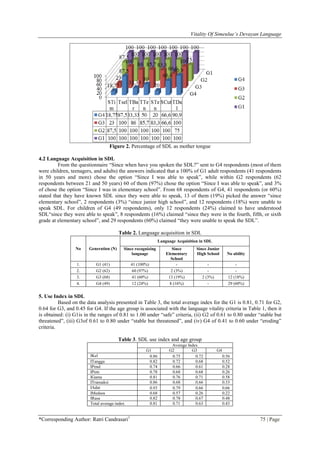
The data indicates that all generations (100%) from G1 and G2 respondents speak SDL as their mother
tongue, except in East Simeulue and Teluk Dalam Sub-districts. All G3 (100%) from South Teupah and Teluk
Dalam Sub-districts speak SDL while respondents from other sub-districts claimed Jamu Language and Bahasa
Indonesia as their first language. Jamu language is, in particular, found to be spoken only in East Simeulue.
With regard to G4, none of respondents failed to prove that their mother tongue is Devayan Language.
In Teluk Dalam, 10 respondents out of 11 (90.9%) claimed SDL is their mother tongue and only 18.75% of G4
respondents claimed SDL as their mother tongue East Simeulue , 87.5% in South Teupah, 33.33% in West
Teupah, 50% in Central Teupah, 20% in Central Simeulue, and 66.6% in Simeulue Cut. In Simeulue Cut, the
G1 and G2 respondents (100%) speak SDL.
Vitality Of Simeulue’s Devayan Language
*Corresponding Author: Ratri Candrasari1
75 | Page
Figure 2. Percentage of SDL as mother tongue
4.2 Language Acquisition in SDL
From the questionnaire “Since when have you spoken the SDL?” sent to G4 respondents (most of them
were children, teenagers, and adults) the answers indicated that a 100% of G1 adult respondents (41 respondents
in 50 years and more) chose the option “Since I was able to speak”, while within G2 respondents (62
respondents between 21 and 50 years) 60 of them (97%) chose the option “Since I was able to speak”, and 3%
of chose the option “Since I was in elementary school”. From 68 respondents of G4, 41 respondents (or 60%)
stated that they have known SDL since they were able to speak, 13 of them (19%) picked the answer “since
elementary school”, 2 respondents (3%) “since junior high school”, and 12 respondents (18%) were unable to
speak SDL. For children of G4 (49 respondents), only 12 respondents (24%) claimed to have understood
SDL“since they were able to speak”, 8 respondents (16%) claimed “since they were in the fourth, fifth, or sixth
grade at elementary school”, and 29 respondents (60%) claimed “they were unable to speak the SDL”.
Table 2. Language acquisition in SDL
No Generation (N)
Language Acquisition in SDL
Since recognizing
language
Since
Elementary
School
Since Junior
High School No ability
1. G1 (41) 41 (100%) - - -
2. G2 (62) 60 (97%) 2 (3%) - -
3. G3 (68) 41 (60%) 13 (19%) 2 (3%) 12 (18%)
4. G4 (49) 12 (24%) 8 (16%) - 29 (60%)
5. Use Index in SDL
Based on the data analysis presented in Table 3, the total average index for the G1 is 0.81, 0.71 for G2,
0.64 for G3, and 0.45 for G4. If the age group is associated with the language vitality criteria in Table 1, then it
is obtained: (i) G1is in the ranges of 0.81 to 1.00 under “safe” criteria, (ii) G2 of 0.61 to 0.80 under “stable but
threatened”, (iii) G3of 0.61 to 0.80 under “stable but threatened”, and (iv) G4 of 0.41 to 0.60 under “eroding”
criteria.
Table 3. SDL use index and age group
Average Index
G1 G2 G3 G4
IKel 0.86 0.75 0.72 0.56
ITangga 0.82 0.72 0.68 0.52
IPend 0.74 0.66 0.61 0.28
IPem 0.78 0.68 0.68 0.26
IGama 0.81 0.76 0.71 0.58
ITransaksi 0.86 0.68 0.66 0.33
IAdat 0.93 0.79 0.66 0.66
IMedsos 0.68 0.57 0.26 0.22
IRasa 0.82 0.78 0.67 0.48
Total average index 0.81 0.71 0.63 0.43
Vitality Of Simeulue’s Devayan Language
*Corresponding Author: Ratri Candrasari1
76 | Page
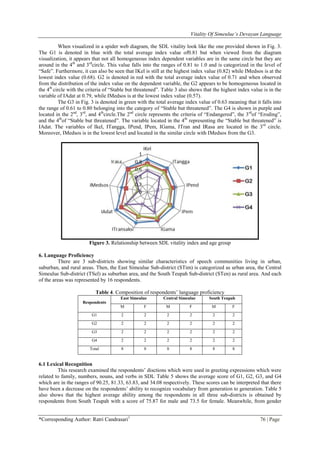
When visualized in a spider web diagram, the SDL vitality look like the one provided shown in Fig. 3.
The G1 is denoted in blue with the total average index value of0.81 but when viewed from the diagram
visualization, it appears that not all homogeneous index dependent variables are in the same circle but they are
around in the 4th
and 3rd
circle. This value falls into the ranges of 0.81 to 1.0 and is categorized in the level of
“Safe”. Furthermore, it can also be seen that IKel is still at the highest index value (0.82) while IMedsos is at the
lowest index value (0.68). G2 is denoted in red with the total average index value of 0.71 and when observed
from the distribution of the index value on the dependent variable, the G2 appears to be homogeneous located in
the 4th
circle with the criteria of “Stable but threatened”. Table 3 also shows that the highest index value is in the
variable of IAdat at 0.79, while IMedsos is at the lowest index value (0.57).
The G3 in Fig. 3 is denoted in green with the total average index value of 0.63 meaning that it falls into
the range of 0.61 to 0.80 belonging into the category of “Stable but threatened”. The G4 is shown in purple and
located in the 2nd
, 3rd
, and 4th
circle.The 2nd
circle represents the criteria of “Endangered”, the 3rd
of “Eroding”,
and the 4th
of “Stable but threatened”. The variable located in the 4th
representing the “Stable but threatened” is
IAdat. The variables of Ikel, ITangga, IPend, IPem, IGama, ITran and IRasa are located in the 3rd
circle.
Moreover, IMedsos is in the lowest level and located in the similar circle with IMedsos from the G3.
Figure 3. Relationship between SDL vitality index and age group
6. Language Proficiency
There are 3 sub-districts showing similar characteristics of speech communities living in urban,
suburban, and rural areas. Then, the East Simeulue Sub-district (STim) is categorized as urban area, the Central
Simeulue Sub-district (TSel) as suburban area, and the South Teupah Sub-district (STen) as rural area. And each
of the areas was represented by 16 respondents.
Table 4. Composition of respondents‟ language proficiency
Respondents
East Simeulue Central Simeulue South Teupah
M F M F M F
G1 2 2 2 2 2 2
G2 2 2 2 2 2 2
G3 2 2 2 2 2 2
G4 2 2 2 2 2 2
Total 8 8 8 8 8 8
6.1 Lexical Recognition
This research examined the respondents‟ disctions which were used in greeting expressions which were
related to family, numbers, nouns, and verbs in SDL.
Table 5 shows the average score of G1, G2, G3, and G4
which are in the ranges of 90.25, 81.33, 63.83, and 34.08 respectively. These scores can be interpreted that there
have been a decrease on the respondents‟ ability to recognize vocabulary from generation to generation. Table 5
also shows that the highest average ability among the respondents in all three sub-districts is obtained by
respondents from South Teupah with a score of 75.87 for male and 73.5 for female. Meanwhile, from gender
Vitality Of Simeulue’s Devayan Language
*Corresponding Author: Ratri Candrasari1
77 | Page
point of view, the data in Table 5 proves that male respondents have higher average value of lexical recognition
ability than female respondents.
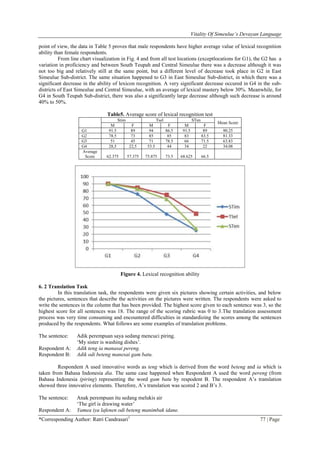
From line chart visualization in Fig. 4 and from all test locations (exceptlocations for G1), the G2 has a
variation in proficiency and between South Teupah and Central Simeulue there was a decrease although it was
not too big and relatively still at the same point, but a different level of decrease took place in G2 in East
Simeulue Sub-district. The same situation happened to G3 in East Simeulue Sub-district, in which there was a
significant decrease in the ability of lexicon recognition. A very significant decrease occured in G4 in the sub-
districts of East Simeulue and Central Simeulue, with an average of lexical mastery below 30%. Meanwhile, for
G4 in South Teupah Sub-district, there was also a significantly large decrease although such decrease is around
40% to 50%.
Table5. Average score of lexical recognition test
Stim Tsel STen
Mean Score
M F M F M F
G1 91.5 89 94 86.5 91.5 89 90.25
G2 78.5 73 85 85 83 83.5 81.33
G3 51 45 71 78.5 66 71.5 63.83
G4 28,5 22,5 53.5 44 34 22 34.08
Average
Score 62.375 57.375 75.875 73.5 68.625 66.5
Figure 4. Lexical recognition ability
6. 2 Translation Task
In this translation task, the respondents were given six pictures showing certain activities, and below
the pictures, sentences that describe the activities on the pictures were written. The respondents were asked to
write the sentences in the column that has been provided. The highest score given to each sentence was 3, so the
highest score for all sentences was 18. The range of the scoring rubric was 0 to 3.The translation assessment
process was very time consuming and encountered difficulties in standardizing the scores among the sentences
produced by the respondents. What follows are some examples of translation problems.
The sentence: Adik perempuan saya sedang mencuci piring.
„My sister is washing dishes‟.
Respondent A: Adik teng ia manasai pereng.
Respondent B: Adik odi beteng manesai gam batu.
Respondent A used innovative words as teng which is derived from the word beteng and ia which is
taken from Bahasa Indonesia dia. The same case happened when Respondent A used the word pereng (from
Bahasa Indonesia (piring) representing the word gam batu by respodent B. The respondent A‟s translation
showed three innovative elements. Therefore, A‟s translation was scored 2 and B‟s 3.
The sentence: Anak perempuan itu sedang melukis air
„The girl is drawing water‟
Respondent A: Yamea iya lafenen odi beteng manimbak idane.
Vitality Of Simeulue’s Devayan Language
*Corresponding Author: Ratri Candrasari1
78 | Page
Respondent B: Anak silafae edeteng ia manim bak oe.
In the second example, the translation problems appear; the word anak is translated into yamea by A
and anak by B. Meanwhile, both words oe and idane share the same meaning in SDL although the second word
is often used in Central Simeulue. As a result, respondent A had the score 3 and B 2.
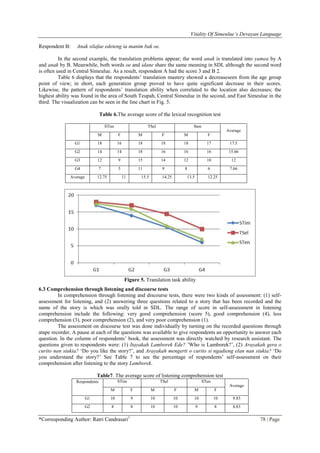
Table 6 displays that the respondents‟ translation mastery showed a decreaseseen from the age group
point of view; in short, each generation group proved to have quite significant decrease in their scores.
Likewise, the pattern of respondents‟ translation ability when correlated to the location also decreases; the
highest ability was found in the area of South Teupah, Central Simeulue in the second, and East Simeulue in the
third. The visualization can be seen in the line chart in Fig. 5.
Table 6.The average score of the lexical recognition test
STim TSel Sten
Average
M F M F M F
G1 18 16 18 18 18 17 17.5
G2 14 14 18 16 16 16 15.66
G3 12 9 15 14 12 10 12
G4 7 5 11 9 8 6 7.66
Average 12.75 11 15.5 14.25 13.5 12.25
Figure 5. Translation task ability
6.3 Comprehension through listening and discourse tests
In comprehension through listening and discourse tests, there were two kinds of assessment: (1) self-
assessment for listening, and (2) answering three questions related to a story that has been recorded and the
name of the story is which was orally told in SDL. The range of score in self-assessment in listening
comprehension include the following: very good comprehension (score 5), good comprehension (4), less
comprehension (3), poor comprehension (2), and very poor comprehension (1).
The assessment on discourse test was done individually by turning on the recorded questions through
atape recorder. A pause at each of the questions was available to give respondents an opportunity to answer each
question. In the column of respondents‟ book, the assessment was directly watched by research assistant. The
questions given to respondents were: (1) Itayakah Lamborek Ede? ‟Who is Lamborek?‟, (2) Arayakah gera o
curito nan siukia? „Do you like the story?‟, and Arayakah mengerti o curito si ngadieng elan nan siukia? „Do
you understand the story?‟ See Table 7 to see the percentage of respondents‟ self-assessment on their
comprehension after listening to the story Lamborek.
Table7. The average score of listening comprehension test
Respondents STim TSel STen
Average
M F M F M F
G1 10 9 10 10 10 10 9.83
G2 8 8 10 10 9 8 8.83
Vitality Of Simeulue’s Devayan Language
*Corresponding Author: Ratri Candrasari1
79 | Page
G3 7 5 8 8 8 6 7
G4 4 3 7 7 6 7 5.66
Average 7.25 6.25 8.75 8.75 8.25 7.75
Average per
respondent 3.625 3.125 4. 375 4. 375 4.125 3.875
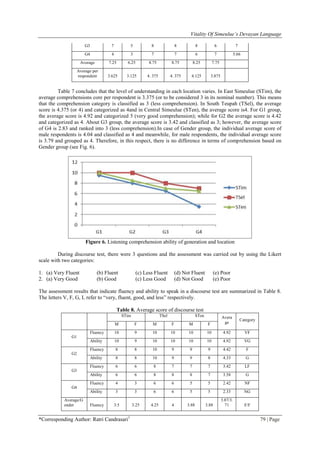
Table 7 concludes that the level of understanding in each location varies. In East Simeulue (STim), the
average comprehensions core per respondent is 3.375 (or to be considered 3 in its nominal number). This means
that the comprehension category is classified as 3 (less comprehension). In South Teupah (TSel), the average
score is 4.375 (or 4) and categorized as 4and in Central Simeulue (STen), the average score is4. For G1 group,
the average score is 4.92 and categorized 5 (very good comprehension); while for G2 the average score is 4.42
and categorized as 4. About G3 group, the average score is 3.42 and classified as 3; however, the average score
of G4 is 2.83 and ranked into 3 (less comprehension).In case of Gender group, the individual average score of
male respondents is 4.04 and classified as 4 and meanwhile, for male respondents, the individual average score
is 3.79 and grouped as 4. Therefore, in this respect, there is no difference in terms of comprehension based on
Gender group (see Fig. 6).
Figure 6. Listening comprehension ability of generation and location
During discourse test, there were 3 questions and the assessment was carried out by using the Likert
scale with two categories:
1. (a) Very Fluent (b) Fluent (c) Less Fluent (d) Not Fluent (e) Poor
2. (a) Very Good (b) Good (c) Less Good (d) Not Good (e) Poor
The assessment results that indicate fluency and ability to speak in a discourse test are summarized in Table 8.
The letters V, F, G, L refer to “very, fluent, good, and less” respectively.
Table 8. Average score of discourse test
STim TSel STen Avera
ge
Category
M F M F M F
G1
Fluency 10 9 10 10 10 10 4.92 VF
Ability 10 9 10 10 10 10 4.92 VG
G2
Fluency 8 8 10 9 9 9 4.42 F
Ability 8 8 10 9 9 8 4.33 G
G3
Fluency 6 6 8 7 7 7 3.42 LF
Ability 6 6 8 8 8 7 3.58 G
G4
Fluency 4 3 6 6 5 5 2.42 NF
Ability 3 3 6 6 5 5 2.33 NG
Average/G
ender Fluency 3.5 3.25 4.25 4 3.88 3.88
3.87/3.
71 F/F
Vitality Of Simeulue’s Devayan Language
*Corresponding Author: Ratri Candrasari1
80 | Page
Ability 3.38 3.25 4.25 4.13 4 3,75
3.87/3.
71 G/G
Average/L
ocation Fluency 3.38 4,13 3.88 3.79 F
Ability 3.31 4.19 3.88 3.79 G
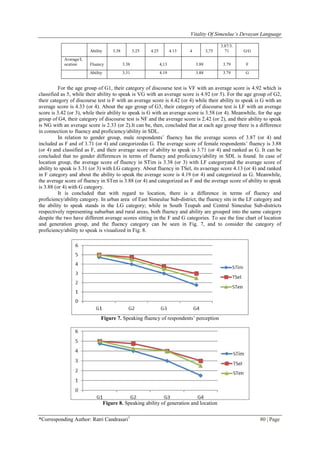
For the age group of G1, their category of discourse test is VF with an average score is 4.92 which is
classified as 5, while their ability to speak is VG with an average score is 4.92 (or 5). For the age group of G2,
their category of discourse test is F with an average score is 4.42 (or 4) while their ability to speak is G with an
average score is 4.33 (or 4). About the age group of G3, their category of discourse test is LF with an average
score is 3.42 (or 3), while their ability to speak is G with an average score is 3.58 (or 4). Meanwhile, for the age
group of G4, their category of discourse test is NF and the average score is 2.42 (or 2), and their ability to speak
is NG with an average score is 2.33 (or 2).It can be, then, concluded that at each age group there is a difference
in connection to fluency and proficiency/ability in SDL.
In relation to gender group, male respondents‟ fluency has the average scores of 3.87 (or 4) and
included as F and of 3.71 (or 4) and categorizedas G. The average score of female respondents‟ fluency is 3.88
(or 4) and classified as F, and their average score of ability to speak is 3.71 (or 4) and ranked as G. It can be
concluded that no gender differences in terms of fluency and proficiency/ability in SDL is found. In case of
location group, the average score of fluency in STim is 3.38 (or 3) with LF categoryand the average score of
ability to speak is 3.31 (or 3) with LG category. About fluency in TSel, its avaerage score 4.13 (or 4) and ranked
in F category and about the ability to speak the average score is 4.19 (or 4) and categorized as G. Meanwhile,
the average score of fluency in STen is 3.88 (or 4) and categorized as F and the average score of ability to speak
is 3.88 (or 4) with G category.
It is concluded that with regard to location, there is a difference in terms of fluency and
proficiency/ability category. In urban area of East Simeulue Sub-district, the fluency sits in the LF category and
the ability to speak stands in the LG category; while in South Teupah and Central Simeulue Sub-districts
respectively representing suburban and rural areas, both fluency and ability are grouped into the same category
despite the two have different average scores sitting in the F and G categories. To see the line chart of location
and generation group, and the fluency category can be seen in Fig. 7, and to consider the category of
proficiency/ability to speak is visualized in Fig. 8.
Figure 7. Speaking fluency of respondents‟ perception
Figure 8. Speaking ability of generation and location
Vitality Of Simeulue’s Devayan Language
*Corresponding Author: Ratri Candrasari1
81 | Page
V. CONCLUSIONS
It can be concluded that the verbal repertoire in the seven districts shows that there are almost
homogeneous characteristics of language communities except the one in East Simeulue Sub-district. SDL serves
as the mother tongue or first language for the native speakers in Simeulue in which G1 speak SDL 100%, G2
94.64%, and G3 77.8%; however, G4 are only recorded at 55.24%. At every generation, there is a decrease in
the quantity of respondents who use as their first language. The language use associated with the age group of
G1, G2, G3, and G4 shows a pattern of „>Bdev and always BDev‟ which are dominated by G1 and G2 in all
domains. For G3, the largest percentage is in the pattern of „BI = BDev‟ but G3 still show quite good usage in
SDL despite being lower in percentage. For G4, in particular, the largest percentage is in the pattern of „always
BI‟ in all domains and it shows the 0% use of the pattern of „always BDev‟ in all domains, except in the
neighborhood domain. For the overall average index, the Devayan Language vitality is in the range of values
from 0.61 to 0.80 with the value of 6.25 for the average index of seven major domains and 0.631 for the nine
domains of language use. This shows that the vitality level of SDL is located in the 3rd
circle which belongs to a
„Stable but threatened‟ category.
REFERENCES
[1] S. Sinar. 2014. Bahasa Ibu di Sumatera Utara: Cermin Kearifan Masyarakat Lokal. Denpasar: Seminar Bahasa Ibu VII 27-28
Februari 2014.
[2] H. Giles, R.Y. Bourhis, D.M. Taylor. 1977. Towards a Theory in Ethnic Group Relations. In Language Ethnicity and Intergroup
Relations.
[3] L.A. Greenoble and L.J. Whaley. 2006. Saving Languages: An Introduction to Language Revitalization. Cambridge: Cambridge
University Press.
[4] J.A. Fishman. 1972a. The Sociology of Language. Massachusetts: Newbury House Plublication
[5] J.A. Fishman. 1972b. The Relationship between Micro-and Macro_Linguistics in The Study of Who Speaks What Language to
Who and When. In Pride and Holmes.15-32.
[6] P.M. Lewis andG.F. Simons. 2015. Sustaining Language Use. Perspective on Community-Based.
[7] Mahsun, 2011.Metode Penelitian Bahasa. Tahapan Strategi, Metode, danTekniknya. Edisi Revisi. Rajawali Press. Jakarta.
[8] Sumarsono. 2007. Sosiolinguistik. Yogyakarta: Pustaka Pelajar.
[9] See Mahsun 2011.

Vitality of Simeulue’s Devayan Language

  • 1.
    Quest Journals Journal ofResearch in Humanities and Social Science Volume 5 ~ Issue 3 (2017) pp: 72-81 ISSN(Online) : 2321-9467 www.questjournals.org *Corresponding Author: Ratri Candrasari1 72 | Page Post-Graduate Department Of Linguistics, University Of Sumatera Utara (Indonesia) Research Paper Vitality of Simeulue’s Devayan Language Ratri Candrasari1 , T. Silvana Sinar2 , Dwi Widayati3 , and Nurlela4 1,2,3,4 Post-Graduate Department Of Linguistics, Faculty Of Cultural Sciences, University Of Sumatera Utara (Indonesia) Received 27 Feb, 2017; Accepted 31 Mar, 2017 © The author(s) 2017. Published with open access at www.questjournals.org ABSTRACT: It is important for native speakers of a language to be able to measure the vitality of their own language and then to decide concrete steps to preserve it. Language vitality refers to the ability of a language to accommodate and perform a variety of functions and purposes of communication. This study examines vitality of Simeulue’s Devayan language (SDL) in the Indonesia’s Simeulue Island and covers seven out of ten sub-districts. Questionnaires and interviews were used to collect data about aspects of first language acquisition process, about uses of mother tongue in nine domains, and of language proficiency of G1, G2, G3, and G4. The preliminary results of the research showed that only 12% of the G4 generation have acquired SDL since they recognized that language. In terms of language use, using spider web diagram, the result of the stretched index scale of the language use was categorized stable, but eroded. From language proficiency lexical, translating, comprehension and speaking tests, the results varied corresponding to the age group. The conclusion can be drawn that SDL is relatively unknown in Aceh Province and that SDL is marginalized by languages brought by immigrants. Keywords: Devayan Language, minority language, spider web diagram, vitality. I. INTRODUCTION The development of information and communication technology greatly brings impacts on the opening of communication system and on the chance of contact with the outside world which brings new choices and challenges in the culture, lifestyle, identity, and, of course, language (Sinar, 2013).[1] In this context, it is important for ethnic community to measure the vitality of their own language and then decide the concrete steps to save it. This study is focused on SDL as the main research object on the grounds that most of the island population uses SDL. Therefore, the research areas include seven out of ten sub-districts, for instance, West Simeulue, West Teupah, Central Teupah, South Teupah, Central Simeulue, Simeulue Cut, and Teluk Dalam. Fig. 1 shows three native languages in Simeulue Island (SI): Devayan, Sigulai, and Leukon. The first is indicated in light blue and spoken in seven sub-districts; the second in light green is spoken in three other sub- districts, and the last is used by native speakers in Alafan sub-district. A preliminary study on SDL has been conducted, and other studies will be conducted for two other languages. Figure 1. Language map in Simeulue Island Language vitality refers to the ability of a language to accommodate and perform a variety of functions and purposes of communication. The term was first introduced to ethno-linguistics by Giles et.al. (1977).[2] The vitality of an ethno-linguistic group will influence a speech group to behave as a distinctive entity. The more vitality a speech group has, the more likely it will survive; conversely, if a language has little vitality or none, it will likely cease to survive. In other words, language vitality becomes the benchmark of language maintenance by measuring the use of language as a means of daily communication in various social contexts for different purposes.
  • 2.
    Vitality Of Simeulue’sDevayan Language *Corresponding Author: Ratri Candrasari1 73 | Page The number of studies on language vitality (Greenoble and Whaley, 2003).[3] of indigenous language is still limited, while the information about it is absolutely necessary in language planning that will encounter some difficulties in its design without any accurate information about language vitality.This research focuses on some indicators of language vitality, for instance, mother tongue acquisition, language use, and language skills through a set of questionnaires and tests conducted on 220 respondents spreading across seven sub-districts. Besides, the number of respondents is adjusted with the ratio of the population of each sub-district. Investigation on these three factors is conducted to answer the question: Up to which level is native speakers‟ vitality towards SDL reached at this time? II. REVIEW OF RELATED LITERATURE Discussion on how to measure the vitality of SDL is conducted by first knowing the criteria of SDL vitality based on the relationship between the language use index and the characteristics of the respondents. The language use is based on the domain concept introduced by Fishman (1972a/b)[4] includes 7 domains, namely a family domain, neighborhood domain, education domain, office domain, religious domain, transaction domain, and custom domain. However, the vitality measurement in this research also includes the language use in social media and feelings which are determined for the purpose of collecting data of language use which corresponds to the development of language use today. The analysis is carried out to measure the vitality of SDL by using a non-parametric statistical analysis, namely Kruskal Wallis and Median, which is used to compare the average value of two or more groups of independent samples with different testing levels among the groups. The value of test results is shown by an index number abbreviated in capital letter “I”. The parametric statistics include the following variables (1) IKel for family index, (2) ITangga for Household index, (3) IPend for Education index, (4) IPem for Office/Government, (5) IGama for Religious index, (6) ITransaksi for Transaction index, and (7) IAdat for Custom index. Moreover, to provide comparative measurements, two independent variables are added, such as, (8) IMedsos for Social Media index, and (9) IRasa for Feeling index. The resulting index number on the average of each index or total index is adjusted to the criteria of Grimes‟ (2000) language vitality[5] who categorized language vitality into six levels: 1. Critically Endangered: Having very few speakers of 70 years old and more (or great-grandparent). 2. Severely endangered: Having speakers of 40 years old and more (or grandparent age). 3. Endangered. Having speakers of 20 years old and more (or parent age). 4. Eroding. Speakers are some children and older people. Most children do not speak it. 5. Stable but threatened. All children and older people are speakers, but few in numbers. 6. Safe. Not endangered. Language is expected to be learned by all children and others in the ethnic group. In this research, such levels are adapted into five levels by combining the first and the second criteria because the first generation (G1) starts from the age of 51 years. The adapted levels are then (1) critically and severely endangered, (2) endangered, (3) eroding, (4) stable but threatened, and (5) stable. With such criteria, the index calculation is shown in the following: I = I = Index = Average value Xmin = Minimum Average Xmax = Maximum Average Such level is made in a stretched scale to form a level visualized in the Table 1 and interpreted through the index number of Spider-Profit with a range of index numbers from 0-1. This index refers to the consensus of participants of “Consignment of Endangered Languages” held in Ciawi on December 2 to 4, 2011, resulting in an index of language vitality measurement. Table 1 shows the basis of measuring or leveling of SDL vitality. Table 1. Language vitality criteria (Grimes 2000) No. Language Vitality Criteria Index Number in Spider Web Diagram 1. Critically and Severely Endangered 0,00 - 0,20 2. Endangered 0,21-0,40 3. Eroding 0,41 - 0,60 4. Stable but threatened 0,61 - 0,80 5. Safe 0,81 - 1,00
  • 3.
    Vitality Of Simeulue’sDevayan Language *Corresponding Author: Ratri Candrasari1 74 | Page To measure the language proficiency, a series of tests of Linguistic Vitality Test proposed by Lewis and Simons (2015) was used.[6] This test has ever been tested in Maluku, Indonesia. There were three kinds of test: (1) lexical recognition, (2) translation task, and (3) discourse test. A lexical recognition test consists of greeting expressions in the family context, numbers, and vocabulary operating on nouns and verbs. In translation task, the respondents were given a sentence that had to be translated into SDL in writing, and for those who did not have ability or had less ability in writing would be assisted by research assistant in writing the answers on a space provided. The questionnaire was added with pictures to facilitate comprehension and perception. III. METHODOLOGY 3.1 Type of research This is a sociolinguistics research with quantitative approach. This is in line with Mahsun‟s (2011) opinion arguing that the field of linguistics associated with language use is one of the studies in sociolinguistics, especially the one focusing on language use based on its social contexts.[7] 3.2 Location and time of research The research was conducted in seven of ten sub-districts including (1) East Simeulue, (2) South Teupah, (3) West Teupah, (4) Central Teupah, (5) Central Simeulue, (6) Simeulue Cut, and (7) Teluk Dalam. Those sub-districts were chosen as the research locations because people in these districts use SDL while in other 3 sub-districts people speak Sigulai and Leukon languages. 3.3 Data collection The data were collected using questionnaires distributed to the respondents in seven districts of Simeulue Region. Two types of questionnaires were distributed to the respondents. The first questionnaire was named KPBS designed to obtain the data on the first language acquisition and the language use. The data were analyzed to find out the pattern of language use, to calculate the index number of language use, and to measure the language vitality. The second questionnaire was called KKB designed to test the language ability of the Devayan Language Speakers. This questionnaire tested the receptive and productive ability; nevertheless, considering that SDL served only as a spoken language, this test measured the ability in terms of performance but not competence (Sumarsono, 2007).[8] 3.4 Population and sample The respondents in this research are native speakers of SDL or whose parent is a Devayan Language native speaker, aged over 5 years, and living in the Devayan speaking areas. As already mentioned above, the people living in the seven sub-districts of Devayan speaking areas become the population of this research. Based on the population statistics of Simeulue Region in 2014, the total population of the region is 87,598 people, spread across all sub-districts, composed of 138 villages and 20,884 households. However, the Devayan speaking areas include only seven sub-districts whose population is 59,904 people. Mahsun (2011) argued a linguistic research does not need a large sample because linguistic behaviors tend to be more homogeneous than other behaviors.[9] Considering the opinion mentioned above this research is not a pure survey; the researchers tend to use a stratified random sampling, i.e. the choice of a group of respondents was based on the given characteristics or properties of population. The sample variables are devided into four age groups: G1 (>50 years of age), G2 (21-50), G3 (13-20),and G4 (6-12). The number of samples obtained was 220 subjects. IV. FINDINGS AND DISCUSSION 4.1 The Percentage of SDL as Mother Tongue The data indicates that all generations (100%) from G1 and G2 respondents speak SDL as their mother tongue, except in East Simeulue and Teluk Dalam Sub-districts. All G3 (100%) from South Teupah and Teluk Dalam Sub-districts speak SDL while respondents from other sub-districts claimed Jamu Language and Bahasa Indonesia as their first language. Jamu language is, in particular, found to be spoken only in East Simeulue. With regard to G4, none of respondents failed to prove that their mother tongue is Devayan Language. In Teluk Dalam, 10 respondents out of 11 (90.9%) claimed SDL is their mother tongue and only 18.75% of G4 respondents claimed SDL as their mother tongue East Simeulue , 87.5% in South Teupah, 33.33% in West Teupah, 50% in Central Teupah, 20% in Central Simeulue, and 66.6% in Simeulue Cut. In Simeulue Cut, the G1 and G2 respondents (100%) speak SDL.
  • 4.
    Vitality Of Simeulue’sDevayan Language *Corresponding Author: Ratri Candrasari1 75 | Page Figure 2. Percentage of SDL as mother tongue 4.2 Language Acquisition in SDL From the questionnaire “Since when have you spoken the SDL?” sent to G4 respondents (most of them were children, teenagers, and adults) the answers indicated that a 100% of G1 adult respondents (41 respondents in 50 years and more) chose the option “Since I was able to speak”, while within G2 respondents (62 respondents between 21 and 50 years) 60 of them (97%) chose the option “Since I was able to speak”, and 3% of chose the option “Since I was in elementary school”. From 68 respondents of G4, 41 respondents (or 60%) stated that they have known SDL since they were able to speak, 13 of them (19%) picked the answer “since elementary school”, 2 respondents (3%) “since junior high school”, and 12 respondents (18%) were unable to speak SDL. For children of G4 (49 respondents), only 12 respondents (24%) claimed to have understood SDL“since they were able to speak”, 8 respondents (16%) claimed “since they were in the fourth, fifth, or sixth grade at elementary school”, and 29 respondents (60%) claimed “they were unable to speak the SDL”. Table 2. Language acquisition in SDL No Generation (N) Language Acquisition in SDL Since recognizing language Since Elementary School Since Junior High School No ability 1. G1 (41) 41 (100%) - - - 2. G2 (62) 60 (97%) 2 (3%) - - 3. G3 (68) 41 (60%) 13 (19%) 2 (3%) 12 (18%) 4. G4 (49) 12 (24%) 8 (16%) - 29 (60%) 5. Use Index in SDL Based on the data analysis presented in Table 3, the total average index for the G1 is 0.81, 0.71 for G2, 0.64 for G3, and 0.45 for G4. If the age group is associated with the language vitality criteria in Table 1, then it is obtained: (i) G1is in the ranges of 0.81 to 1.00 under “safe” criteria, (ii) G2 of 0.61 to 0.80 under “stable but threatened”, (iii) G3of 0.61 to 0.80 under “stable but threatened”, and (iv) G4 of 0.41 to 0.60 under “eroding” criteria. Table 3. SDL use index and age group Average Index G1 G2 G3 G4 IKel 0.86 0.75 0.72 0.56 ITangga 0.82 0.72 0.68 0.52 IPend 0.74 0.66 0.61 0.28 IPem 0.78 0.68 0.68 0.26 IGama 0.81 0.76 0.71 0.58 ITransaksi 0.86 0.68 0.66 0.33 IAdat 0.93 0.79 0.66 0.66 IMedsos 0.68 0.57 0.26 0.22 IRasa 0.82 0.78 0.67 0.48 Total average index 0.81 0.71 0.63 0.43
  • 5.
    Vitality Of Simeulue’sDevayan Language *Corresponding Author: Ratri Candrasari1 76 | Page When visualized in a spider web diagram, the SDL vitality look like the one provided shown in Fig. 3. The G1 is denoted in blue with the total average index value of0.81 but when viewed from the diagram visualization, it appears that not all homogeneous index dependent variables are in the same circle but they are around in the 4th and 3rd circle. This value falls into the ranges of 0.81 to 1.0 and is categorized in the level of “Safe”. Furthermore, it can also be seen that IKel is still at the highest index value (0.82) while IMedsos is at the lowest index value (0.68). G2 is denoted in red with the total average index value of 0.71 and when observed from the distribution of the index value on the dependent variable, the G2 appears to be homogeneous located in the 4th circle with the criteria of “Stable but threatened”. Table 3 also shows that the highest index value is in the variable of IAdat at 0.79, while IMedsos is at the lowest index value (0.57). The G3 in Fig. 3 is denoted in green with the total average index value of 0.63 meaning that it falls into the range of 0.61 to 0.80 belonging into the category of “Stable but threatened”. The G4 is shown in purple and located in the 2nd , 3rd , and 4th circle.The 2nd circle represents the criteria of “Endangered”, the 3rd of “Eroding”, and the 4th of “Stable but threatened”. The variable located in the 4th representing the “Stable but threatened” is IAdat. The variables of Ikel, ITangga, IPend, IPem, IGama, ITran and IRasa are located in the 3rd circle. Moreover, IMedsos is in the lowest level and located in the similar circle with IMedsos from the G3. Figure 3. Relationship between SDL vitality index and age group 6. Language Proficiency There are 3 sub-districts showing similar characteristics of speech communities living in urban, suburban, and rural areas. Then, the East Simeulue Sub-district (STim) is categorized as urban area, the Central Simeulue Sub-district (TSel) as suburban area, and the South Teupah Sub-district (STen) as rural area. And each of the areas was represented by 16 respondents. Table 4. Composition of respondents‟ language proficiency Respondents East Simeulue Central Simeulue South Teupah M F M F M F G1 2 2 2 2 2 2 G2 2 2 2 2 2 2 G3 2 2 2 2 2 2 G4 2 2 2 2 2 2 Total 8 8 8 8 8 8 6.1 Lexical Recognition This research examined the respondents‟ disctions which were used in greeting expressions which were related to family, numbers, nouns, and verbs in SDL. Table 5 shows the average score of G1, G2, G3, and G4 which are in the ranges of 90.25, 81.33, 63.83, and 34.08 respectively. These scores can be interpreted that there have been a decrease on the respondents‟ ability to recognize vocabulary from generation to generation. Table 5 also shows that the highest average ability among the respondents in all three sub-districts is obtained by respondents from South Teupah with a score of 75.87 for male and 73.5 for female. Meanwhile, from gender
  • 6.
    Vitality Of Simeulue’sDevayan Language *Corresponding Author: Ratri Candrasari1 77 | Page point of view, the data in Table 5 proves that male respondents have higher average value of lexical recognition ability than female respondents. From line chart visualization in Fig. 4 and from all test locations (exceptlocations for G1), the G2 has a variation in proficiency and between South Teupah and Central Simeulue there was a decrease although it was not too big and relatively still at the same point, but a different level of decrease took place in G2 in East Simeulue Sub-district. The same situation happened to G3 in East Simeulue Sub-district, in which there was a significant decrease in the ability of lexicon recognition. A very significant decrease occured in G4 in the sub- districts of East Simeulue and Central Simeulue, with an average of lexical mastery below 30%. Meanwhile, for G4 in South Teupah Sub-district, there was also a significantly large decrease although such decrease is around 40% to 50%. Table5. Average score of lexical recognition test Stim Tsel STen Mean Score M F M F M F G1 91.5 89 94 86.5 91.5 89 90.25 G2 78.5 73 85 85 83 83.5 81.33 G3 51 45 71 78.5 66 71.5 63.83 G4 28,5 22,5 53.5 44 34 22 34.08 Average Score 62.375 57.375 75.875 73.5 68.625 66.5 Figure 4. Lexical recognition ability 6. 2 Translation Task In this translation task, the respondents were given six pictures showing certain activities, and below the pictures, sentences that describe the activities on the pictures were written. The respondents were asked to write the sentences in the column that has been provided. The highest score given to each sentence was 3, so the highest score for all sentences was 18. The range of the scoring rubric was 0 to 3.The translation assessment process was very time consuming and encountered difficulties in standardizing the scores among the sentences produced by the respondents. What follows are some examples of translation problems. The sentence: Adik perempuan saya sedang mencuci piring. „My sister is washing dishes‟. Respondent A: Adik teng ia manasai pereng. Respondent B: Adik odi beteng manesai gam batu. Respondent A used innovative words as teng which is derived from the word beteng and ia which is taken from Bahasa Indonesia dia. The same case happened when Respondent A used the word pereng (from Bahasa Indonesia (piring) representing the word gam batu by respodent B. The respondent A‟s translation showed three innovative elements. Therefore, A‟s translation was scored 2 and B‟s 3. The sentence: Anak perempuan itu sedang melukis air „The girl is drawing water‟ Respondent A: Yamea iya lafenen odi beteng manimbak idane.
  • 7.
    Vitality Of Simeulue’sDevayan Language *Corresponding Author: Ratri Candrasari1 78 | Page Respondent B: Anak silafae edeteng ia manim bak oe. In the second example, the translation problems appear; the word anak is translated into yamea by A and anak by B. Meanwhile, both words oe and idane share the same meaning in SDL although the second word is often used in Central Simeulue. As a result, respondent A had the score 3 and B 2. Table 6 displays that the respondents‟ translation mastery showed a decreaseseen from the age group point of view; in short, each generation group proved to have quite significant decrease in their scores. Likewise, the pattern of respondents‟ translation ability when correlated to the location also decreases; the highest ability was found in the area of South Teupah, Central Simeulue in the second, and East Simeulue in the third. The visualization can be seen in the line chart in Fig. 5. Table 6.The average score of the lexical recognition test STim TSel Sten Average M F M F M F G1 18 16 18 18 18 17 17.5 G2 14 14 18 16 16 16 15.66 G3 12 9 15 14 12 10 12 G4 7 5 11 9 8 6 7.66 Average 12.75 11 15.5 14.25 13.5 12.25 Figure 5. Translation task ability 6.3 Comprehension through listening and discourse tests In comprehension through listening and discourse tests, there were two kinds of assessment: (1) self- assessment for listening, and (2) answering three questions related to a story that has been recorded and the name of the story is which was orally told in SDL. The range of score in self-assessment in listening comprehension include the following: very good comprehension (score 5), good comprehension (4), less comprehension (3), poor comprehension (2), and very poor comprehension (1). The assessment on discourse test was done individually by turning on the recorded questions through atape recorder. A pause at each of the questions was available to give respondents an opportunity to answer each question. In the column of respondents‟ book, the assessment was directly watched by research assistant. The questions given to respondents were: (1) Itayakah Lamborek Ede? ‟Who is Lamborek?‟, (2) Arayakah gera o curito nan siukia? „Do you like the story?‟, and Arayakah mengerti o curito si ngadieng elan nan siukia? „Do you understand the story?‟ See Table 7 to see the percentage of respondents‟ self-assessment on their comprehension after listening to the story Lamborek. Table7. The average score of listening comprehension test Respondents STim TSel STen Average M F M F M F G1 10 9 10 10 10 10 9.83 G2 8 8 10 10 9 8 8.83
  • 8.
    Vitality Of Simeulue’sDevayan Language *Corresponding Author: Ratri Candrasari1 79 | Page G3 7 5 8 8 8 6 7 G4 4 3 7 7 6 7 5.66 Average 7.25 6.25 8.75 8.75 8.25 7.75 Average per respondent 3.625 3.125 4. 375 4. 375 4.125 3.875 Table 7 concludes that the level of understanding in each location varies. In East Simeulue (STim), the average comprehensions core per respondent is 3.375 (or to be considered 3 in its nominal number). This means that the comprehension category is classified as 3 (less comprehension). In South Teupah (TSel), the average score is 4.375 (or 4) and categorized as 4and in Central Simeulue (STen), the average score is4. For G1 group, the average score is 4.92 and categorized 5 (very good comprehension); while for G2 the average score is 4.42 and categorized as 4. About G3 group, the average score is 3.42 and classified as 3; however, the average score of G4 is 2.83 and ranked into 3 (less comprehension).In case of Gender group, the individual average score of male respondents is 4.04 and classified as 4 and meanwhile, for male respondents, the individual average score is 3.79 and grouped as 4. Therefore, in this respect, there is no difference in terms of comprehension based on Gender group (see Fig. 6). Figure 6. Listening comprehension ability of generation and location During discourse test, there were 3 questions and the assessment was carried out by using the Likert scale with two categories: 1. (a) Very Fluent (b) Fluent (c) Less Fluent (d) Not Fluent (e) Poor 2. (a) Very Good (b) Good (c) Less Good (d) Not Good (e) Poor The assessment results that indicate fluency and ability to speak in a discourse test are summarized in Table 8. The letters V, F, G, L refer to “very, fluent, good, and less” respectively. Table 8. Average score of discourse test STim TSel STen Avera ge Category M F M F M F G1 Fluency 10 9 10 10 10 10 4.92 VF Ability 10 9 10 10 10 10 4.92 VG G2 Fluency 8 8 10 9 9 9 4.42 F Ability 8 8 10 9 9 8 4.33 G G3 Fluency 6 6 8 7 7 7 3.42 LF Ability 6 6 8 8 8 7 3.58 G G4 Fluency 4 3 6 6 5 5 2.42 NF Ability 3 3 6 6 5 5 2.33 NG Average/G ender Fluency 3.5 3.25 4.25 4 3.88 3.88 3.87/3. 71 F/F
  • 9.
    Vitality Of Simeulue’sDevayan Language *Corresponding Author: Ratri Candrasari1 80 | Page Ability 3.38 3.25 4.25 4.13 4 3,75 3.87/3. 71 G/G Average/L ocation Fluency 3.38 4,13 3.88 3.79 F Ability 3.31 4.19 3.88 3.79 G For the age group of G1, their category of discourse test is VF with an average score is 4.92 which is classified as 5, while their ability to speak is VG with an average score is 4.92 (or 5). For the age group of G2, their category of discourse test is F with an average score is 4.42 (or 4) while their ability to speak is G with an average score is 4.33 (or 4). About the age group of G3, their category of discourse test is LF with an average score is 3.42 (or 3), while their ability to speak is G with an average score is 3.58 (or 4). Meanwhile, for the age group of G4, their category of discourse test is NF and the average score is 2.42 (or 2), and their ability to speak is NG with an average score is 2.33 (or 2).It can be, then, concluded that at each age group there is a difference in connection to fluency and proficiency/ability in SDL. In relation to gender group, male respondents‟ fluency has the average scores of 3.87 (or 4) and included as F and of 3.71 (or 4) and categorizedas G. The average score of female respondents‟ fluency is 3.88 (or 4) and classified as F, and their average score of ability to speak is 3.71 (or 4) and ranked as G. It can be concluded that no gender differences in terms of fluency and proficiency/ability in SDL is found. In case of location group, the average score of fluency in STim is 3.38 (or 3) with LF categoryand the average score of ability to speak is 3.31 (or 3) with LG category. About fluency in TSel, its avaerage score 4.13 (or 4) and ranked in F category and about the ability to speak the average score is 4.19 (or 4) and categorized as G. Meanwhile, the average score of fluency in STen is 3.88 (or 4) and categorized as F and the average score of ability to speak is 3.88 (or 4) with G category. It is concluded that with regard to location, there is a difference in terms of fluency and proficiency/ability category. In urban area of East Simeulue Sub-district, the fluency sits in the LF category and the ability to speak stands in the LG category; while in South Teupah and Central Simeulue Sub-districts respectively representing suburban and rural areas, both fluency and ability are grouped into the same category despite the two have different average scores sitting in the F and G categories. To see the line chart of location and generation group, and the fluency category can be seen in Fig. 7, and to consider the category of proficiency/ability to speak is visualized in Fig. 8. Figure 7. Speaking fluency of respondents‟ perception Figure 8. Speaking ability of generation and location
  • 10.
    Vitality Of Simeulue’sDevayan Language *Corresponding Author: Ratri Candrasari1 81 | Page V. CONCLUSIONS It can be concluded that the verbal repertoire in the seven districts shows that there are almost homogeneous characteristics of language communities except the one in East Simeulue Sub-district. SDL serves as the mother tongue or first language for the native speakers in Simeulue in which G1 speak SDL 100%, G2 94.64%, and G3 77.8%; however, G4 are only recorded at 55.24%. At every generation, there is a decrease in the quantity of respondents who use as their first language. The language use associated with the age group of G1, G2, G3, and G4 shows a pattern of „>Bdev and always BDev‟ which are dominated by G1 and G2 in all domains. For G3, the largest percentage is in the pattern of „BI = BDev‟ but G3 still show quite good usage in SDL despite being lower in percentage. For G4, in particular, the largest percentage is in the pattern of „always BI‟ in all domains and it shows the 0% use of the pattern of „always BDev‟ in all domains, except in the neighborhood domain. For the overall average index, the Devayan Language vitality is in the range of values from 0.61 to 0.80 with the value of 6.25 for the average index of seven major domains and 0.631 for the nine domains of language use. This shows that the vitality level of SDL is located in the 3rd circle which belongs to a „Stable but threatened‟ category. REFERENCES [1] S. Sinar. 2014. Bahasa Ibu di Sumatera Utara: Cermin Kearifan Masyarakat Lokal. Denpasar: Seminar Bahasa Ibu VII 27-28 Februari 2014. [2] H. Giles, R.Y. Bourhis, D.M. Taylor. 1977. Towards a Theory in Ethnic Group Relations. In Language Ethnicity and Intergroup Relations. [3] L.A. Greenoble and L.J. Whaley. 2006. Saving Languages: An Introduction to Language Revitalization. Cambridge: Cambridge University Press. [4] J.A. Fishman. 1972a. The Sociology of Language. Massachusetts: Newbury House Plublication [5] J.A. Fishman. 1972b. The Relationship between Micro-and Macro_Linguistics in The Study of Who Speaks What Language to Who and When. In Pride and Holmes.15-32. [6] P.M. Lewis andG.F. Simons. 2015. Sustaining Language Use. Perspective on Community-Based. [7] Mahsun, 2011.Metode Penelitian Bahasa. Tahapan Strategi, Metode, danTekniknya. Edisi Revisi. Rajawali Press. Jakarta. [8] Sumarsono. 2007. Sosiolinguistik. Yogyakarta: Pustaka Pelajar. [9] See Mahsun 2011.