RELEVANCE OF CONCEPT OF 
VITAL FORCE IN 
LIGHT OF MODERN sciences 
FROM 
DR. ANJU JETHANI m.d. (hom.) 
SENIOR MEDICAL OFFICER, 
MEDICAL CENTER, HIGH COURT OF DELHI, DTE. OF AYUSH, GNCT OF DELHI 
SENIOR LECTURER, DEPT. OF ORGANON OF MEDICINE, NHMC & HOSPITAL, 
GOVT. OF NCT OF DELHI. 
E-MAIL: DRANJUJETHANI@GMAIL.COM
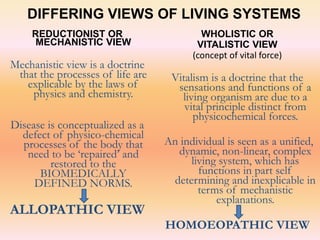
DIFFERING VIEWS OF LIVING SYSTEMS 
REDUCTIONIST OR 
MECHANISTIC VIEW 
Mechanistic view is a doctrine 
that the processes of life are 
explicable by the laws of 
physics and chemistry. 
Disease is conceptualized as a 
defect of physico-chemical 
processes of the body that 
need to be ‘repaired’ and 
restored to the 
BIOMEDICALLY 
DEFINED NORMS. 
ALLOPATHIC VIEW 
WHOLISTIC OR 
VITALISTIC VIEW 
(concept of vital force) 
Vitalism is a doctrine that the 
sensations and functions of a 
living organism are due to a 
vital principle distinct from 
physicochemical forces. 
An individual is seen as a unified, 
dynamic, non-linear, complex 
living system, which has 
functions in part self 
determining and inexplicable in 
terms of mechanistic 
explanations. 
HOMOEOPATHIC VIEW
TO ESTABLISH THE SIGNIFICANCE OF 
CONCEPT OF VITAListic view of life: 
TWO QUESTION ARISE?? 
Why reject reductionistic or allopathic 
view?? 
Is concept of vital force (modified to life 
principle) acceptable in modern sciences??
Why reject reductionism?? 
The following discussion from the works 
of Ernst Mayr, Alexis Carrel, 
Windelband Wilhelm & George Ernst 
Stahl establish the reason for rejecting 
the reductionistic view of life and 
highlights the need to accept the vitalistic 
concept of health and disease.
Why reject reductionism?? 
‘The claim that every attribute of complex living systems can 
be explained through the study of the lowest components 
(molecules, genes or whatever) struck me as absurd. 
Living organisms form a hierarchy of ever more complex 
systems, from molecules, cells and tissues through whole 
organisms, populations and species. In each higher system, 
characteristics emerge that could not have been predicted 
from a knowledge of the components.’ 
Ernst Mayr, ‘This is Biology: The Science of Living World’
The phenomena exhibited by living 
organism in health or in disease can 
never be explained by the exact 
determinist equations of 
thermodynamic or of motion since that 
would exclude the central concept of 
SELF ORGANISING PATTERN– the 
ability of organism to respond in non-linear 
fashion.
‘It is important to understand that, in spite of the 
great triumphs of molecular biology, biologists 
still know very little about how we breathe or 
how a wound heals or how an embryo develops 
into an organism.’ 
‘All of the coordinating activities of life can only be 
grasped when life is understood as a self-organizing 
network.’ 
……….Alexis Carrel, Man, The Unknown
‘Reductionism is like trying to create a whole web by 
examining a single strand of the web. One strand gives 
no analytical clue to the overall pattern, just as a single 
brick or stone gives no visible clue to the architecture of 
a building.’ 
Moreover, reductionist model ought to fail in the 
complex self organizing system of living beings since 
the actual manifestation of disease is always multi-causal 
and depends on the conjunction of precipitating 
psychosocial and pathogenic factors along with 
constitutional susceptibilities in particular organ 
systems.’ 
Windelband Wilhelm, A History of Philosophy, Macmillan, New York
While it is true that all living organisms are 
ultimately made of atoms and molecules, they 
are not ‘nothing but’ atoms and molecules. 
There is something else to life, something non 
material and irreducible – a pattern of 
organization, that something that maintains 
harmonious functioning of the all the organ 
systems. 
……..George Ernst Stahl (1660-1734)
In fact the word ‘Individual’ is derived from 
the Latin root ‘individuous’ – in (not) and 
dividuos (divisible). 
This concept is beautifully highlighted in the 
writings of B.K. Sarkar who states that 
‘individual is that which is indivisible; 
indivisible not in the sense that it is 
incapable of being divided into parts but that 
it cannot be so divided in its nature and 
remain what it is.
Acceptability of concept of vital 
force in modern sciences?? 
• MODERN PHYSICS 
• DEVELOPMENTAL BIOLOGY 
(EMBRYOLOGY) 
• CONVENTIONAL MEDICINE
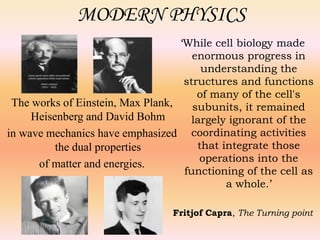
MODERN PHYSICS 
‘While cell biology made 
enormous progress in 
understanding the 
structures and functions 
of many of the cell's 
subunits, it remained 
largely ignorant of the 
coordinating activities 
that integrate those 
operations into the 
functioning of the cell as 
a whole.’ 
Fritjof Capra, The Turning point 
The works of Einstein, Max Plank, 
Heisenberg and David Bohm 
in wave mechanics have emphasized 
the dual properties 
of matter and energies.
Sheldrake’s MORPHOGENETIC FIELD 
Rupert Sheldrake had observed: 
"The instructors [at university] said that all 
morphogenesis is genetically programmed. They 
said different species just follow the instruction 
in their genes. But a few moments' reflection 
show that this reply is inadequate. All the cells of 
the body contain the same genes. In your body, 
the same genetic program is present in your eye 
cells, liver cells and the cells in your arms. The 
ones in your legs. But if they are all programmed 
identically, how do they develop so differently?"
Sheldrake’s MORPHOGENETIC FIELD 
He developed a theory to explain this 
problem of morphology, with its basic 
concept relying on a universal field 
encoding the "basic pattern" of an object. 
He termed it the "morphogenetic field".
DEVELOPMENTAL BIOLOGY 
(EMBRYOLOGY) 
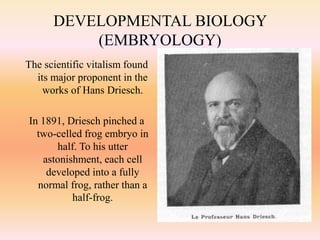
The scientific vitalism found 
its major proponent in the 
works of Hans Driesch. 
In 1891, Driesch pinched a 
two-celled frog embryo in 
half. To his utter 
astonishment, each cell 
developed into a fully 
normal frog, rather than a 
half-frog.
Driesch proposed the emergence of parts in an 
organism is a result of internal interactions 
instead of an assembly of preexisting parts, 
as in a mechanism or machine. 
He described the ability of the embryo to 
develop normally even when some portions 
are removed or rearranged due to 
organising, formative force which directs the 
epigenesis of the embryo as well as directing 
the conservation of the mature body.
CONVENTIONAL MEDICINE 
The living being is not mere repository of isolated parts 
subject to mechanical or physical laws but is in itself a 
self regulating system. So self-organization is the very 
essence of life………. 
The basis of self organizing activities are not mechanico-chemical 
laws but ‘something beyond’……… 
(CECIL TEXTBOOK OF MEDICINE-VOL.1)
“This, then is my vision of what will happen to 
our scientific perception of disease during the 
next century: we shall realize the wisdom of 
the ancient Aristotelian approach to the 
study of nature, which means that we shall no 
longer regard disease as a ‘mechanical fault in 
the human machine’ but as a disturbed life 
process.” 
“We shall apply the theories of open systems 
and non-linear dynamics to medical problems, 
and we shall reach a fuller understanding of 
the development of disease.” 
Wulff HR. The concept of disease: from Newton back to 
Aristotle. Lancet 1999;354(suppl):50S.
RELEVANCE of VITALISTIC VIEW 
If the modern sciences have gradually 
accepted the concept of VITALISM in the 
most subtle form, then as disciples of 
that great philanthropist, Samuel 
Hahnemann , why do we and other ‘so 
called modernists’ have to be biased 
against it just because it was 
promulgated by him long back ago, much 
before the dawn of scientific era???
HAHNEMANN’S CONCEPT OF 
VITAL FORCE 
‘Human life is in no respect regulated by purely physical laws, 
which only obtain among inorganic substances. The material 
substances of which the human body is composed no longer 
follow, in this vital combination, the laws to which material 
substances in the inanimate condition are subject. They are 
regulated by the laws peculiar to vitality alone, they are 
themselves animated just as the whole system is animated. Here 
a nameless fundamental power reigns omnipotent, which 
suspends all the tendency of the component parts to obey the 
laws of gravitation, of momentum, of the vis inertiae, of 
fermentation, of putrefaction & c., and brings them under the 
wonderful laws of life alone,………….’ 
“Spirit of the Homoeopathic Doctrine of Medicine”
HAHNEMANNIAN VIEW 
“…………The organism is indeed the material instrument 
of the life, but it is not conceivable without the animation 
imparted to it by the instinctively perceiving and regulating 
vital force (just as the vital force is not conceivable 
without the organism), consequently the two together 
constitute a unity, although in thought our mind 
separates this unity into two distinct conceptions for the 
sake of facilitating the comprehension of it.” 
§ 15 – Organon of the Art of Healing
Michael Baum, British Professor of surgery, in Journal 
of Royal Society of Medicine. 
‘What is non-science today may 
indeed become the science of 
tomorrow, and with these 
thoughts in mind, the 
complacencies of conventional 
school of thought must be 
shaken.’
Vitalism & its acceptance in modern sciences

Vitalism & its acceptance in modern sciences

  • 1.
    RELEVANCE OF CONCEPTOF VITAL FORCE IN LIGHT OF MODERN sciences FROM DR. ANJU JETHANI m.d. (hom.) SENIOR MEDICAL OFFICER, MEDICAL CENTER, HIGH COURT OF DELHI, DTE. OF AYUSH, GNCT OF DELHI SENIOR LECTURER, DEPT. OF ORGANON OF MEDICINE, NHMC & HOSPITAL, GOVT. OF NCT OF DELHI. E-MAIL: DRANJUJETHANI@GMAIL.COM
  • 2.
    DIFFERING VIEWS OFLIVING SYSTEMS REDUCTIONIST OR MECHANISTIC VIEW Mechanistic view is a doctrine that the processes of life are explicable by the laws of physics and chemistry. Disease is conceptualized as a defect of physico-chemical processes of the body that need to be ‘repaired’ and restored to the BIOMEDICALLY DEFINED NORMS. ALLOPATHIC VIEW WHOLISTIC OR VITALISTIC VIEW (concept of vital force) Vitalism is a doctrine that the sensations and functions of a living organism are due to a vital principle distinct from physicochemical forces. An individual is seen as a unified, dynamic, non-linear, complex living system, which has functions in part self determining and inexplicable in terms of mechanistic explanations. HOMOEOPATHIC VIEW
  • 3.
    TO ESTABLISH THESIGNIFICANCE OF CONCEPT OF VITAListic view of life: TWO QUESTION ARISE?? Why reject reductionistic or allopathic view?? Is concept of vital force (modified to life principle) acceptable in modern sciences??
  • 4.
    Why reject reductionism?? The following discussion from the works of Ernst Mayr, Alexis Carrel, Windelband Wilhelm & George Ernst Stahl establish the reason for rejecting the reductionistic view of life and highlights the need to accept the vitalistic concept of health and disease.
  • 5.
    Why reject reductionism?? ‘The claim that every attribute of complex living systems can be explained through the study of the lowest components (molecules, genes or whatever) struck me as absurd. Living organisms form a hierarchy of ever more complex systems, from molecules, cells and tissues through whole organisms, populations and species. In each higher system, characteristics emerge that could not have been predicted from a knowledge of the components.’ Ernst Mayr, ‘This is Biology: The Science of Living World’
  • 6.
    The phenomena exhibitedby living organism in health or in disease can never be explained by the exact determinist equations of thermodynamic or of motion since that would exclude the central concept of SELF ORGANISING PATTERN– the ability of organism to respond in non-linear fashion.
  • 7.
    ‘It is importantto understand that, in spite of the great triumphs of molecular biology, biologists still know very little about how we breathe or how a wound heals or how an embryo develops into an organism.’ ‘All of the coordinating activities of life can only be grasped when life is understood as a self-organizing network.’ ……….Alexis Carrel, Man, The Unknown
  • 8.
    ‘Reductionism is liketrying to create a whole web by examining a single strand of the web. One strand gives no analytical clue to the overall pattern, just as a single brick or stone gives no visible clue to the architecture of a building.’ Moreover, reductionist model ought to fail in the complex self organizing system of living beings since the actual manifestation of disease is always multi-causal and depends on the conjunction of precipitating psychosocial and pathogenic factors along with constitutional susceptibilities in particular organ systems.’ Windelband Wilhelm, A History of Philosophy, Macmillan, New York
  • 9.
    While it istrue that all living organisms are ultimately made of atoms and molecules, they are not ‘nothing but’ atoms and molecules. There is something else to life, something non material and irreducible – a pattern of organization, that something that maintains harmonious functioning of the all the organ systems. ……..George Ernst Stahl (1660-1734)
  • 10.
    In fact theword ‘Individual’ is derived from the Latin root ‘individuous’ – in (not) and dividuos (divisible). This concept is beautifully highlighted in the writings of B.K. Sarkar who states that ‘individual is that which is indivisible; indivisible not in the sense that it is incapable of being divided into parts but that it cannot be so divided in its nature and remain what it is.
  • 11.
    Acceptability of conceptof vital force in modern sciences?? • MODERN PHYSICS • DEVELOPMENTAL BIOLOGY (EMBRYOLOGY) • CONVENTIONAL MEDICINE
  • 12.
    MODERN PHYSICS ‘Whilecell biology made enormous progress in understanding the structures and functions of many of the cell's subunits, it remained largely ignorant of the coordinating activities that integrate those operations into the functioning of the cell as a whole.’ Fritjof Capra, The Turning point The works of Einstein, Max Plank, Heisenberg and David Bohm in wave mechanics have emphasized the dual properties of matter and energies.
  • 13.
    Sheldrake’s MORPHOGENETIC FIELD Rupert Sheldrake had observed: "The instructors [at university] said that all morphogenesis is genetically programmed. They said different species just follow the instruction in their genes. But a few moments' reflection show that this reply is inadequate. All the cells of the body contain the same genes. In your body, the same genetic program is present in your eye cells, liver cells and the cells in your arms. The ones in your legs. But if they are all programmed identically, how do they develop so differently?"
  • 14.
    Sheldrake’s MORPHOGENETIC FIELD He developed a theory to explain this problem of morphology, with its basic concept relying on a universal field encoding the "basic pattern" of an object. He termed it the "morphogenetic field".
  • 15.
    DEVELOPMENTAL BIOLOGY (EMBRYOLOGY) The scientific vitalism found its major proponent in the works of Hans Driesch. In 1891, Driesch pinched a two-celled frog embryo in half. To his utter astonishment, each cell developed into a fully normal frog, rather than a half-frog.
  • 16.
    Driesch proposed theemergence of parts in an organism is a result of internal interactions instead of an assembly of preexisting parts, as in a mechanism or machine. He described the ability of the embryo to develop normally even when some portions are removed or rearranged due to organising, formative force which directs the epigenesis of the embryo as well as directing the conservation of the mature body.
  • 17.
    CONVENTIONAL MEDICINE Theliving being is not mere repository of isolated parts subject to mechanical or physical laws but is in itself a self regulating system. So self-organization is the very essence of life………. The basis of self organizing activities are not mechanico-chemical laws but ‘something beyond’……… (CECIL TEXTBOOK OF MEDICINE-VOL.1)
  • 18.
    “This, then ismy vision of what will happen to our scientific perception of disease during the next century: we shall realize the wisdom of the ancient Aristotelian approach to the study of nature, which means that we shall no longer regard disease as a ‘mechanical fault in the human machine’ but as a disturbed life process.” “We shall apply the theories of open systems and non-linear dynamics to medical problems, and we shall reach a fuller understanding of the development of disease.” Wulff HR. The concept of disease: from Newton back to Aristotle. Lancet 1999;354(suppl):50S.
  • 19.
    RELEVANCE of VITALISTICVIEW If the modern sciences have gradually accepted the concept of VITALISM in the most subtle form, then as disciples of that great philanthropist, Samuel Hahnemann , why do we and other ‘so called modernists’ have to be biased against it just because it was promulgated by him long back ago, much before the dawn of scientific era???
  • 20.
    HAHNEMANN’S CONCEPT OF VITAL FORCE ‘Human life is in no respect regulated by purely physical laws, which only obtain among inorganic substances. The material substances of which the human body is composed no longer follow, in this vital combination, the laws to which material substances in the inanimate condition are subject. They are regulated by the laws peculiar to vitality alone, they are themselves animated just as the whole system is animated. Here a nameless fundamental power reigns omnipotent, which suspends all the tendency of the component parts to obey the laws of gravitation, of momentum, of the vis inertiae, of fermentation, of putrefaction & c., and brings them under the wonderful laws of life alone,………….’ “Spirit of the Homoeopathic Doctrine of Medicine”
  • 21.
    HAHNEMANNIAN VIEW “…………Theorganism is indeed the material instrument of the life, but it is not conceivable without the animation imparted to it by the instinctively perceiving and regulating vital force (just as the vital force is not conceivable without the organism), consequently the two together constitute a unity, although in thought our mind separates this unity into two distinct conceptions for the sake of facilitating the comprehension of it.” § 15 – Organon of the Art of Healing
  • 22.
    Michael Baum, BritishProfessor of surgery, in Journal of Royal Society of Medicine. ‘What is non-science today may indeed become the science of tomorrow, and with these thoughts in mind, the complacencies of conventional school of thought must be shaken.’