Visual Scene DisplaysPretty Playthings or Powerful Pictures?
Jane FarrallSpeech PathologistAAC Support Services ManagerSpectronics
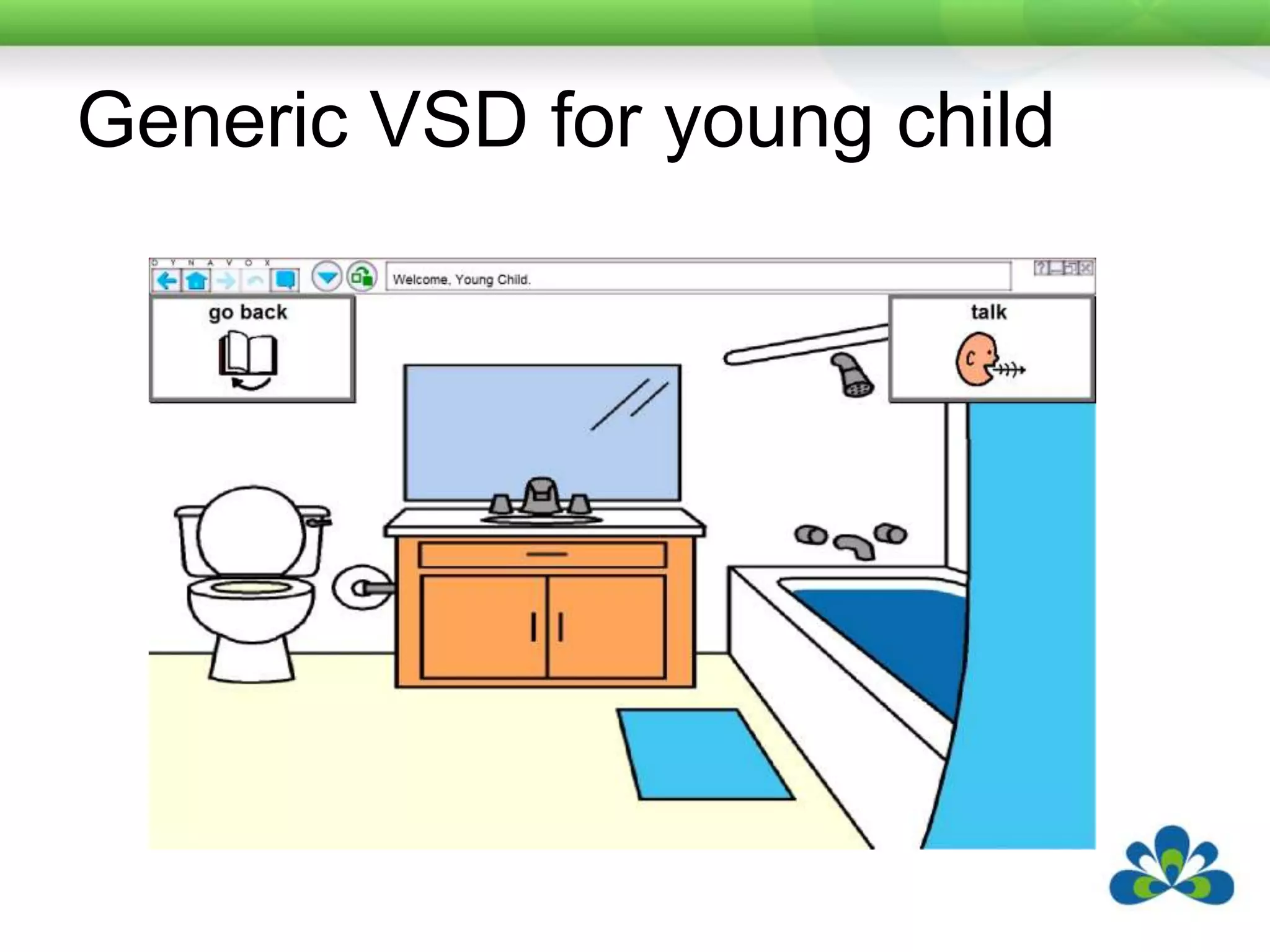
Visual Scene DisplaysA visual scene display (VSD) is a picture, photograph, or virtual environment that depicts and represents a situation, place or experience.  Individual elements such as people, actions and objects appear within the visual scene (Blackstone, 2004).
Visual Scene DisplaysDifferent from a traditional grid displayThe visual scene shows elements such as people, actions and objects in a visually integrated image.Messages can be accessed from the picture.Additional displays might also be triggered from the visual scene display
Visual Scene DisplaysVisual scene displays (VSDs) are meant primarily to address the needs of beginning communicators and individuals with significant cognitive and/or linguistic limitations. These groups are unserved or underserved by current AAC technologies. (Blackstone, 2004)
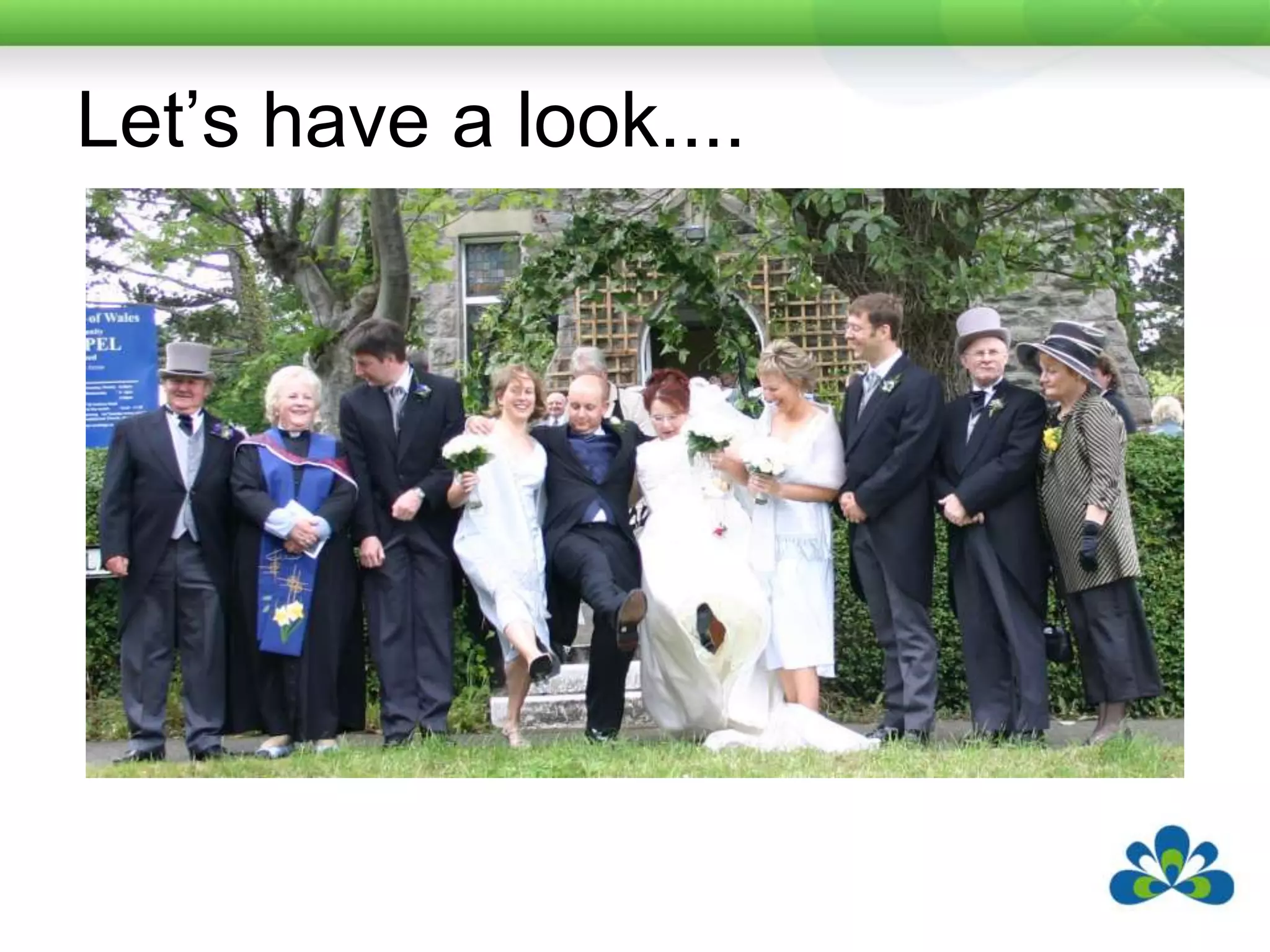
Let’s have a look....
Why so common recently?VSDs are much easier to do on dynamic display touch screensDynamic display touch screens are now common and with a range of software optionsDynamic display touch screens are more portable e.g. iPad, Maestro
Three main areas of research with VSDsPeople with aphasiaChildren with Autism Spectrum DisorderYoung children with Complex Communication NeedsMajority (but not all) of this research has been conducted by members of AAC RERC www.aac-rerc.com
VSDs and people with AphasiaResearch primarily conducted by David Beukelman and colleagues. Summary webcast available at www.aac-rerc.comLooked at research which showed that AAC and Speech Generating Devices (SGDs) were most successful with people who retained literacyWanted to look at ways of allowing people without literacy skills to retain social networks
VSDs and people with aphasiaBeukelman et al (2003), Beukelman et al (2007) and AAC RERC (2009)VSDs have been very successful with people with chronic aphasiaNeed to be customised, real photos from their life.  Higher uptake if individual is involved in selection of pictures and generation of utterances
VSDs and people with aphasia “After her stroke, our mother refused to attend (social) functions due to embarrassment of the challenges she faced when interacting with people outside of her immediate family . . . Her success (with a Visual Scenes Display AAC device) led to a renewed interest in attending family gatherings. Six weeks after the introduction of (the AAC device), she left her house for the first time (after her stroke), to engage socially – she went to a family holiday gathering’’ (Personal communication with the adult daughter of a woman with severe, chronic aphasia, Beukelman et al 2007)
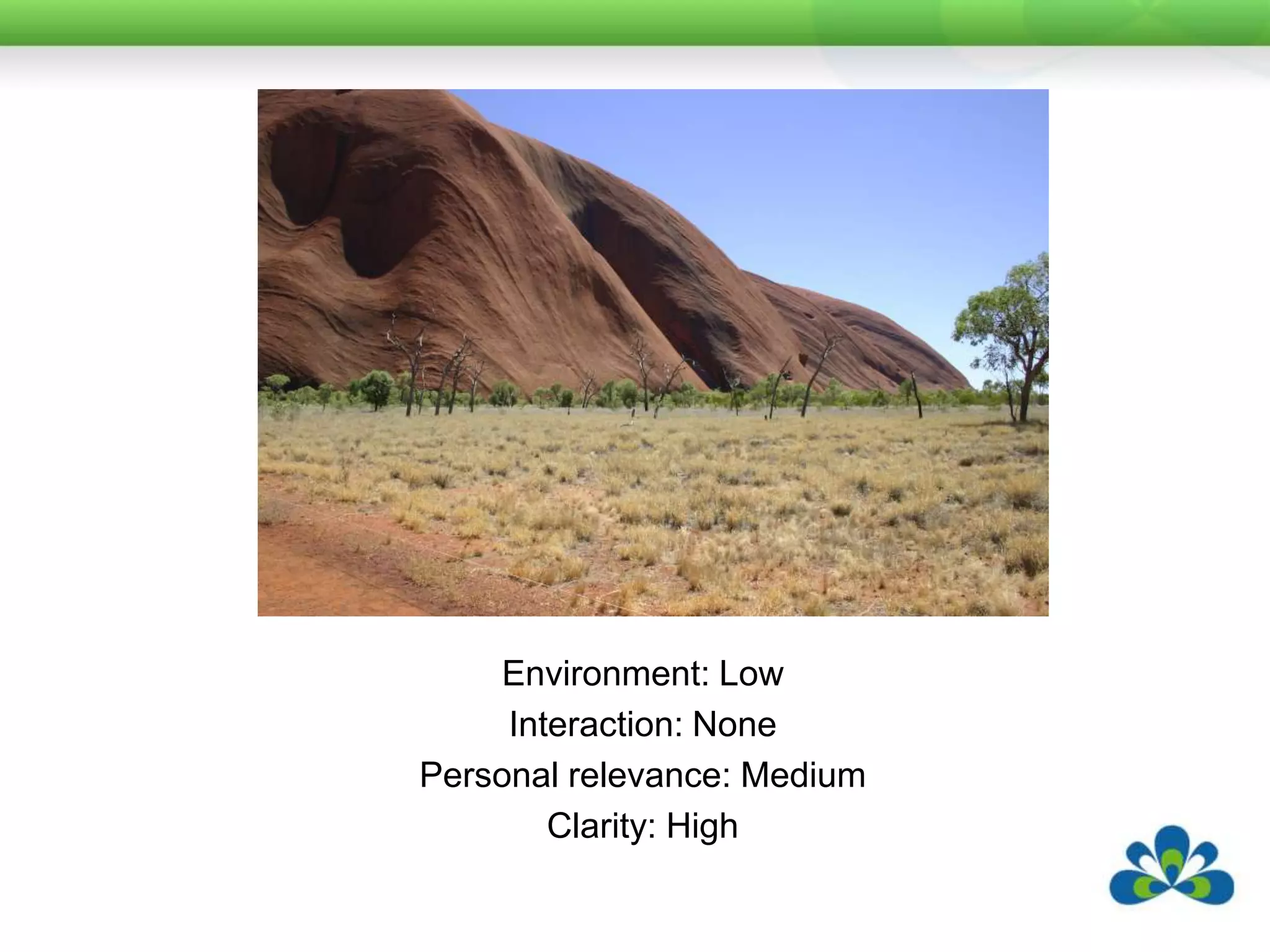
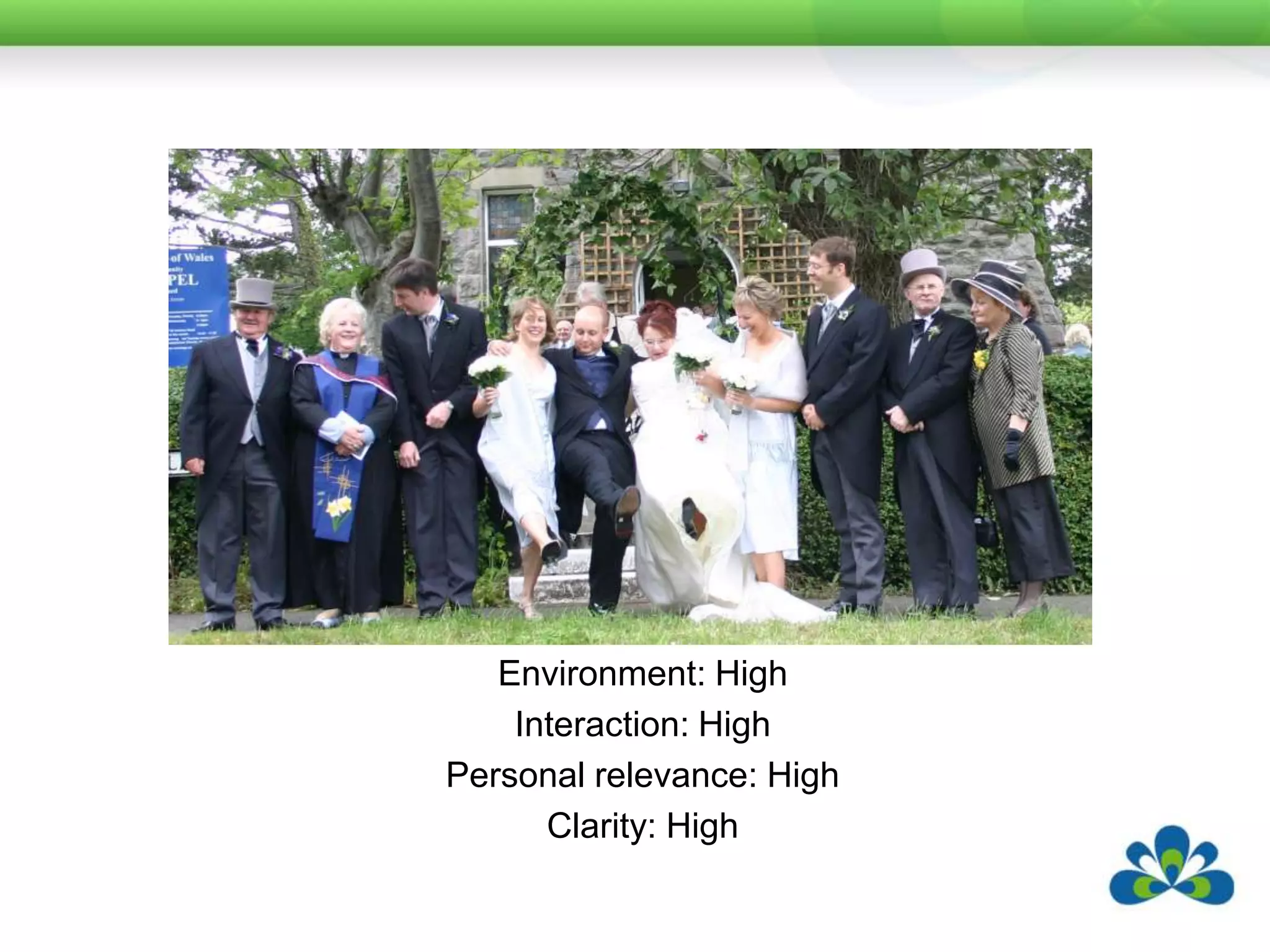
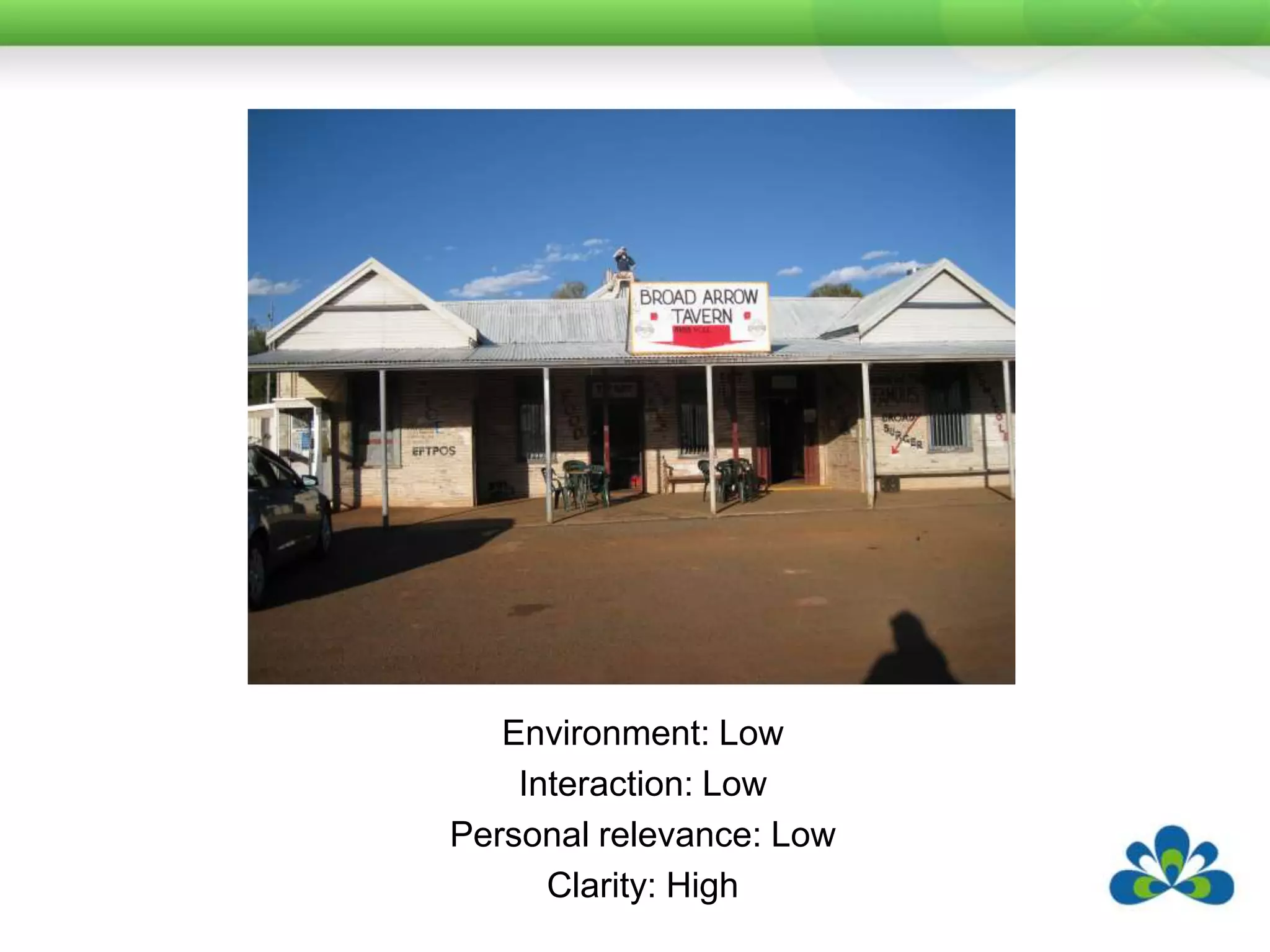
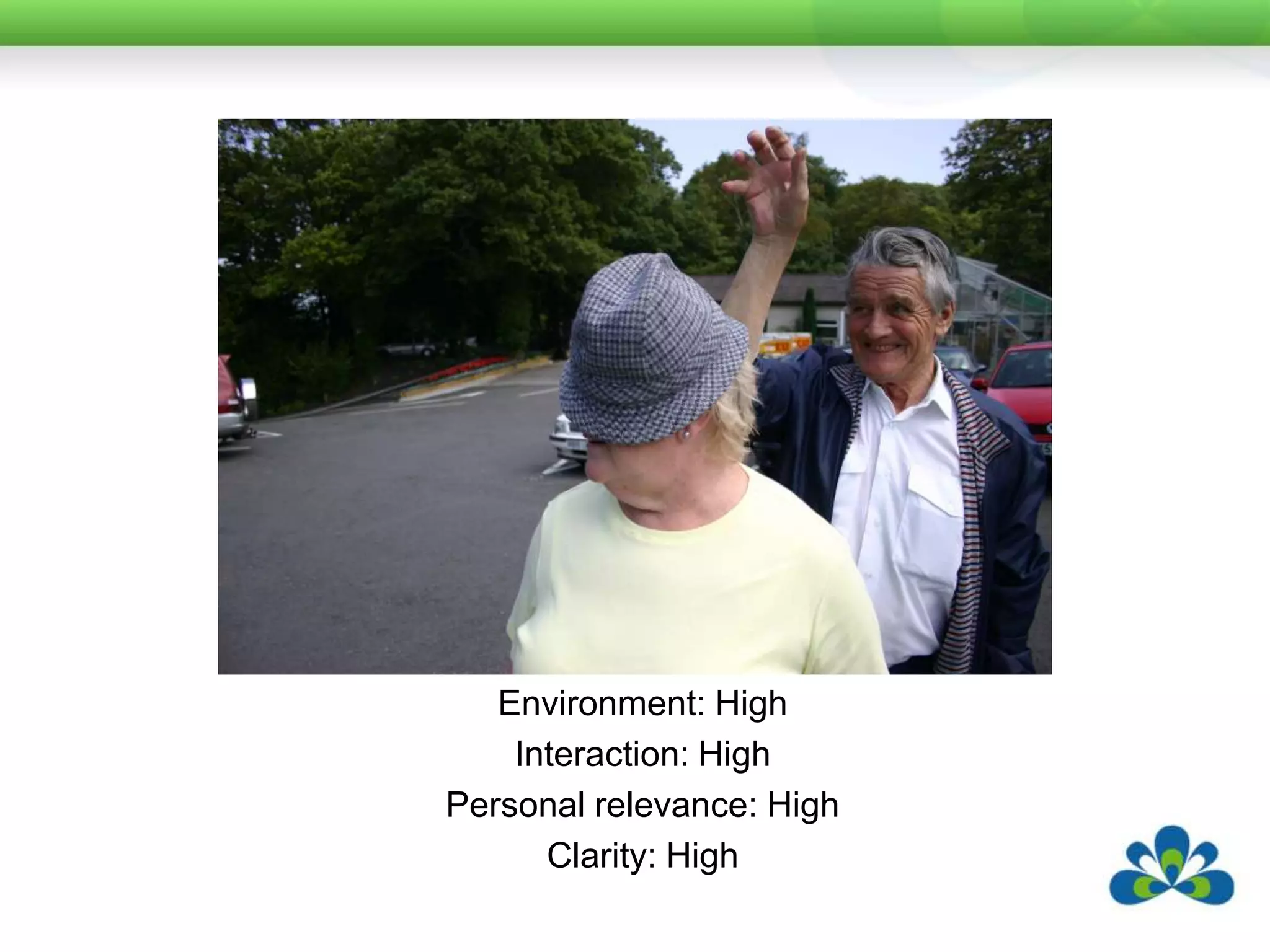
VSDs and people with aphasiaThe most successful VSDs:Provide context (setting, people, objects and activities)Show Interaction with people or the environmentAre personally relevantAre clear photosHave the ability to be used for personal story telling
Environment: LowInteraction: NonePersonal relevance: MediumClarity: High
Environment: HighInteraction: HighPersonal relevance: HighClarity: High
Environment: LowInteraction: LowPersonal relevance: LowClarity: High
Environment: HighInteraction: HighPersonal relevance: HighClarity: High
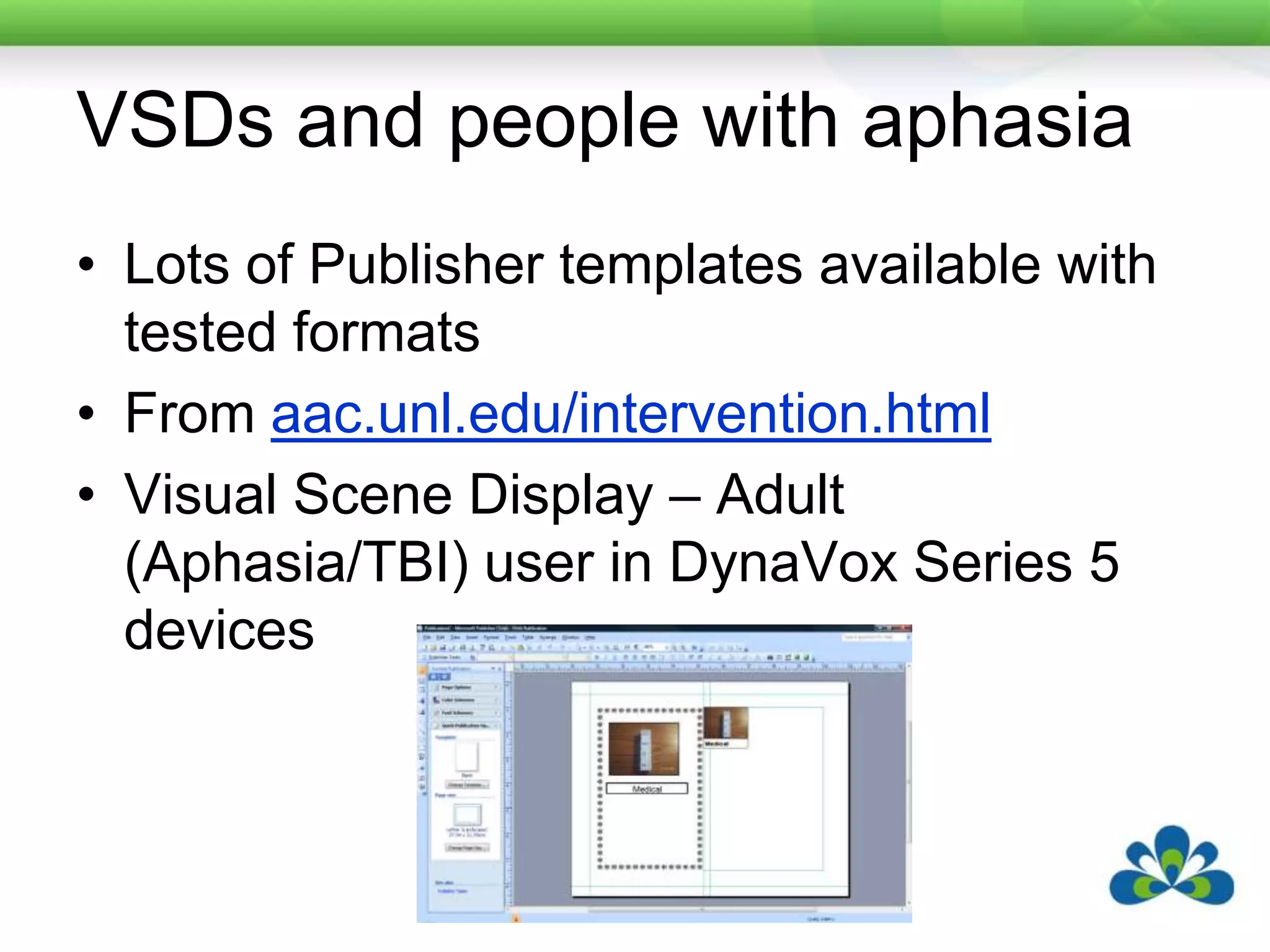
VSDs and people with aphasiaLots of Publisher templates available with tested formatsFrom aac.unl.edu/intervention.htmlVisual Scene Display – Adult (Aphasia/TBI) user in DynaVox Series 5 devices
VSDs and children with Autism Spectrum DisorderResearch primarily conducted by Howard Shane and colleagues. Looked at VSDs asVisual Expressive ModeVisual Organizational ModeVisual Instructional ModeCalled VSDs “Maps”
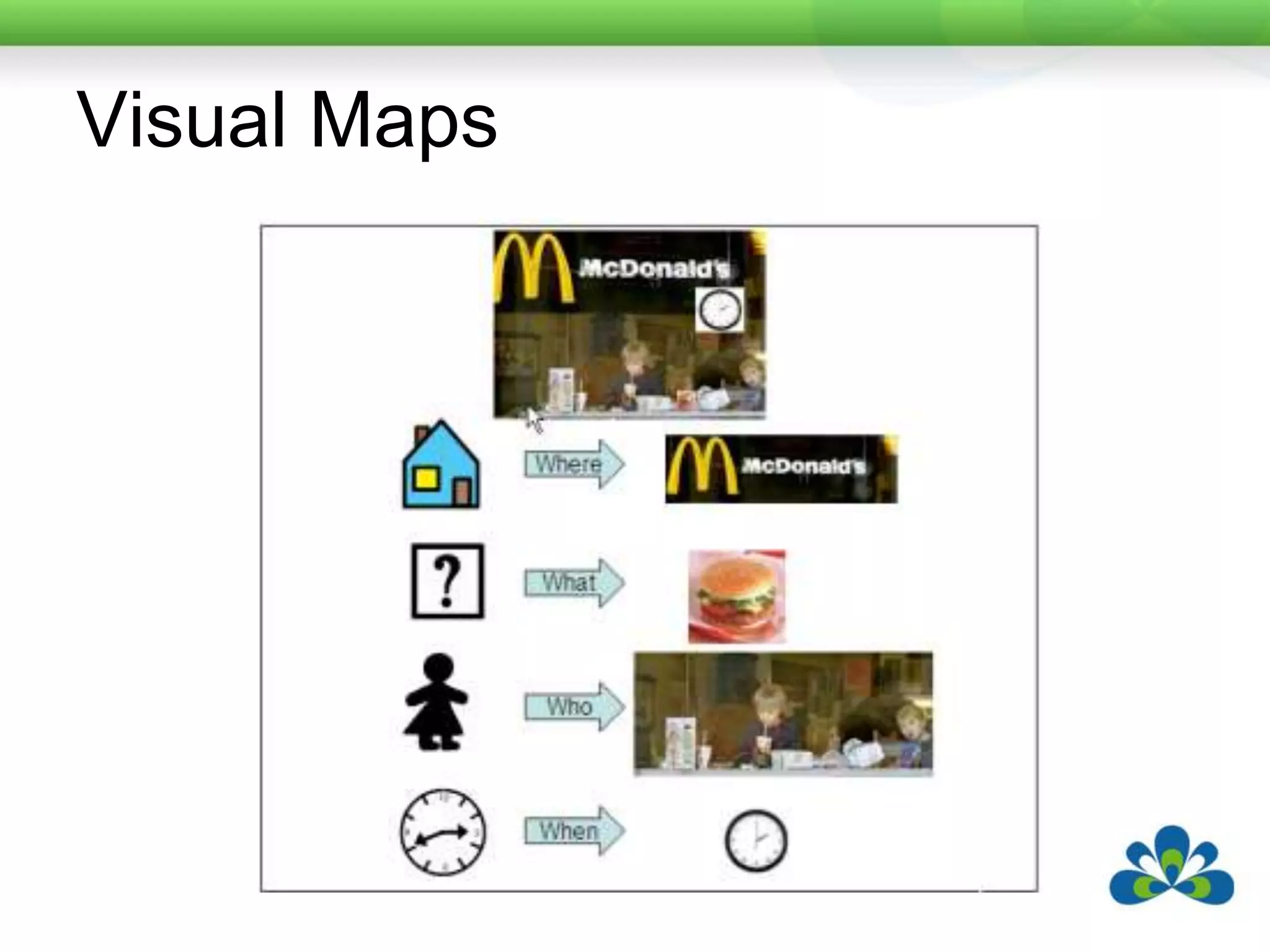
Visual Maps
Visual Organisational ModeMaps can be more successful than traditional schedules or charts because they convey more informationCan convey not just that the individual will be going to McDonalds but also when, who will attend and what will happen.
Visual Instructional ModeVisual scenes compensated for the child’s comprehension or auditory processing difficulties (helped them to understand better what was being said by others)Built comprehension
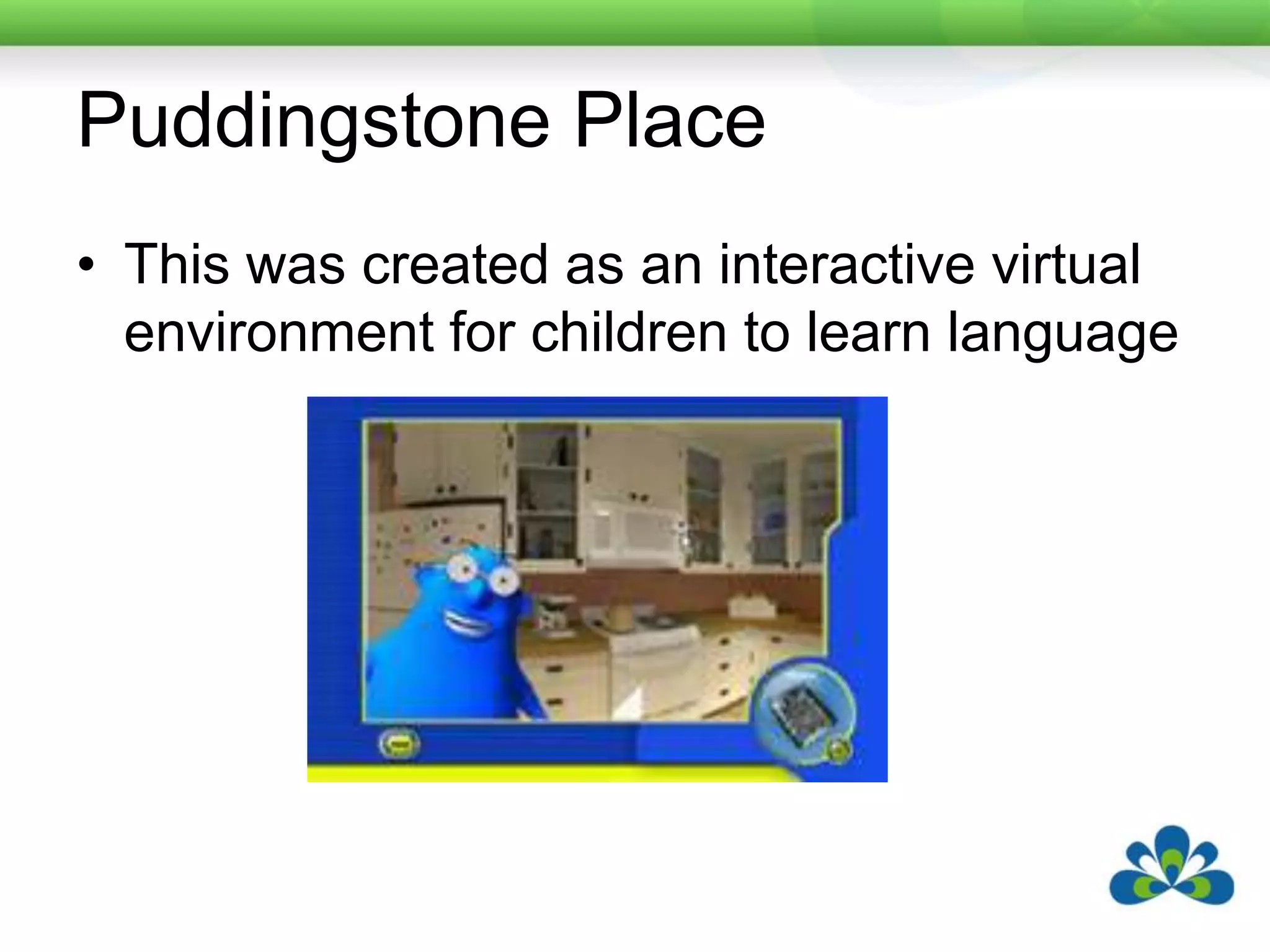
Puddingstone PlaceThis was created as an interactive virtual environment for children to learn language
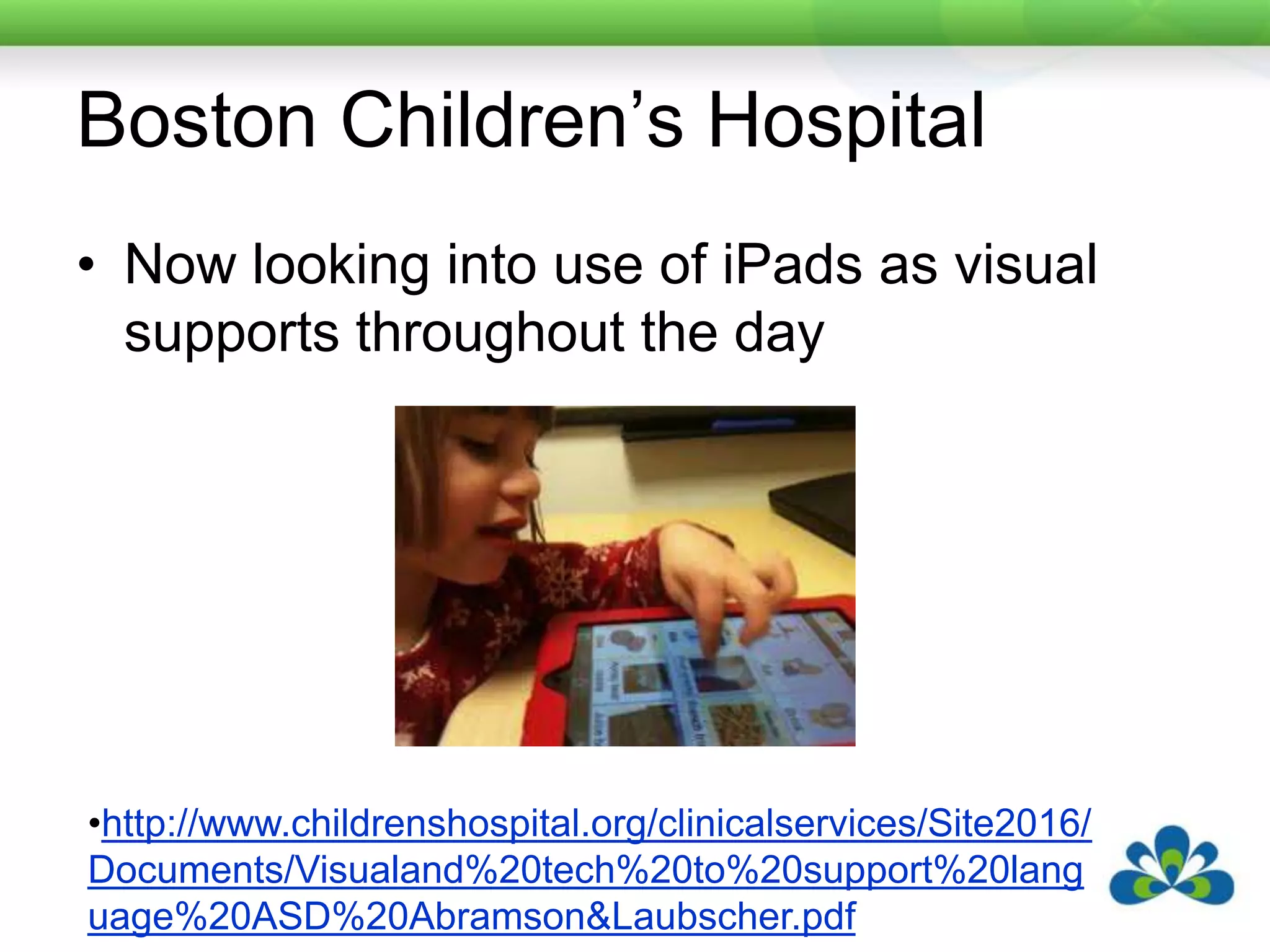
Boston Children’s HospitalNow looking into use of iPads as visual supports throughout the dayhttp://www.childrenshospital.org/clinicalservices/Site2016/Documents/Visualand%20tech%20to%20support%20language%20ASD%20Abramson&Laubscher.pdf
VSD AppsLots of talking photo album options e.g. Click ‘nTalk.SceneSpeakScene&Heard
Visual Expressive ModeDrager et al. (2005) repeated some of the studies done with children with developmental disabilites and found similar results in a study of preschoolers with autism (ages 3 – 5).
VSDs and young childrenResearch primarily conducted by Janice Light and colleagues. Summary webcast available at www.aac-rerc.comIdea partly came from a AAC RERC meeting where the feedback from parents was that SGDs needed to:Decrease learning demandsIncrease appeal
Children and SymbolsDrager et al (2008) asked typically developing children to draw pictures of 10 emerging language concepts.The children’s pictures were:Grounded in contextInvolved familiar experiencesUsed entire scenesThis was mostly consistent across a variety of ethnic/cultural groups.
Generic VSD for young child
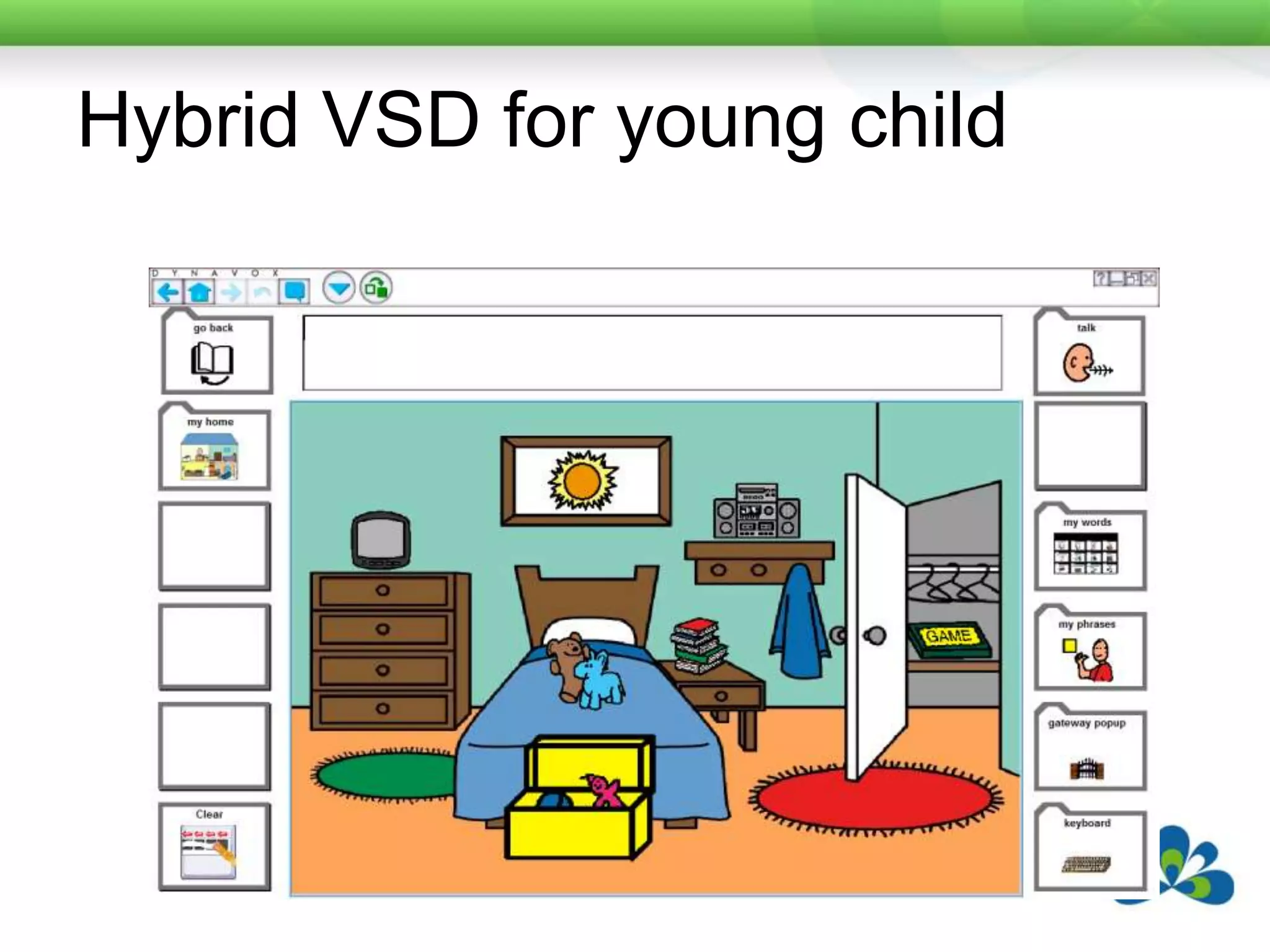
Hybrid VSD for young child
VSDs and young childrenDrager et al (2003) found that 2.5 year olds were most accurate locating vocabulary on VSDs even if displays were not customised for themDrager et al (2004) found that 3 year olds had trouble with all forms of vocabulary arrangement on initial exposure, but after just one session performed significantly better with the visual scenes than a grid format.
VSDs and young childrenLight et al (2004) found that by ages 4 and 5, the children were able to locate vocabulary within the visual scene displays and the grid layouts with similar levels of accuracy, but they had significant difficulty learning to use iconic encoding.
VSDs and Young ChildrenLight and Drager (2008) reported on a study using VSDs with young children with developmental disabilities, aged 1 – 3. They concluded: .....
Young Children and VSDsAll the children were able to use VSDs to participate in social interactions with only one session of modellingThe children demonstrated significant increases in turn taking immediately   The children sustained these turn taking and social communication gainsChildren tended to plateau, but improved again following introduction of hybrid scenes and then grid displays
VSDs and Young Children	A lot of this research has had small sample sizes and in some studies children were only exposed to SGDs for short periods each timeFocus has been on making AAC easier, acknowledging limited intervention many children receive
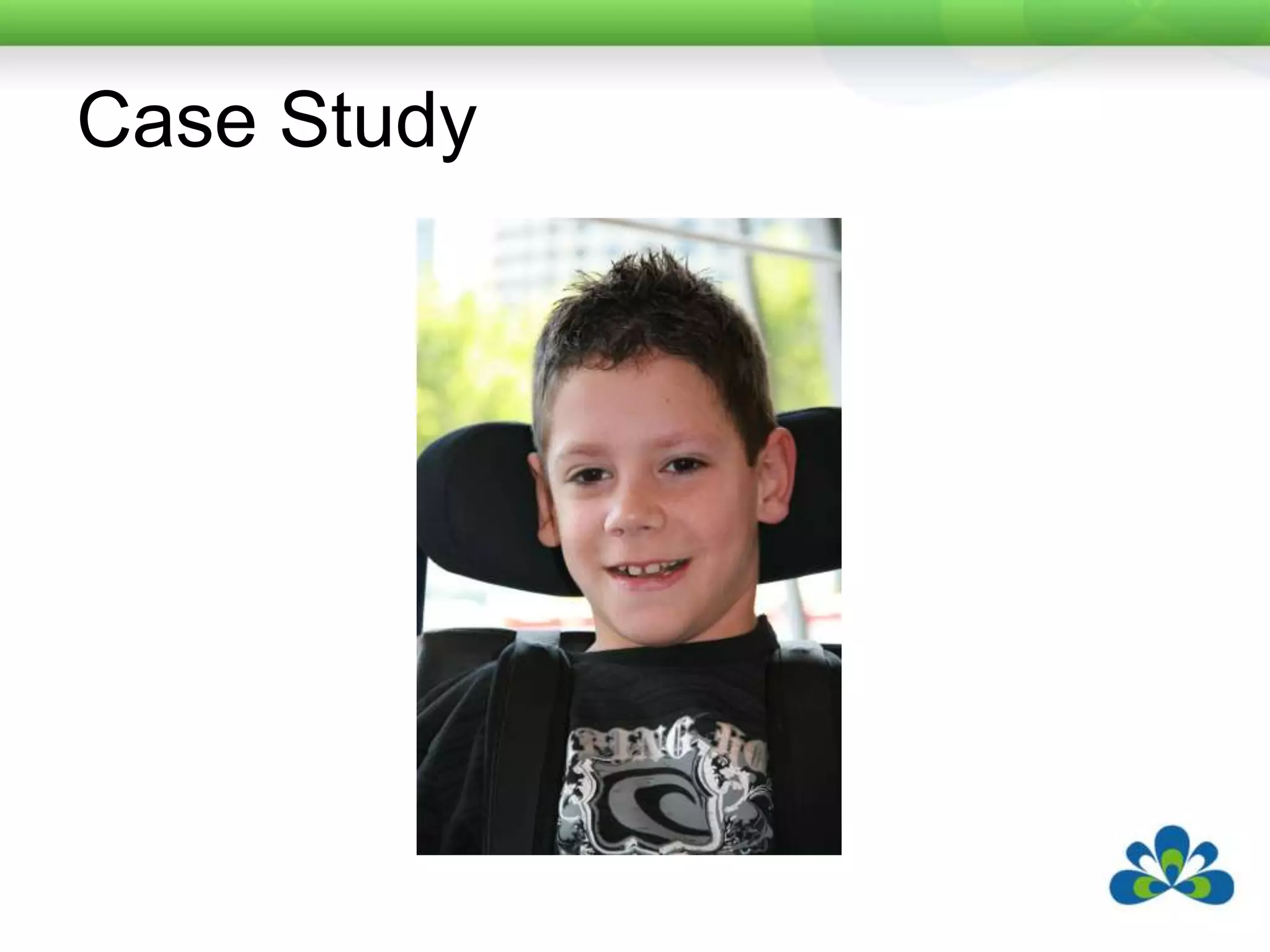
Case Study
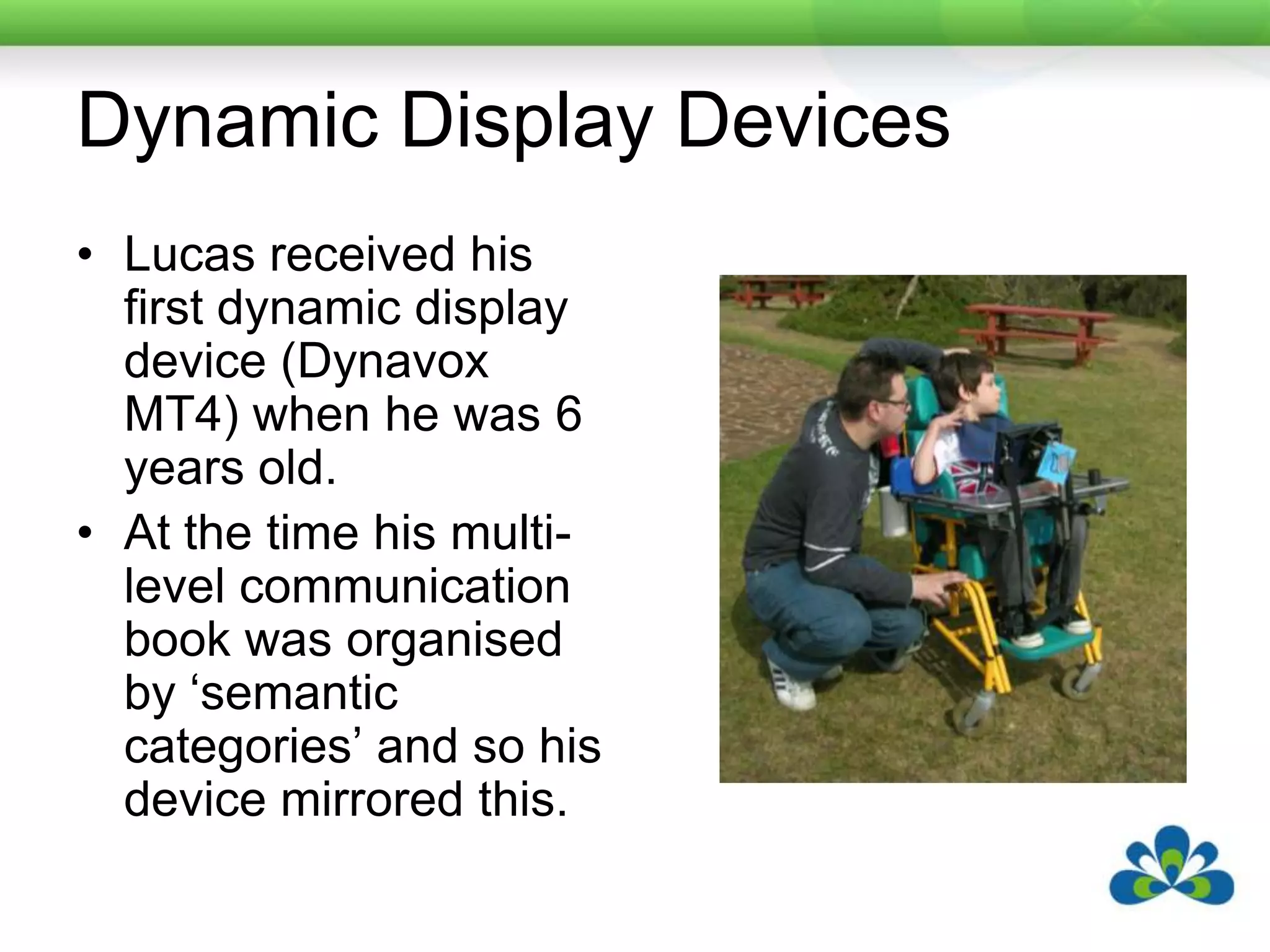
Dynamic Display DevicesLucas received his first dynamic display device (Dynavox MT4) when he was 6 years old.At the time his multi-level communication book was organised by ‘semantic categories’ and so his device mirrored this.
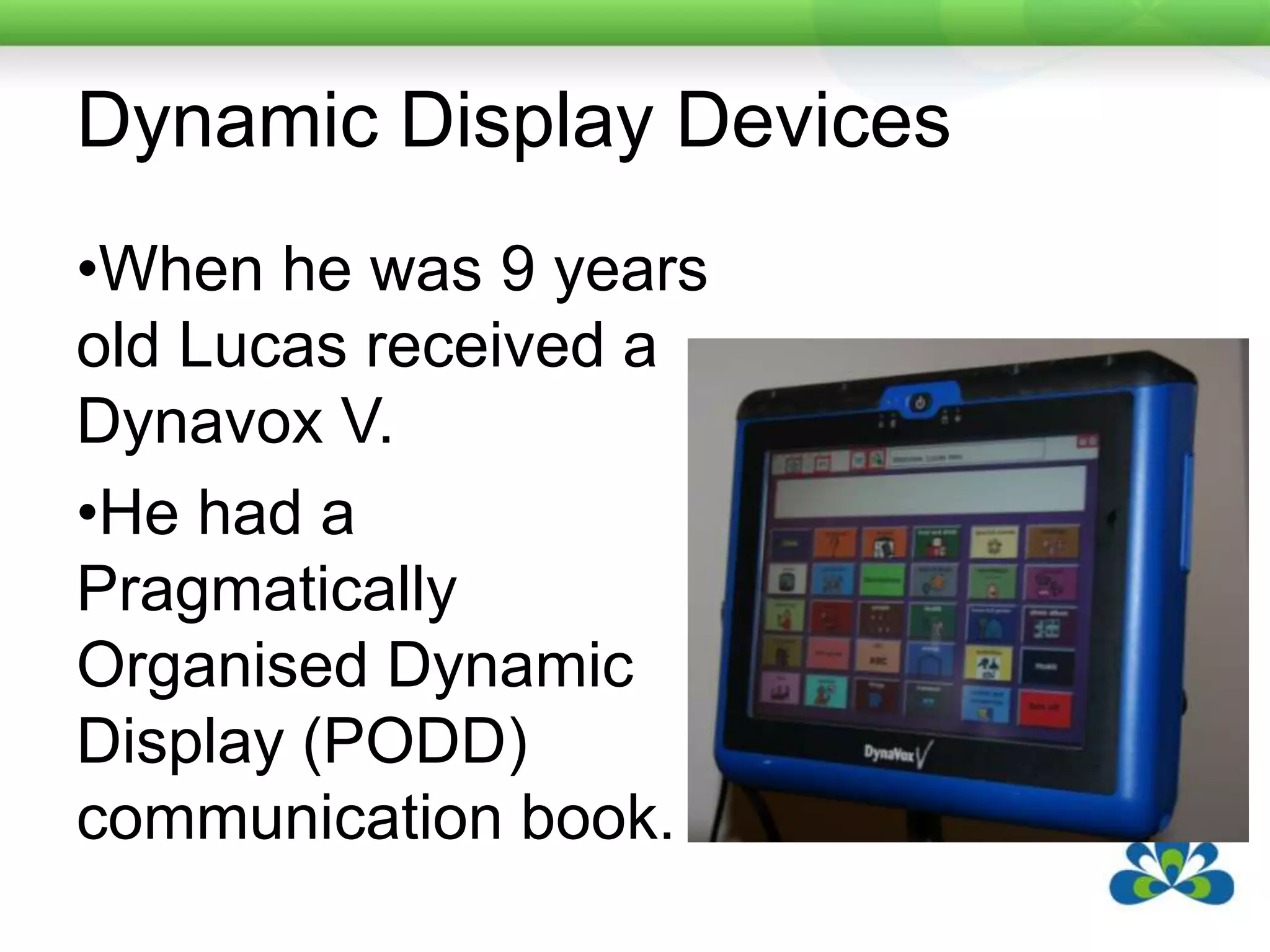
Dynamic Display DevicesWhen he was 9 years old Lucas received a Dynavox V.
He had a Pragmatically Organised Dynamic Display (PODD) communication book.Using Visual Scene DisplaysWhy it was decided to use VSDsAlready was programmed on the deviceEvidence suggested it was an effective way for some people to communicateLucas was motivated to use As he was motivated it was hoped using them would increase his device use
Visual Scene DisplaysAdvantagesLucas like the idea of them and was more motivated to use his deviceThey look ‘pretty’ and so appealed to other people, making them more motivated to use the deviceDisadvantagesIt takes a long time to scan to parts of the visual sceneIt adds an extra cognitive step to the process (ie remembering where in the visual scene things are placed) particularly because of moving between PODD and VSDsIt makes it difficult for other people to model the device as it is impossible/difficult to tell where things are placed on the visual sceneAt times the visual scene itself can be a distractionUsing VSDs means that any multi-level communication book must be organised differently.  For Lucas this meant learning and remembering two systems – VSDs and his PODD book.
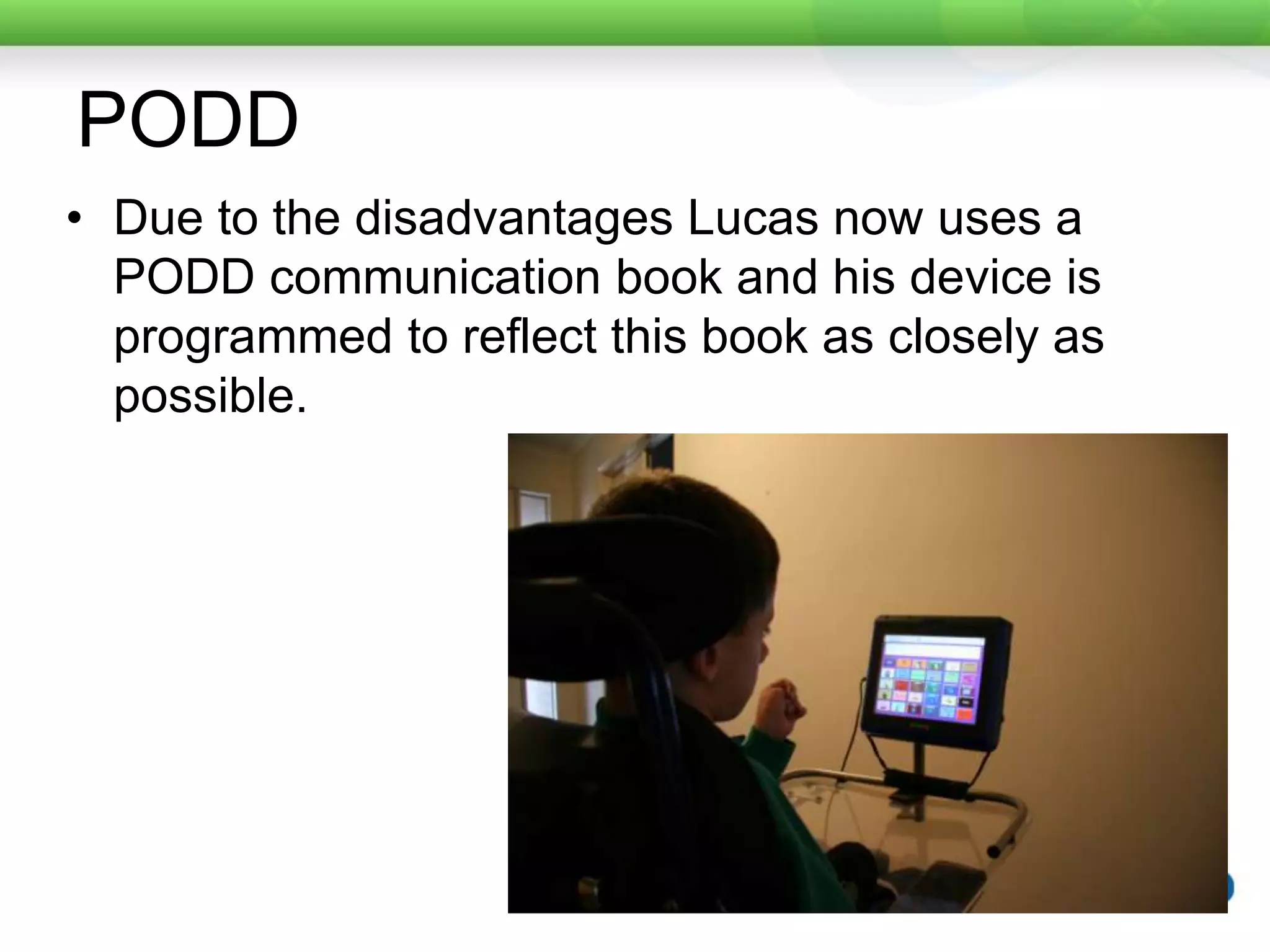
PODDDue to the disadvantages Lucas now uses a PODD communication book and his device is programmed to reflect this book as closely as possible.
ReferencesAAC RERC. (2009). AAC for Aphasia: A Review of Visual Scenes Display Project. Retrieved April 27, 2009, from http://aac-rerc.psu.edu/index-21030.php.htmlAAC RERC. (2009). AAC Interventions to Maximize Language Development for Young Children. Retrieved April 27, 2009, from http://aac-rerc.psu.edu/index-16147.php.htmlASHA. (2009). Children’s Representations of Early Language Concepts: Implications for AAC Symbols. Retrieved May 01, 2009 from http://convention.asha.org/handouts/1420_2072Drager_Kathryn_073157_Nov16_2008_Time_072254PM.pdf
ReferencesBeukelman, D., Fager, S., Ball, L. and Dietz, A. (2007). AAC for adults with acquired neurological conditions: A review. Augmentative and Alternative Communication, 23(3), 230 – 242Beukelman, D., Fager, S., Ball, L., Prentice, C., Jakobs, T., & Caves, K. (2003). New AAC interfaces: Field test results. ASHA Leader, 8, 144.Blackstone, S. (2004). Clinical news: Visual scene displays. Augmentative Communication News, 16(2), 1-8.
ReferencesDrager, K., Light, J., Carlson, R., D’Silva, K., Larsson, B., Pitkin, L. (2004).  Learning of Dynamic Display AAC Technologies by Typically Developing 3-Year-Olds: Journal of Speech, Language and Hearing Research, 47(5), 1133– 1149Drager, K., Light, J., Curran-Speltz, J., Fallon, K., & Jeffries, L. (2003). The performance of typically developing 2 ½-year-olds on dynamic display AAC technologies with different system layouts and language organizations. Journal of Speech, Language and Hearing Research, 46, 298 – 312.
ReferencesDrager, K., Light, J., Angert, E., Finke, E., Johnson, J., Larson, H., et al. (2005). AAC & interactive play: Language learning in children with autism. Seminar presented at the annual conference of the American Speech Language Hearing Association, San Diego, CAHB Munroe Barkley AAC Centers. (2009). Visual Scene Resources. Retrieved April 28, 2009, from http://aac.unl.edu/intervention.htmlLight, J., & Drager, K. (2004). Re-thinking access to AAC technologies for young children: Simplifying the learning demands. Perspectives on Augmentative and Alternative Communication, 13, 5 – 12.
ReferencesLight, J. & Drager, K. (2008) Evidence-based AAC interventions to build language and communication skills with infants, toddlers and preschoolers. Paper presented at the ISAAC biennial conference, Montreal, Canada.Light, J., Drager, K., McCarthy, J., Mellott, S., Parrish, C., Parsons, A., et al. (2004). Performance of typically developing four and five year old children with AAC systems using different language organization techniques. Augmentative and Alternative Communication, 20, 63 – 88.
ReferencesLight, J. and Drager, K. (2007) AAC technologies for young children with complex communication needs: State of the science and future research directions, Augmentative and Alternative Communication,23(3), 204 – 216Shane, H. C. (2006). Using visual scene displays to improve communication and communication instruction in persons with Autism Spectrum Disorders. Perspectives in Augmentative and Alternative Communication, 15(1), 8 – 13.

Visual Scene Displays

  • 1.
    Visual Scene DisplaysPrettyPlaythings or Powerful Pictures?
  • 2.
    Jane FarrallSpeech PathologistAACSupport Services ManagerSpectronics
  • 3.
    Visual Scene DisplaysAvisual scene display (VSD) is a picture, photograph, or virtual environment that depicts and represents a situation, place or experience. Individual elements such as people, actions and objects appear within the visual scene (Blackstone, 2004).
  • 4.
    Visual Scene DisplaysDifferentfrom a traditional grid displayThe visual scene shows elements such as people, actions and objects in a visually integrated image.Messages can be accessed from the picture.Additional displays might also be triggered from the visual scene display
  • 5.
    Visual Scene DisplaysVisualscene displays (VSDs) are meant primarily to address the needs of beginning communicators and individuals with significant cognitive and/or linguistic limitations. These groups are unserved or underserved by current AAC technologies. (Blackstone, 2004)
  • 6.
  • 7.
    Why so commonrecently?VSDs are much easier to do on dynamic display touch screensDynamic display touch screens are now common and with a range of software optionsDynamic display touch screens are more portable e.g. iPad, Maestro
  • 8.
    Three main areasof research with VSDsPeople with aphasiaChildren with Autism Spectrum DisorderYoung children with Complex Communication NeedsMajority (but not all) of this research has been conducted by members of AAC RERC www.aac-rerc.com
  • 9.
    VSDs and peoplewith AphasiaResearch primarily conducted by David Beukelman and colleagues. Summary webcast available at www.aac-rerc.comLooked at research which showed that AAC and Speech Generating Devices (SGDs) were most successful with people who retained literacyWanted to look at ways of allowing people without literacy skills to retain social networks
  • 10.
    VSDs and peoplewith aphasiaBeukelman et al (2003), Beukelman et al (2007) and AAC RERC (2009)VSDs have been very successful with people with chronic aphasiaNeed to be customised, real photos from their life. Higher uptake if individual is involved in selection of pictures and generation of utterances
  • 11.
    VSDs and peoplewith aphasia “After her stroke, our mother refused to attend (social) functions due to embarrassment of the challenges she faced when interacting with people outside of her immediate family . . . Her success (with a Visual Scenes Display AAC device) led to a renewed interest in attending family gatherings. Six weeks after the introduction of (the AAC device), she left her house for the first time (after her stroke), to engage socially – she went to a family holiday gathering’’ (Personal communication with the adult daughter of a woman with severe, chronic aphasia, Beukelman et al 2007)
  • 12.
    VSDs and peoplewith aphasiaThe most successful VSDs:Provide context (setting, people, objects and activities)Show Interaction with people or the environmentAre personally relevantAre clear photosHave the ability to be used for personal story telling
  • 13.
    Environment: LowInteraction: NonePersonalrelevance: MediumClarity: High
  • 14.
    Environment: HighInteraction: HighPersonalrelevance: HighClarity: High
  • 15.
    Environment: LowInteraction: LowPersonalrelevance: LowClarity: High
  • 16.
    Environment: HighInteraction: HighPersonalrelevance: HighClarity: High
  • 17.
    VSDs and peoplewith aphasiaLots of Publisher templates available with tested formatsFrom aac.unl.edu/intervention.htmlVisual Scene Display – Adult (Aphasia/TBI) user in DynaVox Series 5 devices
  • 18.
    VSDs and childrenwith Autism Spectrum DisorderResearch primarily conducted by Howard Shane and colleagues. Looked at VSDs asVisual Expressive ModeVisual Organizational ModeVisual Instructional ModeCalled VSDs “Maps”
  • 19.
  • 20.
    Visual Organisational ModeMapscan be more successful than traditional schedules or charts because they convey more informationCan convey not just that the individual will be going to McDonalds but also when, who will attend and what will happen.
  • 21.
    Visual Instructional ModeVisualscenes compensated for the child’s comprehension or auditory processing difficulties (helped them to understand better what was being said by others)Built comprehension
  • 22.
    Puddingstone PlaceThis wascreated as an interactive virtual environment for children to learn language
  • 23.
    Boston Children’s HospitalNowlooking into use of iPads as visual supports throughout the dayhttp://www.childrenshospital.org/clinicalservices/Site2016/Documents/Visualand%20tech%20to%20support%20language%20ASD%20Abramson&Laubscher.pdf
  • 24.
    VSD AppsLots oftalking photo album options e.g. Click ‘nTalk.SceneSpeakScene&Heard
  • 25.
    Visual Expressive ModeDrageret al. (2005) repeated some of the studies done with children with developmental disabilites and found similar results in a study of preschoolers with autism (ages 3 – 5).
  • 26.
    VSDs and youngchildrenResearch primarily conducted by Janice Light and colleagues. Summary webcast available at www.aac-rerc.comIdea partly came from a AAC RERC meeting where the feedback from parents was that SGDs needed to:Decrease learning demandsIncrease appeal
  • 27.
    Children and SymbolsDrageret al (2008) asked typically developing children to draw pictures of 10 emerging language concepts.The children’s pictures were:Grounded in contextInvolved familiar experiencesUsed entire scenesThis was mostly consistent across a variety of ethnic/cultural groups.
  • 28.
    Generic VSD foryoung child
  • 29.
    Hybrid VSD foryoung child
  • 30.
    VSDs and youngchildrenDrager et al (2003) found that 2.5 year olds were most accurate locating vocabulary on VSDs even if displays were not customised for themDrager et al (2004) found that 3 year olds had trouble with all forms of vocabulary arrangement on initial exposure, but after just one session performed significantly better with the visual scenes than a grid format.
  • 31.
    VSDs and youngchildrenLight et al (2004) found that by ages 4 and 5, the children were able to locate vocabulary within the visual scene displays and the grid layouts with similar levels of accuracy, but they had significant difficulty learning to use iconic encoding.
  • 32.
    VSDs and YoungChildrenLight and Drager (2008) reported on a study using VSDs with young children with developmental disabilities, aged 1 – 3. They concluded: .....
  • 33.
    Young Children andVSDsAll the children were able to use VSDs to participate in social interactions with only one session of modellingThe children demonstrated significant increases in turn taking immediately The children sustained these turn taking and social communication gainsChildren tended to plateau, but improved again following introduction of hybrid scenes and then grid displays
  • 34.
    VSDs and YoungChildren A lot of this research has had small sample sizes and in some studies children were only exposed to SGDs for short periods each timeFocus has been on making AAC easier, acknowledging limited intervention many children receive
  • 35.
  • 36.
    Dynamic Display DevicesLucasreceived his first dynamic display device (Dynavox MT4) when he was 6 years old.At the time his multi-level communication book was organised by ‘semantic categories’ and so his device mirrored this.
  • 37.
    Dynamic Display DevicesWhenhe was 9 years old Lucas received a Dynavox V.
  • 38.
    He had aPragmatically Organised Dynamic Display (PODD) communication book.Using Visual Scene DisplaysWhy it was decided to use VSDsAlready was programmed on the deviceEvidence suggested it was an effective way for some people to communicateLucas was motivated to use As he was motivated it was hoped using them would increase his device use
  • 39.
    Visual Scene DisplaysAdvantagesLucaslike the idea of them and was more motivated to use his deviceThey look ‘pretty’ and so appealed to other people, making them more motivated to use the deviceDisadvantagesIt takes a long time to scan to parts of the visual sceneIt adds an extra cognitive step to the process (ie remembering where in the visual scene things are placed) particularly because of moving between PODD and VSDsIt makes it difficult for other people to model the device as it is impossible/difficult to tell where things are placed on the visual sceneAt times the visual scene itself can be a distractionUsing VSDs means that any multi-level communication book must be organised differently. For Lucas this meant learning and remembering two systems – VSDs and his PODD book.
  • 40.
    PODDDue to thedisadvantages Lucas now uses a PODD communication book and his device is programmed to reflect this book as closely as possible.
  • 41.
    ReferencesAAC RERC. (2009).AAC for Aphasia: A Review of Visual Scenes Display Project. Retrieved April 27, 2009, from http://aac-rerc.psu.edu/index-21030.php.htmlAAC RERC. (2009). AAC Interventions to Maximize Language Development for Young Children. Retrieved April 27, 2009, from http://aac-rerc.psu.edu/index-16147.php.htmlASHA. (2009). Children’s Representations of Early Language Concepts: Implications for AAC Symbols. Retrieved May 01, 2009 from http://convention.asha.org/handouts/1420_2072Drager_Kathryn_073157_Nov16_2008_Time_072254PM.pdf
  • 42.
    ReferencesBeukelman, D., Fager,S., Ball, L. and Dietz, A. (2007). AAC for adults with acquired neurological conditions: A review. Augmentative and Alternative Communication, 23(3), 230 – 242Beukelman, D., Fager, S., Ball, L., Prentice, C., Jakobs, T., & Caves, K. (2003). New AAC interfaces: Field test results. ASHA Leader, 8, 144.Blackstone, S. (2004). Clinical news: Visual scene displays. Augmentative Communication News, 16(2), 1-8.
  • 43.
    ReferencesDrager, K., Light,J., Carlson, R., D’Silva, K., Larsson, B., Pitkin, L. (2004). Learning of Dynamic Display AAC Technologies by Typically Developing 3-Year-Olds: Journal of Speech, Language and Hearing Research, 47(5), 1133– 1149Drager, K., Light, J., Curran-Speltz, J., Fallon, K., & Jeffries, L. (2003). The performance of typically developing 2 ½-year-olds on dynamic display AAC technologies with different system layouts and language organizations. Journal of Speech, Language and Hearing Research, 46, 298 – 312.
  • 44.
    ReferencesDrager, K., Light,J., Angert, E., Finke, E., Johnson, J., Larson, H., et al. (2005). AAC & interactive play: Language learning in children with autism. Seminar presented at the annual conference of the American Speech Language Hearing Association, San Diego, CAHB Munroe Barkley AAC Centers. (2009). Visual Scene Resources. Retrieved April 28, 2009, from http://aac.unl.edu/intervention.htmlLight, J., & Drager, K. (2004). Re-thinking access to AAC technologies for young children: Simplifying the learning demands. Perspectives on Augmentative and Alternative Communication, 13, 5 – 12.
  • 45.
    ReferencesLight, J. &Drager, K. (2008) Evidence-based AAC interventions to build language and communication skills with infants, toddlers and preschoolers. Paper presented at the ISAAC biennial conference, Montreal, Canada.Light, J., Drager, K., McCarthy, J., Mellott, S., Parrish, C., Parsons, A., et al. (2004). Performance of typically developing four and five year old children with AAC systems using different language organization techniques. Augmentative and Alternative Communication, 20, 63 – 88.
  • 46.
    ReferencesLight, J. andDrager, K. (2007) AAC technologies for young children with complex communication needs: State of the science and future research directions, Augmentative and Alternative Communication,23(3), 204 – 216Shane, H. C. (2006). Using visual scene displays to improve communication and communication instruction in persons with Autism Spectrum Disorders. Perspectives in Augmentative and Alternative Communication, 15(1), 8 – 13.