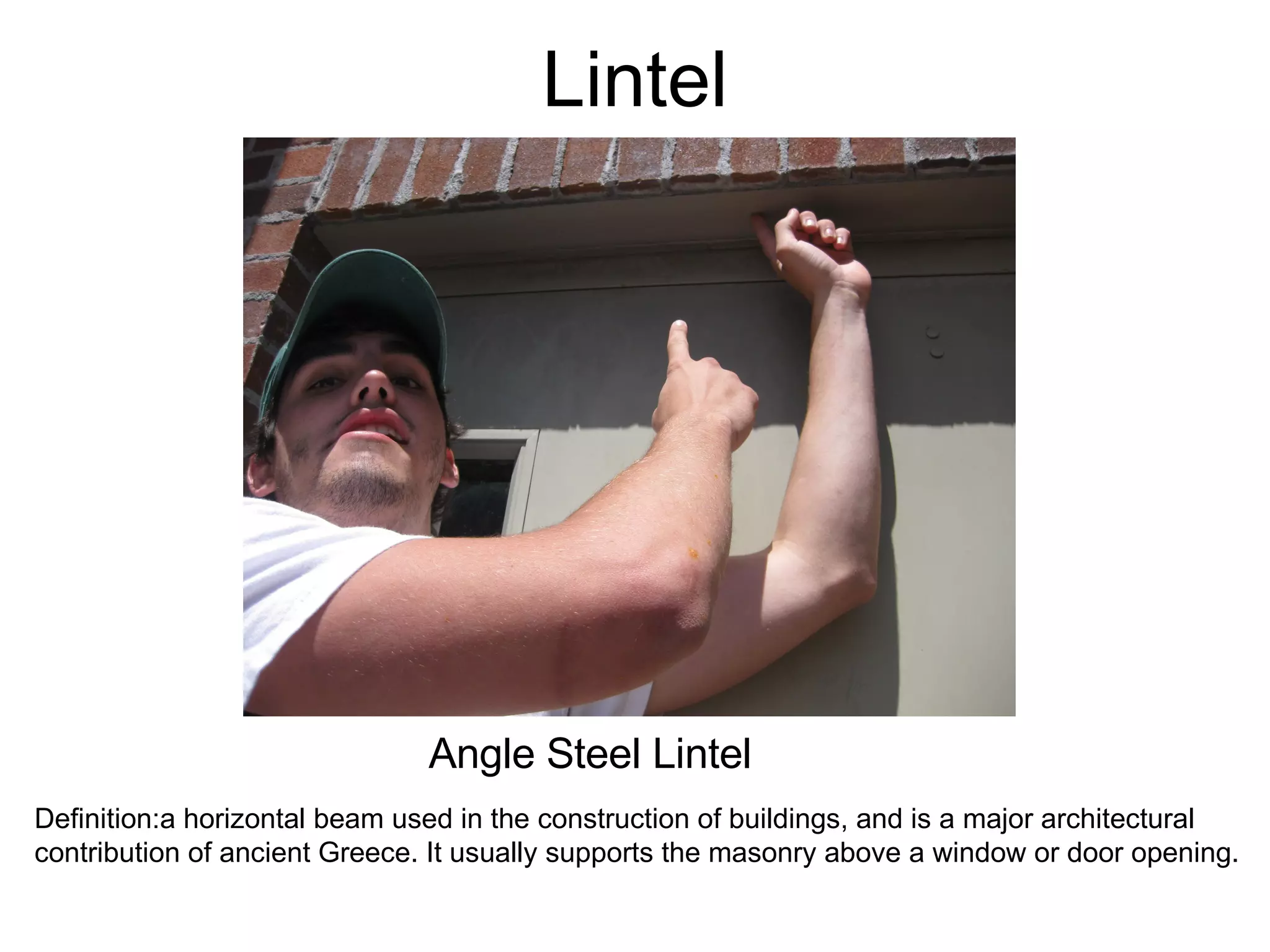
Lintel Angle Steel Lintel Definition:a horizontal beam used in the construction of buildings, and is a major architectural  contribution of ancient Greece. It usually supports the masonry above a window or door opening.
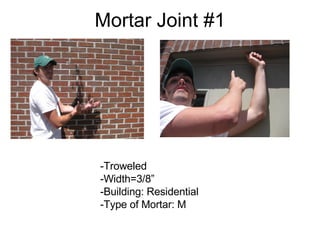
Mortar Joint #1 -Troweled -Width=3/8” -Building: Residential -Type of Mortar: M
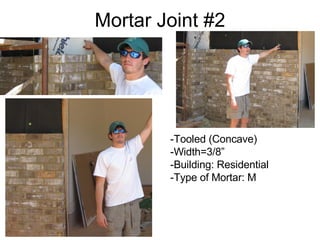
Mortar Joint #2 -Tooled (Concave) -Width=3/8” -Building: Residential -Type of Mortar: M
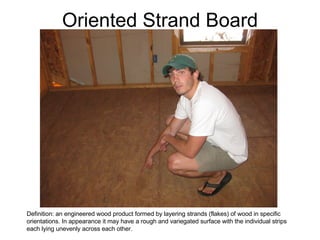
Oriented Strand Board Definition: an engineered wood product formed by layering strands (flakes) of wood in specific  orientations. In appearance it may have a rough and variegated surface with the individual strips  each lying unevenly across each other.
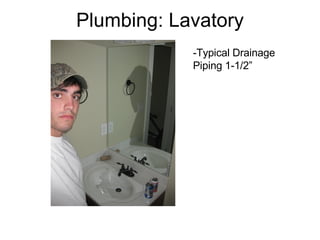
Plumbing: Lavatory -Typical Drainage  Piping 1-1/2”
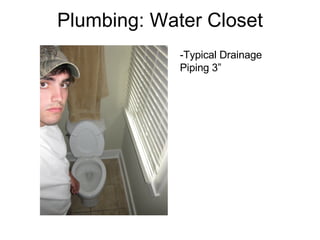
Plumbing: Water Closet -Typical Drainage  Piping 3”
Plumbing: Tub w/o Gypsum Installed
Plumbing: Vent Through Roof What it is doing: allowing air to escape from the sewage Piping so that they can freely flow out of the house VTR
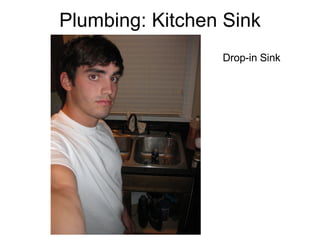
Plumbing: Kitchen Sink Drop-in Sink
Plywood -Plywood: a type of engineered board made from thin sheets of wood, called plies or wood veneers. The layers are glued together, each with its grain at right angles to adjacent layers for greater strength. There are usually an odd number of plies, as the symmetry makes the board less prone to warping [1], and the grain on the outside surfaces runs in the same direction -Veneer: 1: a thin sheet of a material: as a: a layer of wood of superior value or excellent grain to be glued to an inferior wood b: any of the thin layers bonded together to form plywood
Radiant Barrier A radiant barrier is a thin layer of aluminum film placed in a building airspace to block radiant heat transfer between a surface that will radiate heat (such as a hot roof) and a surface that will absorb heat (such as conventional attic floor insulation). The benefits of using attic, wall and floor radiant barriers include both dollar savings and increased comfort. The largest benefit of using a radiant barrier is reduced air-conditioning costs in warm climates.
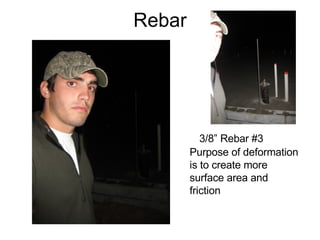
Rebar 3/8” Rebar #3 Purpose of deformation is to create more surface area and  friction
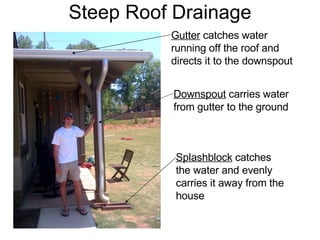
Steep Roof Drainage Gutter  catches water running off the roof and directs it to the downspout Downspout  carries water from gutter to the ground Splashblock  catches the water and evenly carries it away from the house
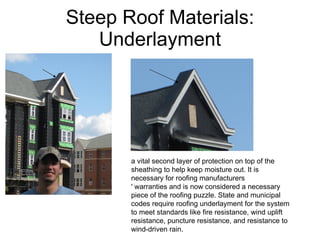
Steep Roof Materials: Underlayment a vital second layer of protection on top of the sheathing to help keep moisture out. It is necessary for roofing manufacturers ' warranties and is now considered a necessary piece of the roofing puzzle. State and municipal codes require roofing underlayment for the system to meet standards like fire resistance, wind uplift resistance, puncture resistance, and resistance to wind-driven rain.
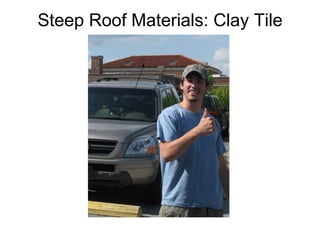
Steep Roof Materials: Clay Tile
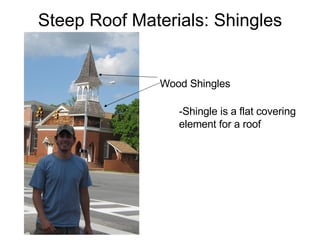
Steep Roof Materials: Shingles Wood Shingles -Shingle is a flat covering  element for a roof
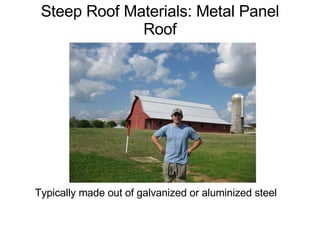
Steep Roof Materials: Metal Panel Roof Typically made out of galvanized or aluminized steel
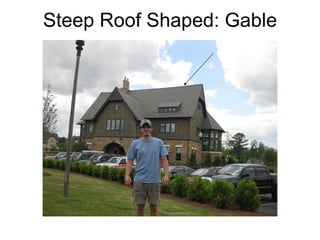
Steep Roof Shaped: Gable
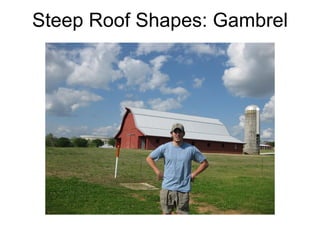
Steep Roof Shapes: Gambrel
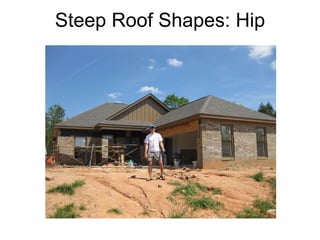
Steep Roof Shapes: Hip
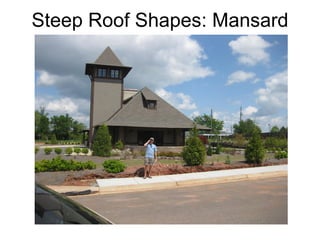
Steep Roof Shapes: Mansard
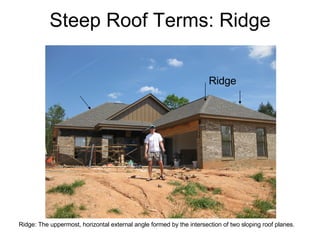
Steep Roof Terms: Ridge Ridge Ridge: The uppermost, horizontal external angle formed by the intersection of two sloping roof planes.
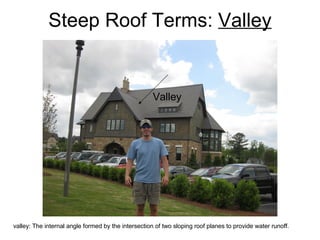
Steep Roof Terms:  Valley Valley valley: The internal angle formed by the intersection of two sloping roof planes to provide water runoff.
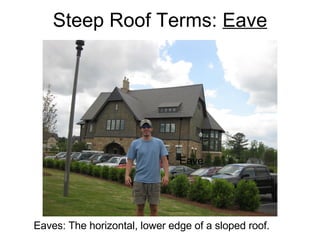
Steep Roof Terms:  Eave Eave Eaves: The horizontal, lower edge of a sloped roof.
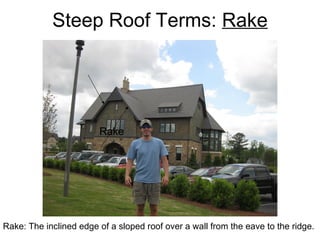
Steep Roof Terms:  Rake Rake Rake: The inclined edge of a sloped roof over a wall from the eave to the ridge.
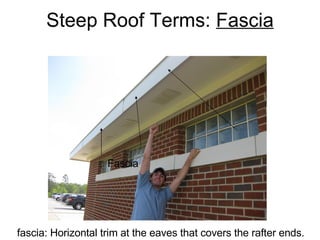
Steep Roof Terms:  Fascia Fascia fascia: Horizontal trim at the eaves that covers the rafter ends.
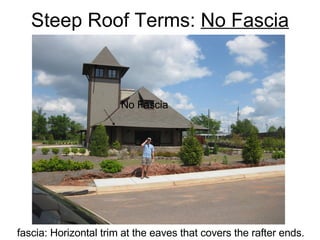
Steep Roof Terms:  No Fascia No Fascia fascia: Horizontal trim at the eaves that covers the rafter ends.
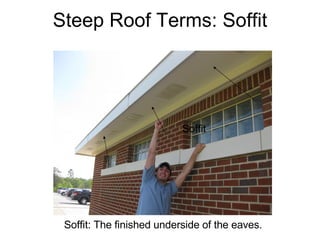
Steep Roof Terms: Soffit Soffit Soffit: The finished underside of the eaves.
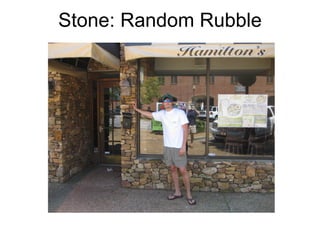
Stone: Random Rubble
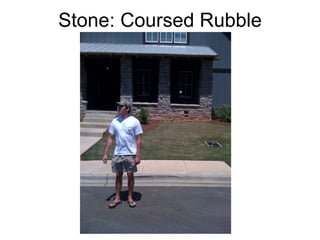
Stone: Coursed Rubble
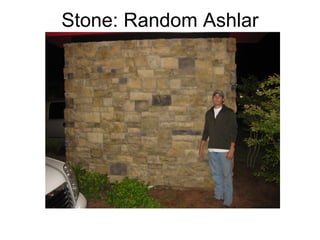
Stone: Random Ashlar
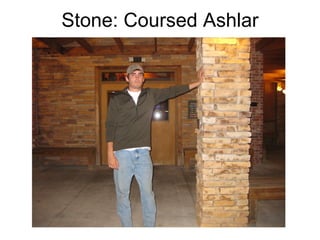
Stone: Coursed Ashlar
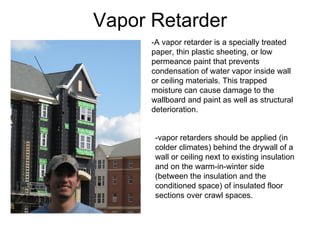
Vapor Retarder -vapor retarders should be applied (in colder climates) behind the drywall of a wall or ceiling next to existing insulation and on the warm-in-winter side (between the insulation and the conditioned space) of insulated floor sections over crawl spaces.  -A vapor retarder is a specially treated paper, thin plastic sheeting, or low permeance paint that prevents condensation of water vapor inside wall or ceiling materials. This trapped moisture can cause damage to the wallboard and paint as well as structural deterioration.
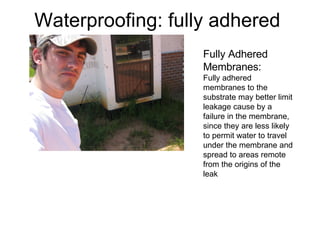
Waterproofing: fully adhered  Fully Adhered Membranes: Fully adhered membranes to the substrate may better limit leakage cause by a failure in the membrane, since they are less likely to permit water to travel under the membrane and spread to areas remote from the origins of the leak
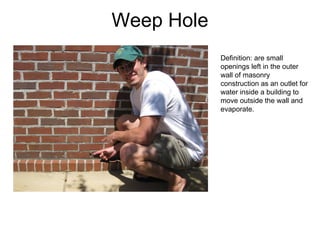
Weep Hole Definition: are small openings left in the outer wall of masonry construction as an outlet for water inside a building to move outside the wall and evaporate.
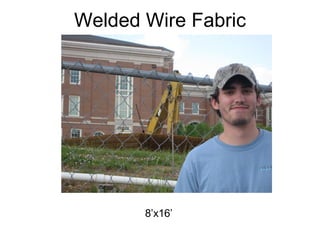
Welded Wire Fabric 8’x16’
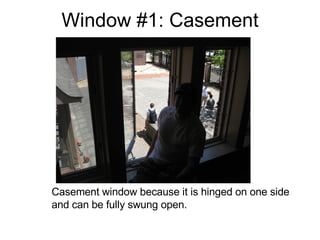
Window #1: Casement Casement window because it is hinged on one side and can be fully swung open.
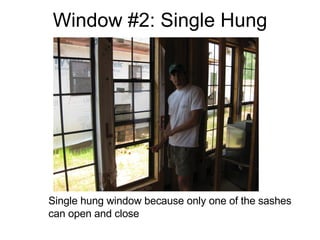
Window #2: Single Hung Single hung window because only one of the sashes can open and close
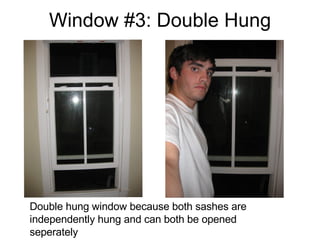
Window #3: Double Hung Double hung window because both sashes are independently hung and can both be opened seperately

Visual Dictionary 2-Bracing

  • 1.
    Lintel Angle SteelLintel Definition:a horizontal beam used in the construction of buildings, and is a major architectural contribution of ancient Greece. It usually supports the masonry above a window or door opening.
  • 2.
    Mortar Joint #1-Troweled -Width=3/8” -Building: Residential -Type of Mortar: M
  • 3.
    Mortar Joint #2-Tooled (Concave) -Width=3/8” -Building: Residential -Type of Mortar: M
  • 4.
    Oriented Strand BoardDefinition: an engineered wood product formed by layering strands (flakes) of wood in specific orientations. In appearance it may have a rough and variegated surface with the individual strips each lying unevenly across each other.
  • 5.
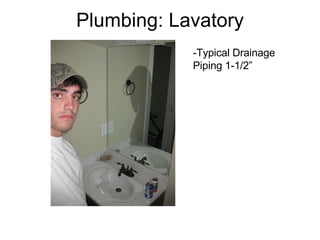
    Plumbing: Lavatory -TypicalDrainage Piping 1-1/2”
  • 6.
    Plumbing: Lavatory -TypicalDrainage Piping 1-1/2”
  • 7.
    Plumbing: Water Closet-Typical Drainage Piping 3”
  • 8.
    Plumbing: Tub w/oGypsum Installed
  • 9.
    Plumbing: Vent ThroughRoof What it is doing: allowing air to escape from the sewage Piping so that they can freely flow out of the house VTR
  • 10.
  • 11.
    Plywood -Plywood: atype of engineered board made from thin sheets of wood, called plies or wood veneers. The layers are glued together, each with its grain at right angles to adjacent layers for greater strength. There are usually an odd number of plies, as the symmetry makes the board less prone to warping [1], and the grain on the outside surfaces runs in the same direction -Veneer: 1: a thin sheet of a material: as a: a layer of wood of superior value or excellent grain to be glued to an inferior wood b: any of the thin layers bonded together to form plywood
  • 12.
    Radiant Barrier Aradiant barrier is a thin layer of aluminum film placed in a building airspace to block radiant heat transfer between a surface that will radiate heat (such as a hot roof) and a surface that will absorb heat (such as conventional attic floor insulation). The benefits of using attic, wall and floor radiant barriers include both dollar savings and increased comfort. The largest benefit of using a radiant barrier is reduced air-conditioning costs in warm climates.
  • 13.
    Rebar 3/8” Rebar#3 Purpose of deformation is to create more surface area and friction
  • 14.
    Steep Roof DrainageGutter catches water running off the roof and directs it to the downspout Downspout carries water from gutter to the ground Splashblock catches the water and evenly carries it away from the house
  • 15.
    Steep Roof Materials:Underlayment a vital second layer of protection on top of the sheathing to help keep moisture out. It is necessary for roofing manufacturers ' warranties and is now considered a necessary piece of the roofing puzzle. State and municipal codes require roofing underlayment for the system to meet standards like fire resistance, wind uplift resistance, puncture resistance, and resistance to wind-driven rain.
  • 16.
  • 17.
    Steep Roof Materials:Shingles Wood Shingles -Shingle is a flat covering element for a roof
  • 18.
    Steep Roof Materials:Metal Panel Roof Typically made out of galvanized or aluminized steel
  • 19.
  • 20.
  • 21.
  • 22.
  • 23.
    Steep Roof Terms:Ridge Ridge Ridge: The uppermost, horizontal external angle formed by the intersection of two sloping roof planes.
  • 24.
    Steep Roof Terms: Valley Valley valley: The internal angle formed by the intersection of two sloping roof planes to provide water runoff.
  • 25.
    Steep Roof Terms: Eave Eave Eaves: The horizontal, lower edge of a sloped roof.
  • 26.
    Steep Roof Terms: Rake Rake Rake: The inclined edge of a sloped roof over a wall from the eave to the ridge.
  • 27.
    Steep Roof Terms: Fascia Fascia fascia: Horizontal trim at the eaves that covers the rafter ends.
  • 28.
    Steep Roof Terms: No Fascia No Fascia fascia: Horizontal trim at the eaves that covers the rafter ends.
  • 29.
    Steep Roof Terms:Soffit Soffit Soffit: The finished underside of the eaves.
  • 30.
  • 31.
  • 32.
  • 33.
  • 34.
    Vapor Retarder -vaporretarders should be applied (in colder climates) behind the drywall of a wall or ceiling next to existing insulation and on the warm-in-winter side (between the insulation and the conditioned space) of insulated floor sections over crawl spaces. -A vapor retarder is a specially treated paper, thin plastic sheeting, or low permeance paint that prevents condensation of water vapor inside wall or ceiling materials. This trapped moisture can cause damage to the wallboard and paint as well as structural deterioration.
  • 35.
    Waterproofing: fully adhered Fully Adhered Membranes: Fully adhered membranes to the substrate may better limit leakage cause by a failure in the membrane, since they are less likely to permit water to travel under the membrane and spread to areas remote from the origins of the leak
  • 36.
    Weep Hole Definition:are small openings left in the outer wall of masonry construction as an outlet for water inside a building to move outside the wall and evaporate.
  • 37.
  • 38.
    Window #1: CasementCasement window because it is hinged on one side and can be fully swung open.
  • 39.
    Window #2: SingleHung Single hung window because only one of the sashes can open and close
  • 40.
    Window #3: DoubleHung Double hung window because both sashes are independently hung and can both be opened seperately