Image Segmentation
Vrushali Kanavade 122M0002
• What do you see first when you look at your selfie? Your
face, right?
• You can spot your face because your brain is capable of
identifying your face and separate it from the rest of the
image (the background).
• Now, if you wanted your computer to recognize your face
in a selfie, would it be able to do that?
• Yes, provided it can perform image segmentation.
• Image segmentation is a method of dividing a digital image into
subgroups called image segments, reducing the complexity of the
image and enabling further processing or analysis of each image
segment.
• Technically, segmentation is the assignment of labels to pixels to
identify objects, people, or other important elements in the image.
• Image segmentation is the first step for image analysis.
• It is a fundamental task in computer vision, enabling many
downstream applications.
• Image segmentation techniques allow us to divide and group pixels
into meaningful regions, assign labels to them, and classify further
pixels according to these labels.
• We can use image segmentation to draw lines, specify borders, and
separate particular objects from the rest in an image.
• The labels generated from image segmentation can be used for
supervised and unsupervised machine learning training, which can
help us solve many business problems.
Use
• Medical image analysis: segmenting tumors, organs, and other
tissues to aid in diagnosis and treatment planning
• Autonomous driving: segmenting roads, vehicles, pedestrians,
and other objects to enable safe navigation
• Robotics: segmenting objects of interest to enable manipulation
and interaction
• Satellite imagery analysis: segmenting buildings, roads, and
other features to monitor land use and environmental changes
• Retail analytics: segmenting products and customers to improve
inventory management and marketing campaigns
What are the Different Kinds of Segmentations?
• Instance Segmentation
• Semantic Segmentation
• Panoptic Segmentation
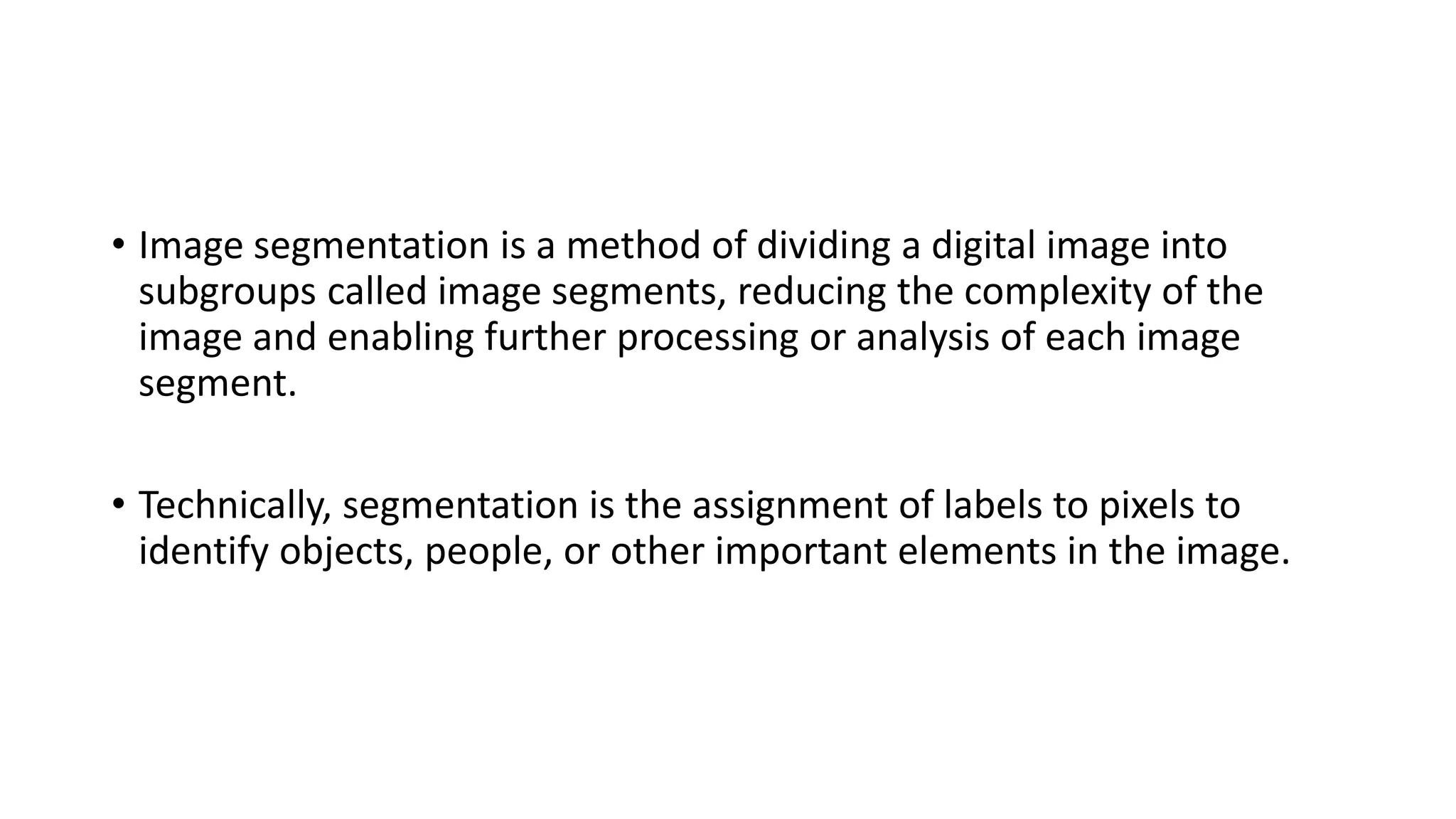
Instance segmentation is a type of image segmentation that
involves detecting and segmenting each object in an image.
It is similar to object detection but with the added task of
segmenting the object’s boundaries. The algorithm has no
idea of the class of the region, but it separates overlapping
objects. Instance segmentation is useful in applications
where individual objects need to be identified and tracked.
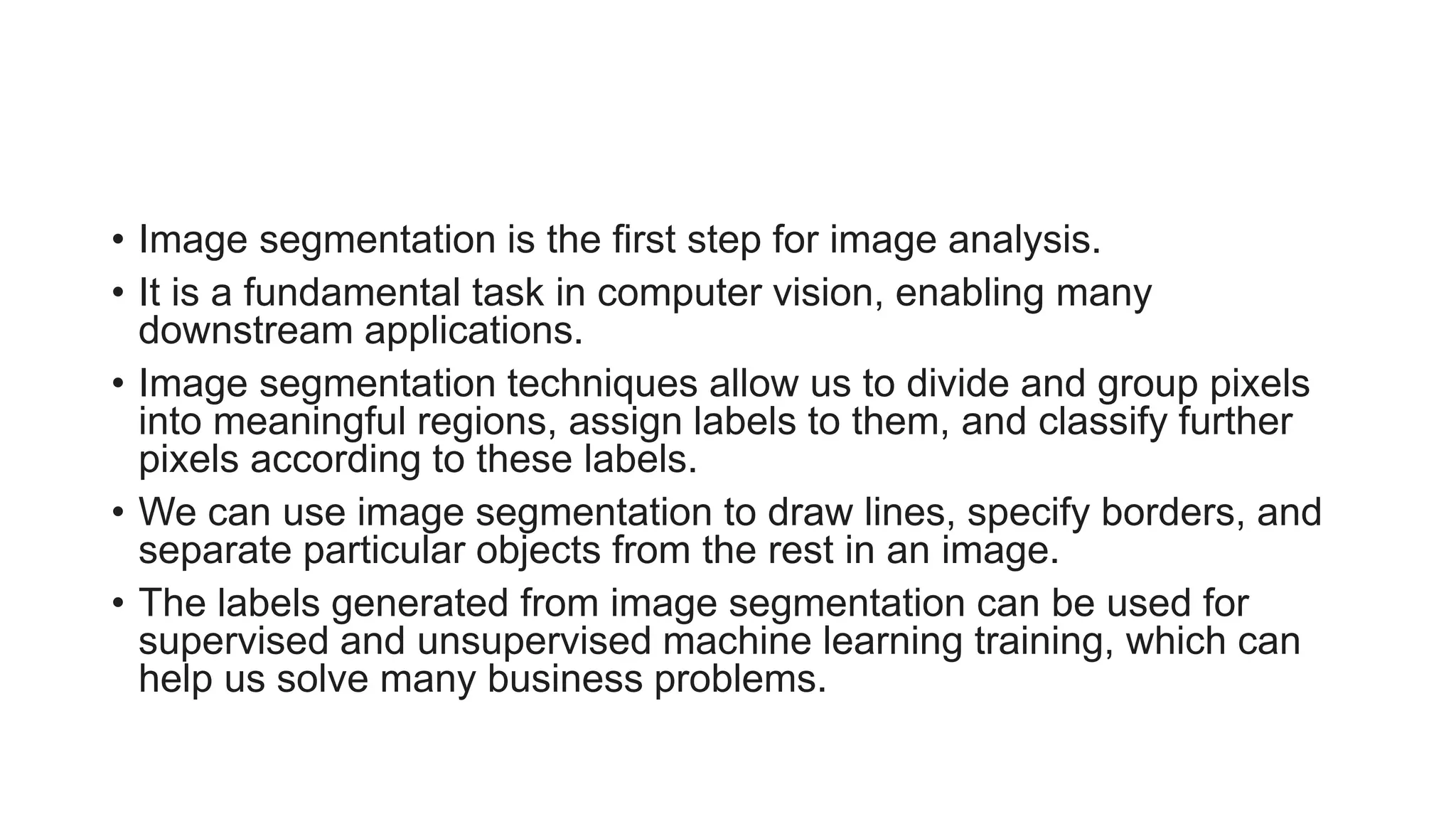
Semantic segmentation is a type of image segmentation
that involves labeling each pixel in an image with a
corresponding class label with no other information or
context taken into consideration.
Semantic segmentation - the human and the dog are
classified together as mammals and separated from the
rest of the background.
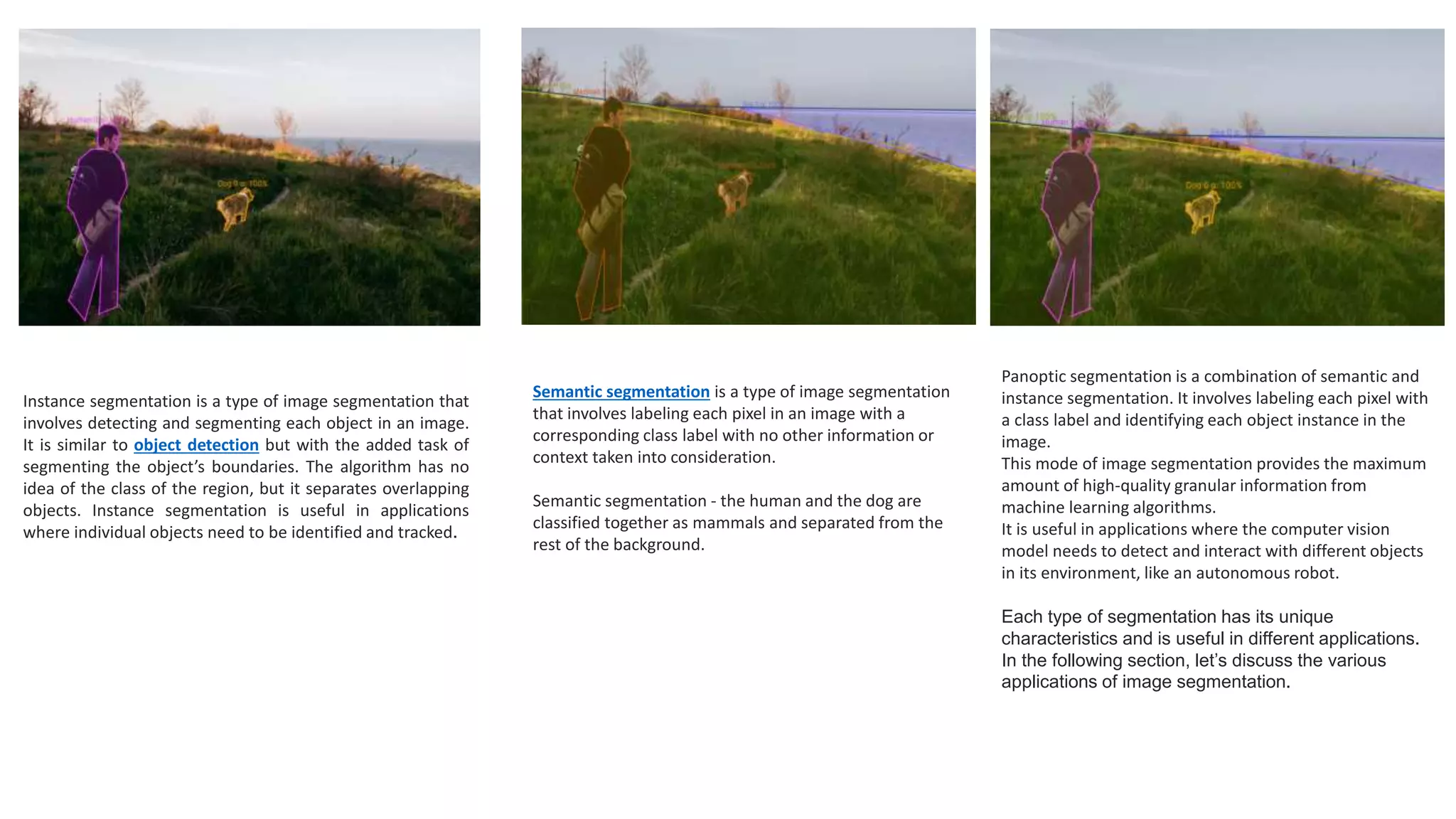
Panoptic segmentation is a combination of semantic and
instance segmentation. It involves labeling each pixel with
a class label and identifying each object instance in the
image.
This mode of image segmentation provides the maximum
amount of high-quality granular information from
machine learning algorithms.
It is useful in applications where the computer vision
model needs to detect and interact with different objects
in its environment, like an autonomous robot.
Each type of segmentation has its unique
characteristics and is useful in different applications.
In the following section, let’s discuss the various
applications of image segmentation.
Image Segmentation Techniques
• Traditional Techniques
• Region-based Segmentation
• Edge-based Segmentation
• Clustering
• Deep Learning Techniques
• U-Net
• SegNet
• DeepLab
Traditional Techniques
•Traditional image segmentation techniques are based on mathematical
models and algorithms that identify regions of an image with common
characteristics, such as color, texture, or brightness.
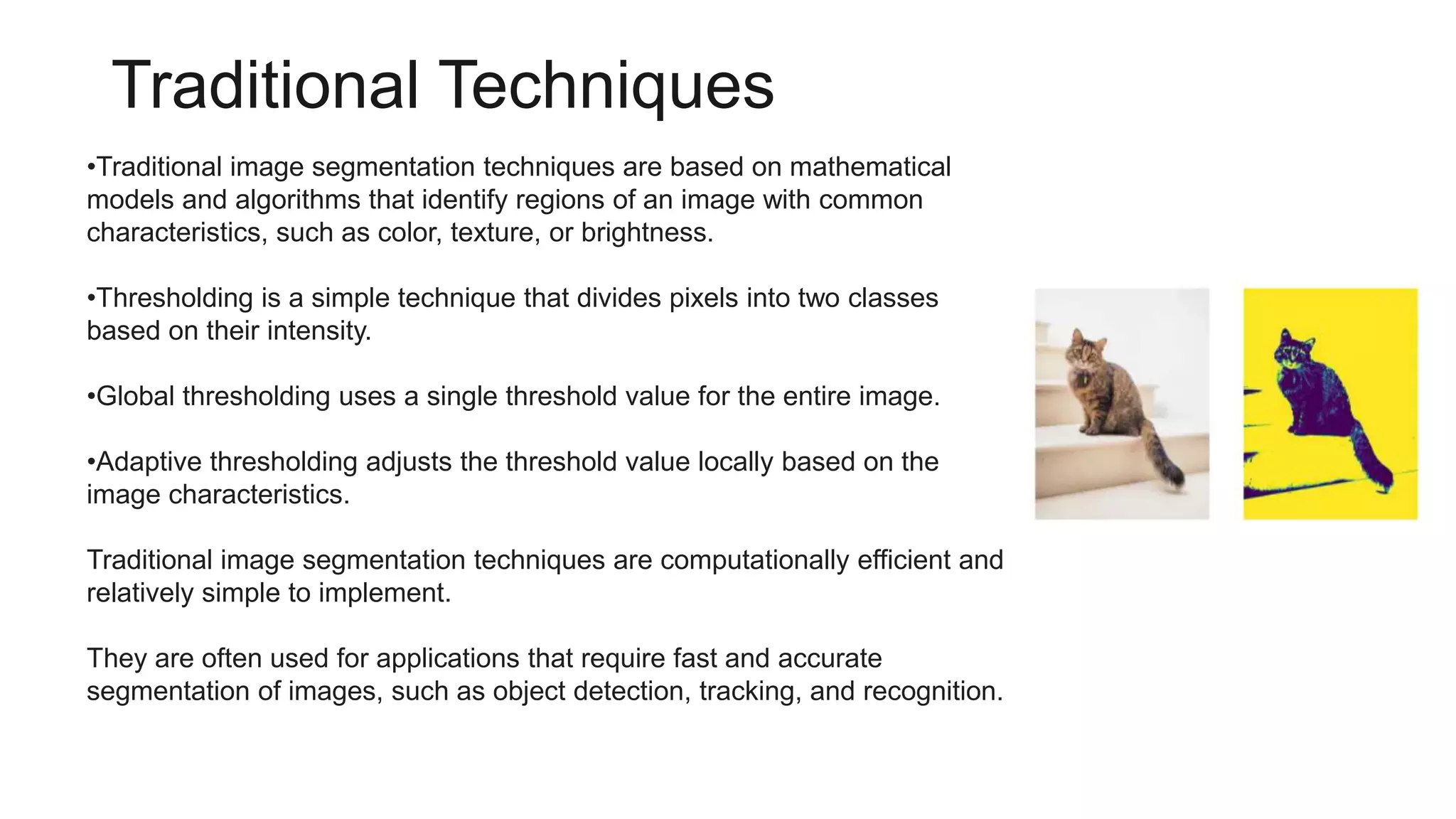
•Thresholding is a simple technique that divides pixels into two classes
based on their intensity.
•Global thresholding uses a single threshold value for the entire image.
•Adaptive thresholding adjusts the threshold value locally based on the
image characteristics.
Traditional image segmentation techniques are computationally efficient and
relatively simple to implement.
They are often used for applications that require fast and accurate
segmentation of images, such as object detection, tracking, and recognition.
• Advantages:
• Fast and computationally efficient
• Relatively simple to implement
• Suitable for a wide range of applications
• Disadvantages:
• May not be as accurate as machine learning-based techniques
• Sensitive to noise and other artifacts in the image
• Require careful parameter tuning for optimal performance
Region-based Segmentation
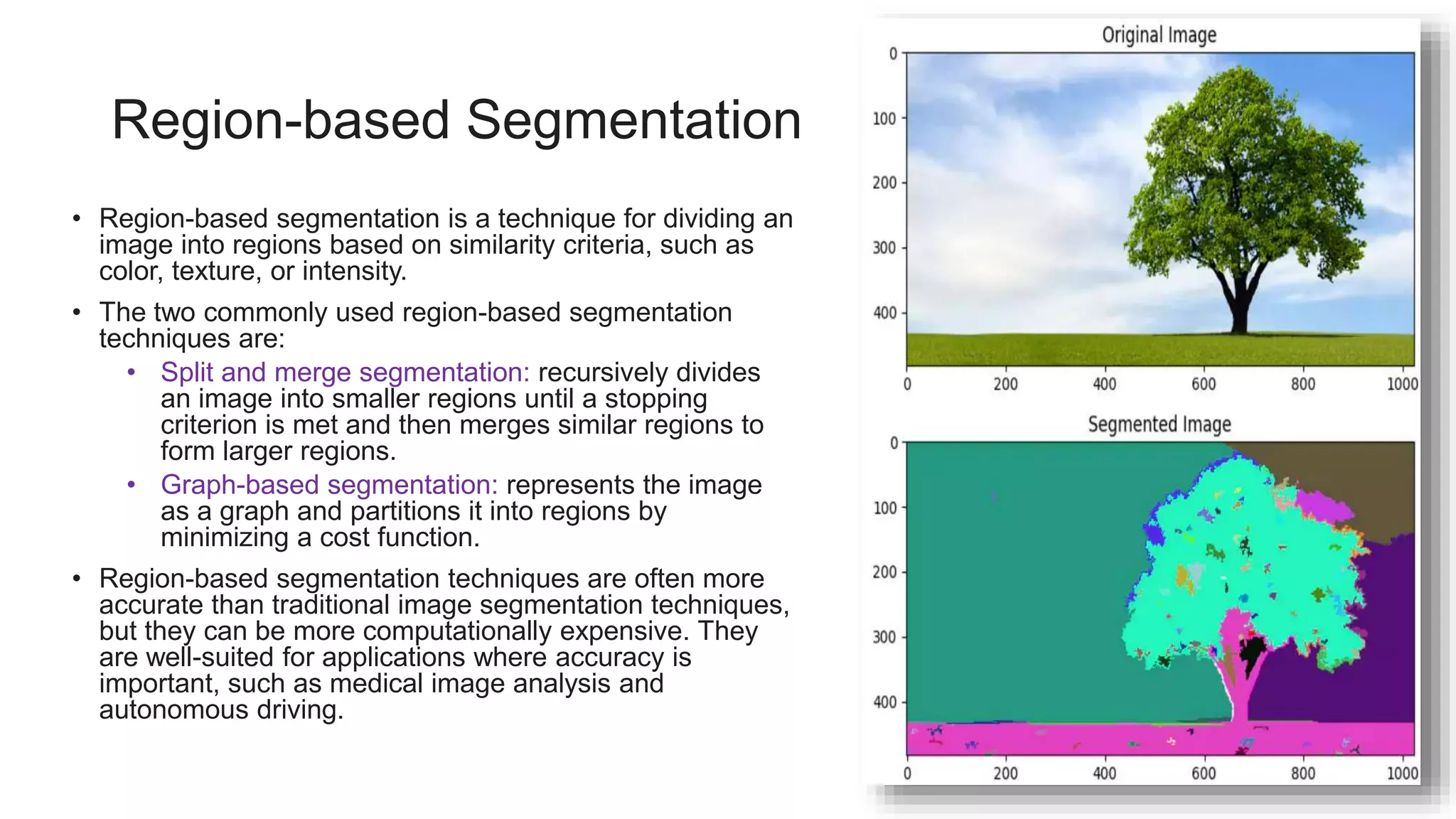
• Region-based segmentation is a technique for dividing an
image into regions based on similarity criteria, such as
color, texture, or intensity.
• The two commonly used region-based segmentation
techniques are:
• Split and merge segmentation: recursively divides
an image into smaller regions until a stopping
criterion is met and then merges similar regions to
form larger regions.
• Graph-based segmentation: represents the image
as a graph and partitions it into regions by
minimizing a cost function.
• Region-based segmentation techniques are often more
accurate than traditional image segmentation techniques,
but they can be more computationally expensive. They
are well-suited for applications where accuracy is
important, such as medical image analysis and
autonomous driving.
• Advantages:
• More accurate than traditional image segmentation techniques
• Can segment complex images with overlapping or irregular regions
• Disadvantages:
• Can be more computationally expensive
• Require careful parameter tuning for optimal performance
• Overall, region-based segmentation techniques are a good choice for
applications where accuracy is important and computational
resources are available
THANK YOU

vision_image_segmentation.pptx

  • 1.
  • 2.
    • What doyou see first when you look at your selfie? Your face, right? • You can spot your face because your brain is capable of identifying your face and separate it from the rest of the image (the background). • Now, if you wanted your computer to recognize your face in a selfie, would it be able to do that? • Yes, provided it can perform image segmentation.
  • 3.
    • Image segmentationis a method of dividing a digital image into subgroups called image segments, reducing the complexity of the image and enabling further processing or analysis of each image segment. • Technically, segmentation is the assignment of labels to pixels to identify objects, people, or other important elements in the image.
  • 4.
    • Image segmentationis the first step for image analysis. • It is a fundamental task in computer vision, enabling many downstream applications. • Image segmentation techniques allow us to divide and group pixels into meaningful regions, assign labels to them, and classify further pixels according to these labels. • We can use image segmentation to draw lines, specify borders, and separate particular objects from the rest in an image. • The labels generated from image segmentation can be used for supervised and unsupervised machine learning training, which can help us solve many business problems.
  • 5.
    Use • Medical imageanalysis: segmenting tumors, organs, and other tissues to aid in diagnosis and treatment planning • Autonomous driving: segmenting roads, vehicles, pedestrians, and other objects to enable safe navigation • Robotics: segmenting objects of interest to enable manipulation and interaction • Satellite imagery analysis: segmenting buildings, roads, and other features to monitor land use and environmental changes • Retail analytics: segmenting products and customers to improve inventory management and marketing campaigns
  • 7.
    What are theDifferent Kinds of Segmentations? • Instance Segmentation • Semantic Segmentation • Panoptic Segmentation
  • 8.
    Instance segmentation isa type of image segmentation that involves detecting and segmenting each object in an image. It is similar to object detection but with the added task of segmenting the object’s boundaries. The algorithm has no idea of the class of the region, but it separates overlapping objects. Instance segmentation is useful in applications where individual objects need to be identified and tracked. Semantic segmentation is a type of image segmentation that involves labeling each pixel in an image with a corresponding class label with no other information or context taken into consideration. Semantic segmentation - the human and the dog are classified together as mammals and separated from the rest of the background. Panoptic segmentation is a combination of semantic and instance segmentation. It involves labeling each pixel with a class label and identifying each object instance in the image. This mode of image segmentation provides the maximum amount of high-quality granular information from machine learning algorithms. It is useful in applications where the computer vision model needs to detect and interact with different objects in its environment, like an autonomous robot. Each type of segmentation has its unique characteristics and is useful in different applications. In the following section, let’s discuss the various applications of image segmentation.
  • 9.
    Image Segmentation Techniques •Traditional Techniques • Region-based Segmentation • Edge-based Segmentation • Clustering • Deep Learning Techniques • U-Net • SegNet • DeepLab
  • 10.
    Traditional Techniques •Traditional imagesegmentation techniques are based on mathematical models and algorithms that identify regions of an image with common characteristics, such as color, texture, or brightness. •Thresholding is a simple technique that divides pixels into two classes based on their intensity. •Global thresholding uses a single threshold value for the entire image. •Adaptive thresholding adjusts the threshold value locally based on the image characteristics. Traditional image segmentation techniques are computationally efficient and relatively simple to implement. They are often used for applications that require fast and accurate segmentation of images, such as object detection, tracking, and recognition.
  • 11.
    • Advantages: • Fastand computationally efficient • Relatively simple to implement • Suitable for a wide range of applications • Disadvantages: • May not be as accurate as machine learning-based techniques • Sensitive to noise and other artifacts in the image • Require careful parameter tuning for optimal performance
  • 12.
    Region-based Segmentation • Region-basedsegmentation is a technique for dividing an image into regions based on similarity criteria, such as color, texture, or intensity. • The two commonly used region-based segmentation techniques are: • Split and merge segmentation: recursively divides an image into smaller regions until a stopping criterion is met and then merges similar regions to form larger regions. • Graph-based segmentation: represents the image as a graph and partitions it into regions by minimizing a cost function. • Region-based segmentation techniques are often more accurate than traditional image segmentation techniques, but they can be more computationally expensive. They are well-suited for applications where accuracy is important, such as medical image analysis and autonomous driving.
  • 13.
    • Advantages: • Moreaccurate than traditional image segmentation techniques • Can segment complex images with overlapping or irregular regions • Disadvantages: • Can be more computationally expensive • Require careful parameter tuning for optimal performance • Overall, region-based segmentation techniques are a good choice for applications where accuracy is important and computational resources are available
  • 14.