THE
DIGESTIVE
SYSTEM
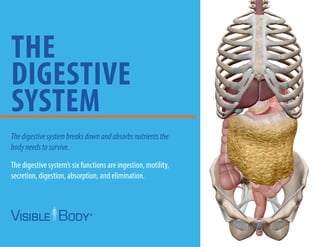
Thedigestivesystembreaksdownandabsorbsnutrientsthe
bodyneedstosurvive.
The digestive system’s six functions are ingestion, motility,
secretion, digestion, absorption, and elimination.
2
ALIMENTARY,
MY DEAR
WATSON
To survive and perform its functions,
the body needs specific macromolecules
(proteins, carbohydrates, and lipids) as
well as water, vitamins, and minerals.
The digestive system breaks the
macromolecules down into smaller
molecules the body can use
Carbohydrates break down from
polysaccharides and disaccharides into
monosaccharides (like glucose), lipids
break down from triglycerides into
fatty acids and glycerol molecules, and
proteins break down into amino acids.
3
SET MUSCLES
TO AUTOMATIC
The muscular system plays a key role
in digestion. Peristalsis is the name for
the involuntary muscle movements
that keep food moving through your
intestines.
Ring-like muscles called sphincters
serve as“gates”between different parts
of the digestive system.
Factoid!
Muscle movements in the digestive
system are controlled by the enteric
nervous system (ENS), a part of the
autonomic nervous system (ANS).
Anal Canal p
Rectum
Anal Sphincter
(Internal)
Anal Sphincter
(External)
PosteriorView
4
THE BIG
PICTURE:
THE GI TRACT
The gastrointestinal tract (GITract),
also referred to as the digestive tract
or alimentary canal, includes the oral
cavity, pharynx, esophagus, stomach,
small intestine, large intestine, and
anus.
The accessory digestive organs (salivary
glands, liver, gallbladder, and pancreas)
work in conjunction with the GI tract.
The teeth and tongue allow us to
mechanically break down and swallow
our food.
Teeth
Salivary
Glands
Tongue
Liver
Gallbladder
Small
Intestine
Anus
Large
Intestine
Pancreas
Esophagus
Pharynx
Oral Cavity
5
THE ORAL
CAVITY
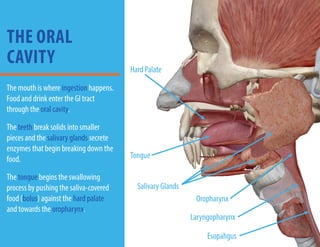
The mouth is where ingestion happens.
Food and drink enter the GI tract
through the oral cavity.
The teeth break solids into smaller
pieces and the salivary glands secrete
enzymes that begin breaking down the
food.
The tongue begins the swallowing
process by pushing the saliva-covered
food (bolus) against the hard palate
and towards the oropharynx.
Hard Palate
Salivary Glands
Tongue
Oropharynx
Laryngopharynx
Esopahgus
6
In the pharyngeal phase of swallowing
(involuntary), the oropharynx, the
soft palate, and uvula close off the
nasopharynx, starting the swallowing
reflex.
In the esophageal phase (involuntary),
muscle contractions in the esophagus
take the bolus to the stomach.This
takes five to eight seconds.
Factoid!
The transition from the pharynx to the
esophagus takes only one second.
PHARYNX &
ESOPHAGUS
Nasopharynx
Soft Palate
(Roof of
mouth)
Uvula
Esophagus
Oral
Cavity
Tongue
Laryngopharynx
PosteriorView
7
THE STOMACH
The stomach is where the bolus is
mixed with gastric juice to form chyme.
The stomach’s interior is extremely
acidic. It also contains an enzyme
called pepsin, which helps with the
breakdown (digestion) of proteins.
Ingested nutrients typically spend two
to six hours in the stomach.
Factoid!
Acid reflux (aka gastroesophageal reflux
or heartburn) occurs when acid from
the stomach escapes back up into the
esophagus.
Esophagus
Lower
Esophageal
Sphincter
Muscle
Layers
Serosa
Mucosa
Pyloric
Sphincter
Duodenum
8
The main digestive function of the
liver is to produce bile, which aids in
the mechanical digestion of lipids
in the small intestine, allowing for
more efficient chemical digestion of
triglycerides.
The gallbladder stores, concentrates,
and releases bile that the liver produces.
Factoid!
You can live without a gallbladder!
Cholecystectomy (gallbladder removal)
is a common surgical procedure for
patients with painful gallstones.
THE LIVER &
GALLBLADDER
Gallbladder
Common
Bile Duct
Liver
9
THE PANCREAS
The pancreas has exocrine and
endocrine cells.
The endocrine cells produce and secrete
hormones such as insulin, which helps
regulate blood glucose levels, and
glucagon, which helps the liver convert
glycogen to glucose.
The exocrine cells produce digestive
enzymes in a pancreatic juice to assist
with digestive activities for proteins,
carbohydrates, and fats.
Pancreatic Duct
PosteriorView
10
THE SMALL
INTESTINE
Chyme moves from the stomach into
the small intestine, where it spends
about 12 hours.The small intestine
has three sections: the duodenum, the
jejunum, and the ileum.
In the small intestine, secretions
from the accessory glands further
the breakdown of macromolecules.
The products of this breakdown
are absorbed along with vitamins,
minerals, and water. Blood vessels in
the walls of the small intestine carry
absorbed nutrients to the liver via the
hepatic portal vein.
Duodenum
Jejunum
Ileum
Hepatic PortalVein
(+Branches)
PosteriorView
11
THE LARGE
INTESTINE &
ANUS
The small intestine empties into the
large intestine (colon), where the
remainder of absorption of water,
electrolytes, and vitamins occurs.
The remaining undigested food is
converted into a solid called feces,
which moves through the large
intestine and the rectum and is
ultimately eliminated (leaves the body)
through the anus.
“Food”spends about 6 hours in the
colon.
Cecum
Transverse Colon
Ascending Colon
Descending
Colon
Sigmoid Colon
Anal
Sphincters
Rectum
Anal Canal
PosteriorView
12
APPENDIX:
THE APPENDIX
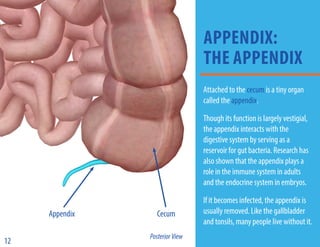
Attached to the cecum is a tiny organ
called the appendix.
Though its function is largely vestigial,
the appendix interacts with the
digestive system by serving as a
reservoir for gut bacteria. Research has
also shown that the appendix plays a
role in the immune system in adults
and the endocrine system in embryos.
If it becomes infected, the appendix is
usually removed. Like the gallbladder
and tonsils, many people live without it.
Appendix Cecum
PosteriorView
https://apps.visiblebody.com/share/?p=vbhaa&t=4_38377_637592894239025180_88814

VisibleBody_Digestive_System.pdf

  • 1.
    THE DIGESTIVE SYSTEM Thedigestivesystembreaksdownandabsorbsnutrientsthe bodyneedstosurvive. The digestive system’ssix functions are ingestion, motility, secretion, digestion, absorption, and elimination.
  • 2.
    2 ALIMENTARY, MY DEAR WATSON To surviveand perform its functions, the body needs specific macromolecules (proteins, carbohydrates, and lipids) as well as water, vitamins, and minerals. The digestive system breaks the macromolecules down into smaller molecules the body can use Carbohydrates break down from polysaccharides and disaccharides into monosaccharides (like glucose), lipids break down from triglycerides into fatty acids and glycerol molecules, and proteins break down into amino acids.
  • 3.
    3 SET MUSCLES TO AUTOMATIC Themuscular system plays a key role in digestion. Peristalsis is the name for the involuntary muscle movements that keep food moving through your intestines. Ring-like muscles called sphincters serve as“gates”between different parts of the digestive system. Factoid! Muscle movements in the digestive system are controlled by the enteric nervous system (ENS), a part of the autonomic nervous system (ANS). Anal Canal p Rectum Anal Sphincter (Internal) Anal Sphincter (External) PosteriorView
  • 4.
    4 THE BIG PICTURE: THE GITRACT The gastrointestinal tract (GITract), also referred to as the digestive tract or alimentary canal, includes the oral cavity, pharynx, esophagus, stomach, small intestine, large intestine, and anus. The accessory digestive organs (salivary glands, liver, gallbladder, and pancreas) work in conjunction with the GI tract. The teeth and tongue allow us to mechanically break down and swallow our food. Teeth Salivary Glands Tongue Liver Gallbladder Small Intestine Anus Large Intestine Pancreas Esophagus Pharynx Oral Cavity
  • 5.
    5 THE ORAL CAVITY The mouthis where ingestion happens. Food and drink enter the GI tract through the oral cavity. The teeth break solids into smaller pieces and the salivary glands secrete enzymes that begin breaking down the food. The tongue begins the swallowing process by pushing the saliva-covered food (bolus) against the hard palate and towards the oropharynx. Hard Palate Salivary Glands Tongue Oropharynx Laryngopharynx Esopahgus
  • 6.
    6 In the pharyngealphase of swallowing (involuntary), the oropharynx, the soft palate, and uvula close off the nasopharynx, starting the swallowing reflex. In the esophageal phase (involuntary), muscle contractions in the esophagus take the bolus to the stomach.This takes five to eight seconds. Factoid! The transition from the pharynx to the esophagus takes only one second. PHARYNX & ESOPHAGUS Nasopharynx Soft Palate (Roof of mouth) Uvula Esophagus Oral Cavity Tongue Laryngopharynx PosteriorView
  • 7.
    7 THE STOMACH The stomachis where the bolus is mixed with gastric juice to form chyme. The stomach’s interior is extremely acidic. It also contains an enzyme called pepsin, which helps with the breakdown (digestion) of proteins. Ingested nutrients typically spend two to six hours in the stomach. Factoid! Acid reflux (aka gastroesophageal reflux or heartburn) occurs when acid from the stomach escapes back up into the esophagus. Esophagus Lower Esophageal Sphincter Muscle Layers Serosa Mucosa Pyloric Sphincter Duodenum
  • 8.
    8 The main digestivefunction of the liver is to produce bile, which aids in the mechanical digestion of lipids in the small intestine, allowing for more efficient chemical digestion of triglycerides. The gallbladder stores, concentrates, and releases bile that the liver produces. Factoid! You can live without a gallbladder! Cholecystectomy (gallbladder removal) is a common surgical procedure for patients with painful gallstones. THE LIVER & GALLBLADDER Gallbladder Common Bile Duct Liver
  • 9.
    9 THE PANCREAS The pancreashas exocrine and endocrine cells. The endocrine cells produce and secrete hormones such as insulin, which helps regulate blood glucose levels, and glucagon, which helps the liver convert glycogen to glucose. The exocrine cells produce digestive enzymes in a pancreatic juice to assist with digestive activities for proteins, carbohydrates, and fats. Pancreatic Duct PosteriorView
  • 10.
    10 THE SMALL INTESTINE Chyme movesfrom the stomach into the small intestine, where it spends about 12 hours.The small intestine has three sections: the duodenum, the jejunum, and the ileum. In the small intestine, secretions from the accessory glands further the breakdown of macromolecules. The products of this breakdown are absorbed along with vitamins, minerals, and water. Blood vessels in the walls of the small intestine carry absorbed nutrients to the liver via the hepatic portal vein. Duodenum Jejunum Ileum Hepatic PortalVein (+Branches) PosteriorView
  • 11.
    11 THE LARGE INTESTINE & ANUS Thesmall intestine empties into the large intestine (colon), where the remainder of absorption of water, electrolytes, and vitamins occurs. The remaining undigested food is converted into a solid called feces, which moves through the large intestine and the rectum and is ultimately eliminated (leaves the body) through the anus. “Food”spends about 6 hours in the colon. Cecum Transverse Colon Ascending Colon Descending Colon Sigmoid Colon Anal Sphincters Rectum Anal Canal PosteriorView
  • 12.
    12 APPENDIX: THE APPENDIX Attached tothe cecum is a tiny organ called the appendix. Though its function is largely vestigial, the appendix interacts with the digestive system by serving as a reservoir for gut bacteria. Research has also shown that the appendix plays a role in the immune system in adults and the endocrine system in embryos. If it becomes infected, the appendix is usually removed. Like the gallbladder and tonsils, many people live without it. Appendix Cecum PosteriorView
  • 13.