Virus Types andAntivirus
Detection
Understanding various types of viruses and how antivirus software identifies
threats.
2.
Introduction
This presentation aimsto provide a comprehensive overview
of computer viruses, their classifications, and the methods
employed by antivirus software to detect and neutralize
them. By understanding these concepts, we can enhance our
cybersecurity measures and protect our systems effectively.
Definition of Virus
Acomputer virus is a malicious software program that
attaches itself to clean files and spreads throughout a
computer system, causing damage and disruption. It can
replicate itself and may perform harmful activities without
the user’s knowledge.
5.
Common Characteristics
Viruses oftenshare specific traits, including the ability to self-
replicate, spread across systems, and execute malicious tasks. They
can be triggered by actions such as opening infected files or
downloading compromised software.
6.
Importance of UnderstandingViruses
Recognizing different types of viruses and their functionalities is
crucial for individuals and organizations in order to implement
effective security strategies and safeguard sensitive data against
potential threats.
File Infector Viruses
Fileinfector viruses attach themselves to executable files, spreading
through file sharing and network drives. Once the infected file is
executed, the virus activates, potentially damaging files and
operating systems.
9.
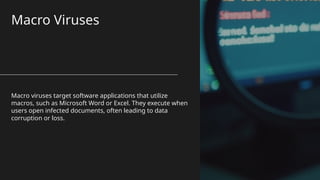
Macro Viruses
Macro virusestarget software applications that utilize
macros, such as Microsoft Word or Excel. They execute when
users open infected documents, often leading to data
corruption or loss.
10.
Polymorphic Viruses
Polymorphic viruseschange their code or signature each time they
infect a new host, making them difficult to detect. They can evade
antivirus software by altering their appearance while retaining the
same malicious functionality.
11.
File Infector Viruses
Fileinfector viruses are a prevalent type of malware that attach
themselves to executable files. They spread through file sharing,
downloads, and removable media. When an infected file is executed,
the virus may initiate harmful activities like corrupting or deleting
data, or potentially compromising the system's integrity. Users
should be cautious while downloading files and ensure their
antivirus software is up-to-date to mitigate risks.
12.
Macro Viruses
Macro virusesspecifically target the macro functionalities within
software applications, such as Microsoft Office programs. They
activate when an infected document is opened and can manipulate
or damage data within the application. Users should disable macros
for unknown documents and regularly update software to minimize
vulnerabilities to macro viruses.
13.
Polymorphic Viruses
Polymorphic virusesare sophisticated malware that can change
their code each time they infect a new system. This ability to alter
their signature allows them to evade detection by traditional
antivirus software. They often leverage obfuscation techniques,
making them harder to identify and neutralize. Continuous
monitoring and the use of advanced detection tools are essential to
combat these threats effectively.
Signature-Based Detection
Signature-based detectionis the most common method employed
by antivirus software. It involves scanning files and programs for
known virus signatures, which are unique strings of data associated
with specific malware. This method is effective for identifying
previously recognized threats but may struggle with new or
modified viruses that don’t match established signatures.
16.
Heuristic-Based Detection
Heuristic-based detectionanalyzes the behavior and
characteristics of programs to identify potential threats. This
proactive approach allows antivirus software to flag
suspicious files based on their actions rather than relying
solely on known signatures. By assessing the file's behavior, it
can catch emerging threats that may not yet have defined
signatures.
17.
Behavioral-Based Detection
Behavioral-based detectionfocuses on monitoring the behavior of
programs in real-time as they execute. This method looks for
harmful activities, such as file modification or unauthorized access
to system resources, allowing timely responses to malicious actions.
It is particularly effective against zero-day threats and polymorphic
viruses that evade traditional detection methods.
18.
Conclusions
Understanding the varioustypes of computer viruses and the
mechanisms used by antivirus software to detect them is
essential for maintaining cybersecurity. Effective prevention
strategies, continuous software updates, and timely threat
detection can significantly reduce the risk of infection and
protect sensitive data from malicious attacks.
19.
CREDITS: This presentation
templatewas created by Slidesgo,
and includes icons, infographics &
images by Freepik
Thank you!
Do you have any questions?
+00 000 000 000