VIRTUAL CLINICAL
EXAMINATION
“INTERACTIVE PAPER
PATIENT”
Prof. Anisuddin Bhatti
Dr. Ziuaddin University Hospital
Clifton, Karachi.
dranisbhatti@gmail.com
Virtual Clinical Examination
• Virtual Clinical Examination (VCE) employs
Virtual Patients (VPs) in clinical examinations
instead of real patients.
• VPs are developed as computer-based programs
that simulate real-life clinical scenarios
• Clinical examination, however, requires a linear
dialogue between examiner and examinee, for
which VPs need to be adapted accordingly
Virtual Clinical Examination
• Virtual Clinical Examination provides an
Interactive role to the examinee, as opposed
to passively watching videos/ visuals and
answering written or oral questions.
• Examinee is required to interact with the
examiner by posing and answering questions
regarding evolving condition of the patient
presented.
Interactive Paper Patients(IPPs)
• This led to development of an
inexpensive tool: IPPs, which has been
used extensively for many years in
cognitive assessment as:
• Modified Essay Questions (MEQs)
• Patient Management Problems (PMPs)
Process
• IPPs reveal patient condition and
workup phase-wise.
• Examiner poses questions to the
examinee after description of
each phase.
• Student can ask questions about
patient condition, investigation
or response to therapy.
• Examiner responds verbally or
furnishes results.
• Answers are scored phase-wise
on a key.
CASE
EXAMPLE
CKD
Phase1-3Marks: 1a: History 1 marks
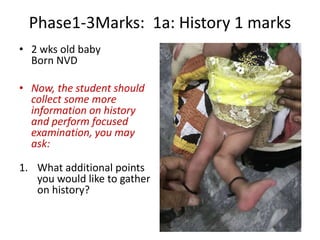
• 2 wks old baby
Born NVD
• Now, the student should
collect some more
information on history
and perform focused
examination, you may
ask:
1. What additional points
you would like to gather
on history?
What additional Questions U like to
ask?
1. Family history
2. Drug history
3. Oligohydromnios
Phase 1b
Clinical
Examination
1 marks
• What focused
clinical
examination
is needed
and what
are the
expected
findings?
• Screening
Exm: Quik
Survey
• General Exm:
Quik Detail
• Systemic Exm:
quik Other
than MSK
• Detailed MSK
Examination
Detailed MSK
Examination
2 marks
LOOK, FEEL & MOVE
1. Feet ?
 CAVE
1. Knee ?
 Architecture, Deformity, Dimple
 ROM
1. Hips?
 Abduction
 Gallazia
 Ortloni Barlows
• Spine?
 Dimple
 Bifida Occulta
• Exclude AGMC
Associated Deformities with CKD
Associated conditions
• developmental dysplasia of the hip
• clubfoot
• metatarsus adductus
Phase-2. 1 marks
After Candidate has furnished his findings on
history and examination, Examiner may ask:
1. What is the likely diagnosis and why?
2. How to define grading of the deformity?
3. What investigations you would like to
order and why?
Examination Findings
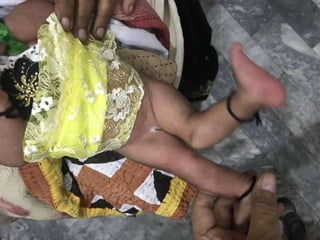
• Limited B/L knee flexion
• B/L knee recurvatum +ve
• MCL lax
• Hip ROM normal
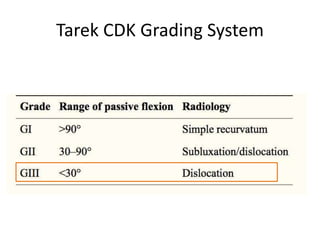
Tarek CDK Grading System
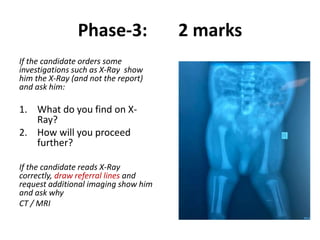
Phase-3: 2 marks
If the candidate orders some
investigations such as X-Ray show
him the X-Ray (and not the report)
and ask him:
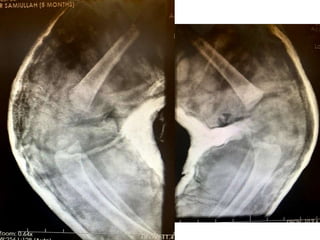
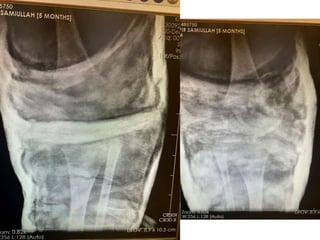
1. What do you find on X-
Ray?
2. How will you proceed
further?
If the candidate reads X-Ray
correctly, draw referral lines and
request additional imaging show him
and ask why
CT / MRI
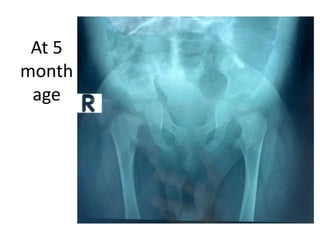
At 5
month
age
Phase 4.
Management
plan
3 marks.
Each section
carries 1mark
Now it may be
revealed that
examiner has
declared him fit, he
shall ask treatment
strategies.
Q. Non-operatieve
or
Operative
Justify
1. What specific
Non operative
Rx & How.
1. If failed to
achieve
satisfactory
results how to
proceed?
2. What specific
surgical
procedure you
would
undertake and
why?
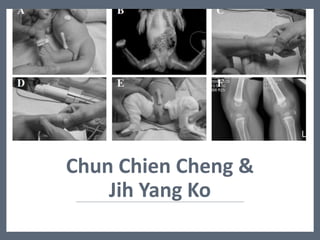
Chun Chien Cheng &
Jih Yang Ko
Surgical
Procedure
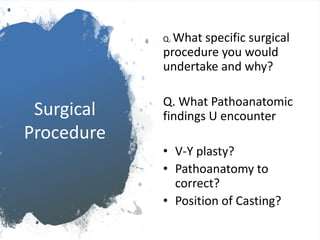
Q. What specific surgical
procedure you would
undertake and why?
Q. What Pathoanatomic
findings U encounter
• V-Y plasty?
• Pathoanatomy to
correct?
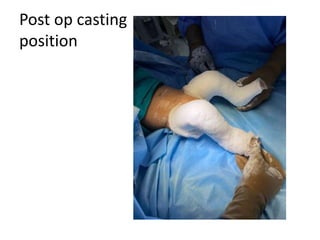
• Position of Casting?
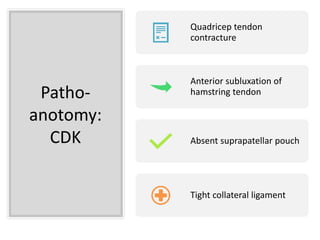
Patho-
anotomy:
CDK
Quadricep tendon
contracture
Anterior subluxation of
hamstring tendon
Absent suprapatellar pouch
Tight collateral ligament
Surgical
Procedure
Define Surgical Procedure?
• V-Y plasty?
• How to tackle Pathoanatomy?
• Position of Casting?
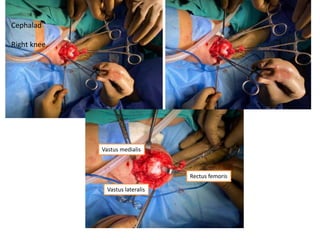
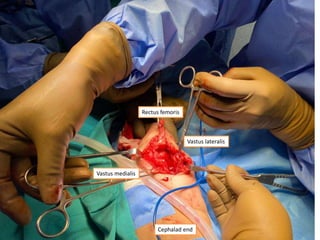
Cephalad
Right knee
Rectus femoris
Vastus lateralis
Vastus medialis
Rectus femoris
Vastus lateralis
Vastus medialis
Cephalad end
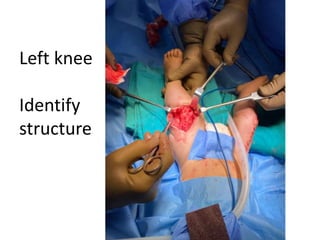
Left knee
Identify
structure
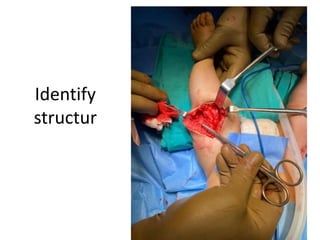
Identify
structur
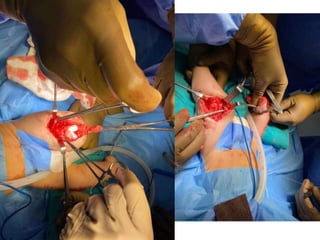
Post op casting
position
Virtual clinical examination

Virtual clinical examination

  • 1.
    VIRTUAL CLINICAL EXAMINATION “INTERACTIVE PAPER PATIENT” Prof.Anisuddin Bhatti Dr. Ziuaddin University Hospital Clifton, Karachi. dranisbhatti@gmail.com
  • 2.
    Virtual Clinical Examination •Virtual Clinical Examination (VCE) employs Virtual Patients (VPs) in clinical examinations instead of real patients. • VPs are developed as computer-based programs that simulate real-life clinical scenarios • Clinical examination, however, requires a linear dialogue between examiner and examinee, for which VPs need to be adapted accordingly
  • 3.
    Virtual Clinical Examination •Virtual Clinical Examination provides an Interactive role to the examinee, as opposed to passively watching videos/ visuals and answering written or oral questions. • Examinee is required to interact with the examiner by posing and answering questions regarding evolving condition of the patient presented.
  • 4.
    Interactive Paper Patients(IPPs) •This led to development of an inexpensive tool: IPPs, which has been used extensively for many years in cognitive assessment as: • Modified Essay Questions (MEQs) • Patient Management Problems (PMPs)
  • 5.
    Process • IPPs revealpatient condition and workup phase-wise. • Examiner poses questions to the examinee after description of each phase. • Student can ask questions about patient condition, investigation or response to therapy. • Examiner responds verbally or furnishes results. • Answers are scored phase-wise on a key.
  • 6.
  • 8.
    Phase1-3Marks: 1a: History1 marks • 2 wks old baby Born NVD • Now, the student should collect some more information on history and perform focused examination, you may ask: 1. What additional points you would like to gather on history?
  • 9.
    What additional QuestionsU like to ask? 1. Family history 2. Drug history 3. Oligohydromnios
  • 10.
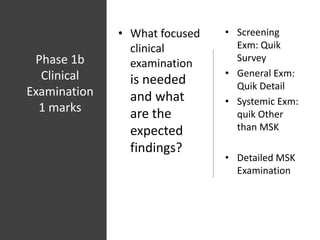
    Phase 1b Clinical Examination 1 marks •What focused clinical examination is needed and what are the expected findings? • Screening Exm: Quik Survey • General Exm: Quik Detail • Systemic Exm: quik Other than MSK • Detailed MSK Examination
  • 11.
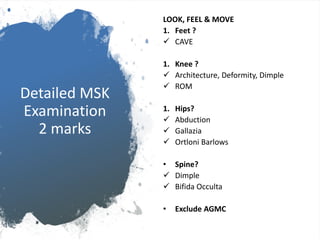
    Detailed MSK Examination 2 marks LOOK,FEEL & MOVE 1. Feet ?  CAVE 1. Knee ?  Architecture, Deformity, Dimple  ROM 1. Hips?  Abduction  Gallazia  Ortloni Barlows • Spine?  Dimple  Bifida Occulta • Exclude AGMC
  • 14.
    Associated Deformities withCKD Associated conditions • developmental dysplasia of the hip • clubfoot • metatarsus adductus
  • 15.
    Phase-2. 1 marks AfterCandidate has furnished his findings on history and examination, Examiner may ask: 1. What is the likely diagnosis and why? 2. How to define grading of the deformity? 3. What investigations you would like to order and why?
  • 16.
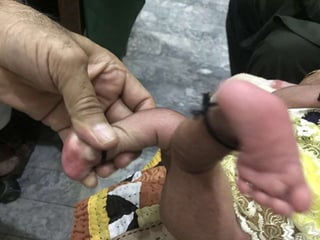
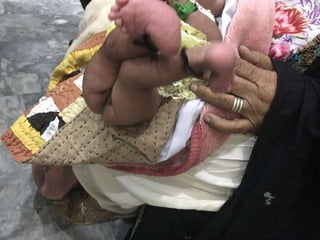
    Examination Findings • LimitedB/L knee flexion • B/L knee recurvatum +ve • MCL lax • Hip ROM normal
  • 17.
  • 18.
    Phase-3: 2 marks Ifthe candidate orders some investigations such as X-Ray show him the X-Ray (and not the report) and ask him: 1. What do you find on X- Ray? 2. How will you proceed further? If the candidate reads X-Ray correctly, draw referral lines and request additional imaging show him and ask why CT / MRI
  • 19.
  • 20.
    Phase 4. Management plan 3 marks. Eachsection carries 1mark Now it may be revealed that examiner has declared him fit, he shall ask treatment strategies. Q. Non-operatieve or Operative Justify 1. What specific Non operative Rx & How. 1. If failed to achieve satisfactory results how to proceed? 2. What specific surgical procedure you would undertake and why?
  • 21.
    Chun Chien Cheng& Jih Yang Ko
  • 22.
    Surgical Procedure Q. What specificsurgical procedure you would undertake and why? Q. What Pathoanatomic findings U encounter • V-Y plasty? • Pathoanatomy to correct? • Position of Casting?
  • 23.
    Patho- anotomy: CDK Quadricep tendon contracture Anterior subluxationof hamstring tendon Absent suprapatellar pouch Tight collateral ligament
  • 24.
    Surgical Procedure Define Surgical Procedure? •V-Y plasty? • How to tackle Pathoanatomy? • Position of Casting?
  • 25.
  • 26.
  • 27.
  • 28.
  • 30.