BCM Clinical Performance
Examination
Tyson Pillow, M.D., M.Ed.
Anita Kusnoor, M.D.
BCM CPX Goals
• Assess the clinical skills performance of medical students after
the completion of their third year of medical school.
• Serve as a competence benchmark for clinical performance
(history taking, physical exam, communication, clinical
reasoning) at this stage of training.
Competence
“The habitual and judicious use of communication,
knowledge, technical skills, clinical reasoning,
emotions, values, and reflection in daily practice for
the benefit of the individual and community being
served.”
-Epstein and Hundert. JAMA 2002;287:226.
BCM CPX Objectives
Based on BCM standards, students will:
•Perform a focused history in a simulation environment.
•Perform and interpret an appropriate physical exam given the
simulated case.
•Communicate effectively in a simulated encounter.
•Demonstrate fundamental patient-centered skills that constitute
the basis of safe and effective patient care.
•Synthesize and construct a differential diagnosis, diagnostic plan
& treatment plan based on the scenario provided.
Framework
• Basic Clinical Skills (H&P)
• Interpret physical findings
• Communication
• Interpret labs/studies
• Problem Solving
• Differential diagnosis
• Management plan
• Post-encounter note
• Verbal presentation
4 Clinical
Cases
Framework
Structure
• Outpatient, time-limited cases
• Checklists to assess clinical skills
• 10 minutes for interstation exercises to
evaluate clinical reasoning
Framework
4 Stations
Station Timing 1 2 3 4
Patient 15 min Patient 1 Patient 2 SAM Patient 3
Post-
Encounter
10 min Post-
encounter
note
Verbal patient
presentation
EKG & CXR
interpretation
Extra 10 min
with patient =
total 25 min
Basic Clinical Skills
• History based on complaint and patient setting
• Physical exam items evaluated according to
BCM standards (available on Blackboard)
• No invasive exams (breast, rectal, pelvic, GU).
If you need to do one, notify the patient as
part of your plan
Draw upon experiences from core
clerkships, LACE, and special sessions
Communication
• Address the patient by name
• Introduce self by name AND title
• Involve patient when discussing the reason for the visit
• Maintain appropriate eye contact
• Use effective body language
Opening the Interview
Communication
• Legitimize patient’s emotions
• Reinforce positive behaviors
Responding to the Patient
Communication
• Encourage questions or concerns
• Elicit patient perspective
• Avoid interrupting
• Avoid leading questions
• Avoid multiple questions
• Conduct the interactions in an organized manner
• Use open- and close-ended questions effectively
• Check for accuracy during the interview
Conducting the Interview
Communication
• Summarize the interview (history and exam, if applicable)
• Avoid inappropriate language
• Review next steps
• Verify patient’s understanding
Educating, Negotiating, Collaborating
Cases
Problem solving tasks related
to type of visit
• New problem
• Chronic illness
• Psychosocial
New Problem Visit
Assess Presenting Complaint
• Information gathering (driven by the differential diagnosis)
• HPI questions
• Associated symptoms
• Relevant review of systems
• Thoroughness associated with accuracy
• Major error is “premature closure” (differential too narrow)
Chronic Visit
• Assess severity and control of condition
• Signs and symptoms of condition
• Home monitoring
• Target organ damage from condition
• Evaluate adherence and treatment side
effects
• Review status of other risk factors
History
Psychosocial Visit
• Assess emotional needs of patient
• Background, Affect, Trouble, Handling, Empathy
(BATHE)
• Evaluate for diagnosable mental illness
• Evaluate for suicide risk
History
Areas of Weakness
HPI
• Open-ended questions
• OLD CARTS/OPQRST
• Alleviating/aggravating factors
• Associated symptoms
• Pertinent review of systems
• Don’t forget that the differential diagnosis drives what
questions you ask in the HPI
Areas of Weakness
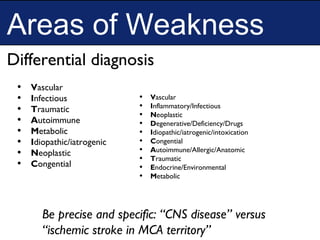
Differential diagnosis
• Vascular
• Infectious
• Traumatic
• Autoimmune
• Metabolic
• Idiopathic/iatrogenic
• Neoplastic
• Congential
• Vascular
• Inflammatory/Infectious
• Neoplastic
• Degenerative/Deficiency/Drugs
• Idiopathic/iatrogenic/intoxication
• Congential
• Autoimmune/Allergic/Anatomic
• Traumatic
• Endocrine/Environmental
• Metabolic
Be precise and specific: “CNS disease” versus
“ischemic stroke in MCA territory”
Areas of Weakness
Chronic illness
• Level of control
• Adherence to treatment plan
• Signs/symptoms of end-organ damage
• Other related risk factors
• Counseling the patient
For chronic disease case, you will get a total of 25
minutes with the patient, and there will be no
post-encounter questions.
Areas of Weakness
Psychosocial
• Effect on functioning
• Emotional reaction
• Social support
Physical Exam
• Lung
• Cardiovascular
• Neurologic
• Lymph nodes
• Thyroid
• Abdomen
• Neurologic
Areas of Weakness
Thoroughly test any organ system
associated with the chief complaint.
Don’t forget to look for complications of
the disease. PE should be focused but
thorough.
Thoroughness Technique
Drape patients appropriately. Don’t listen
over gown/sports bra. Don’t abbreviate
the heart/lung exam (e.g., don’t just listen
to one valve). Don’t be overly aggressive
with palpation.
Post-Encounter Note
HISTORY: Describe
the history you just
obtained from this
patient. Include only
information (pertinent
positives and negatives)
relevant to this patient’s
problem(s).
•Write it like you would
write a regular HPI on a
rotation
Post-Encounter Note
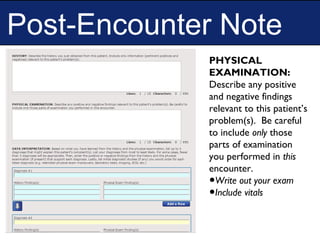
PHYSICAL
EXAMINATION:
Describe any positive
and negative findings
relevant to this patient’s
problem(s). Be careful
to include only those
parts of examination
you performed in this
encounter.
•Write out your exam
•Include vitals
DATA INTERPRETATION:
Based on what you have learned from
the H&P, list up to 3 diagnoses that
might explain this patient’s
complaint(s). List your diagnoses
from most to least likely. For some
cases, fewer than 3 diagnoses will be
appropriate. Then, enter the
positive or negative findings from the
history and the physical examination
(if present) that support each
diagnosis. Lastly, list initial diagnostic
studies (if any) you would order for
each listed diagnosis (e.g., restricted
physical exam maneuvers, laboratory
tests, imaging, ECG, etc.)
Post-Encounter Note
Initial diagnostic studies do not have to correlate with
each diagnosis. For example, if the chief complaint is chest
pain, you may want chest x-ray and EKG for all of the
items on your differential.
Verbal Patient Presentation
• Post-encounter exercise on one station
• Total of 10 minutes
• Use the first portion to organize your thoughts
• After 7 minutes if you have not begun your presentation, the
Standardized Faculty Member will prompt you to start
• Follow presentation style used when presenting new patients on
clerkships
• Don’t forget to state your differential diagnosis, the rationale for
your differential, and your proposed management plan
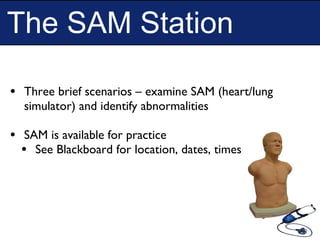
The SAM Station
• Three brief scenarios – examine SAM (heart/lung
simulator) and identify abnormalities
• SAM is available for practice
• See Blackboard for location, dates, times
Chest X-ray Interpretation
Answer choices (in this order)
A. Normal chest
B. Right upper lobe pneumonia
C. Right middle lobe pneumonia
D. Right lower lobe pneumonia
E. Left upper lobe pneumonia
F. Lingular pneumonia
G. Left lower lobe pneumonia
H. Multifocal pneumonia
I. Cardiomegaly
J. Pulmonary edema
K. Pleural effusion(s)
L. Pneumothorax
M. Widened mediastinum
N. Lung mass
O. Cavitary lesion
P. Hyperinflated lungs (COPD)
EKG Interpretation
Answer choices (in this order)
A. Normal sinus rhythm
B. Sinus bradycardia
C. Sinus tachycardia
D. Atrial flutter
E. Atrial fibrillation
F. Supraventricular tachycardia
G. Ventricular tachycardia
H. Ventricular fibrillation
I. Torsades de Pointes
J. 1st
degree heart block
K. 2nd
degree heart block – type I
L. 2nd
degree heart block – type II
M. 3rd
degree heart block
N. Electrical alternans
O. Peaked T waves
P. Anterior ST elevation MI
Q. Inferior ST elevation MI
R. Lateral ST elevation MI
S. Left bundle branch block
T. Right bundle branch block
How to Prepare
• Preparation for the exam is strongly encouraged
• Review BCM Physical Exam Standards, available on CPX
website
• Practice generating differential diagnoses
• Review the PEN questions
• Review the answer choices for chest x-rays and EKGs
• Practice with SAM
• Practice verbal presentations
Performance Information
Passing the BCM CPX is a
graduation requirement
Available online after review and
release of grades
Professionalism
It is our expectation that you will
show up ON TIME* and
PREPARED for the exam
*Please refer to the tardiness/late policy
Professionalism
Professional dress + white coat enhances the
standardized patient’s perception of your
competence
Professionalism
DO NOT share exam content
with your colleagues
Scheduling
• Exam dates: March 27-29, April 2-4
• Online signup starts today. You will receive
instructions by email.
• Refer to Blackboard for specific scheduling questions
• Dates for testing, remediation, and retesting will be
posted in a timely fashion
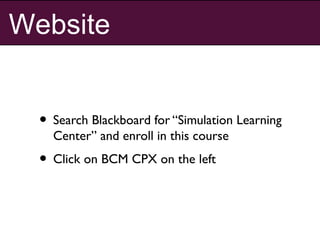
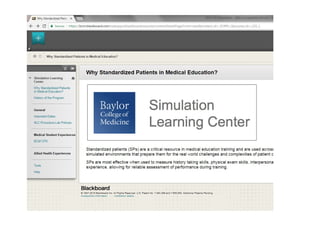
Website
• Search Blackboard for “Simulation Learning
Center” and enroll in this course
• Click on BCM CPX on the left
Contact Information
Contact Email
Mrs. Kira Boerkircher
Program Manager
Simulation & Standardized Patient
Programs
Kira.Boerkircher@bcm.edu
Dr. Anita Kusnoor
CPX Director
avk1@bcm.edu
Dr. Tyson Pillow
Medical Director
Simulation & Standardized Patient
Programs
pillow@bcm.edu
BCM Clinical Performance
Examination
Tyson Pillow, M.D., M.Ed.
Anita Kusnoor, M.D.

BCM CPX Orientation 2018

  • 1.
    BCM Clinical Performance Examination TysonPillow, M.D., M.Ed. Anita Kusnoor, M.D.
  • 2.
    BCM CPX Goals •Assess the clinical skills performance of medical students after the completion of their third year of medical school. • Serve as a competence benchmark for clinical performance (history taking, physical exam, communication, clinical reasoning) at this stage of training.
  • 3.
    Competence “The habitual andjudicious use of communication, knowledge, technical skills, clinical reasoning, emotions, values, and reflection in daily practice for the benefit of the individual and community being served.” -Epstein and Hundert. JAMA 2002;287:226.
  • 4.
    BCM CPX Objectives Basedon BCM standards, students will: •Perform a focused history in a simulation environment. •Perform and interpret an appropriate physical exam given the simulated case. •Communicate effectively in a simulated encounter. •Demonstrate fundamental patient-centered skills that constitute the basis of safe and effective patient care. •Synthesize and construct a differential diagnosis, diagnostic plan & treatment plan based on the scenario provided.
  • 5.
    Framework • Basic ClinicalSkills (H&P) • Interpret physical findings • Communication • Interpret labs/studies • Problem Solving • Differential diagnosis • Management plan • Post-encounter note • Verbal presentation 4 Clinical Cases
  • 6.
    Framework Structure • Outpatient, time-limitedcases • Checklists to assess clinical skills • 10 minutes for interstation exercises to evaluate clinical reasoning
  • 7.
    Framework 4 Stations Station Timing1 2 3 4 Patient 15 min Patient 1 Patient 2 SAM Patient 3 Post- Encounter 10 min Post- encounter note Verbal patient presentation EKG & CXR interpretation Extra 10 min with patient = total 25 min
  • 8.
    Basic Clinical Skills •History based on complaint and patient setting • Physical exam items evaluated according to BCM standards (available on Blackboard) • No invasive exams (breast, rectal, pelvic, GU). If you need to do one, notify the patient as part of your plan Draw upon experiences from core clerkships, LACE, and special sessions
  • 9.
    Communication • Address thepatient by name • Introduce self by name AND title • Involve patient when discussing the reason for the visit • Maintain appropriate eye contact • Use effective body language Opening the Interview
  • 10.
    Communication • Legitimize patient’semotions • Reinforce positive behaviors Responding to the Patient
  • 11.
    Communication • Encourage questionsor concerns • Elicit patient perspective • Avoid interrupting • Avoid leading questions • Avoid multiple questions • Conduct the interactions in an organized manner • Use open- and close-ended questions effectively • Check for accuracy during the interview Conducting the Interview
  • 12.
    Communication • Summarize theinterview (history and exam, if applicable) • Avoid inappropriate language • Review next steps • Verify patient’s understanding Educating, Negotiating, Collaborating
  • 13.
    Cases Problem solving tasksrelated to type of visit • New problem • Chronic illness • Psychosocial
  • 14.
    New Problem Visit AssessPresenting Complaint • Information gathering (driven by the differential diagnosis) • HPI questions • Associated symptoms • Relevant review of systems • Thoroughness associated with accuracy • Major error is “premature closure” (differential too narrow)
  • 15.
    Chronic Visit • Assessseverity and control of condition • Signs and symptoms of condition • Home monitoring • Target organ damage from condition • Evaluate adherence and treatment side effects • Review status of other risk factors History
  • 16.
    Psychosocial Visit • Assessemotional needs of patient • Background, Affect, Trouble, Handling, Empathy (BATHE) • Evaluate for diagnosable mental illness • Evaluate for suicide risk History
  • 17.
    Areas of Weakness HPI •Open-ended questions • OLD CARTS/OPQRST • Alleviating/aggravating factors • Associated symptoms • Pertinent review of systems • Don’t forget that the differential diagnosis drives what questions you ask in the HPI
  • 18.
    Areas of Weakness Differentialdiagnosis • Vascular • Infectious • Traumatic • Autoimmune • Metabolic • Idiopathic/iatrogenic • Neoplastic • Congential • Vascular • Inflammatory/Infectious • Neoplastic • Degenerative/Deficiency/Drugs • Idiopathic/iatrogenic/intoxication • Congential • Autoimmune/Allergic/Anatomic • Traumatic • Endocrine/Environmental • Metabolic Be precise and specific: “CNS disease” versus “ischemic stroke in MCA territory”
  • 19.
    Areas of Weakness Chronicillness • Level of control • Adherence to treatment plan • Signs/symptoms of end-organ damage • Other related risk factors • Counseling the patient For chronic disease case, you will get a total of 25 minutes with the patient, and there will be no post-encounter questions.
  • 20.
    Areas of Weakness Psychosocial •Effect on functioning • Emotional reaction • Social support
  • 21.
    Physical Exam • Lung •Cardiovascular • Neurologic • Lymph nodes • Thyroid • Abdomen • Neurologic Areas of Weakness Thoroughly test any organ system associated with the chief complaint. Don’t forget to look for complications of the disease. PE should be focused but thorough. Thoroughness Technique Drape patients appropriately. Don’t listen over gown/sports bra. Don’t abbreviate the heart/lung exam (e.g., don’t just listen to one valve). Don’t be overly aggressive with palpation.
  • 22.
    Post-Encounter Note HISTORY: Describe thehistory you just obtained from this patient. Include only information (pertinent positives and negatives) relevant to this patient’s problem(s). •Write it like you would write a regular HPI on a rotation
  • 23.
    Post-Encounter Note PHYSICAL EXAMINATION: Describe anypositive and negative findings relevant to this patient’s problem(s). Be careful to include only those parts of examination you performed in this encounter. •Write out your exam •Include vitals
  • 24.
    DATA INTERPRETATION: Based onwhat you have learned from the H&P, list up to 3 diagnoses that might explain this patient’s complaint(s). List your diagnoses from most to least likely. For some cases, fewer than 3 diagnoses will be appropriate. Then, enter the positive or negative findings from the history and the physical examination (if present) that support each diagnosis. Lastly, list initial diagnostic studies (if any) you would order for each listed diagnosis (e.g., restricted physical exam maneuvers, laboratory tests, imaging, ECG, etc.) Post-Encounter Note Initial diagnostic studies do not have to correlate with each diagnosis. For example, if the chief complaint is chest pain, you may want chest x-ray and EKG for all of the items on your differential.
  • 25.
    Verbal Patient Presentation •Post-encounter exercise on one station • Total of 10 minutes • Use the first portion to organize your thoughts • After 7 minutes if you have not begun your presentation, the Standardized Faculty Member will prompt you to start • Follow presentation style used when presenting new patients on clerkships • Don’t forget to state your differential diagnosis, the rationale for your differential, and your proposed management plan
  • 26.
    The SAM Station •Three brief scenarios – examine SAM (heart/lung simulator) and identify abnormalities • SAM is available for practice • See Blackboard for location, dates, times
  • 27.
    Chest X-ray Interpretation Answerchoices (in this order) A. Normal chest B. Right upper lobe pneumonia C. Right middle lobe pneumonia D. Right lower lobe pneumonia E. Left upper lobe pneumonia F. Lingular pneumonia G. Left lower lobe pneumonia H. Multifocal pneumonia I. Cardiomegaly J. Pulmonary edema K. Pleural effusion(s) L. Pneumothorax M. Widened mediastinum N. Lung mass O. Cavitary lesion P. Hyperinflated lungs (COPD)
  • 28.
    EKG Interpretation Answer choices(in this order) A. Normal sinus rhythm B. Sinus bradycardia C. Sinus tachycardia D. Atrial flutter E. Atrial fibrillation F. Supraventricular tachycardia G. Ventricular tachycardia H. Ventricular fibrillation I. Torsades de Pointes J. 1st degree heart block K. 2nd degree heart block – type I L. 2nd degree heart block – type II M. 3rd degree heart block N. Electrical alternans O. Peaked T waves P. Anterior ST elevation MI Q. Inferior ST elevation MI R. Lateral ST elevation MI S. Left bundle branch block T. Right bundle branch block
  • 29.
    How to Prepare •Preparation for the exam is strongly encouraged • Review BCM Physical Exam Standards, available on CPX website • Practice generating differential diagnoses • Review the PEN questions • Review the answer choices for chest x-rays and EKGs • Practice with SAM • Practice verbal presentations
  • 30.
    Performance Information Passing theBCM CPX is a graduation requirement Available online after review and release of grades
  • 31.
    Professionalism It is ourexpectation that you will show up ON TIME* and PREPARED for the exam *Please refer to the tardiness/late policy
  • 32.
    Professionalism Professional dress +white coat enhances the standardized patient’s perception of your competence
  • 33.
    Professionalism DO NOT shareexam content with your colleagues
  • 34.
    Scheduling • Exam dates:March 27-29, April 2-4 • Online signup starts today. You will receive instructions by email. • Refer to Blackboard for specific scheduling questions • Dates for testing, remediation, and retesting will be posted in a timely fashion
  • 35.
    Website • Search Blackboardfor “Simulation Learning Center” and enroll in this course • Click on BCM CPX on the left
  • 38.
    Contact Information Contact Email Mrs.Kira Boerkircher Program Manager Simulation & Standardized Patient Programs Kira.Boerkircher@bcm.edu Dr. Anita Kusnoor CPX Director avk1@bcm.edu Dr. Tyson Pillow Medical Director Simulation & Standardized Patient Programs pillow@bcm.edu
  • 39.
    BCM Clinical Performance Examination TysonPillow, M.D., M.Ed. Anita Kusnoor, M.D.

Editor's Notes

  • #22 Example of thoroughness: If you want to listen to heart, auscultate all valves. Don’t necessarily have to look at JVP if it’s not indicated for the case.
  • #28 Chest x-ray tutorials are available on online: https://internalmedicine.med.uky.edu/im-chest-x-ray-tutorial https://www.med-ed.virginia.edu/courses/rad/cxr/pathology2chest.html
  • #31 Target is late May for grade release
  • #36 See link for physical exam sheet