VIENNA
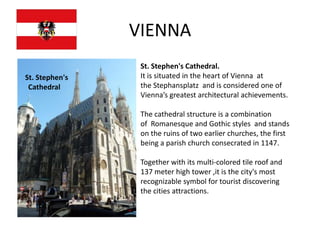
                 St. Stephen's Cathedral.
St. Stephen's    It is situated in the heart of Vienna at
 Cathedral       the Stephansplatz and is considered one of
                 Vienna’s greatest architectural achievements.

                 The cathedral structure is a combination
                 of Romanesque and Gothic styles and stands
                 on the ruins of two earlier churches, the first
                 being a parish church consecrated in 1147.

                 Together with its multi-colored tile roof and
                 137 meter high tower ,it is the city's most
                 recognizable symbol for tourist discovering
                 the cities attractions.
VIENNA
   St.
Stephen's
Cathedral
VIENNA
             Introducing Schonbrunn Palace.
The siege of Vienna began on the 14th. July 1683 marked the turning
point in the 300 years of Turkish occupation.
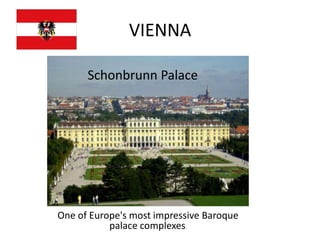
Schonbrunn Palace, the impressive Baroque architectural complex
dates from 1696 and was redesigned by Maria Theresia after 1743.
VIENNA

      Schonbrunn Palace


One of Europe's most impressive Baroque
           palace complexes.
VIENNA


The Gloriette in the Schonbrunn Palace Garden built in 1775 to
serve as a dining hall, a festival hall as well as a breakfast room for
emperor. It is also a lookout point for the garden and on the roof
as an observation platform overlooking Vienna.
VIENNA

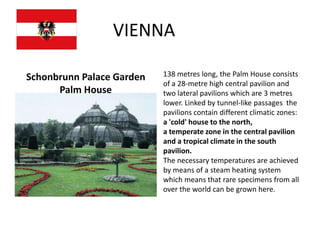
Schonbrunn Palace Garden   138 metres long, the Palm House consists
                           of a 28-metre high central pavilion and
      Palm House           two lateral pavilions which are 3 metres
                           lower. Linked by tunnel-like passages the
                           pavilions contain different climatic zones:
                           a 'cold' house to the north,
                           a temperate zone in the central pavilion
                           and a tropical climate in the south
                           pavilion.
                           The necessary temperatures are achieved
                           by means of a steam heating system
                           which means that rare specimens from all
                           over the world can be grown here.
VIENNA


The Kunsthistorisches Museum "Museum of Art History" also often referred
to as the "Museum of Fine Arts". The Habsburgs' formidable art collection is
housed in its palatial octagonal dome building on Ringstraße. ( Ring road
around the city of Vienna)
VIENNA


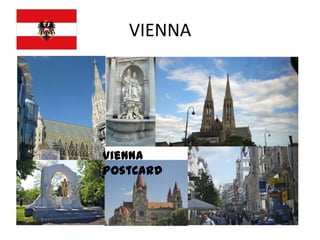
Vienna
Postcard
VIENNA
         Praters Fun Park

           Visible from a long
          distance, the Praters
           fun park skyline is
          defined by the giant
         Ferris Wheel. The 645
          meter high structure
          provides a stunning
            view over Vienna
VIENNA

                            The Graben
                             one of the
                               main
                              business
                             streets in
                              Vienna.

   The monument is                             The Palace of the Barons
    dedicated to the                          Bartolotti von Partenfeld.
devastation of the plague                 It is the only baroque structure
         in 1679                          on the Graben that has survived
                                                      to this day.
VIENNA


Parliament House
VIENNA
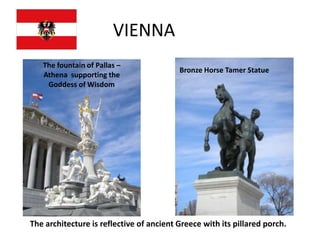
   The fountain of Pallas –
                                          Bronze Horse Tamer Statue
   Athena supporting the
    Goddess of Wisdom


The architecture is reflective of ancient Greece with its pillared porch.
VIENNA


Side view of Parliament House with the ancient Greek styled
                      pillared porch
VIENNA


Vienna
Postcard
VIENNA
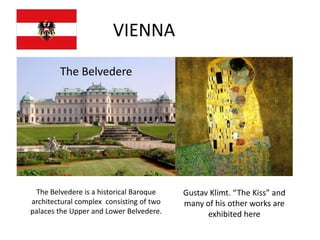
        The Belvedere


 The Belvedere is a historical Baroque    Gustav Klimt. “The Kiss” and
architectural complex consisting of two   many of his other works are
palaces the Upper and Lower Belvedere.          exhibited here
VIENNA


The Vienna National Opera House
VIENNA


The Museum Of Art History
VIENNA
The Art Nouveau designed Anchor
Clock was built between 1911 and
1917.The clock forms a bridge
between two parts of the Anker
Insurance Company's building.

In the course of 12 hours, twelve
historical figures or pairs of figures
move across the bridge .

Every day at noon, all figures parade
accompanied by music from the
various eras. This tourist spectacle is
a special kind of Viennese High Noon.
MELK


Benedictine Monastery At Melk


                Views Of The Danube River At Melk
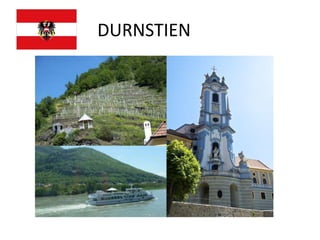
DURNSTIEN
DURNSTIEN
VIENNA


  The golden Strauss Monument is a popular
photographic subject for tourists visiting Vienna.
VIENNA


 We hope that you have enjoyed the views along the Danube through the Wachau
Valley and on to discover some of the grand sights that make Vienna a special place .
    I wish to thank Geoff for his images included in this Powerpoint Presentation.

           This is the end of our Highlights Of Eastern Europe Adventure.
                       Safe Travels Everyone

Vienna

  • 1.
    VIENNA St. Stephen's Cathedral. St. Stephen's It is situated in the heart of Vienna at Cathedral the Stephansplatz and is considered one of Vienna’s greatest architectural achievements. The cathedral structure is a combination of Romanesque and Gothic styles and stands on the ruins of two earlier churches, the first being a parish church consecrated in 1147. Together with its multi-colored tile roof and 137 meter high tower ,it is the city's most recognizable symbol for tourist discovering the cities attractions.
  • 2.
    VIENNA St. Stephen's Cathedral
  • 3.
    VIENNA Introducing Schonbrunn Palace. The siege of Vienna began on the 14th. July 1683 marked the turning point in the 300 years of Turkish occupation. Schonbrunn Palace, the impressive Baroque architectural complex dates from 1696 and was redesigned by Maria Theresia after 1743.
  • 4.
    VIENNA Schonbrunn Palace One of Europe's most impressive Baroque palace complexes.
  • 5.
    VIENNA The Gloriette inthe Schonbrunn Palace Garden built in 1775 to serve as a dining hall, a festival hall as well as a breakfast room for emperor. It is also a lookout point for the garden and on the roof as an observation platform overlooking Vienna.
  • 6.
    VIENNA Schonbrunn Palace Garden 138 metres long, the Palm House consists of a 28-metre high central pavilion and Palm House two lateral pavilions which are 3 metres lower. Linked by tunnel-like passages the pavilions contain different climatic zones: a 'cold' house to the north, a temperate zone in the central pavilion and a tropical climate in the south pavilion. The necessary temperatures are achieved by means of a steam heating system which means that rare specimens from all over the world can be grown here.
  • 7.
    VIENNA The Kunsthistorisches Museum"Museum of Art History" also often referred to as the "Museum of Fine Arts". The Habsburgs' formidable art collection is housed in its palatial octagonal dome building on Ringstraße. ( Ring road around the city of Vienna)
  • 8.
  • 9.
    VIENNA Praters Fun Park Visible from a long distance, the Praters fun park skyline is defined by the giant Ferris Wheel. The 645 meter high structure provides a stunning view over Vienna
  • 10.
    VIENNA The Graben one of the main business streets in Vienna. The monument is The Palace of the Barons dedicated to the Bartolotti von Partenfeld. devastation of the plague It is the only baroque structure in 1679 on the Graben that has survived to this day.
  • 11.
  • 12.
    VIENNA The fountain of Pallas – Bronze Horse Tamer Statue Athena supporting the Goddess of Wisdom The architecture is reflective of ancient Greece with its pillared porch.
  • 13.
    VIENNA Side view ofParliament House with the ancient Greek styled pillared porch
  • 14.
  • 15.
    VIENNA The Belvedere The Belvedere is a historical Baroque Gustav Klimt. “The Kiss” and architectural complex consisting of two many of his other works are palaces the Upper and Lower Belvedere. exhibited here
  • 16.
  • 17.
  • 18.
    VIENNA The Art Nouveaudesigned Anchor Clock was built between 1911 and 1917.The clock forms a bridge between two parts of the Anker Insurance Company's building. In the course of 12 hours, twelve historical figures or pairs of figures move across the bridge . Every day at noon, all figures parade accompanied by music from the various eras. This tourist spectacle is a special kind of Viennese High Noon.
  • 19.
    MELK Benedictine Monastery AtMelk Views Of The Danube River At Melk
  • 20.
  • 21.
  • 22.
    VIENNA Thegolden Strauss Monument is a popular photographic subject for tourists visiting Vienna.
  • 23.
    VIENNA We hopethat you have enjoyed the views along the Danube through the Wachau Valley and on to discover some of the grand sights that make Vienna a special place . I wish to thank Geoff for his images included in this Powerpoint Presentation. This is the end of our Highlights Of Eastern Europe Adventure. Safe Travels Everyone