TRAVEL
INTRODUCTION:
NAME : FAISALANSARI
BATCH : V1
CENTER : GHATKOPAR(EAST),MUMBAI
COURSE : HTCS
MODULE : TRAVEL
ACKNOWLEDGEMENT:
At the onset, I would like to thank the Almighty God without which this
presentation would not have been possible and . I also like to thanks
to my trainer MR DOMNIC D’SOUZA SIR who gave me this golden
opportunity to do this presentation
I also thanks to all my friends for their valuable co-operation during the
period of presentation.
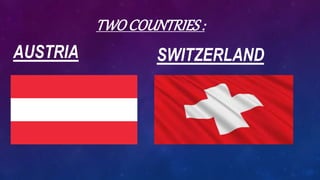
TWOCOUNTRIES :
AUSTRIA SWITZERLAND
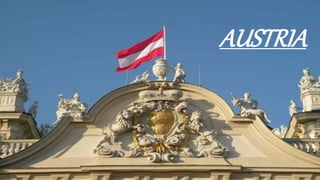
AUSTRIA
AUSTRIA
• Austria is a German-speaking country in Central Europe, characterized by mountain villages,
baroque architecture, Imperial history and rugged Alpine terrain. Vienna, its Danube River capital, is
home to the Schönbrunn and Hofburg palaces. It has counted Mozart, Strauss and Freud among its
residents. The country’s other notable regions include the northern Bohemian Forest, Traunsee Lake
and eastern hillside vineyards.
• Capital : Vienna
• Currency : Euro
• Anthem : Land der berge, Land am strome.
• Language : Austrian german.
• Government : Federal parliamentary repbuplic.
History
• It is bordered by the Czech Republic and Germany to the north, Hungary and Slovakia to the
east, Slovenia and Italy to the south, and Switzerland and Liechtenstein to the west.
• The territory of Austria covers 83,879 km2 (32,386 sq mi). The terrain is highly mountainous, lying
within the Alps; only 32% of the country is below 500 m (1,640 ft), and its highest point is 3,798 m
(12,461 ft.).
• The First Austrian Republic was established in 1919.
• Austria lies between latitudes 46° and 49° N, and longitudes 9° and 18° E.
• The greater part of Austria lies in the cool/temperate climate zone, where humid westerly winds
predominate.
• Although Austria is cold in the winter (−10 – 0 °C).
CITIES
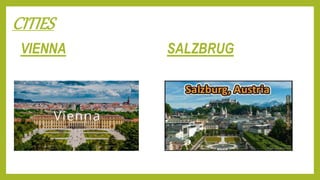
VIENNA SALZBRUG
VIENNA
VIENNA
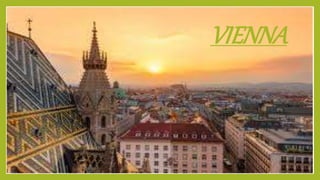
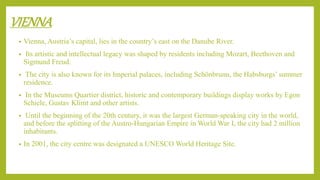
• Vienna, Austria’s capital, lies in the country’s east on the Danube River.
• Its artistic and intellectual legacy was shaped by residents including Mozart, Beethoven and
Sigmund Freud.
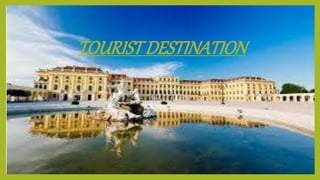
• The city is also known for its Imperial palaces, including Schönbrunn, the Habsburgs’ summer
residence.
• In the Museums Quartier district, historic and contemporary buildings display works by Egon
Schiele, Gustav Klimt and other artists.
• Until the beginning of the 20th century, it was the largest German-speaking city in the world,
and before the splitting of the Austro-Hungarian Empire in World War I, the city had 2 million
inhabitants.
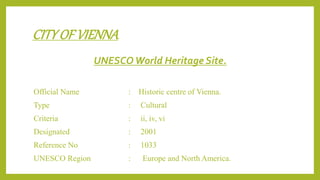
• In 2001, the city centre was designated a UNESCO World Heritage Site.
CITYOF VIENNA
UNESCOWorld Heritage Site.
Official Name : Historic centre of Vienna.
Type : Cultural
Criteria : ii, iv, vi
Designated : 2001
Reference No : 1033
UNESCO Region : Europe and North America.
TOURISTDESTINATION
VOLKSGARTEN
• The Volksgarten is a public park in the Innere Stadt first district of Vienna, Austria.
• The Volksgarten was opened to the public in 1823.
• The garden, which is part of the Hofburg Palace, was laid out by Ludwig Remy in 1821. The park
was built over the city fortifications that were destroyed by Napoleon in 1809.
• The Volksgarten area was originally used for fortifications. Between 1596 and 1597, a fortress
wall was built on the eastern side of park.
• Between 1817 and 1821, the area near Ballhausplatz square was converted to gardens originally
intended for a private garden for the archdukes.
• These plans were changed through a proposal by the court garden administration to turn the area
into the first public park in the city.
• On 1 March 1823, the park was officially opened. Starting in 1825, the name Volksgarten was
commonly used.
• In 1862, the gardens were extended toward Ringstraße after the city moat had been filled in.
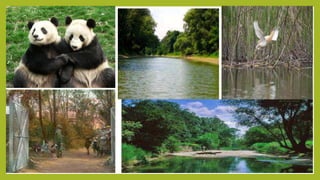
DANUBEAUENNATIONALPARK
• The Danube-Auen National Park covers 93 square kilometres in Vienna and Lower Austria and
is one of the largest remaining floodplains of the Danube in Middle Europe.
• The German word Aue means "river island, wetland, floodplain, riparian woodland.
• The Danube-Auen National Park protects a large area of lowland forests, meadows, wetlands, and
other riparian habitat along the Danube just downstream of Vienna.
• The park was designated an IUCN category II national park and spans the areas of Vienna.
• Until the 19th century the Danube was an untamed river.
• In the national park area there are more than 700 species of higher plants, more than 30 mammals,
100 species of breeding birds, 8 reptiles, 13 amphibian species, and around 50 species of fish.
• Established on October 27, 1996.
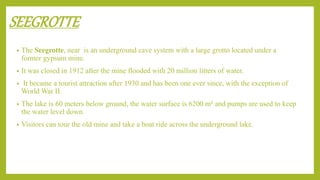
SEEGROTTE
• The Seegrotte, near is an underground cave system with a large grotto located under a
former gypsum mine.
• It was closed in 1912 after the mine flooded with 20 million litters of water.
• It became a tourist attraction after 1930 and has been one ever since, with the exception of
World War II.
• The lake is 60 meters below ground, the water surface is 6200 m² and pumps are used to keep
the water level down.
• Visitors can tour the old mine and take a boat ride across the underground lake.
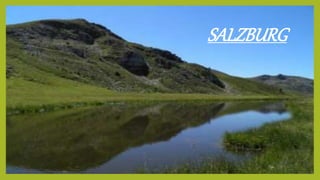
SALZBURG
HISTORY
• Salzburg is an Austrian city on the border of Germany, with views of the Eastern Alps.
• The city is divided by the Salzach River, with medieval and baroque buildings of the pedestrian
Altstadt (Old City) on its left bank, facing the 19th-century Neustadt (New City) on its right.
• The Altstadt birthplace of famed composer Mozart is preserved as a museum displaying his
childhood instruments.
• It was listed as a UNESCO World Heritage Site in 1997.
• The city has three universities and a large population of students. Tourists also visit Salzburg to
tour the historic centre and the scenic Alpine surroundings.
• The name Salzburg means "Salt Castle" . The name derives from the barges carrying salt on
the Salzach River, which were subject to a toll in the 8th century as was customary for many
communities and cities on European rivers.
• Salzburg is part of the temperate zone.
• Salzburg would be a four-season oceanic climate with significant temperature differences
between seasons.
• Due to the location at the northern rim of the Alps, the amount of precipitation is
comparatively high, mainly in the summer months.
• Salzburg is a tourist favourite, with the number of tourists outnumbering locals by a large
margin in peak times. In addition to Mozart's birthplace and other notable places.
TOURISTDESTNATION
HOUSEOF NATURE
• The House of Nature (founded in 1924) is the local natural history museum of Salzburg.
• It houses a large exhibition about all aspects of nature, a Science Center, an aquarium and a reptile
zoo.
• With our exhibitions we attempt to inspire our visitors, to stimulate their interest in the natural
world and to enhance their understanding for natural processes.
• As a nature competence centre the House of Nature plays an important role in the scientific
exploration and documentation of nature in Salzburg.
• In the Biodiversity Database at the Haus der Natur, about 1,100,000 records are recorded for the
distribution of flowering plants , vertebrates , butterflies , beetles and other animal and plant
groups in the province of Salzburg ( Austria ) and neighbouring regions.
PANORAMA MUSEUM
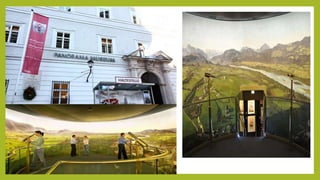
• The Panorama Museum Salzburg belongs to the Salzburg Museum and is located in the New
Residenz in the old town of Salzburg.
• The Panoramagemälde shows the city of Salzburg and its surroundings around 1825 from
the fortress Hohensalzburg . It is the world's only remaining historical city panorama.
• From 1875 to 1937 the Panoramagemälde was located in its own exhibition pavilion in the spa
gardens of the city of Salzburg . It was then rolled up and only put up again in 1977 in the then
newly built casino building on the Mönchsberg.
• In 2001, the panorama had to be removed because of the demolition of the building. In 2003, he
moved to the Neue Residenz and was subjected to a comprehensive restoration for two years.
• On 6 October 2005 , the Panorama Museum was officially inaugurated as part of the Salzburg
Museum .
• In the Panorama Museum, 24 Cosmo gorses are displayed around the approximately 25-meter long
and almost 5-meter-high round paintings . These large paintings with depictions of landscapes and
cities were part of Johann Michael Sattler.
KAPUZINBERG
• Kapuzinerberg is a hill on the eastern bank of Salzach river in Salzburg, Salzburgerland, Austria.
• It is elevated 640 meters above sea level.
• It is home to a Capucines cloister built in 1599-1605 on the site of a medieval fortress, the
"Trompeterschlössl". Earliest human settlements on the eastern slope of Kapuzinerberg date back
to Neolithic period. Big prehistoric settlements on mountain date back to 1100 B.C.
• On the way of the Linzergasse to the monastery are standing 13 oratories with the way of the
cross, which were built up between 1736 and 1744.
SWITZERLAND
HISTORY
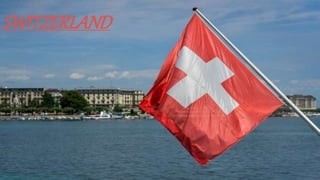
• Switzerland is a mountainous Central European country, home to numerous lakes, villages and the high peaks of the Alps.
• Its cities contain medieval quarters, with landmarks like capital Bern’s Zytglogge clock tower and Lucerne’s wooden chapel bridge.
• The country is also known for its ski resorts and hiking trails. Banking and finance are key industries, and Swiss watches and chocolate are
world renowned.
CAPITAL : BERN
LANGUAGES : GERMAN, FRENCH, ITALIAN, ROMANSH.
CURRENCY : SWISS FRANC (CHF)
ANTHEM : "One for all, all for one”.
GOVERNMENT : FEDERAL SEMI-DIRECT DEMOCRACY.
Switzerland is one of the most developed countries in the world, with the highest nominal wealth per adult and the eighth-highest per
capita gross domestic product according to the IMF.
Switzerland ranks at or near the top globally in several metrics of national performance, including government transparency, civil liberties,
quality of life, economic competitiveness, and human development.
Zürich and Geneva have each been ranked among the top cities in the world in terms of quality of life, with the former ranked second globally,
according to Mercer.
• The English name Switzerland is a compound containing Switzer, an obsolete term for the Swiss, which was in use during
the 16th to 19th centuries.
• The oldest traces of hominid existence in Switzerland date back about 150,000 years.
• The Swiss climate is generally temperate, but can vary greatly between the localities, from glacial conditions on the
mountaintops to the often pleasant near Mediterranean climate at Switzerland's southern tip. There are some valley areas in
the southern part of Switzerland where some cold-hardy palm trees are found. Summers tend to be warm and humid at
times with periodic rainfall so they are ideal for pastures and grazing.
• Switzerland's ecosystems can be particularly fragile, because the many delicate valleys separated by high mountains often
form unique ecologies. The mountainous regions themselves are also vulnerable, with a rich range of plants not found at
other altitudes, and experience some pressure from visitors and grazing. The climatic, geological and topographical
conditions of the alpine region make for a very fragile ecosystem that is particularly sensitive to climate change.
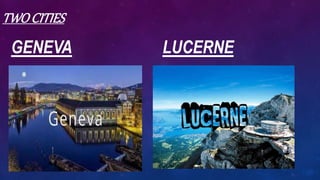
TWO CITIES
GENEVA LUCERNE
GENEVA
HISTORY
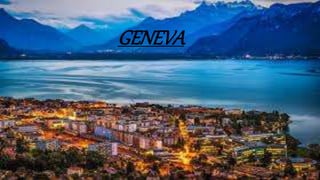
• Geneva is a city in Switzerland that lies at the southern tip of expansive Lac Léman (Lake Geneva). Surrounded by the Alps
and Jura mountains, the city has views of dramatic Mont Blanc.
• Headquarters of Europe’s United Nations and the Red Cross, it’s a global hub for diplomacy and banking. French influence
is widespread, from the language to gastronomy and bohemian districts like Carouge.
• Geneva is the second most populous city in Switzerland (after Zürich) and is the most populous city of Romandy, the
French-speaking part of Switzerland.
• Geneva is a global city, a financial center, and worldwide center for diplomacy due to the presence of
numerous international organizations, including the headquarters of many of the agencies of the United Nations and
the Red Cross.
• Geneva is the city that hosts the highest number of international organizations in the world
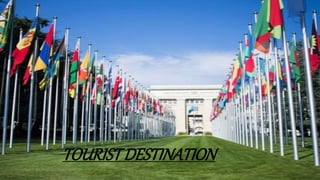
TOURISTDESTINATION
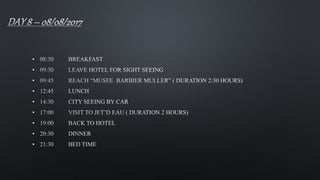
JET’DEAU
• The Jet d'Eau is a large fountain in Geneva, Switzerland, and is one of the city's most famous landmarks, being featured on
the city's official tourism web site and on the official logo for Geneva's hosting of the 2008 UEFA Championships.
• Situated at the point where Lake Geneva empties into the Rhône, it is visible throughout the city and from the air, even
when flying over Geneva at an altitude of 10 kilometres (33,000 ft).
• Five hundred litres of water per second are jetted to an altitude of 140 metres (460 ft) by two 500 kW pumps, operating at
2,400 V, consuming one megawatt of electricity.
• On 25 August 2016, the fountain celebrated its 125th anniversary at its present location.
• Since 2003, the fountain has operated during the day all year round, except in case of frost and particularly strong wind.
• It also operates in the evening between spring and autumn and is lit by a set of 21 lights totalling 9 kW
BARBIERMULLERMUSEUM
• Since 2003, the fountain has operated during the day all year round, except in case of frost and particularly strong wind. It
also operates in the evening between spring and autumn and is lit by a set of 21 lights totalling 9 kW.
• Its collection contains over 7,000 pieces and includes works of art from Tribal and Classical antiquity as well as sculptures,
fabrics and ornaments from "primitive" civilizations around the world.
• The museum has gained international acclaim through itinerant exhibitions, the loans to other museums, and the publication
of numerous catalogues and art books.
• goal is to preserve, study, and publish the collection begun by Josef Mueller in 1907 and carried on by his daughter
Monique and son-in-law Jean Paul Barbier-Mueller
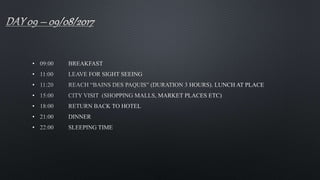
BAINSDESPAQUIS
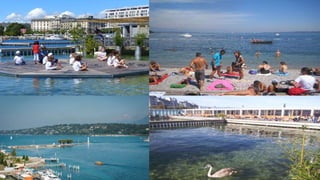
• Bains des Pâquis is an installation of public baths located on the mole of the right bank of Lake Geneva and protecting
the harbor of Geneva , at the height of the district of Pâquis .
• They house the headquarters of the Association of Users of Baths of the Pâquis (AUBP) and the Geneva Rescue .
• On Sundays and holidays the entrance was not chargeable and some hours were reserved exclusively for women.
• The first Baths of the Pâquis, built in wood, were born in 1872 on the jetty of the right bank - the inner side - of
the roadstead of Geneva .
• The association celebrates its 20th anniversary in 2008.
• The first weekend of September 2012, a four-year anniversary is celebrated under the name of "Jubilons 2012": the 80th
anniversary of the reconstruction of the Baths, the 25th anniversary of the creation of the Pâquis ) And 15 years of the
swimming race around the Paquis lighthouse
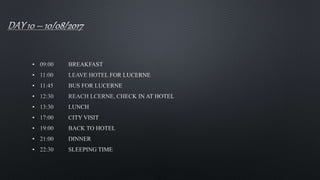
LUCERNE
HISTORY
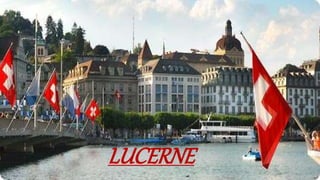
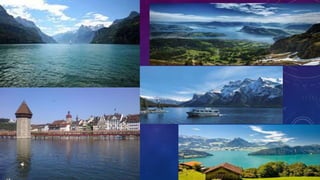
• Lucerne, a compact city in Switzerland known for its preserved medieval architecture, sits amid snowcapped mountains
on Lake Lucerne. Its colorful Altstadt (Old Town) is bordered on the north by 870m Museggmauer (Musegg Wall), a 14-
century rampart.
• The covered Kapellbrücke (Chapel Bridge), built in 1333, links the Aldstadt to the Reuss River's right bank.
• Lucerne is the most populous town in Central Switzerland, and a nexus of economics, transportation, culture, and media
of this region.
• The official language of Lucerne is (the Swiss variety of Standard) German, but the main spoken language is the local
variant of the Alemannic Swiss German dialect.
• The city's urban area consists of 17 municipalities and towns located in three different cantons with an overall population
of about 250,000 people.
• Lucerne has long been a destination for tourists. One of the city's famous landmarks is the Chapel Bridge , a wooden
bridge first erected in the 14th century.
TOURISTDESTINATION
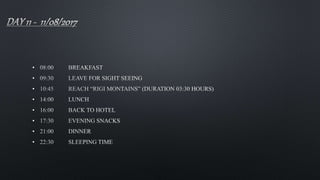
RIGI MOUNTAINS
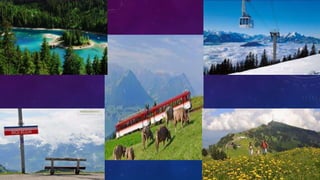
• The Rigi is a mountain massif of the Alps, located in Central Switzerland. The whole massif is almost entirely surrounded
by the water of three different water bodies: Lake Lucerne, Lake Zug and Lake Lauerz.
• The Rigi Kulm and other areas, such as the resort of Rigi Kaltbad, are served by Europe's oldest mountain railways,
the Rigi Railways. The whole area offers many activities such as skiing or sledging in the winter, and hiking in the
summer.
• The range is in the Schwyzer Alps, and is split between the cantons of Schwyz and Lucerne, although the main summit,
named Rigi Kulm, at 1,798 meters above sea level, lies within the canton of Schwyz.
• The name Rigi is from Old High German *rigî, from rîga "row, stripe, furrow", after the stratification that is clearly
visible on the north-side of the mountain. The name is first recorded in 1350 as Riginun.
LAKELUCERNE
• Lake Lucerne is a lake in central Switzerland and the fourth largest in the country. The lake has a complicated shape, with
several sharp bends and four arms.
• The lake has a complicated shape, with several sharp bends and four arms. It starts in the south-north bound Reuss Valley
between steep cliffs above the Urnersee from Flüelen towards Brunnen to the north before it makes a sharp bend to the
west where it continues into the Gersauer Beckenur arms.
• The entire lake has a total area of 114 km² (44 sq mi) at an elevation of 434 m (1,424 ft) a.s.l., and a maximum depth of
214 m (702 ft). Its volume is 11.8 km³. Much of the shoreline rises steeply into mountains up to 1,500 m above the lake,
resulting in many picturesque views including those of the mountains Rigi and Pilatus.
• It is a popular tourist destination, both for native Swiss and foreigners, and there are many hotels and resorts along the
shores.
• A 35 km commemorative walkway, the Swiss Path, was built around the Lake of Uri to celebrate the country's 700th
anniversary in 1991.
• The older name of the lake is Luzerner See ("Lake of Lucerne").
• The lake is navigable, and has formed an important part of Switzerland's transport system for many centuries, and at
least since the opening of the first track across the Gotthard Pass in 1230.
• The SGV serves 32 places along the shore of the lake, with interchange to both main line and mountain railways at
various points.
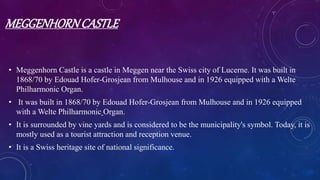
MEGGENHORNCASTLE
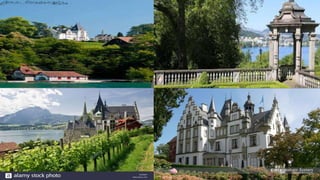
• Meggenhorn Castle is a castle in Meggen near the Swiss city of Lucerne. It was built in
1868/70 by Edouad Hofer-Grosjean from Mulhouse and in 1926 equipped with a Welte
Philharmonic Organ.
• It was built in 1868/70 by Edouad Hofer-Grosjean from Mulhouse and in 1926 equipped
with a Welte Philharmonic Organ.
• It is surrounded by vine yards and is considered to be the municipality's symbol. Today, it is
mostly used as a tourist attraction and reception venue.
• It is a Swiss heritage site of national significance.
I.A.T.A(International AirTransportAssociation
• IATA was founded by the airlines in 1945 founded by the airlines.
• It is a non-governmental organization and draw its legal existence from special Act of the Canadian parliament,
given Royal Assent in December 1945.
• Closely associated with ICAO.
• Airlines engaged directly in international operations are ACTIVE MEMBERS, while those offering domestic
services are ASSOCIATE MEMBERS.
AIMSOFIATA
 TO PROMOTE :
Safe, regular and economical air transport for benefit of the people of the world.
 TO PROVIDE :
Means for collaboration among the air transport enterprises. Engaged directly and indirectly in
international air transport services.
 TO CO-OPERATE :
With International Civil Aviation Organization and other International Organizations.
IATA’SROLEIN AIRTRANSPORT:
 IATAAnnual General Meeting n which all the active member have an equal vote.
 The Association has two main offices one in Montreal and the other in Geneva.
 Regional Directors are based in Singapore, Geneva, Buenos, Aires, Beirut, and Washington.
 Regional Technical Directors n Bangkok, Dakar, London, Nairobi, and Rio de janeriro.
 Clearing House began in January 1947.
 IATA Clearing House include over 300 airlines.
 Traffic conference are held once a year, Meetings to review fares for passenger tariffs are held in the
Autumn, and for those matters involving air cargo in the SPRING, Special meetings are held in the interim.
The Traffic Services work falls into three main areas :
 Passenger Services.
 Cargo Services.
 Airport Handling.
 For tracing mishandled luggage IATA/SITA, BAGTRAC system are used.
U.F.T.A.A(UniversalFederationofTravelAgent’sAssociation
 UFTAA was founded in 1966 by the merger of International Federation of Travel Agencies and the
Universal Organization of Travel Agents Association (UOTTA).
 Handling 70% of the International airline bookings.
 Apart from the full members, the Secretary General of UFTAA may register an individually any Travel
agency., which is
A member of national association in a country which does have an UFTAA member
OR
A member of a national association in a country which is a member of FTAA.
OR
Located in a country where there is no National Association.
AIMSOF UFTAA
 To unite and reinforce National Association and Organization of Travel Agents.
 To act as a sole representative of the agency profession at international and worldwide.
 To ensure the maximum possible cohesion, prestige, protection, and development in the economic, juridical,
and social sphere for the tourist trade economy.
Policy making body of UFTAA is the Annual General Assembly which decides on the general policy of the
Federation
The General Secretariat is in Monaco, France.
The official languages of UFTAA are English, French and Spanish.
ACTIVITESOF UFTAA
 UFTAA represents the interest of the travel agents on a permanent basic through international associations
such as IATA, IRU, UIC.
 The General Secretariat maintains a large library at the disposal of all UFTAA members.
 Publishes a monthly bulletin called “Courier”.
 UFFTA also provide an insurance policy to the traveling public known as “UFTAA EXTRA SRE”.
P.A.T.A(PacificAreaTravel Association
 PATA was founded in the year 1951 to stimulate interest in a pacific region as a vacationland.
 To develop, promote, facilitate travel to the many pacific destinations.
 PATA’S first conference was held in 1952.
 Headquarters established in San Francisco, U.S.A in 1953.
 PATA’S first Asian office was opened in Manila, Philippines in the year 1976.
 The PATA publication , “The Pacific Travel News” s relied upon by the wholesale and the retail agents and
“Pacific Area Destination Handbook” which compiles in a single volume all the data that is required for the
planning ang the sale of travel .
 There are 31 pacific destination.
PATAMEMBERSHIP
 PATA has 9 categories of membership:
1. Active Government
2. Associate Government
3. Active Carrier
4. Associate Carrier
5. Active Industry
6. Allied
7. Affiliated Allied
8. Associate
9. Sustaining.
India was an Associate Member since 1957 and became a full-fledged member in 1964.
T.A.A.I(Travel Agents Association Of India)
• Main objective is to safe guard and protect
the interest of its members.
• Registered Office is in Mumbai(BOM)
• Regional Office at Calcutta, Delhi, and
Chennai.
• Once a year they hold a conference at
some place in India to discuss the problem
connected with the industry.
I.C.A.O(INTERNATIONALCIVILAVIATIONORGANIZATION
 Created as a permanent body on April 4, 1947 for the purpose of promoting the safe and orderly development of civil
aviation throughout the world.
 The agency headquarters are in Montreal.
 The ICAO is composed of 185 member nations that meet once every three years at an assembly.
 33 member nations who are elected by the assembly on the basis of their relative importance in international air transport
and of geographical distribution.
OBECTIVESOFI.C.A.O
 Ensure the safe and orderly growth to international civil aviation throughout the world.
 Encourage the arts of the aircraft design and operation for the peaceful purpose.
 Encourage the development of the railways, airports and navigation facilities for international civil aviation association.
 Meets the needs of the people of the world for safe regular efficient, economical air transport.
 Prevent economic waste caused by unreasonable competition.
 Ensure that the rights of the contracting countries are full respected and have a fair opportunity to operate international
airlines.
 Avoid discrimination between contracting countries.
 Promote safety of flight in international air navigation.
 Promote generally the development of all aspects of international civil aeronautics.
CHICAGOCONVENTION
 In Chicago, in the year 1944 in an international meeting between various Government
 All countries active in international air transport, participated.
 Chicago convention governs relations between states on technical as well as commercial subjects connecting
International Air Transport such as :
1. Flying over territory of contracting states, customs, rules, of the air spread of disease.
2. Nationality of aircraft.
3. Facilitation
4. Documents
5. International standards and practices including those for carriage of dangerous our goods.
6. Statistics, Finance, Technical assistance etc.
WARSAWCONVENTION
 Created in 1929.
 Specified the conditions under which airline could be liable for the death or injury to passengers.
 Loss or damage to baggage.
 All legal aspects of the relationship between airlines and passengers.
 “Condition of Contract” which is printed on the passenger tickets include liability which is not handled by the convention.
 Convention limits for loss or damage to checked n baggage to about $9 per pound or approx. $400 for unchecked hand
baggage. Higher figures apply on US flights.
 Compensation for injury or death $10,000 or $20,000 on flights only outside the U.S.
 Flight involving a stop in the U.S has a maximum liability of $75,000 including legal costs.
 Agreements such as Hague Protocol and the Montreal Agreement increase the maximum liability of the airlines.
MONTREALCONVENTION
 Montreal convention adopted by meeting by ICAO member states in 1999.
 Founded in Montreal , Canada effective from 4 November 2003 .
 Number of Members 109.
 Common Languages Used are English, Arabic, Chinese, French, Russian and Spanish.
 The Convention attempts to re-establish uniformity and predictability of rules relating to the international carriage of
passenger, baggage and cargo.
 The Montreal Convention was brought about mainly to amend liabilities to be paid to families for death or injury whilst
on board an aircraft.
 Under the Montreal Convention, air carriers are strictly liable for proven damages up to 100,000 special drawing
rights (SDR), a mix of currency values established by the International Monetary Fund.
 Where damages of more than 113,100 SDR are sought, the airline may avoid liability by proving that the accident which
caused the injury or death was not due to their negligence or was attributable to the negligence of a third party.
FREEDOMS OFTHEAIR
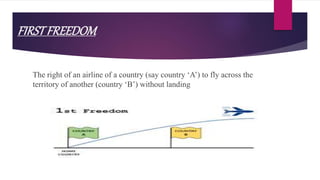
FIRSTFREEDOM
The right of an airline of a country (say country ‘A’) to fly across the
territory of another (country ‘B’) without landing
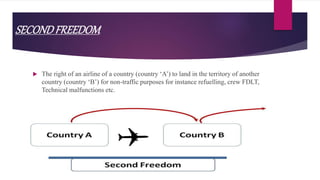
SECONDFREEDOM
 The right of an airline of a country (country ‘A’) to land in the territory of another
country (country ‘B’) for non-traffic purposes for instance refuelling, crew FDLT,
Technical malfunctions etc.
THIRDFREEDOM
 The right of an airline of a country (country ‘A’) to set down in another country
(country ‘B’) passengers, mail, and cargo coming from the home country of the
airline (country ‘B’)
FOURTHFREEDOM
 The right of an airline of a country (country ‘A’) to pick up in another country
(country ‘B’) passengers, Mail, and cargo designated for the home country of the
airline (country 'A’)
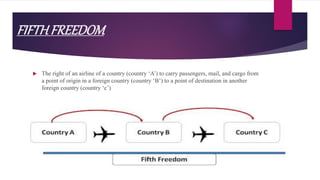
FIFTHFREEDOM
 The right of an airline of a country (country ‘A’) to carry passengers, mail, and cargo from
a point of origin in a foreign country (country ‘B’) to a point of destination in another
foreign country (country ‘c’)
•
•
•
•
•
•
•
•
•
•
•
•
•
•
•
•
•
•
•
•
•
•
•
•
•
•
•
•
•
•
•
•
•
•
•
•
•
•
•
•
•
•
•
•
•
•
•
•
•
•
•
•
•
•
•
•
•
•
•
•
•
•
•
•
•
•
•
•
•
•
•
•
•
•
•
•
•
•
•
•
•
•
•
•
•
•
•
•
•
•
•
•
•
•
•
•
•
•
•
•
•
•
•
•
•
•
•
•
z
DOCMENTSREQUIREDTO VISITSWITZERLAND
 Passport and copies of your previous visas – valid for at least 3 months beyond return
date – are required. Your passport must have at least two blank pages.
 Visa
 Invitation letter with the address and phone number from family member or sponsor – if
applicable
 Bank statement of the last 6 months
 Passport copies
 Carry a warm clothes.
z
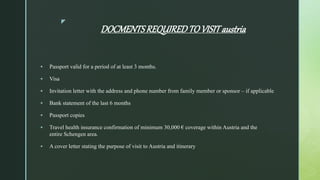
DOCMENTSREQUIREDTO VISIT austria
 Passport valid for a period of at least 3 months.
 Visa
 Invitation letter with the address and phone number from family member or sponsor – if applicable
 Bank statement of the last 6 months
 Passport copies
 Travel health insurance confirmation of minimum 30,000 € coverage within Austria and the
entire Schengen area.
 A cover letter stating the purpose of visit to Austria and itinerary
zCOMPAREYOURPACKAGEWITHOTHERTOUROPERATER
PACKAGE
OURPACKAGE
 All the transport ways(Air, Land, Only the Air
transport is been Water) includes in the
package to included in the package which will
make it a wonderful experience.
 All types of cuisine are included in the
package.
 Our package includes beach activity, site
seeing, shows, shopping etc.
 Our flight is excellent and time saving.
COMPETITORSPACKAGE
 Only the air ticket is included n the package
which will increase the air fare and make the
package expensive.
 Cuisine are not included in the package.
 Package include only shopping.
 Flight routing is very tiring in the pacakage.
z
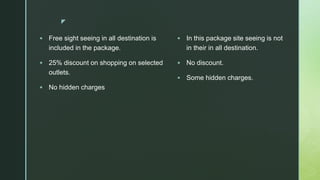
 Free sight seeing in all destination is
included in the package.
 25% discount on shopping on selected
outlets.
 No hidden charges
 In this package site seeing is not
in their in all destination.
 No discount.
 Some hidden charges.
z
FREEDOMOF AIRAPPLYON THIS TOUR
 FIRSTFREEDOM
 FOURTHFREEDOM
 FIFTHFREEDOM
z
TOTAL EXPENSES
 AIR TICKET ---- 71106
 ACCOMODATION ---- 115000
 RAIL & BUS TICKET ----- 3000
 SHOPPING WITH 25% DISCOUNT --- 5000 WITH 25% (1250)
TAX ------ 10%
TOTAL ------- 192856
211641.6
CONCLUSION
With the help of this assignment, I came to know about the various
countries, cities, attractions, rules, regulations, airlines and so on. This
assignment made me to think about the various scopes and
possibilities of the air-travel industry. I learned how to issue a ticket,
about international travel organizations, freedoms of air, travel
itinerary preparation, flight schedule and soon. I hereby declare that
this assignment is true and best of my knowledge.
THANK YOU……!

Travel ppt frankfinn

  • 1.
  • 2.
    INTRODUCTION: NAME : FAISALANSARI BATCH: V1 CENTER : GHATKOPAR(EAST),MUMBAI COURSE : HTCS MODULE : TRAVEL
  • 3.
    ACKNOWLEDGEMENT: At the onset,I would like to thank the Almighty God without which this presentation would not have been possible and . I also like to thanks to my trainer MR DOMNIC D’SOUZA SIR who gave me this golden opportunity to do this presentation I also thanks to all my friends for their valuable co-operation during the period of presentation.
  • 4.
  • 5.
  • 6.
    AUSTRIA • Austria isa German-speaking country in Central Europe, characterized by mountain villages, baroque architecture, Imperial history and rugged Alpine terrain. Vienna, its Danube River capital, is home to the Schönbrunn and Hofburg palaces. It has counted Mozart, Strauss and Freud among its residents. The country’s other notable regions include the northern Bohemian Forest, Traunsee Lake and eastern hillside vineyards. • Capital : Vienna • Currency : Euro • Anthem : Land der berge, Land am strome. • Language : Austrian german. • Government : Federal parliamentary repbuplic.
  • 7.
    History • It isbordered by the Czech Republic and Germany to the north, Hungary and Slovakia to the east, Slovenia and Italy to the south, and Switzerland and Liechtenstein to the west. • The territory of Austria covers 83,879 km2 (32,386 sq mi). The terrain is highly mountainous, lying within the Alps; only 32% of the country is below 500 m (1,640 ft), and its highest point is 3,798 m (12,461 ft.). • The First Austrian Republic was established in 1919. • Austria lies between latitudes 46° and 49° N, and longitudes 9° and 18° E. • The greater part of Austria lies in the cool/temperate climate zone, where humid westerly winds predominate. • Although Austria is cold in the winter (−10 – 0 °C).
  • 8.
  • 9.
  • 10.
    VIENNA • Vienna, Austria’scapital, lies in the country’s east on the Danube River. • Its artistic and intellectual legacy was shaped by residents including Mozart, Beethoven and Sigmund Freud. • The city is also known for its Imperial palaces, including Schönbrunn, the Habsburgs’ summer residence. • In the Museums Quartier district, historic and contemporary buildings display works by Egon Schiele, Gustav Klimt and other artists. • Until the beginning of the 20th century, it was the largest German-speaking city in the world, and before the splitting of the Austro-Hungarian Empire in World War I, the city had 2 million inhabitants. • In 2001, the city centre was designated a UNESCO World Heritage Site.
  • 11.
    CITYOF VIENNA UNESCOWorld HeritageSite. Official Name : Historic centre of Vienna. Type : Cultural Criteria : ii, iv, vi Designated : 2001 Reference No : 1033 UNESCO Region : Europe and North America.
  • 12.
  • 13.
    VOLKSGARTEN • The Volksgartenis a public park in the Innere Stadt first district of Vienna, Austria. • The Volksgarten was opened to the public in 1823. • The garden, which is part of the Hofburg Palace, was laid out by Ludwig Remy in 1821. The park was built over the city fortifications that were destroyed by Napoleon in 1809. • The Volksgarten area was originally used for fortifications. Between 1596 and 1597, a fortress wall was built on the eastern side of park. • Between 1817 and 1821, the area near Ballhausplatz square was converted to gardens originally intended for a private garden for the archdukes. • These plans were changed through a proposal by the court garden administration to turn the area into the first public park in the city. • On 1 March 1823, the park was officially opened. Starting in 1825, the name Volksgarten was commonly used. • In 1862, the gardens were extended toward Ringstraße after the city moat had been filled in.
  • 15.
    DANUBEAUENNATIONALPARK • The Danube-AuenNational Park covers 93 square kilometres in Vienna and Lower Austria and is one of the largest remaining floodplains of the Danube in Middle Europe. • The German word Aue means "river island, wetland, floodplain, riparian woodland. • The Danube-Auen National Park protects a large area of lowland forests, meadows, wetlands, and other riparian habitat along the Danube just downstream of Vienna. • The park was designated an IUCN category II national park and spans the areas of Vienna. • Until the 19th century the Danube was an untamed river. • In the national park area there are more than 700 species of higher plants, more than 30 mammals, 100 species of breeding birds, 8 reptiles, 13 amphibian species, and around 50 species of fish. • Established on October 27, 1996.
  • 17.
    SEEGROTTE • The Seegrotte,near is an underground cave system with a large grotto located under a former gypsum mine. • It was closed in 1912 after the mine flooded with 20 million litters of water. • It became a tourist attraction after 1930 and has been one ever since, with the exception of World War II. • The lake is 60 meters below ground, the water surface is 6200 m² and pumps are used to keep the water level down. • Visitors can tour the old mine and take a boat ride across the underground lake.
  • 19.
  • 20.
    HISTORY • Salzburg isan Austrian city on the border of Germany, with views of the Eastern Alps. • The city is divided by the Salzach River, with medieval and baroque buildings of the pedestrian Altstadt (Old City) on its left bank, facing the 19th-century Neustadt (New City) on its right. • The Altstadt birthplace of famed composer Mozart is preserved as a museum displaying his childhood instruments. • It was listed as a UNESCO World Heritage Site in 1997. • The city has three universities and a large population of students. Tourists also visit Salzburg to tour the historic centre and the scenic Alpine surroundings. • The name Salzburg means "Salt Castle" . The name derives from the barges carrying salt on the Salzach River, which were subject to a toll in the 8th century as was customary for many communities and cities on European rivers.
  • 21.
    • Salzburg ispart of the temperate zone. • Salzburg would be a four-season oceanic climate with significant temperature differences between seasons. • Due to the location at the northern rim of the Alps, the amount of precipitation is comparatively high, mainly in the summer months. • Salzburg is a tourist favourite, with the number of tourists outnumbering locals by a large margin in peak times. In addition to Mozart's birthplace and other notable places.
  • 22.
  • 23.
    HOUSEOF NATURE • TheHouse of Nature (founded in 1924) is the local natural history museum of Salzburg. • It houses a large exhibition about all aspects of nature, a Science Center, an aquarium and a reptile zoo. • With our exhibitions we attempt to inspire our visitors, to stimulate their interest in the natural world and to enhance their understanding for natural processes. • As a nature competence centre the House of Nature plays an important role in the scientific exploration and documentation of nature in Salzburg. • In the Biodiversity Database at the Haus der Natur, about 1,100,000 records are recorded for the distribution of flowering plants , vertebrates , butterflies , beetles and other animal and plant groups in the province of Salzburg ( Austria ) and neighbouring regions.
  • 25.
    PANORAMA MUSEUM • ThePanorama Museum Salzburg belongs to the Salzburg Museum and is located in the New Residenz in the old town of Salzburg. • The Panoramagemälde shows the city of Salzburg and its surroundings around 1825 from the fortress Hohensalzburg . It is the world's only remaining historical city panorama. • From 1875 to 1937 the Panoramagemälde was located in its own exhibition pavilion in the spa gardens of the city of Salzburg . It was then rolled up and only put up again in 1977 in the then newly built casino building on the Mönchsberg. • In 2001, the panorama had to be removed because of the demolition of the building. In 2003, he moved to the Neue Residenz and was subjected to a comprehensive restoration for two years. • On 6 October 2005 , the Panorama Museum was officially inaugurated as part of the Salzburg Museum . • In the Panorama Museum, 24 Cosmo gorses are displayed around the approximately 25-meter long and almost 5-meter-high round paintings . These large paintings with depictions of landscapes and cities were part of Johann Michael Sattler.
  • 27.
    KAPUZINBERG • Kapuzinerberg isa hill on the eastern bank of Salzach river in Salzburg, Salzburgerland, Austria. • It is elevated 640 meters above sea level. • It is home to a Capucines cloister built in 1599-1605 on the site of a medieval fortress, the "Trompeterschlössl". Earliest human settlements on the eastern slope of Kapuzinerberg date back to Neolithic period. Big prehistoric settlements on mountain date back to 1100 B.C. • On the way of the Linzergasse to the monastery are standing 13 oratories with the way of the cross, which were built up between 1736 and 1744.
  • 29.
  • 30.
    HISTORY • Switzerland isa mountainous Central European country, home to numerous lakes, villages and the high peaks of the Alps. • Its cities contain medieval quarters, with landmarks like capital Bern’s Zytglogge clock tower and Lucerne’s wooden chapel bridge. • The country is also known for its ski resorts and hiking trails. Banking and finance are key industries, and Swiss watches and chocolate are world renowned. CAPITAL : BERN LANGUAGES : GERMAN, FRENCH, ITALIAN, ROMANSH. CURRENCY : SWISS FRANC (CHF) ANTHEM : "One for all, all for one”. GOVERNMENT : FEDERAL SEMI-DIRECT DEMOCRACY. Switzerland is one of the most developed countries in the world, with the highest nominal wealth per adult and the eighth-highest per capita gross domestic product according to the IMF. Switzerland ranks at or near the top globally in several metrics of national performance, including government transparency, civil liberties, quality of life, economic competitiveness, and human development. Zürich and Geneva have each been ranked among the top cities in the world in terms of quality of life, with the former ranked second globally, according to Mercer.
  • 31.
    • The Englishname Switzerland is a compound containing Switzer, an obsolete term for the Swiss, which was in use during the 16th to 19th centuries. • The oldest traces of hominid existence in Switzerland date back about 150,000 years. • The Swiss climate is generally temperate, but can vary greatly between the localities, from glacial conditions on the mountaintops to the often pleasant near Mediterranean climate at Switzerland's southern tip. There are some valley areas in the southern part of Switzerland where some cold-hardy palm trees are found. Summers tend to be warm and humid at times with periodic rainfall so they are ideal for pastures and grazing. • Switzerland's ecosystems can be particularly fragile, because the many delicate valleys separated by high mountains often form unique ecologies. The mountainous regions themselves are also vulnerable, with a rich range of plants not found at other altitudes, and experience some pressure from visitors and grazing. The climatic, geological and topographical conditions of the alpine region make for a very fragile ecosystem that is particularly sensitive to climate change.
  • 32.
  • 33.
  • 34.
    HISTORY • Geneva isa city in Switzerland that lies at the southern tip of expansive Lac Léman (Lake Geneva). Surrounded by the Alps and Jura mountains, the city has views of dramatic Mont Blanc. • Headquarters of Europe’s United Nations and the Red Cross, it’s a global hub for diplomacy and banking. French influence is widespread, from the language to gastronomy and bohemian districts like Carouge. • Geneva is the second most populous city in Switzerland (after Zürich) and is the most populous city of Romandy, the French-speaking part of Switzerland. • Geneva is a global city, a financial center, and worldwide center for diplomacy due to the presence of numerous international organizations, including the headquarters of many of the agencies of the United Nations and the Red Cross. • Geneva is the city that hosts the highest number of international organizations in the world
  • 35.
  • 36.
    JET’DEAU • The Jetd'Eau is a large fountain in Geneva, Switzerland, and is one of the city's most famous landmarks, being featured on the city's official tourism web site and on the official logo for Geneva's hosting of the 2008 UEFA Championships. • Situated at the point where Lake Geneva empties into the Rhône, it is visible throughout the city and from the air, even when flying over Geneva at an altitude of 10 kilometres (33,000 ft). • Five hundred litres of water per second are jetted to an altitude of 140 metres (460 ft) by two 500 kW pumps, operating at 2,400 V, consuming one megawatt of electricity. • On 25 August 2016, the fountain celebrated its 125th anniversary at its present location. • Since 2003, the fountain has operated during the day all year round, except in case of frost and particularly strong wind. • It also operates in the evening between spring and autumn and is lit by a set of 21 lights totalling 9 kW
  • 38.
    BARBIERMULLERMUSEUM • Since 2003,the fountain has operated during the day all year round, except in case of frost and particularly strong wind. It also operates in the evening between spring and autumn and is lit by a set of 21 lights totalling 9 kW. • Its collection contains over 7,000 pieces and includes works of art from Tribal and Classical antiquity as well as sculptures, fabrics and ornaments from "primitive" civilizations around the world. • The museum has gained international acclaim through itinerant exhibitions, the loans to other museums, and the publication of numerous catalogues and art books. • goal is to preserve, study, and publish the collection begun by Josef Mueller in 1907 and carried on by his daughter Monique and son-in-law Jean Paul Barbier-Mueller
  • 40.
    BAINSDESPAQUIS • Bains desPâquis is an installation of public baths located on the mole of the right bank of Lake Geneva and protecting the harbor of Geneva , at the height of the district of Pâquis . • They house the headquarters of the Association of Users of Baths of the Pâquis (AUBP) and the Geneva Rescue . • On Sundays and holidays the entrance was not chargeable and some hours were reserved exclusively for women. • The first Baths of the Pâquis, built in wood, were born in 1872 on the jetty of the right bank - the inner side - of the roadstead of Geneva . • The association celebrates its 20th anniversary in 2008. • The first weekend of September 2012, a four-year anniversary is celebrated under the name of "Jubilons 2012": the 80th anniversary of the reconstruction of the Baths, the 25th anniversary of the creation of the Pâquis ) And 15 years of the swimming race around the Paquis lighthouse
  • 42.
  • 43.
    HISTORY • Lucerne, acompact city in Switzerland known for its preserved medieval architecture, sits amid snowcapped mountains on Lake Lucerne. Its colorful Altstadt (Old Town) is bordered on the north by 870m Museggmauer (Musegg Wall), a 14- century rampart. • The covered Kapellbrücke (Chapel Bridge), built in 1333, links the Aldstadt to the Reuss River's right bank. • Lucerne is the most populous town in Central Switzerland, and a nexus of economics, transportation, culture, and media of this region. • The official language of Lucerne is (the Swiss variety of Standard) German, but the main spoken language is the local variant of the Alemannic Swiss German dialect. • The city's urban area consists of 17 municipalities and towns located in three different cantons with an overall population of about 250,000 people. • Lucerne has long been a destination for tourists. One of the city's famous landmarks is the Chapel Bridge , a wooden bridge first erected in the 14th century.
  • 44.
  • 45.
    RIGI MOUNTAINS • TheRigi is a mountain massif of the Alps, located in Central Switzerland. The whole massif is almost entirely surrounded by the water of three different water bodies: Lake Lucerne, Lake Zug and Lake Lauerz. • The Rigi Kulm and other areas, such as the resort of Rigi Kaltbad, are served by Europe's oldest mountain railways, the Rigi Railways. The whole area offers many activities such as skiing or sledging in the winter, and hiking in the summer. • The range is in the Schwyzer Alps, and is split between the cantons of Schwyz and Lucerne, although the main summit, named Rigi Kulm, at 1,798 meters above sea level, lies within the canton of Schwyz. • The name Rigi is from Old High German *rigî, from rîga "row, stripe, furrow", after the stratification that is clearly visible on the north-side of the mountain. The name is first recorded in 1350 as Riginun.
  • 47.
    LAKELUCERNE • Lake Lucerneis a lake in central Switzerland and the fourth largest in the country. The lake has a complicated shape, with several sharp bends and four arms. • The lake has a complicated shape, with several sharp bends and four arms. It starts in the south-north bound Reuss Valley between steep cliffs above the Urnersee from Flüelen towards Brunnen to the north before it makes a sharp bend to the west where it continues into the Gersauer Beckenur arms. • The entire lake has a total area of 114 km² (44 sq mi) at an elevation of 434 m (1,424 ft) a.s.l., and a maximum depth of 214 m (702 ft). Its volume is 11.8 km³. Much of the shoreline rises steeply into mountains up to 1,500 m above the lake, resulting in many picturesque views including those of the mountains Rigi and Pilatus. • It is a popular tourist destination, both for native Swiss and foreigners, and there are many hotels and resorts along the shores. • A 35 km commemorative walkway, the Swiss Path, was built around the Lake of Uri to celebrate the country's 700th anniversary in 1991. • The older name of the lake is Luzerner See ("Lake of Lucerne").
  • 48.
    • The lakeis navigable, and has formed an important part of Switzerland's transport system for many centuries, and at least since the opening of the first track across the Gotthard Pass in 1230. • The SGV serves 32 places along the shore of the lake, with interchange to both main line and mountain railways at various points.
  • 50.
    MEGGENHORNCASTLE • Meggenhorn Castleis a castle in Meggen near the Swiss city of Lucerne. It was built in 1868/70 by Edouad Hofer-Grosjean from Mulhouse and in 1926 equipped with a Welte Philharmonic Organ. • It was built in 1868/70 by Edouad Hofer-Grosjean from Mulhouse and in 1926 equipped with a Welte Philharmonic Organ. • It is surrounded by vine yards and is considered to be the municipality's symbol. Today, it is mostly used as a tourist attraction and reception venue. • It is a Swiss heritage site of national significance.
  • 52.
    I.A.T.A(International AirTransportAssociation • IATAwas founded by the airlines in 1945 founded by the airlines. • It is a non-governmental organization and draw its legal existence from special Act of the Canadian parliament, given Royal Assent in December 1945. • Closely associated with ICAO. • Airlines engaged directly in international operations are ACTIVE MEMBERS, while those offering domestic services are ASSOCIATE MEMBERS.
  • 53.
    AIMSOFIATA  TO PROMOTE: Safe, regular and economical air transport for benefit of the people of the world.  TO PROVIDE : Means for collaboration among the air transport enterprises. Engaged directly and indirectly in international air transport services.  TO CO-OPERATE : With International Civil Aviation Organization and other International Organizations.
  • 54.
    IATA’SROLEIN AIRTRANSPORT:  IATAAnnualGeneral Meeting n which all the active member have an equal vote.  The Association has two main offices one in Montreal and the other in Geneva.  Regional Directors are based in Singapore, Geneva, Buenos, Aires, Beirut, and Washington.  Regional Technical Directors n Bangkok, Dakar, London, Nairobi, and Rio de janeriro.  Clearing House began in January 1947.  IATA Clearing House include over 300 airlines.  Traffic conference are held once a year, Meetings to review fares for passenger tariffs are held in the Autumn, and for those matters involving air cargo in the SPRING, Special meetings are held in the interim.
  • 55.
    The Traffic Serviceswork falls into three main areas :  Passenger Services.  Cargo Services.  Airport Handling.  For tracing mishandled luggage IATA/SITA, BAGTRAC system are used.
  • 56.
    U.F.T.A.A(UniversalFederationofTravelAgent’sAssociation  UFTAA wasfounded in 1966 by the merger of International Federation of Travel Agencies and the Universal Organization of Travel Agents Association (UOTTA).  Handling 70% of the International airline bookings.  Apart from the full members, the Secretary General of UFTAA may register an individually any Travel agency., which is A member of national association in a country which does have an UFTAA member OR A member of a national association in a country which is a member of FTAA. OR Located in a country where there is no National Association.
  • 57.
    AIMSOF UFTAA  Tounite and reinforce National Association and Organization of Travel Agents.  To act as a sole representative of the agency profession at international and worldwide.  To ensure the maximum possible cohesion, prestige, protection, and development in the economic, juridical, and social sphere for the tourist trade economy. Policy making body of UFTAA is the Annual General Assembly which decides on the general policy of the Federation The General Secretariat is in Monaco, France. The official languages of UFTAA are English, French and Spanish.
  • 58.
    ACTIVITESOF UFTAA  UFTAArepresents the interest of the travel agents on a permanent basic through international associations such as IATA, IRU, UIC.  The General Secretariat maintains a large library at the disposal of all UFTAA members.  Publishes a monthly bulletin called “Courier”.  UFFTA also provide an insurance policy to the traveling public known as “UFTAA EXTRA SRE”.
  • 59.
    P.A.T.A(PacificAreaTravel Association  PATAwas founded in the year 1951 to stimulate interest in a pacific region as a vacationland.  To develop, promote, facilitate travel to the many pacific destinations.  PATA’S first conference was held in 1952.  Headquarters established in San Francisco, U.S.A in 1953.  PATA’S first Asian office was opened in Manila, Philippines in the year 1976.  The PATA publication , “The Pacific Travel News” s relied upon by the wholesale and the retail agents and “Pacific Area Destination Handbook” which compiles in a single volume all the data that is required for the planning ang the sale of travel .  There are 31 pacific destination.
  • 60.
    PATAMEMBERSHIP  PATA has9 categories of membership: 1. Active Government 2. Associate Government 3. Active Carrier 4. Associate Carrier 5. Active Industry 6. Allied 7. Affiliated Allied 8. Associate 9. Sustaining. India was an Associate Member since 1957 and became a full-fledged member in 1964.
  • 61.
    T.A.A.I(Travel Agents AssociationOf India) • Main objective is to safe guard and protect the interest of its members. • Registered Office is in Mumbai(BOM) • Regional Office at Calcutta, Delhi, and Chennai. • Once a year they hold a conference at some place in India to discuss the problem connected with the industry.
  • 62.
    I.C.A.O(INTERNATIONALCIVILAVIATIONORGANIZATION  Created asa permanent body on April 4, 1947 for the purpose of promoting the safe and orderly development of civil aviation throughout the world.  The agency headquarters are in Montreal.  The ICAO is composed of 185 member nations that meet once every three years at an assembly.  33 member nations who are elected by the assembly on the basis of their relative importance in international air transport and of geographical distribution.
  • 63.
    OBECTIVESOFI.C.A.O  Ensure thesafe and orderly growth to international civil aviation throughout the world.  Encourage the arts of the aircraft design and operation for the peaceful purpose.  Encourage the development of the railways, airports and navigation facilities for international civil aviation association.  Meets the needs of the people of the world for safe regular efficient, economical air transport.  Prevent economic waste caused by unreasonable competition.  Ensure that the rights of the contracting countries are full respected and have a fair opportunity to operate international airlines.  Avoid discrimination between contracting countries.  Promote safety of flight in international air navigation.  Promote generally the development of all aspects of international civil aeronautics.
  • 64.
    CHICAGOCONVENTION  In Chicago,in the year 1944 in an international meeting between various Government  All countries active in international air transport, participated.  Chicago convention governs relations between states on technical as well as commercial subjects connecting International Air Transport such as : 1. Flying over territory of contracting states, customs, rules, of the air spread of disease. 2. Nationality of aircraft. 3. Facilitation 4. Documents 5. International standards and practices including those for carriage of dangerous our goods. 6. Statistics, Finance, Technical assistance etc.
  • 65.
    WARSAWCONVENTION  Created in1929.  Specified the conditions under which airline could be liable for the death or injury to passengers.  Loss or damage to baggage.  All legal aspects of the relationship between airlines and passengers.  “Condition of Contract” which is printed on the passenger tickets include liability which is not handled by the convention.  Convention limits for loss or damage to checked n baggage to about $9 per pound or approx. $400 for unchecked hand baggage. Higher figures apply on US flights.  Compensation for injury or death $10,000 or $20,000 on flights only outside the U.S.  Flight involving a stop in the U.S has a maximum liability of $75,000 including legal costs.  Agreements such as Hague Protocol and the Montreal Agreement increase the maximum liability of the airlines.
  • 66.
    MONTREALCONVENTION  Montreal conventionadopted by meeting by ICAO member states in 1999.  Founded in Montreal , Canada effective from 4 November 2003 .  Number of Members 109.  Common Languages Used are English, Arabic, Chinese, French, Russian and Spanish.  The Convention attempts to re-establish uniformity and predictability of rules relating to the international carriage of passenger, baggage and cargo.  The Montreal Convention was brought about mainly to amend liabilities to be paid to families for death or injury whilst on board an aircraft.  Under the Montreal Convention, air carriers are strictly liable for proven damages up to 100,000 special drawing rights (SDR), a mix of currency values established by the International Monetary Fund.  Where damages of more than 113,100 SDR are sought, the airline may avoid liability by proving that the accident which caused the injury or death was not due to their negligence or was attributable to the negligence of a third party.
  • 67.
  • 68.
    FIRSTFREEDOM The right ofan airline of a country (say country ‘A’) to fly across the territory of another (country ‘B’) without landing
  • 69.
    SECONDFREEDOM  The rightof an airline of a country (country ‘A’) to land in the territory of another country (country ‘B’) for non-traffic purposes for instance refuelling, crew FDLT, Technical malfunctions etc.
  • 70.
    THIRDFREEDOM  The rightof an airline of a country (country ‘A’) to set down in another country (country ‘B’) passengers, mail, and cargo coming from the home country of the airline (country ‘B’)
  • 71.
    FOURTHFREEDOM  The rightof an airline of a country (country ‘A’) to pick up in another country (country ‘B’) passengers, Mail, and cargo designated for the home country of the airline (country 'A’)
  • 72.
    FIFTHFREEDOM  The rightof an airline of a country (country ‘A’) to carry passengers, mail, and cargo from a point of origin in a foreign country (country ‘B’) to a point of destination in another foreign country (country ‘c’)
  • 74.
  • 75.
  • 76.
  • 77.
  • 78.
  • 79.
  • 80.
  • 81.
  • 82.
  • 83.
  • 84.
  • 85.
  • 86.
  • 87.
    z DOCMENTSREQUIREDTO VISITSWITZERLAND  Passportand copies of your previous visas – valid for at least 3 months beyond return date – are required. Your passport must have at least two blank pages.  Visa  Invitation letter with the address and phone number from family member or sponsor – if applicable  Bank statement of the last 6 months  Passport copies  Carry a warm clothes.
  • 88.
    z DOCMENTSREQUIREDTO VISIT austria Passport valid for a period of at least 3 months.  Visa  Invitation letter with the address and phone number from family member or sponsor – if applicable  Bank statement of the last 6 months  Passport copies  Travel health insurance confirmation of minimum 30,000 € coverage within Austria and the entire Schengen area.  A cover letter stating the purpose of visit to Austria and itinerary
  • 89.
    zCOMPAREYOURPACKAGEWITHOTHERTOUROPERATER PACKAGE OURPACKAGE  All thetransport ways(Air, Land, Only the Air transport is been Water) includes in the package to included in the package which will make it a wonderful experience.  All types of cuisine are included in the package.  Our package includes beach activity, site seeing, shows, shopping etc.  Our flight is excellent and time saving. COMPETITORSPACKAGE  Only the air ticket is included n the package which will increase the air fare and make the package expensive.  Cuisine are not included in the package.  Package include only shopping.  Flight routing is very tiring in the pacakage.
  • 90.
    z  Free sightseeing in all destination is included in the package.  25% discount on shopping on selected outlets.  No hidden charges  In this package site seeing is not in their in all destination.  No discount.  Some hidden charges.
  • 91.
    z FREEDOMOF AIRAPPLYON THISTOUR  FIRSTFREEDOM  FOURTHFREEDOM  FIFTHFREEDOM
  • 92.
    z TOTAL EXPENSES  AIRTICKET ---- 71106  ACCOMODATION ---- 115000  RAIL & BUS TICKET ----- 3000  SHOPPING WITH 25% DISCOUNT --- 5000 WITH 25% (1250) TAX ------ 10% TOTAL ------- 192856 211641.6
  • 93.
    CONCLUSION With the helpof this assignment, I came to know about the various countries, cities, attractions, rules, regulations, airlines and so on. This assignment made me to think about the various scopes and possibilities of the air-travel industry. I learned how to issue a ticket, about international travel organizations, freedoms of air, travel itinerary preparation, flight schedule and soon. I hereby declare that this assignment is true and best of my knowledge.
  • 94.