Video-Based Labs
                             for Introductory Physics
                                      Courses
                                 Analyzing and Graphing Motion on Video

                                       Robert J. Beichner and David S. Abbott


Video-based labs (VBL) are a powerful            Unfortunately, studies indicate that    the axes, creating a graph of vertical
tool for improving student understanding      students do not share the vocabulary,      position versus horizontal position (y
of one of the most difficult and important    nor are they able to easily comprehend     vs. x) rather than a graph of velocity
topics in physics: graphs. This article de-   graphs (Beichner 1994; McDermott,          versus time (v vs. t). Unfortunately,
scribes common student graphing difficul-     Rosenquist, and van Zee 1987; van          the “graph as picture” error can lead
ties, the history of VBL, techniques for                                                 to a correct position versus time graph.
                                              Zee and McDermott 1987). A valuable
improving student understanding of
                                              device for students facing these ob-       This situation will occur whenever the
graphs, and software for acquiring and
analyzing video data.                         stacles is a video-based lab (VBL). The    horizontal motion of the object is a
                                              link between graphing and kinematics       linear function of time, making the
                                              makes video-based motion labs a par-       graph as picture error difficult to de-


K
        inematics, the study of motion,       ticularly powerful tool for combating      tect. Although this error is probably
        is critical to understanding          some of the most common difficulties       peculiar to kinematics, it indicates a
        physics. For that reason it is        students encounter when they inter-        general deficit in graphing skills,
among the first topics covered in in-         pret graphs.                               namely, students are not aware of the
troductory physics classes and it acts as        The most frequently confronted          abstract nature of graphing as a way to
a foundation for much of the rest of          problem when working with kinemat-         represent data of a concrete situation.
the course.                                   ics graphs is the belief that a graph is      Many students have trouble deter-
    Graphs are an important element in        some form of photographic-like repli-      mining slope. One critical misinterpre-
the study of kinematics. Interpreting         cation of the motion event. The            tation is referred to as “slope/height”
the large amounts of data displayed on        “graph as picture” error might occur
graphs is critical to making sense of the     when a student is asked to draw a ve-
field. Because features on kinematics         locity or acceleration versus time graph   Robert J. Beichner is an associate pro-
graphs, such as slopes and areas, are         of a bicycle rolling down a hill and       fessor of physics and David S. Abbott
directly linked to observable physical        over a small bump. The resulting           is a National Science Foundation
quantities such as distance traveled,         drawing often duplicates the physical      Graduate Fellow, physics department,
speed, and acceleration, kinematics           configuration of the given motion          North Carolina State University, Ra-
graphs are used as objects of study and       event, right down to the bump at the       leigh, NC 27695-8202; e-mail:
a language of learning in physics in-         end of the path.                           Beichner@NCSU.edu and DSAbbott@
struction.                                       In effect, the student misinterprets    unity.NCSU.edu.

                                                                                                  November 1999 JCST         101
confusion. Asked to indicate the point duce a graph of the object’s motion. video source are to be skipped between
of maximum or minimum slope on a Videodiscs like Zollman’s Physics of captures.
graph, students often pick the place Sports have proven to be very useful in                               The on-screen video controller is
with the largest or smallest ordinate helping students closely examine the used to advance to the beginning of
value, where the slope is actually zero motion of real objects.                                        the desired sequence before clicking
(Mokros and Tinker 1987; Barclay                 Computers have been used in phys- the record button. The video source is
1986). Research by one of the authors ics labs to digitize movies and gener- automatically advanced through the
found other difficulties related to ate graphs of moving objects in the frames while the video capture pro-
slopes, including students’ surprising video since the mid-1980s (Beichner gram directs the computer to capture
inability to calculate the slope of lines 1989). The relatively primitive tech- images, compress them, and then store
that do not pass through (0,0) even nology available during those early ef- them on disk. Operation is the same
though they have little trouble finding forts resulted in very grainy black and whether students are collecting images
the slope of lines that pass through the white images. Objects in these early from a videodisc player or from a com-
origin (Beichner 1994).                       digitized movies were difficult to rec- puter-controlled VCR—the lower
    Several tools are available to help ognize unless they were moving be- slider on the controller switches back
students understand kinematics cause of the lack of color or even and forth between the two video
graphs. With the rapidly increasing shades of gray.                                                    sources.
availability of technology in
the schools, many excellent
instructional packages have
been developed. One of the
most popular is Graphs and
Tracks—software that takes
students back and forth be-
tween a simulated ball roll-
ing on a track and kinemat-
ics graphs that describe the
ball’s motion (Beichner et.
al. 1995).
    Ultrasonically based mo-
tion detectors with accom-
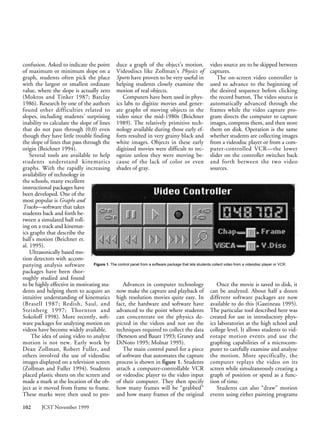
panying analysis software        Figure 1. The control panel from a software package that lets students collect video from a videodisc player or VCR.
packages have been thor-
oughly studied and found
to be highly effective in motivating stu-        Advances in computer technology                           Once the movie is saved to disk, it
dents and helping them to acquire an now make the capture and playback of can be analyzed. About half a dozen
intuitive understanding of kinematics high resolution movies quite easy. In different software packages are now
(Brasell 1987; Redish, Saul, and fact, the hardware and software have available to do this (Gastineau 1995).
Steinberg 1997; Thornton and advanced to the point where students The particular tool described here was
Sokoloff 1998). More recently, soft- can concentrate on the physics de- created for use in introductory phys-
ware packages for analyzing motion on picted in the videos and not on the ics laboratories at the high school and
videos have become widely available.          techniques required to collect the data college level. It allows students to vid-
     The idea of using video to analyze (Beneson and Bauer 1993; Graney and eotape motion events and use the
motion is not new. Early work by DiNoto 1995; Molnar 1995).                                            graphing capabilities of a microcom-
Dean Zollman, Robert Fuller, and                 The main control panel for a piece puter to carefully examine and analyze
others involved the use of videodisc of software that automates the capture the motion. More specifically, the
images displayed on a television screen process is shown in figure 1. Students computer replays the video on its
(Zollman and Fuller 1994). Students attach a computer-controllable VCR screen while simultaneously creating a
placed plastic sheets on the screen and or videodisc player to the video input graph of position or speed as a func-
made a mark at the location of the ob- of their computer. They then specify tion of time.
ject as it moved from frame to frame. how many frames will be “grabbed”                                    Students can also “draw” motion
These marks were then used to pro- and how many frames of the original events using either painting programs

102       JCST November 1999
or a programming language. So, be-
sides its obvious use as a data-gather-
ing and analysis tool, video-based lab
software can be used by students to
analyze previously recorded motion
events or even simulated microworlds
where the laws of motion are pro-
grammed into the system by either the
students or their teacher.
   We contend that by seeing both the
concrete motion event and the abstract
graphical representation of that mo-
tion, students will be better able to
make the cognitive links between the
two and may confront some of their
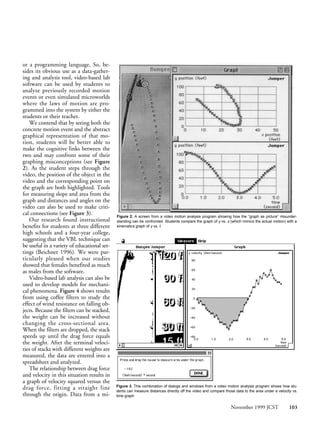
graphing misconceptions (see Figure
2). As the student steps through the
video, the position of the object in the
video and the corresponding point on
the graph are both highlighted. Tools
for measuring slope and area from the
graph and distances and angles on the
video can also be used to make criti-
cal connections (see Figure 3).              Figure 2. A screen from a video motion analysis program showing how the “graph as picture” misunder-
   Our research found instructional          standing can be confronted. Students compare the graph of y vs. x (which mimics the actual motion) with a
benefits for students at three different     kinematics graph of y vs. t.
high schools and a four-year college,
suggesting that the VBL technique can
be useful in a variety of educational set-
tings (Beichner 1996). We were par-
ticularly pleased when our studies
showed that females benefited as much
as males from the software.
   Video-based lab analysis can also be
used to develop models for mechani-
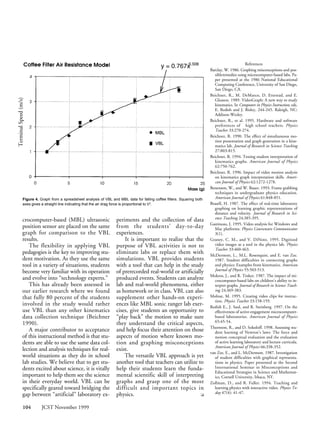
cal phenomena. Figure 4 shows results
from using coffee filters to study the
effect of wind resistance on falling ob-
jects. Because the filters can be stacked,
the weight can be increased without
changing the cross-sectional area.
When the filters are dropped, the stack
speeds up until the drag force equals
the weight. After the terminal veloci-
ties of stacks with different weights are
measured, the data are entered into a
spreadsheet and analyzed.
   The relationship between drag force
and velocity in this situation results in
a graph of velocity squared versus the
                                             Figure 3. This combination of dialogs and windows from a video motion analysis program shows how stu-
drag force, fitting a straight line          dents can measure distances directly off the video and compare those data to the area under a velocity vs.
through the origin. Data from a mi-          time graph.


                                                                                                                November 1999 JCST                103
References
                                                                                                                           Barclay, W. 1986. Graphing misconceptions and pos-
                                                                                                                              sibleremedies using microcomputer-based labs. Pa-
                                                                                                                              per presented at the 1986 National Educational
                                                                                                                              Computing Conference, University of San Diego,
                                                                                                                              San Diego, CA.
                                                                                                                           Beichner, R., M. DeMarco, D. Ettestad, and E.
Terminal Speed (m/s)


                                                                                                                              Gleason. 1989. VideoGraph: A new way to study
                                                                                                                              kinematics. In Computers in Physics Instruction, eds.
                                                                                                                              E. Redish and J. Risley, 244-245. Raleigh, NC:
                                                                                                                              Addison-Wesley.
                                                                                                                           Beichner, R., et al. 1995. Hardware and software
                                                                                                                              preferences of high school teachers. Physics
                                                                                                                              Teacher 33:270-274.
                                                                                                                           Beichner, R. 1990. The effect of simultaneous mo-
                                                                                                                              tion presentation and graph generation in a kine-
                                                                                                                              matics lab. Journal of Research in Science Teaching
                                                                                                                              27:803-815.
                                                                                                                           Beichner, R. 1994. Testing student interpretation of
                                                                                                                              kinematics graphs. American Journal of Physics
                                                                                                                              62:750-762.
                                                                                                                           Beichner, R. 1996. Impact of video motion analysis
                                                                                                                              on kinematics graph interpretation skills. Ameri-
                                                                                                                              can Journal of Physics 62:1272-1278.
                                                                                                                           Benenson, W., and W. Bauer. 1993. Frame grabbing
                                                                                                                              techniques in undergraduate physics education.
               Figure 4. Graph from a spreadsheet analysis of VBL and MBL data for falling coffee filters. Squaring both      American Journal of Physics 61:848-851.
               axes gives a straight line indicating that the air drag force is proportional to V2.                        Brasell, H. 1987. The effect of real-time laboratory
                                                                                                                              graphing on learning graphic representations of
                                                                                                                              distance and velocity. Journal of Research in Sci-
              crocomputer-based (MBL) ultrasonic                     periments and the collection of data                     ence Teaching 24:385-395.
                                                                                                                           Gastineau, J. 1995. Video analysis for Windows and
              position sensor are placed on the same                 from the students’ day-to-day                            Mac platforms. Physics Courseware Communicator
              graph for comparison to the VBL                        experiences.                                             3(1).
              results.                                                   It is important to realize that the               Graney, C. M., and V. DiNoto. 1995. Digitized
                 The flexibility in applying VBL                     purpose of VBL activities is not to                      video images as a tool in the physics lab. Physics
                                                                                                                              Teacher 33:460-463.
              pedagogies is the key to improving stu-                eliminate labs or replace them with                   McDermott, L., M.L. Rosenquist, and E. van Zee.
              dent motivation. As they use the same                  simulations. VBL provides students                       1987. Student difficulties in connecting graphs
              tool in a variety of situations, students              with a tool that can help in the study                   and physics: Examples from kinematics. American
              become very familiar with its operation                of prerecorded real-world or artificially                Journal of Physics 55:503-513.
                                                                                                                           Mokros, J., and R. Tinker. 1987. The impact of mi-
              and evolve into “technology experts.”                  produced events. Students can analyze                    crocomputer-based labs on children’s ability to in-
                 This has already been assessed in                   lab and real-world phenomena, either                     terpret graphs. Journal of Research in Science Teach-
              our earlier research where we found                    as homework or in class. VBL can also                    ing 24:369-383.
              that fully 80 percent of the students                  supplement other hands-on experi-                     Molnar, M. 1995. Creating video clips for instruc-
                                                                                                                              tion. Physics Teacher 33:158-159.
              involved in the study would rather                     ences like MBL sonic ranger lab exer-                 Redish E., J. Saul, and R. Steinberg. 1997. On the
              use VBL than any other kinematics                      cises, give students an opportunity to                   effectiveness of active-engagement microcomputer-
              data collection technique (Beichner                    “play back” the motion to make sure                      based laboratories. American Journal of Physics
              1990).                                                 they understand the critical aspects,                    65:45-54.
                                                                                                                           Thornton, R., and D. Sokoloff. 1998. Assessing stu-
                 A major contributor to acceptance                   and help focus their attention on those                  dent learning of Newton’s laws: The force and
              of this instructional method is that stu-              aspects of motion where known mo-                        motion conceptual evaluation and the evaluation
              dents are able to use the same data col-               tion and graphing misconceptions                         of active learning laboratory and lecture curricula.
                                                                                                                              American Journal of Physics 66:338-352.
              lection and analysis techniques for real-              exist.
                                                                                                                           van Zee, E., and L. McDermott. 1987. Investigation
              world situations as they do in school                      The versatile VBL approach is yet                    of student difficulties with graphical representa-
              lab studies. We believe that to get stu-               another tool that teachers can utilize to                tions in physics. Paper presented at the Second
              dents excited about science, it is vitally             help their students learn the funda-                     International Seminar in Misconceptions and
                                                                                                                              Educational Strategies in Science and Mathemat-
              important to help them see the science                 mental scientific skill of interpreting                  ics, Cornell University, Ithaca, NY.
              in their everyday world. VBL can be                    graphs and grasp one of the most                      Zollman, D., and R. Fuller. 1994. Teaching and
              specifically geared toward bridging the                difficult and important topics in                        learning physics with interactive video. Physics To-
              gap between “artificial” laboratory ex-                physics.                                t
                                                                                                                              day 47(4): 41-47.


               104        JCST November 1999

Video phys

  • 1.
    Video-Based Labs for Introductory Physics Courses Analyzing and Graphing Motion on Video Robert J. Beichner and David S. Abbott Video-based labs (VBL) are a powerful Unfortunately, studies indicate that the axes, creating a graph of vertical tool for improving student understanding students do not share the vocabulary, position versus horizontal position (y of one of the most difficult and important nor are they able to easily comprehend vs. x) rather than a graph of velocity topics in physics: graphs. This article de- graphs (Beichner 1994; McDermott, versus time (v vs. t). Unfortunately, scribes common student graphing difficul- Rosenquist, and van Zee 1987; van the “graph as picture” error can lead ties, the history of VBL, techniques for to a correct position versus time graph. Zee and McDermott 1987). A valuable improving student understanding of device for students facing these ob- This situation will occur whenever the graphs, and software for acquiring and analyzing video data. stacles is a video-based lab (VBL). The horizontal motion of the object is a link between graphing and kinematics linear function of time, making the makes video-based motion labs a par- graph as picture error difficult to de- K inematics, the study of motion, ticularly powerful tool for combating tect. Although this error is probably is critical to understanding some of the most common difficulties peculiar to kinematics, it indicates a physics. For that reason it is students encounter when they inter- general deficit in graphing skills, among the first topics covered in in- pret graphs. namely, students are not aware of the troductory physics classes and it acts as The most frequently confronted abstract nature of graphing as a way to a foundation for much of the rest of problem when working with kinemat- represent data of a concrete situation. the course. ics graphs is the belief that a graph is Many students have trouble deter- Graphs are an important element in some form of photographic-like repli- mining slope. One critical misinterpre- the study of kinematics. Interpreting cation of the motion event. The tation is referred to as “slope/height” the large amounts of data displayed on “graph as picture” error might occur graphs is critical to making sense of the when a student is asked to draw a ve- field. Because features on kinematics locity or acceleration versus time graph Robert J. Beichner is an associate pro- graphs, such as slopes and areas, are of a bicycle rolling down a hill and fessor of physics and David S. Abbott directly linked to observable physical over a small bump. The resulting is a National Science Foundation quantities such as distance traveled, drawing often duplicates the physical Graduate Fellow, physics department, speed, and acceleration, kinematics configuration of the given motion North Carolina State University, Ra- graphs are used as objects of study and event, right down to the bump at the leigh, NC 27695-8202; e-mail: a language of learning in physics in- end of the path. Beichner@NCSU.edu and DSAbbott@ struction. In effect, the student misinterprets unity.NCSU.edu. November 1999 JCST 101
  • 2.
    confusion. Asked toindicate the point duce a graph of the object’s motion. video source are to be skipped between of maximum or minimum slope on a Videodiscs like Zollman’s Physics of captures. graph, students often pick the place Sports have proven to be very useful in The on-screen video controller is with the largest or smallest ordinate helping students closely examine the used to advance to the beginning of value, where the slope is actually zero motion of real objects. the desired sequence before clicking (Mokros and Tinker 1987; Barclay Computers have been used in phys- the record button. The video source is 1986). Research by one of the authors ics labs to digitize movies and gener- automatically advanced through the found other difficulties related to ate graphs of moving objects in the frames while the video capture pro- slopes, including students’ surprising video since the mid-1980s (Beichner gram directs the computer to capture inability to calculate the slope of lines 1989). The relatively primitive tech- images, compress them, and then store that do not pass through (0,0) even nology available during those early ef- them on disk. Operation is the same though they have little trouble finding forts resulted in very grainy black and whether students are collecting images the slope of lines that pass through the white images. Objects in these early from a videodisc player or from a com- origin (Beichner 1994). digitized movies were difficult to rec- puter-controlled VCR—the lower Several tools are available to help ognize unless they were moving be- slider on the controller switches back students understand kinematics cause of the lack of color or even and forth between the two video graphs. With the rapidly increasing shades of gray. sources. availability of technology in the schools, many excellent instructional packages have been developed. One of the most popular is Graphs and Tracks—software that takes students back and forth be- tween a simulated ball roll- ing on a track and kinemat- ics graphs that describe the ball’s motion (Beichner et. al. 1995). Ultrasonically based mo- tion detectors with accom- panying analysis software Figure 1. The control panel from a software package that lets students collect video from a videodisc player or VCR. packages have been thor- oughly studied and found to be highly effective in motivating stu- Advances in computer technology Once the movie is saved to disk, it dents and helping them to acquire an now make the capture and playback of can be analyzed. About half a dozen intuitive understanding of kinematics high resolution movies quite easy. In different software packages are now (Brasell 1987; Redish, Saul, and fact, the hardware and software have available to do this (Gastineau 1995). Steinberg 1997; Thornton and advanced to the point where students The particular tool described here was Sokoloff 1998). More recently, soft- can concentrate on the physics de- created for use in introductory phys- ware packages for analyzing motion on picted in the videos and not on the ics laboratories at the high school and videos have become widely available. techniques required to collect the data college level. It allows students to vid- The idea of using video to analyze (Beneson and Bauer 1993; Graney and eotape motion events and use the motion is not new. Early work by DiNoto 1995; Molnar 1995). graphing capabilities of a microcom- Dean Zollman, Robert Fuller, and The main control panel for a piece puter to carefully examine and analyze others involved the use of videodisc of software that automates the capture the motion. More specifically, the images displayed on a television screen process is shown in figure 1. Students computer replays the video on its (Zollman and Fuller 1994). Students attach a computer-controllable VCR screen while simultaneously creating a placed plastic sheets on the screen and or videodisc player to the video input graph of position or speed as a func- made a mark at the location of the ob- of their computer. They then specify tion of time. ject as it moved from frame to frame. how many frames will be “grabbed” Students can also “draw” motion These marks were then used to pro- and how many frames of the original events using either painting programs 102 JCST November 1999
  • 3.
    or a programminglanguage. So, be- sides its obvious use as a data-gather- ing and analysis tool, video-based lab software can be used by students to analyze previously recorded motion events or even simulated microworlds where the laws of motion are pro- grammed into the system by either the students or their teacher. We contend that by seeing both the concrete motion event and the abstract graphical representation of that mo- tion, students will be better able to make the cognitive links between the two and may confront some of their graphing misconceptions (see Figure 2). As the student steps through the video, the position of the object in the video and the corresponding point on the graph are both highlighted. Tools for measuring slope and area from the graph and distances and angles on the video can also be used to make criti- cal connections (see Figure 3). Figure 2. A screen from a video motion analysis program showing how the “graph as picture” misunder- Our research found instructional standing can be confronted. Students compare the graph of y vs. x (which mimics the actual motion) with a benefits for students at three different kinematics graph of y vs. t. high schools and a four-year college, suggesting that the VBL technique can be useful in a variety of educational set- tings (Beichner 1996). We were par- ticularly pleased when our studies showed that females benefited as much as males from the software. Video-based lab analysis can also be used to develop models for mechani- cal phenomena. Figure 4 shows results from using coffee filters to study the effect of wind resistance on falling ob- jects. Because the filters can be stacked, the weight can be increased without changing the cross-sectional area. When the filters are dropped, the stack speeds up until the drag force equals the weight. After the terminal veloci- ties of stacks with different weights are measured, the data are entered into a spreadsheet and analyzed. The relationship between drag force and velocity in this situation results in a graph of velocity squared versus the Figure 3. This combination of dialogs and windows from a video motion analysis program shows how stu- drag force, fitting a straight line dents can measure distances directly off the video and compare those data to the area under a velocity vs. through the origin. Data from a mi- time graph. November 1999 JCST 103
  • 4.
    References Barclay, W. 1986. Graphing misconceptions and pos- sibleremedies using microcomputer-based labs. Pa- per presented at the 1986 National Educational Computing Conference, University of San Diego, San Diego, CA. Beichner, R., M. DeMarco, D. Ettestad, and E. Terminal Speed (m/s) Gleason. 1989. VideoGraph: A new way to study kinematics. In Computers in Physics Instruction, eds. E. Redish and J. Risley, 244-245. Raleigh, NC: Addison-Wesley. Beichner, R., et al. 1995. Hardware and software preferences of high school teachers. Physics Teacher 33:270-274. Beichner, R. 1990. The effect of simultaneous mo- tion presentation and graph generation in a kine- matics lab. Journal of Research in Science Teaching 27:803-815. Beichner, R. 1994. Testing student interpretation of kinematics graphs. American Journal of Physics 62:750-762. Beichner, R. 1996. Impact of video motion analysis on kinematics graph interpretation skills. Ameri- can Journal of Physics 62:1272-1278. Benenson, W., and W. Bauer. 1993. Frame grabbing techniques in undergraduate physics education. Figure 4. Graph from a spreadsheet analysis of VBL and MBL data for falling coffee filters. Squaring both American Journal of Physics 61:848-851. axes gives a straight line indicating that the air drag force is proportional to V2. Brasell, H. 1987. The effect of real-time laboratory graphing on learning graphic representations of distance and velocity. Journal of Research in Sci- crocomputer-based (MBL) ultrasonic periments and the collection of data ence Teaching 24:385-395. Gastineau, J. 1995. Video analysis for Windows and position sensor are placed on the same from the students’ day-to-day Mac platforms. Physics Courseware Communicator graph for comparison to the VBL experiences. 3(1). results. It is important to realize that the Graney, C. M., and V. DiNoto. 1995. Digitized The flexibility in applying VBL purpose of VBL activities is not to video images as a tool in the physics lab. Physics Teacher 33:460-463. pedagogies is the key to improving stu- eliminate labs or replace them with McDermott, L., M.L. Rosenquist, and E. van Zee. dent motivation. As they use the same simulations. VBL provides students 1987. Student difficulties in connecting graphs tool in a variety of situations, students with a tool that can help in the study and physics: Examples from kinematics. American become very familiar with its operation of prerecorded real-world or artificially Journal of Physics 55:503-513. Mokros, J., and R. Tinker. 1987. The impact of mi- and evolve into “technology experts.” produced events. Students can analyze crocomputer-based labs on children’s ability to in- This has already been assessed in lab and real-world phenomena, either terpret graphs. Journal of Research in Science Teach- our earlier research where we found as homework or in class. VBL can also ing 24:369-383. that fully 80 percent of the students supplement other hands-on experi- Molnar, M. 1995. Creating video clips for instruc- tion. Physics Teacher 33:158-159. involved in the study would rather ences like MBL sonic ranger lab exer- Redish E., J. Saul, and R. Steinberg. 1997. On the use VBL than any other kinematics cises, give students an opportunity to effectiveness of active-engagement microcomputer- data collection technique (Beichner “play back” the motion to make sure based laboratories. American Journal of Physics 1990). they understand the critical aspects, 65:45-54. Thornton, R., and D. Sokoloff. 1998. Assessing stu- A major contributor to acceptance and help focus their attention on those dent learning of Newton’s laws: The force and of this instructional method is that stu- aspects of motion where known mo- motion conceptual evaluation and the evaluation dents are able to use the same data col- tion and graphing misconceptions of active learning laboratory and lecture curricula. American Journal of Physics 66:338-352. lection and analysis techniques for real- exist. van Zee, E., and L. McDermott. 1987. Investigation world situations as they do in school The versatile VBL approach is yet of student difficulties with graphical representa- lab studies. We believe that to get stu- another tool that teachers can utilize to tions in physics. Paper presented at the Second dents excited about science, it is vitally help their students learn the funda- International Seminar in Misconceptions and Educational Strategies in Science and Mathemat- important to help them see the science mental scientific skill of interpreting ics, Cornell University, Ithaca, NY. in their everyday world. VBL can be graphs and grasp one of the most Zollman, D., and R. Fuller. 1994. Teaching and specifically geared toward bridging the difficult and important topics in learning physics with interactive video. Physics To- gap between “artificial” laboratory ex- physics. t day 47(4): 41-47. 104 JCST November 1999