WELCOME TO OUR PRESENTATION
Group Name: VIBRIO SPP
Group members are: Johora Tabassum Munia
Abdus Sattar
Borhan Tushar
Shorap Mia
Srabony Easmin
Scientific Classification of Vibrio
Domain: Bacteria
Phylum: Pseudomonad Ota
Class: Gamma proteobacteria
Order: Vibrion ales
Family: Vibrionaceae
Genus: Vibrio
Pacini: 1854
Type species: Vibrio cholerae
What is Vibrio?
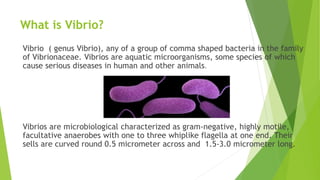
Vibrio ( genus Vibrio), any of a group of comma shaped bacteria in the family
of Vibrionaceae. Vibrios are aquatic microorganisms, some species of which
cause serious diseases in human and other animals.
Vibrios are microbiological characterized as gram-negative, highly motile,
facultative anaerobes with one to three whiplike flagella at one end. Their
sells are curved round 0.5 micrometer across and 1.5-3.0 micrometer long.
Example of Vibrio Bacteria
 Asiatic cholera
 Vibrio vulnificus
 Vibrio parahaemolyticus
 Vibrio harveyi
 Vibrio alginolyticus
 Vibrio natriegens
 Vibrio anguillarum
What is Vibrio SSP?
Vibrio spp. are a group of common, Gram-negative, rod-shaped bacteria
that are natural constituents of freshwater, estuarine and marine
environments. Vibrio spp. share several biological and genomic features.
Their genomes are divided between two chromosomes, which have been
shaped by recombination and horizontal gene transfer (HGT; that is, the
acquisition of genetic material by transfer from other organisms). Although
these pathogens may be gnomically diverse, they all originate from aquatic
and marine environments: they prefer warm, brackish (slightly salty) water,
and their abundance in the natural environment tends to mirror
environmental temperatures.
Where is Vibrio SSP found?
Being highly salt tolerant and unable to survive in fresh water, Vibrio spp.
are commonly found in various salt water environments. Vibrio spp. are
facultative anaerobes that test positive for oxidase and do not form
spores.
All members of the genus are motile. Cases of Vibrio spp. infections have a
marked seasonal distribution, with most cases occurring during warmer
months.
Vibrio spp. infections are usually initiated from exposure to contaminated
water or consumption of raw or undercooked contaminated seafood and
cause a variety of symptoms in humans.
Situation of Vibrio infection around the
world:
 An estimated 3–5 million people contract cholera worldwide annually, with ~100,000 deaths; in
endemic countries, about half of the deaths occur in children of <5 years of age.
 highest incidence in children of <5 years of age; about half of all cholera cases occur in this
age group, although the incidence varies annually, presumably related to climate and hitherto
unknown factors.
 For centuries, cholera has been endemic in Asia, mainly in the Ganges delta of the Bay of
Bengal, Bangladesh and India. Asiatic cholera has exploded at several different times, spread
rapidly and resulted in waves of global pandemics . The spread of cholera outside of Asia.
Largely mediated by human activities. Cholera was likely introduced through infected humans
to
 Africa, Haiti and Latin America, and probably also historically to Europe and the United States.
 The seventh pandemic continues to be a major public health threat for 175 countries in Asia.
Mechanisms/pathophysiology:
 Of all the studied pathogenic Vibrio spp., V. cholerae is the most well
understood. V. cholerae is
 the paradigmatic non-invasive mucosal pathogen: following ingestion of
contaminated water or food by the host, the pathogen proliferates to
high density along the mucosal surface of the small intestine but does
not disrupt the integrity of the epithelial barrier or cause substantial
damage to epithelial cells.
Symptoms Of Vibrio SSP
Signs and symptoms of vibriosis can include watery diarrhea that is often accompanied by abdominal
cramping. Other associated symptoms and signs can include
 nausea,
 vomiting,
 fever, and
 chills.
Other vibrio infection symptoms and signs are:
 Abdominal Cramping
 High Fever
 Watery Diarrhea
Prevention:
We can reduce the risk of vibriosis by following these tips:
1.Don’t eat raw or undercooked oysters or other shellfish. Cook them before
eating.
2. Always wash hands with soap and water after handing raw shellfish.
3.Avoid contaminating cooked shellfish with raw shellfish and its juices.
4.Wash wounds and cuts thoroughly with soap and water if they have been exposed
to seawater or raw seafood or its juices.
5.If develop a skin infection, meet medical provider.
References:
www.biologydiscussion.com
www.cdc.gov
www.medicinenet.com
www.nature.com
www.britannica.com
Vibrio spp. (Group presentation).pptx

Vibrio spp. (Group presentation).pptx

  • 1.
    WELCOME TO OURPRESENTATION Group Name: VIBRIO SPP Group members are: Johora Tabassum Munia Abdus Sattar Borhan Tushar Shorap Mia Srabony Easmin
  • 2.
    Scientific Classification ofVibrio Domain: Bacteria Phylum: Pseudomonad Ota Class: Gamma proteobacteria Order: Vibrion ales Family: Vibrionaceae Genus: Vibrio Pacini: 1854 Type species: Vibrio cholerae
  • 3.
    What is Vibrio? Vibrio( genus Vibrio), any of a group of comma shaped bacteria in the family of Vibrionaceae. Vibrios are aquatic microorganisms, some species of which cause serious diseases in human and other animals. Vibrios are microbiological characterized as gram-negative, highly motile, facultative anaerobes with one to three whiplike flagella at one end. Their sells are curved round 0.5 micrometer across and 1.5-3.0 micrometer long.
  • 4.
    Example of VibrioBacteria  Asiatic cholera  Vibrio vulnificus  Vibrio parahaemolyticus  Vibrio harveyi  Vibrio alginolyticus  Vibrio natriegens  Vibrio anguillarum
  • 5.
    What is VibrioSSP? Vibrio spp. are a group of common, Gram-negative, rod-shaped bacteria that are natural constituents of freshwater, estuarine and marine environments. Vibrio spp. share several biological and genomic features. Their genomes are divided between two chromosomes, which have been shaped by recombination and horizontal gene transfer (HGT; that is, the acquisition of genetic material by transfer from other organisms). Although these pathogens may be gnomically diverse, they all originate from aquatic and marine environments: they prefer warm, brackish (slightly salty) water, and their abundance in the natural environment tends to mirror environmental temperatures.
  • 6.
    Where is VibrioSSP found? Being highly salt tolerant and unable to survive in fresh water, Vibrio spp. are commonly found in various salt water environments. Vibrio spp. are facultative anaerobes that test positive for oxidase and do not form spores. All members of the genus are motile. Cases of Vibrio spp. infections have a marked seasonal distribution, with most cases occurring during warmer months. Vibrio spp. infections are usually initiated from exposure to contaminated water or consumption of raw or undercooked contaminated seafood and cause a variety of symptoms in humans.
  • 7.
    Situation of Vibrioinfection around the world:  An estimated 3–5 million people contract cholera worldwide annually, with ~100,000 deaths; in endemic countries, about half of the deaths occur in children of <5 years of age.  highest incidence in children of <5 years of age; about half of all cholera cases occur in this age group, although the incidence varies annually, presumably related to climate and hitherto unknown factors.  For centuries, cholera has been endemic in Asia, mainly in the Ganges delta of the Bay of Bengal, Bangladesh and India. Asiatic cholera has exploded at several different times, spread rapidly and resulted in waves of global pandemics . The spread of cholera outside of Asia. Largely mediated by human activities. Cholera was likely introduced through infected humans to  Africa, Haiti and Latin America, and probably also historically to Europe and the United States.  The seventh pandemic continues to be a major public health threat for 175 countries in Asia.
  • 8.
    Mechanisms/pathophysiology:  Of allthe studied pathogenic Vibrio spp., V. cholerae is the most well understood. V. cholerae is  the paradigmatic non-invasive mucosal pathogen: following ingestion of contaminated water or food by the host, the pathogen proliferates to high density along the mucosal surface of the small intestine but does not disrupt the integrity of the epithelial barrier or cause substantial damage to epithelial cells.
  • 9.
    Symptoms Of VibrioSSP Signs and symptoms of vibriosis can include watery diarrhea that is often accompanied by abdominal cramping. Other associated symptoms and signs can include  nausea,  vomiting,  fever, and  chills. Other vibrio infection symptoms and signs are:  Abdominal Cramping  High Fever  Watery Diarrhea
  • 10.
    Prevention: We can reducethe risk of vibriosis by following these tips: 1.Don’t eat raw or undercooked oysters or other shellfish. Cook them before eating. 2. Always wash hands with soap and water after handing raw shellfish. 3.Avoid contaminating cooked shellfish with raw shellfish and its juices. 4.Wash wounds and cuts thoroughly with soap and water if they have been exposed to seawater or raw seafood or its juices. 5.If develop a skin infection, meet medical provider. References: www.biologydiscussion.com www.cdc.gov www.medicinenet.com www.nature.com www.britannica.com