VHDL Data Types
Module F3.1
VHDL Data Types
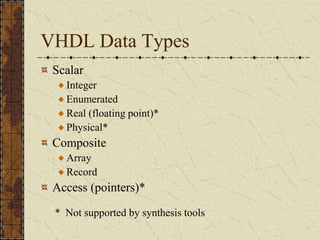
Scalar
Integer
Enumerated
Real (floating point)*
Physical*
Composite
Array
Record
Access (pointers)*
* Not supported by synthesis tools
VHDL Data Objects
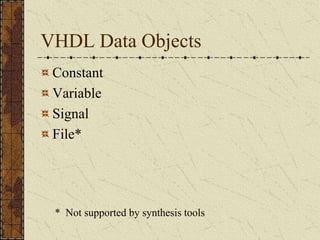
Constant
Variable
Signal
File*
* Not supported by synthesis tools
Identifiers
May contain A-Z, a-z, 0-9, _
Must start with letter
May not end with _
May not include two consecutive _
VHDL is case insensitive
Sel sel and SEL refer to same object
Identifier Examples
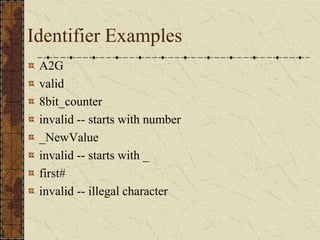
A2G
valid
8bit_counter
invalid -- starts with number
_NewValue
invalid -- starts with _
first#
invalid -- illegal character
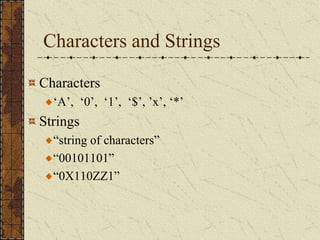
Characters and Strings
Characters
‘A’, ‘0’, ‘1’, ‘$’, ’x’, ‘*’
Strings
“string of characters”
“00101101”
“0X110ZZ1”
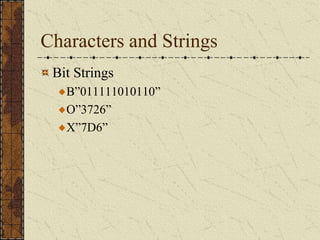
Characters and Strings
Bit Strings
B”011111010110”
O”3726”
X”7D6”
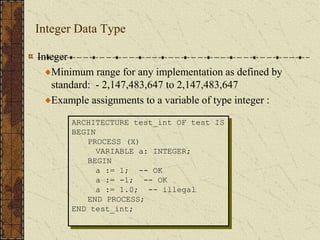
Integer Data Type
Integer
Minimum range for any implementation as defined by
standard: - 2,147,483,647 to 2,147,483,647
Example assignments to a variable of type integer :
ARCHITECTURE test_int OF test IS
BEGIN
PROCESS (X)
VARIABLE a: INTEGER;
BEGIN
a := 1; -- OK
a := -1; -- OK
a := 1.0; -- illegal
END PROCESS;
END test_int;
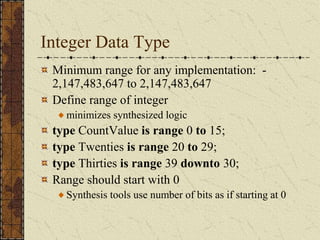
Integer Data Type
Minimum range for any implementation: -
2,147,483,647 to 2,147,483,647
Define range of integer
minimizes synthesized logic
type CountValue is range 0 to 15;
type Twenties is range 20 to 29;
type Thirties is range 39 downto 30;
Range should start with 0
Synthesis tools use number of bits as if starting at 0
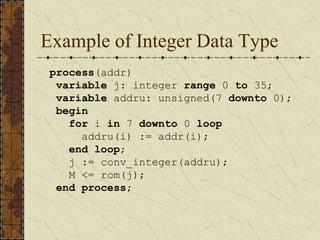
Example of Integer Data Type
process(addr)
variable j: integer range 0 to 35;
variable addru: unsigned(7 downto 0);
begin
for i in 7 downto 0 loop
addru(i) := addr(i);
end loop;
j := conv_integer(addru);
M <= rom(j);
end process;
TYPE binary IS ( ON, OFF );
... some statements ...
ARCHITECTURE test_enum OF test IS
BEGIN
PROCESS (X)
VARIABLE a: binary;
BEGIN
a := ON; -- OK
... more statements ...
a := OFF; -- OK
... more statements ...
END PROCESS;
END test_enum;
VHDL Data Types
Scalar Types (Cont.)
Enumerated
User specifies list of possible values
Example declaration and usage of enumerated data type :
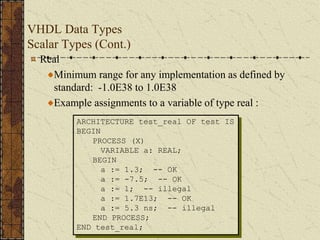
ARCHITECTURE test_real OF test IS
BEGIN
PROCESS (X)
VARIABLE a: REAL;
BEGIN
a := 1.3; -- OK
a := -7.5; -- OK
a := 1; -- illegal
a := 1.7E13; -- OK
a := 5.3 ns; -- illegal
END PROCESS;
END test_real;
VHDL Data Types
Scalar Types (Cont.)
Real
Minimum range for any implementation as defined by
standard: -1.0E38 to 1.0E38
Example assignments to a variable of type real :
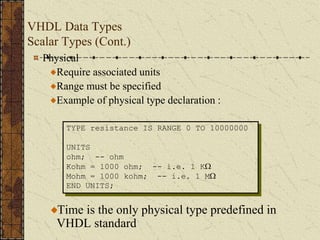
Physical
Require associated units
Range must be specified
Example of physical type declaration :
Time is the only physical type predefined in
VHDL standard
TYPE resistance IS RANGE 0 TO 10000000
UNITS
ohm; -- ohm
Kohm = 1000 ohm; -- i.e. 1 KW
Mohm = 1000 kohm; -- i.e. 1 MW
END UNITS;
VHDL Data Types
Scalar Types (Cont.)
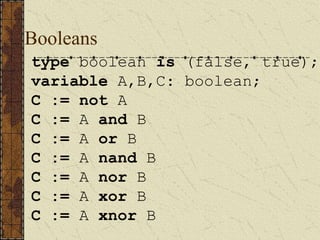
Booleans
type boolean is (false, true);
variable A,B,C: boolean;
C := not A
C := A and B
C := A or B
C := A nand B
C := A nor B
C := A xor B
C := A xnor B
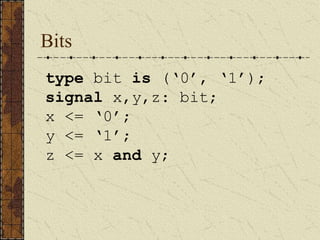
Bits
type bit is (‘0’, ‘1’);
signal x,y,z: bit;
x <= ‘0’;
y <= ‘1’;
z <= x and y;
Standard Logic
type std_ulogic is ( ‘U’, -- Uninitialized
‘X’ -- Forcing unknown
‘0’ -- Forcing zero
‘1’ -- Forcing one
‘Z’ -- High impedance
‘W’ -- Weak unknown
‘L’ -- Weak zero
‘H’ -- Weak one
‘-’); -- Don’t care
library IEEE;
use IEEE.std_logic_1164.all;
Standard Logic
type std_ulogic is unresolved.
Resolved signals provide a mechanism
for handling the problem of multiple
output signals connected to one signal.
subtype std_logic is resolved std_ulogic;
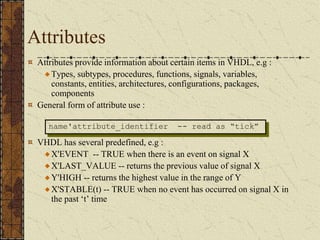
Attributes
Attributes provide information about certain items in VHDL, e.g :
Types, subtypes, procedures, functions, signals, variables,
constants, entities, architectures, configurations, packages,
components
General form of attribute use :
VHDL has several predefined, e.g :
X'EVENT -- TRUE when there is an event on signal X
X'LAST_VALUE -- returns the previous value of signal X
Y'HIGH -- returns the highest value in the range of Y
X'STABLE(t) -- TRUE when no event has occurred on signal X in
the past ‘t’ time
name'attribute_identifier -- read as “tick”
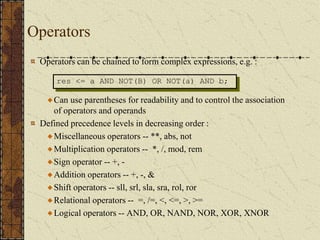
Operators
Operators can be chained to form complex expressions, e.g. :
Can use parentheses for readability and to control the association
of operators and operands
Defined precedence levels in decreasing order :
Miscellaneous operators -- **, abs, not
Multiplication operators -- *, /, mod, rem
Sign operator -- +, -
Addition operators -- +, -, &
Shift operators -- sll, srl, sla, sra, rol, ror
Relational operators -- =, /=, <, <=, >, >=
Logical operators -- AND, OR, NAND, NOR, XOR, XNOR
res <= a AND NOT(B) OR NOT(a) AND b;
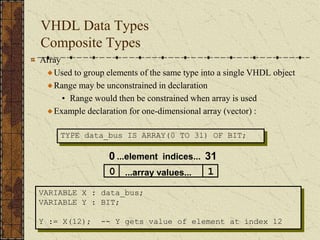
TYPE data_bus IS ARRAY(0 TO 31) OF BIT;
VARIABLE X : data_bus;
VARIABLE Y : BIT;
Y := X(12); -- Y gets value of element at index 12
0 31
0 1
...element indices...
...array values...
VHDL Data Types
Composite Types
Array
Used to group elements of the same type into a single VHDL object
Range may be unconstrained in declaration
• Range would then be constrained when array is used
Example declaration for one-dimensional array (vector) :
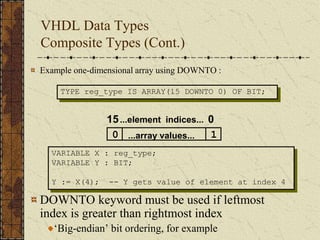
Example one-dimensional array using DOWNTO :
DOWNTO keyword must be used if leftmost
index is greater than rightmost index
‘Big-endian’ bit ordering, for example
TYPE reg_type IS ARRAY(15 DOWNTO 0) OF BIT;
VARIABLE X : reg_type;
VARIABLE Y : BIT;
Y := X(4); -- Y gets value of element at index 4
15 0
0 1
...element indices...
...array values...
VHDL Data Types
Composite Types (Cont.)
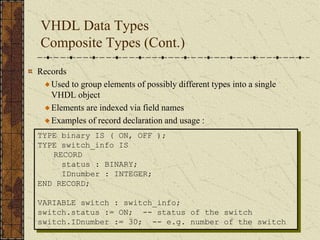
TYPE binary IS ( ON, OFF );
TYPE switch_info IS
RECORD
status : BINARY;
IDnumber : INTEGER;
END RECORD;
VARIABLE switch : switch_info;
switch.status := ON; -- status of the switch
switch.IDnumber := 30; -- e.g. number of the switch
VHDL Data Types
Composite Types (Cont.)
Records
Used to group elements of possibly different types into a single
VHDL object
Elements are indexed via field names
Examples of record declaration and usage :

VHDL-Data-Types.ppt

  • 1.
  • 2.
    VHDL Data Types Scalar Integer Enumerated Real(floating point)* Physical* Composite Array Record Access (pointers)* * Not supported by synthesis tools
  • 3.
  • 4.
    Identifiers May contain A-Z,a-z, 0-9, _ Must start with letter May not end with _ May not include two consecutive _ VHDL is case insensitive Sel sel and SEL refer to same object
  • 5.
    Identifier Examples A2G valid 8bit_counter invalid --starts with number _NewValue invalid -- starts with _ first# invalid -- illegal character
  • 6.
    Characters and Strings Characters ‘A’,‘0’, ‘1’, ‘$’, ’x’, ‘*’ Strings “string of characters” “00101101” “0X110ZZ1”
  • 7.
    Characters and Strings BitStrings B”011111010110” O”3726” X”7D6”
  • 8.
    Integer Data Type Integer Minimumrange for any implementation as defined by standard: - 2,147,483,647 to 2,147,483,647 Example assignments to a variable of type integer : ARCHITECTURE test_int OF test IS BEGIN PROCESS (X) VARIABLE a: INTEGER; BEGIN a := 1; -- OK a := -1; -- OK a := 1.0; -- illegal END PROCESS; END test_int;
  • 9.
    Integer Data Type Minimumrange for any implementation: - 2,147,483,647 to 2,147,483,647 Define range of integer minimizes synthesized logic type CountValue is range 0 to 15; type Twenties is range 20 to 29; type Thirties is range 39 downto 30; Range should start with 0 Synthesis tools use number of bits as if starting at 0
  • 10.
    Example of IntegerData Type process(addr) variable j: integer range 0 to 35; variable addru: unsigned(7 downto 0); begin for i in 7 downto 0 loop addru(i) := addr(i); end loop; j := conv_integer(addru); M <= rom(j); end process;
  • 11.
    TYPE binary IS( ON, OFF ); ... some statements ... ARCHITECTURE test_enum OF test IS BEGIN PROCESS (X) VARIABLE a: binary; BEGIN a := ON; -- OK ... more statements ... a := OFF; -- OK ... more statements ... END PROCESS; END test_enum; VHDL Data Types Scalar Types (Cont.) Enumerated User specifies list of possible values Example declaration and usage of enumerated data type :
  • 12.
    ARCHITECTURE test_real OFtest IS BEGIN PROCESS (X) VARIABLE a: REAL; BEGIN a := 1.3; -- OK a := -7.5; -- OK a := 1; -- illegal a := 1.7E13; -- OK a := 5.3 ns; -- illegal END PROCESS; END test_real; VHDL Data Types Scalar Types (Cont.) Real Minimum range for any implementation as defined by standard: -1.0E38 to 1.0E38 Example assignments to a variable of type real :
  • 13.
    Physical Require associated units Rangemust be specified Example of physical type declaration : Time is the only physical type predefined in VHDL standard TYPE resistance IS RANGE 0 TO 10000000 UNITS ohm; -- ohm Kohm = 1000 ohm; -- i.e. 1 KW Mohm = 1000 kohm; -- i.e. 1 MW END UNITS; VHDL Data Types Scalar Types (Cont.)
  • 14.
    Booleans type boolean is(false, true); variable A,B,C: boolean; C := not A C := A and B C := A or B C := A nand B C := A nor B C := A xor B C := A xnor B
  • 15.
    Bits type bit is(‘0’, ‘1’); signal x,y,z: bit; x <= ‘0’; y <= ‘1’; z <= x and y;
  • 16.
    Standard Logic type std_ulogicis ( ‘U’, -- Uninitialized ‘X’ -- Forcing unknown ‘0’ -- Forcing zero ‘1’ -- Forcing one ‘Z’ -- High impedance ‘W’ -- Weak unknown ‘L’ -- Weak zero ‘H’ -- Weak one ‘-’); -- Don’t care library IEEE; use IEEE.std_logic_1164.all;
  • 17.
    Standard Logic type std_ulogicis unresolved. Resolved signals provide a mechanism for handling the problem of multiple output signals connected to one signal. subtype std_logic is resolved std_ulogic;
  • 18.
    Attributes Attributes provide informationabout certain items in VHDL, e.g : Types, subtypes, procedures, functions, signals, variables, constants, entities, architectures, configurations, packages, components General form of attribute use : VHDL has several predefined, e.g : X'EVENT -- TRUE when there is an event on signal X X'LAST_VALUE -- returns the previous value of signal X Y'HIGH -- returns the highest value in the range of Y X'STABLE(t) -- TRUE when no event has occurred on signal X in the past ‘t’ time name'attribute_identifier -- read as “tick”
  • 19.
    Operators Operators can bechained to form complex expressions, e.g. : Can use parentheses for readability and to control the association of operators and operands Defined precedence levels in decreasing order : Miscellaneous operators -- **, abs, not Multiplication operators -- *, /, mod, rem Sign operator -- +, - Addition operators -- +, -, & Shift operators -- sll, srl, sla, sra, rol, ror Relational operators -- =, /=, <, <=, >, >= Logical operators -- AND, OR, NAND, NOR, XOR, XNOR res <= a AND NOT(B) OR NOT(a) AND b;
  • 20.
    TYPE data_bus ISARRAY(0 TO 31) OF BIT; VARIABLE X : data_bus; VARIABLE Y : BIT; Y := X(12); -- Y gets value of element at index 12 0 31 0 1 ...element indices... ...array values... VHDL Data Types Composite Types Array Used to group elements of the same type into a single VHDL object Range may be unconstrained in declaration • Range would then be constrained when array is used Example declaration for one-dimensional array (vector) :
  • 21.
    Example one-dimensional arrayusing DOWNTO : DOWNTO keyword must be used if leftmost index is greater than rightmost index ‘Big-endian’ bit ordering, for example TYPE reg_type IS ARRAY(15 DOWNTO 0) OF BIT; VARIABLE X : reg_type; VARIABLE Y : BIT; Y := X(4); -- Y gets value of element at index 4 15 0 0 1 ...element indices... ...array values... VHDL Data Types Composite Types (Cont.)
  • 22.
    TYPE binary IS( ON, OFF ); TYPE switch_info IS RECORD status : BINARY; IDnumber : INTEGER; END RECORD; VARIABLE switch : switch_info; switch.status := ON; -- status of the switch switch.IDnumber := 30; -- e.g. number of the switch VHDL Data Types Composite Types (Cont.) Records Used to group elements of possibly different types into a single VHDL object Elements are indexed via field names Examples of record declaration and usage :