VETERINARY EMERGENCY CARE
IN SMALL ANIMALS
Presented by:
M’d Saleem
15-BVM-
103
College of Veterinary Animal Sciences,
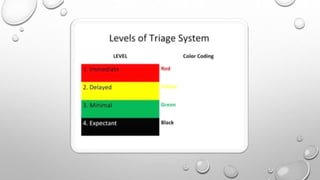
Mannuthy
Dept of Teaching Veterinary Clinical Complex.
WHAT IS EMERGENCY CARE?
• Aims of emergency care are :
 To preserve life
 To protect the casualty
 To prevent further injury or pain
 To promote recovery
“Simple, effective management or care
given to casualty of injury or sudden
illness until more advanced care can be
provided.”
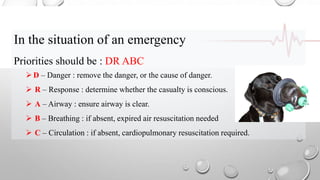
In the situation of an emergency
Priorities should be : DR ABC
D – Danger : remove the danger, or the cause of danger.
 R – Response : determine whether the casualty is conscious.
 A – Airway : ensure airway is clear.
 B – Breathing : if absent, expired air resuscitation needed
 C – Circulation : if absent, cardiopulmonary resuscitation required.
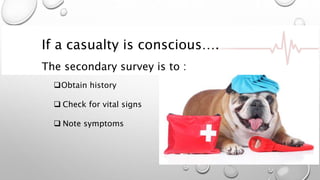
If a casualty is conscious….
The secondary survey is to :
Obtain history
 Check for vital signs
 Note symptoms
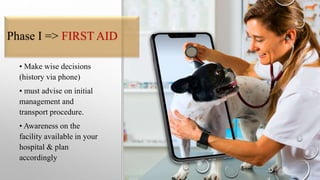
• Make wise decisions
(history via phone)
• must advise on initial
management and
transport procedure.
• Awareness on the
facility available in your
hospital & plan
accordingly
Phase I => FIRST AID
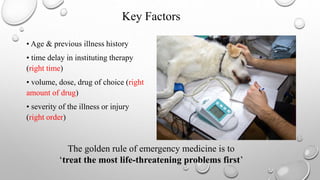
Key Factors
• Age & previous illness history
• time delay in instituting therapy
(right time)
• volume, dose, drug of choice (right
amount of drug)
• severity of the illness or injury
(right order)
The golden rule of emergency medicine is to
‘treat the most life-threatening problems first’
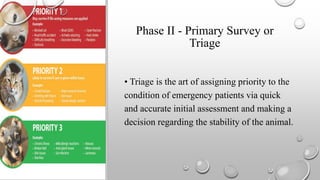
Phase II - Primary Survey or
Triage
• Triage is the art of assigning priority to the
condition of emergency patients via quick
and accurate initial assessment and making a
decision regarding the stability of the animal.
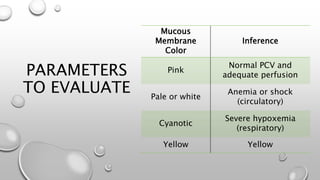
PARAMETERS
TO EVALUATE
Mucous
Membrane
Color
Inference
Pink
Normal PCV and
adequate perfusion
Pale or white
Anemia or shock
(circulatory)
Cyanotic
Severe hypoxemia
(respiratory)
Yellow Yellow
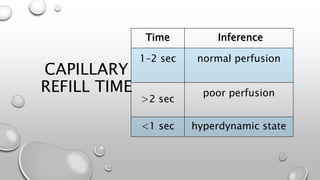
CAPILLARY
REFILL TIME
Time Inference
1–2 sec normal perfusion
>2 sec
poor perfusion
<1 sec hyperdynamic state
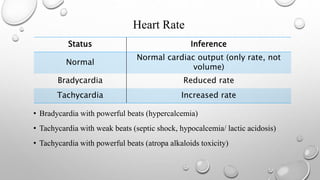
Heart Rate
• Bradycardia with powerful beats (hypercalcemia)
• Tachycardia with weak beats (septic shock, hypocalcemia/ lactic acidosis)
• Tachycardia with powerful beats (atropa alkaloids toxicity)
Status Inference
Normal
Normal cardiac output (only rate, not
volume)
Bradycardia Reduced rate
Tachycardia Increased rate
PULSE RATE
AND QUALITY
Alert and responsive
Normal overall
neurologic and
metabolic state
Depressed or
obtunded
Decreased perfusion
Seizures
Excitatory neurological
symptoms
Stupor (arousable only
with painful stimuli)
Severe neurological
problems
Comatose
(unarousable with any
stimuli)
Severe neurological
problems
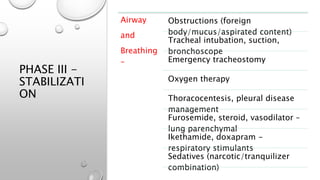
PHASE III -
STABILIZATI
ON
Airway
and
Breathing
–
Obstructions (foreign
body/mucus/aspirated content)
Tracheal intubation, suction,
bronchoscope
Emergency tracheostomy
Oxygen therapy
Thoracocentesis, pleural disease
management
Furosemide, steroid, vasodilator –
lung parenchymal
Ikethamide, doxapram -
respiratory stimulants
Sedatives (narcotic/tranquilizer
combination)
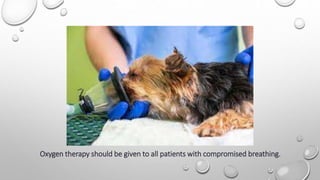
Oxygen therapy should be given to all patients with compromised breathing.
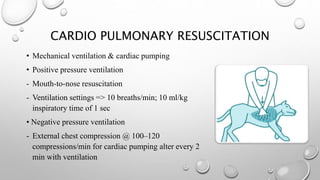
CARDIO PULMONARY RESUSCITATION
• Mechanical ventilation & cardiac pumping
• Positive pressure ventilation
- Mouth-to-nose resuscitation
- Ventilation settings => 10 breaths/min; 10 ml/kg
inspiratory time of 1 sec
• Negative pressure ventilation
- External chest compression @ 100–120
compressions/min for cardiac pumping alter every 2
min with ventilation
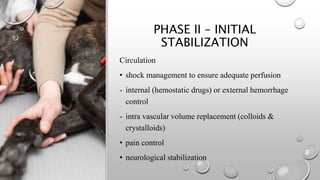
PHASE II – INITIAL
STABILIZATION
Circulation
• shock management to ensure adequate perfusion
- internal (hemostatic drugs) or external hemorrhage
control
- intra vascular volume replacement (colloids &
crystalloids)
• pain control
• neurological stabilization
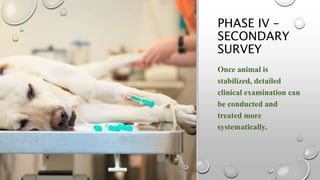
PHASE IV –
SECONDARY
SURVEY
Once animal is
stabilized, detailed
clinical examination can
be conducted and
treated more
systematically.
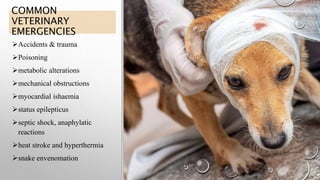
Accidents & trauma
Poisoning
metabolic alterations
mechanical obstructions
myocardial ishaemia
status epilepticus
septic shock, anaphylatic
reactions
heat stroke and hyperthermia
snake envenomation
COMMON
VETERINARY
EMERGENCIES
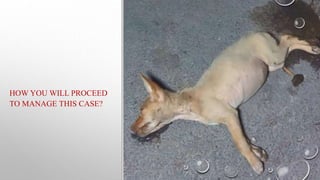
HOW YOU WILL PROCEED
TO MANAGE THIS CASE?
Veterinary Emergency Medicine

Veterinary Emergency Medicine

  • 1.
    VETERINARY EMERGENCY CARE INSMALL ANIMALS Presented by: M’d Saleem 15-BVM- 103 College of Veterinary Animal Sciences, Mannuthy Dept of Teaching Veterinary Clinical Complex.
  • 2.
    WHAT IS EMERGENCYCARE? • Aims of emergency care are :  To preserve life  To protect the casualty  To prevent further injury or pain  To promote recovery “Simple, effective management or care given to casualty of injury or sudden illness until more advanced care can be provided.”
  • 3.
    In the situationof an emergency Priorities should be : DR ABC D – Danger : remove the danger, or the cause of danger.  R – Response : determine whether the casualty is conscious.  A – Airway : ensure airway is clear.  B – Breathing : if absent, expired air resuscitation needed  C – Circulation : if absent, cardiopulmonary resuscitation required.
  • 4.
    If a casualtyis conscious…. The secondary survey is to : Obtain history  Check for vital signs  Note symptoms
  • 5.
    • Make wisedecisions (history via phone) • must advise on initial management and transport procedure. • Awareness on the facility available in your hospital & plan accordingly Phase I => FIRST AID
  • 6.
    Key Factors • Age& previous illness history • time delay in instituting therapy (right time) • volume, dose, drug of choice (right amount of drug) • severity of the illness or injury (right order) The golden rule of emergency medicine is to ‘treat the most life-threatening problems first’
  • 7.
    Phase II -Primary Survey or Triage • Triage is the art of assigning priority to the condition of emergency patients via quick and accurate initial assessment and making a decision regarding the stability of the animal.
  • 9.
    PARAMETERS TO EVALUATE Mucous Membrane Color Inference Pink Normal PCVand adequate perfusion Pale or white Anemia or shock (circulatory) Cyanotic Severe hypoxemia (respiratory) Yellow Yellow
  • 10.
    CAPILLARY REFILL TIME Time Inference 1–2sec normal perfusion >2 sec poor perfusion <1 sec hyperdynamic state
  • 11.
    Heart Rate • Bradycardiawith powerful beats (hypercalcemia) • Tachycardia with weak beats (septic shock, hypocalcemia/ lactic acidosis) • Tachycardia with powerful beats (atropa alkaloids toxicity) Status Inference Normal Normal cardiac output (only rate, not volume) Bradycardia Reduced rate Tachycardia Increased rate
  • 12.
    PULSE RATE AND QUALITY Alertand responsive Normal overall neurologic and metabolic state Depressed or obtunded Decreased perfusion Seizures Excitatory neurological symptoms Stupor (arousable only with painful stimuli) Severe neurological problems Comatose (unarousable with any stimuli) Severe neurological problems
  • 13.
    PHASE III - STABILIZATI ON Airway and Breathing – Obstructions(foreign body/mucus/aspirated content) Tracheal intubation, suction, bronchoscope Emergency tracheostomy Oxygen therapy Thoracocentesis, pleural disease management Furosemide, steroid, vasodilator – lung parenchymal Ikethamide, doxapram - respiratory stimulants Sedatives (narcotic/tranquilizer combination)
  • 14.
    Oxygen therapy shouldbe given to all patients with compromised breathing.
  • 15.
    CARDIO PULMONARY RESUSCITATION •Mechanical ventilation & cardiac pumping • Positive pressure ventilation - Mouth-to-nose resuscitation - Ventilation settings => 10 breaths/min; 10 ml/kg inspiratory time of 1 sec • Negative pressure ventilation - External chest compression @ 100–120 compressions/min for cardiac pumping alter every 2 min with ventilation
  • 16.
    PHASE II –INITIAL STABILIZATION Circulation • shock management to ensure adequate perfusion - internal (hemostatic drugs) or external hemorrhage control - intra vascular volume replacement (colloids & crystalloids) • pain control • neurological stabilization
  • 17.
    PHASE IV – SECONDARY SURVEY Onceanimal is stabilized, detailed clinical examination can be conducted and treated more systematically.
  • 18.
    Accidents & trauma Poisoning metabolicalterations mechanical obstructions myocardial ishaemia status epilepticus septic shock, anaphylatic reactions heat stroke and hyperthermia snake envenomation COMMON VETERINARY EMERGENCIES
  • 19.
    HOW YOU WILLPROCEED TO MANAGE THIS CASE?