VERTICAL FARMING
VERTICAL
FARMING
Types
Advantages
History
Technologies
and devices
Problem
VERTICAL
FARMING
Types
Advantages
History
Technologies
and devices
Problem
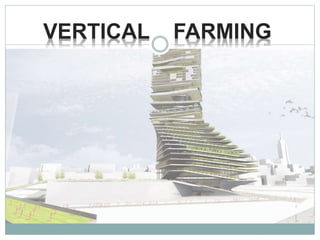
VERTICAL FARMING
• Vertical farming is cultivating plant life within a skyscraper
greenhouse or on vertically inclined surfaces.
• The modern idea of vertical farming uses techniques similar to
glass houses, where natural sunlight can be augmented with
artificial lighting.
History
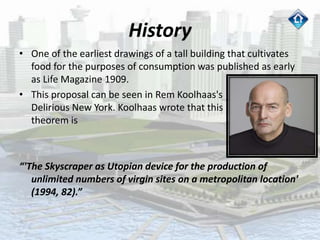
• One of the earliest drawings of a tall building that cultivates
food for the purposes of consumption was published as early
as Life Magazine 1909.
• This proposal can be seen in Rem Koolhaas's
Delirious New York. Koolhaas wrote that this 1909
theorem is
“'The Skyscraper as Utopian device for the production of
unlimited numbers of virgin sites on a metropolitan location'
(1994, 82).”
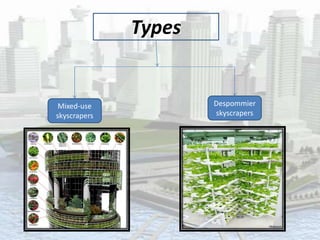
Types
Mixed-use
skyscrapers
Despommier
skyscrapers
Mixed-use skyscrapers
• It was proposed and built by architect Ken Yeang.
• He proposes that instead of hermetically sealed
mass-produced agriculture that plant life should be
cultivated within open air, mixed-use skyscrapers for climate
control and consumption
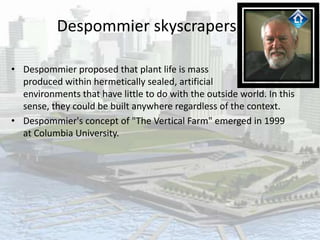
Despommier skyscrapers
• Despommier proposed that plant life is mass
produced within hermetically sealed, artificial
environments that have little to do with the outside world. In this
sense, they could be built anywhere regardless of the context.
• Despommier's concept of "The Vertical Farm" emerged in 1999
at Columbia University.
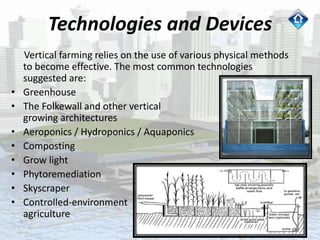
Technologies and Devices
Vertical farming relies on the use of various physical methods
to become effective. The most common technologies
suggested are:
• Greenhouse
• The Folkewall and other vertical
growing architectures
• Aeroponics / Hydroponics / Aquaponics
• Composting
• Grow light
• Phytoremediation
• Skyscraper
• Controlled-environment
agriculture
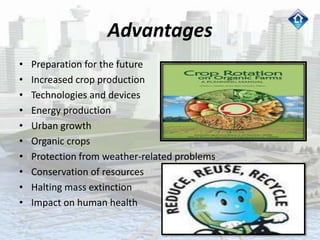
Advantages
• Preparation for the future
• Increased crop production
• Technologies and devices
• Energy production
• Urban growth
• Organic crops
• Protection from weather-related problems
• Conservation of resources
• Halting mass extinction
• Impact on human health
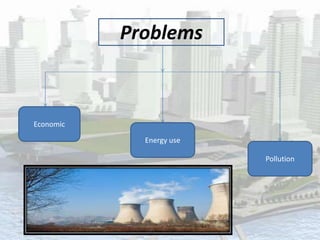
Problems
Economic
Pollution
Energy use
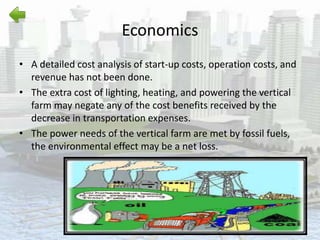
Economics
• A detailed cost analysis of start-up costs, operation costs, and
revenue has not been done.
• The extra cost of lighting, heating, and powering the vertical
farm may negate any of the cost benefits received by the
decrease in transportation expenses.
• The power needs of the vertical farm are met by fossil fuels,
the environmental effect may be a net loss.
Energy use
• During the growing season, the sun shines on a vertical
surface at an extreme angle such that much less light is
available to crops than when they are planted on flat land.
• Therefore, supplemental light, would be required in order to
obtain economically viable yields.
• As "The Vertical Farm" proposes a controlled environment,
heating and cooling costs will be at least as costly as any other
tower.
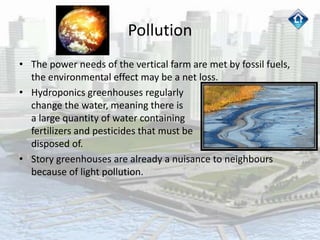
Pollution
• The power needs of the vertical farm are met by fossil fuels,
the environmental effect may be a net loss.
• Hydroponics greenhouses regularly
change the water, meaning there is
a large quantity of water containing
fertilizers and pesticides that must be
disposed of.
• Story greenhouses are already a nuisance to neighbours
because of light pollution.
I hope you it.
Himanshu Kotnala
Shubhankit Sharma

Vertical farming

  • 1.
  • 2.
  • 3.
  • 4.
    VERTICAL FARMING • Verticalfarming is cultivating plant life within a skyscraper greenhouse or on vertically inclined surfaces. • The modern idea of vertical farming uses techniques similar to glass houses, where natural sunlight can be augmented with artificial lighting.
  • 5.
    History • One ofthe earliest drawings of a tall building that cultivates food for the purposes of consumption was published as early as Life Magazine 1909. • This proposal can be seen in Rem Koolhaas's Delirious New York. Koolhaas wrote that this 1909 theorem is “'The Skyscraper as Utopian device for the production of unlimited numbers of virgin sites on a metropolitan location' (1994, 82).”
  • 6.
  • 7.
    Mixed-use skyscrapers • Itwas proposed and built by architect Ken Yeang. • He proposes that instead of hermetically sealed mass-produced agriculture that plant life should be cultivated within open air, mixed-use skyscrapers for climate control and consumption
  • 8.
    Despommier skyscrapers • Despommierproposed that plant life is mass produced within hermetically sealed, artificial environments that have little to do with the outside world. In this sense, they could be built anywhere regardless of the context. • Despommier's concept of "The Vertical Farm" emerged in 1999 at Columbia University.
  • 9.
    Technologies and Devices Verticalfarming relies on the use of various physical methods to become effective. The most common technologies suggested are: • Greenhouse • The Folkewall and other vertical growing architectures • Aeroponics / Hydroponics / Aquaponics • Composting • Grow light • Phytoremediation • Skyscraper • Controlled-environment agriculture
  • 10.
    Advantages • Preparation forthe future • Increased crop production • Technologies and devices • Energy production • Urban growth • Organic crops • Protection from weather-related problems • Conservation of resources • Halting mass extinction • Impact on human health
  • 11.
  • 12.
    Economics • A detailedcost analysis of start-up costs, operation costs, and revenue has not been done. • The extra cost of lighting, heating, and powering the vertical farm may negate any of the cost benefits received by the decrease in transportation expenses. • The power needs of the vertical farm are met by fossil fuels, the environmental effect may be a net loss.
  • 13.
    Energy use • Duringthe growing season, the sun shines on a vertical surface at an extreme angle such that much less light is available to crops than when they are planted on flat land. • Therefore, supplemental light, would be required in order to obtain economically viable yields. • As "The Vertical Farm" proposes a controlled environment, heating and cooling costs will be at least as costly as any other tower.
  • 14.
    Pollution • The powerneeds of the vertical farm are met by fossil fuels, the environmental effect may be a net loss. • Hydroponics greenhouses regularly change the water, meaning there is a large quantity of water containing fertilizers and pesticides that must be disposed of. • Story greenhouses are already a nuisance to neighbours because of light pollution.
  • 15.
  • 16.