Version #
Implemented by
Revision Date
Approved by
Approval Date
Reason
EXECUTION PLAN REVISION HISTORY
Table of Contents
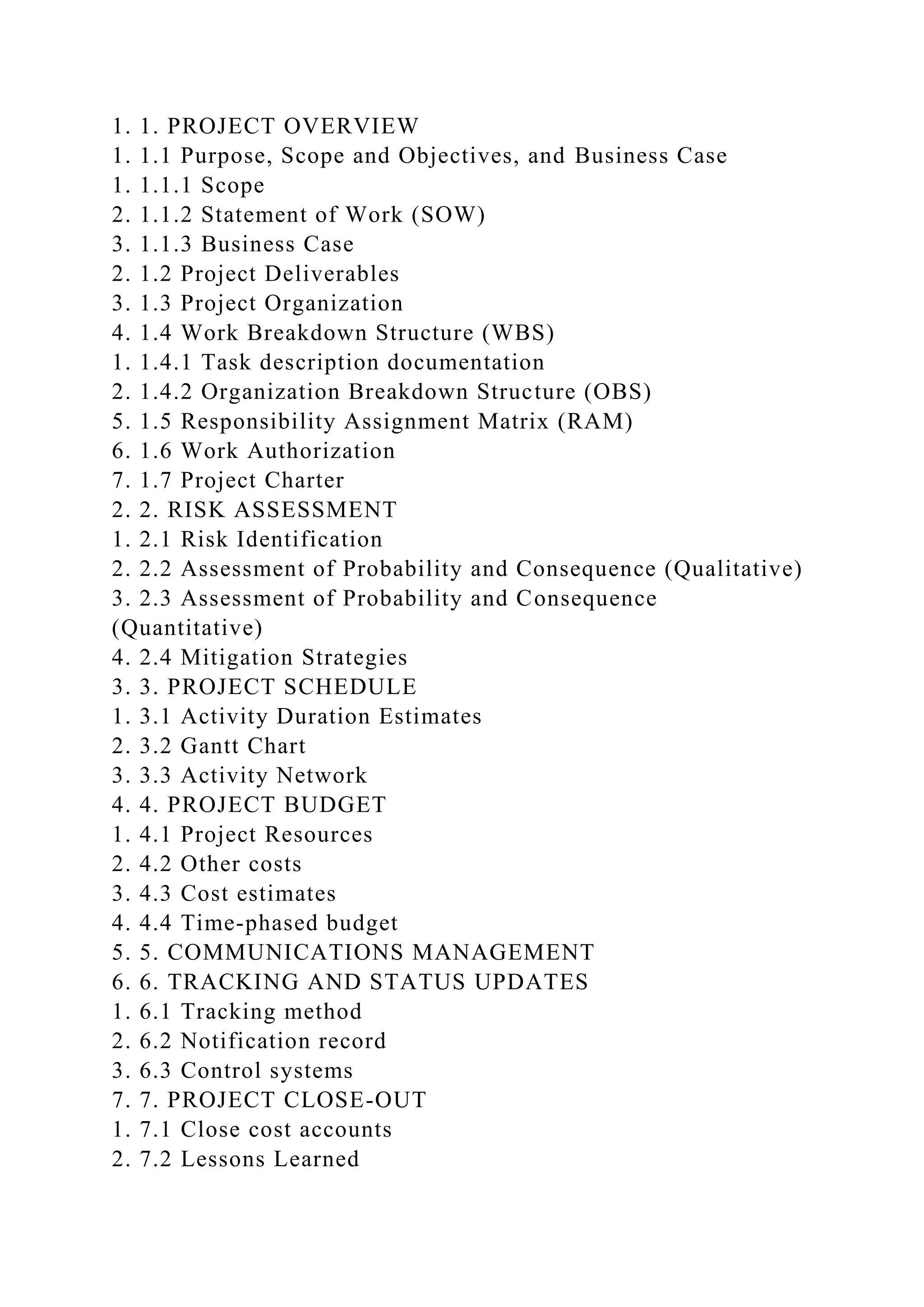
1. 1. PROJECT OVERVIEW
1. 1.1 Purpose, Scope and Objectives, and Business Case
1. 1.1.1 Scope
2. 1.1.2 Statement of Work (SOW)
3. 1.1.3 Business Case
2. 1.2 Project Deliverables
3. 1.3 Project Organization
4. 1.4 Work Breakdown Structure (WBS)
1. 1.4.1 Task description documentation
2. 1.4.2 Organization Breakdown Structure (OBS)
5. 1.5 Responsibility Assignment Matrix (RAM)
6. 1.6 Work Authorization
7. 1.7 Project Charter
2. 2. RISK ASSESSMENT
1. 2.1 Risk Identification
2. 2.2 Assessment of Probability and Consequence (Qualitative)
3. 2.3 Assessment of Probability and Consequence
(Quantitative)
4. 2.4 Mitigation Strategies
3. 3. PROJECT SCHEDULE
1. 3.1 Activity Duration Estimates
2. 3.2 Gantt Chart
3. 3.3 Activity Network
4. 4. PROJECT BUDGET
1. 4.1 Project Resources
2. 4.2 Other costs
3. 4.3 Cost estimates
4. 4.4 Time-phased budget
5. 5. COMMUNICATIONS MANAGEMENT
6. 6. TRACKING AND STATUS UPDATES
1. 6.1 Tracking method
2. 6.2 Notification record
3. 6.3 Control systems
7. 7. PROJECT CLOSE-OUT
1. 7.1 Close cost accounts
2. 7.2 Lessons Learned
1. Project Overview—This section is intended to provide a brief
background description of the project, including motivation,
goals and objectives, success criteria by which it will be
evaluated, major project deliverables, and identified constraints.
See Chapter 5 for development of project scope.
1. 1.1 Purpose, Scope and Objectives, and Business Case—
Describe the purpose of the project here. What are the key
deliverables, that is, the major items to be delivered to the
customer, other stakeholders, suppliers, or other parties?
1. 1.1.1 Scope—Describe the project scope in general terms.
Include a problem statement, detailed steps in requirements
gathering (who was consulted, when?), information gathering
(critical features uncovered from investigation), project
constraints, alternatives analysis, and business case
documentation.
2. 1.1.2 Statement of Work (SOW)—Include a detailed SOW for
the project. Include:
· 1. Key milestones
· 2. Resource requirements
· 3. Risks and concerns
· 4. Acceptance criteria
3. 1.1.3 Business Case—Insert the project Business Case here.
You can find an explanation of the business case in Chapter 5.
Briefly identify the business needs to be satisfied, the
feasibility of the project, a description of internal and external
forces likely to affect the project, a comparative analysis of the
costs and benefits of this project over alternative solutions, and
time estimates to return on investment. Identify how the
satisfaction of business needs will be determined.
2. 1.2 Project Deliverables—List the major items or project
features to be delivered to the client. Include sign-off
documentation from client to demonstrate their concurrence
with the deliverable set.
3. 1.3 Project Organization—Indicate all project team members,
their specific roles, and project organization hierarchy. Where
appropriate, indicate joint responsibility between project
manager and functional manager. Develop project team
reporting structure and include sponsor and/or executive team
sign-off. See Chapter 3 for examples of project organization
types.
4. 1.4 Work Breakdown Structure (WBS)—Insert a WBS for the
project, including all key deliverables and work packages.
Include sign-off from project stakeholders on WBS.
1. 1.4.1 Include project task description documentation
If appropriate, complete project task description data sheets (for
an example, see Figure 5.5 from Chapter 5 .
2. 1.4.2 Include an organization breakdown structure (OBS) if
needed. Identify all cost accounts across cooperating
departments in the organization. See Figure 5.7 from Chapter 5 .
5. 1.5 Responsibility Assignment Matrix—Include a copy of a
RAM for the project identifying all team members by WBS task
code, including tasks for which they assume responsibility,
notification, support, or approval upon completion. See Figure
5.10 from Chapter 5 .
6. 1.6 Work Authorization—Include a copy of the contract or
specific mention of contract terms and conditions. Include all
penalty clauses and specific events that will trigger execution of
penalties. Include all notification information, including
members of the organization to be notified of changes in
contract terms.
7. 1.7 Project Charter—Include a copy of the project charter
here. Include the formal sanction of the project and
authorization to apply organizational resources to the project’s
execution. See an example in the Appendix to Chapter 5.
2. Risk Assessment—This section requires evidence of project
risk assessment. The section is divided into subsections on
identification of risks, analysis (assessment of risk probability
and consequences), and mitigation strategies. See Chapter 7 for
methods for risk management.
1. 2.1 Risk Identification—Identify all relevant risk variables
for the project, including a brief description of the risk variable
and the ways in which it is likely to affect the project.
2. 2.2 Assessment of Probability and Consequence
(Qualitative)—Insert a qualitative risk assessment matrix in this
space. Give evidence of how you arrived at this assessment,
including sign-offs from key project stakeholders participating
in the risk assessment exercise.
Sample Qualitative Risk Assessment Matrix
Low Consequences
High Consequences
Low Likelihood
Low Priority
Medium Priority
High Likelihood
Medium Priority
High Priority
3. 2.3 Assessment of Probability and Consequence
(Quantitative)—Insert a quantitative assessment of probability
and consequences, clearly identifying the criteria used for
determining both probability of failure and consequence of
failure. Insert this analysis here.
4. 2.4 Mitigation Strategies—Identify individual mitigation
strategies for each high priority risk factor. Briefly describe the
strategy as either: Accept, Minimize, Transfer, or Share and
specify actions to be taken in order to accomplish the strategy.
3. Project Schedule—This section addresses the duration
estimates for all project activities, their activity networks,
project critical path, and estimated project duration. A copy of
the approved project schedule, including both activity network
and Gantt chart, should be inserted in this section of the
execution plan. See Chapters 9 and 11 for methods for project
schedule development.
1. 3.1 Activity Duration Estimates—Insert table with all activity
duration estimates shown. Indicate if each estimate was derived
stochastically (through PERT probability estimates) or
deterministically. Add sign-off documentation from key
organization members, including the project sponsor, that
supports these duration estimates.
2. 3.2 Gantt Chart—Insert copy of project Gantt chart from MS
Project output file. On the chart, make sure to identify the
project critical path, estimated time to completion, and resource
assignments. Indicate all activity precedence relationships,
including any lag requirements. Show all milestones and other
significant mid-project stages, including scheduled supplier
delivery dates (where appropriate).
3. 3.3 Activity Network—Provide activity-on-node (AON)
project network from MS Project output file.
4. Project Budget—This section includes activity cost
estimation and the project budget. All direct and indirect costs
should be included as well as the method used to develop fully
loaded costs for all project resources. See Chapters 8 and 12 for
examples of methods for cost estimation, fully loaded resource
charges, time-phased budgeting, and resource leveling.
1. 4.1 Project Resources—Identify all project resources. Include
employment status (full-time, part-time, exemption status, etc.).
Develop fully loaded cost table for all project resources.
2. 4.2 Other costs—Identify all significant costs for materials,
equipment, overhead, expediting, etc.
3. 4.3 Cost estimates—Submit ballpark, comparative, and
feasibility estimates. Show all information gathered to support
these estimates. Identify who participated in the cost estimate
exercise. Provide final, definitive estimate with sponsor sign-
off for final project budget.
4. 4.4 Time-phased Budget—Submit time-phased budget with
estimated expenses costed by project duration increments
(weeks, months, quarters, etc.).
5. Communications Management—This section identifies all
critical communication channels for project stakeholders,
frequency of communications, types of information to be
communicated, and project status tracking plan. Where
appropriate, include electronic media used for collaborative
purposes (e.g., Google Docs, Yammer, Facebook, etc.). Also, in
cases of geographically dispersed project teams, indicate
methods for regular communication. See discussion from
Chapter 6 on team communication methods. An example of a
communication management protocol is shown below.
Purpose of communication
Schedule frequency
Media or mechanism used
Called by:
Participants
Status updates
Weekly
Meeting and/or teleconference
Project manager
Full project team
Exception/variance reports
As needed
Meeting and/or teleconference
Project manager or technical lead
Impacted team members and client
Project reviews
Monthly or at milestone
Meeting and/or teleconference
Project manager
Full project team, sponsor
Configur
ation changes
As changes are approved
Meeting for impacted parties; e-mail for team
Project manager, sponsor or technical lead
Impacted team members and client
Supplier coordination
As needed prior to and post deliveries
Phone call
Supply chain lead
Project manager and supply chain lead
Emergency or critical events
As needed
Face to face
Any team member
Ful Project Team
6. Tracking and Status Updates—This section of the plan
indicates the methods the project team will use to regularly
update the project status, including methods for tracking project
progress, and which organizational stakeholders receive
notification of the project status. See Chapter 13 for examples
of tracking and status updating methods.
1. 6.1 Tracking method—Show the method used to track project
status (S-curve, earned value, milestones, etc.). Indicate the
regularity of these assessments (i.e., monthly, as needed, upon
completion of major deliverables, etc.). For earned value
assessments, indicate how you will provide updated cost
performance index (CPI) and schedule performance index (SPI)
data in a sample format as shown below.
Date
CPI
Trend
SPI
Trend
Month 1
Month 2
Month 3
2. 6.2 Notification record—Maintain record of project status
update communications. Indicate who received project updates
and show sign-off by key stakeholders upon their receipt of
status updates.
3. 6.3 Control systems—Indicate the forms of project control
that will be used for the project, including configuration
control, design control, quality control, document control, and
trend monitoring. Develop control documentation for each form
of control you intend to use, including a list of key
organizational stakeholders who will be copied on all control
documents and status updates.
7. Project Close-out—In this section, all necessary project
close-out documentation and sign-offs must be included. Work
completed or soon-to-be-complete must be identified, and
configuration management changes, all sign-off documentation,
warranties, notices of completion, supplier contracts, and
charges for or against suppliers must be recorded and formally
documented. Include copies of client sign-off, including
satisfaction of contracted terms and conditions. See Chapter 14
for examples of steps in project close-out.
1. 7.1 Close cost-accounts—Complete and close all project cost-
accounts and other financial closeouts.
2. 7.2 Lessons Learned—Complete a Lessons Learned
assessment that identifies all exceptions and other problems,
mitigation strategies employed, success of the strategies, and
suggestions for the future, and include sign-off documentation
that key project team members participated in Lessons Learned
meetings. Develop and embed an action plan for future projects
in the Lessons Learned documentation.
Project Make sure you’ve read and understand these
pages:Project Instructions:This project
Make sure you’ve read and understand these pages:Project
Instructions:This project is focused on wrangling and analyzing
data using pivot tables and complex formulas.This project uses
data that was scraped from IMDB websites. The original data
set was downloaded early 2017 from:
https://www.kaggle.com/deepmatrix/imdb-5000-movie-dataset
(Links to an external site.)Links to an external site..Download
the dataset for this project here: movie_metadata.csv and load
the file into Excel to get started. Remember the submission
must be in .xlsx format (Excel).Part A Wrangle:
1. Scroll to Movie_IMDB_Link Column in the dataset. That
column contains a URL string that we want to extract a specific
variable from. Specifically we want to extract a specific range
of characters (letters and numbers) that looks like tt0499549
from every URL string. This is going to be a unique identifier
for the table (primary key). Each row can then be identified by
this field.Create a formula learned in class to extract the
primary key from the Movie_IMDB_Link column into a new
column (call that new column Primary Key and make it the first
column dataset). Leave the Movie_IMDB_Link column
untouched. Create a named range for the new column called
PrimaryKey . Make sure you leave the formula that you created
intact so that I can see your process. 10pts
2. Format the table as a table. Create named ranges for these
columns: Director Country Gross (Gross Revenue) Budget and
Title Year. 5pts3. Copy and paste the new primary key column
and the genres column into a new worksheet (call it the genre
worksheet). Use an Excel feature to give each genre it’s own
column: label the columns Genre1 Genre2 etc. Create a function
that counts the number of movies that are described with at least
3 genres. 5ptsSo if you have a single cell that has Action
Comedy Romance it should now be:Action | Comedy |
RomanceWhere | represents a new column.
4. Modify the movie_title column and remove the unique
character that exists in the cell values. 5pts
5. Format the budget column in U.S. Dollars. Create a
conditional formatting on the budget column. Use the best
conditional formatting that shows the differences between the
amounts in each cell. 5pts.
5a. Scroll through the dataset what do you notice? Is formatting
the column as dollars an appropriate choice why or why not?
Explain. 5pts
Part B Analysis:Q. Which countries produced the most number
of movies?
6. Create another worksheet called Countries . Copy and paste a
distinct listing of countries from the raw data. Use a formula
learned in class to count the total number of movies made by
the particular country make sure to use the appropriate named
range in your equation. Create another column called Ranking
by Count and use a function learned in class to rank the
countries by their respective count. Which Countries were in the
top 5 based on quantity of movies produced? 10pts
Note: Do not use pivot tables.Q. Which countries had the
largest gross revenue and biggest movie budgets?
7. In the same Countries worksheet use another formula learned
in class to bring in the Total Gross Revenues and Total Budgets
of all movies by country. Again make sure to use the
appropriate named range in your equation. Create two additional
columns called Ranking by Gross Revenue and Ranking by
Total Budget and use a function learned in class to rank the
countries by each measure respectively. Does the countries in
your top 5 change from the total revenue versus the budget
total? 10pts
7a. Describe the issue that is present in number 7 and describe
how you would go about solving it. 5pts
Note: Do not use pivot tables.
Q. How many movies was each actor in?
8. In a new worksheet called Actors create an unduplicated
listing of all actors (from columns actor_1_name actor_2_name
actor_3_name) in 1 column. Sort the column from A-Z. Use a
function learned in class to count the total number of movies
each actor appears in (regardless of whether they are in column
they are in). 10pts
8a.Create a new column called Flag and write an equation that
Flags the actor if they appeared in more than 25 films. Filter the
table by this flag . Create another function learned in class to
count the number of actors who appeared in 30 movies or more.
10pts
Note: Do not use pivot tables.
Q. How many movies did each director make by year within the
US?
9. Use the pivot table feature in Excel to help you answer this
problem.In a new worksheet called Directors create your pivot
and filter it by: Year >= 2010 and Country = USA. Include the
director_name as your first column and additional column
names for each of the years from 2010 – 2015. Next bring in the
Primary Key field (that you created in Step 1) as your value to
be counted for each director in each year respectively. Create a
Total column and Total row to sum the data accordingly. 10pts
Note: Do not use equations.
10. Create your own analysis with the data. Clearly describe the
problem/question that you’re trying to address show your work
and explain the answer that you derived at. And make sure the
analysis is complex. It should not be something as simple as the
total number of movies in the dataset or even the total number
of movies by year . Make sure your analysis is more interesting
and complicated than that. And make sure it’s not similar to one
of the other problems in this project. 10pts
Running head: UNIT IV COURSE PROJECT
UNIT IV COURSE PROJECT
Unit IV Course Project
Project Management
Bobby Holman
March 22,2020
Unit IV Course Project
2. Risk Assessment
Every project has a certain amount of risks in it. To manage
projects successfully, the project manager in conjunction with
the risk manager needs to be aware of potential project risks and
be able to deal with them efficiently. They need to ensure that
there is an effective risk management plan in place before the
project begins. An effective risk management plan will help in
successfully identifying and assessing some of the potential
project risks.
2.1 Risk Identification
Risk identification is the process by which the impact of a
potential threat is translated into information and is recorded
hence there are sufficient details concerning potential project
risks. This will enable the risk manager to facilitate effective
risk management assessment of the potential project risks to
support efficient risk management decisions. Some of the
methods that will aid in the identification of the potential
project risks include seminars and workshops, using check-lists,
analyzing networks and work breakdown structures (WBS),
using structured interviews and analyzing proposals and change
requests (CRs). Some of the potential project risks include not
being able to have control over priorities of project staff, delays
among contractors or consultants, scheduling/estimating errors,
lack of communication, scope creep, legal action and theft of
equipment, materials, or intellectual property.
2.2 Assessment of Probability and Consequence (Qualitative)
Qualitative risk analysis will be conducted on each project risk
that has been identified. This will assist in estimating the
probability of occurrence of an event that may pose threats and
also estimate the impact of a risk on the proposed project. The
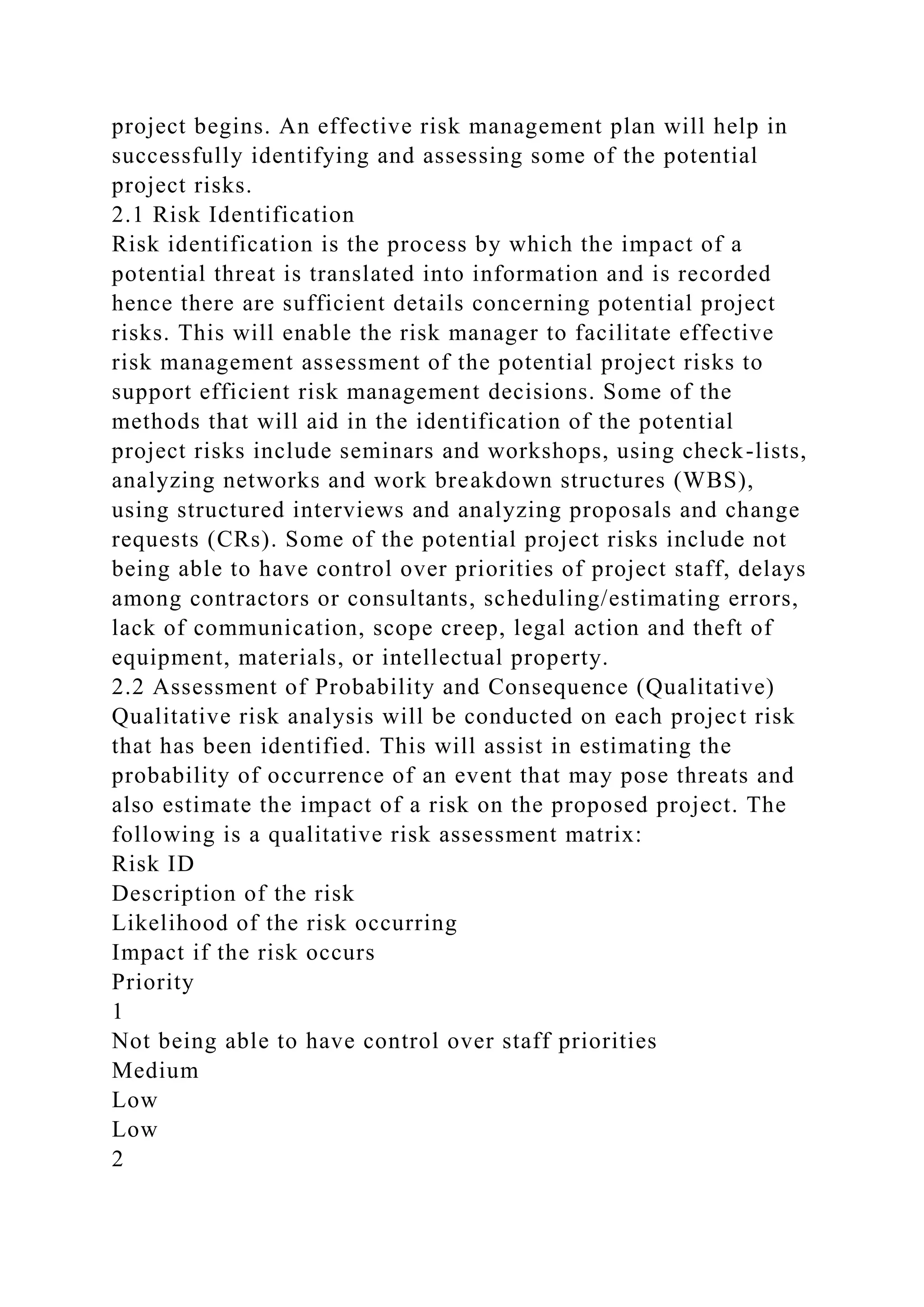
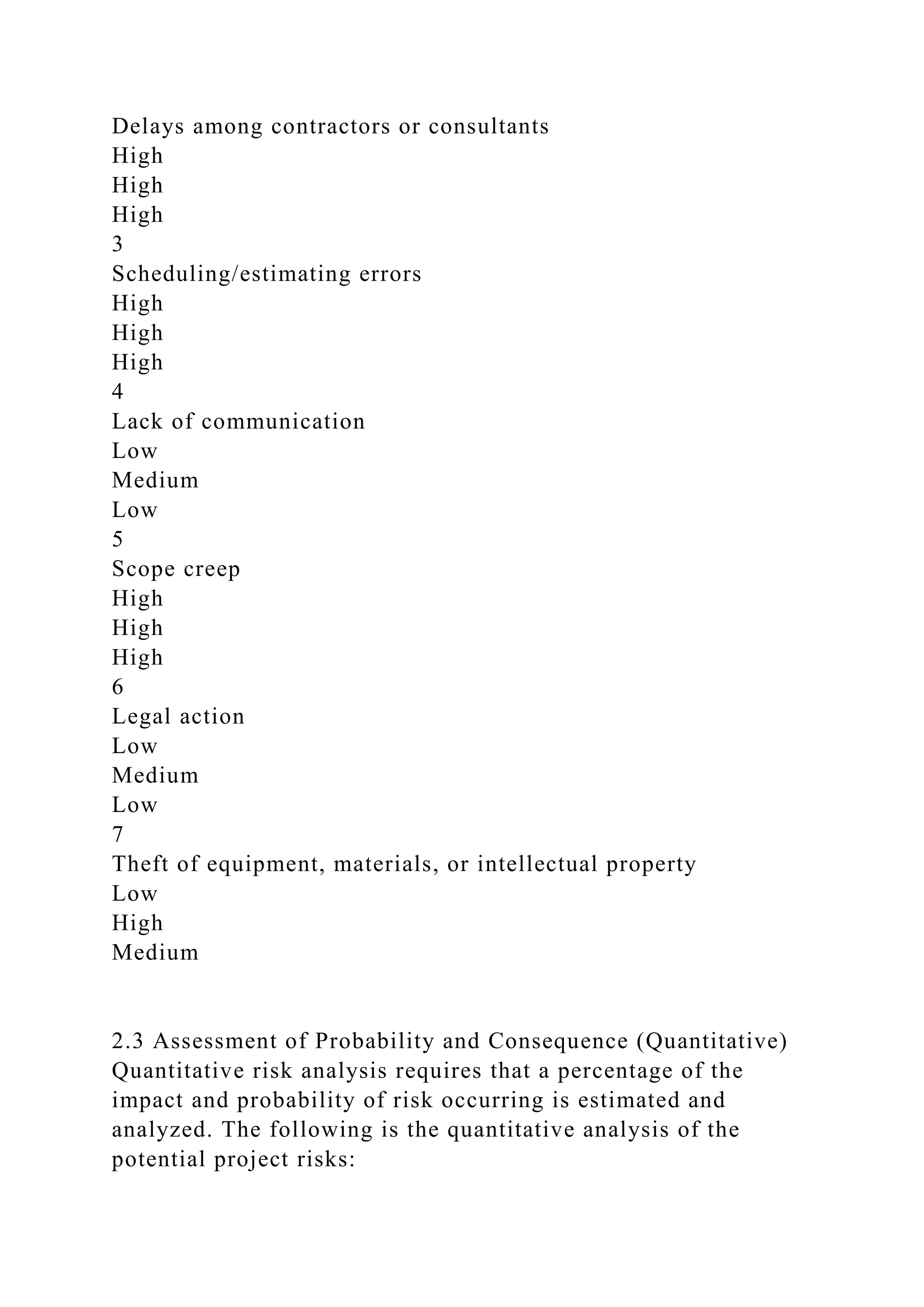
following is a qualitative risk assessment matrix:
Risk ID
Description of the risk
Likelihood of the risk occurring
Impact if the risk occurs
Priority
1
Not being able to have control over staff priorities
Medium
Low
Low
2
Delays among contractors or consultants
High
High
High
3
Scheduling/estimating errors
High
High
High
4
Lack of communication
Low
Medium
Low
5
Scope creep
High
High
High
6
Legal action
Low
Medium
Low
7
Theft of equipment, materials, or intellectual property
Low
High
Medium
2.3 Assessment of Probability and Consequence (Quantitative)
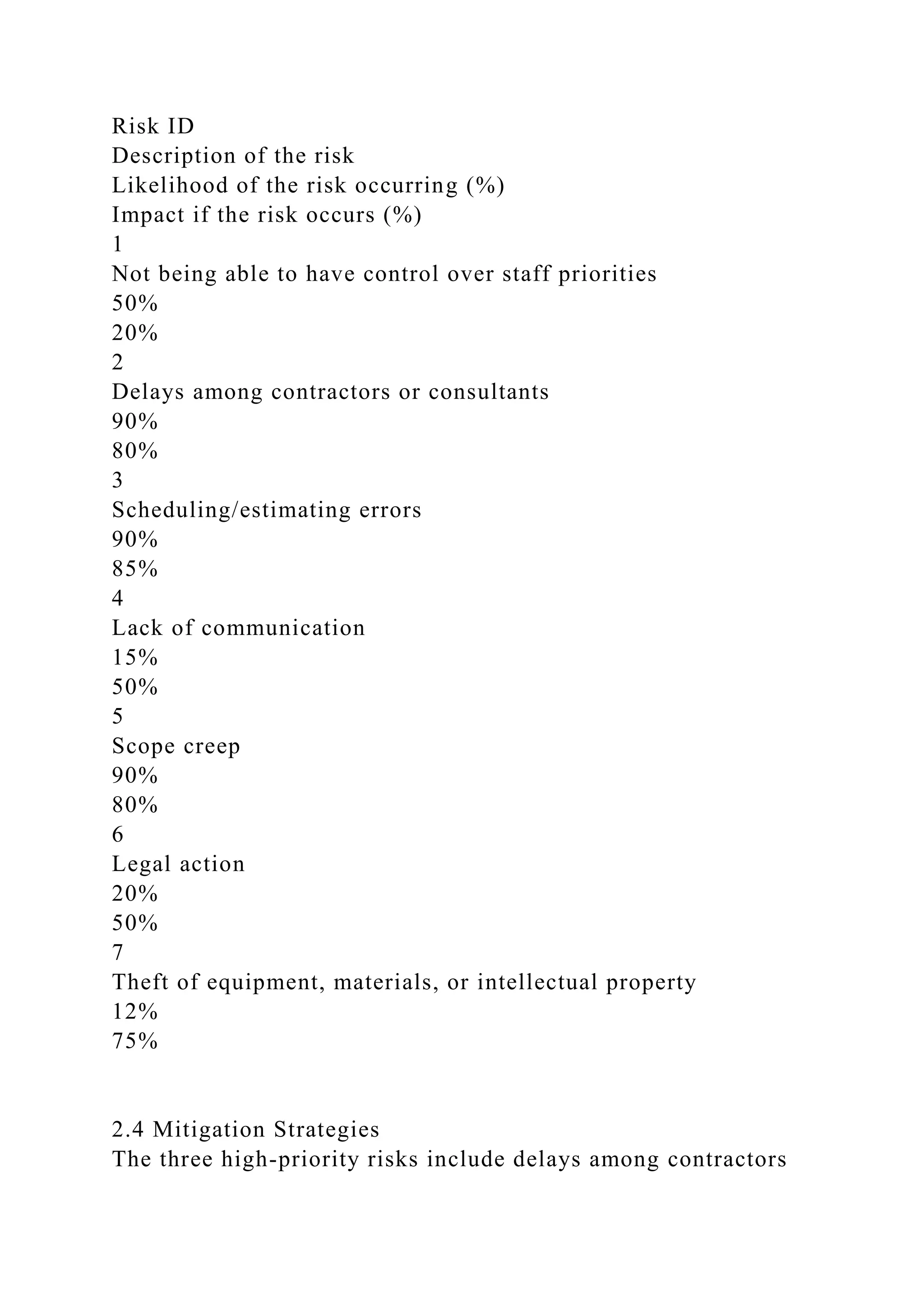
Quantitative risk analysis requires that a percentage of the
impact and probability of risk occurring is estimated and
analyzed. The following is the quantitative analysis of the
potential project risks:
Risk ID
Description of the risk
Likelihood of the risk occurring (%)
Impact if the risk occurs (%)
1
Not being able to have control over staff priorities
50%
20%
2
Delays among contractors or consultants
90%
80%
3
Scheduling/estimating errors
90%
85%
4
Lack of communication
15%
50%
5
Scope creep
90%
80%
6
Legal action
20%
50%
7
Theft of equipment, materials, or intellectual property
12%
75%
2.4 Mitigation Strategies
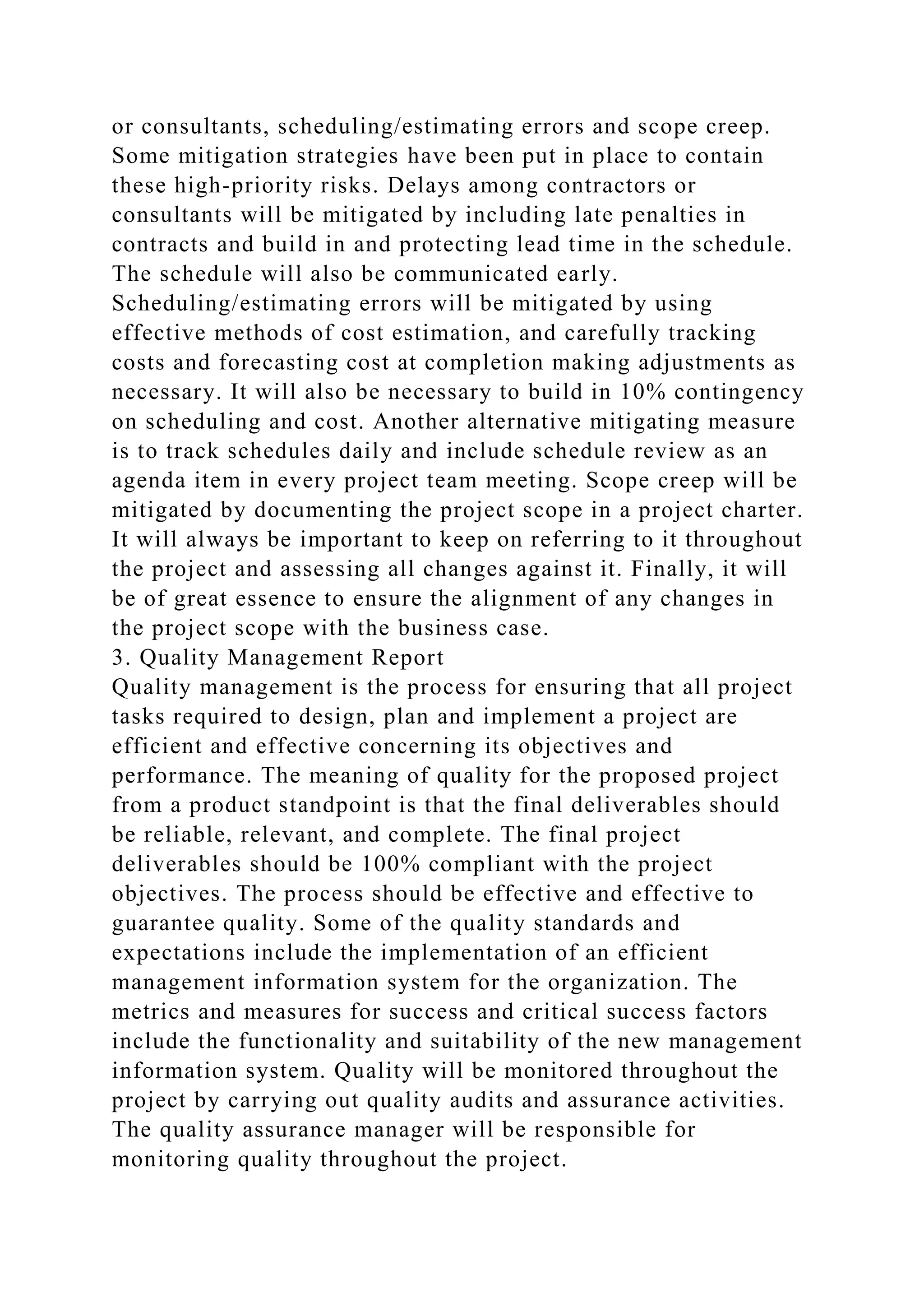
The three high-priority risks include delays among contractors
or consultants, scheduling/estimating errors and scope creep.
Some mitigation strategies have been put in place to contain
these high-priority risks. Delays among contractors or
consultants will be mitigated by including late penalties in
contracts and build in and protecting lead time in the schedule.
The schedule will also be communicated early.
Scheduling/estimating errors will be mitigated by using
effective methods of cost estimation, and carefully tracking
costs and forecasting cost at completion making adjustments as
necessary. It will also be necessary to build in 10% contingency
on scheduling and cost. Another alternative mitigating measure
is to track schedules daily and include schedule review as an
agenda item in every project team meeting. Scope creep will be
mitigated by documenting the project scope in a project charter.
It will always be important to keep on referring to it throughout
the project and assessing all changes against it. Finally, it will
be of great essence to ensure the alignment of any changes in
the project scope with the business case.
3. Quality Management Report
Quality management is the process for ensuring that all project
tasks required to design, plan and implement a project are
efficient and effective concerning its objectives and
performance. The meaning of quality for the proposed project
from a product standpoint is that the final deliverables should
be reliable, relevant, and complete. The final project
deliverables should be 100% compliant with the project
objectives. The process should be effective and effective to
guarantee quality. Some of the quality standards and
expectations include the implementation of an efficient
management information system for the organization. The
metrics and measures for success and critical success factors
include the functionality and suitability of the new management
information system. Quality will be monitored throughout the
project by carrying out quality audits and assurance activities.
The quality assurance manager will be responsible for
monitoring quality throughout the project.
References
Heagney, J. (2016). Fundamentals of project management.
Amacom.
Meredith, J. R., Mantel Jr, S. J., & Shafer, S. M. (2017). Project
management: a managerial approach. John Wiley & Sons.
Unit III Course Project- Project Management
· Instructions
Wrapping up the Project Overview
In Unit II, you were required to complete components 1.1–1.3 in
the Project Overview section. As you receive feedback from
your professor, be sure to make improvements to your project
plan.
In Unit III, you are required to complete the rest of the Project
Overview section (components 1.4–1.7) from your project plan.
For this assignment, refer to your unit lesson and required unit
resources to advance your project plan. You should now have
the components from Unit II already developed (see below).
1. Project Overview (due in Unit II)
· 1.1 Purpose, Scope and Objectives, and Business Case (due in
Unit II)
· 1.1.1 Scope (due in Unit II)
· 1.1.2 Statement of Work (SOW) (due in Unit II)
· 1.1.3 Business Case (due in Unit II)
· 1.2 Project Deliverables (due in Unit II)
· 1.3 Project Organization (due in Unit II)
For this assignment, continue this section by completing the
components listed below.
1. 1.4 Work Breakdown Structure (WBS): Provide a WBS for
the project, including all key deliverables and work packages.
4. 1.4.1 Task Description Documentation
4. 1.4.2 Organization Breakdown Structure (OBS): Include all
cost accounts across cooperating departments in the
organization.
1. 1.5 Responsibility Assignment Matrix (RAM): Include a copy
of a RAM for the project that identifies all team members by
WBS task code, including tasks for which they assume
responsibility, notification, support, or approval upon
completion.
1. 1.6 Work Authorization: Describe contract terms and
conditions. Include all penalty clauses and specific events that
will trigger execution of penalties. Include all notification
information, including members of the organization to be
notified of changes in contract terms.
1. 1.7 Work Charter
This assignment should be a minimum of two pages in length,
not counting the title page and reference page. Be sure to use
proper APA formatting. Citations are not required; however, if
outside sources are used, make certain to provide in-text
citations and references in APA format. For more elaboration on
what you should include in your project plan, refer to pp. 539–
542 in your textbook.
Running head: PROJECT OVERVIEW
1
PROJECT OVERVIEW
5
Unit II
Course Project
Bobby Holman
Project Management
March 3, 2020
1. Project Overview
1.1 Purpose and Objectives of the proposed project
The organization is required to install new information systems.
The organization is rolling out a project that is aimed at
installing new information systems. The overall goal of the
project is implement comprehensive and reliable information
systems that will automate all organization’s processes. Other
goals and objectives of the project include installation of
information systems that will ensure that the organization’s
information is always readily available to the decision makers
and effectively collect the required data. The success criteria is
the improved efficiency characterized by reduction in
operational errors, the rate of processing information is fast,
and efficient work flow two months after the new information
systems has been implemented . The major project deliverables
include purchase of new software, desktop workstations and
networked servers.
1.1.1 Scope
The proposed project is necessary in that the current
information system that is in place is not efficient enough. The
information systems currently in use are also outdated. The
organization has faced numerous challenges in its operations
due to the existing information systems. The project will
involve a number of activities. These activities will range from
acquisition of the new information systems to implementation
and maintenance. Some of the major constraints include
financial constraints and lack of experts who are very well
conversant with the new information system. Some of the
techniques that were used to derive the requirements for the
proposed project include brainstorming, interviews, focus group
discussions, benchmarking, questionnaires and surveys. These
techniques were useful in getting to know what the project
required to start.
1.1.2 Statement of Work (SOW)
The key project milestones include procurement of new
information systems and successful implementation of the new
information systems. These milestones will indicate that the
project is on course. The resources that will be required to start
the project include financial resources and personnel. Some of
the risks and concerns include the high costs involved and
whether the new system will be fully compatible with the
existing software. The acceptance criteria is when the new
information system is fully functional and compatible with the
software.
1.1.3 Business Case
Some of the business needs to be satisfied include the need to
improve business operations and also the need to have an
efficient system. A feasibility study was carried out and it was
found out that the project is feasible in that the organization
will gain a lot by implementing the new information systems.
The internal and external forces that are likely to affect the
project include the stakeholder perception, resources, price of
the new information system etc. Despite the huge costs that will
be involved, the organization will realize huge benefits after
implementing it. The satisfaction of business needs will be
determined by analyzing the outcome of the project.
1.2 Project Deliverables
Some of the major items or project features to be delivered after
the project has been rolled out include purchase of new
software, networked servers, and desktop workstations,
compatibility between the newly installed software and
hardware and successful installation of the most current
information systems for the organization.
1.3 Project Organization
The project members will include project manager, project
coordinator and six members who form the project teams. The
roles of the project manager include developing a project plan,
managing deliverables, recruiting project staff and assigning
tasks to project team members (Heagney, 2016). The project
coordinator will be responsible of supervising all project
activities and ensuring that the project is progressing well
(Meredith, Mantel & Shafer, 2017). The project team members
will contribute to overall objectives of the project by
completing the assigned tasks and providing expertise. The
project organization hierarchy is that the project manager is at
the top, followed by project coordinator and finally project team
members. The reporting structure is such that the project team
members report to the project coordinator. The project
coordinator reports to the project manager.
References
Heagney, J. (2016). Fundamentals of project management.
Amacom.
Meredith, J. R., Mantel Jr, S. J., & Shafer, S. M. (2017). Project
management: a managerial approach. John Wiley & Sons.
· Unit VIII Course Project
· Instructions
Project Closing
In Unit VIII, you are required to complete the Project Closeout
section of your project plan. Refer to your unit lesson and
required unit resources to advance your project plan. For this
unit, create the section listed below.
8. Project Closeout: All necessary project closeout
documentation should be included. Work completed or soon to
be-completed must be identified, along with any configuration
management changes.
· 8.1 Close Cost Accounts: Discuss completing and closing all
project cost accounts and other financial closeouts.
· 8.2 Lessons Learned: Complete a Lessons Learned assessment
that identifies key concepts learned and suggestions for future
projects. What is your plan for retention of this information?
The Project Closeout section should be a minimum of two pages
in length. You will need to add the Project Closeout section to
your previous work from Units II–VII and submit a cohesive,
complete, polished document for your final project plan. You
will submit only one document; you do not have to submit the
Project Closeout section separately. Be sure that you have
incorporated modifications based on your professor’s feedback
throughout Units II–VII.
This assignment should be a minimum of two pages in length,
not counting the title page and reference page. Be sure to use
proper APA formatting. Citations are not required; however, if
outside sources are used, make certain to provide in-text
citations and references in APA format. For more elaboration on
what you should include in your project plan, refer to pp. 539–
542 in your textbook.
· Unit VII Course Project
· Instructions
Communications and Control
In this unit, you are required to complete the following
sections: Communications Management and Tracking and Status
Updates. Refer to your unit lesson (from this unit and last unit)
and required unit resources to advance your project plan. For
this unit, create the sections listed below.
6. Communications Management: Identify all critical
communications channels for project stakeholders, frequency of
communications, types of information to be communicated, and
the project status-tracking plan. Where appropriate, include
electronic media used for collaborative purposes (e.g., Google
Docs, Yammer, and Facebook). Also, in cases of geographically
dispersed project teams, indicate methods for regular
communications. Please review the discussion from Chapter 6
on team communication methods. An example of a
communications management protocol is shown on p. 541 of
your textbook.
7. Tracking and Status Updates: Indicate the methods the
project team will use to regularly update the project status,
including methods for tracking project progress, and identify
which organizational stakeholders receive notification of the
project status.
· 7.1 Tracking Method: Show the method used to track project
status (e.g., S-curve, earned value, milestones). Indicate the
regularity of these assessments (i.e., monthly, as needed, or
upon completion of major deliverables). For earned value
assessments, indicate how you will provide updated cost
performance index (CPI) and schedule performance index (SPI)
data. See p. 542 of your textbook.
· 7.2 Notification Record: Provide a record of project status
update communications. Indicate who received project updates,
and show sign-off by key stakeholders upon their receipt of
status updates.
· 7.3 Control Systems: Indicate the forms of project control to
be used for the project, including configuration control, design
control, quality control, document control, and trend
monitoring. Develop control documentation for each form of
control you intend to use, including a list of key organizational
stakeholders who will be copied on all control documents and
status updates.
This assignment should be a minimum of two pages in length,
not counting the title page and reference page. Be sure to use
proper APA formatting. Citations are not required; however, if
outside sources are used, make certain to provide in-text
citations and references in APA format. For more elaboration on
what you should include in your project plan, refer to pp. 539–
542 in your textbook.
· Unit VI Course Project
Instructions
Cost Estimation and Budgeting
In this unit, you are required to complete the Project Budget
section of the project plan. Refer to your unit lesson and
required unit resources to advance your project plan. You may
also need to revisit the Unit V Lesson. For this assignment,
create the components listed below.
4. Project Budget: Include cost estimation and project budget.
Include direct and indirect costs, recurring and nonrecurring
costs, and any expedited costs.
· 5.1 Project Resources: Identify all project resources. Develop
a cost table for all project resources.
· 5.2 Other Costs: Identify all significant costs for materials
(e.g., equipment, overhead, expediting).
· 5.3 Cost Estimates: Submit ballpark, comparative, and
feasibility estimates. Show all information gathered to support
these estimates.
· 5.4 Time-Phased Budget: Include estimated expenses for
duration increments (e.g., days, weeks, and quarters).
This assignment should be a minimum of two pages in length,
not counting the title page and reference page. Be sure to use
proper APA formatting. Citations are not required; however, if
outside sources are used, make certain to provide in-text
citations and references in APA format. For more elaboration on
what you should include in your project plan, refer to pp. 539–
542 in your textbook.
· Unit V Course Project
Instructions
Project Schedule
In this unit, you are required to complete the Project Schedule
section of the project plan. Refer to your unit lesson (from this
unit and last unit) and required unit resources to advance your
project plan. For this assignment, create the components listed
below.
4. Project Schedule: Include the duration estimates for all
project activities, their activity networks, the project critical
path, and estimated project duration.
· 4.1 Activity Duration Estimates: Include a table with activity
number, activity, predecessors, optimistic duration, most likely
duration, pessimistic duration, and estimated duration. Be sure
to show your paths as well as the critical path.
· 4.2 Gantt Chart: Show the task, duration, predecessors, and
the schedule leveling.
· 4.3 Activity Network: Be sure to include fully completed
nodes, including early start, early finish, late start, late finish,
and activity float/slack.
This assignment should be a minimum of two pages in length,
not counting the title page and reference page. Be sure to use
proper APA formatting. Citations are not required; however, if
outside sources are used, make certain to provide in-text
citations and references in APA format. For more elaboration on
what you should include in your project plan, refer to pp. 539–
542 in your textbook.
Resources

Version #Implemented byRevision DateApproved byApproval Da.docx

  • 1.
    Version # Implemented by RevisionDate Approved by Approval Date Reason
  • 2.
    EXECUTION PLAN REVISIONHISTORY Table of Contents
  • 3.
    1. 1. PROJECTOVERVIEW 1. 1.1 Purpose, Scope and Objectives, and Business Case 1. 1.1.1 Scope 2. 1.1.2 Statement of Work (SOW) 3. 1.1.3 Business Case 2. 1.2 Project Deliverables 3. 1.3 Project Organization 4. 1.4 Work Breakdown Structure (WBS) 1. 1.4.1 Task description documentation 2. 1.4.2 Organization Breakdown Structure (OBS) 5. 1.5 Responsibility Assignment Matrix (RAM) 6. 1.6 Work Authorization 7. 1.7 Project Charter 2. 2. RISK ASSESSMENT 1. 2.1 Risk Identification 2. 2.2 Assessment of Probability and Consequence (Qualitative) 3. 2.3 Assessment of Probability and Consequence (Quantitative) 4. 2.4 Mitigation Strategies 3. 3. PROJECT SCHEDULE 1. 3.1 Activity Duration Estimates 2. 3.2 Gantt Chart 3. 3.3 Activity Network 4. 4. PROJECT BUDGET 1. 4.1 Project Resources 2. 4.2 Other costs 3. 4.3 Cost estimates 4. 4.4 Time-phased budget 5. 5. COMMUNICATIONS MANAGEMENT 6. 6. TRACKING AND STATUS UPDATES 1. 6.1 Tracking method 2. 6.2 Notification record 3. 6.3 Control systems 7. 7. PROJECT CLOSE-OUT 1. 7.1 Close cost accounts 2. 7.2 Lessons Learned
  • 4.
    1. Project Overview—Thissection is intended to provide a brief background description of the project, including motivation, goals and objectives, success criteria by which it will be evaluated, major project deliverables, and identified constraints. See Chapter 5 for development of project scope. 1. 1.1 Purpose, Scope and Objectives, and Business Case— Describe the purpose of the project here. What are the key deliverables, that is, the major items to be delivered to the customer, other stakeholders, suppliers, or other parties? 1. 1.1.1 Scope—Describe the project scope in general terms. Include a problem statement, detailed steps in requirements gathering (who was consulted, when?), information gathering (critical features uncovered from investigation), project constraints, alternatives analysis, and business case documentation. 2. 1.1.2 Statement of Work (SOW)—Include a detailed SOW for the project. Include: · 1. Key milestones · 2. Resource requirements · 3. Risks and concerns · 4. Acceptance criteria 3. 1.1.3 Business Case—Insert the project Business Case here. You can find an explanation of the business case in Chapter 5. Briefly identify the business needs to be satisfied, the feasibility of the project, a description of internal and external forces likely to affect the project, a comparative analysis of the costs and benefits of this project over alternative solutions, and time estimates to return on investment. Identify how the satisfaction of business needs will be determined. 2. 1.2 Project Deliverables—List the major items or project features to be delivered to the client. Include sign-off documentation from client to demonstrate their concurrence with the deliverable set. 3. 1.3 Project Organization—Indicate all project team members, their specific roles, and project organization hierarchy. Where appropriate, indicate joint responsibility between project
  • 5.
    manager and functionalmanager. Develop project team reporting structure and include sponsor and/or executive team sign-off. See Chapter 3 for examples of project organization types. 4. 1.4 Work Breakdown Structure (WBS)—Insert a WBS for the project, including all key deliverables and work packages. Include sign-off from project stakeholders on WBS. 1. 1.4.1 Include project task description documentation If appropriate, complete project task description data sheets (for an example, see Figure 5.5 from Chapter 5 . 2. 1.4.2 Include an organization breakdown structure (OBS) if needed. Identify all cost accounts across cooperating departments in the organization. See Figure 5.7 from Chapter 5 . 5. 1.5 Responsibility Assignment Matrix—Include a copy of a RAM for the project identifying all team members by WBS task code, including tasks for which they assume responsibility, notification, support, or approval upon completion. See Figure 5.10 from Chapter 5 . 6. 1.6 Work Authorization—Include a copy of the contract or specific mention of contract terms and conditions. Include all penalty clauses and specific events that will trigger execution of penalties. Include all notification information, including members of the organization to be notified of changes in contract terms. 7. 1.7 Project Charter—Include a copy of the project charter here. Include the formal sanction of the project and authorization to apply organizational resources to the project’s execution. See an example in the Appendix to Chapter 5. 2. Risk Assessment—This section requires evidence of project risk assessment. The section is divided into subsections on identification of risks, analysis (assessment of risk probability and consequences), and mitigation strategies. See Chapter 7 for methods for risk management. 1. 2.1 Risk Identification—Identify all relevant risk variables for the project, including a brief description of the risk variable and the ways in which it is likely to affect the project.
  • 6.
    2. 2.2 Assessmentof Probability and Consequence (Qualitative)—Insert a qualitative risk assessment matrix in this space. Give evidence of how you arrived at this assessment, including sign-offs from key project stakeholders participating in the risk assessment exercise. Sample Qualitative Risk Assessment Matrix Low Consequences High Consequences Low Likelihood Low Priority Medium Priority High Likelihood Medium Priority High Priority 3. 2.3 Assessment of Probability and Consequence (Quantitative)—Insert a quantitative assessment of probability and consequences, clearly identifying the criteria used for determining both probability of failure and consequence of failure. Insert this analysis here. 4. 2.4 Mitigation Strategies—Identify individual mitigation strategies for each high priority risk factor. Briefly describe the strategy as either: Accept, Minimize, Transfer, or Share and specify actions to be taken in order to accomplish the strategy.
  • 7.
    3. Project Schedule—Thissection addresses the duration estimates for all project activities, their activity networks, project critical path, and estimated project duration. A copy of the approved project schedule, including both activity network and Gantt chart, should be inserted in this section of the execution plan. See Chapters 9 and 11 for methods for project schedule development. 1. 3.1 Activity Duration Estimates—Insert table with all activity duration estimates shown. Indicate if each estimate was derived stochastically (through PERT probability estimates) or deterministically. Add sign-off documentation from key organization members, including the project sponsor, that supports these duration estimates. 2. 3.2 Gantt Chart—Insert copy of project Gantt chart from MS Project output file. On the chart, make sure to identify the project critical path, estimated time to completion, and resource assignments. Indicate all activity precedence relationships, including any lag requirements. Show all milestones and other significant mid-project stages, including scheduled supplier delivery dates (where appropriate). 3. 3.3 Activity Network—Provide activity-on-node (AON) project network from MS Project output file. 4. Project Budget—This section includes activity cost estimation and the project budget. All direct and indirect costs should be included as well as the method used to develop fully loaded costs for all project resources. See Chapters 8 and 12 for examples of methods for cost estimation, fully loaded resource charges, time-phased budgeting, and resource leveling. 1. 4.1 Project Resources—Identify all project resources. Include employment status (full-time, part-time, exemption status, etc.). Develop fully loaded cost table for all project resources. 2. 4.2 Other costs—Identify all significant costs for materials, equipment, overhead, expediting, etc. 3. 4.3 Cost estimates—Submit ballpark, comparative, and feasibility estimates. Show all information gathered to support these estimates. Identify who participated in the cost estimate
  • 8.
    exercise. Provide final,definitive estimate with sponsor sign- off for final project budget. 4. 4.4 Time-phased Budget—Submit time-phased budget with estimated expenses costed by project duration increments (weeks, months, quarters, etc.). 5. Communications Management—This section identifies all critical communication channels for project stakeholders, frequency of communications, types of information to be communicated, and project status tracking plan. Where appropriate, include electronic media used for collaborative purposes (e.g., Google Docs, Yammer, Facebook, etc.). Also, in cases of geographically dispersed project teams, indicate methods for regular communication. See discussion from Chapter 6 on team communication methods. An example of a communication management protocol is shown below.
  • 9.
    Purpose of communication Schedulefrequency Media or mechanism used Called by: Participants Status updates Weekly Meeting and/or teleconference Project manager Full project team Exception/variance reports As needed Meeting and/or teleconference Project manager or technical lead Impacted team members and client Project reviews Monthly or at milestone Meeting and/or teleconference Project manager Full project team, sponsor Configur ation changes
  • 10.
    As changes areapproved Meeting for impacted parties; e-mail for team Project manager, sponsor or technical lead Impacted team members and client Supplier coordination As needed prior to and post deliveries Phone call Supply chain lead Project manager and supply chain lead Emergency or critical events As needed Face to face Any team member Ful Project Team 6. Tracking and Status Updates—This section of the plan indicates the methods the project team will use to regularly update the project status, including methods for tracking project progress, and which organizational stakeholders receive notification of the project status. See Chapter 13 for examples of tracking and status updating methods. 1. 6.1 Tracking method—Show the method used to track project status (S-curve, earned value, milestones, etc.). Indicate the regularity of these assessments (i.e., monthly, as needed, upon completion of major deliverables, etc.). For earned value assessments, indicate how you will provide updated cost performance index (CPI) and schedule performance index (SPI) data in a sample format as shown below.
  • 11.
  • 12.
    2. 6.2 Notificationrecord—Maintain record of project status update communications. Indicate who received project updates and show sign-off by key stakeholders upon their receipt of status updates. 3. 6.3 Control systems—Indicate the forms of project control that will be used for the project, including configuration control, design control, quality control, document control, and trend monitoring. Develop control documentation for each form of control you intend to use, including a list of key organizational stakeholders who will be copied on all control documents and status updates. 7. Project Close-out—In this section, all necessary project close-out documentation and sign-offs must be included. Work completed or soon-to-be-complete must be identified, and configuration management changes, all sign-off documentation, warranties, notices of completion, supplier contracts, and charges for or against suppliers must be recorded and formally documented. Include copies of client sign-off, including satisfaction of contracted terms and conditions. See Chapter 14 for examples of steps in project close-out. 1. 7.1 Close cost-accounts—Complete and close all project cost- accounts and other financial closeouts. 2. 7.2 Lessons Learned—Complete a Lessons Learned assessment that identifies all exceptions and other problems, mitigation strategies employed, success of the strategies, and suggestions for the future, and include sign-off documentation that key project team members participated in Lessons Learned meetings. Develop and embed an action plan for future projects in the Lessons Learned documentation. Project Make sure you’ve read and understand these pages:Project Instructions:This project Make sure you’ve read and understand these pages:Project
  • 13.
    Instructions:This project isfocused on wrangling and analyzing data using pivot tables and complex formulas.This project uses data that was scraped from IMDB websites. The original data set was downloaded early 2017 from: https://www.kaggle.com/deepmatrix/imdb-5000-movie-dataset (Links to an external site.)Links to an external site..Download the dataset for this project here: movie_metadata.csv and load the file into Excel to get started. Remember the submission must be in .xlsx format (Excel).Part A Wrangle: 1. Scroll to Movie_IMDB_Link Column in the dataset. That column contains a URL string that we want to extract a specific variable from. Specifically we want to extract a specific range of characters (letters and numbers) that looks like tt0499549 from every URL string. This is going to be a unique identifier for the table (primary key). Each row can then be identified by this field.Create a formula learned in class to extract the primary key from the Movie_IMDB_Link column into a new column (call that new column Primary Key and make it the first column dataset). Leave the Movie_IMDB_Link column untouched. Create a named range for the new column called PrimaryKey . Make sure you leave the formula that you created intact so that I can see your process. 10pts 2. Format the table as a table. Create named ranges for these columns: Director Country Gross (Gross Revenue) Budget and Title Year. 5pts3. Copy and paste the new primary key column and the genres column into a new worksheet (call it the genre worksheet). Use an Excel feature to give each genre it’s own column: label the columns Genre1 Genre2 etc. Create a function that counts the number of movies that are described with at least 3 genres. 5ptsSo if you have a single cell that has Action Comedy Romance it should now be:Action | Comedy | RomanceWhere | represents a new column. 4. Modify the movie_title column and remove the unique
  • 14.
    character that existsin the cell values. 5pts 5. Format the budget column in U.S. Dollars. Create a conditional formatting on the budget column. Use the best conditional formatting that shows the differences between the amounts in each cell. 5pts. 5a. Scroll through the dataset what do you notice? Is formatting the column as dollars an appropriate choice why or why not? Explain. 5pts Part B Analysis:Q. Which countries produced the most number of movies? 6. Create another worksheet called Countries . Copy and paste a distinct listing of countries from the raw data. Use a formula learned in class to count the total number of movies made by the particular country make sure to use the appropriate named range in your equation. Create another column called Ranking by Count and use a function learned in class to rank the countries by their respective count. Which Countries were in the top 5 based on quantity of movies produced? 10pts Note: Do not use pivot tables.Q. Which countries had the largest gross revenue and biggest movie budgets? 7. In the same Countries worksheet use another formula learned in class to bring in the Total Gross Revenues and Total Budgets of all movies by country. Again make sure to use the appropriate named range in your equation. Create two additional columns called Ranking by Gross Revenue and Ranking by Total Budget and use a function learned in class to rank the countries by each measure respectively. Does the countries in your top 5 change from the total revenue versus the budget total? 10pts
  • 15.
    7a. Describe theissue that is present in number 7 and describe how you would go about solving it. 5pts Note: Do not use pivot tables. Q. How many movies was each actor in? 8. In a new worksheet called Actors create an unduplicated listing of all actors (from columns actor_1_name actor_2_name actor_3_name) in 1 column. Sort the column from A-Z. Use a function learned in class to count the total number of movies each actor appears in (regardless of whether they are in column they are in). 10pts 8a.Create a new column called Flag and write an equation that Flags the actor if they appeared in more than 25 films. Filter the table by this flag . Create another function learned in class to count the number of actors who appeared in 30 movies or more. 10pts Note: Do not use pivot tables. Q. How many movies did each director make by year within the US? 9. Use the pivot table feature in Excel to help you answer this problem.In a new worksheet called Directors create your pivot and filter it by: Year >= 2010 and Country = USA. Include the director_name as your first column and additional column names for each of the years from 2010 – 2015. Next bring in the Primary Key field (that you created in Step 1) as your value to be counted for each director in each year respectively. Create a Total column and Total row to sum the data accordingly. 10pts Note: Do not use equations.
  • 16.
    10. Create yourown analysis with the data. Clearly describe the problem/question that you’re trying to address show your work and explain the answer that you derived at. And make sure the analysis is complex. It should not be something as simple as the total number of movies in the dataset or even the total number of movies by year . Make sure your analysis is more interesting and complicated than that. And make sure it’s not similar to one of the other problems in this project. 10pts Running head: UNIT IV COURSE PROJECT UNIT IV COURSE PROJECT Unit IV Course Project Project Management Bobby Holman March 22,2020 Unit IV Course Project 2. Risk Assessment Every project has a certain amount of risks in it. To manage projects successfully, the project manager in conjunction with the risk manager needs to be aware of potential project risks and be able to deal with them efficiently. They need to ensure that there is an effective risk management plan in place before the
  • 17.
    project begins. Aneffective risk management plan will help in successfully identifying and assessing some of the potential project risks. 2.1 Risk Identification Risk identification is the process by which the impact of a potential threat is translated into information and is recorded hence there are sufficient details concerning potential project risks. This will enable the risk manager to facilitate effective risk management assessment of the potential project risks to support efficient risk management decisions. Some of the methods that will aid in the identification of the potential project risks include seminars and workshops, using check-lists, analyzing networks and work breakdown structures (WBS), using structured interviews and analyzing proposals and change requests (CRs). Some of the potential project risks include not being able to have control over priorities of project staff, delays among contractors or consultants, scheduling/estimating errors, lack of communication, scope creep, legal action and theft of equipment, materials, or intellectual property. 2.2 Assessment of Probability and Consequence (Qualitative) Qualitative risk analysis will be conducted on each project risk that has been identified. This will assist in estimating the probability of occurrence of an event that may pose threats and also estimate the impact of a risk on the proposed project. The following is a qualitative risk assessment matrix: Risk ID Description of the risk Likelihood of the risk occurring Impact if the risk occurs Priority 1 Not being able to have control over staff priorities Medium Low Low 2
  • 18.
    Delays among contractorsor consultants High High High 3 Scheduling/estimating errors High High High 4 Lack of communication Low Medium Low 5 Scope creep High High High 6 Legal action Low Medium Low 7 Theft of equipment, materials, or intellectual property Low High Medium 2.3 Assessment of Probability and Consequence (Quantitative) Quantitative risk analysis requires that a percentage of the impact and probability of risk occurring is estimated and analyzed. The following is the quantitative analysis of the potential project risks:
  • 19.
    Risk ID Description ofthe risk Likelihood of the risk occurring (%) Impact if the risk occurs (%) 1 Not being able to have control over staff priorities 50% 20% 2 Delays among contractors or consultants 90% 80% 3 Scheduling/estimating errors 90% 85% 4 Lack of communication 15% 50% 5 Scope creep 90% 80% 6 Legal action 20% 50% 7 Theft of equipment, materials, or intellectual property 12% 75% 2.4 Mitigation Strategies The three high-priority risks include delays among contractors
  • 20.
    or consultants, scheduling/estimatingerrors and scope creep. Some mitigation strategies have been put in place to contain these high-priority risks. Delays among contractors or consultants will be mitigated by including late penalties in contracts and build in and protecting lead time in the schedule. The schedule will also be communicated early. Scheduling/estimating errors will be mitigated by using effective methods of cost estimation, and carefully tracking costs and forecasting cost at completion making adjustments as necessary. It will also be necessary to build in 10% contingency on scheduling and cost. Another alternative mitigating measure is to track schedules daily and include schedule review as an agenda item in every project team meeting. Scope creep will be mitigated by documenting the project scope in a project charter. It will always be important to keep on referring to it throughout the project and assessing all changes against it. Finally, it will be of great essence to ensure the alignment of any changes in the project scope with the business case. 3. Quality Management Report Quality management is the process for ensuring that all project tasks required to design, plan and implement a project are efficient and effective concerning its objectives and performance. The meaning of quality for the proposed project from a product standpoint is that the final deliverables should be reliable, relevant, and complete. The final project deliverables should be 100% compliant with the project objectives. The process should be effective and effective to guarantee quality. Some of the quality standards and expectations include the implementation of an efficient management information system for the organization. The metrics and measures for success and critical success factors include the functionality and suitability of the new management information system. Quality will be monitored throughout the project by carrying out quality audits and assurance activities. The quality assurance manager will be responsible for monitoring quality throughout the project.
  • 21.
    References Heagney, J. (2016).Fundamentals of project management. Amacom. Meredith, J. R., Mantel Jr, S. J., & Shafer, S. M. (2017). Project management: a managerial approach. John Wiley & Sons. Unit III Course Project- Project Management · Instructions Wrapping up the Project Overview In Unit II, you were required to complete components 1.1–1.3 in the Project Overview section. As you receive feedback from your professor, be sure to make improvements to your project plan. In Unit III, you are required to complete the rest of the Project Overview section (components 1.4–1.7) from your project plan. For this assignment, refer to your unit lesson and required unit resources to advance your project plan. You should now have the components from Unit II already developed (see below). 1. Project Overview (due in Unit II) · 1.1 Purpose, Scope and Objectives, and Business Case (due in Unit II) · 1.1.1 Scope (due in Unit II) · 1.1.2 Statement of Work (SOW) (due in Unit II) · 1.1.3 Business Case (due in Unit II) · 1.2 Project Deliverables (due in Unit II)
  • 22.
    · 1.3 ProjectOrganization (due in Unit II) For this assignment, continue this section by completing the components listed below. 1. 1.4 Work Breakdown Structure (WBS): Provide a WBS for the project, including all key deliverables and work packages. 4. 1.4.1 Task Description Documentation 4. 1.4.2 Organization Breakdown Structure (OBS): Include all cost accounts across cooperating departments in the organization. 1. 1.5 Responsibility Assignment Matrix (RAM): Include a copy of a RAM for the project that identifies all team members by WBS task code, including tasks for which they assume responsibility, notification, support, or approval upon completion. 1. 1.6 Work Authorization: Describe contract terms and conditions. Include all penalty clauses and specific events that will trigger execution of penalties. Include all notification information, including members of the organization to be notified of changes in contract terms. 1. 1.7 Work Charter This assignment should be a minimum of two pages in length, not counting the title page and reference page. Be sure to use proper APA formatting. Citations are not required; however, if outside sources are used, make certain to provide in-text citations and references in APA format. For more elaboration on what you should include in your project plan, refer to pp. 539– 542 in your textbook. Running head: PROJECT OVERVIEW 1 PROJECT OVERVIEW 5 Unit II Course Project
  • 23.
    Bobby Holman Project Management March3, 2020 1. Project Overview 1.1 Purpose and Objectives of the proposed project The organization is required to install new information systems. The organization is rolling out a project that is aimed at installing new information systems. The overall goal of the project is implement comprehensive and reliable information systems that will automate all organization’s processes. Other goals and objectives of the project include installation of information systems that will ensure that the organization’s information is always readily available to the decision makers and effectively collect the required data. The success criteria is the improved efficiency characterized by reduction in operational errors, the rate of processing information is fast, and efficient work flow two months after the new information systems has been implemented . The major project deliverables include purchase of new software, desktop workstations and networked servers. 1.1.1 Scope The proposed project is necessary in that the current information system that is in place is not efficient enough. The information systems currently in use are also outdated. The organization has faced numerous challenges in its operations due to the existing information systems. The project will involve a number of activities. These activities will range from acquisition of the new information systems to implementation and maintenance. Some of the major constraints include financial constraints and lack of experts who are very well conversant with the new information system. Some of the techniques that were used to derive the requirements for the proposed project include brainstorming, interviews, focus group discussions, benchmarking, questionnaires and surveys. These
  • 24.
    techniques were usefulin getting to know what the project required to start. 1.1.2 Statement of Work (SOW) The key project milestones include procurement of new information systems and successful implementation of the new information systems. These milestones will indicate that the project is on course. The resources that will be required to start the project include financial resources and personnel. Some of the risks and concerns include the high costs involved and whether the new system will be fully compatible with the existing software. The acceptance criteria is when the new information system is fully functional and compatible with the software. 1.1.3 Business Case Some of the business needs to be satisfied include the need to improve business operations and also the need to have an efficient system. A feasibility study was carried out and it was found out that the project is feasible in that the organization will gain a lot by implementing the new information systems. The internal and external forces that are likely to affect the project include the stakeholder perception, resources, price of the new information system etc. Despite the huge costs that will be involved, the organization will realize huge benefits after implementing it. The satisfaction of business needs will be determined by analyzing the outcome of the project. 1.2 Project Deliverables Some of the major items or project features to be delivered after the project has been rolled out include purchase of new software, networked servers, and desktop workstations, compatibility between the newly installed software and hardware and successful installation of the most current information systems for the organization.
  • 25.
    1.3 Project Organization Theproject members will include project manager, project coordinator and six members who form the project teams. The roles of the project manager include developing a project plan, managing deliverables, recruiting project staff and assigning tasks to project team members (Heagney, 2016). The project coordinator will be responsible of supervising all project activities and ensuring that the project is progressing well (Meredith, Mantel & Shafer, 2017). The project team members will contribute to overall objectives of the project by completing the assigned tasks and providing expertise. The project organization hierarchy is that the project manager is at the top, followed by project coordinator and finally project team members. The reporting structure is such that the project team members report to the project coordinator. The project coordinator reports to the project manager. References Heagney, J. (2016). Fundamentals of project management. Amacom. Meredith, J. R., Mantel Jr, S. J., & Shafer, S. M. (2017). Project management: a managerial approach. John Wiley & Sons. · Unit VIII Course Project · Instructions Project Closing In Unit VIII, you are required to complete the Project Closeout section of your project plan. Refer to your unit lesson and required unit resources to advance your project plan. For this unit, create the section listed below. 8. Project Closeout: All necessary project closeout documentation should be included. Work completed or soon to be-completed must be identified, along with any configuration management changes. · 8.1 Close Cost Accounts: Discuss completing and closing all
  • 26.
    project cost accountsand other financial closeouts. · 8.2 Lessons Learned: Complete a Lessons Learned assessment that identifies key concepts learned and suggestions for future projects. What is your plan for retention of this information? The Project Closeout section should be a minimum of two pages in length. You will need to add the Project Closeout section to your previous work from Units II–VII and submit a cohesive, complete, polished document for your final project plan. You will submit only one document; you do not have to submit the Project Closeout section separately. Be sure that you have incorporated modifications based on your professor’s feedback throughout Units II–VII. This assignment should be a minimum of two pages in length, not counting the title page and reference page. Be sure to use proper APA formatting. Citations are not required; however, if outside sources are used, make certain to provide in-text citations and references in APA format. For more elaboration on what you should include in your project plan, refer to pp. 539– 542 in your textbook. · Unit VII Course Project · Instructions Communications and Control In this unit, you are required to complete the following sections: Communications Management and Tracking and Status Updates. Refer to your unit lesson (from this unit and last unit) and required unit resources to advance your project plan. For this unit, create the sections listed below. 6. Communications Management: Identify all critical communications channels for project stakeholders, frequency of communications, types of information to be communicated, and the project status-tracking plan. Where appropriate, include electronic media used for collaborative purposes (e.g., Google Docs, Yammer, and Facebook). Also, in cases of geographically
  • 27.
    dispersed project teams,indicate methods for regular communications. Please review the discussion from Chapter 6 on team communication methods. An example of a communications management protocol is shown on p. 541 of your textbook. 7. Tracking and Status Updates: Indicate the methods the project team will use to regularly update the project status, including methods for tracking project progress, and identify which organizational stakeholders receive notification of the project status. · 7.1 Tracking Method: Show the method used to track project status (e.g., S-curve, earned value, milestones). Indicate the regularity of these assessments (i.e., monthly, as needed, or upon completion of major deliverables). For earned value assessments, indicate how you will provide updated cost performance index (CPI) and schedule performance index (SPI) data. See p. 542 of your textbook. · 7.2 Notification Record: Provide a record of project status update communications. Indicate who received project updates, and show sign-off by key stakeholders upon their receipt of status updates. · 7.3 Control Systems: Indicate the forms of project control to be used for the project, including configuration control, design control, quality control, document control, and trend monitoring. Develop control documentation for each form of control you intend to use, including a list of key organizational stakeholders who will be copied on all control documents and status updates. This assignment should be a minimum of two pages in length, not counting the title page and reference page. Be sure to use proper APA formatting. Citations are not required; however, if outside sources are used, make certain to provide in-text citations and references in APA format. For more elaboration on what you should include in your project plan, refer to pp. 539– 542 in your textbook.
  • 28.
    · Unit VICourse Project Instructions Cost Estimation and Budgeting In this unit, you are required to complete the Project Budget section of the project plan. Refer to your unit lesson and required unit resources to advance your project plan. You may also need to revisit the Unit V Lesson. For this assignment, create the components listed below. 4. Project Budget: Include cost estimation and project budget. Include direct and indirect costs, recurring and nonrecurring costs, and any expedited costs. · 5.1 Project Resources: Identify all project resources. Develop a cost table for all project resources. · 5.2 Other Costs: Identify all significant costs for materials (e.g., equipment, overhead, expediting). · 5.3 Cost Estimates: Submit ballpark, comparative, and feasibility estimates. Show all information gathered to support these estimates. · 5.4 Time-Phased Budget: Include estimated expenses for duration increments (e.g., days, weeks, and quarters). This assignment should be a minimum of two pages in length, not counting the title page and reference page. Be sure to use proper APA formatting. Citations are not required; however, if outside sources are used, make certain to provide in-text citations and references in APA format. For more elaboration on what you should include in your project plan, refer to pp. 539– 542 in your textbook. · Unit V Course Project Instructions Project Schedule In this unit, you are required to complete the Project Schedule section of the project plan. Refer to your unit lesson (from this
  • 29.
    unit and lastunit) and required unit resources to advance your project plan. For this assignment, create the components listed below. 4. Project Schedule: Include the duration estimates for all project activities, their activity networks, the project critical path, and estimated project duration. · 4.1 Activity Duration Estimates: Include a table with activity number, activity, predecessors, optimistic duration, most likely duration, pessimistic duration, and estimated duration. Be sure to show your paths as well as the critical path. · 4.2 Gantt Chart: Show the task, duration, predecessors, and the schedule leveling. · 4.3 Activity Network: Be sure to include fully completed nodes, including early start, early finish, late start, late finish, and activity float/slack. This assignment should be a minimum of two pages in length, not counting the title page and reference page. Be sure to use proper APA formatting. Citations are not required; however, if outside sources are used, make certain to provide in-text citations and references in APA format. For more elaboration on what you should include in your project plan, refer to pp. 539– 542 in your textbook. Resources