
Verification of Financial Models: Duplication of Development Efforts? Alyona Lamash, Boris Rabinovich EXTENT October 2011
Contents Introduction Model and Implementation Application Technical Analysis Derivatives Pricing Implied Liquidity Value at Risk Model Risk in Modern Markets Summary Q&A
1.Introduction Financial modeling: Applying appropriate mathematical models to financial concepts Verification of financial models: Correctness of model implementation Internal consistency   of the model  Its correspondence to real life Calibration (fine tuning)
2.Model and Implementation Verification of Model: Selecting assumptions The risk to make an assumption The impact of the assumption on your model Calibrating the model
2.Model and Implementation (cont.) Verification of Implementation: Algorithm Hardware capacity Market conditions
3.Application Examples of application: Technical analysis Derivatives pricing Implied liquidity Risk measurement (VaR) Trading algorithms (robots) Accounting
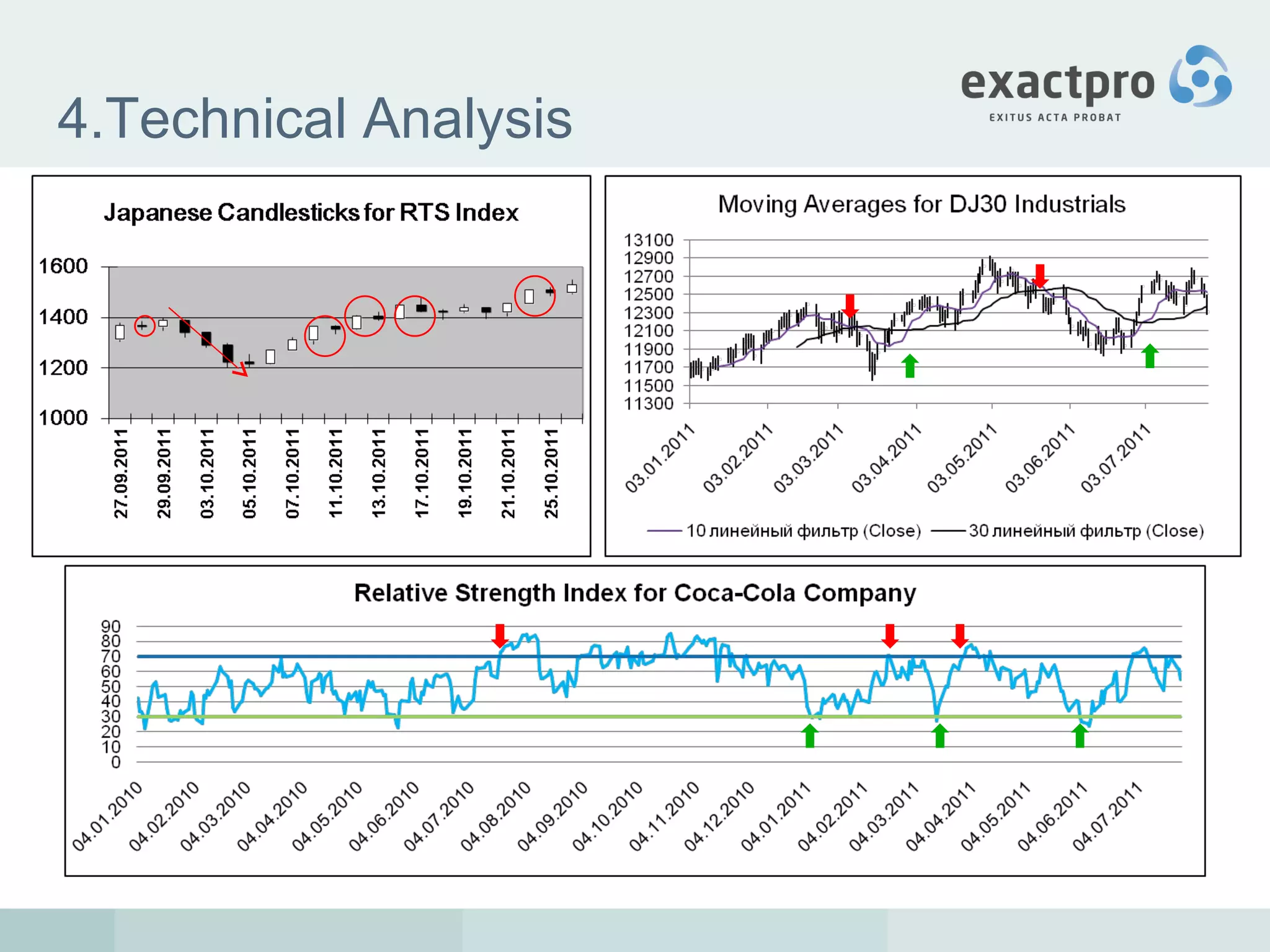
4.Technical Analysis
4.Technical Analysis (cont.) Testing of technical analysis applications Excel: basic strategies and P&L calculations Test on historical data Manually include patterns to the data Then test complex strategies, trends, etc. on artificially created market data
4.Technical Analysis (cont.) Testing of technical analysis strategies Firstly test on historical data (back-testing) No full freedom in data manipulation Simulate specific market conditions (extra-ordinary, but still realistic) Take into account: Delay after the signal Bid-Ask spread Market impact
5.Derivatives Pricing Derivative – financial product depending on another asset (underlying) Derivative pricing validation Internal consistency: Call - Put = Forward (call-put parity) American option > European option Knock In + Knock Out = Vanilla Geometric mean < arithmetical mean Dependencies on parameters Simple is a particular case of complex
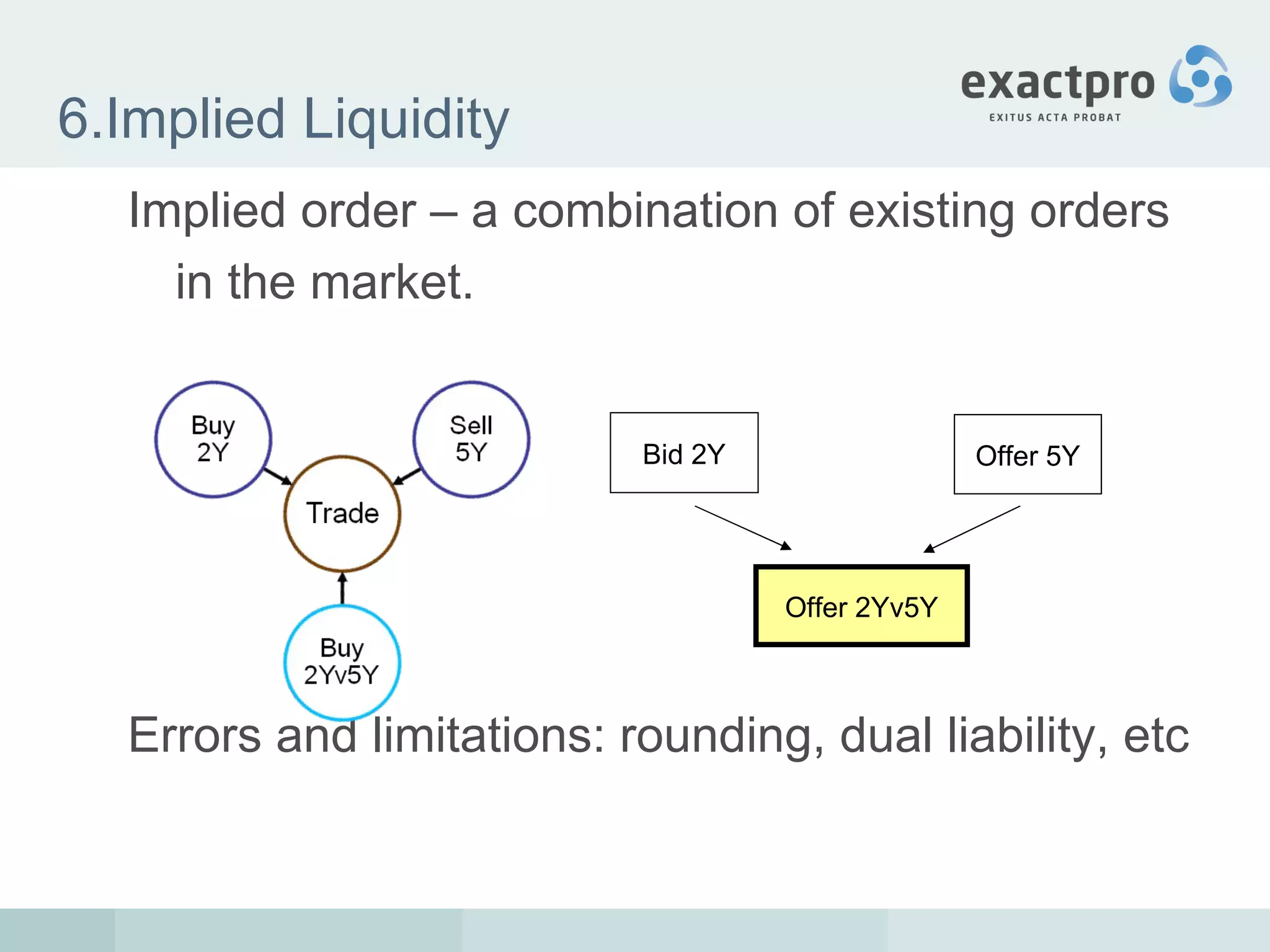
6.Implied Liquidity Implied order – a combination of existing orders in the market. Errors and limitations: rounding, dual liability, etc Bid 2Y Offer 5Y Offer 2Yv5Y
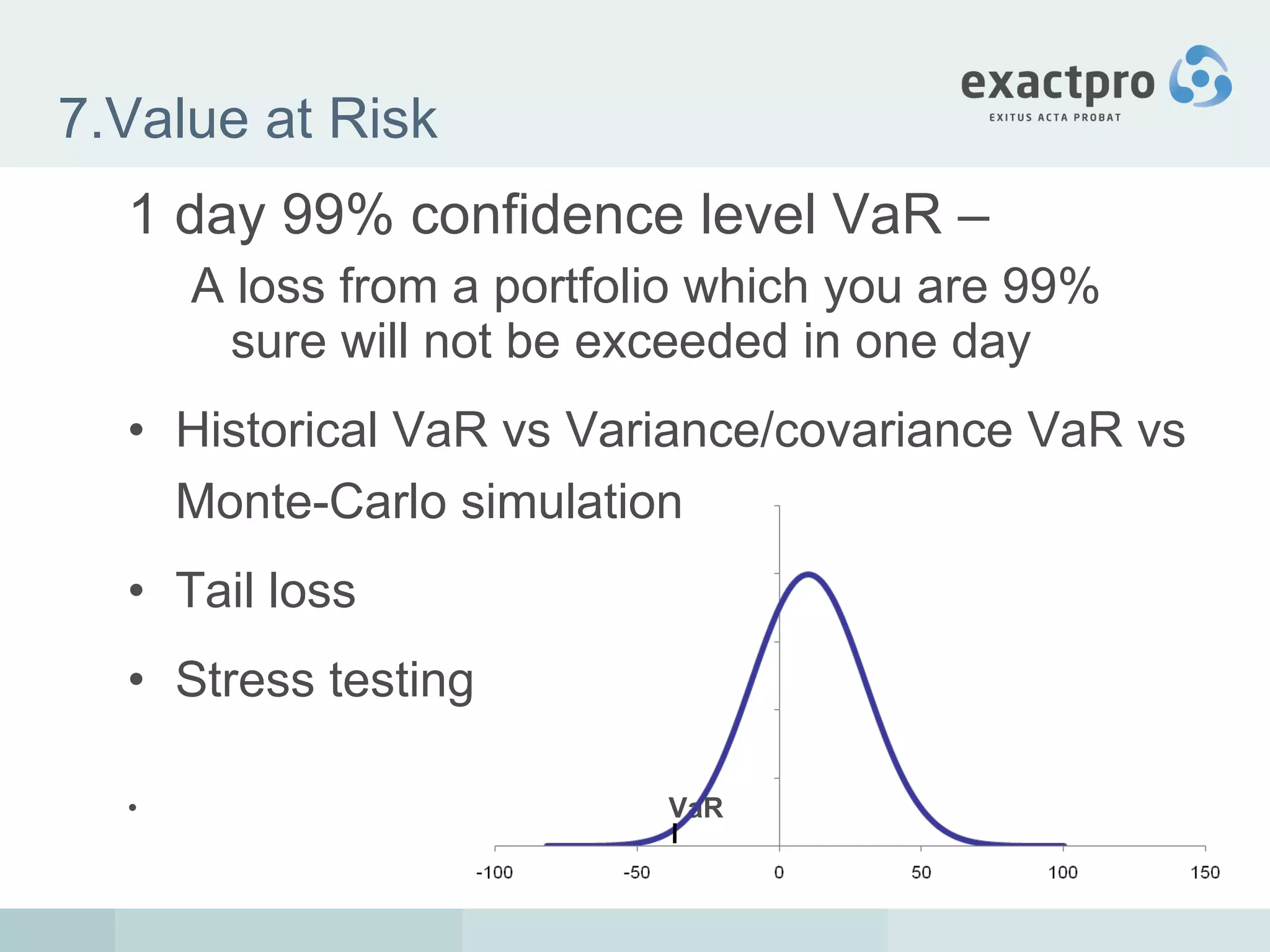
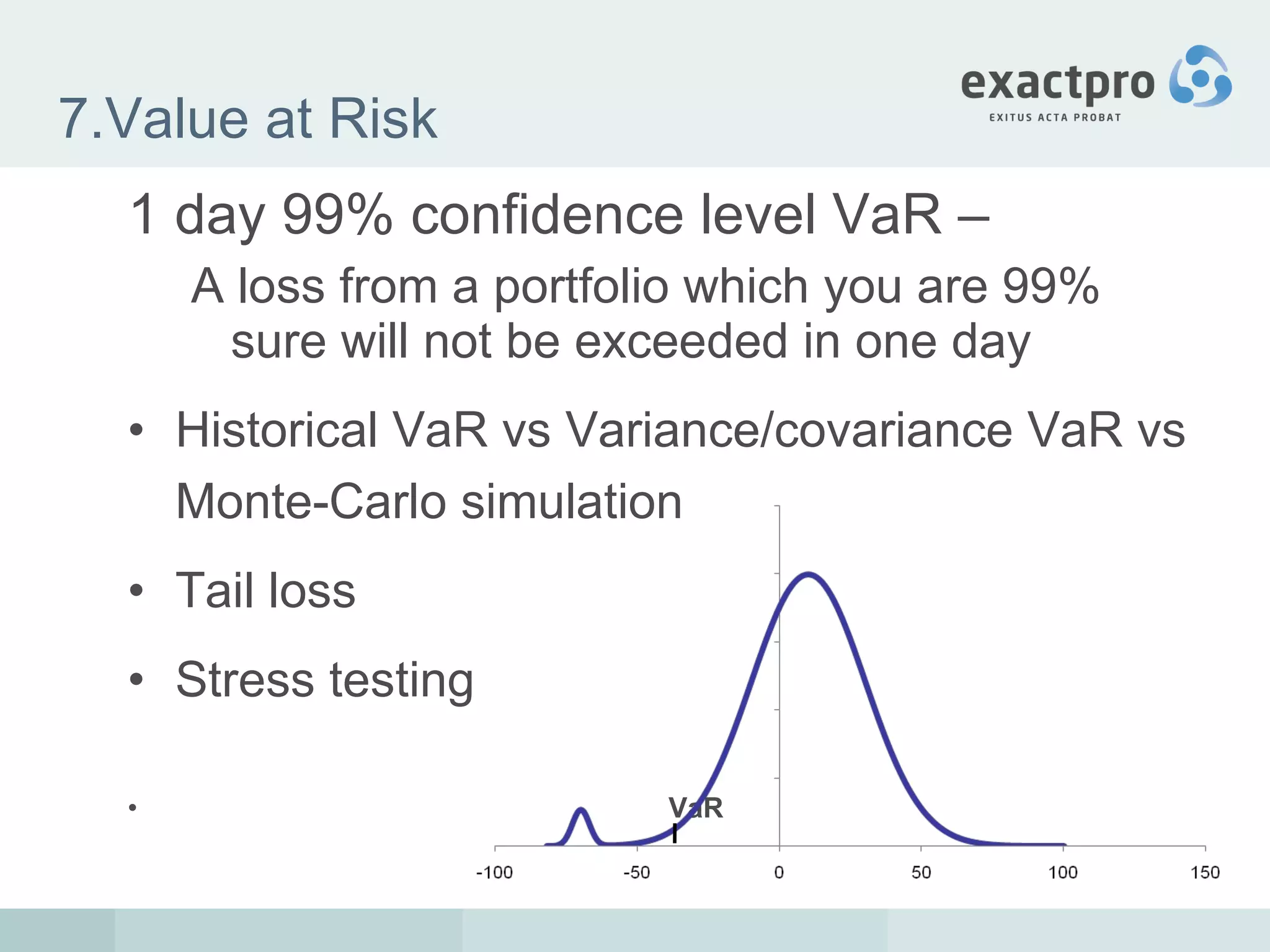
7.Value at Risk 1 day 99% confidence level VaR – A loss from a portfolio which you are 99% sure will not be exceeded in one day Historical VaR vs Variance/covariance VaR vs Monte-Carlo simulation Tail loss Stress testing VaR
8.Model Risk in Modern Markets QA (verification) to prevent errors in model and its implementation Financial disasters when models failed
9.Summary Verification gives another point of view on the problem Helps to find errors in the algorithm Reveals caveats in model and implementation Appropriate method should be selected in order not to duplicate efforts but give additional value
10.Questions & Answers Thank you.

Verification of Financial Models

  • 1.
    Verification of FinancialModels: Duplication of Development Efforts? Alyona Lamash, Boris Rabinovich EXTENT October 2011
  • 2.
    Contents Introduction Modeland Implementation Application Technical Analysis Derivatives Pricing Implied Liquidity Value at Risk Model Risk in Modern Markets Summary Q&A
  • 3.
    1.Introduction Financial modeling:Applying appropriate mathematical models to financial concepts Verification of financial models: Correctness of model implementation Internal consistency of the model Its correspondence to real life Calibration (fine tuning)
  • 4.
    2.Model and ImplementationVerification of Model: Selecting assumptions The risk to make an assumption The impact of the assumption on your model Calibrating the model
  • 5.
    2.Model and Implementation(cont.) Verification of Implementation: Algorithm Hardware capacity Market conditions
  • 6.
    3.Application Examples ofapplication: Technical analysis Derivatives pricing Implied liquidity Risk measurement (VaR) Trading algorithms (robots) Accounting
  • 7.
  • 8.
    4.Technical Analysis (cont.)Testing of technical analysis applications Excel: basic strategies and P&L calculations Test on historical data Manually include patterns to the data Then test complex strategies, trends, etc. on artificially created market data
  • 9.
    4.Technical Analysis (cont.)Testing of technical analysis strategies Firstly test on historical data (back-testing) No full freedom in data manipulation Simulate specific market conditions (extra-ordinary, but still realistic) Take into account: Delay after the signal Bid-Ask spread Market impact
  • 10.
    5.Derivatives Pricing Derivative– financial product depending on another asset (underlying) Derivative pricing validation Internal consistency: Call - Put = Forward (call-put parity) American option > European option Knock In + Knock Out = Vanilla Geometric mean < arithmetical mean Dependencies on parameters Simple is a particular case of complex
  • 11.
    6.Implied Liquidity Impliedorder – a combination of existing orders in the market. Errors and limitations: rounding, dual liability, etc Bid 2Y Offer 5Y Offer 2Yv5Y
  • 12.
    7.Value at Risk1 day 99% confidence level VaR – A loss from a portfolio which you are 99% sure will not be exceeded in one day Historical VaR vs Variance/covariance VaR vs Monte-Carlo simulation Tail loss Stress testing VaR
  • 13.
    7.Value at Risk1 day 99% confidence level VaR – A loss from a portfolio which you are 99% sure will not be exceeded in one day Historical VaR vs Variance/covariance VaR vs Monte-Carlo simulation Tail loss Stress testing VaR
  • 14.
    8.Model Risk inModern Markets QA (verification) to prevent errors in model and its implementation Financial disasters when models failed
  • 15.
    9.Summary Verification givesanother point of view on the problem Helps to find errors in the algorithm Reveals caveats in model and implementation Appropriate method should be selected in order not to duplicate efforts but give additional value
  • 16.