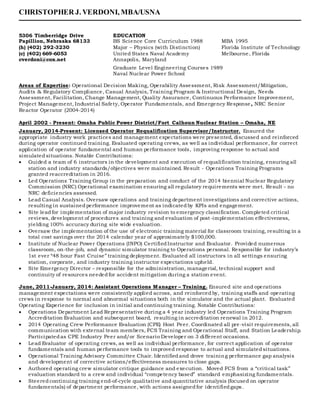
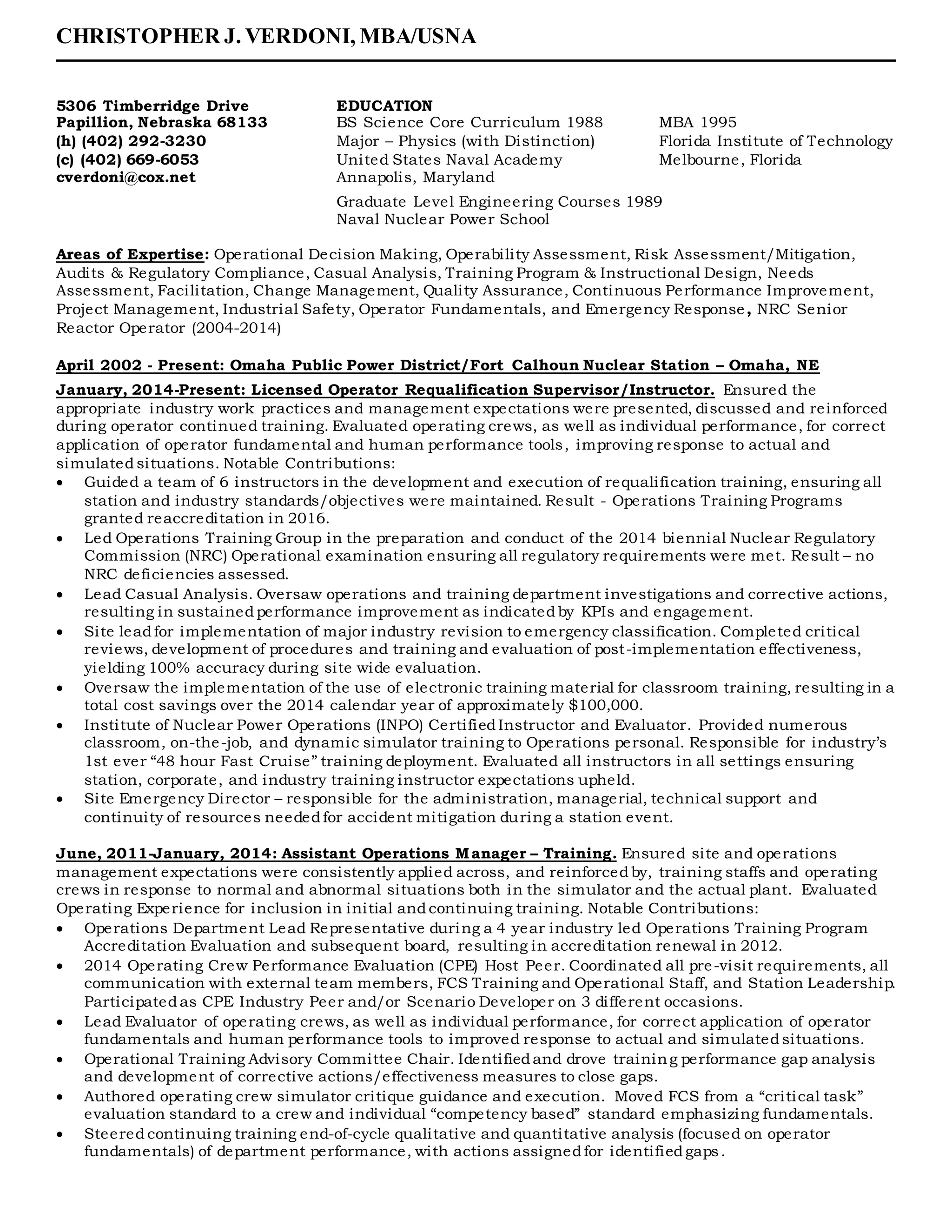
CHRISTOPHER J. VERDONI, MBA/USNA
5306 Timberridge Drive EDUCATION
Papillion, Nebraska 68133 BS Science Core Curriculum 1988 MBA 1995
(h) (402) 292-3230 Major – Physics (with Distinction) Florida Institute of Technology
(c) (402) 669-6053 United States Naval Academy Melbourne, Florida
cverdoni@cox.net Annapolis, Maryland
Graduate Level Engineering Courses 1989
Naval Nuclear Power School
Areas of Expertise: Operational Decision Making, Operability Assessment, Risk Assessment/Mitigation,
Audits & Regulatory Compliance, Casual Analysis, Training Program & Instructional Design, Needs
Assessment, Facilitation, Change Management, Quality Assurance, Continuous Performance Improvement,
Project Management, Industrial Safety, Operator Fundamentals, and Emergency Response, NRC Senior
Reactor Operator (2004-2014)
April 2002 - Present: Omaha Public Power District/Fort Calhoun Nuclear Station – Omaha, NE
January, 2014-Present: Licensed Operator Requalification Supervisor/Instructor. Ensured the
appropriate industry work practices and management expectations were presented, discussed and reinforced
during operator continued training. Evaluated operating crews, as well as individual performance, for correct
application of operator fundamental and human performance tools, improving response to actual and
simulatedsituations. Notable Contributions:
ď‚· Guided a team of 6 instructors in the development and execution of requalification training, ensuring all
station and industry standards/objectives were maintained. Result - Operations Training Programs
granted reaccreditation in 2016.
ď‚· Led Operations Training Group in the preparation and conduct of the 2014 biennial Nuclear Regulatory
Commission (NRC) Operational examination ensuring all regulatory requirements were met. Result – no
NRC deficiencies assessed.
ď‚· Lead Casual Analysis. Oversaw operations and training department investigations and corrective actions,
resulting in sustainedperformance improvement as indicatedby KPIs and engagement.
ď‚· Site leadfor implementation of major industry revision to emergency classification. Completed critical
reviews, development of procedures and training and evaluation of post-implementation effectiveness,
yielding 100% accuracy during site wide evaluation.
ď‚· Oversaw the implementation of the use of electronic training material for classroom training, resulting in a
total cost savings over the 2014 calendar year of approximately $100,000.
ď‚· Institute of Nuclear Power Operations (INPO) CertifiedInstructor and Evaluator. Provided numerous
classroom, on-the-job, and dynamic simulator training to Operations personal. Responsible for industry’s
1st ever “48 hour Fast Cruise” training deployment. Evaluated all instructors in all settings ensuring
station, corporate, and industry training instructor expectations upheld.
 Site Emergency Director – responsible for the administration, managerial, technical support and
continuity of resources neededfor accident mitigation during a station event.
June, 2011-January, 2014: Assistant Operations Manager – Training. Ensured site and operations
management expectations were consistently applied across, and reinforcedby, training staffs and operating
crews in response to normal and abnormal situations both in the simulator and the actual plant. Evaluated
Operating Experience for inclusion in initial andcontinuing training. Notable Contributions:
ď‚· Operations Department Lead Representative during a 4 year industry led Operations Training Program
Accreditation Evaluation and subsequent board, resulting in accreditation renewal in 2012.
ď‚· 2014 Operating Crew Performance Evaluation (CPE) Host Peer. Coordinated all pre-visit requirements, all
communication with external team members, FCS Training and Operational Staff, and Station Leadership.
Participatedas CPE Industry Peer and/or Scenario Developer on 3 different occasions.
ď‚· Lead Evaluator of operating crews, as well as individual performance, for correct application of operator
fundamentals and human performance tools to improved response to actual and simulatedsituations.
ď‚· Operational Training Advisory Committee Chair. Identifiedand drove training performance gap analysis
and development of corrective actions/effectiveness measures to close gaps.
 Authored operating crew simulator critique guidance and execution. Moved FCS from a “critical task”
evaluation standard to a crew and individual “competency based” standard emphasizing fundamentals.
ď‚· Steered continuing training end-of-cycle qualitative and quantitative analysis (focused on operator
fundamentals) of department performance, with actions assignedfor identifiedgaps.
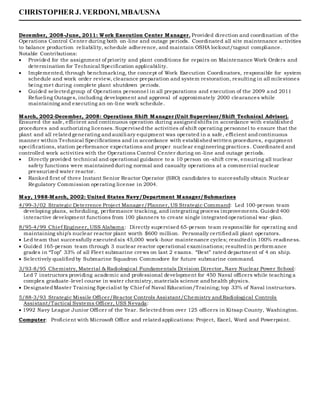
CHRISTOPHER J. VERDONI, MBA/USNA
December, 2008-June, 2011: Work Execution Center Manager. Provided direction and coordination of the
Operations Control Center during both on-line and outage periods. Coordinated all site maintenance activities
to balance production reliability, schedule adherence, and maintain OSHA lockout/tagout compliance.
Notable Contributions:
ď‚· Provided for the assignment of priority and plant conditions for repairs on Maintenance Work Orders and
determination for Technical Specification applicability.
ď‚· Implemented, through benchmarking, the concept of Work Execution Coordinators, responsible for system
schedule and work order review, clearance preparation and system restoration, resulting in all milestones
being met during complete plant shutdown periods.
ď‚· Guided selectedgroup of Operations personnel in all preparations and execution of the 2009 a nd 2011
Refueling Outages, including development and approval of approximately 2000 clearances while
maintaining and executing an on-line work schedule.
March, 2002-December, 2008: Operations Shift Manager (Unit Supervisor/Shift Technical Advisor).
Ensured the safe, efficient and continuous operation during assignedshifts in accordance with established
procedures and authorizing licenses. Supervisedthe activities of shift operating personnel to ensure that the
plant and all relatedgenerating andauxiliary equipment was operated in a safe, efficient andcontinuous
manner within Technical Specifications and in accordance with establishedwritten procedures, equipment
specifications, station performance expectations and proper nuclear engineering practices. Coordinated and
controlled work activities with the Operations Control Center during on-line and outage periods.
ď‚· Directly provided technical and operational guidance to a 10 person on-shift crew, ensuring all nuclear
safety functions were maintainedduring normal and casualty operations at a commercial nuclear
pressurized water reactor.
ď‚· Ranked first of three Instant Senior Reactor Operator (SRO) candidates to successfully obtain Nuclear
Regulatory Commission operating license in 2004.
May, 1988-March, 2002: United States Navy/Department Manager/Submarines
4/99-3/02 Strategic Deterrence Project Manager/Planner, US Strategic Command: Led 100-person team
developing plans, scheduling, performance tracking, and integrating process improvements. Guided 400
interactive development functions from 100 planners to create single integratedoperational war -plan.
8/95-4/99 Chief Engineer, USS Alabama: Directly supervised 65-person team responsible for operating and
maintaining ship’s nuclear reactor plant worth $600 million. Personally certifiedall plant operators.
ď‚· Led team that successfully executedsix 45,000 work-hour maintenance cycles; resultedin 100% readiness.
ď‚· Guided 165-person team through 3 nuclear reactor operational examinations; resultedin perform ance
grades in “Top” 33% of all Fleet submarine crews on last 2 exams. “Best” rated department of 4 on ship.
ď‚· Selectively qualifiedby Submarine Squadron Commodore for future submarine command.
3/93-8/95 Chemistry, Material & Radiological Fundamentals Division Director, Navy Nuclear Power School:
Led 7 instructors providing academic and professional development for 450 Naval officers while teaching a
complex graduate-level course in water chemistry, materials science andhealth physics.
ď‚· DesignatedMaster Training Specialist by Chief of Naval Education/Training; top 33% of Naval instructors.
5/88-3/93 Strategic Missile Officer/Reactor Controls Assistant/Chemistry andRadiological Controls
Assistant/Tactical Systems Officer, USS Nevada:
ď‚· 1992 Navy League Junior Officer of the Year. Selectedfrom over 125 officers in Kitsap County, Washington.
Computer: Proficient with Microsoft Office and relatedapplications: Project, Excel, Word and Powerpoint.

Verdoni_Resume_091216

  • 1.
    CHRISTOPHER J. VERDONI,MBA/USNA 5306 Timberridge Drive EDUCATION Papillion, Nebraska 68133 BS Science Core Curriculum 1988 MBA 1995 (h) (402) 292-3230 Major – Physics (with Distinction) Florida Institute of Technology (c) (402) 669-6053 United States Naval Academy Melbourne, Florida cverdoni@cox.net Annapolis, Maryland Graduate Level Engineering Courses 1989 Naval Nuclear Power School Areas of Expertise: Operational Decision Making, Operability Assessment, Risk Assessment/Mitigation, Audits & Regulatory Compliance, Casual Analysis, Training Program & Instructional Design, Needs Assessment, Facilitation, Change Management, Quality Assurance, Continuous Performance Improvement, Project Management, Industrial Safety, Operator Fundamentals, and Emergency Response, NRC Senior Reactor Operator (2004-2014) April 2002 - Present: Omaha Public Power District/Fort Calhoun Nuclear Station – Omaha, NE January, 2014-Present: Licensed Operator Requalification Supervisor/Instructor. Ensured the appropriate industry work practices and management expectations were presented, discussed and reinforced during operator continued training. Evaluated operating crews, as well as individual performance, for correct application of operator fundamental and human performance tools, improving response to actual and simulatedsituations. Notable Contributions:  Guided a team of 6 instructors in the development and execution of requalification training, ensuring all station and industry standards/objectives were maintained. Result - Operations Training Programs granted reaccreditation in 2016.  Led Operations Training Group in the preparation and conduct of the 2014 biennial Nuclear Regulatory Commission (NRC) Operational examination ensuring all regulatory requirements were met. Result – no NRC deficiencies assessed.  Lead Casual Analysis. Oversaw operations and training department investigations and corrective actions, resulting in sustainedperformance improvement as indicatedby KPIs and engagement.  Site leadfor implementation of major industry revision to emergency classification. Completed critical reviews, development of procedures and training and evaluation of post-implementation effectiveness, yielding 100% accuracy during site wide evaluation.  Oversaw the implementation of the use of electronic training material for classroom training, resulting in a total cost savings over the 2014 calendar year of approximately $100,000.  Institute of Nuclear Power Operations (INPO) CertifiedInstructor and Evaluator. Provided numerous classroom, on-the-job, and dynamic simulator training to Operations personal. Responsible for industry’s 1st ever “48 hour Fast Cruise” training deployment. Evaluated all instructors in all settings ensuring station, corporate, and industry training instructor expectations upheld.  Site Emergency Director – responsible for the administration, managerial, technical support and continuity of resources neededfor accident mitigation during a station event. June, 2011-January, 2014: Assistant Operations Manager – Training. Ensured site and operations management expectations were consistently applied across, and reinforcedby, training staffs and operating crews in response to normal and abnormal situations both in the simulator and the actual plant. Evaluated Operating Experience for inclusion in initial andcontinuing training. Notable Contributions:  Operations Department Lead Representative during a 4 year industry led Operations Training Program Accreditation Evaluation and subsequent board, resulting in accreditation renewal in 2012.  2014 Operating Crew Performance Evaluation (CPE) Host Peer. Coordinated all pre-visit requirements, all communication with external team members, FCS Training and Operational Staff, and Station Leadership. Participatedas CPE Industry Peer and/or Scenario Developer on 3 different occasions.  Lead Evaluator of operating crews, as well as individual performance, for correct application of operator fundamentals and human performance tools to improved response to actual and simulatedsituations.  Operational Training Advisory Committee Chair. Identifiedand drove training performance gap analysis and development of corrective actions/effectiveness measures to close gaps.  Authored operating crew simulator critique guidance and execution. Moved FCS from a “critical task” evaluation standard to a crew and individual “competency based” standard emphasizing fundamentals.  Steered continuing training end-of-cycle qualitative and quantitative analysis (focused on operator fundamentals) of department performance, with actions assignedfor identifiedgaps.
  • 2.
    CHRISTOPHER J. VERDONI,MBA/USNA December, 2008-June, 2011: Work Execution Center Manager. Provided direction and coordination of the Operations Control Center during both on-line and outage periods. Coordinated all site maintenance activities to balance production reliability, schedule adherence, and maintain OSHA lockout/tagout compliance. Notable Contributions:  Provided for the assignment of priority and plant conditions for repairs on Maintenance Work Orders and determination for Technical Specification applicability.  Implemented, through benchmarking, the concept of Work Execution Coordinators, responsible for system schedule and work order review, clearance preparation and system restoration, resulting in all milestones being met during complete plant shutdown periods.  Guided selectedgroup of Operations personnel in all preparations and execution of the 2009 a nd 2011 Refueling Outages, including development and approval of approximately 2000 clearances while maintaining and executing an on-line work schedule. March, 2002-December, 2008: Operations Shift Manager (Unit Supervisor/Shift Technical Advisor). Ensured the safe, efficient and continuous operation during assignedshifts in accordance with established procedures and authorizing licenses. Supervisedthe activities of shift operating personnel to ensure that the plant and all relatedgenerating andauxiliary equipment was operated in a safe, efficient andcontinuous manner within Technical Specifications and in accordance with establishedwritten procedures, equipment specifications, station performance expectations and proper nuclear engineering practices. Coordinated and controlled work activities with the Operations Control Center during on-line and outage periods.  Directly provided technical and operational guidance to a 10 person on-shift crew, ensuring all nuclear safety functions were maintainedduring normal and casualty operations at a commercial nuclear pressurized water reactor.  Ranked first of three Instant Senior Reactor Operator (SRO) candidates to successfully obtain Nuclear Regulatory Commission operating license in 2004. May, 1988-March, 2002: United States Navy/Department Manager/Submarines 4/99-3/02 Strategic Deterrence Project Manager/Planner, US Strategic Command: Led 100-person team developing plans, scheduling, performance tracking, and integrating process improvements. Guided 400 interactive development functions from 100 planners to create single integratedoperational war -plan. 8/95-4/99 Chief Engineer, USS Alabama: Directly supervised 65-person team responsible for operating and maintaining ship’s nuclear reactor plant worth $600 million. Personally certifiedall plant operators.  Led team that successfully executedsix 45,000 work-hour maintenance cycles; resultedin 100% readiness.  Guided 165-person team through 3 nuclear reactor operational examinations; resultedin perform ance grades in “Top” 33% of all Fleet submarine crews on last 2 exams. “Best” rated department of 4 on ship.  Selectively qualifiedby Submarine Squadron Commodore for future submarine command. 3/93-8/95 Chemistry, Material & Radiological Fundamentals Division Director, Navy Nuclear Power School: Led 7 instructors providing academic and professional development for 450 Naval officers while teaching a complex graduate-level course in water chemistry, materials science andhealth physics.  DesignatedMaster Training Specialist by Chief of Naval Education/Training; top 33% of Naval instructors. 5/88-3/93 Strategic Missile Officer/Reactor Controls Assistant/Chemistry andRadiological Controls Assistant/Tactical Systems Officer, USS Nevada:  1992 Navy League Junior Officer of the Year. Selectedfrom over 125 officers in Kitsap County, Washington. Computer: Proficient with Microsoft Office and relatedapplications: Project, Excel, Word and Powerpoint.