Sample Handmade Responses
    to Hale’s Sin and Syntax,
        Chapter 3: Verbs
   with corresponding citations from the chapter


Angelo State University
English 4361: English Grammar
Dr. Laurence Musgrove
Department of English and Modern Languages
January 24, 2013


                                             www.theillustratedprofessor.com
                                                                 @lemusgro
“But remember: static verbs lack punch. Dynamic verbs, on the other hand,
grab you by the lapels” (56).
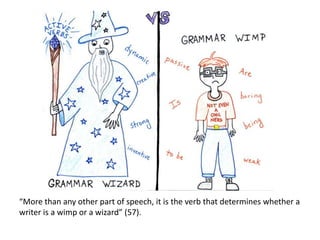
“More than any other part of speech, it is the verb that determines whether a
writer is a wimp or a wizard” (57).
“More than any other part of speech, it is the verb that determines whether a
writer is a wimp or a wizard” (57).
“The active voice is strong, direct, muscular” (58).
“Stasis certainly has its place – whether expressed by the infinitives in ‘to be
or not to be’ or by less anxious ‘is and ‘tis.’ But remember: static verbs lack
punch. Dynamic verbs, on the other hand, grab you by the lapels” (56).
“…the static verbs, which either express a state of being or quietly link starlet
nouns without demanding a lot of attention” (55).
“Dynamic verbs, on the other hand, grab you by the lapels” (56).
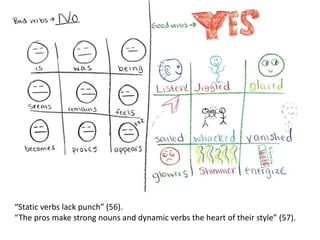
“Static verbs lack punch” (56).
“The pros make strong nouns and dynamic verbs the heart of their style” (57).
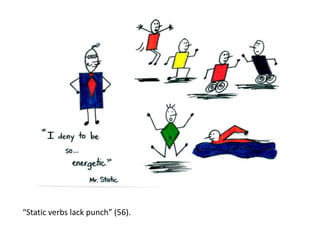
“Static verbs lack punch” (56).
“Verbs add drama to a random grouping of other words, producing an event,
a happening, an exciting moment” (55).
“Verbs subdivide into two major classes: Static and Dynamic” (55).
“In a third, subordinate class, verbs gather around other verbs, acting as accomplices
to the action. These auxiliary or ‘helping’ verbs…are mere sidekicks” (56).
“They *verbs+ also kick-start sentences: without them, words would simply
cluster together in suspended animation, waiting for something to click” (55).
“These auxiliary or ‘helping’ verbs….are mere sidekicks, symbiotically
attaching themselves to a main verb in a combo called a ‘verb phrase’” (56).
“Stasis certainly has its place…But remember: static verbs lack punch” (56).
“Using the imperative voice, he implores his reader to engage” (62).
“The pros make strong nouns and dynamic verbs the heart of their style” (57).
“Take a stand” (67).
“Look out for verbs that convey less action than other words in the
sentence, and avoid them” (68).
“Avoid ‘being’ like the plague” (65).

Verbs Illustrated

  • 1.
    Sample Handmade Responses to Hale’s Sin and Syntax, Chapter 3: Verbs with corresponding citations from the chapter Angelo State University English 4361: English Grammar Dr. Laurence Musgrove Department of English and Modern Languages January 24, 2013 www.theillustratedprofessor.com @lemusgro
  • 2.
    “But remember: staticverbs lack punch. Dynamic verbs, on the other hand, grab you by the lapels” (56).
  • 3.
    “More than anyother part of speech, it is the verb that determines whether a writer is a wimp or a wizard” (57).
  • 4.
    “More than anyother part of speech, it is the verb that determines whether a writer is a wimp or a wizard” (57).
  • 5.
    “The active voiceis strong, direct, muscular” (58).
  • 6.
    “Stasis certainly hasits place – whether expressed by the infinitives in ‘to be or not to be’ or by less anxious ‘is and ‘tis.’ But remember: static verbs lack punch. Dynamic verbs, on the other hand, grab you by the lapels” (56).
  • 7.
    “…the static verbs,which either express a state of being or quietly link starlet nouns without demanding a lot of attention” (55). “Dynamic verbs, on the other hand, grab you by the lapels” (56).
  • 8.
    “Static verbs lackpunch” (56). “The pros make strong nouns and dynamic verbs the heart of their style” (57).
  • 9.
    “Static verbs lackpunch” (56).
  • 10.
    “Verbs add dramato a random grouping of other words, producing an event, a happening, an exciting moment” (55).
  • 11.
    “Verbs subdivide intotwo major classes: Static and Dynamic” (55). “In a third, subordinate class, verbs gather around other verbs, acting as accomplices to the action. These auxiliary or ‘helping’ verbs…are mere sidekicks” (56).
  • 12.
    “They *verbs+ alsokick-start sentences: without them, words would simply cluster together in suspended animation, waiting for something to click” (55).
  • 13.
    “These auxiliary or‘helping’ verbs….are mere sidekicks, symbiotically attaching themselves to a main verb in a combo called a ‘verb phrase’” (56).
  • 14.
    “Stasis certainly hasits place…But remember: static verbs lack punch” (56). “Using the imperative voice, he implores his reader to engage” (62).
  • 15.
    “The pros makestrong nouns and dynamic verbs the heart of their style” (57).
  • 16.
    “Take a stand”(67). “Look out for verbs that convey less action than other words in the sentence, and avoid them” (68).
  • 17.
    “Avoid ‘being’ likethe plague” (65).