Handmade Thinking:
Drawing Out Reading
Dr. Laurence Musgrove
English and Modern Languages
Angelo State University
www.laurencemusgrove.com
@lemusgro #handmadethinking
“In fact, without visualization, students
cannot comprehend, and reading cannot
be said to be reading.”
Reading is Seeing, Jeffrey Wilhelm
My Contract: $100
1. Feed me
2. Let me sleep on your couch
3. I’ll sell and sign some books
Z Z Z
Boring!
?
Me !
Me !
WHY?
Drawing with guided practice and
choice in visual formats can increase
reading
engagement, comprehension, as well
as collaborative problem-solving and
critical thinking.
Drawing is Thinking
• The hand focuses the mind and body
• Focus = engagement = presence = mindfulness
Handmade Thinking as Engagement
• Physical, emotional, mental engagement
strategy made possible by drawing responses
to literary and non-literary texts
• Reading = presence
Introduction to Drawing
People
Places
Things
Twos
Family
Amount
Action
GUIDELINES FOR HANDMADE RESPONSES
1. Using one of the 21 visual formats, respond to argument or
narrative of reading assignment
2. White paper – landscape format
3. Three colors – black may be one of those colors
4. Combination of words and images
5. On reverse: name of selected format(s)
6. Corresponding citation from text with page number
OK, Let’s read and draw.
HANDMADE RESPONSES IN CLASS
1. Students share responses with each other
2. They tell each other what they liked best about drawings
3. They tell whole class which format they selected
4. They are offered opportunity to share to whole class –
displayed on overhead
5. They are assigned question or activity related to reading
assignment
6. When evaluating handmade responses, I select best drawings
for display at beginning of the next class
OK, Let’s read and draw together.
Teaching Handmade Thinking as a Process
1. Introduce visual and handmade thinking
2. Show 21 formats and examples
3. Introduce simple drawing strategies in response to
“I can’t draw!”
4. Students create first handmade responses
5. Individual students share format selected
6. Students share in small groups
7. Teacher shows exemplary student examples
8. Teacher nudges students into other formats
9. Small groups assigned to create new response in
new format
10. Group leader presents collaborative response
TAKE AWAY
Drawing with guided practice and
choice in visual formats can increase
reading
engagement, comprehension, as well
as collaborative problem-solving and
critical thinking.
Handmade Thinking:
Drawing Out Reading
Dr. Laurence Musgrove
English and Modern Languages
Angelo State University
www.laurencemusgrove.com
@lemusgro #handmadethinking

Handmade Thinking: Drawing Out Reading

  • 1.
    Handmade Thinking: Drawing OutReading Dr. Laurence Musgrove English and Modern Languages Angelo State University www.laurencemusgrove.com @lemusgro #handmadethinking
  • 2.
    “In fact, withoutvisualization, students cannot comprehend, and reading cannot be said to be reading.” Reading is Seeing, Jeffrey Wilhelm
  • 6.
    My Contract: $100 1.Feed me 2. Let me sleep on your couch 3. I’ll sell and sign some books
  • 8.
  • 9.
  • 10.
  • 12.
  • 19.
    WHY? Drawing with guidedpractice and choice in visual formats can increase reading engagement, comprehension, as well as collaborative problem-solving and critical thinking.
  • 20.
    Drawing is Thinking •The hand focuses the mind and body • Focus = engagement = presence = mindfulness
  • 22.
    Handmade Thinking asEngagement • Physical, emotional, mental engagement strategy made possible by drawing responses to literary and non-literary texts • Reading = presence
  • 23.
  • 35.
  • 44.
  • 64.
  • 78.
  • 91.
  • 121.
    GUIDELINES FOR HANDMADERESPONSES 1. Using one of the 21 visual formats, respond to argument or narrative of reading assignment 2. White paper – landscape format 3. Three colors – black may be one of those colors 4. Combination of words and images 5. On reverse: name of selected format(s) 6. Corresponding citation from text with page number
  • 125.
  • 126.
    HANDMADE RESPONSES INCLASS 1. Students share responses with each other 2. They tell each other what they liked best about drawings 3. They tell whole class which format they selected 4. They are offered opportunity to share to whole class – displayed on overhead 5. They are assigned question or activity related to reading assignment 6. When evaluating handmade responses, I select best drawings for display at beginning of the next class
  • 141.
    OK, Let’s readand draw together.
  • 142.
    Teaching Handmade Thinkingas a Process 1. Introduce visual and handmade thinking 2. Show 21 formats and examples 3. Introduce simple drawing strategies in response to “I can’t draw!” 4. Students create first handmade responses 5. Individual students share format selected 6. Students share in small groups 7. Teacher shows exemplary student examples 8. Teacher nudges students into other formats 9. Small groups assigned to create new response in new format 10. Group leader presents collaborative response
  • 143.
    TAKE AWAY Drawing withguided practice and choice in visual formats can increase reading engagement, comprehension, as well as collaborative problem-solving and critical thinking.
  • 147.
    Handmade Thinking: Drawing OutReading Dr. Laurence Musgrove English and Modern Languages Angelo State University www.laurencemusgrove.com @lemusgro #handmadethinking

Editor's Notes

  • #4 Hello, my name is Laurence Musgrove and I am a professor of English at Angelo State University where I teach composition, literature, and creative writing.
  • #5 I’ve recently written a book called Handmade Thinking in which I share how I use drawing to help my students improve their reading habits.
  • #6 I also give workshops to middle school, high school, and college teachers on how to use handmade thinking in their own classes. And some of these teachers have shared their students’ drawings with me.
  • #8 Handmade thinking is a response to two problems I’ve encounteredin my classes. Maybe you have discovered this problem, too.
  • #9 The first problem is that students don’t read what I assign them to read.
  • #10 The second problem is that they don’t read what I assign them in a critical way.
  • #11 So I began to look for a way to help students become more engaged in what I wanted them to read.
  • #12 I know that some teachers use pop quizzes to force students to read.
  • #13 And some teachers call on students and give participation grades.
  • #14 Some teachershave students write journal or daily responses about what they have read. And I often do this, too.
  • #15 But I’ve also have students draw their responses by hand. And I have had very good success in getting students engaged in what I’ve assigned them to read through handmade thinking.
  • #16 What do I mean by handmade thinking?
  • #17 Let’s say that this circle represents everything we do when we think. Inside this circle is both conscious and unconscious thought. When our brain processes information, when it manages or cues the performances of our body, when we reflect, dream, speak, read, write, listen, see, move in the world, all of what the brain controls and does for us is included in this circle.
  • #18 Inside the circle called thinking is another area that I’d like to call visual thinking. For those of us who have the privilege of sight, we are constantly seeing the world around us and making decisions about what to do with those images or in response to what we see. When we read maps, select a new paint color for the bedroom, or type words on a computer screen, and scroll down through our email on a smartphone, we are engaged in visual decision-making and thinking.
  • #19 And a portion of visual thinking is what I call handmade thinking. Within the process of visual thinking, we draw images that help us capture or develop ideas. Drawing is in fact a subcategory of thinking. Drawing helps us figure out and communicate to others what we think and what we want others to think. Drawing by hand, using a pen or pencil or marker or mouse or just a finger, we draw to understand and to be understood.
  • #20 So what does this have to do with teaching English or teaching reading or getting students to read better? Or to read at all? I have found that by incorporating drawing in my classes students are more often prepared for class and more engaged in class. I have learned that through guided practice and with a choice is visual formats, drawing can increase reading engagement, comprehension, as well as collaborative problem-solving and critical thinking.
  • #21 Let me emphasize again that drawing is a kind of thinking. And it’s a particularly effective way of thinking because it engages the body in ways that pure cognition can’t. Handmade thinking focuses the mind because the body is also focused. This kind of focus leads to improved engagement, it leads to present mindfulness and improved concentration is an increasingly distracting world.
  • #22 Here is a cartoon I drew recently that I share with my students to help them see the difference between attendance and presence. I tell them that it’s one thing to appear in class and another to actually be there and ready to learn. Attendance isn’t the same thing as presence.
  • #25 My ideas about using “handmade thinking” to promote better reading habits really began after I read Dan Roam’s great book The Back of the Napkin. Here and elsewhere Dan has argued that drawing can be a powerful tool for problem-solving and presenting one’s ideas to others.
  • #26 Dan claims that there are 6 ways to tackle a problem and demonstrate its solution. These are similar to the journalist’s questions many of us have learned to investigate and explain a situation, but in this case, Dan revises the traditional questions to include Who or What? Where? When? How? How much? And why?
  • #27 He also claims that there are 6 basic visual formats that we can use when capturing the answers to those questions. A portrait for who or what. A map for where. A timeline for when. A process chart for how. A chart for how much. And a multivariable chart for why. In other words, by using these basic formats or related images, we can draw our way into better solving the problems we encounter and communicating solutions to others. I would encourage you to look further into Dan’s book and his approach and see for yourself just how powerful drawing can be in problem-solving and decision-making. Much of his work is available on his website at danroam.com.
  • #28 Next, I began thinking how I might apply these 6 basic questions and visual formats to the problems my students would encounter in what I would be assigning them to read. And as I thought more about having my students draw their responses, I realized that there were quite a few more visual formats that might be helpful to them. And eventually I developed 21 visual formats for handmade thinking, including the six proposed by Dan.
  • #29 Here they are and I’ve divided them into five categories.
  • #30 The first category is for visual formats that identify people, places, and things. The portrait for people and things. The map for locations.
  • #31 The second category is for pairs of ideas that are in dialogue, contrast, balance, or relationship.
  • #32 The fourth category is for visual formats to depict the quantity of ideas.
  • #33 The third category provides visual formats for ideas that are grounded in or develop from other ideas.
  • #34 The fifth and final category is for ideas in action.
  • #35 Here they are again. 21 formats for handmade thinking. Now let’s look at some student examples of handmade responses to a variety of texts: poetry, essays, short stories, biographies, and traditional textbook materials.
  • #36 Again the first category was people, places, and things—what we might call the noun group.
  • #37 For people and things, this is the portrait format.
  • #38 The poem Evening Star by Charles Goodrich
  • #39 First Lesson by Philip Booth
  • #40 Mary Karr’s memoir Cherry
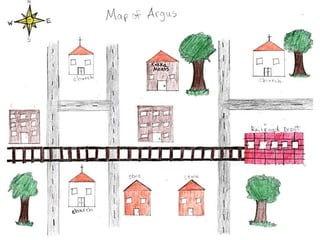
  • #41 For locations, this is the map format.
  • #42 LouiseErdrich’s story Fleur
  • #43 Thoreau’s journal
  • #44 from THE END OF NATURE by Bill McKibben
  • #45 The second category is for pairs of ideas.
  • #46 This a comic panel.
  • #47 Many students extended this format into several comic panels. Like this response to an essay on the decline of local bookshops.
  • #48 This drawing is a response to a poem by Bill Hicok called for three whose reflex was yes.
  • #49 Here is a response capturing a moment of negotiation in True Grit by Charles Portis.
  • #50 Here is a more extended comic, also from True Grit.
  • #51 Comparison/contrast
  • #52 Also from True Grit: LaBoeuf and Rooster Cogburn
  • #53 JENNIE YABROFF’s essay, In Defense of Cheering
  • #54 Floyd Skloot’s essay Gray Area: Thinking with a Damaged Brain
  • #55 Venn diagram
  • #56 Rolls-Royce Dreams, a poem by Ginger Adams
  • #57 “A Clean Well-Lighted Place” by Ernest Hemingway
  • #58 Wives of the Dead, Nathaniel Hawthorne
  • #59 Seesaw
  • #60 Tess Gallagher’s poem I Stop Writing the Poem
  • #61 Another response to JENNIE YABROFF’s essay, In Defense of Cheering
  • #62 Scales
  • #63 So far I’ve been showing you examples from my college students. This is a drawing from an 8th grader responding to a selection a unit on the Holocaust concerning the Nuremburg Laws. o
  • #64 And this a student in one of my sophomore literature courses responding to Jack London’s story In a Far Country.
  • #65 The third category of visual formats captures the growth of and relationship between ideas.
  • #66 Like a tree.
  • #67 A response to Art Speigelman’s graphic memoir MAUS.
  • #68 A response to the introduction of an anthology of environmental writing titled American Earth edited by Bill McKibben
  • #69 The common web for brainstorming and mindmapping.
  • #70 Another response to the introduction of American Earth.
  • #71 Thoreau’s JOURNALS
  • #72 Sylvia Plath’s poem Metaphors
  • #73 The organizational chart.
  • #74 A response to the introduction of Dan Roam’s The Back of the Napkin
  • #75 A response to Scott McCloud’s Understanding Comics
  • #76 The genealogical chart
  • #77 Another 8th grader’s response to the Nuremburg Laws.
  • #78 Andrei Codrescu’s Joe Stopped By
  • #79 The fourth category of visual formats indicate quantities.
  • #80 Bar charts
  • #81 I also have students collaborate on handmade responses: This is response to Donald Hall’s Good Use for Bad Weather
  • #82 And this is an individual student’s response to Paul Ehrlich’s The Population Bomb
  • #83 Pie charts
  • #84 Deborah Garrison’s poem Worked Late on a Tuesday Night
  • #85 A series of pie charts in response to Paul Erhlich’s The Population Bomb
  • #86 And another series of pie charts (actually pizza pies) in response to the same essay. This is also a good example of how some students combine visual formats. In this case, a combination of the timeline and pie chart formats.
  • #87 And multivariable charts. Roam puts this in the “why?” category.
  • #88 Students tend to shy away from the multivariable chart, so I often introduce this format in class and have students work in teams to produce collaborative responses. Here students are putting their charts on the classroom whiteboard.
  • #89 This one is from Washington Irving’s Rip Van Winkle.
  • #90 This is another response to Bill Hicok’s poem For Three Whose Reflex Was Yes. This poem describes a mother and child who are taken away by a flash flood and the people who dive in to save them. It compares the amount of danger the mother and child experience to the amount of people willing to sacrifice themselves to save the mother and child.
  • #91 This is another 8th grader’s handmade response. He has read Steve Job’s biography and is depicting the relationship between Apple’s stock price and Jobs’ tenure at Apple.
  • #92 And the fifth category includes visual formats that depict ideas or characters in action.
  • #93 Timeline
  • #94 This is a response to Stephen Dobyns’ poem Fear.
  • #95 Flannery O’Connor’s story A Late Encounter with the Enemy
  • #96 John McPhee’s essay An Album Quilt
  • #97 And here a timeline similar to a gameboard for Sarah Orne Jewett’s A White Heron
  • #98 Here is the before and after format that might also fit in the “pairs” category.
  • #99 Another response to LouiseErdrich’s Fleur
  • #100 Meredith Hall’s Shunned
  • #101 Theodore Roethke’s poem My Papa’s Waltz
  • #102 The equation.
  • #103 “Heat” by Joyce Carol Oates
  • #104 Zora Neale Hurston’s Sweat
  • #105 A flow or process chart.
  • #106 From John Gage’s THE SHAPE OF ARGUMENT
  • #107 A response to They Say, I Say, by Gerald Graff and Cathy Birkenstein and Russell Durst on how a writer enters an academic conversation.
  • #108 Freytag’s pyramid plot line
  • #109 Bobbie Ann Mason’s The Big Bertha Stories
  • #110 Another response to Stephen Dobyns’ poem Fear
  • #111 Another response to Hurston’s story Sweat
  • #112 A response to Peter Bergen’s article A Dangerous New World of Drones depicting the increasing tension of the drone arms race
  • #113 A creative plot pyramid response to Howard Nemerov’s poem Learning by Doing.
  • #114 This is the positive and negative plot line that shows progression up and down and left to right. I learned about this from my friend Austin Kleon who learned it from Kurt Vonnegut.
  • #115 Here is another handmade response to Hurston’s Sweat
  • #116 “A Journey” by Edith Wharton
  • #117 And a more detailed response to Wharton’s story A Journey
  • #118 This format represents sediment, layers moving from bottom to top.
  • #119 A response to SAND COUNTY ALMANAC by Aldo Leopold
  • #120 And another to Sand County Almanac
  • #121 And here are the 21 formats again.
  • #125 Here they are and I’ve divided them into five categories.