Modes of
Ventilation
 To be able to demonstrate essential
knowledge of the care and management of
the patient requiring mechanical ventilation
Aims
 Explore the indications and contra-indications
 Overview of the modes of ventilation
 Be familiar with normal parameters of
ventilation
 Discuss the indications for weaning and
extubation
Objectives
 Respiratory Failure
 Cardiopulmonary arrest
 Trauma Events
 Cardiovascular impairment
 Neurological impairment
 Pulmonary impairment
 Procedures requiring sedation/paralysis
Indications
Goals
 Treat hypoxemia/hypercapnia
 Relieve respiratory distress/reverse
fatigue
 Decrease Myocardial O2 demand
 Prevention or reversal of atelectasis
 Breath for the sedated/paralysed
patient
 Stabilise the chest wall
 Risks outweigh benefits, for example
Neutropenia
 Non-invasive deemed preferable to invasive
ventilation
 Invasive ventilation considered medically futile
 Contrary to the expressed wishes of the patient
Contra-Indications
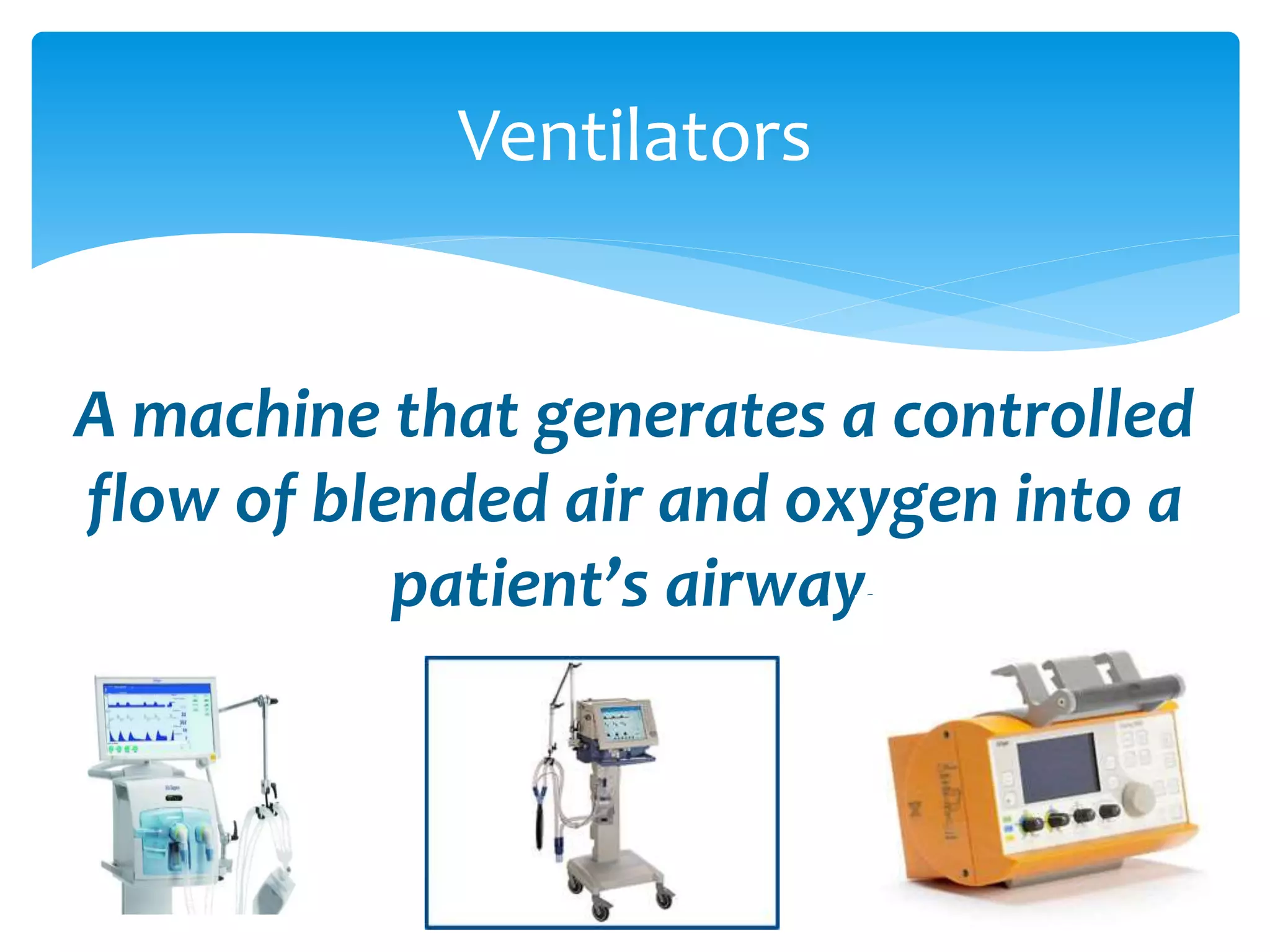
Ventilation
A machine that generates a controlled
flow of blended air and oxygen into a
patient’s airway.
Ventilators
Two categories Volume or Pressure
This refers to the mode of breath delivery
rather than the mode itself
Ventilation
In volume category modes of ventilation the machine
generates flow to achieve a set volume known as
TIDAL VOLUME
Volume
Tidal Volume
VT
Definition –
‘the volume of air that
is inspired or expired
in a single breath
during regular
breathing’
Volume Modes
Advantages
Guaranteed Minute
Ventilation (Mv).
Disadvantages
Increased monitoring
of airway pressures.
Airway pressures will
increase if lung
compliance decreases.
Risk of barotrauma.
Minute Ventilation
MV
Definition –
‘the total volume of gas
in litres expelled from
the lungs per minute’
In pressure modes of ventilation a pressure limit is set,
the machine generates flow until the peak pressure
limit is achieved-
PAP or PIP
Peak Airway
(inspiratory) Pressures
Pressure
Peak Airway (Inspiratory)
Pressures
Pip
Pap
Ppeak
Definition –
‘is the highest level of
pressure applied to the
lungs during inhalation
expressed in cmh2o’
Pressure Modes
Advantages
Greater control of
airway pressure.
Less risk of
barotrauma.
Disadvantages
No guaranteed minute
ventilation.
Increased monitoring of
VT required.
Rapid changes in the
compliance can cause
hypoventilation/hypoxia.
FLOW TRIGGER - a breath is generated when the patient’s
respiratory effort causes flow to reach a set level.
PRESSURE TRIGGER - a breath is generated by measuring
pressure and starting assisted ventilation when pressure
reaches a given level.
TIME TRIGGER - a breath is generated by measuring
frequency of respirations and starting ventilation when
respirations frequency is at a given.
Inspiration
 TIME CYCLED - such in in pressure controlled ventilation
 FLOW CYCLED - such as in pressure support
 VOLUME CYCLED - the ventilator cycles to expiration once a
set tidal volume has been delivered: this occurs in volume
controlled ventilation.
Expiration
Mandatory Modes of
Ventilation
Intermittent Positive Pressure
Ventilation
IPPV
IPPV
 Set: TV, rate, Fi02, PEEP,
 No capacity for the patient
to trigger a breath
 Uncomfortable if patient
not fully sedated &/
paralysed
 Suitable only for patients
who have no ability to
breathe spontaneously
Mandatory Assist Modes of
Ventilation
SIMV
Synchronized Intermittent Mandatory Ventilation
 Provides a set TIDAL VOLUME at a set RATE (F)
 Patient can breathe in-between mandatory
ventilation
 Spontaneous breaths are supported with pressure
support
 Ventilator synchronises mandatory breaths and
spontaneous breaths for increased patient comfort
NB
Usually volume targeted but some machines offer SIMV(pc)
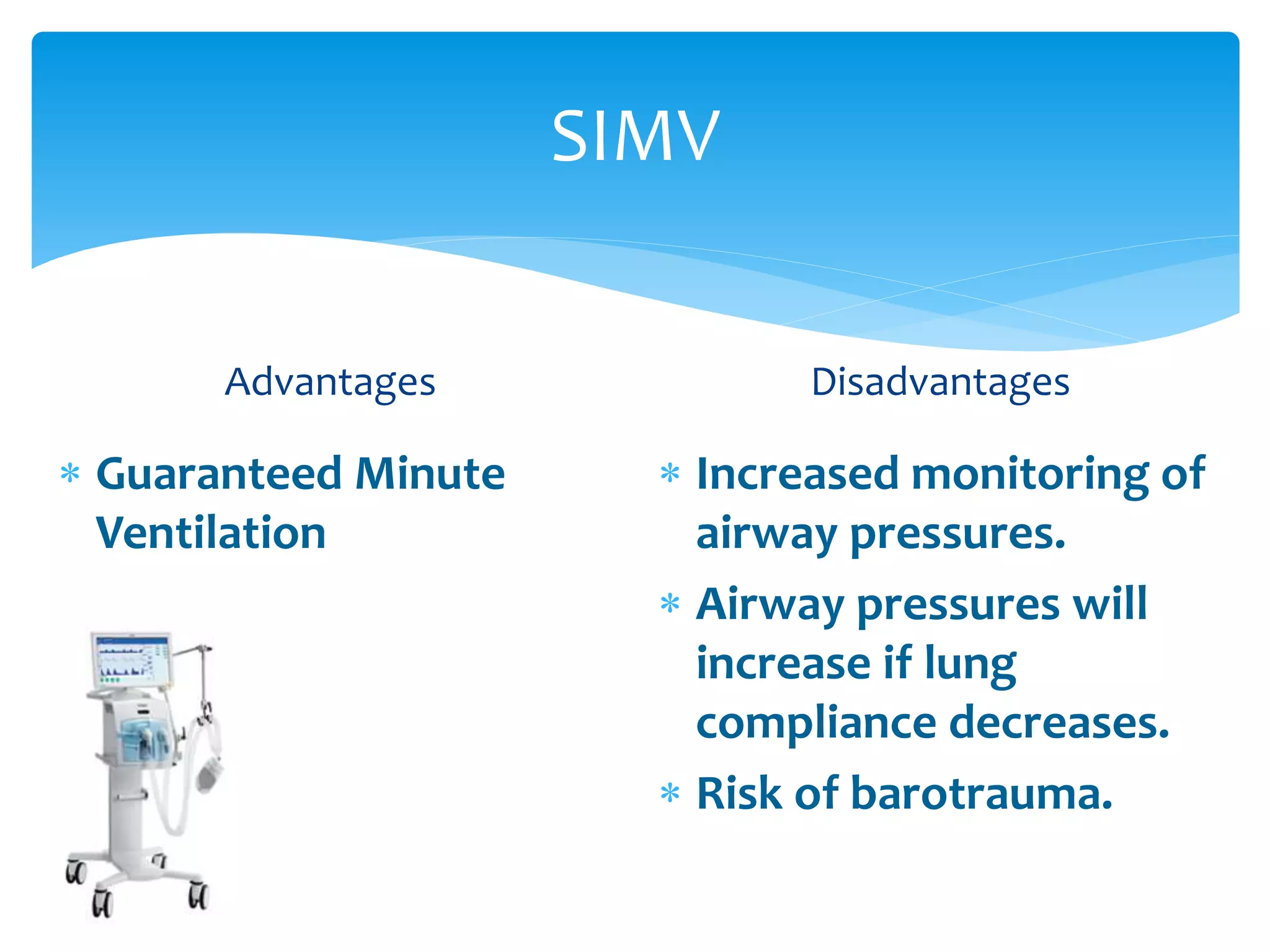
SIMV
SIMV
Advantages
 Guaranteed Minute
Ventilation
Disadvantages
 Increased monitoring of
airway pressures.
 Airway pressures will
increase if lung
compliance decreases.
 Risk of barotrauma.
Bilevel Positive Airway Pressure
BiPAP
 Provides a set P-insp at a set RATE (F)
 Patient can breathe in-between mandatory ventilation
 Spontaneous breaths are supported with pressure
support
 Pt can breathe at any point of respiratory cycle, not just
between breaths
 Breathing takes between two levels Pinsp and PEEP
BiPAP
BiPAP
Advantages
Increased patient comfort
Can limit high airway
pressures
Reduce risk of barotrauma
Disadvantages
No guaranteed Minute
Ventilation
Increased monitoring of Tidal
Volumes
Patient may hypo-ventilate
and become hypoxic if lung
compliance changes
suddenly
Spontaneous Modes of
Ventilation
Spontaneous Modes of
Ventilation
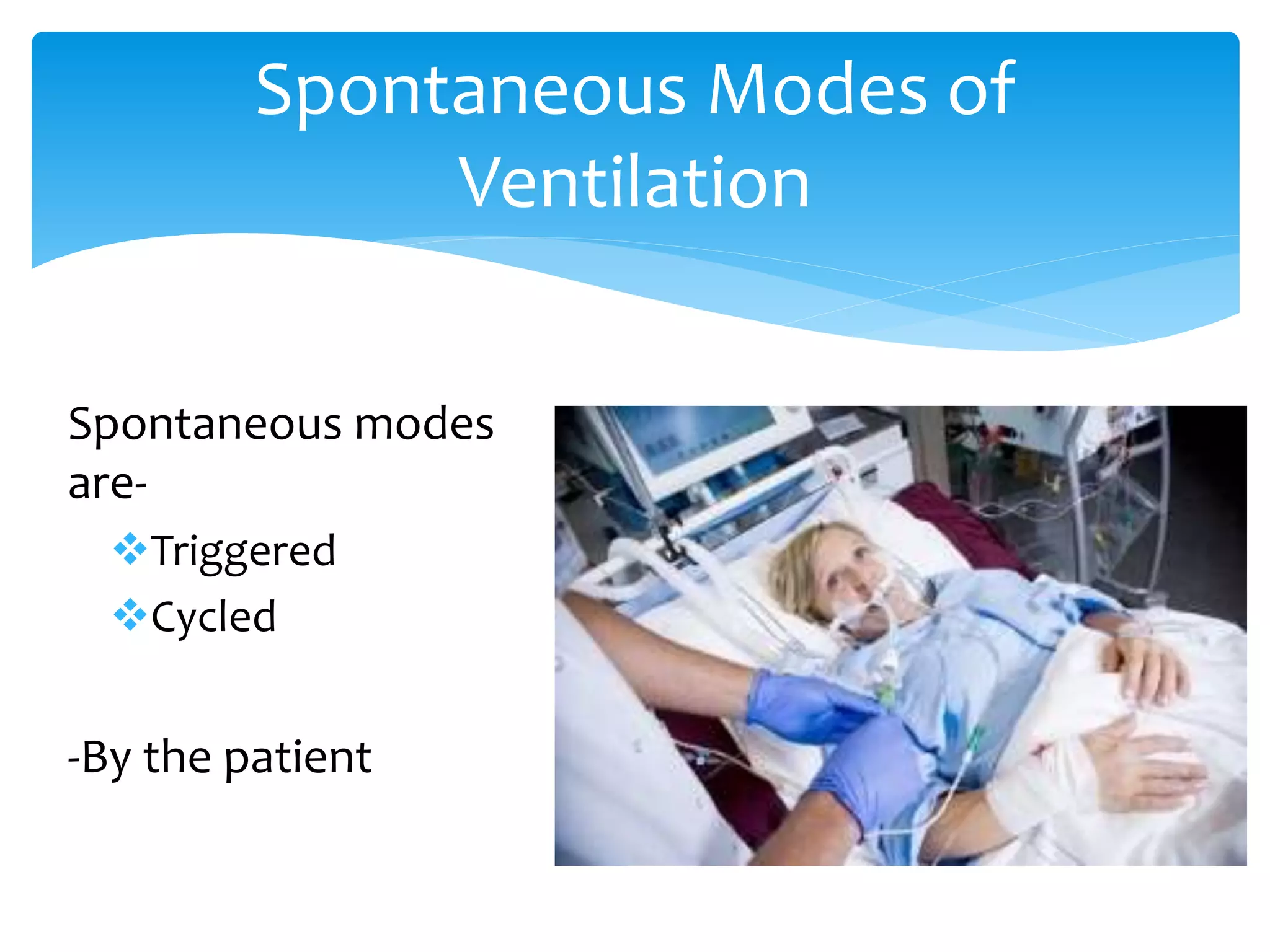
Spontaneous modes
are-
Triggered
Cycled
-By the patient
The patient triggers the ventilator and receives a
supported breath at a pre-set pressure.
This helps overcome the increased work of breathing
or resistance of breathing through an endotracheal
tube.
Pressure Support or ASB
Complications of invasive ventilation
 Airway:
 Aspiration pneumonia
 Trauma to trachea during
intubation
 Hypoxia prior to / during
intubation
 Laryngeal oedema
 Occlusion of blood supply to
trachea (if cuff pressures to
high)
 Sinus infection
Complications of invasive ventilation
 Mechanical:
 Ventilator malfunction.
 Ventilator circuit: occlusion,
kinks, bronchospasm,
disconnection & biting.
 Barotrauma / Volutrauma
can rupture alveoli, causing
pneumothorax.
Complications of invasive ventilation
 Decreased cardiac output:
 Induction agents
 Changes intrathoracic
pressure & reduces venous
return
 Cardiac output falls, BP
drops
 CVP and LV preload rise
 This has implications for the
perfusion of all vital organs:
brain, kidneys, GI tract
Complications
PEEP
 Maintains pressure within
the breathing circuit at a
pre-set level at the end of
expiration
 When used during
spontaneous respiration it is
called CPAP
 A degree of PEEP should
be applied on all ventilation
modes to minimise risk of
atelectasis
Other settings to consider:
Inspiration time : Expiration time
 I:E ratio is 1:2
 Can be reversed – 1:1 or less:
2:1
 Some machines automatically
alter I:E ratios when the set
resp rate is altered.
Reversing the I:E Ratio
Disadvantages
Air trapping from
increased
intrathoracic
pressure
Hypercarbia ( Î C02)
Breath stacking
Extreme discomfort
for the pt
Reduction in cardiac
return
Advantages
Advantages or
reversing the I:E ratio:
Alveolar recruitment
Reduced alveolar
collapse due to shorter
expiratory times
Increased mean airway
pressure without
increasing PAP

Ventilation.ppt

  • 1.
  • 2.
     To beable to demonstrate essential knowledge of the care and management of the patient requiring mechanical ventilation Aims
  • 3.
     Explore theindications and contra-indications  Overview of the modes of ventilation  Be familiar with normal parameters of ventilation  Discuss the indications for weaning and extubation Objectives
  • 4.
     Respiratory Failure Cardiopulmonary arrest  Trauma Events  Cardiovascular impairment  Neurological impairment  Pulmonary impairment  Procedures requiring sedation/paralysis Indications
  • 5.
    Goals  Treat hypoxemia/hypercapnia Relieve respiratory distress/reverse fatigue  Decrease Myocardial O2 demand  Prevention or reversal of atelectasis  Breath for the sedated/paralysed patient  Stabilise the chest wall
  • 6.
     Risks outweighbenefits, for example Neutropenia  Non-invasive deemed preferable to invasive ventilation  Invasive ventilation considered medically futile  Contrary to the expressed wishes of the patient Contra-Indications
  • 7.
  • 8.
    A machine thatgenerates a controlled flow of blended air and oxygen into a patient’s airway. Ventilators
  • 9.
    Two categories Volumeor Pressure This refers to the mode of breath delivery rather than the mode itself Ventilation
  • 10.
    In volume categorymodes of ventilation the machine generates flow to achieve a set volume known as TIDAL VOLUME Volume
  • 11.
    Tidal Volume VT Definition – ‘thevolume of air that is inspired or expired in a single breath during regular breathing’
  • 12.
    Volume Modes Advantages Guaranteed Minute Ventilation(Mv). Disadvantages Increased monitoring of airway pressures. Airway pressures will increase if lung compliance decreases. Risk of barotrauma.
  • 13.
    Minute Ventilation MV Definition – ‘thetotal volume of gas in litres expelled from the lungs per minute’
  • 14.
    In pressure modesof ventilation a pressure limit is set, the machine generates flow until the peak pressure limit is achieved- PAP or PIP Peak Airway (inspiratory) Pressures Pressure
  • 15.
    Peak Airway (Inspiratory) Pressures Pip Pap Ppeak Definition– ‘is the highest level of pressure applied to the lungs during inhalation expressed in cmh2o’
  • 16.
    Pressure Modes Advantages Greater controlof airway pressure. Less risk of barotrauma. Disadvantages No guaranteed minute ventilation. Increased monitoring of VT required. Rapid changes in the compliance can cause hypoventilation/hypoxia.
  • 17.
    FLOW TRIGGER -a breath is generated when the patient’s respiratory effort causes flow to reach a set level. PRESSURE TRIGGER - a breath is generated by measuring pressure and starting assisted ventilation when pressure reaches a given level. TIME TRIGGER - a breath is generated by measuring frequency of respirations and starting ventilation when respirations frequency is at a given. Inspiration
  • 18.
     TIME CYCLED- such in in pressure controlled ventilation  FLOW CYCLED - such as in pressure support  VOLUME CYCLED - the ventilator cycles to expiration once a set tidal volume has been delivered: this occurs in volume controlled ventilation. Expiration
  • 19.
  • 20.
  • 21.
    IPPV  Set: TV,rate, Fi02, PEEP,  No capacity for the patient to trigger a breath  Uncomfortable if patient not fully sedated &/ paralysed  Suitable only for patients who have no ability to breathe spontaneously
  • 22.
    Mandatory Assist Modesof Ventilation
  • 23.
  • 24.
     Provides aset TIDAL VOLUME at a set RATE (F)  Patient can breathe in-between mandatory ventilation  Spontaneous breaths are supported with pressure support  Ventilator synchronises mandatory breaths and spontaneous breaths for increased patient comfort NB Usually volume targeted but some machines offer SIMV(pc) SIMV
  • 26.
    SIMV Advantages  Guaranteed Minute Ventilation Disadvantages Increased monitoring of airway pressures.  Airway pressures will increase if lung compliance decreases.  Risk of barotrauma.
  • 28.
  • 29.
     Provides aset P-insp at a set RATE (F)  Patient can breathe in-between mandatory ventilation  Spontaneous breaths are supported with pressure support  Pt can breathe at any point of respiratory cycle, not just between breaths  Breathing takes between two levels Pinsp and PEEP BiPAP
  • 31.
    BiPAP Advantages Increased patient comfort Canlimit high airway pressures Reduce risk of barotrauma Disadvantages No guaranteed Minute Ventilation Increased monitoring of Tidal Volumes Patient may hypo-ventilate and become hypoxic if lung compliance changes suddenly
  • 33.
  • 34.
    Spontaneous Modes of Ventilation Spontaneousmodes are- Triggered Cycled -By the patient
  • 35.
    The patient triggersthe ventilator and receives a supported breath at a pre-set pressure. This helps overcome the increased work of breathing or resistance of breathing through an endotracheal tube. Pressure Support or ASB
  • 37.
    Complications of invasiveventilation  Airway:  Aspiration pneumonia  Trauma to trachea during intubation  Hypoxia prior to / during intubation  Laryngeal oedema  Occlusion of blood supply to trachea (if cuff pressures to high)  Sinus infection
  • 38.
    Complications of invasiveventilation  Mechanical:  Ventilator malfunction.  Ventilator circuit: occlusion, kinks, bronchospasm, disconnection & biting.  Barotrauma / Volutrauma can rupture alveoli, causing pneumothorax.
  • 39.
    Complications of invasiveventilation  Decreased cardiac output:  Induction agents  Changes intrathoracic pressure & reduces venous return  Cardiac output falls, BP drops  CVP and LV preload rise  This has implications for the perfusion of all vital organs: brain, kidneys, GI tract
  • 40.
  • 41.
    PEEP  Maintains pressurewithin the breathing circuit at a pre-set level at the end of expiration  When used during spontaneous respiration it is called CPAP  A degree of PEEP should be applied on all ventilation modes to minimise risk of atelectasis
  • 42.
  • 43.
    Inspiration time :Expiration time  I:E ratio is 1:2  Can be reversed – 1:1 or less: 2:1  Some machines automatically alter I:E ratios when the set resp rate is altered.
  • 44.
    Reversing the I:ERatio Disadvantages Air trapping from increased intrathoracic pressure Hypercarbia ( Î C02) Breath stacking Extreme discomfort for the pt Reduction in cardiac return Advantages Advantages or reversing the I:E ratio: Alveolar recruitment Reduced alveolar collapse due to shorter expiratory times Increased mean airway pressure without increasing PAP