Vedic Math
                Presentation
                      John L. Lehet
                jlehet@mathmaverick.com
             http://www.mathmaverick.com


       check out my mental math apps for android devices at
http://www.mathmaverick.com/viewMMIndex.php?vid=997
    practice and master mental math – the Vedic way
Vedic Math
         Veda means Knowledge
        Vedic Maths over 2000 years old
 Rediscovered in 20th century by Bharati Krishna

        Comprised of Sutras and sub-Sutras
          which are aphoristic formulas

         A system of Mental Mathematics

            Recommended Reference Book
Vedic Mathematics – Teacher’s Manual - Elementary Level
                 Kenneth R. Williams
                 ISBN: 81-208-2774-0
Vedic Math

Completing the Whole
              lessons
        The Ten Point Circle
Using Subtraction to Simply Addition
Using Addition to Simplify Subtraction
Simplifying Addition by Groups of 10

               sutras
 By Completion or Non-Completion
        By the Deficiency
The Ten Point Circle
                   20
         19        10
                                11
              9             1


18                                   2 12
     8


     7                               3
17                                       13


              6            4
         16                 14
                    5
                   15
The Ten Point Circle           By Completion or
                                                   Non-Completion

five number pairs
                                           Use number pairs to
      1+9                    10
                                             make groups of
      2+8           9                    1 “10” when adding
      3+7
                                                numbers
      4+6
      5+5
             8                                 2


                                               3
              7

                                                 example:
                    6                4          24 + 26 = 50
                             5
Below a Multiple of Ten                 By the Deficiency


View a number as to how close it is to the next multiple of ten

                49 is close to 50 and is 1 short
                38 is close to 40 and is 2 short

It’s easy to              59 + 4 = 63                    Practice
add zeros!       59 is close to 60 and is 1 below it       This
                   So, 59 + 4 is 1 below 60 + 4          Process
Make use         59 + 4 = 60 + 4 – 1 = 64 – 1 = 63       Mentally!
 of this!

                         38 + 24 = 62
                 38 is close to 40 and is 2 below it
                  So, 38 + 24 is 2 below 40 + 24
                38 + 24 = 40 + 24 – 2 = 64 – 2 = 62
Sum to Ten
      The Ten Point Circle illustrates the pairs of numbers
                       whose sum is 10

There are eight unique groups of three numbers that sum to 10
                 1 + 2 + 7 = 10 is an example

1     +    2   +    7    =   10                +        +         =   10
      +        +         =   10                +        +         =   10
      +        +         =   10                +        +         =   10
      +        +         =   10                +        +         =   10

    Can you find the other seven groups of three numbers summing to 10?
By Completion or
       Adding a List of Numbers                      Non-Completion

Look for number pairs that make a multiple of 10
                  7+6+3+4
     The list can be sequentially added as follows
                       7+6 is 13,
                       13+3 is 16
                    And 16+4 is 20
                                                             7
                                                             8
                        OR                             10    9   10
     You could look for number pairs that make               2
                  multiples of 10                      10
                                                             3
                     7+3 is 10,                              5
                                                             3
                     6+4 is 10                               1
                                                                 10
                    10+10 is 20                              2
                                                       10    3
               48 + 16 + 61 + 32                             7
                                                            +9
                                                            59
By Completion or
              Subtracting Near a Base                     Non-Completion

   When subtracting a number close to a multiple of 10,
Just subtract from the multiple of 10 and correct the answer
                        accordingly                  mentally
                          53 – 29                → (53 – 30) + 1
                                                        ↓
                   29 is close to 30, just 1 lower,         (23) + 1
                So subtract 30 from 53 making 23                ↓
                      Then add 1 to make 24                     24
        53 – 29 = 53 – (30 – 1) = 53 – 30 + 1 = 23 + 1 = 24

            This process can be done mentally

                             45 – 18
        45 – 18 = 45 – (20 – 2) = 45 - 20 + 2 = 25 + 2 = 27
Vedic Math

      Doubling and Halving
                    lessons
     Mentally Multiplying and Dividing by 2
  Mentally Multiplying and Dividing by 4 and 8
Mentally Multiplying and Dividing by 5, 50 and 25
Using Number Relationships to Simplify a Problem

                    sutras
                Proportionately
Doubling                         Proportionately

    Adding a number to itself is called Doubling
                         23
                      +23
                   2+2 →     46    ← 3+3

Mentally, we can double each column and then combine results
                           58       ← double 50 and add double 8
                          +58
                           116      ← 100 + 16 = 116

         Grouping columns may simply the problem
                         263        ← double 260 and add double 3
                        +263
                           526      ← 520 + 6 = 526

             Practice Doubling Mentally
Doubling                          Proportionately

      Practice how to approach a problem
                      736
                   +736
                   1472
Mentally, the problem can be “broken” into two problems

                  736 = 700 + 36

        double each of these and combine
               1400 + 72 = 1472


           Practice Doubling Mentally
Multiplying by 4 and 8               Proportionately

Doubling can be used to multiply by 4
   just double the number twice
        35 x 4 = (35 x 2 ) x 2
                 so,
        35 x 4 = 70 x 2 = 140
              similarly,
       163 x 4 = 326 x 2 = 652

Doubling can be used to multiply by 8
 just double the number three times
     35 x 8 = ( (35 x 2 ) x 2 ) x 2
                  so,
   35 x 8 = 70 x 4 = 140 x 2 = 280
             similarly,
 163 x 8 = 326 x 4 = 652 x 2 = 1304
Halving                          Proportionately

      Halving is the opposite of Doubling

                  Half of 42 is 21
               just half each column

                  Half of 56 is 28
         just half 50 and half 6 then add

Mentally, the problem can be “broken” into two problems

                   736 = 700 + 36

          half each of these and combine
                  350 + 18 = 368

           Practice Halving Mentally
Dividing by 4 and 8               Proportionately

Halving can be used to divide by 4
   just half the number twice
      72 ÷ 4 = (72 ÷ 2 ) ÷ 2
               so,
      72 ÷ 4 = 36 ÷ 2 = 18
            similarly,
      164 ÷ 4 = 82 ÷ 2 = 41
Halving can be used to divide by 8
just half the number three times
   72 ÷ 8 = ( (72 ÷ 2 ) ÷ 2 ) ÷ 2
                so,
72 ÷ 8 = (36 ÷ 2) ÷ 2 = 18 ÷ 2 = 9
           similarly,
504 ÷ 8 = 252 ÷ 4 = 126 ÷ 4 = 63
Multiplying by 5, 50 and 25                       Proportionately


  Multiply by 5 by multiplying by 10 and halving the result
           26 x 5 = ( 26 x 10 ) ÷ 2 = 260 ÷ 2 = 130

         It’s easy to multiply by 10 and 100! Make use of this!


  Multiply by 50 by multiplying by 100 and half the result
        43 x 50 = ( 43 x 100 ) ÷ 2 = 4300 ÷ 2 = 2150


Multiply by 25 by multiplying by 100 and half the result twice
  68 x 25 = ( 68 x 100 ) ÷ 4 = 6800 ÷ 4 = 3400 ÷ 2 = 1700
Dividing by 5, 50 and 25                          Proportionately


    Divide by 5 by doubling and dividing the result by 10
         320 ÷ 5 = ( 2 x 320 ) ÷ 10 = 640 ÷ 10 = 64
         It’s easy to divide by 10 and 100! Make use of this!


  Divide by 50 by doubling and dividing the result by 100
     850 ÷ 50 = ( 850 x 2 ) ÷ 100 = 1700 ÷ 100 = 17


Divide by 25 by doubling twice and dividing the result by 100
      325 ÷ 25 = ( 325 x 4 ) ÷ 100 = 1300 ÷ 100 = 13
Proportionately                 Proportionately


  We know certain number facts well, such as 8 x 7 = 56
                But given the problem 16 x 7,
               we may use long multiplication,
          Instead, proportionately allows us to use
      our number facts along with halving and doubling

           16 x 7 = 2 x (8 x 7) = 2 x (56) = 112

            all of which can be done mentally!

                         similarly,
18 x 14= (2x9) x (2x7) = 4 x (9x7) = 4 x 63 = 2 x 126 = 252
Vedic Math

           Digit Sums
                lessons
         Definition of Digit Sum
           Nine Point Circle
           “Casting Out” 9’s
        Checking with Digit Sums

                sutras
When the Samuccaya is the Same it is Zero
Digit Sums

    A Digit Sum is the sum of all of the digits of a number
     and is found by adding all of the digits of a number
              The Digit Sum of 35 is 3+5 = 8
             The Digit Sum of 142 is 1+4+2 = 7
        If the sum of the digits is greater than 9, then
sum the digits of the result again until the result is less than 10
                                              >9, so sum the digits again
         The Digit Sum of 57 is 5+7 = 12 → 1+2 = 3
                So the Digit Sum of 57 is 3

       The Digit Sum of 687 is 6+8+7 = 21 → 2+1 = 3
                So the Digit Sum of 687 is 3
Keep finding the Digit Sum of the result until it’s less than 10
                  0 and 9 are equivalent!
Nine Point Circle
                                    27                  Numbers at each
                                    18
                                                      19 point on the
           26                        9                   circle have the
                   17                              10
                        8                        1       same digit sum


25                                                                 20
     16                                                       11
           7                                             2


               6                                     3
          15                                             12
     24                                                       21
                                5        4
                              14          13
                            23              22
Casting Out 9’s

   When finding the Digit Sum of a number,
            9’s can be “cast out”
      The Digit Sum of 94993 is 4+3 = 7
              “cast out” the 9’s

   When finding the Digit Sum of a number,
Group of numbers that sum to 9 can be “cast out”
        The Digit Sum of 549673 is 7
 “cast out” the 5+4, 9 and 6+3, leaving just 7

              By Casting Out 9’s,
 Finding a Digit Sum can be done more quickly
                 and mentally!
Checking with Digit Sums
 Both Addition and Multiplication preserve Digit Sums
 21    →   3                   26      →   8
             →   3+5 = 8                     →   8+8 =16 → 8
+14    →   5                  +35      →   8

 35    → 8                     61     → 7
    If the sum of the Digit Sums does NOT equal
  The Digit Sum of the sum, then there’s a problem!

 21    →   3                    26     →   8
             → 3x5 = 15 → 6                  →   8x8 = 64 → 1
x14    →   5                   x35     →   8

294    → 6                     910     → 1

   If the product of the Digit Sums does NOT equal
 The Digit Sum of the product, then there’s a problem!
Digit Sums of Perfect Squares

          All Perfect Squares
        end in 1, 4, 5, 6, 9 or 0
                  and
       digit sums are 1, 4, 7 or 9

                 4539
              ends in 9
            digit sum is 3
Therefore, 4539 is not a perfect square

                 5776
               ends in 6
             digit sum is 7
Therefore, 5776 may be a perfect square
Vedic Math


Left to Right
Vedic Math

All from 9 and the last from 10
                lessons
      Subtracting Number from 10n
        Applications with Money


                sutras
     All From 9 and the Last From 10
All from 9 and the
 All From 9 and the Last From 10                  Last from 10

When subtracting a number from a power of 10
 Subtract all digits from 9 and last from 10
                                 from   from
             1000                  9     10


             -276                 276
              724                 ↓↓↓
                                  724
           If the number ends in zero,
use the last non-zero number as the last number
                                 from   from
           10000                   9     10


           -4250                  4250
            5750                  ↓↓↓↓
                                  5750
All from 9 and the
          All From 9 and the Last From 10                      Last from 10


   If the number is less digits, then append zeros to the start
                                              from   from
                    10000                       9     10


                     -425                   0425
                      9575                  ↓↓↓↓
                                            9575

       When subtracting from a multiple of a power of 10,
Just decrement the first digit by 1, then subtract remaining digits
                                              from   from
                      4000                      9     10


                      - 257                   257
                      3743                    ↓↓↓
                                    4–1   → 3743
All from 9 and the
                           Money                             Last from 10


A great application of “All from 9 and last from 10” is money.
  Change can be calculated by applying this sutra mentally!
                                            from   from
                  $ 1 0 .0 0                  9     10


                  - $ 4 .2 5              $ 4 .2 5
                   $ 5 .7 5                 ↓↓↓
                                          $ 5 .7 5

   It is often the case the payment is made with bills only,
                  these are multiples of “100”


                  THINK MENTALLY!
Vedic Math

    Number Splitting
             lessons
Splitting Number to Simplify Problem


              sutras
          Proportionately
Number Splitting
Quick mental calculations can be performed more easily if the
    the numbers are “split” into more manageable parts
         This sum can look             “split” into two more
        somewhat daunting               manageable sums

                                                               The “split” allows one
             3642                           36 42               to add “36+24” and
           + 2439                         + 24 39                 “42+39”, both of
                                                                 which can be done
                                              60 81                   mentally

          Think about where to place the “split” line.
    It’s often best to avoid number “carries” over the line
        342                         3 42                              34 2
      + 587                       + 5 87                            + 58 7
                                      9 29                             92 9
                             carry → 1
                                a carry of “1” over              No carry is required
                                the line is required
Number Splitting
 The same can be done for subtraction also!
                                      The “split” allows one
         3642                36 42     to subtract “36-24”
       - 2439              - 24 39     and “42-39”, both of
                                        which can be done
                           12 03             mentally

The same can be done for multiplication also!
        263                26 3
         x2                x2 x2
                            52   6       526
   The same can be done for division also!
       6234                62 34
        ÷2                 ÷2 ÷2
                            31 17      3117
Number Splitting
The “split” may require more “parts”

 30155                 30 15  5
   ÷5                  ÷5 ÷5 ÷5
                         6 03     1    631


244506                 24 45 06
   ÷3                  ÷3 ÷3 ÷3
                         8 15     2    81502
Vedic Math

        Base Multiplication
                   lessons
 Multiplying Numbers Just Above or Below 10n
Using Number Relationships to Simplify Problems
   Multiplying Numbers Near Different Bases
        Squaring Numbers Near a Base

                   sutras
           Vertically and Crosswise
                Proportionately
Vertically and
            Multiplying Numbers Just Above 10                         Crosswise

    Traditionally, the multiplication of 2-digit numbers requires
       Four single digit multiplies and series of summations
                        to combine the results
       Traditional                       Vedic
         Method                          Method
          12                           12         2      12 is 2 above 10
        x 13
           36                          13         3      13 is 3 above 10
          12
                                       15         6           156
          156
                          15 = 12+3 or 13+2            6 = 2x3
                           think “crosswise”      think “vertically”

The Vedic Method requires an addition (crosswise), a single digit
        Multiplication (vertically) and possibly a carry
Vertically and
        Multiplying Numbers Just Above 10                    Crosswise


A carry may be required when combining the crosswise and
                      vertical results
   Traditional                  Vedic
     Method                     Method
      16                       16        6       16 is 6 above 10
    x 13
      48                       13        3       13 is 3 above 10
     16
                               19     18             208
      208

                                 carry “1” and
                                   add to 19
Vertically and
       Multiplying Numbers Just Below 100                        Crosswise

Traditionally, the multiplication of 2-digit numbers requires
   Four single digit multiplies and series of summations
                    to combine the results
     Traditional                     Vedic
      Method                         Method
        98                         98         2      98 is 2 below 100
      x 88
       784                         88      12        88 is 12 below 100
      784
                                   86      24            8624
      8624
                      86 = 98–12 or 88-2          24 = 2x12
                       think “crosswise”      think “vertically”

The Vedic Method requires a subtraction (crosswise), and
        a single digit multiplication (vertically)
Vertically and
       Multiplying Numbers Just Above 100                       Crosswise

Traditionally, the multiplication of 3-digit numbers requires
   Six single digit multiplies and series of summations
                    to combine the results
     Traditional                    Vedic
      Method                        Method
       102                       102         2      102 is 2 above 100
     x 112
       204                       112       12       112 is 12 above 100
     102
    102                          114       24            11424
     11424         114 = 112+2 or 102+12         24 = 2x12
                      think “crosswise”      think “vertically”

The Vedic Method requires an addition (crosswise), and
             a multiplication (vertically)
Vertically and
Multiplying Numbers on Either Side of 100                          Crosswise

           Multiplying Numbers Close to 100
                   but on either side

  Traditional                     Vedic
   Method                         Method
    112                        112 +12            112 is 12 above 100
  x 98
   896                          98      -2        98 is 2 below100
 1008
                               110     -24 = 11000 – 24 - 10976
  10976
                110 = 112-2 or 98+12       -24 = -2x12
                                                         All from 9 and the
                                                            Last from 10

      So, what’s 103 x 96?         9900 – 12 = 9888
Vertically and
                 Multiplying Larger Numbers                              Crosswise

Traditionally, the multiplication of larger numbers requires
numerous single digit multiplies and series of summations
                   to combine the results
   Traditional                          Vedic
    Method                              Method
     672                         672      328        672 is 328 below 1000
   x 998                                             “all from 9, the last from 10”

    5376                         998        2         998 is 2 below 1000
   6048
 6048                            670 656                670656
  670656               670 = 672-2             656 = 2x328
                    think “crosswise”       think “vertically”

The Vedic Method requires an addition (crosswise), and
             a multiplication (vertically)
Vertically and Crosswise
                     Proportionately                 Proportionately

Often problems can be simplified in order to be performed
                 mentally more easily
    Traditional                 Vedic
     Method                     Method
      212                                                      rewrite
    x 104             212 x 104          2 x (106 x 104)       problem
      848                                                      vertically/
                      2 x (106 x 104) = 2 x 11024              crosswise
    212
    22048                                = 22048               doubling


                         another example
46 x 192 can be rewritten as 92 x 96 by doubling and halving
                                                 vertically/
                  46 x 192 = 92 x 96 = 8832      crosswise
Vertically and
   Multiplying Numbers Near Different                Bases Crosswise
         Multiplying numbers near different bases
                 uses the same techniques
     94 x 9997             9997    3          9997 is 3 below 10000


                           94       6        94 is 6 below 100

                           9397    18           939718
           9397 = 9997-6x100            18 = 3x6
            think “crosswise”       think “vertically”

10006 x 1002               10006   6          10006 is 6 above 10000


                           1002     2        1002 is 2 above 1000
10026 = 10006+20
 think “crosswise”
                         10026     12          10026012
Vertically and
           Squaring Numbers Near a Base                               Crosswise

To square numbers near a base, just apply the same techniques
           942                94     6
                                                    94 is 6 below 100
                              94     6
                              88     36                 8836
                  88 = 94-6               36 = 62


          10052               1005    5
                                                    1005 is 5 above 1000

                              1005       5
                              1010    25               1010025
Vedic Math

     Bar Numbers
           lessons
     Define Bar Numbers
    Bar Number Arithmetic
     Using Bar Numbers

           sutras
All From 9 and the Last From 10
Bar Numbers
 29 is close to the number 30
    Let’s rewrite 29 as 31

    31 means 30 – 1 or 29

Bar numbers are analogous to time
      The time 5:45 can be
       “45 minutes past 5”
              OR
      “15 minutes before 6”

    52 means 50 – 2 or 48
                             Note the distinction
    63 means 60 – 3 or 57          between
412 means 400 – 10 + 2 = 392     412 = 392
                                     and
  413 means 400 – 13 = 387       412 = 388
Subtraction using Bar Numbers

                435           Traditionally, subtraction is
               -276        performed on columns right to left
                             “borrowing” from the next left
                 159            column when necessary

          However, subtracting each column independently
                       gives the following:

                            4–2=2
                            3 – 7 = -4
                            5 – 6 = -1
Negative numbers can be replaced with their bar number equivalent , so

                4–2=2                       435
                3–7=4             So,      -276
                5–6=1                        2 4 1 = 241 = 159
Arithmetic of Bar Numbers

                     29       → 31
                    +48       → 52
                        77
The original problem can be rewritten three different ways
                   using bar numbers


       31                     29              31
      +48                    +52             +52
         77                   77                83 =77
              7 = 8-1              7 = 9-2             3 = 2+1

           In each case, the result is the same, 77!
Arithmetic of Bar Numbers
                    28    →    31
    Addition:      +43        +42
                     71        71         1 = 2+1 = 2-1


                     63   →    63
  Subtraction:      -37       -43
                     26        26         6 = 3-3 = 3+3


                     28   → 32
Multiplication:
                    x 3     x 3           6 = 2x3

                     84        9 6 = 84
                     87   → 93
     Division:      ÷ 3    ÷ 3            1 = 3÷3
                     71        3 1 = 29
Vedic Math
  Special Multiplication
                 lessons
              Multiply by 11
     Multiply ab x ac where b+c=10
     Multiply ba x ca where b+c=10
        Multiply by 99, 999, etc
     Using the Average to Multiply

                  sutras
         Vertically and Crosswise
   By One More than The One Before
    By One Less than The One Before
The First by the First, The Last by the Last
             Specific General
Multiplying by 11
   Multiplying by 11 can be performed easily
        Traditional                            Vedic
         Method                                Method
           45                                   45
         x 11                                   sum
                                       4         9      5   → 495
           45
          45
          495

Carries may be required when the sum exceeds 9
                        57
                              sum
                       5       1   2       7     → 627
                       carry the 1
                      and add to 5
Multiplying by 11

         Traditional                      Vedic
          Method                          Method
            243                               243
           x 11
                                        2+4     4+3
            243               2         6        7     3   → 2673
          243
          2673

Carries may be required when a center sum exceeds 9

                                  561

                           5+6      6+1
                       5   11        7          1     → 6171
                    carry the 1
                   and add to 5
By One More Than
                 Special Multiplication                               The One Before

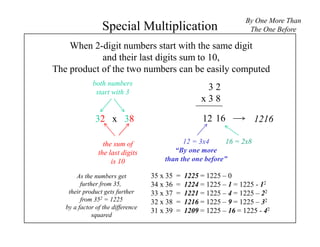
    When 2-digit numbers start with the same digit
            and their last digits sum to 10,
The product of the two numbers can be easily computed
             both numbers
              start with 3
                                                       32
                                                      x38

               32 x 38                                 12 16           1216

                  the sum of                 12 = 3x4      16 = 2x8
                the last digits           “By one more
                     is 10             than the one before”

       As the numbers get          35 x 35   =   1225 = 1225 – 0
         further from 35,          34 x 36   =   1224 = 1225 – 1 = 1225 - 12
    their product gets further     33 x 37   =   1221 = 1225 – 4 = 1225 – 22
         from 352 = 1225           32 x 38   =   1216 = 1225 – 9 = 1225 – 32
   by a factor of the difference
                                   31 x 39   =   1209 = 1225 – 16 = 1225 - 42
              squared
The First by the First
            Special Multiplication                  The Last by the Last

    When 2-digit numbers end with the same digit
            and their first digits sum to 10,
The product of the two numbers can be easily computed
           both numbers
            End with 4                     24
                                          x84
          24 x 84
                                          20 16            2016
           the sum of
         the first digits      20 = 2x8 + 4     16 = 4x4
              is 10

       36                                62
      x76                               x42
       27 36            2736            26 04         2604
By One Less Than
              Special Multiplication                     The One Before

When multiplying by a number with all digits equal to “9”,
 The product of the two numbers can be easily computed
                      in two parts
                             32
                            x99

                            31 68            3168

                 31 = 32-1           68 = 100-32
                “By one less         “All from 9,
            than the one before”   the last from 10”

       568                             1285
     x 999                           x 9999

      567 432       567432          1284 8715          12848715
Specific
                Special Multiplication                                 General


When multiplying numbers, the average can sometimes be used
                 to determine their product
                           31 x 29
                     their average is 30
     square this and subtract 1 to determine the product
           31 x 29 = 302 – 12 = 900 – 1 = 899

         30 = (31+29)/2       1 = (31-30)2


           38 x 42 = 402 – 22
                   = 1600 – 4 = 1596         “all from 9, the last from 10”

           47 x 53 = 502 – 32
                   = 2500 – 9 = 2491         “all from 9, the last from 10”
Vedic Math


General Multiplication
           lessons
   Multiply 2-Digit Numbers
   Multiply 3-Digit Numbers


           sutras
   Vertically and Crosswise
Vertically and
              Multiplying 2-Digit Numbers                           Crosswise


Traditional      Intermediate                       Vedic
 Method             Method                          Method
   24               24                              2        4
 x 43             x 43
   72               12    =3x4                      4        3
  96                60    =3x20                         16
                   160    =40x4                 8            12
 1032              800    =40x20
                                                         6
                                    8 = 2x4                      12 = 4x3
                  1032               upper                         lower
                                      half       16 = 4x4           half
                                   “vertical”     6 = 2x3        “vertical”
                                                “crosswise”
                                          812 + 220 = 1032

               46 x 52 = 2012 + 380 = 2392
Multiplying 3-Digit Numbers
                   Find 504 x 321
 Traditional                            Vedic
  Method                                Method
    504                             5     0      4
  x 321
                                    3     2      1
    504
 1008                          15, 10, 17, 8, 4
1512                                161784
161784              Mentally, we think 15; 160; 1617; 16178; 161784


                  Find 123 x 321
                   3, 8, 14, 8, 3
                       39483
        Mentally, we think 3; 38; 394; 3948; 39483
Multiplying 3-Digit Numbers                      Vertically and
                                                   Crosswise


            Find 617 x 893
                      Vedic
                      Method
                  6     1      7
                  8     9      3
            48, 62, 83, 66, 21
                 550981
Mentally, we think 48;542; 5503; 55096; 550981
Vertically and
               Vedic Math                         Crosswise


               Squaring
                  lessons
        Squaring Numbers Ending in 5
         Squaring Numbers Near 50
General Squaring using the Duplex of a Number

                  sutras
      By One More Than the One Before
              Proportionately
By One More Than
Squaring Numbers that End in 5             The One Before

   By One More Than the One Before

  352 → 3•4 / 25 → 12 / 25 → 1225

 The result is comprised of two “parts”
    The bottom “part” is always 25
       The top “part” is n(n+1)

  752 → 7•8 / 25 → 56 / 25 → 5625

  452 → 4•5 / 25 → 20 / 25 → 2025

  952 → 9•10 / 25 → 90 / 25 → 9025
1152 → 11•12 / 25 → 132 / 25 → 13225
Squaring Numbers Near 50
            542 → 52+4 / 42 → 29 / 16 → 2916
               For numbers greater than 50
           The result is comprised of two “parts”
   The bottom “part” is always the bottom digit squared
 The top “part” is the top digit squared plus the bottom digit

              482 → 52-2 / 22 → 23 / 4 → 2304
                  For numbers less than 50
            The result is comprised of two “parts”
The bottom “part” is always the bar of the bottom digit squared
         The top “part” is the top digit squared minus
                  the bar of the bottom digit
              532 → 25+3 / 9 → 28 / 9 → 2809
             462 → 25-4 / 16 → 21 / 16 → 2116
General Squaring
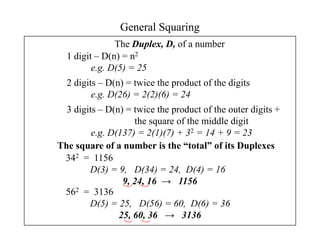
               The Duplex, D, of a number
  1 digit – D(n) = n2
         e.g. D(5) = 25
  2 digits – D(n) = twice the product of the digits
         e.g. D(26) = 2(2)(6) = 24
  3 digits – D(n) = twice the product of the outer digits +
                    the square of the middle digit
         e.g. D(137) = 2(1)(7) + 32 = 14 + 9 = 23
The square of a number is the “total” of its Duplexes
 342 = 1156
        D(3) = 9, D(34) = 24, D(4) = 16
                 9, 24, 16 → 1156
 562 = 3136
        D(5) = 25, D(56) = 60, D(6) = 36
                25, 60, 36 → 3136
General Squaring

472 = 1156
     D(4) = 16, D(47) = 56, D(4) = 49       16 49
            16, 56, 49 → 2209                56
                                            22 09

             Number Splitting

 1232 - Split 123 into two parts 12 / 3
      D(12) = 144, D(123) = 72, D(3) = 9
              144, 72, 9 → 15129

 4122 - Split 412 into two parts 4 / 12
      D(4) = 16, D(412) = 96, D(12) = 144
            16, 96, 144 → 169744
General Squaring (3 and 4-digit numbers)

3412 = 116281
 D(3) = 9, D(34) = 24, D(341) = 22, D(41) = 8, D(1) = 1
               9, 24, 22, 8, 1 → 116281

2632 =
 D(2) = 4, D(26) = 24, D(263) = 48, D(63) = 36, D(3) = 9
                4, 24, 48, 36, 9 → 69169

43322 =
  D(4) = 16, D(43) = 24, D(433) = 33, D(4332) = 34,
  D(332) = 21, D(32) = 12, D(2) = 4
           16, 24, 33, 34, 21, 12, 4 → 18766224
Vedic Math

 Special Division
          lessons
        Division by 9
Division Below and Above 10n


          sutras
   Need to Determine This
Division by 9
32 ÷ 9     9)32
             3 r5 where 5 = 3+2

52 ÷ 9     9)52
             5 r7 where 7 = 5+2

75 ÷ 9     9)75
             7 r12 where 12 = 7+5 remainder > 9
            = 8 r3
3102 ÷ 9   9)3102
                                  When dividing by 9,
             3 4 4 r6
                             The remainder is always the
312 ÷ 9    9 ) 312        digit sum of the original number
               3 4 r6
Division by 9 with Carries

3172 ÷ 9      9 ) 3 17 2
                  3 4 11 r13 = 351 r13 = 352 r4

5555 ÷ 9      9)555
                5 10 r15 = 61 r6

                   Short Cut
3172 ÷ 9      9)3172       Check to see if next sum is >9, if so add 1
                3 5 2 r4

6153 ÷ 9      9)6153
                6 8 3 r6
Division Below a Base Number

  235 ÷ 88   88 ) 2    3 5         1.   Drop 2 (the first digit)
             1 2       2   4       2.   Create 12 = 88
                                   3.   Multiple 12 by 2 = 24
                   2   5 9         4.   Add 35 and24


  211 ÷ 75   76 ) 2    1 1
             2 5       5   0

                   2   6 1

1121123 ÷ 8989     8989 ) 1 1 2 1 1 2 3
                   1011        1   0 1 1
                                   2 0 2 2
                                     4 0 4        4

                           1 2 4 6 4 8 7
Division Above a Base Number

1498 ÷ 124 124 ) 1 4       9 8      1.   Drop 1 (the first digit)
               2 4     2   4        2.   Create 24
                           4   8    3.   Multiply 24 by 1 = 24
                                    4.   Add 4 + 2 = 2
                     1 2   1 0      5.   Multiply 24 by 2 = 48
                                    6.   Add columns
                       12 r10


2311 ÷ 112    112 ) 2 3    1 1
               1 2     2   4
                           1    2

                     2 1   4 1      = 20 r71 where 71 = 112-41
Vedic Math


General Division
         lessons
     General Division
Decimalizing the Remainder


         sutras
General Division
                                    1. Create flag, 1, from divisor 2nd digit
308 ÷ 51       1   3   0       8    2. 5 goes into 30 6 times with r0
           5               0        3. 08 – 1x6 = 2
                       6 2         = 6 r2

                                    1. Create flag, 4, from divisor 2nd digit
234 ÷ 54       4   2   3       4    2. 5 goes into 23 4 times with r3
           5               3        3. 34 – 4x4 = 18
                       4 18 = 4 r18

                                    1. Create flag, 2, from divisor 2nd digit
503 ÷ 72       2   5   0       3    2. 7 goes into 50 7 times with r1
           7               1        3. 13 – 2x7 = 1 = 72 – 1= 71
                       7 1         = 6 r71
General Division
                                     19902 ÷ 62
    2   1   9 9          0       2
6               1                          1. Create flag, 2, from divisor 2nd digit
                                           2. 6 goes into 19 3 times with r1
            3

    2   1   9 9          0       2
6               1    1       0             1. Compute 19 – 2x3 = 13
                                           2. 6 goes into 13 2 times with r1
            3 2       1      0

    2   1   9       9 0          2
6               1    1       0             1. Compute 10 – 2x2 = 6
                                           2. 6 goes into 6 1 times with r0
            3 2       1      0

    2   1   9       9 0 2
6               1    1       0             1. Compute 02 – 2x1 = 0 (remainder)

            3   2 1          0          = 321 r0
General Division
                                            92054 ÷ 63
    3   9 2             0       5       4         1. Create flag, 3, from divisor 2nd digit
6           3                                     2. 6 goes into 9 1 times with r3
        1

    3   9 2             0       5       4         1. Compute 32 – 3x1 = 29
6           3       5               0             2. 6 goes into 29 4 times with r5
        1       4

    3   9       2 0             5       4         1. Compute 50 – 3x4 = 38
6           3       5       2                     2. 6 goes into 38 6 times with r2
        1 4             6

    3   9       2       0 5             4         1. Compute 25 – 3x6 = 7
6           3       5       2       1             2. 6 goes into 7 1 time with r1
                                                  3. Compute 14 – 3x1 = 11 remainder
        1       4 6             1 11
                                              = 1461 r11
General Division
                      543 ÷ 68
    8   5   2   3
6                           1. Create flag, 8, from divisor 2nd digit


    2   5   2   3           1. Change flag to a bar number 2
6               4
                            2. 6 goes into 52 8 times with r4
            8


    2   5   2 3
6               4           1. Compute 43 - 2x8 = 27 remainder
            8 27      = 8 r27
Decimalizing the Reminder


40342 ÷ 73        3   4   0       3       4       2       0       0   0       0       0
              7               5       3       5       4       1           3       6

                          5       5       2       6 .3 0              1       3       7
Questions and Comments

Vedic math

  • 1.
    Vedic Math Presentation John L. Lehet jlehet@mathmaverick.com http://www.mathmaverick.com check out my mental math apps for android devices at http://www.mathmaverick.com/viewMMIndex.php?vid=997 practice and master mental math – the Vedic way
  • 2.
    Vedic Math Veda means Knowledge Vedic Maths over 2000 years old Rediscovered in 20th century by Bharati Krishna Comprised of Sutras and sub-Sutras which are aphoristic formulas A system of Mental Mathematics Recommended Reference Book Vedic Mathematics – Teacher’s Manual - Elementary Level Kenneth R. Williams ISBN: 81-208-2774-0
  • 3.
    Vedic Math Completing theWhole lessons The Ten Point Circle Using Subtraction to Simply Addition Using Addition to Simplify Subtraction Simplifying Addition by Groups of 10 sutras By Completion or Non-Completion By the Deficiency
  • 4.
    The Ten PointCircle 20 19 10 11 9 1 18 2 12 8 7 3 17 13 6 4 16 14 5 15
  • 5.
    The Ten PointCircle By Completion or Non-Completion five number pairs Use number pairs to 1+9 10 make groups of 2+8 9 1 “10” when adding 3+7 numbers 4+6 5+5 8 2 3 7 example: 6 4 24 + 26 = 50 5
  • 6.
    Below a Multipleof Ten By the Deficiency View a number as to how close it is to the next multiple of ten 49 is close to 50 and is 1 short 38 is close to 40 and is 2 short It’s easy to 59 + 4 = 63 Practice add zeros! 59 is close to 60 and is 1 below it This So, 59 + 4 is 1 below 60 + 4 Process Make use 59 + 4 = 60 + 4 – 1 = 64 – 1 = 63 Mentally! of this! 38 + 24 = 62 38 is close to 40 and is 2 below it So, 38 + 24 is 2 below 40 + 24 38 + 24 = 40 + 24 – 2 = 64 – 2 = 62
  • 7.
    Sum to Ten The Ten Point Circle illustrates the pairs of numbers whose sum is 10 There are eight unique groups of three numbers that sum to 10 1 + 2 + 7 = 10 is an example 1 + 2 + 7 = 10 + + = 10 + + = 10 + + = 10 + + = 10 + + = 10 + + = 10 + + = 10 Can you find the other seven groups of three numbers summing to 10?
  • 8.
    By Completion or Adding a List of Numbers Non-Completion Look for number pairs that make a multiple of 10 7+6+3+4 The list can be sequentially added as follows 7+6 is 13, 13+3 is 16 And 16+4 is 20 7 8 OR 10 9 10 You could look for number pairs that make 2 multiples of 10 10 3 7+3 is 10, 5 3 6+4 is 10 1 10 10+10 is 20 2 10 3 48 + 16 + 61 + 32 7 +9 59
  • 9.
    By Completion or Subtracting Near a Base Non-Completion When subtracting a number close to a multiple of 10, Just subtract from the multiple of 10 and correct the answer accordingly mentally 53 – 29 → (53 – 30) + 1 ↓ 29 is close to 30, just 1 lower, (23) + 1 So subtract 30 from 53 making 23 ↓ Then add 1 to make 24 24 53 – 29 = 53 – (30 – 1) = 53 – 30 + 1 = 23 + 1 = 24 This process can be done mentally 45 – 18 45 – 18 = 45 – (20 – 2) = 45 - 20 + 2 = 25 + 2 = 27
  • 10.
    Vedic Math Doubling and Halving lessons Mentally Multiplying and Dividing by 2 Mentally Multiplying and Dividing by 4 and 8 Mentally Multiplying and Dividing by 5, 50 and 25 Using Number Relationships to Simplify a Problem sutras Proportionately
  • 11.
    Doubling Proportionately Adding a number to itself is called Doubling 23 +23 2+2 → 46 ← 3+3 Mentally, we can double each column and then combine results 58 ← double 50 and add double 8 +58 116 ← 100 + 16 = 116 Grouping columns may simply the problem 263 ← double 260 and add double 3 +263 526 ← 520 + 6 = 526 Practice Doubling Mentally
  • 12.
    Doubling Proportionately Practice how to approach a problem 736 +736 1472 Mentally, the problem can be “broken” into two problems 736 = 700 + 36 double each of these and combine 1400 + 72 = 1472 Practice Doubling Mentally
  • 13.
    Multiplying by 4and 8 Proportionately Doubling can be used to multiply by 4 just double the number twice 35 x 4 = (35 x 2 ) x 2 so, 35 x 4 = 70 x 2 = 140 similarly, 163 x 4 = 326 x 2 = 652 Doubling can be used to multiply by 8 just double the number three times 35 x 8 = ( (35 x 2 ) x 2 ) x 2 so, 35 x 8 = 70 x 4 = 140 x 2 = 280 similarly, 163 x 8 = 326 x 4 = 652 x 2 = 1304
  • 14.
    Halving Proportionately Halving is the opposite of Doubling Half of 42 is 21 just half each column Half of 56 is 28 just half 50 and half 6 then add Mentally, the problem can be “broken” into two problems 736 = 700 + 36 half each of these and combine 350 + 18 = 368 Practice Halving Mentally
  • 15.
    Dividing by 4and 8 Proportionately Halving can be used to divide by 4 just half the number twice 72 ÷ 4 = (72 ÷ 2 ) ÷ 2 so, 72 ÷ 4 = 36 ÷ 2 = 18 similarly, 164 ÷ 4 = 82 ÷ 2 = 41 Halving can be used to divide by 8 just half the number three times 72 ÷ 8 = ( (72 ÷ 2 ) ÷ 2 ) ÷ 2 so, 72 ÷ 8 = (36 ÷ 2) ÷ 2 = 18 ÷ 2 = 9 similarly, 504 ÷ 8 = 252 ÷ 4 = 126 ÷ 4 = 63
  • 16.
    Multiplying by 5,50 and 25 Proportionately Multiply by 5 by multiplying by 10 and halving the result 26 x 5 = ( 26 x 10 ) ÷ 2 = 260 ÷ 2 = 130 It’s easy to multiply by 10 and 100! Make use of this! Multiply by 50 by multiplying by 100 and half the result 43 x 50 = ( 43 x 100 ) ÷ 2 = 4300 ÷ 2 = 2150 Multiply by 25 by multiplying by 100 and half the result twice 68 x 25 = ( 68 x 100 ) ÷ 4 = 6800 ÷ 4 = 3400 ÷ 2 = 1700
  • 17.
    Dividing by 5,50 and 25 Proportionately Divide by 5 by doubling and dividing the result by 10 320 ÷ 5 = ( 2 x 320 ) ÷ 10 = 640 ÷ 10 = 64 It’s easy to divide by 10 and 100! Make use of this! Divide by 50 by doubling and dividing the result by 100 850 ÷ 50 = ( 850 x 2 ) ÷ 100 = 1700 ÷ 100 = 17 Divide by 25 by doubling twice and dividing the result by 100 325 ÷ 25 = ( 325 x 4 ) ÷ 100 = 1300 ÷ 100 = 13
  • 18.
    Proportionately Proportionately We know certain number facts well, such as 8 x 7 = 56 But given the problem 16 x 7, we may use long multiplication, Instead, proportionately allows us to use our number facts along with halving and doubling 16 x 7 = 2 x (8 x 7) = 2 x (56) = 112 all of which can be done mentally! similarly, 18 x 14= (2x9) x (2x7) = 4 x (9x7) = 4 x 63 = 2 x 126 = 252
  • 19.
    Vedic Math Digit Sums lessons Definition of Digit Sum Nine Point Circle “Casting Out” 9’s Checking with Digit Sums sutras When the Samuccaya is the Same it is Zero
  • 20.
    Digit Sums A Digit Sum is the sum of all of the digits of a number and is found by adding all of the digits of a number The Digit Sum of 35 is 3+5 = 8 The Digit Sum of 142 is 1+4+2 = 7 If the sum of the digits is greater than 9, then sum the digits of the result again until the result is less than 10 >9, so sum the digits again The Digit Sum of 57 is 5+7 = 12 → 1+2 = 3 So the Digit Sum of 57 is 3 The Digit Sum of 687 is 6+8+7 = 21 → 2+1 = 3 So the Digit Sum of 687 is 3 Keep finding the Digit Sum of the result until it’s less than 10 0 and 9 are equivalent!
  • 21.
    Nine Point Circle 27 Numbers at each 18 19 point on the 26 9 circle have the 17 10 8 1 same digit sum 25 20 16 11 7 2 6 3 15 12 24 21 5 4 14 13 23 22
  • 22.
    Casting Out 9’s When finding the Digit Sum of a number, 9’s can be “cast out” The Digit Sum of 94993 is 4+3 = 7 “cast out” the 9’s When finding the Digit Sum of a number, Group of numbers that sum to 9 can be “cast out” The Digit Sum of 549673 is 7 “cast out” the 5+4, 9 and 6+3, leaving just 7 By Casting Out 9’s, Finding a Digit Sum can be done more quickly and mentally!
  • 23.
    Checking with DigitSums Both Addition and Multiplication preserve Digit Sums 21 → 3 26 → 8 → 3+5 = 8 → 8+8 =16 → 8 +14 → 5 +35 → 8 35 → 8 61 → 7 If the sum of the Digit Sums does NOT equal The Digit Sum of the sum, then there’s a problem! 21 → 3 26 → 8 → 3x5 = 15 → 6 → 8x8 = 64 → 1 x14 → 5 x35 → 8 294 → 6 910 → 1 If the product of the Digit Sums does NOT equal The Digit Sum of the product, then there’s a problem!
  • 24.
    Digit Sums ofPerfect Squares All Perfect Squares end in 1, 4, 5, 6, 9 or 0 and digit sums are 1, 4, 7 or 9 4539 ends in 9 digit sum is 3 Therefore, 4539 is not a perfect square 5776 ends in 6 digit sum is 7 Therefore, 5776 may be a perfect square
  • 25.
  • 26.
    Vedic Math All from9 and the last from 10 lessons Subtracting Number from 10n Applications with Money sutras All From 9 and the Last From 10
  • 27.
    All from 9and the All From 9 and the Last From 10 Last from 10 When subtracting a number from a power of 10 Subtract all digits from 9 and last from 10 from from 1000 9 10 -276 276 724 ↓↓↓ 724 If the number ends in zero, use the last non-zero number as the last number from from 10000 9 10 -4250 4250 5750 ↓↓↓↓ 5750
  • 28.
    All from 9and the All From 9 and the Last From 10 Last from 10 If the number is less digits, then append zeros to the start from from 10000 9 10 -425 0425 9575 ↓↓↓↓ 9575 When subtracting from a multiple of a power of 10, Just decrement the first digit by 1, then subtract remaining digits from from 4000 9 10 - 257 257 3743 ↓↓↓ 4–1 → 3743
  • 29.
    All from 9and the Money Last from 10 A great application of “All from 9 and last from 10” is money. Change can be calculated by applying this sutra mentally! from from $ 1 0 .0 0 9 10 - $ 4 .2 5 $ 4 .2 5 $ 5 .7 5 ↓↓↓ $ 5 .7 5 It is often the case the payment is made with bills only, these are multiples of “100” THINK MENTALLY!
  • 30.
    Vedic Math Number Splitting lessons Splitting Number to Simplify Problem sutras Proportionately
  • 31.
    Number Splitting Quick mentalcalculations can be performed more easily if the the numbers are “split” into more manageable parts This sum can look “split” into two more somewhat daunting manageable sums The “split” allows one 3642 36 42 to add “36+24” and + 2439 + 24 39 “42+39”, both of which can be done 60 81 mentally Think about where to place the “split” line. It’s often best to avoid number “carries” over the line 342 3 42 34 2 + 587 + 5 87 + 58 7 9 29 92 9 carry → 1 a carry of “1” over No carry is required the line is required
  • 32.
    Number Splitting Thesame can be done for subtraction also! The “split” allows one 3642 36 42 to subtract “36-24” - 2439 - 24 39 and “42-39”, both of which can be done 12 03 mentally The same can be done for multiplication also! 263 26 3 x2 x2 x2 52 6 526 The same can be done for division also! 6234 62 34 ÷2 ÷2 ÷2 31 17 3117
  • 33.
    Number Splitting The “split”may require more “parts” 30155 30 15 5 ÷5 ÷5 ÷5 ÷5 6 03 1 631 244506 24 45 06 ÷3 ÷3 ÷3 ÷3 8 15 2 81502
  • 34.
    Vedic Math Base Multiplication lessons Multiplying Numbers Just Above or Below 10n Using Number Relationships to Simplify Problems Multiplying Numbers Near Different Bases Squaring Numbers Near a Base sutras Vertically and Crosswise Proportionately
  • 35.
    Vertically and Multiplying Numbers Just Above 10 Crosswise Traditionally, the multiplication of 2-digit numbers requires Four single digit multiplies and series of summations to combine the results Traditional Vedic Method Method 12 12 2 12 is 2 above 10 x 13 36 13 3 13 is 3 above 10 12 15 6 156 156 15 = 12+3 or 13+2 6 = 2x3 think “crosswise” think “vertically” The Vedic Method requires an addition (crosswise), a single digit Multiplication (vertically) and possibly a carry
  • 36.
    Vertically and Multiplying Numbers Just Above 10 Crosswise A carry may be required when combining the crosswise and vertical results Traditional Vedic Method Method 16 16 6 16 is 6 above 10 x 13 48 13 3 13 is 3 above 10 16 19 18 208 208 carry “1” and add to 19
  • 37.
    Vertically and Multiplying Numbers Just Below 100 Crosswise Traditionally, the multiplication of 2-digit numbers requires Four single digit multiplies and series of summations to combine the results Traditional Vedic Method Method 98 98 2 98 is 2 below 100 x 88 784 88 12 88 is 12 below 100 784 86 24 8624 8624 86 = 98–12 or 88-2 24 = 2x12 think “crosswise” think “vertically” The Vedic Method requires a subtraction (crosswise), and a single digit multiplication (vertically)
  • 38.
    Vertically and Multiplying Numbers Just Above 100 Crosswise Traditionally, the multiplication of 3-digit numbers requires Six single digit multiplies and series of summations to combine the results Traditional Vedic Method Method 102 102 2 102 is 2 above 100 x 112 204 112 12 112 is 12 above 100 102 102 114 24 11424 11424 114 = 112+2 or 102+12 24 = 2x12 think “crosswise” think “vertically” The Vedic Method requires an addition (crosswise), and a multiplication (vertically)
  • 39.
    Vertically and Multiplying Numberson Either Side of 100 Crosswise Multiplying Numbers Close to 100 but on either side Traditional Vedic Method Method 112 112 +12 112 is 12 above 100 x 98 896 98 -2 98 is 2 below100 1008 110 -24 = 11000 – 24 - 10976 10976 110 = 112-2 or 98+12 -24 = -2x12 All from 9 and the Last from 10 So, what’s 103 x 96? 9900 – 12 = 9888
  • 40.
    Vertically and Multiplying Larger Numbers Crosswise Traditionally, the multiplication of larger numbers requires numerous single digit multiplies and series of summations to combine the results Traditional Vedic Method Method 672 672 328 672 is 328 below 1000 x 998 “all from 9, the last from 10” 5376 998 2 998 is 2 below 1000 6048 6048 670 656 670656 670656 670 = 672-2 656 = 2x328 think “crosswise” think “vertically” The Vedic Method requires an addition (crosswise), and a multiplication (vertically)
  • 41.
    Vertically and Crosswise Proportionately Proportionately Often problems can be simplified in order to be performed mentally more easily Traditional Vedic Method Method 212 rewrite x 104 212 x 104 2 x (106 x 104) problem 848 vertically/ 2 x (106 x 104) = 2 x 11024 crosswise 212 22048 = 22048 doubling another example 46 x 192 can be rewritten as 92 x 96 by doubling and halving vertically/ 46 x 192 = 92 x 96 = 8832 crosswise
  • 42.
    Vertically and Multiplying Numbers Near Different Bases Crosswise Multiplying numbers near different bases uses the same techniques 94 x 9997 9997 3 9997 is 3 below 10000 94 6 94 is 6 below 100 9397 18 939718 9397 = 9997-6x100 18 = 3x6 think “crosswise” think “vertically” 10006 x 1002 10006 6 10006 is 6 above 10000 1002 2 1002 is 2 above 1000 10026 = 10006+20 think “crosswise” 10026 12 10026012
  • 43.
    Vertically and Squaring Numbers Near a Base Crosswise To square numbers near a base, just apply the same techniques 942 94 6 94 is 6 below 100 94 6 88 36 8836 88 = 94-6 36 = 62 10052 1005 5 1005 is 5 above 1000 1005 5 1010 25 1010025
  • 44.
    Vedic Math Bar Numbers lessons Define Bar Numbers Bar Number Arithmetic Using Bar Numbers sutras All From 9 and the Last From 10
  • 45.
    Bar Numbers 29is close to the number 30 Let’s rewrite 29 as 31 31 means 30 – 1 or 29 Bar numbers are analogous to time The time 5:45 can be “45 minutes past 5” OR “15 minutes before 6” 52 means 50 – 2 or 48 Note the distinction 63 means 60 – 3 or 57 between 412 means 400 – 10 + 2 = 392 412 = 392 and 413 means 400 – 13 = 387 412 = 388
  • 46.
    Subtraction using BarNumbers 435 Traditionally, subtraction is -276 performed on columns right to left “borrowing” from the next left 159 column when necessary However, subtracting each column independently gives the following: 4–2=2 3 – 7 = -4 5 – 6 = -1 Negative numbers can be replaced with their bar number equivalent , so 4–2=2 435 3–7=4 So, -276 5–6=1 2 4 1 = 241 = 159
  • 47.
    Arithmetic of BarNumbers 29 → 31 +48 → 52 77 The original problem can be rewritten three different ways using bar numbers 31 29 31 +48 +52 +52 77 77 83 =77 7 = 8-1 7 = 9-2 3 = 2+1 In each case, the result is the same, 77!
  • 48.
    Arithmetic of BarNumbers 28 → 31 Addition: +43 +42 71 71 1 = 2+1 = 2-1 63 → 63 Subtraction: -37 -43 26 26 6 = 3-3 = 3+3 28 → 32 Multiplication: x 3 x 3 6 = 2x3 84 9 6 = 84 87 → 93 Division: ÷ 3 ÷ 3 1 = 3÷3 71 3 1 = 29
  • 49.
    Vedic Math Special Multiplication lessons Multiply by 11 Multiply ab x ac where b+c=10 Multiply ba x ca where b+c=10 Multiply by 99, 999, etc Using the Average to Multiply sutras Vertically and Crosswise By One More than The One Before By One Less than The One Before The First by the First, The Last by the Last Specific General
  • 50.
    Multiplying by 11 Multiplying by 11 can be performed easily Traditional Vedic Method Method 45 45 x 11 sum 4 9 5 → 495 45 45 495 Carries may be required when the sum exceeds 9 57 sum 5 1 2 7 → 627 carry the 1 and add to 5
  • 51.
    Multiplying by 11 Traditional Vedic Method Method 243 243 x 11 2+4 4+3 243 2 6 7 3 → 2673 243 2673 Carries may be required when a center sum exceeds 9 561 5+6 6+1 5 11 7 1 → 6171 carry the 1 and add to 5
  • 52.
    By One MoreThan Special Multiplication The One Before When 2-digit numbers start with the same digit and their last digits sum to 10, The product of the two numbers can be easily computed both numbers start with 3 32 x38 32 x 38 12 16 1216 the sum of 12 = 3x4 16 = 2x8 the last digits “By one more is 10 than the one before” As the numbers get 35 x 35 = 1225 = 1225 – 0 further from 35, 34 x 36 = 1224 = 1225 – 1 = 1225 - 12 their product gets further 33 x 37 = 1221 = 1225 – 4 = 1225 – 22 from 352 = 1225 32 x 38 = 1216 = 1225 – 9 = 1225 – 32 by a factor of the difference 31 x 39 = 1209 = 1225 – 16 = 1225 - 42 squared
  • 53.
    The First bythe First Special Multiplication The Last by the Last When 2-digit numbers end with the same digit and their first digits sum to 10, The product of the two numbers can be easily computed both numbers End with 4 24 x84 24 x 84 20 16 2016 the sum of the first digits 20 = 2x8 + 4 16 = 4x4 is 10 36 62 x76 x42 27 36 2736 26 04 2604
  • 54.
    By One LessThan Special Multiplication The One Before When multiplying by a number with all digits equal to “9”, The product of the two numbers can be easily computed in two parts 32 x99 31 68 3168 31 = 32-1 68 = 100-32 “By one less “All from 9, than the one before” the last from 10” 568 1285 x 999 x 9999 567 432 567432 1284 8715 12848715
  • 55.
    Specific Special Multiplication General When multiplying numbers, the average can sometimes be used to determine their product 31 x 29 their average is 30 square this and subtract 1 to determine the product 31 x 29 = 302 – 12 = 900 – 1 = 899 30 = (31+29)/2 1 = (31-30)2 38 x 42 = 402 – 22 = 1600 – 4 = 1596 “all from 9, the last from 10” 47 x 53 = 502 – 32 = 2500 – 9 = 2491 “all from 9, the last from 10”
  • 56.
    Vedic Math General Multiplication lessons Multiply 2-Digit Numbers Multiply 3-Digit Numbers sutras Vertically and Crosswise
  • 57.
    Vertically and Multiplying 2-Digit Numbers Crosswise Traditional Intermediate Vedic Method Method Method 24 24 2 4 x 43 x 43 72 12 =3x4 4 3 96 60 =3x20 16 160 =40x4 8 12 1032 800 =40x20 6 8 = 2x4 12 = 4x3 1032 upper lower half 16 = 4x4 half “vertical” 6 = 2x3 “vertical” “crosswise” 812 + 220 = 1032 46 x 52 = 2012 + 380 = 2392
  • 58.
    Multiplying 3-Digit Numbers Find 504 x 321 Traditional Vedic Method Method 504 5 0 4 x 321 3 2 1 504 1008 15, 10, 17, 8, 4 1512 161784 161784 Mentally, we think 15; 160; 1617; 16178; 161784 Find 123 x 321 3, 8, 14, 8, 3 39483 Mentally, we think 3; 38; 394; 3948; 39483
  • 59.
    Multiplying 3-Digit Numbers Vertically and Crosswise Find 617 x 893 Vedic Method 6 1 7 8 9 3 48, 62, 83, 66, 21 550981 Mentally, we think 48;542; 5503; 55096; 550981
  • 60.
    Vertically and Vedic Math Crosswise Squaring lessons Squaring Numbers Ending in 5 Squaring Numbers Near 50 General Squaring using the Duplex of a Number sutras By One More Than the One Before Proportionately
  • 61.
    By One MoreThan Squaring Numbers that End in 5 The One Before By One More Than the One Before 352 → 3•4 / 25 → 12 / 25 → 1225 The result is comprised of two “parts” The bottom “part” is always 25 The top “part” is n(n+1) 752 → 7•8 / 25 → 56 / 25 → 5625 452 → 4•5 / 25 → 20 / 25 → 2025 952 → 9•10 / 25 → 90 / 25 → 9025 1152 → 11•12 / 25 → 132 / 25 → 13225
  • 62.
    Squaring Numbers Near50 542 → 52+4 / 42 → 29 / 16 → 2916 For numbers greater than 50 The result is comprised of two “parts” The bottom “part” is always the bottom digit squared The top “part” is the top digit squared plus the bottom digit 482 → 52-2 / 22 → 23 / 4 → 2304 For numbers less than 50 The result is comprised of two “parts” The bottom “part” is always the bar of the bottom digit squared The top “part” is the top digit squared minus the bar of the bottom digit 532 → 25+3 / 9 → 28 / 9 → 2809 462 → 25-4 / 16 → 21 / 16 → 2116
  • 63.
    General Squaring The Duplex, D, of a number 1 digit – D(n) = n2 e.g. D(5) = 25 2 digits – D(n) = twice the product of the digits e.g. D(26) = 2(2)(6) = 24 3 digits – D(n) = twice the product of the outer digits + the square of the middle digit e.g. D(137) = 2(1)(7) + 32 = 14 + 9 = 23 The square of a number is the “total” of its Duplexes 342 = 1156 D(3) = 9, D(34) = 24, D(4) = 16 9, 24, 16 → 1156 562 = 3136 D(5) = 25, D(56) = 60, D(6) = 36 25, 60, 36 → 3136
  • 64.
    General Squaring 472 =1156 D(4) = 16, D(47) = 56, D(4) = 49 16 49 16, 56, 49 → 2209 56 22 09 Number Splitting 1232 - Split 123 into two parts 12 / 3 D(12) = 144, D(123) = 72, D(3) = 9 144, 72, 9 → 15129 4122 - Split 412 into two parts 4 / 12 D(4) = 16, D(412) = 96, D(12) = 144 16, 96, 144 → 169744
  • 65.
    General Squaring (3and 4-digit numbers) 3412 = 116281 D(3) = 9, D(34) = 24, D(341) = 22, D(41) = 8, D(1) = 1 9, 24, 22, 8, 1 → 116281 2632 = D(2) = 4, D(26) = 24, D(263) = 48, D(63) = 36, D(3) = 9 4, 24, 48, 36, 9 → 69169 43322 = D(4) = 16, D(43) = 24, D(433) = 33, D(4332) = 34, D(332) = 21, D(32) = 12, D(2) = 4 16, 24, 33, 34, 21, 12, 4 → 18766224
  • 66.
    Vedic Math SpecialDivision lessons Division by 9 Division Below and Above 10n sutras Need to Determine This
  • 67.
    Division by 9 32÷ 9 9)32 3 r5 where 5 = 3+2 52 ÷ 9 9)52 5 r7 where 7 = 5+2 75 ÷ 9 9)75 7 r12 where 12 = 7+5 remainder > 9 = 8 r3 3102 ÷ 9 9)3102 When dividing by 9, 3 4 4 r6 The remainder is always the 312 ÷ 9 9 ) 312 digit sum of the original number 3 4 r6
  • 68.
    Division by 9with Carries 3172 ÷ 9 9 ) 3 17 2 3 4 11 r13 = 351 r13 = 352 r4 5555 ÷ 9 9)555 5 10 r15 = 61 r6 Short Cut 3172 ÷ 9 9)3172 Check to see if next sum is >9, if so add 1 3 5 2 r4 6153 ÷ 9 9)6153 6 8 3 r6
  • 69.
    Division Below aBase Number 235 ÷ 88 88 ) 2 3 5 1. Drop 2 (the first digit) 1 2 2 4 2. Create 12 = 88 3. Multiple 12 by 2 = 24 2 5 9 4. Add 35 and24 211 ÷ 75 76 ) 2 1 1 2 5 5 0 2 6 1 1121123 ÷ 8989 8989 ) 1 1 2 1 1 2 3 1011 1 0 1 1 2 0 2 2 4 0 4 4 1 2 4 6 4 8 7
  • 70.
    Division Above aBase Number 1498 ÷ 124 124 ) 1 4 9 8 1. Drop 1 (the first digit) 2 4 2 4 2. Create 24 4 8 3. Multiply 24 by 1 = 24 4. Add 4 + 2 = 2 1 2 1 0 5. Multiply 24 by 2 = 48 6. Add columns 12 r10 2311 ÷ 112 112 ) 2 3 1 1 1 2 2 4 1 2 2 1 4 1 = 20 r71 where 71 = 112-41
  • 71.
    Vedic Math General Division lessons General Division Decimalizing the Remainder sutras
  • 72.
    General Division 1. Create flag, 1, from divisor 2nd digit 308 ÷ 51 1 3 0 8 2. 5 goes into 30 6 times with r0 5 0 3. 08 – 1x6 = 2 6 2 = 6 r2 1. Create flag, 4, from divisor 2nd digit 234 ÷ 54 4 2 3 4 2. 5 goes into 23 4 times with r3 5 3 3. 34 – 4x4 = 18 4 18 = 4 r18 1. Create flag, 2, from divisor 2nd digit 503 ÷ 72 2 5 0 3 2. 7 goes into 50 7 times with r1 7 1 3. 13 – 2x7 = 1 = 72 – 1= 71 7 1 = 6 r71
  • 73.
    General Division 19902 ÷ 62 2 1 9 9 0 2 6 1 1. Create flag, 2, from divisor 2nd digit 2. 6 goes into 19 3 times with r1 3 2 1 9 9 0 2 6 1 1 0 1. Compute 19 – 2x3 = 13 2. 6 goes into 13 2 times with r1 3 2 1 0 2 1 9 9 0 2 6 1 1 0 1. Compute 10 – 2x2 = 6 2. 6 goes into 6 1 times with r0 3 2 1 0 2 1 9 9 0 2 6 1 1 0 1. Compute 02 – 2x1 = 0 (remainder) 3 2 1 0 = 321 r0
  • 74.
    General Division 92054 ÷ 63 3 9 2 0 5 4 1. Create flag, 3, from divisor 2nd digit 6 3 2. 6 goes into 9 1 times with r3 1 3 9 2 0 5 4 1. Compute 32 – 3x1 = 29 6 3 5 0 2. 6 goes into 29 4 times with r5 1 4 3 9 2 0 5 4 1. Compute 50 – 3x4 = 38 6 3 5 2 2. 6 goes into 38 6 times with r2 1 4 6 3 9 2 0 5 4 1. Compute 25 – 3x6 = 7 6 3 5 2 1 2. 6 goes into 7 1 time with r1 3. Compute 14 – 3x1 = 11 remainder 1 4 6 1 11 = 1461 r11
  • 75.
    General Division 543 ÷ 68 8 5 2 3 6 1. Create flag, 8, from divisor 2nd digit 2 5 2 3 1. Change flag to a bar number 2 6 4 2. 6 goes into 52 8 times with r4 8 2 5 2 3 6 4 1. Compute 43 - 2x8 = 27 remainder 8 27 = 8 r27
  • 76.
    Decimalizing the Reminder 40342÷ 73 3 4 0 3 4 2 0 0 0 0 0 7 5 3 5 4 1 3 6 5 5 2 6 .3 0 1 3 7
  • 77.