Vata RaktaChikitsa
Introduction:
> A chronic disease or a chronic illness is defined as a condition which develops
gradually through years because of frequent and continuous exposure to abnormal
dietary, lifestyle or environmental factors.
> Initially there may be absence of diseased symptoms but at later stages, complex
manifestations involving one or more organs leading to derangement of bodily
functions will be seen in chronic diseases.
> Vata Rakta in Ayurveda is considered as one such chronic illness which is
commonly seen affecting nearly 14-17 percent of population every year.
> It is caused by vitiated Vata and Rakta. Vitiated Vayu obstructs the path of vitiated
Rakta in the beginning and then gets vitiated by Rakta further this complete process
is known as Vata- Rakta.
 Types of Vata Rakta mainly include Uttana & Gambhira
 Vata Pradhana, Pitta Pradhana, Kapha Pradhana, & Rakta Pradhana.
> Clinical Features of Vata Rakta ranges from mild inflammation and discoloration of skin
to complete derangement of bodily organs depending up on its type and chronicity.
Chronic and later stages of Vata Rakta also cause complications like mamsa kotha,
murcha, marma graham, anguli vakrata etc.
> Though Vata Rakta is mentioned to be as kriccha sadhya vyadhi, by strictly following
the protocol of Vata Rakta chikitsa as mentioned in various Ayurvedic classics a
physician can boldly treat this condition.
VataRaktaChikitsaSutra:
Vatarakta
chikitsa
upakrama:
> Treatment measures of
Vata Rakta include both
Antah Parimarjana and
Bahir Parimarjana Chikitsa
as shown in the figure.
SHODANAChiktsa:
Ama Pachana and Agni Deepana
> It is carried out Prior to Shodana chikitsa with Tikta, Katu rasa and Ruksha guna
pradhanya drugs according to Rogi and Roga bala for a duration of 3 to 5 days.
1. Shaddarana churna
(Gambhira and pittaja)
2. Pancasama churna (vataja)
3. Guduchyadi or Amrutottara -i
kvatha (pittaja, kaphaja)
Dose - 3 to 6gm, bid, before food Anupana -
Honey/Ushna jala
4. Dashamoola kvatha
Dose -15 to 20ml, bid, before food
(Vataja) Anupana - Ushna Jala
Sneha Pana
> Sneha Pana is carried out according to koshta bala and prakruti of patient and also
according to predominant dosha present i.e.
1. Vata Pradhana Vata Rakta - Sadphala ghritam, Madhu yashtyadi tailam,
Ksheera bala tailam, Dhanvantari ghritam
^ All these sneha dravyas does Brimhana and Vata hara Karma
2. Pitta Pradhana Vata Rakta - Maha tiktaka ghritam
^ This ghrita promotes Rakta prasadana and pitta Shamaka karma
3. Kapha Pradhanya Vata Rakta - Guggulu tiktaka ghritam
- Madhu yashtyadi tailam and Dhanvantari ghritam
(Only in selected cases)
^ All these sneha dravyas does Ushna guna and kapha hara Karmas
> Sneha Pana is given in a dose of 40 to 60 ml, twice daily, before food for a duration
of 5 to 7 days.
> Sneha Pana is Contra indicated in medo margavarana janya Vata Rakta.
Svedana
> Usually Svedana is contraindicated in Vata Rakta but just for the purpose Of
Virechana we can go for “Mrudu Svedana”.
> Pota and Sekam measures are followed to promote svedana in Kapha pradhana
Vata Rakta.
> In few Vata Pradhana Vata Rakta conditions, very mild Upanaha Svedana is
advised.
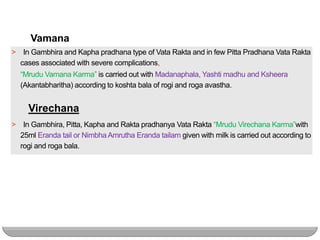
Vamana
> In Gambhira and Kapha pradhana type of Vata Rakta and in few Pitta Pradhana Vata Rakta
cases associated with severe complications,
“Mrudu Vamana Karma” is carried out with Madanaphala, Yashti madhu and Ksheera
(Akantabharitha) according to koshta bala of rogi and roga avastha.
Virechana
> In Gambhira, Pitta, Kapha and Rakta pradhanya Vata Rakta “Mrudu Virechana Karma”with
25ml Eranda tail or NimbhaAmrutha Eranda tailam given with milk is carried out according to
rogi and roga bala.
Vasthi
 Specifically in Vata Pradhana type of Vata Rakta and in presence of symptoms like
Basti shula, Vankshana shula, Parswa shula and Udara shula, “Vasthi Karma” is
considered to be as a best treatment of choice.
> Administration of Ksheera Vasti/ Bala Guducyadi Ksheera Vasti is widely
emphasized in all types of Vata Rakta and especially in Vata Pradhana condition.
^ Ingredients of Ksheera Vasti include:
Makshika - 100ml
Sneha (maha tiktaka ghritam and bala tailam 100ml each) - 200ml and Guducyadi
Ksheera kvatha - 200ml
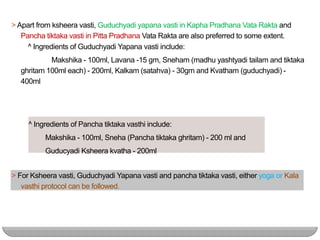
> Apart from ksheera vasti, Guduchyadi yapana vasti in Kapha Pradhana Vata Rakta and
Pancha tiktaka vasti in Pitta Pradhana Vata Rakta are also preferred to some extent.
^ Ingredients of Guduchyadi Yapana vasti include:
Makshika - 100ml, Lavana -15 gm, Sneham (madhu yashtyadi tailam and tiktaka
ghritam 100ml each) - 200ml, Kalkam (satahva) - 30gm and Kvatham (guduchyadi) -
400ml
^ Ingredients of Pancha tiktaka vasthi include:
Makshika - 100ml, Sneha (Pancha tiktaka ghritam) - 200 ml and
Guducyadi Ksheera kvatha - 200ml
> For Ksheera vasti, Guduchyadi Yapana vasti and pancha tiktaka vasti, either yoga or Kala
vasthi protocol can be followed.
Rakta mokshana
> In bhrihatrayee“Rakta mokshana” was mentioned as first line of treatment to
be opted for chronic Vata Rakta condition.
> Prior to Rakta mokshana certain measures like snehana, mrudu virechana n
vasti should be followed.
> Rakta mokshana according to types of Vata Rakta
1. Uttana - Shringi, Jalauka, Alabu and Pracchanna
2. Gambhira - Siravyadhana
3. Vataja - Shringi
4. Pittaja and Raktaja - Jalauka
5. Kaphaja - Alabu
> If lesions are small and if pain moves from one part of the body to the other
then bloodletting should be done by pracchana.
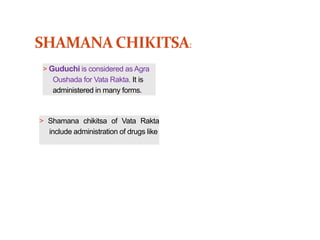
SHAMANA CHIKITSA:
> Guduchi is considered as Agra
Oushada for Vata Rakta. It is
administered in many forms.
> Shamana chikitsa of Vata Rakta
include administration of drugs like
Shamana oushada Drugs Dose Anupana
Rasa or Bhasma Rasa manikya ras-
kaphaja; Maha
taleshwar ras; Tala
bhasma; Gandhaka
bhasma - Pittaja
125-250 mg, od/bid Madhu
Vati or Guggulu Arogya vardhini vati-
Tridoshaja;
Gokshuradi
guggulu-Vataja;
Kaishore guggulu
and Amruthadi
guggulu-
Gambhira,Pittaja,K
ap haja and
Raktaja;
Punarnava,Yoga
raja and Simhanada
guggulu-Kaphaja
250-500 mg, bid Guduci kvatha,
Ushna jala
Shamana oushada Drugs Dose Anupana
Churna Hareetaki,
Manjishtadi,
Nimbadi,
Chopchinyadi
3-6 gm, bid Ushna jala or
Madhu
Asava or Arista Saribhyadasava,
Manjishtyadarishta,
A
mrutarishta
20-40 ml, bid Jala
Kvatha Dashamoola-
Vataja;
Manjishtadi-
Tridoshaja;
Amrutadi/
Amruttotara-
Gambhira, Pittaja
and Raktaja;
Rasna saptaka and
Guggulu tiktaka-
Kaphaja
20-30ml,bd,before
food
Jala or Madhu
Shamana oushada Drugs Dose Anupana
Ghrita Guduchyadi-
Tridoshaja; Satavari,
Sukumaraka,Jeevani
ya, Bhallataka-
Kaphaja
10-20ml,bd Ksheera
Taila Pinda, Madhu
parnyadi,Bala and
Dhanvantari- Vataja;
Guducyadiand
Narayana- Pittaja;
Kottam chukkadi and
cinchyadi- Kaphaja
Depends on mode
of administration
Depends on mode of
administration
Rasayana
Chyavana prasa-
Vataja and Pittaja;
Vardhamana pippali-
Kaphaja and Vataja;
Bhallataka- Kaphaja;
Shilajith- Tridoshaja
20gm,bd Ksheera
> Bahir Parimarjana Chikitsa is followed as general measure of treatment for all types of
Vata Rakta but it is specifically considered as a main line of treatment for Uttana Vata
Rakta.
> It includes External measures like
1. Avagahana - Nimbha patra or Guduci patra are used for Avagahana karma
(fumigation)
2. Lepa - Madhuchista, Dashanga, Tagaradi, Pra Poundarikadi/Sata doutha ghrita,
Krishna tila etc are used for ext.application on Vata Rakta affected joints.
3. Upanaha - Mainly advised for Uttana, Vataja and Kaphaja Vata Rakta.
- Vatagna Snigdha upanaha and Tila pinda upanaha are advised.
4. Seka
5. Abhyanga Carried out with Pinda/Bala/Dhanvantari/Guducyadi tailam
6. Dhara
Single drugs
> Guduchi
> Saribha
> Guggulu
> Shilajith
> Bhallataka
> Erandamoola
> Shunti
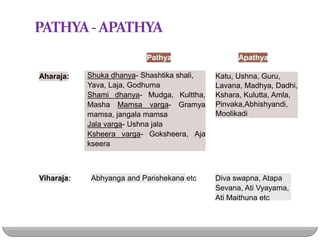
PATHYA-APATHYA
Aharaja:
Pathya
Shuka dhanya- Shashtika shali,
Yava, Laja, Godhuma
Shami dhanya- Mudga, Kulttha,
Masha Mamsa varga- Gramya
mamsa, jangala mamsa
Jala varga- Ushna jala
Ksheera varga- Goksheera, Aja
kseera
Apathya
Katu, Ushna, Guru,
Lavana, Madhya, Dadhi,
Kshara, Kulutta, Amla,
Pinvaka,Abhishyandi,
Moolikadi
Viharaja: Abhyanga and Parishekana etc Diva swapna, Atapa
Sevana, Ati Vyayama,
Ati Maithuna etc
Idealtreatment plan:
1. Nidana Parivarjanam
2. Samsodhana Chikitsa (Yathochita)
3. Bahir Parimarjajana Chikitsa (Yathochita)
4. Samshamana Chikitsa
Rasa manikya Ras - 125mg +
Guduci Satva - 500mg +
Arogyavardhini Vati - 250mg +
Chopchinyadi Churna - 2gm Kaishore guggulu : 2- bd to tid with Luke
warm water , before food
1- bd with Honey, before food
Manjishtyadarishta : 20ml- bd with equal quantity water, after food
Satavari Ghrita : 20ml- bd with milk, after food
• Pinda tailam : for external application
5. Pathya-Apathya
References:
> Charaka Samhita, Chikitsa Sthana.29th chap
> Sushruta Samhita, Chikitsa Sthana.5th chap
> Ashtanga Hridaya, Chikitsa Sthana.22nd chap
> Bhava Prakasha Samhitha, 29th chap
> Bhaisajya Ratnavali, Vata Rakta Chikitsa Prakaran
> Sarangadhara Samhitha
> Rasendra Sara Sangraha
> L. Mahadevan’s Clinical methods of Ayurveda book, vol.2
> Prof. Ajay Kumar Sharma’s Hindi text of Kaya Chikitsa, vol.2
ThankYou.

Vata raktha.ppt

  • 1.
  • 2.
    Introduction: > A chronicdisease or a chronic illness is defined as a condition which develops gradually through years because of frequent and continuous exposure to abnormal dietary, lifestyle or environmental factors. > Initially there may be absence of diseased symptoms but at later stages, complex manifestations involving one or more organs leading to derangement of bodily functions will be seen in chronic diseases. > Vata Rakta in Ayurveda is considered as one such chronic illness which is commonly seen affecting nearly 14-17 percent of population every year. > It is caused by vitiated Vata and Rakta. Vitiated Vayu obstructs the path of vitiated Rakta in the beginning and then gets vitiated by Rakta further this complete process is known as Vata- Rakta.
  • 3.
     Types ofVata Rakta mainly include Uttana & Gambhira  Vata Pradhana, Pitta Pradhana, Kapha Pradhana, & Rakta Pradhana. > Clinical Features of Vata Rakta ranges from mild inflammation and discoloration of skin to complete derangement of bodily organs depending up on its type and chronicity. Chronic and later stages of Vata Rakta also cause complications like mamsa kotha, murcha, marma graham, anguli vakrata etc. > Though Vata Rakta is mentioned to be as kriccha sadhya vyadhi, by strictly following the protocol of Vata Rakta chikitsa as mentioned in various Ayurvedic classics a physician can boldly treat this condition.
  • 4.
  • 6.
    Vatarakta chikitsa upakrama: > Treatment measuresof Vata Rakta include both Antah Parimarjana and Bahir Parimarjana Chikitsa as shown in the figure.
  • 8.
    SHODANAChiktsa: Ama Pachana andAgni Deepana > It is carried out Prior to Shodana chikitsa with Tikta, Katu rasa and Ruksha guna pradhanya drugs according to Rogi and Roga bala for a duration of 3 to 5 days. 1. Shaddarana churna (Gambhira and pittaja) 2. Pancasama churna (vataja) 3. Guduchyadi or Amrutottara -i kvatha (pittaja, kaphaja) Dose - 3 to 6gm, bid, before food Anupana - Honey/Ushna jala 4. Dashamoola kvatha Dose -15 to 20ml, bid, before food (Vataja) Anupana - Ushna Jala
  • 9.
    Sneha Pana > SnehaPana is carried out according to koshta bala and prakruti of patient and also according to predominant dosha present i.e. 1. Vata Pradhana Vata Rakta - Sadphala ghritam, Madhu yashtyadi tailam, Ksheera bala tailam, Dhanvantari ghritam ^ All these sneha dravyas does Brimhana and Vata hara Karma 2. Pitta Pradhana Vata Rakta - Maha tiktaka ghritam ^ This ghrita promotes Rakta prasadana and pitta Shamaka karma 3. Kapha Pradhanya Vata Rakta - Guggulu tiktaka ghritam - Madhu yashtyadi tailam and Dhanvantari ghritam (Only in selected cases) ^ All these sneha dravyas does Ushna guna and kapha hara Karmas
  • 10.
    > Sneha Panais given in a dose of 40 to 60 ml, twice daily, before food for a duration of 5 to 7 days. > Sneha Pana is Contra indicated in medo margavarana janya Vata Rakta. Svedana > Usually Svedana is contraindicated in Vata Rakta but just for the purpose Of Virechana we can go for “Mrudu Svedana”. > Pota and Sekam measures are followed to promote svedana in Kapha pradhana Vata Rakta. > In few Vata Pradhana Vata Rakta conditions, very mild Upanaha Svedana is advised.
  • 11.
    Vamana > In Gambhiraand Kapha pradhana type of Vata Rakta and in few Pitta Pradhana Vata Rakta cases associated with severe complications, “Mrudu Vamana Karma” is carried out with Madanaphala, Yashti madhu and Ksheera (Akantabharitha) according to koshta bala of rogi and roga avastha. Virechana > In Gambhira, Pitta, Kapha and Rakta pradhanya Vata Rakta “Mrudu Virechana Karma”with 25ml Eranda tail or NimbhaAmrutha Eranda tailam given with milk is carried out according to rogi and roga bala.
  • 12.
    Vasthi  Specifically inVata Pradhana type of Vata Rakta and in presence of symptoms like Basti shula, Vankshana shula, Parswa shula and Udara shula, “Vasthi Karma” is considered to be as a best treatment of choice. > Administration of Ksheera Vasti/ Bala Guducyadi Ksheera Vasti is widely emphasized in all types of Vata Rakta and especially in Vata Pradhana condition. ^ Ingredients of Ksheera Vasti include: Makshika - 100ml Sneha (maha tiktaka ghritam and bala tailam 100ml each) - 200ml and Guducyadi Ksheera kvatha - 200ml
  • 13.
    > Apart fromksheera vasti, Guduchyadi yapana vasti in Kapha Pradhana Vata Rakta and Pancha tiktaka vasti in Pitta Pradhana Vata Rakta are also preferred to some extent. ^ Ingredients of Guduchyadi Yapana vasti include: Makshika - 100ml, Lavana -15 gm, Sneham (madhu yashtyadi tailam and tiktaka ghritam 100ml each) - 200ml, Kalkam (satahva) - 30gm and Kvatham (guduchyadi) - 400ml ^ Ingredients of Pancha tiktaka vasthi include: Makshika - 100ml, Sneha (Pancha tiktaka ghritam) - 200 ml and Guducyadi Ksheera kvatha - 200ml > For Ksheera vasti, Guduchyadi Yapana vasti and pancha tiktaka vasti, either yoga or Kala vasthi protocol can be followed.
  • 14.
    Rakta mokshana > Inbhrihatrayee“Rakta mokshana” was mentioned as first line of treatment to be opted for chronic Vata Rakta condition. > Prior to Rakta mokshana certain measures like snehana, mrudu virechana n vasti should be followed. > Rakta mokshana according to types of Vata Rakta 1. Uttana - Shringi, Jalauka, Alabu and Pracchanna 2. Gambhira - Siravyadhana 3. Vataja - Shringi 4. Pittaja and Raktaja - Jalauka 5. Kaphaja - Alabu > If lesions are small and if pain moves from one part of the body to the other then bloodletting should be done by pracchana.
  • 16.
    SHAMANA CHIKITSA: > Guduchiis considered as Agra Oushada for Vata Rakta. It is administered in many forms. > Shamana chikitsa of Vata Rakta include administration of drugs like
  • 17.
    Shamana oushada DrugsDose Anupana Rasa or Bhasma Rasa manikya ras- kaphaja; Maha taleshwar ras; Tala bhasma; Gandhaka bhasma - Pittaja 125-250 mg, od/bid Madhu Vati or Guggulu Arogya vardhini vati- Tridoshaja; Gokshuradi guggulu-Vataja; Kaishore guggulu and Amruthadi guggulu- Gambhira,Pittaja,K ap haja and Raktaja; Punarnava,Yoga raja and Simhanada guggulu-Kaphaja 250-500 mg, bid Guduci kvatha, Ushna jala
  • 18.
    Shamana oushada DrugsDose Anupana Churna Hareetaki, Manjishtadi, Nimbadi, Chopchinyadi 3-6 gm, bid Ushna jala or Madhu Asava or Arista Saribhyadasava, Manjishtyadarishta, A mrutarishta 20-40 ml, bid Jala Kvatha Dashamoola- Vataja; Manjishtadi- Tridoshaja; Amrutadi/ Amruttotara- Gambhira, Pittaja and Raktaja; Rasna saptaka and Guggulu tiktaka- Kaphaja 20-30ml,bd,before food Jala or Madhu
  • 19.
    Shamana oushada DrugsDose Anupana Ghrita Guduchyadi- Tridoshaja; Satavari, Sukumaraka,Jeevani ya, Bhallataka- Kaphaja 10-20ml,bd Ksheera Taila Pinda, Madhu parnyadi,Bala and Dhanvantari- Vataja; Guducyadiand Narayana- Pittaja; Kottam chukkadi and cinchyadi- Kaphaja Depends on mode of administration Depends on mode of administration Rasayana Chyavana prasa- Vataja and Pittaja; Vardhamana pippali- Kaphaja and Vataja; Bhallataka- Kaphaja; Shilajith- Tridoshaja 20gm,bd Ksheera
  • 21.
    > Bahir ParimarjanaChikitsa is followed as general measure of treatment for all types of Vata Rakta but it is specifically considered as a main line of treatment for Uttana Vata Rakta. > It includes External measures like 1. Avagahana - Nimbha patra or Guduci patra are used for Avagahana karma (fumigation) 2. Lepa - Madhuchista, Dashanga, Tagaradi, Pra Poundarikadi/Sata doutha ghrita, Krishna tila etc are used for ext.application on Vata Rakta affected joints. 3. Upanaha - Mainly advised for Uttana, Vataja and Kaphaja Vata Rakta. - Vatagna Snigdha upanaha and Tila pinda upanaha are advised. 4. Seka 5. Abhyanga Carried out with Pinda/Bala/Dhanvantari/Guducyadi tailam 6. Dhara
  • 22.
    Single drugs > Guduchi >Saribha > Guggulu > Shilajith > Bhallataka > Erandamoola > Shunti
  • 24.
    PATHYA-APATHYA Aharaja: Pathya Shuka dhanya- Shashtikashali, Yava, Laja, Godhuma Shami dhanya- Mudga, Kulttha, Masha Mamsa varga- Gramya mamsa, jangala mamsa Jala varga- Ushna jala Ksheera varga- Goksheera, Aja kseera Apathya Katu, Ushna, Guru, Lavana, Madhya, Dadhi, Kshara, Kulutta, Amla, Pinvaka,Abhishyandi, Moolikadi Viharaja: Abhyanga and Parishekana etc Diva swapna, Atapa Sevana, Ati Vyayama, Ati Maithuna etc
  • 25.
  • 26.
    1. Nidana Parivarjanam 2.Samsodhana Chikitsa (Yathochita) 3. Bahir Parimarjajana Chikitsa (Yathochita) 4. Samshamana Chikitsa Rasa manikya Ras - 125mg + Guduci Satva - 500mg + Arogyavardhini Vati - 250mg + Chopchinyadi Churna - 2gm Kaishore guggulu : 2- bd to tid with Luke warm water , before food 1- bd with Honey, before food Manjishtyadarishta : 20ml- bd with equal quantity water, after food Satavari Ghrita : 20ml- bd with milk, after food • Pinda tailam : for external application 5. Pathya-Apathya
  • 27.
    References: > Charaka Samhita,Chikitsa Sthana.29th chap > Sushruta Samhita, Chikitsa Sthana.5th chap > Ashtanga Hridaya, Chikitsa Sthana.22nd chap > Bhava Prakasha Samhitha, 29th chap > Bhaisajya Ratnavali, Vata Rakta Chikitsa Prakaran > Sarangadhara Samhitha > Rasendra Sara Sangraha > L. Mahadevan’s Clinical methods of Ayurveda book, vol.2 > Prof. Ajay Kumar Sharma’s Hindi text of Kaya Chikitsa, vol.2
  • 28.