

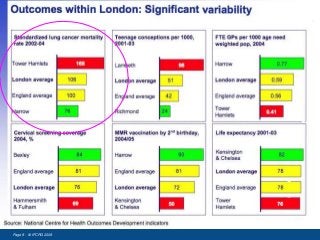
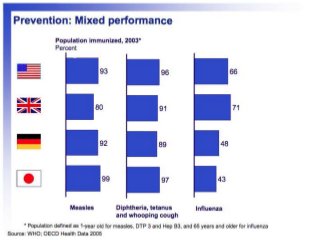




Variation
           Siân Williams, IPCRG Executive Officer
           IPCRG Biennial Conference May 2008

© IPCRG 2007
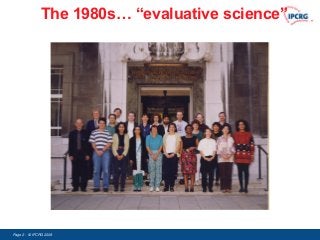
The 1980s… “evaluative science”


Page 2 - © IPCRG 2007
                 2008
What this session will cover:

 •      What is meant by variation?
 •      Does it matter?
 •      How should it be analysed?
 •      What can be done by individuals?
 •      What can be done by IPCRG?


Page 3 - © IPCRG 2007
                 2008
What is meant by variation?


© IPCRG 2007
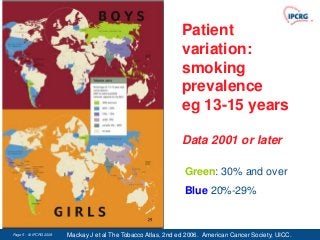
Patient
                                                               variation:
                                                               smoking
                                                               prevalence
                                                               eg 13-15 years

                                                               Data 2001 or later

                                                                Green: 30% and over
                                                                Blue 20%-29%


Page 5 - © IPCRG 2007
                 2008   Mackay J et al The Tobacco Atlas, 2nd ed 2006. American Cancer Society, UICC.
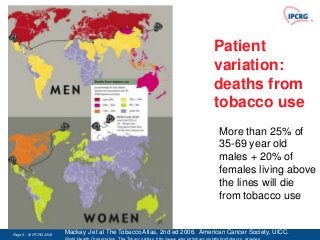
Patient
                                                                          variation:
                                                                          deaths from
                                                                          tobacco use
                                                                            More than 25% of
                                                                            35-69 year old
                                                                            males + 20% of
                                                                            females living above
                                                                            the lines will die
                                                                            from tobacco use


Page 6 - © IPCRG 2007
                 2008   Mackay J et al The Tobacco Atlas, 2nd ed 2006. American Cancer Society, UICC. Also
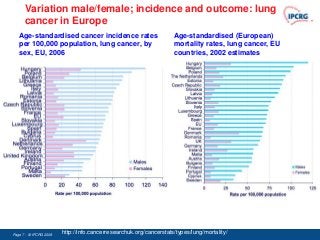
Variation male/female; incidence and outcome: lung
      cancer in Europe
   Age-standardised cancer incidence rates                          Age-standardised (European)
   per 100,000 population, lung cancer, by                          mortality rates, lung cancer, EU
   sex, EU, 2006                                                    countries, 2002 estimates


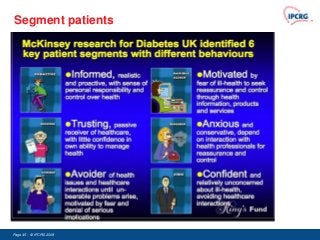
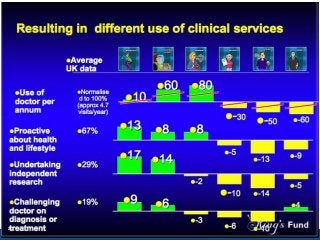
Page 7 - © IPCRG 2007
                 2008   http://info.cancerresearchuk.org/cancerstats/types/lung/mortality/
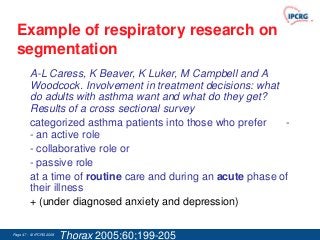
Page 8 - © IPCRG 2007
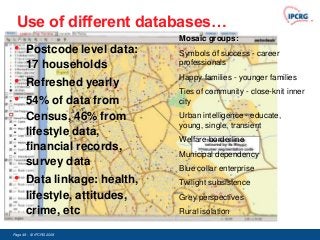
                 2008
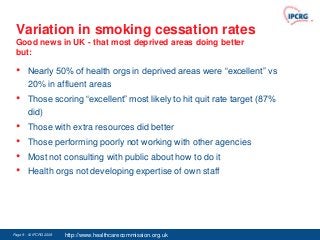
Variation in smoking cessation rates
 Good news in UK - that most deprived areas doing better
 but:

 •      Nearly 50% of health orgs in deprived areas were “excellent” vs
        20% in affluent areas
 •      Those scoring “excellent” most likely to hit quit rate target (87%
        did)
 •      Those with extra resources did better
 •      Those performing poorly not working with other agencies
 •      Most not consulting with public about how to do it
 •      Health orgs not developing expertise of own staff


Page 9 - © IPCRG 2007
                 2008   http://www.healthcarecommission.org.uk
Page 10 - © IPCRG 2007
                  2008
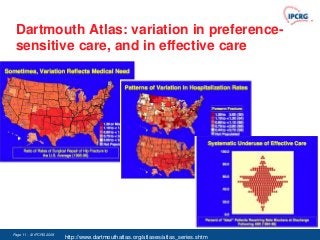
Dartmouth Atlas: variation in preference-
 sensitive care, and in effective care


Page 11 - © IPCRG 2007
                  2008
                         http://www.dartmouthatlas.org/atlases/atlas_series.shtm
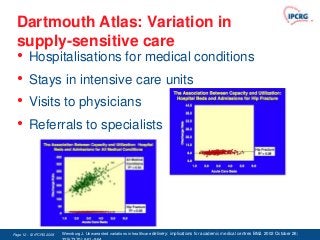
Dartmouth Atlas: Variation in
  supply-sensitive care
  •     Hospitalisations for medical conditions
  •     Stays in intensive care units
  •     Visits to physicians
  •     Referrals to specialists


Page 12 - © IPCRG 2007
                  2008   Wennburg J. Unwarranted variations in healthcare delivery: implications for academic medical centres BMJ. 2002 October 26;
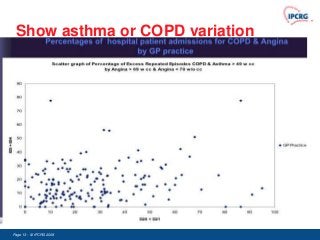
Show asthma or COPD variation


Page 13 - © IPCRG 2007
                  2008
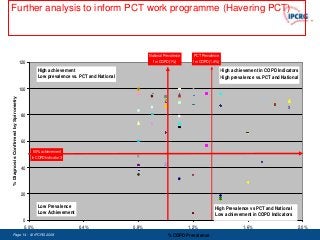
Further analysis to inform PCT work programme (Havering PCT)


                                                                                            National Prevalence      PCT Prevalence
                                      120                                                     for COPD (1%)         for COPD (1.4%)

                                               High achievement                                                                       High achievement in COPD Indicators
                                               Low prevalence vs. PCT and National                                                    High prevalence vs. PCT and National

                                      100
% Diagnosis Confirmed by Spirometry


                                      80


                                      60
                                             50% achievement
                                            in COPD Indicator 3

                                      40


                                      20

                                               Low Prevalence                                                                   High Prevalence vs PCT and National
                                               Low Achievement                                                                  Low achievement in COPD Indicators
                                       0
                                       0.0%                       0.4%               0.8%                         1.2%                          1.6%                     2.0%
Page 14 - © IPCRG 2007
                  2008
                                                                                                       % COPD Prevalence
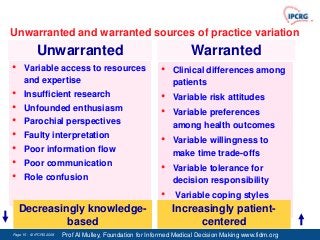
Unwarranted and warranted sources of practice variation
            Unwarranted                                               Warranted
•     Variable access to resources                         •   Clinical differences among
      and expertise                                            patients
•     Insufficient research                                •   Variable risk attitudes
•     Unfounded enthusiasm
                                                           •   Variable preferences
•     Parochial perspectives                                   among health outcomes
•     Faulty interpretation
                                                           •   Variable willingness to
•     Poor information flow                                    make time trade-offs
•     Poor communication
                                                           •   Variable tolerance for
•     Role confusion                                           decision responsibility
                                                           •    Variable coping styles
    Decreasingly knowledge-                                    Increasingly patient-
             based                                                   centered
Page 15 - © IPCRG 2007
                  2008   Prof Al Mulley, Foundation for Informed Medical Decision Making www.fidm.org
There is a gap between
           what we know and what
          we do…and, particularly
               in low income
          countries, there is also a
            gap between what we
          need and what is known
Page 16 - © IPCRG 2007
                  2008
                         Prof Don Berwick www.ihi.org
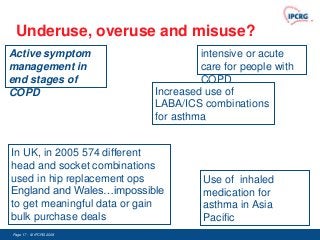
Underuse, overuse and misuse?
Active symptom                       intensive or acute
management in                        care for people with
end stages of                        COPD
COPD                        Increased use of
                            LABA/ICS combinations
                            for asthma


In UK, in 2005 574 different
head and socket combinations
used in hip replacement ops           Use of inhaled
England and Wales…impossible          medication for
to get meaningful data or gain        asthma in Asia
bulk purchase deals                   Pacific
Page 17 - © IPCRG 2007
                  2008
Why does it matter?


© IPCRG 2007
Why does it matter?

  •     We don‟t use all the science we know - use the
        evidence to improve outcomes
  •     We could reduce health inequalities and achieve global
        targets of EQUITY
  •     We should avoid unnecessary risks for patients and
  •     Use scarce resources efficiently and
  •     Improve self-management


Page 19 - © IPCRG 2007
                  2008
Patients are aware of the
 inequity:
       European Allergy, Asthma & COPD
       Patients’ Sofia Declaration 2 June 2007
 •      Access to good, equal standards of care, no matter
        where you live in Europe

 •      High standards of and access to patient &
        professional education, information and new
        knowledge

 •      Healthy, unpolluted air to breathe indoors and out

Page 20 - © IPCRG 2007
                  2008
                         European Federation of Allergy and Airways Diseases Patient‟s Association (EFA) www.efanet.org
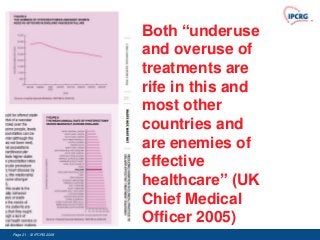
Both “underuse
                         and overuse of
                         treatments are
                         rife in this and
                         most other
                         countries and
                         are enemies of
                         effective
                         healthcare” (UK
                         Chief Medical
                         Officer 2005)
Page 21 - © IPCRG 2007
                  2008
What’s relevance of UK to
 anywhere else?
 • Only 20% of cases of chronic disease occur in
        high income countries
 •      75% of smokers live in low or middle income
        countries
 •      Next 20 years communicable disease is
        predominant problem in low-and middle-income
        countries but then
 •      Epidemic of chronic disease everywhere
 •      Will affect those in poverty most

Page 22 - © IPCRG 2007
                  2008   Ottmani S et al. Respiratory care in primary care services. A survey in 9 countries. WHO 2004. Quoted in Chronic Respiratory
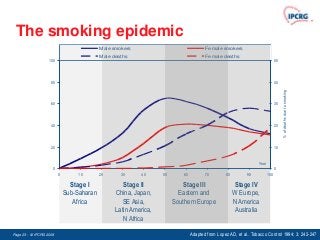
The smoking epidemic
                                                                        Male smokers                                Female smokers
                                                                        Male deaths                                 Female deaths
                                                100                                                                                                         50


                                                 80                                                                                                         40


                                                                                                                                                                 % of d ea ths du e t o sm o ki ng
               % of sm okers am on g a du lts


                                                 60                                                                                                         30


                                                 40                                                                                                         20


                                                 20                                                                                                         10


                                                                                                                                               Year
                                                  0                                                                                                         0
                                                      0        10       20      30     40      50       60          70         80        90           100

                                                            Stage I              Stage II              Stage III                    Stage IV
                                                          Sub-Saharan         China, Japan,           Eastern and                   W Europe,
                                                             Africa              SE Asia,           Southern Europe                 N America
                                                                              Latin America,                                        Australia
                                                                                 N Africa

Page 23 - © IPCRG 2007
                  2008                                                                                       Adapted from Lopez AD, et al.. Tobacco Control 1994; 3: 242-247
Achieving equity is tough
 Patients with low health literacy
 •      Have poorer health status
 •      Are at greater risk of hospitalisation and have longer length of stay
 •      Have higher rates of emergency admission
 •      Are less likely to adhere to plans and treatments
 •      Have more medication and treatment errors
 •      Have less knowledge of disease management and health promoting
        behaviours
 •      Have decreased ability to communicate with HCPs and share decision-
        making
 •      Are less able to make appropriate health decisions
 •      Make less use of preventive service
 •      Incur substantially higher healthcare costs


Page 24 - © IPCRG 2007
                  2008   Coulter and Ellins QEI review Chap 1Health literacy drawing on Ad Hoc Committee on Health Litera
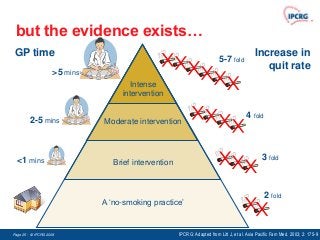
but the evidence exists…
 GP time                                                                                     Increase in
                                                                           5-7 fold
                                                                                                quit rate
                     >5 mins
                                       Intense
                                    intervention

                                                                                         4 fold
         2-5 mins              Moderate intervention


  <1 mins                         Brief intervention
                                                                                                 3 fold


                                                                                                  2 fold
                               A „no-smoking practice‟


Page 25 - © IPCRG 2007
                  2008                                 IPCRG: Adapted from Litt J, et al. Asia Pacific Fam Med. 2003; 2: 175-9
How is it analysed?


© IPCRG 2007
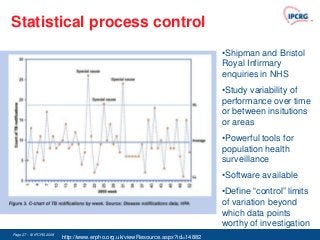
Statistical process control
                                                                              •Shipman and Bristol
                                                                              Royal Infirmary
                                                                              enquiries in NHS
                                                                              •Study variability of
                                                                              performance over time
                                                                              or between insitutions
                                                                              or areas
                                                                              •Powerful tools for
                                                                              population health
                                                                              surveillance
                                                                              •Software available
                                                                              •Define “control” limits
                                                                              of variation beyond
                                                                              which data points
                                                                              worthy of investigation
Page 27 - © IPCRG 2007
                  2008
                         http://www.erpho.org.uk/viewResource.aspx?id=14882
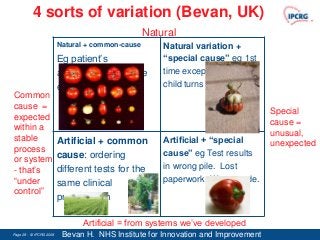
4 sorts of variation (Bevan, UK)
                                                  Natural
                         Natural + common-cause       Natural variation +
                         Eg patient‟s                 “special cause” eg 1st
                         age, gender, disease         time exceptionally sick
                         etc                          child turns up at clinic
Common
cause =
                                                                                  Special
expected
                                                                                  cause =
within a
                                                                                  unusual,
stable                   Artificial + common          Artificial + “special       unexpected
process                                               cause” eg Test results
or system                cause: ordering
- that‟s                 different tests for the      in wrong pile. Lost
“under                                                paperwork. Wrong code.
                         same clinical
control”
                         presentation

                               Artificial = from systems we‟ve developed
Page 28 - © IPCRG 2007
                  2008    Bevan H. NHS Institute for Innovation and Improvement
Our reaction to data about our services

 • The data are wrong

 • The data are right but they are not a problem

 • The data are right, it is a problem, but it’s not MY
   problem

 • The data are right, it is a problem, and it is my
   problem


Page 29 - © IPCRG 2007
                  2008
                         Don Berwick, IHI
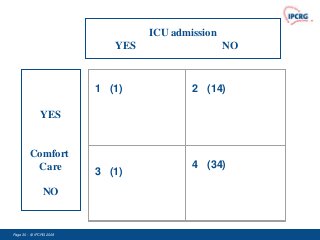
ICU ADMISSION
                                  ICU admission
                            YES
                            YES                 NO
                                               NO


                         1 (1)            2 (14)

              YES


         Comfort
          Care                            4 (34)
                         3 (1)
                NO


Page 30 - © IPCRG 2007
                  2008
So we know what it is, and how it is
           analysed, but so what?


© IPCRG 2007
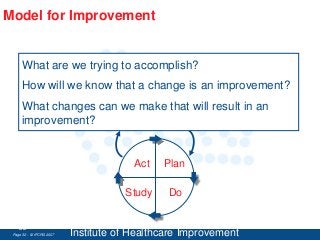
Model for Improvement


     What are we trying to accomplish?
     How will we know that a change is an improvement?
     What changes can we make that will result in an
     improvement?


                                       Act   Plan

                                     Study    Do


    32
 Page 32 - © IPCRG 2007   Institute of Healthcare Improvement
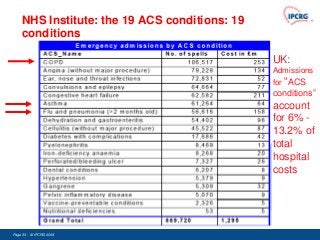
NHS Institute: the 19 ACS conditions: 19
    conditions

                                               UK:
                                               Admissions
                                               for “ACS
                                               conditions”
                                               account
                                               for 6% -
                                               13.2% of
                                               total
                                               hospital
                                               costs


Page 33 - © IPCRG 2007
                  2008
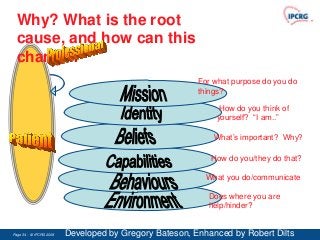
Why? What is the root
  cause, and how can this
  change?
                                                        For what purpose do you do
                                                        things?

                                                             How do you think of
                                                            yourself? “I am..”

                                                            What‟s important? Why?

                                                           How do you/they do that?

                                                          What you do/communicate

                                                          Does where you are
                                                          help/hinder?


Page 34 - © IPCRG 2007
                  2008   Developed by Gregory Bateson, Enhanced by Robert Dilts
Checkland’s sensemaking questions:
 • What stories do staff tell about their practice
 • What roles are occupied in this practice?
 • What is considered legitimate work?
 • How do you define success?
 • How has this practice responded to external
   events in the past?
 Examining response to change:
 • How do perceptions of legitimate work affect
   approaches to change?
 • How are roles changing in the practice?


Page 35 - © IPCRG 2007
                  2008   Checkland K. B Understanding general practice:a conceptual framework developed from case studies in the UK NHS
The implications for change management in
 primary care

 •      General practices/primary care offices are small
        organisations
 •      Change needs to be bottom up and
 •      Is determined by PCP’s view of organisational reality
 •       Important factors for generating responses to change
        included
          o the story that the practice members told about their
            practice,
          o beliefs about what counted as legitimate work,
          o the role played by the manager, and
          o previous experiences of change.


Page 36 - © IPCRG 2007
                  2008
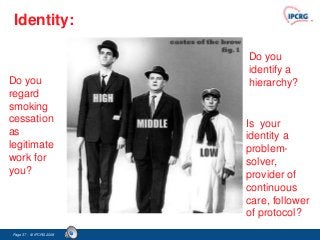
Identity:

                         Do you
                         identify a
Do you                   hierarchy?
regard
smoking
cessation                Is your
as                       identity a
legitimate               problem-
work for                 solver,
you?                     provider of
                         continuous
                         care, follower
                         of protocol?
Page 37 - © IPCRG 2007
                  2008
Behaviours and beliefs


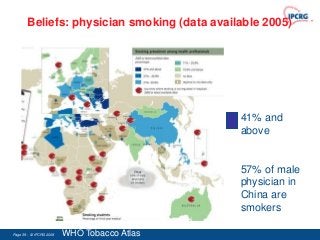
                          “In early stages of the smoking pandemic, higher status
                            individuals like health professionals tend to exhibit
                         markedly higher smoking prevalence rates than general
                             population. In later stages..health professionals -
                         direct observers of the terrible health consequences,…
                         often quit smoking and initiate national tobacco-control
                                                 movements”


Page 38 - © IPCRG 2007
                  2008
                            WHO Tobacco Atlas
Beliefs: physician smoking (data available 2005)


                                             41% and
                                             above


                                             57% of male
                                             physician in
                                             China are
                                             smokers

Page 39 - © IPCRG 2007
                  2008   WHO Tobacco Atlas
So what does it mean for you, and
           us?


© IPCRG 2007
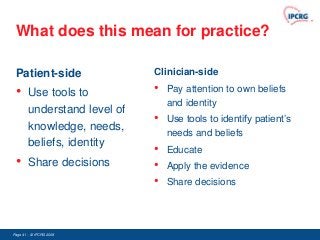
What does this mean for practice?

 Patient-side                 Clinician-side

 •      Use tools to          •   Pay attention to own beliefs
                                  and identity
        understand level of
                              •   Use tools to identify patient‟s
        knowledge, needs,
                                  needs and beliefs
        beliefs, identity
                              •   Educate
 •      Share decisions       •   Apply the evidence
                              •   Share decisions


Page 41 - © IPCRG 2007
                  2008
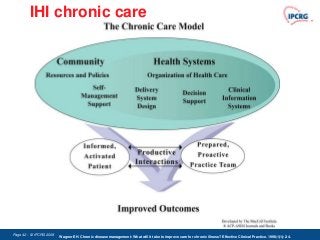
IHI chronic care


Page 42 - © IPCRG 2007
                  2008
                         Wagner EH. Chronic disease management: What will it take to improve care for chronic illness? Effective Clinical Practice. 1998;1(1):2-4.
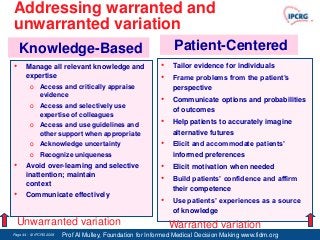
Addressing warranted and
unwarranted variation
    Knowledge-Based                                             Patient-Centered
•      Manage all relevant knowledge and                   •   Tailor evidence for individuals
       expertise                                           •   Frame problems from the patient’s
         o Access and critically appraise                      perspective
           evidence
                                                           •   Communicate options and probabilities
         o Access and selectively use
                                                               of outcomes
           expertise of colleagues
         o Access and use guidelines and                   •   Help patients to accurately imagine
           other support when appropriate                      alternative futures
         o Acknowledge uncertainty                         •   Elicit and accommodate patients’
         o Recognize uniqueness                                informed preferences
•      Avoid over-learning and selective                   •   Elicit motivation when needed
       inattention; maintain
                                                           •   Build patients’ confidence and affirm
       context
                                                               their competence
•      Communicate effectively
                                                           •   Use patients’ experiences as a source
                                                               of knowledge
  Unwarranted variation                                        Warranted variation
Page 44 - © IPCRG 2007
                  2008   Prof Al Mulley, Foundation for Informed Medical Decision Making www.fidm.org
Segment patients


Page 45 - © IPCRG 2007
                  2008
Page 46 - © IPCRG 2007
                  2008
Example of respiratory research on
  segmentation
         A-L Caress, K Beaver, K Luker, M Campbell and A
         Woodcock. Involvement in treatment decisions: what
         do adults with asthma want and what do they get?
         Results of a cross sectional survey
         categorized asthma patients into those who prefer    -
         - an active role
         - collaborative role or
         - passive role
         at a time of routine care and during an acute phase of
         their illness
         + (under diagnosed anxiety and depression)

Page 47 - © IPCRG 2007
                  2008
                         Thorax 2005;60;199-205
Use of different databases…
                               Mosaic groups:
•      Postcode level data:    Symbols of success - career
       17 households           professionals

•      Refreshed yearly
                               Happy families - younger families
                               Ties of community - close-knit inner
•      54% of data from        city
       Census, 46% from        Urban intelligence - educate,
                               young, single, transient
       lifestyle data,
                               Welfare borderline
       financial records,
                               Municipal dependency
       survey data             Blue collar enterprise
•      Data linkage: health,   Twilight subsistence
       lifestyle, attitudes,   Grey perspectives
       crime, etc              Rural isolation

Page 48 - © IPCRG 2007
                  2008
GARD: 3 segments in low
 income countries
 • In urban areas with high income +
        settled, sedentary lifestyle
        o High income, can afford diagnostics and treatments
        o Government workers - reimbursed
        o Industrial, agricultural, service sector workers -
          reimbursed
 •      In urban areas with limited resources or jobless
        OR in low income suburban or periurban areas
 •      Poor people in rural areas

Page 49 - © IPCRG 2007
                  2008
                         Global Alliance Against Respiratory Disease a comprehensive approach
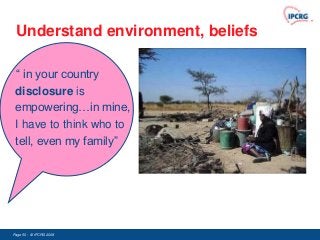
Understand environment, beliefs

 “ in your country
 disclosure is
 empowering…in mine,
 I have to think who to
 tell, even my family”


Page 50 - © IPCRG 2007
                  2008
Effective strategies: informing,educating
 and involving patients
 •      Improve health literacy:
        o Printed leaflets and health information packages
        o Computer based and internet health information
        o Targeted approaches to tackle low health literacy
        o Targeted mass media campaigns
 •      Improve clinical decision making
        o Patient decision aids
        o Training in communication skills for HCPs
        o Coaching and question prompts for patients


Page 51 - © IPCRG 2007
                  2008   Effectiveness of strategies for informing, educating and involving patients. Coulter A. Ellins J. BMJ
Effective strategies: informing,educating and
 involving patients
  •     Improve self care
        o Self management education
        o Self monitoring and self adminstered treatment
        o Self help groups and peer support
        o Patient access to personal medical information
        o Patient centred telecare
  •     Improve patient safety
        o Information to help choose safe providers
        o Patient involvement in infection control
        o Encouraging adherence to treatment regimes
        o Check records and care processes
        o Patient reporting of adverse drug events

Page 52 - © IPCRG 2007
                  2008   Effectiveness of strategies for informing, educating and involving patients. Coulter A. Ellins J. BMJ 2007:335;24-27
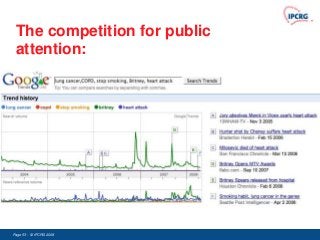
The competition for public
 attention:


Page 53 - © IPCRG 2007
                  2008
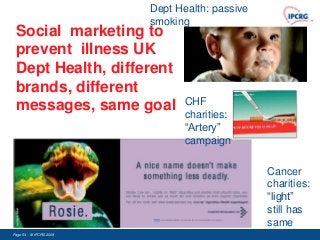
Dept Health: passive
                         smoking
 Social marketing to
 prevent illness UK
 Dept Health, different
 brands, different
 messages, same goal            CHF
                                charities:
                                “Artery”
                                campaign

                                                Cancer
                                                charities:
                                                “light”
                                                still has
                                                same
Page 54 - © IPCRG 2007
                  2008
                                                nicotine
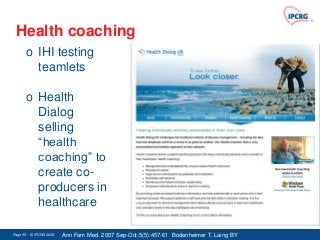
Health coaching
       o IHI testing
         teamlets

       o Health
         Dialog
         selling
         “health
         coaching” to
         create co-
         producers in
         healthcare

Page 55 - © IPCRG 2007
                  2008   Ann Fam Med. 2007 Sep-Oct;5(5):457-61 Bodenheimer T, Laing BY
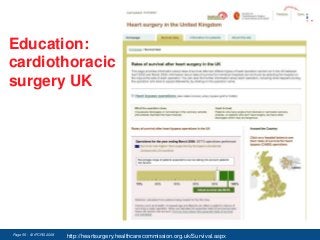
Education:
cardiothoracic
surgery UK


Page 56 - © IPCRG 2007
                  2008
                         http://heartsurgery.healthcarecommission.org.uk/Survival.aspx
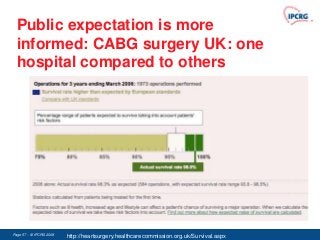
Public expectation is more
  informed: CABG surgery UK: one
  hospital compared to others


Page 57 - © IPCRG 2007
                  2008
                         http://heartsurgery.healthcarecommission.org.uk/Survival.aspx
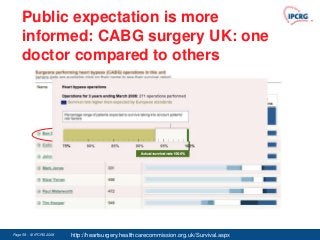
Public expectation is more
    informed: CABG surgery UK: one
    doctor compared to others


Page 58 - © IPCRG 2007
                  2008   http://heartsurgery.healthcarecommission.org.uk/Survival.aspx
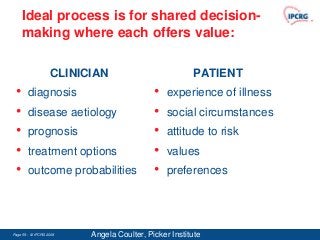
Ideal process is for shared decision-
     making where each offers value:

                   CLINICIAN                          PATIENT
 •      diagnosis                          •   experience of illness
 •      disease aetiology                  •   social circumstances
 •      prognosis                          •   attitude to risk
 •      treatment options                  •   values
 •      outcome probabilities              •   preferences


Page 59 - © IPCRG 2007
                  2008   Angela Coulter, Picker Institute
“Knowing is not enough. We must apply.”
 Johann Wolfgang von Goethe


  •     We are not using all the science we know
  •     Individuals integrate the evidence into their own
        practice in a piecemeal way rather than
        systematically to avoid infringing clinical
        autonomy So:
  •     Practise the science of medicine, consistently
  •     Practise the art of
        medicine, together, altruistically


Page 60 - © IPCRG 2007
                  2008
Reliability science                         [René Amalberti IHI]

    No limit on discretion               Increasing safety margins

             Excessive autonomy of actors                   Becoming team player
                                                               Agreeing to become
                                  Craftmanship attitude
                                                               « equivalent actors »
                                                                                      Accepting the residual
                              Ego-centered safety protections, vertical conflicts risk
                                                                                           Accepting that
                                             Loss of visibility of risk, freezing actions changes can be
                                                                                           destructive
                                                                              Blood transfusion
                                         Fatal Iatrogenic


                                                                                                               No system beyond
                                         adverse events                    Anesthesiology
                                                                                    ASA1


                                                                                                                   this point
             Cardiac Surgery               Medical risk (total)
             Patient ASA 3-5
Himalaya                                                          Chartered Flight
mountaineering                                                                         Civil Aviation

                 Microlight or             Road Safety                               Railways (France)
                 helicopters spreading
                 activity                      Chemical Industry (total)                    Nuclear Industry


   10-2                  10-3                  10-4                       10-5                 10-6                       Fatal
  Very unsafe                                                                                     Ultra safe              Risk
Page 62 - © IPCRG 2007
                  2008
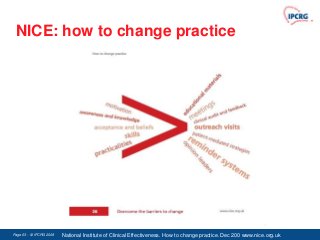
NICE: how to change practice


Page 63 - © IPCRG 2007
                  2008   National Institute of Clinical Effectiveness. How to change practice. Dec 200 www.nice.org.uk
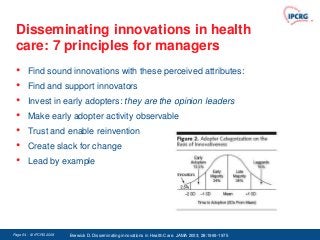
Disseminating innovations in health
 care: 7 principles for managers
 •      Find sound innovations with these perceived attributes:
 •      Find and support innovators
 •      Invest in early adopters: they are the opinion leaders
 •      Make early adopter activity observable
 •      Trust and enable reinvention
 •      Create slack for change
 •      Lead by example


Page 64 - © IPCRG 2007
                  2008
                         Berwick D. Disseminating innovations in Health Care. JAMA 2003; 28:1969-1975
What does it mean for the IPCRG?

 •      Collaborate on real life research
 •      Support research and analytical techniques
 •      Disseminate knowledge to clinicians
 •      Disseminate knowledge to the public
 •      Create tools that can support concordance
        o Elicit beliefs, identity of clinician and patient
        o Support shared decision-making - decision aids
 •      Learn from each other


Page 65 - © IPCRG 2007
                  2008
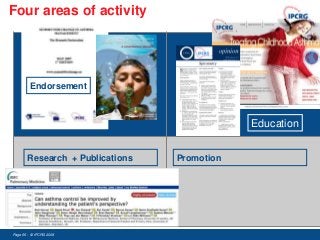
Four areas of activity


         Endorsement


                                             Education


       Research + Publications   Promotion


Page 66 - © IPCRG 2007
                  2008
Primary Care Respiratory Journal

 Medline listed
 Primary care authors
 Primary care editorial board
 Primary care audience


Page 67 - © IPCRG 2007
                  2008
So what does this mean?
 • Collect data to look for variation
 • Analyse: warranted or unwarranted
 • If unwarranted: common or special cause?
        Misuse, underuse or overuse?
 •      Plan the intervention: seek beliefs, concerns, identity.
        Consider segmentation. Apply the evidence
        consistently.
 •      Aim to make shared decisions: be aware of personal
        identity and beliefs too
 •      IPCRG will collaborate to provide:
        research, publications, endorsement, education +
        promotion
Page 68 - © IPCRG 2007
                  2008

Variation

  • 1.
    Variation Siân Williams, IPCRG Executive Officer IPCRG Biennial Conference May 2008 © IPCRG 2007
  • 2.
    The 1980s… “evaluativescience” Page 2 - © IPCRG 2007 2008
  • 3.
    What this sessionwill cover: • What is meant by variation? • Does it matter? • How should it be analysed? • What can be done by individuals? • What can be done by IPCRG? Page 3 - © IPCRG 2007 2008
  • 4.
    What is meantby variation? © IPCRG 2007
  • 5.
    Patient variation: smoking prevalence eg 13-15 years Data 2001 or later Green: 30% and over Blue 20%-29% Page 5 - © IPCRG 2007 2008 Mackay J et al The Tobacco Atlas, 2nd ed 2006. American Cancer Society, UICC.
  • 6.
    Patient variation: deaths from tobacco use More than 25% of 35-69 year old males + 20% of females living above the lines will die from tobacco use Page 6 - © IPCRG 2007 2008 Mackay J et al The Tobacco Atlas, 2nd ed 2006. American Cancer Society, UICC. Also
  • 7.
    Variation male/female; incidenceand outcome: lung cancer in Europe Age-standardised cancer incidence rates Age-standardised (European) per 100,000 population, lung cancer, by mortality rates, lung cancer, EU sex, EU, 2006 countries, 2002 estimates Page 7 - © IPCRG 2007 2008 http://info.cancerresearchuk.org/cancerstats/types/lung/mortality/
  • 8.
    Page 8 -© IPCRG 2007 2008
  • 9.
    Variation in smokingcessation rates Good news in UK - that most deprived areas doing better but: • Nearly 50% of health orgs in deprived areas were “excellent” vs 20% in affluent areas • Those scoring “excellent” most likely to hit quit rate target (87% did) • Those with extra resources did better • Those performing poorly not working with other agencies • Most not consulting with public about how to do it • Health orgs not developing expertise of own staff Page 9 - © IPCRG 2007 2008 http://www.healthcarecommission.org.uk
  • 10.
    Page 10 -© IPCRG 2007 2008
  • 11.
    Dartmouth Atlas: variationin preference- sensitive care, and in effective care Page 11 - © IPCRG 2007 2008 http://www.dartmouthatlas.org/atlases/atlas_series.shtm
  • 12.
    Dartmouth Atlas: Variationin supply-sensitive care • Hospitalisations for medical conditions • Stays in intensive care units • Visits to physicians • Referrals to specialists Page 12 - © IPCRG 2007 2008 Wennburg J. Unwarranted variations in healthcare delivery: implications for academic medical centres BMJ. 2002 October 26;
  • 13.
    Show asthma orCOPD variation Page 13 - © IPCRG 2007 2008
  • 14.
    Further analysis toinform PCT work programme (Havering PCT) National Prevalence PCT Prevalence 120 for COPD (1%) for COPD (1.4%) High achievement High achievement in COPD Indicators Low prevalence vs. PCT and National High prevalence vs. PCT and National 100 % Diagnosis Confirmed by Spirometry 80 60 50% achievement in COPD Indicator 3 40 20 Low Prevalence High Prevalence vs PCT and National Low Achievement Low achievement in COPD Indicators 0 0.0% 0.4% 0.8% 1.2% 1.6% 2.0% Page 14 - © IPCRG 2007 2008 % COPD Prevalence
  • 15.
    Unwarranted and warrantedsources of practice variation Unwarranted Warranted • Variable access to resources • Clinical differences among and expertise patients • Insufficient research • Variable risk attitudes • Unfounded enthusiasm • Variable preferences • Parochial perspectives among health outcomes • Faulty interpretation • Variable willingness to • Poor information flow make time trade-offs • Poor communication • Variable tolerance for • Role confusion decision responsibility • Variable coping styles Decreasingly knowledge- Increasingly patient- based centered Page 15 - © IPCRG 2007 2008 Prof Al Mulley, Foundation for Informed Medical Decision Making www.fidm.org
  • 16.
    There is agap between what we know and what we do…and, particularly in low income countries, there is also a gap between what we need and what is known Page 16 - © IPCRG 2007 2008 Prof Don Berwick www.ihi.org
  • 17.
    Underuse, overuse andmisuse? Active symptom intensive or acute management in care for people with end stages of COPD COPD Increased use of LABA/ICS combinations for asthma In UK, in 2005 574 different head and socket combinations used in hip replacement ops Use of inhaled England and Wales…impossible medication for to get meaningful data or gain asthma in Asia bulk purchase deals Pacific Page 17 - © IPCRG 2007 2008
  • 18.
    Why does itmatter? © IPCRG 2007
  • 19.
    Why does itmatter? • We don‟t use all the science we know - use the evidence to improve outcomes • We could reduce health inequalities and achieve global targets of EQUITY • We should avoid unnecessary risks for patients and • Use scarce resources efficiently and • Improve self-management Page 19 - © IPCRG 2007 2008
  • 20.
    Patients are awareof the inequity: European Allergy, Asthma & COPD Patients’ Sofia Declaration 2 June 2007 • Access to good, equal standards of care, no matter where you live in Europe • High standards of and access to patient & professional education, information and new knowledge • Healthy, unpolluted air to breathe indoors and out Page 20 - © IPCRG 2007 2008 European Federation of Allergy and Airways Diseases Patient‟s Association (EFA) www.efanet.org
  • 21.
    Both “underuse and overuse of treatments are rife in this and most other countries and are enemies of effective healthcare” (UK Chief Medical Officer 2005) Page 21 - © IPCRG 2007 2008
  • 22.
    What’s relevance ofUK to anywhere else? • Only 20% of cases of chronic disease occur in high income countries • 75% of smokers live in low or middle income countries • Next 20 years communicable disease is predominant problem in low-and middle-income countries but then • Epidemic of chronic disease everywhere • Will affect those in poverty most Page 22 - © IPCRG 2007 2008 Ottmani S et al. Respiratory care in primary care services. A survey in 9 countries. WHO 2004. Quoted in Chronic Respiratory
  • 23.
    The smoking epidemic Male smokers Female smokers Male deaths Female deaths 100 50 80 40 % of d ea ths du e t o sm o ki ng % of sm okers am on g a du lts 60 30 40 20 20 10 Year 0 0 0 10 20 30 40 50 60 70 80 90 100 Stage I Stage II Stage III Stage IV Sub-Saharan China, Japan, Eastern and W Europe, Africa SE Asia, Southern Europe N America Latin America, Australia N Africa Page 23 - © IPCRG 2007 2008 Adapted from Lopez AD, et al.. Tobacco Control 1994; 3: 242-247
  • 24.
    Achieving equity istough Patients with low health literacy • Have poorer health status • Are at greater risk of hospitalisation and have longer length of stay • Have higher rates of emergency admission • Are less likely to adhere to plans and treatments • Have more medication and treatment errors • Have less knowledge of disease management and health promoting behaviours • Have decreased ability to communicate with HCPs and share decision- making • Are less able to make appropriate health decisions • Make less use of preventive service • Incur substantially higher healthcare costs Page 24 - © IPCRG 2007 2008 Coulter and Ellins QEI review Chap 1Health literacy drawing on Ad Hoc Committee on Health Litera
  • 25.
    but the evidenceexists… GP time Increase in 5-7 fold quit rate >5 mins Intense intervention 4 fold 2-5 mins Moderate intervention <1 mins Brief intervention 3 fold 2 fold A „no-smoking practice‟ Page 25 - © IPCRG 2007 2008 IPCRG: Adapted from Litt J, et al. Asia Pacific Fam Med. 2003; 2: 175-9
  • 26.
    How is itanalysed? © IPCRG 2007
  • 27.
    Statistical process control •Shipman and Bristol Royal Infirmary enquiries in NHS •Study variability of performance over time or between insitutions or areas •Powerful tools for population health surveillance •Software available •Define “control” limits of variation beyond which data points worthy of investigation Page 27 - © IPCRG 2007 2008 http://www.erpho.org.uk/viewResource.aspx?id=14882
  • 28.
    4 sorts ofvariation (Bevan, UK) Natural Natural + common-cause Natural variation + Eg patient‟s “special cause” eg 1st age, gender, disease time exceptionally sick etc child turns up at clinic Common cause = Special expected cause = within a unusual, stable Artificial + common Artificial + “special unexpected process cause” eg Test results or system cause: ordering - that‟s different tests for the in wrong pile. Lost “under paperwork. Wrong code. same clinical control” presentation Artificial = from systems we‟ve developed Page 28 - © IPCRG 2007 2008 Bevan H. NHS Institute for Innovation and Improvement
  • 29.
    Our reaction todata about our services • The data are wrong • The data are right but they are not a problem • The data are right, it is a problem, but it’s not MY problem • The data are right, it is a problem, and it is my problem Page 29 - © IPCRG 2007 2008 Don Berwick, IHI
  • 30.
    ICU ADMISSION ICU admission YES YES NO NO 1 (1) 2 (14) YES Comfort Care 4 (34) 3 (1) NO Page 30 - © IPCRG 2007 2008
  • 31.
    So we knowwhat it is, and how it is analysed, but so what? © IPCRG 2007
  • 32.
    Model for Improvement What are we trying to accomplish? How will we know that a change is an improvement? What changes can we make that will result in an improvement? Act Plan Study Do 32 Page 32 - © IPCRG 2007 Institute of Healthcare Improvement
  • 33.
    NHS Institute: the19 ACS conditions: 19 conditions UK: Admissions for “ACS conditions” account for 6% - 13.2% of total hospital costs Page 33 - © IPCRG 2007 2008
  • 34.
    Why? What isthe root cause, and how can this change? For what purpose do you do things? How do you think of yourself? “I am..” What‟s important? Why? How do you/they do that? What you do/communicate Does where you are help/hinder? Page 34 - © IPCRG 2007 2008 Developed by Gregory Bateson, Enhanced by Robert Dilts
  • 35.
    Checkland’s sensemaking questions: • What stories do staff tell about their practice • What roles are occupied in this practice? • What is considered legitimate work? • How do you define success? • How has this practice responded to external events in the past? Examining response to change: • How do perceptions of legitimate work affect approaches to change? • How are roles changing in the practice? Page 35 - © IPCRG 2007 2008 Checkland K. B Understanding general practice:a conceptual framework developed from case studies in the UK NHS
  • 36.
    The implications forchange management in primary care • General practices/primary care offices are small organisations • Change needs to be bottom up and • Is determined by PCP’s view of organisational reality • Important factors for generating responses to change included o the story that the practice members told about their practice, o beliefs about what counted as legitimate work, o the role played by the manager, and o previous experiences of change. Page 36 - © IPCRG 2007 2008
  • 37.
    Identity: Do you identify a Do you hierarchy? regard smoking cessation Is your as identity a legitimate problem- work for solver, you? provider of continuous care, follower of protocol? Page 37 - © IPCRG 2007 2008
  • 38.
    Behaviours and beliefs “In early stages of the smoking pandemic, higher status individuals like health professionals tend to exhibit markedly higher smoking prevalence rates than general population. In later stages..health professionals - direct observers of the terrible health consequences,… often quit smoking and initiate national tobacco-control movements” Page 38 - © IPCRG 2007 2008 WHO Tobacco Atlas
  • 39.
    Beliefs: physician smoking(data available 2005) 41% and above 57% of male physician in China are smokers Page 39 - © IPCRG 2007 2008 WHO Tobacco Atlas
  • 40.
    So what doesit mean for you, and us? © IPCRG 2007
  • 41.
    What does thismean for practice? Patient-side Clinician-side • Use tools to • Pay attention to own beliefs and identity understand level of • Use tools to identify patient‟s knowledge, needs, needs and beliefs beliefs, identity • Educate • Share decisions • Apply the evidence • Share decisions Page 41 - © IPCRG 2007 2008
  • 42.
    IHI chronic care Page42 - © IPCRG 2007 2008 Wagner EH. Chronic disease management: What will it take to improve care for chronic illness? Effective Clinical Practice. 1998;1(1):2-4.
  • 43.
    Addressing warranted and unwarrantedvariation Knowledge-Based Patient-Centered • Manage all relevant knowledge and • Tailor evidence for individuals expertise • Frame problems from the patient’s o Access and critically appraise perspective evidence • Communicate options and probabilities o Access and selectively use of outcomes expertise of colleagues o Access and use guidelines and • Help patients to accurately imagine other support when appropriate alternative futures o Acknowledge uncertainty • Elicit and accommodate patients’ o Recognize uniqueness informed preferences • Avoid over-learning and selective • Elicit motivation when needed inattention; maintain • Build patients’ confidence and affirm context their competence • Communicate effectively • Use patients’ experiences as a source of knowledge Unwarranted variation Warranted variation Page 44 - © IPCRG 2007 2008 Prof Al Mulley, Foundation for Informed Medical Decision Making www.fidm.org
  • 44.
    Segment patients Page 45- © IPCRG 2007 2008
  • 45.
    Page 46 -© IPCRG 2007 2008
  • 46.
    Example of respiratoryresearch on segmentation A-L Caress, K Beaver, K Luker, M Campbell and A Woodcock. Involvement in treatment decisions: what do adults with asthma want and what do they get? Results of a cross sectional survey categorized asthma patients into those who prefer - - an active role - collaborative role or - passive role at a time of routine care and during an acute phase of their illness + (under diagnosed anxiety and depression) Page 47 - © IPCRG 2007 2008 Thorax 2005;60;199-205
  • 47.
    Use of differentdatabases… Mosaic groups: • Postcode level data: Symbols of success - career 17 households professionals • Refreshed yearly Happy families - younger families Ties of community - close-knit inner • 54% of data from city Census, 46% from Urban intelligence - educate, young, single, transient lifestyle data, Welfare borderline financial records, Municipal dependency survey data Blue collar enterprise • Data linkage: health, Twilight subsistence lifestyle, attitudes, Grey perspectives crime, etc Rural isolation Page 48 - © IPCRG 2007 2008
  • 48.
    GARD: 3 segmentsin low income countries • In urban areas with high income + settled, sedentary lifestyle o High income, can afford diagnostics and treatments o Government workers - reimbursed o Industrial, agricultural, service sector workers - reimbursed • In urban areas with limited resources or jobless OR in low income suburban or periurban areas • Poor people in rural areas Page 49 - © IPCRG 2007 2008 Global Alliance Against Respiratory Disease a comprehensive approach
  • 49.
    Understand environment, beliefs “ in your country disclosure is empowering…in mine, I have to think who to tell, even my family” Page 50 - © IPCRG 2007 2008
  • 50.
    Effective strategies: informing,educating and involving patients • Improve health literacy: o Printed leaflets and health information packages o Computer based and internet health information o Targeted approaches to tackle low health literacy o Targeted mass media campaigns • Improve clinical decision making o Patient decision aids o Training in communication skills for HCPs o Coaching and question prompts for patients Page 51 - © IPCRG 2007 2008 Effectiveness of strategies for informing, educating and involving patients. Coulter A. Ellins J. BMJ
  • 51.
    Effective strategies: informing,educatingand involving patients • Improve self care o Self management education o Self monitoring and self adminstered treatment o Self help groups and peer support o Patient access to personal medical information o Patient centred telecare • Improve patient safety o Information to help choose safe providers o Patient involvement in infection control o Encouraging adherence to treatment regimes o Check records and care processes o Patient reporting of adverse drug events Page 52 - © IPCRG 2007 2008 Effectiveness of strategies for informing, educating and involving patients. Coulter A. Ellins J. BMJ 2007:335;24-27
  • 52.
    The competition forpublic attention: Page 53 - © IPCRG 2007 2008
  • 53.
    Dept Health: passive smoking Social marketing to prevent illness UK Dept Health, different brands, different messages, same goal CHF charities: “Artery” campaign Cancer charities: “light” still has same Page 54 - © IPCRG 2007 2008 nicotine
  • 54.
    Health coaching o IHI testing teamlets o Health Dialog selling “health coaching” to create co- producers in healthcare Page 55 - © IPCRG 2007 2008 Ann Fam Med. 2007 Sep-Oct;5(5):457-61 Bodenheimer T, Laing BY
  • 55.
    Education: cardiothoracic surgery UK Page 56- © IPCRG 2007 2008 http://heartsurgery.healthcarecommission.org.uk/Survival.aspx
  • 56.
    Public expectation ismore informed: CABG surgery UK: one hospital compared to others Page 57 - © IPCRG 2007 2008 http://heartsurgery.healthcarecommission.org.uk/Survival.aspx
  • 57.
    Public expectation ismore informed: CABG surgery UK: one doctor compared to others Page 58 - © IPCRG 2007 2008 http://heartsurgery.healthcarecommission.org.uk/Survival.aspx
  • 58.
    Ideal process isfor shared decision- making where each offers value: CLINICIAN PATIENT • diagnosis • experience of illness • disease aetiology • social circumstances • prognosis • attitude to risk • treatment options • values • outcome probabilities • preferences Page 59 - © IPCRG 2007 2008 Angela Coulter, Picker Institute
  • 59.
    “Knowing is notenough. We must apply.” Johann Wolfgang von Goethe • We are not using all the science we know • Individuals integrate the evidence into their own practice in a piecemeal way rather than systematically to avoid infringing clinical autonomy So: • Practise the science of medicine, consistently • Practise the art of medicine, together, altruistically Page 60 - © IPCRG 2007 2008
  • 60.
    Reliability science [René Amalberti IHI] No limit on discretion Increasing safety margins Excessive autonomy of actors Becoming team player Agreeing to become Craftmanship attitude « equivalent actors » Accepting the residual Ego-centered safety protections, vertical conflicts risk Accepting that Loss of visibility of risk, freezing actions changes can be destructive Blood transfusion Fatal Iatrogenic No system beyond adverse events Anesthesiology ASA1 this point Cardiac Surgery Medical risk (total) Patient ASA 3-5 Himalaya Chartered Flight mountaineering Civil Aviation Microlight or Road Safety Railways (France) helicopters spreading activity Chemical Industry (total) Nuclear Industry 10-2 10-3 10-4 10-5 10-6 Fatal Very unsafe Ultra safe Risk
  • 61.
    Page 62 -© IPCRG 2007 2008
  • 62.
    NICE: how tochange practice Page 63 - © IPCRG 2007 2008 National Institute of Clinical Effectiveness. How to change practice. Dec 200 www.nice.org.uk
  • 63.
    Disseminating innovations inhealth care: 7 principles for managers • Find sound innovations with these perceived attributes: • Find and support innovators • Invest in early adopters: they are the opinion leaders • Make early adopter activity observable • Trust and enable reinvention • Create slack for change • Lead by example Page 64 - © IPCRG 2007 2008 Berwick D. Disseminating innovations in Health Care. JAMA 2003; 28:1969-1975
  • 64.
    What does itmean for the IPCRG? • Collaborate on real life research • Support research and analytical techniques • Disseminate knowledge to clinicians • Disseminate knowledge to the public • Create tools that can support concordance o Elicit beliefs, identity of clinician and patient o Support shared decision-making - decision aids • Learn from each other Page 65 - © IPCRG 2007 2008
  • 65.
    Four areas ofactivity Endorsement Education Research + Publications Promotion Page 66 - © IPCRG 2007 2008
  • 66.
    Primary Care RespiratoryJournal Medline listed Primary care authors Primary care editorial board Primary care audience Page 67 - © IPCRG 2007 2008
  • 67.
    So what doesthis mean? • Collect data to look for variation • Analyse: warranted or unwarranted • If unwarranted: common or special cause? Misuse, underuse or overuse? • Plan the intervention: seek beliefs, concerns, identity. Consider segmentation. Apply the evidence consistently. • Aim to make shared decisions: be aware of personal identity and beliefs too • IPCRG will collaborate to provide: research, publications, endorsement, education + promotion Page 68 - © IPCRG 2007 2008