Ideas & Methodology For Bringing
North-East To A Level It Deserves
Presented By:
Suraj Kumar
Aman Kumar Rahul
Ashutosh Cupsimay
Chiranjeeb Mishra
Saiman Swain
(Trident Academy Of Technology, Bhubaneswar)
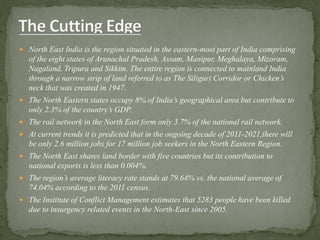
ď‚— North East India is the region situated in the eastern-most part of India comprising
of the eight states of Arunachal Pradesh, Assam, Manipur, Meghalaya, Mizoram,
Nagaland, Tripura and Sikkim. The entire region is connected to mainland India
through a narrow strip of land referred to as The Siliguri Corridor or Chicken’s
neck that was created in 1947.
 The North Eastern states occupy 8% of India’s geographical area but contribute to
only 2.3% of the country’s GDP.
ď‚— The rail network in the North East form only 3.7% of the national rail network.
ď‚— At current trends it is predicted that in the ongoing decade of 2011-2021,there will
be only 2.6 million jobs for 17 million job seekers in the North Eastern Region.
ď‚— The North East shares land border with five countries but its contribution to
national exports is less than 0.004%.
 The region’s average literacy rate stands at 79.64% vs. the national average of
74.04% according to the 2011 census.
ď‚— The Institute of Conflict Management estimates that 5283 people have been killed
due to insurgency related events in the North-East since 2005.
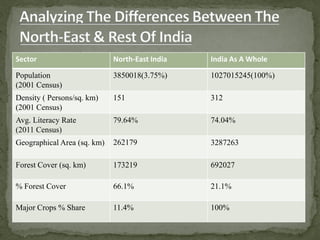
Sector North-East India India As A Whole
Population
(2001 Census)
3850018(3.75%) 1027015245(100%)
Density ( Persons/sq. km)
(2001 Census)
151 312
Avg. Literacy Rate
(2011 Census)
79.64% 74.04%
Geographical Area (sq. km) 262179 3287263
Forest Cover (sq. km) 173219 692027
% Forest Cover 66.1% 21.1%
Major Crops % Share 11.4% 100%
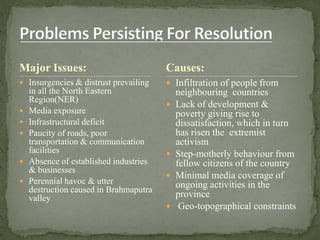
Major Issues:
ď‚— Insurgencies & distrust prevailing
in all the North Eastern
Region(NER)
ď‚— Media exposure
ď‚— Infrastructural deficit
ď‚— Paucity of roads, poor
transportation & communication
facilities
ď‚— Absence of established industries
& businesses
ď‚— Perennial havoc & utter
destruction caused in Brahmaputra
valley
ď‚— Infiltration of people from
neighbouring countries
ď‚— Lack of development &
poverty giving rise to
dissatisfaction, which in turn
has risen the extremist
activism
ď‚— Step-motherly behaviour from
fellow citizens of the country
ď‚— Minimal media coverage of
ongoing activities in the
province
ď‚— Geo-topographical constraints
Causes:
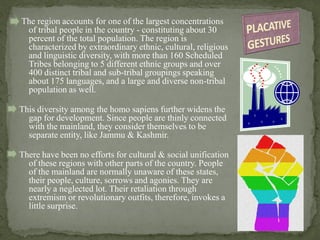
The region accounts for one of the largest concentrations
of tribal people in the country - constituting about 30
percent of the total population. The region is
characterized by extraordinary ethnic, cultural, religious
and linguistic diversity, with more than 160 Scheduled
Tribes belonging to 5 different ethnic groups and over
400 distinct tribal and sub-tribal groupings speaking
about 175 languages, and a large and diverse non-tribal
population as well.
This diversity among the homo sapiens further widens the
gap for development. Since people are thinly connected
with the mainland, they consider themselves to be
separate entity, like Jammu & Kashmir.
There have been no efforts for cultural & social unification
of these regions with other parts of the country. People
of the mainland are normally unaware of these states,
their people, culture, sorrows and agonies. They are
nearly a neglected lot. Their retaliation through
extremism or revolutionary outfits, therefore, invokes a
little surprise.
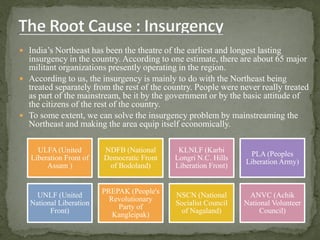
 India’s Northeast has been the theatre of the earliest and longest lasting
insurgency in the country. According to one estimate, there are about 65 major
militant organizations presently operating in the region.
ď‚— According to us, the insurgency is mainly to do with the Northeast being
treated separately from the rest of the country. People were never really treated
as part of the mainstream, be it by the government or by the basic attitude of
the citizens of the rest of the country.
ď‚— To some extent, we can solve the insurgency problem by mainstreaming the
Northeast and making the area equip itself economically.
ULFA (United
Liberation Front of
Assam )
NDFB (National
Democratic Front
of Bodoland)
KLNLF (Karbi
Longri N.C. Hills
Liberation Front)
PLA (Peoples
Liberation Army)
UNLF (United
National Liberation
Front)
PREPAK (People's
Revolutionary
Party of
Kangleipak)
NSCN (National
Socialist Council
of Nagaland)
ANVC (Achik
National Volunteer
Council)
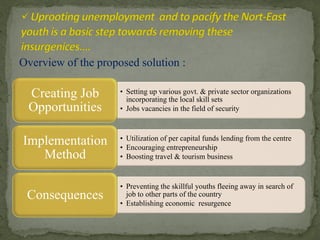
Overview of the proposed solution :
• Setting up various govt. & private sector organizations
incorporating the local skill sets
• Jobs vacancies in the field of security
Creating Job
Opportunities
• Utilization of per capital funds lending from the centre
• Encouraging entrepreneurship
• Boosting travel & tourism business
Implementation
Method
• Preventing the skillful youths fleeing away in search of
job to other parts of the country
• Establishing economic resurgence
Consequences
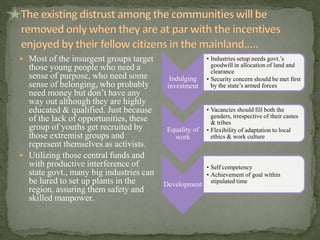
ď‚— Most of the insurgent groups target
those young people who need a
sense of purpose, who need some
sense of belonging, who probably
need money but don’t have any
way out although they are highly
educated & qualified. Just because
of the lack of opportunities, these
group of youths get recruited by
those extremist groups and
represent themselves as activists.
ď‚— Utilizing those central funds and
with productive interference of
state govt., many big industries can
be lured to set up plants in the
region, assuring them safety and
skilled manpower.
Indulging
investment
• Industries setup needs govt.’s
goodwill in allocation of land and
clearance
• Security concern should be met first
by the state’s armed forces
Equality of
work
• Vacancies should fill both the
genders, irrespective of their castes
& tribes
• Flexibility of adaptation to local
ethics & work culture
Development
• Self competency
• Achievement of goal within
stipulated time
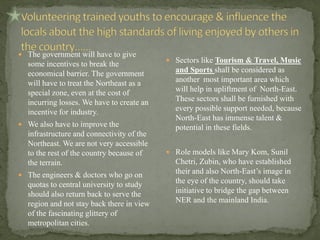
ď‚— The government will have to give
some incentives to break the
economical barrier. The government
will have to treat the Northeast as a
special zone, even at the cost of
incurring losses. We have to create an
incentive for industry.
ď‚— We also have to improve the
infrastructure and connectivity of the
Northeast. We are not very accessible
to the rest of the country because of
the terrain.
ď‚— The engineers & doctors who go on
quotas to central university to study
should also return back to serve the
region and not stay back there in view
of the fascinating glittery of
metropolitan cities.
ď‚— Sectors like Tourism & Travel, Music
and Sports shall be considered as
another most important area which
will help in upliftment of North-East.
These sectors shall be furnished with
every possible support needed, because
North-East has immense talent &
potential in these fields.
ď‚— Role models like Mary Kom, Sunil
Chetri, Zubin, who have established
their and also North-East’s image in
the eye of the country, should take
initiative to bridge the gap between
NER and the mainland India.
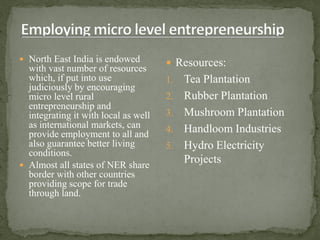
ď‚— North East India is endowed
with vast number of resources
which, if put into use
judiciously by encouraging
micro level rural
entrepreneurship and
integrating it with local as well
as international markets, can
provide employment to all and
also guarantee better living
conditions.
ď‚— Almost all states of NER share
border with other countries
providing scope for trade
through land.
ď‚— Resources:
1. Tea Plantation
2. Rubber Plantation
3. Mushroom Plantation
4. Handloom Industries
5. Hydro Electricity
Projects
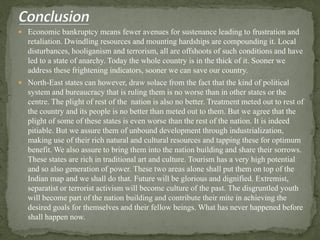
ď‚— Economic bankruptcy means fewer avenues for sustenance leading to frustration and
retaliation. Dwindling resources and mounting hardships are compounding it. Local
disturbances, hooliganism and terrorism, all are offshoots of such conditions and have
led to a state of anarchy. Today the whole country is in the thick of it. Sooner we
address these frightening indicators, sooner we can save our country.
ď‚— North-East states can however, draw solace from the fact that the kind of political
system and bureaucracy that is ruling them is no worse than in other states or the
centre. The plight of rest of the nation is also no better. Treatment meted out to rest of
the country and its people is no better than meted out to them. But we agree that the
plight of some of these states is even worse than the rest of the nation. It is indeed
pitiable. But we assure them of unbound development through industrialization,
making use of their rich natural and cultural resources and tapping these for optimum
benefit. We also assure to bring them into the nation building and share their sorrows.
These states are rich in traditional art and culture. Tourism has a very high potential
and so also generation of power. These two areas alone shall put them on top of the
Indian map and we shall do that. Future will be glorious and dignified. Extremist,
separatist or terrorist activism will become culture of the past. The disgruntled youth
will become part of the nation building and contribute their mite in achieving the
desired goals for themselves and their fellow beings. What has never happened before
shall happen now.
 India’s North-East Diversifying Growth Opportunities (PWC
2013)
ď‚— Human Development Report of North East States (Ministry of
Development of North Eastern Region. 2011)
ď‚— Excerpts from Agatha Sangma interview (Tehelka Archive)
ď‚— Article on rural entrepreneurship development in North-East
India (coolage.in)
ď‚— Wikipedia
ď‚— mdoner.gov.in/north-east-report
ď‚— northeastindiadiary.com
ď‚— Population and Development in North East India - Google
Books
ď‚— Manthan Theme Resources

Vanguard5

  • 1.
    Ideas & MethodologyFor Bringing North-East To A Level It Deserves Presented By: Suraj Kumar Aman Kumar Rahul Ashutosh Cupsimay Chiranjeeb Mishra Saiman Swain (Trident Academy Of Technology, Bhubaneswar)
  • 2.
     North EastIndia is the region situated in the eastern-most part of India comprising of the eight states of Arunachal Pradesh, Assam, Manipur, Meghalaya, Mizoram, Nagaland, Tripura and Sikkim. The entire region is connected to mainland India through a narrow strip of land referred to as The Siliguri Corridor or Chicken’s neck that was created in 1947.  The North Eastern states occupy 8% of India’s geographical area but contribute to only 2.3% of the country’s GDP.  The rail network in the North East form only 3.7% of the national rail network.  At current trends it is predicted that in the ongoing decade of 2011-2021,there will be only 2.6 million jobs for 17 million job seekers in the North Eastern Region.  The North East shares land border with five countries but its contribution to national exports is less than 0.004%.  The region’s average literacy rate stands at 79.64% vs. the national average of 74.04% according to the 2011 census.  The Institute of Conflict Management estimates that 5283 people have been killed due to insurgency related events in the North-East since 2005.
  • 3.
    Sector North-East IndiaIndia As A Whole Population (2001 Census) 3850018(3.75%) 1027015245(100%) Density ( Persons/sq. km) (2001 Census) 151 312 Avg. Literacy Rate (2011 Census) 79.64% 74.04% Geographical Area (sq. km) 262179 3287263 Forest Cover (sq. km) 173219 692027 % Forest Cover 66.1% 21.1% Major Crops % Share 11.4% 100%
  • 4.
    Major Issues: ď‚— Insurgencies& distrust prevailing in all the North Eastern Region(NER) ď‚— Media exposure ď‚— Infrastructural deficit ď‚— Paucity of roads, poor transportation & communication facilities ď‚— Absence of established industries & businesses ď‚— Perennial havoc & utter destruction caused in Brahmaputra valley ď‚— Infiltration of people from neighbouring countries ď‚— Lack of development & poverty giving rise to dissatisfaction, which in turn has risen the extremist activism ď‚— Step-motherly behaviour from fellow citizens of the country ď‚— Minimal media coverage of ongoing activities in the province ď‚— Geo-topographical constraints Causes:
  • 5.
    The region accountsfor one of the largest concentrations of tribal people in the country - constituting about 30 percent of the total population. The region is characterized by extraordinary ethnic, cultural, religious and linguistic diversity, with more than 160 Scheduled Tribes belonging to 5 different ethnic groups and over 400 distinct tribal and sub-tribal groupings speaking about 175 languages, and a large and diverse non-tribal population as well. This diversity among the homo sapiens further widens the gap for development. Since people are thinly connected with the mainland, they consider themselves to be separate entity, like Jammu & Kashmir. There have been no efforts for cultural & social unification of these regions with other parts of the country. People of the mainland are normally unaware of these states, their people, culture, sorrows and agonies. They are nearly a neglected lot. Their retaliation through extremism or revolutionary outfits, therefore, invokes a little surprise.
  • 6.
     India’s Northeasthas been the theatre of the earliest and longest lasting insurgency in the country. According to one estimate, there are about 65 major militant organizations presently operating in the region.  According to us, the insurgency is mainly to do with the Northeast being treated separately from the rest of the country. People were never really treated as part of the mainstream, be it by the government or by the basic attitude of the citizens of the rest of the country.  To some extent, we can solve the insurgency problem by mainstreaming the Northeast and making the area equip itself economically. ULFA (United Liberation Front of Assam ) NDFB (National Democratic Front of Bodoland) KLNLF (Karbi Longri N.C. Hills Liberation Front) PLA (Peoples Liberation Army) UNLF (United National Liberation Front) PREPAK (People's Revolutionary Party of Kangleipak) NSCN (National Socialist Council of Nagaland) ANVC (Achik National Volunteer Council)
  • 7.
    Overview of theproposed solution : • Setting up various govt. & private sector organizations incorporating the local skill sets • Jobs vacancies in the field of security Creating Job Opportunities • Utilization of per capital funds lending from the centre • Encouraging entrepreneurship • Boosting travel & tourism business Implementation Method • Preventing the skillful youths fleeing away in search of job to other parts of the country • Establishing economic resurgence Consequences
  • 8.
     Most ofthe insurgent groups target those young people who need a sense of purpose, who need some sense of belonging, who probably need money but don’t have any way out although they are highly educated & qualified. Just because of the lack of opportunities, these group of youths get recruited by those extremist groups and represent themselves as activists.  Utilizing those central funds and with productive interference of state govt., many big industries can be lured to set up plants in the region, assuring them safety and skilled manpower. Indulging investment • Industries setup needs govt.’s goodwill in allocation of land and clearance • Security concern should be met first by the state’s armed forces Equality of work • Vacancies should fill both the genders, irrespective of their castes & tribes • Flexibility of adaptation to local ethics & work culture Development • Self competency • Achievement of goal within stipulated time
  • 9.
     The governmentwill have to give some incentives to break the economical barrier. The government will have to treat the Northeast as a special zone, even at the cost of incurring losses. We have to create an incentive for industry.  We also have to improve the infrastructure and connectivity of the Northeast. We are not very accessible to the rest of the country because of the terrain.  The engineers & doctors who go on quotas to central university to study should also return back to serve the region and not stay back there in view of the fascinating glittery of metropolitan cities.  Sectors like Tourism & Travel, Music and Sports shall be considered as another most important area which will help in upliftment of North-East. These sectors shall be furnished with every possible support needed, because North-East has immense talent & potential in these fields.  Role models like Mary Kom, Sunil Chetri, Zubin, who have established their and also North-East’s image in the eye of the country, should take initiative to bridge the gap between NER and the mainland India.
  • 10.
    ď‚— North EastIndia is endowed with vast number of resources which, if put into use judiciously by encouraging micro level rural entrepreneurship and integrating it with local as well as international markets, can provide employment to all and also guarantee better living conditions. ď‚— Almost all states of NER share border with other countries providing scope for trade through land. ď‚— Resources: 1. Tea Plantation 2. Rubber Plantation 3. Mushroom Plantation 4. Handloom Industries 5. Hydro Electricity Projects
  • 11.
    ď‚— Economic bankruptcymeans fewer avenues for sustenance leading to frustration and retaliation. Dwindling resources and mounting hardships are compounding it. Local disturbances, hooliganism and terrorism, all are offshoots of such conditions and have led to a state of anarchy. Today the whole country is in the thick of it. Sooner we address these frightening indicators, sooner we can save our country. ď‚— North-East states can however, draw solace from the fact that the kind of political system and bureaucracy that is ruling them is no worse than in other states or the centre. The plight of rest of the nation is also no better. Treatment meted out to rest of the country and its people is no better than meted out to them. But we agree that the plight of some of these states is even worse than the rest of the nation. It is indeed pitiable. But we assure them of unbound development through industrialization, making use of their rich natural and cultural resources and tapping these for optimum benefit. We also assure to bring them into the nation building and share their sorrows. These states are rich in traditional art and culture. Tourism has a very high potential and so also generation of power. These two areas alone shall put them on top of the Indian map and we shall do that. Future will be glorious and dignified. Extremist, separatist or terrorist activism will become culture of the past. The disgruntled youth will become part of the nation building and contribute their mite in achieving the desired goals for themselves and their fellow beings. What has never happened before shall happen now.
  • 12.
     India’s North-EastDiversifying Growth Opportunities (PWC 2013)  Human Development Report of North East States (Ministry of Development of North Eastern Region. 2011)  Excerpts from Agatha Sangma interview (Tehelka Archive)  Article on rural entrepreneurship development in North-East India (coolage.in)  Wikipedia  mdoner.gov.in/north-east-report  northeastindiadiary.com  Population and Development in North East India - Google Books  Manthan Theme Resources