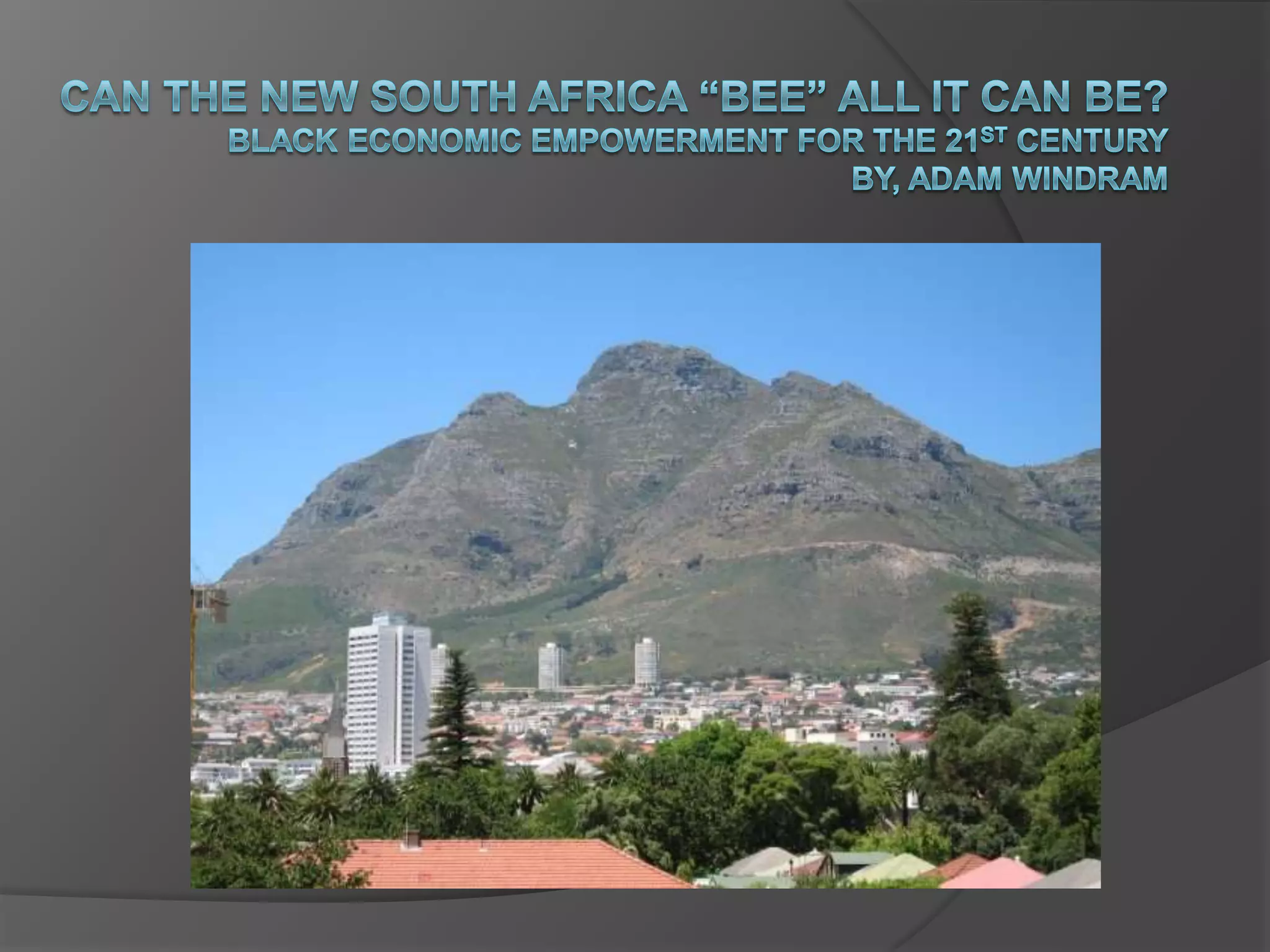
Can the New South Africa “BEE” All it can Be?Black Economic Empowerment for the 21stCenturybY, Adam Windram
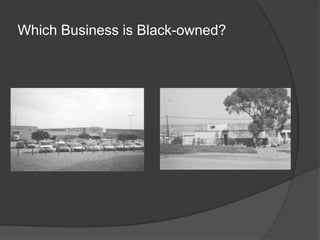
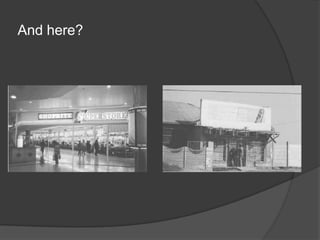
Which Business is Black-owned?
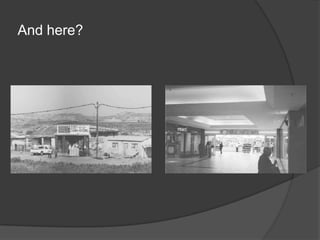
And here?
And here?
History:  Economic Consequences of RacismBy 1980 South African economy dominated by the service sector, particularly in banking and financeSanctions imposed by foreign lending companies in response to Apartheid weakened South African economyAs a response to this, South Africa needed to use import substitution and high import tariffs to keep capital inside the country due to difficulty in obtaining credit from foreign institutionsCorporations such as ABSA, Sanlam, and Nedbank wanted to expand markets as South Africa became an oversaturated marketThus some companies began joining the statewide push for ending Apartheid, and need for further economic integration of blacks.
Push for change1992 Nelson Mandela visited the World Economic Forum to make the case for a new South African market economy that would be attractive to foreign investment.  ANC also recognized that a market economy in South Africa needed to serve the needs of social welfare, thus requiring state intervention to ensure blacks were brought into the new post-Apartheid market economy.Term “black” used to define all formerly repressed minorities, including native Africans, coloreds (mixed race), Indians, Chinese1994 white rule officially ends, ushers in beginnings of Black Economic Empowerment
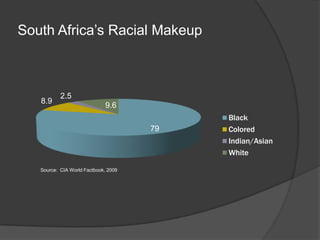
South Africa’s Racial Makeup
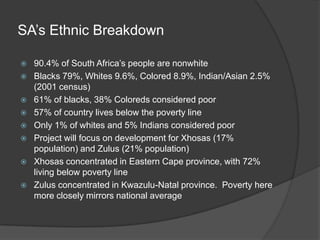
SA’s Ethnic Breakdown90.4% of South Africa’s people are nonwhiteBlacks 79%, Whites 9.6%, Colored 8.9%, Indian/Asian 2.5% (2001 census)61% of blacks, 38% Coloreds considered poor57% of country lives below the poverty lineOnly 1% of whites and 5% Indians considered poorProject will focus on development for Xhosas (17% population) and Zulus (21% population)Xhosas concentrated in Eastern Cape province, with 72% living below poverty lineZulus concentrated in Kwazulu-Natal province.  Poverty here more closely mirrors national average
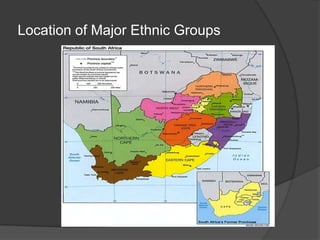
Location of Major Ethnic Groups
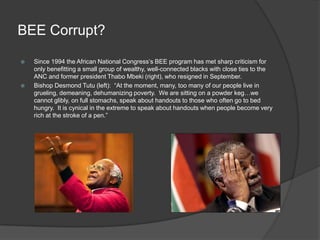
BEE Corrupt?Since 1994 the African National Congress’s BEE program has met sharp criticism for only benefitting a small group of wealthy, well-connected blacks with close ties to the ANC and former president Thabo Mbeki (right), who resigned in September.Bishop Desmond Tutu (left):  “At the moment, many, too many of our people live in grueling, demeaning, dehumanizing poverty.  We are sitting on a powder keg…we cannot glibly, on full stomachs, speak about handouts to those who often go to bed hungry.  It is cynical in the extreme to speak about handouts when people become very rich at the stroke of a pen.”
Prince Sifiso Zulu:  Mbeki-style BEE poster boyChairman of Emtateni Freight Plus, a BEE company started in 2001Attended “some university”, then hired as a project manager at Independent Projects TrustMember of Zulu royal familyClose connections with ANC stalwart Jacob Zuma and Tokyo Sexwale, a Johannesburg billionaireRecently in controversy over accident where two people were killed in hit-and-run involving  Zulu’s BMW X5, driven by a mystery man People like Zulu are what many South Africans see as the primary beneficiaries of BEE under the Mbeki government
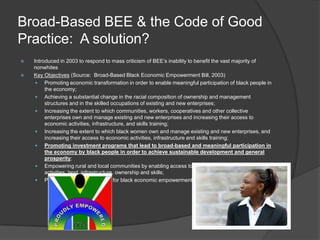
Broad-Based BEE & the Code of Good Practice:  A solution?Introduced in 2003 to respond to mass criticism of BEE’s inability to benefit the vast majority of nonwhitesKey Objectives (Source:  Broad-Based Black Economic Empowerment Bill, 2003)Promoting economic transformation in order to enable meaningful participation of black people in the economy;Achieving a substantial change in the racial composition of ownership and management structures and in the skilled occupations of existing and new enterprises;Increasing the extent to which communities, workers, cooperatives and other collective enterprises own and manage existing and new enterprises and increasing their access to economic activities, infrastructure, and skills training;Increasing the extent to which black women own and manage existing and new enterprises, and increasing their access to economic activities, infrastructure and skills training;Promoting investment programs that lead to broad-based and meaningful participation in the economy by black people in order to achieve sustainable development and general prosperity;Empowering rural and local communities by enabling access to economic activities, land, infrastructure, ownership and skills;Promoting access to finance for black economic empowerment.
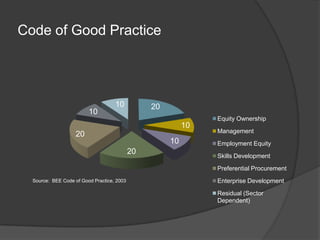
Code of Good PracticeSource:  BEE Code of Good Practice, 2003
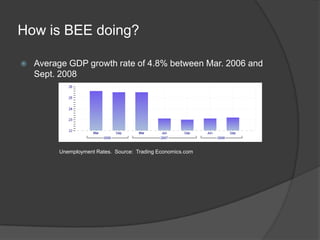
How is BEE doing?Average GDP growth rate of 4.8% between Mar. 2006 and Sept. 2008Unemployment Rates.  Source:  Trading Economics.com
Criticism from WithinProgram still taking heat from public and politicians after 2003 revisions, drawing support away from the ANCMangosuthu Buthelezi, leader of the Inkatha Freedom Party (IFP), contends that BEE’s current design has caused “white flight”, as many well-heeled, well-educated white South Africans are leaving the country, causing a skills shortage and leaving fewer businesses which could hire blacks looking for opportunities through BEEMatches criticism that under Mbeki the government has moved for the country to be racially pure, moving away from Mandela’s vision of a non-racial South Africa, creating divisions within the ANC itself, which comprises nearly 70% of the legislature.  Congress of the People (COPE) is a new party that has broken away from the ANC, and is rallying to defeat Jacob Zuma in 2009.
Possible Improvements to BEE in the future & Further ResearchANC cronyism and unfair distribution of BEE benefits exacerbated by ANC’s long-term domination of South African politics.  Effective reevaluation and change to the current BEE practices may require the success of the new COPE movementMore statistical data on BEE’s effect on particular groups such as the Xhosa and ZuluTry to get some opinions from natives on the program and whether it’s working effectively for themInterview professors from University of Cape Town, and other South African universities, to get more specialized knowledge on the subject

Black Economic Empowerment presentation

  • 1.
    Can the NewSouth Africa “BEE” All it can Be?Black Economic Empowerment for the 21stCenturybY, Adam Windram
  • 2.
    Which Business isBlack-owned?
  • 3.
  • 4.
  • 5.
    History: EconomicConsequences of RacismBy 1980 South African economy dominated by the service sector, particularly in banking and financeSanctions imposed by foreign lending companies in response to Apartheid weakened South African economyAs a response to this, South Africa needed to use import substitution and high import tariffs to keep capital inside the country due to difficulty in obtaining credit from foreign institutionsCorporations such as ABSA, Sanlam, and Nedbank wanted to expand markets as South Africa became an oversaturated marketThus some companies began joining the statewide push for ending Apartheid, and need for further economic integration of blacks.
  • 6.
    Push for change1992Nelson Mandela visited the World Economic Forum to make the case for a new South African market economy that would be attractive to foreign investment. ANC also recognized that a market economy in South Africa needed to serve the needs of social welfare, thus requiring state intervention to ensure blacks were brought into the new post-Apartheid market economy.Term “black” used to define all formerly repressed minorities, including native Africans, coloreds (mixed race), Indians, Chinese1994 white rule officially ends, ushers in beginnings of Black Economic Empowerment
  • 7.
  • 8.
    SA’s Ethnic Breakdown90.4%of South Africa’s people are nonwhiteBlacks 79%, Whites 9.6%, Colored 8.9%, Indian/Asian 2.5% (2001 census)61% of blacks, 38% Coloreds considered poor57% of country lives below the poverty lineOnly 1% of whites and 5% Indians considered poorProject will focus on development for Xhosas (17% population) and Zulus (21% population)Xhosas concentrated in Eastern Cape province, with 72% living below poverty lineZulus concentrated in Kwazulu-Natal province. Poverty here more closely mirrors national average
  • 9.
    Location of MajorEthnic Groups
  • 10.
    BEE Corrupt?Since 1994the African National Congress’s BEE program has met sharp criticism for only benefitting a small group of wealthy, well-connected blacks with close ties to the ANC and former president Thabo Mbeki (right), who resigned in September.Bishop Desmond Tutu (left): “At the moment, many, too many of our people live in grueling, demeaning, dehumanizing poverty. We are sitting on a powder keg…we cannot glibly, on full stomachs, speak about handouts to those who often go to bed hungry. It is cynical in the extreme to speak about handouts when people become very rich at the stroke of a pen.”
  • 11.
    Prince Sifiso Zulu: Mbeki-style BEE poster boyChairman of Emtateni Freight Plus, a BEE company started in 2001Attended “some university”, then hired as a project manager at Independent Projects TrustMember of Zulu royal familyClose connections with ANC stalwart Jacob Zuma and Tokyo Sexwale, a Johannesburg billionaireRecently in controversy over accident where two people were killed in hit-and-run involving Zulu’s BMW X5, driven by a mystery man People like Zulu are what many South Africans see as the primary beneficiaries of BEE under the Mbeki government
  • 12.
    Broad-Based BEE &the Code of Good Practice: A solution?Introduced in 2003 to respond to mass criticism of BEE’s inability to benefit the vast majority of nonwhitesKey Objectives (Source: Broad-Based Black Economic Empowerment Bill, 2003)Promoting economic transformation in order to enable meaningful participation of black people in the economy;Achieving a substantial change in the racial composition of ownership and management structures and in the skilled occupations of existing and new enterprises;Increasing the extent to which communities, workers, cooperatives and other collective enterprises own and manage existing and new enterprises and increasing their access to economic activities, infrastructure, and skills training;Increasing the extent to which black women own and manage existing and new enterprises, and increasing their access to economic activities, infrastructure and skills training;Promoting investment programs that lead to broad-based and meaningful participation in the economy by black people in order to achieve sustainable development and general prosperity;Empowering rural and local communities by enabling access to economic activities, land, infrastructure, ownership and skills;Promoting access to finance for black economic empowerment.
  • 13.
    Code of GoodPracticeSource: BEE Code of Good Practice, 2003
  • 14.
    How is BEEdoing?Average GDP growth rate of 4.8% between Mar. 2006 and Sept. 2008Unemployment Rates. Source: Trading Economics.com
  • 15.
    Criticism from WithinProgramstill taking heat from public and politicians after 2003 revisions, drawing support away from the ANCMangosuthu Buthelezi, leader of the Inkatha Freedom Party (IFP), contends that BEE’s current design has caused “white flight”, as many well-heeled, well-educated white South Africans are leaving the country, causing a skills shortage and leaving fewer businesses which could hire blacks looking for opportunities through BEEMatches criticism that under Mbeki the government has moved for the country to be racially pure, moving away from Mandela’s vision of a non-racial South Africa, creating divisions within the ANC itself, which comprises nearly 70% of the legislature. Congress of the People (COPE) is a new party that has broken away from the ANC, and is rallying to defeat Jacob Zuma in 2009.
  • 16.
    Possible Improvements toBEE in the future & Further ResearchANC cronyism and unfair distribution of BEE benefits exacerbated by ANC’s long-term domination of South African politics. Effective reevaluation and change to the current BEE practices may require the success of the new COPE movementMore statistical data on BEE’s effect on particular groups such as the Xhosa and ZuluTry to get some opinions from natives on the program and whether it’s working effectively for themInterview professors from University of Cape Town, and other South African universities, to get more specialized knowledge on the subject