www.hilti.com 1
Lean@Hilti I Value Stream Mapping
Value Stream Mapping
October 2016
www.hilti.com 2
Lean@Hilti I Value Stream Mapping 2
Agenda
1. Introduction & Expectations
 Who are we? Who are you?
 Spotting Waste within the value chain- activity
2. Value Stream Mapping– The theory
 Overview of Value Stream: “Why VSM” ?
 Map process : “AS IS”
 Highlight weaknesses & improvement opportunities
3. Examples of Value Stream Optimization
 Example 1
 Example 2
4. Value Stream Mapping simulation
 Game
www.hilti.com 3
Lean@Hilti I Value Stream Mapping
Who are we?
Sofia Albohaithi
Lean Manager
Northern Europe
Kostas Kefalakis
Global Lean Manager
www.hilti.com 4
Lean@Hilti I Value Stream Mapping
Outcomes/ Expectations
Key expectations
www.hilti.com 5
Lean@Hilti I Value Stream Mapping
Ball game - 5 General rules
1. Create a process to pass over the ball within your team (team of min. 5)
2. You can‘t pass the ball to the person next to you
3. Everybody in your team must have had contact to the ball
4. The ball must return to the person who started with it
5. The ball must travel through the air
Kick-off round
www.hilti.com 6
Lean@Hilti I Value Stream Mapping 6
Waste can be divided into 7 (+1) types
Motion
Over processing/unsuitable methods
Transport/information transfer
Over information/production
Inventory
Defects
Waiting
Unused potential
www.hilti.com 7
Lean@Hilti I Value Stream Mapping
An image instead of words… what’s going wrong?
Functional Segmentation
(Task bundling/ specialization/ spatial
seperation/ department thinking)
Media breaks and
paper-based infos
Push Connections
(Lack of demand-orientation
and lack of coordination)
Big lots (Binder
tradition)
Serial Processing
(In large lots with many
interfaces)
www.hilti.com 8
Lean@Hilti I Value Stream Mapping
Uses and goals of value stream mapping (VSM)
Added value of using value stream mapping
 Holistic view
- Process mapping from a bird’s eye view
- Common process understanding
 Redesign the value stream
- Uncover weaknesses / potential
- Alignment with LEAN principles
- Restructuring the value chain
 Increasing competitiveness
- Reducing throughput time (TPT)
- Increasing performance level
www.hilti.com 9
Lean@Hilti I Value Stream Mapping
What is value and the value stream?
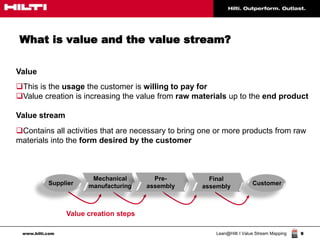
Value
This is the usage the customer is willing to pay for
Value creation is increasing the value from raw materials up to the end product
Value stream
Contains all activities that are necessary to bring one or more products from raw
materials into the form desired by the customer
Value creation steps
Customer
9
Supplier
Final
assembly
Pre-
assembly
Mechanical
manufacturing
www.hilti.com 10
Lean@Hilti I Value Stream Mapping
Process step
1
Process step
2
Process step
3
Process step
4
Process step
x
Chain of effects of value stream mapping
Concentration of value generation
Reduction of throughput time (TPT)
Value Waste
Higher
quality
Better
service
Improved
flexibility
Smaller
stocks
Reduced
complexity
Lower
costs
Customer Company
Process optimization with the support of the tool value stream mapping
From analysis to optimization:
www.hilti.com 11
Lean@Hilti I Value Stream Mapping 1
Agenda
1. Introduction
 Who are we?
 Spotting Waste within the value chain- activity
2. Value Stream Mapping– The theory
 Overview of Value Stream: “Why VSM” ?
 Map process : “AS IS”
 Highlight weaknesses & improvement opportunities
3. Examples of Value Stream Optimization
 Example 1
 Example 2
4. Value Stream Mapping simulation
 Game tbc
www.hilti.com 12
Lean@Hilti I Value Stream Mapping
Systematic optimization of a value stream
Process structure on the way to the target value stream
Zero line in project
AS-IS
value stream
analysis
Value stream
TO-BE 1
(Implementation
step 1 of x)
Quick wins first!
Taking restrictions
into consideration
Green field approach
(free of restrictions)
Uncovering
weaknesses
detached
AS-IS
value stream
mapping
Value stream
VISION
www.hilti.com 13
Lean@Hilti I Value Stream Mapping
VSM workshop – Brown-paper approach
www.hilti.com 14
Lean@Hilti I Value Stream Mapping
The weakness analysis follows the AS-IS map
www.hilti.com 15
Lean@Hilti I Value Stream Mapping 1
Agenda
1. Introduction
 Who are we?
 Spotting Waste within the value chain- activity
2. Value Stream Mapping– The theory
 Overview of Value Stream: “Why VSM” ?
 Map process : “AS IS”
 Highlight weaknesses & improvement opportunities
3. Examples of Value Stream Optimization
 Example 1
 Example 2
4. Value Stream Mapping simulation
 Game tbc
www.hilti.com 16
Lean@Hilti I Value Stream Mapping
Product Development
Project overview Key Improvements
Potential Impact
• A product requires development loops
Development  Prototyping  Assembly  Test
• The average development loop time is 6 weeks
• Teams can go through 30 loops in one project
• Identified key value creation points
• Identified 26 issues/wastes
• Created 10 solutions & implemented 8
• Eliminated ‘throwing over the wall’
communication, rework & firefighting
• ~30% time saving per dev. loop
• Created a communication platform with
clear roles & responsibilities confirming
development loop target, timeline
responsibilities, outcomes & learnings
• Created smoother flow of development
loops by creating a concurrent schedule
BEFORE
AFTER
6 Weeks
4 Weeks
www.hilti.com 17
Lean@Hilti I Value Stream Mapping 1
Agenda
1. Introduction
 Who are we?
 Spotting Waste within the value chain- activity
2. Value Stream Mapping– The theory
 Overview of Value Stream: “Why VSM” ?
 Map process : “AS IS”
 Highlight weaknesses & improvement opportunities
3. Examples of Value Stream Optimization
 Example 1
 Example 2
4. Value Stream Mapping simulation
 Current VS future state VSM
www.hilti.com 18
Lean@Hilti I Value Stream Mapping
Value Stream Mapping Game
October 2016
www.hilti.com 19
Lean@Hilti I Value Stream Mapping
Game structure
Architects
Design
Engineers
Check
Builders
Build
Max Time:
45 Minutes
www.hilti.com 20
Lean@Hilti I Value Stream Mapping
Game Structure – Steps
• Step 1: Orientation Together you need to build a tower
• Step 2: Setup Split group into 3 teams, put separator pinboards in between each team – handout
instruction sheets to each team (next page)
• Step 3: Play Observe & time how long each process takes. Game ends
• Step 4: Video (map) Show video on how to map the process
• Step 5: Map Together the team maps the entire process
• Step 6: Video (waste) Show video on identifying wastes in processes
• Step 7: Waste Individually each person writes red post-its of wastes observed
• Step 8: Vision state Together discuss how to create vision state
• Step 9: Run game again (optional) Play game again in new state
www.hilti.com 21
Lean@Hilti I Value Stream Mapping
Architects – Instructions
• Responsibilities
1. Receiving customer requirements
2. Designing the Marshmallow Tower
3. Communicating your design specifications to the Engineering group
• Customer Requirements:
• Customer wants the tallest possible spaghetti tower with a Marshmallow on top
• Measurement starts from the ground up to the Marshmallow
• 0-30cm: Poor customer satisfaction
• 30-40cm: Average customer satisfaction
• 50-60cm: Good customer satisfaction
• 60+cm: Great customer satisfaction
• Material Budget:
• 20 pieces of spaghetti
• 1 meter/yard of string
• 1 meter/yard of tape
• 1 marshmallow
• Communication rules:
• You are allowed to communicate only via paper
www.hilti.com 22
Lean@Hilti I Value Stream Mapping
Engineers – Instructions
• Responsibilities
1. Receiving design specifications from Architects
2. Checking design against structural requirements (example below)
3. Creating instructions on how to build the marshmallow tower (for the builders)
4. Communicating instructions to the builders
• Structural Requirements:
• Minimum 2 spaghetti sticks are required per column (vertical spaghetti not horizontal spaghetti)
• Minimum 3 cm wide tape required to connect any two parts
• Structure is not allowed to have support structure apart from the ground (no taping to table legs or walls)
• Eg:
• Communication rules:
• You are allowed to communicate only via paper
• You can only start your communication with architects after they start communicating with you
1cm
tape
3cm
tape
www.hilti.com 23
Lean@Hilti I Value Stream Mapping
Builders – Instructions
• Responsibilities
1. Testing structural capability (Test budget: of 1 marshmallow 10 spaghetti sticks, 50cm tape, 50cm string)
2. Receiving building instructions from Engineers
3. Checking building design & instructions against building requirements (below)
4. Building the Marshmallow Tower as per instructions
• Building Requirements:
• When using 2 pieces of spaghetti together – You need to use tape to connect them in the middle (see diagram)
• You can build the tower only as per Engineering instructions
• You need to get approval from Engineering if you want to modify the design or instructions
• Communication rules:
• You are allowed to communicate only via paper
• You can only start your communication with engineers after they start communicating with you
tape
spaghetti
www.hilti.com 24
Lean@Hilti I Value Stream Mapping
What can we remove?
What control steps can we limit?
What can we do concurrently?
How do handovers take place?
Are there any air gaps?
Is there information starvation?
Is there a skill bottleneck?
Are we repeating processes?
Questions to ask ourselves
24
www.hilti.com 25
Lean@Hilti I Value Stream Mapping
Backup
www.hilti.com 26
Lean@Hilti I Value Stream Mapping
Video?

Value Stream Mapping

  • 1.
    www.hilti.com 1 Lean@Hilti IValue Stream Mapping Value Stream Mapping October 2016
  • 2.
    www.hilti.com 2 Lean@Hilti IValue Stream Mapping 2 Agenda 1. Introduction & Expectations  Who are we? Who are you?  Spotting Waste within the value chain- activity 2. Value Stream Mapping– The theory  Overview of Value Stream: “Why VSM” ?  Map process : “AS IS”  Highlight weaknesses & improvement opportunities 3. Examples of Value Stream Optimization  Example 1  Example 2 4. Value Stream Mapping simulation  Game
  • 3.
    www.hilti.com 3 Lean@Hilti IValue Stream Mapping Who are we? Sofia Albohaithi Lean Manager Northern Europe Kostas Kefalakis Global Lean Manager
  • 4.
    www.hilti.com 4 Lean@Hilti IValue Stream Mapping Outcomes/ Expectations Key expectations
  • 5.
    www.hilti.com 5 Lean@Hilti IValue Stream Mapping Ball game - 5 General rules 1. Create a process to pass over the ball within your team (team of min. 5) 2. You can‘t pass the ball to the person next to you 3. Everybody in your team must have had contact to the ball 4. The ball must return to the person who started with it 5. The ball must travel through the air Kick-off round
  • 6.
    www.hilti.com 6 Lean@Hilti IValue Stream Mapping 6 Waste can be divided into 7 (+1) types Motion Over processing/unsuitable methods Transport/information transfer Over information/production Inventory Defects Waiting Unused potential
  • 7.
    www.hilti.com 7 Lean@Hilti IValue Stream Mapping An image instead of words… what’s going wrong? Functional Segmentation (Task bundling/ specialization/ spatial seperation/ department thinking) Media breaks and paper-based infos Push Connections (Lack of demand-orientation and lack of coordination) Big lots (Binder tradition) Serial Processing (In large lots with many interfaces)
  • 8.
    www.hilti.com 8 Lean@Hilti IValue Stream Mapping Uses and goals of value stream mapping (VSM) Added value of using value stream mapping  Holistic view - Process mapping from a bird’s eye view - Common process understanding  Redesign the value stream - Uncover weaknesses / potential - Alignment with LEAN principles - Restructuring the value chain  Increasing competitiveness - Reducing throughput time (TPT) - Increasing performance level
  • 9.
    www.hilti.com 9 Lean@Hilti IValue Stream Mapping What is value and the value stream? Value This is the usage the customer is willing to pay for Value creation is increasing the value from raw materials up to the end product Value stream Contains all activities that are necessary to bring one or more products from raw materials into the form desired by the customer Value creation steps Customer 9 Supplier Final assembly Pre- assembly Mechanical manufacturing
  • 10.
    www.hilti.com 10 Lean@Hilti IValue Stream Mapping Process step 1 Process step 2 Process step 3 Process step 4 Process step x Chain of effects of value stream mapping Concentration of value generation Reduction of throughput time (TPT) Value Waste Higher quality Better service Improved flexibility Smaller stocks Reduced complexity Lower costs Customer Company Process optimization with the support of the tool value stream mapping From analysis to optimization:
  • 11.
    www.hilti.com 11 Lean@Hilti IValue Stream Mapping 1 Agenda 1. Introduction  Who are we?  Spotting Waste within the value chain- activity 2. Value Stream Mapping– The theory  Overview of Value Stream: “Why VSM” ?  Map process : “AS IS”  Highlight weaknesses & improvement opportunities 3. Examples of Value Stream Optimization  Example 1  Example 2 4. Value Stream Mapping simulation  Game tbc
  • 12.
    www.hilti.com 12 Lean@Hilti IValue Stream Mapping Systematic optimization of a value stream Process structure on the way to the target value stream Zero line in project AS-IS value stream analysis Value stream TO-BE 1 (Implementation step 1 of x) Quick wins first! Taking restrictions into consideration Green field approach (free of restrictions) Uncovering weaknesses detached AS-IS value stream mapping Value stream VISION
  • 13.
    www.hilti.com 13 Lean@Hilti IValue Stream Mapping VSM workshop – Brown-paper approach
  • 14.
    www.hilti.com 14 Lean@Hilti IValue Stream Mapping The weakness analysis follows the AS-IS map
  • 15.
    www.hilti.com 15 Lean@Hilti IValue Stream Mapping 1 Agenda 1. Introduction  Who are we?  Spotting Waste within the value chain- activity 2. Value Stream Mapping– The theory  Overview of Value Stream: “Why VSM” ?  Map process : “AS IS”  Highlight weaknesses & improvement opportunities 3. Examples of Value Stream Optimization  Example 1  Example 2 4. Value Stream Mapping simulation  Game tbc
  • 16.
    www.hilti.com 16 Lean@Hilti IValue Stream Mapping Product Development Project overview Key Improvements Potential Impact • A product requires development loops Development  Prototyping  Assembly  Test • The average development loop time is 6 weeks • Teams can go through 30 loops in one project • Identified key value creation points • Identified 26 issues/wastes • Created 10 solutions & implemented 8 • Eliminated ‘throwing over the wall’ communication, rework & firefighting • ~30% time saving per dev. loop • Created a communication platform with clear roles & responsibilities confirming development loop target, timeline responsibilities, outcomes & learnings • Created smoother flow of development loops by creating a concurrent schedule BEFORE AFTER 6 Weeks 4 Weeks
  • 17.
    www.hilti.com 17 Lean@Hilti IValue Stream Mapping 1 Agenda 1. Introduction  Who are we?  Spotting Waste within the value chain- activity 2. Value Stream Mapping– The theory  Overview of Value Stream: “Why VSM” ?  Map process : “AS IS”  Highlight weaknesses & improvement opportunities 3. Examples of Value Stream Optimization  Example 1  Example 2 4. Value Stream Mapping simulation  Current VS future state VSM
  • 18.
    www.hilti.com 18 Lean@Hilti IValue Stream Mapping Value Stream Mapping Game October 2016
  • 19.
    www.hilti.com 19 Lean@Hilti IValue Stream Mapping Game structure Architects Design Engineers Check Builders Build Max Time: 45 Minutes
  • 20.
    www.hilti.com 20 Lean@Hilti IValue Stream Mapping Game Structure – Steps • Step 1: Orientation Together you need to build a tower • Step 2: Setup Split group into 3 teams, put separator pinboards in between each team – handout instruction sheets to each team (next page) • Step 3: Play Observe & time how long each process takes. Game ends • Step 4: Video (map) Show video on how to map the process • Step 5: Map Together the team maps the entire process • Step 6: Video (waste) Show video on identifying wastes in processes • Step 7: Waste Individually each person writes red post-its of wastes observed • Step 8: Vision state Together discuss how to create vision state • Step 9: Run game again (optional) Play game again in new state
  • 21.
    www.hilti.com 21 Lean@Hilti IValue Stream Mapping Architects – Instructions • Responsibilities 1. Receiving customer requirements 2. Designing the Marshmallow Tower 3. Communicating your design specifications to the Engineering group • Customer Requirements: • Customer wants the tallest possible spaghetti tower with a Marshmallow on top • Measurement starts from the ground up to the Marshmallow • 0-30cm: Poor customer satisfaction • 30-40cm: Average customer satisfaction • 50-60cm: Good customer satisfaction • 60+cm: Great customer satisfaction • Material Budget: • 20 pieces of spaghetti • 1 meter/yard of string • 1 meter/yard of tape • 1 marshmallow • Communication rules: • You are allowed to communicate only via paper
  • 22.
    www.hilti.com 22 Lean@Hilti IValue Stream Mapping Engineers – Instructions • Responsibilities 1. Receiving design specifications from Architects 2. Checking design against structural requirements (example below) 3. Creating instructions on how to build the marshmallow tower (for the builders) 4. Communicating instructions to the builders • Structural Requirements: • Minimum 2 spaghetti sticks are required per column (vertical spaghetti not horizontal spaghetti) • Minimum 3 cm wide tape required to connect any two parts • Structure is not allowed to have support structure apart from the ground (no taping to table legs or walls) • Eg: • Communication rules: • You are allowed to communicate only via paper • You can only start your communication with architects after they start communicating with you 1cm tape 3cm tape
  • 23.
    www.hilti.com 23 Lean@Hilti IValue Stream Mapping Builders – Instructions • Responsibilities 1. Testing structural capability (Test budget: of 1 marshmallow 10 spaghetti sticks, 50cm tape, 50cm string) 2. Receiving building instructions from Engineers 3. Checking building design & instructions against building requirements (below) 4. Building the Marshmallow Tower as per instructions • Building Requirements: • When using 2 pieces of spaghetti together – You need to use tape to connect them in the middle (see diagram) • You can build the tower only as per Engineering instructions • You need to get approval from Engineering if you want to modify the design or instructions • Communication rules: • You are allowed to communicate only via paper • You can only start your communication with engineers after they start communicating with you tape spaghetti
  • 24.
    www.hilti.com 24 Lean@Hilti IValue Stream Mapping What can we remove? What control steps can we limit? What can we do concurrently? How do handovers take place? Are there any air gaps? Is there information starvation? Is there a skill bottleneck? Are we repeating processes? Questions to ask ourselves 24
  • 25.
    www.hilti.com 25 Lean@Hilti IValue Stream Mapping Backup
  • 26.
    www.hilti.com 26 Lean@Hilti IValue Stream Mapping Video?

Editor's Notes