Supply Chain and Value Chain Management
Basic principles
Strategic Decisions
Profit Margin
• Value Created and Captured – Cost
of Creating that Value = Margin
Competitive strategy, CS
• Understanding how your company
creates value, and looking for ways
to add more value – critical to
develop CS
Value chain
• A set of activities that an
organization carries out to create
value for its customers.
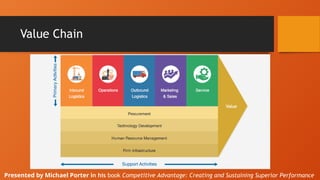
Value Chain
Presented by Michael Porter in his book Competitive Advantage: Creating and Sustaining Superior Performance
Primary
Activities
Inbound logistics –Processes related to receiving, storing, and
distributing inputs internally. Your supplier relationships are a key
factor in creating value here.
Operations –Transformation activities that change inputs into
outputs that are sold to customers. Here, operational systems
create value.
Outbound logistics –Deliver your product or service to your
customer. E.g. collection, storage, and distribution systems
Marketing and sales –Processes used to persuade clients to
purchase from you instead of your competitors. The benefits you
offer, and how well you communicate them, are sources of value
here.
Service –Activities related to maintaining the value of your
product or service to your customers, once it's been purchased.
Support
Activities
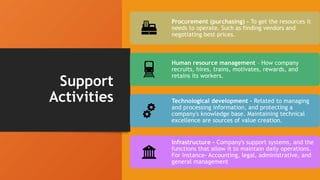
Procurement (purchasing) – To get the resources it
needs to operate. Such as finding vendors and
negotiating best prices.
Human resource management – How company
recruits, hires, trains, motivates, rewards, and
retains its workers.
Technological development – Related to managing
and processing information, and protecting a
company's knowledge base. Maintaining technical
excellence are sources of value creation.
Infrastructure – Company's support systems, and the
functions that allow it to maintain daily operations.
For instance- Accounting, legal, administrative, and
general management
Using
Porter's
Value Chain
Step 1 – Identify sub-activities for
each primary activity
Step 2 – Identify sub-activities for
each support activity.
Step 3 – Identify links between
different activities
Step 4 – Look for opportunities to
increase value
Using Porter's Value Chain
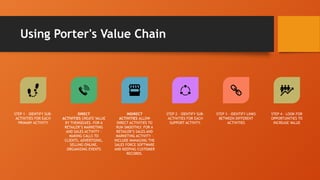
STEP 1 – IDENTIFY SUB-
ACTIVITIES FOR EACH
PRIMARY ACTIVITY
DIRECT
ACTIVITIES CREATE VALUE
BY THEMSELVES. FOR A
RETAILER’S MARKETING
AND SALES ACTIVITY -
MAKING CALLS TO
CLIENTS, ADVERTISING,
SELLING ONLINE,
ORGANIZING EVENTS
INDIRECT
ACTIVITIES ALLOW
DIRECT ACTIVITIES TO
RUN SMOOTHLY. FOR A
RETAILER’S SALES AND
MARKETING ACTIVITY -
INCLUDE MANAGING THE
SALES FORCE SOFTWARE
AND KEEPING CUSTOMER
RECORDS.
STEP 2 – IDENTIFY SUB-
ACTIVITIES FOR EACH
SUPPORT ACTIVITY.
STEP 3 – IDENTIFY LINKS
BETWEEN DIFFERENT
ACTIVITIES
STEP 4 – LOOK FOR
OPPORTUNITIES TO
INCREASE VALUE
Supply Chain
• Characterized by
• short product life cycles
• unpredictable customer demands
• tremendous product variety
• labor-intensive production
• long supply processes
• Complex decision making
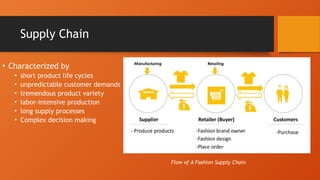
Flow of A Fashion Supply Chain
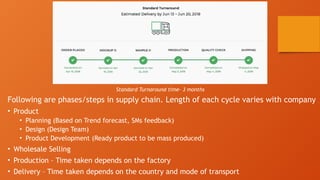
Following are phases/steps in supply chain. Length of each cycle varies with company
• Product
• Planning (Based on Trend forecast, SMs feedback)
• Design (Design Team)
• Product Development (Ready product to be mass produced)
• Wholesale Selling
• Production – Time taken depends on the factory
• Delivery – Time taken depends on the country and mode of transport
Standard Turnaround time- 3 months
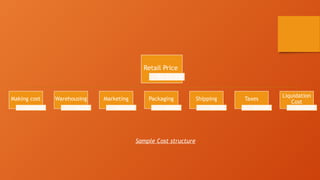
Retail Price
Rs.10,000
Making cost
Rs.1,500
Warehousing
Rs.500
Marketing
Rs.3,000
Packaging
Rs.500
Shipping
Rs.500
Taxes
Rs.1000
Liquidation
Cost
Rs.3,000
Sample Cost structure
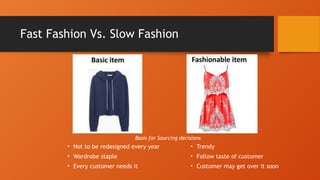
Fast Fashion Vs. Slow Fashion
• Not to be redesigned every year
• Wardrobe staple
• Every customer needs it
• Trendy
• Follow taste of customer
• Customer may get over it soon
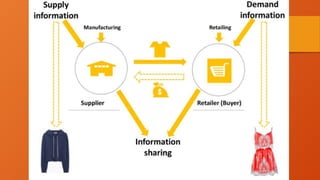
Basis for Sourcing decisions
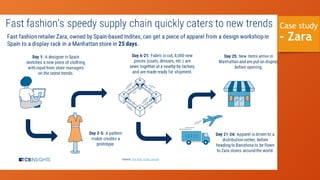
Case study
- Zara
supplychainandvaluechainmanagementbasicprinciples-221002114851-f406fec2.pptx

supplychainandvaluechainmanagementbasicprinciples-221002114851-f406fec2.pptx

  • 1.
    Supply Chain andValue Chain Management Basic principles
  • 2.
    Strategic Decisions Profit Margin •Value Created and Captured – Cost of Creating that Value = Margin Competitive strategy, CS • Understanding how your company creates value, and looking for ways to add more value – critical to develop CS Value chain • A set of activities that an organization carries out to create value for its customers.
  • 3.
    Value Chain Presented byMichael Porter in his book Competitive Advantage: Creating and Sustaining Superior Performance
  • 4.
    Primary Activities Inbound logistics –Processesrelated to receiving, storing, and distributing inputs internally. Your supplier relationships are a key factor in creating value here. Operations –Transformation activities that change inputs into outputs that are sold to customers. Here, operational systems create value. Outbound logistics –Deliver your product or service to your customer. E.g. collection, storage, and distribution systems Marketing and sales –Processes used to persuade clients to purchase from you instead of your competitors. The benefits you offer, and how well you communicate them, are sources of value here. Service –Activities related to maintaining the value of your product or service to your customers, once it's been purchased.
  • 5.
    Support Activities Procurement (purchasing) –To get the resources it needs to operate. Such as finding vendors and negotiating best prices. Human resource management – How company recruits, hires, trains, motivates, rewards, and retains its workers. Technological development – Related to managing and processing information, and protecting a company's knowledge base. Maintaining technical excellence are sources of value creation. Infrastructure – Company's support systems, and the functions that allow it to maintain daily operations. For instance- Accounting, legal, administrative, and general management
  • 6.
    Using Porter's Value Chain Step 1– Identify sub-activities for each primary activity Step 2 – Identify sub-activities for each support activity. Step 3 – Identify links between different activities Step 4 – Look for opportunities to increase value
  • 7.
    Using Porter's ValueChain STEP 1 – IDENTIFY SUB- ACTIVITIES FOR EACH PRIMARY ACTIVITY DIRECT ACTIVITIES CREATE VALUE BY THEMSELVES. FOR A RETAILER’S MARKETING AND SALES ACTIVITY - MAKING CALLS TO CLIENTS, ADVERTISING, SELLING ONLINE, ORGANIZING EVENTS INDIRECT ACTIVITIES ALLOW DIRECT ACTIVITIES TO RUN SMOOTHLY. FOR A RETAILER’S SALES AND MARKETING ACTIVITY - INCLUDE MANAGING THE SALES FORCE SOFTWARE AND KEEPING CUSTOMER RECORDS. STEP 2 – IDENTIFY SUB- ACTIVITIES FOR EACH SUPPORT ACTIVITY. STEP 3 – IDENTIFY LINKS BETWEEN DIFFERENT ACTIVITIES STEP 4 – LOOK FOR OPPORTUNITIES TO INCREASE VALUE
  • 8.
    Supply Chain • Characterizedby • short product life cycles • unpredictable customer demands • tremendous product variety • labor-intensive production • long supply processes • Complex decision making Flow of A Fashion Supply Chain
  • 9.
    Following are phases/stepsin supply chain. Length of each cycle varies with company • Product • Planning (Based on Trend forecast, SMs feedback) • Design (Design Team) • Product Development (Ready product to be mass produced) • Wholesale Selling • Production – Time taken depends on the factory • Delivery – Time taken depends on the country and mode of transport Standard Turnaround time- 3 months
  • 10.
  • 11.
    Fast Fashion Vs.Slow Fashion • Not to be redesigned every year • Wardrobe staple • Every customer needs it • Trendy • Follow taste of customer • Customer may get over it soon Basis for Sourcing decisions
  • 13.

Editor's Notes

  • #3 https://www.smstudy.com/article/what-is-value-chain-analysis
  • #4 Primary activities relate directly to the physical creation, sale, maintenance and support of a product or service.  Inbound logistics – These are all the processes related to receiving, storing, and distributing inputs internally. Your supplier relationships are a key factor in creating value here. Operations – These are the transformation activities that change inputs into outputs that are sold to customers. Here, your operational systems create value. Outbound logistics – These activities deliver your product or service to your customer. These are things like collection, storage, and distribution systems, and they may be internal or external to your organization. Marketing and sales – These are the processes you use to persuade clients to purchase from you instead of your competitors. The benefits you offer, and how well you communicate them, are sources of value here. Service – These are the activities related to maintaining the value of your product or service to your customers, once it's been purchased.
  • #5 Support Activities These activities support the primary functions above. In our diagram, the dotted lines show that each support, or secondary, activity can play a role in each primary activity. For example, procurement supports operations with certain activities, but it also supports marketing and sales with other activities. Procurement (purchasing) – This is what the organization does to get the resources it needs to operate. This includes finding vendors and negotiating best prices. Human resource management – This is how well a company recruits, hires, trains, motivates, rewards, and retains its workers. People are a significant source of value, so businesses can create a clear advantage with good HR practices. Technological development – These activities relate to managing and processing information, as well as protecting a company's knowledge base. Minimizing information technology costs, staying current with technological advances, and maintaining technical excellence are sources of value creation. Infrastructure – These are a company's support systems, and the functions that allow it to maintain daily operations. Accounting, legal, administrative, and general management are examples of necessary infrastructure that businesses can use to their advantage.
  • #6 https://www.mindtools.com/pages/article/newSTR_66.htm
  • #7 https://www.mindtools.com/pages/article/newSTR_66.htm
  • #8 https://www.mindtools.com/pages/article/newSTR_66.htm
  • #9 The fashion supply chain is characterized by short product life cycles, volatile and unpredictable customer demands, tremendous product variety, labor-intensive production, and long supply processes. These distinct features increase the complexity of decision making in the fashion supply chain. Picture description- https://www.publichabit.com/blogs/publicknowledge/crash-course-on-fashion-supply-chain
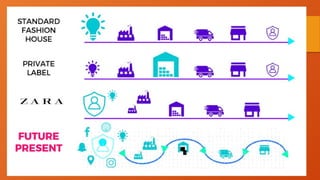
  • #10 A traditional supply chain turnaround used to be a year, it reduced to 6 months and then 3 months. (Picture explanation- https://medium.com/@Ignition_Partners/giving-apparel-its-2-0-moment-the-studios-digital-transformation-of-fashion-supply-chain-6c8f9dbcd2da ) A fashion guru or best-in-class designer (e.g. Anne Wintour, Alessandro Michele) creates the collection. The artistic insights are key, and Operations accross the value chain try to optimize each process according to last season sales/forecast. The customer will receive what the Brand is producing. Customers are the last participants on the value chain.
  • #11 Cost structure for a garment to be exported to another country https://www.publichabit.com/blogs/publicknowledge/crash-course-on-fashion-supply-chain
  • #12 https://blog.procurify.com/2016/10/24/supply-chain-beats-zara-spend-culture/
  • #14 Case study- https://www.scmglobe.com/zara-clothing-company-supply-chain/ Picture Source: https://www.cbinsights.com/research/zara-apparel-supply-chain/
  • #15 Explanation- https://fashionretail.blog/2017/09/05/the-fashion-retail-value-chain-evolution/