48 SPOT THEM
V
alletta, Malta’s capital city, is no
stranger to being written about
and there’s good reason for that.
Recognised as a World Heritage
Site by UNESCO since 1980, Valletta
was built in the 16th century during the
time of the Order of St John, and named
after Grand Master La Valette, who lay
the first stone, but didn’t live to see the
finished result of the city.
The city’s history is well documented in
various books and websites, and visitors
flock to it on a daily basis – locals are
mainly there to work and shop, but
tourists grab the opportunity to walk
through its streets steeped in history
and culture.
Although there are features to attract
your attention at eye-level while walking
through Valletta, it also happens to be
one of those cities that retains many
fascinating stories at a higher level, so
looking up and around is recommended
if you want to catch some interesting and
quirky elements.
This occurred to me one day when I
was idly strolling through the main
thoroughfare of Republic Street and
happened to cast my eye on a plaque
upon which was inscribed the name of
a very famous English poet – Samuel
Taylor Coleridge, one of the founders of
the Romantic movement in literature.
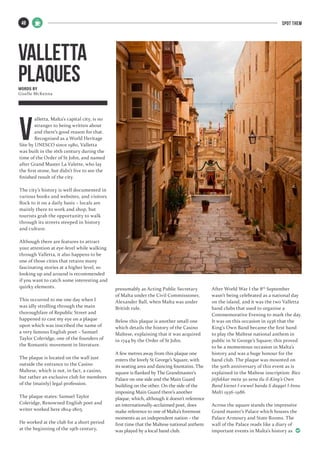
The plaque is located on the wall just
outside the entrance to the Casino
Maltese, which is not, in fact, a casino,
but rather an exclusive club for members
of the (mainly) legal profession.
The plaque states: Samuel Taylor
Coleridge, Renowned English poet and
writer worked here 1804-1805.
He worked at the club for a short period
at the beginning of the 19th century,
VALLETTA
PLAQUES
presumably as Acting Public Secretary
of Malta under the Civil Commissioner,
Alexander Ball, when Malta was under
British rule.
Below this plaque is another small one
which details the history of the Casino
Maltese, explaining that it was acquired
in 1744 by the Order of St John.
A few metres away from this plaque one
enters the lovely St George’s Square, with
its seating area and dancing fountains. The
square is flanked by The Grandmaster’s
Palace on one side and the Main Guard
building on the other. On the side of the
imposing Main Guard there’s another
plaque, which, although it doesn’t reference
an internationally-acclaimed poet, does
make reference to one of Malta’s foremost
moments as an independent nation – the
first time that the Maltese national anthem
was played by a local band club.
After World War I the 8th
September
wasn’t being celebrated as a national day
on the island, and it was the two Valletta
band clubs that used to organise a
Commemorative Evening to mark the day.
It was on this occasion in 1936 that the
King’s Own Band became the first band
to play the Maltese national anthem in
public in St George’s Square; this proved
to be a momentous occasion in Malta’s
history and was a huge honour for the
band club. The plaque was mounted on
the 50th anniversary of this event as is
explained in the Maltese inscription: Biex
jitfakkar meta 50 sena ilu il-King’s Own
Band kienet l-ewwel banda li daqqet l-Innu
Malti 1936-1986.
Across the square stands the impressive
Grand master’s Palace which houses the
Palace Armoury and State Rooms. The
wall of the Palace reads like a diary of
important events in Malta’s history as
WORDS BY
Giselle McKenna
50 SPOT THEM
there are several plaques, each of which
represent a significant occasion.
Starting with the oldest – a short
inscription of a letter received from King
George VI, the reigning monarch of the
time in 1942. The letter is addressed to
the governor, Lieutenant-General Sir
William Dobbie, awarding the George
Cross (a medal that is awarded only for
acts of great heroism or conspicuous
courage) to the island of Malta 'to bear
witness to the heroism and devotion' of its
people. This was a momentous moment
for Malta and its people, and the George
Cross was embroidered into the national
flag to recognise its importance.
Following that is an inscribed scroll,
with a citation from United States
President Franklin D Roosevelt speaking
on behalf of the people of the US, about
their admiration for Malta’s contribution
to democracy; the scroll was presented
by the President when he visited Malta
in December 1943. A particularly
poignant phrase reads, 'Under repeated
fire from the skies, Malta stood alone but
unafraid in the center of the sea, one tiny
bright flame in the darkness – a beacon
of hope for the clearer days which have
come.' The scroll was dated December
7, 1943, to mark the second anniversary
of the US’s entry into World War II. The
original scroll is held at the National
Library in Valletta.
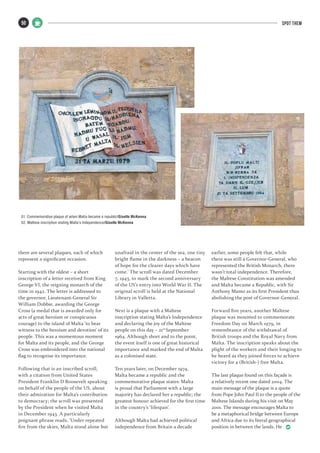
Next is a plaque with a Maltese
inscription stating Malta’s Independence
and declaring the joy of the Maltese
people on this day – 21st
September
1964. Although short and to the point,
the event itself is one of great historical
importance and marked the end of Malta
as a colonised state.
Ten years later, on December 1974,
Malta became a republic and the
commemorative plaque states: Malta
is proud that Parliament with a large
majority has declared her a republic; the
greatest honour achieved for the first time
in the country’s ‘lifespan’.
Although Malta had achieved political
independence from Britain a decade
earlier, some people felt that, while
there was still a Governor-General, who
represented the British Monarch, there
wasn’t total independence. Therefore,
the Maltese Constitution was amended
and Malta became a Republic, with Sir
Anthony Mamo as its first President thus
abolishing the post of Governor-General.
Forward five years, another Maltese
plaque was mounted to commemorate
Freedom Day on March 1979, in
remembrance of the withdrawal of
British troops and the Royal Navy from
Malta. The inscription speaks about the
plight of the workers and their longing to
be heard as they joined forces to achieve
victory for a (British-) free Malta.
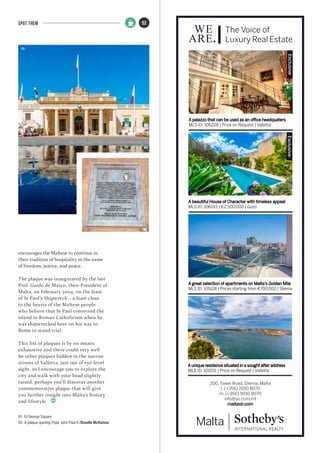
The last plaque found on this façade is
a relatively recent one dated 2004. The
main message of the plaque is a quote
from Pope John Paul II to the people of the
Maltese Islands during his visit on May
2001. The message encourages Malta to
be a metaphorical bridge between Europe
and Africa due to its literal geographical
position in between the lands. He
01. Commemorative plaque of when Malta became a republic/Giselle McKenna
02. Maltese inscription stating Malta’s Independence/Giselle McKenna
01
02
A palazzo that can be used as an office headquaters
MLS ID: 106228 | Price on Request | Valletta
200, Tower Road, Sliema, Malta
t. (+356) 2010 8070
m. (+356) 9910 8070
info@sir.com.mt
maltasir.com
The Voice of
Luxury Real Estate
A beautiful House of Character with timeless appeal
MLS ID: 106193 | €2,500,000 | Gozo
A great selection of apartments on Malta’s Golden Mile
MLS ID: 105124 | Prices starting from €700,000 | Sliema
A unique residence situated in a sought after address
MLS ID: 101031 | Price on Request | Valletta
ExclusiveExclusive
53SPOT THEM
encourages the Maltese to continue in
their tradition of hospitality in the name
of freedom, justice, and peace.
The plaque was inaugurated by the late
Prof. Guido de Marco, then-President of
Malta, on February 2004, on the feast
of St Paul’s Shipwreck – a feast close
to the hearts of the Maltese people
who believe that St Paul converted the
island to Roman Catholicism when he
was shipwrecked here on his way to
Rome to stand trial.
This list of plaques is by no means
exhaustive and there could very well
be other plaques hidden in the narrow
streets of Valletta, just out of eye-level
sight, so I encourage you to explore the
city and walk with your head slightly
raised, perhaps you’ll discover another
commemorative plaque that will give
you further insight into Malta’s history
and lifestyle.
01. St George Square
02. A plaque quoting Pope John Paul II /Giselle McKenna
01
02

Valletta Plaques - November 2016

  • 1.
    48 SPOT THEM V alletta,Malta’s capital city, is no stranger to being written about and there’s good reason for that. Recognised as a World Heritage Site by UNESCO since 1980, Valletta was built in the 16th century during the time of the Order of St John, and named after Grand Master La Valette, who lay the first stone, but didn’t live to see the finished result of the city. The city’s history is well documented in various books and websites, and visitors flock to it on a daily basis – locals are mainly there to work and shop, but tourists grab the opportunity to walk through its streets steeped in history and culture. Although there are features to attract your attention at eye-level while walking through Valletta, it also happens to be one of those cities that retains many fascinating stories at a higher level, so looking up and around is recommended if you want to catch some interesting and quirky elements. This occurred to me one day when I was idly strolling through the main thoroughfare of Republic Street and happened to cast my eye on a plaque upon which was inscribed the name of a very famous English poet – Samuel Taylor Coleridge, one of the founders of the Romantic movement in literature. The plaque is located on the wall just outside the entrance to the Casino Maltese, which is not, in fact, a casino, but rather an exclusive club for members of the (mainly) legal profession. The plaque states: Samuel Taylor Coleridge, Renowned English poet and writer worked here 1804-1805. He worked at the club for a short period at the beginning of the 19th century, VALLETTA PLAQUES presumably as Acting Public Secretary of Malta under the Civil Commissioner, Alexander Ball, when Malta was under British rule. Below this plaque is another small one which details the history of the Casino Maltese, explaining that it was acquired in 1744 by the Order of St John. A few metres away from this plaque one enters the lovely St George’s Square, with its seating area and dancing fountains. The square is flanked by The Grandmaster’s Palace on one side and the Main Guard building on the other. On the side of the imposing Main Guard there’s another plaque, which, although it doesn’t reference an internationally-acclaimed poet, does make reference to one of Malta’s foremost moments as an independent nation – the first time that the Maltese national anthem was played by a local band club. After World War I the 8th September wasn’t being celebrated as a national day on the island, and it was the two Valletta band clubs that used to organise a Commemorative Evening to mark the day. It was on this occasion in 1936 that the King’s Own Band became the first band to play the Maltese national anthem in public in St George’s Square; this proved to be a momentous occasion in Malta’s history and was a huge honour for the band club. The plaque was mounted on the 50th anniversary of this event as is explained in the Maltese inscription: Biex jitfakkar meta 50 sena ilu il-King’s Own Band kienet l-ewwel banda li daqqet l-Innu Malti 1936-1986. Across the square stands the impressive Grand master’s Palace which houses the Palace Armoury and State Rooms. The wall of the Palace reads like a diary of important events in Malta’s history as WORDS BY Giselle McKenna
  • 2.
    50 SPOT THEM thereare several plaques, each of which represent a significant occasion. Starting with the oldest – a short inscription of a letter received from King George VI, the reigning monarch of the time in 1942. The letter is addressed to the governor, Lieutenant-General Sir William Dobbie, awarding the George Cross (a medal that is awarded only for acts of great heroism or conspicuous courage) to the island of Malta 'to bear witness to the heroism and devotion' of its people. This was a momentous moment for Malta and its people, and the George Cross was embroidered into the national flag to recognise its importance. Following that is an inscribed scroll, with a citation from United States President Franklin D Roosevelt speaking on behalf of the people of the US, about their admiration for Malta’s contribution to democracy; the scroll was presented by the President when he visited Malta in December 1943. A particularly poignant phrase reads, 'Under repeated fire from the skies, Malta stood alone but unafraid in the center of the sea, one tiny bright flame in the darkness – a beacon of hope for the clearer days which have come.' The scroll was dated December 7, 1943, to mark the second anniversary of the US’s entry into World War II. The original scroll is held at the National Library in Valletta. Next is a plaque with a Maltese inscription stating Malta’s Independence and declaring the joy of the Maltese people on this day – 21st September 1964. Although short and to the point, the event itself is one of great historical importance and marked the end of Malta as a colonised state. Ten years later, on December 1974, Malta became a republic and the commemorative plaque states: Malta is proud that Parliament with a large majority has declared her a republic; the greatest honour achieved for the first time in the country’s ‘lifespan’. Although Malta had achieved political independence from Britain a decade earlier, some people felt that, while there was still a Governor-General, who represented the British Monarch, there wasn’t total independence. Therefore, the Maltese Constitution was amended and Malta became a Republic, with Sir Anthony Mamo as its first President thus abolishing the post of Governor-General. Forward five years, another Maltese plaque was mounted to commemorate Freedom Day on March 1979, in remembrance of the withdrawal of British troops and the Royal Navy from Malta. The inscription speaks about the plight of the workers and their longing to be heard as they joined forces to achieve victory for a (British-) free Malta. The last plaque found on this façade is a relatively recent one dated 2004. The main message of the plaque is a quote from Pope John Paul II to the people of the Maltese Islands during his visit on May 2001. The message encourages Malta to be a metaphorical bridge between Europe and Africa due to its literal geographical position in between the lands. He 01. Commemorative plaque of when Malta became a republic/Giselle McKenna 02. Maltese inscription stating Malta’s Independence/Giselle McKenna 01 02
  • 3.
    A palazzo thatcan be used as an office headquaters MLS ID: 106228 | Price on Request | Valletta 200, Tower Road, Sliema, Malta t. (+356) 2010 8070 m. (+356) 9910 8070 info@sir.com.mt maltasir.com The Voice of Luxury Real Estate A beautiful House of Character with timeless appeal MLS ID: 106193 | €2,500,000 | Gozo A great selection of apartments on Malta’s Golden Mile MLS ID: 105124 | Prices starting from €700,000 | Sliema A unique residence situated in a sought after address MLS ID: 101031 | Price on Request | Valletta ExclusiveExclusive 53SPOT THEM encourages the Maltese to continue in their tradition of hospitality in the name of freedom, justice, and peace. The plaque was inaugurated by the late Prof. Guido de Marco, then-President of Malta, on February 2004, on the feast of St Paul’s Shipwreck – a feast close to the hearts of the Maltese people who believe that St Paul converted the island to Roman Catholicism when he was shipwrecked here on his way to Rome to stand trial. This list of plaques is by no means exhaustive and there could very well be other plaques hidden in the narrow streets of Valletta, just out of eye-level sight, so I encourage you to explore the city and walk with your head slightly raised, perhaps you’ll discover another commemorative plaque that will give you further insight into Malta’s history and lifestyle. 01. St George Square 02. A plaque quoting Pope John Paul II /Giselle McKenna 01 02