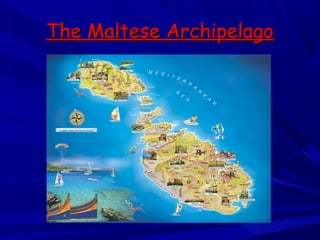
The Maltese Archipelago
GENERAL INFORMATION……
Malta , Gozo and Comino are 3 islands situated
in the middle of the mediterranean sea , exactly
under Sicily .
Malta is 17.5miles (28.2km) long and 8.3 miles
(13.4km) wide .
Gozo is 5 miles (8km) distant from Malta .It is
9miles(14.5km) long and 4.5miles(7.2km) wide.
Comino is 1mile squared (2.5km squared )
……more
The population is around 400,000 .
We have a pretty hot climate , unlike other
countries , snow is never seen in Malta  . The
highest temperature ever recorded in Malta is
+43.8c , whilst the lowest is 1.5 c .
We are Catholics and was introduced in Malta
by Saint Paul when he was shipwrecked on
these islands around 60 after Christ .
We have 2 main languages : Maltese & English .
THE FLAG
     The cross on the
     white part of the flag
     is the George Cross .
     It was given to Malta
     by King George VI for
     the “heroism showed
     by the Maltese
     population” when it
     resisted German and
     Italian attacks in
     World War II.
Some History
        Man first arrived in Malta
        around 5200BC probably from
        nearby Sicily.

        Prior to 1964 when we
        obtained our independence
        Malta was invaded and ruled
        by various empires , including :
        Arabs , Romans , Normans ,
        French , British and others .
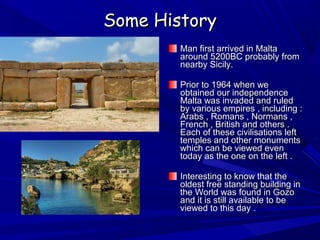
        Each of these civilisations left
        temples and other monuments
        which can be viewed even
        today as the one on the left .

        Interesting to know that the
        oldest free standing building in
        the World was found in Gozo
        and it is still available to be
        viewed to this day .
OLD CAPITAL CITY
The old capital of Malta is Mdina. It is an interesting and typical medieval
town situated in the centre of the island. The "Silent City", as it is also
known, commands a magnificent view of the Island and although it is fully
inhabited, silence reigns supreme.

It is thought to have been first populated by the Phoenicians around 1000
BC. When Malta came under the Romans, the Governor chose to build his
Palace there and it housed the government. The city earned its present day
name from the Saracens who came to Malta around 870 AD. They
surrounded the city with thicker walls, separating it from its nearest town,
Rabat.

Today, mercifully it is mainly off limits to cars and there is a calming
atmosphere as you walk along its narrow streets and ways, passing by
some of the best Norman and Baroque architecture on the island. Several
Palaces are situated here, most serving as private homes. The Cathedral is
worth visiting and is fronted by a large square, the only open space you'll
find.
OUR CAPITAL CITY: VALLETTA
Valletta has many titles, all recalling its rich historical past. It is the "modern" city built
by the Knights of St John; a masterpiece of the baroque; a European Art City; and a
World Heritage City. But these are just some of its faces and fortunes.

Valletta is also Malta's capital city: a living, working city, the administrative and
commercial heart of the Islands. Nowhere in Malta is the life of the Islands reflected
more than here. The city is busy by day, yet retains a timeless atmosphere. The grid
of narrow streets house some of Europe's finest art works, churches and palaces.
OUR CAPITAL CITY: VALLETTA


Valletta hosts a vast cultural programme. Street events are staged
against the city's magnificent baroque architecture and floodlit
bastions. There is theatre and music and all manner of things to see
and join in, from avant garde art to traditional church festas. The city
is a delight to shop in: narrow side streets are full of tiny shops
selling antiques, maps, books, prints and jewellery.

Walking around Valletta, you'll come across an intriguing historical
site around every corner: votive statues, niches, fountains and coats
of arms high up on parapets. And when you need to stop and take it
all in, the city yields up squares, courtyards, gardens and any
number of cafés, right on cue.
OUR TOWN: GŻIRA
OUR SCHOOL: ST CLARE COLLEGE
       GZIRA PRIMARY
THE END!

Malta

  • 1.
  • 2.
    GENERAL INFORMATION…… Malta ,Gozo and Comino are 3 islands situated in the middle of the mediterranean sea , exactly under Sicily . Malta is 17.5miles (28.2km) long and 8.3 miles (13.4km) wide . Gozo is 5 miles (8km) distant from Malta .It is 9miles(14.5km) long and 4.5miles(7.2km) wide. Comino is 1mile squared (2.5km squared )
  • 3.
    ……more The population isaround 400,000 . We have a pretty hot climate , unlike other countries , snow is never seen in Malta  . The highest temperature ever recorded in Malta is +43.8c , whilst the lowest is 1.5 c . We are Catholics and was introduced in Malta by Saint Paul when he was shipwrecked on these islands around 60 after Christ . We have 2 main languages : Maltese & English .
  • 4.
    THE FLAG The cross on the white part of the flag is the George Cross . It was given to Malta by King George VI for the “heroism showed by the Maltese population” when it resisted German and Italian attacks in World War II.
  • 5.
    Some History Man first arrived in Malta around 5200BC probably from nearby Sicily. Prior to 1964 when we obtained our independence Malta was invaded and ruled by various empires , including : Arabs , Romans , Normans , French , British and others . Each of these civilisations left temples and other monuments which can be viewed even today as the one on the left . Interesting to know that the oldest free standing building in the World was found in Gozo and it is still available to be viewed to this day .
  • 6.
    OLD CAPITAL CITY Theold capital of Malta is Mdina. It is an interesting and typical medieval town situated in the centre of the island. The "Silent City", as it is also known, commands a magnificent view of the Island and although it is fully inhabited, silence reigns supreme. It is thought to have been first populated by the Phoenicians around 1000 BC. When Malta came under the Romans, the Governor chose to build his Palace there and it housed the government. The city earned its present day name from the Saracens who came to Malta around 870 AD. They surrounded the city with thicker walls, separating it from its nearest town, Rabat. Today, mercifully it is mainly off limits to cars and there is a calming atmosphere as you walk along its narrow streets and ways, passing by some of the best Norman and Baroque architecture on the island. Several Palaces are situated here, most serving as private homes. The Cathedral is worth visiting and is fronted by a large square, the only open space you'll find.
  • 7.
    OUR CAPITAL CITY:VALLETTA Valletta has many titles, all recalling its rich historical past. It is the "modern" city built by the Knights of St John; a masterpiece of the baroque; a European Art City; and a World Heritage City. But these are just some of its faces and fortunes. Valletta is also Malta's capital city: a living, working city, the administrative and commercial heart of the Islands. Nowhere in Malta is the life of the Islands reflected more than here. The city is busy by day, yet retains a timeless atmosphere. The grid of narrow streets house some of Europe's finest art works, churches and palaces.
  • 8.
    OUR CAPITAL CITY:VALLETTA Valletta hosts a vast cultural programme. Street events are staged against the city's magnificent baroque architecture and floodlit bastions. There is theatre and music and all manner of things to see and join in, from avant garde art to traditional church festas. The city is a delight to shop in: narrow side streets are full of tiny shops selling antiques, maps, books, prints and jewellery. Walking around Valletta, you'll come across an intriguing historical site around every corner: votive statues, niches, fountains and coats of arms high up on parapets. And when you need to stop and take it all in, the city yields up squares, courtyards, gardens and any number of cafés, right on cue.
  • 9.
  • 10.
    OUR SCHOOL: STCLARE COLLEGE GZIRA PRIMARY
  • 11.