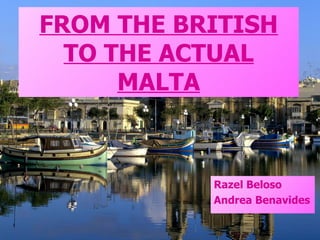
Razel Beloso  Andrea Benavides FROM THE BRITISH TO THE ACTUAL MALTA
Index Introduction
The French Occupation
A British Colony
Political Developments
The Second World War
Independence
British traditions in modern Malta
Tourism in Malta
INTRODUCTION Malta  is officially the  Republic of Malta,  it’s a Southern European country. It is one of the world's smallest and most densely populated countries.   The country has two official languages –  Maltese  and  English  – with  Maltese  being considered the national language.
THE FRENCH OCCUPATION On the 11th of June 1798 Napoleon occupied the Maltese islands. All possessions of the Knight's Order were confiscated by the French.   The french promised not to interfere with the church but convents were closed and church treasures were taken. And in the 2nd of September , the first uprising took place. Maltese rebels fought  the French people with the help of the British army. As a result, The French lost their control over the Maltese countryside.
A BRITISH   COLONY British rule from 1800 to 1964, radically and permanently transformed the language, culture and politics of Malta. Malta’s position in the British Empire was unique  because It didn’t come by conquest or by colonization, but at the voluntary request of the Maltese people. In the 19th century,  the opening of the Suez Canal further enhanced Malta's importance as a supply station . The Maltese economy depended heavily on the British navy, but most Maltese didn’t take much benefit from it. There was much poverty,especially among the rural population.
POLITICAL DEVELOPMENTS Since 1849 there was a Council of Government with a minority number of Maltese representatives. The new constitution of 1887 gave the elected members of the Council a majority, but in 1903 this was reverted.  The influence of the Maltese on politics remained , until the establishment of the Maltese parliament in 1921. The 30s were characterized by a very instable political situation, in which the constitution was suspended several times.
THE SECOND WORLD WAR During the Second World War, Malta, being a British base, was heavily targeted by both the Italians and the Germans. Especially Valletta. The Three Cities suffered a lot. The war brought the British and the Maltese closer to each other. On the 15th of April 1942 King George VI granted the George Cross to the Maltese population.
INDEPENDENCE After World War II in 1947, self government was introduced, and the independence was achieved in 1964. Malta remained in the Commonwealth and recognized the British Queen as head of state.  When Malta became a republic with its own president in 1974we. In 1979 the last British troops left the island.  The present Maltese government of Dr. Edward Fenech Adami, leader of the Nationalist Party, wants to join the European Union. The Labour opposition of Dr. Alfred Sant is against.
BRITISH TRADITIONS IN MODERN MALTA British traditions that live on in Malta include an efficient civil service, a military that is based on the British model, a Westminster-style parliamentary structure, a governmental structure premised on the rule of law, and a legal system based on common law. Another British legacy in Malta is the widely popular annual Christmas pantomime at the Manoel Theatre. Most Maltese families have adopted turkey and plum pudding as Christmas treats in place of the more traditional Maltese rooste and cassata.

Maltaaaaaaaaaaaa

  • 1.
    Razel Beloso Andrea Benavides FROM THE BRITISH TO THE ACTUAL MALTA
  • 2.
  • 3.
  • 4.
  • 5.
  • 6.
  • 7.
  • 8.
  • 9.
  • 10.
    INTRODUCTION Malta is officially the Republic of Malta, it’s a Southern European country. It is one of the world's smallest and most densely populated countries. The country has two official languages – Maltese and English – with Maltese being considered the national language.
  • 11.
    THE FRENCH OCCUPATIONOn the 11th of June 1798 Napoleon occupied the Maltese islands. All possessions of the Knight's Order were confiscated by the French. The french promised not to interfere with the church but convents were closed and church treasures were taken. And in the 2nd of September , the first uprising took place. Maltese rebels fought the French people with the help of the British army. As a result, The French lost their control over the Maltese countryside.
  • 12.
    A BRITISH COLONY British rule from 1800 to 1964, radically and permanently transformed the language, culture and politics of Malta. Malta’s position in the British Empire was unique because It didn’t come by conquest or by colonization, but at the voluntary request of the Maltese people. In the 19th century, the opening of the Suez Canal further enhanced Malta's importance as a supply station . The Maltese economy depended heavily on the British navy, but most Maltese didn’t take much benefit from it. There was much poverty,especially among the rural population.
  • 13.
    POLITICAL DEVELOPMENTS Since1849 there was a Council of Government with a minority number of Maltese representatives. The new constitution of 1887 gave the elected members of the Council a majority, but in 1903 this was reverted. The influence of the Maltese on politics remained , until the establishment of the Maltese parliament in 1921. The 30s were characterized by a very instable political situation, in which the constitution was suspended several times.
  • 14.
    THE SECOND WORLDWAR During the Second World War, Malta, being a British base, was heavily targeted by both the Italians and the Germans. Especially Valletta. The Three Cities suffered a lot. The war brought the British and the Maltese closer to each other. On the 15th of April 1942 King George VI granted the George Cross to the Maltese population.
  • 15.
    INDEPENDENCE After WorldWar II in 1947, self government was introduced, and the independence was achieved in 1964. Malta remained in the Commonwealth and recognized the British Queen as head of state. When Malta became a republic with its own president in 1974we. In 1979 the last British troops left the island. The present Maltese government of Dr. Edward Fenech Adami, leader of the Nationalist Party, wants to join the European Union. The Labour opposition of Dr. Alfred Sant is against.
  • 16.
    BRITISH TRADITIONS INMODERN MALTA British traditions that live on in Malta include an efficient civil service, a military that is based on the British model, a Westminster-style parliamentary structure, a governmental structure premised on the rule of law, and a legal system based on common law. Another British legacy in Malta is the widely popular annual Christmas pantomime at the Manoel Theatre. Most Maltese families have adopted turkey and plum pudding as Christmas treats in place of the more traditional Maltese rooste and cassata.