The Diamond Thunderbolt Way
I am the Guru
  Padmasmbhava,
    and I brought
Buddhism to Tibet.
   I combined my
    Indian Tantric
    teaching with
 aspects of the Bon
Shamanism of Tibet
  to form a totally
      new kind of
   Buddhist path.
I “converted” many
of the Bon Spirits to
Buddhism, and they
    have become
      “Dharma
protectors” – fierce
spirits who protect
 Buddhist teaching
   and those who
      follow it
This is Mahakala, for
       example;
Tantra is an Indian
religious tradition that
emphasises Ritual and
      Visualisation
   meditations, and
 values the gaining of
Siddhas – mysterious,
   magical powers.
 Some of my disciples
  call me the “Crazy
    Wisdom Guru”,
because my teachings
   are often strange!
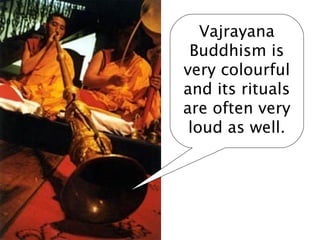
Vajrayana
 Buddhism is
very colourful
and its rituals
are often very
 loud as well.
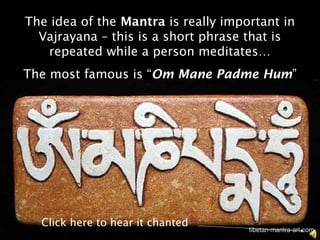
The idea of the Mantra is really important in
  Vajrayana – this is a short phrase that is
   repeated while a person meditates…
The most famous is “Om Mane Padme Hum”


  Click here to hear it chanted
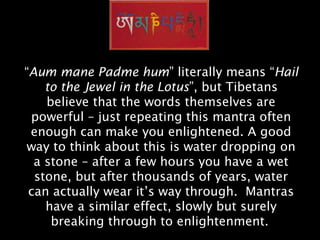
“Aum mane Padme hum” literally means “Hail
    to the Jewel in the Lotus”, but Tibetans
    believe that the words themselves are
 powerful – just repeating this mantra often
 enough can make you enlightened. A good
 way to think about this is water dropping on
  a stone – after a few hours you have a wet
  stone, but after thousands of years, water
 can actually wear it’s way through. Mantras
    have a similar effect, slowly but surely
     breaking through to enlightenment.
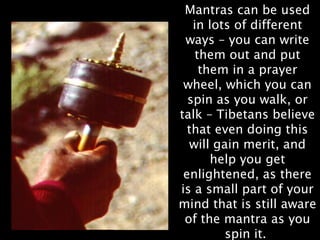
Mantras can be used
   in lots of different
 ways – you can write
    them out and put
     them in a prayer
 wheel, which you can
  spin as you walk, or
talk – Tibetans believe
  that even doing this
  will gain merit, and
       help you get
 enlightened, as there
is a small part of your
mind that is still aware
 of the mantra as you
         spin it.
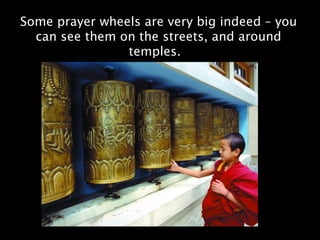
Some prayer wheels are very big indeed – you
  can see them on the streets, and around
                temples.
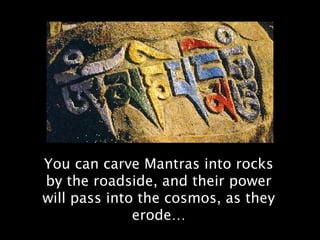
You can carve Mantras into rocks
by the roadside, and their power
will pass into the cosmos, as they
              erode…
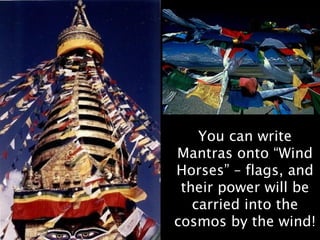
You can write
Mantras onto “Wind
Horses” – flags, and
 their power will be
   carried into the
cosmos by the wind!
Vajrayana monks
 are called Lamas
 – and have some
   differences to
   other kinds of
 Buddhist monk –
we are allowed to
 eat Meat (as it is
a staple in Tibet),
  and we have to
support ourselves
financially, as well
     as living a
   monastic life.
Many of our Pujas
are long, complex
 rituals, involving
 specific types of
   meditation, as
well as the use of
  some particular
ritual tools, which
   are unique to
     Vajrayana
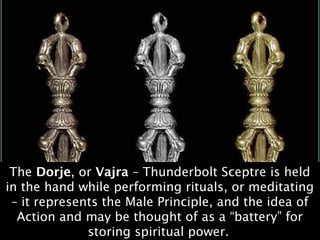
The Dorje, or Vajra – Thunderbolt Sceptre is held
in the hand while performing rituals, or meditating
 – it represents the Male Principle, and the idea of
  Action and may be thought of as a “battery” for
              storing spiritual power.
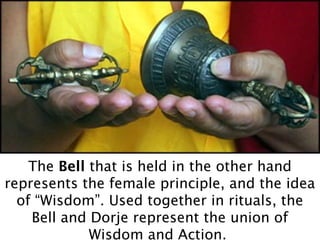
The Bell that is held in the other hand
represents the female principle, and the idea
  of “Wisdom”. Used together in rituals, the
    Bell and Dorje represent the union of
             Wisdom and Action.
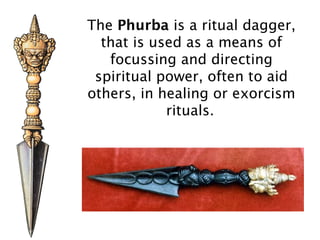
The Phurba is a ritual dagger,
  that is used as a means of
   focussing and directing
 spiritual power, often to aid
others, in healing or exorcism
            rituals.
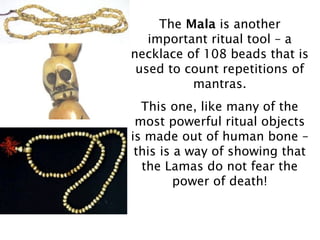
The Mala is another
   important ritual tool – a
necklace of 108 beads that is
 used to count repetitions of
          mantras.
  This one, like many of the
 most powerful ritual objects
is made out of human bone –
 this is a way of showing that
  the Lamas do not fear the
         power of death!
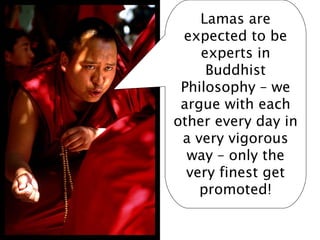
Lamas are
 expected to be
    experts in
     Buddhist
 Philosophy – we
 argue with each
other every day in
 a very vigorous
  way – only the
  very finest get
    promoted!
Thankas are very detailed
 pictures of Bodhisattvas
 that are used as a focus
     for Pujas, and for
 meditation – some very
 large ones are used for
          festivals.
Offerings are made
    in front of the
    images of the
      Buddha and
    Bodhisattvas –
  Light, Water, and
Flowers you will be
  familiar with, but
also white scarves –
which are a symbol
    of honour and
     respect – the
 Tibetan equivalent
    of garlands of
 flowers – as these
 do not grow easily
       in Tibet.
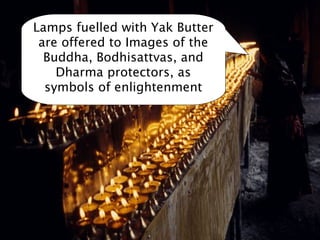
Lamps fuelled with Yak Butter
 are offered to Images of the
  Buddha, Bodhisattvas, and
    Dharma protectors, as
  symbols of enlightenment
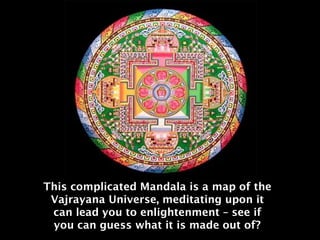
This complicated Mandala is a map of the
 Vajrayana Universe, meditating upon it
 can lead you to enlightenment – see if
 you can guess what it is made out of?
It is made out of
   sand – teams of
Lamas painstakingly
    spend months
   creating these.


                      They are created
                       for particular
                        festivals and
                        celebrations
At the high point
   of the ritual,
 these mandalas
  are destroyed,
   and the sand
swept up – this is
  an example of
    Anicca, and
teaches us not to
  be attached to
      things!
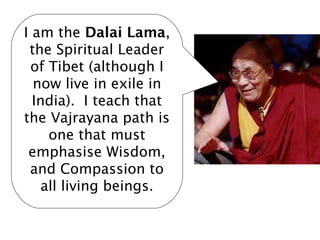
I am the Dalai Lama,
 the Spiritual Leader
 of Tibet (although I
  now live in exile in
  India). I teach that
the Vajrayana path is
     one that must
 emphasise Wisdom,
 and Compassion to
    all living beings.
Before the Chinese
 invasion, I was the
ruler of Tibet as well,
   and Tibet was a
   Buddhist state –
 everyone practiced
Buddhism, and nearly
  every man was a
        monk.
I am the Fourteenth
Dalai Lama, and I am
a direct reincarnation
    of the previous
    thirteen – many
Tibetans believe that I
am the incarnation of
   Chenzenrig – the
                            Many senior
     Bodhisattva of            Lamas
      compassion          reincarnate like
                          this, this called
                              a “tulku”
This is the Potala –
My palace in Lhasa.
 It is still a place of
Pilgrimage for many
of my Countrymen.
Vajrayana

Vajrayana

  • 1.
  • 2.
    I am theGuru Padmasmbhava, and I brought Buddhism to Tibet. I combined my Indian Tantric teaching with aspects of the Bon Shamanism of Tibet to form a totally new kind of Buddhist path.
  • 3.
    I “converted” many ofthe Bon Spirits to Buddhism, and they have become “Dharma protectors” – fierce spirits who protect Buddhist teaching and those who follow it
  • 4.
    This is Mahakala,for example;
  • 5.
    Tantra is anIndian religious tradition that emphasises Ritual and Visualisation meditations, and values the gaining of Siddhas – mysterious, magical powers. Some of my disciples call me the “Crazy Wisdom Guru”, because my teachings are often strange!
  • 6.
    Vajrayana Buddhism is verycolourful and its rituals are often very loud as well.
  • 7.
    The idea ofthe Mantra is really important in Vajrayana – this is a short phrase that is repeated while a person meditates… The most famous is “Om Mane Padme Hum” Click here to hear it chanted
  • 8.
    “Aum mane Padmehum” literally means “Hail to the Jewel in the Lotus”, but Tibetans believe that the words themselves are powerful – just repeating this mantra often enough can make you enlightened. A good way to think about this is water dropping on a stone – after a few hours you have a wet stone, but after thousands of years, water can actually wear it’s way through. Mantras have a similar effect, slowly but surely breaking through to enlightenment.
  • 9.
    Mantras can beused in lots of different ways – you can write them out and put them in a prayer wheel, which you can spin as you walk, or talk – Tibetans believe that even doing this will gain merit, and help you get enlightened, as there is a small part of your mind that is still aware of the mantra as you spin it.
  • 10.
    Some prayer wheelsare very big indeed – you can see them on the streets, and around temples.
  • 11.
    You can carveMantras into rocks by the roadside, and their power will pass into the cosmos, as they erode…
  • 12.
    You can write Mantrasonto “Wind Horses” – flags, and their power will be carried into the cosmos by the wind!
  • 13.
    Vajrayana monks arecalled Lamas – and have some differences to other kinds of Buddhist monk – we are allowed to eat Meat (as it is a staple in Tibet), and we have to support ourselves financially, as well as living a monastic life.
  • 14.
    Many of ourPujas are long, complex rituals, involving specific types of meditation, as well as the use of some particular ritual tools, which are unique to Vajrayana
  • 15.
    The Dorje, orVajra – Thunderbolt Sceptre is held in the hand while performing rituals, or meditating – it represents the Male Principle, and the idea of Action and may be thought of as a “battery” for storing spiritual power.
  • 16.
    The Bell thatis held in the other hand represents the female principle, and the idea of “Wisdom”. Used together in rituals, the Bell and Dorje represent the union of Wisdom and Action.
  • 17.
    The Phurba isa ritual dagger, that is used as a means of focussing and directing spiritual power, often to aid others, in healing or exorcism rituals.
  • 18.
    The Mala isanother important ritual tool – a necklace of 108 beads that is used to count repetitions of mantras. This one, like many of the most powerful ritual objects is made out of human bone – this is a way of showing that the Lamas do not fear the power of death!
  • 19.
    Lamas are expectedto be experts in Buddhist Philosophy – we argue with each other every day in a very vigorous way – only the very finest get promoted!
  • 20.
    Thankas are verydetailed pictures of Bodhisattvas that are used as a focus for Pujas, and for meditation – some very large ones are used for festivals.
  • 21.
    Offerings are made in front of the images of the Buddha and Bodhisattvas – Light, Water, and Flowers you will be familiar with, but also white scarves – which are a symbol of honour and respect – the Tibetan equivalent of garlands of flowers – as these do not grow easily in Tibet.
  • 22.
    Lamps fuelled withYak Butter are offered to Images of the Buddha, Bodhisattvas, and Dharma protectors, as symbols of enlightenment
  • 23.
    This complicated Mandalais a map of the Vajrayana Universe, meditating upon it can lead you to enlightenment – see if you can guess what it is made out of?
  • 24.
    It is madeout of sand – teams of Lamas painstakingly spend months creating these. They are created for particular festivals and celebrations
  • 25.
    At the highpoint of the ritual, these mandalas are destroyed, and the sand swept up – this is an example of Anicca, and teaches us not to be attached to things!
  • 26.
    I am theDalai Lama, the Spiritual Leader of Tibet (although I now live in exile in India). I teach that the Vajrayana path is one that must emphasise Wisdom, and Compassion to all living beings.
  • 27.
    Before the Chinese invasion, I was the ruler of Tibet as well, and Tibet was a Buddhist state – everyone practiced Buddhism, and nearly every man was a monk.
  • 28.
    I am theFourteenth Dalai Lama, and I am a direct reincarnation of the previous thirteen – many Tibetans believe that I am the incarnation of Chenzenrig – the Many senior Bodhisattva of Lamas compassion reincarnate like this, this called a “tulku”
  • 29.
    This is thePotala – My palace in Lhasa. It is still a place of Pilgrimage for many of my Countrymen.