GITA Chapter 3 FLOWCHARTS
Compiled by
Dr. Medicherla Shyam Sunder Kumar
samc108@gmail.com
Based on teachings of
Bhagvad gita Study by Bhakti Caitanya Swami
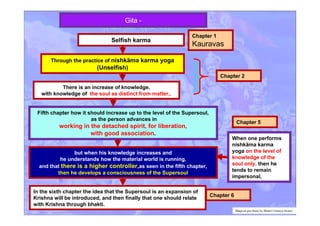
Gita -
There is an increase of knowledge.
with knowledge of the soul as distinct from matter,.
Fifth chapter how it should increase up to the level of the Supersoul,
as the person advances in
working in the detached spirit, for liberation,
with good association.
Selfish karma
When one performs
nishkäma karma
yoga on the level of
knowledge of the
soul only, then he
tends to remain
impersonal,
In the sixth chapter the idea that the Supersoul is an expansion of
Krishna will be introduced, and then finally that one should relate
with Krishna through bhakti.
Chapter 2
but when his knowledge increases and
he understands how the material world is running,
and that there is a higher controller,as seen in the fifth chapter,
then he develops a consciousness of the Supersoul
Through the practice of nishkäma karma yoga
(Unselfish)
Chapter 5
Chapter 6
Chapter 1
Kauravas
Bhagvad gita Study by Bhakti Caitanya Swami
Karma Yoga mentioned
in Chapter 2 :
{2.31-37 Slokas / Verses}
Bhagvad gita Study by Bhakti Caitanya Swami
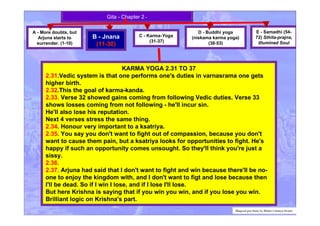
Gita - Chapter 2 -
A - More doubts, but
Arjuna starts to
surrender. (1-10)
B - Jnana
(11-30)(11-30)
C - Karma-Yoga
(31-37)
D - Buddhi yoga
(niskama karma yoga)
(38-53)
E - Samadhi (54-
72) Sthita-prajna,
Illumined Soul
Bhagvad gita Study by Bhakti Caitanya Swami
KARMA YOGA 2.31 TO 37
2.31.Vedic system is that one performs one's duties in varnasrama one gets
higher birth.
2.32.This the goal of karma-kanda.
2.33. Verse 32 showed gains coming from following Vedic duties. Verse 33
shows losses coming from not following - he'll incur sin.
He'll also lose his reputation.
Next 4 verses stress the same thing.
2.34. Honour very important to a ksatriya.
2.35. You say you don't want to fight out of compassion, because you don't
want to cause them pain, but a ksatriya looks for opportunities to fight. He's
happy if such an opportunity comes unsought. So they'll think you're just a
sissy.
2.36.
2.37. Arjuna had said that I don't want to fight and win because there'll be no-
one to enjoy the kingdom with, and I don't want to figt and lose because then
I'll be dead. So if I win I lose, and if I lose I'll lose.
But here Krishna is saying that if you win you win, and if you lose you win.
Brilliant logic on Krishna's part.
Chapter 3 : Karma Yoga
{43 Slokas / Verses}
Bhagvad gita Study by Bhakti Caitanya Swami
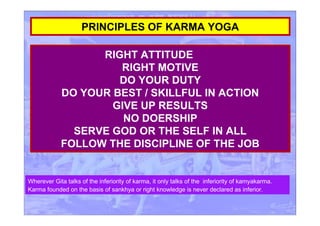
RIGHT ATTITUDE
RIGHT MOTIVE
DO YOUR DUTY
DO YOUR BEST / SKILLFUL IN ACTION
GIVE UP RESULTS
NO DOERSHIP
SERVE GOD OR THE SELF IN ALL
FOLLOW THE DISCIPLINE OF THE JOB
PRINCIPLES OF KARMA YOGA
Wherever Gita talks of the inferiority of karma, it only talks of the inferiority of kamyakarma.
Karma founded on the basis of sankhya or right knowledge is never declared as inferior.
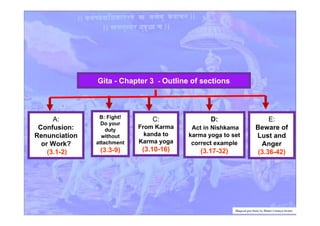
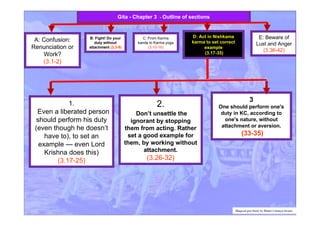
A:
Confusion:
Renunciation
or Work?
(3.1-2)
B: Fight!
Do your
duty
without
attachment
(3.3-9)
C:
From Karma
kanda to
Karma yoga
(3.10-16)
D:
Act in Nishkama
karma yoga to set
correct example
(3.17-32)
E:
Beware of
Lust and
Anger
(3.36-42)
Gita - Chapter 3 - Outline of sections
Bhagvad gita Study by Bhakti Caitanya Swami
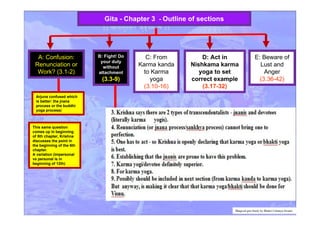
A: Confusion:
Renunciation or
Work? (3.1-2)
B: Fight! Do
your duty
without
attachment
(3.3-9)
C: From
Karma kanda
to Karma
yoga
(3.10-16)
D: Act in
Nishkama karma
yoga to set
correct example
(3.17-32)
E: Beware of
Lust and
Anger
(3.36-42)
This same question
comes up in beginning
of 5th chapter, Krishna
discusses the point in
the beginning of the 6th
chapter.
A variation (impersonal
vs personal is in
beginning of 12th)
Gita - Chapter 3 - Outline of sections
Arjuna confused which
is better: the jnana
process or the buddhi
yoga process)
Bhagvad gita Study by Bhakti Caitanya Swami
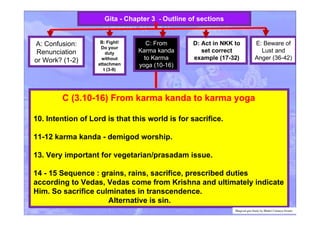
C (3.10-16) From karma kanda to karma yoga
10. Intention of Lord is that this world is for sacrifice.
11-12 karma kanda - demigod worship.
13. Very important for vegetarian/prasadam issue.
14 - 15 Sequence : grains, rains, sacrifice, prescribed duties
according to Vedas, Vedas come from Krishna and ultimately indicate
Him. So sacrifice culminates in transcendence.
Alternative is sin.
Gita - Chapter 3 - Outline of sections
A: Confusion:
Renunciation
or Work? (1-2)
B: Fight!
Do your
duty
without
attachmen
t (3-9)
C: From
Karma kanda
to Karma
yoga (10-16)
D: Act in NKK to
set correct
example (17-32)
E: Beware of
Lust and
Anger (36-42)
Bhagvad gita Study by Bhakti Caitanya Swami
A: Confusion:
Renunciation or
Work?
(3.1-2)
B: Fight! Do your
duty without
attachment (3.3-9)
C: From Karma
kanda to Karma yoga
(3.10-16)
D: Act in Nishkama
karma to set correct
example
(3.17-35)
E: Beware of
Lust and Anger
(3.36-42)
Gita - Chapter 3 - Outline of sections
1.
Even a liberated person
should perform his duty
(even though he doesn’t
have to), to set an
example — even Lord
Krishna does this)
(3.17-25)
2.
Don’t unsettle the
ignorant by stopping
them from acting. Rather
set a good example for
them, by working without
attachment.
(3.26-32)
3
One should perform one's
duty in KC, according to
one's nature, without
attachment or aversion.
(33-35)
Bhagvad gita Study by Bhakti Caitanya Swami
A: Confusion:
Renunciation or Work?
(3.1-2)
B: Fight! Do your
duty without
attachment (3.3-9)
C: From Karma
kanda to Karma yoga
(3.10-16)
D: Act in NKK to set
correct example
(3.17-32)
E: Beware of
Lust and Anger
(3.36-42)
Gita - Chapter 3 - Outline of sections
Bhagvad gita Study by Bhakti Caitanya Swami
A: Confusion:
Renunciation or Work?
(3.1-2)
B: Fight! Do your
duty without
attachment (3.3-9)
C: From Karma
kanda to Karma yoga
(3.10-16)
E: Beware of
Lust and Anger
(3.36-42)
Gita - Chapter 3 - Outline of sections
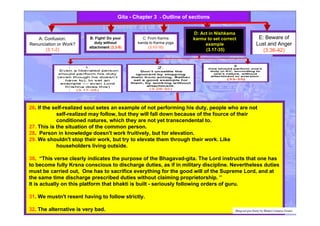
26. If the self-realized soul setes an example of not performing his duty, people who are not
self-realized may follow, but they will fall down because of the fource of their
conditioned natures, which they are not yet transcendental to.
27. This is the situation of the common person.
28. Person in knowledge doesn't work fruitively, but for elevation.
29. We shouldn't stop their work, but try to elevate them through their work. Like
householders living outside.
30. “This verse clearly indicates the purpose of the Bhagavad-gita. The Lord instructs that one has
to become fully Krsna conscious to discharge duties, as if in military discipline. Nevertheless duties
must be carried out, One has to sacrifice everything for the good will of the Supreme Lord, and at
the same time discharge prescribed duties without claiming proprietorship. ”
It is actually on this platform that bhakti is built - seriously following orders of guru.
31. We mustn't resent having to follow strictly.
32. The alternative is very bad. Bhagvad gita Study by Bhakti Caitanya Swami
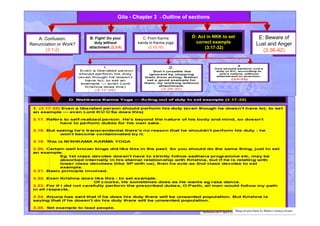
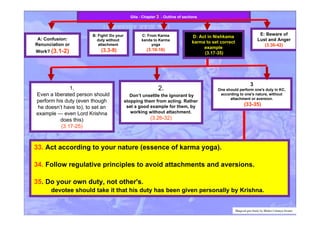
D: Act in Nishkama
karma to set correct
example
(3.17-35)
33. Act according to your nature (essence of karma yoga).
34. Follow regulative principles to avoid attachments and aversions.
35. Do your own duty, not other's.
devotee should take it that his duty has been given personally by Krishna.
A: Confusion:
Renunciation or
Work? (3.1-2)
B: Fight! Do your
duty without
attachment
(3.3-9)
C: From Karma
kanda to Karma
yoga
(3.10-16)
E: Beware of
Lust and Anger
(3.36-42)
Gita - Chapter 3 - Outline of sections
1.
Even a liberated person should
perform his duty (even though
he doesn’t have to), to set an
example — even Lord Krishna
does this)
(3.17-25)
2.
Don’t unsettle the ignorant by
stopping them from acting. Rather
set a good example for them, by
working without attachment.
(3.26-32)
3
One should perform one's duty in KC,
according to one's nature, without
attachment or aversion.
(33-35)
Bhagvad gita Study by Bhakti Caitanya Swami
D: Act in Nishkama
karma to set correct
example
(3.17-35)
Bhagvad gita Study by Bhakti Caitanya Swami
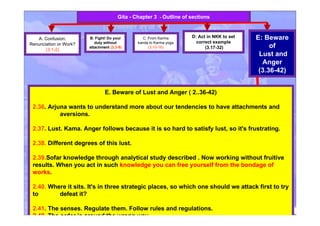
E. Beware of Lust and Anger ( 2..36-42)
2.36. Arjuna wants to understand more about our tendencies to have attachments and
aversions.
2.37. Lust. Kama. Anger follows because it is so hard to satisfy lust, so it's frustrating.
2.38. Different degrees of this lust.
2.39.Sofar knowledge through analytical study described . Now working without fruitive
results. When you act in such knowledge you can free yourself from the bondage of
works.
2.40. Where it sits. It's in three strategic places, so which one should we attack first to try
to defeat it?
2.41. The senses. Regulate them. Follow rules and regulations.
2.42. The order is around the wrong way.
2.43. So one should assert oneself in the right position and fully engage in devotional
A: Confusion:
Renunciation or Work?
(3.1-2)
B: Fight! Do your
duty without
attachment (3.3-9)
C: From Karma
kanda to Karma yoga
(3.10-16)
D: Act in NKK to set
correct example
(3.17-32)
Gita - Chapter 3 - Outline of sections
E: Beware
of
Lust and
Anger
(3.36-42)
OM SHANTI
OM SHANTI
OM SHANTI
Om- let all the deficiencies of this book go away
Tat- let this give Bhagavan great happiness
Sat- let this give true lasting benefits

Bhagvad gita chapter 3 flowcharts

  • 1.
    GITA Chapter 3FLOWCHARTS Compiled by Dr. Medicherla Shyam Sunder Kumar samc108@gmail.com
  • 2.
    Based on teachingsof Bhagvad gita Study by Bhakti Caitanya Swami
  • 3.
    Gita - There isan increase of knowledge. with knowledge of the soul as distinct from matter,. Fifth chapter how it should increase up to the level of the Supersoul, as the person advances in working in the detached spirit, for liberation, with good association. Selfish karma When one performs nishkäma karma yoga on the level of knowledge of the soul only, then he tends to remain impersonal, In the sixth chapter the idea that the Supersoul is an expansion of Krishna will be introduced, and then finally that one should relate with Krishna through bhakti. Chapter 2 but when his knowledge increases and he understands how the material world is running, and that there is a higher controller,as seen in the fifth chapter, then he develops a consciousness of the Supersoul Through the practice of nishkäma karma yoga (Unselfish) Chapter 5 Chapter 6 Chapter 1 Kauravas Bhagvad gita Study by Bhakti Caitanya Swami
  • 4.
    Karma Yoga mentioned inChapter 2 : {2.31-37 Slokas / Verses} Bhagvad gita Study by Bhakti Caitanya Swami
  • 5.
    Gita - Chapter2 - A - More doubts, but Arjuna starts to surrender. (1-10) B - Jnana (11-30)(11-30) C - Karma-Yoga (31-37) D - Buddhi yoga (niskama karma yoga) (38-53) E - Samadhi (54- 72) Sthita-prajna, Illumined Soul Bhagvad gita Study by Bhakti Caitanya Swami KARMA YOGA 2.31 TO 37 2.31.Vedic system is that one performs one's duties in varnasrama one gets higher birth. 2.32.This the goal of karma-kanda. 2.33. Verse 32 showed gains coming from following Vedic duties. Verse 33 shows losses coming from not following - he'll incur sin. He'll also lose his reputation. Next 4 verses stress the same thing. 2.34. Honour very important to a ksatriya. 2.35. You say you don't want to fight out of compassion, because you don't want to cause them pain, but a ksatriya looks for opportunities to fight. He's happy if such an opportunity comes unsought. So they'll think you're just a sissy. 2.36. 2.37. Arjuna had said that I don't want to fight and win because there'll be no- one to enjoy the kingdom with, and I don't want to figt and lose because then I'll be dead. So if I win I lose, and if I lose I'll lose. But here Krishna is saying that if you win you win, and if you lose you win. Brilliant logic on Krishna's part.
  • 6.
    Chapter 3 :Karma Yoga {43 Slokas / Verses} Bhagvad gita Study by Bhakti Caitanya Swami
  • 8.
    RIGHT ATTITUDE RIGHT MOTIVE DOYOUR DUTY DO YOUR BEST / SKILLFUL IN ACTION GIVE UP RESULTS NO DOERSHIP SERVE GOD OR THE SELF IN ALL FOLLOW THE DISCIPLINE OF THE JOB PRINCIPLES OF KARMA YOGA Wherever Gita talks of the inferiority of karma, it only talks of the inferiority of kamyakarma. Karma founded on the basis of sankhya or right knowledge is never declared as inferior.
  • 9.
    A: Confusion: Renunciation or Work? (3.1-2) B: Fight! Doyour duty without attachment (3.3-9) C: From Karma kanda to Karma yoga (3.10-16) D: Act in Nishkama karma yoga to set correct example (3.17-32) E: Beware of Lust and Anger (3.36-42) Gita - Chapter 3 - Outline of sections Bhagvad gita Study by Bhakti Caitanya Swami
  • 10.
    A: Confusion: Renunciation or Work?(3.1-2) B: Fight! Do your duty without attachment (3.3-9) C: From Karma kanda to Karma yoga (3.10-16) D: Act in Nishkama karma yoga to set correct example (3.17-32) E: Beware of Lust and Anger (3.36-42) This same question comes up in beginning of 5th chapter, Krishna discusses the point in the beginning of the 6th chapter. A variation (impersonal vs personal is in beginning of 12th) Gita - Chapter 3 - Outline of sections Arjuna confused which is better: the jnana process or the buddhi yoga process) Bhagvad gita Study by Bhakti Caitanya Swami
  • 11.
    C (3.10-16) Fromkarma kanda to karma yoga 10. Intention of Lord is that this world is for sacrifice. 11-12 karma kanda - demigod worship. 13. Very important for vegetarian/prasadam issue. 14 - 15 Sequence : grains, rains, sacrifice, prescribed duties according to Vedas, Vedas come from Krishna and ultimately indicate Him. So sacrifice culminates in transcendence. Alternative is sin. Gita - Chapter 3 - Outline of sections A: Confusion: Renunciation or Work? (1-2) B: Fight! Do your duty without attachmen t (3-9) C: From Karma kanda to Karma yoga (10-16) D: Act in NKK to set correct example (17-32) E: Beware of Lust and Anger (36-42) Bhagvad gita Study by Bhakti Caitanya Swami
  • 12.
    A: Confusion: Renunciation or Work? (3.1-2) B:Fight! Do your duty without attachment (3.3-9) C: From Karma kanda to Karma yoga (3.10-16) D: Act in Nishkama karma to set correct example (3.17-35) E: Beware of Lust and Anger (3.36-42) Gita - Chapter 3 - Outline of sections 1. Even a liberated person should perform his duty (even though he doesn’t have to), to set an example — even Lord Krishna does this) (3.17-25) 2. Don’t unsettle the ignorant by stopping them from acting. Rather set a good example for them, by working without attachment. (3.26-32) 3 One should perform one's duty in KC, according to one's nature, without attachment or aversion. (33-35) Bhagvad gita Study by Bhakti Caitanya Swami
  • 13.
    A: Confusion: Renunciation orWork? (3.1-2) B: Fight! Do your duty without attachment (3.3-9) C: From Karma kanda to Karma yoga (3.10-16) D: Act in NKK to set correct example (3.17-32) E: Beware of Lust and Anger (3.36-42) Gita - Chapter 3 - Outline of sections Bhagvad gita Study by Bhakti Caitanya Swami
  • 14.
    A: Confusion: Renunciation orWork? (3.1-2) B: Fight! Do your duty without attachment (3.3-9) C: From Karma kanda to Karma yoga (3.10-16) E: Beware of Lust and Anger (3.36-42) Gita - Chapter 3 - Outline of sections 26. If the self-realized soul setes an example of not performing his duty, people who are not self-realized may follow, but they will fall down because of the fource of their conditioned natures, which they are not yet transcendental to. 27. This is the situation of the common person. 28. Person in knowledge doesn't work fruitively, but for elevation. 29. We shouldn't stop their work, but try to elevate them through their work. Like householders living outside. 30. “This verse clearly indicates the purpose of the Bhagavad-gita. The Lord instructs that one has to become fully Krsna conscious to discharge duties, as if in military discipline. Nevertheless duties must be carried out, One has to sacrifice everything for the good will of the Supreme Lord, and at the same time discharge prescribed duties without claiming proprietorship. ” It is actually on this platform that bhakti is built - seriously following orders of guru. 31. We mustn't resent having to follow strictly. 32. The alternative is very bad. Bhagvad gita Study by Bhakti Caitanya Swami D: Act in Nishkama karma to set correct example (3.17-35)
  • 15.
    33. Act accordingto your nature (essence of karma yoga). 34. Follow regulative principles to avoid attachments and aversions. 35. Do your own duty, not other's. devotee should take it that his duty has been given personally by Krishna. A: Confusion: Renunciation or Work? (3.1-2) B: Fight! Do your duty without attachment (3.3-9) C: From Karma kanda to Karma yoga (3.10-16) E: Beware of Lust and Anger (3.36-42) Gita - Chapter 3 - Outline of sections 1. Even a liberated person should perform his duty (even though he doesn’t have to), to set an example — even Lord Krishna does this) (3.17-25) 2. Don’t unsettle the ignorant by stopping them from acting. Rather set a good example for them, by working without attachment. (3.26-32) 3 One should perform one's duty in KC, according to one's nature, without attachment or aversion. (33-35) Bhagvad gita Study by Bhakti Caitanya Swami D: Act in Nishkama karma to set correct example (3.17-35)
  • 16.
    Bhagvad gita Studyby Bhakti Caitanya Swami E. Beware of Lust and Anger ( 2..36-42) 2.36. Arjuna wants to understand more about our tendencies to have attachments and aversions. 2.37. Lust. Kama. Anger follows because it is so hard to satisfy lust, so it's frustrating. 2.38. Different degrees of this lust. 2.39.Sofar knowledge through analytical study described . Now working without fruitive results. When you act in such knowledge you can free yourself from the bondage of works. 2.40. Where it sits. It's in three strategic places, so which one should we attack first to try to defeat it? 2.41. The senses. Regulate them. Follow rules and regulations. 2.42. The order is around the wrong way. 2.43. So one should assert oneself in the right position and fully engage in devotional A: Confusion: Renunciation or Work? (3.1-2) B: Fight! Do your duty without attachment (3.3-9) C: From Karma kanda to Karma yoga (3.10-16) D: Act in NKK to set correct example (3.17-32) Gita - Chapter 3 - Outline of sections E: Beware of Lust and Anger (3.36-42)
  • 17.
    OM SHANTI OM SHANTI OMSHANTI Om- let all the deficiencies of this book go away Tat- let this give Bhagavan great happiness Sat- let this give true lasting benefits