Download to read offline
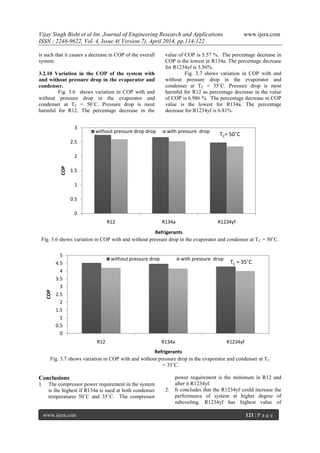
![Vijay Singh Bisht et al Int. Journal of Engineering Research and Applications www.ijera.com
ISSN : 2248-9622, Vol. 4, Issue 4( Version 7), April 2014, pp.114-122
www.ijera.com 114 | P a g e
Thermodynamic Analysis of Actual Vapour Compression System
with R12 and Its Eco-Friendly Alternatives Refrigerants
Vijay Singh Bisht1
, A.K.Pratihar2
1
(Assistant Professor Mechanical Engineering Department, Uttaranchal University, Dehradun, Uttarakhand,
India),
2
(Professor Mechanical Engineering Department, College of Technology G.B.P.U.A.T, Pantnagar, Uttarakhand
India)
ABSTRACT
This paper presents a theoretical performance study of a vapour compression refrigeration system with
refrigerants R-12, R134a and R1234yf. A computational model based on energy first law analysis is presented
for the investigation of the effects of evaporating temperatures, degree of subcooling, dead state temperatures
and effectiveness of the liquid vapour heat exchanger on the relative capacity change index, coefficient of
performance of the vapour compression refrigeration cycle. RCI (relative capacity change index) of the system
is highest for R1234yf and with increase in degree of subcooling; R1234yf has the highest percentage increase
in COP. The total compressor work requirement for system is highest with R134a. R1234yf is the only
refrigerants of all the refrigerants used in present work that satisfy MAC directive (2006/40/EG) because of
GWP value less than 150. From these results, it is indicated that R1234yf is the refrigerant for future.
KEYWORDS:- COP, Subcooling, LVHE, Pressure drop ,RCI.
I. INTRODUCTION
Refrigerants are essential working
substances used in refrigeration systems. The
performance of refrigeration system largely depends
upon the characteristics of the refrigerants. Besides
performance issues, there are environmental issues
concerning the use of refrigerants. In last few
decades, it was discovered that some refrigerants
cause ozone layer depletion and global warming,
which is a serious hazard to environment. Ozone
layer depletion (ODP) and global warming potential
(GWP) have become one of the most important
global issues. The Montreal protocol (UNEP, 1997)
states the phasing out of CFC’s and HCFC’s as
refrigerants that deplete the ozone layer (ODP). The
Kyoto protocol (UNFCC, 2011) encouraged
promotion of plans for sustainable development and
reduction of global warming potential (GWP)
including the regulations of HCFCs.
Chlorofluorocarbons (CFCs) are the refrigerants
which were responsible for both the environmental
problems. Ozone layer depletion problem has been
almost solved by replacing chlorofluorocarbons
(CFCs) by hydro fluorocarbons (HFCs), hydrocarbon
(HCs) and some natural refrigerants. However,
problem of global warming is still associated with
some newer refrigerants.
R12 refrigerant was widely used for
domestic refrigeration which has been replaced by
R134a, which is a HFC having zero ozone depletion
potential (ODP). But, R134a causes global warming
with a global warming potential (GWP) of 1300. This
means that the emission of 1 kg of R134a is
equivalent to 1300 kg of CO2. R134a is stable in
atmosphere for long time and has atmospheric life
time of 13 years. Many investigations have been
conducted in the research into substitutes for CFC12
and CFC22. Simulation of vapour compression cycle
using R134a and R12 [1]. A comparison of the
performance of HFC134a and CFC12 is presented
using COP (and compressor power) as a criterion for
the same cooling load. Results indicate that the COP
for HFC 134a is slightly (about3%) lower than that
for a CFC 12 system. An experimental study on the
application of a mixture of propane, butane, and
isobutene to replace HFC134a in a domestic
refrigerator. The results showed that a 60%/40%
propane/butane mixture was the most appropriate
alternative refrigerant has presented [2] . Theoretical
analysis of vapour compression refrigeration system
with R502, R404A and R507A has presented [3].
The results showed that R507A was better substitute
to R502 than R404A. An experimental performance
of R1234yf and R1234ze as drop in replacement for
R134a in domestic refrigerators has presented [4]. It
is shown that R-134a and R-1234yf have similar
energy consumptions and capacities in both
refrigerators tested, thus R-1234yf would make a
good drop-in replacement for R-134a in domestic
refrigeration. A review of next generation refrigerants
, the refrigerant selection criteria for the new
generation is based on low GWP value suitability,
RESEARCH ARTICLE OPEN ACCESS](https://image.slidesharecdn.com/v4408114122-140529023020-phpapp02/85/V4408114122-1-320.jpg)
![Vijay Singh Bisht et al Int. Journal of Engineering Research and Applications www.ijera.com
ISSN : 2248-9622, Vol. 4, Issue 4( Version 7), April 2014, pp.114-122
www.ijera.com 115 | P a g e
safety, and materials compatibility [5]. According to
National Aeronautics and Space Administration
(NASA), due to global warming the following future
trends are very likely to occur [6].
Contraction of snow cover areas, increased thaw
in permafrost regions, decrease in sea ice
extent.
Increased frequency of hot extremes, heat waves
and heavy precipitation.
Increase in tropical cyclone intensity.
Precipitation increases in high latitudes.
Precipitation decreases in subtropical land
regions.
Therefore, search for better alternatives
which have zero ozone depletion potential (ODP) and
zero or lower global warming potential (GWP) is still
on. R1234yf is a new refrigerant which has lower
global warming potential than R134a. R1234yf has
global warming potential (GWP) of 4, so it satisfy
MAC Directive (GWP below 150) passed in July
2006 [7]. R1234yf has nearly similar value of
molecular weight and normal boiling point, making
R1234yf a good replacement of R134a.Vapour
pressure is very critical property when considering
replacement capability of a refrigerant in vapour
compression system. The vapour pressure of both the
refrigerants is nearly similar. An experimental
analysis of the internal heat exchanger influence on a
vapour compression system performance working
with R1234yf as a drop-in replacement for R134a
have presented [8].
It was concluded that in R1234yf drop-in
substitute for R134a, the introduction of an internal
heat exchanger would reduce the decrease in the
cooling capacity and COP between 2-6%, almost
compensating these reductions cause by using
R1234yf as drop-in replacement for R134a with an
internal heat exchanger for high compression ratios.
The main characteristics of R12 and its
alternatives are given in Table 1.
Table 1 Characteristics of R12 and its alternative
refrigerants [5,7]
Characteristics R12 R134a R1234yf
Chemical
Formula
CF2Cl2 CF3CH2F C3F4H2
Molecular
weight
120.92 102.03 114.04
Boiling point
( ˚C)
-29.75 -26.07 -29.03
Ozone Depletion
Potential (ODP)
1 0 0
Global warming
Potential
(GWP)
10,900 1300 4
Atmospheric
Life Time
100(Yea
rs)
13(Years
)
11(days)
2.1 Thermodynamic Analysis of Vapour
Compression System
The vapour compression system used in
present analysis has been shown in figure 1
2.1.1 Assumptions
Following assumptions have been taken in
the analysis:
1. The system is at steady state condition. All
processes are steady flow processes.
2. Changes in kinetic and potential energy in
analysis of all the components of
system.
3. There is no heat in-leak to the system.
4. Pressure losses in pipelines are neglected
Fig. 2.1 Schematic diagram of actual vapour compression system with liquid vapour heat exchanger](https://image.slidesharecdn.com/v4408114122-140529023020-phpapp02/85/V4408114122-2-320.jpg)
![Vijay Singh Bisht et al Int. Journal of Engineering Research and Applications www.ijera.com
ISSN : 2248-9622, Vol. 4, Issue 4( Version 7), April 2014, pp.114-122
www.ijera.com 116 | P a g e
Thermodynamic cycle of actual vapour compression system on p-h coordinates has been shown in
Figure 2.2.
Fig. 2.2 p-h diagram showing subcooling and superheating
2.1.2 Governing equations
Energy balance equation for compressor
Ein = Eout (2.1)
w1−2 = m (h2 − h1 ) (2.2)
Compressor isentropic or adiabatic efficiency: It is
ratio of isentropic work to the actual measure input
power.
Ƞcomp ,isen =
h2−h1
h5−h1
(2.3)
h5 =
h2−h1
Ƞcomp ,isen
+ h1 (2.4)
wcomp = mr(h5 − h1) (2.5)
Energy balance equation for condenser
m h3 + QC = m h5 (2.6)
QC = m h5 − m h3 (2.7)
Energy balance equation for LVHE
Since the mass flow rate of liquid and vapour is the
same, we get from the energy balance of the heat
exchanger.
Qn = h1 − h11 = h3 − h33 (2.8)
The effectiveness of lvhe is the ratio of the actual to
maximum possible heat transfer rates. In our system
effectiveness is given as
𝜀 =
T1−T11
T3−T11
(2.9)
The effect of a liquid-suction heat exchanger
on refrigeration capacity can be evaluated in terms of
RCI [9].
Relative capacity change index (RCI) is percentage
increase in refrigeration capacity when using liquid
vapour heat exchanger.
RCI =
(h11−h33)−(h11−h3)
h11−h3
×100 (2.10)
Qe is refrigerating effect, given as
Qe = h1 − h4 (2.11)
Qrc = m × Qe (2.12)
Energy balance in expansion valve
m h33 = m h4 (2.13)
Expansion valve is essentially an isenthalpic (i.e.,
constant enthalpy) device.
h33 = h4 (2.14)
Energy balance equation for evaporator
m h4 + Qrc = m h11 (2.15)
Qrc = m h11 − m h4 (2.16)
Where, Qrc is refrigerating capacity, Ƞc is
isentropic efficiency of compressor, wcomp is work
done by compressor.
The performance of vapour compression refrigeration
system can be predicted in terms of coefficient of
performance (COP), which is defined as the ratio of
net refrigerating effect produced by the refrigerator to
the work done by the compressor. The ideal COP of
vapour compression cycle is dependent on the
properties of the refrigerant.
COP is expressed as
COP =
Qrc
wcomp
(2.17)
The present work is validated Arora and Kaushik,
(2008) carried out theoretical analysis of vapour
compression refrigeration system with R502, R404A
and R507A.The present computational model
developed for carrying out the energy analysis of the
system using Engineering Equation Solver software
(Klein and Alvarado, 2012). The present
computational model system using the same
assumptions and conditions give the same result as
by Arora and Kaushik, (2008) [3].
II. Result and discussions
A computer program has been developed
depending upon the requirements of engineering
equation solver (EES). The equations are written in](https://image.slidesharecdn.com/v4408114122-140529023020-phpapp02/85/V4408114122-3-320.jpg)
![Vijay Singh Bisht et al Int. Journal of Engineering Research and Applications www.ijera.com
ISSN : 2248-9622, Vol. 4, Issue 4( Version 7), April 2014, pp.114-122
www.ijera.com 117 | P a g e
the equation window of EES in the FORTRAN
LANGUAGE. EES solves these equations itself on
giving ‘calculate’ command [10].
Computational model developed for
carrying out the energy analysis of the system using
Engineering Equation Solver software (Klein and
Alvarado, 2012) was solved to get the desired results.
Various operating conditions assumed for analysis
have been listed in section 4.1 and results have been
presented in the subsequent sections
3.1 Operating conditions assumed for analysis of
R12 and its alternatives
For thermodynamic analysis of vapour
compression system following data has been
assumed.
1. Mass flow rate of refrigerant: 1kg/sec.
2. Degree of sub cooling of liquid refrigerant in
LVHE (∆Tsub ,lvhe : 5˚C).
3. Isentropic efficiency of compressor ( Ƞcomp )
:75%.
4. Difference between evaporator and space
temperature (TR-TE): 15˚C.
5. Effectiveness of liquid vapour heat exchanger ε=
0.8.
6. Evaporator temperature -30˚C to 0˚C in steps of
5.
7. Condenser temperature: 35˚C and 50˚C.
8. Pressure drop in evaporator δPe: 20 kPa.
9. Pressure drop in condenser δPc:10 kPa.
10. Dead state temperature (T0) = 25 ˚C.
11. It is presumed that pressure drop in liquid vapour
heat exchanger (LVHE) is negligible.
3.2.1 Effect of evaporator temperature on
compressor work and refrigerating effect
at condenser temperature 50˚ C
Evaporator temperature varies from -30˚C to
0˚C is shown in fig. 3.1. The condenser temperature
is fixed to 50˚C. As the evaporator temperature
increases from -30˚C to 0˚C, the value of compressor
work decreases and refrigerating effect increases for
all refrigerants. R134a has highest value of
compressor work. R12 has minimum value of
compressor work. R134a also has highest value of
refrigerating effect at evaporator temperature equal to
0˚C.
Fig.3.1 Variation of compressor work & refrigerating effect with evaporator temperature
This result trend can be explained from the fact that with increase in evaporator temperature refrigerating effect
increases, there is decrease in specific volume of suction vapour. There is decrease in pressure ratio. With decrease in
pressure ratio there is increase in the volumetric efficiency. There is decrease in compressor work due to decrease in
pressure ratio.
3.2.2 Effect of evaporator temperature on compressor work and refrigerating effect at condenser
temperature 35 ˚C.
10
30
50
70
90
110
130
150
170
20
30
40
50
60
70
80
90
100
-30 -25 -20 -15 -10 -5 0
Qe[kW]
Wc[kW]
Evaporator Temperature TE [˚C]
Wcom R12 [kW] Wcom R134a [kW] Wcom R1234yf [kW]
Q_e R12 [kW] Q_e R134a [kw] Q_e R1234yf [kW]](https://image.slidesharecdn.com/v4408114122-140529023020-phpapp02/85/V4408114122-4-320.jpg)
![Vijay Singh Bisht et al Int. Journal of Engineering Research and Applications www.ijera.com
ISSN : 2248-9622, Vol. 4, Issue 4( Version 7), April 2014, pp.114-122
www.ijera.com 118 | P a g e
Fig 3.2 compressor work & refrigerating effect with evaporator temperature
Fig.3.2 shows variation of compressor work
with evaporator temperature. Evaporator temperature
varies from -30˚C to 0˚C. The condenser temperature
is fixed to 35˚C. As the evaporator temperature
increases from -30˚C to 0˚C the value of compressor
work decreases for all refrigerants. R134a has highest
value of compressor work. R12 has minimum value
of compressor work. Fig.4.4 shows variation of
refrigerating effect with evaporator temperature.
R134a also has highest value of refrigerating effect at
evaporator temperature equal to 0˚C. R1234yf has
lowest value of refrigerating effect at evaporator
temperature 0˚C. The performance of refrigerants
would be clearer from their COP values. All the
refrigerants are performed well at 35 ˚C than 50˚C
condenser temperature.
This result trend can be explained from the
fact that with increase in evaporator temperature
refrigerating effect increases, there is decrease in
specific volume of suction vapour. There is decrease
in pressure ratio. With decrease in pressure ratio there
is increase in the volumetric efficiency. There is
decrease in compressor work due to decrease in
pressure ratio.
3.2.3 Effect of evaporator temperature on COP of
the system
For all three refrigerants with increase in
evaporator temperature, the COP value increases as
shown in Fig. 3.3. At 50˚C condenser temperature
and -30˚C evaporator temperature all the refrigerants
have lowest value of COP. The percentage increase
in value of COP from 0˚C and 30˚C is the highest for
R1234yf that is about 162.23%. The percentage
increase in value of COP from 0˚C and 30˚C for R12
and R134a are 140% and 148% respectively. R12 has
highest value of COP but still the performance or
percentage increase in COP value is least in all three
refrigerants.
At 35˚C condenser temperature and -30˚C
evaporator temperature the refrigerants have
minimum value of COP. The percentage increase in
value of COP from 0˚C and 30˚C is highest for
R1234yf is about 190.6%. The percentage increase in
value of COP from 0˚C and 30˚C for R12 and R134a
are 173.5% and 181.5%.R12 has highest value of
COP but still the performance or percentage increase
in COP value is least in all three refrigerants.
40
60
80
100
120
140
40
50
60
70
80
90
100
110
120
-30 -25 -20 -15 -10 -5 0
Qe[kW]
Wc[kW]
Evaporator TemperatureTE [˚C ]
Wcom R12 [kW] Wcom R134a [Kw]
Wcom R1234yf [kW] Q_e R12 [kW]
Q_e R134a [kW] Q_e R1234yf [kw]](https://image.slidesharecdn.com/v4408114122-140529023020-phpapp02/85/V4408114122-5-320.jpg)
![Vijay Singh Bisht et al Int. Journal of Engineering Research and Applications www.ijera.com
ISSN : 2248-9622, Vol. 4, Issue 4( Version 7), April 2014, pp.114-122
www.ijera.com 119 | P a g e
Fig. 3.3 Variation in COP with evaporator temperature
This result trend can be explained from the
fact that with increase in evaporator temperature, the
pressure ratio across the compressor reduces causing
compressor work to reduce and cooling capacity
increases because of increase in refrigerating effect.
The combined effect of these two factors is to
enhance the overall COP. R12 presents the highest
COP among all the refrigerants corresponding to
condenser temperatures considered 50˚C and 35˚C.
Effect of subcooling on relative capacity change
index of system with different refrigerants
Fig. 3.4 shows variation in percentage
change in refrigerating capacity value or RCI values
of refrigerants R12, R134a and R1234yf for different
values of ΔTsubcooling ranging from 1˚ C to 10˚ C.
RCI increases for all refrigerants with increase in
degree of subcooling.
Fig. 3.3 Variation in RCI with degree of subcooling
The RCI value shows how much subcooling in the liquid vapour heat exchanger is effective in
increasing refrigerating capacity.
The RCI is the lowest at 1˚ C subcooling and the highest at 10˚ C subcooling for R1234yf. All
refrigerants have the minimum value of RCI atΔTsubcooling a 1˚ C. R134a has the percentage change in
refrigerating capacity value greater than R12 at both ΔTsubcooling 1˚C and ΔTsubcooling 10˚C. R1234yf has the
highest percentage increase in value of RCI with increase in degree of subcooling. Liquid vapour heat exchanger
is most beneficial for R1234yf.
0.5
1.5
2.5
3.5
4.5
-30 -25 -20 -15 -10 -5 0
COP
Evaporator Temperature TE [˚C]
R12 COP (Tc= 50˚C)
R134a COP(Tc=50˚C)
R1234yf COP(Tc= 5o˚C)
R12 COP (Tc= 35˚C)
R134a COP (Tc= 35˚C)
0.5
2.5
4.5
6.5
8.5
10.5
1 2 3 4 5 6 7 8 9 10
RCI
ΔTsubcooling [˚C ]
RCI R12 RCI R134a
RCI R1234yf
TC = 35˚C](https://image.slidesharecdn.com/v4408114122-140529023020-phpapp02/85/V4408114122-6-320.jpg)
![Vijay Singh Bisht et al Int. Journal of Engineering Research and Applications www.ijera.com
ISSN : 2248-9622, Vol. 4, Issue 4( Version 7), April 2014, pp.114-122
www.ijera.com 120 | P a g e
Effect of subcooling on cop of system working with different refrigerants
Fig. 3.5 shows variation of COP with increase inΔTsubcooling . AsΔTsubcooling increases, the COP value of
all refrigerants increases. At ΔTsubcooling 1˚C, all the three refrigerants have their lowest value of COP. At
ΔTsubcooling 10˚C, all the three refrigerants have their highest value of their COP. With increase in ΔTsubcooling from
1˚ C to 10˚ C the percentage increase in value of COP is the highest for R1234yf is 10.4876 %. R134a have
percentage increase in COP of 8.589%. R12 has lowest percentage increase in COP of 7.34 %. This result indicate
that R1234yf could perform better at higher value of ΔTsubcooling .
Fig.3.4 Variation in values of COP of system with degree of subcooling
This trend can be explained, as there is increase in degree of subcooling, consequently specific
refrigerating effect increases causing cooling capacity to increase. While the compressors work, remain
constant. The COP of system increases with degree of subcooling in liquid vapour heat exchanger.
4.2.6 Effect of liquid vapour heat exchanger effectiveness on cop of the system
Fig. 3.5 Variation in value of COP of system with effectiveness of liquid vapour heat exchanger
Fig. 3.6 shows the variation in COP of
system with effectiveness of liquid vapour heat
exchanger. For all three refrigerants, the value of
COP decreases with increase in effectiveness of the
liquid vapour heat exchanger. The percentage
decrease in value of COP for R12, R134a
andR1234yf are 13.8%, 14.02% and 14.82 %.
This trend of results can be explained from the fact
that with the increase in effectiveness of LVHE, first
there is increase in degree of subcooling,
consequently specific refrigerating effect increases
causing cooling capacity to increase. Second, there is
superheating of suction vapour, which causes
isentropic compression to happen along the
isentropes having reduced slope, and thus increase in
compressor work is observed. The positive effect of
increase in cooling capacity is heavily negated by
increase in compressor work hence combined effect
3.5
3.7
3.9
4.1
4.3
4.5
1 2 3 4 5 6 7 8 9 10
COP
ΔTsubcooling [˚C ]
R12 (COP) R134a (COP) R1234yf (COP) TC = 35˚C
3.5
3.7
3.9
4.1
4.3
4.5
4.7
4.9
0.1 0.2 0.3 0.4 0.5 0.6 0.7 0.8 0.9 1
COP
effectiveness, ε
R12 COP R134a COP R1234yf COPTC = 35˚C](https://image.slidesharecdn.com/v4408114122-140529023020-phpapp02/85/V4408114122-7-320.jpg)
![Vijay Singh Bisht et al Int. Journal of Engineering Research and Applications www.ijera.com
ISSN : 2248-9622, Vol. 4, Issue 4( Version 7), April 2014, pp.114-122
www.ijera.com 122 | P a g e
relative capacity change index (RCI) of all the
three refrigerants.
3. The performance of system with and without
pressure drop at both condenser temperatures 50
and 35˚C, at evaporator temperature 0˚C is
carried out. The R12 system performance is most
affected by pressure drop. COP is decreases
with increase in pressure drop. In the descending
order of decrease in COP these refrigerants can
be arranged as R12, R1234yf and R134a.
Thermodynamic analysis result concluded
that R1234yf is good drop in replacement and it has
also advantage of lower GWP value than R12 and
R134a. R134a system highest work required of all
the three refrigerants. With the use of liquid vapour
heat exchanger R1234yf has highest value of relative
capacity change index (RCI) of all the three
refrigerants increases with increase in degree of
subcooling system using R1234yf. R1234yf shows
the highest percentage increase in COP. R1234yf is
the only refrigerants of all the refrigerants used in
present work that satisfy MAC directive
(2006/40/EG) because of its GWP value less than
150.
References
[1] Prasad and Chen.1999. Simulation of
vapour compression cycle using R134a and
R12. International communication of heat
and mass transfer. 1933:00037-8.
[2] Wongwises, S. and Chimres, N. 2004.
Experimental study of hydrocarbon mixtures
to replace HFC-134a in a domestic
refrigerator. Energy Conversion and
Management 46: 85–100.
[3] Arora, A. and Kaushik, S.C. 2008.
Theoretical analysis of a vapour
compression refrigeration system with
R502, R404 and R507A. International
journal of refrigeration. 31: 998 –1005.
[4] Abdelaziz. O., Karber. M and Vineyard.
A. 2012. Experimental Performance of R-
1234yf and R-1234ze as Drop-in
Replacements for R-134a in Domestic
Refrigerators. International refrigeration
and air conditioning conference. School of
Mechanical Engineering, U.S. 2241 Purdue
University .
[5] James M. Calm. 2008. The next generation
refrigerants- Historical review consideration
and outlook. International Journal of
Refrigeration 31(2008) 1123-1133.
[6] NASA report.2013. Effect: The current and
future consequences of global change.
(http://climate.nasa.gov/effects).
[7] Honeywell. Factsheet.2013.www.1234fact
s.com solstice-yf- refrigerant.
[8] Esbr ı J. N., Mole.F. and Barragan-
Cervera. A. 2013. Experimental analysis of
the internal heat exchanger influence on a
vapour compression system performance
working with R1234yf as a drop-in
replacement for R134a. Applied Thermal
Engineering.59 :153-161.
[9] Klein, S.A. 2012. Engineering Equation
Solver.VersionV9.205 3-D. F Chart
Software.
[10] Klein. S. A., Reindl, D.T. and Brownell,
K. 2000. Refrigeration system performance
using liquid-suction heat exchangers.
International Journal of Refrigeration 23:
588-596.](https://image.slidesharecdn.com/v4408114122-140529023020-phpapp02/85/V4408114122-9-320.jpg)

This document presents a theoretical analysis of the performance of a vapor compression refrigeration system using different refrigerants: R-12, R134a, and R1234yf. The analysis uses a computational model based on the first law of thermodynamics to investigate the effects of evaporating temperature, subcooling, condenser temperature, and liquid-vapor heat exchanger effectiveness on the system's coefficient of performance and refrigerating capacity. The results show that R1234yf has the highest relative capacity increase with increased subcooling and the highest percentage increase in COP. R134a requires the most compressor work. R1234yf is identified as a promising alternative to R134a due to its low global warming potential


