Using Workforce
Analytics to Improve
Our Libraries
Outcomes. Outreach. Outstanding.
PLAI Congress, November 2021
Celia Emmelhainz / @anthrolib
About me:
- Qualitative research librarian
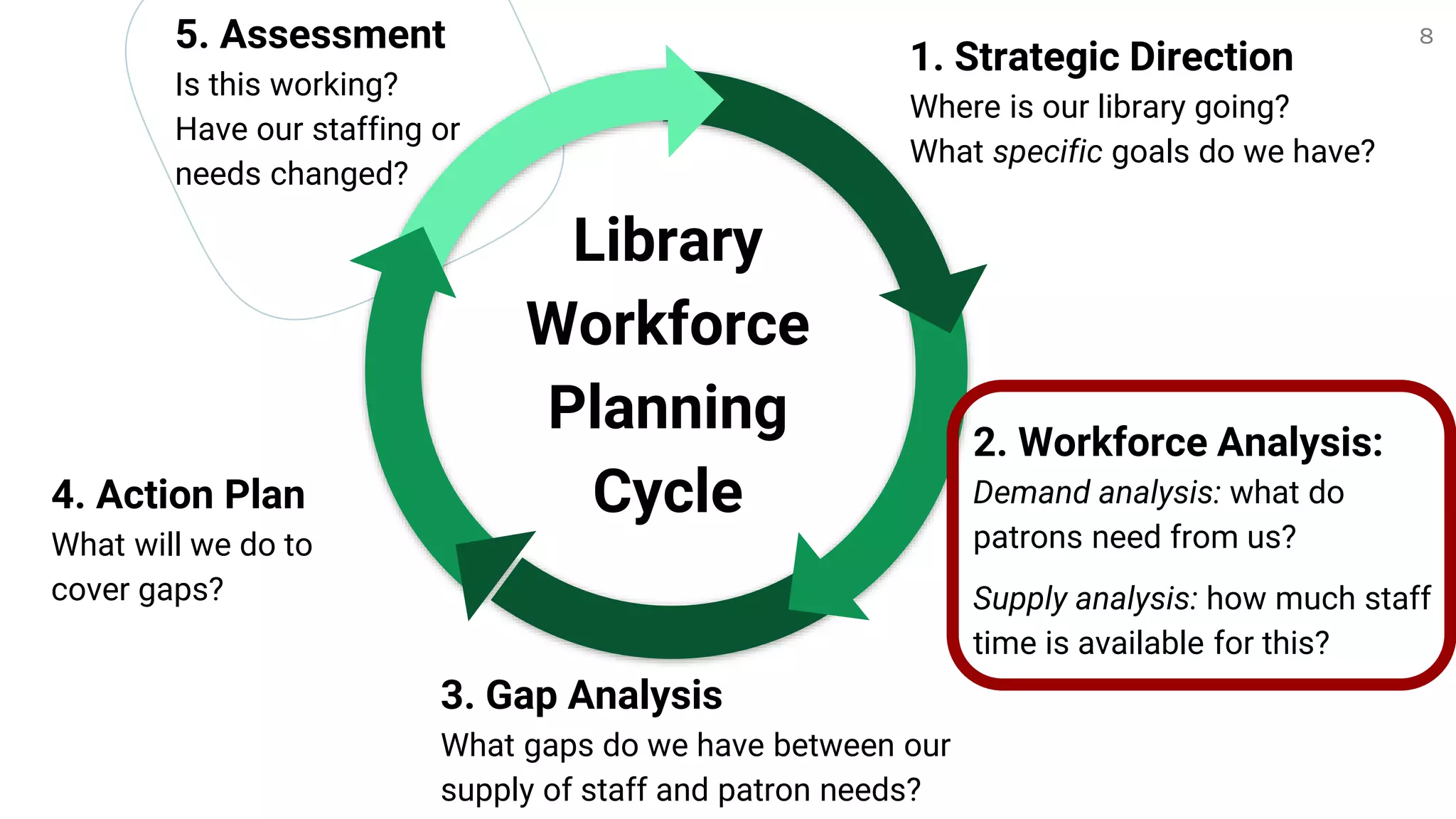
at UC Berkeley (USA)
- Managed a school library in Kazakhstan
- Research on workforce development and
staff experiences in academic libraries
2
Our Challenge
Many libraries are understaffed and
overworked -- and we can no longer do
“more with less.”
4
Issues in
US libraries
during the
pandemic
⇩ Fewer staff than before
⇩ Lower budget after inflation
⇧ New pandemic services
⇧ Profs and students need more help
⇧ Staff have more caregiving needs
5
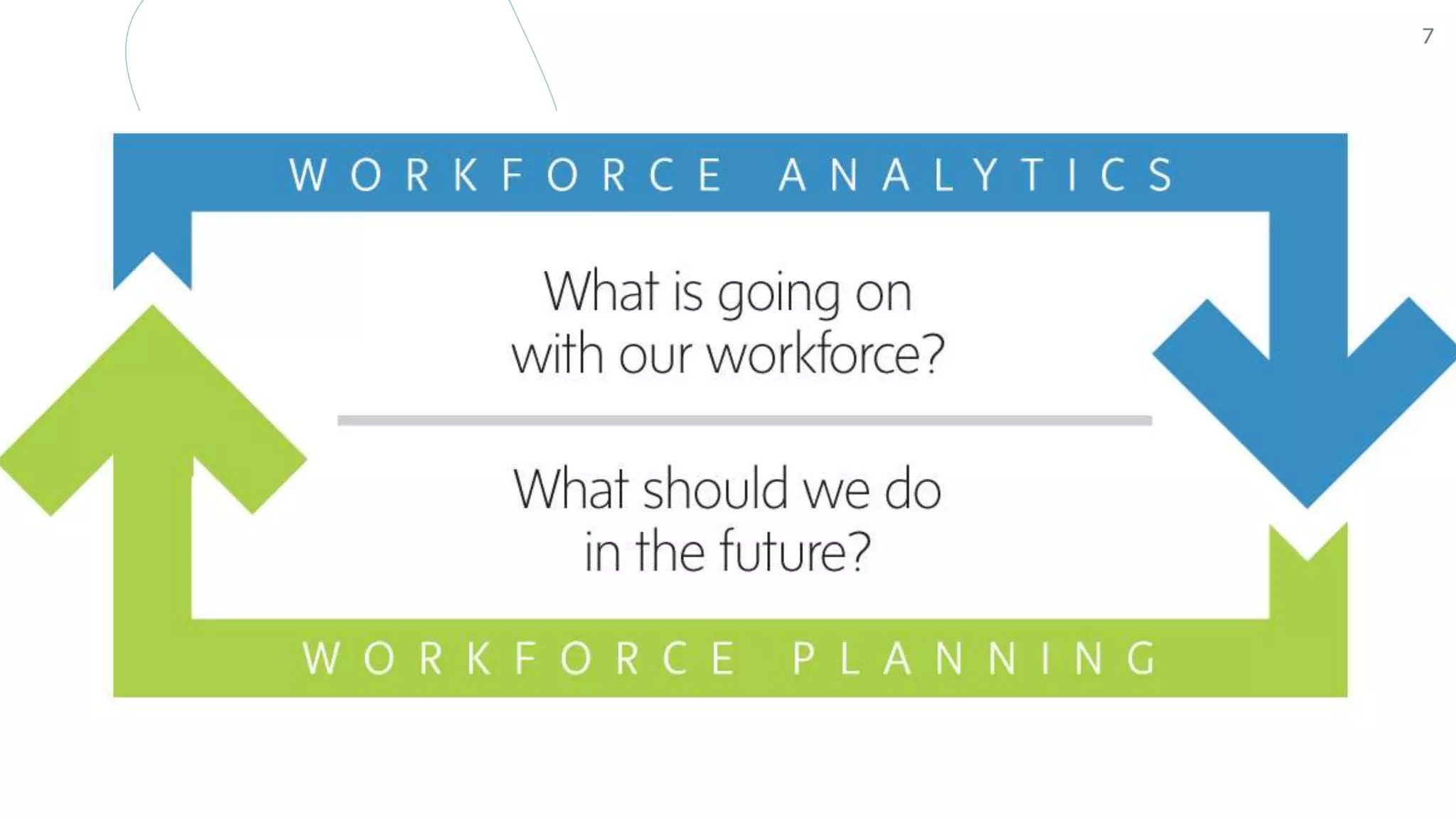
What to do about it:
7
8
5. Assessment
Is this working?
Have our staffing or
needs changed?
2. Workforce Analysis:
Demand analysis: what do
patrons need from us?
Supply analysis: how much staff
time is available for this?
1. Strategic Direction
Where is our library going?
What specific goals do we have?
4. Action Plan
What will we do to
cover gaps?
Library
Workforce
Planning
Cycle
3. Gap Analysis
What gaps do we have between our
supply of staff and patron needs?
Why do
workforce
analysis?
9
Address budget cuts
How can we cover gaps?
Fill skills gaps
Who should we train?
Realign to meet new needs
Where should we shift
people?
Adapt to a change in mandate
New goals set by our
campus or
cf. NIH Workforce Planning Guide
10
1. Productive Time
Work on core tasks like helping
patrons, cataloging, ordering
books, transferring books
between locations, licensing,
leading workshops, etc.
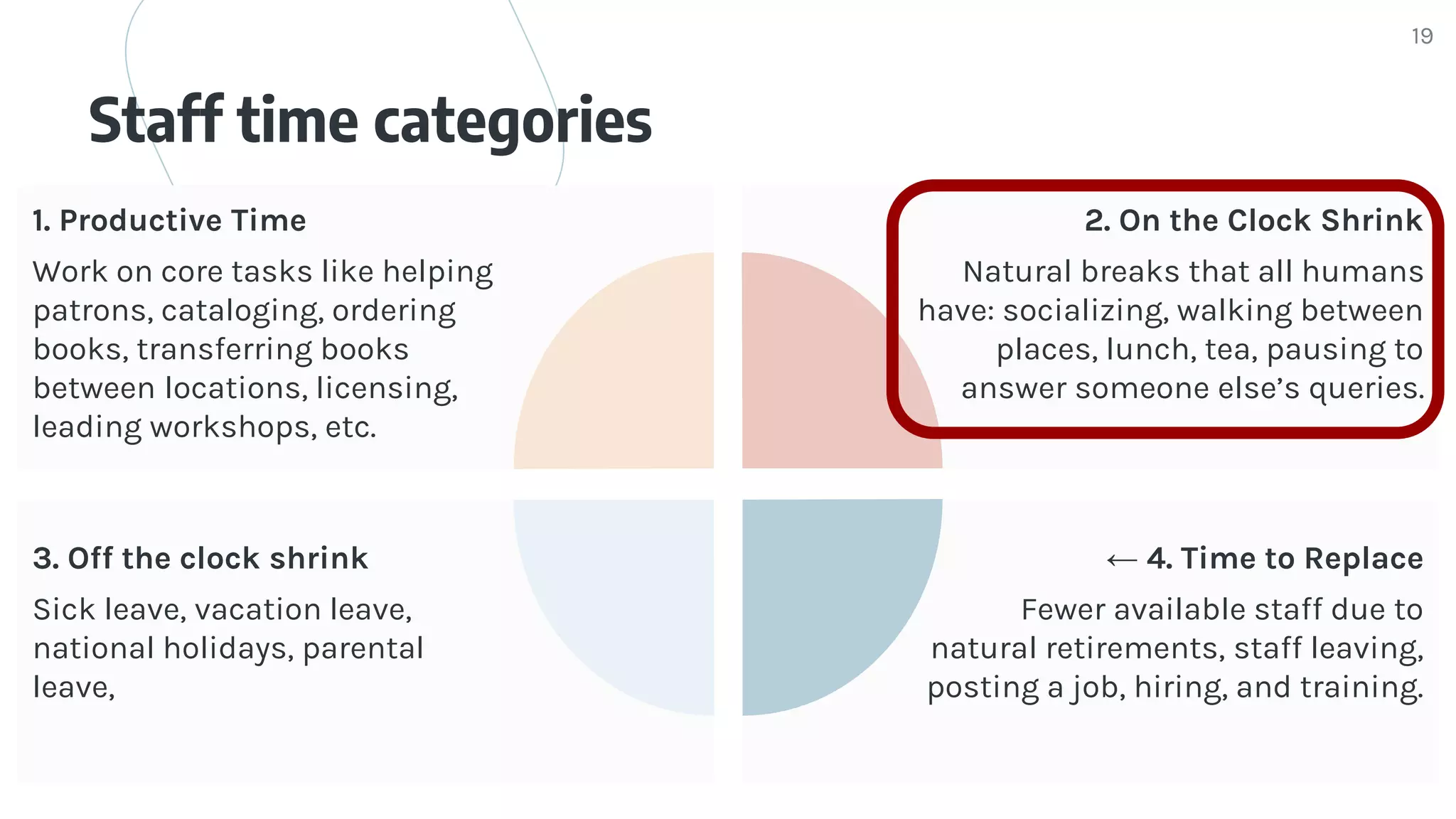
2. On the Clock Shrink
Natural breaks that all humans
have: socializing, walking between
places, lunch, tea, pausing to
answer someone else’s queries.
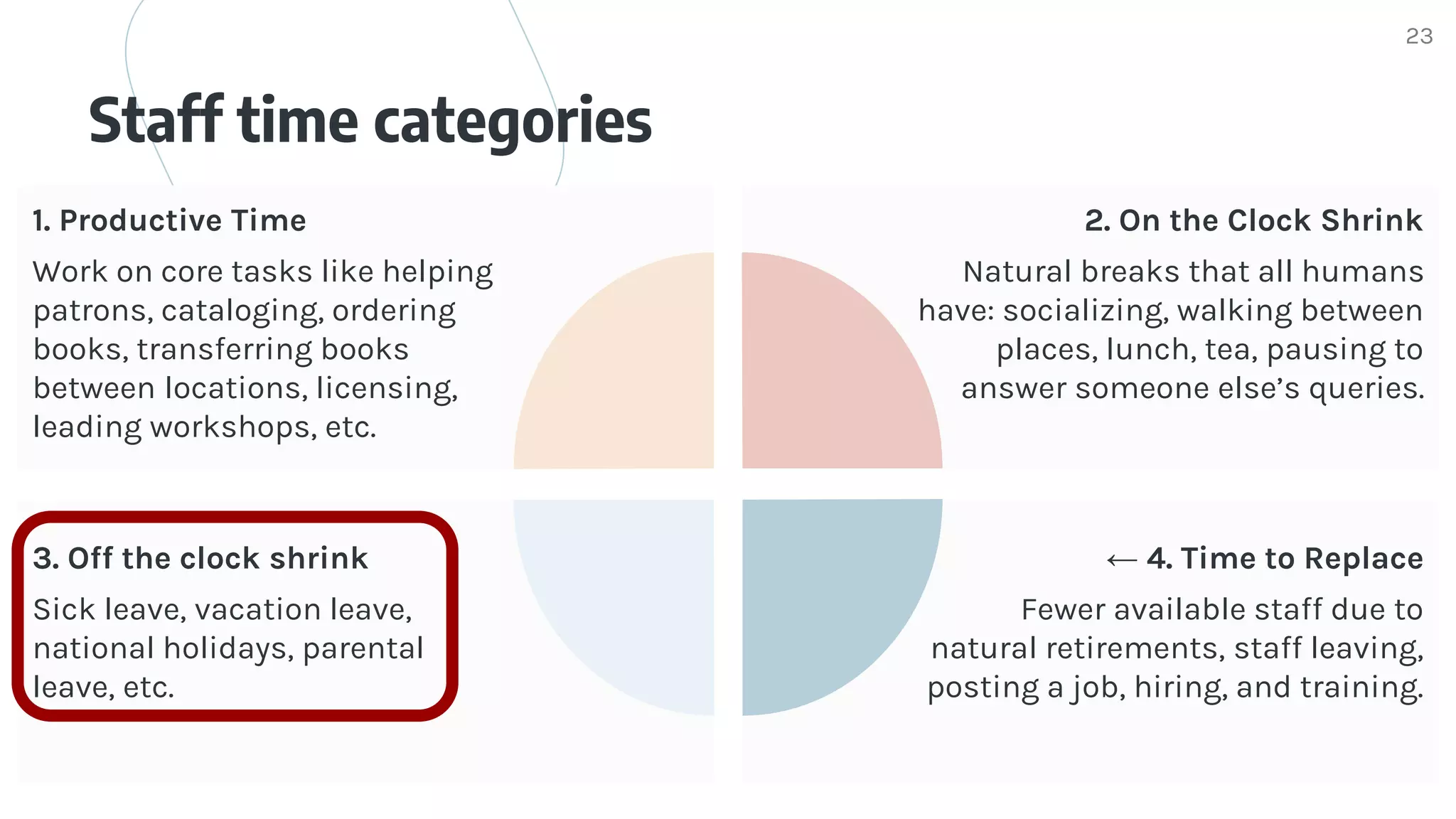
3. Off the clock shrink
Sick leave, vacation leave,
national holidays, parental
leave,
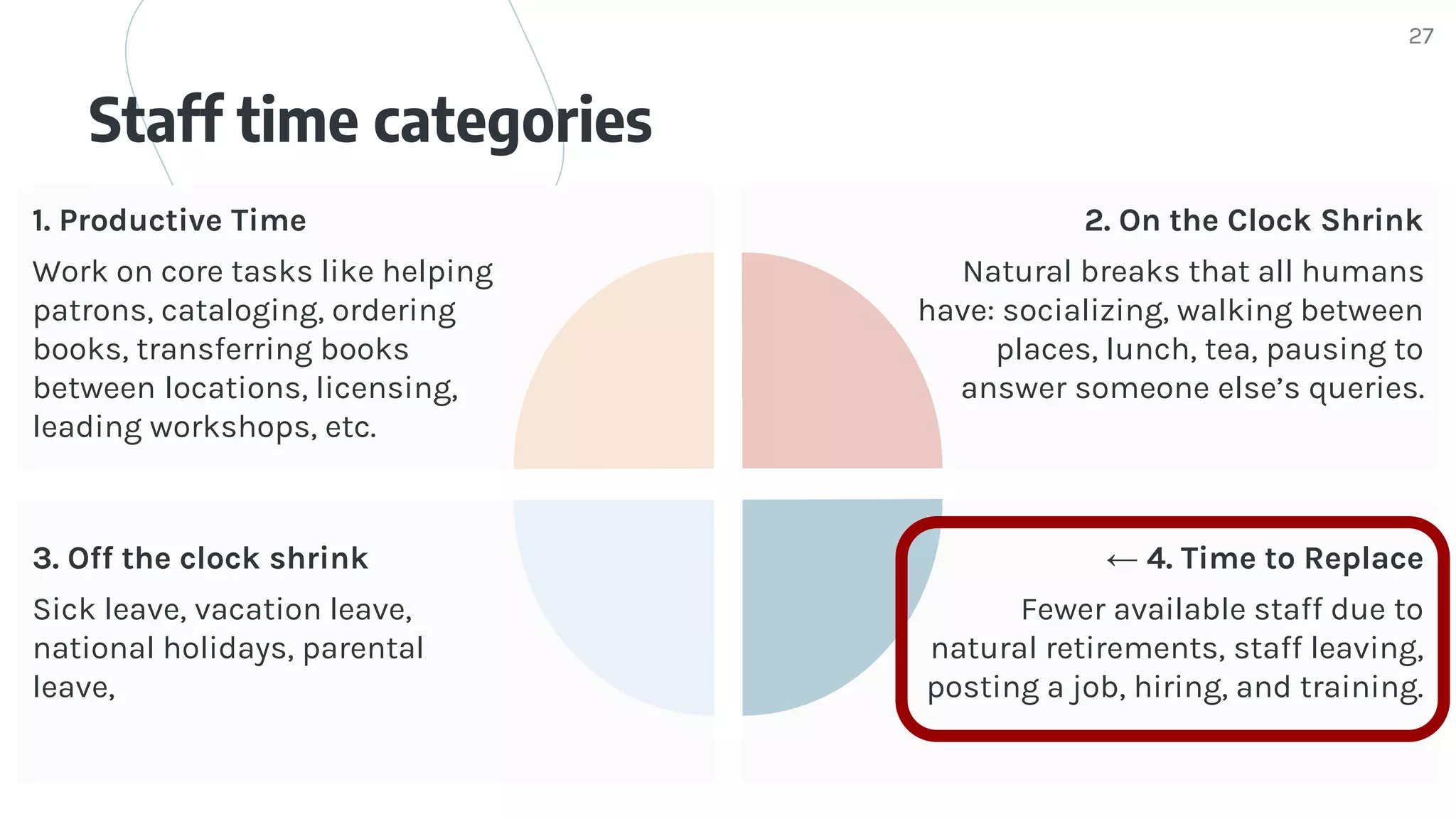
← 4. Time to Replace
Fewer available staff due to
natural retirements, staff leaving,
posting a job, hiring, and training.
Staff time categories
1. Task Planning
Which tasks help your team
meet your library’s core goals /
patron demands?
You might list them by quantity
(30 faculty consultations to date),
frequency (weekly, daily, hourly), or
length of task (10 mins, 3 hours).
11
Demand
drivers:
What demand drivers affect my team’s
workload?
- gate count by hour and location
- requests to buy books
- requests to teach classes
- requests for research assistance
- requests for help with web issues
- requests to scan books
- offers to donate books… etc.
12
13
14
15
How many people-hours?
Set a rough labor standard for how
many people and how long it takes
to complete a task:
Reteach a class: 1 hr prep, 30 min
adapt library guide, 1 hr in class, 30
min assessment = 3 hours
Original cataloging: 30 mins to
catalog, 5 min to shift books
16
On task planning:
Don’t take creativity and freedom away
from your staff!
But, clarify expectations:
- Should I copy a library guide in 30
mins….or take 20 hours to read up
and write a new one?
- Should I research for a half hour a
week, or 10 hours a week, to meet
promotion requirements?
17
Pause:
Before you start counting up hours
available per person per week…
take a look at shrink!
Staff time categories
19
1. Productive Time
Work on core tasks like helping
patrons, cataloging, ordering
books, transferring books
between locations, licensing,
leading workshops, etc.
2. On the Clock Shrink
Natural breaks that all humans
have: socializing, walking between
places, lunch, tea, pausing to
answer someone else’s queries.
3. Off the clock shrink
Sick leave, vacation leave,
national holidays, parental
leave,
← 4. Time to Replace
Fewer available staff due to
natural retirements, staff leaving,
posting a job, hiring, and training.
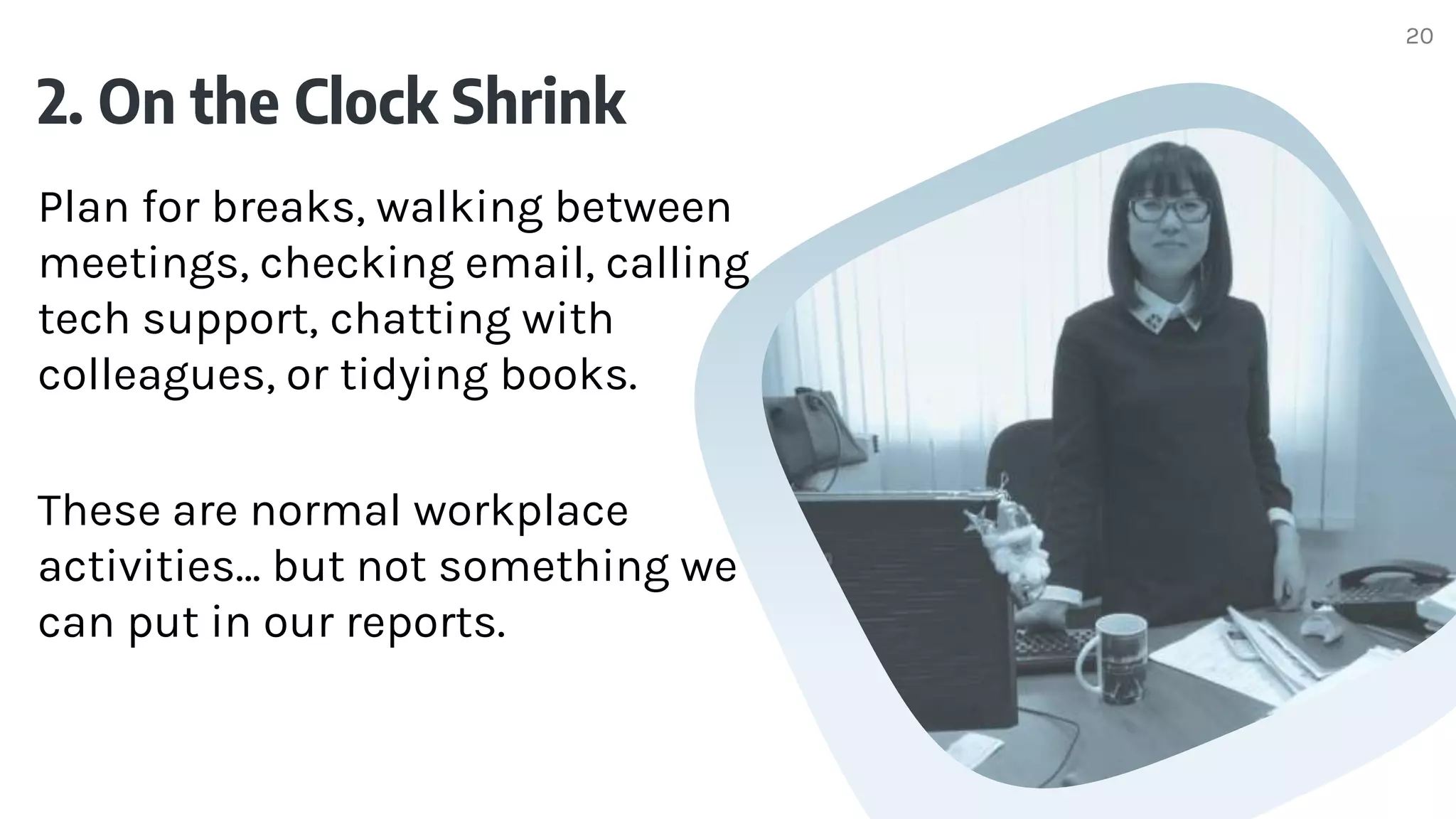
2. On the Clock Shrink
Plan for breaks, walking between
meetings, checking email, calling
tech support, chatting with
colleagues, or tidying books.
These are normal workplace
activities… but not something we
can put in our reports.
20
An example:
~ 30 mins between meetings
~ 30 mins on emails
~ 20 mins chat with peers
~ 30 mins reading updates
~ 20 mins on odds and ends
= 2.5 hours per person per day of
“on the clock shrink”
21
Calibrating workload
This slack or idle time helps
work feel well-paced and
reduces burnout.
It also gives us ‘wiggle-room’
to draw on during a surge of
work or sudden loss of staff.
22
Staff time categories
23
1. Productive Time
Work on core tasks like helping
patrons, cataloging, ordering
books, transferring books
between locations, licensing,
leading workshops, etc.
2. On the Clock Shrink
Natural breaks that all humans
have: socializing, walking between
places, lunch, tea, pausing to
answer someone else’s queries.
3. Off the clock shrink
Sick leave, vacation leave,
national holidays, parental
leave, etc.
← 4. Time to Replace
Fewer available staff due to
natural retirements, staff leaving,
posting a job, hiring, and training.
3. Off the Clock Shrink
Workers are being paid, but
aren’t able to work. They’re on
vacation, or sick, or caring for a
new child.
This is also great!
But we have to plan for it.
24
An example:
If we have promised 5 weeks per
year of vacation and sick time to
20 workers, 1-2 people will be out
every week of the year.
This means your available staff
is always 2 people lower than
you think it is.
25
A healthy library asks for
meaningful work, yet plans for
staff to care for family, go on
vacation, and find new jobs!
26
Staff time categories
27
1. Productive Time
Work on core tasks like helping
patrons, cataloging, ordering
books, transferring books
between locations, licensing,
leading workshops, etc.
2. On the Clock Shrink
Natural breaks that all humans
have: socializing, walking between
places, lunch, tea, pausing to
answer someone else’s queries.
3. Off the clock shrink
Sick leave, vacation leave,
national holidays, parental
leave,
← 4. Time to Replace
Fewer available staff due to
natural retirements, staff leaving,
posting a job, hiring, and training.
4. Time to Replace
Here, the worker has left. It takes 6-
15 months to get approval, post a
job, review apps, interview, make
an offer, do papers, wait for a start
date, and train the new
staff member.
If you lose 2 people every year plus
have people on leave, you could be
down 2-4 people every week.
28
29
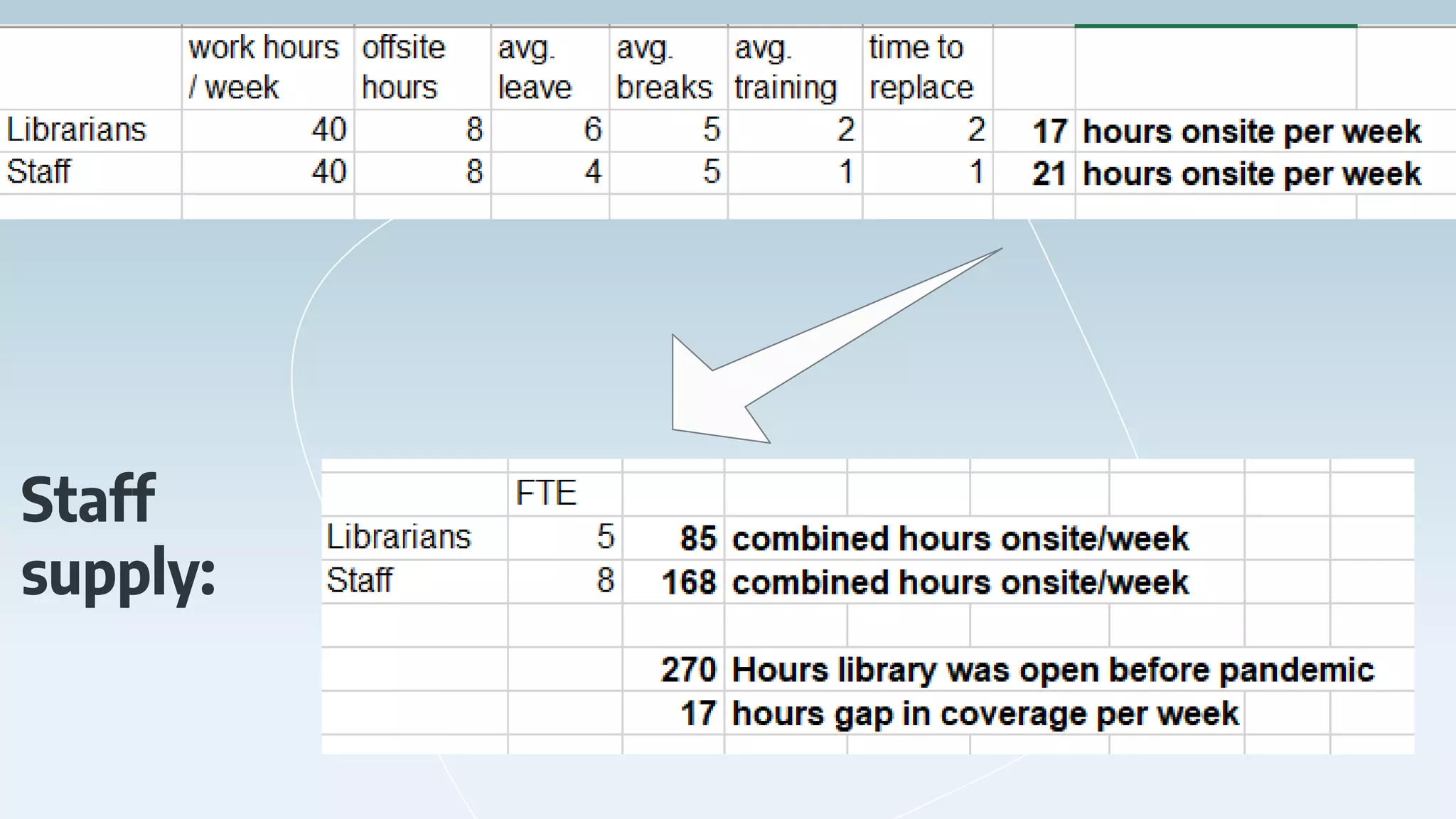
Staff
supply:
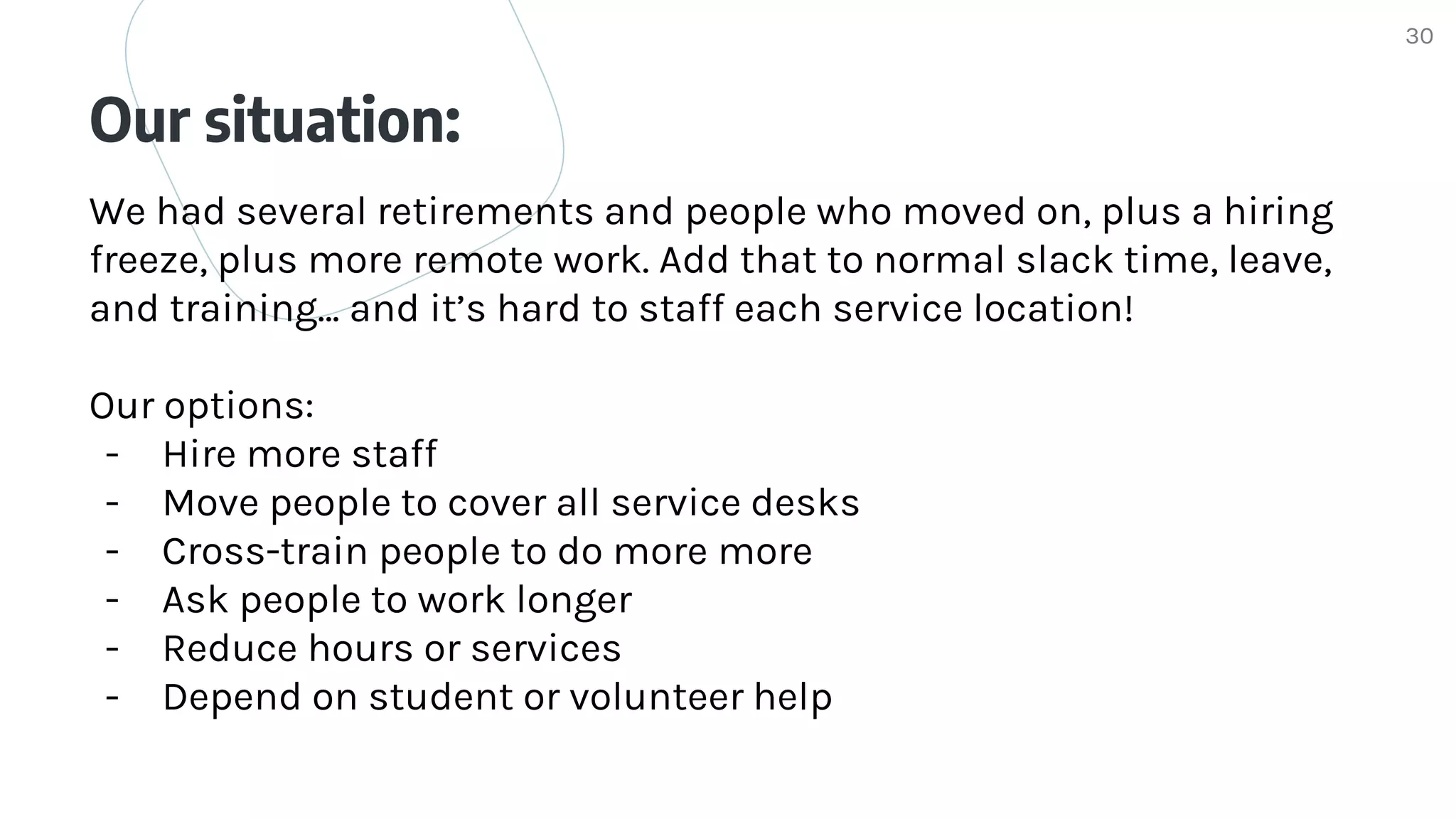
Our situation:
30
We had several retirements and people who moved on, plus a hiring
freeze, plus more remote work. Add that to normal slack time, leave,
and training… and it’s hard to staff each service location!
Our options:
- Hire more staff
- Move people to cover all service desks
- Cross-train people to do more more
- Ask people to work longer
- Reduce hours or services
- Depend on student or volunteer help
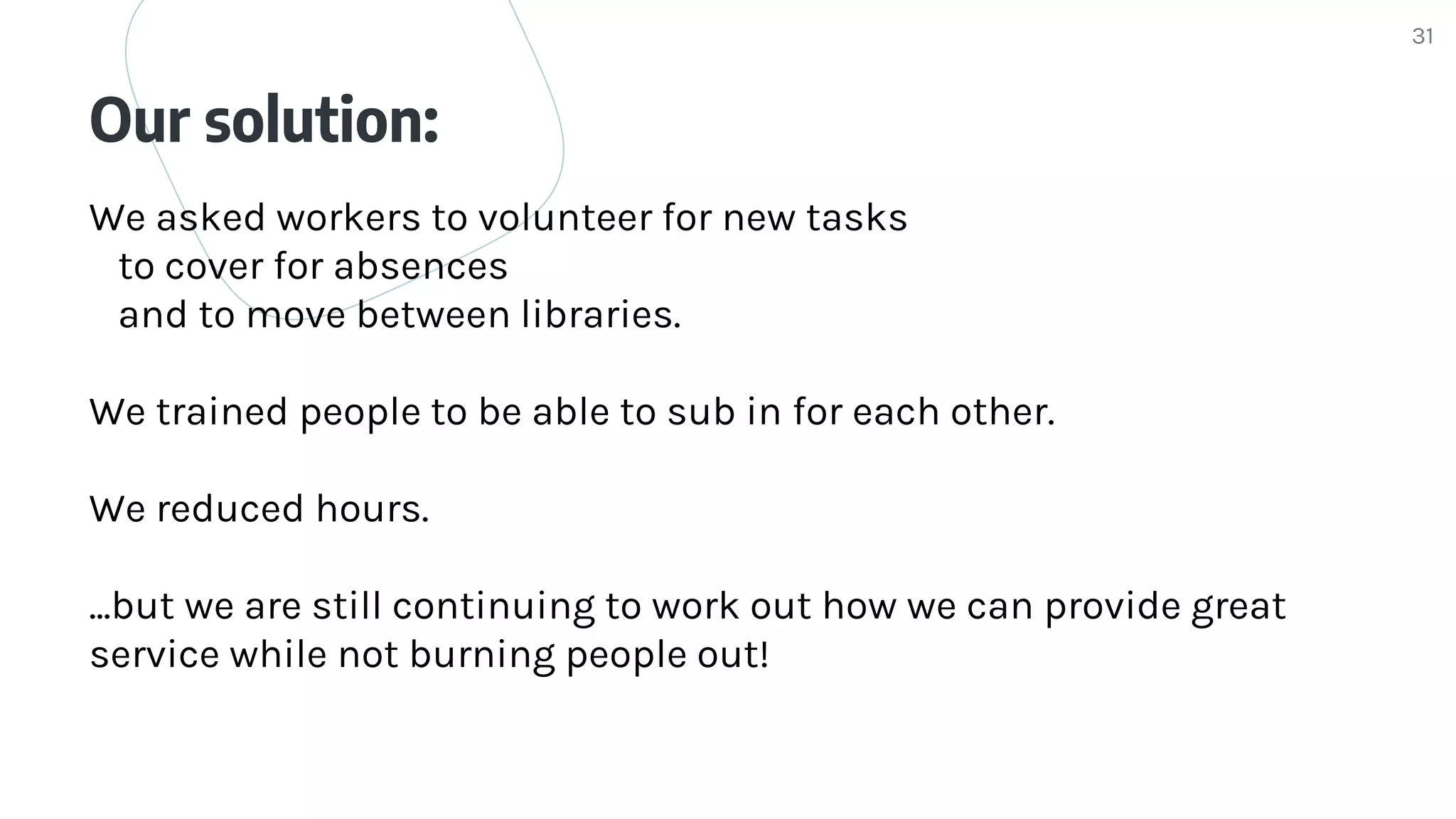
Our solution:
31
We asked workers to volunteer for new tasks
to cover for absences
and to move between libraries.
We trained people to be able to sub in for each other.
We reduced hours.
...but we are still continuing to work out how we can provide great
service while not burning people out!
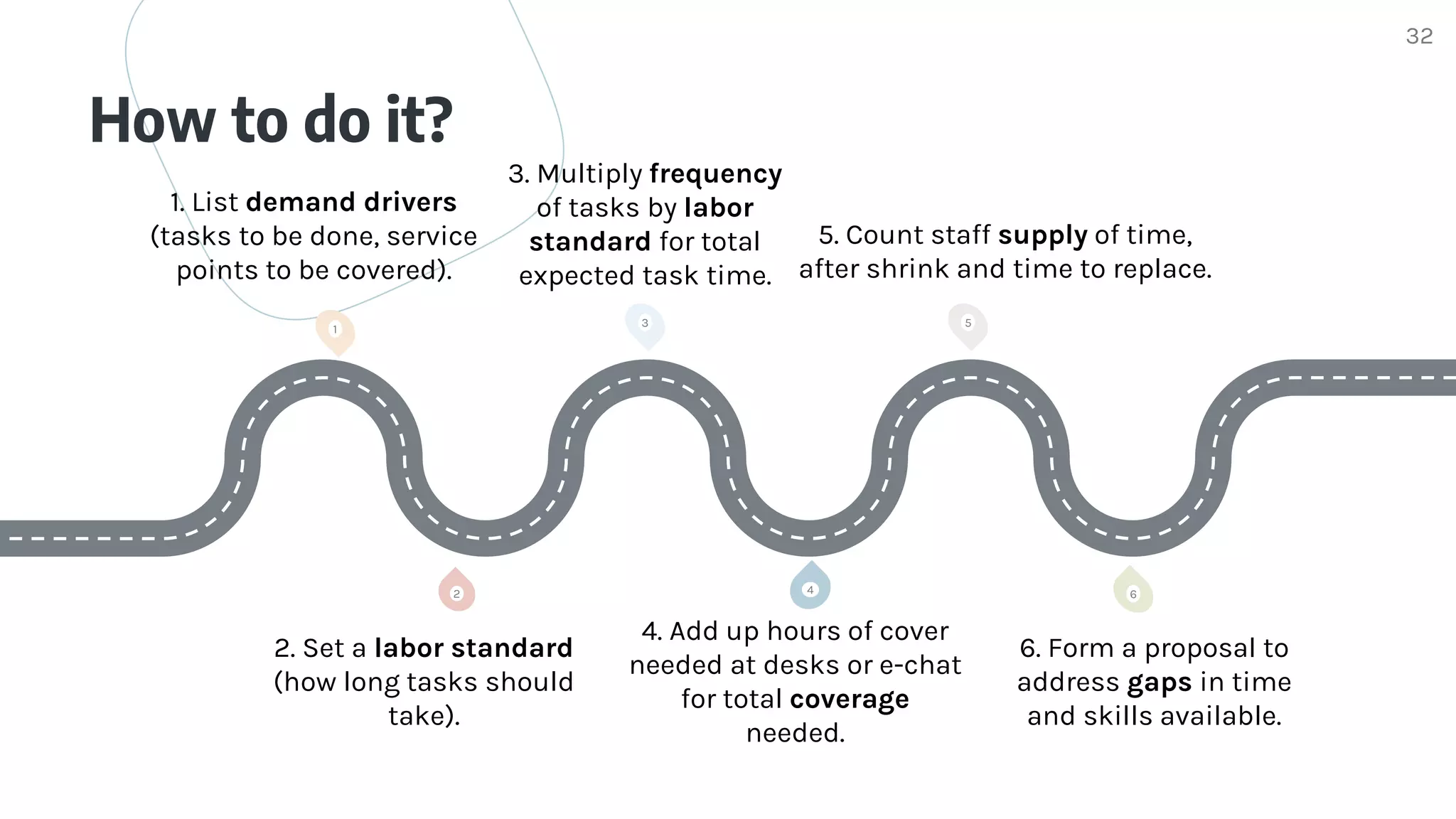
How to do it?
32
1
3 5
6
4
2
1. List demand drivers
(tasks to be done, service
points to be covered).
3. Multiply frequency
of tasks by labor
standard for total
expected task time.
4. Add up hours of cover
needed at desks or e-chat
for total coverage
needed.
2. Set a labor standard
(how long tasks should
take).
5. Count staff supply of time,
after shrink and time to replace.
6. Form a proposal to
address gaps in time
and skills available.
Further
Reading
NIH Workforce Planning Guide
Workforce Planning in NZ Libraries
(Barthorpe 2012)
Workforce Planning at ANU SIS in
Australia (2017)
Library Workforce lit review
(Williamson 2016)
Oracle Strategic Workforce Planning
software walkthrough
33
Thank you!
Thank you for listening.
Thank you to Rob Emmelhainz and Susan
Edwards for guidance and support in exploring
how to improve our libraries.
34
Questions?
Let’s discuss!
Look me up on Twitter, LinkedIn, or at my work email!
35

Using Workforce Analytics to Improve Our Libraries

  • 1.
    Using Workforce Analytics toImprove Our Libraries Outcomes. Outreach. Outstanding. PLAI Congress, November 2021 Celia Emmelhainz / @anthrolib
  • 2.
    About me: - Qualitativeresearch librarian at UC Berkeley (USA) - Managed a school library in Kazakhstan - Research on workforce development and staff experiences in academic libraries 2
  • 3.
  • 4.
    Many libraries areunderstaffed and overworked -- and we can no longer do “more with less.” 4
  • 5.
    Issues in US libraries duringthe pandemic ⇩ Fewer staff than before ⇩ Lower budget after inflation ⇧ New pandemic services ⇧ Profs and students need more help ⇧ Staff have more caregiving needs 5
  • 6.
    What to doabout it:
  • 7.
  • 8.
    8 5. Assessment Is thisworking? Have our staffing or needs changed? 2. Workforce Analysis: Demand analysis: what do patrons need from us? Supply analysis: how much staff time is available for this? 1. Strategic Direction Where is our library going? What specific goals do we have? 4. Action Plan What will we do to cover gaps? Library Workforce Planning Cycle 3. Gap Analysis What gaps do we have between our supply of staff and patron needs?
  • 9.
    Why do workforce analysis? 9 Address budgetcuts How can we cover gaps? Fill skills gaps Who should we train? Realign to meet new needs Where should we shift people? Adapt to a change in mandate New goals set by our campus or cf. NIH Workforce Planning Guide
  • 10.
    10 1. Productive Time Workon core tasks like helping patrons, cataloging, ordering books, transferring books between locations, licensing, leading workshops, etc. 2. On the Clock Shrink Natural breaks that all humans have: socializing, walking between places, lunch, tea, pausing to answer someone else’s queries. 3. Off the clock shrink Sick leave, vacation leave, national holidays, parental leave, ← 4. Time to Replace Fewer available staff due to natural retirements, staff leaving, posting a job, hiring, and training. Staff time categories
  • 11.
    1. Task Planning Whichtasks help your team meet your library’s core goals / patron demands? You might list them by quantity (30 faculty consultations to date), frequency (weekly, daily, hourly), or length of task (10 mins, 3 hours). 11
  • 12.
    Demand drivers: What demand driversaffect my team’s workload? - gate count by hour and location - requests to buy books - requests to teach classes - requests for research assistance - requests for help with web issues - requests to scan books - offers to donate books… etc. 12
  • 13.
  • 14.
  • 15.
  • 16.
    How many people-hours? Seta rough labor standard for how many people and how long it takes to complete a task: Reteach a class: 1 hr prep, 30 min adapt library guide, 1 hr in class, 30 min assessment = 3 hours Original cataloging: 30 mins to catalog, 5 min to shift books 16
  • 17.
    On task planning: Don’ttake creativity and freedom away from your staff! But, clarify expectations: - Should I copy a library guide in 30 mins….or take 20 hours to read up and write a new one? - Should I research for a half hour a week, or 10 hours a week, to meet promotion requirements? 17
  • 18.
    Pause: Before you startcounting up hours available per person per week… take a look at shrink!
  • 19.
    Staff time categories 19 1.Productive Time Work on core tasks like helping patrons, cataloging, ordering books, transferring books between locations, licensing, leading workshops, etc. 2. On the Clock Shrink Natural breaks that all humans have: socializing, walking between places, lunch, tea, pausing to answer someone else’s queries. 3. Off the clock shrink Sick leave, vacation leave, national holidays, parental leave, ← 4. Time to Replace Fewer available staff due to natural retirements, staff leaving, posting a job, hiring, and training.
  • 20.
    2. On theClock Shrink Plan for breaks, walking between meetings, checking email, calling tech support, chatting with colleagues, or tidying books. These are normal workplace activities… but not something we can put in our reports. 20
  • 21.
    An example: ~ 30mins between meetings ~ 30 mins on emails ~ 20 mins chat with peers ~ 30 mins reading updates ~ 20 mins on odds and ends = 2.5 hours per person per day of “on the clock shrink” 21
  • 22.
    Calibrating workload This slackor idle time helps work feel well-paced and reduces burnout. It also gives us ‘wiggle-room’ to draw on during a surge of work or sudden loss of staff. 22
  • 23.
    Staff time categories 23 1.Productive Time Work on core tasks like helping patrons, cataloging, ordering books, transferring books between locations, licensing, leading workshops, etc. 2. On the Clock Shrink Natural breaks that all humans have: socializing, walking between places, lunch, tea, pausing to answer someone else’s queries. 3. Off the clock shrink Sick leave, vacation leave, national holidays, parental leave, etc. ← 4. Time to Replace Fewer available staff due to natural retirements, staff leaving, posting a job, hiring, and training.
  • 24.
    3. Off theClock Shrink Workers are being paid, but aren’t able to work. They’re on vacation, or sick, or caring for a new child. This is also great! But we have to plan for it. 24
  • 25.
    An example: If wehave promised 5 weeks per year of vacation and sick time to 20 workers, 1-2 people will be out every week of the year. This means your available staff is always 2 people lower than you think it is. 25
  • 26.
    A healthy libraryasks for meaningful work, yet plans for staff to care for family, go on vacation, and find new jobs! 26
  • 27.
    Staff time categories 27 1.Productive Time Work on core tasks like helping patrons, cataloging, ordering books, transferring books between locations, licensing, leading workshops, etc. 2. On the Clock Shrink Natural breaks that all humans have: socializing, walking between places, lunch, tea, pausing to answer someone else’s queries. 3. Off the clock shrink Sick leave, vacation leave, national holidays, parental leave, ← 4. Time to Replace Fewer available staff due to natural retirements, staff leaving, posting a job, hiring, and training.
  • 28.
    4. Time toReplace Here, the worker has left. It takes 6- 15 months to get approval, post a job, review apps, interview, make an offer, do papers, wait for a start date, and train the new staff member. If you lose 2 people every year plus have people on leave, you could be down 2-4 people every week. 28
  • 29.
  • 30.
    Our situation: 30 We hadseveral retirements and people who moved on, plus a hiring freeze, plus more remote work. Add that to normal slack time, leave, and training… and it’s hard to staff each service location! Our options: - Hire more staff - Move people to cover all service desks - Cross-train people to do more more - Ask people to work longer - Reduce hours or services - Depend on student or volunteer help
  • 31.
    Our solution: 31 We askedworkers to volunteer for new tasks to cover for absences and to move between libraries. We trained people to be able to sub in for each other. We reduced hours. ...but we are still continuing to work out how we can provide great service while not burning people out!
  • 32.
    How to doit? 32 1 3 5 6 4 2 1. List demand drivers (tasks to be done, service points to be covered). 3. Multiply frequency of tasks by labor standard for total expected task time. 4. Add up hours of cover needed at desks or e-chat for total coverage needed. 2. Set a labor standard (how long tasks should take). 5. Count staff supply of time, after shrink and time to replace. 6. Form a proposal to address gaps in time and skills available.
  • 33.
    Further Reading NIH Workforce PlanningGuide Workforce Planning in NZ Libraries (Barthorpe 2012) Workforce Planning at ANU SIS in Australia (2017) Library Workforce lit review (Williamson 2016) Oracle Strategic Workforce Planning software walkthrough 33
  • 34.
    Thank you! Thank youfor listening. Thank you to Rob Emmelhainz and Susan Edwards for guidance and support in exploring how to improve our libraries. 34
  • 35.
    Questions? Let’s discuss! Look meup on Twitter, LinkedIn, or at my work email! 35

Editor's Notes

  • #2 Hello! My name is Celia Emmelhainz, and I’m here today to talk with you today about using workforce analytics to improve our libraries. First, I would like to express my thanks to the organizers of Outcomes. Outreach. Outstanding for the invitation to present. I hope that this presentation helps all of us to increase the outcomes and impact of our libraries.
  • #3 To give you context on where I’m coming from, I would like to briefly introduce myself. I work as a qualitative research librarian at UC Berkeley, one of the larger public universities in the United States. In this role, I provide analysis and advice for qualitative and mixed-method projects across my library system. Previously, I worked as a quantitative data librarian at a small college, as an academic librarian in Kazakhstan, and as a school librarian in Kazakhstan, in Central Asia. I am interested in both research and organizational improvement. I started out by looking at readers’ needs, or what we might call the demands on our libraries. More recently, I have been looking at the supply of workers to our libraries. What motivates people to enter the library field? How can we create opportunities for staff to move up into leadership? How do we move from a collection of smart individuals into a library, or group of libraries, that truly works well together? And how do we make the results of all this work effective and impactful?
  • #4 Today I’m focused on understanding what our needs are from our library workers, how to estimate how much time we actually have available for our big projects, and how to make decision when it seems like there’s not enough people or time.
  • #5 Many American libraries have gone through rounds of budget cuts and limits on how many staff we can hire. I suspect you have experienced this as well. And while we want to help our readers, I’m starting to hear people say that we can’t just keep asking people to “more with less.” More with less being this idea that even if we have fewer resources, people, or capacity, we have to just keep pushing ourselves to expand our services anyway. But trying to do more and more with fewer resources just leads to burnout and to people leaving our libraries.
  • #6 Many American libraries have fewer staff to do our work since the pandemic. Some libraries laid off workers, while others just chose not to rehire new people when old ones retired or left. We’re also seeing budget cuts, as our communities responded to a drop in tax or tuition revenues by cutting costs in libraries. But we haven’t stopped working. We’re providing new services during the pandemic. We’ve led remote classes and meetings, digitized books to support online teaching, and even offered “curbside pickup” so that people who couldn’t enter a library could still safely get their books. And even as our staff and funds dropped, we found that readers needed more help from us than before the pandemic. When a book was in our catalog, readers went directly to the shelf to retrieve it. But when they can’t access the shelf and there’s no ebook, now the librarians are very involved in looking for a solution! Finally, our library staff have more caregiving needs, for their own health, for their families, and even for mental health, as Americans experience burnout, anxiety, and depression as a result of the pandemic news cycle and our country’s political upheaval.
  • #7 So what can we do about this? Of course, many library leaders are meeting more often, communicating more often, and reassuring both staff and patrons that we recognize the challenges they’re facing and that we intend to support them.
  • #8 But after years of limited hiring and new needs from our libraries, we’re also finding sticky structural issues -- that our current allocation of staff doesn’t always match the responsibilities they’re expected to cover. This is where workforce planning and workforce analytics comes in. As you see, it’s a cycle, where our past planning has helped to create the situation we’re in now, and our analysis of the needs from and availability of our current workforce informs our plans for and actions in the future. [Image from visier.com]
  • #9 We often describe workforce planning as a circle, starting from 1) clear goals and then diving in to analyze 2) what our patrons need from us and who we have available to do the work. We then look at 3) any gaps between our goals and the people available to do them, and we 4) make a plan to close these gaps, or, if we’re short on time and people, we make a plan on what we can set aside for now. Finally, we 5) assess how it’s going. This is too much for a short talk, so I’m going to focus today on the workforce analysis part of the planning cycle, where we look at what we need people to do, and the realistically assess just how much staff time we have to accomplish these things.
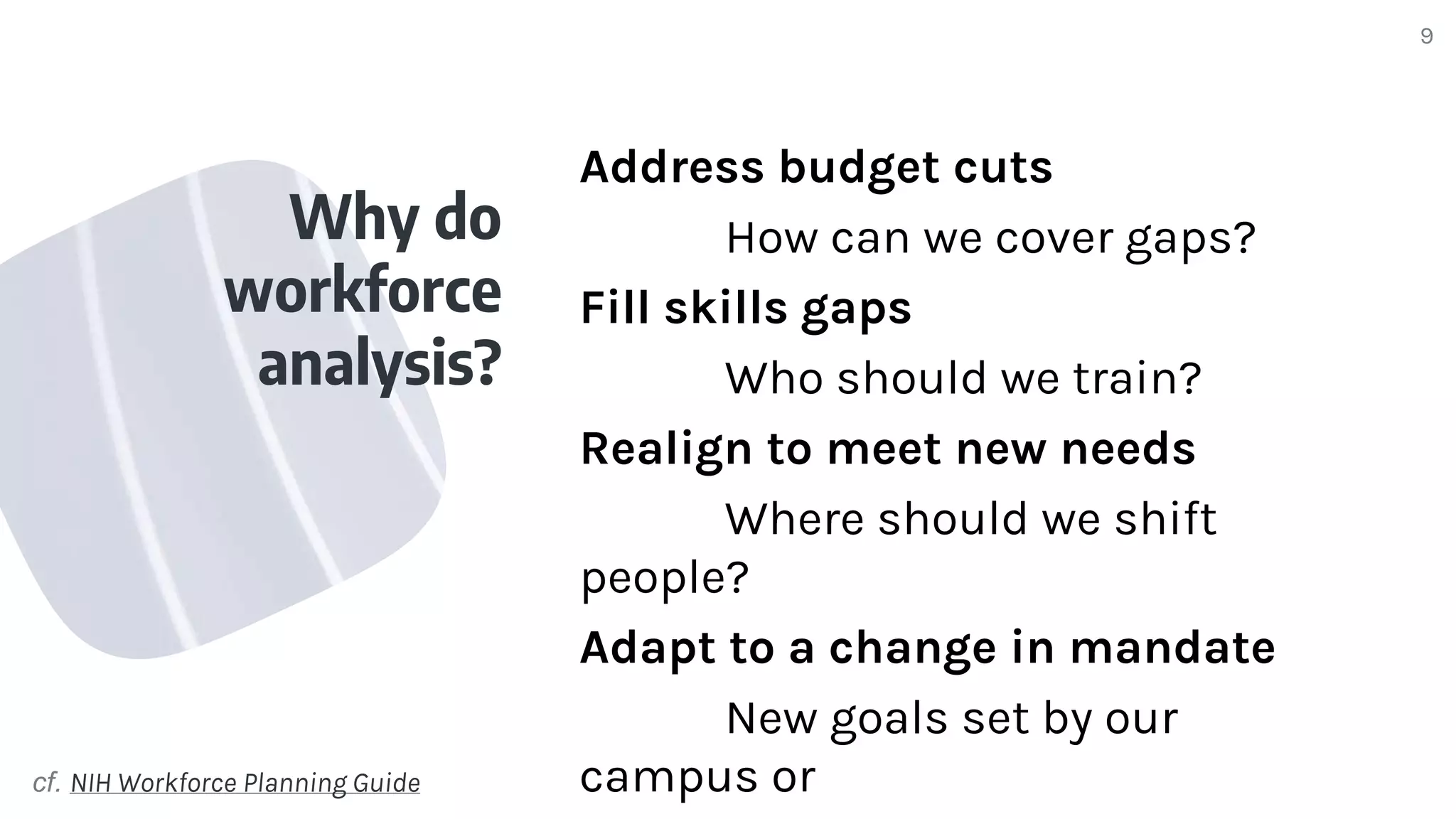
  • #10 Of course digging into a planning project like this takes a lot of staff time away from the urgent tasks in front of us. So it’s fair to ask why we’d do workforce analysis. I believe workforce planning can help us to meet our goals within the context of resources shortages--like the budget cuts my campus has faced. It can help us develop staff skills in working with new technology, like our library’s new integrated library system. It can help us realign to meet new needs from our users, like digitization or remote reference And it can help us adapt to changes in our community’s needs and goals, as with an increased emphasis in addressing racial barriers in American libraries. [Four reasons adapted from https://hr.nih.gov/sites/default/files/public/documents/workforce/workforce-planning/docx/2-getting-started-strategicworkforceplanwithtemplate-508.docx]
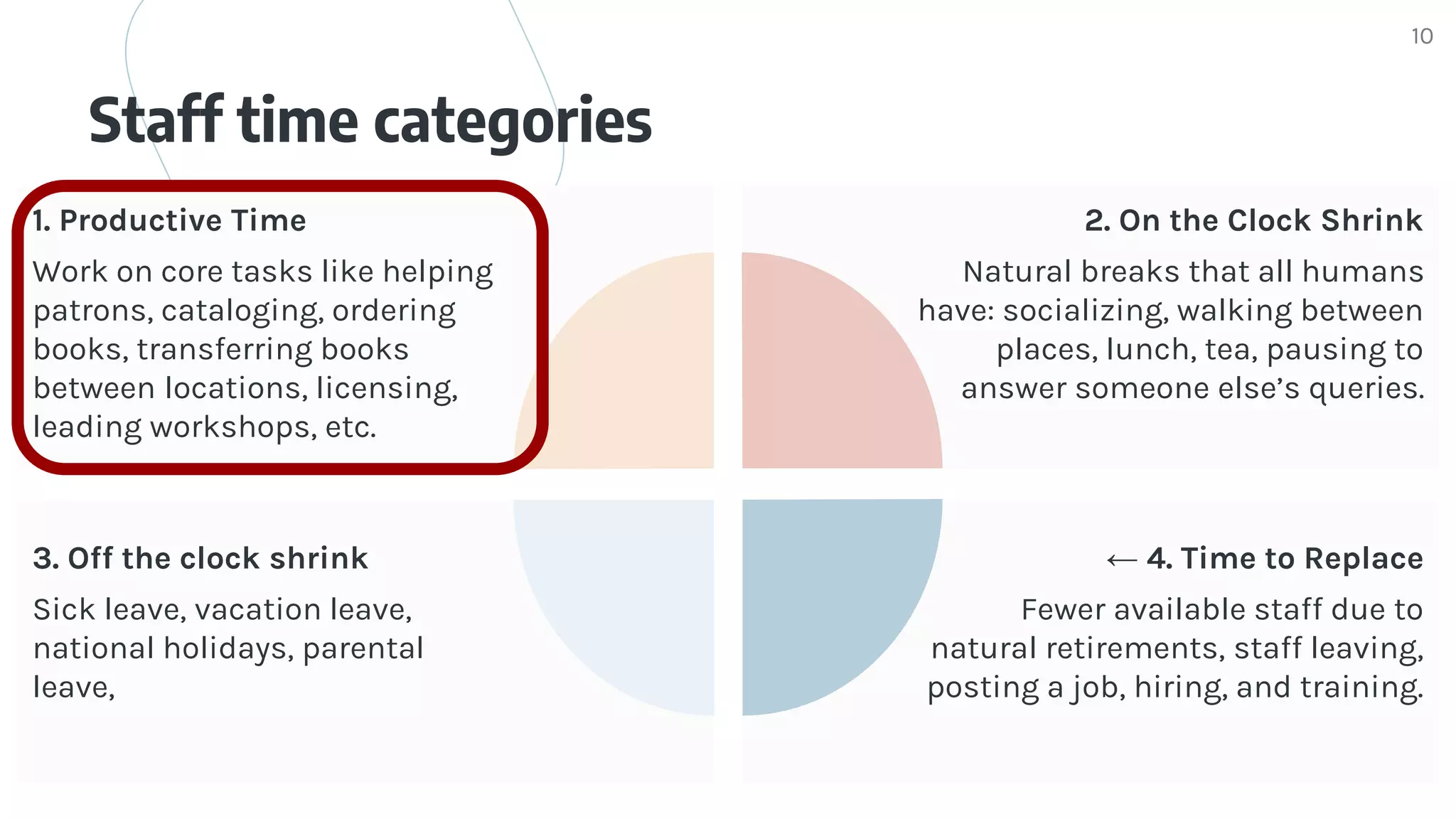
  • #11 When we think about what it’s possible for our library workers to sustainably accomplish, we can think of their time in four buckets, which we’ll go through today. The first is productive time--time available for working on core projects or providing core services, like lending out books through ILL, or meeting with researchers.
  • #12 To get a sense of what those projects might be, you can make a list of tasks people need to do to meet the core demands or responsibilities on your library.
  • #13 Of course, it seems like our tasks and responsibilities are endless! So we can narrow down our key tasks to those which are driven by demand from patrons, campus leaders, or other units in your library. Think about what you’re asking to do: how many workshops, trainings, or orientations are your staff asked to lead, and how much time do they need to prepare each event? How long does it take to respond to issues with your catalog or website? How much time does it take to order requested books, to fulfill ILL requests… and so on. [Find more questions for demand analysis at: https://hr.nih.gov/workforce/workforce-planning/demand-analysis]
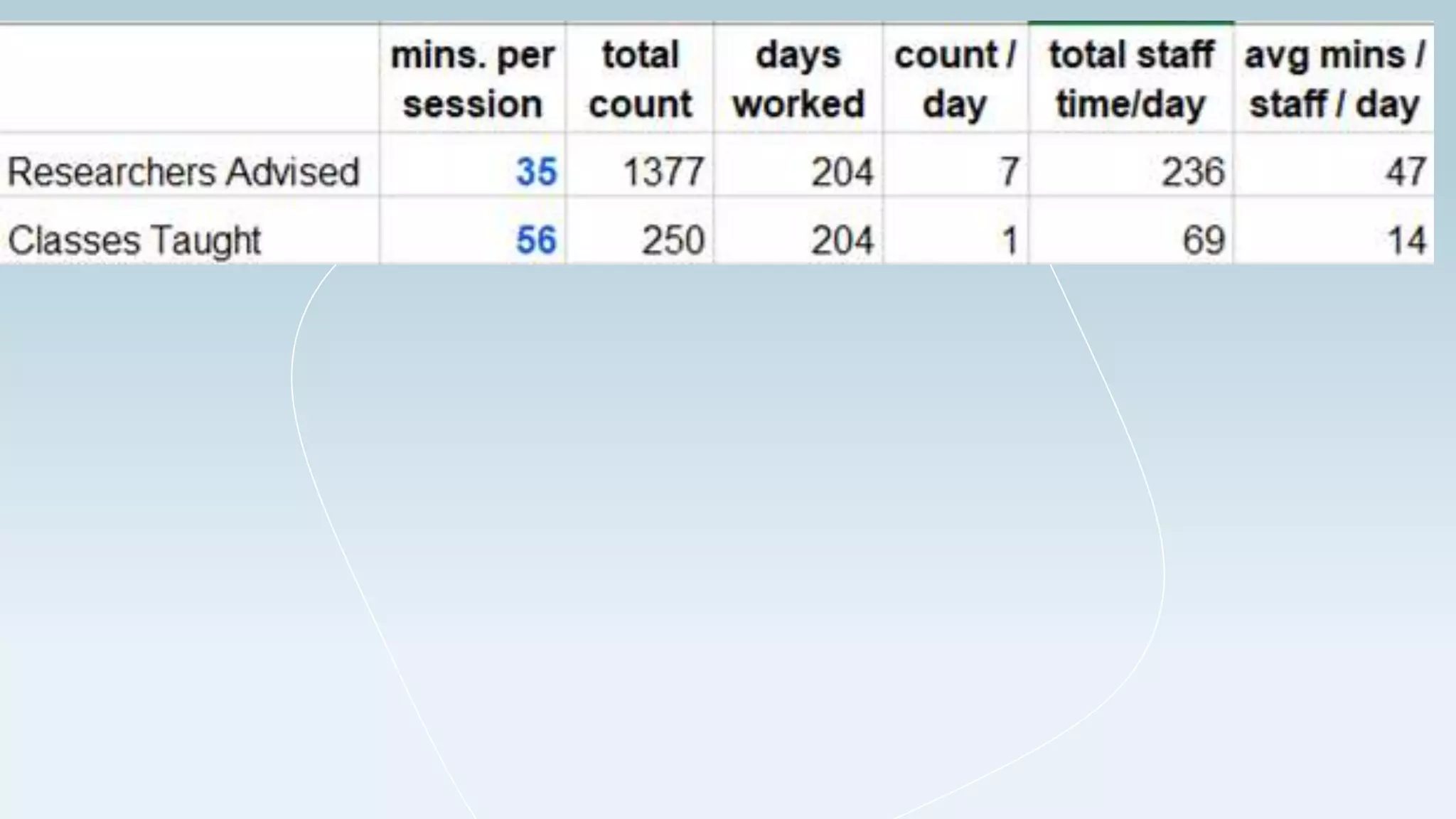
  • #14 How would you actually organize information about your library’s tasks in a way that’s useful? I’ll use an example from my line of work as a liaison librarian. I work on a team of librarians and staff who provide services and staff service points across campus. I could start by looking at our major tasks, like advising researchers and teaching classes. We have tracked our work in this area, so we have assessment statistics I can draw on. In this example, across 1500 interactions, we can see that librarians and staff spend an average of a half hour in each reference session, and an average of an hour in each class taught. If we times that by the total number of key interactions, and then divide by the number of days worked, we get an estimated count of how often per day (or week, or month) our staff are in this interaction, including a total of time across all staff, and how much time an individual staff member takes per day for these tasks. Of course, if you look at the average amount of time staff spends in teaching each day, you’ll see that it’s just that -- an average across teaching and non-teaching days. Who teaches for only 14 minutes at a time??
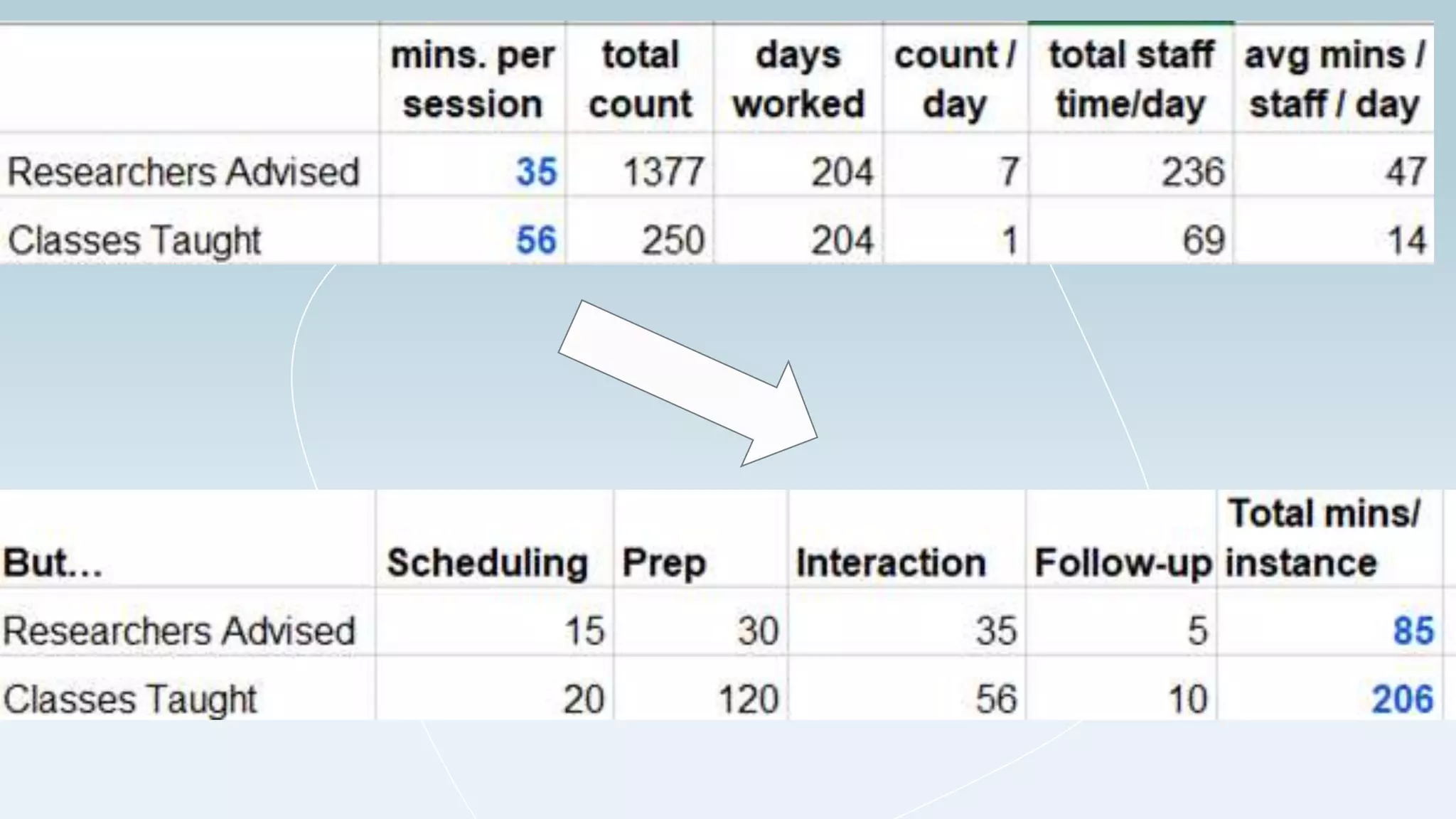
  • #15 Because these statistics only capture average time in direct interaction, it misses how some people do more of this work than others. And it misses all the background work that goes into a direction interaction with readers. So if I were planning for my team, I’d estimate how long other aspects of the interaction take, like scheduling, doing background research or setting up a library guide for a class, meeting with readers, and then following up by sending them additional resources. This might mean that we spend more like an hour per scheduled reference appointment, and more like three hours for each class taught!
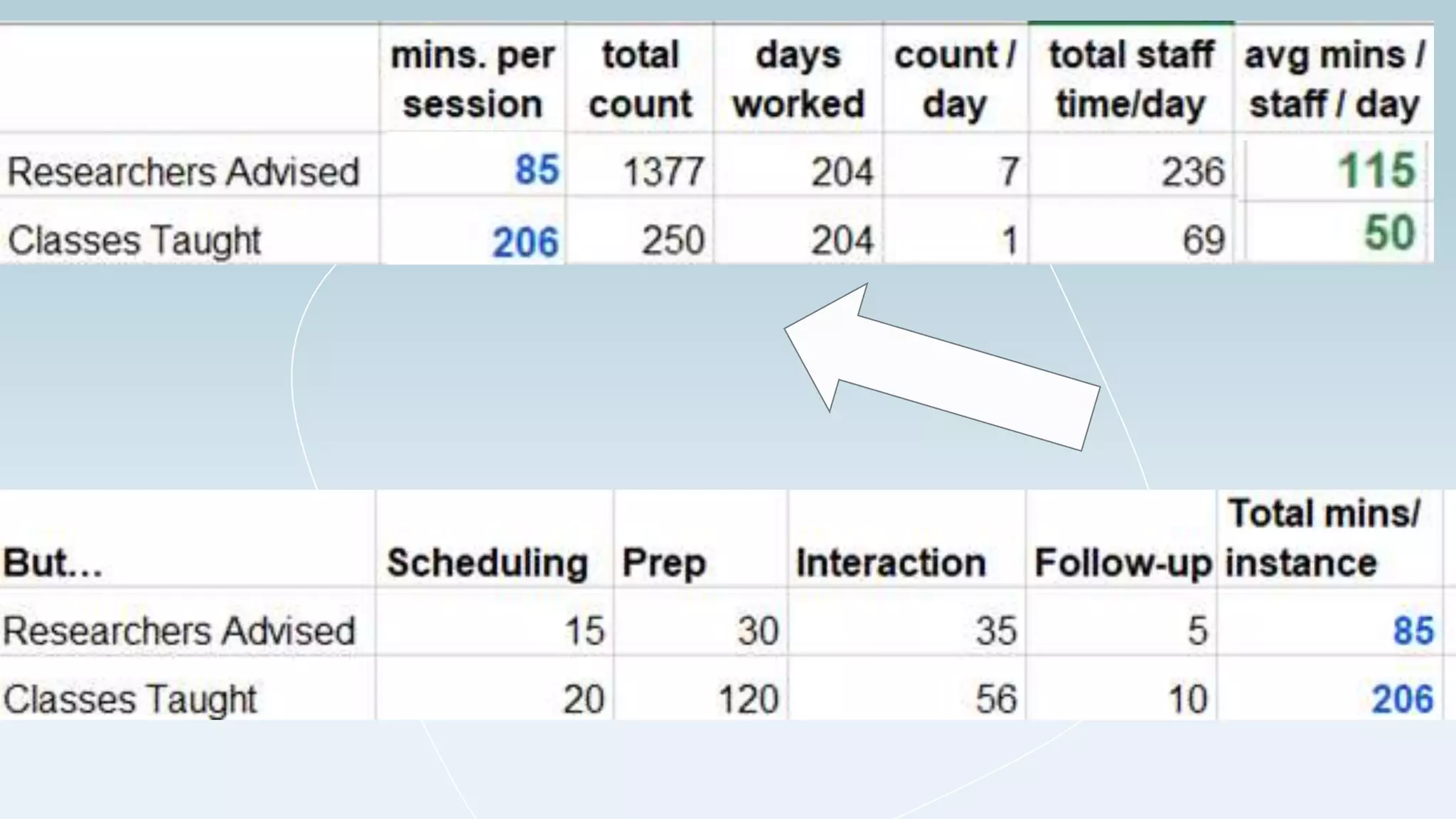
  • #16 I can then put those numbers back into my original chart, which results in an average two hours per day that our staff spend on reference, and an average one hour per workday that our staff spend on classes.
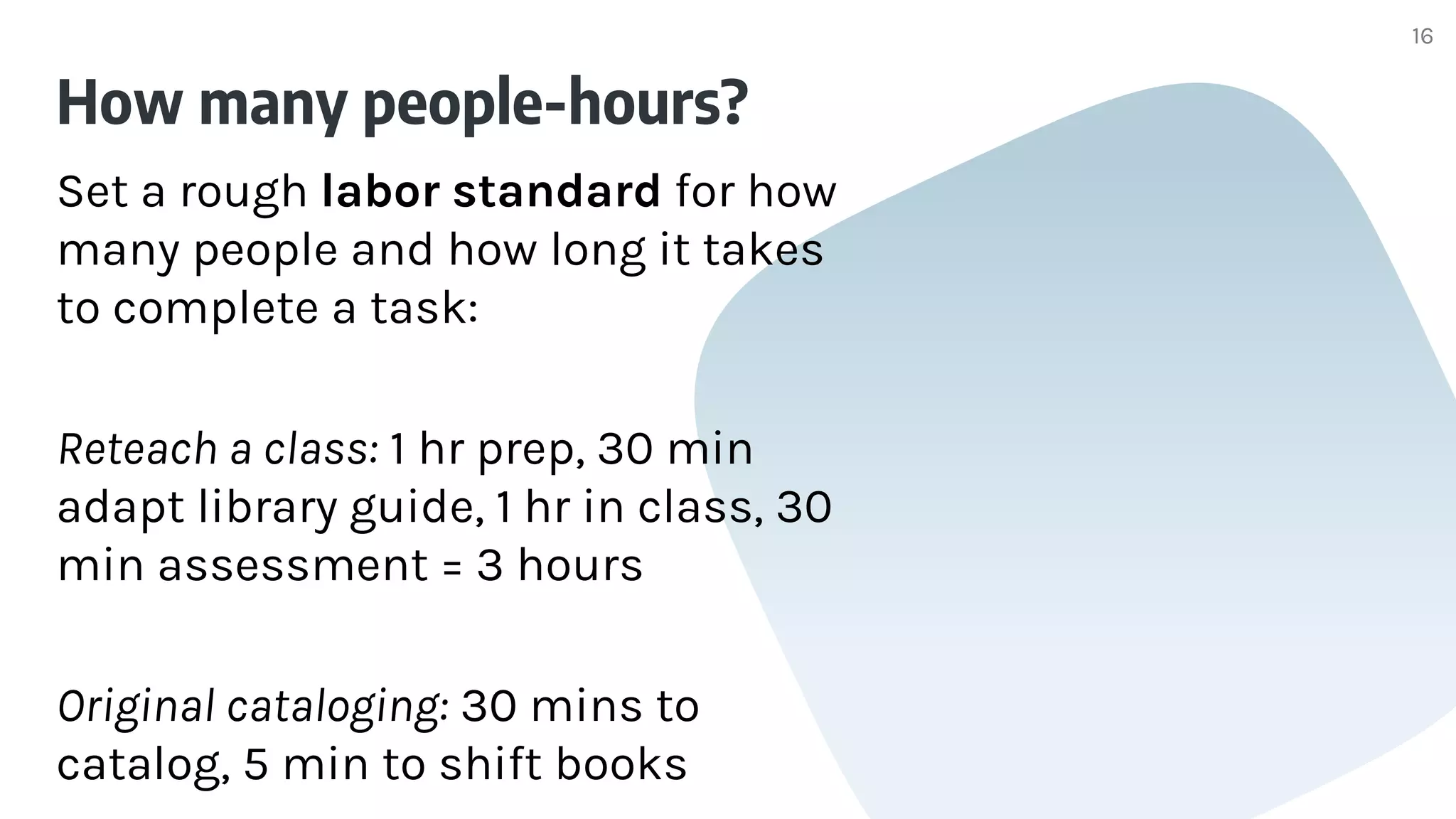
  • #17 What I just did is called setting a labor standard -- a broad estimate of how long all parts of a task will take to complete. [Examples] People will disagree quite vigorously about how long tasks should take, or do take!
  • #18 My goal here isn’t take away creativity or authority from individuals in our teams. But it can help to set broad parameters. Should I just copy a guide from another library, and add my own links… or research a new one? Should I research and customize each class, or teach the same thing over and over? Different libraries will have different expectations for this.
  • #19 Now you’re probably thinking… great… I make a list of tasks, calculate how long it takes, and then assign to people until their hours are full. But stop! Before you figure out where to put people or what tasks to assign, take a look at shrink.
  • #20 This has us looking at the opposite of “productive time,” which is shrink. There are two types, on- and off-the clock, which are important when planning what your team can actually get done.
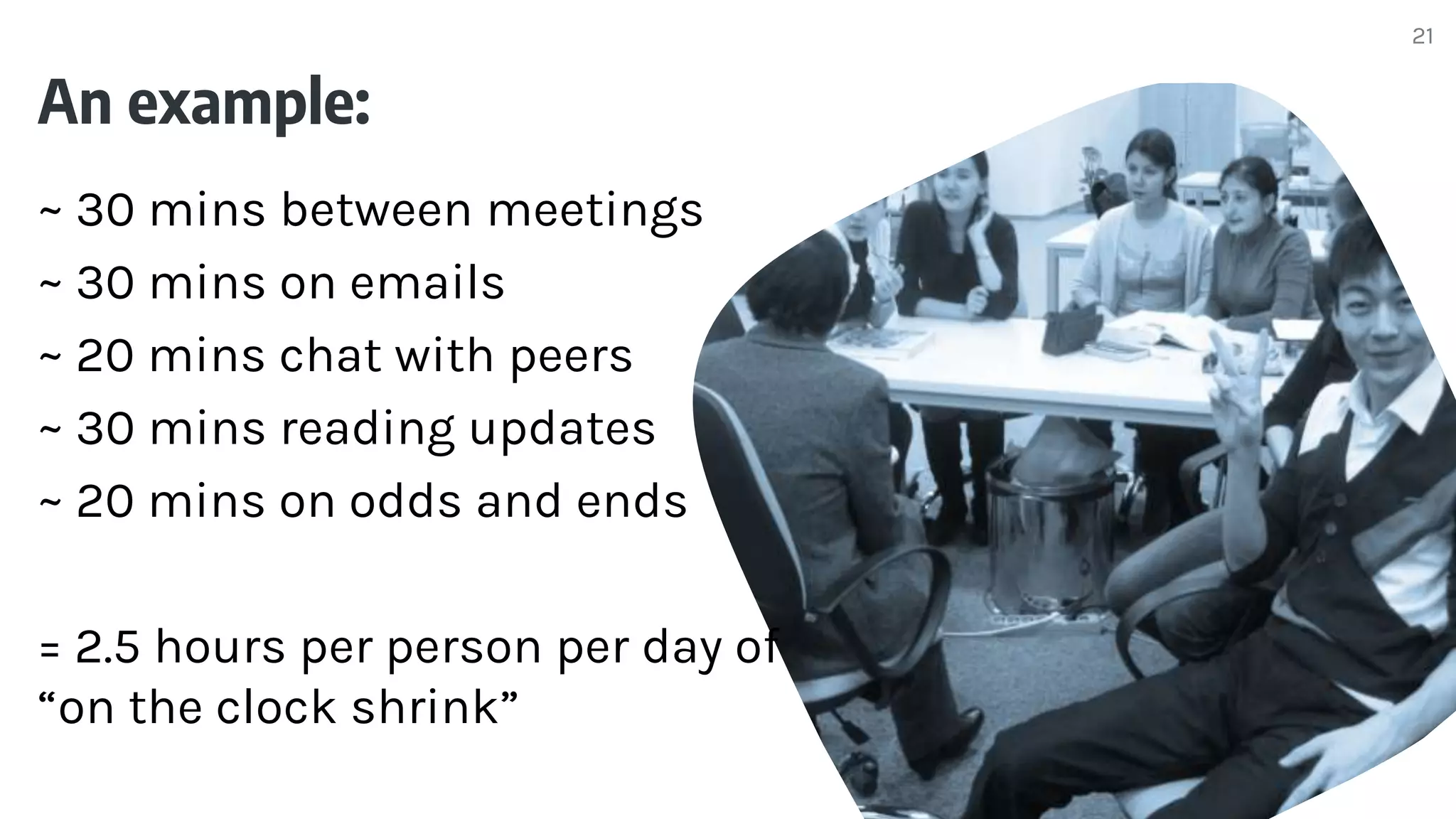
  • #21 “Shrink” is time where we’re transitioning between core tasks, or checking in with colleagues, or getting tea, or walking between buildings for meetings, or reading email updates on your campus or from a library listserv. This is good and normal! People aren’t machines. We need to connect and move and explore in order to do good work.
  • #22 We just need to plan for this. If we want to divide up work between 5 or 20 or 100 library staff, we need to estimate how much time they have available for key projects-which means subtracting the time that’s unavailable. For instance, on my large college campus, people may spend 30 minutes walking between meetings, an hour on emails, 20 minutes talking to colleagues, 20 minutes reading the news, and 20 minutes on break. So I’d want to plan for two and a half hours--out of eight--where someone isn’t working on their core work.
  • #24 The third essential category to think about when planning staff time is “off the clock shrink,” or days when people aren’t “on the clock” and working.
  • #25 Excellent libraries often give their workers leave for vacation, when they’re sick, after they have a child. They might give leave for the worker to go to classes or present at conferences. These things are important for staff and make us better libraries, but we also have to plan for it -- it means the person isn’t available for daily work that day!
  • #26 This is really critical when planning for work within a team. For instance, if you have 20 workers who each get 5 weeks of leave a year, that means 1.5 people will be gone, on average, every single week of the year. This means the number of full-time workers you have isn’t 20 -- it’s more like 18. Plan accordingly.
  • #27 At one library I worked at, staff were promised 30 days of paid leave in their work contracts… but the managers didn’t want to let them take any leave, because the library’s circulation desk would not be covered. This is poor planning on the part of management! We need to plan for enough coverage of tasks and service points that we can operate smoothly even if several people are out at once, say, for family leave, plus someone who left for another job, plus someone taking vacation.
  • #28 The fourth category to plan for in terms of workers’ time is “time to replace.”
  • #29 When a librarian or staff member leaves, it may take from 6 months to 2 years to get approval to replace the person, post a job, review applications, interview, offer, process paperwork, wait for the person to start, and then fully train the new person. If you have fairly high turnover--perhaps because people can’t advance, because they retire, because their family needs to move, because it’s expensive to live in your city, or because they move to another job or career -- then you could find yourself losing several people each year. If you lose 3 people per year to retirement or other jobs, on average, you might find that you’re down 2-4 FTE each year from what you *think of* as your capacity. So… I think of myself as having 20 people, but maybe I only have 17 -- and if I take out off the clock shrink like vacation and family leave, maybe I only have 15 people working at a given time!
  • #30 Here’s a sample way to calculate this. Here, we have 5 librarians and 8 staff members who each work 40 hours per week. During the pandemic they worked remotely, so they’re now allowed to work from home one day a week (- 8 hours available to staff service points, although they of course can do other tasks during that time). If they get 6 weeks of sick and vacation leave a year, maybe they’re gone an average 4-6 hours per week! We can take out one more hour per day (five per week) for on-the-clock shrink like walking between meetings and reading news updates from campus. And we take out 1-2 hours per day for training, figuring they’ll be at conferences a few days per year. Finally, we assume that we lose 1-2 hours per day, on average, given our estimates of how often people leave and the time it takes to replace them. This results in an estimate that our 13 librarians and staff, which all work full-time, are each only available 20 hours per week, averaged across the whole year! When we’re planning tasks and which desks people will be at, we need to take this into account. We have about 253 total hours per week that we expect staff to bne at their desks on campus and working--which is less than the total number of hours at reference and circulation desks that we expected them to be available before the pandemic!
  • #31 I’ve given sample numbers, but we faced just this issue in my division over the past few years. After people left, or took breaks, or worked from home, we realized each person was only on campus part-time. Yet we wanted to cover multiple circulation and reference desks across campus. We wanted both circulation staff and librarians to be available when patrons asks. We realized we had hard choices [outline].
  • #32 Although we didn’t find a perfect solution, we chose to make several smaller changes, moving people, re-training people, reducing hours, and giving more work to managers (!). We realize that many workers are burnt out during the pandemic, but don’t currently have the budget to hire as many people as we would like. So we are continuing that much harder process of gap analysis and action planning, which is where we figure out how to respond in the midst of the constraints that we have.
  • #33 That was a lot to cover! Just to sum up what we went over, if you’d like to do a workforce analysis in your library, you’ll want to develop a clear list of tasks that need to be done and service points at which you need coverage. You’ll set estimates of how long each task takes, including hidden and background work, to get an estimate of how much task work there is to be done. You’ll also add up the hours for which you need coverage, for an estimate of staffing demand. You’ll then look at how much time your staff has available for specific projects as well as being generally available at service points, after necessary slack or on the job-shrink, as well as off-the job shrink (vacations) and time to replace. This gives you a final estimate of staffing supply. Compare the total demand on your staff time with the available supply of hours they can work on specific projects or locations, and adjust. If you find there’s more demand than supply, you’ll need to either hire more people, or cut expectations! And make sure to give yourself slack for anything unexpected, and to avoid burning out your workers.
  • #34 We’ve covered a lot, but if you’re interested, you can use these links to find more concrete examples of workforce planning and workforce analysis generally, as well as of how it’s been applied in libraries.
  • #35 Thank you for your time and attention, and thank you to Rob Emmelhainz for guidance on these concepts, and to Susan Edwards for support in exploring how to help our libraries work better for everyone.
  • #36 I would be glad to hear your question -- either now, if you’re watching this live, or later at emmelhainz at berkeley dot edu