Using Triangles- in Technical
Analysis
By
Sangamesh.K.S
Index
• What are triangles & why they are formed?
• Types of Triangles
• How to trade triangles?
• Placing Stop-Loss
• Strategies for trading triangles
• set price targets for triangles
• EWT’s perspective of triangles
• Using indicators & triangles
• Do patterns really work?
• Sleeping Triangles (An research and findings)
What are Triangles?
Triangles are the patterns formed when upper
and lower price level collide (converging trend
lines) at a single point called Apex/cardle.
Facts about triangles
• Triangles can be best described as horizontal
trading patterns.
• As the market continues to trade in a sideways
pattern, the range of trading narrows, and the
point of the triangle is formed.
• The triangle shows losing interest in an
issue, both from the buy side as well as the sell
side: the supply line (support) diminishes to meet
the demand.
Contd.
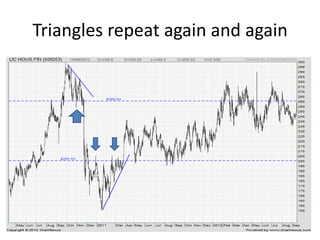
• They have a tendency to repeat again and
again.
• Triangles indicates its direction before it give
you a breakout.
Nature of Triangle
• They consist of
 Trend Line
 Major Support/ Resistance
• Volumes will be low before breakout; Volumes
kick high after breakout.
• Triangle speak its direction (Bullish/Bearish)
• Price never touch the cardle/Apex.
When they are formed?
• After a impulse wave; Triangles are corrective
wave(As per wave)
• When market start to move sideways.
• Range bound Market; Triangles are
anticipation of breaking S/R
Continuation Vs Reversal
• As per pattern it is Continuation
• As per EWT it is Reversal.
Types of Triangles
• Ascending triangle
• Descending triangle
• Symmetrical triangle
– Others
Triangles and parts of Triangles
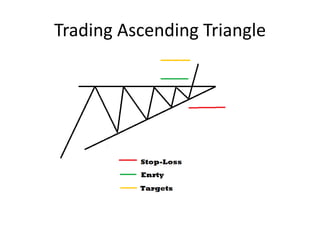
Trading Ascending Triangle
An example where
an Ascending
triangle failed to
give a bullish
breakout!!!
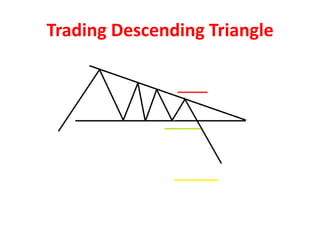
Trading Descending Triangle
Trading Symmetrical Triangle
Expanding Triangles
• These Expanding triangles are the
inverse(mirror image) of Regular Triangles
• The volume in the expanding triangles
increase
• Hear trading within the triangle can be
profitable.
Indicators and You
• MACD
• RSI
• ADX etc
• “It isn’t important which indicator is the best;
but you need to know your indicator”
• Tips: Keep an oscillator indicator and a moving
average indicator. And keep experimenting to
know more.
Stop-Loss
• 2% or 5% Stop Loss
• ATR
• Pivot points
And More
• Fib Levels
• Neckline
• Trend line
Before placing your stops. Keep an eye on “Risk” and “Volatility”
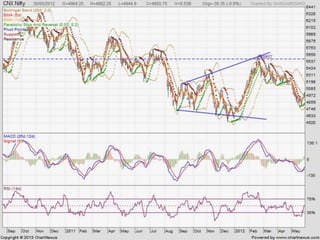
Premature Breakouts
• They are the violation of Support/Resistance
and Trend-line.
• They stand as a road map for traders.
What we can understand from a with
Premature breakouts?
– We can predict the breakout( Bullish/ Bearish)
• TIP: Stay away from the stock if the stock is showing
violation in both upper and lower levels. Look for
breakout for trading; They are the only reliable source
Triangles repeat again and again
Measuring Triangle
There are 2 techniques adopted to measure the
targets for triangle
• Parallel trend-line method
• Fibonacci Method
Elliott Wave Theory
It consist of
• Impulse wave
• Corrective wave
 Zig-zag Correction
 Flat Correction
Zig-Zag Correction
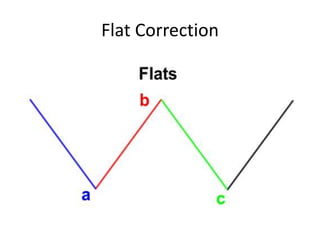
Flat Correction
EWT’s Perspective
What we learn from Elliott’s wave?
Do Patterns Work?
Yes, Patterns work
Really?
NO
Why we think in Patterns?
• Your pattern is based on our decision
• Your decision is based on your thinking
• Your thinking is based on your recognition.
Sleeping Triangle
Using Triangles  in Technical Analysis

Using Triangles in Technical Analysis

  • 1.
    Using Triangles- inTechnical Analysis By Sangamesh.K.S
  • 2.
    Index • What aretriangles & why they are formed? • Types of Triangles • How to trade triangles? • Placing Stop-Loss • Strategies for trading triangles • set price targets for triangles • EWT’s perspective of triangles • Using indicators & triangles • Do patterns really work? • Sleeping Triangles (An research and findings)
  • 3.
    What are Triangles? Trianglesare the patterns formed when upper and lower price level collide (converging trend lines) at a single point called Apex/cardle.
  • 4.
    Facts about triangles •Triangles can be best described as horizontal trading patterns. • As the market continues to trade in a sideways pattern, the range of trading narrows, and the point of the triangle is formed. • The triangle shows losing interest in an issue, both from the buy side as well as the sell side: the supply line (support) diminishes to meet the demand.
  • 5.
    Contd. • They havea tendency to repeat again and again. • Triangles indicates its direction before it give you a breakout.
  • 6.
    Nature of Triangle •They consist of  Trend Line  Major Support/ Resistance • Volumes will be low before breakout; Volumes kick high after breakout. • Triangle speak its direction (Bullish/Bearish) • Price never touch the cardle/Apex.
  • 7.
    When they areformed? • After a impulse wave; Triangles are corrective wave(As per wave) • When market start to move sideways. • Range bound Market; Triangles are anticipation of breaking S/R
  • 8.
    Continuation Vs Reversal •As per pattern it is Continuation • As per EWT it is Reversal.
  • 9.
    Types of Triangles •Ascending triangle • Descending triangle • Symmetrical triangle – Others
  • 10.
    Triangles and partsof Triangles
  • 11.
  • 13.
    An example where anAscending triangle failed to give a bullish breakout!!!
  • 14.
  • 17.
  • 19.
    Expanding Triangles • TheseExpanding triangles are the inverse(mirror image) of Regular Triangles • The volume in the expanding triangles increase • Hear trading within the triangle can be profitable.
  • 21.
    Indicators and You •MACD • RSI • ADX etc • “It isn’t important which indicator is the best; but you need to know your indicator” • Tips: Keep an oscillator indicator and a moving average indicator. And keep experimenting to know more.
  • 22.
    Stop-Loss • 2% or5% Stop Loss • ATR • Pivot points And More • Fib Levels • Neckline • Trend line Before placing your stops. Keep an eye on “Risk” and “Volatility”
  • 23.
    Premature Breakouts • Theyare the violation of Support/Resistance and Trend-line. • They stand as a road map for traders.
  • 24.
    What we canunderstand from a with Premature breakouts? – We can predict the breakout( Bullish/ Bearish) • TIP: Stay away from the stock if the stock is showing violation in both upper and lower levels. Look for breakout for trading; They are the only reliable source
  • 25.
  • 26.
    Measuring Triangle There are2 techniques adopted to measure the targets for triangle • Parallel trend-line method • Fibonacci Method
  • 27.
    Elliott Wave Theory Itconsist of • Impulse wave • Corrective wave  Zig-zag Correction  Flat Correction
  • 28.
  • 29.
  • 30.
  • 31.
    What we learnfrom Elliott’s wave?
  • 32.
    Do Patterns Work? Yes,Patterns work Really? NO
  • 33.
    Why we thinkin Patterns? • Your pattern is based on our decision • Your decision is based on your thinking • Your thinking is based on your recognition.
  • 34.