Using the Bells that Ring- systemic
model of supervision on the Practice
Supervisor Development Programme
Hazel Miller
Senior Practitioner, Essex County Council
Suzannah Rockett
Social Work Practice Development Manager, Barnsley
Metropolitan Borough Council
1
Using the Bells that Ring-
systemic model of
supervision on the Practice
Supervisor Development
Programme
During the next hour we will
• Give you a brief overview of the Practice Supervisor
Development Programme (PSDP)
• Outline the key elements of one model of supervision
(Bells that Ring) which forms part of the teaching and
tools on the PSDP
• Demonstrate the model for you using a live practice
discussion
• Talk with you about the ways in which you might use
this model in practice (and anything else which strikes
you)
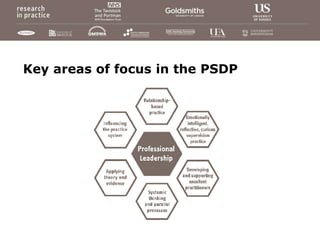
Key areas of focus in the PSDP
What we learnt in preparing for the
PSDP
•The transition to Practice Supervisor is a big step, not
always well-supported
•Relationships and emotions are central to the role
•Being a Practice Supervisor means more than ‘doing
supervision’ (and ‘supervision’ is more than 1:1 meetings)
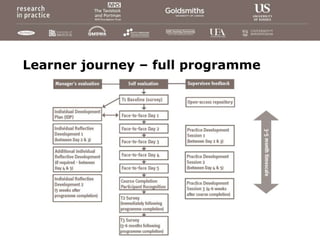
Learner journey – full programme
Introducing Bells that Ring: a process
for systemic group supervision
• Proctor, K. (2013)The Bells that Ring: A Process for Group
Supervision; or What to do When a Client Slips from your
Grasp and becomes Owned by Everyone Else in the Room!
Wiley online Library, https://doi.org/10.1002/j.1467-
8438.1997.tb00299.x
• Dugmore, P., Partridge, K., Sethi, I. and Krupa-Flasinska, M.
(2018) Systemic Supervision in Statutory Social Work in the
UK: Systemic Rucksacks and Bells that Ring. European
Journal of Social Work, DOI:
10.1080/13691457.2018.1446914
The process of supervision in Bells
that Ring
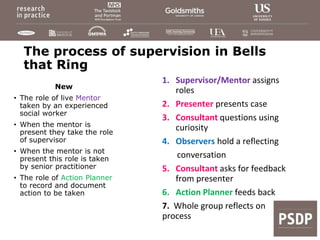
1. Supervisor/Mentor assigns
roles
2. Presenter presents case
3. Consultant questions using
curiosity
4. Observers hold a reflecting
conversation
5. Consultant asks for feedback
from presenter
6. Action Planner feeds back
7. Whole group reflects on
process
New
• The role of live Mentor
taken by an experienced
social worker
• When the mentor is
present they take the role
of supervisor
• When the mentor is not
present this role is taken
by senior practitioner
• The role of Action Planner
to record and document
action to be taken
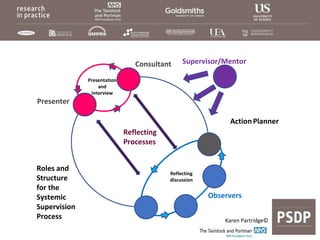
Observers
Supervisor/MentorConsultant
Presenter
Reflecting
Processes
Presentation
and
Interview
Reflecting
discussion
Roles and
Structure
for the
Systemic
Supervision
Process
Action Planner
Karen Partridge©
SUPERVISOR/MENTOR
• As a Supervisor/Mentor, your role is to ASSIGN the ROLES of
Presenter, Consultant and Observers to the group
• To keep the TIME boundaries and adhere to the systemic
supervision process for the duration of the session
• To agree what SYSTEMIC CONCEPT(S) the group will focus on
today referring to the laminated cards
• To ALLOCATE which observer completes the supervision template
• To PROMPT the Consultant to ask systemic questions of the
Presenter
• To FACILITATE the Observers reflections adding any relevant
observations
• To LEAD the group reflections on learning at the end of the
process making practice theory links with the identified systemic
concept(s) Karen Partridge©
CONSULTANT
• As the Consultant you INTERVIEW the Presenter about the case or work dilemma they are
presenting
• EXPLORE what would be helpful for the Presenter
• Help to CLARIFY AND DECONSTRUCT the presenting issue(s)
• ASK SYSTEMIC QUESTIONS from a stance of appreciation and curiosity.
• Use the following themes to inform your questioning:
• How ‘Social Graces’ inform the work
• Self of the therapist
• Risk and uncertainty
• Beliefs and stories
Karen Partridge©
PRESENTER
When PRESENTING your case to the group, include the following:
• AIM of presenting this case … what you want from the group and why are you presenting
now. How can the group help out?
• GENOGRAM of the family members that we need to know about. Of the clients you have
met, write down three words to describe them
• OUTLINE your work so far, including a description of what has worked for you with this
case. i.e. include practice wisdom: strategies, techniques, approaches that you feel have
been useful
• WHERE TO FROM HERE?
Hypothesis?
Goals?
Ideas that have been floating around?
Risk issues?
Karen Partridge©
OBSERVER/S
• As an OBSERVER, your role is to note down comments in the
following areas as you are listening to the conversation between
the Presenter and Consultant
• THEMES AND ISSUES: that have arisen out of the presentation and
processing of the case
• ROLE OF THE SOCIAL WORKER: What you think the role of the
Social Worker is in relation to the client work being presented
• WHAT YOU LIKED ABOUT: the Social Worker’s presentation and the
work with the client(s). What would you like to see more or less of
in the future?
• BELLS THAT RING: What bells ring for you, either from your
personal or your professional life that you would like to share with
the Presenter, (and the group)
Karen Partridge©
ACTION PLANNER/S
• As an ACTION PLANNER, your role is to note down comments in the
following areas as you are listening to the conversation between the
Presenter and Consultant
• WHAT DOES THE FAMILY WANT?: and how does this link with what has
arisen out of the presentation and processing of the case
• WHAT ARE THE PROFESSIONAL VIEWS ON THE CHILD’S BEST INTERESTS:
What you think the role of the professionals needs to be in relation to
the client work being presented
• WHAT DOES THE CHILD WANT: What would you the child like to see
more or less of in the future? Who and what is important to them?
• BELLS THAT RING: What bells ring for you, that you would like to see go
into the action plan
Karen Partridge©
The Reflecting Discussion
Themes
Resonance
“Bells that ring”
Appreciations
Relationship
• What themes did you
notice?
• What words stood out?
• What images or
metaphors did you
notice
• What do you feel?
• Where in your body?
• What relationships are
getting constructed?
• How are people relating
to each other?
• What do they want
from each other?
• How are people
honouring and
respecting each other?
• How does what
you have heard
connect to you,
personally or
professionally?
• What rings a bell in
your work context?
• How has what you
have heard moved
you or changed
your own thinking?
• What might you
take away from
this ?
• What did you like in
what you have seen and
heard?
• What do you appreciate
about the presenter and
their clients?
• What would you like to
see more of?
• What would you like to
see less of? Karen Partridge©
A reflective discussion
• What did you think?
• How do you think this model might be useful for you?
• What will you take away from seeing the Bells that Ring
systemic model of supervision?

Using the Bells that Ring- systemic model of supervision on the Practice Supervisor Development Programme

  • 1.
    Using the Bellsthat Ring- systemic model of supervision on the Practice Supervisor Development Programme Hazel Miller Senior Practitioner, Essex County Council Suzannah Rockett Social Work Practice Development Manager, Barnsley Metropolitan Borough Council 1
  • 2.
    Using the Bellsthat Ring- systemic model of supervision on the Practice Supervisor Development Programme
  • 3.
    During the nexthour we will • Give you a brief overview of the Practice Supervisor Development Programme (PSDP) • Outline the key elements of one model of supervision (Bells that Ring) which forms part of the teaching and tools on the PSDP • Demonstrate the model for you using a live practice discussion • Talk with you about the ways in which you might use this model in practice (and anything else which strikes you)
  • 4.
    Key areas offocus in the PSDP
  • 5.
    What we learntin preparing for the PSDP •The transition to Practice Supervisor is a big step, not always well-supported •Relationships and emotions are central to the role •Being a Practice Supervisor means more than ‘doing supervision’ (and ‘supervision’ is more than 1:1 meetings)
  • 6.
    Learner journey –full programme
  • 7.
    Introducing Bells thatRing: a process for systemic group supervision • Proctor, K. (2013)The Bells that Ring: A Process for Group Supervision; or What to do When a Client Slips from your Grasp and becomes Owned by Everyone Else in the Room! Wiley online Library, https://doi.org/10.1002/j.1467- 8438.1997.tb00299.x • Dugmore, P., Partridge, K., Sethi, I. and Krupa-Flasinska, M. (2018) Systemic Supervision in Statutory Social Work in the UK: Systemic Rucksacks and Bells that Ring. European Journal of Social Work, DOI: 10.1080/13691457.2018.1446914
  • 8.
    The process ofsupervision in Bells that Ring 1. Supervisor/Mentor assigns roles 2. Presenter presents case 3. Consultant questions using curiosity 4. Observers hold a reflecting conversation 5. Consultant asks for feedback from presenter 6. Action Planner feeds back 7. Whole group reflects on process New • The role of live Mentor taken by an experienced social worker • When the mentor is present they take the role of supervisor • When the mentor is not present this role is taken by senior practitioner • The role of Action Planner to record and document action to be taken
  • 9.
  • 10.
    SUPERVISOR/MENTOR • As aSupervisor/Mentor, your role is to ASSIGN the ROLES of Presenter, Consultant and Observers to the group • To keep the TIME boundaries and adhere to the systemic supervision process for the duration of the session • To agree what SYSTEMIC CONCEPT(S) the group will focus on today referring to the laminated cards • To ALLOCATE which observer completes the supervision template • To PROMPT the Consultant to ask systemic questions of the Presenter • To FACILITATE the Observers reflections adding any relevant observations • To LEAD the group reflections on learning at the end of the process making practice theory links with the identified systemic concept(s) Karen Partridge©
  • 11.
    CONSULTANT • As theConsultant you INTERVIEW the Presenter about the case or work dilemma they are presenting • EXPLORE what would be helpful for the Presenter • Help to CLARIFY AND DECONSTRUCT the presenting issue(s) • ASK SYSTEMIC QUESTIONS from a stance of appreciation and curiosity. • Use the following themes to inform your questioning: • How ‘Social Graces’ inform the work • Self of the therapist • Risk and uncertainty • Beliefs and stories Karen Partridge©
  • 12.
    PRESENTER When PRESENTING yourcase to the group, include the following: • AIM of presenting this case … what you want from the group and why are you presenting now. How can the group help out? • GENOGRAM of the family members that we need to know about. Of the clients you have met, write down three words to describe them • OUTLINE your work so far, including a description of what has worked for you with this case. i.e. include practice wisdom: strategies, techniques, approaches that you feel have been useful • WHERE TO FROM HERE? Hypothesis? Goals? Ideas that have been floating around? Risk issues? Karen Partridge©
  • 13.
    OBSERVER/S • As anOBSERVER, your role is to note down comments in the following areas as you are listening to the conversation between the Presenter and Consultant • THEMES AND ISSUES: that have arisen out of the presentation and processing of the case • ROLE OF THE SOCIAL WORKER: What you think the role of the Social Worker is in relation to the client work being presented • WHAT YOU LIKED ABOUT: the Social Worker’s presentation and the work with the client(s). What would you like to see more or less of in the future? • BELLS THAT RING: What bells ring for you, either from your personal or your professional life that you would like to share with the Presenter, (and the group) Karen Partridge©
  • 14.
    ACTION PLANNER/S • Asan ACTION PLANNER, your role is to note down comments in the following areas as you are listening to the conversation between the Presenter and Consultant • WHAT DOES THE FAMILY WANT?: and how does this link with what has arisen out of the presentation and processing of the case • WHAT ARE THE PROFESSIONAL VIEWS ON THE CHILD’S BEST INTERESTS: What you think the role of the professionals needs to be in relation to the client work being presented • WHAT DOES THE CHILD WANT: What would you the child like to see more or less of in the future? Who and what is important to them? • BELLS THAT RING: What bells ring for you, that you would like to see go into the action plan Karen Partridge©
  • 15.
    The Reflecting Discussion Themes Resonance “Bellsthat ring” Appreciations Relationship • What themes did you notice? • What words stood out? • What images or metaphors did you notice • What do you feel? • Where in your body? • What relationships are getting constructed? • How are people relating to each other? • What do they want from each other? • How are people honouring and respecting each other? • How does what you have heard connect to you, personally or professionally? • What rings a bell in your work context? • How has what you have heard moved you or changed your own thinking? • What might you take away from this ? • What did you like in what you have seen and heard? • What do you appreciate about the presenter and their clients? • What would you like to see more of? • What would you like to see less of? Karen Partridge©
  • 16.
    A reflective discussion •What did you think? • How do you think this model might be useful for you? • What will you take away from seeing the Bells that Ring systemic model of supervision?

Editor's Notes

  • #3 Funded by DoE – over 900 places in England – 3 new practice supervisors per LA Delivred by local delivery partners – and involves four organisations – rip- tavi goldsmiths and uni of sussex Acknowledge that this presentation represents our joint working- here we present materials from staff at Tavi the bells that ring model- which forms part of the teaching on the programme- we acknowledge and thank Karen Partridge for freely making this available to the programme and for us to use today
  • #6 Introduce roles of each member of presenting group
  • #8 This is a group supervision model devised by Kerry Proctor in Melbourne in 1997 It offers a structure and roles for the supervision process Subtitle of the paper is…. “What to do when a client slips from your grasp and becomes owned by everyone else in the room Give reference to the work of Tavi colleagues who have developed this
  • #9 The model aims to help the person presenting the case to think for themselves Taking an appreciative stance to themselves, the client/s and their practice This enables them to be more open to learning And supports them in role Facilitating a culture of candour and openness And contributing to a learning culture
  • #10 This is a visual description of the process which shows the interactions between different systems As according to Bateson, (an anthropologist who is seen as the father of systems theory) context determines meaning, different systems will have different experiences and viewpoints in the process This adds to a multi layered perspective and increases the richness of the conversations Keeping the systems distinct so that people only make eye contact within their system means that the integrity of each system is preserved Keeping the systems distinct means that when viewpoints are shared in the reflecting team discussion there is a real possibility of “news of difference” which can make a difference to the presenter Social workers and families participating in this process sometimes describe a process of reverie, where listening to the reflections sets off their own thought processes in new and different ways One way of thinking about this is in terms of the process creating reflexive space to play with ideas This also links with Winnicott's ideas about transitional space
  • #11 This will also be printed on a series of cards to be given to the group when they take up their roles. The suggestion would be 6 people in a group with a mentor A mentor A presenter A consultant 2 or 3 observers