Using SMS to support learning & teaching Geraldine Jones  [email_address] Thom Bunting [email_address] E-learning Summer Seminar Series 2008 Slideshare.net: eatbath-present08 All material and post session discussion: www.tasterseries.wordpress.com
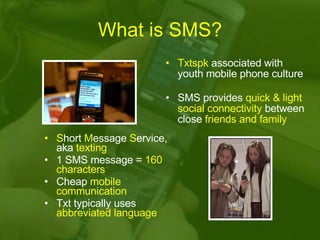
What is SMS? S hort  M essage  S ervice, aka  texting 1 SMS message =  160 characters Cheap  mobile communication Txt typically uses  abbreviated language Txtspk  associated with youth mobile phone culture SMS provides  quick & light social connectivity  between close  friends and family
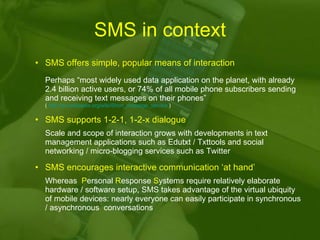
SMS in context SMS offers simple, popular means of interaction Perhaps “most widely used data application on the planet, with already 2.4 billion active users, or 74% of all mobile phone subscribers sending and receiving text messages on their phones” (  http://en.wikipedia.org/wiki/Short_message_service  ) SMS supports 1-2-1, 1-2-x dialogue Scale and scope of interaction grows with developments in text management applications such as Edutxt / Txttools and social networking / micro-blogging services such as Twitter   SMS encourages interactive communication ‘at hand’  Whereas  P ersonal  R esponse  S ystems require relatively elaborate hardware / software setup, SMS takes advantage of the virtual ubiquity of mobile devices: nearly everyone can easily participate in synchronous / asynchronous  conversations
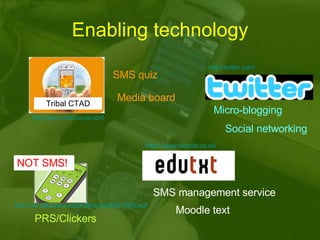
Enabling technology Tribal CTAD SMS quiz Media board Micro-blogging Social networking SMS management service Moodle text PRS/Clickers NOT SMS! http://www.ctad.co.uk/content/view/185/277/ https:// www.txttools.co.uk / http://net.educause.edu/ir/library/pdf/ELI7002.pdf http:// twitter.com /
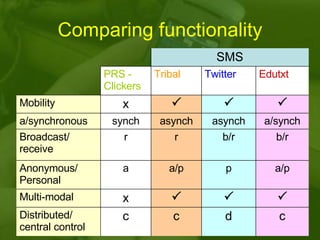
Comparing functionality c  a/p r asynch  Tribal SMS c d c Distributed/ central control   x Multi-modal a/p p a Anonymous/ Personal b/r b/r r Broadcast/ receive a/synch asynch synch a/synchronous   x Mobility Edutxt Twitter PRS - Clickers
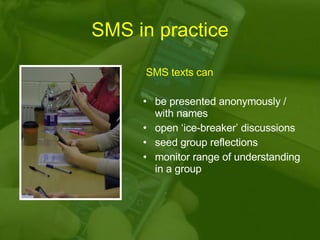
SMS in practice SMS texts can be presented anonymously / with names open ‘ice-breaker’ discussions seed group reflections monitor range of understanding in a group
What do you  like  about texting? Please text your response to 07624 802 748  starting your text with  LIKE   Discussion of group’s responses….
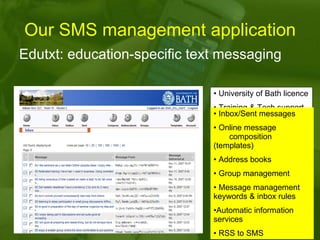
Our SMS management application Edutxt: education-specific text messaging University of Bath licence  Training & Tech support Web-based interface Plugin to Moodle Multiple user accounts Multiple incoming numbers Automated rule-based SMS forwarding to mobiles, email addresses, etc Inbox/Sent messages  Online message  composition (templates) Address books  Group management Message management keywords & inbox rules  Automatic information services RSS to SMS
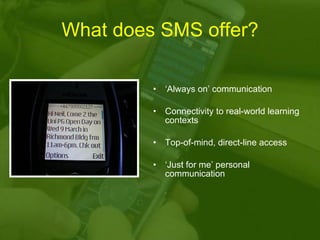
What does SMS offer? ‘ Always on’ communication Connectivity to real-world learning contexts  Top-of-mind, direct-line access  ‘ Just for me’ personal communication
What do you  hate  about texting? Please text your response to 07624 802 748 Start your text with  HATE Discussion of group’s responses….
Possible barriers for students Access  to a mobile phone? Adequate  network coverage ? Willingness  to use own mobile phones/text messages for study purposes? If so, how? Conflict  between social and academic use of mobiles/SMS?
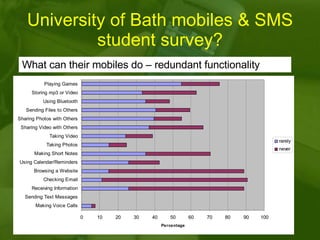
University of Bath mobiles & SMS student survey? What can their mobiles do – redundant functionality
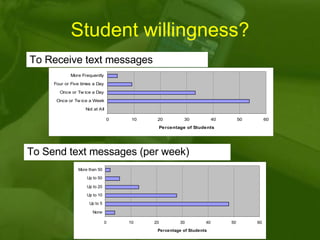
To Receive text messages Student willingness? To Send text messages (per week)
As a learner, how would  you  like SMS texting to be used? Please text your response to 07624 802 748 Start your text with  VIEW Discussion of group’s responses….
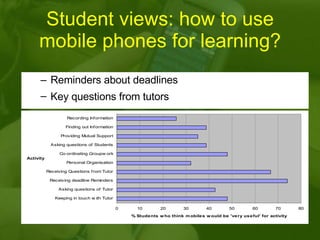
Reminders about deadlines Key questions from tutors   Student views: how to use mobile phones for learning?
Why use SMS in academic contexts?   Encourage participation in learning activities (within and outside the lecture theatre) Scaffold organisational skills Deliver timely information Provide personal support
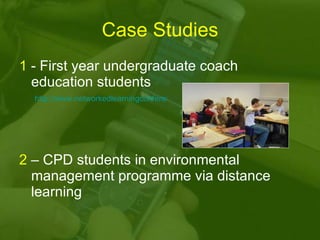
Case Studies 1  - First year undergraduate coach education students 2  – CPD students in environmental management programme via distance learning http://www.networkedlearningconference.org.uk/abstracts/gjones.htm
Case Study 1 – students’ profile 90 First year UG students (Education, & other departments) New to Higher Education (HE)  Studying Exploring Effective Learning (EEL) Students  not highly motivated  towards this unit
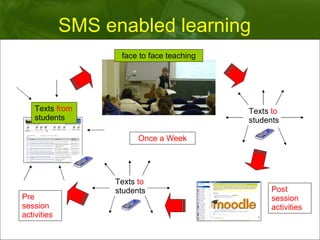
SMS enabled learning  face to face teaching Once a Week Post session activities Pre session activities Texts  to  students Texts  from  students Texts  to  students
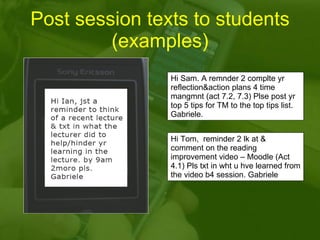
Post session texts to students (examples) Hi Sam. A remnder 2 complte yr reflection&action plans 4 time mangmnt (act 7.2, 7.3) Plse post yr top 5 tips for TM to the top tips list. Gabriele. Hi Tom,  reminder 2 lk at & comment on the reading improvement video – Moodle (Act 4.1) Pls txt in wht u hve learned from the video b4 session. Gabriele
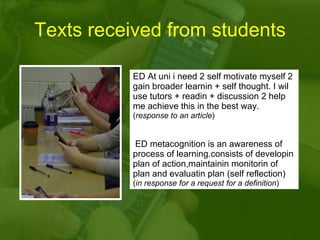
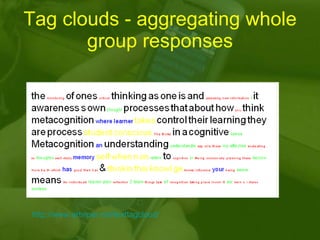
Texts received from students ED At uni i need 2 self motivate myself 2 gain broader learnin + self thought. I wil use tutors + readin + discussion 2 help me achieve this in the best way.  ( response to an article ) ED metacognition is an awareness of process of learning.consists of developin plan of action,maintainin monitorin of plan and evaluatin plan (self reflection)  ( in response for a request for a definition )
Tag clouds - aggregating whole group responses http:// www.artviper.net/texttagcloud /
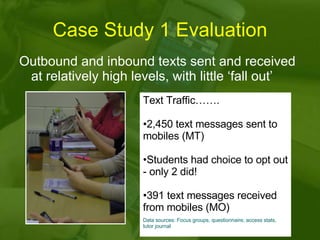
Case Study 1 Evaluation Outbound and inbound texts sent and received at relatively high levels, with little ‘fall out’  Text Traffic……. 2,450 text messages sent to mobiles (MT) Students had choice to opt out - only 2 did! 391 text messages received from mobiles (MO) Data sources: Focus groups, questionnaire, access stats, tutor journal
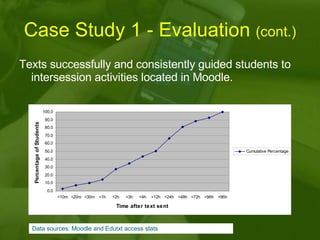
Case Study 1 - Evaluation  (cont.) Texts successfully and consistently guided students to intersession activities located in Moodle. Data sources: Moodle and Edutxt access stats
Case Study 1 - Evaluation  (cont.) Student views about texting: Effective aid to time management  (62% n=71) Students liked the personal nature of texts Less supportive of sending texts as part of learning activities.
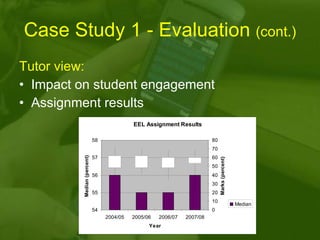
Case Study 1 - Evaluation  (cont.) Tutor view: Impact on student engagement Assignment results
Case Study 2: student profile Pilot group of twelve CPD environmental management students, responding to invitation to enrol in distance learning workshop starting March 2008 All students face challenges of M-level studies amidst full-time work commitments, busy lives Students (or employers) pay extra fee for this pilot online workshop, designed to provide extra levels of structured interactive support
Case Study 2: text activity to date Personalised  SMS invitation texts   sent to prospective students’ mobile phones  link to explanation of workshop, FAQs, online registration form Personalised  SMS reminder texts   sent to mobile phones of all students who ‘opt in’ encourage work as assignment deadlines approach Personalised  SMS update texts   sent to mobile phone of all students who ‘opt in’ explain availability of feedback / tutor assessment
Case study 2: interim evidence Personalised  SMS invitation texts   conversion rate 6.5% via SMS versus 5.2% via email less fall-out from spam effect, more reliable indications of receipt Personalised  SMS reminder texts   60% of workshop students ‘opt in’ for assignment reminders student responses to reminders are positive to date Personalised  SMS update texts   regular dispatch of batch / ad hoc texts re assignment feedback students typically follow-up  very  promptly
Case study 2: evaluation to date Tutor  finds that integration of SMS into learning activities provides  “a really beneficial way to get a quick message out via a medium which students are maybe more likely to read than e-mail (if they've got loads of e-mails coming in, they may choose to park until later)” Students  are responding well to reminders and feedback notifications; time-poor workshop participants, engaged in full-time work, show promising evidence of steady and reliable progress
Case study 2: upcoming plans SMS reading-response texts   Students to highlight key concepts in assigned readings Automated ‘tag cloud’ generation SMS status-check texts   Students to work in  Apprentice -style case study groups, rotating leadership Scheduled prompts for status updates from group members SMS   integration with VLE  Programmatic updates to be implemented via Txttools API (web services) Plug-in to provide direct SMS interface to (‘moodletxt’)
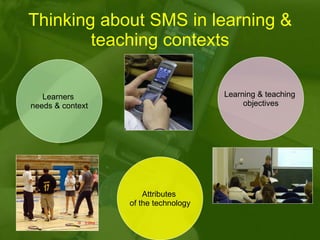
Thinking about SMS in learning & teaching contexts Attributes  of the technology Learning & teaching  objectives Learners  needs & context
Implementing SMS to support learning “… harness technology to the needs of education, rather than simply search for problems to which the latest technology is a solution”  Laurillard (2008) Laurillard , D. ( 2008 ) ‘The teacher as  action  researcher: Using technology to capture pedagogic form', Studies in Higher Education, 33( 2)
Follow up information To receive 3 additional tips about getting started with SMS for teaching and learning   Please text  SMS  to  07624 802 748   To unsubscribe please text  STOPSMS  to  07624 802 748
Your Questions?
Thank you Next event: Wed 18 th  June “ Using Skype and other web-conferencing tools to support off campus learners”  Materials and online discussion:  http://tasterseries.wordpress.com/ Twitter Updates: eatbath Podcast: http://www.bath.ac.uk/lmf/group/rss/7798   Email:  [email_address] , tb254@bath.ac.uk

Using Sms To Support Learning and Teaching in HE

  • 1.
    Using SMS tosupport learning & teaching Geraldine Jones [email_address] Thom Bunting [email_address] E-learning Summer Seminar Series 2008 Slideshare.net: eatbath-present08 All material and post session discussion: www.tasterseries.wordpress.com
  • 2.
    What is SMS?S hort M essage S ervice, aka texting 1 SMS message = 160 characters Cheap mobile communication Txt typically uses abbreviated language Txtspk associated with youth mobile phone culture SMS provides quick & light social connectivity between close friends and family
  • 3.
    SMS in contextSMS offers simple, popular means of interaction Perhaps “most widely used data application on the planet, with already 2.4 billion active users, or 74% of all mobile phone subscribers sending and receiving text messages on their phones” ( http://en.wikipedia.org/wiki/Short_message_service ) SMS supports 1-2-1, 1-2-x dialogue Scale and scope of interaction grows with developments in text management applications such as Edutxt / Txttools and social networking / micro-blogging services such as Twitter SMS encourages interactive communication ‘at hand’ Whereas P ersonal R esponse S ystems require relatively elaborate hardware / software setup, SMS takes advantage of the virtual ubiquity of mobile devices: nearly everyone can easily participate in synchronous / asynchronous conversations
  • 4.
    Enabling technology TribalCTAD SMS quiz Media board Micro-blogging Social networking SMS management service Moodle text PRS/Clickers NOT SMS! http://www.ctad.co.uk/content/view/185/277/ https:// www.txttools.co.uk / http://net.educause.edu/ir/library/pdf/ELI7002.pdf http:// twitter.com /
  • 5.
    Comparing functionality c a/p r asynch  Tribal SMS c d c Distributed/ central control   x Multi-modal a/p p a Anonymous/ Personal b/r b/r r Broadcast/ receive a/synch asynch synch a/synchronous   x Mobility Edutxt Twitter PRS - Clickers
  • 6.
    SMS in practiceSMS texts can be presented anonymously / with names open ‘ice-breaker’ discussions seed group reflections monitor range of understanding in a group
  • 7.
    What do you like about texting? Please text your response to 07624 802 748 starting your text with LIKE Discussion of group’s responses….
  • 8.
    Our SMS managementapplication Edutxt: education-specific text messaging University of Bath licence Training & Tech support Web-based interface Plugin to Moodle Multiple user accounts Multiple incoming numbers Automated rule-based SMS forwarding to mobiles, email addresses, etc Inbox/Sent messages Online message composition (templates) Address books Group management Message management keywords & inbox rules Automatic information services RSS to SMS
  • 9.
    What does SMSoffer? ‘ Always on’ communication Connectivity to real-world learning contexts Top-of-mind, direct-line access ‘ Just for me’ personal communication
  • 10.
    What do you hate about texting? Please text your response to 07624 802 748 Start your text with HATE Discussion of group’s responses….
  • 11.
    Possible barriers forstudents Access to a mobile phone? Adequate network coverage ? Willingness to use own mobile phones/text messages for study purposes? If so, how? Conflict between social and academic use of mobiles/SMS?
  • 12.
    University of Bathmobiles & SMS student survey? What can their mobiles do – redundant functionality
  • 13.
    To Receive textmessages Student willingness? To Send text messages (per week)
  • 14.
    As a learner,how would you like SMS texting to be used? Please text your response to 07624 802 748 Start your text with VIEW Discussion of group’s responses….
  • 15.
    Reminders about deadlinesKey questions from tutors Student views: how to use mobile phones for learning?
  • 16.
    Why use SMSin academic contexts? Encourage participation in learning activities (within and outside the lecture theatre) Scaffold organisational skills Deliver timely information Provide personal support
  • 17.
    Case Studies 1 - First year undergraduate coach education students 2 – CPD students in environmental management programme via distance learning http://www.networkedlearningconference.org.uk/abstracts/gjones.htm
  • 18.
    Case Study 1– students’ profile 90 First year UG students (Education, & other departments) New to Higher Education (HE) Studying Exploring Effective Learning (EEL) Students not highly motivated towards this unit
  • 19.
    SMS enabled learning face to face teaching Once a Week Post session activities Pre session activities Texts to students Texts from students Texts to students
  • 20.
    Post session textsto students (examples) Hi Sam. A remnder 2 complte yr reflection&action plans 4 time mangmnt (act 7.2, 7.3) Plse post yr top 5 tips for TM to the top tips list. Gabriele. Hi Tom, reminder 2 lk at & comment on the reading improvement video – Moodle (Act 4.1) Pls txt in wht u hve learned from the video b4 session. Gabriele
  • 21.
    Texts received fromstudents ED At uni i need 2 self motivate myself 2 gain broader learnin + self thought. I wil use tutors + readin + discussion 2 help me achieve this in the best way. ( response to an article ) ED metacognition is an awareness of process of learning.consists of developin plan of action,maintainin monitorin of plan and evaluatin plan (self reflection) ( in response for a request for a definition )
  • 22.
    Tag clouds -aggregating whole group responses http:// www.artviper.net/texttagcloud /
  • 23.
    Case Study 1Evaluation Outbound and inbound texts sent and received at relatively high levels, with little ‘fall out’ Text Traffic……. 2,450 text messages sent to mobiles (MT) Students had choice to opt out - only 2 did! 391 text messages received from mobiles (MO) Data sources: Focus groups, questionnaire, access stats, tutor journal
  • 24.
    Case Study 1- Evaluation (cont.) Texts successfully and consistently guided students to intersession activities located in Moodle. Data sources: Moodle and Edutxt access stats
  • 25.
    Case Study 1- Evaluation (cont.) Student views about texting: Effective aid to time management (62% n=71) Students liked the personal nature of texts Less supportive of sending texts as part of learning activities.
  • 26.
    Case Study 1- Evaluation (cont.) Tutor view: Impact on student engagement Assignment results
  • 27.
    Case Study 2:student profile Pilot group of twelve CPD environmental management students, responding to invitation to enrol in distance learning workshop starting March 2008 All students face challenges of M-level studies amidst full-time work commitments, busy lives Students (or employers) pay extra fee for this pilot online workshop, designed to provide extra levels of structured interactive support
  • 28.
    Case Study 2:text activity to date Personalised SMS invitation texts sent to prospective students’ mobile phones link to explanation of workshop, FAQs, online registration form Personalised SMS reminder texts sent to mobile phones of all students who ‘opt in’ encourage work as assignment deadlines approach Personalised SMS update texts sent to mobile phone of all students who ‘opt in’ explain availability of feedback / tutor assessment
  • 29.
    Case study 2:interim evidence Personalised SMS invitation texts conversion rate 6.5% via SMS versus 5.2% via email less fall-out from spam effect, more reliable indications of receipt Personalised SMS reminder texts 60% of workshop students ‘opt in’ for assignment reminders student responses to reminders are positive to date Personalised SMS update texts regular dispatch of batch / ad hoc texts re assignment feedback students typically follow-up very promptly
  • 30.
    Case study 2:evaluation to date Tutor finds that integration of SMS into learning activities provides “a really beneficial way to get a quick message out via a medium which students are maybe more likely to read than e-mail (if they've got loads of e-mails coming in, they may choose to park until later)” Students are responding well to reminders and feedback notifications; time-poor workshop participants, engaged in full-time work, show promising evidence of steady and reliable progress
  • 31.
    Case study 2:upcoming plans SMS reading-response texts Students to highlight key concepts in assigned readings Automated ‘tag cloud’ generation SMS status-check texts Students to work in Apprentice -style case study groups, rotating leadership Scheduled prompts for status updates from group members SMS integration with VLE Programmatic updates to be implemented via Txttools API (web services) Plug-in to provide direct SMS interface to (‘moodletxt’)
  • 32.
    Thinking about SMSin learning & teaching contexts Attributes of the technology Learning & teaching objectives Learners needs & context
  • 33.
    Implementing SMS tosupport learning “… harness technology to the needs of education, rather than simply search for problems to which the latest technology is a solution” Laurillard (2008) Laurillard , D. ( 2008 ) ‘The teacher as action researcher: Using technology to capture pedagogic form', Studies in Higher Education, 33( 2)
  • 34.
    Follow up informationTo receive 3 additional tips about getting started with SMS for teaching and learning Please text SMS to 07624 802 748 To unsubscribe please text STOPSMS to 07624 802 748
  • 35.
  • 36.
    Thank you Nextevent: Wed 18 th June “ Using Skype and other web-conferencing tools to support off campus learners” Materials and online discussion: http://tasterseries.wordpress.com/ Twitter Updates: eatbath Podcast: http://www.bath.ac.uk/lmf/group/rss/7798 Email: [email_address] , tb254@bath.ac.uk