Smart Cities and the Future Internet:  Towards Collaboration Models for Open and User Driven Innovation Ecosystems FIA Ghent, Session VI 16th December 2010 ”Smart Cities and Future Internet Experimentation” Hans Schaffers Adventure Research & ESoCE Net [email_address] [email_address]   www.fireball4smartcities.eu
Three constituencies shaping the  landscape Future Internet Smart Cities Living Labs Innovation  Actors Researchers ICT sector Commission experts Mayors and staff Citizen groups Associations Entrepreneurs Users / citizens / entrepreneurs Living labs organizers Priorities Experimental facilities  Future Internet challenges, e.g. routing, scalability, mobility ( …) Quality of life, health and care, infrastructure, social innovation Establish user driven open innovation environments. Cities as platforms for ICT-based innovation Resources Technologies Network infrastructures Research and testing facilities Applications pilots Innovation policies Budgets Organizational assets Development plans Agents for change Living lab  facilities, usability labs Monitoring tools Policies Research, testing, prototyping, piloting of technologies and applications City policies to stimulate innovation and urban development Public-private partnering Innovative procurement Mobilizing the users User experimentation User roll-out User-driven innovation projects development Open, cooperative innovation
A definition of “Smart City” “ We believe a city to be smart when investments in  human and social capital  and traditional (transport) and modern (ICT) communications  infrastructure  fuel  sustainable economic growth  and a  high quality of life , with a wise management of natural resources, through  participatory governance ” A. Caragliu, C. del Bo, P. Nijkamp (2009) Balancing multiple demands, using the  enabling power of ICT-based innovation
Drivers towards smart, vital cities Urban development, socio-economic ambitions , revitalization Critical infrastructure: public services, administration, healthcare, safety Enhancing the attractiveness of cities for living and working Open innovation models strengthen existing clusters and attract business and research After broadband deployment (fiber), the need to push  for (smart) applications Connectedness of cities,  rural areas, regions City marketing strategies, being part of larger network of advanced “modern” cities Emphasis is mostly on large cities  but we should  not forget villages, medium-sized peripheral cities  and their rural and regional environment
Smart cities overview Komninos (2010)
Smart city and living lab projects in the CIP ICT-PSP Smart Islands:  smart transport, leisure, forest fire fighting, retailing. EPIC : Smart City vision. Service catalogue: relocation, urban planning, environment Life 2.0 : new services for elderly. People:  basic urban infrastructure. Open Cities : open innovation for public sector in cities. Periphéria : RFID and Internet of things for smart societal services. SmartiP : smart engagement, environment and mobility (Open Data, citizens as sensors, social (data) networking Peripheria view
Relations between Future Internet, Open  User Driven Innovation and Smart cities Cities may form innovation ecosystem for future Internet technologies and applications Future Internet facilities ensure flow of innovative technologies and services Living labs for open and  user driven  innovation  establish a  “front office” of innovation, benefiting Future Internet research as well as cities innovation and development policies A system of synergies Smart Cities Living Lab facilities Future Internet testbeds Citizen  user groups Testing of networks,  service platforms Large-scale  use cases and  user communities User driven  open innovation Methodologies User experience Action research Innovation opportunities
Living lab domain landscape: user co-creation Pallot et al (2010)
Living Labs methodological elements  (C@R,  www.c-rural.eu   Book:  www.ejov.org ) Phased  development approach Living Lab as projects organization Cyclic approach Action research
Cities and living labs as development mechanisms : socio-technical change Smart city development context Organisational context of living lab development Living lab development, operation and experimentation Innovation of smart city infrastructures (health, transport etc)  Field experiments Enhanced services and infrastructures Experimenting and using Modified services Stakeholder agreements Funding decisions Existing infrastructures  Early testing Idea development Living lab infrastructure Partnership agreements Smart city development needs Living lab infrastructure Initial Living lab configuration  Policy decisions
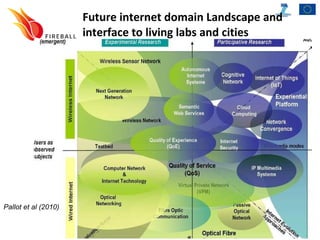
Future internet domain Landscape and interface to living labs and cities Pallot et al (2010)
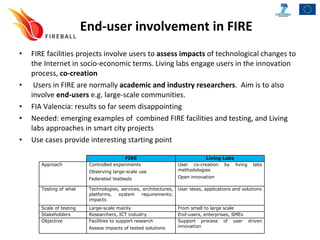
End-user involvement in FIRE FIRE facilities projects involve users to  assess impacts  of technological changes to the Internet in socio-economic terms. Living labs engage users in the innovation process,  co-creation Users in FIRE are normally  academic and industry researchers .  Aim is to also involve  end-users  e.g. large-scale communities. FIA Valencia: results so far seem disappointing Needed: emerging examples of  combined FIRE facilities and testing, and Living labs approaches in smart city projects Use cases provide interesting starting point FIRE Living Labs Approach Controlled experiments Observing large-scale use Federated testbeds User co-creation by living labs methodologies Open innovation Testing of what Technologies, services, architectures, platforms, system requirements; impacts User ideas, applications and solutions Scale of testing Large-scale mainly From small to large scale Stakeholders Researchers, ICT industry End-users, enterprises, SMEs Objective Facilities to support research Assess impacts of tested solutions Support process of user driven innovation
Fireworks portfolio analysis of FIRE projects Integrated Projects have  different notions of users , of use cases (related to federation) and of the range of collaborations that can be expected to augment the value of the technologies they bring to FIRE. FIREWORKS has defined a set of issues that must be dealt with by a testbed or federation of testbeds  to  support real external users , e.g. user facing clearinghouse, terms and conditions, security and privacy, define, simulate and control experiments etc. These issues seem not to be covered systematically in FIRE. Methods for  end user involvement and end user experiments  are  not exploited  that much. In  PII  this is discussed and taken up in some STREPs of Call 5. Cost and effort  to maintain a user community  is very high. Including external users is still low-level. Exception seems to be PlanetLab Europe (OneLab2). Still, end-users seem to be experts researchers only (it is mentioned astronomy as an example of users involvement). . Generally spoken: user support is a new and untested concept. The report recommends that the FIRESTATION project takes the lead in  identifying appropriate levels of user support  and ensuring that best practices are shared. Vision of end-to-end support for FIRE users needs to be integrated into upcoming Calls 7 and 8.
Urban value creation systems Future Internet facilities contribute to cities infrastructure Living lab concept organizes the cities’ innovation ecosystem through open business models, user community building and project methodologies City value creation system comprised by four determinants What are the collaboration models underlying this value creation system? Porter’s diamond approach, borrowing  from Freeman’s concept of national systems  of innovation,  applied to cities
Two generic collaboration models Collaboration  within  the innovation process (direct collaboration) 2. Collaboration  across  the innovation processes (collaboration system) Potentially interesting examples SmartSantander, Apollon, Periphéria Driven by urban development policies and innovation system building Future  Internet Research Technologies For Smart  Cities Smart City Applications (federated) Testbeds User driven innovation FIRE experimentally-driven advanced research projects (OPNEX, ECODE, NANODATACENTERS, N4C etc) Testbeds in FP7:  OneLab2, PII, VITAL++, WISEBED, FEDERICA Living Labs: ENoLL (200+ liing labs),  APOLLON etc
Innovation driven landscape of smart cities and future Internet Technologies  For Smart Cities (Emerging,  growing,  maturing) Smart City Citizens Needs  and  Networked  Applications Emerging Smart City  Innovation  ecosystems Future  Internet Research Technologies For Smart  Cities Smart City Applications (federated) Testbeds User driven innovation FIRE experimentally-driven advanced research projects (OPNEX, ECODE, NANODATACENTERS, N4C etc) Testbeds in FP7:  OneLab2, PII, VITAL++, WISEBED, FEDERICA Living Labs: ENoLL (200+ liing labs),  APOLLON etc Smart City  Internet pilots:  Creative media, health and care, energy Barcelona, Manchester, Helsinki etc Intelligence Content Management Collaboration Web Visualisation Participative planning Government and citizens services Affordable health and care for all Energy-efficiency in urban areas Broadband networks Entrepreneurship support, jobs “ Sustainable growth and  high quality of life through  participatory governance” Data mining Collective intelligence OLAP Wiki’s mashups JOOMLA Co-design tools Virtual collaboration Community  support Crowdsourcing Web design 3D tools Simulation for  deciision making Access for all Security and trust
FIRE and Living Lab interplay  for Smart Cities innovation
Future Internet and Living Labs in the Smart Cities innovation ecosystem Future Internet: Technology push (Testbeds: technology platforms) Smart cities: Application pull (public data) Living lab: User-driven playground  for co-creating innovative  scenarios and services Constituting an Open  Innovation Ecosystem Fireball D2.1 (2010_
Smart city ecosystem as portfolio of assets Testbed : Testing of  Future Internet technologies Field trial facilities  (larger scale field trials of applications) Software prototyping facility  (Prototyping of software applications) Living lab  (user driven, cyclic process of innovation) Innovation Community  (visioning of innovations) Maturity of solutions Time to market of solutions Venture Lab  (new business creation) Social innovation facilities  (Societal pilots)

Hans Schaffers - Smart Cities and the Future Internet: Towards Collaboration Models for Open and User Driven Innovation Ecosystems

  • 1.
    Smart Cities andthe Future Internet: Towards Collaboration Models for Open and User Driven Innovation Ecosystems FIA Ghent, Session VI 16th December 2010 ”Smart Cities and Future Internet Experimentation” Hans Schaffers Adventure Research & ESoCE Net [email_address] [email_address] www.fireball4smartcities.eu
  • 2.
    Three constituencies shapingthe landscape Future Internet Smart Cities Living Labs Innovation Actors Researchers ICT sector Commission experts Mayors and staff Citizen groups Associations Entrepreneurs Users / citizens / entrepreneurs Living labs organizers Priorities Experimental facilities Future Internet challenges, e.g. routing, scalability, mobility ( …) Quality of life, health and care, infrastructure, social innovation Establish user driven open innovation environments. Cities as platforms for ICT-based innovation Resources Technologies Network infrastructures Research and testing facilities Applications pilots Innovation policies Budgets Organizational assets Development plans Agents for change Living lab facilities, usability labs Monitoring tools Policies Research, testing, prototyping, piloting of technologies and applications City policies to stimulate innovation and urban development Public-private partnering Innovative procurement Mobilizing the users User experimentation User roll-out User-driven innovation projects development Open, cooperative innovation
  • 3.
    A definition of“Smart City” “ We believe a city to be smart when investments in human and social capital and traditional (transport) and modern (ICT) communications infrastructure fuel sustainable economic growth and a high quality of life , with a wise management of natural resources, through participatory governance ” A. Caragliu, C. del Bo, P. Nijkamp (2009) Balancing multiple demands, using the enabling power of ICT-based innovation
  • 4.
    Drivers towards smart,vital cities Urban development, socio-economic ambitions , revitalization Critical infrastructure: public services, administration, healthcare, safety Enhancing the attractiveness of cities for living and working Open innovation models strengthen existing clusters and attract business and research After broadband deployment (fiber), the need to push for (smart) applications Connectedness of cities, rural areas, regions City marketing strategies, being part of larger network of advanced “modern” cities Emphasis is mostly on large cities but we should not forget villages, medium-sized peripheral cities and their rural and regional environment
  • 5.
    Smart cities overviewKomninos (2010)
  • 6.
    Smart city andliving lab projects in the CIP ICT-PSP Smart Islands: smart transport, leisure, forest fire fighting, retailing. EPIC : Smart City vision. Service catalogue: relocation, urban planning, environment Life 2.0 : new services for elderly. People: basic urban infrastructure. Open Cities : open innovation for public sector in cities. Periphéria : RFID and Internet of things for smart societal services. SmartiP : smart engagement, environment and mobility (Open Data, citizens as sensors, social (data) networking Peripheria view
  • 7.
    Relations between FutureInternet, Open User Driven Innovation and Smart cities Cities may form innovation ecosystem for future Internet technologies and applications Future Internet facilities ensure flow of innovative technologies and services Living labs for open and user driven innovation establish a “front office” of innovation, benefiting Future Internet research as well as cities innovation and development policies A system of synergies Smart Cities Living Lab facilities Future Internet testbeds Citizen user groups Testing of networks, service platforms Large-scale use cases and user communities User driven open innovation Methodologies User experience Action research Innovation opportunities
  • 8.
    Living lab domainlandscape: user co-creation Pallot et al (2010)
  • 9.
    Living Labs methodologicalelements (C@R, www.c-rural.eu Book: www.ejov.org ) Phased development approach Living Lab as projects organization Cyclic approach Action research
  • 10.
    Cities and livinglabs as development mechanisms : socio-technical change Smart city development context Organisational context of living lab development Living lab development, operation and experimentation Innovation of smart city infrastructures (health, transport etc) Field experiments Enhanced services and infrastructures Experimenting and using Modified services Stakeholder agreements Funding decisions Existing infrastructures Early testing Idea development Living lab infrastructure Partnership agreements Smart city development needs Living lab infrastructure Initial Living lab configuration Policy decisions
  • 11.
    Future internet domainLandscape and interface to living labs and cities Pallot et al (2010)
  • 12.
    End-user involvement inFIRE FIRE facilities projects involve users to assess impacts of technological changes to the Internet in socio-economic terms. Living labs engage users in the innovation process, co-creation Users in FIRE are normally academic and industry researchers . Aim is to also involve end-users e.g. large-scale communities. FIA Valencia: results so far seem disappointing Needed: emerging examples of combined FIRE facilities and testing, and Living labs approaches in smart city projects Use cases provide interesting starting point FIRE Living Labs Approach Controlled experiments Observing large-scale use Federated testbeds User co-creation by living labs methodologies Open innovation Testing of what Technologies, services, architectures, platforms, system requirements; impacts User ideas, applications and solutions Scale of testing Large-scale mainly From small to large scale Stakeholders Researchers, ICT industry End-users, enterprises, SMEs Objective Facilities to support research Assess impacts of tested solutions Support process of user driven innovation
  • 13.
    Fireworks portfolio analysisof FIRE projects Integrated Projects have different notions of users , of use cases (related to federation) and of the range of collaborations that can be expected to augment the value of the technologies they bring to FIRE. FIREWORKS has defined a set of issues that must be dealt with by a testbed or federation of testbeds to support real external users , e.g. user facing clearinghouse, terms and conditions, security and privacy, define, simulate and control experiments etc. These issues seem not to be covered systematically in FIRE. Methods for end user involvement and end user experiments are not exploited that much. In PII this is discussed and taken up in some STREPs of Call 5. Cost and effort to maintain a user community is very high. Including external users is still low-level. Exception seems to be PlanetLab Europe (OneLab2). Still, end-users seem to be experts researchers only (it is mentioned astronomy as an example of users involvement). . Generally spoken: user support is a new and untested concept. The report recommends that the FIRESTATION project takes the lead in identifying appropriate levels of user support and ensuring that best practices are shared. Vision of end-to-end support for FIRE users needs to be integrated into upcoming Calls 7 and 8.
  • 14.
    Urban value creationsystems Future Internet facilities contribute to cities infrastructure Living lab concept organizes the cities’ innovation ecosystem through open business models, user community building and project methodologies City value creation system comprised by four determinants What are the collaboration models underlying this value creation system? Porter’s diamond approach, borrowing from Freeman’s concept of national systems of innovation, applied to cities
  • 15.
    Two generic collaborationmodels Collaboration within the innovation process (direct collaboration) 2. Collaboration across the innovation processes (collaboration system) Potentially interesting examples SmartSantander, Apollon, Periphéria Driven by urban development policies and innovation system building Future Internet Research Technologies For Smart Cities Smart City Applications (federated) Testbeds User driven innovation FIRE experimentally-driven advanced research projects (OPNEX, ECODE, NANODATACENTERS, N4C etc) Testbeds in FP7: OneLab2, PII, VITAL++, WISEBED, FEDERICA Living Labs: ENoLL (200+ liing labs), APOLLON etc
  • 16.
    Innovation driven landscapeof smart cities and future Internet Technologies For Smart Cities (Emerging, growing, maturing) Smart City Citizens Needs and Networked Applications Emerging Smart City Innovation ecosystems Future Internet Research Technologies For Smart Cities Smart City Applications (federated) Testbeds User driven innovation FIRE experimentally-driven advanced research projects (OPNEX, ECODE, NANODATACENTERS, N4C etc) Testbeds in FP7: OneLab2, PII, VITAL++, WISEBED, FEDERICA Living Labs: ENoLL (200+ liing labs), APOLLON etc Smart City Internet pilots: Creative media, health and care, energy Barcelona, Manchester, Helsinki etc Intelligence Content Management Collaboration Web Visualisation Participative planning Government and citizens services Affordable health and care for all Energy-efficiency in urban areas Broadband networks Entrepreneurship support, jobs “ Sustainable growth and high quality of life through participatory governance” Data mining Collective intelligence OLAP Wiki’s mashups JOOMLA Co-design tools Virtual collaboration Community support Crowdsourcing Web design 3D tools Simulation for deciision making Access for all Security and trust
  • 17.
    FIRE and LivingLab interplay for Smart Cities innovation
  • 18.
    Future Internet andLiving Labs in the Smart Cities innovation ecosystem Future Internet: Technology push (Testbeds: technology platforms) Smart cities: Application pull (public data) Living lab: User-driven playground for co-creating innovative scenarios and services Constituting an Open Innovation Ecosystem Fireball D2.1 (2010_
  • 19.
    Smart city ecosystemas portfolio of assets Testbed : Testing of Future Internet technologies Field trial facilities (larger scale field trials of applications) Software prototyping facility (Prototyping of software applications) Living lab (user driven, cyclic process of innovation) Innovation Community (visioning of innovations) Maturity of solutions Time to market of solutions Venture Lab (new business creation) Social innovation facilities (Societal pilots)

Editor's Notes

  • #2 This paper discusses strategies to empower three constituencies (Future Internet, Living Labs, Smart Cities) to work together in establishing smart city urban innovation ecosystems. In doing so, these constituencies will share and jointly exploit their innovation assets and the opportunities of their key methodologies for research, innovation and valorization, such as Future Internet experimentation and Living labs open and user driven innovation, for the benefit of Smart Cities innovation and socio-economic development. A city can be defined as ‘smart’ when investments in human and social capital and traditional (transport) and modern (ICT) communication infrastructure fuel sustainable economic development and a high quality of life, with a wise management of natural resources, through participatory governance (Caragliu et al, 2009). The view we are proposing adds the characteristic of Smart Cities to be environments of open and user driven innovation that are continuously open for renewal and change.