Data for
Fun and Profit
Heather Yandow
heather@thirdspacestudio.com
Today’s Agenda
• Types of data
• Discovering your data needs
• Collecting data
• Using data
• Data dashboards
• Other data visualization tools
data
“The goal is to turn data into
information, and information into
insight.”
Carly Fiorina
Four Types of Data
From NTEN’s 2012 State of Nonprofit Data Report
1. Financial and internal operations data
2. Marketing, communications, and fundraising
data
3. Program data
4. External data
Financial and Operations Data
• Simplest version: budget vs. actuals
• Financial and operations data includes:
– Expenses
– Income
– Cash on hand
– Volunteer hours
– Staff training
Marketing, Communications, and
Fundraising Data
• Simplest version: membership records
• Marketing and communications:
– # of website visitors, most popular pages, and time
spent on site
– # of emails on your newsletter list, open rate, and
click through rate
– # of comments on Facebook, # of actions
• Fundraising:
– # of new donors, retention rate, and average gift
– response rate to direct mail
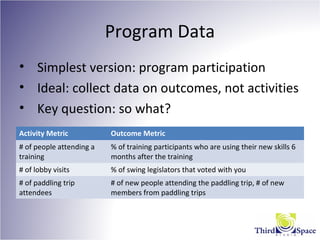
Program Data
• Simplest version: program participation
• Ideal: collect data on outcomes, not activities
• Key question: so what?
Activity Metric Outcome Metric
# of people attending a
training
% of training participants who are using their new skills 6
months after the training
# of lobby visits % of swing legislators that voted with you
# of paddling trip
attendees
# of new people attending the paddling trip, # of new
members from paddling trips
External Data
• Data about the world around you, often
collected by the government or other nonprofits
• External data includes:
– Demographics of the population you serve
– Broader ‘outcome’ data about the impact you are
seeking to create
• Increasing amount of useful public data:
– data.gov
– DataMarket.com
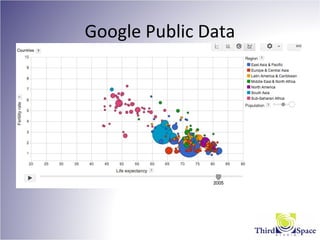
– Google’s Public Data Directory
Questions? Comments?
Discovering Your Data Needs
• First step is to narrow down the data you want
to collect
• Collect data that will help your organization
make decisions
• Beware of “it would be interesting to
know…”
• Consider the key questions you are facing:
– How is Facebook helping us to achieve our
organizational outcomes?
– Is our kids in nature program building our
membership base?
Discovering Your Data Needs
• What are the three questions that will have
the most impact on your organization and its
ability to achieve its mission?
• Be sure to consider all the categories:
– Internal operations
– Marketing and fundraising
– Programs
– External environment
Discovering Your Data Needs
• Decide exactly what data will be tracked and
how
– For your three key questions, what data could
you track to help answer the questions? What
data is easily accessible?
– Who can/should track it? How often?
Collecting Data
• Get buy-in from your team
• Consider appointing a data czar
• Start small, but with big impact
• Don’t let the perfect be the enemy of the
good
Choosing a Database
• For donor and volunteer data, you need a
database
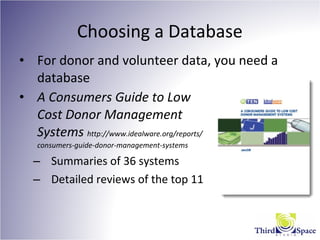
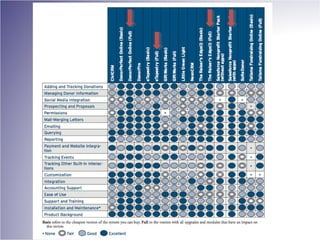
• A Consumers Guide to Low
Cost Donor Management
Systems http://www.idealware.org/reports/
consumers-guide-donor-management-systems
– Summaries of 36 systems
– Detailed reviews of the top 11
Choosing a Database
• Be clear about needs vs. wants when looking
for a database
• Architecture trumps data, procedures trump
architecture
• Happiness is directly correlated with time
spent learning and using your database
Questions? Comments?
“It is a capital mistake to
theorize before one has the

data.”
Arthur Conan Doyle
Using Data
• Data helps you measure AND improve
performance
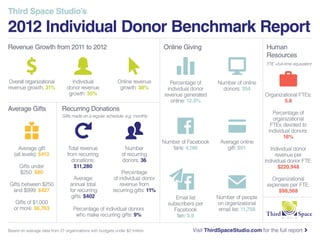
• Data can be used to benchmark activities
• NTEN: nten.org/research/benchmarks
• Giving USA: givingusareports.org
• M + R Benchmarks: mrbenchmarks.com
Individual Donor Benchmarks Report
Using Data
• Keep an experimentation mindset
– What are you testing?
– How will you know if you’ve been successful?
• Organize data around your key questions or
decision points
• Present data in a way that is accessible and
exciting to your team
Data Dashboard
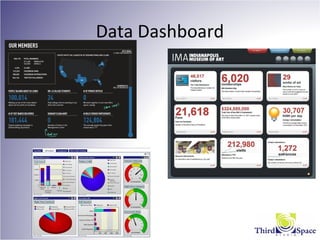
• A visual tool for reviewing and decoding your
organization’s key metrics
• Can have many different audiences: public,
funders, program participants, Board
• Keep it simple and easy to understand
Data Dashboard
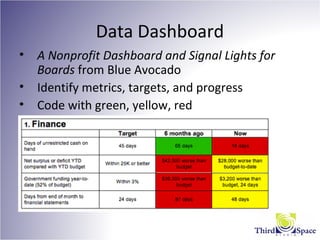
• A Nonprofit Dashboard and Signal Lights for
Boards from Blue Avocado
• Identify metrics, targets, and progress
• Code with green, yellow, red
Data Dashboard
“Torture numbers and they’ll
confess anything.”
-Greg Easterbrook
Data Visualization
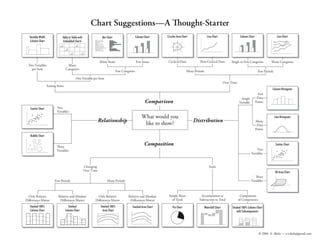
• Design follows data
• Focus on your questions
Data Visualization
• Design follows data
• Keep it simple
• Tell the truth
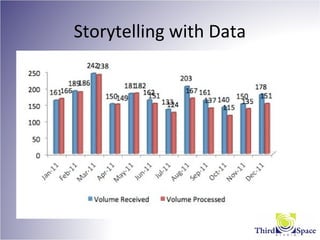
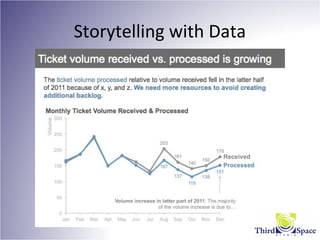
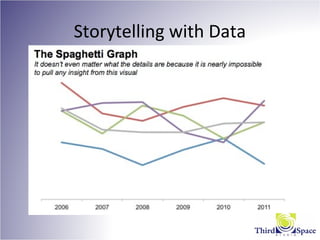
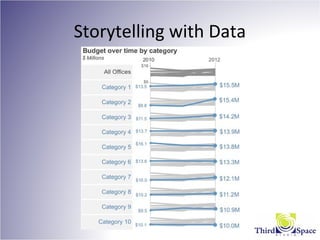
• www.storytellingwithdata.com
Data Visualization
• Design follows data
• Focus on your questions
• Keep it simple
• Tell the truth
• www.storytellingwithdata.com
Storytelling with Data
Questions? Comments?
Google Public Data
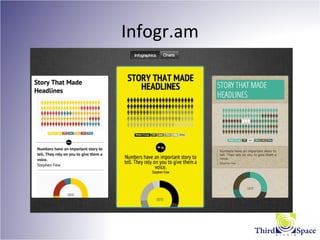
Infogr.am
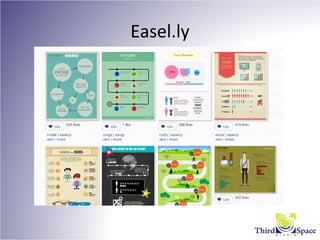
Easel.ly
Questions? Comments?
Thank you!
Heather Yandow
919.780.4117
heather@thirdspacestudio.com
www.thirdspacestudio.com

Using Data for Fun and Profit

  • 1.
    Data for Fun andProfit Heather Yandow heather@thirdspacestudio.com
  • 2.
    Today’s Agenda • Typesof data • Discovering your data needs • Collecting data • Using data • Data dashboards • Other data visualization tools
  • 3.
  • 4.
    “The goal isto turn data into information, and information into insight.” Carly Fiorina
  • 5.
    Four Types ofData From NTEN’s 2012 State of Nonprofit Data Report 1. Financial and internal operations data 2. Marketing, communications, and fundraising data 3. Program data 4. External data
  • 6.
    Financial and OperationsData • Simplest version: budget vs. actuals • Financial and operations data includes: – Expenses – Income – Cash on hand – Volunteer hours – Staff training
  • 7.
    Marketing, Communications, and FundraisingData • Simplest version: membership records • Marketing and communications: – # of website visitors, most popular pages, and time spent on site – # of emails on your newsletter list, open rate, and click through rate – # of comments on Facebook, # of actions • Fundraising: – # of new donors, retention rate, and average gift – response rate to direct mail
  • 8.
    Program Data • Simplestversion: program participation • Ideal: collect data on outcomes, not activities • Key question: so what? Activity Metric Outcome Metric # of people attending a training % of training participants who are using their new skills 6 months after the training # of lobby visits % of swing legislators that voted with you # of paddling trip attendees # of new people attending the paddling trip, # of new members from paddling trips
  • 9.
    External Data • Dataabout the world around you, often collected by the government or other nonprofits • External data includes: – Demographics of the population you serve – Broader ‘outcome’ data about the impact you are seeking to create • Increasing amount of useful public data: – data.gov – DataMarket.com – Google’s Public Data Directory
  • 10.
  • 11.
    Discovering Your DataNeeds • First step is to narrow down the data you want to collect • Collect data that will help your organization make decisions • Beware of “it would be interesting to know…” • Consider the key questions you are facing: – How is Facebook helping us to achieve our organizational outcomes? – Is our kids in nature program building our membership base?
  • 12.
    Discovering Your DataNeeds • What are the three questions that will have the most impact on your organization and its ability to achieve its mission? • Be sure to consider all the categories: – Internal operations – Marketing and fundraising – Programs – External environment
  • 13.
    Discovering Your DataNeeds • Decide exactly what data will be tracked and how – For your three key questions, what data could you track to help answer the questions? What data is easily accessible? – Who can/should track it? How often?
  • 14.
    Collecting Data • Getbuy-in from your team • Consider appointing a data czar • Start small, but with big impact • Don’t let the perfect be the enemy of the good
  • 15.
    Choosing a Database •For donor and volunteer data, you need a database • A Consumers Guide to Low Cost Donor Management Systems http://www.idealware.org/reports/ consumers-guide-donor-management-systems – Summaries of 36 systems – Detailed reviews of the top 11
  • 17.
    Choosing a Database •Be clear about needs vs. wants when looking for a database • Architecture trumps data, procedures trump architecture • Happiness is directly correlated with time spent learning and using your database
  • 18.
  • 19.
    “It is acapital mistake to theorize before one has the data.” Arthur Conan Doyle
  • 20.
    Using Data • Datahelps you measure AND improve performance • Data can be used to benchmark activities • NTEN: nten.org/research/benchmarks • Giving USA: givingusareports.org • M + R Benchmarks: mrbenchmarks.com
  • 21.
  • 22.
    Using Data • Keepan experimentation mindset – What are you testing? – How will you know if you’ve been successful? • Organize data around your key questions or decision points • Present data in a way that is accessible and exciting to your team
  • 23.
    Data Dashboard • Avisual tool for reviewing and decoding your organization’s key metrics • Can have many different audiences: public, funders, program participants, Board • Keep it simple and easy to understand
  • 24.
    Data Dashboard • ANonprofit Dashboard and Signal Lights for Boards from Blue Avocado • Identify metrics, targets, and progress • Code with green, yellow, red
  • 25.
  • 26.
    “Torture numbers andthey’ll confess anything.” -Greg Easterbrook
  • 27.
    Data Visualization • Designfollows data • Focus on your questions
  • 28.
    Data Visualization • Designfollows data • Keep it simple • Tell the truth • www.storytellingwithdata.com
  • 29.
    Data Visualization • Designfollows data • Focus on your questions • Keep it simple • Tell the truth • www.storytellingwithdata.com
  • 30.
  • 31.
  • 32.
  • 33.
  • 34.
  • 35.
  • 36.
  • 37.
  • 38.
  • 39.

Editor's Notes

  • #11 Any other ways that you find major donor prospects?
  • #19 Any other ways that you find major donor prospects?
  • #35 Any other ways that you find major donor prospects?
  • #36 World Bank, Census, Bureau of Economic Analysis, Eurostat, and your data
  • #39 Any other ways that you find major donor prospects?