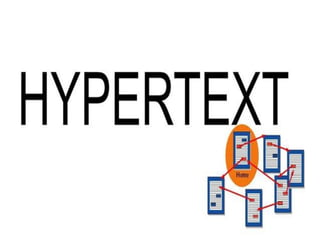
Hypertext by its
natureis purely a
computer
construct. It’s a
way of providing
clickable links to
other sections of a
document, or
other documents
on the internet.
Readers of hypertextmay follow
their own path , create their own
order- their own meaning out of the
materials that connect topics on a
screen to related information,
graphics, videos, and music- the
information is not simply related to
text.
18.
How can youidentify
hypertext?
•This information
appears as links and is
usually accessed by
clicking and shifting to
different web pages in
a matter of seconds
and minutes.
19.
The reader cannavigate
around the internet and
jump to more information
about a topic, which in
turn may have more links,
that open up the reader
to a wider horizon of
information or to a new
directions.
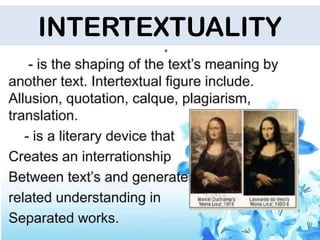
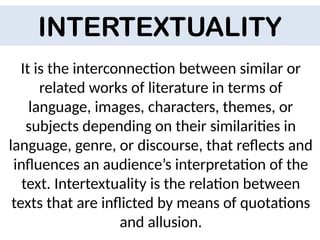
It is theinterconnection between similar or
related works of literature in terms of
language, images, characters, themes, or
subjects depending on their similarities in
language, genre, or discourse, that reflects and
influences an audience’s interpretation of the
text. Intertextuality is the relation between
texts that are inflicted by means of quotations
and allusion.
INTERTEXTUALITY
27.
INTERTEXT is…
•putting atext in relation
to another text, usually
through direct quotes or
references. A book that
quotes another book to
compare, contrast, or
expand on a point is
using intertext.
30.
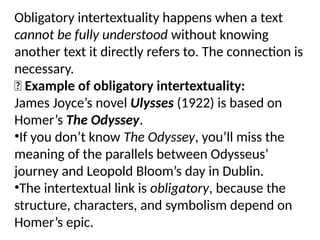
Obligatory intertextuality happenswhen a text
cannot be fully understood without knowing
another text it directly refers to. The connection is
necessary.
✅ Example of obligatory intertextuality:
James Joyce’s novel Ulysses (1922) is based on
Homer’s The Odyssey.
•If you don’t know The Odyssey, you’ll miss the
meaning of the parallels between Odysseus’
journey and Leopold Bloom’s day in Dublin.
•The intertextual link is obligatory, because the
structure, characters, and symbolism depend on
Homer’s epic.
32.
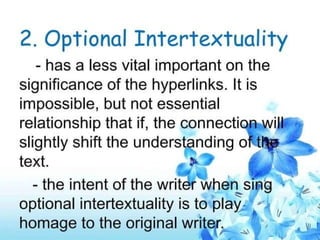
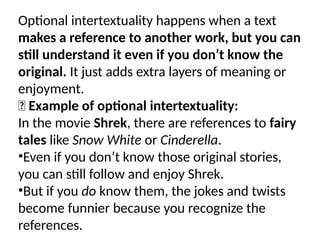
Optional intertextuality happenswhen a text
makes a reference to another work, but you can
still understand it even if you don’t know the
original. It just adds extra layers of meaning or
enjoyment.
✅ Example of optional intertextuality:
In the movie Shrek, there are references to fairy
tales like Snow White or Cinderella.
•Even if you don’t know those original stories,
you can still follow and enjoy Shrek.
•But if you do know them, the jokes and twists
become funnier because you recognize the
references.
34.
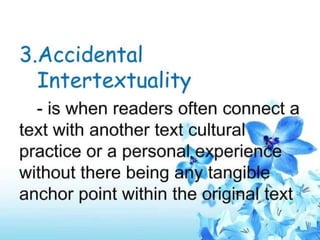
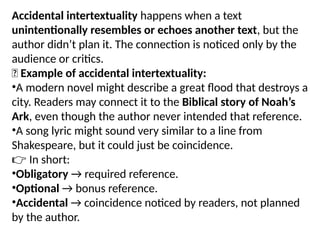
Accidental intertextuality happenswhen a text
unintentionally resembles or echoes another text, but the
author didn’t plan it. The connection is noticed only by the
audience or critics.
✅ Example of accidental intertextuality:
•A modern novel might describe a great flood that destroys a
city. Readers may connect it to the Biblical story of Noah’s
Ark, even though the author never intended that reference.
•A song lyric might sound very similar to a line from
Shakespeare, but it could just be coincidence.
👉 In short:
•Obligatory → required reference.
•Optional → bonus reference.
•Accidental → coincidence noticed by readers, not planned
by the author.